
Online bingo in the UK — the bingo-and-slots market, ranked
 Available in GB
A UK online bingo site that sells you slots is not a bingo site with a few games bolted on. It is a hybrid product built around the maths of two different verticals, and the better you understand where they meet, the sharper your choice of operator becomes. The market is small enough to know (£192.8 million in gross gambling yield for online bingo, sitting inside a £7.8 billion remote sector) but the rulebook is dense enough that the difference between a good deal and a poor one is rarely the headline number.
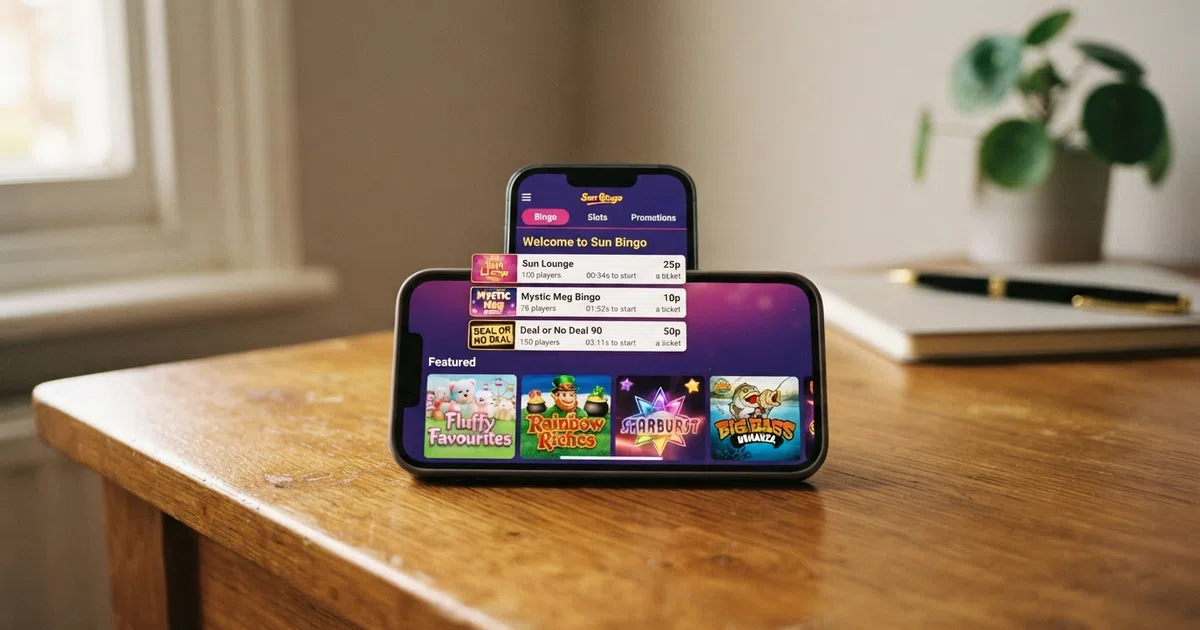
The page below ranks ten UKGC-licensed bingo-and-slots operators on welcome value, game range and terms fairness, then walks through what the bonuses really cost, what free play delivers, how mobile apps compare to browsers, what to check on a new site, and the full layer of protections that come with a British licence. Every figure comes from the Gambling Commission, operator terms and the supporting research behind this guide.
Data current as of September 8, 2026, verified against the UK Gambling Commission’s public register and operator terms published on each brand’s website.
What UK online bingo with slots actually looks like in 2026
Bingo carries the smallest gross gambling yield of any regulated product in Britain. In the year to March 2025, total remote GGY reached £7.8 billion. Online casino generated £5.0 billion of that, with £4.2 billion from slots alone, while online bingo contributed £192.8 million, roughly 4% of the remote market. The latest quarterly data, for January to March 2026, shows the trend continuing: total remote GGY hit £1.55 billion, up 7% year-on-year, with slots up 12% and 13.4 million average monthly active accounts.
Those numbers matter for a player because the smallness of bingo is the point. The Gambling Commission’s relative-risk research has repeatedly found bingo to be the lowest-risk gambling product, with average losses of 7.2 pence per minute and low concentration of revenue. The same research warns that this characterisation might shift as the format moves online into solo, isolated play. Bingo in a community hall is not the same product as bingo in a browser tab, and a bingo-and-slots hybrid, where the slots lobby sits one click away, is its own thing again.
The difference between a bingo site and a bingo-and-slots site
A pure online bingo site sells you tickets into networked bingo rooms: 90-ball, 75-ball, 30-ball, speed variants. Chat hosts run the room, numbers are called, tickets auto-mark, and a percentage of every ticket feeds the prize pool. The gambling happens in the form of small-stake, social, communal play.
A bingo-and-slots site adds a slots lobby under the same login. The slot machines, mostly supplied by studios like Eyecon, NetEnt, Blueprint, Playtech and Pragmatic Play, run on a different mathematical model: fixed RTP, variable volatility, individual spin cycles. Slingo is the bridge between the two, a hybrid game that crosses Slingo’s grid with a slot’s reels. Slingo Starburst and Slingo Fluffy Favourites are the most common examples at UK bingo sites, and they illustrate why the distinction matters: a player who thinks they are buying a bingo ticket is sometimes buying a slot, with the slot’s RTP and volatility doing the work.
The reason the distinction matters is that the regulatory framework treats the two formats differently. The online slots stake cap (£5 for adults 25 and over, £2 for 18–24) does not apply to bingo. Game-design rules on spin speed and auto-play apply to slots, not to a 90-ball ticket. A bonus that conditions a slots offer on also playing bingo is now banned; a single welcome package must be a single product. The hybrid site is a real product, but it is a hybrid in marketing only; the maths and the rules are two separate products under one account.
The UK bingo-and-slots market by the numbers
Bingo’s £192.8 million slice of the £7.8 billion remote market is roughly the size of a single quarter’s worth of growth in slots. The sector is not a giant. What it is, is mature: most major UK gambling brands have a bingo product because the audience is loyal, the average stake is small, and the loss rate per minute is the lowest in the industry.
The quarterly trend points upward. Q1 2026 GGY of £1.55 billion, up 7% year-on-year, was driven mostly by slots (up 12%). The 13.4 million active accounts is the highest the Commission has reported. Participation in any gambling activity in the past four weeks was 47% in the most recent Gambling Survey for Great Britain wave (September 2025 to January 2026), with 37% of adults gambling online and 15% doing so outside of lottery draws alone.
Two policy changes from April 2026 reshape the economics underneath those numbers. Bingo Duty was abolished on 1 April 2026, removing a 20% tax that applied to the gross takings of physical and online bingo. Remote Gaming Duty, the equivalent levy on online casino and slots gross profit, increased from 21% to 40% on the same date. The net effect for operators is that bingo, which used to carry the heavier tax, is now the lightly-taxed product relative to online slots. For players this does not translate to better odds, but it does mean the bingo product is more commercially viable for an operator to keep open, which keeps the network of bingo rooms larger than the maths alone would justify.
Real money vs free play: the two worlds of online bingo
Real-money play at a UK bingo-and-slots site means depositing by debit card or accepted e-wallet, claiming or declining the welcome offer, and playing for cash returns. Every regulatory protection covered later in this page applies: identity verified before first deposit, deposit limits prompted, GAMSTOP respected, the 10× wagering cap on bonuses. The slots you play under real-money mode are subject to the stake cap, the spin-speed minimum, the auto-play ban and the losses-disguised-as-wins prohibition. Bingo tickets bought with cash carry the bingo-room rules, not the slot rules.
Free play means demo mode on slots, where it is offered. The games feel identical because they are the same games on the same servers. The maths is the same, including the return-to-player percentage, because UK regulation requires the same RTP regardless of stake or mode. What changes is everything that makes gambling a financial activity: no real-money wins, no withdrawal, no bonus eligibility, no clock on a wagering requirement, and no impact on a deposit limit. The regulatory game-design rules, the auto-play ban, the 2.5-second minimum spin, apply to demo mode as well, because the rules are about the game, not the wallet.
The bridge from demo to deposit is the moment a player decides they want a real win, claims the welcome offer, sets a deposit limit, and starts playing with their own money. The mandatory deposit-limit prompt exists precisely because the Commission knows this is the moment the protection needs to be in place.
The slot machines and side games you will find at UK bingo sites
The bingo formats at a UK site are familiar: 90-ball is the British staple with three prize tiers (one line, two lines, full house), 75-ball is the American pattern-based variant, 30-ball is the speed game, and Slingo is the grid-based hybrid. Side games on a bingo site were once simple slot mini-games running alongside the ticket; today the entire slots lobby is the side game, with hundreds of titles accessible from the same account.
The slots that dominate the bonus-eligible lists at UK bingo-and-slots sites are Eyecon’s Fluffy Favourites (a medium-volatility title launched in 2006 with a max win of around 5,000× the stake), NetEnt’s Starburst (a 96.09% RTP, low-volatility slot with frequent small wins and a max win around 500×), Pragmatic Play’s Big Bass Bonanza, Blueprint’s Fishin’ Frenzy, Gamesys’s Double Bubble, and Slingo variants of each. Slingo Starburst runs at 96.59–96.66% RTP with medium volatility and a max win of up to 2,000× the stake, while Slingo Fluffy Favourites carries a 95.5% RTP and uses the Toybox Pick and Free Balls features.
Progressive jackpots sit on a separate network, usually a pooled prize across multiple operators using the same slot, with the prize growing until someone hits the qualifying combination. They are a smaller share of the lobby than the fixed-jackpot games but they appear at every featured operator. Most UK bingo sites do not lead with their progressive slots; they lead with the brand-recognisable titles above, and the jackpots are one of several menu options in the slots lobby.
How to get started at a UK bingo-and-slots site
Registration, identity verification, deposit, claim or decline the offer, play. The full sequence runs in about five minutes at a well-built site.
Identity comes first, by law, since 7 May 2019. Every UKGC-licensed operator must verify your name, address and date of birth before accepting a deposit or letting you place a bet. There is no grace period, no demo of real-money play, no “try us and verify later”. Most operators run the check automatically through a credit-reference-style database, and the process is invisible when it succeeds. When it fails (the name on the card does not match the registered name, the address is recent), the site asks for documents and the deposit is held until verification completes.
Deposits are made by Visa Debit, Mastercard Debit, bank transfer, PayPal, Apple Pay, Google Pay, Paysafecard and a handful of other e-wallets. Credit cards are banned for gambling in Great Britain since 14 April 2020, and the ban extends to credit-card-funded e-wallet deposits. The site will not show a credit card option at the cashier.
The first deposit triggers a mandatory prompt to set a financial deposit limit, in force from 31 October 2025. The prompt is unskippable: the operator must offer it, the gross deposit limit must carry at least equal prominence to other financial limits, and any request to reduce the limit is actioned immediately. The intent is to put a guardrail in place before a single real-money spin or ticket has been bought.
Claiming the welcome offer is the next decision. Operators in this ranking all use a deposit-and-spend model, meaning a £10 deposit and a £10 wager unlocks the bonus, not a deposit alone. Opting in happens either on the deposit screen or in the bonus tab. After that, the choice is between bingo rooms, slots, and Slingo, with the responsible-gambling tools (deposit limits, reality checks, time-out, self-exclusion via GAMSTOP) accessible from the account menu throughout.
The best UK bingo-and-slots sites for 2026 — ranked and compared
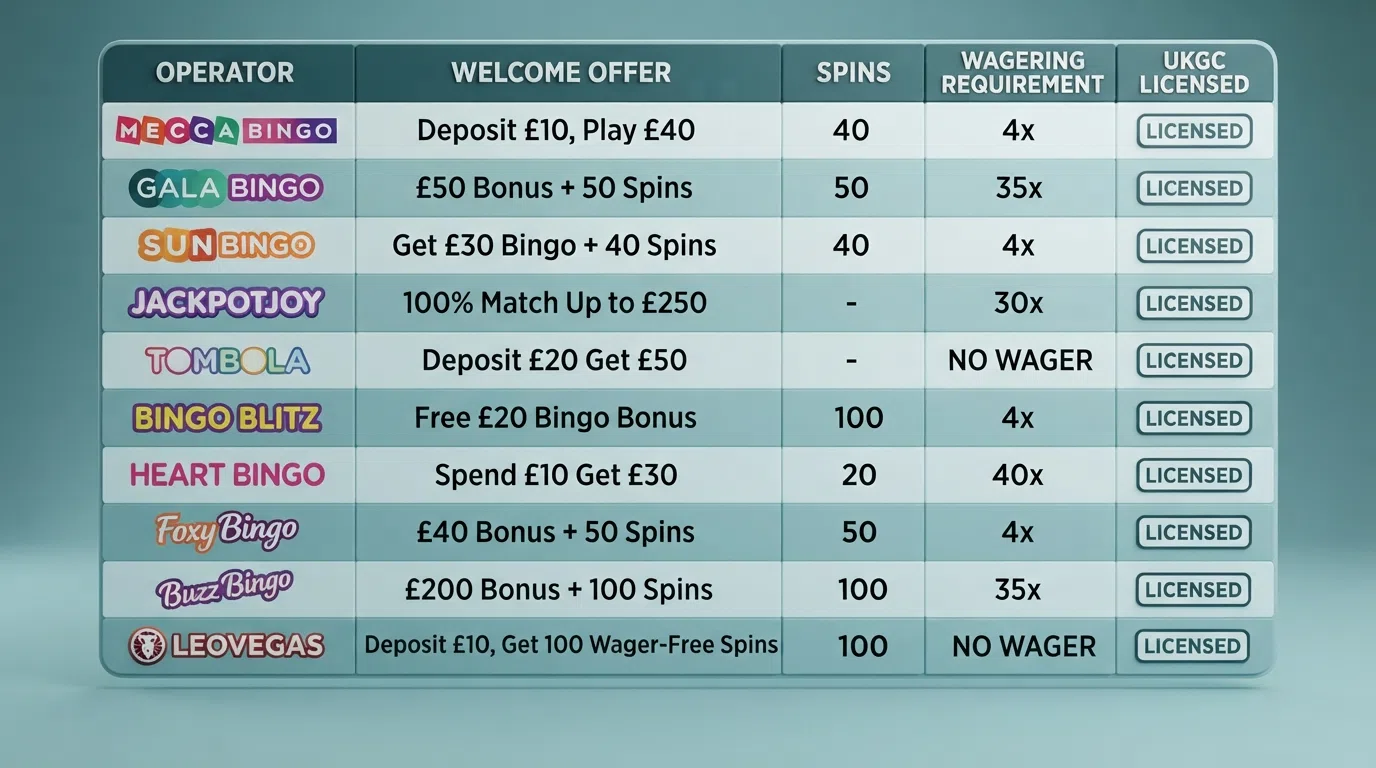
The ranking below uses three inputs: licence status confirmed against the UK Gambling Commission’s public register (last updated 29 July 2026), welcome-offer value and fairness of the small print, and the breadth of the game library. No weighting or scoring methodology is imposed on the ranking; the order reflects the offer quality, the wagering burden, and the depth of the games catalogue. All ten operators hold an active UKGC remote bingo and/or casino operating licence, all are required by that licence to comply with the 10× wagering cap and the mixed-product promotion ban, and all are covered by GAMSTOP.
| Operator | UKGC licence | Welcome offer | Free spins | Wagering (×) | Bonus validity | Game providers |
|---|---|---|---|---|---|---|
| JackpotJoy | Gamesys Operations Limited | Play £10: £30 bingo tickets OR 100 spins on Fishin Frenzy The Big Catch 2 | 100 (slots track) | 0× | 30 days | Gamesys, Eyecon, NetEnt, Blueprint |
| Mecca Bingo | Mecca Bingo Limited, account 2396 | Play £10: £40 bingo + 50 spins + £20 club voucher | 50 | 5× (bingo) | 28 days | Playtech, Eyecon, Blueprint, IGT, NetEnt |
| Foxy Bingo | LC International Limited (Entain) | Deposit & spend £10: 100 spins | 100 | Compliant with 10× cap | 30 days | Entain, Eyecon, NetEnt, Blueprint, Pragmatic Play |
| Gala Bingo | LC International Limited (Entain) | Deposit & spend £10: 100 spins at £0.10 | 100 | Compliant with 10× cap | 7 days from registration | Entain, Eyecon, NetEnt, Blueprint, Pragmatic Play, Playtech |
| Buzz Bingo | Buzz Bingo Digital Limited, account 57594 | Stake £10: £40 bingo (£30 online + £10 club) OR up to 200 spins | Up to 200 (slots track) | 4× (bingo) | 14 days to qualify | Playtech, Blueprint, IGT, Eyecon, Pragmatic Play |
| bet365 Bingo | Hillside UK Gaming LP | Spend £10 on bingo: up to 365 free tickets | — | 0× | 7 days | Playtech, NetEnt, Microgaming, Pragmatic Play, Blueprint, Eyecon |
| Virgin Games | Gamesys Operations Limited (Bally’s) | Play £10: 30 spins on Double Bubble OR £50 bingo tickets | 30 (slots track) | 0× | 30 days from registration | Gamesys, NetEnt, IGT, Eyecon, Blueprint |
| Heart Bingo | BV Gaming Limited, account 39576 | Play £10: £60 bingo OR 100 spins | 100 (slots track) | 4× (bingo) | 7 days from opt-in | Playtech, Eyecon, NetEnt, Blueprint, Pragmatic Play |
| Ladbrokes Bingo | LC International Limited, account 54743 (Entain) | Spend £5: £25 bingo bonus | — | 2× | 14 days to accept, 30 days to use | Entain, Playtech, Eyecon, NetEnt, Blueprint |
| 888 Ladies | 888 UK Limited (evoke plc) | 50% games bonus up to £100 (min £10) OR 400% bingo bonus up to £100 | — | 10× (games) / 2× (bingo) | 5 days | Dragonfish, Eyecon, NetEnt, Blueprint, Pragmatic Play |
The spread tells the story. Three operators, JackpotJoy, Virgin Games and bet365, run zero-wagering offers; the bonus is the bonus, with no multiplier in the way of the winnings. Three more, Buzz, Heart and Ladbrokes, sit at the low-wagering end of 2× to 4×, meaning a £25 bonus at Ladbrokes means £50 of qualifying turnover, a small enough sum to clear in a single session of moderate play. 888 Ladies carries the 10× ceiling on its games bonus, the highest allowed in the market, and the rest of the field sits between 4× and 5×. Bonus validity ranges from 5 days at 888 Ladies to 30 days at JackpotJoy, Virgin, and Foxy. Spin counts where offered run from 30 (Virgin) to 200 (Buzz). Every one of these offers requires a deposit, and nine of ten require a stake on top of the deposit, so the “no-deposit” keyword that pulls some search traffic does not map onto any offer in the featured set.
JackpotJoy
JackpotJoy is a Gamesys veteran, the brand that grew out of the old standalone bingo site into a full hybrid on Gamesys’s proprietary platform, with Eyecon, NetEnt and Blueprint slots sitting alongside. The welcome is a dual-track offer: a £10 play on bingo unlocks £30 of free bingo tickets, and a £10 play on slots unlocks 100 free spins on Fishin Frenzy The Big Catch 2 at £0.10 per spin. Both tracks carry zero wagering on winnings, and the bonus is valid for 30 days from deposit. The choice matters because the bingo track is for the room-first player and the slots track is for the slot-first player, and the player decides which product they want to extend their play on.
What JackpotJoy is worth depends on which track you take. The 100 free spins at £0.10 on a medium-volatility slot like Fishin Frenzy The Big Catch 2 carry a face value of £10 in spin stakes, with no multiplier to clear on anything won. The £30 in bingo tickets is a fixed-pot spend in the rooms. Neither track is a deposit-free offer; the £10 trigger is a real-money deposit and a real-money wager. JackpotJoy is the natural choice for anyone prioritising a fuss-free welcome over complex terms.
Mecca Bingo
Mecca is the best-known UK bingo brand, a name that goes back to the high-street halls, now running a digital operation on Playtech bingo software with Eyecon, Blueprint, IGT and NetEnt slots. The remote bingo licence (account 2396) has been active since 22 September 2020. The welcome is a three-part package triggered by a £10 deposit and £10 spend on bingo within 7 days: £40 bingo bonus, 50 free spins on a Playtech title (King Kong Cash Even Bigger Bananas being the named slot), and a £20 club voucher usable in Mecca’s retail clubs. The bingo bonus carries 5× wagering, with 28 days to fulfil.
The trade-off at Mecca is the 5× wagering on a substantial £40 bonus, so £200 of qualifying turnover before the bonus is withdrawable, and the payment-method exclusion of PayPal and Paysafecard deposits from the welcome offer. Players who deposit through Visa Debit or bank transfer get the full package; e-wallet users do not. The retail voucher is a genuine extra for a player who visits a Mecca club, and irrelevant for one who does not. The offer rewards the committed Mecca player more than the casual browser.
Foxy Bingo
Foxy is an Entain-owned brand running on the group’s proprietary platform, with Eyecon, NetEnt, Blueprint and Pragmatic Play slots. The welcome is a deposit-and-spend offer: £10 in, £10 staked on slots or casino, 100 free spins returned on selected games. The wagering multiple is not specified in the published terms; Foxy’s offer complies with the UKGC 10× cap, and the offer is valid for 30 days from claim. The deposit exclusions are the most extensive in the featured set: Envoy, Neteller, PayPal, Moneybookers, Paysafecard and Skrill are all excluded from the welcome.
Foxy’s value is in the slots selection. Pragmatic Play’s catalogue is one of the deepest in the UK, and the Entain platform carries the studio’s full portfolio of Big Bass Bonanza, Gates of Olympus and the rest. A slots-first player who can deposit by debit card and is not put off by the 30-day window will find more variety in the lobby than at the smaller bingo-led brands. The e-wallet exclusion removes a chunk of the market, however, and is worth checking before depositing.
Gala Bingo
Gala is the second Entain bingo house, sitting next to Foxy in the same licence group, with the broadest provider mix in the Entain portfolio through the addition of Playtech to the line-up. The welcome is 100 free spins at £0.10 per spin on selected featured slots, triggered by a £10 deposit and a £10 slot spend, with a 7-day claim window from registration. The 7 days is the shortest claim period in the set and the sharpest constraint to be aware of: the offer expires if the player does not stake £10 on slots within a week of registering.
Gala’s edge is the confirmed £0.10 spin value and the Playtech slots layer, which adds games like the Age of the Gods progressive series to the lobby. For a player who signs up with intent to play within a week, the deal is straightforward. Missing this one-week window means the offer expires, making prompt action a necessity.
Buzz Bingo
Buzz is the UK’s largest retail bingo operator, and the digital arm extends the same brand online through Playtech bingo software, with Blueprint, IGT, Eyecon and Pragmatic Play slots. The remote bingo licence (account 57594) is active. The welcome is a two-track offer: stake £10 on bingo within 14 days of signing up for a £40 bingo bonus (split £30 online plus £10 retail club voucher) at 4× wagering, or stake £10 on slots for up to 200 free spins on King Kong or Fishin’ Frenzy qualifying games. The 4× wagering is among the lowest in the featured set, and the £10 retail voucher mirrors the Mecca structure.
The 14-day qualification window is the broadest in the set for the bingo track, and the up-to-200 slot spin count is the highest headline number. The trade-off is the vagueness of the slot side: “up to 200” is a tiered structure, the qualifying games are restricted, and the spin value is not specified. The bingo track is the cleaner read, with a clear 4× on a defined £40 bonus. This is a solid recommendation for slot enthusiasts, provided they check the qualifying game list before the first spin.
bet365 Bingo
Bet365 is the largest UK gambling operator by market share (12.77%), and the bingo vertical sits on Playtech software with NetEnt, Microgaming, Pragmatic Play, Blueprint and Eyecon slots. The welcome is a 365 free bingo ticket offer after a £10 spend on bingo tickets, with zero wagering on ticket winnings, no max cashout cap, and a 7-day ticket validity. There are no free spins in the welcome, and the offer is not deposit-free.
What bet365 gives up in headline number it gains in simplicity. Zero wagering means every penny won from the free tickets is withdrawable cash. No max cashout cap means a lucky session is not truncated. The 7-day window on the free tickets is the only clock, and a player who plans one session per week can use them all. The operator’s market position shows in the platform reliability, the depth of the bingo room schedule, and the speed of withdrawals. Bet365 remains the gold standard for players who prioritise clear-cut value and deposit simplicity.
Virgin Games
Virgin Games is the Bally’s-owned Gamesys brand running on the proprietary Gamesys platform, with NetEnt, IGT, Eyecon and Blueprint slots. The welcome is a £10 play trigger opening two zero-wagering tracks: 30 free spins on Double Bubble, or £50 in free bingo tickets. The 30-day registration window and the requirement to opt in before first deposit are the operational conditions. Visa Debit is the qualifying deposit method for some of the offer terms; check the cashier for current conditions.
The Double Bubble slot is a Gamesys proprietary title, and the 30 free spins are weighted at the operator’s discretion, so the value depends on the spin configuration. The £50 in free bingo tickets is the larger absolute number in the set for a zero-wagering offer. The 30-day window is generous; the requirement to opt in before the first deposit is the small operational cost, and missing it forfeits the welcome.
Heart Bingo
Heart Bingo is operated by BV Gaming Limited (account 39576) on Playtech bingo software with Eyecon, NetEnt, Blueprint and Pragmatic Play slots. The welcome is a £10 play trigger opening two tracks: £60 in bingo bonus, or 100 free spins on selected games, with 4× wagering on the bingo bonus and a 7-day opt-in window. The £60 figure is the highest bingo bonus number in the featured set.
The trade-off is the 7-day opt-in window, the tightest in the set, and the vagueness of the slot side. The bingo track rewards the player who values bonus size and is happy to clear 4× wagering on £60 (£240 of qualifying turnover). The slot track is competitive in spin count but lacks the confirmed bonus slot title that JackpotJoy, Gala and Virgin carry. For a player who wants the largest single bingo bonus in the set, Heart sits at the top of that sub-ranking.
Ladbrokes Bingo
Ladbrokes is the other Entain bingo house, on the group’s proprietary platform with Playtech, Eyecon, NetEnt and Blueprint slots, under account 54743. The welcome is the lowest deposit trigger in the set: a £5 spend on bingo tickets unlocks a £25 bingo bonus at 2× wagering, with 14 days to accept and 30 days to use the bonus. There are no free spins. Certain deposit types are excluded.
The 2× wagering is the lowest non-zero multiplier in the set, meaning a £25 bonus requires only £50 of qualifying turnover to clear. The £5 entry is half the trigger of every other operator in the ranking, opening the door to a smaller bankroll. The 14-day acceptance window is the wider of the two clocks; the 30-day use window is comfortably broad. For a player with a small bankroll who values the lowest entry point and the lowest bonus clearance burden, Ladbrokes is the most accessible offer in the ranking.
888 Ladies
888 Ladies is the 888 UK Limited brand (now under evoke plc) running on the Dragonfish proprietary bingo platform, with Eyecon, NetEnt, Blueprint and Pragmatic Play slots. The welcome is the only percentage-match offer in the featured set: 50% games bonus up to £100 on a minimum £10 deposit, with an alternative 400% bingo bonus up to £100. The games bonus carries 10× wagering (the statutory ceiling), the bingo bonus carries 2×, and the bonus expires after 5 days. A daily 5% cashback up to £100 is available for existing players on losses.
The 5-day expiry is the tightest clock in the set; the 10× wagering is the highest multiple allowed. A player who deposits £100 and takes the full games bonus must clear £1,000 of qualifying turnover in five days, which is the toughest playthrough in the ranking. The 400% bingo bonus is the most generous percentage in the set, but the 2× on a smaller absolute figure produces a much lower turnover burden. The mixed-product ban means a player cannot combine the two into one offer. For a player with a large bankroll who can clear the games bonus in five days, the percentage is the headline; for everyone else, the bingo bonus is the cleaner offer.
Why your 2026 UK bingo bonus is smaller than it looks
Every welcome offer in the UK market today looks smaller than the ones that came before it. The 10× wagering cap, in force from 19 December 2025, replaced a regime where 30× to 60× wagering was common. The mixed-product promotion ban, in force from the same date, killed the bundled welcome where one deposit unlocked a bingo bonus, free spins and a casino bonus in a single package. The headline numbers shrank because the offer structure shrank, and the small print that remained is the same small print that has always been there: the wagering multiplier, the validity window, the excluded payment methods.
The maths of a bonus is straightforward. A £50 bonus at 10× wagering means £500 of qualifying turnover before the bonus is withdrawable. At 5×, £250. At 0×, nothing. The lower the multiplier, the closer the bonus is to cash. A 0× bonus is cash; a 10× bonus is a £50 bonus that has to be earned through £500 of slot or bingo play.
Welcome bonuses and deposit-match offers: what UK bingo sites actually give you
The dominant welcome model in the UK is deposit-and-spend, not deposit-only. Every featured operator requires a £10 (or £5 at Ladbrokes) deposit and an equivalent stake on the qualifying product. The bonus is unlocked on the spend, not on the deposit alone. The shape of the bonus varies: free bingo tickets at bet365 and JackpotJoy’s bingo track, free spins at JackpotJoy’s slot track, Virgin and Gala, a percentage match at 888 Ladies, a fixed bingo bonus at Mecca, Heart, Buzz and Ladbrokes, and a hybrid package at Mecca.
The mixed-product ban reshaped the offer landscape from December 2025. An operator can no longer condition a slots bonus on the player also playing bingo, or vice versa; the welcome is one product, not a basket. Mecca’s three-part package (bingo bonus + free spins + club voucher) survives because each component is tied to a single qualifying action, and the bingo bonus and free spins are alternative tracks, not conditional layers. The general direction is simpler offers with cleaner separation between products, and the player who used to read a single welcome page now reads one offer per product type.
The spread of welcome values is wide: a £5 trigger at Ladbrokes producing a £25 bonus at 2× wagering on the low end, and a £100 cap on a 50% match at 888 Ladies producing a bonus that must clear £1,000 of turnover at the high end. A low-trigger, low-wagering offer is more accessible to more players. A high-cap, high-wagering offer rewards bankroll and time.
Free spins at bingo-and-slots sites: counts, games and what they are worth
Seven of the ten featured operators offer free spins in their welcome, ranging from 30 at Virgin to 200 at Buzz’s slot track. The bonus slot title is confirmed at three: JackpotJoy’s Fishin Frenzy The Big Catch 2, Mecca’s King Kong Cash Even Bigger Bananas, and Virgin’s Double Bubble. Gala confirms the spin value at £0.10 but not the specific title. Buzz, Foxy and Heart describe the slot side as selected or qualifying games without naming the title in the welcome terms. Three operators (bet365, Ladbrokes, 888 Ladies) do not run a free-spin welcome.
The wagering on the free-spin winnings is the key figure. JackpotJoy, Virgin and bet365 run zero-wagering offers where every spin win is cash. Mecca carries 5× wagering on the bingo portion of its package, and the spin value is not confirmed in published terms. The 0× / 5× spread is wider than the headline spin counts suggest. A 0× welcome at 30 spins is worth more per spin than a 5× welcome at 50 spins, because the multiplier eats into the winnings on the way out.
Spin value, where confirmed, is £0.10 at JackpotJoy and Gala. Where unconfirmed (Mecca, Foxy, Buzz, Virgin, Heart), the published terms do not specify the per-spin stake, and the player encounters the spin configuration only when the bonus is loaded. The audit of the welcome should check three things: how many spins, on which game, and at what stake.
No-deposit bingo bonuses: why none of the featured operators currently offer one
A no-deposit bonus is a welcome that pays out real money or real bonus funds without the player making a deposit. In the UKGC-licensed market, the deposit-and-spend model has become universal, and every featured operator in this ranking requires a deposit before the welcome unlocks. The reason is partly regulatory and partly commercial. UKGC rules require identity verification before the first deposit, so the operator is already incurring compliance cost on registration; combined with the 10× cap, the bonus has a hard ceiling on its attractiveness to the operator. The math of a no-deposit bonus at 10× wagering, on a player the operator has verified for free, is a worse trade than a deposit-gated bonus, and the UKGC-licensed market has converged on the latter.
The keyword “no-deposit bonus” is one of the most-searched terms in the UK bingo cluster, and the page is honest about why the answer is “not in the featured set.” A player searching for a no-deposit offer is most likely to encounter offshore-licensed sites advertising them, and the regulatory section of this page covers what is lost on those sites. The short version: a no-deposit bonus at a non-UKGC site is a bonus with no UK consumer protection, no GAMSTOP coverage, and no UKGC complaints route.
The mandatory deposit-limit prompt that has been in force since October 2025 is the regulatory mirror to the bonus model. The Commission requires the operator to ask the player to set a deposit limit before the first deposit; the operator’s commercial incentive is to make the deposit the entry point to the bonus. The two requirements combine into a UK market where the first action is always a real-money deposit, with a deposit limit attached, and the bonus is on the other side of that.
The terms that shrink your bonus: wagering, validity and payment exclusions
Three small-print terms decide what a bonus is really worth: the wagering multiplier, the validity window, and the list of excluded payment methods. Every other clause is informational.
Wagering multipliers in the featured set run from 0× to 10×. The 0× offers are at JackpotJoy, Virgin and bet365; the 5× at Mecca; the 4× at Buzz and Heart; the 2× at Ladbrokes and at 888 Ladies’ bingo track; the 10× at 888 Ladies’ games track (the statutory cap). The spread is a direct consequence of the 19 December 2025 rule change: before that date, wagering requirements of 30× to 60× were common, and the operator could set whatever it wanted within reason. The 10× cap is the new ceiling, and the lower end of the market is now genuinely low.
Validity windows run from 5 days at 888 Ladies to 30 days at JackpotJoy, Virgin and Foxy. The window starts either at registration, at deposit, or at bonus credit, depending on the operator, and the player should check the trigger before claiming. A 5-day window on a 10× wagering bonus is the tightest combination in the set; a 30-day window on a 0× bonus is the loosest.
Payment-method exclusions are the most-skipped clause. Mecca excludes PayPal and Paysafecard from the welcome. Foxy excludes Envoy, Neteller, PayPal, Moneybookers, Paysafecard and Skrill, the broadest exclusion list in the featured set. Ladbrokes excludes certain deposit types without specifying them in the public snippet. The rule is consistent: an e-wallet-funded welcome is rarer than a debit-card-funded welcome in the UK, because e-wallets were historically used to layer credit cards behind a gambling transaction. The credit card ban is enforced at the e-wallet level, and some operators have responded by excluding e-wallets entirely from the bonus.
The deposit-and-spend trigger is the final term. Every featured offer requires both a deposit and a stake on the qualifying product. A £10 deposit with no stake unlocks nothing. A £10 stake on slots without the qualifying deposit is a real-money bet with no bonus attached. The trigger is what the operator calls “qualifying spend” in the terms, and it is the action that credits the bonus.
Can you play bingo slots for free? Yes — here is how
Demo mode is the standard free-play route at UK bingo-and-slots sites. The same games, the same RTP, the same mechanics, no real money at risk. The catch is that demo mode is not universal, and the regulatory framework is the reason.
The UK game-design rules, in force since 31 October 2021, apply to every online slot regardless of mode. Auto-play is banned, the minimum spin speed is 2.5 seconds, features that speed up play are banned, and losses disguised as wins are banned. These rules govern the game, not the wallet, and they apply in demo as well as in real-money play. The experience in demo is, by design, the same as the experience in real money, minus the financial outcome.
Free bingo slots without depositing a penny
Demo mode availability across the featured operators is not uniform, and the research does not confirm per-operator demo access. The general UK landscape is that most licensed sites offer demo mode on the majority of their slot catalogue once a player has registered, and a smaller subset offer no-registration demo access. The norm is to register first, verify identity second, and access demo third, with a few sites allowing unregistered play on selected titles.
The verification-before-deposit rule, in force since 7 May 2019, means the operator knows who the player is before the first real-money bet. Demo play is on the other side of that registration, but the bonus eligibility is the carrot on the real-money side, and the carrot is what the operator uses to convert a demo player into a depositing player. The transition is the moment the welcome offer enters the picture.
What demo mode includes is the full game: mechanics, features, RTP, volatility, the bonus rounds. What it does not include is real-money wins, withdrawal, bonus eligibility, or any impact on a deposit limit. The 2.5-second spin minimum and the auto-play ban apply, so the experience in demo is paced exactly as it would be in real-money play, and a player who likes the pace in demo will experience the same pace with cash at stake.
Demo mode vs real-money play: what changes when you deposit
Demo mode and real-money play share the same games on the same servers, and the maths is the same. Everything else differs.
Stakes are zero in demo, real in real-money. The win is a number in the account balance in demo, and a withdrawable sum in real-money, subject to the bonus terms if a bonus is active. The bonus is the principal reason a player transitions from demo to deposit: the welcome offer is the unblocked content, and the deposit is the ticket.
The psychological weight changes. A 2.5-second spin in demo is a moment; the same spin in real-money is a stake, a potential win, and a moment of decision. The pace is the same (the regulator ensures that) but the attention is different. Reality-check pop-ups, mandatory under the game-design rules, appear in real-money mode at session intervals, and they are the regulator’s intervention to break the rhythm of uninterrupted play.
The transition point from demo to deposit is the deposit-limit prompt. The Commission requires it from 31 October 2025, and the prompt is the moment the player is asked to set a financial limit on real-money play before the first deposit is taken. A player who has been playing demo can take the time to set a sensible limit, knowing the bonus will still be there when they deposit. The operator cannot offer the bonus until the player has set the limit; the limit is the gate.
Popular free-to-play titles at UK bingo sites
The slots that dominate demo lobbies at UK bingo sites are the same ones that dominate the bonus lists: the games the operator wants players to try.
Fluffy Favourites (Eyecon) is the medium-volatility, max-win-of-approximately-5,000×-stake slot launched in 2006, the longest-running fixture of the UK bingo-site lobby. Its appeal is the toy-stuffed animal theme, the Toybox Pick feature, and the volatility that produces longer dry spells but bigger hits when the features land. The 95.5% RTP version is the Slingo Fluffy Favourites variant, and the original slot RTP sits in a similar range.
Starburst (NetEnt) is the low-volatility, 96.09% RTP slot with a max win of around 500× the stake and frequent small wins. Its popularity in demo lobbies is the volatility: a player can spin for five minutes and see the balance move, which is the engagement hook the demo is designed to provide. Slingo Starburst runs at 96.59–96.66% RTP with medium volatility and a max win of up to 2,000× the stake, the hybrid of NetEnt’s flagship with Slingo’s grid.
Other frequently available demo titles include Fishin’ Frenzy, Rainbow Riches, Double Bubble, Big Bass Bonanza, Bonanza, and the progressive jackpot series. The bingo sites tend to feature the same shortlist because the studios have deal structures that place the games in featured positions, and the players search for the titles they recognise from the high street.
Bingo on the move: the UK mobile and apps picture in 2026
The mobile picture at UK bingo-and-slots sites is a browser-versus-app choice with a regulatory overlay. The browser delivers the full game library with no download. The app delivers faster loading, push notifications, and biometric login, with the trade-off of a smaller game library and storage cost.
Most UKGC-licensed bingo operators offer both, with the app being a more curated version of the desktop lobby. The Commission’s regulatory rules apply regardless of how the player accesses the site, so the stake cap, the spin-speed minimum, the deposit-limit prompt, and the GAMSTOP integration are present in the app and in the browser with the same logic.
Dedicated bingo-and-slots apps for UK players
The operators known to offer iOS and Android apps in the UK include the major brands: JackpotJoy, Mecca, Foxy, Gala, Buzz, bet365, Virgin, Heart, Ladbrokes, and 888 Ladies. App availability changes, and the player should check the App Store or Google Play for the current listing of any brand, because operators occasionally withdraw apps to consolidate around the mobile web experience.
A typical UK bingo app includes the bingo rooms, the slots lobby, the cashier, the account tools (deposit limits, reality checks, time-out, GAMSTOP link), the bonus tab, and a search/filter system for the games. The lobby is usually a smaller version of the desktop site, and the most popular titles are featured at the top. The cashier is the same as the desktop cashier, with deposit and withdrawal managed from the app or the web account.
Push notifications are a feature that the browser cannot match. An app can send a reminder when a deposit limit is approaching, when a session has been long, when a bonus is about to expire, and when a new game is launched. The responsible-gambling prompt is the one the regulator cares about, and a well-built app uses the push channel for that purpose: reality-check alerts, time-on-site reminders, GAMSTOP prompts. The notification settings should be reviewed on first install.
Mobile browser vs app: which delivers the better bingo experience
The mobile browser delivers the full game library, no storage cost, no download step, and instant access from any device. The slots that load in a desktop browser will load in a mobile browser, including the progressive jackpots and the lesser-known titles that may not have a mobile app wrapper. The cashier and the account tools are usually a separate mobile experience within the same browser, optimised for touch.
The app delivers faster loading (the games are cached locally on install), biometric login, push notifications, and a more native experience of the bingo rooms. The trade-off is a smaller game library, because not every slot is packaged for the app, and a storage cost on the device. On older devices, the app can also be slower than the browser if the device is short on RAM.
The game-count gap is the main thing a player notices. A site with 800 slots on desktop might have 400 on mobile web and 250 on app. The reduction is partly technical (HTML5 versus native) and partly commercial (the operator features the games with the best mobile performance). For a player who plays a wide variety of slots, the browser delivers more. For a player who plays the same few titles repeatedly, the app is faster and more convenient.
The performance question on older devices is real. A 2018-vintage Android phone with 3 GB of RAM will load the browser faster than the native app for most titles, because the browser is a more efficient runtime than a packaged app with cached assets. The same phone in 2026 may struggle with newer HTML5 slots in the browser. The rule of thumb is that the browser is the most-compatible option and the app is the most-performant on recent hardware.
What to look for in a UK bingo app
The checklist for a UK bingo app is short, and the player should run it before the first deposit.
The licence and registration details should be visible in the app’s footer or About section, with a link to the Gambling Commission’s public register. The licence number is the verification anchor, and a quick search on the Commission’s register confirms the operator is active. If the licence number is missing, the app is not one to use.
The deposit-limit and reality-check tools should be accessible from the app menu, not buried in a help section. The deposit-limit prompt is mandatory from 31 October 2025, and it should appear before the first deposit is taken in the app. The reality-check pop-up should appear at session intervals during real-money play, with a clear timer and an action to continue or end the session.
GAMSTOP awareness and self-exclusion links should be present in the responsible-gambling section. A player who is self-excluded through GAMSTOP should not be able to deposit or play in the app, and the operator is required to enforce that. The self-exclusion link in the app should take the player to the GAMSTOP registration flow if they are not already registered.
The game filtering and search quality in the mobile lobby matters because the smaller screen hides the categories. A good app surfaces the bingo rooms, the slots, the live casino, the jackpots, the new releases, and the most popular titles with clear navigation. A weak app dumps the player into a generic lobby and expects them to scroll.
The payment-method and withdrawal experience on mobile should match the desktop. A PayPal deposit in the app should be the same as a PayPal deposit on the web. A withdrawal request should be made from the app and tracked in the account history. The credit card ban is enforced at the cashier regardless of platform, so no credit card option should appear in the app.
New UK bingo sites worth knowing about in 2026
Genuinely new UK bingo-and-slots sites launch infrequently. The UKGC licensing pipeline is long (months from application to grant), the public register is searchable, and most “new” sites on affiliate pages are either re-skins of existing brands or white-label operations on established platforms.
The distinction matters because a new site on a new platform has not had time to build a track record, and the player has no external data on its payout speed, its bonus terms, or its customer service. A re-skin on an established platform has the parent’s track record, even if the brand is unfamiliar. A white-label on Dragonfish, Playtech, or another platform carries the platform’s reputation, which is the relevant operational reality.
The newest bingo-and-slots sites on the UK market
The UKGC public register is the source of truth. Every operator serving GB customers must hold a remote bingo operating licence, a remote casino operating licence, or both, and the licence number must appear on the operator’s website and in its app. The register is searchable by operator name and by licence number, and the player can verify a licence in under a minute.
New operators are listed on the register at the point the licence is granted, and the date appears on the entry. A licence granted in 2024 or 2025 is genuinely new. A licence granted in 2014 with a re-brand in 2024 is a re-brand, and the player should treat the original licence date as the relevant operational history.
Affiliate pages listing “new bingo sites” are a useful but unreliable source. Most aggregator pages mix genuinely new operators with re-skins and white-labels, and the player should treat the list as a lead-generation source rather than a verification. The verification is the UKGC register, and the operator’s own website should carry the licence number that resolves on the register.
The licensing pipeline is the structural constraint. A new applicant must pass the Commission’s fit-and-proper test, submit its platform for technical standards testing, demonstrate its safer-gambling tools, and complete the LCCP and RTS compliance evidence. The process typically takes 6 to 12 months, and the result is a register entry the player can search. The constraint is intentional: the Commission would rather have fewer new operators and higher compliance than a steady stream of new sites with weak protections.
What to check before you join a new bingo site
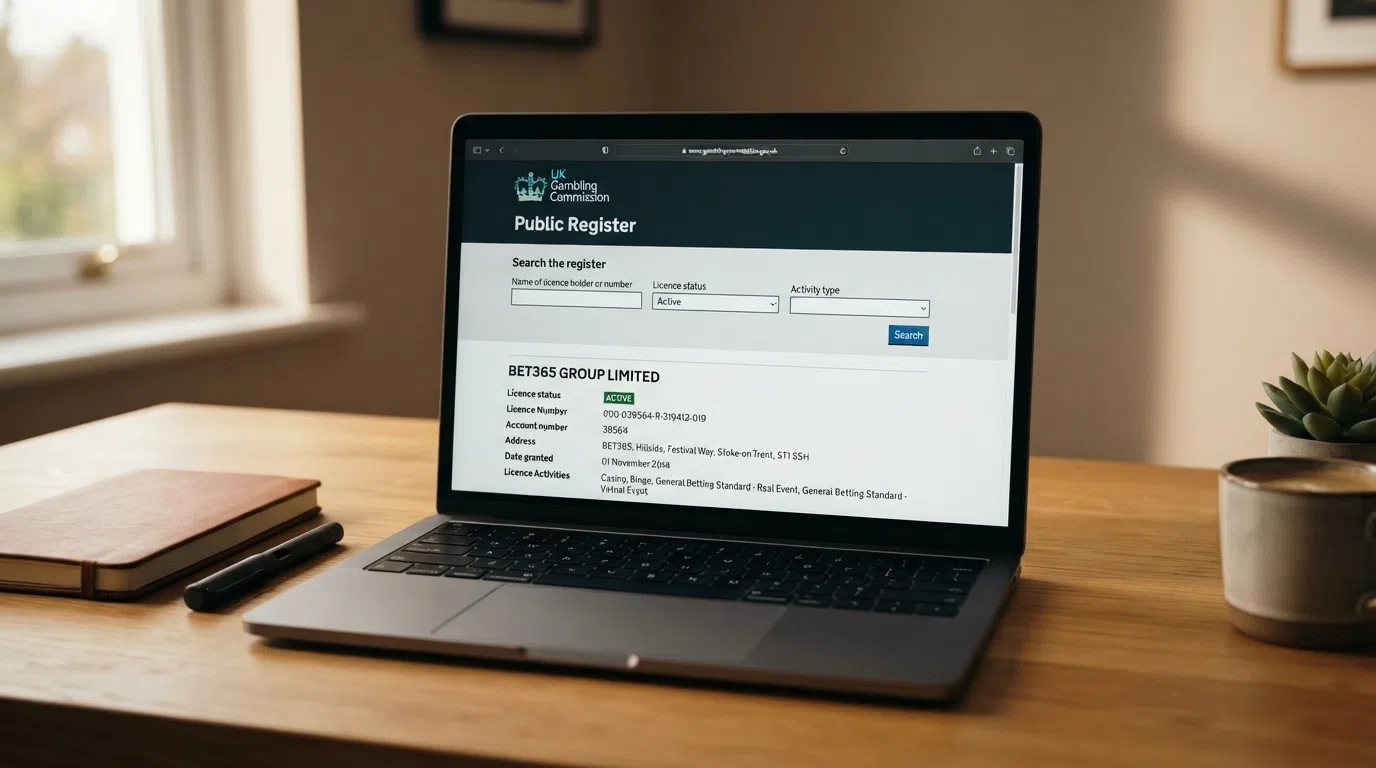
The five-minute verification routine is the same for every new site. The first minute is the UKGC public register: search the operator name, confirm the licence is active, note the licence number. The second minute is the licence number on the operator’s own site: it should appear in the footer, the About section, or the Terms and Conditions. If the numbers do not match, the site is not the operator it claims to be.
The third minute is the welcome-offer terms. The wagering multiplier (should be 10× or below), the validity window, the qualifying deposit and spend, and the list of excluded payment methods. The 10× wagering cap, in force from 19 December 2025, is the benchmark. Any bonus offering more than 10× wagering is non-compliant, and the player should not deposit. Any bonus conditioning a slots offer on playing bingo is non-compliant under the mixed-product ban.
The fourth minute is the payment methods. No credit card option should be present. PayPal, Apple Pay, Google Pay, Visa Debit, Mastercard Debit, and bank transfer are the standard set. E-wallets like Skrill and Neteller are sometimes excluded from the welcome. The absence of credit card is a sign of compliance; the presence of credit card is a sign to leave.
The fifth minute is the responsible-gambling footer. GAMSTOP logo, GamCare logo, the National Gambling Helpline number, the deposit-limit and reality-check tools, the self-exclusion link. The site should carry all of these. The absence of GAMSTOP is a sign the site is not UKGC-licensed; the presence of all the rest is a sign the operator is meeting the LCCP safer-gambling requirements.
The verification routine is five minutes and the deposit should not happen until it is done. A site that fails any of the five checks is a site to leave.
Is online bingo legal in the UK? The full regulatory picture
Yes, and the regulatory framework is the densest in the world. A UK player playing on a UKGC-licensed bingo-and-slots site is operating inside a system of protections that no other major gambling jurisdiction matches. The framework is layered: statute, regulator, licensing conditions, technical standards, game-design rules, stake limits, wagering caps, financial-vulnerability checks, and self-exclusion, all backed by a public register and an enforcement model that operates against unlicensed operators.
The Gambling Commission and how UK licensing works
The Gambling Commission is the single statutory regulator of gambling in Great Britain, an executive non-departmental public body sponsored by the Department for Culture, Media and Sport. It was established under the Gambling Act 2005, which extended a regime that had been fragmented across local authorities, the Gaming Board for Great Britain, and the National Lottery Commission into a single point of regulation. The 2014 Gambling (Licensing and Advertising) Act extended the Commission’s reach to remote operators, requiring any operator serving GB customers to hold a GB licence wherever the operator is based. The reform is the point-of-consumption model, and it is the reason a Curaçao or Malta licence alone is not sufficient.
The Commission’s three licensing objectives, set out in section 1 of the Gambling Act 2005, are preventing gambling from being a source of crime or disorder, ensuring gambling is conducted in a fair and open way, and protecting children and other vulnerable persons from being harmed or exploited. Every licensing decision, every enforcement action, and every code of practice is tested against these three objectives.
The day-to-day rulebook sits in the Licence Conditions and Codes of Practice (LCCP) and the Remote Technical Standards (RTS). The LCCP is the set of operating conditions every licensee must meet, covering social responsibility, anti-money-laundering, technical standards, and marketing. The RTS is the technical counterpart, covering platform security, game integrity, return-to-player reporting, and customer-fund protection. The player will not see most of these documents in their daily play, but the rules are the reason a UK-licensed site looks and behaves the way it does.
The public register is the player’s first verification tool. Every active operating licence is listed, with the operator name, the licence number, the licence type (operating, personal, software), the status (active, suspended, revoked), and the date of grant. The player can search the register at any time, and the licence number on an operator’s site should resolve to a register entry. The register is the single check that separates a protected player from one with no legal recourse.
The minimum age is 18 for any gambling activity in Great Britain, and the verification requirement since 7 May 2019 is that name, address and date of birth must be confirmed before any deposit or bet. There is no grace period. A player who has registered but not verified cannot deposit, cannot play, and cannot claim a bonus. The verification is usually invisible (the credit-reference check runs in the background), but the failure case (mismatch on name or address) requires document upload and a wait.
Financial vulnerability checks, in force from 28 February 2025, are a light-touch check using publicly available data on customers reaching a net deposit threshold of £150 in a rolling 30-day period. The check is not a credit check, does not involve asking the player for documents, and is run against indicators of financial distress that are in the public domain. The Commission’s aim is to identify customers who may be gambling beyond their means and prompt a conversation with the operator.
The stake limits, wagering caps and game-design rules that protect you
The UK framework is a layered set of rules, each addressing a different risk. The following protections apply to a player on a UKGC-licensed bingo-and-slots site.
| Protection | What it covers | In force since |
|---|---|---|
| Online slots stake cap (£5 for 25+, £2 for 18–24) | Maximum stake per game cycle on online slots. Does not apply to bingo, other casino games, or sports betting. | 9 April 2025 / 21 May 2025 |
| Wagering requirement cap (10×) | Maximum wagering multiplier on any gambling promotion, applied to the bonus amount. | 19 December 2025 |
| Mixed-product promotion ban | An offer may not condition a bonus on playing a different product type. | 19 December 2025 |
| Auto-play ban | Auto-play is banned on online slots. | 31 October 2021 |
| Spin speed minimum (2.5s) | Spin cycle may not be faster than 2.5 seconds; features that speed up play are banned. | 31 October 2021 |
| Losses disguised as wins banned | Slot features may not present a losing spin as a win. | 31 October 2021 |
| Reverse withdrawals banned | A player may not cancel a withdrawal request and return the funds to the playing balance. | 31 October 2021 |
| Credit card gambling ban | Credit cards are banned for all gambling payments, including credit-card-funded e-wallet deposits. | 14 April 2020 |
| Mandatory deposit-limit prompt | Operator must prompt a customer to set a financial deposit limit before the first deposit. | 31 October 2025 |
| Financial vulnerability checks | Light-touch check using publicly available data at £150 net deposits in a rolling 30-day period. | 28 February 2025 |
| GAMSTOP | National multi-operator self-exclusion, mandatory on every GB-licensed online operating licence. | 31 March 2020 |
| Age verification before first deposit | Name, address and date of birth verified before any deposit or gambling. | 7 May 2019 |
The stake limits are the most discussed and the most specific. Two adults at the same bingo-and-slots site can face different maximum bets on the same slot: the 25+ player can bet £5 per game cycle, the 18–24 player can bet £2. The limits apply to online slots only; bingo games carry their own ticket pricing, set by the operator, and the bingo-side play is not affected. The two age-banded limits went live in April and May 2025, and the Q1 2026 data is the fourth quarter of operation under the new regime.
The wagering cap and the mixed-product ban are the most recent structural changes. The 10× cap, in force from 19 December 2025, replaced a regime where 30× to 60× was common; before the cap, an operator could set whatever it wanted within reason, and the market converged on high-wagering offers because they were more profitable for the operator. The 10× cap reduces the operator’s profit on bonuses, which is the intended effect, and the consequence for the player is that welcome offers are now genuinely accessible to clear.
The game-design rules, in force from 31 October 2021, are the structural change that altered the slot experience. The 2.5-second spin minimum is the most visible; the player cannot speed up a slot by holding the spin button or using a turbo feature, because the feature is banned. The auto-play ban is the most operational: a player who wants 100 automatic spins has to press the spin button 100 times. The losses-disguised-as-wins ban removed the slot design where a spin is a net loss but the game celebrates it as a win with flashing lights and a sound effect; that design is now illegal. Reverse withdrawals were banned at the same time, closing the loop where a player would request a withdrawal and then cancel it to keep playing.
The credit card ban, in force since 14 April 2020, removed the credit card as a gambling payment method in Great Britain, including credit-card-funded e-wallet deposits. The aim was to prevent the layering of credit behind a gambling transaction through an e-wallet. The result is that every deposit is a debit card, a bank transfer, or a pre-funded e-wallet, and the player cannot borrow to play.
The mandatory deposit-limit prompt, in force from 31 October 2025, is the most recent behavioural protection. The operator must offer the player a chance to set a financial deposit limit before the first deposit is taken, the gross deposit limit must carry at least equal prominence to other financial limits, and any request to reduce a limit is actioned immediately. The aim is to put a guardrail in place before a single real-money bet has been placed.
The financial vulnerability checks at £150 net deposits in a rolling 30-day period are the new layer of protection. The check is light-touch, uses publicly available data, and does not involve asking the player for documents or running a credit check. The Commission’s aim is to identify customers who may be in financial distress and prompt the operator to have a conversation, not to block play. Announced but not yet commenced are the more detailed financial risk assessments, with stage 1 thresholds of £5,000 (25+) and £2,500 (under 25) in 24-hour net deposits, and final thresholds of £1,000 (25+), £3,000 (25+), £750 (under 25), and £2,000 (under 25) at lower cumulative levels. The start date is not confirmed.
UK-licensed vs offshore: what you lose when you play outside the system
A GB licence is compulsory at point of consumption. The 2014 Act made it an offence for any operator to transact with GB customers without a GB licence, and operating without a licence is a criminal offence under section 33 of the Gambling Act 2005, carrying up to 51 weeks’ imprisonment and an unlimited fine. The offence sits with the operator, not the player, but the consequence for the player is that the operator is not subject to UK regulation, and the protections that follow from a UK licence are absent.
A Curaçao, Malta or Gibraltar licence is not a substitute. None of those regulators require the operator to integrate with GAMSTOP, none enforce the UK stake cap or the 10× wagering cap, none require a deposit-limit prompt or a financial-vulnerability check, and none subject the operator to the UKGC’s enforcement jurisdiction. The player on an offshore-licensed site has no UKGC complaints route, no access to an alternative dispute resolution (ADR) provider approved by the UKGC, no British consumer redress, and no statutory stake limits on the games.
The enforcement model is disruption rather than ISP blocking. The UKGC does not hold statutory powers to order ISPs or DNS providers to block unlicensed sites. The Commission’s tools are cease-and-desist notices to the operator, referrals to search engines for delisting, domain suspension through the registry, and payment-provider referrals to cut off the deposit flow. In the period April 2024 to June 2025, the Commission issued 3,140 disruption notices, referred 447,778 URLs to search engines, and saw 287,961 URLs removed. The model is iterative: the site reappears under a new domain, the Commission issues a new notice, and the cycle continues.
The point of the framework is not to make offshore play impossible. It is to make the offshore site’s offer uncompetitive against the UK-licensed offer, because the UK-licensed offer is more transparent, the bonus terms are more favourable, the safer-gambling tools are present, and the player has recourse if the operator fails to pay. The offshore site competes on headlines: larger bonuses, no-deposit offers, looser terms. The cost is the absence of every protection covered in the table above.
Staying safe: responsible gambling tools every UK bingo player should know
The UK requires more player-protection infrastructure than any other gambling market, and the tools are accessible from every UKGC-licensed bingo-and-slots site. The tools fall into three categories: national (GAMSTOP), account-level (deposit limits, reality checks, time-out, self-exclusion), and external (helplines, clinics, blocking software, peer support).
GAMSTOP: how the national self-exclusion scheme works
GAMSTOP is the national multi-operator self-exclusion scheme for Great Britain, mandatory on every GB-licensed online operating licence since 31 March 2020. A single registration excludes the player from every UKGC-licensed online gambling site, including every bingo-and-slots site in this ranking, for the chosen exclusion period.
The exclusion periods are six months, one year, five years, or five years with auto-renewal. The choice is made at registration, and the registration cannot be cancelled early. After the chosen period expires, the player is contacted to confirm whether the exclusion should end or continue; if the player does not respond, the exclusion continues for up to seven years after expiry. The duration is the safeguard against a player registering in a moment of distress and ending the exclusion too quickly.
GAMSTOP covers every GB-licensed online operator. It does not cover offshore-licensed sites, land-based venues (bookmakers, casinos, bingo halls), or Northern Ireland, which is outside the Gambling Act 2005’s territorial scope. A player who has registered with GAMSTOP and then tries to open an account with a UK-licensed online operator will be blocked at the verification stage, because the operator checks the GAMSTOP database before completing registration. The operator must close any existing account and block marketing during the exclusion.
The registration process is a single online form, and the player is asked for name, address, date of birth, and email. The exclusions take effect within 24 hours, and the player receives confirmation by email. The TalkBanStop campaign combines GAMSTOP registration with free Gamban blocking software (which blocks access to gambling sites and apps at the device level) and GamCare support, so a player registering for GAMSTOP can also install Gamban and contact the National Gambling Helpline in a single flow.
Deposit limits, reality checks and the tools already on your account
Before GAMSTOP, the daily-use controls are the more frequently used tools, and every UK-licensed site must offer them.
The mandatory deposit-limit prompt, in force from 31 October 2025, is the first tool a player encounters. The operator must offer the player a chance to set a financial deposit limit before the first deposit is taken, and the gross deposit limit must be presented with at least equal prominence to any other financial limit. The player can set a daily, weekly, or monthly limit, and any request to reduce a limit is actioned immediately. A request to increase a limit has a 24-hour cooling-off period before it takes effect, which is the regulator’s guard against an impulse raise.
Reality-check pop-ups are mandatory under the game-design rules and appear in real-money play at session intervals, typically every 15, 30, or 60 minutes depending on the operator’s setting. The pop-up shows the session time, the net position, and an option to continue or end the session. A player who has set a deposit limit sees the remaining allowance in the pop-up as well.
The financial vulnerability check at £150 net deposits in a rolling 30-day period, in force from 28 February 2025, is a light-touch check using publicly available data. The check is not a credit check and does not involve asking the player for documents. If the check flags potential financial distress, the operator contacts the player to discuss the situation, and the conversation may include a review of deposit limits, a time-out, or a referral to support services. The announced but not-yet-commenced financial risk assessments will add more detailed checks at higher thresholds (£5,000/£2,500 in 24 hours for stage 1, lower thresholds for the final stage) and will incorporate income and affordability data.
The session loss/win and time display is mandatory from 31 October 2021. Every slot must display the player’s session time, the session net position (loss or win), and an indicator of time elapsed. The display is the player’s ongoing read on their activity, and the regulator requires it because the alternative is a player running a session with no visible measure of time or money.
Self-exclusion at the operator level is the account-level tool that complements GAMSTOP. A player can self-exclude from a single operator for a chosen period (six months, one year, or longer), and the operator must close the account, refund the balance, and block marketing for the duration. The exclusion is for that operator only; GAMSTOP extends the exclusion to every UK-licensed online operator.
Where to get help: helplines, clinics and blocking software
The support infrastructure is independent of the operator and the regulator, and the player can access it directly without going through the site.
- National Gambling Helpline (run by GamCare): 0808 8020 133 for England and Scotland, 0808 2819 265 for Wales. Free, 24/7, confidential.
- NHS gambling harm clinics: Free specialist treatment in England, Scotland and Wales, accessed via the National Gambling Helpline or a GP referral.
- Gamblers Anonymous: Peer-support meetings across the UK, run on a fellowship model.
- Gamban: Blocking software that prevents access to gambling sites and apps at the device level, available as a subscription with financial support for players who cannot afford it.
- GamCare: The charity that runs the National Gambling Helpline, provides online advice, and operates the TalkBanStop partnership.
- GambleAware: The independent charity that funds research, education, and treatment for gambling harm.
The relative-risk context is worth restating once. Bingo is the lowest-risk gambling product in GambleAware’s research, with average losses of 7.2 pence per minute and low concentration of revenue. The same research warns that the relative harm of bingo may change as the format moves online into solo, isolated play. A player who notices the experience drifting from entertainment to compulsion should contact the National Gambling Helpline at the numbers above. The call is free, the line is open 24 hours, and the conversation is confidential.
Selection method: how these ten UKGC-licensed operators made the cut
The ranking is built on three inputs and the limits of those inputs are worth stating.
- Source basis: the UK Gambling Commission’s public register for licence verification, the operator’s own website for live offer terms, and Gambling Commission publications for regulatory context. The register was last updated 29 July 2026, and the offers below are the welcome offers published on the operator’s website on the same date.
- Operators checked: ten UKGC-licensed operators, each offering both bingo and slots on the same platform, each with an active remote bingo and/or remote casino operating licence on the public register. Operators offering only bingo, only slots, or only one product on a separate platform, are not included.
- Ranking criteria: licence status confirmed against the public register; welcome-offer value and fairness of the small print (wagering multiplier, validity window, payment exclusions); breadth of the game-provider mix and depth of the slots library; and the presence and prominence of responsible-gambling tools on the operator’s site and app.
The ranking does not score these criteria on a weighted scale. The order reflects a qualitative assessment of which offer delivers the most genuine value to the most players, with a slight preference for low-wagering, zero-wagering, and longer-validity offers. The ten operators are not the whole market. A player who finds a UKGC-licensed site outside this list should run the same verification routine covered in the section on new sites, and may find a better fit for their play pattern.
Offers change. Welcome bonuses are promotional, and the terms on the operator’s site are the live version; the figures above are accurate as of the date of this guide and may have changed by the time the player visits. A player who is comparing offers should always check the current terms on the operator’s site before depositing.
Your move: what the UK bingo-and-slots market means for your next game
The UK bingo-and-slots market in 2026 is regulated, stable, and dense. Ten featured operators all carry active UKGC licences; three of them run zero-wagering welcomes; every welcome in the ranking requires a deposit. No genuinely no-deposit offer exists in the featured set, and a player who is searching for one is most likely being targeted by offshore sites, where the cost is the absence of every protection covered above.
The welcome-offer landscape is smaller than it was two years ago. The 10× wagering cap and the mixed-product ban reshaped the structure, and the offers that remain are simpler, cleaner, and easier to clear. A player who values low wagering has JackpotJoy, Virgin, and bet365 at 0×; Buzz, Heart, and Ladbrokes at 2× to 4×; and 888 Ladies’ bingo track at 2×. A player who values headline size has Mecca’s three-part package, Heart’s £60 bingo bonus, Buzz’s up-to-200 spins, and 888 Ladies’ £100 cap. The choice depends on which axis matters more.
The regulatory framework is the player’s real advantage. The £5/£2 stake cap on slots, the 10× wagering cap on bonuses, the GAMSTOP national self-exclusion, the deposit-limit prompt, the financial-vulnerability check, the age verification before first deposit, and the credit card ban are all in force on every UKGC-licensed site. None of them are present on any offshore site. The “loss” of playing offshore is the sum of all of them.
The decision a player faces is straightforward. Pick a UKGC-licensed operator that fits their game preference and budget. Set a deposit limit before the first spin, using the mandatory prompt rather than skipping it. Check the wagering multiplier and the validity window before claiming the welcome. Verify the licence on the Commission’s public register. Use GAMSTOP if self-exclusion is the right step. Contact the National Gambling Helpline on 0808 8020 133 (England and Scotland) or 0808 2819 265 (Wales) if the play is starting to feel like more than entertainment.
The market is mature enough to know what to do. The framework is dense enough to support it. The rest is the player’s.
Frequently asked questions
Can I play bingo and slots at the same site in the UK?
Yes. Every featured operator on this page runs a hybrid lobby with both bingo rooms and a slots catalogue on a single login, and the same UKGC licence covers both products. The licensed product is called a “bingo-and-slots” hybrid, and the regulatory rules differ between the two: the online slots stake cap does not apply to bingo tickets, and the game-design rules (auto-play ban, 2.5-second spin minimum) apply to slots, not to bingo. Slingo is the bridge game that lives in both worlds, with an RTP of around 95% to 97% depending on the variant.
What is the maximum I can bet on slots at a UK bingo site?
The statutory maximum stake is £5 per game cycle for players aged 25 and over, and £2 for players aged 18 to 24. The age-banded limits came into force in April and May 2025 and apply only to online slots, not to bingo games, other casino games, or sports betting. The operator verifies age at registration, and the slot’s stake selector will not allow a stake above the player’s age-banded maximum. Two adults at the same site on the same slot can face different maximum bets because the limit is age-banded.
How do I know if a UK bingo site is safe and licensed?
Every UKGC-licensed operator carries a remote operating licence number on its website and in its app, usually in the footer. The number resolves to an entry on the Gambling Commission’s public register, which lists the operator, the licence type, the status, and the date of grant. A player can verify a licence in under a minute by searching the register at the Commission’s site. A site that does not display a licence number, or whose number does not resolve on the register, is not one to use.
Can I self-exclude from all UK online bingo sites at once?
Yes, through GAMSTOP, the national multi-operator self-exclusion scheme mandatory on every GB-licensed online operating licence since 31 March 2020. A single registration excludes the player from every UKGC-licensed online gambling site, with exclusion periods of six months, one year, five years, or five years with auto-renewal. Registration cannot be cancelled early, and the exclusion continues for up to seven years after expiry if the player does not respond to a follow-up. GAMSTOP covers GB-licensed online operators only; offshore-licensed sites and Northern Ireland are not covered.
What payment methods can I use at UK bingo sites?
UK players can deposit with Visa Debit, Mastercard Debit, bank transfer, PayPal, Apple Pay, Google Pay, Paysafecard, and a small set of e-wallets (the available set varies by operator). Credit cards have been banned for all gambling in Great Britain since 14 April 2020, and the ban extends to credit-card-funded e-wallet deposits. Some operators exclude e-wallets from welcome offers; Mecca excludes PayPal and Paysafecard, and Foxy excludes Envoy, Neteller, PayPal, Moneybookers, Paysafecard, and Skrill. Withdrawals are made to the original deposit method where possible, and the operator must process the withdrawal without requiring a reverse.
What is a wagering requirement and how does it work?
A wagering requirement is a multiplier that determines how much qualifying play is required before a bonus is withdrawable. A £50 bonus at 10× wagering means £500 of qualifying turnover (stake on eligible games) before the bonus becomes cash. The UKGC caps the multiplier at 10× from 19 December 2025; before that, requirements as high as 60× were common. Zero-wagering offers (JackpotJoy, Virgin, bet365) have no multiplier, and the bonus is withdrawable as cash. The lower the multiplier, the closer the bonus is to cash, and the easier it is to clear.
Slots – fastestpayout-casinos-uk
Content created by the «fastestpayout-casinos-uk» team