
Curacao Casino Licence in the UK: What the Law and the LOK Reform Mean for Players
 Available in GB
A Curacao-licensed online casino is not a legal place to serve British customers. The licence that lets it operate from Willemstad does not let it accept a single deposit from someone sitting in Birmingham, Manchester or Cardiff. The Gambling (Licensing and Advertising) Act 2014 moved the test from where the operator sits to where the player sits, and since that change no offshore licence has substituted for the one issued by the Gambling Commission. The page that follows is the working-out of that single fact: what a Curacao licence gives the player, what the UK regime demands, why the bonuses look larger, where the protections disappear, and what changed when the Curacao Gaming Authority tore down the old master-and-sub-licence system in 2025.
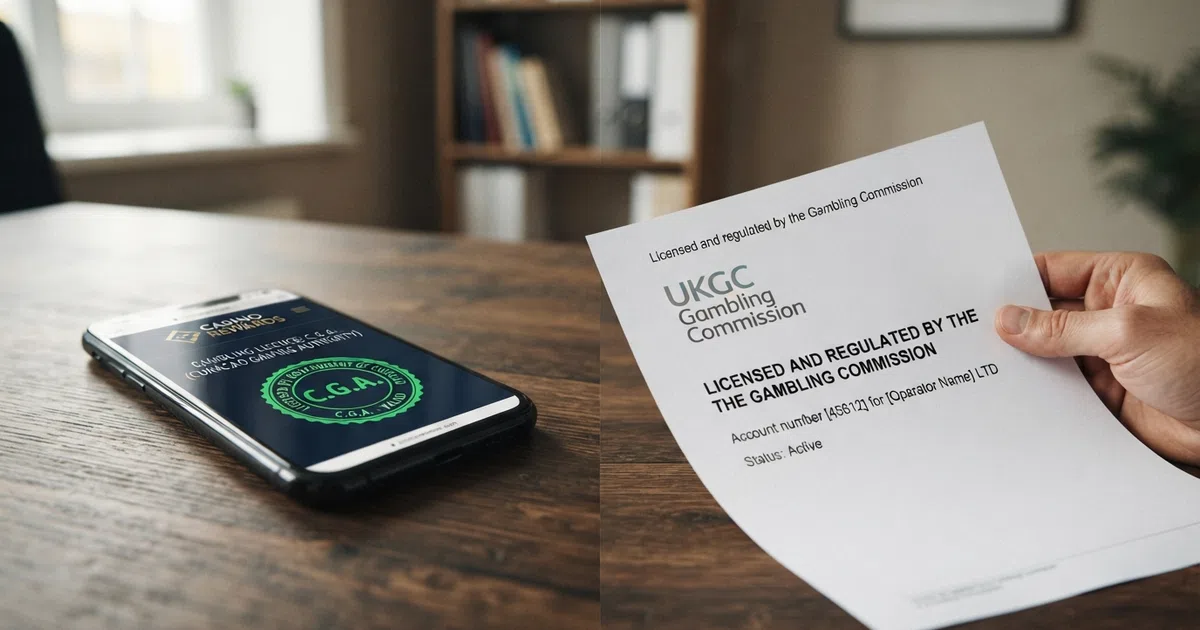
*Current as of September 8, 2026 · verified against the UK Gambling Commission public register, the Curaçao Gaming Authority portal at Cga.cw, and Gambling Act 2005 statute.*
Why a Curacao Licence Cannot Make a Casino Legal in the UK
The headline is unflattering for the marketing pages that promise “Curacao-licensed and regulated”. A Curacao licence is a real licence, issued by a real regulator. It is simply the wrong licence for serving GB customers, and it has been the wrong licence since 2014.
The Point-of-Consumption Rule: Every Operator Serving GB Players Needs a UKGC Licence
Before 2014, an online casino could hold a licence in any jurisdiction it chose and target British customers from that base. The Gambling (Licensing and Advertising) Act 2014 closed that door by making the player’s location the trigger. A Gambling Commission licence is now compulsory at the point of consumption: anyone offering gambling facilities to a customer in Great Britain must hold a GB operating licence, no matter where the company is incorporated or where its servers sit. A Curacao licence does not satisfy that requirement. The Gambling Commission has stated the position plainly: a licensed operator based in Curaçao is not permitted to offer gambling services within the UK without a licence from us.
The rule was designed to do what the previous offshore-tolerant regime could not: pull customer-facing enforcement back inside the UK perimeter. A player who lost money to a company in Antigua, in Malta, in Curaçao, had nowhere to complain that British law recognised. After 2014 the perimeter moved. Now it is the operator’s licence, the operator’s complaint route and the operator’s duty of care that determine whether the player has any recourse at all. A Curacao operator serving GB customers from outside the perimeter has none of those things.
No, UK Players Do Not Face Prosecution — and Here Is How the UKGC Polices Offshore Sites Instead
The criminal offence sits with the operator, not the customer. Section 33 of the Gambling Act 2005 makes providing facilities for gambling without the required licence a criminal offence, carrying up to 51 weeks’ imprisonment, an unlimited fine, or both. There is no established penalty for the player who merely gambles on an unlicensed site. What the player loses is protection, not liberty.
The Commission’s enforcement approach is disruption rather than blocking. Between April 2024 and June 2025 the UKGC issued 3,140 disruption notices, referred 447,778 URLs to search engines for delisting, and recorded the removal of 287,961 of those URLs, with an average 32% fall in engagement across 160 disrupted sites. The Commission does not currently hold statutory ISP or DNS blocking powers — legislation to grant those powers has been proposed but not enacted. The pressure runs through search visibility, payment-provider referrals and domain-registrar pressure. For a UK player this means the offshore casino may simply vanish from Google one morning, but the player will not be arrested.
The asymmetry of the system is worth naming. The operator carries the criminal risk; the player carries the consumer risk. There is no British ombudsman for a Curacao casino dispute. There is no British levy-funded treatment pathway automatically opened because the gambling happened at an unlicensed site. The whole UK safety net is built for operators who chose to be inside it.
GamStop and Curacao Casinos: Why Self-Exclusion Stops at the UK Border
GAMSTOP is a licence condition, not a free-standing national database. Registration with GAMSTOP has been mandatory for every Gambling Commission online operating licence since 31 March 2020. Exclusion periods are six months, one year, five years, or five years with auto-renewal, and they cannot be cancelled early. The scheme reaches every GB-licensed online operator because every such operator must integrate it. It cannot reach a Curacao casino because no such casino holds a GB licence and therefore has no obligation to integrate it.
Curacao’s own self-exclusion model is operator-level. A player who self-excludes at one Curacao brand is excluded only at that brand; the same player can open an account at a different Curacao operator the same afternoon, because there is no cross-operator portable scheme. The British safety net runs through a single sign-on. The Curacao alternative runs through repeated, brand-by-brand opt-ins. For a player who has self-excluded in the UK and is now searching for a Curacao casino, the practical reading of “not on GamStop” is this: the one national database that holds the exclusion does not see this site, and the site has no equivalent database of its own.
Curacao vs UKGC: What Each Licence Actually Gives the Player
The gap is best seen in a single table, because the two licences answer different questions in different rooms.
| Feature | UKGC-Licensed Casino | Curacao-Licensed Casino |
|---|---|---|
| Licence requirement for GB players | GB operating licence compulsory | Not permitted to serve GB without a GB licence |
| GAMSTOP integration | Mandatory for every operator since 31 March 2020 | No integration; no equivalent cross-operator scheme |
| Slot stake cap | £5 per spin (25+), £2 per spin (18–24) from 2025 | No statutory stake cap |
| Credit cards | Banned since 14 April 2020 | Permitted |
| Bonus wagering cap | 10× maximum on bonus funds from 19 December 2025 | 35×–40× common; no statutory cap |
| Game-design rules | No auto-play; ≥2.5s spin speed; no losses disguised as wins | No equivalent design rules |
| Complaint resolution | UKGC complaints route plus approved ADR | CGA does not resolve player complaints; ADR only |
| Player redress | British consumer law, chargeback, civil court | Civil court or chargeback; no British ombudsman |
| Crypto deposits | Not specifically prohibited but not widely supported | Allowed under CGA June 2025 policy |
| Operator tax burden | 40% Remote Gaming Duty from April 2026; 1.1% statutory levy from April 2025 | CGA licence fees; no UK levy applies |
The asymmetry of the two columns is the message. A UKGC licence is a permission slip that comes with a price tag and a set of obligations to the player. A Curacao licence is a permission slip that comes with fewer obligations and a lower price tag. The obligations the player loses are the obligations that mattered when things went wrong.
What a Curacao Casino Licence Is — and What It Does Not Guarantee
The Curacao licence has had a harder year than most regulatory overhauls ever manage. The system that produced the certificate under your casino’s footer two years ago no longer exists.
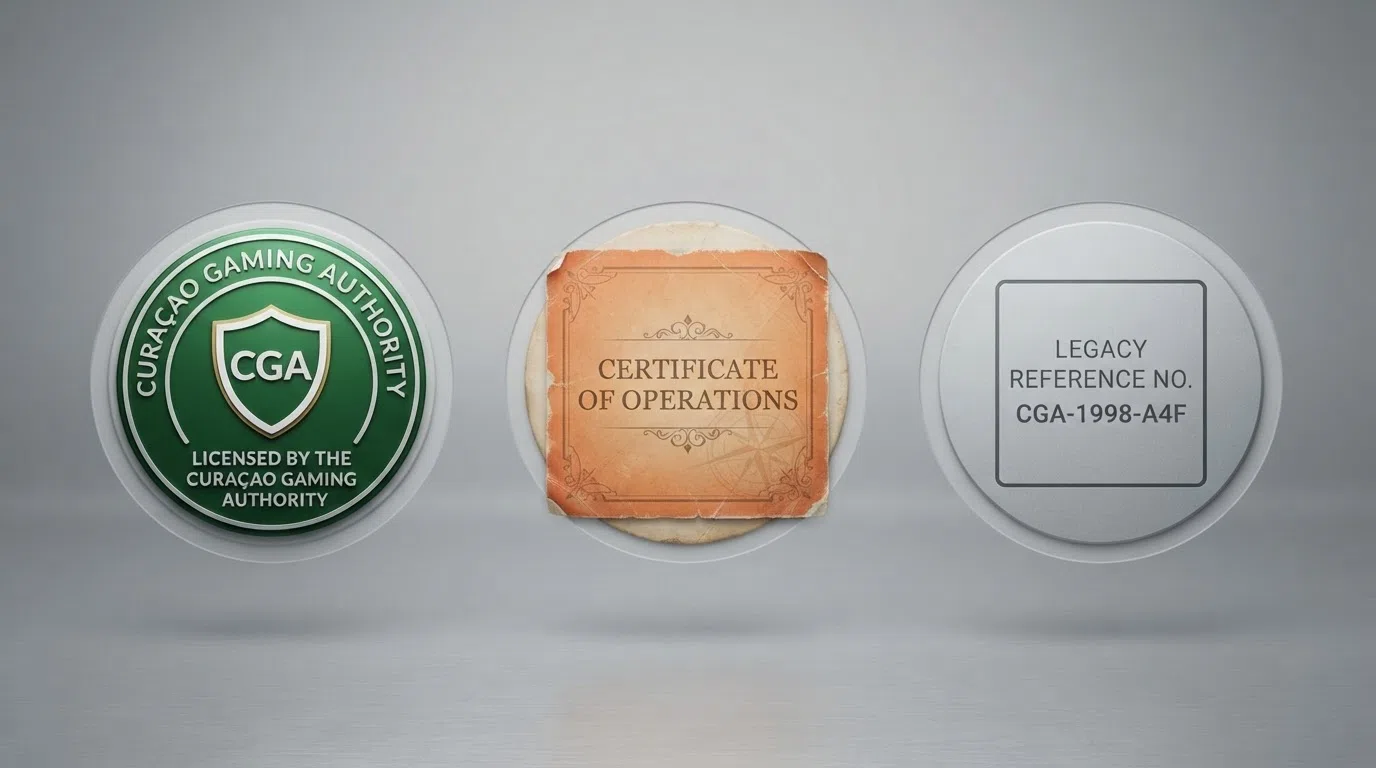
The Two Eras of Curacao Licensing: NOOGH Sub-Licences vs the LOK Direct System
Until January 2025, Curaçao’s gambling regime worked the way many small-jurisdiction regimes did: a handful of master licence holders — names like Antillephone and Gaming Curaçao, with reference numbers such as 1668/JAZ and 8048/JAZ — issued sub-licences to operators underneath them. The operator’s footer would show a /JAZ reference number; the master licence holder sat between the regulator and the brand; the CGA’s own reach into the operator’s conduct was indirect.
The Landsverordening op de Kansspelen — the LOK — replaced that arrangement with a direct licensing model. Every operator wanting to remain licensed in Curaçao must now hold a direct licence from the Curaçao Gaming Authority. The sub-licences issued under the old NOOGH framework expired in January 2025. Operators were given a transition window; the certificate they held during it (the orange authorisation seal) ran out on 15 October 2025. After that date only the new green seal, issued under a direct B2C licence with an OGL number, is current. The LOK regime also moved the regulator itself. The old Gaming Control Board became the Curaçao Gaming Authority in late 2024, and the CGA now issues licences directly to operators rather than through master holders.
From 1,200 to 330 Casinos: What the LOK Reform Changed
The pre-reform landscape of Curaçao-licensed online casinos numbered roughly 1,200 operators; by early 2026 the LOK transition had reduced that figure to around 330. The contraction is structural rather than punitive. Operators that did not make the transition lost their right to advertise a Curacao licence; some moved to Anjouan, some to other small jurisdictions, some simply closed. The survivors had to meet the CGA’s direct-licence standards: proper AML procedures, an Alternative Dispute Resolution provider in place, self-exclusion and deposit-limit tooling, and an active certificate of operations linked to the green seal.
A smaller licensed market is not automatically a safer one. The survivors have been filtered, but the filter tests administrative readiness rather than player outcomes. The next section is about how a player performs that test on a single operator in less than a minute.
How to Verify a Curacao Casino Licence in 60 Seconds
Four checks separate a current, active Curacao licence from a footer claim that survived January 2025 by accident.
- Find the licence claim in the casino’s footer or terms and conditions. Look for a green CGA seal, an OGL/2024/xxxx/xxxx number, or a legacy /JAZ reference. The presence of a /JAZ reference alone is no longer evidence of a current licence.
- Go to the CGA public register at Cga.cw and search by operator name or OGL number. A genuine active licence shows an entry with a status of Active and a current validity window.
- Click the green seal on the casino site. A live seal opens a certificate page on cert.cga.cw whose domain matches. If the link goes anywhere else, the seal is decorative.
- Confirm the certificate shows the casino’s domain, status Active, and a current validity window. If the footer claim, the register entry and the certificate disagree, treat the licence as unproven.
BC.Game illustrates what an unproven licence looks like in practice. BC.Game migrated from Curaçao to Anjouan in 2024, was the subject of a bankruptcy ruling over approximately $2.5 million in unpaid player claims, and formally withdrew its Curaçao licence in December 2025. A casino that no longer holds a Curacao licence is still advertising in places where review sites have not updated; that gap is exactly what the four checks are designed to close.
Green Seal, Orange Seal, No Seal: What Each One Means Right Now
A casino footer shows one of four things, and three of them are now warnings. The green CGA seal is an active B2C licence verified through cert.cga.cw — the only seal that proves a current Curaçao licence at the time of writing. The orange Certificate of Operations was issued during the LOK transition window and expired on 15 October 2025; an orange seal on a casino footer in 2026 is expired, not pending. Grey means the licence has been withdrawn. Blue denotes a B2B licence — a software provider, not an operator serving end customers. A footer showing only a /JAZ reference without a clickable seal usually means the operator has not transitioned to the LOK regime at all.
The practical reading is straightforward. Green is the only colour a player should accept; the other three states require either a separate explanation (a B2B relationship) or an exit.
Curacao Casinos Ranked: Which Ones Accept UK Players in 2026
The ten operators below were assessed on the same five criteria: licence verifiability against the CGA public register where accessible, transparency of bonus terms, breadth of game-provider coverage, complaint history and ADR accessibility, and current UK accessibility including geo-block status. Two of the ten — Stake.com and Roobet — now hard-block British IP addresses and are included for reference rather than for player use.

| Operator | Curacao Licence | Welcome Bonus | Game Providers |
|---|---|---|---|
| CasinoK | OGL/2024/1800/1049 (Ryker B.V.) | 300% + 777 free spins | Multiple |
| BitStarz | Dama N.V. (legacy 8048/JAZ references) | Up to 5 BTC + 180 free spins | Multiple, crypto-first |
| Slotoro | Curacao licence reported | 50 FS no deposit + up to €2,500 | 50+ providers, 5,000+ titles |
| Cloudbet | OGL/2024/328/0599 (Halcyon Super Holdings B.V.) | Not specified in sources | Multiple, crypto focus |
| Ivibet | GLH-OCCHKTW0702282021 (TechOptions Group B.V.) | 100% up to €150 (sportsbook) | 35+ sports, casino games |
| NeedforSpin | Curacao-licensed per Casino Guru | 100% up to €500 + 150 extra spins | Wide genre selection |
| NV Casino | Curacao licence reported | 100% up to €500 + 80 FS no deposit + 100 spins | Not specified in sources |
| FastOne Casino | Curacao licence reported | 275% up to €1,000 | Not specified in sources |
| Stake.com | OGL/2024/1451/0918 (Medium Rare N.V.) | Rakeback model (no traditional welcome bonus) | 65+ providers, 6,000+ games |
| Roobet | OGL/2024/687/0427 (Raw Entertainment B.V.) | Tournament promotions ($150K+ prize pools) | 65+ providers, 6,000+ games, 10 originals |
The two geo-blocked brands are flagged below. The remaining eight are accessible to UK-based players as of the date of writing, subject to each operator’s own terms.
CasinoK: A Fresh LOK-Era Licence and a 300% Welcome Package
CasinoK launched in 2025 under Ryker B.V. and reports a direct LOK-era licence with the OGL number OGL/2024/1800/1049. It is one of the first wave of LOK-transition operators and one of the few whose licence number is in the current OGL format. The welcome package runs to 300% plus 777 free spins, with a 35× wagering requirement on bonus funds and a deposit required to trigger the full package. The bonus percentage is at the top end of the featured set, and so is the wagering multiple — they are paired here rather than coincidentally.
BitStarz: The Multi-Currency Veteran With Crypto at Its Core
BitStarz operates under Dama N.V., one of the longer-established names on the Curaçao register, with legacy 8048/JAZ references still appearing in its licence history. The welcome package is crypto-denominated: up to 5 BTC plus 180 free spins spread across the first four deposits, with 40× wagering on bonus funds and a €5 maximum bet rule that applies while the bonus is active. Game-restricted titles are excluded from the bonus playthrough; the cashier and terms carry the full list. The crypto-native infrastructure means deposits, gameplay and withdrawals can all run in Bitcoin, Ethereum and several altcoins, which is the central pitch for the brand.
Slotoro: 50 Free Spins No Deposit and Over 5,000 Titles
Slotoro is a 2025 entrant, with one of the larger game catalogues among the operators in this ranking: more than 5,000 slots from over 50 software providers. The welcome structure is unusual in splitting the offer across a no-deposit and a deposit component. Registration alone credits 50 free spins; the full package adds up to €2,500 on a first deposit. The Curacao licence is reported rather than confirmed against the live register; the catalogue scale and the no-deposit component are the more visible selling points.
Cloudbet: A Confirmed CGA Direct Licence and Deep Crypto Markets
Cloudbet is operated by Halcyon Super Holdings B.V. and its OGL/2024/328/0599 licence was confirmed against the CGA tracker as current in June 2026, one of the few operators in this ranking whose OGL number is independently verifiable on the register. The brand is positioned as a crypto casino with multi-currency support across Bitcoin, Ethereum and stablecoins. The sources available for this page do not include a confirmed welcome-bonus figure for Cloudbet; the verification of the licence and the crypto positioning are the two things the page can stand behind.
Ivibet: One Curacao Licence, Two Products — Sportsbook and Casino
Ivibet operates under TechOptions Group B.V. with reported licence GLH-OCCHKTW0702282021. The welcome offer is a sportsbook product rather than a casino product: 100% up to €150 with a 5× rollover on accumulator bets, requiring a minimum of two selections and combined odds of 2.0 or higher, and a seven-day validity. The casino half of the platform carries the usual catalogue. The product split matters because a sportsbook welcome is cleared very differently from a casino welcome — five-fold on a coupon is faster to complete than thirty-five-fold on slots — but the bonus amount is correspondingly smaller.
NeedforSpin: A Casino Guru High-Safety Pick With 150 Extra Spins
NeedforSpin carries a Casino Guru Safety Index of 8.3, classed as High — the highest score among the operators in this ranking. The Safety Index aggregates licensing checks, complaint resolution and responsible-gambling tooling into a single score; the 8.3 figure places the operator in a small group of Curacao-licensed brands that have been independently evaluated on outcomes rather than marketing claims. The welcome offer is 100% up to €500 plus 150 extra spins; the wagering terms are not published in the sources available for this page.
NV Casino: 80 No-Deposit Free Spins Plus a 100% Match Bonus
NV Casino’s structure splits into three parts: a 100% match up to €500 on the first deposit, 80 free spins credited on registration with no deposit required, and a further 100 spins released with the deposit. The no-deposit component is the largest in the featured set, and the terms attached to it — maximum cashout, game restrictions, wagering on the winnings — will determine whether it is worth claiming. The provider list for NV Casino is not carried in the sources available for this page; the welcome structure is the verifiable detail.
FastOne Casino: A Straightforward 275% Welcome Match
FastOne offers a 275% match up to €1,000 on a single deposit, with no free-spin component and no bonus-structure complexity. The Curacao licence is reported via a third-party listing; the operator name and the underlying provider list are not specified in the sources available for this page. The pitch is the percentage: 275% is a high headline number, and the terms underneath it — wagering multiple, max bet, game restrictions — are what determine what it is actually worth.
Stake.com: Exclusive High-RTP Slots — Now Behind a UK Geo-Block
Stake.com operates under Medium Rare N.V. with confirmed OGL/2024/1451/0918, and is the highest-profile crypto casino to have held and then surrendered a UK Gambling Commission licence. The licence surrender happened in March 2025; UK players are now hard-blocked at the IP level. The brand is included in this ranking as a reference point, not as a destination: the Enhanced RTP series (Gates of Heaven at 98.00%, Sugar Twist at 98.00%, Big Bass Boom at 97.97%) sets a benchmark for what high-return slot catalogues look like, and the 6,000+ games across 65+ providers explain why the brand matters. The promotion model is rakeback rather than a traditional welcome bonus — Stake does not run the standard deposit-match structure that the other operators on this page run.
Roobet: Ten Provably Fair Originals, Zero UK Access
Roobet operates under Raw Entertainment B.V. with confirmed OGL/2024/687/0427, and the United Kingdom is on its blocked-country list. The catalogue carries 6,000+ games from 65+ providers, plus ten provably fair originals — the in-house games whose outcomes a player can verify on the blockchain rather than trusting to the operator. Promotions run through tournament structures with prize pools of $150,000 and above rather than a traditional welcome bonus. The UK access situation is what closes the door for a British reader; the originals and the tournament format are what explain why the brand is mentioned.
Why Curacao Casino Bonuses Look Bigger Than UK Offers — and What They Really Cost
The 300% at CasinoK, the 5 BTC at BitStarz, the 275% at FastOne: these numbers do not appear at UKGC-licensed casinos. They appear because the operators writing them pay a different cost stack, and the saving is passed to the marketing budget rather than the player.
Welcome Bonuses at Curacao Casinos: The Numbers Behind the Headlines
The featured set spans from 300% at CasinoK to 100% at several other operators, with BitStarz offering 5 BTC plus 180 free spins and Stake and Roobet carrying no traditional welcome bonus at all. The percentages are paired with wagering requirements that UK regulation now forbids. The UKGC’s LCCP Social Responsibility Code 5.1.1 caps wagering requirements at 10× from 19 December 2025; before that change, UK bonuses commonly carried requirements as high as 60×. The Curacao operators in this ranking run at 35× (CasinoK), 40× (BitStarz), and 5× on accumulator bets only (Ivibet sportsbook). The wagering gap is the actual cost difference, and it is large.
The reason for the gap is the cost stack that a UKGC operator carries and a Curacao operator does not. Remote Gaming Duty rose to 40% on 1 April 2026, applying to accounting periods beginning on or after that date. A statutory gambling levy of 1.1% of gross gambling yield applies to remote casino, remote bingo and remote general betting licences from 6 April 2025. Neither charge applies to a Curacao operator serving GB customers without a GB licence. The CGA licence fees and LOK compliance costs are lower by an order of magnitude. The marketing budget has more room; the bonus percentage reflects that.
No-Deposit Bonuses and Free Spins: Which Operators Offer Them
Two of the ten featured operators give the player something before any payment is made. Slotoro credits 50 free spins on registration, and NV Casino credits 80 free spins on registration. Both are deposit-free components of a larger package; the full bonus at each operator requires a deposit. Among the remaining eight operators, BitStarz, CasinoK, Ivibet, NeedforSpin and FastOne all require a deposit to trigger the welcome offer, and Stake and Roobet carry no welcome bonus at all.
The terms attached to no-deposit offers are where the marketing language meets the actual value. A 50-spin no-deposit credit with a 40× wagering multiple on the winnings is a smaller real-money offer than its headline suggests; the spin value multiplied by the wagering requirement determines what is realistically withdrawable. BitStarz’s €5 maximum bet rule and its restricted-game list apply while any bonus is active; the same rules tend to apply at the no-deposit level. The standard strings — a max bet cap, a game-exclusion list, wagering on the winnings — are the structure, not the exception.
Wagering Requirements at Curacao Casinos vs the UKGC 10× Cap
The 10× cap that took effect on 19 December 2025 changed the UK market from one in which operators could demand sixty-fold play-through to one in which the worst case is ten-fold. The Curacao operators in this ranking sit at 35× and 40× on casino bonuses, with Ivibet’s 5× confined to accumulator bets. The arithmetic of the gap is straightforward: a £100 casino bonus at a UKGC site needs £1,000 of qualifying wagers to clear; the same £100 at BitStarz needs £4,000. The chance of clearing it falls as the wagering requirement rises, because each spin carries the house edge and more spins means more expected loss to that edge.
Several operators in the featured set do not publish their wagering terms upfront, and that absence is the most reliable red flag on the page. A welcome bonus with no visible playthrough requirement is a welcome bonus whose terms are settled after registration, when the player has already given the operator their email address and possibly a deposit. The verification approach in the previous section — register, seal, certificate — applies in the same way to bonus terms: if they are not visible before signup, the operator is not behaving as a comparable UKGC operator would.
How UK Players Can Deposit and Withdraw at Curacao Casinos
The payment surface at a Curacao casino is broader than at a UKGC site, partly by design and partly because the UK restrictions simply do not bind.
E-Wallets, Prepaid Cards and Bank Transfers: What Is Actually Available
The typical Curacao casino cashier covers e-wallets (Skrill, Neteller and similar providers), prepaid cards (Paysafecard and equivalents), bank transfer and Trustly-style instant bank methods, with cryptocurrency added at the operators that support it. The exact list varies by operator; the cashier page at the casino in question is the only place that lists it definitively. Credit cards are permitted at Curacao casinos — the UK ban on credit cards for gambling, in force since 14 April 2020 at GB sites, does not extend to operators licensed outside the UK.
The asymmetry is structural. The UK ban exists because the Gambling Commission identified credit card use at gambling as a harm indicator; the ban runs through the GB licence condition, and a Curacao operator serving GB customers without a GB licence is not bound by it. The same logic applies to deposit limits, to affordability checks and to source-of-funds requests: none of these are required at a Curacao casino because none of them are GB licence conditions. The convenience is real. The protection gap is the price.
Withdrawal Speed and Payout Experience at Curacao Casinos
Withdrawal speed is the most common player complaint at Curacao casinos, and the structural reason is the absence of a UK-level payout framework. The CGA requires operators to assess and respond to complaints within four weeks, extendable once by an additional four weeks with prior written notice, and to bear the cost of the ADR process. The CGA does not itself resolve or make decisions on individual player complaints — the regulator’s stated position is that the CGA will not adjudicate disputes between operators and players. A player whose withdrawal stalls has three escalation routes: the operator’s internal complaints process, the ADR provider the operator is required to maintain, and either civil court or a payment-provider chargeback once those routes are exhausted.
A four-week response window is not a guarantee of payment. It is a procedural floor. The ADR provider can recommend a settlement; the CGA will not enforce it. A civil claim in a small-claims court is a real option but is also a real cost in time and effort. Chargeback through the card issuer or the e-wallet provider is faster but is not available for cryptocurrency withdrawals. The shape of the payout experience is set by these limits.
Crypto and Bitcoin Gambling at Curacao-Licensed Casinos
Curacao is the dominant jurisdiction for crypto casinos because the regulator chose to be. The June 2025 crypto policy formalised the position; the practical limits sit in the application rather than the policy.
Bitcoin and Crypto Deposits: What the CGA Allows — and What It Restricts
The CGA confirmed in June 2025 that crypto payments are allowed for licensed B2C operators. The same policy drew a clear line: a Curacao casino may not act as an exchange, a payment services provider or a virtual asset service provider. The casino accepts deposits and pays out withdrawals, but it does not run a brokerage desk. The default rule for withdrawals is the same wallet and the same crypto asset as the original deposit — players cannot deposit Bitcoin and withdraw Ethereum unless the operator has explicitly enabled that path.
The operators in this ranking that support crypto are BitStarz, Cloudbet, Stake and Roobet, with BitStarz’s multi-currency infrastructure and Cloudbet’s crypto-casino focus being the two clearest expressions of the model. Ivibet accepts crypto in places; the remaining operators in the featured set sit closer to a fiat-first model with crypto as an option rather than the spine.
Anonymity, KYC and Crypto: How Much Privacy You Actually Have
Crypto deposits do not equate to anonymity. The LOK regime’s AML obligations require operators to identify customers before processing withdrawals, and the identity check is the moment at which a name, an address and a proof of identity are held by an operator based outside the UK regulatory perimeter. The GB regime goes further — identity is verified before the first deposit, age is verified before play, and financial vulnerability checks run at £150 of net deposit in any rolling 30-day period. None of those checks are mandatory at a Curacao casino because none of them are LOK requirements. The difference between crypto-as-payment-method and true anonymity is the difference between the casino holding your identity documents and the casino holding nothing about you at all.
The data-protection implications matter. A UK player who sends a passport scan and a utility bill to a Curacao-based operator is sending those documents to a company outside UK jurisdiction, outside the GDPR’s territorial scope as it applies to gambling supervision, and outside the UK Information Commissioner’s reach. The CGA has data-handling requirements under LOK; the operator is bound by them; the player is not.
Crypto-Only vs Crypto-Friendly: The Two Types of Curacao Bitcoin Casino
The difference between a crypto-native operator and a crypto-friendly one shows up in three places: fees, game selection and withdrawal speed. BitStarz, Cloudbet, Stake and Roobet were built with crypto at their centre: multi-currency wallets, blockchain-based originals, settlement in the same asset as the deposit. Their withdrawal infrastructure is built for crypto rails. Crypto-friendly operators added a Bitcoin deposit button to a fiat-first platform, and the experience at the withdrawal end is slower and more manual. The choice between the two is a choice about how much friction the player wants at the payout end.
What You Are Actually Playing: Slots, RTP and Providers at Curacao Casinos
A 5,000-title catalogue is impressive on its own. The same title running at a different return rate at a different casino is the part that does not advertise itself.
Slot Catalogues at Curacao Casinos: Quantity vs RTP Reality
The featured set spans Slotoro’s 5,000+ slots from 50+ providers, Stake and Roobet’s 6,000+ games from 65+ providers each, and the multi-provider catalogues at the remaining operators. The number of titles is one fact. The RTP at which those titles run is a separate fact, and it varies by operator.
The mechanism behind the variation is the variable-RTP model used by major providers. Pragmatic Play, Play’n GO and several others ship most titles in three RTP tiers, and the casino operator chooses which tier to deploy at integration time. The same slot can return 96.5% at one casino and 94.5% at another, and the casino is not obliged to disclose which version it has selected. The in-game information panel is the only place a player can check the RTP, and only where the provider has built the disclosure into the client. Stake’s Enhanced RTP exclusives — Gates of Heaven at 98.00%, Sugar Twist at 98.00%, Big Bass Boom at 97.97% — sit at the high end of what the variable-RTP model can produce and are exclusive to Stake; no UK-licensed casino carries these titles at these return rates.
Game Providers and the Variable RTP Problem
The provider line-up tells a player what is on offer; it does not tell them at what return rate each title is configured. Pragmatic Play is the clearest example of the variable-RTP model: a single studio shipping multiple RTP tiers of the same game and letting the operator pick. The same pattern applies across other major studios.
The UK regime adds game-design rules that do not bind Curacao operators. Auto-play is banned at GB-licensed sites; the minimum spin speed is 2.5 seconds; losses disguised as wins are prohibited; reverse withdrawals are banned permanently; session loss, win and time displays are mandatory. None of these rules apply at a Curacao casino. A UK player who has become accustomed to the slower spin speed and the absence of losses-disguised-as-wins at a GB site will find both features available at a Curacao casino, and the design intent behind them is part of the regulatory bargain that the offshore site has opted out of.
How to Separate Trustworthy Curacao Casinos from the Rest
A Curacao licence is a starting point, not a trust signal. The work of building trust falls on the player because the regulator has decided it will not do that work.
What Curacao Casino Reviews Actually Tell You — and What They Leave Out
The Curacao casino review ecosystem is dominated by affiliate pages, listicles and SEO comparison sites. The standard review covers the welcome bonus, the game count, the payment methods and the headline licence claim. The reviews that add value do three things the standard format does not: they verify the licence claim against Cga.cw, they search for player complaints independently, and they cross-reference the casino’s ADR provider. Most do none of these. The four-check verification workflow from earlier in this page is the test a review should pass; it is the test most reviews do not run.
The Casino Guru Safety Index is one of the few published scoring systems that aggregates licensing checks, complaint volumes and resolution outcomes into a single number. NeedforSpin’s 8.3 (High) score in this ranking is the highest in the featured set; that score reflects the operator’s complaint-handling track record rather than its marketing copy.
Complaint Histories, ADR and What Happens When Things Go Wrong
The CGA’s position on player complaints is explicit: the CGA will not resolve or make decisions on any player complaints regarding gambling-related transactions on the operator’s websites. The regulator requires every operator to maintain an ADR provider and to respond to complaints within four weeks (extendable to eight). The ADR provider’s recommendation is the ceiling of the regulatory process; the CGA will not enforce it.
The BC.Game case illustrates what complaint escalation failure looks like at the limit. The operator migrated from Curaçao to Anjouan in 2024, faced a bankruptcy ruling over approximately $2.5 million in unpaid player claims, and formally withdrew its Curaçao licence in December 2025. A player who had an open complaint at BC.Game at the moment of the bankruptcy ruling was outside the CGA’s reach and inside a court process that may or may not produce recovery. The lesson is not that every Curacao casino becomes BC.Game; the lesson is that the regulatory perimeter stops at the ADR provider, and a player whose complaint outruns the ADR provider is outside the system.
Responsible Gambling Without the UK Safety Net
A Curacao casino’s responsible-gambling tooling exists because LOK requires it, not because the operator has chosen to invest in player protection. The list of required tools is a baseline, not a safety net.
What Responsible Gambling Tools Curacao Casinos Offer — and What They Cannot Replace
LOK clause 5.4(2) sets the minimum: self-exclusion of at least one year, deposit limits, session-time controls, reality checks, and player-activity reporting. Every licensed Curacao casino must offer these tools. None of them substitute for the UK system.
The UK system runs through GAMSTOP (cross-operator, mandatory, with periods of six months to five years and no early cancellation), through financial vulnerability checks at £150 of net deposit, through mandatory age verification before play, through the UKGC’s complaints route and approved ADR, and through funded treatment pathways. None of these are obligations at a Curacao casino because none of them are GB licence conditions. The tooling that the LOK requires is real; the system it sits inside is partial.
The UK help infrastructure remains available regardless of where a player gambles. The National Gambling Helpline (0808 8020 133), GamCare, GambleAware, the NHS gambling harm clinics in England, Scotland and Wales, and Gamblers Anonymous are all reachable from a UK phone or browser. GamCare made 996 referrals to treatment and peer-based support services in January 2026, a 48% increase on the same month in 2025. The National Gambling Support Network treated 11,960 clients between April 2024 and March 2025, an 11% year-on-year increase. The NHS Adult Psychiatric Morbidity Survey 2023–24 recorded 0.4% of adults as problem gamblers (PGSI 8+) and 1.6% at moderate risk (PGSI 3+). The treatment system exists. It is not gated by the operator’s licence.
How We Selected and Ranked the Operators on This Page
Every operator in this ranking was assessed against the same five criteria, with licence status verified against the CGA public register where the entry was accessible. The selection drew from the Curacao-licensed operators that research confirmed target or accept UK players, with the operators ordered by the verifiability of their licence status first and UK accessibility second.
The criteria applied were: licence verifiability against Cga.cw (operators whose OGL numbers were independently verifiable on the register were ranked above those whose licence numbers came from operator-published terms alone), bonus terms transparency (operators with published wagering requirements and clear max-bet rules were ranked above those whose terms were opaque), game-provider breadth (operators carrying 50+ providers or 5,000+ titles were ranked above narrower catalogues), complaint history and ADR accessibility (operators with a track record of complaint resolution were ranked above those without one), and UK player accessibility (operators actively serving GB customers ranked above geo-blocked brands, with the geo-blocked brands included for reference rather than for use).
The sources used were the CGA public register at Cga.cw, the CGA portal at portal.gamingcontrolcuracao.org, the UK Gambling Commission’s published enforcement figures and licence register, Gambling Act 2005 statute and the LCCP, and third-party review databases (Casino Guru’s Safety Index in particular). What was excluded: operators whose Curacao licence could not be independently verified beyond a footer claim, and brands that had migrated to other jurisdictions (BC.Game, the most prominent example, withdrew its Curaçao licence in December 2025). The ranking is qualitative — no invented weightings, no percentage scores, no mathematical composite.
Curacao Casinos and UK Players: What the Evidence Says You Should Do
The closing position is drawn from the facts the page has already established, not from a fresh recommendation.
A Curacao licence is not a GB licence substitute. The Gambling Commission has said so explicitly. Section 33 of the Gambling Act 2005 exists to penalise operators, not players. The player who gambles at a Curacao casino does not face prosecution; the player loses protection. There is no GAMSTOP integration at the casino, no UKGC complaints route, no approved ADR binding the operator under UK supervision, no British consumer redress mechanism, no credit card ban, no statutory slot stake cap, no 10× wagering cap, no financial vulnerability check at £150. The list of things the player loses is the list of things that mattered in the moments when things went wrong.
The list of things the player gains is real but partial. Larger welcome bonuses, the option of cryptocurrency, no per-spin stake cap, faster game features, wider game libraries — all of these exist because the operator is not paying the 40% Remote Gaming Duty that applies to UKGC licensees from April 2026, is not paying the 1.1% statutory levy from April 2025, is not running under the LCCP’s bonus and design rules, and is not subject to GB game-design restrictions. The structural reason for the bigger bonus is the structural reason for the lost protection. The two are the same trade.
The course of action follows from the trade. Three checks before signing up with any Curacao casino: verify the licence on Cga.cw and confirm the green seal opens an Active certificate at cert.cga.cw; read the bonus terms before registration, especially the wagering multiple and the max-bet rule; set a personal deposit limit at the point of registration, because the operator will not run a financial vulnerability check on the player’s behalf. The course of action is the same regardless of which operator in the ranking the player ends up at, because the licence structure is what creates the gap, and the gap is the same across the featured set.
The decision is not between a Curacao casino and a UKGC casino in the abstract. It is between two player types. A player who has a hard use limit, who wants the maximum game-library breadth, who can verify a licence and read bonus terms in a critical frame, and who is willing to give up the UK safety net to access what the offshore market offers — that player can move through the Curacao route with eyes open. A player who has self-excluded in the UK and is searching for a route around GAMSTOP, who wants the bonus headline rather than the bonus terms, who cannot or will not verify a licence against the CGA register — that player should stay inside the UK licensed system, where the safety net is the point.
Frequently Asked Questions
What can I actually do if a Curacao casino refuses to pay my withdrawal?
Start with the operator’s internal complaints process. If the operator fails to respond within four weeks (extendable to eight with written notice), escalate to the ADR provider the operator is required to maintain under LOK. If the ADR process does not produce a resolution, the practical options are a payment-provider chargeback (available for card and most e-wallet deposits, not for crypto) or a civil claim in a small-claims court. The CGA will not adjudicate the dispute directly.
Can I use a VPN to access Curacao casinos that block UK players?
Using a VPN to bypass a geo-block typically breaches the operator’s terms of service and voids the player protections the operator otherwise offers. The brand in question has chosen to block the UK for a reason — Stake.com surrendered its UKGC licence in March 2025 — and a player who circumvents that block is exposing themselves to a withdrawal dispute with no contractual cover.
Do I have to pay tax on winnings from a Curacao casino?
No. UK residents pay no tax on gambling winnings from any source, onshore or offshore. The UK is not on Curaçao’s restricted-country list, and there is no legal prohibition on a UK resident holding an account with a Curaçao licence holder. The player pays no tax; the offshore operator does not pay UK tax either, which is part of the structural reason the bonuses are larger.
Can a UK player register for a self-exclusion programme through a Curacao casino website?
Each operator must offer self-exclusion of at least one year under LOK clause 5.4(2), and registration at the casino is the entry point. The self-exclusion is operator-level only: it covers that casino’s brands but does not extend to other Curaçao licensees. There is no cross-operator portable scheme comparable to GAMSTOP at Curacao.
Are Curacao casino bonuses actually better than UKGC bonuses once wagering is factored in?
The headline percentages are larger — 300% and 275% are common at Curacao operators, against typical UKGC offers of 50% to 100%. The wagering requirements are larger too — 35× to 40× at Curacao, against the UKGC’s 10× cap that took effect on 19 December 2025. The net value depends on the player’s stake size and the games the bonus allows. The headline percentage is the marketing number; the wagering multiple is the cost.
Why do Stake.com and Roobet turn UK visitors away while other offshore casinos do not?
Stake.com surrendered its UK Gambling Commission licence in March 2025 as a strategic exit; the operator decided the GB cost stack was not worth the player base. Roobet has the UK on its blocked-country list for similar commercial reasons. Other offshore casinos in this ranking continue to accept UK registrations because they have not made the same calculation. The geo-block is a business decision, not a regulatory one — though in both cases it leaves UK-based players without access to brands that some players are searching for.
Licence – fastestpayout-casinos-uk
Content created by the «fastestpayout-casinos-uk» team