
A Bank Cheque Casino in the UK — Why the Slowest Rail Still Matters
 Available in GB
A bank cheque is the slowest way to put money into an online casino account. In a market where a debit card takes seconds and Open Banking rails settle before the page refreshes, posting a piece of paper through the Royal Mail sounds like something from the previous decade. Yet the question keeps surfacing in UK search logs. Some players hold a cheque rather than a card. Others simply want to know whether the option still exists, who accepts it, and what it costs them in days before they can spin.
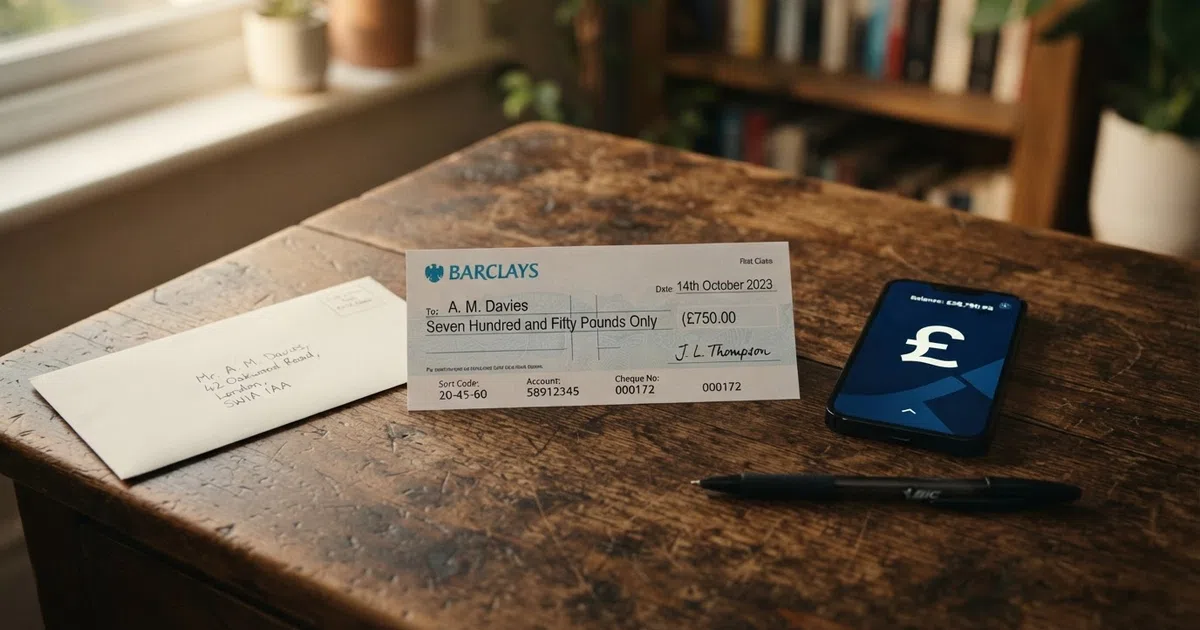
This page provides an answer based on the UK Gambling Commission’s public register and the operators’ own cashier pages. It is not a directory of cheque-accepting sites, because no published, up-to-date list exists, and any list that names specific cheque-accepting brands would be speculative. What follows is the framework around the niche — how cheques work, what they cost, what protections apply, and which ten major UK brands are ranked based on verifiable terms.
Current as of September 8, 2026 and cross-checked against the UK Gambling Commission’s public register of gambling businesses.
What a Bank Cheque Casino Actually Is — and Why It Still Matters in 2026
What a Bank Cheque Casino Is
A bank cheque casino is, in plain terms, any UK-licensed online casino whose cashier page lists bank cheques as a deposit or withdrawal option. The casino itself is not a separate breed of operator. It holds the same Gambling Commission licence as any debit-card-accepting site, runs the same KYC checks, and segregates player funds under the same rules. The only thing that distinguishes it is the payment rail — a paper instrument drawn on a UK bank, posted to an address the operator provides, and cleared through the standard banking system rather than processed electronically at the point of sale.
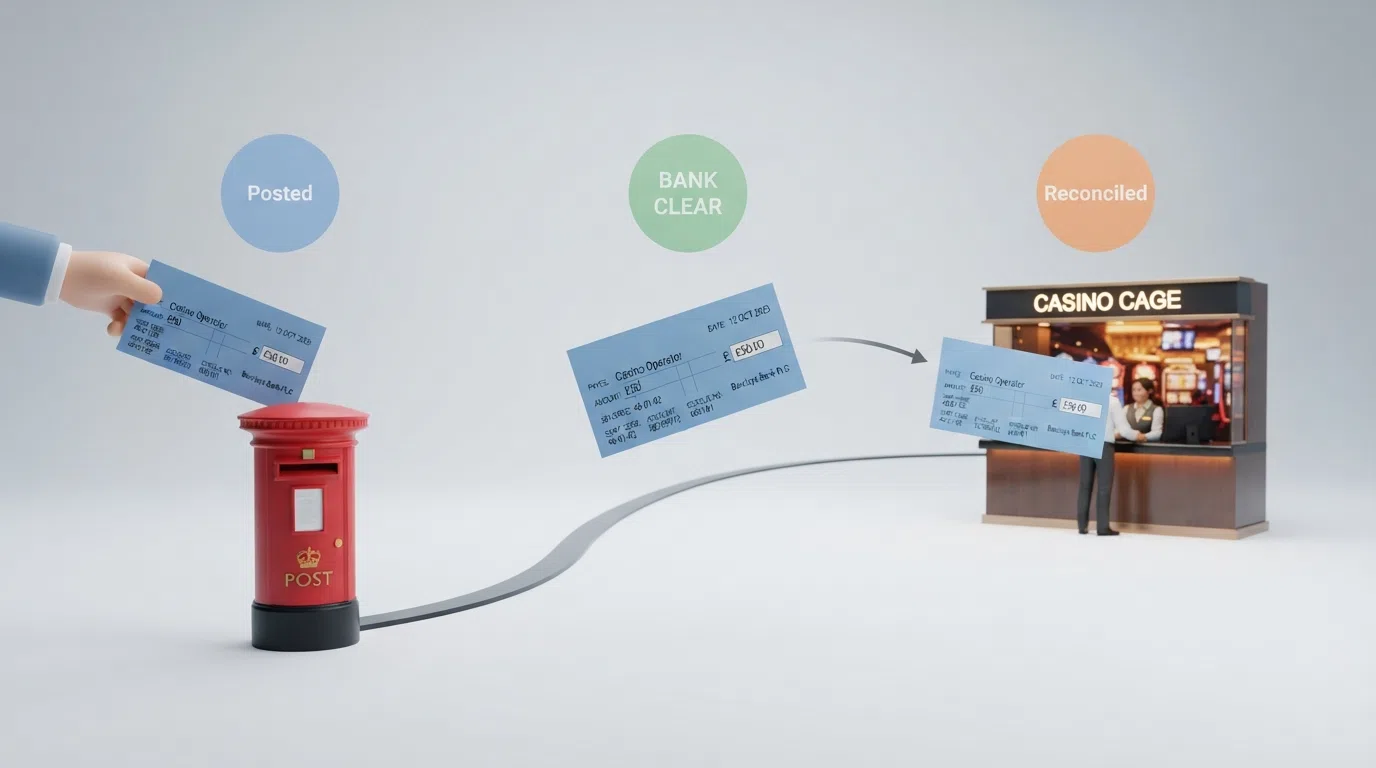
Two cheque types matter here. A personal cheque is signed against the player’s own current account and bounces through the bank’s clearing cycle. A banker’s cheque, sometimes called a bank guaranteed cheque, is drawn on the bank’s own funds and carries a stronger assurance of payment, though at a fee. Both are treated, at the casino end, as a slow deposit subject to manual reconciliation. The casino does not credit a player account when the cheque lands in its mailbox; it credits after reconciliation, which is itself a separate stage that sits on top of the banking clear.
Cheques vs Debit Cards, PayPal and Bank Transfers
Rank the four rails by the time it takes for deposited funds to appear as playable credit. Debit cards sit at the front, typically instant for Visa and Mastercard, with PayPal close behind. Open Banking, Trustly and Faster Payments settle on a near-instant basis through the player’s own banking app. Bank cheques bring up the rear by a margin measured in working days, not minutes.
| Deposit Method | Typical Clearing Time | Typical Availability |
|---|---|---|
| Debit Cards | Instant | High |
| Bank Transfers | Instant | High |
| Bank Cheques | Several working days | Low |
The convenience gap is obvious. A debit card deposit is a tap in the cashier. A bank transfer is a confirmation in a banking app. A PayPal deposit sits behind a password manager. A bank cheque is a sheet of paper, an envelope, a stamp, and a wait. None of that is a reason to write the method off. It is a reason to understand what it costs the player who chooses it.
The accessibility reasons to hold a cheque rather than a card or wallet are real and worth naming. Some UK players either do not hold a debit card, prefer not to register card details with an online casino, or want a payment that leaves a clearer paper trail at the bank end. A cheque carries the player’s bank details on its face and passes through the issuing bank’s audit. That is the feature the marketing copy never quite says out loud: cheques are slow because they are traceable.
Instant rails have become dominant because they fit how UK consumers already pay for everything else. The licensed market has built its cashier around them, and cheque acceptance survives where it survives because a niche of operators still find it worth supporting.
Where Cheques Fit in a Market Built on Speed
The same regulated market that has moved deposits to seconds has also moved play to seconds. UK game-design rules, in force since 31 October 2021, ban auto-play, set a minimum spin speed of 2.5 seconds, ban loss-disguised-as-win features, ban reverse withdrawals, and require session time and net position to be visible on screen. The licensed market has regulated itself to slow play down, even as it sped deposits up. A bank cheque sits awkwardly in that frame — it is the slowest deposit method in a market whose every other rule is built around bringing play under control.
That tension is exactly why a reader asking about bank cheques deserves a careful answer. The player profile most likely to reach for a cheque is the one that needs the cheque the least: someone who can wait days for funds to clear, who does not need the bonus claim window to start counting down immediately, and who values the paper trail over the instant credit. For anyone who has decided to play today, the debit card or the bank transfer gets them there with identical player protections.
The Vanishing Cheque Deposit: Which UK Casinos Still Take Them in 2026
The Directory Problem: Why There Is No Simple List
There is no published, up-to-date directory of bank-cheque-accepting UK casinos. Operators have, over time, dropped cheque deposits from their advertised cashier pages in favour of instant rails. The result is that a searcher who types the phrase this article is built around is chasing a list that the industry has quietly stopped publishing.
This is not a corner of the market with a clean information landscape. The competitor pages that rank for adjacent queries are built around welcome-offer terms, licence verification, and withdrawal speed rather than cheque-specific deposit mechanics. The information gap is real: there is no comprehensive public list that names which GB operators accept bank cheques today, gives the end-to-end clearing time, and explains how each one treats bonus eligibility while a cheque is still in transit. Any third-party “cheque casino list” the reader encounters should be treated with caution.
How a Cheque Deposit Works, Step by Step
The end-to-end process is older than the industry that uses it. The player writes a cheque for the chosen amount, payable to the operator’s nominated banking entity, posts it to the address the cashier page provides. The casino receives the cheque, reconciles it against the player account, runs the standard verification checks, and only then credits the funds. Reconciliation is not the same as banking clearance: the casino’s own internal processing sits on top of the banking clear and adds to the total time.
Pre-deposit verification has been mandatory since 7 May 2019, which means anonymous play is no longer possible at any UK-licensed site. By the time a cheque reaches the casino, the player account has already been through identity, age and address checks. A posted cheque therefore enters a process where the KYC is done and the funds are simply the slow part.
The Clearing Wait: Why Your Deposit Takes Days, Not Minutes
The UK cheque-clearing timeline runs through the Image Clearing System, which can settle a cheque on the next working day in many cases, but the casino’s own internal processing stacks on top. The practical end-to-end time from envelope to playable credit is several working days rather than minutes. The player’s instinct to compare that to a debit card deposit is the right comparison to make, and it is the comparison the cheque loses.
The asymmetry is what makes the wait feel longer than it is. A debit card deposit is the player’s money appearing in real time. A bank cheque is the player’s money in transit. Until reconciliation is complete, the funds are not playable, the welcome bonus claim window is not paused, and the offer’s expiry is not extended. The clearing wait is the cost the player pays for the rail.
Bonus Eligibility While Your Cheque Is Still Clearing
This is the least-covered question in the niche, and it deserves a direct answer. Welcome offers typically come with a claim window measured in days from registration. A cheque’s clearing delay eats into that window. If the bonus terms require a deposit before a stated deadline, the player who posts a cheque on day one may find the offer’s claim window has shortened by the time the funds arrive.
Operators do not typically publish policies on how bonus terms treat a cheque deposit that is still in transit. The safe reading is to check the bonus terms before posting the cheque. If the offer requires the deposit to land within a tight window, the cheque rail is the wrong choice for that player. If the offer’s claim window is generous and the bonus is claimable after deposit clearance rather than at deposit, the cheque rail carries no penalty beyond the wait itself.
Cashing Out by Cheque: Slower Than You Would Hope
Withdrawal by cheque still exists at some UK casinos, though the timeline punishes the impatient. The casino’s internal processing adds to the postage time, and the cheque itself then runs through the player’s banking cycle on receipt. E-wallet withdrawals typically settle within 24 hours. Bank transfer withdrawals settle within one to three working days at most UK-licensed operators. A cheque withdrawal can take a week or more end to end.
The practical advice is plain. Once a player has won, the cashout rail should be the fastest one the operator offers, not the same method that brought the deposit in. Choosing cheque for both deposit and withdrawal compounds the wait across both ends of the session.
What a Cheque Deposit Costs: Fees and Charges
Whether UK casinos charge a processing fee for cheque deposits is operator-specific, and there is no general rule. Bank-side charges may apply to the issuing account, particularly for banker’s cheques, where the bank charges a fee for the guarantee. The instant rails are typically fee-free for the player. The cost comparison therefore runs: cheque may carry a fee at one or both ends; debit card and bank transfer do not. Any fee should be confirmed on the operator’s banking page before the cheque is sent.
Cheque Deposit Limits: Minimums, Maximums and How They Compare
Cheque deposits are a manual process and the limits reflect it. The minimum cheque amount a casino will accept is typically higher than the £10 minimum on a debit card, and the maximum is set by what the casino’s reconciliation team is willing to process in a single transaction. Compared to a debit card or bank transfer at the same casino, cheque limits will be tighter at the bottom end and looser at the top end.
A large cheque deposit interacts with the UK’s £150 net-deposit vulnerability check. The light-touch financial vulnerability check at £150 in a rolling 30-day period, in force since 28 February 2025, is triggered by deposit volume rather than by payment method. A single cheque above that threshold will trip the check; a series of smaller cheques that accumulate above it will trip it just the same.
10 UK Casino Brands Compared on Welcome Value — With Cheque Acceptance Unconfirmed Across the Board in 2026
Best Overall Bank Cheque Casino: Ranking the Ten on What We Know
The ranking that follows rests on what the research could verify: UKGC licence status where it surfaced, welcome-offer value, and wagering terms. Bank cheque acceptance is unconfirmed for every featured operator. The instruction to the reader is uniform across the set: confirm each operator’s live cashier page before posting a cheque.
| Brand | Licence Date | Known Offer Status |
|---|---|---|
| LeoVegas | 1 Nov 2014 | 50 Wager-Free Spins |
| Ladbrokes | 1 Nov 2014 | Check Site for Details |
| Sky Vegas | Not Stated | 250 Free Spins |
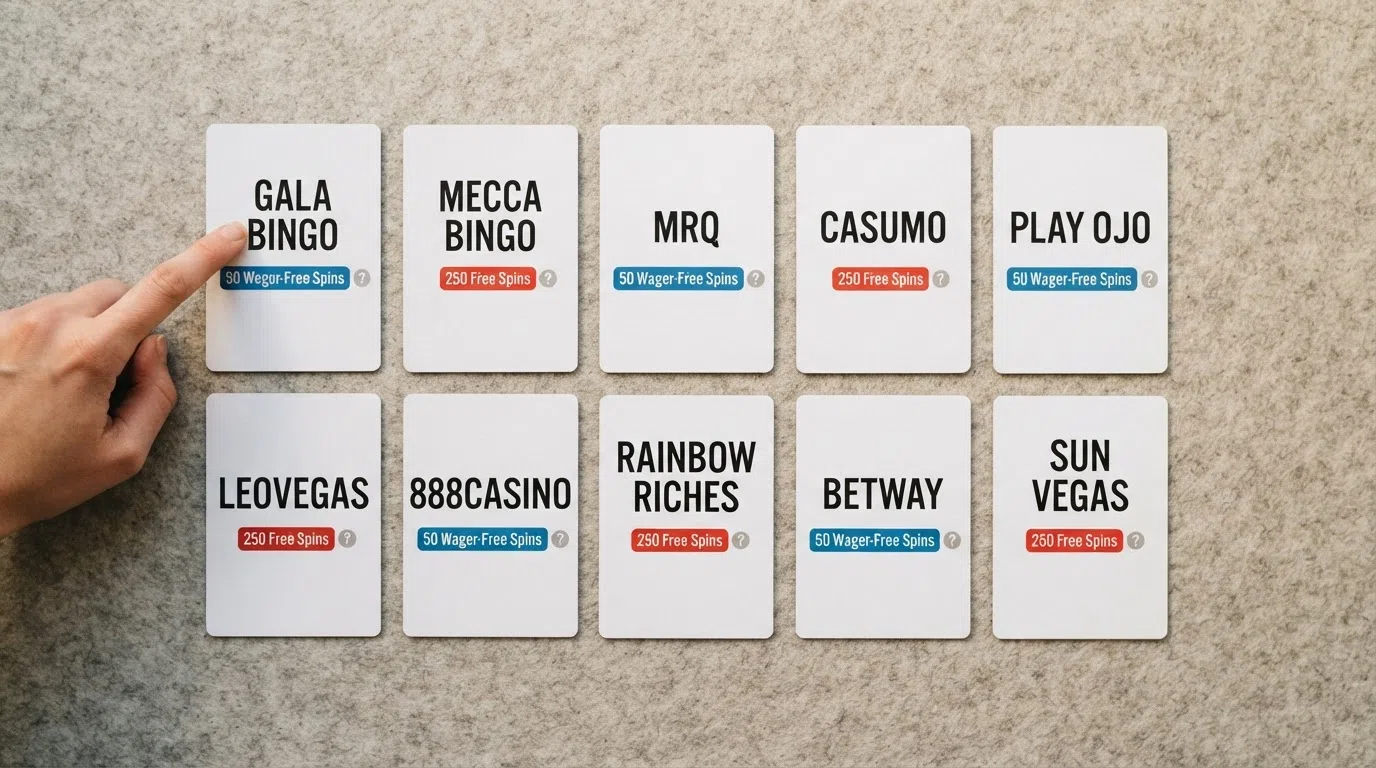
LeoVegas and Ladbrokes lead on verifiable standing, with Casino Remote activity confirmed Active from 1 November 2014 on the UKGC register. Sky Vegas, bet365 and LeoVegas lead on offer value — Sky Vegas for a genuinely no-deposit welcome, bet365 for the headline spin count, and LeoVegas for the clean 0×-wagering structure.
Top-Rated by Player Reviews and Reputation
Independent player-review or reputation data for these brands is rarely available. The ranking therefore rests on licence status and offer terms rather than review scores. Reputation claims are left out rather than invented, and the reader should treat any third-party review score for these brands as needing its own verification.
Processing Speed: The One Comparison This Page Cannot Make Yet
None of these operators currently confirm bank cheque acceptance. A per-operator cheque processing-time comparison would require at least one such confirmation, and none was available. The page therefore publishes no cheque-speed column. The only grounded speed contrast the page can make is the one between cheques, which are manual and take days, and instant rails, which credit on deposit. The reader should read the deposit-timing information on each operator’s live cashier page directly.
Deposit Limits and Fees by Operator: What Is Known and What Is Not
Per-operator cheque deposit limits and fees are not generally available. The cross-reference is to the sections above on cheque limits and cheque fees, which describe the general picture without claiming operator-specific figures that the research could not substantiate.
Sky Vegas — The Deposit-Free Entry Point
Sky Vegas is the only featured brand with a genuinely no-deposit welcome in the research carried out for this page. The structure is two stages: 50 free spins credited at registration, with no deposit required, followed by a further 200 free spins after a £10 deposit-and-stake. The wagering on winnings is 0×, stated on the operator’s support page, and each spin carries a 10p value. The first 50 spins expire seven days from credit; the £10 deposit-and-stake must be completed within 30 days of registration. Maximum cashout from the offer was not stated in the surfaced terms and should be verified on the live offer page.
For a cheque depositor, the structure matters because the first 50 spins can be played without committing any funds at all, and the deposit-and-stake step that unlocks the second 200 spins is a £10 transaction that posts fine through any rail. The wager-free framing is the cleanest in the featured set.
bet365 — Up to 500 Free Spins with a 10× Wagering Catch
bet365’s welcome offer headlines as “up to 500 free spins,” delivered via reveals or selections on selected Blueprint titles. The wagering on spin winnings is 10×, to be met within 72 hours of credit, and each spin carries a 10p value. The minimum trigger is £10 in lifetime deposits, and the offer must be claimed within 30 days of registration. The per-spin RTP on the eligible titles was not surfaced in the research and should be checked on the live offer page.
The 10× wagering is the line that changes the maths. Compare it to Sky Vegas or LeoVegas, where winnings carry no wagering at all, and the headline spin count starts to cost something real. A player chasing spin volume should weigh the headline against the playthrough it carries.
William Hill — A Sports-Bet Welcome, Not a Casino One
The William Hill welcome offer that surfaced in the research was a sports free-bet structure worth £40 in free bets under the G40 promo code. No casino-specific welcome bonus terms surfaced in this run. The casino welcome terms, free-spin position and wagering multipliers were not captured, and bank cheque acceptance was not confirmed. William Hill’s place in the UK high-street-to-online landscape is the only context the page can offer.
A reader expecting a casino match from William Hill needs to check the live casino promotions page directly. The brand is licensed and live; the offer shape on the casino side is simply not in the surfaced research.
Ladbrokes — UKGC-Licensed Since 2014, Light on Offer Detail
Ladbrokes Betting & Gaming Limited holds a UKGC Casino Remote licence active from 1 November 2014, which is the most concrete piece of verifiable data the research captured for this brand. The site’s own terms reference a welcome bonus and free spins, but no specific current amount surfaced in this run, and the wagering, expiry and bank cheque acceptance details are unverified.
The instruction is the same as elsewhere: confirm the live offer before depositing by any method. The licence date gives the reader a verified standing to start from, which is more than half the brands in the set carry.
Paddy Power — No Welcome Data Surfaced This Run
No welcome bonus, free-spin or wagering data is available, and bank cheque acceptance is unconfirmed. Paddy Power’s UK market presence is the only context the page can offer, and the brand is widely recognised on the UK high street and online.
The instruction is to read the live promotions and banking pages directly. A reader who arrives at the site expecting an offer structure from this page will not find one in the research; they will need the operator’s own page to fill that gap.
Coral — Another High-Street Name with No Surfaced Casino Offer
Coral’s current casino welcome terms were not captured in the research carried out for this page. No welcome bonus, free-spin or wagering data surfaced, and bank cheque acceptance was not confirmed. The brand’s place in the UK high-street-to-online landscape is the context the page can offer, alongside its sister-brand relationship with Ladbrokes under the same parent group.
The instruction is the same: verify the live offer and banking options directly. Coral is a recognised UK brand, and the absence of surfaced terms here is a research gap rather than a verdict on the brand.
Betfair — The Exchange Brand with a Casino Side
Betfair is best known for its betting exchange, and the only surfaced casino fragment in the research was a reference to a Jackpot King games promotion. No full current casino bonus terms were captured, and no bank cheque acceptance confirmation surfaced either.
The instruction is to check the live casino promotions page before committing. A reader who knows Betfair primarily from the exchange side should not assume the casino side carries a comparable offer structure without checking it directly.
LeoVegas — 50 Wager-Free Spins and a Confirmed UKGC Licence
LeoVegas Gaming PLC holds a UKGC Casino Remote licence active from 1 November 2014, on the same verified footing as Ladbrokes. The welcome offer is 50 wager-free free spins on Big Bass Splash after a £10 deposit with 1× deposit wagering, with each spin carrying a 10p value and a three-day expiry from credit. Maximum cashout from the offer was not stated in the surfaced terms.
The wager-free framing is the headline. Compare it to bet365’s 10× on spin winnings and the difference is the kind of number that changes which welcome is worth chasing. The confirmed licence date is the second headline: a reader who values verifiable standing can point at the UKGC register and read it for themselves.
Betway — A Global Brand with No Surfaced UK Welcome Data
Betway is on every UK casino shortlist by name, and no current offer specifics were found. No welcome bonus, free-spin or wagering data surfaced, and no bank cheque acceptance confirmation either. The brand’s global footprint is the only context the page can offer.
The instruction is to verify the live UK offer and banking options directly. The absence here is a research gap rather than a verdict, and Betway’s UK presence is real.
32Red — The Player-Favourite Brand with No Surfaced Terms
32Red has a long-standing UK reputation, and no current welcome package terms were found. No welcome bonus, free-spin or wagering data surfaced, and no bank cheque acceptance confirmation either. The brand’s established UK presence is the context the page can offer.
The instruction is the same as for the rest of the set: read the live promotions page before depositing. A player who knows 32Red by reputation should expect a familiar brand; they should not expect this page to fill in the offer terms the research did not capture.
A Cheque Is Still Your Money: How UK Licensing Protects Deposits Arriving by Post in 2026
What a UKGC Casino Licence Actually Requires
Every UK-licensed casino must meet the three licensing objectives set out in section 1 of the Gambling Act 2005: prevent gambling from being a source of crime or disorder, ensure gambling is conducted in a fair and open way, and protect children and vulnerable persons from harm. The working rules sit in the Licence Conditions and Codes of Practice (LCCP) and the Remote Gambling and Software Technical Standards (RTS). Operators follow them in practice through compliance teams, transaction monitoring and customer interaction protocols.
A GB licence is compulsory at point of consumption under the Gambling (Licensing and Advertising) Act 2014. Serving GB customers without one is criminal under section 33 of the Gambling Act 2005. The framework is sponsored by the Department for Culture, Media and Sport and enforced by the Gambling Commission, whose public register of gambling businesses is searchable by business, trading or domain name and was last updated on 29 July 2026.
The licensing objectives apply to every deposit method, including bank cheques. A cheque that lands at a casino’s banking address is held under the same segregation rules as a card payment, the same source-of-funds regime, and the same vulnerability-check thresholds. The licence does not vary by rail.
How a Paper Cheque Fits UK Anti-Money-Laundering Rules
A posted cheque is slower and more traceable than an e-wallet, and that alignment with the UK’s source-of-funds regime is the under-appreciated feature of the rail. Every UK casino runs pre-deposit identity verification, mandatory since 7 May 2019, which is what makes anonymous play impossible at any licensed site. A cheque that arrives at the casino carries the issuing bank’s details on its face and passes through the bank’s own audit trail, which feeds into the KYC process rather than complicating it.
The cheque’s manual nature does not exempt it from any verification step. If anything, it adds steps: the casino’s reconciliation team must match the cheque to the player account, confirm the issuing bank details, and clear the funds before credit. The slowness is the cost of the traceability.
What Happens to Your Money If a Casino Goes Under
Player fund segregation under UKGC licence conditions applies to every deposit method. Operators must keep customer balances separate from operating capital, and the protection tier each operator holds must be disclosed to the Gambling Commission. The tier the operator holds determines what happens to player funds in an insolvency scenario, and the limits of that protection vary.
The payment method used does not change the protection tier. A cheque deposit is held under the same rules as a debit card deposit, and the player whose cheque is still clearing when an operator fails has the same claim on the segregated pool as the player whose card deposit has already settled. The protection is structural rather than per-transaction.
Staying in Control: Safer-Gambling Tools Every Cheque Depositor Should Use in 2026
Deposit Limits and How They Apply to Cheque Payments
Every UK-licensed operator must prompt a player to set a financial limit before the first deposit, and any decrease to a set limit takes effect immediately. From 30 June 2026, the rule sharpens: only money paid into the account over a set duration may be called a “deposit limit,” and the term itself narrows to that meaning.
The £150 net-deposit vulnerability check, in force since 28 February 2025, runs on rolling 30-day net deposit totals using public data only. A cheque deposit above £150 in a rolling 30-day period trips the light-touch check. The cheque rail does not change the trigger; the deposit volume does. A player planning a single large cheque deposit should expect the check to run on it.
GamStop Self-Exclusion: What It Covers and How to Use It
GamStop has been mandatory for all online UKGC licensees since 31 March 2020. The exclusion periods are six months, one year and five years, with the five-year option set to auto-renew. A player cannot cancel an exclusion early, and if they do not re-contact GamStop after expiry, the block continues for up to seven years.
A player who has registered with GamStop cannot deposit at any UK-licensed site by any method, including cheque. The rail is irrelevant once the exclusion is in place. The tool is the strongest single control available to a UK player and is worth using before the deposit rail becomes a question.
Real Help When You Need It: Helpline, Self-Guided Tools and NHS Clinics
The National Gambling Helpline is free, confidential and available 24/7, run by GamCare. GamCare also publishes self-guided online support tools for players exploring their own gambling behaviour. NHS gambling-harm clinics operate in England, Scotland and Wales for treatment referrals.
The demand behind these services is part of why they exist. In 2026, up to 2 June 2026, 81.5% of National Gambling Helpline contacts disclosed online forms of gambling, up from 79.5% in 2025. In January 2026, GamCare made 996 referrals to treatment and peer-based support, up from 674 in January 2025, a 48% year-on-year rise. These figures are support-demand indicators, not population prevalence, but they are the scale that the licensed market’s player-protection framework is built to address.
How We Chose and Ranked These Operators
The ten featured operators were selected from the UK-market casino shortlist for fit to the topic. The UKGC public register was consulted where licence details surfaced, and the register’s last-updated date was 29 July 2026. The ranking criteria were UKGC licence status, welcome-offer value and wagering terms, with bank cheque policy as a fourth criterion that the research could not verify for any of the ten.
The honest caveat applies across the set: bank cheque acceptance was not confirmed for any featured operator at the time of research, and the reader must verify acceptance on each operator’s live cashier page. The scope is also narrower than the UK market as a whole: ten brands is not the licensed register, and a brand that did not feature here may still accept cheques. The page is a ranking of the set it ranks, not a directory of every UK-licensed casino.
Should You Deposit by Bank Cheque at a UK Casino in 2026?
A bank cheque deposit at a UK-licensed casino is legal and protected under the same UKGC rules as any other method. The fixed cost is the clearing delay of several working days before funds are playable, stacked on top of any postage time. The deeper problem is availability. No featured operator confirmed bank cheque acceptance at the time of research, and the page does not invent a list to fill the gap.
For a player who wants to play today, a debit card or bank transfer gets them there faster with identical player protections. A bank cheque remains a slow, manual niche, useful for a player who values the paper trail, who can wait for the funds to clear, and who has checked the operator’s live cashier page to confirm the rail is still accepted. For a player chasing a welcome bonus with a tight claim window, the cheque rail is the wrong choice: the clearing delay eats into the window before the bonus is even claimable.
The verdict is that the bank cheque casino in the UK is a real, licensed, protected niche — but a niche that has shrunk to the point where the question is less “which casino accepts my cheque” and more “does any casino still accept my cheque.” The answer to that question lives on the cashier page of each operator, and the page refuses to fill that gap with guesses.
Frequently Asked Questions
Do many UK-licensed casinos still accept bank cheque deposits, and which ones do?
Bank cheque acceptance is a niche rather than a standard rail at UK-licensed casinos in 2026. No featured operator in this page’s ranking confirmed acceptance at the time of research, and no published, up-to-date directory of cheque-accepting UK casinos surfaced. Confirm on each operator’s live cashier page before posting a cheque, and treat any third-party “cheque casino list” with the same caution.
How long does it take for a bank cheque deposit to clear and appear in my casino account?
The full end-to-end time runs from envelope to playable credit and is measured in working days rather than minutes. The UK cheque-clearing timeline handles the banking side, and the casino’s internal reconciliation adds a further processing delay on top. Compare this to a debit card or bank transfer deposit, which credits on deposit. The clearing wait is the cost of the rail.
Can I withdraw by cheque from a UK casino, and how long does that take?
Withdrawal by cheque still exists at some UK-licensed casinos, though the timeline is slower than e-wallet or bank transfer cashouts. The casino’s processing time stacks on top of the postage time and the player’s own banking cycle on receipt. Once a player has won, the practical advice is to choose the fastest cashout rail the operator offers rather than mirror the deposit method.
What is the maximum online slots stake for UK players in 2026, and does it affect deposits?
The maximum stake per game cycle is £5 for players aged 25 and over, in force since 9 April 2025, and £2 for players aged 18 to 24, in force since 21 May 2025. The cap applies to spin stakes, not to deposit amounts, so a cheque deposit can sit above the per-spin cap without any direct interaction. Deposit limits are a separate player-controlled mechanism.
Can I still pay at a UK casino by credit card in 2026?
Credit card gambling has been banned for UK customers since 14 April 2020, including via e-wallets where the wallet was funded by a credit card. The ban covers deposits only, not withdrawals, and applies to every UK-licensed operator regardless of payment method. A cheque drawn on a personal current account is unaffected by the credit card ban.
Payments – fastestpayout-casinos-uk
Content created by the «fastestpayout-casinos-uk» team