
Best International Casinos for UK Players in 2026: A Ranked, Honest Read
 Available in GB
Current as of September 8, 2026, with operator licence claims verified against the UK Gambling Commission’s public register and the Curaçao eGaming licence register.

A UK player searching for an “international casino” usually means one of three things, and the three do not lead to the same site. Some are looking for a way around the £5/£2 per-spin stake cap on online slots, which now binds every operator holding a Gambling Commission licence. Some are looking for a casino that will take a deposit without a GamStop self-exclusion blocking the transaction, an option the licensed market deliberately closes. Some are looking for crypto, which GB-licensed operators do not accept. All three readers will find what they want offshore, and all three will lose the safety net that comes with a GB licence the moment they do. This page ranks ten operators that accept UK players from outside the UKGC perimeter, names the licence each one runs on, and says out loud what that licence does and does not guarantee.
The ranking is built from operator websites, the Curaçao eGaming and UKGC public registers, the operator-side bonus terms published at sign-up, and recent player-complaint patterns from public forums and review aggregators. Where a number could not be verified, the cell stays empty rather than padded. The trade-off between the regulated GB market and the offshore one is the through-line: every section either shows what is given up or what is gained, and the final verdict in the last section names the reader each offer suits.
Why “International Casino” Means Something Different for UK Players
The word “international” does a lot of work on casino comparison sites, and almost none of it is the same work twice. Strip the marketing off and the term has a precise meaning in the UK context, and a precise set of consequences that follow from it.

What “International Casino” Actually Means in the UK Context
An international casino, as the term is used in UK-facing affiliate copy, is any online operator that accepts players in Great Britain while running on a licence issued somewhere else. The most common jurisdictions are Curaçao, the Malta Gaming Authority (MGA), Anjouan and, less often these days, Gibraltar. None of these is the UK Gambling Commission, and the difference is not cosmetic. A Curaçao-licensed operator is regulated by the Curaçao eGaming authority, accountable to it on disputes, complaint handling and licence conditions — and to nobody else for the British player sitting at the other end. An MGA-licensed operator is regulated in Malta, by a more established body, but the same point applies: when a payout stalls or a bonus term turns out to mean something else, the player cannot escalate to a UK regulator. The UK Gambling Commission oversees GB-licensed sites and nothing else.
The reason UK players search for these sites in the first place is structural, and the UKGC’s own rulebook is part of the pull. Online slots at GB-licensed casinos are now capped at £5 per game cycle for players aged 25 and over, and £2 per game cycle for players aged 18 to 24, in force since April and May 2025 under SI 2025/215. Credit cards have been banned for gambling at GB-licensed operators since April 2020, including credit-card-funded e-wallet top-ups. These two rules, plus a longer list of feature bans the next section covers, are the actual reason the international market exists as a search term rather than a niche.
How International Casinos Differ from UKGC-Licensed Operators
The differences are not aesthetic. They run through the rulebook the UKGC has built up over the last five years, and the absence of that rulebook at offshore sites is the whole point. The GB-licensed online slots player has not had auto-play available since 2021, cannot spin faster than once every 2.5 seconds, cannot see “losses disguised as wins” animations on the reels, and cannot reverse a withdrawal they have already requested. The international casino player can, because none of those rules bind the operator.
The bonus rules are the sharper difference for anyone whose main interest is the welcome offer. LCCP Social Responsibility Code 5.1.1, in force since 19 December 2025, caps wagering requirements at 10× on bonus funds at every GB-licensed site and bans mixed-product promotions. Non-GamStop casinos typically impose wagering requirements of 30× to 50× on deposit bonuses, with some reaching 60× to 70×. That is the same multiplier three to seven times over, on the same kind of offer, applied to a balance the player will probably never fully clear. The GB cap is a real ceiling. The offshore number is the marketing’s opening bid.
Financial checks and affordability controls are the next layer. A GB-licensed operator must verify a customer’s name, address and date of birth before the first deposit — the pre-2019 grace period is gone, and it went in May 2019. It must also run a light-touch financial vulnerability check once a player’s net deposits cross £150 in a rolling 30-day window, in force since 28 February 2025. Offshore sites typically do not run either check at deposit time. The verification is at the operator’s discretion, and the financial-vulnerability regime does not exist.
What UK Players Should Expect Before They Sign Up
Two things should be expected, and they pull in opposite directions. First, signing up at an international casino is faster and looser than signing up at a GB-licensed one. Most Curaçao-licensed operators in the featured set let a new account deposit, play and trigger the welcome offer within minutes of registration; KYC happens at withdrawal, if at all, and is run by the operator’s own compliance team rather than against a UK statute.
Second, the absence of a UKGC complaints route is the structural risk that follows. Withdrawal disputes are the most common complaint pattern at Curaçao-licensed sites, and there is no approved ADR provider standing behind a player who believes a payout has been wrongly withheld. The operator’s own internal complaints process is the only process. A UK player weighing an offshore site is weighing a faster and looser sign-up against a dispute-resolution path that ends at the operator’s own front door.
Top 10 International Casinos for UK Players in 2026
The ranking below is built from the operator’s licence jurisdiction, the published bonus terms at the time of review, the provider list and the no-deposit availability. Operators are ordered roughly by what they offer a UK player weighing one operator against the next, not by a single score: a no-deposit-free-spins offer sits higher than a larger but wagering-heavy headline bonus, and a transparent wagering mechanic ranks above a larger bonus with terms hidden behind a login wall. The full methodology is in the section titled “How We Selected and Ranked These International Casinos” further down.
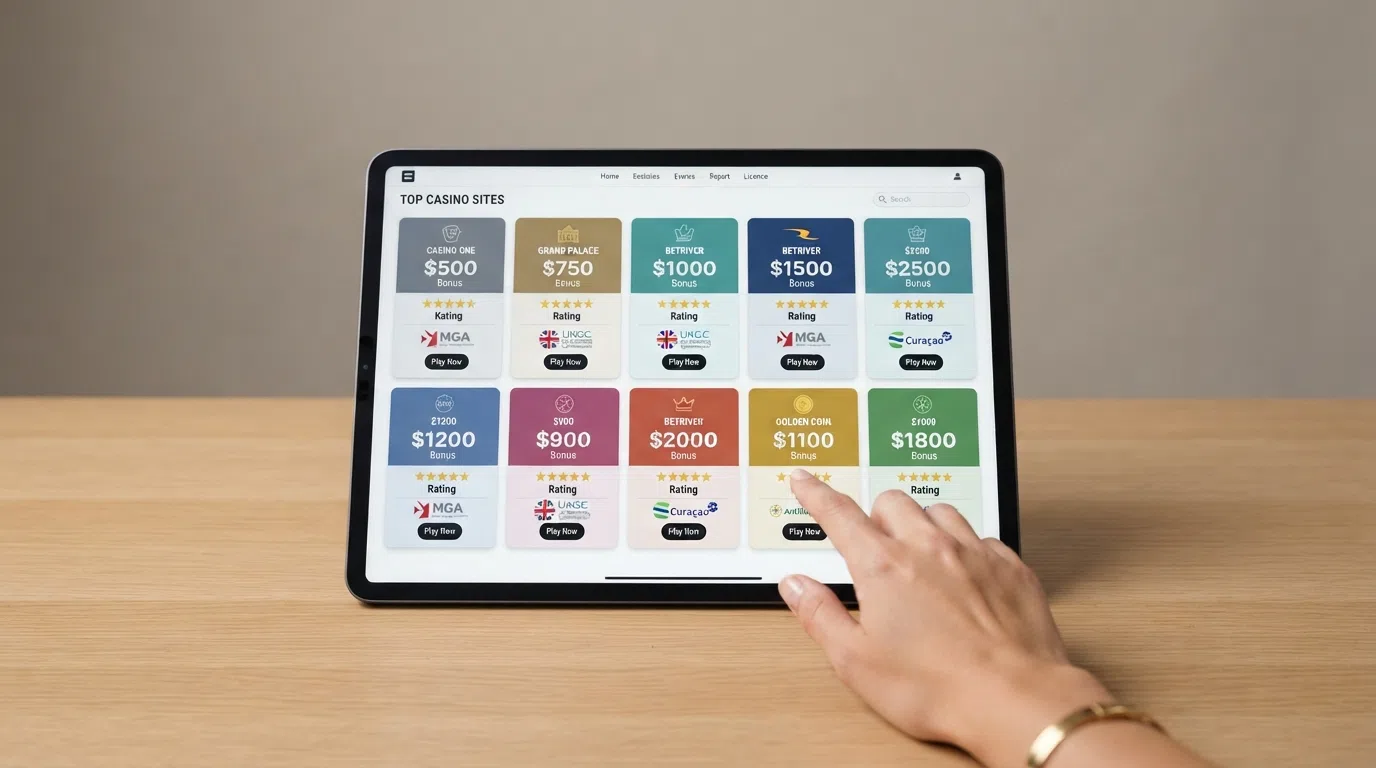
Comparison at a Glance
| Operator | Licence | Welcome Bonus | Wagering Multiplier | Free Spins |
|---|---|---|---|---|
| GoldenBet | Curaçao eGaming | 300% up to £1,500 (3 deposits) | 35× (deposit + bonus) | 100 FS in welcome + 30 ND FS |
| MyStake | Curaçao eGaming | 300% up to £1,500 (3 deposits) | 30× (deposit + bonus) | 20 ND FS |
| Rolletto | Curaçao eGaming (Santeda International B.V.) | 150% up to £500 + 200 FS | 30× (bonus) | 200 FS |
| FreshBet | Curaçao eGaming | 100% up to £500 (up to £1,280 over 3 deposits) | 30× (bonus only) | 25 ND FS |
| Winstler | Curaçao or Anjouan Gaming | 600% up to €9,500 (5 deposits) | 45× (deposit + bonus) | 50 ND FS |
| Jackbit | Curaçao eGaming | 100 wager-free spins (£50 deposit) | 0× (wager-free) | 100 FS |
| Wildz | MGA MGA/B2C/599/2018 + UKGC (Rootz Limited) | 100% up to €500 + 200 FS | 35× (bonus) | 200 FS |
| Slots Royale | UKGC (Jumpman Gaming) | Mega Reel variable prize | 10× (bonus) | Variable via Mega Reel |
| BC.Game | Curaçao eGaming | 360% first deposit (tiered) | — | — |
| Cloudbet | Curaçao eGaming | Matched deposit | — | — |
Two operators in the table — Wildz and Slots Royale — are GB-licensed and have been kept in the ranking deliberately. They are the contrast the rest of the table is set against, and they answer a reader who would rather not leave the UKGC perimeter at all. They are not “international” in the marketing sense; they sit in this ranking because the comparison the page is making is incomplete without them.
GoldenBet: No-Deposit Free Spins with Zero Wagering
GoldenBet is the standout no-deposit offer in the featured set. GoldenBet runs on a Curaçao eGaming licence. New accounts receive 30 free spins on Book of Dead on registration with no deposit required, and the winnings from those spins carry 0× wagering — meaning anything won is paid as cash, not bonus funds. That mechanic is rare enough to be worth naming twice: most no-deposit free-spin offers carry a wagering multiplier of 30× to 50× on winnings, which converts a small win into a long clearing run. GoldenBet removes the multiplier entirely for the no-deposit spins.
The deposit welcome package is 300% up to £1,500 across three deposits, plus 100 free spins in the welcome bundle. Wagering is 35× on deposit plus bonus with a 30-day validity window. The provider mix reads like a checklist of the studios UK players actually want: Pragmatic Play, NetEnt, Evolution, Hacksaw, Play’n GO, Push Gaming and Nolimit City. For a player who values the no-deposit mechanics above the deposit welcome, GoldenBet is the cleanest option in the ranking.
MyStake: 6,800+ Games and a 300% Welcome Package
MyStake pairs the second-largest game library in the featured set with a 300% welcome package split 150%, 100% and 50% across the first three deposits, up to £1,500 in total. MyStake holds a Curaçao eGaming licence. Game count is the headline: 6,800+ titles from Pragmatic Play, NetEnt, Evolution, Microgaming and Play’n GO, with the rest of the catalogue spread across the smaller studios the platform has integrated.
The no-deposit side offers 20 free spins on registration, smaller than GoldenBet’s 30 and without the zero-wagering edge. The deposit-bonus wagering is 30× on deposit plus bonus combined, with 30 days to clear. MyStake is the operator for a player who treats game variety as the primary signal of value and is willing to take a smaller no-deposit spins package in exchange for the deeper catalogue.
Rolletto: 200 Free Spins and a Sports-Casino Hybrid
Rolletto runs on a Curaçao eGaming licence under Santeda International B.V. The casino welcome is 150% up to £500 plus 200 free spins, and the combined sportsbook-and-casino welcome reaches up to £5,500 across three deposits for players who want to use the bonus across both products. Wagering is 30× on the bonus amount and 30× on free-spin winnings, with a 30-day validity. The minimum deposit to trigger the offer is £10.
The provider mix covers Pragmatic Play, Evolution, NetEnt, Hacksaw and Play’n GO. Rolletto’s edge over the rest of the Curaçao-licensed cluster is the combined sportsbook, which matters to a player who wants to use one wallet for both products rather than split deposits across two sites. The bonus terms on the free-spin winnings are the trade-off: 30× on spin winnings is heavier than GoldenBet’s zero and turns a 200-spin win into a clearing run rather than cash.
FreshBet: No-Deposit Spins with Bonus-Only Wagering
FreshBet is an offshore operator licensed in Curaçao. The headline is 100% up to £500 on the first deposit, with the full package reaching up to £1,280 across three deposits, and 25 no-deposit free spins on registration with no bonus code required. The wagering mechanic is the differentiator: 30× is applied to the bonus amount only, not the deposit plus bonus, which halves the playthrough volume at any given bonus size. The provider list covers Pragmatic Play, NetEnt, Evolution and Play’n GO.
For a player doing the arithmetic on what a bonus actually costs to clear, FreshBet’s bonus-only wagering is materially cheaper than deposit-plus-bonus wagering at the same multiplier. The 25 no-deposit free spins are mid-pack by count and do not carry the zero-wagering edge GoldenBet offers on its no-deposit spins. FreshBet is the cleanest bonus-only play in the ranking.
Winstler: The 600% Five-Deposit Marathon
Winstler runs on a Curaçao licence (some sources cite Anjouan Gaming / Comoros) and is not GB-licensed. The headline is the largest percentage in the featured set: 600% up to €9,500 across the first five deposits. Fifty no-deposit free spins are available on registration, with 40× wagering on the no-deposit winnings. The deposit welcome carries 45× on deposit plus bonus per promotion, with a 7-day validity per tier — a window short enough to make the higher multiplier harder to clear in practice. The minimum deposit to trigger the welcome package is €50.
The provider list includes Pragmatic Play, NetEnt, Evolution and Microgaming. The trade-off is sharp: 600% looks exceptional on a marketing page, but the combination of 45× wagering, a 7-day per-tier window and a €50 minimum per deposit is the most aggressive set of conditions in the ranking. Winstler suits a high-volume player who can clear a five-tier package inside a week and is willing to commit €50 per deposit to do it.
Jackbit: 100 Wager-Free Spins — Keep What You Win
Jackbit runs on a Curaçao eGaming licence and is not GB-licensed. The welcome offer is the only one in the featured set with 0× wagering on the welcome spins: 100 free spins activated at a £50 minimum deposit, with no playthrough on winnings. There is no no-deposit offer confirmed. The provider mix covers Pragmatic Play, Evolution, NetEnt and Hacksaw.
The 100 wager-free spins make Jackbit the simplest offer to evaluate in the ranking: a player who deposits £50 gets 100 spins, wins whatever the spins return, and withdraws. There is no clearing calculation to run because there is no clearing requirement. The £50 entry point is the only friction, and it is on the high side relative to the £10 minimums at Rolletto and Wildz.
Wildz: The GB-Licensed Operator with an International Feel
Wildz is the ranking’s pivot. It is operated by Rootz Limited under MGA licence MGA/B2C/599/2018 and a parallel UKGC licence, so it is GB-licensed and subject to the full UKGC rulebook — the £5/£2 stake cap, the 10× wagering cap, the financial vulnerability check at £150 net deposits, the GamStop integration, the credit card ban. The 6,000+ game catalogue runs on Pragmatic Play, NetEnt, Evolution, Microgaming and Play’n GO. The welcome is 100% up to €500 plus 200 free spins, delivered as 25 spins per day over 8 days, with 35× wagering on the bonus amount — a 2-minute daily release. No no-deposit offer is available.
Wildz is in this ranking because it is the operator a UK player should look at first if the reason for going offshore is the welcome offer rather than the stake cap, the crypto rail or the GamStop gap. A player who can live with a 10× cap and a £5 spin ceiling does not need to leave the UKGC perimeter. The free-spin drip is the soft trade-off: 200 spins sound generous, but 25 a day over 8 days is a slow release that drags the welcome out.
Slots Royale: UKGC-Regulated with a Gamified Welcome
Slots Royale is operated under a UKGC licence by Jumpman Gaming, so it is GB-licensed and bound by the same rulebook as Wildz. The welcome is a spin on the Mega Reel for a variable prize, with 10× wagering on whatever the wheel lands on — a gamification layer that converts the welcome bonus into a lottery. The provider list covers Pragmatic Play, NetEnt, Microgaming and Eyecon. A minimum £10 fund is required to spin the reel. There is no no-deposit offer.
Slots Royale is for a player who has decided to stay inside the UKGC perimeter and wants the prize-wheel mechanic as part of the welcome. The variable prize is the trade-off against the predictable welcome at Wildz: a player may land a useful bonus or may not, and the 10× wagering on the GB-capped side means the wagering is the cheapest in the ranking, but the headline is the most volatile.
BC.Game: 4,000+ Games and a Crypto-First Platform
BC.Game runs on a Curaçao eGaming licence and is not GB-licensed. The platform hosts 4,000+ games from 60+ studios, with Pragmatic Play, Evolution and Hacksaw among the larger names in the mix. The first-deposit welcome is 360%, structured across tiers. Wagering, free-spin availability and validity windows are not publicly disclosed at the headline level and require opening an account to see the full terms. The platform is crypto-focused at the payment rail: deposits and withdrawals are built around digital assets rather than card rails.
BC.Game is for a player who wants the deepest crypto integration in the ranking and is comfortable with terms that are not published up front. The 60+ studio count is the structural advantage over the smaller Curaçao-licensed operators. The opacity on wagering at the headline level is the trade-off, and a player who wants the terms in writing before depositing should look elsewhere.
Cloudbet: The Crypto-Only Sportsbook and Casino Hybrid
Cloudbet runs on a Curaçao eGaming licence and is not GB-licensed. Deposits are crypto-only — Bitcoin, Ethereum and other digital assets are the supported rails, with no card or bank-transfer deposit route. The welcome is a matched-deposit offer, with the multiplier and maximum varying by current promotion; wagering and validity are not publicly disclosed at the headline level. The catalogue covers slots, live casino and table games across multiple providers, and the platform pairs the casino with a sportsbook.
Cloudbet is the only fully crypto-only operator in the ranking, and the trade-off follows from that. A player who wants to deposit in pounds through a debit card cannot use Cloudbet. A player who already holds crypto and wants the matched-deposit bonus without a UKGC perimeter will find a deep enough catalogue, but the headline terms require an account to see in full. Cloudbet suits a crypto-native player who has already decided on the rail.
What You Gain — and What You Give Up — Playing Outside the UKGC
The trade-off a UK player makes by leaving the UKGC perimeter is not hidden in the small print. It is the entire shape of the decision, and the rest of this page is unpacking it. This section names the protections, the losses and the gains in the same place, so the comparison the rest of the article is built on is visible to the reader up front.
The UKGC Protection Stack: What GB-Licensed Players Get by Default
A GB-licensed online casino is one of the most heavily regulated consumer products a UK adult can sign up for. The full stack runs from sign-up through to dispute, and the most important parts of it are mandatory.
GAMSTOP has been a mandatory condition of every GB online operating licence since 31 March 2020, with exclusion periods of six months, one year, five years, or five years with auto-renewal — and no early cancellation. From 31 October 2025, GB-licensed operators must prompt customers to set a financial limit before their first deposit; the term “deposit limit” is reserved for a gross deposit limit per the Remote Technical Standards from 30 September 2026. Online slots carry a maximum stake of £5 per game cycle for players aged 25 and over, and £2 per game cycle for players aged 18 to 24, in force since April and May 2025. Credit cards have been banned for gambling since 14 April 2020, including credit-card-funded e-wallet transactions. Identity verification — name, address and date of birth — is required before the first deposit, a rule in force since 7 May 2019. LCCP Social Responsibility Code 5.1.1, in force since 19 December 2025, caps wagering requirements at 10× on bonus funds. Financial vulnerability checks trigger at a £150 net deposit threshold in a rolling 30 days, in force since 28 February 2025. And if a dispute with a GB-licensed operator cannot be resolved directly, the player has an approved ADR provider and a UKGC complaints route standing behind them.
What You Leave Behind When You Play Offshore
Each of the protections above stops at the UKGC perimeter, and the international casino picks up nothing in their place. GAMSTOP coverage applies to GB-licensed sites only — an offshore site has no integration and no obligation to honour the exclusion. The UKGC complaints route does not extend to non-GB-licensed operators; the regulator’s enforcement tools (cease-and-desist notices, search-engine URL referrals, payment-provider referrals, test purchasing) reach the operator, not the player. There is no approved ADR provider for dispute resolution. There is no statutory deposit-limit prompt, no financial vulnerability check, no age-banded stake cap. Wagering requirements typically run 30× to 50×, with some reaching 60× to 70×, against the GB cap of 10×. And critically, the operator faces no UK criminal sanction if it withholds a player’s funds.
What You Gain: The Reasons UK Players Choose International Casinos
The pull factors are not invented. Welcome bonuses at international casinos in the featured set run from 100% to 600% of the first deposit, against the GB-capped 10× wagering environment where the bonus percentage is secondary to the clearing mechanic. Higher or no stake limits on slots — the £5/£2 cap simply does not bind. Cryptocurrency deposits, which the UKGC does not allow at its licensees. No GamStop block for a player who self-excluded and later changed their mind, although that is a sensitive outcome and not a benefit to be encouraged. No financial vulnerability checks at the £150 net deposit threshold. And access to game providers and titles that may not hold UKGC game certification, which means some slots, mechanics and live-dealer variants the GB market does not carry.
How International Casinos Accept UK Players: Verification, Geo-Blocking and the Law
The mechanics of access matter as much as the offer. The Gambling Act 2005 targets operators, not players, and the Commission’s own line is that there is no law that makes it illegal for a UK resident to play at a site licensed abroad. Most international casinos do not geo-block UK IP addresses, so the practical entry point is the same as for any other player: a registration form, a deposit method and a sign-in.
KYC is the variable. There is no statutory pre-deposit verification regime at offshore sites, and the timing and depth of identity checks is at the operator’s discretion. Withdrawal is where KYC most often hits, and the most common complaint pattern at Curaçao-licensed sites is a withdrawal stalled or refused after a verification request. The UKGC’s enforcement toolkit is real but bounded: it issued 3,140 disruption notices, referred 447,778 URLs to search engines, achieved 287,961 URL removals and recorded an average 32% fall in engagement across 160 disrupted sites between April 2024 and June 2025. ISP/DNS blocking legislation has been proposed but is not yet enacted. The Commission has no current statutory blocking power, and the operator it disrupts faces enforcement against itself, not sanctions on behalf of the player.
Why Your 2026 International Casino Bonus Is Smaller Than It Looks
The headline bonus is the smallest piece of the calculation. A 300% up to £1,500 offer is not £1,500 of free money; it is a matched amount that must be cleared through a wagering multiplier, inside a validity window, against games that contribute different percentages to the playthrough. The same £1,500 headline at two operators can cost two very different amounts to clear.
How International Casino Welcome Bonuses Actually Work
The structure most international casinos use is a deposit-tiered package. GoldenBet’s 300% up to £1,500 is split across the first three deposits. MyStake’s 300% up to £1,500 runs 150%, 100% and 50% across three deposits. Winstler’s 600% up to €9,500 runs across five. Rolletto’s combined package reaches up to £5,500 across three deposits when the sportsbook is included. The match percentage is multiplied by the deposit at each tier, not added flat across the three, so the second and third deposits always carry a lower match than the first.
The maximum cap is the ceiling on what the bonus can be, not a guaranteed payout. A player who deposits the minimum at every tier will receive a much smaller bonus than a player who deposits the maximum at every tier. The wagering requirement is the real gatekeeper: it is the multiplier applied to the bonus amount (or deposit plus bonus, depending on the operator) that determines how much must be staked before the bonus converts to withdrawable cash.
Bonus Terms That Decide What You Actually Keep
Four numbers turn a headline bonus into withdrawable cash: the wagering multiplier, what the multiplier applies to, the validity window, and the game-weighting percentages.
Wagering multipliers at the featured offshore operators run from 0× (Jackbit’s wager-free spins) to 45× (Winstler). Most sit between 30× and 35×. The 10× cap at GB-licensed sites is the floor, and offshore offers are three to four times heavier on the same kind of bonus.
What the multiplier applies to matters as much as the multiplier. GoldenBet, MyStake and Winstler apply their wagering to deposit plus bonus, which doubles the volume the player has to stake at any given multiplier. FreshBet applies 30× to the bonus amount only, which halves the playthrough at the same multiplier. Jackbit’s 0× applies to nothing, because there is no playthrough. A 35× on deposit plus bonus at a £1,000 deposit and a £1,500 bonus means £87,500 of qualifying stakes; a 30× on bonus only at the same figures means £45,000. The “smaller” 30× is the cheaper bonus.
Validity windows decide whether the wagering is realistic. GoldenBet, MyStake and Rolletto give 30 days. Winstler gives 7 days per tier, which compresses the same clearing volume into a fifth of the time. A 7-day window at 45× on deposit plus bonus is the hardest combination in the featured set.
Game weighting is the variable that does not appear in the headline. Slots typically contribute 100% of the stake to the wagering requirement; table games often contribute 10% to 20%. A player who wants to clear a bonus on blackjack has to stake five to ten times the volume to release the same amount. Maximum win caps on bonus funds — present at some operators, absent at others — are the final ceiling.
Bonus Terms at a Glance
| Operator | Wagering Multiplier | Applies To | Validity |
|---|---|---|---|
| GoldenBet | 35× | Deposit + bonus | 30 days |
| MyStake | 30× | Deposit + bonus | 30 days |
| Rolletto | 30× | Bonus amount | 30 days |
| FreshBet | 30× | Bonus only | — |
| Winstler | 45× | Deposit + bonus | 7 days per tier |
| Jackbit | 0× | Wager-free | — |
| Wildz | 35× | Bonus amount | — |
| Slots Royale | 10× | Bonus amount | — |
| BC.Game | — | — | — |
| Cloudbet | — | — | — |
The two GB-licensed operators — Wildz and Slots Royale — sit at the bottom of the multiplier column by design, not by generosity. The 10× cap is the rule, and any GB welcome sits at or below it. BC.Game and Cloudbet leave the wagering and validity columns empty because those terms are not published at the headline level and require opening an account to see. A reader who wants the terms in writing before depositing should treat the empty cells as a signal.
No-Deposit Bonuses and Free Spins: What Is Actually Free
Four operators in the featured set offer genuine no-deposit free spins: GoldenBet (30 spins on Book of Dead with 0× wagering), MyStake (20 spins on registration), FreshBet (25 spins on registration, no code required) and Winstler (50 spins available). The “no-deposit” descriptor means what it says — no payment is required to trigger the spins — but the winnings on those spins are usually subject to a wagering multiplier before they convert to withdrawable cash.
GoldenBet is the exception. The 30 no-deposit free spins on Book of Dead carry 0× wagering on winnings, which means a win on the spins is paid as cash rather than as bonus funds. The 0× mechanic is rare enough to be the single sharpest edge in the no-deposit cluster, and it is the reason GoldenBet sits at the top of the ranking. Winstler’s 50 no-deposit spins sit at the other end: more spins, but 40× wagering on the winnings, which is a long clearing run on whatever the spins return. The deposit-triggered free spins at Rolletto (200 spins), Jackbit (100 wager-free spins at £50 deposit) and Wildz (200 spins dripped at 25 per day) are a different category: the spins are real, but the offer is conditioned on a deposit, which makes it part of the welcome package rather than a free look.
Ongoing Promotions, Reload Bonuses and Loyalty Schemes
The welcome bonus is a one-time event. What the casino offers returning players is the longer-term value, and it is also the part of an operator’s offering that changes most often. Reload bonuses — matched deposits on second, third and subsequent deposits beyond the welcome — are the most common ongoing mechanic. Cashback programmes return a percentage of net losses over a defined period. Loyalty and VIP tiers convert play volume into perks like faster withdrawals, higher deposit limits, personal account managers and bespoke bonuses. Tournament and leaderboard promotions run on slots and live-dealer games with prize pools funded by the operator.
Per-operator ongoing-promo data is thinner in the public domain than welcome-bonus data, in part because the terms change frequently and in part because loyalty tiers are by definition negotiated on a per-player basis. The honest framing is that ongoing value at international casinos is real and the welcome bonus is a misleading predictor of it. A player who plans to stay at a single operator for six months will get more from the reload and cashback terms than from the welcome they signed up to.
Getting Your Money Out: Payments, Crypto and the Withdrawal Wait
Deposits are the easy half of the payment process. Withdrawals are where international casinos show their real colours, and the speed, friction and cost of a payout is a sharper quality signal than the welcome offer.
Deposit Methods: What UK Players Can Actually Use
Debit cards (Visa, Mastercard), e-wallets (Skrill, Neteller, and at some sites PayPal), bank transfer and cryptocurrency (Bitcoin, Ethereum, Tether, others) are the standard rails. Prepaid vouchers appear at some operators. The credit card ban at GB-licensed sites does not bind offshore operators directly, but UK-issued credit cards may still decline gambling transactions at the issuer’s discretion — a card-rail block, not a regulatory one. No blanket UK-wide block on debit-card gambling transactions exists, but individual banks have been known to flag gambling transactions, and a player whose bank does so will need a different rail.
E-wallets are useful at international casinos for a different reason: they keep the gambling transaction off the bank statement’s main feed, which is a privacy rather than a regulatory benefit. Cryptocurrency is the differentiator at the international end. UKGC licensees do not allow direct crypto deposits under their AML and source-of-funds rules, so the offshore crypto offer is genuinely unavailable in the GB-licensed market. Cloudbet and BC.Game are the operators in the featured set built around the crypto rail; the others accept crypto as one option among several.
Withdrawal Speed, Limits and the Verification Hurdle
Typical withdrawal processing times at international casinos range from instant (crypto at operators with automated systems) to five business days (card and bank transfer at operators with manual approval queues), and the range within the featured set is wide. KYC verification is the most common cause of a withdrawal delay: a player who registered without full verification and then requested a payout will be asked for proof of ID, proof of address and proof of payment method, and the request has to clear the operator’s compliance team before the funds are released.
Withdrawal limits per transaction, per day, per week and per month are operator-defined and vary widely; some of the featured Curaçao-licensed operators publish daily and monthly limits in the cashier area, others do not. The absence of a UKGC complaints route is the structural risk: if a withdrawal is disputed and the operator’s internal process does not resolve it, the player has no approved ADR provider and no regulator to escalate to. Crypto withdrawals are typically faster than card or bank withdrawals and carry fewer intermediary steps, which is one of the structural reasons crypto-first operators are popular with high-volume players.
Currency Options: GBP, EUR, Crypto and the Hidden Cost of Conversion
Most Curaçao-licensed operators in the featured set accept GBP deposits, but several settle internally in EUR and convert on the way in or out. MGA-licensed operators like Wildz default to EUR. Crypto settles in the asset deposited, with no fiat conversion at all. The conversion cost is the hidden one: a £10 deposit converted to EUR at the operator’s rate may return less than the £10 the player sent, and the same conversion runs in reverse on the way out, with the exchange-rate margin taken at the operator’s chosen rate.
A player who wants to avoid the conversion layer has two routes: deposit in the currency the operator settles in, or use crypto. Both routes require the player to check the cashier’s terms before depositing, because the operator’s stated deposit currency and its settlement currency are not always the same. Per-operator currency-fee data is not consistently published, and a player who wants the exact margin should ask the operator’s support before committing a large balance.
More Than Slots: The Games and Providers That Set International Casinos Apart
Game variety is the international casino’s strongest suit. The provider list at the larger Curaçao-licensed operators is wider than the typical GB-licensed catalogue, and the absence of the UKGC’s stake cap and feature bans means slots, live-dealer tables and game-show titles all run at full stake with no auto-play restriction.
Online Slots: Classic, Video and Progressive Jackpots Without the UKGC Stake Cap
The slots lobby at a typical international casino in the featured set runs from classic three-reel titles through video slots with bonus rounds and free-spin features, and out to progressive jackpot slots with pooled prizes across a network. The £5/£2 per-spin stake cap at GB-licensed sites, in force since April and May 2025, does not apply at offshore operators, which means a slot can be played at the stake level the player and the game’s betting range both support. Auto-play is available at offshore casinos, having been banned at GB sites since 2021. Minimum spin speed is not regulated, so the 2.5-second minimum that binds GB-licensed slots does not apply.
The trade-off is verification, not variety. A progressive jackpot slot at an international casino is paid by the operator, not by a GB-licensed network, and the jackpot’s terms — contribution rate, payout cap, withdrawal method — are set by the operator. The headline jackpot is real, but the terms around it are operator-defined.
Live Dealer Games: Blackjack, Roulette, Baccarat and Beyond
Evolution and Pragmatic Play Live dominate the live-dealer lobby at international casinos in the featured set, with both studios present in eight of the ten operators. The catalogue covers live blackjack (standard and variant tables including Infinite, Speed and VIP), live roulette (European, French, American and the Lightning/Immersive variants), live baccarat and live poker variants, and the game-show titles — Dream Catcher, Crazy Time, Monopoly Live and their successors — that have become a separate category at the major live-dealer studios. Native-speaking dealer tables for English-speaking players are standard at the larger operators.
The Evolution / Pragmatic Play Live duopoly at the top of the live-dealer market is the structural reason the live lobby looks similar across operators. Different operators differentiate on table limits, side-bet availability and the game-show catalogue, not on the studio itself.
The Provider Studios Behind International Casino Game Libraries
The provider list at an international casino is a faster quality signal than the bonus headline. The names that recur across the featured set are Pragmatic Play (slots and live dealer), NetEnt (slots), Evolution (live dealer), Microgaming (slots and the progressive jackpot network), Play’n GO (slots), Hacksaw Gaming (high-volatility slots), Push Gaming (slots) and Nolimit City (high-volatility slots). A casino with all eight is in a different category from a casino with three; the catalogue is wider, the games are newer, and the live-dealer lobby is full rather than token.
BC.Game’s 60+ studio count is the outlier and reflects a different business model — a crypto casino aggregating as many studios as it can integrate, against a smaller Curaçao-licensed operator with five to ten studios and a tighter catalogue. Game certification and RNG auditing at offshore casinos is real but not visible at the player-facing level: a player who wants the audit trail should look for the operator’s published testing-house certificates (typically from companies like iTech Labs, Gaming Laboratories International or BMM Testlabs), and the absence of a certificate in the footer is a soft signal, not a verdict.
Mobile Play: Apps, Browser and What You Lose on a Small Screen
Native apps are rare at Curaçao-licensed casinos and more common at MGA-licensed operators. Wildz runs an app; the smaller Curaçao-licensed operators in the featured set rely on responsive mobile web. The browser experience at the larger operators is good: the game catalogue is the same as on desktop, the cashier works on a phone, and the live-dealer tables run in landscape. The losses on a small screen are the things an app would otherwise carry: push notifications for bonuses and tournament alerts, biometric login, and the slightly faster load of an installed app over a browser tab. None of the losses is structural for a player who plays a few times a week; all three matter more for a daily player.
How to Separate Trustworthy International Casinos from the Rest
Without the UKGC as a backstop, the due diligence moves from the regulator to the player. The framework below is the minimum routine for evaluating an international casino before depositing.
The Evaluation Criteria That Actually Matter
Licence jurisdiction is the first filter. Curaçao eGaming is the most common licence in the offshore market and the one with the lightest regulatory touch — the licence exists and the operator is accountable to it, but the player-protection regime is thinner than at MGA or UKGC. MGA is more established and runs a more rigorous dispute-resolution process, but the player is still outside the UK perimeter. Anjouan is a newer licence jurisdiction and the regulatory weight is the least established of the three. None of the three equals the UKGC; the comparison is among three offshore regimes, not against the GB one.
The provider list is the second filter. A casino with Pragmatic Play, NetEnt, Evolution, Microgaming, Play’n GO and Hacksaw on its lobby is integrating with studios that have their own compliance obligations and audit their games independently. A casino with three unknown studios is a different kind of operation, and the game-certification question matters more.
Withdrawal complaints are the third filter and the most informative. A search of the operator’s name plus “withdrawal” or “payout” on a public forum or review aggregator surfaces the complaint pattern directly. A casino with a clean record over two or three years is a stronger candidate than a casino with no record at all — and a casino with no record is, by definition, new.
Bonus terms published at the headline level are the fourth. A casino that publishes its wagering multiplier, what it applies to, the validity window and the game weighting before the player registers is more transparent than one that hides the terms behind a login wall. The four numbers in the previous section’s table — wagering, applies-to, validity and game weighting — are the minimum the player should be able to see before depositing.
The absence of a UK ADR provider is the structural fact the player cannot change. If a withdrawal goes wrong, the operator’s internal process is the only process. A casino with a published, time-defined complaints process and a named escalation contact is in a different category from a casino with neither.
Red Flags and Warning Signs
A short list of what should make a player pause: no licence information visible on the operator’s site, or licence information that does not resolve to a register entry. Bonus terms hidden behind a login wall, or not published at all. Withdrawal complaints visible in forum and review-aggregator searches, especially patterns of the same complaint repeating. No responsible-gambling tools on the site — no deposit limit, no session timer, no self-exclusion link, no help-line number. Unrealistic bonus promises, particularly the kind of headline that requires a 60× or 70× wagering multiplier to clear. Copycat branding or a site design that visibly clones another operator’s. No live chat or a customer-support team that does not respond to a pre-deposit question.
None of these is a verdict on its own. A casino with one is unusual; a casino with three or more is a hard pass.
How to Vet a New International Casino Before Depositing
A new international casino in 2026 is one launched within the last 12 to 18 months, and the category is worth a separate routine because the withdrawal track record does not yet exist. The advantages are real: fresh welcome bonuses, modern mobile-first design, newer provider integrations and the promotional spend of a brand trying to build a player base. The risks are the inverse: no track record, limited review coverage, ownership that may not yet be established, and a licence that has not been stress-tested by a complaint cycle.
The five-minute routine is straightforward. Check the licence register — the Curaçao eGaming register and the MGA register are both searchable by operator name, and an entry that does not resolve is the end of the conversation. Search the operator’s name plus “withdrawal”, “payout” and “complaint” on a public forum or a review aggregator. Open the live chat before depositing and ask a question — a deposit-and-withdrawal method, a bonus term, a verification requirement. Read the bonus terms in the cashier before signing up, and look for the four numbers the previous section names. Look for the responsible-gambling footer — deposit limit, session timer, self-exclusion, help-line link. None of the steps is conclusive on its own, and together they take less time than a first deposit and a first spin.
Where UK Players Can Turn When Gambling Stops Being Fun
International casinos are thinner on responsible-gambling infrastructure than GB-licensed sites, and the difference is the most important one in this section. The tools exist at most offshore operators, but they are not mandatory, and the UK-specific help network that surrounds the licensed market is what a UK player in difficulty is most likely to use. This section names the help available and the prevalence data that makes it relevant.
The Tools International Casinos Offer — and What Is Missing
Most international casinos in the featured set offer a deposit limit, a session timer and an operator-level self-exclusion. The deposit limit is typically set in the cashier and applies across the operator’s product line. The session timer is a reality-check prompt after a defined play period. Operator-level self-exclusion blocks the player’s account at that operator, but it is not cross-operator: there is no GamStop equivalent offshore, and a player who self-excludes at one international casino can sign up at another the same afternoon.
The mandatory GB protections are not present. There is no statutory deposit-limit prompt at first deposit. There is no financial vulnerability check at a £150 net deposit threshold. There is no affordability assessment. There is no GamStop integration. The gap between what a GB-licensed site must offer and what an international casino typically does is the structural one a player in difficulty feels first.
UK Help Resources: Free, Confidential and Available Now
The UK help network is robust, free and confidential. The National Gambling Helpline, run by GamCare, is on 0808 8020 133 — freephone, 24 hours a day, every day. The same service runs online chat and a forum at gamcare.org.uk, alongside structured counselling. GamCare received 55,228 calls and online chats in 2023–24, a 25% increase on the previous year, and made 996 referrals to treatment and peer-based support services in January 2026, up from 674 in January 2025 — a 48% year-on-year increase that is the clearest indicator of how demand has moved.
GambleAware, at gambleaware.org, runs self-assessment tools and information. NHS gambling harm clinics operate in England, Scotland and Wales. Gamblers Anonymous UK, at ga.org.uk, runs peer-support meetings. GamStop, at gamstop.co.uk, runs the self-exclusion register, but it covers GB-licensed sites only and is the gap a player in difficulty who is using an international casino is most likely to fall through. The statutory levy that came into force on 6 April 2025, charged at 1.1% of gross gambling yield for remote casino, remote bingo and remote general betting licences, funds this treatment and prevention infrastructure — 50% to treatment, 30% to prevention, 20% to research.
The prevalence numbers behind this infrastructure are uncomfortable to read. The NHS Adult Psychiatric Morbidity Survey 2023–24 found 0.4% of adults in the relevant population experienced problem gambling (PGSI 8+) and 1.6% experienced at least moderate-risk gambling (PGSI 3+), with prevalence highest among 25 to 34 year olds at 3.5%. GambleAware’s Annual Treatment and Support Survey found 13.1% of adults — approximately 6.8 million GB adults — were classified as experiencing any level of gambling problems (PGSI 1+). 47% of GB adults had gambled in the past four weeks at the time of the GSGB Wave 4 survey, which covered September 2025 to January 2026. The market is large, the harm rate is real, and the help is free.
How We Selected and Ranked These International Casinos
The ranking is built from operator websites, the Curaçao eGaming and UKGC public registers, the operator-side bonus terms published at sign-up, and recent player-complaint patterns from public forums and review aggregators. Every operator in the featured set was checked against the relevant licence register, and the licence status quoted in the table is the status at the time of review. Where two sources differ on the licence (Winstler’s Curaçao / Anjouan question is the live example), the discrepancy is named in the operator write-up rather than collapsed to a single answer.
The criteria that ordered the ranking, in the order of weight applied, were: bonus terms transparency (a casino with published terms ranks above one with terms behind a login wall), licence status (a named licence ranks above an unverified one), provider quality (a casino with six or more of the named studios ranks above one with three), no-deposit offer availability (a casino with a genuine no-deposit offer ranks above one without), and player-complaint patterns (a casino with a clean recent record ranks above one with a pattern of the same complaint). No proprietary score, no editorial weighting table. The ranking reflects verifiable data points weighted qualitatively by the author’s assessment of what matters most to a UK player choosing an international casino, and the methodology is published here so a reader can rerun the sort with their own weights.
Two operators in the ranking are GB-licensed by design. Wildz and Slots Royale are not “international” in the sense the rest of the table is using, and they are kept in the ranking as the contrast the offshore cluster is set against. A reader who would rather not leave the UKGC perimeter can see, in the same table, what staying in costs in headline-bonus terms.
What This Means for Your Next Casino Decision
The trade-off the rest of this article has been unpacking is the only one that matters, and the verdict below names it in practical terms.
UK players at international casinos give up the UKGC protection stack — GamStop coverage, the £150 financial vulnerability check, the £5/£2 stake cap, the 10× wagering cap, the credit card ban, the pre-deposit identity verification, the approved ADR provider and the UKGC complaints route — and they receive in exchange higher bonus percentages, higher or no stake limits on slots, crypto payment rails, no GamStop block and no financial vulnerability checks. The arithmetic in the previous section shows the wagering gap: a 35× on deposit plus bonus at a £1,500 bonus produces £87,500 of qualifying stakes, against the 10× cap at GB-licensed sites which produces, at the same bonus, £15,000. The 5.8× difference in clearing volume is the price of the higher headline.
The £1,500 GoldenBet welcome used in the worked example, with 35× wagering on deposit plus bonus, at a representative £1 stake and a 5-second spin interval, requires £87,500 of qualifying stakes. At a typical 96% slot RTP, the expected loss across those stakes is £3,500 — a number that is more than twice the headline bonus. The expected loss is an average across many spins under the stated assumptions; it is not a guaranteed outcome for any single player, and no individual session will land on it. It is the size of the cost the bonus is asking the player to absorb to convert the headline into withdrawable cash.
The single most important decision rule is the licence. A UK player who values the GB protection stack should stay at Wildz or Slots Royale and accept the lower bonus percentage. A UK player who values the higher bonus and the no-stake-cap environment should pick an international operator with a clean withdrawal record, a published bonus term and a named licence register entry. A UK player with an active GamStop exclusion should be aware that the exclusion is the GB-licensed market’s strongest harm-reduction tool, and the international casino is precisely the gap the exclusion was not designed to close. International casinos are not for every UK player. They are for the UK player who understands the trade-off, has no active GamStop exclusion and chooses an operator with published terms and a verifiable licence. They are not the page’s recommendation. They are the option the page has laid out for the reader to decide on.
Frequently Asked Questions
Are international casinos legal for UK players in 2026?
Yes. The Gambling Act 2005 targets operators, not players, and there is no law that makes it illegal for a UK resident to play at a site licensed abroad. Section 33 of the Act applies to operators serving GB customers without a GB licence; it does not penalise the player. The legal status of the player is distinct from the loss of UKGC protections, which is the practical consequence the rest of this page has been unpacking.
Do international casinos accept GamStop-excluded players?
Most do, because GamStop is a GB-licensed-operator integration and offshore sites are not part of the scheme. An exclusion registered with GamStop blocks the player at every GB-licensed online casino; it does not block the player at Curaçao-, MGA- or Anjouan-licensed sites. The exclusion cannot be cancelled early — the shortest term is six months — and the international casino is the structural gap the exclusion does not cover.
Are crypto casinos safe for UK players?
“Crypto casino” describes the payment rail, not the safety. A Curaçao-licensed crypto casino operates outside the UKGC perimeter; an MGA-licensed one operates under a different regulator; a crypto-only operator like Cloudbet runs on a Curaçao licence with no fiat alternative. The safety question is the same as for any international casino: licence register entry, provider list, withdrawal track record and published terms. The payment rail does not change the underlying risk.
Will my UK bank block deposits to an international casino?
There is no blanket UK-wide block on debit-card gambling transactions, but individual banks have been known to flag gambling transactions, and the response is issuer-specific. The credit card ban in force since April 2020 applies to GB-licensed operators; an offshore casino may accept a UK credit card in principle, but a UK-issued card may still decline the transaction at the issuer’s discretion. E-wallets and crypto are the rails UK players use when the bank route is closed.
Are winnings from international casinos taxable in the UK?
No. UK players pay no tax on gambling winnings from any source, domestic or international, under the current rules. The operator pays Remote Gaming Duty at 40% from 1 April 2026, and the statutory levy at 1.1% of gross gambling yield from 6 April 2025, but neither of those is a player-side tax. A UK player who wins at a Curaçao-, MGA- or Anjouan-licensed casino keeps the full amount, less the operator’s withdrawal terms and any currency conversion costs.
Licence – fastestpayout-casinos-uk
Content created by the «fastestpayout-casinos-uk» team