
Trusted UK Casinos: Beyond the UKGC Badge
 Available in GB
The phrase “trusted UK casino” sounds like a marketing claim, but in a regulated market it has a specific meaning: the operator holds a Gambling Commission licence, plays by rules no offshore site answers to, and has enough years on the register that its paperwork is more than a screenshot. The licence is the start of the check, not the end of it. A site can be UKGC-licensed and still bury a 50-times wagering requirement in the small print; a site can be UKGC-licensed and still hold winnings while a vague “verification review” drags on. Trust, in the British market, is what an operator does on top of having a number on a footer.

The bonus landscape just shifted under players’ feet. Since 19 January 2026, every casino promotion offered to a GB player is capped at 10 times the bonus value in wagering, and mixed-product offers (the football bet that comes bundled with free spins) are banned outright. That cap closed a chapter: for years, the “trusted” badge and a 50-times bonus coexisted on the same homepage. They still do at the operators who never adopted the cap voluntarily, but the legal ceiling now sits where the worst offenders used to start. What the page below lays out is how to read a UK casino the way an experienced player does, what the UKGC’s machinery actually buys a depositor, and which offers on the current market are worth the time it takes to read their terms.
This page was verified against the UK Gambling Commission’s public register on September 8, 2026. All ten operators named are cross-checked with the register; the bonus terms reflect what the operators’ own pages and current promotional materials state. Where the Commission’s own rules and an operator’s marketing diverge, the rules win.
A UKGC Licence Alone Does Not Make a Casino Trustworthy
The first thing any UK-facing casino will tell a visitor is that it is “licensed and regulated by the UK Gambling Commission.” That is genuinely important — operating without a GB licence is a criminal offence, and the Commission took 208,088 enforcement actions against illegal online gambling between October 2024 and September 2025. The badge is a filter for keeping the worst operators out. It is not, on its own, a reason to deposit. Trust in this market is the work that comes after the licence is confirmed.
The UKGC Licence: The Floor, Not the Ceiling
The Gambling Commission is the single statutory regulator for commercial gambling in Great Britain, an executive non-departmental public body sponsored by the Department for Culture, Media and Sport. It licenses operators, the people who run them, and the software houses that supply their games. It publishes a public register that anyone can search by operator name or account number. It is the body a player complains to when an operator’s in-house dispute process fails. Outside the Commission, no other GB regulator shares that job.
The licence itself is grounded in statute. The Gambling Act 2005 set the three licensing objectives — preventing crime, ensuring fair and open gambling, and protecting children and vulnerable persons — and the Gambling (Licensing and Advertising) Act 2014 extended the regime to remote operators, making a GB licence compulsory at the point of consumption for any operator taking GB players. Before 2014, a casino licensed in Malta or Gibraltar could legally serve British customers from overseas. After November 2014, it cannot. The 2014 change is the reason offshore sites are technically criminal operations in GB, not alternative jurisdictions.
A point worth being exact about: GB-licensed, not “UK-licensed”. Northern Ireland runs under older, separate legislation and sits outside the Commission’s remit. A site serving Belfast customers is governed by different law than one serving Birmingham, and the Commission’s rules and protections apply in the three GB nations only.
The licence guarantees three things: that the operator has passed fit-and-proper checks on its directors and major shareholders, that its customer funds are held in a way the Commission has approved, and that there is a route to a formal complaint if something goes wrong. It does not guarantee that bonuses are fair, that withdrawals are fast, or that customer service is competent. Those are earned — or not — on the operator’s own terms.
Testing, Certification and Fair-Play Audits
A licence gets the operator through the door. The question of whether the games themselves are fair is answered by independent testing houses — eCOGRA, iTech Labs, and others are the names that recur on the better-regulated UK sites. They audit the random number generators on slot and table games, verify that published return-to-player percentages are accurate, and certify that game outcomes cannot be manipulated by either the operator or the player. A casino carrying one of these certifications has, at some point, opened its games to outside inspection; a casino without one has not.
This is the second licensing objective in practice: ensuring gambling is conducted in a fair and open way. The Commission’s role is to set the standard; the testing houses do the line-by-line checks. A trustworthy casino displays its certification in the footer alongside its licence number. If a site has neither — no testing house seal, no UKGC number — it is not a GB-licensed operator, regardless of what its homepage claims.
Secure Payments, Data Protection and the End of Anonymity
Every transaction at a UKGC-licensed casino is encrypted. That is the floor of the modern web, and an operator running without SSL would lose its licence in short order. What is more specific to the British market is the verification regime: since 7 May 2019, a remote licensee must verify a customer’s name, address and date of birth before they can deposit or gamble. Anonymous play is impossible, by design. The full KYC check happens before the first pound goes in, not before the first withdrawal, and a casino that asks for documents only at withdrawal is either not UKGC-licensed or running afoul of a condition it has held for seven years.
That regime is a trust signal rather than a hurdle. A player who passes verification at the front door knows the operator has confirmed they are who they say they are, has checked they are over 18, and is not a self-excluded person. By the time that player is playing, the operator’s hard compliance work is done. Withdrawal delays caused by a fresh KYC request at cashout are vanishingly rare at compliant sites.
Credit cards were banned for all remote gambling in April 2020, including credit-card-funded e-wallet deposits, under LCCP licence condition 6.1.2. Players at UK casinos are using debit cards, e-wallets and bank transfers. A site that still markets credit card deposits is not a GB-licensed operator.
A Trustworthy Track Record: Time, Ownership and Reputation
A licence is a starting position; the years after it tell the rest. The Commission’s public register shows when each operator was first licensed, and the answer matters more than the licence number does. LeoVegas and Videoslots have been on the register since 1 November 2014 — the first day point-of-consumption licensing took effect. bet365’s casino licence is dated 17 October 2019. Unibet’s Platinum Gaming entity has been licensed since July 2016. The longer an operator has been licensed, the more enforcement actions, complaints and adverse rulings it has weathered in public. A new licence is not, in itself, a mark against an operator, but it offers less of a track record to check.
The ownership behind the brand matters as well. Flutter (Paddy Power, Betfair, Sky Betting), Entain (Grosvenor’s parent across multiple brands), LeoVegas Gaming PLC (LeoVegas and BetMGM UK), MGM Resorts (BetMGM) and the Betway group are publicly accountable operators in their home markets, with listings, financial filings and a public face to regulatory action. A small privately-held operator with a single GB licence is a harder entity to read, not necessarily a worse one, but a player comparing options has more verifiable information about the larger groups.
Alternative dispute resolution, or ADR, is the second layer of complaint handling after the operator’s own process. Every GB-licensed operator belongs to an ADR provider — typically IBAS — and a player who is not satisfied with the operator’s final answer can escalate at no cost. An operator without a working ADR route is one to avoid.
The 10 Most Trusted GB Casinos for 2026
Every operator below is on the Gambling Commission’s public register (last checked 29 July 2026). The table is ordered by fit to a “trusted” theme — wagering transparency, licence tenure, provider quality and responsible-gambling integration — not by the size of the headline bonus. Two readers comparing this list will reach different conclusions about which entry suits them; the table is built to make those conclusions easier to reach.
| Casino | UKGC Licence No. | Welcome Offer | Wagering on Bonus | Free Spins | Offer Window |
|---|---|---|---|---|---|
| bet365 | 55148 (Hillside UK Sports ENC) | 100% up to £50 (debit card only) | 50× bonus | Up to 500 free spins on selected games | 7 days |
| Betway | 39372 (Betway Limited) | 100% up to £250 + 50 free spins | 50× bonus | 50 free spins | 7 days |
| LeoVegas | 39198 (LeoVegas Gaming PLC, since 1 Nov 2014) | Deposit £10, wager 1× → 50 wager-free spins | 0× on spin winnings | 50 wager-free spins on Big Bass Splash | 7 days to claim; spins 3 days |
| MrQ | 51250 (Lindar Media Limited) | 100 free spins on Big Bass Splash | 0× (wager-free) | 100 wager-free spins | 48 hours |
| Videoslots | 39380 (Videoslots Limited, since 1 Nov 2014) | 11 wager-free spins on Starburst + optional 100% up to £200 | 35× on deposit match | 11 wager-free spins | 30 days (spins); 60 days (bonus) |
| BetMGM UK | 39198 (LeoVegas Gaming PLC) | 200 free spins on Big Bass Splash | 10× on free spin winnings | 200 free spins | 7 days to claim; spins 3 days |
| Grosvenor Casinos | 57924 (Rank Digital Gaming UK Ltd) | £40 bonus + 100 free spins on Big Bass Splash | 10× on free spin winnings | 100 free spins | 30 days |
| Unibet | 045322 (Platinum Gaming Limited, since Jul 2016) | £20 bonus + 150 free spins on Fishin’ Frenzy the Big Catch | 50× bonus; 10× on free spin winnings | 150 free spins | 7 days to claim; spins 48 hours |
| Paddy Power Games | — | 50–200 free spins (no wagering) | 0× (wager-free) | 50–200 free spins | 7 days |
| Duelz | — | Up to 140 free spins | 0× (wager-free) | Up to 140 free spins | 30 days |
The split the table makes visible is the one the rest of this page is built around. Five of the ten (LeoVegas, MrQ, Videoslots, Paddy Power, Duelz) ship their welcome as wager-free spins and ask the player to clear nothing. Three (BetMGM, Grosvenor, Unibet) sit at the legal 10× cap on free-spin winnings. Two (bet365, Betway) still carry 50× wagering on the bonus portion. Same licence regime, very different products.
bet365: A Household Name — but the 50× Wagering Deserves a Second Look
bet365 is the British gambling brand that needs no introduction. The casino arm sits under UKGC account 55148, held by Hillside (UK Sports) ENC, licensed since 17 October 2019. The game library draws from Playtech, NetEnt, Microgaming, Evolution, Pragmatic Play and Play’n GO — six of the most reputable studios in the business, covering slots, live dealer and table games. For a player who values brand recognition and game range over bonus generosity, bet365 is a defensible default.
The welcome offer, however, asks more of a player than most of its peers. The 100% up to £50 deposit match carries 50-times wagering on the bonus, valid for 7 days from registration, and the bonus is only available on debit card deposits. A £50 bonus therefore requires £2,500 of qualifying play before withdrawal. The alternative — up to 500 free spins on selected games — is a softer route, though the games and the per-spin value vary by promotion. No maximum cashout is specified for either path; standard operator terms apply.
The verdict is mixed. bet365 is the largest name in the market and holds a clean licence. The bonus terms, however, are a step behind the post-2026 market, and a player whose primary reason for choosing a casino is bonus value will find better terms elsewhere. For a player who prioritises brand trust and a wide game range, it remains a strong choice despite the bonus structure.
Betway: A £250 Welcome Bonus, with Terms Worth Reading
Betway has been on the UKGC register under account 39372 for years, and the casino side of the business carries a Microgaming-led portfolio — Microgaming, Evolution, Pragmatic Play, NetEnt and Play’n GO. Live dealer, slots, table games and jackpot titles are all present. The brand has been a familiar presence in British sport for decades and a familiar presence in British casino gaming for almost as long.
The headline number is 100% up to £250 plus 50 free spins, and the headline number is where most reviews stop. The 50-times wagering on the bonus is the part that matters, and a £250 bonus therefore requires £12,500 of qualifying play. The 50 free spins are a small addition, not a separate value lever. Validity runs 7 days from account registration, deposit by debit card only, and the maximum cashout is not specified.
The honest read: Betway is offering a big headline for a familiar reason — a high wagering multiple turns a £250 headline into a real-money requirement that takes serious volume to clear. A player with a large bankroll and time on the casino will get value; a player making a small first deposit is unlikely to clear the bonus before it expires.
LeoVegas: 50 Wager-Free Spins, Licensed Since 2014
LeoVegas is one of the longest-tenured GB licences in the market: LeoVegas Gaming PLC has been on the UKGC register under account 39198 since 1 November 2014, the first day of the point-of-consumption regime. The game library is the broadest on this list — Evolution, Playtech, Pragmatic Play, NetEnt, Microgaming, Play’n GO, Nolimit City, Big Time Gaming and Hacksaw Gaming. Nolimit City and Hacksaw in particular are the studios behind the high-volatility slots of the last three years, and their presence signals a serious operation.
The welcome offer is built around wager-free spins. A £10 deposit and a 1-times wager on eligible games unlocks 50 spins on Big Bass Splash, at £0.10 per spin, with seven days to make the qualifying deposit and wager, and three days to use the spins once credited. The winnings are credited as real money with no wagering attached, and there is no maximum cashout.
A 50-spin welcome is not the largest in this market, but it is one of the cleanest: no turnover requirement, no game eligibility restrictions to memorise, and no withdrawal cap. For a player who values clarity over scale, LeoVegas balances a long regulatory track record with a simple, modern welcome that avoids the complexities of bonus wagering.
MrQ: Every Promotion Comes Wager-Free
MrQ holds UKGC account 51250 through Lindar Media Limited and has built its identity on a single rule: every promotion is wager-free. There is no asterisk, no fine-print exception, no “selected games only” on the welcome offer. A first £10 deposit unlocks 100 free spins on Big Bass Splash at £0.10 per spin, the winnings are real money, and there is no turnover to clear. Spins must be used within 48 hours of crediting; the operator’s game library covers Pragmatic Play, NetEnt, Blueprint, Big Time Gaming, Hacksaw Gaming and Relax Gaming.
The wagering-free promise is unusual enough that a player should look at it twice. The standard offer in this market is 30 to 50 times wagering, and 10 times is the legal cap. MrQ has chosen to operate below the cap, on every promotion, as a brand position. That is the clearest trust signal a casino can send in the current market — the product terms are doing the talking the licence alone cannot.
The 48-hour spin window is the trade-off for the wager-free position, and it is the only practical friction to consider. A player who plans to use them within a couple of days will find a cleaner offer than anywhere else on this list; those depositing on a Friday evening expecting to play on Sunday will find the spins expired.
Videoslots: 11,000+ Games and a Mixed Bonus Picture
Videoslots Limited has been on the UKGC register under account 39380 since 1 November 2014 — the same first day as LeoVegas. The casino’s defining feature is the size of its game lobby: the operator has long marketed “over 11,000 games”, a number that no peer on this list matches. NetEnt, Microgaming, Play’n GO, Evolution, Pragmatic Play, Big Time Gaming, Red Tiger, Nolimit City and Hacksaw Gaming are all present, and the breadth extends well beyond those nine studios. A player who treats game variety as the primary feature has found their casino.
The welcome offer is split into two routes. The headline is 11 wager-free spins on Starburst at £0.10 each, valid 30 days, no wagering on winnings, no maximum cashout. The optional side is a 100% deposit match up to £200 with 35-times wagering, valid 60 days. The free spins are a small teaser; the deposit match is the meaningful offer, and 35-times is well below the old 50-times standard but above the post-2026 cap.
The honest read: Videoslots is a serious operation with a serious library, and the wager-free teaser is a nod toward transparency that most operators of its size do not make. The deposit match sits above the new 10-times cap and is therefore a legacy offer, not a current-market one. A player who wants the games should take the free spins; a player who wants the bonus should read the small print.
BetMGM UK: 200 Free Spins, with a 10× Wagering Condition on Winnings
BetMGM UK is the British face of the American casino heavyweight, but the UK operation runs on LeoVegas Gaming PLC’s licence — UKGC account 39198, the same entity behind LeoVegas. The game library draws on Evolution, Pragmatic Play, NetEnt, Playtech, Microgaming, Big Time Gaming and Hacksaw Gaming. The shared licence is a useful transparency point: BetMGM UK is, from the Commission’s perspective, the same operator as LeoVegas, and the regulatory protections are identical.
The welcome offer is the largest spin count on this list. A £10 deposit and 1-times wagering on casino games unlocks 200 free spins on Big Bass Splash at £0.10 each, with seven days to deposit and wager and three days to use the spins once credited. The catch is the 10-times wagering on the free spin winnings — a legally compliant condition that turns what looks like a clean spin offer into a clearing exercise. A player who wins £20 from the spins must wager £200 before withdrawal. Maximum cashout is not specified.
A 200-spin offer is large in headline terms and requires the player to clear the winnings at the 10-times legal cap. For a player who values spin count and is comfortable with that requirement, BetMGM is competitive. Those seeking wager-free winnings, however, will find the LeoVegas offer provides the same game with a more straightforward structure.
Grosvenor Casinos: High-Street Trust Meets Online Play
Grosvenor is the largest land-based casino chain in the United Kingdom, and the online arm sits under UKGC account 57924, held by Rank Digital Gaming (UK) Limited. The game library is six providers — Playtech, Evolution, NetEnt, Microgaming, IGT and Pragmatic Play — and IGT in particular is a slot studio with little overlap on this list. The brand is the most familiar high-street name in British casino gaming, and that familiarity is not a small thing for a player who values physical presence alongside the online licence.
The welcome offer is a £40 bonus plus 100 free spins on Big Bass Splash, with a minimum £20 deposit, a 30-day validity, and 10-times wagering on the free spin winnings. PayPal and Paysafecard are excluded from bonus eligibility — a restriction that signals how broadly the operator accepts other payment methods. The bonus funds carry deposit-plus-bonus wagering; the maximum cashout is not specified.
The honest read: Grosvenor is the operator for a player who trusts a brand they can see on their local high street. The terms are at the new 10-times cap on the spins, not above it, and the absence of a high-multiplier bonus makes the offer a fair representation of the operator’s product. It is a solid choice for those prioritising a well-known name in British gaming.
Unibet: 150 Free Spins and a 50× Bonus Wagering Requirement
Unibet sits under UKGC account 045322, held by Platinum Gaming Limited, licensed since July 2016. The Kindred Group-owned brand carries a 10-provider portfolio — NetEnt, Microgaming, Play’n GO, Evolution, Pragmatic Play, Big Time Gaming, Hacksaw Gaming, Nolimit City, Relax Gaming and Playtech — and the breadth covers slots, live dealer, table games and sports. The casino is part of a European operation that has been regulated in multiple jurisdictions for over two decades.
The welcome offer is a £10 deposit unlocking a £20 casino bonus plus 150 free spins on Fishin’ Frenzy the Big Catch. The bonus carries 50-times wagering; the free spin winnings carry 10-times. There are 7 days to opt in and stake, 48 hours to use the spins, and 30 days to clear the wagering. The split is a fair representation of the post-2026 market: a large spin count, a 10-times cap on spin winnings, and a legacy 50-times on the bonus portion that survives from the pre-cap era.
The honest read: Unibet’s spin count is among the larger on this list, and the 10-times on spin winnings is at the new legal ceiling. The 50-times on the bonus portion is the part that doesn’t sit comfortably beside the post-2026 cap. A player who takes the spins and ignores the bonus is making the right move; a player who treats the £20 bonus as the headline will find £1,000 of required play before withdrawal.
Paddy Power Games: No-Wagering Spins from a British High-Street Brand
Paddy Power is one of the most familiar names in British betting, and the casino side sits under PPB Counterparty Services Limited, the Flutter Entertainment entity that also runs Sky Betting and Betfair. The game library is six providers — Playtech, NetEnt, Evolution, Pragmatic Play, Red Tiger and Blueprint — and the brand is one of the most heavily marketed in the British market.
The welcome offer is wager-free spins, with the count varying by promotion. The current structure runs from 50 to 200 spins, with the upper figure tied to a “spend £10, get 200” promotion in the second quarter of 2026. The slot varies — Paddy’s Mansion Heist and others — and the offer is renewed on a roughly seasonal basis. The 7-day validity is generous by wager-free standards, the winnings are uncapped, and the no-wagering position extends to every free-spin promotion the brand runs.
The honest read: Paddy Power is one of four operators on this list to make wager-free its default position, alongside MrQ, Duelz and LeoVegas. The Flutter ownership is one of the largest in the British market. A player who values a familiar brand with clean bonus terms will find it here; a player who wants a stable slot catalogue will find the bonus slot varies enough to read the current terms before depositing.
Duelz: Up to 140 Wager-Free Spins from a Smaller Licensed Contender
Duelz is the least familiar name on this list, and the smallest in terms of public profile. The operator is licensed under SuprPlay Limited and offers a 7-provider portfolio — Evolution, Pragmatic Play, NetEnt, Play’n GO, Big Time Gaming, Red Tiger and Relax Gaming. The casino’s identity is built around the gamified “duel” structure between deposit bonuses, but the welcome offer is straightforward: deposit £25, receive up to 140 free spins, with no wagering on winnings, no maximum cashout, and 30 days to use the spins.
The £25 minimum deposit is higher than most of the rest of this list, and the 140-spin cap is promotion-dependent. A player who finds the upper end of the promotion will find one of the larger wager-free offers in the British market; a player who lands on a lower tier will find a smaller offer. The 30-day validity is the most generous window in the wager-free cluster, and the absence of a wagering requirement is the deciding factor.
The honest read: Duelz is the operator for a player who has decided the wagering position matters more than brand familiarity. The licence is current, the providers are reputable, and the offer is clean. The lower public profile is a real consideration — a smaller operator carries less public accountability than a Flutter or MGM brand — but the regulatory framework treats both the same way.
How GB Casino Regulation Protects Your Money and Your Data
A UKGC licence is the entry ticket; the regulatory framework that surrounds it is the substance. The Gambling Act 2005 sets three objectives, the Commission enforces them through a body of rules called the Licence Conditions and Codes of Practice (LCCP) and the Remote Technical Standards (RTS), and the practical effect is that a British player at a GB-licensed casino is operating inside one of the most heavily regulated consumer products in the country.

The three objectives — preventing crime, ensuring fair and open gambling, and protecting children and vulnerable persons — read like a list of aspirations until you see them translated into specific rules. The fair-and-open objective is what requires the testing-house certifications described above. The vulnerable-persons objective is what mandates GAMSTOP, deposit limits, and the financial vulnerability check. The crime objective is what underwrites the enforcement action against unlicensed sites. None of these are optional for a GB-licensed operator; all are licence conditions that can be suspended or revoked.
One terminology point that matters: GB-licensed is the correct phrase, not UK-licensed. Northern Ireland operates under separate legislation and is outside the Commission’s remit. A site that markets itself as “UK-licensed” is being loose with the geography; a site that markets itself as “GB-licensed” is being accurate. The distinction does not affect most players, but it is the kind of thing a careful reader notices.
Stake Limits, Spin Speed and the End of Auto-Play: The Product Rules
The most visible rule change in recent years was the introduction of age-banded stake limits on online slots, imposed by the Statutory Instrument 2025/215. From 9 April 2025, players aged 25 and over have been capped at £5 per game cycle on online slots; from 21 May 2025, players aged 18 to 24 have been capped at £2 per game cycle. A “game cycle” includes the base spin and any follow-up features it triggers — a free-spins round inside a single paid spin still counts as one cycle. The cap does not apply to other online products: sports betting, live casino, bingo all run on the casino’s own stake rules.
Four other slot-design rules have been in force since 31 October 2021 and have quietly reshaped how British slots play. Auto-play is banned, so a player who wants to spin 200 times in a row must press the button 200 times. Spin speed is set at a minimum of 2.5 seconds per game cycle, ending the pre-2021 era of 0.5-second turbo spins. Features that disguise losses as wins — a slot paying 80p on a £1 spin with flashing lights and celebratory sounds — are banned. And reverse withdrawals, the option to cancel a cashout and return the money to a casino balance, is permanently banned. A player who requests a withdrawal at a GB-licensed casino cannot undo it through the operator’s interface.
The effect of these rules is that the British slot product is materially different from the offshore product. A player comparing a UKGC-licensed slot to the same title at an offshore site will see the same game but a slower, more transparent, lower-stakes version. That is the design intent.
Bonus Caps, Deposit Rules and the January 2026 Reset
The single biggest change to the British bonus market in years took effect on 19 January 2026: the Gambling Commission introduced a hard cap on wagering requirements at 10 times the bonus value, under LCCP social responsibility code 5.1.1. The Commission’s own framing of the change was that “capping the wagering requirement to ten decreases the likelihood of harm, reduces complexity, and improves transparency while maintaining consumer choice.” Mixed-product offers — the football bet that comes bundled with free spins, the casino deposit that comes with sportsbook credit — are banned outright in the same rule change.
The 10-times cap does not abolish wagering. A player who takes a £100 deposit match at 10-times still needs to wager £1,000 before withdrawal, and that figure is the legal maximum. It abolishes the 30-times, 40-times and 50-times requirements that defined the British market for the previous decade, and it brings the worst offenders down to a level that the rest of the market had been approaching. Three operators on this list sit at the new ceiling (BetMGM, Grosvenor, Unibet on their spin-winnings portions), and four sit below it by going wager-free entirely (MrQ, Paddy Power, Duelz, LeoVegas on spins).
The deposit-limit framework has also been tightened. Since 31 October 2025, every GB-licensed online operator must prompt a customer to set a financial limit before their first deposit, and any decrease to that limit is actioned immediately. From 30 September 2026, only money paid into the account can be called a “deposit limit” — the “gross” deposit limit standardisation that closes off the practice of including bonus money or other credits in the headline limit figure. The vocabulary is technical; the effect is that a player who sees a “deposit limit” on a UK casino can be confident the figure is money they have put in, not a marketing number.
The Commission also changed the direct marketing rules: since 1 May 2025, operators must hold opt-in consent for each product and each channel separately. A player who has consented to casino emails has not consented to sports emails, and a player who has consented to email has not consented to SMS. The change ended the practice of bundling consent across products and channels in a single sign-up tick box.
GB-Licensed vs Offshore: What Protection You Lose
A GB licence is compulsory at the point of consumption. Operating without one is a criminal offence under section 33 of the Gambling Act 2005, carrying up to 51 weeks’ imprisonment, an unlimited fine, or both. The Commission’s enforcement record is real: 208,088 enforcement actions against illegal online gambling in the year to September 2025, with the largest single category being search-engine URL referrals. The Commission is not blocking the sites at the ISP level — no statutory ISP or DNS blocking powers exist in the current UK law, and legislation to introduce them has been proposed but not enacted — but it is putting pressure on the infrastructure that makes them findable.
The player who chooses an offshore site does not face prosecution. There are no penalties for being a customer of an unlicensed operator, and the Commission has not pursued player action in this regime. What the player loses is the protection: no GAMSTOP coverage, so a self-excluded player can still deposit; no ADR route, so a complaint has no formal escalation; no Commission complaints path, so an unresolved dispute has nowhere to go; no guarantee of fund segregation, so player balances may not be ringfenced from operating costs; and no testing-house certification requirement, so the game’s fairness is whatever the operator says it is. The licensed product is not a perfect product, but the unlicensed product is a product with no consumer protection behind it.
Five Minutes to Verify a Casino: A Checklist UK Players Can Use Today
The verification process for a GB-licensed casino is short, free and worth doing before any deposit. The five-minute checklist below is the practical version of everything the previous sections have described, in the order a player should run it.
The UKGC Public-Register Check: 60 Seconds That Could Save You
The starting point is the Gambling Commission’s public register, available on the Commission’s website and searchable by operator name or account number. The register is updated regularly and shows the licence status — active, suspended, revoked — alongside any licence conditions attached to a specific operator. Entering the operator’s name brings up the licence entity, the licence number, the date first licensed, and the activities covered (operating licence, personal management licence, software licence).
The result a player wants is unambiguous: an active operating licence, the date the licence was first issued, and an entity name that matches the casino the player is considering. If the entity is a holding company in a jurisdiction unrelated to the brand on the homepage, that is worth a second look; if the licence is in “suspended” status, the operator is not currently authorised to take GB players. The register check is the test the licence itself cannot pass on its own: it confirms the licence is real, current and held by the operator the player is dealing with.
Red Flags That Mean Walk Away Immediately
A few signals are reliable enough to act on without further investigation. The first is a missing or unverifiable UKGC licence number — a footer that says “licensed and regulated” without naming a register entry, or a licence number that does not appear on the Commission’s public register, is a sign the operator is not what it claims to be. The second is bonus terms that exceed the 10-times wagering cap; since 19 January 2026, any offer above 10-times is non-compliant with LCCP SR Code 5.1.1, and an operator running a non-compliant bonus is an operator running on the wrong side of a licence condition.
The third is the absence of GAMSTOP. Participation in GAMSTOP is a mandatory condition of every GB online operating licence since 31 March 2020. A site that does not link to GAMSTOP or does not honour a GAMSTOP exclusion is in breach of its licence, and a player who is self-excluded but finds the site still accepting deposits is in front of a non-compliant operator. The fourth is a vague or non-existent identity-verification process. Since 7 May 2019, a GB-licensed operator must verify name, address and date of birth before the first deposit; a site that does not perform this check is not GB-licensed. The fifth is unresponsive or absent UK customer support — a missing contact channel, no UK-based hours, no live chat option.
A final signal is the domain itself. A GB-licensed operator will name a GB entity in its terms and conditions; an operator that points at a Curaçao, Anjouan or Costa Rica entity with no UK presence named is offshore, regardless of what its footer claims. The .com versus .co.uk domain is a weaker signal than the entity named in the small print, and a careful player reads the small print before depositing.
Casino Review Sites: Which Ones Earn Their Own Trust
The British search results for “trusted UK casino” are dominated by affiliate and editorial review pages. These platforms generally structure their content as ranked top-10 or top-15 lists accompanied by comparison tables, methodology sections, and operator write-ups. The most frequent trust signals cited are UKGC licence verification, eCOGRA, iTech Labs certification, GAMSTOP integration, and SSL encryption. Common content gaps across these pages include the lack of a dedicated trust-verification framework and the absence of the January 2026 wagering cap as a substantive section.
What a Trustworthy Casino Review Actually Contains
A genuine review and a disguised advertisement are separated by what the review is willing to say. A trustworthy review names the licence entity and account number, and the player can cross-check the number on the Commission’s register. A trustworthy review breaks bonus terms into the components that matter: the wagering multiple, the validity window, the eligible games, the maximum cashout, and the deposit methods that count toward bonus eligibility. A trustworthy review describes the withdrawal experience — the verification gate, the pending period, the processing time, the payment methods — with the same specificity as the deposit experience. A trustworthy review assesses responsible-gambling tools as functional features, naming whether the operator offers GAMSTOP, deposit limits, reality checks and time-outs, and whether those tools work as advertised.
What separates a review from an advertisement is also what the review leaves out. A page that names only the bonus size and skips the wagering multiple is selling the bonus, not reviewing the casino. A page that lists an operator’s strengths without naming any weakness has stopped being a review and started being a listing. The point of a review is the comparison the reader could not make alone, and a page that omits the negative has removed the value the review was supposed to add.
Cross-Referencing Reviews: Why One Opinion Is Never Enough
The British affiliate market is large enough that a single operator is reviewed on dozens of sites, and the variance between those reviews is informative. A player who reads three or four reviews of the same casino and finds the same wagering multiple, the same validity window, the same withdrawal experience has probably found a well-documented operator. A player who finds wildly different bonus terms, or wildly different payout times, has found reviews that are not all reading the same source material.
The signals of paid placement are familiar: identical phrasing across multiple sites, the absence of any negative observation, the same promotional offer presented as the headline across reviews that do not name a date. A player who sees the same paragraph copied across three sites is looking at syndicated marketing copy, not independent review. The cross-reference that matters is the second-tier check — a player forum, an ASA complaints entry, the Commission’s enforcement report — and the time spent on that check is the difference between a researched choice and a marketed one.
Why Your 2026 Casino Bonus Is Smaller Than the Advertised Number
A £250 welcome bonus that requires £12,500 of qualifying play is not a £250 bonus. The headline is the smallest part of the offer; the wagering multiple is the largest. A player who reads only the headline has been told what the casino is offering, not what the player is being asked to do.
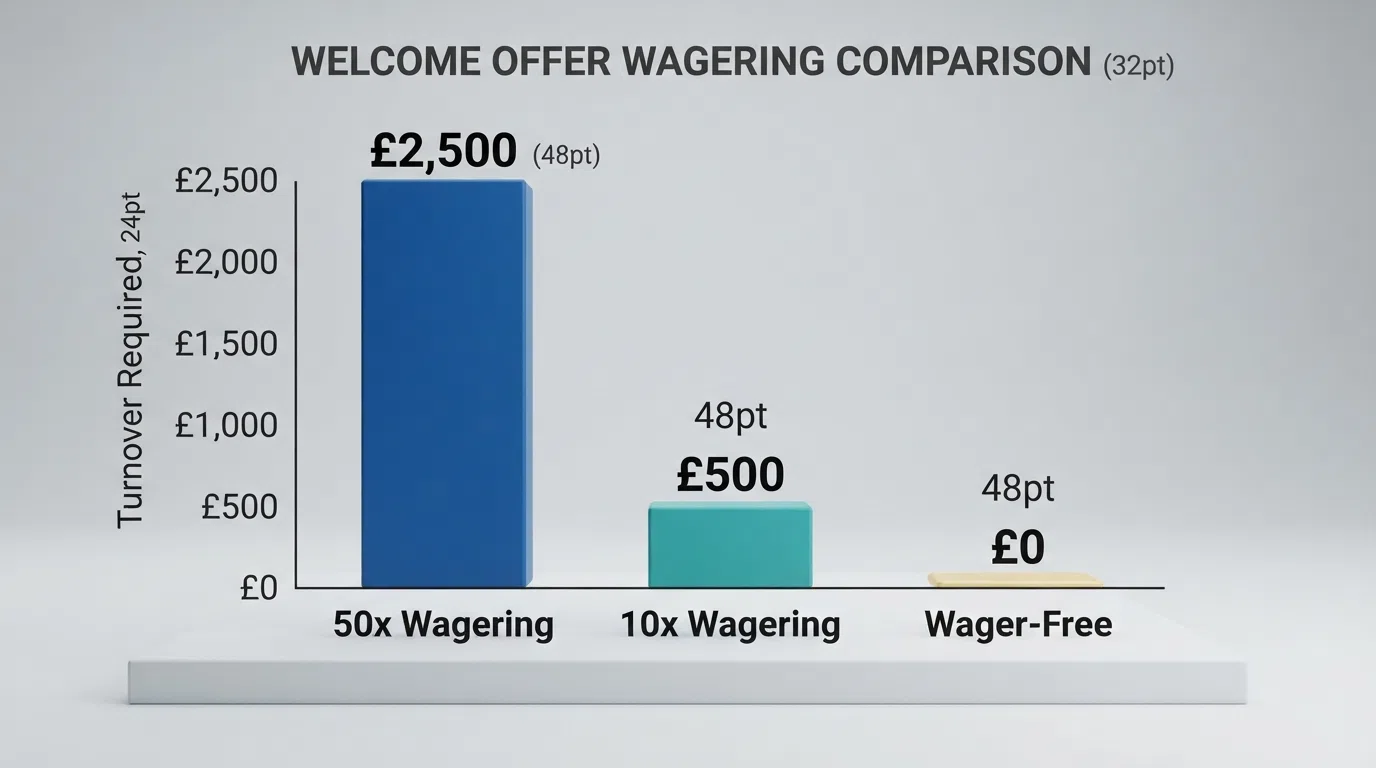
The mechanics are simple. A bonus at 50-times wagering on a £50 deposit match requires £2,500 of qualifying play; at 10-times, the same £50 requires £500. The casino’s stake contribution to the requirement depends on the game: slots typically contribute 100%, table games often 10% or 0%, and live casino games are usually excluded. A player who plays a £1 slot spin needs 2,500 qualifying spins to clear a £50 bonus at 50-times; the same bonus at 10-times needs 500 spins. At a 2.5-second minimum spin interval, 500 spins is roughly 42 minutes of play; 2,500 spins is over 42 minutes, and that is at maximum efficiency with no bonus-buy features and no dis-qualifying games. The honest read: the wagering multiple is the bonus, and the headline number is the marketing.
Welcome Bonuses: How the 10× Cap Reshaped the Landscape
The table below sets the same scenario — a £50 bonus cleared at slot play, an average slot RTP of 96% — against the three wagering positions the British market now offers. The turnover figure is the bonus multiplied by the wagering multiple; the real cost is the expected loss, calculated as turnover times (1 minus RTP), or, for the wager-free case, the expected loss on a £5 spinning stake with no bonus attached.
| Operator | Bonus Type | Headline Value | Wagering Multiple | Turnover Required | Real Cost at 96% RTP |
|---|---|---|---|---|---|
| bet365 | Deposit match | £50 | 50× | £2,500 | £100 |
| Betway | Deposit match | £250 | 50× | £12,500 | £500 |
| BetMGM UK | Free spin winnings | 200 × £0.10 = £20 | 10× | £200 | £8 |
| Grosvenor | Free spin winnings | 100 × £0.10 = £10 | 10× | £100 | £4 |
| Unibet | Bonus + free spin winnings | £20 + 150 × £0.10 = £35 | 50× on bonus, 10× on spins | £1,000 + £150 | £46 |
| MrQ | Wager-free spins | 100 × £0.10 = £10 | 0× | £0 | £0 |
| Paddy Power | Wager-free spins | 50–200 × £0.10 = £5–£20 | 0× | £0 | £0 |
| Duelz | Wager-free spins | Up to 140 × £0.10 = up to £14 | 0× | £0 | £0 |
| LeoVegas | Wager-free spins | 50 × £0.10 = £5 | 0× | £0 | £0 |
| Videoslots | Free spins + optional bonus | 11 × £0.10 = £1.10 + up to £200 | 35× on bonus | £0 + up to £7,000 | £0 + up to £280 |
The table makes the point. The wager-free offers ask the player to clear nothing; the offers at 10-times ask the player to clear twice the bonus value; the offers at 50-times ask the player to clear 25 times the bonus value. The real cost scales with the turnover, and the turnover scales with the wagering multiple. A £250 headline at 50-times costs a player in expectation roughly £500 in expected loss during clearing. A £250 headline at 10-times would cost roughly £100. The Commission moved the legal maximum from 50 to 10 in January 2026, and the real cost difference is the reason the move mattered.
Wager-Free Spins: The Offer That Actually Delivers What It Promises
A wager-free spin is a free spin where the winnings are credited as real money and can be withdrawn immediately. A standard free spin is a free spin where the winnings are credited as bonus money and must be wagered before withdrawal. The difference is the entire distinction the rest of this section has been building toward: a wager-free spin converts a 96% RTP slot into a roughly 96p-on-the-pound return to the player, with no turnover between the spin and the cashout. A standard free spin with 10-times wagering converts the same slot into a return that is reduced by the expected loss during clearing — at 10-times, that is £4 in expected loss on every £10 of spin winnings, before any spin variance.
Five operators on this list offer wager-free spins as their default welcome. MrQ’s 100 spins on Big Bass Splash, LeoVegas’s 50, Paddy Power’s 50 to 200, Duelz’s up to 140, and Videoslots’s 11 are all wager-free. BetMGM and Grosvenor offer wagered spins at the 10-times cap; Unibet offers wagered spins at 10-times alongside a 50-times bonus. The five wager-free offers are the cleanest products in the current market, and a player whose decision is driven by bonus transparency will find what they want in that cluster. The trade-off is volume: a 50-spin wager-free offer is fewer spins than a 200-spin offer at 10-times, and the headline is smaller for that reason. The decision between them is a decision between volume and cleanliness, and a player comparing them is making the comparison the bonus section is built around.
No-Deposit Bonuses, Cashback and the Fine Print That Defines Them
The validity windows across the featured set are not uniform, and a player who ignores them will forfeit offers they could have used. bet365, Betway, BetMGM and Paddy Power run 7-day windows from registration or deposit; Videoslots, Grosvenor and Duelz run 30 days for spins and longer for deposit matches; MrQ gives 48 hours from credit; LeoVegas and BetMGM run a 7-day claim window with a 3-day spin window once credited. A player who deposits on a Friday and returns on a Monday will find the MrQ and BetMGM spins gone, and the LeoVegas spins on a similar timeline. The Unibet spin window is 48 hours; the deposit bonus carries 30 days.
Game eligibility is the second fine-print layer. A bonus that contributes 100% on slots may contribute 0% on table games or live casino, and a player who clears the bonus on a £10 blackjack hand will find the contribution at zero. Maximum cashout is the third. Several operators on the wager-free cluster (LeoVegas, MrQ, Paddy Power, Duelz) explicitly state there is no maximum cashout; others (bet365, Betway, BetMGM, Grosvenor, Unibet) do not specify a cap, and standard terms apply. The reverse-withdrawal ban is the rule that prevents a player from cancelling a withdrawal and returning the money to the casino balance — the money is committed once the request is made, and that is a feature, not a limitation.
Grosvenor’s exclusion of PayPal and Paysafecard from bonus eligibility is a useful signal about the operator’s payment breadth: both methods are otherwise available, and the exclusion applies to the bonus only, not to deposits and withdrawals on the operator’s general site. A player who deposits by PayPal at Grosvenor is using a real-money balance; a player who wants the bonus is using debit card or bank transfer.
Fast Payouts Are a Trust Signal — Here Is What Slows Yours Down
Withdrawal speed is a trust signal because it is the only part of the casino experience where the operator handles a player’s money without a player’s deposit on the line. The credit card ban narrowed the deposit field; the verification regime narrowed the front door; the reverse-withdrawal ban closed off the last-minute change of mind. What remains is a withdrawal request that, in principle, should move through the operator’s processing and into the player’s bank account on a known timeline. In practice, the timeline varies.
Debit Cards, E-Wallets and Paysafecard: What Each Method Means for Trust
A debit card deposit is the universal baseline at every GB-licensed casino, and the credit card ban that took effect in April 2020 means there is no other way to put a credit-card-funded deposit into a British casino account. E-wallets — PayPal, Skrill, Neteller, Apple Pay, Google Pay at the operators that accept them — are the next layer. Not every casino on this list accepts every e-wallet; Grosvenor excludes PayPal and Paysafecard from bonus eligibility, and other operators restrict e-wallet deposits from bonus consideration in their standard terms. A player who values the e-wallet speed on the way out should check whether their preferred method is bonus-eligible on the way in.
Paysafecard is a prepaid voucher and is treated separately from a bank-linked payment. It is deposit-only: a player cannot withdraw to a Paysafecard. Players who use Paysafecard for the privacy of the deposit need a separate withdrawal method, and the standard practice is to verify a bank account or e-wallet for the cashout. The trust signal here is operator breadth: an operator that accepts debit cards, multiple e-wallets and Paysafecard is offering a player the choice of payment method, and the choice itself is the trust point.
How Fast You Can Actually Get Your Money
The withdrawal timeline has two distinct phases: the operator’s processing time and the payment-method clearing time. The operator’s processing time is the period between the player’s request and the money leaving the operator’s account; the clearing time is the period between the money leaving the operator’s account and the money appearing in the player’s bank or e-wallet. A casino that processes in 24 hours is not necessarily faster than one that processes in 48, if the slower one uses a faster clearing method.
The single biggest variable is the KYC gate. Since 7 May 2019, that gate has been at the front door: a player at a GB-licensed casino has been verified before their first deposit, not before their first withdrawal. By the time a withdrawal is requested, the operator has already confirmed identity, address and date of birth, and the documents have been checked. A withdrawal that stalls for verification reasons at a compliant operator is rare, and where it happens, the reason is usually a change of bank account or a new payment method that triggered a secondary check. A player who has been depositing by debit card for six months and then requests a withdrawal to a new e-wallet should expect a short verification delay on the new method; a player withdrawing to a previously used method should not.
Operator processing time is where the trust signal lives. The longer an operator has been on the register, the more established its payment and operations teams, and the fewer the teething issues. LeoVegas and Videoslots have been licensed since 2014; bet365 since 2019; Unibet since 2016. The newer operators (Duelz, MrQ) have shorter tenures but have not been flagged for payment issues. The honest position is that withdrawal speed is a comparison the player has to make at the point of choosing, and the comparison is between operators, not between the licensed and unlicensed markets — at the unlicensed end, the comparison is not available at all.
Mobile Casino Apps and Sites: Trust Should Not Shrink to fit Your Screen
The mobile experience at a GB-licensed casino is regulated under the same operating licence as the desktop site. A player who is playing on a phone in a GB location is inside the same regulatory framework as a player on a desktop in the same location, and the protections — UKGC licence, GAMSTOP, identity verification, complaint routes — apply identically. The licence number in the app’s footer is the licence number in the desktop footer’s terms, and the Commission’s register check works the same way for both.
The British market often segments mobile casino and casino apps as distinct sections within ranked lists, and this segmentation reflects a real difference: a dedicated iOS or Android app is built around the device, with biometric login, push notifications and an interface tuned to touch; a mobile browser site is a responsive version of the desktop product, accessible from any device without installation. The trust considerations are the same; the user experience is different.
Casino Apps: What to Check Before You Tap Install
A pre-install check on a casino app takes about a minute and is worth doing. The first thing to verify is the publisher name in the app store listing; it should match the UKGC licence entity named on the operator’s website, not a third-party developer or a generic studio. The Hillside (UK Sports) ENC entity behind bet365, the Betway Limited entity behind Betway, and the LeoVegas Gaming PLC entity behind LeoVegas and BetMGM UK are all named in the app store publisher fields of their respective apps; if the publisher field names a different entity, the app is a wrapper, not a regulated product.
The second check is the permissions the app requests on install. A casino app that asks for camera access (for document verification), location (for jurisdictional compliance) and biometric data (for login) is requesting the permissions a UK operator needs; an app that asks for contacts, microphone and unrestricted storage is over-asking. The third is the responsible-gambling integration: the app should link to GAMSTOP, should expose the deposit limit, time-out and self-exclusion options, and should not require the player to leave the app to set a reality check. A player who cannot find the responsible-gambling tools inside the app is looking at a product that has not finished the integration work the licence requires.
Crypto Casinos and UK Players: Why “GB-Licensed Crypto Casino” Is a Contradiction
As of 2026, no UKGC-licensed casino accepts cryptocurrency as a deposit or withdrawal method. The statement is worth making as a single fact because the search results for “crypto casino UK” are crowded with offshore operators marketing themselves to British players, and the marketing is misleading. A casino that takes Bitcoin and serves a UK customer is licensed outside the UK — typically Curaçao, Anjouan or Costa Rica — and is not authorised to operate in Great Britain.
The Commission’s position is the one Tim Miller, the Commission’s Executive Director, stated at the Betting and Gaming Council’s Annual General Meeting in February 2026: “Permitting crypto payments would not amount to approving offshore crypto casinos to operate in the UK.” The point is the regulatory logic. A regulated crypto framework would govern how a UKGC-licensed casino handles crypto deposits; it would not retroactively license operators that have been taking British customers’ Bitcoin outside the framework.
What the UKGC’s Crypto Review Could Change — and What It Will Not
The Commission has tasked its Industry Forum with examining how crypto payments could be introduced under a UKGC framework, and the review is linked to the Financial Services and Markets Act 2000 (Cryptoassets) Regulations 2025, expected in force on 25 October 2027. The framework under discussion is a regulated one: licensed crypto-payment processors, customer due diligence on the source of funds, and the same player protections that apply to fiat deposits. A regulated crypto framework in the UK would look like a UKGC-licensed casino adding a payment method, not a Bitcoin casino adding a UK licence.
What the review will not do is legitimise the offshore sites. A player playing at a Curaçao-licensed crypto casino in 2026 is playing at an unlicensed site for GB purposes, and the protections described above — GAMSTOP, ADR, fund segregation, testing-house certification — do not apply. The review’s outcome, whatever it is, will not change the position of those operators retrospectively.
The Real Cost of Playing at an Offshore Crypto Casino
The cost of playing at an offshore crypto casino is not the price of Bitcoin or the volatility of the coin. The cost is the absence of the protection a UK player takes for granted. There is no GAMSTOP coverage, so a self-excluded player can still deposit; there is no ADR, so a complaint has no formal escalation beyond the operator’s own customer service; there is no Commission complaints route, so an unresolved dispute has nowhere to go; there is no testing-house certification requirement, so the game’s fairness is whatever the operator says it is; and there is no fund-segregation requirement, so the player’s balance may be operating money.
The Commission’s enforcement record against unlicensed sites is real but partial. The 208,088 enforcement actions in the year to September 2025 included a large category of search-engine URL referrals — the Commission is putting pressure on Google and other search engines to delist unlicensed operators — but the UK does not have statutory ISP or DNS blocking powers in current law. The Commission’s disruption work is meaningful but not absolute, and the player who chooses an offshore site is choosing to operate outside the protection the disruption work is trying to extend.
There is no player penalty for gambling on an unlicensed site, and the Commission has not pursued player action in this regime. What the player loses is the protection, not the liberty. That is the right framing: the cost of an offshore site is the absence of the safety net, not the addition of a punishment.
The Slots, Live Tables and Providers You Can Actually Trust
The British online casino market is a slots market. In the 2024–25 financial year, online casino games generated £5.0 billion in gross gambling yield; £4.2 billion of that came from slots. Slots are the product most players encounter first, the product with the most visible regulatory design (stake limits, spin speed, no auto-play), and the product the rest of this section is built around.
Slot Sites You Can Trust — and the RTPs That Matter
The RTP, or return-to-player percentage, is the long-run proportion of money wagered that a slot returns to players. A 96% RTP slot returns 96p on the pound over millions of spins; the house edge is the 4p that does not come back. The figure is published by the game provider and verified by the testing house that certifies the game. A trustworthy casino displays the RTP somewhere in the game’s information panel; a casino that hides the RTP is hiding the most useful single number a slot has.
Two RTPs recur on this page because two slots recur on the welcome offers. Big Bass Splash, the Pragmatic Play fishing-themed slot used by LeoVegas, MrQ, BetMGM and Grosvenor, has a published RTP of 96.71%. Starburst, the NetEnt classic used by Videoslots, has a published RTP of 96.09%. The difference between the two is 0.62 percentage points — a small number in isolation, but a meaningful one in expectation over thousands of spins. The UK’s slot-design rules apply to every slot at every GB-licensed casino: no auto-play, minimum 2.5-second spin speed, no losses disguised as wins, no reverse withdrawals. A player at a UK casino is playing a regulated version of the same slot available offshore, and the regulation is the difference.
| Slot | Provider | RTP | Used as Welcome Slot By |
|---|---|---|---|
| Big Bass Splash | Pragmatic Play | 96.71% | LeoVegas, MrQ, BetMGM UK, Grosvenor |
| Starburst | NetEnt | 96.09% | Videoslots |
| Fishin’ Frenzy the Big Catch | Blueprint Gaming | — | Unibet |
Live Dealer Casinos: Real Dealers, Real Regulation
Live dealer games sit under the same regulatory umbrella as slots and table games, and the same UKGC licence covers them. The dominant providers across the featured set are Evolution and Playtech: Evolution appears in the provider list at nine of the ten operators, Playtech at six. The studios are based in Latvia, Malta, Romania, Canada and the United States; the streams are real; the dealers are real; the gameplay is regulated.
What is different is the stake rules. The age-banded stake limits (£5 for 25+, £2 for 18–24) apply to online slots specifically; there is no statutory stake cap on live casino, sports betting or bingo. A player who plays live blackjack at a UK casino is playing under the operator’s table limits, not under a Commission-imposed cap. The design rules (no auto-play, no reverse withdrawals) apply to slots, not to live tables; a player who plays 100 live roulette spins in a row is not breaking a regulation. The rules that do apply are the general fair-and-open objective: the game’s RNG (where used for shuffling or wheel outcomes) is tested, the dealer’s training and supervision is operator-managed, and the player has a complaint route through the operator and the ADR if needed.
Verifying a live casino stream is genuine is not as simple as verifying a slot, because the live product is a video stream rather than a deterministic game. The verification is the licence check: a GB-licensed casino streams from a licensed provider, the stream runs on a tested platform, and the game’s outcomes are recorded and auditable. Playing at a licensed casino is the only way to be sure the game is real, whereas unlicensed sites offer no such assurances.
The Game Providers Behind a Trustworthy Casino Lobby
The provider list of a GB-licensed casino is a trust signal in its own right. The most reputable studios — NetEnt, Pragmatic Play, Evolution, Microgaming, Play’n GO, Big Time Gaming, Hacksaw Gaming, Nolimit City, IGT, Blueprint, Red Tiger, Relax Gaming — are the ones with the testing-house certifications, the public reputation and the multi-year track record. A casino carrying nine of these twelve is carrying the same library as a casino carrying six, and the difference is breadth, not quality.
The featured set’s provider overlap is informative. NetEnt appears in nine of ten operator lists, Pragmatic Play in nine, Evolution in nine, Play’n GO in seven, Big Time Gaming in seven, Hacksaw Gaming in six, Microgaming in six. The “anywhere” providers are the safest benchmark: a player who sees NetEnt, Pragmatic Play and Evolution on a casino’s provider list is looking at a casino that has chosen the studios the rest of the market has chosen. The Commission licenses software providers as well as operators, and the same register check that confirms a casino’s licence confirms a software provider’s licence.
Responsible Gambling Is Not Optional — The Safety Net Every UK Casino Must Provide
The responsible-gambling infrastructure at a GB-licensed casino is not a marketing section. It is a set of mandatory systems the operator is required to provide, the regulator is required to enforce, and the player is required to know about. The tools exist because the data justifies them: 47% of GB adults gambled in the past four weeks, 38% online, and 2.4% of adults scored 8+ on the Problem Gambling Severity Index in 2025 (down from 2.7% the year before). The same data shows 562,000 people have registered with GAMSTOP, and roughly 7% of the British population report being negatively affected by someone else’s gambling. The framework is built to those numbers.
GAMSTOP, Deposit Limits and Reality Checks: The Tools You Control
GAMSTOP is the national multi-operator self-exclusion system, and participation has been mandatory for every GB online operating licence since 31 March 2020. A player who registers with GAMSTOP chooses one of four exclusion periods: six months, one year, five years, or five years with auto-renewal. The exclusion is binding and cannot be cancelled early — a player who chose five years cannot withdraw at the four-year mark by emailing customer service. The exclusion applies to every GB-licensed online gambling site, not to a single operator, and the registration is the player-side action that the operator side enforces.
Deposit limits are the customer-set tool. A player can set a deposit limit on their account at any time, and any decrease to that limit takes effect immediately; any increase takes effect after a 24-hour cooling-off period (and, for any customer, after a one-day wait — a long-standing industry practice now confirmed by the new rules). From 31 October 2025, every GB-licensed operator must prompt the player to set a financial limit before their first deposit; the prompt is a one-time event at sign-up, but the limit itself is in the player’s control at all times. From 30 September 2026, only money paid into the account can be called a “deposit limit” — the “gross” deposit limit standardisation that closes off the practice of counting bonus money or credits in the headline number.
Reality checks are the in-session tool. A player playing online slots at a GB-licensed casino sees a periodic display of cumulative time played, total staked, total won or lost, and a prompt to confirm they want to continue. The interval and the display are operator-set within the Commission’s minimum requirements, and a player who wants a tighter reality check can set one in the responsible-gambling section of their account. From 28 February 2025, a financial vulnerability check is mandatory at £150 of net deposits in a rolling 30-day period, run on publicly available data (county court judgments, bankruptcy orders) and designed to flag a player who has been financially compromised in a way the operator should know about.
Where to Get Help: Helplines, Clinics and Support Networks
The National Gambling Helpline, run by GamCare, is available 24 hours a day, 7 days a week, free on 0808 80 20 133. The helpline is the first point of contact for a player who is concerned about their own gambling or someone else’s, and the call is free from any UK landline or mobile. GamCare also runs the National Gambling Support Network, a regional face-to-face counselling service, and the National Gambling Treatment Service, which provides structured treatment for problem gambling.
The NHS runs gambling harm clinics in England, Scotland and Wales, accessible via GP referral or self-referral. The Primary Care Gambling Service is a national service for anyone experiencing gambling-related harms, with a particular focus on the link between problem gambling and other health conditions. Gamblers Anonymous runs peer support groups across the UK, modelled on the Alcoholics Anonymous approach. Gamban is a piece of software that blocks gambling websites and apps on a player’s devices, operating at the network level rather than the self-exclusion level; the player installs it, and the player removes it, and the Commission does not have a direct role in its operation. A player who wants to block gambling transactions at the bank level can ask their bank to apply a gambling-block to their card; most UK banks now offer this, and it is the most effective single block a player can put in place outside of GAMSTOP.
The statutory gambling levy replaced voluntary operator contributions from 6 April 2025, and remote casino operators now pay 1.1% of gross gambling yield: 50% to treatment, 30% to prevention, 20% to research. The levy is a structural change in how the harm-reduction infrastructure is funded, and a player using GamCare, the NHS clinics or any of the listed services is using a system paid for by the operators that the levy applies to.
How Many UK Players Are Affected — and Why the Numbers Are Improving
The prevalence data tells a story of slow improvement. The PGSI 8+ score — the threshold used to identify problem gambling — was 2.4% of GB adults in 2025, down from 2.7% in 2024. The moderate-risk band (PGSI 3–7) sat at 3.5% in 2025, broadly stable from the prior year. 47% of adults gambled in the past four weeks (27% excluding lottery-only), and 38% gambled online. The Gambling Survey for Great Britain Wave 1 2025, the source for the figures, was published by NatCen and the University of Glasgow, and the methodology is comparable year to year.
The numbers matter for the framework. 562,000 GAMSTOP registrations is a meaningful fraction of the adult problem-gambling population, and the fact that the figure is rising year on year is evidence that the self-exclusion system is reaching the people it is built for. The PGSI 8+ decline from 2.7% to 2.4% is small in percentage terms but real in population terms, and the framework — GAMSTOP, the financial vulnerability check, the stake limits, the wagering cap — is the structure the decline is happening inside. A player who uses the tools is using the system the data says is working.
How We Selected and Ranked the Casinos on This Page
The featured set is built from a single starting point: the Gambling Commission’s public register, last updated 29 July 2026. Every operator on the list appears on the register as an active GB online operating licence holder, and the licence number and entity name in the table are taken from the register entry, not from the operator’s own marketing. The featured set is not the licensed market — the register lists far more operators than ten — but it is a representative cross-section of the established, active and currently-trading end of that market.
The ranking is not produced by a weighted score. The criteria that order the list are qualitative: licence tenure (longer-tenured operators are credited with more verifiable track record), bonus transparency (wager-free operators are credited for their product position), provider quality (operators carrying a higher share of the well-tested studios are credited for the underlying fairness of their product), and responsible-gambling integration (operators that prominently surface GAMSTOP, deposit limits and reality checks are credited for compliance visibility). Where two operators are close on those criteria, the order in the table is editorial. The table is a starting point for the player’s own comparison, not a verdict.
The sources consulted for the page were the Gambling Commission’s published statistics, news releases and register; the operators’ own published terms and conditions for current bonus details; and a cross-section of the editorial and affiliate review pages identified in search results for the same topic. The cross-section is what the previous section recommends: no single review source is treated as definitive, and any figure a single source carried has been cross-referenced against either an operator page or a Commission publication. The page does not recommend a single operator; it describes ten and gives the player the framework to compare them.
What “Trusted” Means for Your Next Casino Deposit
The evidence on this page points in one direction. The UKGC licence is the entry ticket, and a player who has run the five-minute verification check is past the largest single risk in the British market — playing at an unlicensed site. Beyond the licence, the operator’s behaviour on bonus terms, payment processing and responsible-gambling integration is what separates the ten operators in the featured set from the rest of the registered field. The wager-free cluster (MrQ, Paddy Power, Duelz, LeoVegas on spins) is the clearest single trust signal the current market offers: operators that have chosen to be below the new 10-times cap, on every promotion, are making a product choice that a player can rely on. The legacy 50-times operators (bet365, Betway on the bonus portion) are not breaking the rules; the rules still allow 50-times for the bonus portion of certain structures, and these operators are using that latitude. A player who compares the two clusters is making the comparison the new rules are designed to enable.
The stake limits, the spin speed rules, the bonus cap, the verification regime, GAMSTOP, the financial vulnerability check, the statutory levy — the British regulatory framework is the most extensive player-protection regime in any major gambling market. The data shows it is working: PGSI 8+ has declined from 2.7% to 2.4% in a year, GAMSTOP registrations are at 562,000, and the responsible-gambling tools are used because they are useful. A player who uses them is not a player who has lost; a player who uses them is a player who has read the operator’s own documentation and decided what they want.
The next deposit is the player’s decision, and the decision is the one the rest of this page has been built around. The UKGC register is at gamblingcommission.gov.uk. GAMSTOP is at gamstop.co.uk. The National Gambling Helpline is 0808 80 20 133, free, 24/7. The wagering multiple is on the operator’s terms page. The stake limit is on the slot’s information panel. The decision is personal, but the evidence is here, and the evidence says the British market is the safer market by a margin no offshore site can close.
Frequently Asked Questions
Do I pay tax on casino winnings in the UK?
No. UK players do not pay tax on gambling winnings of any kind, including online casino, sports betting, poker and the National Lottery. The tax is paid by the operator — Remote Gaming Duty rose to 40% of operator gaming profits from 1 April 2026 — and the player’s net winnings are paid in full. This applies to winnings from GB-licensed operators; offshore sites may have different tax positions depending on the player’s country of residence.
What is the maximum I can bet per spin on UK online slots?
The maximum stake is age-banded. Players aged 25 and over can stake up to £5 per game cycle, in force from 9 April 2025. Players aged 18 to 24 can stake up to £2 per game cycle, in force from 21 May 2025. A “game cycle” includes the base spin and any follow-up features it triggers. The cap applies to online slots only; live casino, sports betting and bingo have no statutory stake cap under the current rules.
Can I cancel a GAMSTOP self-exclusion before it ends?
No. GAMSTOP exclusions of six months, one year, five years, or five years with auto-renewal are binding and cannot be cancelled early. The shortest exclusion is six months from the registration date; a player who chose five years cannot withdraw at the four-year mark. The exclusion applies to every GB-licensed online gambling site, and a player who tries to register at a GB-licensed casino during the exclusion period will be blocked.
Why can’t I use a credit card to deposit at UK casinos?
Credit card deposits for all remote gambling have been banned since 14 April 2020 under LCCP licence condition 6.1.2. The ban covers credit-card-funded e-wallet deposits as well, so a player cannot route a credit card through PayPal to fund a casino account. The accepted methods are debit cards, e-wallets (PayPal, Skrill, Neteller and others, depending on the operator), bank transfers and prepaid options like Paysafecard. A GB-licensed operator that accepts credit card deposits is in breach of its licence.
What changed for UK casino bonuses in January 2026?
The wagering requirement on casino bonuses was capped at 10 times the bonus value from 19 January 2026, under LCCP social responsibility code 5.1.1. Mixed-product promotional offers — the football bet bundled with free spins, the casino deposit that came with sportsbook credit — were banned in the same rule change. The Commission’s stated rationale was that the cap decreases harm, reduces complexity, and improves transparency. Operators with legacy 50-times bonuses on the bonus portion of a welcome are not in breach; the cap is the new ceiling, not a retroactive reduction.
Do any British casino sites take cryptocurrency deposits?
No. As of 2026, no UKGC-licensed casino accepts cryptocurrency as a deposit or withdrawal method. The Commission is examining the question through its Industry Forum, linked to the Financial Services and Markets Act 2000 (Cryptoassets) Regulations 2025 expected in force on 25 October 2027. Any casino currently taking Bitcoin, Ethereum or similar from UK players is licensed offshore — typically Curaçao, Anjouan or Costa Rica — and is not authorised to operate for GB residents. The Commission’s position is that permitting crypto payments under a UKGC framework would not retroactively approve offshore operators.
Casinos – fastestpayout-casinos-uk
Content created by the «fastestpayout-casinos-uk» team