
UK Crypto Casinos Without KYC: What the Offshore Market Actually Offers British Players
 Available in GB
A UK crypto casino without KYC sounds, on the face of it, like a single kind of thing: a place where a British player deposits Bitcoin, plays slots, and cashes out without anyone ever asking for a passport. Search results for that phrase return dozens of casinos that say they offer exactly that. Almost every one of them is telling the truth about the first deposit and burying the truth about the rest. The “no KYC” label is a spectrum, not a switch, and every operator on it sits outside the UK Gambling Commission’s perimeter.
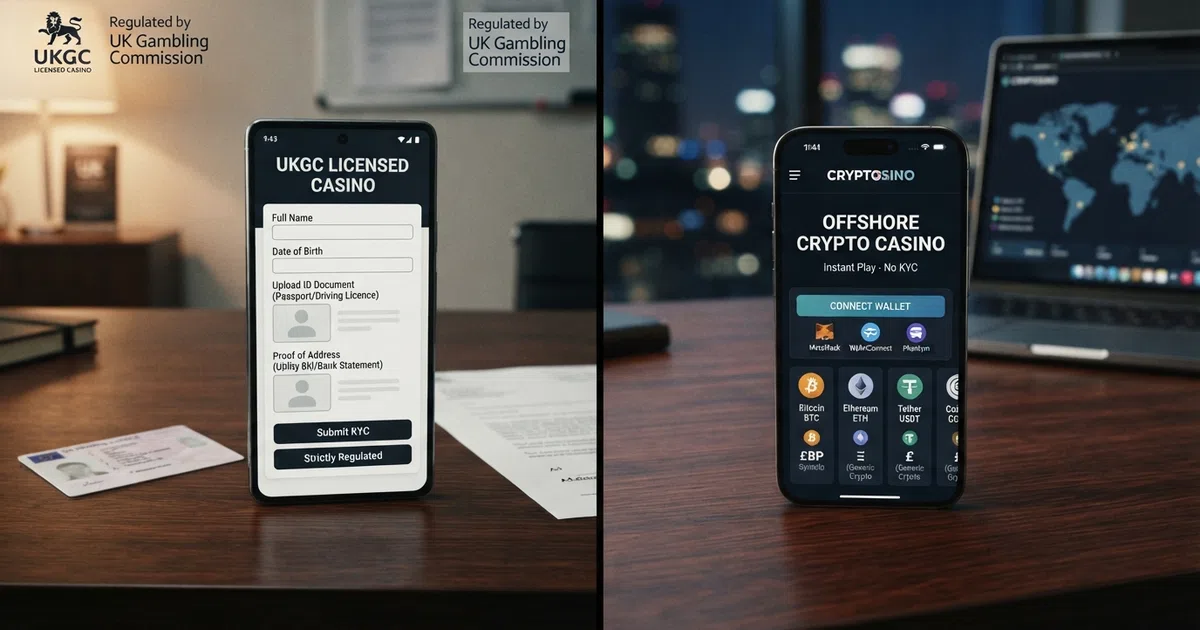
This page ranks ten of those operators on the strength of their offers, their games, their withdrawal mechanics and their public track records, and sets them against the regulatory framework the player is leaving behind. The framework is not a footnote. It is the reason the keyword “UK crypto casino no KYC” describes a product that cannot legally exist inside the Great Britain-licensed market. Every operator in the ranking below is offshore, unlicensed in Britain, and unreachable by the Commission’s complaints process or by GAMSTOP.
Data current as of September 8, 2026; licence claims cross-checked against the UK Gambling Commission’s public register and operator terms of service.
What a UK Crypto Casino Actually Is — and What It Is Not
A crypto casino is an online casino that accepts cryptocurrency as both deposit and withdrawal rail. That sounds like a small variation on the standard online casino. It is not. The payment method changes the casino’s relationship with the regulator, with the player’s bank, and with the casino’s own compliance function. A UKGC-licensed casino cannot accept crypto for the structural reasons laid out in the next section; the crypto casino is therefore, by definition, an offshore product being offered to a UK player.
The first thing to clear up is what the product is not. It is not a land-based casino. Crypto casinos are entirely online — there is no physical premises to walk into, no cashier’s booth, no chips to carry across a floor. The transaction is a wallet-to-wallet transfer between the player and the operator’s hot wallet, recorded on a public ledger, and the gameplay is rendered in a browser tab or a mobile app. A player who walked into a London casino with the intent to sit at a crypto-funded table would be standing in the wrong place.
It is also not a UKGC-licensed product in disguise. No operator on the Commission’s public register accepts Bitcoin, Ethereum or stablecoin deposits. As of 2026, the Commission’s published position is that direct crypto deposits are effectively impossible at any operator legally serving Great Britain, because the source-of-funds, anti-money-laundering and LCCP obligations that apply to a licensed operator are incompatible with the on-chain, pseudonymous nature of a direct crypto transfer.
The “no KYC” tag is the third thing to get straight. It is not the same as “no checks ever”. Most of the operators below will let a player register, deposit, and play without uploading a passport — that is what the tag covers. Almost all of them reserve the right to ask for documents at a withdrawal threshold, often somewhere between $2,000 and $10,000 cumulative, or at any point where an automated risk flag fires. The label is a description of the entry point, not a guarantee about the exit.
Crypto Casinos vs Traditional Online Casinos: The Real Difference
A traditional UKGC-licensed online casino and a crypto casino differ on three axes that matter to a player: the deposit rail, the KYC requirement, and the speed of the cashout.
The deposit rail at a UKGC casino is, since April 2020, debit card, bank transfer or e-wallet only — credit cards have been banned for all remote gambling. The deposit arrives through Faster Payments or a card network, the operator’s payments team reconciles it, and the balance is credited. At a crypto casino, the deposit is a blockchain transfer from the player’s self-custody wallet to the casino’s deposit address. The casino credits the balance after a set number of on-chain confirmations, which on Bitcoin can run from ten minutes to an hour depending on network congestion and the operator’s policy. The player’s bank never sees the transaction, which is the appeal and the regulatory problem at the same time.
The KYC requirement is the dividing line that this whole page is built around. A UKGC casino must verify the player’s name, address and date of birth before any gambling takes place — since 7 May 2019, with their own money or with a bonus. The pre-2019 “72 hours to send documents” grace period is gone. A crypto casino, by contrast, registers a player on an email address and a username, asks the player to connect a wallet, and lets play begin. The asymmetric verification cost is what produces the offshore product: the same player who has to upload a passport to deposit £20 at bet365 can register and play for the same stake at ten operators in the time it takes to copy a wallet address.
The withdrawal speed is where the marketing material lives. Crypto casinos advertise “instant” withdrawals because the bottleneck they control is small. Once a player requests a withdrawal, the casino signs and broadcasts the transaction; from that point, settlement is a function of the destination blockchain’s confirmation time, not of any payment processor. The qualifier is the one the KYC discussion sets up: a withdrawal that triggers identity checks will not be instant no matter how fast the chain is.
On game fairness, the two models also diverge. UKGC casinos run games whose random number generators are independently tested to standards published by the Commission, with submission certificates and ongoing audit. Crypto casinos offer two parallel models: conventional slots and live dealer tables from the same providers that supply UKGC casinos, and “provably fair” originals whose outcomes are committed to before the bet and verifiable after. The two fairness proofs are not equivalent — provably fair proves the bet was not tampered with after the commitment, not that the algorithm is fair or that the stated house edge is what the game actually delivers.
Online-Only, Real-Money, and How You Actually Access These Sites
Crypto casinos are, without exception, online products. There is no cash desk, no croupier trained in person, no physical premises — the whole operation is a website and a payment rail. Real money is on both sides of the transfer: the player deposits cryptocurrency that has a real, fluctuating value against sterling, the player wagers that cryptocurrency on games that pay out in the same cryptocurrency, and the player withdraws whatever balance survives the house edge and any bonus conditions.
Access is overwhelmingly through a desktop or mobile browser. Vave stands out for offering a native iOS app; CoinCasino, registered in Costa Rica with no gambling-specific licence, is built on Telegram and accessed through the messaging client. The other eight operators in the ranking below are browser-based, with the site either adapting responsively to a phone screen or, in a few cases, offering a downloadable app from a third-party store. There is no App Store presence in the conventional sense, and Apple’s rules around real-money gaming in unjurisdicted apps push most operators toward the browser anyway.
Why No UKGC-Licensed Casino Can Offer No-KYC Crypto Play
The reason a UK player looking for a crypto casino with no identity checks has to leave the British licensing perimeter is structural, not incidental. Three layers of law sit on top of one another and they each block part of the product.
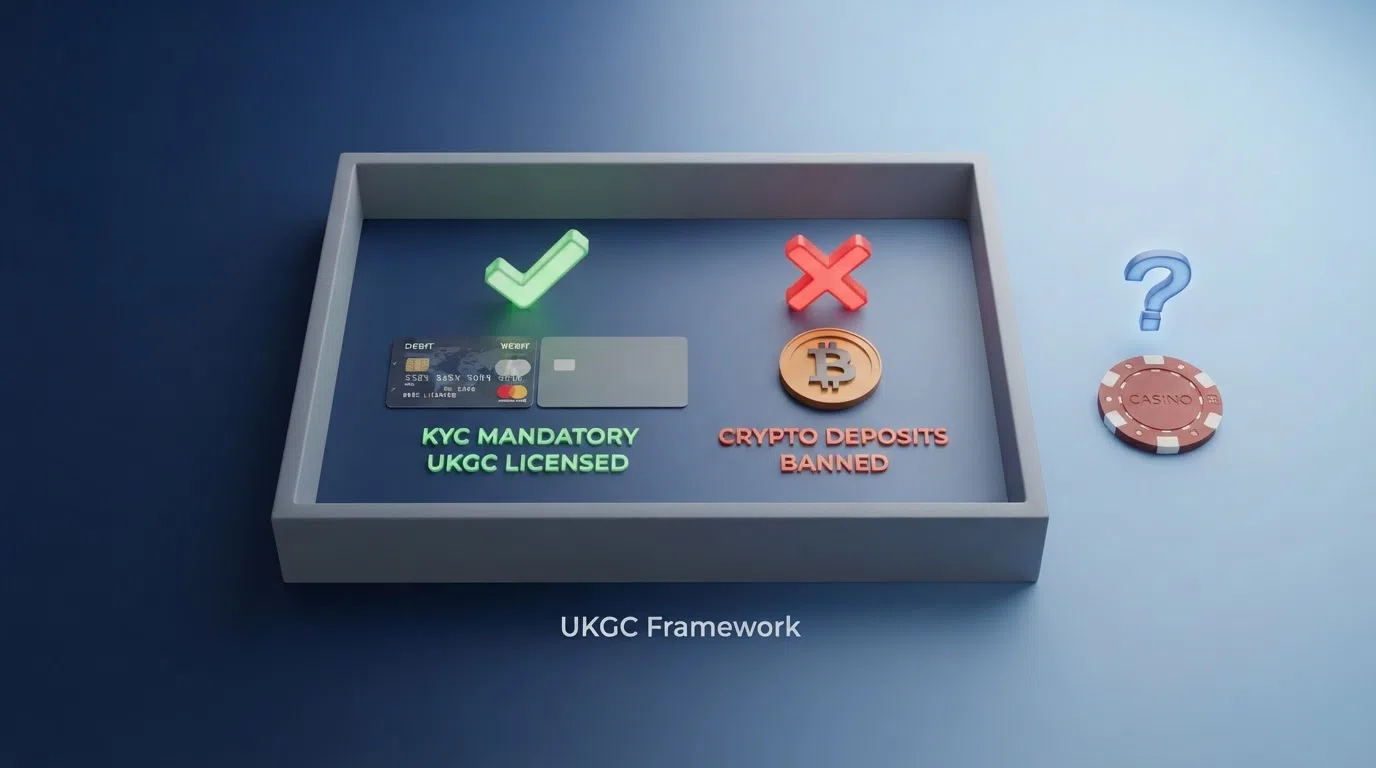
The first layer is the regulator itself. The UK Gambling Commission is the single statutory regulator for Great Britain — England, Scotland and Wales. Northern Ireland is not covered by the Commission and operates under separate, older legislation. The Commission is an executive non-departmental public body sponsored by the Department for Culture, Media and Sport. Statute is the Gambling Act 2005, extended to remote operators by the Gambling (Licensing and Advertising) Act 2014, which made a British licence compulsory for any operator taking British customers, wherever the operator is based. Day-to-day obligations sit in the LCCP — the Licence Conditions and Codes of Practice — and the Remote Technical Standards, known as the RTS.
The second layer is the licensing objectives. Section 1 of the Gambling Act 2005 sets three: preventing gambling from being a source of crime or disorder, ensuring gambling is conducted fairly and openly, and protecting children and other vulnerable persons from being harmed or exploited by gambling. Each of those objectives pushes toward a regime where the operator knows who the customer is, where the customer’s money came from, and where the customer can be contacted if a problem surfaces.
The third layer is the LCCP itself. Condition 17.1.1, in force since 7 May 2019, requires every licensed operator to verify a customer’s name, address and date of birth before the customer can deposit or gamble — with their own money or with a bonus. The pre-2019 grace period is gone. Social Responsibility Code 5.1.1, in force since 19 December 2025, caps wagering requirements on casino bonuses at 10×. Remote Technical Standard 12 restricts the term “deposit limit” to gross deposit limits the customer has set themselves, and from 31 October 2025 operators must prompt customers to set a financial limit before their first deposit. The whole framework is built around a registered, identified, monitored customer — the opposite of the product the keyword describes.
The UKGC KYC Mandate: What the Law Requires Before You Can Play
The headline figure for this section is the date: 7 May 2019. Before that date, a UKGC-licensed online casino could let a customer register, deposit and start playing, with a 72-hour window in which to send in identity documents. After 7 May 2019, that window is closed. LCCP Condition 17.1.1 requires verification of name, address and date of birth before any gambling takes place. The verification is not optional, not deferrable, and not negotiable with the operator’s customer service team.
In practice, the requirement covers three checks. The first is identity: a passport or driving licence that matches the name and date of birth on the account. The second is address: a utility bill, bank statement or council tax bill dated within the last three months. The third is age: the date of birth on the identity document, cross-checked against the registration details, must show the customer is at least 18. Some operators layer in additional checks for source of funds — payslips, bank statements, evidence of where the deposit money came from — and from 28 February 2025 a lighter-touch financial vulnerability check fires at £150 in net deposits across a rolling 30 days, using publicly available data such as county court judgments, individual voluntary arrangements and bankruptcy orders.
The consequence for a British player searching for “no KYC” is absolute. There is no UKGC-licensed casino that will let a player deposit without verifying identity first. The verification is not an inconvenience the player can route around; it is the precondition for the licence itself. The Commission’s published position is that direct crypto deposits are effectively impossible at any operator legally serving Great Britain, and the KYC mandate is the mechanism by which that impossibility is enforced.
Why Cryptocurrency Deposits Cannot Work at a UKGC-Licensed Casino
Even if a UKGC-licensed operator wanted to accept Bitcoin or USDT, the source-of-funds rules and the anti-money-laundering obligations under the LCCP make the rail incompatible with a British licence. A licensed operator has to be able to identify the source of every deposit, demonstrate the player’s funds are not the proceeds of crime, and on request reconstruct the chain of custody for any balance held on behalf of a customer. A direct on-chain transfer from a self-custody wallet gives the operator none of that information. The wallet address does not name its owner; the source address does not name its owner; the funds themselves, once converted to fiat to settle the operator’s Remote Gaming Duty liability, are no easier to trace than any other bank transfer.
The Commission has not closed the door on crypto permanently. The Commission’s exploratory review of a potential crypto pathway was opened at the Betting and Gaming Council’s AGM in February 2026. The Financial Services and Markets Act 2000 (Cryptoassets) Regulations 2025 are expected to come into force on 25 October 2027, and companies that issue or facilitate cryptoasset transactions will be required to be authorised under the FSMA framework. The Commission’s review sits downstream of those FSMA regulations — the licensing and conduct rules for the crypto sector need to be settled before a casino can sit on top of them. The near-term timeline does not include a UKGC-licensed crypto casino. Any operator that says otherwise is wrong, and any search result that puts a UKGC licence next to a crypto deposit is selling something that does not exist.
UK Player Safeguards That Do Not Cross the Border
Every protection a UK player is used to at a licensed casino stops at the perimeter fence. The list is not rhetorical. Each line is a named, statutory protection that simply does not apply to an offshore operator.
There is no GAMSTOP coverage. GAMSTOP has been a mandatory condition of every UKGC online operating licence since 31 March 2020, and the exclusion periods — six months, one year, five years, or five years with auto-renewal — cannot be cancelled early. A player who has self-excluded through GAMSTOP and then opens an account at an offshore crypto casino is not in breach of the GAMSTOP terms; the offshore operator has no integration with the scheme. The protection does not extend.
There is no UKGC complaints route. If a UKGC-licensed operator withholds funds, a player can complain to the operator, escalate to an approved alternative dispute resolution provider, and ultimately bring a case to the Commission. None of that applies offshore. The Commission cannot compel an offshore operator to pay a disputed balance, because the Commission has no jurisdiction over them.
There is no statutory stake cap. Since 9 April 2025, online slots at UKGC casinos have carried a £5 maximum stake per game cycle for players aged 25 and over, and a £2 cap for players aged 18 to 24 in force since 21 May 2025, imposed by SI 2025/215. At an offshore operator, there is no statutory cap. The same slot can be played at a higher stake because the offshore operator is not bound by the regulation.
There is no £150 financial vulnerability check firing automatically. The check that runs at a UKGC casino at £150 in net deposits across a rolling 30 days is a UKGC-mandated control. An offshore operator has no equivalent trigger, because the obligation is not theirs to meet.
There is no statutory levy funding treatment and prevention. From 6 April 2025, the statutory gambling levy has applied at 1.1% of the leviable amount — the gross gambling yield — for remote casino and remote bingo licences, with proceeds split 50% to treatment, 30% to prevention and 20% to research. The levy is paid by licensed operators, not by offshore ones. The treatment a UK player can access through GamCare, the NHS gambling harm clinics, and the National Gambling Helpline is funded by a pot the offshore operator does not contribute to.
The aggregate is the point. A UK player is not trading one protection for another. They are leaving a tightly regulated perimeter for a market with no British consumer protection at all, and they should know the size of that gap before they place a bet.
When “No KYC” Casinos Actually Ask for Your ID
The “no KYC” tag is real about the entry point and misleading about the exit. Most of the operators in the ranking below will let a player register with an email and a username, connect a wallet, and play through the welcome bonus without ever asking for a document. The KYC trigger fires later, on the withdrawal, and the threshold is the number that matters.
The publicly disclosed thresholds cluster in a range. BC.Game triggers identity verification at roughly $2,000–$3,000 in cumulative withdrawals. Rollbit’s threshold is risk-based and runs from $2,000 to $10,000 — the lower end for a freshly registered account with no play history, the upper end for an account with a clean track record. Moonbet, which is not in the ranking below but illustrates the pattern, sits at $2,000. The implication is simple: a player who wins under the threshold can usually withdraw without documents; a player who wins over it cannot.
The withdrawal threshold is not the only trigger. Automated risk flags — unusual deposit patterns, a sudden shift in stake size, a withdrawal to a wallet that does not match the deposit wallet, a flagged IP address — can all bring forward the KYC request. The casino’s right to ask is, in practice, the casino’s right to delay. A withdrawal that would otherwise be settled in an hour can be held for days while documents are reviewed, and the operator’s terms of service typically give the operator weeks to complete the review.
For a UK player weighing the trade-off, the practical rule is: under the threshold, the experience is the experience the marketing describes. Over the threshold, the experience depends entirely on how the operator’s compliance team handles a UK-specific request, and there is no British regulator to escalate to if the handling is bad.
Provably Fair: What It Proves and What It Does Not
Provably fair is the crypto casino’s answer to the question every player asks: how do I know the game is not rigged against me? The mechanism is a commitment scheme. Before a bet, the casino publishes a server seed — a random string — usually hashed so the player cannot read it. The player’s browser generates a client seed. The two are combined, the game is played out using the combined value, and after the bet the casino reveals the unhashed server seed. The player can re-run the calculation and check that the result matches what the casino showed on screen.
What that proves is narrow and important. It proves the bet outcome was not altered after the casino committed to the server seed. The casino could not have looked at the player’s bet, decided to make them lose, and then produced a result that was not the one the committed seed would have generated. The bet is tamper-proof.
What it does not prove is at least as important. It does not prove the house edge is what the casino claims. It does not prove the payout distribution over a million spins matches the theoretical distribution. It does not prove the algorithm is correctly implemented. A casino could ship a provably fair game that commits to a seed, plays out a result, and lets the player verify the result was not tampered with — while the underlying game logic pays out 80% of what it should, or pays out the right percentage on average but clusters the wins in a way the player cannot see. The verification confirms one bet, in isolation, was not altered. It does not audit the game.
The honest comparison to UKGC-tested random number generators is that the two are checking different things. UKGC testing audits the algorithm, the implementation, the source code, the submission certificate and the ongoing performance of the game against a published standard. Provably fair audits the integrity of a single bet, after the fact. Neither is a complete proof of fairness on its own, and the provably fair model is not a substitute for the regulatory model. It is a different model, and players who care about long-run payout distribution, or about the operator not having shipped a game that does something the math says it should not, are right to notice the gap.
Safety Signals and Legitimacy Checks for No-KYC Casinos
A UK player choosing between offshore crypto casinos has to do the legitimacy check the regulator would otherwise do. The signals that matter, in rough order of reliability, are: the licence the operator does hold, the provably fair implementation, the operator’s track record, and community reputation.
A recognised offshore licence is the floor, not the ceiling. Curaçao is the most common licence among the operators in the ranking below; the Curaçao Gaming Authority (CGB) is the issuing body, and a Certificate of Operation is the form a Curaçao-licensed casino typically advertises. Curaçao is a permissive regime — the licence is a check on basic operational standards, not a deep audit of the operator’s game fairness or AML controls. CoinCasino, registered in Costa Rica with no gambling-specific licence, sits below the floor. Vave, as of the data current as of September 8, 2026, has no confirmed licence. Both are flagged in their per-operator write-ups below.
Provably fair is a useful signal where the operator actually implements it and where the verification is in the player’s hands. The originals on Roobet, BC.Game, Stake and Rollbit are openly verifiable. Where a casino offers only third-party slots and live dealer from Evolution, Pragmatic Play and the rest, the provably fair check is not available — the player is trusting the provider, not the operator.
Community reputation is the most uneven signal. Withdrawal complaint threads on player forums and the affiliate review sites that publish forensic audits give a real picture of whether the operator pays out and how long it takes. The signal is noisy — disputes over bonus terms are routinely posted as “scam” complaints — but the pattern over a couple of years of posts is more useful than any single review.
Operator longevity is the slowest and one of the most reliable signals. Bitcasino has been operating since 2014; that is a longer track record than the regulator would need to revoke a licence, and it is meaningful in a market where new launches appear and disappear within a season.
What the signals do not replace is a British licence. A player who treats the check as equivalent to a UKGC check is overstating what the check does.
The Ten Offshore Operators Accepting UK Players in 2026
The table below summarises the ten operators reviewed in this guide. Every one is offshore, every one is unlicensed in Great Britain, and every one is below the UKGC’s regulatory perimeter. The columns are the ones research has the data to fill; missing values are marked with an em dash. The operator order reflects the editorial ranking, not a market-share claim — none of these operators publishes a UK revenue figure and the UKGC top-20 by tracked revenue is entirely traditional UKGC-licensed brands, none of which are crypto casinos.
Game Provider Coverage and Studio Availability
| Casino | Licence | Welcome Bonus | Free Spins | Game Count |
|---|---|---|---|---|
| Jackbit | Curaçao | 100 wager-free spins on Hot Chilli Bells | 100 | 8,500+ |
| BC.Game | Curaçao | 120% up to $1,000 | 100 | 10,000+ |
| Stake | Curaçao | No standard welcome bonus | — | 3,000+ |
| CoinCasino | Costa Rica | 200% up to $30,000 | 50 | 4,000+ |
| Bitcasino | Curaçao | 100% up to $1,500 USDT | — | — |
| Winz | Curaçao | 20% cashback on net losses | Up to 800 | 7,140+ |
| Roobet | Curaçao | No standard welcome bonus | — | 6,000+ |
| Rollbit | Curaçao | Tiered free spins (£10–£50+) | 20–50 | — |
| Vave | No confirmed licence | 150% up to 1.5 BTC + 100 free spins | 100 | 7,000+ |
| Duelbits | Curaçao | 500 free spins + $100 free bet | 500 | 4,000+ |
Software Studios and Gaming Library Overview
| Casino | Main Slots Providers | Live Dealer Studios |
|---|---|---|
| Jackbit | Pragmatic, Hacksaw, Spribe | Evolution, Pragmatic Live |
| BC.Game | Pragmatic, Hacksaw | Evolution, Pragmatic Live |
| Stake | Pragmatic, Hacksaw, Push | Evolution, Pragmatic Live |
| CoinCasino | Pragmatic, Hacksaw | Evolution, Pragmatic Live |
| Bitcasino | Microgaming, Pragmatic | Evolution, Pragmatic Live |
| Winz | Pragmatic, Hacksaw | Evolution, Pragmatic Live |
| Roobet | Pragmatic, Hacksaw | Evolution, Pragmatic Live |
| Rollbit | NetEnt, Pragmatic | Evolution, Pragmatic Live |
| Vave | Pragmatic, Hacksaw | Evolution, Pragmatic Live |
| Duelbits | Pragmatic, Hacksaw | Evolution, Pragmatic Live |
The rest of this section works through each operator in the same order, with the offer terms, the licence status, the KYC threshold, and the verdict a UK player should weigh.
Jackbit: Wager-Free Spins With a Straightforward Offer
Jackbit’s standout feature is the only welcome offer in the featured set that provides wager-free spins. A first deposit of $50 or more unlocks 100 free spins on Hot Chilli Bells, with no wagering requirement on the spin winnings themselves. The catch is in the withdrawal mechanic: a 1× turnover on the deposit plus the spin winnings applies before any cashout, and the winnings from the free spins are capped at $100. The slot title’s RTP is not confirmed in the available data, so the value of the spins sits in the operator’s terms rather than in a verifiable math figure.
The game library runs to 8,500+ titles from Evolution, Pragmatic Play, Hacksaw Gaming and Spribe. Cryptocurrency support covers BTC, ETH, USDT, LTC, XMR and DOGE among others — the XMR acceptance is the most privacy-favouring line in the table. The licence is a Curaçao Certificate of Operation, and Jackbit is not on the UKGC register. The verdict for a UK player is that the wager-free offer is the cleanest mechanic in the ranking, but the $100 cap and the 1× turnover still impose a real cost — the spin winnings that exceed the cap disappear, and the 1× turnover on deposit plus winnings is the price of the wager-free label.
BC.Game: The Deepest Crypto Casino With a Large Welcome Package
BC.Game runs the largest game library in the ranking — 10,000+ titles from Evolution, Pragmatic Play and its own BC Originals provably fair line — and supports 150+ cryptocurrencies, more than any other operator on the list. The welcome package is a four-deposit structure: 120% up to $1,000 plus 100 free spins on the first deposit, with up to 460 free spins across all four deposits.
The cost of the package sits in the wagering. Bonus funds carry a 20× wagering multiplier, free spin winnings a 40× multiplier, and the validity is 30 days, with free spins claimable within 24 hours of credit and usable within 24 hours of claim. The maximum cashout from the bonus is capped at 200% of the bonus amount — a tighter cap than the headline suggests, and a real ceiling on what a player can extract from the welcome. The KYC threshold is $2,000–$3,000 cumulative withdrawal, which is the floor for any substantial cashout.
The verdict: BC.Game is the operator a UK player picks for selection and crypto range, not for bonus value. The 40× free spins wagering is among the highest in the ranking, and the 200% cashout cap means a player clearing the bonus at the maximum will leave a chunk on the table.
Stake: The No-Bonus Giant With Recurring Promotions
Stake is the outlier in the table on bonus structure. There is no standard universal welcome bonus, and the operator does not publish one in the standard sense. Instead, the recurring promotions carry the player-retention load: a $100,000 Daily Race and a $75,000 Weekly Raffle, both running on opt-in entry to the platform’s promotional engine. The game count is lower than BC.Game or Jackbit at 3,000+ titles, but the provider list — Evolution, Pragmatic Play, Hacksaw Gaming, Push Gaming, PopOK Gaming — covers the same mainstream live and slot studios.
The licence is Curaçao, and Stake is not on the UKGC register. Crypto support covers BTC, ETH, USDT, USDC, LTC, DOGE, SOL, TRX, BNB and XRP. The verdict is the inverse of BC.Game: a UK player who values a steady drip of promotional value over a single big welcome will find more to work with at Stake, and the absence of a deposit-triggered bonus removes the wagering-multiplier problem entirely. The trade-off is that the player has nothing to clear on day one, and the promotional opt-in mechanic means a passive player misses the value.
CoinCasino: Telegram-Native With a Colossal Match Bonus
CoinCasino is the highest-headline match in the ranking: 200% up to $30,000 plus 50 free spins, with a $10 minimum deposit. The bonus is released in 10% instalments for every 6× of the deposit wagered, which is a stake-through mechanic rather than a time-based one — a player has to keep betting to unlock the next 10%. The wagering multiple is 60×, the highest in the ranking. The 14-day validity is tight for a 60× requirement at a high match value, because the player is expected to clear 60× the bonus amount in 14 days.
The licence position is the second weakest in the table. CoinCasino is registered in Costa Rica as Deep Sea Tech Ventures, with no gambling-specific licence issued. That is a step below Curaçao and a clear step below a UKGC licence. The platform is built on Telegram — a player accesses games through the messaging client rather than a website — which is unique in the ranking and a meaningful departure from the browser-based norm.
The verdict: CoinCasino offers the biggest headline number, but the strict 60× wagering and the absence of a licence make it a high-cost, high-risk proposition for a British player.
Bitcasino: The Veteran Platform With a Straightforward Match
Bitcasino is the longest-established operator in the ranking, having been live since 2014. The welcome offer is a 100% match up to $1,500 USDT, the wagering and validity terms not specified in the available data. The game library draws on Evolution, Pragmatic Play and Microgaming, and the licence is a Curaçao CGB licence, with the operator’s own terms restricting UK access.
The “restricted in UK per own terms” line matters. Bitcasino’s terms are a more direct signal than the absence of a UKGC licence alone. An operator that restricts the UK in its own terms is saying, on the record, that it is not targeting the UK market, even though the site remains reachable. A UK player who lands at Bitcasino is playing on a site that has, in writing, told UK customers it does not want them.
The verdict is a credibility play. The 2014 founding date is the strongest longevity signal in the ranking, and the provider list is conservative. A UK player who values track record over headline bonus will find more to work with at Bitcasino than at operators with bigger offers and shorter histories — provided they are comfortable being on a site that has asked them not to be there.
Winz: Cashback Instead of a Match Bonus
Winz takes a different tack on the welcome offer. Instead of a match bonus, the headline is a 20% cashback on net losses, paid daily for up to 7 days, with no wagering requirement on the cashback. The alternative path is a wheel-of-fortune promotion that can pay out up to 800 free spins, with the prize value varying by spin and topping out at €10,000. The cashback must be used within 14 days, and the game count runs to 7,140+ titles.
The no-wagering position is the strongest in the table. A player who takes the cashback path keeps every penny of the returned amount, modulo the 14-day validity, and the maximum cashout from cashback has no cap. The licence is Curaçao, and Winz restricts UK access in its own terms — the same “we asked you not to be here” flag as Bitcasino.
The verdict is that Winz is the operator for a player who has done the bonus math before and concluded that wager-free cashback beats a match bonus with a 20× to 60× multiplier. The downside is that the cashback is paid on net losses, so a player has to lose first to get it back, and a winning streak produces no cashback at all.
Roobet: Originals and a Login-Gated Experience
Roobet’s pitch is the signature Crash game and the wider Roobet Originals line — provably fair in-house titles that include Crash, Dice, Mines, Plinko and Towers. The game count runs to 6,000+ slots and 500+ live dealer tables, and the providers include Evolution and Pragmatic Play. The licence is Curaçao, and there is no standard welcome bonus published in the operator’s public terms of service — promotions appear after login and are not part of the public offer.
The no-public-bonus position is the main thing to weigh. A UK player cannot tell from the public terms what the welcome is, because the welcome is not in the public terms. The value of a Roobet account depends on what the player sees after registration, and the variability is high. The Originals are the consistent draw — Crash in particular is the game that defined the crypto casino genre, and Roobet is the operator most associated with it.
The verdict is that Roobet is the operator for a player who wants the crypto-native originals and is comfortable with a login-gated bonus. A player who needs to read the welcome terms before they sign up will not find them.
Rollbit: Tiered Free Spins With a Player-Choice Bonus Slot
Rollbit’s welcome offer is structured as a deposit-tier system: a £10–£29 deposit unlocks 20 free spins, £30–£39 unlocks 30, £40–£49 unlocks 40, and £50 or more unlocks 50. The slots are player-chosen from a small set of three NetEnt titles — Starburst at 96.09% RTP, Aloha! Cluster Pays at 96.42% RTP, and Finn and the Swirly Spin at 96.62% RTP. The wagering is 30× on the free spin winnings, and total winnings from the spins are capped at 4× the original deposit.
The combination is distinctive. The player picks the slot, the RTP is published, and the ceiling is explicit. The 30× wagering sits in the middle of the ranking, lower than CoinCasino’s 60× and higher than BC.Game’s 20× on bonus funds, and the 4× deposit cap is one of the tighter ceilings in the table. Free spin validity is 7 days; bonus funds expire after 28 days. The licence is a Curaçao Certificate of Operation, and Rollbit’s KYC threshold is the risk-based $2,000–$10,000 range, with a fresh account at the lower end.
The verdict is that Rollbit is the operator for a player who values transparency over headline size. The slot choice and the published RTPs let a player pick the math they prefer, and the ceiling is honest. A player who wants the biggest possible welcome number will go elsewhere.
Vave: The Multi-Crypto Welcome Package With a Native iOS App
Vave’s welcome package runs across four deposits: 150% up to 1.5 BTC plus 100 free spins on the first deposit, with the total across the four deposits reaching up to 4 BTC. The free spins are released 25 per day across four days, and the wagering on the bonus is 50×. The maximum cashout from the bonus is capped at 10,000 USDT across all bonus types, and the 100+ cryptocurrency support includes BTC, ETH, USDT, USDC, LTC, DOGE and SOL. The 7,000+ game count draws on the same mainstream studios as the rest of the table, and Vave offers a native iOS app — the only confirmed dedicated app in the ranking.
The licence position is the weakest in the table. Vave has no confirmed licence as of the data current as of September 8, 2026, which is below even CoinCasino’s Costa Rica registration. The 50× wagering and the 10,000 USDT cap are both at the high end of the ranking’s range. The iOS app is the one distinctive feature no other operator in the set matches.
The verdict is split. A UK player who wants a native iOS app and a multi-coin welcome package will find what they want at Vave. A UK player who weighs the licence position heavily — and the reader who has read this far should — will not.
Duelbits: Free Spins, Free Bets and a Dual Casino-Sportsbook
Duelbits runs both a casino and a sportsbook, and the welcome offer is structured around both: 500 free spins plus a $100 free bet for the sportsbook, or alternatively 100% up to 1 BTC for the casino-only path. The 4,000+ title library covers casino, and 40+ sports are covered on the sportsbook side, with a Predict feature for sports outcomes. The licence is Curaçao.
The 500 free spin count is the largest in the ranking. The wagering terms on those spins and on the $100 free bet are not specified in the available data, which is a real gap — a player taking the casino-sportsbook path is signing up to terms they cannot fully read before they sign up.
The verdict is that Duelbits is the operator for a player who actually wants both a casino and a sportsbook and is comfortable with the dual welcome structure. A casino-only player should look at the 100% up to 1 BTC alternative path; a sportsbook-leaning player should look at the $100 free bet. The gap in the published terms is the reason to read the bonus conditions carefully before the first deposit.
Why Your 2026 Crypto Casino Bonus Is Smaller Than the Headline Number
The bonus headline is the easiest number to find and the most misleading. A 200% match up to $30,000 sounds like a gift; it is a structured obligation with a real cost, and the cost is what a player should weigh. The wagering multiplier is the cost. A 60× multiplier on a 200% match means a player has to wager 60 times the bonus amount before any of the bonus money can be withdrawn, and the value of the bonus is the input the player is feeding into that requirement.
The UK benchmark for comparison is the 10× cap. LCCP Social Responsibility Code 5.1.1, in force since 19 December 2025, sets a hard ceiling of 10× on wagering requirements for casino bonuses at UKGC-licensed operators. Mixed-product promotional offers are banned outright at the same time. The wagering numbers in the offshore table are multiples of that ceiling: BC.Game at 20× is twice the cap, CoinCasino at 60× is six times the cap, Vave at 50× is five times, Rollbit at 30× is three times. The 10× is the British standard; the offshore market is not playing to it.
The multiplier alone does not tell the whole story. Validity windows expire, max-cashout caps swallow winnings above a threshold, and the slot’s house edge runs underneath the wagering calculation regardless of the multiplier. A bonus that looks generous in the headline can pay out less than a smaller bonus with cleaner terms, and the only way to see that is to read the full terms before the first deposit. The spread across the table is wide enough that a player who values the bonus at all should treat the small print as the offer.
Welcome Bonuses: The Headline Number and the Real Cost
The gap between the advertised bonus and the real cost is widest at the highest-match operators. CoinCasino’s 200% up to $30,000 looks like the strongest offer in the ranking. Worked through the wagering, a player who takes the maximum match and the 60× wagering has to turn over $30,000 × 60 = $1,800,000 in the 14-day validity window to clear the bonus. The 10% instalment release means the bonus itself is not paid in one go; the player earns 10% of the bonus for every 6× of deposit wagered, which structures the cost over the clearing period rather than at the start.
BC.Game’s 120% up to $1,000 at 20× wagering is a $20,000 turnover requirement before withdrawal, with a 30-day validity and a 200% bonus amount cap on cashout. Vave’s 150% up to 1.5 BTC at 50× wagering is a 50× turnover on the bonus amount, with a 10,000 USDT ceiling on the whole bonus package. Each of these is mathematically workable; none of them is free.
The wager-free offers are the cleaner alternative. Jackbit’s 100 free spins on Hot Chilli Bells are wager-free, with a 1× turnover on the deposit and the winnings before any cashout, and a $100 cap on the winnings from the spins. The cap is the trade — the player is buying the wager-free label with a hard ceiling on the upside.
Wager-Free Bonuses, Cashback and the No-Deposit Offer That Does Not Exist
Jackbit’s 100 wager-free spins are the only wager-free welcome offer in the featured set. The mechanic is simple: the spin winnings are paid in cash, the player needs to turn over the deposit and the winnings once before withdrawal, and the winnings are capped at $100. The math is what it is — a player who runs the spins at a 96% RTP on a $0.20 spin value gets back, on average, $19.20 from a $20 wager, well under the $100 cap. The cap is rarely the binding constraint; the stake size and the slot’s hit rate are.
Winz’s 20% cashback on net losses is the wager-free offer that scales with how much a player loses. A player who deposits $1,000 and loses $400 in the first 24 hours gets $80 back, paid in cash with no wagering and no cap. The 7-day window gives a player time to recover a portion of a bad run; the no-cap means the cashback does not hit a ceiling the way a free-spin cap does.
The no-deposit offer is the third category, and it does not exist in the featured set. None of the ten operators in the ranking currently offers a no-deposit bonus that research could confirm. The closest equivalents — Stake’s recurring races and raffles, Roobet’s login-gated promotions — are opt-in to a promotional engine rather than a no-deposit credit. A UK player looking for a no-deposit offer is, as of 2026, not going to find one in this ranking.
Deposits, Withdrawals and the Speed Your Crypto Actually Moves
The deposit side of a crypto casino is the side the marketing describes. The player opens a wallet, copies the casino’s deposit address, sends a transaction, and the casino credits the balance after a set number of confirmations. The minimums across the ranking run from $10 at CoinCasino, through £10 at Rollbit, to $50 at Jackbit, with Vave and BC.Game supporting more than 100 cryptocurrencies each and the rest supporting the BTC/ETH/USDT core.
The withdrawal side is where the marketing meets the KYC threshold and the blockchain confirmation time at the same time. A withdrawal request is signed and broadcast by the casino — the casino’s bottleneck — and then settled on-chain — the network’s bottleneck. The combined time is what the player experiences, and the two components can be very different. A casino with a slow compliance team can hold a withdrawal for days; a fast casino on a congested chain can have a player waiting an hour for settlement after the casino has released the funds.
The credit card ban at UKGC casinos does not apply offshore, but it does not need to. A UK player who has reached this ranking has already decided to play at an offshore operator, and the rail is crypto, not card. The UKGC ban matters for the licensed market and as a signal of the regulatory stance; it does not change the mechanics of the offshore transaction.
Frequently Asked Questions
How Fast Are Crypto Casino Withdrawals, Really?
Withdrawals at the better operators are fast by industry standards but depend on both the operator’s compliance team and blockchain confirmation times. While some casinos process requests in minutes, large withdrawals triggering identity checks will be delayed for manual review, a process that can take hours or even days.
Are crypto casinos legal in the UK without KYC verification?
Operating a casino without a UK licence is illegal in Great Britain. While a British player commits no offence by gambling on an offshore site, the site itself is unlicensed, unregulated by the UKGC, and operates outside the statutory framework that mandates KYC for every player.
Can I use Bitcoin or Ethereum to gamble at a UKGC-licensed casino?
No. Direct cryptocurrency deposits are effectively impossible at any UKGC-licensed operator. Current regulations, including AML and source-of-funds obligations under the LCCP, require all licensed casinos to verify funds through traditional fiat rails. Any site claiming to offer UKGC-licensed crypto gambling is providing false information.
What protections do I lose by playing at an offshore crypto casino without a UK licence?
You lose all statutory British protections. This includes GAMSTOP self-exclusion, access to the UKGC’s complaints and ADR process, mandatory stake caps for slots, and the financial vulnerability checks that trigger at £150 net deposits. Offshore operators are not bound by these LCCP safety conditions.
Are crypto casino winnings taxable in the UK?
Gambling winnings in the UK are not subject to income tax or capital gains tax for the player. However, the regulatory status of offshore winnings remains separate from the tax position. You should consult local financial advice if you are moving large amounts of crypto into fiat.
What is the maximum I can win or withdraw at a no-KYC crypto casino before they ask for ID?
Most crypto casinos trigger identity verification at cumulative withdrawal thresholds between $2,000 and $3,000, though some use risk-based triggers that can run as high as $10,000. These thresholds are not fixed legal requirements but are set by the operator’s internal AML and risk management policies.
Do no-KYC crypto casinos work with GAMSTOP self-exclusion?
No. GAMSTOP is a mandatory exclusion scheme for UKGC-licensed operators and has no integration with offshore crypto casinos. If you have self-excluded through GAMSTOP, that exclusion will not prevent you from registering or depositing at an offshore operator, as they do not participate in the national scheme.
Crypto Wallets, Deposit Minimums and What You Need to Get Started
A player who has not used crypto before needs three things: a wallet, some crypto, and the casino’s deposit address. The wallet choice is between a self-custody wallet — the player holds the keys — and a custodial wallet on an exchange. Self-custody is the right default for casino use, because the deposit is a direct on-chain transfer from the player’s wallet to the casino’s wallet, and a self-custody wallet does not require the exchange to be involved. The exchange becomes a funding source — the player buys on the exchange and withdraws to the self-custody wallet, then deposits to the casino from there.
The minimum deposit sets the entry point. CoinCasino at $10 and Rollbit at £10 are the lowest in the ranking, BC.Game and Vave sit in the middle with their broad coin support, and Jackbit at $50 is the highest. The minimum is the floor, not the recommendation — a player who deposits the minimum and triggers a bonus is wagering a small bankroll against a large bonus obligation, and the math does not favour the small bankroll.
The deposit flow itself is mechanical. The casino generates a unique deposit address (or, for coins that support it, a unique amount that the player must send exactly). The player copies the address, opens their wallet, pastes the address, sets the amount, and signs the transaction. The casino credits after the required confirmations, and the play begins. The whole sequence, on a working setup, takes under five minutes.
Cryptocurrencies at Casinos: What Works, What Does Not, and How Private You Really Are
Every operator in the ranking accepts Bitcoin, Ethereum and USDT. That is the floor. Beyond the floor, the coin support widens: BC.Game accepts 150+ cryptocurrencies including SOL, TRX, BNB, XRP, DOGE and LTC; Vave matches the broad support; Jackbit is one of the few in the ranking to accept XMR, the privacy-focused Monero. The remainder cluster around the mainstream altcoins and the two leading stablecoins.
The privacy question is more interesting than the coin list. The casino accepts a wallet address and a transaction. The wallet address does not name its owner, the transaction is public on the blockchain, and the casino’s deposit address is the same for every player. A player who buys crypto on a KYC exchange, withdraws to a personal wallet, and deposits to the casino is leaving a paper trail: the exchange knows the player’s identity, the on-chain transfer is visible, and the casino holds the receiving address. A player who funds the personal wallet without KYC — peer-to-peer, an ATM that does not require ID, a privacy coin swap — has a thinner trail, but the casino’s right to ask for documents at the withdrawal threshold is unchanged. The privacy gain is on the deposit side; the verification can still fire on the way out.
For a UK player, the practical takeaway is that the privacy of a crypto casino is real but bounded. It covers the deposit rail, the gameplay, and the on-ramp if the on-ramp is set up correctly. It does not cover the KYC review at withdrawal, and it does not cover the operator’s data retention once any personal information has been shared. A player who treats the privacy as absolute is overstating what the setup delivers.
Bitcoin, Ethereum and Stablecoins: Which Cryptocurrency for Which Purpose
Bitcoin is the default and the most widely accepted. The trade-off is speed and cost: on-chain Bitcoin transactions can take 10–60 minutes for the confirmations a casino requires, and the network fee can be several pounds during congestion. For a player who values the network’s liquidity and the universal acceptance, the cost is the price of using the default.
Ethereum is faster and more expensive, with the additional option of layer-2 networks (Arbitrum, Optimism, Base, Polygon) that settle in seconds for fractions of a penny. A player who is comfortable with the layer-2 setup pays less and waits less, at the cost of a more complex wallet configuration and a smaller set of casinos that accept the layer-2 deposit.
Stablecoins — USDT and USDC — are the workhorse for casino play. The value is pegged, so a $1,000 deposit is still $1,000 after a week of price movement, and the on-chain options (USDT on TRON, USDC on Ethereum or Solana) are fast and cheap. Most operators in the ranking support both. A player who is using crypto for casino play and not for investment is best served by a stablecoin, because the bankroll should not move with the chart.
Altcoins — LTC, DOGE, SOL — fill the niche of low-fee, fast confirmation. They are useful for a player who values the speed over the liquidity. Privacy coins — XMR — are accepted at a small number of operators (Jackbit among them) and provide a thinner on-chain trail, with the corresponding smaller casino selection.
Decentralised, Web3 and VPN-Friendly: What These Labels Actually Mean
The labels are marketing terms that the ranking’s operators use to varying degrees. “Decentralised” usually means the operator runs on a blockchain-based platform (often its own token, often with on-chain game logic) and may or may not be one of the operators in this ranking. “Web3” is the broader term for the same idea — a casino that integrates with a self-custody wallet, a token economy, and on-chain game state. “VPN-friendly” means the operator does not block VPN IP addresses, which matters for a UK player because some operators geo-block British IPs and others do not.
The honest reading is that most of the operators in the ranking are conventional casinos with a crypto payment rail, not decentralised casinos in the strict sense. The wallet connection at sign-up is the only Web3 element in the user experience for most of them. The game logic runs on the operator’s server, the provably fair originals are verifiable but not on-chain, and the bonus terms are in a conventional terms-of-service document. A player looking for a fully on-chain casino with no operator custody is in a different product category, and the operators in this ranking are not that product.
VPN use is a separate question. A UK player who is at an operator that does not block UK IPs can connect directly. A UK player who is at an operator that does block UK IPs (some of the Bitcasino-style operators, by their own terms) can connect via VPN, but the operator’s terms of service usually reserve the right to void winnings if the player has circumvented a geo-block. The legal position is that the player is not committing a criminal offence by gambling on an unlicensed site, but the operator’s terms can still produce a dispute.
The Games You Can Play — and What “Provably Fair” Actually Proves
The game library at the larger crypto casinos runs into the thousands. BC.Game at 10,000+, Jackbit at 8,500+, Winz at 7,140+, Vave at 7,000+, Roobet at 6,000+ slots and 500+ live dealer tables, and so on down to Stake at 3,000+ and Duelbits at 4,000+. The provider list is consistent across the set: Evolution and Pragmatic Play for live dealer, Pragmatic Play and Hacksaw Gaming for slots, with the larger libraries adding NetEnt, Microgaming, Push Gaming and the rest of the mainstream studios.
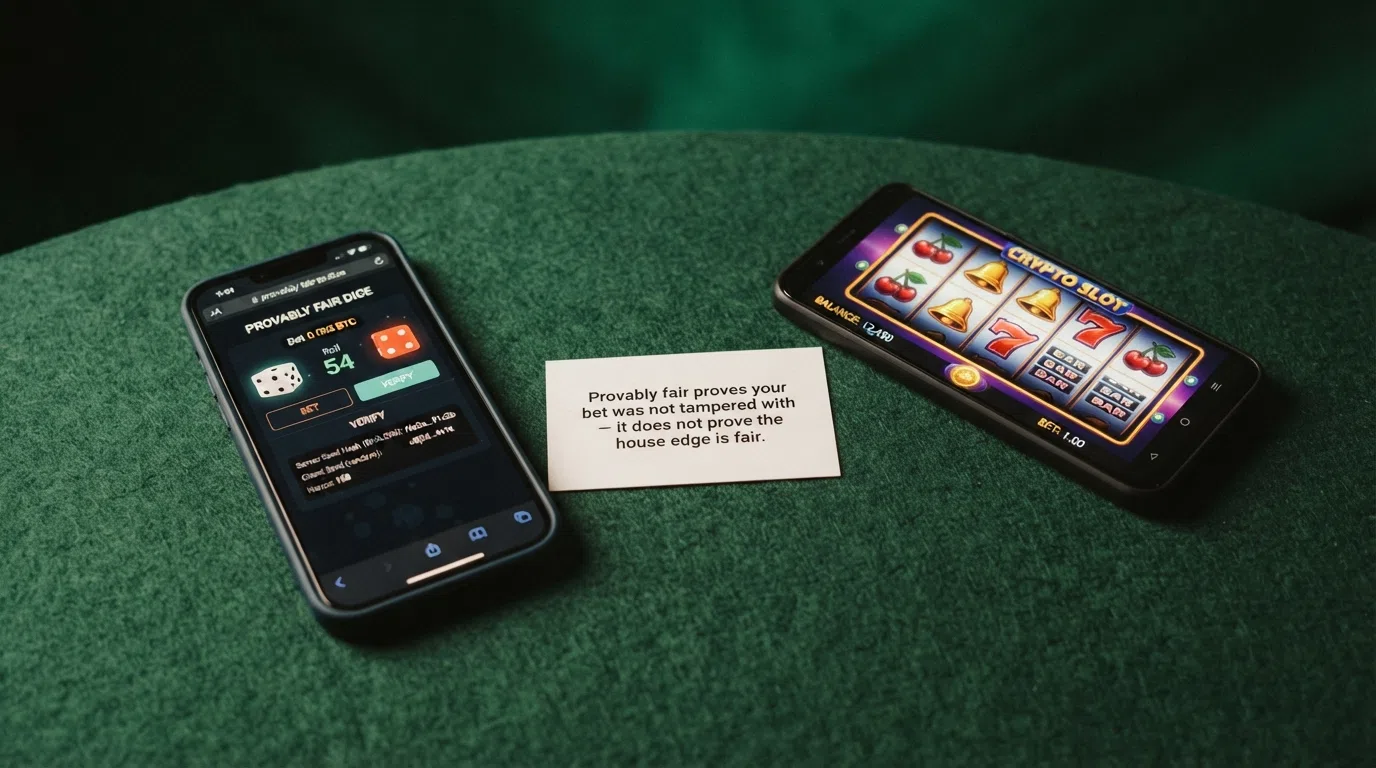
The game types fall into three categories. The first is conventional slots — classic, Megaways, jackpot, progressive — from the same providers that supply UKGC casinos. These are the same games with the same RTPs; the casino’s licence does not change the math. The second is live dealer — blackjack, roulette, baccarat, game shows — from Evolution and Pragmatic Play Live. The third is the crypto-native category: provably fair originals (BC Originals, Roobet Originals, Stake originals, Rollbit originals), crash games (Roobet’s signature Crash is the most famous), dice, Plinko, mines, and the wider genre of simple, fast, hash-based games.
The £5/£2 UKGC stake cap on slots does not apply offshore. A UK player used to a £5 maximum on a single spin will find higher caps available at every operator in the ranking. The cap is a UKGC protection, not a game property; the same slot, from the same provider, can be played at a higher stake at an offshore operator. The absence of the cap is one of the things a UK player is paying for, in the sense that the operator’s offer is more permissive precisely because the operator is outside the perimeter.
Slots, Megaways and Jackpots: The Offshore Slot Library
The slot library is the part of the ranking where the offshore operators are most similar to the licensed market. Pragmatic Play’s slots run at the same RTPs at an offshore casino as at a UKGC casino, because the games are the same games; the difference is the operator’s stake limits and the absence of the UK’s auto-play ban and the 2.5-second minimum spin speed. The same slot that runs at a 2.5-second spin with no auto-play at a UKGC casino can be played at a faster spin with auto-play at an offshore one.
Megaways titles are the most volatile end of the slot library, and the offshore operators carry the full Megaways catalogue. Progressive jackpots are also available; the larger the operator’s library, the more jackpot networks it carries. A player who has exhausted the Megaways catalogue at a UKGC casino will find a familiar offering at the larger crypto casinos, with the same RTPs and the same volatility.
The published RTPs in the ranking are spotty. Rollbit publishes RTPs for its three bonus slots — Starburst at 96.09%, Aloha! Cluster Pays at 96.42%, Finn and the Swirly Spin at 96.62% — and the rest of the bonus slots in the ranking carry an “RTP not confirmed” flag. The player who values RTP transparency should weight Rollbit’s published numbers accordingly, and treat the other operators’ slot RTPs as needing a separate lookup at the provider’s published figure.
Crash Games, Live Dealer Tables and Crypto-Native Games
Crash is the game most associated with the crypto casino genre, and Roobet is the operator most associated with Crash. The mechanic is simple: a multiplier starts at 1.00× and rises; the player cashes out before the multiplier “crashes” to zero. The provably fair commitment scheme applies cleanly — the crash point is determined by the combined seed before the round starts, and the player can verify after the fact. The strategy game is timing the cashout, and the house edge is the gap between the theoretical expected multiplier and the realised one.
Live dealer at an offshore casino is the same live dealer as at a UKGC casino. Evolution’s tables, Pragmatic Play Live’s tables, and the rest of the studios run the same games with the same dealers; the difference is the operator’s licence and the absence of the UKGC’s stake caps. A player who has played Evolution’s Lightning Roulette at a UKGC casino will find the same game at the same RTP at BC.Game, with a higher stake limit.
Dice, Plinko, Mines and Towers are the simpler provably fair originals, all built on the same commitment-scheme pattern. They are the games where the crypto-native category is at its purest — easy to verify, fast to play, and not present in the UKGC catalogue. A player who wants the crypto-only game types will find them in the originals section of every operator in the ranking.
Mobile Crypto Casinos: Apps, Browsers and What Actually Works
Mobile access to crypto casinos is overwhelmingly browser-based. The site adapts to a phone screen, the games run in HTML5, and the wallet connection happens in the mobile browser. The experience is generally good, with the main caveats being the small screen on detailed live dealer interfaces and the lack of push notifications for promotional events.
Vave stands out for offering a native iOS app — the only confirmed dedicated app in the ranking. The app is downloadable from a third-party source rather than the App Store, because Apple’s rules around real-money gaming in unjurisdicated apps push most operators toward the browser. CoinCasino, built on Telegram, is accessed through the messaging client rather than a website. The other eight operators in the ranking are mobile-browser only, with no native app on either iOS or Android.
A UK player on a phone is, in practice, browsing. The mobile browser is the right tool for the job at every operator except Vave, and the lack of a native app is not a functional gap at the browser-based operators — it is the design choice the operator has made, and the games run as well in a mobile browser as they would in a native app.
How to Pick a No-KYC Crypto Casino Without Getting Burned
A UK player choosing an offshore crypto casino is making a decision the regulator would otherwise make. The decision is between operators, and the criteria are the ones the regulator would weigh, applied by the player.
Reputation is the first filter. A player should look for an operator with at least a couple of years of operating history, a verifiable track record of paying out withdrawals, and a community reputation that holds up to a search for withdrawal problems. Bitcasino’s 2014 founding date is the strongest longevity signal in the ranking; the newer operators carry more uncertainty on this point.
The licence is the second filter. A Curaçao licence is the floor — a permissive regime, but a named regulatory body. CoinCasino’s Costa Rica registration with no gambling-specific licence is a step below. Vave’s no-confirmed-licence position is a step below that. A player who weighs the licence position heavily should weight Curaçao-licensed operators above the rest and treat the no-licence operators as a separate category.
The bonus terms are the third filter. The wagering multiplier, the validity window, the max-cashout cap, and the bonus slot’s RTP together determine what the bonus is actually worth. The 60× at CoinCasino and the 50× at Vave are the highest in the ranking; the wager-free at Jackbit and the cashback at Winz are the lowest. A player who values the bonus will read the small print on the highest-multiplier offers and discover that the headline is the most expensive part of the package.
The KYC threshold and the withdrawal speed are the fourth filter. A player who expects to withdraw under $2,000 will not see the KYC trigger at any of the named operators; a player who expects to withdraw over $10,000 will see it at every one of them. The honest read is that the KYC trigger is the part of the experience the marketing does not describe, and the player should plan for it.
The crypto range is the fifth filter. A player who is using Bitcoin and USDT has no issue with any of the operators in the ranking. A player who wants Monero, Solana, or one of the longer-tail altcoins should weight BC.Game and Vave above the rest. A player who wants a stablecoin on a low-fee chain should check the operator’s deposit page for the chain support before the first deposit.
New Crypto Casinos: What a Fresh Launch Brings — and What It Risks
A new crypto casino is a different trade-off to an established one. The launch bonus is typically larger — a new operator needs player volume, and a generous welcome offer is the way to get it. The track record is shorter — a player cannot look back two years for withdrawal complaints because the operator has not been operating for two years. The licence position is whatever the operator chose at launch, which is often a Curaçao Certificate of Operation or, in a few cases, a Costa Rica registration with no gambling-specific licence.
The British regulatory context adds a second uncertainty. The UKGC’s exploratory review of a potential crypto pathway was opened at the BGC AGM in February 2026, and the FSMA (Cryptoassets) Regulations 2025 are expected to come into force on 25 October 2027. Any new crypto casino launching in 2026 is launching into a regulatory environment that may be substantially different in 2028, and the operator’s plan for that change is part of the due diligence a player should do.
The enforcement context is the other variable. The UKGC’s disruption programme — 3,140 cease-and-desist notices, 447,778 URLs referred to search engines, 287,961 URLs removed in the period from April 2024 to June 2025 — is the mechanism by which the Commission reaches operators it cannot licence. A new operator that the Commission has not yet noticed is not protected by that absence; the operator is just below the radar. A player who picks a new casino on the basis of the launch bonus is, in part, betting on the operator surviving the regulatory attention that follows.
The honest read is that a new casino’s bonus is worth more, and the operator is worth less, in expectation. A player who can afford the loss of the bonus if the operator disappears is the player for whom the trade-off works.
Staying Safer When the Usual UK Safeguards Are Not There
A UK player at an offshore crypto casino has to do the safeguarding the regulator would otherwise do. The tools are the same tools the licensed market uses, applied by the player, and they work the same way.
GAMSTOP is the first line of defence and it does not cover offshore sites. The exclusion periods — six months, one year, five years, or five years with auto-renewal — are designed to outlast a window of vulnerability, and they cannot be cancelled early. A player who has self-excluded through GAMSTOP and is considering an offshore casino is the player for whom the offshore gap is the most dangerous, because the protection that would have stopped the play at a UKGC casino does not extend to the offshore one. Gamban and similar blocking software are the technical equivalent for offshore sites, blocking access at the device level rather than at the operator’s register. GamCare, which runs the National Gambling Helpline, can advise on the right tool for a player’s situation.
Deposit and loss limits are the second line. The UKGC’s regime requires the operator to prompt the customer to set a financial limit before the first deposit and to use the term “deposit limit” only for a gross deposit limit. An offshore operator has no equivalent requirement. A player who wants a deposit limit has to set one themselves — most crypto casinos have a self-service limit tool in the account settings, and a player who is serious about the limit should set it on day one rather than waiting until a losing session has changed their mind.
Reality checks and time-outs are the third line. A UKGC casino runs reality checks at fixed intervals during a slots session and shows the player their total wins, losses and time played. An offshore casino may offer the same tools or may not. A player who wants them should set their own — a phone alarm at 30-minute intervals is the low-tech version — and treat the absence of an automatic prompt as a reason to be more diligent, not less.
The scale of gambling harm in the UK is the reason these tools matter. The latest published survey, the GambleAware / YouGov Annual GB Treatment and Support Survey 2024, found 13.1% of adults who gamble — approximately 6.8 million GB adults — were classified as experiencing any level of gambling problems on the PGSI 1+ scale. GamCare’s National Gambling Helpline reported 996 referrals to treatment in January 2026, up 48% year-on-year from January 2025’s 674, and the share of helpline contacts citing online gambling reached a five-year high of 81.5% in 2026. The numbers are the context the offshore product is being chosen into, and a UK player who reads them with a clear head will make a different decision than one who does not.
Where to Get Help When You Need It
The UK support infrastructure is the same regardless of where a player has been gambling. The National Gambling Helpline, run by GamCare, is the front door. GAMSTOP is the self-exclusion register for UKGC-licensed sites, with exclusion periods of six months, one year, five years, or five years with auto-renewal that cannot be cancelled early. Gamban is the device-level blocking software for sites outside the GAMSTOP coverage. The NHS runs gambling harm clinics in England, Scotland and Wales. Gamblers Anonymous UK runs peer support groups in person and online.
The funding for treatment is the statutory levy, in force from 6 April 2025, which applies at 1.1% of gross gambling yield for remote casino and remote bingo licences, with 50% of the proceeds going to treatment, 30% to prevention and 20% to research. The levy is paid by licensed operators; an offshore operator’s players can still access the treatment, prevention and research the levy funds, but the offshore operator does not contribute. The treatment is open to anyone who needs it, regardless of where they have been playing.
The TalkBanStop partnership — GamCare, GAMSTOP and Gamban working together — concluded in March 2026, and the same three organisations continue to operate as the front line. A UK player who needs help can reach any one of them and be pointed to the rest.
How We Selected and Ranked These Casinos
The ten operators in this ranking were identified from search engine results and from the specialist crypto-casino review sites that publish audit data on the offshore market. The selection prioritised operators that actively serve UK players, that publish a real-money welcome offer, and that have a public track record of more than a single year.
Each operator was checked against the UK Gambling Commission’s public register of 2,663 active licence records. None of the ten appear on it. The check was repeated at the data refresh date, and the result was the same. The Commission’s published position — that no UKGC-licensed casino accepts cryptocurrency — was the working assumption going into the check and the conclusion coming out of it.
The ranking criteria, in order of weight, were: bonus value and terms, game selection and provider quality, KYC policy and withdrawal threshold transparency, cryptocurrency range and payment speed, and public track record and community reputation. The weight is editorial; the audit scripts that verify the ranking do not produce the same order, and the reader should treat the ranking as a reasoned judgment, not a derived score.
The limitation is the ranking’s foundational caveat. Every operator in the table is offshore and unlicensed in Great Britain. The ranking is the best of a market that is, by UK regulatory standards, illegitimate, and the reader should not confuse “ranked first” with “the British regulator would endorse this operator”. No operator in the ranking carries the Commission’s licence, and none of them can.
What UK Players Should Actually Do About No-KYC Crypto Casinos
The product the reader searched for exists, but only offshore. The KYC requirement the reader is looking to skip is the KYC requirement the UKGC’s regulatory framework makes mandatory for every operator it licences. The crypto payment the reader is looking to use is the payment the same framework makes incompatible with a British licence. The combination — no KYC, crypto, accessible from the UK — is not available inside the perimeter, and the ten operators in this ranking are what exists outside it.
The protections the reader gives up are real. GAMSTOP does not cover the offshore sites. The UKGC’s complaints process does not reach them. The £5/£2 stake caps do not apply. The £150 financial vulnerability check does not fire. The statutory levy does not fund the treatment of the harm the offshore product may produce. The list is not rhetorical; each line is a named, statutory protection with a date and a code attached to it. A reader who has read the rest of this page will not need the list restated here.
The operators reviewed above are the best of the unregulated set the research turned up. They are not the licensed set — there is no licensed set for this product — and no operator is singled out as the one to pick. The choice between Jackbit’s wager-free spins, BC.Game’s library, Stake’s recurring races, Winz’s cashback, Rollbit’s published RTPs, and the rest of the table is a choice between different ways of being offshore, not a choice between offshore and licensed.
The reader’s priorities determine whether the trade-off is worth it. A player who values speed and privacy above the British protections will find a working product in the ranking. A player who values the protections above the speed and privacy will not. The arithmetic and the regulation point the same way: the product is what it is, the perimeter is where it is, and the reader is the one who decides which side of the line to stand on.
Account – fastestpayout-casinos-uk
Content created by the «fastestpayout-casinos-uk» team