
Casino Sites Not Registered With Gamstop UK — What the Label Means and What It Costs
 Available in GB
The phrase “casino sites not registered with Gamstop UK” is doing two jobs at once. On the surface, it points at a list of casinos a player can use right now. Underneath, it describes a regulatory position: a casino that sits outside the British licensing perimeter entirely, beyond the reach of Gamstop, the UK Gambling Commission, and the consumer protections those systems provide. This page is about that second job. The first one, the list of brands, sits below it.

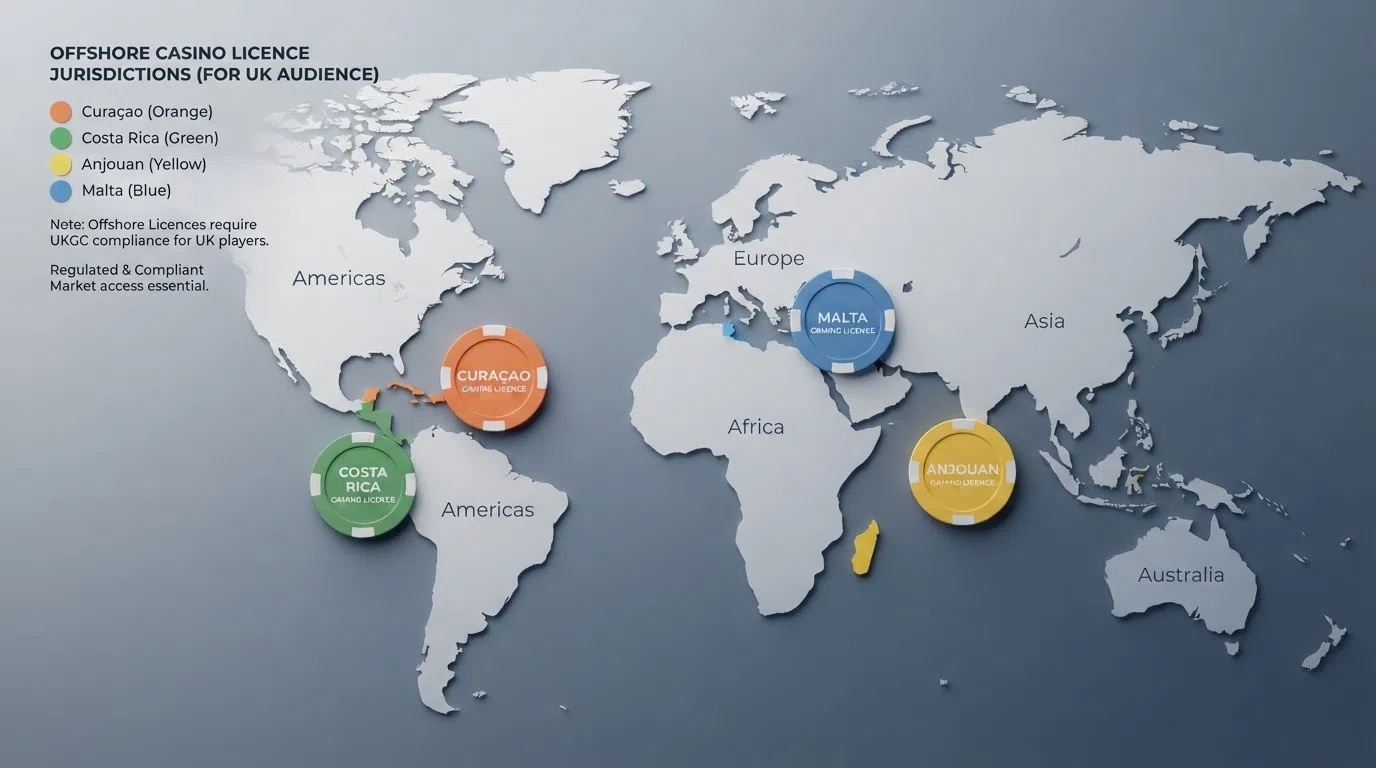
Every casino compared here holds a Curaçao, Costa Rica, Anjouan, or MGA licence. None of them appears on the UK Gambling Commission’s public register. That is the single most important fact about each of them, because it determines everything else: what the bonus looks like, how the games behave, which payments work, where the player goes if something goes wrong, and what the player gives up by being there.
Data current as of September 8, 2026, licence claims verified against each operator’s stated regulator and cross-checked against the UK Gambling Commission’s public register of licence holders.
What “Not Registered with Gamstop” Actually Means for UK Players
Gamstop is the UK’s national online self-exclusion scheme. Register with it and every casino licensed by the UK Gambling Commission is supposed to block your account. The scheme became mandatory for every UKGC online licence on 31 March 2020 — there is no UKGC-licensed casino that lets a self-excluded player gamble. By the end of 2025, 561,983 active exclusions sat on the register, with 117,756 new registrations that year. By mid-2026, the cumulative number had climbed to 614,738 consumers, and May 2026 set a monthly record of 12,236 sign-ups.
“Casino sites not registered with Gamstop” therefore describes operators that have not enrolled in that scheme — not because they opted out of it, but because they do not hold the UKGC licence that would require them to enrol. The label tells the player exactly one thing: this casino is not part of the British regulatory system.
That is also what makes the category exist. Self-excluded players are the audience these sites are built to reach, and the Commission has warned in plain language that unlicensed markets “target vulnerable customers, such as those who have self-excluded via the GAMSTOP scheme.” Players who have not self-excluded land on the same sites for different reasons — credit-card acceptance, larger bonus caps, game catalogues that aren’t trimmed to the UKGC’s stake cap, or simply curiosity about a casino the UK market doesn’t list.
The trade-off at the heart of this page: access to higher bonuses, larger game libraries, and payment methods UKGC sites cannot offer, in exchange for every layer of British consumer protection that comes with a UKGC licence.
Gamstop Participation Explained
Gamstop works on a simple model. A player registers, chooses an exclusion period (six months, one year, or five years), and the platform tells every UKGC-licensed operator to refuse that customer’s account. The minimum exclusion is six months; the maximum is five years plus auto-renewal of up to a further seven years. The exclusion cannot be cancelled early. There is no “I changed my mind” button.
The mandatory part is the part that matters here. Since 31 March 2020, every online operating licence issued by the UK Gambling Commission has required Gamstop participation. The Commission has suspended licences over failure to participate. A casino that is not registered with Gamstop is therefore not licensed by the UKGC. The two things are not separate; they are the same statement from opposite sides.
The 16% year-on-year rise in Gamstop registrations in the first half of 2026, and the 40% rise in 16-to-24-year-olds registering in the second half of 2025, suggest the scheme is being used more, not less. That growth is the demand-side reason non-Gamstop casinos exist: there are more excluded players looking for somewhere to play, and the supply has grown to meet them.
How Non-Gamstop Casinos Differ from UKGC-Licensed Operators
The contrast is structural, not cosmetic. A UKGC licence is a single framework that bundles dozens of obligations — identity verification before first deposit, mandatory deposit-limit prompts, affordability checks at £150 of net deposits in 30 days, a £5/£2 per-spin slot stake cap, banned auto-play, a 2.5-second minimum spin interval, no “losses disguised as wins,” no reverse withdrawals, banned credit-card gambling, a 10x wagering cap on bonuses, and Gamstop itself. Drop the licence and every one of those obligations drops with it.
The practical upshot:
- Stake freedom. No statutory £5/£2 cap. Slots at non-Gamstop casinos can be played at whatever stake the operator allows. That is the single biggest design difference between the two catalogues.
- Game-design rules gone. Auto-play works. Spin speed is whatever the developer set. Losses disguised as wins remain in the reels. Reverse withdrawals are allowed.
- Credit cards accepted. Banned at UKGC casinos since 14 April 2020, and the ban extends to credit-card-funded payments through e-wallets. Non-Gamstop casinos routinely accept Visa and Mastercard credit.
- No deposit-limit prompt. Operators can offer one, but they are not required to. Some do — Bilucky is a documented example — but the player must look for it.
- No affordability check at £150. The financial vulnerability check that fires at every UKGC site after 30 days of net deposits reaching £150 does not exist here.
- No Gamstop. The exclusion scheme that defines the licensed market cannot reach these sites.
These are not small differences. Each one changes how the player interacts with the casino, how much they can lose per spin, and what protections they have if a dispute arises.
Types of Non-Gamstop Casinos Available to UK Players
The category is broad enough to hold several formats. Browser-based online casinos are the default — desktop and mobile sites that load in a browser, with no software to install. Mobile-optimised versions of those same sites are the next layer, responsive layouts tuned for phones and tablets, sometimes with light apps on the major stores. Live-dealer platforms power the table-game side, with studios streamed in real time and chat between player and dealer; Evolution Gaming is the dominant supplier, supported by Pragmatic Play Live and smaller studios such as OnAir and Iconic21. Crypto-first operators — FreshBet, Winstler, Winorio, SlimKing among the ten reviewed here — take Bitcoin, Ethereum, and a handful of other coins for both deposits and withdrawals, often with payout times measured in minutes rather than days. Hybrid platforms mix all of the above: a slot library, a live-dealer floor, a sportsbook, and crypto rails under one account.
The slots market alone shows the demand. UK online slots generated £773 million in gross gambling yield in the first quarter of 2026, up 12% on the previous year, across 25.1 billion spins. That is the size of the British slot machine. Non-Gamstop sites compete for a slice of it.
Safety and Reputation: What to Look For
Without the UKGC, the player has to do some of the regulator’s job themselves. The first check is licence jurisdiction, and the four that appear in the featured set are not equal. The Malta Gaming Authority sits at the top of the offshore tier — segregated player funds, a formal complaints process, decades of regulatory track record. Curaçao reformed its regime in 2024 under the LOK framework, which moved it from minimal oversight toward something closer to a mid-tier regulator, though still well short of the UKGC. Costa Rica and Anjouan offer the lightest oversight of the four — Costa Rica issues no gaming-specific licence at all, and Anjouan’s framework is thin enough that it functions more as a registration than a regulator.
Player reviews and operational longevity matter more when the regulator is light. A casino that has been paying out customers for three years and is still answering complaints publicly is worth more than one that launched last month with no track record. Public complaint patterns, payout disputes, and how an operator responds to a slow withdrawal tell more about a casino than its bonus page does.
The Commission’s enforcement record is the other side of this: 260 cease-and-desist notices to advertisers between January 2025 and February 2026, with the response deadline cut to 48 hours, and a 32% drop in GB user engagement across 160 websites targeted for action. That is the disruption record, not a safety verdict — a 32% drop means two-thirds of the traffic kept coming back. It is the data the Commission has on its own enforcement, not a guarantee that any given site is safe.
Top 2026 Non-Gamstop Casinos Compared
The table below covers the ten featured operators across the fields the player can compare them on. Where research did not confirm a value, the cell carries the article-language no-data marker. Several operators — Winstler, Winorio, SlimKing — carry gaps that the plan flagged at the source level: terms, wagering or licence details were not confirmed during this review cycle, and the page says so rather than guessing.
How We Ranked These Casinos
Licence jurisdiction is the primary filter. A casino with a UKGC licence would be a different kind of page; every brand here sits outside the British system, and the tier they sit in (MGA, Curaçao, Costa Rica, Anjouan) determines what they offer the player when things go wrong. Bonus fairness is benchmarked against the UKGC’s 10x wagering cap, which is the ceiling every UKGC-licensed bonus must stay under from 19 December 2025 — a useful yardstick even though it does not bind these operators. Game-provider breadth is the quality signal: studios like NetEnt, Evolution, Pragmatic Play, Play’n GO, and Hacksaw Gaming supply the UK market too, so their presence here suggests the games are real. Deposit minimum and public player-feedback signals round out the ranking.
What the ranking does not measure: how often each casino pays out on a disputed withdrawal, how a complaint is handled, whether the licence regulator has ever taken action against the operator. Those are real questions; the data needed to answer them is not on the table for this category.
| Casino | Licence jurisdiction | GB licence status | Welcome bonus | Free spins | Wagering multiplier | Bonus validity | Min deposit |
|---|---|---|---|---|---|---|---|
| MyStake | Curaçao GCB | Not held | 150% up to £750 (first deposit); 300% up to £1,500 across 3 deposits | 30 no-deposit spins on registration | 30x (deposit + bonus) | 30 days | £20 |
| GoldenBet | Curaçao GCB | Not held | 300% up to £1,500 across 3 deposits | 100 bonus spins with deposit | 35x (bonus funds) | 30 days | £20 |
| DonBet | Curaçao GCB | Not held | 150% up to £750 first deposit | 50 with welcome deposit; 30 no-deposit spins | 30x (deposit + bonus + FS winnings) | 30 days (bonus); 14 days to meet wagering | £20 |
| Rolletto | Curaçao GCB | Not held | 150% up to £500 first deposit (£5,500 total across 3 deposits) | 200 (50 instant + 30/day for 5 daily logins) | 30x (bonus funds) | 30 days | £20 |
| FreshBet | Curaçao GCB | Not held | 100% up to £500 first deposit (250% up to £1,500 across 3 deposits) | 25 no-deposit spins on registration | 30x (bonus funds) | 30 days | £20 |
| Winstler | Curaçao 5536/JAZ (master) + Anjouan | Not held | 600% up to €9,500 | — | — | — | £20 / €20 |
| Emperia Casino | Curaçao (Fortuna Games N.V.) | Not held | 200% up to £865 + 100 FS (first deposit); 450% + 325 FS across 4 deposits, up to £3,000 total | 325 across 4 deposits; 100 on first deposit on The Dog House | 35x (deposit + bonus); 40x on FS winnings | — | £17 / €10 |
| Winorio Casino | Costa Rica (AXENTRA LTD) | Not held | 100% up to €500 + 150 FS (first deposit); up to €1,500 + 250 FS across 3 deposits | 250 across 3 deposits (150 + 50 + 50) | — | — | €20 / £20 |
| Bilucky Casino | Costa Rica | Not held | 100% up to £250 + 200 FS on first deposit (4-part package across 4 deposits) | 200 on Beware the Deep Megaways (20/day over 10 days, first 20 immediate) | 40x (deposit bonuses) | — | €20 / £20 |
| SlimKing Casino | — | Not held | — | — | — | — | — |
MyStake
MyStake is one of three operators in the featured set offering a no-deposit entry point: 30 free spins on registration, before any deposit lands. The headline offer is a 150% welcome match up to £750 on the first deposit, scaling to 300% up to £1,500 across three deposits. The wagering requirement is 30x on deposit plus bonus, with 30 days to clear it and a £20 minimum deposit to qualify.
The provider mix reads like a UKGC site’s shopping list: Pragmatic Play, NetEnt, Evolution Gaming, Play’n GO, Hacksaw Gaming. That is the same software powering licensed British casinos — which is exactly the Commission warning about licensed software appearing on the illegal market.
The no-deposit spins are the interesting part. They let a player test the casino without committing money, which most Curaçao-licensed competitors don’t offer. Wagering on the deposit bonus is on the heavier side at 30x deposit plus bonus — a £750 match on a £500 deposit at 30x means wagering £37,500 in total before the bonus converts to withdrawable cash. That arithmetic is what the bonus number is actually worth, and the calculation is the only place it shows up clean.
Verdict: MyStake suits a player who wants a deposit-free trial before committing and is comfortable with Curaçao-level consumer protection rather than UKGC-level.
GoldenBet
GoldenBet is the highest percentage match in the featured set at 300%, spread across three deposits up to £1,500 total, with 100 bonus spins attached to the deposit. Wagering is 35x on bonus funds — slightly heavier than MyStake’s 30x on the combined deposit-plus-bonus base, and slightly lighter than Emperia’s 35x on the same base. The casino carries the same Curaçao GCB licence as MyStake and a provider line-up that overlaps almost entirely: Pragmatic Play, Evolution, NetEnt, Play’n GO, Hacksaw Gaming.
The 300% headline number deserves context. With a wagering requirement on bonus funds, the matched amount is large because the wagering requirement is heavy. The two are not independent.
Verdict: GoldenBet suits a player who wants the largest match percentage available and is prepared for the wagering workload that comes with it.
DonBet
DonBet layers two offers on top of each other. The headline match is 150% up to £750 on the first deposit, with 50 free spins attached, but the casino also offers 30 no-deposit spins on a separate terms basis — a risk-free trial before deposit. The wagering requirement applies to deposit, bonus, and free-spin winnings at 30x, with a 30-day bonus validity and a tighter 14-day window to meet the wagering itself.
The fixed spin value of £0.10 is unusual — most casinos price free spins at the minimum stake of the slot they are attached to, which can be lower than a penny. £0.10 per spin over 50 spins is £5 of nominal spin value, and the winnings on those spins then carry the same 30x requirement as the deposit match. That is a quiet way to load wagering onto a bonus that looks small.
Verdict: DonBet suits a player who wants both a deposit-free trial and a deposit match in the same place, and is comfortable reading the wagering terms on both before claiming either.
Rolletto
Rolletto’s 200 free spins are the highest in the featured set, and they are structured unusually: 50 of them land immediately on the first deposit, then 30 per day for five daily logins, requiring the player to come back to claim them. The headline offer is a 150% match up to £500 on the first deposit, scaling to £5,500 total across three. Wagering is 30x on bonus funds, with 30 days’ validity and a £20 minimum deposit.
The daily-login mechanic is worth understanding. If a player deposits on a Friday, takes the 50 instant spins, then misses Saturday and Sunday, they forfeit 60 spins. The offer is structured to keep a player returning, which is exactly what wagering-against-a-clock designs do — and exactly what the UKGC’s 10x wagering cap was introduced to dampen.
Verdict: Rolletto suits a player who will actually log in for six consecutive days, and who is comfortable with a wagering structure that rewards exactly that behaviour.
FreshBet
FreshBet is one of three operators offering no-deposit free spins (25, on registration) and one of three in the set with confirmed crypto payout times. The headline match is 100% up to £500 on the first deposit, scaling to 250% up to £1,500 across three. Wagering is 30x on bonus funds, with a 30-day validity and a £20 minimum deposit.
The payout infrastructure is where FreshBet stands out. Crypto withdrawals clear in minutes to two hours; Skrill and Neteller take up to 24 hours; Visa and Mastercard take 24 to 72 hours. That is the fastest crypto payout window in the featured set and one of the few that publishes it. The 25 no-deposit spins are a smaller trial than MyStake’s 30, but the wagering on their winnings (30x) is on the lighter end.
Verdict: FreshBet suits a player who values payout speed, particularly on crypto rails, and wants a no-deposit trial before committing.
Winstler
Winstler is the largest headline offer in the set — 600% up to €9,500, denominated in euros — and one of two operators with a Curaçao/Anjouan dual-licence structure. The licence is Curaçao master 5536/JAZ (Favorit United N.V.) with a subsidiary licence from Anjouan Gaming. The casino is listed as restricted in the UK by some sources, which is worth checking against the cashier page before depositing.
Several fields were not confirmed during this review cycle. Wagering requirement, free-spin offer, and bonus validity are not on the page because research did not confirm them. That is a meaningful gap for a 600% bonus, because the wagering multiplier is what turns that headline number from a marketing line into a workload. The payout infrastructure is confirmed: crypto under 24 hours, cards and bank transfer within three business days, with a £20/€20 minimum deposit.
Verdict: Winstler suits a player who is comfortable with a Curaçao/Anjouan structure, has checked the casino’s UK availability directly, and accepts that the headline number’s true cost depends on terms that were not confirmed here.
Emperia Casino
Emperia is a 2026 launch, one of two operators in the set that opened this year, and the one with the largest game catalogue: 12,000+ titles across Pragmatic Play, NetEnt, Evolution, Play’n GO, Push Gaming, BetSoft, Spinomenal, Microgaming, BGaming, Hacksaw Gaming, Playson, and others. The welcome package is 200% up to £865 plus 100 free spins on The Dog House (Pragmatic Play) on the first deposit, scaling to 450% plus 325 free spins across four deposits, up to £3,000 total.
The wagering structure is split: 35x on deposit plus bonus, 40x on free-spin winnings, with a £4 maximum bet during wagering and a £17/€10 minimum qualifying deposit. The max-bet cap during wagering is a useful safeguard for the player — it prevents the bonus being cleared in a single spin — but it is also a signal that the casino is serious about the wagering being met.
Verdict: Emperia suits a player who wants a large game catalogue and a structured four-deposit package, and accepts Curaçao-level consumer protection in exchange for both.
Winorio Casino
Winorio opened in March 2025 under Costa Rican registration (AXENTRA LTD) and offers 100% up to €500 plus 150 free spins on the first deposit, scaling to €1,500 plus 250 free spins across three deposits. Wagering requirements were not confirmed during this review cycle — a gap that matters more here than it would for a smaller bonus, because the wagering multiplier is what determines how much work the player has to do to clear the headline amount.
The payout infrastructure is confirmed and on the slower end of the featured set. Crypto withdrawals take between instant and 24 hours; bank transfers take one to seven banking days; requests are processed within 48 hours. The casino carries 10,000+ titles from Pragmatic Play, NetEnt, Evolution, Play’n GO, and others. There is no no-deposit bonus.
Verdict: Winorio suits a player who values a Costa Rica-registered operator with a long payout timeline they can plan around, and accepts that the wagering terms were not confirmed at the time of this comparison.
Bilucky Casino
Bilucky is the Costa Rica-registered operator in the set that publishes a responsible-gambling suite: deposit limits, loss limits, session limits, stake limits, time-out, and self-exclusion. That is the only operator in the featured ten with that combination confirmed in the source material, and it is the closest thing to the UKGC’s mandatory deposit-limit prompt that exists in this category — though it is offered, not required.
The welcome offer is 100% up to £250 plus 200 free spins on Beware the Deep Megaways, structured as 20 spins per day for 10 days with the first 20 available immediately. Wagering is 40x on the deposit bonus, the heaviest confirmed multiplier in the set, with a €/£20 minimum deposit and a 2,000+ game library.
Verdict: Bilucky suits a player who wants built-in responsible-gambling tools and is willing to accept the highest wagering multiplier in the featured set.
SlimKing Casino
SlimKing is the other 2026 launch in the featured set and the operator where the comparison runs out of confirmed data. The casino describes itself as an independent operator with 3,650+ games (3,400+ slots), 85+ live-dealer tables from five or more studios including Iconic21, OnAir, and WinFinity, plus Bonus Buy slots, Quickspins, and crypto payments. Provider list includes Amatic, Hacksaw Gaming, Mancala, and 40+ others.
Welcome bonus, free spins, wagering multiplier, bonus validity, minimum deposit, and licence — none of these were confirmed for SlimKing during this review cycle. The casino offers what an unusually deep game catalogue offers, but the player cannot compare it on the fields the rest of the table is built on.
Verdict: SlimKing suits a player who is happy to verify the casino’s current terms and licence directly at the cashier before depositing, and wants the breadth of a 3,650-game catalogue with a 85-table live-dealer floor.
Why Non-Gamstop Slot Libraries Outstrip UKGC Casinos — and What That Costs You
The slot catalogue at a non-Gamstop casino is larger for two reasons: there is no UKGC stake cap to design around, and there is no UKGC game-design rule to remove features for. Both reasons matter, and they push in opposite directions at once.
The size is real. Emperia carries 12,000+ games; Winorio carries 10,000+; SlimKing carries 3,400+ slots alone. The UK market’s licensed casinos do not publish a single headline catalogue number in the same way, in part because the £5/£2 stake cap removes the commercial case for the highest-volatility titles and the bonus-buy features that ship with them.
The stake cap is the structural reason. A 2025 statutory instrument introduced a £5 maximum stake per game cycle for players aged 25 and over (in force 9 April 2025) and £2 for 18-to-24-year-olds (in force 21 May 2025). Offshore, there is no equivalent cap. A non-Gamstop casino can accept £100 spins on a high-volatility slot, £500 spins on a bonus-buy feature, or whatever else the game supports. That is the single largest difference between the two catalogues, and it changes which games are commercially viable to operate.
The game-design rules compound the effect. UKGC-licensed slots cannot offer auto-play, must have a 2.5-second minimum spin interval, must not disguise losses as wins, and cannot allow reverse withdrawals. Non-Gamstop slots can offer all four. Bonus Buy features — where a player pays a premium to trigger the bonus round directly, skipping the base game — are common in offshore catalogues and largely absent from UKGC ones, because the feature sits in tension with the stake cap and the spin-speed minimum.
The live-dealer side tells the same story. SlimKing’s 85-table floor with five studios (Iconic21, OnAir, WinFinity, plus Evolution) is the kind of depth UKGC casinos do not run, partly because the £5/£2 stake cap does not map cleanly onto live table minimums and partly because the studios are designed for higher-stakes play. The same Evolution Gaming studio powers both markets; the games are the same; the rules around how a player interacts with them are not.
The cost of the larger catalogue is paid in two currencies. The first is the games themselves: high-volatility slots and bonus-buy features are designed to concentrate the loss into fewer spins, which suits a player with a larger bankroll and punishes one without one. The second is the absence of the speed-of-play protections: at a UKGC site, a 2.5-second minimum spin and a banned auto-play mean a player cannot spin faster than 24 spins per minute. Offshore, that ceiling is gone, and the spin rate is whatever the player and the machine agree on.
The catalogue is real, and so is the trade-off.
Online Slots at Non-Gamstop Casinos
The headline catalogue numbers at Emperia (12,000+) and Winorio (10,000+) reflect what an offshore casino can host when it does not have to filter for a £5/£2 stake cap. The provider line-ups — Pragmatic Play, NetEnt, Hacksaw Gaming, NoLimit City, Push Gaming — are the same studios powering the UK market, which means the RTP numbers are largely comparable. What changes is what surrounds them.
Auto-play works. Spin speed is whatever the developer set, often under 2.5 seconds. Losses disguised as wins — a slot paying less than the stake on a “win” line and playing a celebratory animation — remain in the reels. Reverse withdrawals are allowed. Bonus Buy features are available at most providers’ titles, letting a player pay 50x or 100x the stake to trigger the bonus round directly.
The UKGC introduced all of those rules between 2021 and 2025 specifically because the evidence showed they accelerate loss. The offshore market does not have those rules because it does not have the UKGC. The games are not more generous; the speed at which they can take a player’s money is faster, and the features that disguise that speed are still in.
Live Dealer Casinos Outside Gamstop
The live-dealer floor at a non-Gamstop casino is typically powered by Evolution Gaming, the dominant supplier to both UK and offshore markets, plus studios such as Pragmatic Play Live and a handful of smaller suppliers. SlimKing’s 85-table floor across five or more providers is the deepest in the featured set, and the studios named — Iconic21, OnAir, WinFinity — sit alongside Evolution as the live-dealer equivalent of mid-tier slot providers.
The depth is the difference. A UKGC casino’s live floor typically runs 30 to 60 tables across a handful of studios. Offshore, the floor can run to 100+ tables across twice as many studios, because the studios can offer higher-stakes tables, more game-show titles, and niche formats (salon privé, lightning variants, regional tables) that the UKGC’s stake cap makes uneconomical.
The trade-off is identical to the slot side: the same game providers, the same games, no UKGC rules around the player interface. Auto-play on roulette doesn’t exist anyway, but the spin-speed rules do not bind here because there are no spin-speed rules at all outside the UK.
The Game Providers Behind Non-Gamstop Sites
The provider line-up at most featured operators — Pragmatic Play, NetEnt, Evolution Gaming, Play’n GO, Hacksaw Gaming — overlaps almost entirely with the UKGC market. The same studios supply both, because the games are the same games and the studios themselves are licensed in multiple jurisdictions.
The Commission’s warning about “licensed software appearing on the illegal market” describes exactly this. The software is licensed; the platform it is hosted on is not. That is the structural paradox of the offshore market: the games are real, the platform is unregulated, and the player is betting on whether the platform will pay out what the game says it has won.
Provider breadth is therefore a quality signal but not a safety one. A casino hosting 12 providers including NetEnt and Evolution is a casino that has invested in a real games catalogue, which raises the cost of operating a fly-by-night scam. It does not guarantee that the casino will pay out, because the licence that would compel it to is missing.
Getting Money In and Out: Payment Methods That Actually Work
Non-Gamstop casinos accept payment methods UKGC sites cannot, and lack the protections that come with the UKGC’s payment framework. The most consequential difference is credit cards — banned at every UKGC casino since 14 April 2020, including credit-card-funded e-wallet payments, and routinely accepted at offshore sites. That single policy is the reason many players end up on non-Gamstop casinos in the first place.
The rest of the payment picture is a mix. Debit cards work everywhere. E-wallets — Skrill and Neteller — are available at most offshore casinos, sometimes with faster payout times than cards. Crypto is a category UKGC casinos cannot offer at all: Bitcoin, Ethereum, and a handful of altcoins are deposit and withdrawal rails at FreshBet, Winstler, Winorio, and SlimKing. Bank transfer is the slowest option but the one with the highest ceiling. PayPal is rare at non-Gamstop casinos because PayPal does not process gambling payments for unlicensed operators in most jurisdictions.
Payout speed is where the offshore market separates itself. FreshBet’s crypto payouts clear in minutes to two hours; Winstler’s crypto payouts clear in under 24 hours; Winorio’s crypto payouts are instant to 24 hours. Card and bank-transfer payouts stretch longer — 24 to 72 hours at FreshBet, zero to three business days at Winstler, one to seven banking days at Winorio. The 48-hour processing window at Winorio is the operator’s internal review time, separate from the rail.
Credit Cards, Crypto and Debit: What You Can Use
The credit-card ban at UKGC sites is in force since 14 April 2020 and covers all remote gambling, including any payment that originates from a credit card even if it lands in an e-wallet first. Non-Gamstop casinos are not bound by it. Visa and Mastercard credit are accepted at most of the featured operators.
Crypto is the second differentiator. Bitcoin and Ethereum deposits and withdrawals are processed without a bank in the middle, which is why payout times drop to minutes at FreshBet and to under 24 hours at Winstler and Winorio. The trade-off is that crypto transactions are irreversible — a casino that delays or refuses a withdrawal leaves the player with no chargeback route and no bank to escalate to.
Debit cards work at both UKGC and non-Gamstop casinos. Skrill and Neteller work at both, with the UKGC e-wallet ban on credit-card-funded payments applying to both. The structural difference is credit cards: a payment method UKGC casinos have not accepted for six years is the most common method at non-Gamstop sites.
PayPal, Pay by Mobile and Boku: What Is Actually Available
PayPal is the major gap. UKGC casinos can offer PayPal because PayPal is licensed as a payment institution in the UK and will process gambling payments for UKGC-licensed operators. PayPal does not process gambling payments for offshore casinos in most jurisdictions, so PayPal deposits are not available at most non-Gamstop sites. Where research confirms PayPal availability at a non-Gamstop casino, it is the exception.
Pay-by-mobile and Boku — services that bill deposits to a player’s phone bill — appear in marketing materials at some offshore casinos but operator-level confirmation was not obtained during this review cycle. The honest position is to check the cashier page directly: pay-by-mobile availability is not universal at non-Gamstop casinos, and the absence of PayPal does not mean the absence of a pay-by-mobile option.
The Legal Reality: Why These Casinos Sit Outside UK Regulation
The legal position is straightforward and worth stating plainly. Online casino gambling is legal and licensable in Great Britain — but only with a UK Gambling Commission licence. Non-Gamstop casinos do not hold a GB licence. They are operating outside the British regulatory framework. A Curaçao, Costa Rica, Anjouan or MGA licence does not substitute for a GB licence under the Gambling (Licensing and Advertising) Act 2014, which made a UKGC licence compulsory for any operator taking GB customers, wherever it is based.
The penalty for the operator is a criminal one. Section 33 of the Gambling Act 2005 makes providing facilities for gambling without the required licence an offence carrying up to 51 weeks’ imprisonment, an unlimited fine, or both. The Commission enforces through cease-and-desist notices (260 issued to advertisers between January 2025 and February 2026, with the response deadline cut to 48 hours), referral of illegal URLs to search engines for delisting, work with domain registrars and hosts, and payment-provider referrals. The Commission does not currently hold statutory ISP/DNS blocking powers — legislation has been proposed but not enacted — which is why these sites remain accessible to GB players.
The penalty for the player is not a criminal one. What a player loses by gambling at a non-Gamstop casino is not liberty; it is every layer of British consumer protection that comes with a UKGC licence.
What Gamstop Is and Why It Matters
Gamstop is the UK’s national online self-exclusion scheme. Register with it, and every UKGC-licensed online gambling site is required to refuse the customer’s account. The scheme became mandatory for every UKGC online licence on 31 March 2020, and the Commission has suspended licences over failure to participate.
The exclusion periods run from six months to five years, with auto-renewal of up to a further seven years if the customer does not contact Gamstop after the minimum period expires. The exclusion cannot be cancelled early. There is no opt-out.
By the end of 2025, 561,983 active exclusions sat on the register, with 117,756 new registrations during the year and a 40% rise in 16-to-24-year-olds in the second half. By mid-2026, 614,738 consumers were on the register, with May 2026 setting a monthly record of 12,236 sign-ups. The trajectory is sharply upward.
The point for this page is the last one. Gamstop is online-only and licence-bound. It cannot reach an operator outside the British licensing system. A self-excluded British player is not protected on an unlicensed site, and the Commission has said so in plain language.
UKGC Licensing vs Offshore Licences: What Each Gives the Player
| Protection | UKGC (GB) | Curaçao GCB | MGA (Malta) | Costa Rica / Anjouan |
|---|---|---|---|---|
| Gamstop coverage | Mandatory since 31 March 2020 | None | None | None |
| Online slot stake cap | £5 (£2 for 18–24), age-banded | None | None | None |
| Auto-play ban | In force | None | None | None |
| 2.5-second minimum spin | In force | None | None | None |
| Losses-disguised-as-wins ban | In force | None | None | None |
| Reverse withdrawal ban | Permanent | None | None | None |
| Deposit-limit prompt | Mandatory from 31 October 2025 | Operator’s discretion | Operator’s discretion | Operator’s discretion |
| Financial vulnerability check (£150 net deposit) | Mandatory from 28 February 2025 | None | None | None |
| Wagering cap on bonuses | 10x maximum from 19 December 2025 | None | None | None |
| Credit-card gambling ban | In force since 14 April 2020 | None | None | None |
| ADR / formal complaints route | Approved ADR providers | LOK-era complaints mechanism | Formal complaints process | None formal ADR |
| Segregated player funds | Required | LOK reform includes segregation | Required | Not required |
| Mixed-product bonus ban | In force from 19 December 2025 | None | None | None |
The table reads the same way in any direction. Every row is a protection the UKGC delivers that the offshore alternatives do not, and every cell in the offshore columns is “none” or “operator’s discretion.” The MGA is the strongest offshore regulator on the list, with segregated player funds and a formal complaints process; Curaçao’s LOK reform has moved it closer to a mid-tier regulator; Costa Rica and Anjouan offer the lightest oversight.
The player’s position is the same across all four offshore columns: no Gamstop, no Commission complaints route, no British consumer redress if funds are withheld. The protection that exists elsewhere — MGA’s ADR, Curaçao’s LOK complaints mechanism — sits outside the British system the player is in.
European-Regulated Casinos Accepting UK Players
MGA-licensed casinos sit between UKGC and Curaçao on regulatory rigour. The Malta Gaming Authority requires segregated player funds, runs a formal complaints process, and has a multi-decade regulatory track record — the strongest of any offshore jurisdiction. Some MGA casinos accept UK players.
A Maltese licence is not a British substitute under the 2014 Act. The point-of-consumption rule means any operator taking GB customers needs a UKGC licence regardless of where it is based. An MGA casino accepting UK players sits outside Gamstop and outside the Commission’s complaints process, but inside an ADR framework that the UKGC does not offer.
For a player comparing options, the MGA tier is the safest non-Gamstop tier available, but it is still not a UKGC tier.
Player Protections and Dispute Resolution Outside the UK System
Without a UKGC licence, the player has no statutory alternative dispute resolution, no Commission complaints route, and no guaranteed fund segregation by default. What exists instead depends on the licence jurisdiction.
The MGA runs a formal complaints process that escalates player disputes through a structured process — the strongest ADR outside the UKGC. Curaçao’s LOK reform includes a complaints mechanism, though it remains less rigorous than Malta’s. Costa Rica and Anjouan offer no formal ADR. The Commission’s published position is that there is no approved ADR provider and no British consumer redress if funds are withheld at an unlicensed site.
The practical limit is what the player can do if a withdrawal is delayed or refused. A bank chargeback is possible on card payments. A payment-provider complaint is possible on e-wallets. A regulator complaint is possible at MGA-licensed operators and (with caveats) at Curaçao LOK-licensed ones. None of these are available through British channels at a non-Gamstop casino.
The pre-deposit check is the licence jurisdiction itself, and the operator’s operational history. A casino with three years of consistent payouts and a responsive complaints address is worth more than one that launched last month with no track record.
The Real Risks: What UK Players Lose Outside the Licensed System
The player loses, in order of consequence:
- Gamstop coverage — the exclusion scheme that defines the licensed market cannot reach these sites.
- Statutory ADR — no Commission-approved dispute resolution route, no British consumer redress.
- The £5/£2 stake cap — offshore, the stake is whatever the operator allows.
- Auto-play and spin-speed protections — gone. Spin as fast as the machine allows.
- Losses-disguised-as-wins and reverse-withdrawal bans — gone. Both features remain in the reels.
- The deposit-limit prompt — operator’s discretion. Some offer one; most don’t.
- Financial vulnerability checks — the £150 net-deposit check that fires at UKGC sites does not exist here.
- Mixed-product bonus ban — non-Gamstop sites can still offer combined casino/sports welcome packages.
- Wagering cap — the 10x ceiling on UKGC bonuses does not bind offshore. The featured set ranges from 30x to 40x.
- Credit-card ban — the UKGC ban since 2020 does not extend offshore.
None of these are speculative. Each one is a documented protection at UKGC sites and a documented absence at non-Gamstop sites.
Staying in Control: Safer Gambling Without the Gamstop Safety Net
The UK Gambling Commission’s safer-gambling infrastructure does not require a UKGC licence to use it. The National Gambling Helpline (0808 8020 133) is free, confidential, 24/7, and available to every UK resident regardless of where they gamble. GambleAware publishes tools and self-assessment resources. NHS England operates gambling-harm clinics — the National Problem Gambling Clinic and NHS Northern Gambling Service, with equivalent services in Scotland and Wales. Gamblers Anonymous runs peer support. Gamban and Betblocker are free for UK residents. Most UK banks offer gambling transaction blocks on debit and credit cards. The TalkBanStop partnership formally concluded in March 2026, with services transitioning to statutory levy commissioning.

The prevalence data behind these services is worth knowing. The Adult Psychiatric Morbidity Survey 2023-24 found 0.4% of adults in England experienced problem gambling (PGSI 8+) and 1.6% experienced at least moderate risk gambling (PGSI 3+). The Gambling Survey for Great Britain in 2024 found 2.7% of adults scored 8+ on the PGSI. NHS gambling referrals reached 4,355 in 2024/25, up from 2,284 the year before. The 40% rise in 16-to-24-year-olds registering with Gamstop in the second half of 2025 is the same demographic the prevalence surveys identify as the highest-risk group.
The absence of mandatory safer-gambling infrastructure at non-Gamstop casinos makes the external tools more important, not less.
Self-Regulation Tools at Non-Gamstop Casinos
Some offshore operators offer safer-gambling tools; most do not advertise them prominently, and none are compelled by law to offer them. Bilucky is the documented example in the featured set: deposit limits, loss limits, session limits, stake limits, time-out, and self-exclusion, all on the operator’s responsible-gambling page.
The contrast with UKGC sites is that the UKGC requires the deposit-limit prompt to fire before the first deposit. Offshore, the player has to find the limit-setting page themselves, set the limits themselves, and trust the operator to honour them. The tools can be real; the framework around them is not.
What to look for before depositing: a responsible-gambling page that lists deposit, loss, session and stake limits, time-out, and self-exclusion as named features, with each one accessible from the account dashboard. The absence of such a page is information in itself.
Setting Your Own Deposit and Time Limits
Without a statutory prompt, the player has to set limits independently. Three tools make this practical.
Bank-level gambling transaction blocks are available at most UK banks — Monzo, Starling, Barclays, HSBC, Lloyds, NatWest, Santander, and others allow customers to block gambling transactions on debit and credit cards either through the app or by request. The block sits at the bank, not at the casino, which means it works across every site the player might use.
Gamban and Betblocker are blocking software tools free for UK residents. They install on the device and block access to gambling sites and apps at the network level. The block survives browser changes, private-browsing modes, and most workarounds. For a player who has self-excluded and wants to keep it that way, device-level blocking is the strongest tool available outside Gamstop itself.
Manual session-timing and deposit-capping are the fallback. Set a deposit cap before the first deposit, not after; set a session timer; stop when either expires. The discipline is the tool.
Recognizing Problem Gambling Signals
The signals are behavioural, and they precede the financial ones. Chasing losses — depositing again to win back what was just lost — is the most common early sign. Increasing deposit frequency, escalating stakes, gambling at unusual hours, hiding gambling activity from family or friends, and using gambling to manage mood (boredom, anxiety, depression) are the others. The escalation pattern is the diagnosis, not any single behaviour.
Problem gambling (PGSI 8+) affected 0.4% of adults in England in 2023-24, while broader prevalence estimates reached 2.7% across Great Britain in 2024. The volume of NHS gambling referrals also increased, growing from 2,284 in 2023/24 to 4,355 in 2024/25. Additionally, Gamstop registrations among 16-to-24-year-olds rose by 40% in the second half of 2025, highlighting a significant increase in this demographic.
Playing at a non-Gamstop casino adds a structural risk to the behavioural ones: there is no mandatory affordability check, no deposit-limit prompt, no vulnerability assessment. The player’s own monitoring is the only monitoring.
Where to Get Help: Support Resources for UK Players
UK players have access to several support resources. The National Gambling Helpline (0808 8020 133), run by GamCare, is free, confidential, and available 24/7 via phone, live chat, or WhatsApp. GamCare also provides treatment services and online support. GambleAware is the commissioning body for prevention and treatment, offering self-assessment tools at its site. NHS England operates the National Problem Gambling Clinic and the NHS Northern Gambling Service, with equivalent services in Scotland and Wales. Other resources include Gamblers Anonymous for peer support, Gamban and Betblocker for device-level blocking software, and gambling transaction blocks offered by most UK banks. Additionally, the TalkBanStop partnership formally concluded in March 2026, with services transitioning to statutory levy commissioning.
How We Selected and Ranked These Casinos
The source basis is the public-facing material from each operator — bonus terms, licence disclosure, game catalogue, payment page, responsible-gambling page — cross-referenced against affiliate review sites where the operator’s own material was incomplete. The UK Gambling Commission’s public register of licence holders (2,663 records as of the search date) was checked against every featured operator; none of the ten appear on it, which is consistent with the “not registered with Gamstop” label.
The ranking criteria, in order: licence jurisdiction (MGA strongest, then Curaçao LOK, then Costa Rica and Anjouan), bonus fairness benchmarked against the UKGC’s 10x wagering cap (which is the ceiling every UKGC-licensed bonus must stay under from 19 December 2025), game-provider breadth, deposit minimum, and public player-feedback signals. No weights were assigned to these criteria; they are listed in the order they shaped the ranking.
What the ranking does not measure: payout reliability, complaint-handling quality, licence-regulator enforcement history, or any operator-level data that is not in the public-facing material. Those are real questions; the data needed to answer them is not on the table.
What UK Players Should Take Away from This Comparison
The decision facing a UK player looking at non-Gamstop casinos is not about finding the biggest bonus. The biggest bonus in the featured set — Winstler’s 600% up to €9,500 — is also the one where wagering terms were not confirmed at the time of this comparison, which means the player cannot compute what clearing it would cost them. The decision is about understanding what protections are absent and whether the operator’s jurisdiction, terms, and tools fill any of that gap.
The trade-off the page has documented: access to higher bonuses, larger game libraries, and payment-method freedom in exchange for every layer of British consumer protection that comes with a UKGC licence. The single most important filter is the licence jurisdiction, because it determines what the player can do if a withdrawal is delayed, refused, or disputed. MGA sits at the top of the offshore tier; Curaçao LOK is the mid-tier; Costa Rica and Anjouan offer minimal regulatory oversight.
The bonus terms that matter are the wagering multiplier, the validity window, and the maximum cashout where one is published. The headline percentage match is a marketing line until the wagering requirement is read alongside it. A 30x wagering requirement on a £750 match at £1 per spin means 22,500 spins before the bonus converts — roughly 42 minutes of continuous play at the default spin interval, against a 30-day clock. That is the workload the bonus number actually represents.
The responsible-gambling resources every player should activate before depositing are independent of which casino they choose. Bank-level gambling blocks, device-level blocking software (Gamban, Betblocker), the National Gambling Helpline, and the NHS gambling-harm clinics work whether the player is at a UKGC site or not. The non-Gamstop casino does not offer these; the player brings them.
The player who is well-served by these sites is one who has decided, with eyes open, that the bonus terms, stake freedom, and payment-method choice are worth the absence of Gamstop, the ADR framework, the stake cap, and the Commission’s enforcement reach — and who has activated their own monitoring tools before depositing. The player who is not well-served is one who arrived at a non-Gamstop casino because they were looking for a way around a self-exclusion they had set for themselves. Gamstop’s hard boundary at the UKGC licensing perimeter is there because the evidence says it should be; a casino outside that perimeter is the place where that boundary is least effective.
Neither conclusion is a recommendation. It is what the data on the page supports.
Frequently Asked Questions
Do non-Gamstop casinos offer welcome bonuses and free spins?
Yes. Every featured operator in this comparison offers a welcome bonus with a percentage match and a free-spin component, and three of them — MyStake, FreshBet, and DonBet — offer free spins before any deposit is made. Wagering multipliers on the deposit match range from 30x to 40x, which is heavier than the 10x cap that applies to UKGC-licensed bonuses from December 2025.
What happens if I have a dispute with a non-Gamstop casino?
You have no Commission complaints route and no British statutory ADR. The recourse available depends on the licence jurisdiction: the MGA operates a formal complaints process for Malta-licensed operators, Curaçao’s LOK framework includes a complaints mechanism (less rigorous than Malta’s), and Costa Rica and Anjouan offer no formal ADR. Card chargebacks and e-wallet payment-provider complaints remain available regardless of licence.
Are there alternatives to Gamstop for self-exclusion from non-Gamstop sites?
Gamstop is licence-bound and cannot reach operators outside the UKGC system. The alternatives sit with the player, not the operator: device-level blocking software (Gamban and Betblocker, both free for UK residents), bank-level gambling transaction blocks (most UK banks offer them), and the responsible-gambling tools some operators offer (Bilucky is a documented example in this comparison).
Do non-Gamstop casinos accept PayPal or pay by mobile?
PayPal is rare at non-Gamstop casinos because PayPal does not process gambling payments for unlicensed operators in most jurisdictions. Pay-by-mobile and Boku appear in some offshore casino marketing, but operator-level confirmation was not obtained during this review cycle — checking the cashier page directly is the reliable check. Credit cards, by contrast, are accepted at most non-Gamstop casinos; the UKGC credit-card gambling ban does not extend offshore.
What games are available at casino sites not registered with Gamstop?
The slot catalogues at non-Gamstop casinos are larger than at UKGC sites because there is no £5/£2 stake cap and no UKGC game-design rules to design around. Emperia carries 12,000+ games, Winorio carries 10,000+, and SlimKing carries 3,400+ slots alone, with provider line-ups that overlap almost entirely with the UK market (Pragmatic Play, NetEnt, Evolution, Play’n GO, Hacksaw Gaming). Live-dealer floors reach 85+ tables at SlimKing across five studios.
Can UK players face penalties for gambling at non-Gamstop sites?
No criminal penalty was established for a player who merely gambles at an unlicensed site during this review cycle. The penalties under section 33 of the Gambling Act 2005 — up to 51 weeks’ imprisonment, an unlimited fine, or both — apply to operators providing gambling facilities without a licence, not to players. What a player loses is not liberty but consumer protection: no Gamstop coverage, no Commission complaints route, no approved ADR provider, no British consumer redress if funds are withheld.
How Fast Do Non-Gamstop Casinos Actually Pay Out?
Payout speed is where the offshore market has a real structural advantage, and where the data is most uneven across the featured set. Three operators publish confirmed payout windows; the other seven do not, and the comparison should say so.
The payout speed data for FreshBet, Winstler, and Winorio shows variation across methods. Crypto withdrawals are the fastest, clearing in anywhere from minutes to 24 hours depending on the operator. E-wallets like Skrill and Neteller take up to 24 hours at FreshBet. Card withdrawals generally take between 24 and 72 hours, while bank transfers are the slowest, with Winorio requiring 1 to 7 banking days including internal processing.
For the remaining seven operators — MyStake, GoldenBet, DonBet, Rolletto, Emperia, Bilucky, SlimKing — payout-speed data was not confirmed during this review cycle. The cashier page at each operator is the source of truth, and the player should check before depositing.
Account – fastestpayout-casinos-uk
Content created by the «fastestpayout-casinos-uk» team