
Best Offshore Casino Sites for UK Players (2026)
 Available in GB
A UK player who types “best offshore casino sites” into a search engine is usually after one of three things: a bigger welcome bonus than any UKGC-licensed site will run, a casino that won’t ask for documents at sign-up, or a game library that doesn’t carry the £5/£2 slots stake cap and the 2.5-second spin minimum. Each of those things is real, and each comes at a price the marketing doesn’t print. None of the ten operators in this ranking holds a Gambling Commission licence. Every one operates under a Curaçao licence, the cheapest and most common regulatory framework for UK-facing offshore play. None participates in GAMSTOP. None of them is bound by the UKGC’s 10× wagering cap, its credit card ban, or its deposit-limit rules. Playing at any of them forfeits protections that British players at licensed sites take for granted — and the trade-off is the first thing any honest guide has to make clear.

Data current as of September 8, 2026; licence claims verified against the Curaçao Gaming Authority public register.
What Offshore Casinos Are and Why UK Players Use Them
An offshore casino is a gambling operator that holds no British licence but accepts customers from Great Britain anyway. Since the Gambling (Licensing and Advertising) Act 2014, that arrangement is illegal on the operator’s side — a GB licence is compulsory for any operator serving GB customers, regardless of where it is based — but the legal weight falls on the operator, not on the player. The player who logs in from Leeds faces no prosecution for doing so.
UK players use offshore casinos for reasons that are easy to list and harder to evaluate. The bonuses are larger — the highest welcome in this ranking tops out at 470%, paid across four deposits. The game libraries are wider — one Curaçao-licensed operator in this set carries more than 7,000 titles, compared with the typical 1,500–3,000 at a GB-licensed brand. Auto-play is available, spin speed is not throttled to 2.5 seconds, and the slots stake cap that caps play at £5 (£2 for 18–24-year-olds) at GB-licensed sites does not apply. Crypto deposits and withdrawals are routine. Credit cards are accepted. The menu of payment rails is wider than any GB-licensed site can offer.
The core trade-off the player accepts in return: every protection the Gambling Act 2005 builds. GAMSTOP does not extend to offshore sites — a self-excluded player is unprotected. The 10× wagering cap, the credit card ban, the £150 financial vulnerability check, the deposit-limit prompt, the ADR complaints route — none of these applies. The operator is answerable to its own licence jurisdiction, not to the UKGC. When a withdrawal goes wrong, no UK regulator can help recover funds.
The scale of this market is large enough to be worth measuring. The five most popular offshore gambling sites drew approximately four million UK visits between October and December 2024, according to a Guardian report from March 2025. The Gambling Commission’s own enforcement figures show 397,527 URLs reported to search engines in 2025–26, with 266,667 removed. That is the Commission disrupting the trade, not blocking it.
The Best Offshore Casino Sites for UK Players at a Glance
The offshore casinos accessible from the UK in 2026 divide into three loose types: Curaçao-licensed multi-vertical platforms (the bulk of the market, including nine of the ten operators ranked below), crypto-only specialists (Stake, which accepts no fiat at all), and smaller operators on Anjouan licences that target narrower niches. All ten featured operators hold Curaçao licences issued under the post-LOK regime — the reformed framework that replaced the old master-licence model and gives the Curaçao Gaming Authority direct authority over every operator it licences.
What separates a top-tier offshore casino from a mediocre one comes down to four things the marketing tends to gloss over: bonus value measured against wagering burden rather than headline percentage, game depth and the calibre of studios on offer, payout reliability under real-world conditions, and crypto and payment flexibility. Two operators in this set offer no-deposit free spins on sign-up; most gate everything behind a deposit. One offers a BCD progressive unlock system instead of a standard wagering multiple; one offers rakeback as real cash with no wagering. The differences are real and they appear in the comparison table further down.
Game Selection at Offshore Casinos: Slots, Live Dealer and More
Game libraries at offshore casinos dwarf those at GB-licensed sites. Velobet runs more than 7,000 titles across 90-plus studios. BC.Game lists 6,500-plus. Stake sits at 4,200-plus. GoldenBet clears 4,000. MyStake confirms 70-plus studios (Pragmatic Play, NetEnt, Play’n GO among them). The library size is partly a function of not paying the 40% Remote Gaming Duty that GB-licensed operators carry from April 2026 — the tax differential is reflected in catalogue investment.
Slot libraries at offshore casinos typically carry every release from every major studio, without the UKGC’s game-design restrictions. Auto-play is available. Spin speed is not throttled to the 2.5-second minimum the UKGC imposes at GB-licensed sites. Losses disguised as wins are not banned. The slot stake cap of £5 (25+) or £2 (18–24) per game cycle, in force since spring 2025 under SI 2025/215, does not apply offshore — a player can bet whatever the operator accepts, which at most Curaçao-licensed sites means anything up to several hundred pounds per spin.
Live dealer and table-game availability extends to game-show titles — Crazy Time, Monopoly Live, the Pragmatic Play live suite — and to the full Evolution and Pragmatic catalogues. Provably fair games sit alongside standard RNG titles at crypto-native operators like Rolletto, replacing the regulator with a cryptographic check the player can run themselves.
These features are precisely why UK players seek out offshore sites. They are also precisely what the UKGC’s regulatory framework was designed to constrain. The choice is not free — every restriction the regulator imposed is a restriction the player is opting out of.
The Best Offshore Casinos for UK Players: Our 2026 Ranking
Every operator in the ranking below is Curaçao-licensed under the post-LOK regime. None holds a GB licence. None of them is covered by GAMSTOP, the 10× wagering cap, the credit card ban, the ADR complaints route, or the fund segregation requirement that protects GB-licensed players. The ranking orders these ten by overall value for a UK player who understands the trade-off and has decided to play anyway — not by headline bonus percentage alone, since a 470% match at 80× wagering is not worth what it sounds like, and a 150% match at 30× wagering can be worth considerably more.

The comparison table beneath this section carries five columns: licence, welcome bonus, free spins, wagering, and crypto support. Where research could not confirm a figure for a specific operator, the cell carries the no-data marker rather than a guess. The gaps are themselves information — they tell the reader where to read the terms before depositing.
How We Evaluate and Rank Offshore Casinos
Five qualitative criteria order this ranking, none of them reduced to a weighting formula:
Licence standing and regulatory reform. All ten featured operators hold direct Curaçao licences issued under the post-LOK framework that took effect in December 2024 — a meaningful upgrade on the old master-licence regime. The reform requires real local substance from January 2026 and gives the CGA direct enforcement authority over the operators it licences. The old master-licence model, where a handful of sub-licensors held authority and rented out permissions, is gone.
Bonus value weighed against wagering burden and cashout caps. A 470% welcome at BC.Game is a larger headline than a 150% welcome at MyStake, but BC.Game uses a BCD progressive unlock system tied to real-money play rather than a standard wagering multiple — a structurally different model whose real cost depends on how the player plays. A 150% match at 30× wagering can be a more honest deal than a 470% match whose unlock path is opaque. We weigh the package, not the percentage.
Game depth and provider quality. Catalogue size matters, but the studios on the roster matter more. MyStake confirms 70-plus studios including Pragmatic Play, NetEnt and Play’n GO. Velobet lists 90-plus. BC.Game’s 79-plus crypto coins and 6,500-plus games point to genuine depth, not just slots padding.
Crypto and payment flexibility. Stake accepts no fiat at all. BC.Game accepts 79-plus crypto coins with no fiat equivalent. Freshbet, Donbet, Rolletto and 7Bit run hybrid stacks covering both crypto and card deposits. The width of the rail tells the reader something about the operator’s customer base.
Operator track record and transparency. 7Bit has operated on the SoftSwiss platform since 2014 — over a decade of continuous operation is a meaningful track record for an offshore casino. Velobet carries a Casino Guru Safety Index of 8.4/10. Other operators in the set have shorter histories or less public third-party verification.
Top 10 Offshore Casinos Compared at a Glance
| Operator | Licence | Welcome Bonus | Free Spins | Wagering | Crypto Support |
|---|---|---|---|---|---|
| MyStake | Curaçao (post-LOK) | 150% up to £750 | 30 no-deposit FS + rotating promos | 30× (casino bonus) | — |
| GoldenBet | Curaçao | Matched deposit (terms not confirmed) | 100 FS on Book of Witches (£25 min deposit) | — | — |
| Freshbet | Curaçao | 300% up to £3,000 across three deposits | 200 FS on Pragmatic Play titles (Gates of Olympus) | FS terms not confirmed | LTC, DASH, XRP, XMR |
| Donbet | Curaçao | 150% up to £300 (casino) | 100 FS on first casino deposit | Sports 5× on accumulators (3+ legs, 1.50+ odds) | BTC, ETH, plus Paysafecard |
| Velobet | Curaçao | 150% up to £500 (<£500); 100% up to £1,000 (£500+) | 70 FS (35× FS wagering, £100 max cashout) | 30× bonus / 35× crypto track | — |
| Stake | Curaçao | 200% up to $2,000 | No standard FS offer (5% rakeback real cash, no wagering) | 40× on deposit match | BTC, ETH, LTC, USDT, DOGE, XRP, TRX, BNB (crypto-only) |
| BC.Game | Curaçao | 470% up to $4,000 across four deposits (first dep 380% up to $4,000) | 400 FS across four deposits | BCD progressive unlock (not standard multiplier) | 79+ crypto coins (no fiat) |
| 7Bit Casino | Curaçao (OGL/2023/174/0082) | 325% up to €10,800 across four deposits | 250 FS across four deposits | 35× bonus / 45× no-deposit FS | BTC, ETH, LTC, DOGE, BCH, USDT + cards |
| Rolletto | Curaçao | 150% up to £500 (casino) / 150% up to £1,000 (sports) | 50 FS on casino welcome | 35× casino / 6× sports (1.80 min odds) | Crypto accepted |
| Jokabet | Curaçao | 100% up to €150 + 150 FS (1st), 55% up to €150 + 100 FS (2nd), 100% up to €150 (3rd) | 250 FS across three deposits | — | — |
Where a cell carries an em dash, research did not confirm that figure for this operator in this run. The reader should check the operator’s own terms page before depositing, particularly for wagering requirements on free-spin winnings and on bonus funds where the comparison table shows a gap.
MyStake: Curaçao-Regulated Platform with a No-Deposit Free-Spins Starter
MyStake is the only operator in this ranking that opens with a no-deposit free-spin welcome — 30 free spins on Gamino Slots before the first deposit lands. That is a rare feature offshore and worth flagging on its own. Beyond the free spins, the welcome bonus is a 150% match up to £750 on the first deposit, extending to a 300% match up to £1,500 across three deposits. Wagering on the casino bonus sits at 30× — at the low end of the offshore range, and three times the UKGC cap, but reasonable by offshore standards.
The operator is Santeda International B.V., holding a Curaçao licence under the post-LOK regime. The game library confirms 70-plus studios, including Pragmatic Play, NetEnt and Play’n GO. Rotating Slots of the Week promotions run alongside the welcome package, extending the free-spin pipeline beyond sign-up. For a UK player looking for a no-deposit opener before committing real money, MyStake is the cleanest entry in this set.
GoldenBet: A 4,000-Plus Game Library with Deposit-Linked Free Spins
GoldenBet’s catalogue sits at over 4,000 games — a meaningful library, though smaller than the top of the set. The free-spins offer is 100 spins on Book of Witches, gated behind a £25 minimum deposit, which makes it deposit-linked rather than no-deposit. The matched-deposit welcome bonus structure is confirmed, though the specific percentage was not pinned down in this research run.
The wagering requirement on either the deposit bonus or the free-spin winnings was not confirmed either — and that is worth treating as a flag, not a footnote. An operator that doesn’t surface its wagering terms clearly is one a careful player should test before committing. Read the bonus terms page in full before claiming.
Freshbet: A 300% Multi-Deposit Package with Pragmatic Play Free Spins
Freshbet offers the second-largest welcome package in this set by headline percentage — 300% up to £3,000 across three deposits, plus 200 free spins on Pragmatic Play titles including Gates of Olympus. Free-spin value sits at £0.10 per spin, which is the standard offshore default.
Where Freshbet stands out from the cluster is on the crypto side. Litecoin, Dash, XRP and Monero are accepted alongside the more common Bitcoin and Ethereum. The Monero acceptance in particular is unusual — Monero is a privacy coin, and an operator that accepts it is signalling that anonymity is part of its offer. Wagering on the free spins themselves was not confirmed in this research run.
Donbet: Casino and Sports Under One Curaçao Licence
Donbet runs a casino and a sportsbook on the same Curaçao licence. The casino welcome is a 150% match up to £300 plus 100 free spins on the first casino deposit, with a 30-day validity window from activation. The sports track is structured differently — a 5× wagering requirement on three-leg accumulators at minimum 1.50 odds, which is a tighter sports bonus than the casino track’s casino bonus (whose own wagering was not confirmed).
The minimum deposit is £20. Bitcoin and Ethereum are accepted, plus Paysafecard for fiat deposits — a rail GB-licensed operators do not carry because Paysafecard funded by credit card was caught in the credit card ban’s net. For UK players who want a casino and sportsbook on a single balance, Donbet keeps the choice simple.
Velobet: A 7,000-Title Library with a Tiered Casino Welcome
Velobet carries the largest game library in this ranking: more than 7,000 titles from over 90 studios. The welcome bonus is tiered — a 150% match up to £500 plus 70 free spins on deposits under £500, scaling to a 100% match up to £1,000 plus 70 free spins on deposits of £500 or more. The structure rewards the larger deposit without altering the free-spin count.
Wagering sits at 30× on the bonus amount, with the crypto track at 35×. Free-spin winnings carry their own 35× wagering and a maximum cashout cap of £100 — a single number that bounds the entire free-spin offer’s real value. Minimum deposit is £20. Velobet also carries a Casino Guru Safety Index of 8.4/10, one of the few third-party scores available in this set. For UK players who care about catalogue depth, Velobet is the deepest library in the ranking.
Stake: Crypto-Only Operator with Rakeback and Near-Instant Withdrawals
Stake is the most distinctive operator in this set. It accepts no fiat currency at all — Bitcoin, Ethereum, Litecoin, USDT, DOGE, XRP, TRX and BNB are the deposit and withdrawal rails, and that’s the full list. The welcome bonus is a 200% deposit match up to $2,000 at 40× wagering with a 30-day expiry. There is no standard free-spins welcome.
What Stake offers instead is a 5% rakeback credited as real cash with no wagering requirement — money back on every bet, withdrawable immediately. That is structurally different from any standard bonus model. Combined with near-instant crypto withdrawals — tested at eight minutes — it is the operator in this set most clearly built for a player who wants to deposit, play and withdraw without friction. The operator is Medium Rare N.V. on a Curaçao licence. The catalogue runs to 4,200-plus games.
BC.Game: A 470% Multi-Deposit Package with a Progressive Unlock System
BC.Game runs the highest welcome percentage in this ranking — 470% up to $4,000 plus 400 free spins across four deposits, with the first deposit alone offering 380% up to $4,000 plus 100 free spins. The percentage is the largest, but the unlock mechanism is not a standard wagering multiple. BC.Game uses a BCD progressive unlock system that releases bonus funds as real-money wagering accumulates — a model whose real cost depends on play volume rather than a stated multiplier.
The platform accepts 79-plus crypto coins, more than any other operator in this set. Sign-up requires no KYC — the player creates an account and deposits. Verification is risk-based and typically arrives at withdrawal rather than at deposit, which means the frictionless sign-up is real but the frictionless withdrawal is not guaranteed. The operator is BlockDance B.V. on a Curaçao licence. The catalogue runs to 6,500-plus games.
7Bit Casino: A Veteran Platform with a Four-Deposit Welcome Across 250 Free Spins
7Bit has operated since 2014 — over a decade on the SoftSwiss platform — which makes it one of the longest-running offshore crypto casinos. The welcome is structured across four deposits, totalling 325% up to €10,800 plus 250 free spins. The first deposit alone is a 100% match up to €400 plus 100 free spins, with the remainder scaling across deposits two, three and four.
Wagering sits at 35× on bonus funds and 45× on no-deposit free-spin winnings — meaningfully higher than the cluster average, and worth weighing against the headline percentage. Bonus validity is 14 days, which is tight — all bonuses expire if wagering is not covered in that window. The licence is Curaçao via Dama N.V., licence number OGL/2023/174/0082 — a verifiable licence number rather than a bare jurisdiction claim. Multi-coin crypto is accepted alongside card deposits.
Rolletto: Casino and Sportsbook on a Single Balance with a 150% Match
Rolletto runs casino and sportsbook on a single wallet, with the player choosing a casino or sports welcome at sign-up. The casino track is a 150% match up to £500 plus 50 free spins at 35× wagering. The sports track is a 150% match up to £1,000 at 6× wagering with a 1.80 minimum odds requirement. Bonus validity is 30 days on both tracks. Minimum deposit is €20.
Provably fair games sit alongside the standard casino and sportsbook, giving crypto-native players a verification mechanism that doesn’t depend on the operator’s honesty. Rolletto is Curaçao-licensed and runs a hybrid crypto-and-fiat stack.
Jokabet: A Three-Deposit Welcome Totalling €450 and 250 Extra Spins
Jokabet’s welcome builds across three deposits: 100% up to €150 plus 150 extra spins on the first, 55% up to €150 plus 100 free spins on the second, and 100% up to €150 on the third — a total of €450 plus 250 free spins across the package. The structure rewards players who stick around past the first deposit rather than front-loading value.
The wagering requirement on the bonus funds or free-spin winnings was not confirmed in this research run, which is the key figure to check before claiming. Without a confirmed multiplier, the headline total cannot be evaluated against the wagering burden. The operator is Curaçao-licensed.
Offshore Casino Bonuses: Why Welcome Offers Look Bigger Than They Are
The headline percentages on offshore welcome bonuses are larger than anything a GB-licensed operator can run — 470% at BC.Game, 325% at 7Bit, 300% at Freshbet, all across multi-deposit structures. The UKGC’s 10× wagering cap, in force from 19 December 2025, does not apply. That is the headline that gets a player in the door.
What the headline doesn’t carry is the wagering multiple. Offshore bonuses commonly apply wagering requirements of 30× to 80× on the bonus amount, with no-deposit free-spin wagering at 30× to 60×. A 470% match at 80× wagering generates a turnover obligation that dwarfs the bonus’s face value, and a player who treats the headline as the deal is the player the marketing is built for. No-deposit free spins carry maximum cashout caps ranging from £20 to £100 — a single number that bounds what the player can actually withdraw from a free-spin offer, regardless of how many spins were paid out.
The comparison that matters is not headline versus headline. It is bonus face value versus turnover obligation versus cashout cap versus game-weighting table. The arithmetic lives in the terms page, and the terms page is what separates a player who understands what they’re buying from a player who’s buying the marketing.
Welcome Bonuses at Offshore Casinos
A typical offshore welcome package is structured as a deposit match — 100% to 470% — paid across one to four deposits, often with free spins layered on top. The headline percentage describes the match, not the deal. The deal is what the player has to put through the wagering requirement before any of the bonus money becomes withdrawable.
At a GB-licensed site, the wagering cap sits at 10× from 19 December 2025. A £500 bonus at 10× wagering generates £5,000 of required turnover. The same £500 bonus at 30× wagering offshore generates £15,000. At 80×, it generates £40,000. The bonus face value is identical; the turnover is four to eight times larger. The 10× cap is one of the structural reasons UKGC-licensed welcome bonuses are smaller — they cost the operator less in expected loss per pound of bonus, which is why the operator offers less in the first place.
No-Deposit Bonuses and Free Spins
The most tempting offshore offer is also the most tightly capped. A no-deposit free-spin welcome — MyStake’s 30 free spins on Gamino Slots before any deposit — looks free, and is not. The default spin value sits at £0.10, which means 30 free spins generate £3 of face value before wagering. Maximum cashout caps on no-deposit free spins range from £20 to £100 across the offshore market — and a £100 cap on a 100-free-spin offer at £0.10 per spin is a ceiling on what the player can actually withdraw, not a floor.
Wagering on free-spin winnings runs at 30× to 60× offshore — substantially higher than the 10× cap at GB-licensed sites. Velobet applies 35× wagering on free-spin winnings with a £100 max cashout. 7Bit applies 45× on no-deposit free-spin winnings. The arithmetic is unfavourable, and the cap ensures that even a lucky spin on a no-deposit offer cannot pay out more than the cap permits.
Wagering Requirements That Eat Your Bonus
The wagering requirement is a multiplier. Bonus × multiple = required turnover before any withdrawal of the bonus or its winnings. A £500 bonus at 30× wagering requires £15,000 in eligible wagers before the bonus becomes withdrawable. At 80×, the same bonus requires £40,000.
The UKGC’s 10× cap, in force from 19 December 2025, applies to GB-licensed sites only. Offshore wagering sits at 30× to 80× — a gap of three to eight times on every bonus. On a £500 bonus, the difference between the UKGC standard and the offshore mid-range is £10,000 of additional turnover. On a £1,000 bonus, it is £20,000.
BC.Game uses a different mechanism. Its BCD progressive unlock system releases bonus funds as real-money wagering accumulates, rather than applying a standard multiplier. The model is structurally different — there is no single turnover figure to multiply against — but it is also less transparent, and the real cost depends on play volume in a way a flat multiple does not. Where research confirms the multiplier, the multiplier is the comparison. Where it confirms an unlock system instead, the comparison becomes qualitative.
Getting Paid: Deposits, Withdrawals and Payout Realities at Offshore Casinos
Payment rails at offshore casinos are broader than the UKGC-licensed menu because the restrictions that shape the licensed market — the credit card ban, the deposit-limit requirements, the customer-set loss ceilings — do not apply. Credit cards are accepted. Crypto deposits and withdrawals are routine. The menu of e-wallets and prepaid options is wider.
The structural difference that matters most is regulatory. GB-licensed operators are required to segregate player funds from operating capital. They are subject to UKGC-mandated processing timelines. They are answerable to an ADR provider for disputes. Offshore operators are answerable to their own licence jurisdiction, with no UKGC enforcement and no ADR route. When a withdrawal is delayed or refused, no UK regulator can compel a payout — the player’s only practical recourse is a chargeback, and even that is bounded by the operator’s location and the payment rail used.
Deposit Methods Available to UK Players
Debit cards, e-wallets and Paysafecard are widely accepted at offshore casinos. Credit cards are also accepted — banned at GB-licensed sites since 14 April 2020 under LCCP condition 6.1.2, which extends to credit-card-funded e-wallet payments, but freely available offshore. The Commission’s stated rationale for the ban: a reported 22% of online gamblers using credit cards were classed as problem gamblers. That protection does not extend across the offshore boundary.
Cryptocurrency deposits are routine at most of the operators in this ranking. Bitcoin and Ethereum are the standard. Litecoin, USDT, DOGE, XRP, TRX and BNB are common. BC.Game lists 79-plus crypto coins. Freshbet accepts Litecoin, Dash, XRP and Monero — including a privacy coin, which is a different category of deposit rail entirely. The crypto deposit is fast, the crypto deposit is irreversible, and the crypto deposit carries no chargeback mechanism if the operator refuses to pay out.
Withdrawal Methods and Real Payout Speed
Speed claims are common in offshore marketing — “instant withdrawals” appears on most operator pages — and the figures that research actually confirmed are narrower than the marketing suggests. Stake’s near-instant crypto withdrawals tested at eight minutes, which is the fastest rail confirmed in this research run. Fiat withdrawal methods vary by operator, and per-operator payout-speed data across the full featured set is not consistently published.
The structural difference that determines real payout speed is not the operator’s marketing but the regulatory framework. GB-licensed operators face UKGC-mandated processing timelines and an ADR complaints route if a withdrawal is delayed. Offshore operators face neither. No UK regulator can compel an offshore operator to release funds, freeze an account, or resolve a dispute. If a withdrawal is withheld, the player has the operator’s customer service, the operator’s licence jurisdiction, and a chargeback — and nothing more.
Real-Money Offshore Play: What Changes When Cash Is on the Line
The switch from demo to real-money play at an offshore casino is the moment several UKGC-imposed protections vanish. GB-licensed operators must prompt a customer to set a financial limit before first deposit, from 31 October 2025, and from 30 September 2026 only a “gross deposit limit” may be called a “deposit limit” under RTS 12. Neither rule applies offshore. The offshore operator is not required to ask.
GB-licensed operators must run a light-touch financial vulnerability check on customers reaching a net deposit threshold of £150 in a rolling 30-day period, under LCCP Social Responsibility Code 3.4.4 since 28 February 2025. The check does not exist offshore. A player depositing £5,000 in a single month at a Curaçao-licensed casino receives no operator-side prompt that the same deposit would trigger at a UKGC site.
Fund segregation is the third protection that vanishes. GB-licensed operators are required to hold player funds separately from operating capital. Offshore operators are not. Player deposits may be held alongside the operator’s working capital, which means an operator insolvency exposes player balances to the operator’s creditors — a structural risk that no marketing page acknowledges.
Crypto Offshore Casinos: Faster Cashouts, Fewer Questions
Crypto offshore casinos form a parallel ecosystem within the offshore market. Their defining features are speed and privacy: near-instant withdrawals because there is no bank intermediary, no chargeback mechanism because crypto is irreversible, and a friction-light sign-up because crypto-native operators verify less at the front door. The trade-off is that the same features that protect the player from bank scrutiny also protect the operator from chargeback recovery, and that no UK regulator can step in if the operator disappears with the balance.
The crypto operators in this ranking cover a wide coin spread. Stake accepts Bitcoin, Ethereum, Litecoin, USDT, DOGE, XRP, TRX and BNB — eight coins, no fiat. BC.Game accepts 79-plus crypto coins. 7Bit runs BTC, ETH, LTC, DOGE, BCH and USDT plus card deposits. Freshbet accepts Litecoin, Dash, XRP and Monero — a coin selection that includes a privacy coin most operators don’t list. Donbet accepts Bitcoin and Ethereum. The coin spread is part of what differentiates one crypto offshore casino from another.
Bitcoin and Cryptocurrency Offshore Casinos
The crypto-only operators and the hybrid platforms split the market. Stake accepts no fiat at all — there is no card deposit button, no bank transfer option. BC.Game runs 79-plus crypto coins with no fiat equivalent. Rolletto and 7Bit run hybrid stacks, accepting both crypto and cards. The choice between crypto-only and hybrid tells the reader what the operator is built for: Stake is built for the player who already holds crypto and wants to stay in crypto; a hybrid platform is built for the player who wants both rails available.
Provably fair games sit at Rolletto alongside the standard casino, and at most crypto-native operators that publish provably fair titles. A provably fair game lets the player verify each bet’s outcome against a cryptographic seed — replacing the regulator’s oversight with a mechanism the player can run themselves. It is not a substitute for everything a regulator does, but it is a meaningful transparency layer for the parts of casino play a regulator oversees.
No-KYC Casinos: Anonymity Has a Price
No-KYC offshore casinos let UK players sign up without identity documents — no name, no address, no date of birth at the front door. BC.Game is the clearest example in this set: no KYC to create an account, deposits credited immediately, gameplay unrestricted until a withdrawal triggers verification. The frictionless sign-up is real. The frictionless withdrawal is not.
Verification arrives at withdrawal, on a risk-based trigger. That means a small withdrawal to a fresh wallet may pass without documents, but a larger withdrawal, a change in deposit pattern, or a flagged jurisdiction may prompt a verification request mid-payout. The casino that did not verify at sign-up is now asking for documents before releasing funds, and no UK regulator can compel it to release them anyway.
The privacy appeal for UK players is real — keeping gambling activity off bank statements, off credit reports, away from bank-level gambling blocks. The downside is structural: a casino that does not verify the player’s identity has no obligation to verify the player’s withdrawal either, and the player carries the risk alone. Chargebacks remain the primary recovery mechanism — a fiat-rail tool that crypto deposits cannot use.
Crypto Deposits and Withdrawals: Speed vs Traceability
Near-instant crypto withdrawals are the headline advantage of the crypto offshore rail. Stake tested at eight minutes in this research run — the fastest figure confirmed. The transaction clears because there is no intermediary: the player signs from their wallet, the operator’s hot wallet receives the funds, and the balance updates.
Crypto is also irreversible. There is no chargeback mechanism, no bank to appeal to, no payment-provider dispute process. If the operator refuses to credit a withdrawal, the player’s recourse is the operator’s customer service, the operator’s licence jurisdiction, and in extremis legal action in the jurisdiction where the licence was issued. None of those mechanisms has the speed of the deposit rail that just took the funds in.
The practical steps a UK player can take if a crypto withdrawal is withheld are limited. Document everything — the deposit transaction, the gameplay log, the withdrawal request, the operator’s response. Submit a complaint through the operator’s licence jurisdiction if the operator holds a verifiable licence. Consult a lawyer specialising in cross-border gambling disputes. None of these is fast, and none of them involves a UK regulator.
The Legal Reality: You Will Not Be Prosecuted, But You Give Up Every Protection
The legal position is asymmetric in a way the marketing rarely makes plain. UK law does not criminalise the player who uses an offshore casino — it criminalises the operator that offers unlicensed gambling facilities to GB customers. The Gambling (Licensing and Advertising) Act 2014 made a GB licence compulsory for any operator serving GB customers regardless of where it is based, but the criminal sanctions under section 33 of the Gambling Act 2005 — up to 51 weeks’ imprisonment (six months in Scotland), an unlimited fine, or both — target providers, not users. No UK player has been prosecuted for merely gambling on an unlicensed offshore site.
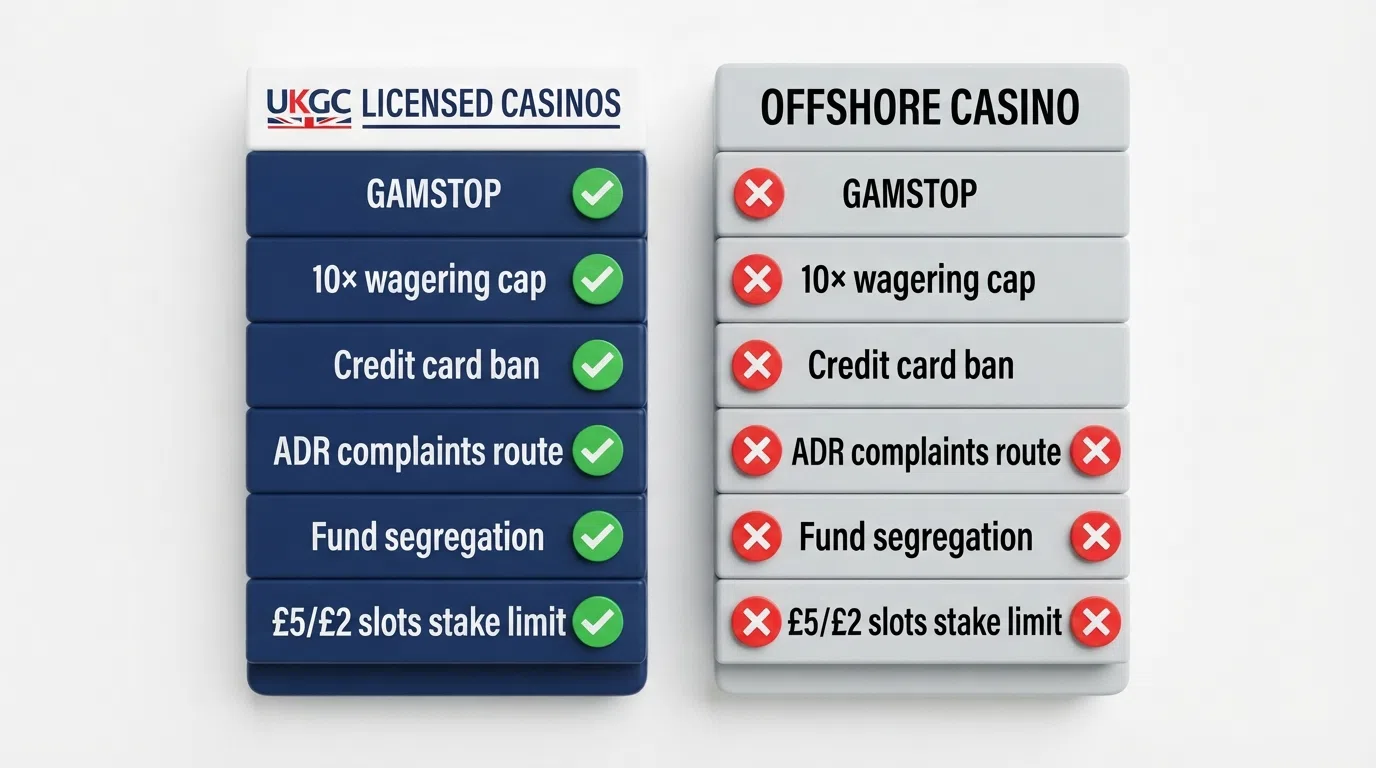
What the player gives up is every protection the Gambling Act 2005 built. GAMSTOP coverage. The 10× wagering cap. The credit card ban. The financial vulnerability check at £150. The ADR complaints route. Fund segregation. The statutory levy-funded treatment infrastructure. The 2.5-second spin minimum and the £5/£2 slots stake cap. None of these applies at an offshore casino, and the practical enforcement reality — the UKGC disrupts and delists but cannot block or prosecute the player — leaves every safeguard as a thing the player chose to walk away from.
What UK Law Actually Says About Offshore Casinos
The Gambling (Licensing and Advertising) Act 2014 — the point-of-consumption reform — made a GB licence compulsory for any operator serving GB customers, regardless of where it is based. A Curaçao, Maltese or Gibraltar licence is not a substitute. Section 33 of the Gambling Act 2005 makes providing gambling facilities without the required licence a criminal offence carrying up to 51 weeks’ imprisonment (six months in Scotland), an unlimited fine, or both. Advertising unlawful gambling is separately an offence. The sanctions target operators, advertisers and intermediaries.
The player’s position is different. As The Gambling Journal’s 2026 explainer states: you are not committing a criminal offence by using an offshore site from Great Britain. The Gambling Act’s criminal penalties apply to operators providing facilities, not to individuals using them. No UK player has been prosecuted for gambling on an unlicensed offshore site in any enforcement data this research surfaced.
Northern Ireland operates under separate, older law outside the UKGC’s remit. The Gambling Act 2005 and the Commission cover Great Britain only — England, Scotland and Wales. Northern Irish players face a different statutory landscape that this article does not cover.
Offshore Casino Licensing: Curaçao, Anjouan and MGA Compared
Not all offshore licences carry the same regulatory substance. The three jurisdictions observed in UK-facing offshore casinos — Curaçao, Anjouan, and Malta — differ on application time, regulatory depth, and player-fund protection. The comparison below covers the substantive differences.
| Licence Feature | Curaçao (CGA, post-LOK) | Anjouan | Malta (MGA) |
|---|---|---|---|
| Regulatory substance | Direct CGA licences; local substance requirement from January 2026 | Lower regulatory substance; cheapest and fastest tier | Strongest offshore tier; gaming tax and player-fund protection obligations exceed Curaçao |
| Application time | Mid-range after LOK reform | Cheapest and fastest | 3–6 month application process |
| Player-fund protection | Not guaranteed at the post-LOK level | Limited; lower tier | Exceeds Curaçao; explicit player-fund obligations |
| Featured operator coverage | All ten featured operators | Some UK-facing sites outside this ranking | Strongest tier; fewer UK-facing offshore brands |
All ten operators in this ranking hold Curaçao licences under the post-LOK regime — the December 2024 reform that replaced the old master-licence model with direct CGA licences and gave the Curaçao Gaming Authority real enforcement authority. The reform is meaningful but it is not equivalent to MGA standards on player-fund protection, and the difference shows up at the moment a withdrawal is withheld.
The Risks You Take When You Play Offshore
Every missing UKGC safeguard is a risk the player carries alone. The list is long enough to be worth enumerating once.
No GAMSTOP coverage — a self-excluded British player is unprotected on an offshore site. The exclusion register covers GB-licensed operators only, and the offshore operator has no obligation to check.
No UKGC complaints route and no ADR provider — disputes are resolved on the operator’s terms under the licence jurisdiction’s law. The player cannot appeal to IBAS or any other ADR body the UKGC licenses.
No fund segregation requirement — player deposits may be held alongside operating capital. An operator insolvency exposes player balances to creditors.
No statutory stake limits — the £5/£2 slots stake cap does not apply. A player aged 18 to 24 can bet more than £2 per spin at an offshore casino.
No credit card ban — credit cards are accepted for gambling offshore, with the same problem-gambling correlation that prompted the GB ban.
No financial vulnerability checks — the £150 net-deposit threshold that triggers a light-touch check at UKGC sites does not exist offshore.
The market-mechanics gap is the structural one. Remote Gaming Duty rose to 40% from 1 April 2026, up from 21%, and a statutory levy of 1.1% of gross gambling yield for remote casinos took effect from 6 April 2025. Both apply to GB-licensed operators only. The regulatory cost differential is reflected in the welcome bonuses, the game libraries and the operational investment GB-licensed operators can afford. Offshore operators carry none of it.
When a withdrawal goes wrong, no UK regulator can help recover funds. The player’s recourse is the operator, the licence jurisdiction, and a chargeback.
Chargebacks and What to Do When an Offshore Casino Will Not Pay out
When an offshore operator refuses to pay, the chargeback is the primary recovery mechanism available to a UK player. A chargeback reverses a card transaction through the issuing bank, on the grounds that the service was not rendered or the transaction was unauthorised. The mechanism works on fiat rails; it does not work on crypto.
The practical difficulty is enforcement. The operator is outside UK jurisdiction, often in a country with limited mutual legal assistance treaties for consumer disputes. The chargeback process takes weeks, requires documentation, and is not guaranteed to succeed. Chargebacks cover unauthorised transactions and services not rendered — they do not cover disputed gambling outcomes, where the player disputes whether the operator paid the correct amount rather than whether the operator paid at all.
The Guardian reported in March 2025 that Mastercard and Visa were processing payments for illegal gambling websites accused of scamming UK customers, with the five most popular sites drawing approximately four million UK visits between October and December 2024. The Commission’s enforcement figures for 2025–26 — 741 cease-and-desist notices, 397,527 URLs reported, 266,667 removed, 1,134 websites disrupted through takedowns or geo-blocking — describe the disruption effort. The UKGC does not currently hold statutory ISP/DNS blocking powers; that has been proposed but is not enacted. The Crime and Policing Bill (2026) extended the Commission’s ability to pursue illegal sites’ IP addresses and domain names.
How to Spot an Offshore Casino Worth Trusting
Without a UKGC licence as a baseline, the player does their own due diligence. Three filters matter most: the licence, the operator’s track record, and the game fairness layer. Each is verifiable. Each can be checked before depositing.
The licence is the first filter. Check the issuing authority’s public register. The Curaçao Gaming Authority publishes a register of direct post-LOK licence holders. The Malta Gaming Authority publishes a licensee list. Anjouan’s register is thinner, and Anjouan licences carry lower regulatory substance — a fact that does not make them worthless but does change what they guarantee.
Operator track record tells the reader something about how the operator handles disputes. A platform operating since 2014 — 7Bit’s record — has weathered multiple market cycles, regulatory changes, and crypto winters. A Casino Guru Safety Index of 8.4/10 — Velobet’s score — is one of the few independent assessments available in this set. A pattern of unresolved complaints visible on forums and review aggregators is a flag the reader should not ignore.
Game fairness at offshore casinos rests on the studios on the roster and the provably fair mechanism where one is offered. Pragmatic Play, NetEnt and Play’n GO on the provider list is a meaningful signal — those studios do not licence their games to operators they consider uncreditworthy. Provably fair games are a crypto-native trust mechanism that replaces the regulator with a cryptographic check the player can run themselves.
Key Factors to Evaluate Before You Sign Up
Verify the licence on the issuing authority’s public register. For Curaçao post-LOK operators, that is the Curaçao Gaming Authority register. For MGA-licensed operators, the Malta Gaming Authority licensee list. For Anjouan, the Anjouan Gaming Board. A licence number on the operator’s footer that does not resolve to a register entry is a red flag.
Read the bonus terms before claiming. Check the wagering multiple — 30× is at the low end of the offshore range, 80× at the high end. Check the validity window — 14 days (7Bit) is tight, 30 days (Donbet, Rolletto) is more workable. Check the game-weighting table — slots typically count 100%, table games often count 10% or less. Check the maximum cashout cap — £20 to £100 is the typical offshore range on no-deposit free-spin winnings.
Test the withdrawal policy. Minimum withdrawal amounts, processing times stated in terms, any identity-verification triggers. The terms page is the contract; the marketing page is the pitch.
Check operator age and public track record. A platform operating since 2014 carries a different level of confidence than one launched last year. Casino Guru’s Safety Index, where available, is a third-party data point worth reading.
Red Flags That Signal a Risky Offshore Casino
No verifiable licence — or a licence from a jurisdiction with no public register. Bonus terms that are vague about wagering, validity, or cashout caps — the operator that doesn’t surface its numbers clearly is the operator that has reasons not to. A pattern of unresolved player complaints visible on forums and review aggregators. No published game providers or an unverifiable game library — a legitimate casino names its studios. A history of domain changes or rebrands — frequent name changes are often a signal the operator is staying ahead of a reputation.
Anjouan licences are not automatically a red flag, but they are the cheapest and fastest tier with lower regulatory substance. The reader should know what the licence actually requires before treating it as equivalent to Curaçao post-LOK or MGA.
Staying in Control: Responsible Gambling Outside the UKGC System
GAMSTOP does not cover offshore casinos. A self-excluded British player who tries to open an account at a Curaçao-licensed site is not blocked — the operator has no access to the GAMSTOP register and no obligation to honour an exclusion that does not appear on its own systems. The UK’s most powerful self-exclusion tool does nothing at an offshore casino.
The player has to build their own safety net. Tools that work regardless of the site’s licence include bank-level gambling blocks — most UK current accounts now offer them through the bank’s app or through a service like Monzo’s gambling block — and device-level blocking software like Gamban and Gamblock, which work across every site a device can reach. Self-imposed deposit limits set before the first deposit, written down and stuck to, are the third layer. None of these is regulator-mandated at an offshore site. All of them are available to the player.
UK treatment and support infrastructure is available to any British resident regardless of where they gamble. GamCare runs the National Gambling Helpline. The National Gambling Treatment Service treats thousands of clients a year. NHS gambling harm clinics operate in England, Scotland and Wales. Gamblers Anonymous runs peer-support groups. None of these services asks where the player gambled.
Deposit and Loss Limits You Can Set Yourself
The UKGC requirement for GB-licensed operators to prompt a financial limit before first deposit, in force from 31 October 2025, does not apply offshore. The forthcoming gross deposit limit standard, from 30 September 2026 under RTS 12, will not apply offshore either. The offshore operator is not required to ask.
Self-imposed strategies work regardless. Bank-level gambling blocks — available through most UK current accounts, including Monzo, Starling, and the major high-street banks — block gambling transactions at the bank’s end and cannot be bypassed by an offshore operator. Prepaid card limits cap the maximum deposit regardless of the site’s terms. Crypto-wallet caps — setting a maximum balance on a non-custodial wallet — bound the deposit rail from the player’s side.
The player who decides to play at an offshore casino and wants a deposit limit has to set it themselves, before the first deposit, with a tool the operator cannot see.
Self-Exclusion and Reality Checks Without GAMSTOP
GAMSTOP exclusion periods — six months, one year, five years, or five years with auto-renewal — are the most powerful self-exclusion tool in British gambling, and they cannot be cancelled early. They cover every GB-licensed online operator and have been mandatory since 31 March 2020. They do not cover offshore sites.
A self-excluded player who tries to open an account at an offshore casino will not be blocked. The site will accept the deposit. The site’s own self-exclusion mechanism — where one exists — is voluntary on the operator’s side and carries no regulatory enforcement.
Alternatives to GAMSTOP for offshore play are limited but real. Gamban and Gamblock are device-level blocking software that work across every gambling site a device can reach, including offshore sites. Bank-level gambling blocks block the deposit rail. Neither is regulator-mandated at an offshore site. Both work regardless of where the player chooses to play.
Where to Find Help: UK Support Services That Work Regardless
GamCare runs the National Gambling Helpline on 0808 8020 133. In 2026, 81.5% of contacts disclosing a form of gambling cited online gambling — a five-year high. The National Gambling Treatment Service treated 11,960 clients between April 2024 and March 2025, an 11% increase on the previous year, with 93% of treatment completers seeing improvement. NHS gambling harm clinics operate in England, Scotland and Wales. Gamblers Anonymous runs peer-support groups across the country.
The prevalence context frames the help. In 2025, 2.4% of GB adults aged 18 and over scored 8+ on the Problem Gambling Severity Index — approximately 1.3 million adults, per the Gambling Survey for Great Britain Year 3. The Health Survey for England 2024 found 5% of adults scored 1 or more on the PGSI — at-risk or problem gambling — with men at 7% and women at 3%, stable since 2012. These figures cover British adults regardless of where they gamble. The help services cover British residents regardless of where they gamble.
How We Selected and Ranked These Offshore Casinos
The operator universe for this ranking was assembled from the UK-facing offshore market in 2026. All ten featured operators were checked against the Curaçao Gaming Authority’s public register for post-LOK licence standing. Operator terms pages were reviewed for bonus structure, wagering requirements and cashout caps. Public player-feedback sources were consulted where available.
The ranking criteria applied qualitatively, not by formula: licence standing under the post-LOK Curaçao regime, bonus value weighed against wagering burden and cashout caps, game depth and provider quality, crypto and payment flexibility, and operator track record including public complaint history.
Sources used: UK Gambling Commission enforcement data and public registers; operator terms pages and licensing records; GamCare and GambleAware published statistics; the Gambling Survey for Great Britain; the Health Survey for England; HM Treasury’s gambling duty changes; and competitor analysis of the top-ranking pages for the target keyword.
What UK Players Should Actually Do About Offshore Casinos
The trade-off is the whole decision. The bonuses are larger at offshore casinos. The game libraries are deeper. The payment rails are broader. Crypto is routine. Auto-play is available. None of the UKGC-imposed restrictions that have shaped the British licensed market since 2020 apply.
Every protection that shapes the British licensed market also does not apply. GAMSTOP coverage is gone — a self-excluded player is unprotected. The 10× wagering cap is gone — offshore bonuses routinely apply 30× to 80×. The credit card ban is gone — credit cards are accepted. The ADR complaints route is gone — disputes resolve on the operator’s terms under the licence jurisdiction’s law. Fund segregation is gone — player deposits may sit alongside operating capital. The financial vulnerability check at £150 is gone. The deposit-limit prompt is gone. When a withdrawal is withheld, no UK regulator can compel a payout.
A player who rationally accepts the offshore trade-off is a player who has decided that the larger bonuses and wider game libraries are worth the loss of those protections. A player who should not accept it is anyone who has ever self-excluded through GAMSTOP, anyone who struggles to set their own deposit limit, and anyone who would need a UK regulator to recover funds if a withdrawal went wrong.
If the reader decides to proceed: verify the licence on the CGA register before depositing. Read the bonus terms in full, paying particular attention to the wagering multiple, the validity window, the game-weighting table and the maximum cashout cap. Set a personal deposit limit before the first deposit, with a bank-level gambling block if it can be arranged. Keep the GamCare National Gambling Helpline (0808 8020 133) to hand. And never deposit more than the reader can afford to lose at a site where no British regulator can help recover it.
Frequently Asked Questions
Are offshore casinos connected to GAMSTOP?
No. GAMSTOP is mandatory for every GB-licensed online operator and has been since 31 March 2020, with exclusion periods of six months, one year, five years, or five years with auto-renewal. Offshore casinos are not GB-licensed and do not participate in GAMSTOP — a self-excluded British player is not protected at an offshore site. The exclusion register covers British licensed operators only, and an offshore casino has no obligation to honour a GAMSTOP registration it cannot see.
Is there a risk of prosecution for playing at an offshore casino from the UK?
No. UK law does not criminalise the player who uses an offshore site — it criminalises the operator that offers unlicensed gambling facilities to GB customers. Section 33 of the Gambling Act 2005, which carries up to 51 weeks’ imprisonment (six months in Scotland), an unlimited fine, or both, targets providers, advertisers and intermediaries. No UK player has been prosecuted for gambling on an unlicensed offshore site in the enforcement data this research surfaced.
What happens if an offshore casino refuses to pay out my winnings?
The primary recovery mechanism is a chargeback through the issuing bank on the deposit rail used — a tool available on fiat deposits but not on crypto. No UK regulator can compel an offshore operator to release funds, freeze an account, or resolve a dispute; the player’s recourse is the operator’s customer service, the licence jurisdiction, and in extremis legal action in the jurisdiction where the licence was issued. The UKGC’s enforcement is disruption-based (cease-and-desist notices, search-engine referrals, payment-provider referrals), not ISP blocking — and the Commission does not currently hold statutory ISP/DNS blocking powers.
How fast are withdrawals at offshore crypto casinos?
Near-instant on the fastest rail. Stake’s near-instant crypto withdrawals tested at eight minutes in this research run, the fastest figure confirmed across the featured set. Other operators in the ranking accept crypto without confirmed speed data. Fiat withdrawal methods vary by operator and per-operator payout-speed data is not consistently published. The structural difference from UKGC sites: no mandated processing timelines and no ADR provider to appeal to if a fiat withdrawal is delayed.
Do offshore casinos offer no-deposit bonuses and free spins?
Yes, though most are deposit-gated. MyStake runs 30 no-deposit free spins on Gamino Slots before the first deposit — the cleanest no-deposit offer in this ranking. Most other operators gate free spins behind a qualifying deposit. Maximum cashout caps on no-deposit free spins range from £20 to £100 offshore, with the default spin value at £0.10 — meaning 100 free spins at £0.10 generate £10 of face value before the cap. Wagering on free-spin winnings runs at 30× to 60× offshore, against the 10× UKGC cap.
What licence do offshore casinos typically hold?
Curaçao, under the post-LOK regime that took effect in December 2024. All ten featured operators in this ranking hold Curaçao licences issued directly by the Curaçao Gaming Authority — a meaningful upgrade on the old master-licence model. Anjouan is the cheapest and fastest offshore tier with lower regulatory substance, and Malta (MGA) is the strongest offshore tier with a 3–6 month application process and player-fund protection obligations that exceed Curaçao. None of the three substitutes for a UKGC licence.
Licence – fastestpayout-casinos-uk
Content created by the «fastestpayout-casinos-uk» team