
Pay by Phone Casinos in the UK
 Available in GB
The first time a player charges a casino deposit to their phone bill, the rest of the cashier starts to look slow. A £10 top-up, a four-digit confirmation code, and the balance is there before the next hand of blackjack loads. For UK players who want that speed without handing over a debit card for a five-pound flutter, pay-by-phone deposits have become the default quick-deposit option. The trade-off is not in the deposit itself. It sits one screen further on, where the welcome bonus is either credited or conspicuously absent, and where the withdrawal has to find a different method entirely.
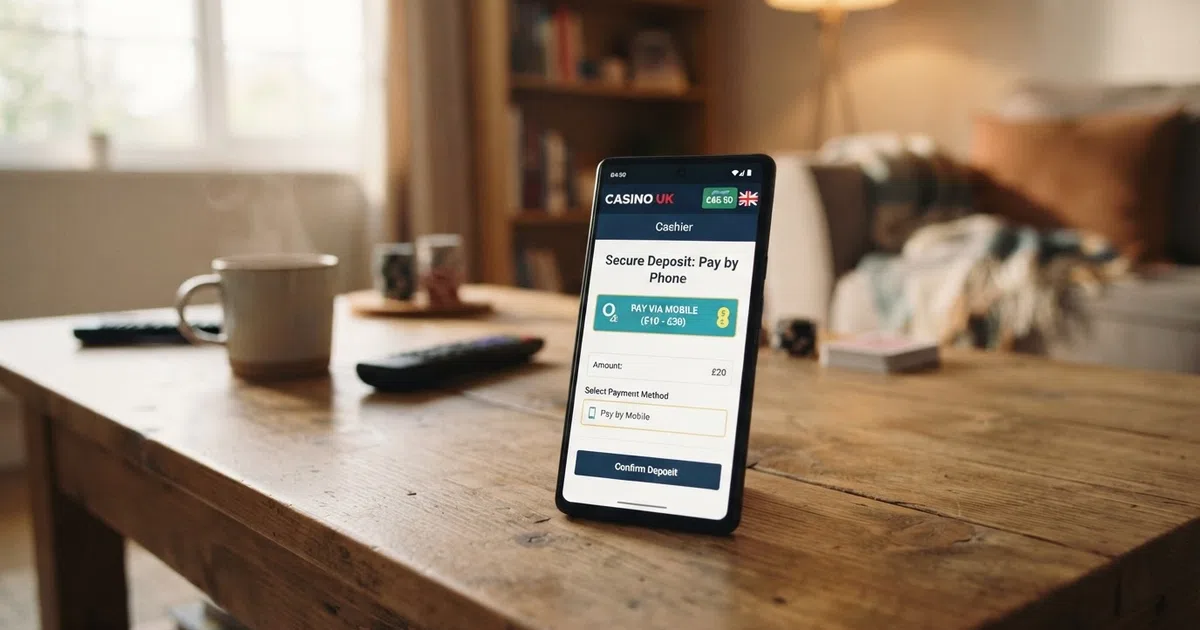
This page ranks the UKGC-licensed casinos that accept phone-bill deposits, sets out the per-transaction and monthly caps that govern every one of them, and lays bare the bonus rules that decide which operators are actually worth a phone deposit. The current as of stamp below reflects when these terms were verified, and against which register.
*Data current as of September 8, 2026 · verified against the UK Gambling Commission public register*
Mobile-Charge Casino Banking: Instant Access With a Spending Ceiling
Pay-by-phone casino banking is a deposit mechanism that charges a player’s casino top-up to their mobile phone account rather than to a bank card or e-wallet. The mechanism runs through intermediaries, with Boku, Fonix, Siru Mobile and PayViaPhone the four names a UK player will see at the cashier. Two flavours exist, though a player rarely needs to distinguish them. The first routes the charge through the mobile network’s billing system and adds it to the contract holder’s monthly bill. The second runs as a premium SMS transaction and deducts the deposit from a pay-as-you-go SIM’s prepaid credit. Both are functionally identical at the casino end: the cashier receives confirmation, the balance updates, and the player is playing within seconds.
The one thing both flavours have in common is direction. Pay-by-phone deposits are one-way transactions. Mobile networks do not support credit-back to a phone bill, so a withdrawal cannot ride the same rail back to the player. That asymmetry defines the entire product. It is the reason phone billing works as a deposit method at all (the network’s billing infrastructure is built to charge, not to refund) and the reason the same mechanism falls short the moment a player wants their winnings.
The other defining feature is the cap. UK carriers and the premium-rate services regulatory framework impose hard ceilings on what can flow through this rail: typically £30 to £40 per single transaction, and up to £240 per calendar month. Those are not casino-set limits. They are structural to the payment method, and they apply regardless of how much a player wants to deposit. A pay-by-phone deposit is, by design, a small-and-often method rather than a bulk-load option.
Since 1 February 2025, the regulation of UK charge-to-mobile services has sat with Ofcom rather than the Phone-paid Services Authority, which has wound down its operations. The move brought the payment mechanism under the same communications regulator that oversees the broader telecoms sector and continued the premium-rate services regime under the Regulation of Premium Rate Services Order 2024. A dual regulatory layer is now in play: the UK Gambling Commission (UKGC) regulates the casino, Ofcom regulates the payment rail, and both must be in place for a phone-bill deposit to be lawful at a GB-licensed site.
Any site offering pay-by-phone deposits to UK customers must hold a UKGC licence. The two checks a player can run in under a minute, the licence status on the UK Gambling Commission’s public register and the network compatibility for their SIM, are the practical floor for safety. Everything else on this page assumes that floor has been met.
What “Pay by Phone” Means at a UK Online Casino
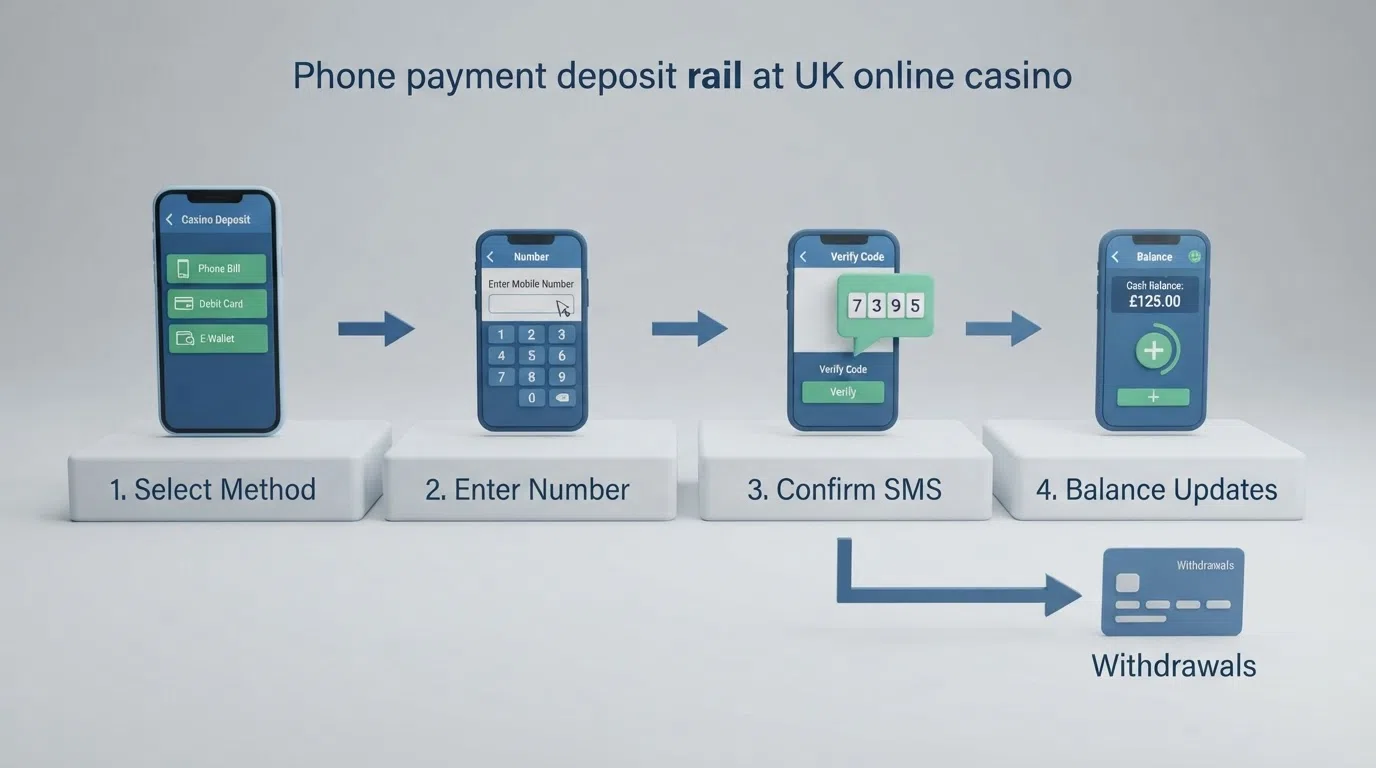
The mechanic is the same regardless of operator or network. At the cashier, the player selects Pay by Phone (or the operator’s branded equivalent, Boku, Fonix, PayViaPhone, Siru Mobile), enters their mobile number, and receives a four-digit confirmation code by SMS. Entering the code confirms the transaction; the casino balance updates within seconds. The deposit is then either added to the next mobile phone bill (contract customers) or deducted from prepaid credit (PAYG customers).
What distinguishes pay-by-phone from a debit card deposit is the absence of the usual banking middleman. There is no card number, no sort code, no e-wallet login. The deposit clears on the strength of the mobile number and the SMS handshake. For players who do not want their gambling transactions appearing on a bank statement, or who simply do not have a debit card to hand, that is the attraction. The trade-off, again, is the one-way nature of the rail: the deposit arrives almost instantly, the withdrawal must travel by a different method.
The instant nature of the deposit is worth dwelling on, because it changes the rhythm of a session. A debit card deposit can take thirty seconds and a card-reader step on the first try. A phone-bill deposit clears in the time it takes to read a four-digit code. For short sessions, low-stakes play, or topping up a balance mid-game, that speed is the entire point of the method.
GamCare’s National Gambling Helpline data gives some context for how widespread phone-based gambling funding has become: 81.5% of people contacting the helpline in 2026 disclosed online forms of gambling, a five-year high. Phone billing is one of several deposit methods that has normalised small, instant top-ups, and the regulatory caps that govern it sit alongside other player-protection measures described in the responsible-gambling sections below.
Real-Money Casino Play Through Your Phone Bill
Playing for real money at a phone-bill casino is the same game as playing at any other UKGC-licensed site, with three checks worth making before the first deposit. The first is the licence itself. Every operator in the ranking that follows is cross-referenced against the UK Gambling Commission’s public register; a player who wants to verify independently can search the register at the UKGC’s website, which carries over 2,665 licensed businesses and is updated daily. The second is the phone-bill provider the casino uses, which determines whether a player’s network supports the deposit. The third is the welcome-bonus terms, which at the majority of UKGC-licensed sites exclude phone-bill deposits from qualifying for the headline offer.
The stakes a player can place on a slot are governed by statutory caps that apply regardless of how the account is funded. Players aged 25 and over face a maximum of £5 per spin on online slots, in force since 9 April 2025 under SI 2025/215; players aged 18 to 24 face a £2 cap, in force since 21 May 2025. Those caps sit on the slot, not on the deposit method, and they apply to phone-bill-funded play exactly the same as to debit-card-funded play.
UKGC licensing objectives sit in the background of every interaction at a licensed casino. The Gambling Act 2005 sets three statutory objectives, including ensuring gambling is conducted in a fair and open way and protecting children and other vulnerable persons from being harmed or exploited. From a player’s perspective, those objectives translate into fund segregation at the operator, access to ADR (alternative dispute resolution) if a payout is disputed, and integration with the national self-exclusion scheme. The first two are immediate; the third, GamStop, is the subject of a dedicated section below.
Since 14 April 2020, credit cards have been banned for all remote gambling in Great Britain, including payments routed through e-wallets funded by credit cards. A pay-by-phone deposit is not a credit-card deposit, but the ban sets the broader context: the regulated UK market has been steadily narrowing the funding methods that risk turning a gambling session into a debt event. Phone billing, capped at the carrier level, fits the same direction of travel.
Money In, Money Out: The One-Way Street of Mobile Casino Payments
The full lifecycle of a pay-by-phone deposit is asymmetric. The deposit is instant, capped, and frictionless. The withdrawal is none of those things, because it has to use a different method entirely. That asymmetry shapes everything from how a player manages their bankroll to which welcome offer they can claim.
The deposit side is governed by a layered set of limits. The carrier’s premium-rate services cap sets a per-transaction ceiling of around £30 to £40, and a monthly ceiling of around £240. The casino may set its own minimum deposit, typically £5 or £10 for phone-bill funding. Both apply, and the player is bound by whichever is lower for the transaction in question.
The withdrawal side has no such caps but no such speed either. Withdrawals must use a registered debit card, bank transfer or e-wallet, and they are subject to the operator’s standard pending periods and verification checks. For a player who has only funded their account by phone, this means registering a withdrawal method before cashing out for the first time, and waiting the usual 24 to 72 hours (longer at some operators) for the funds to clear.
Boku, the most widely known pay-by-phone provider, operates in over 90 countries and serves more than 28 million active users, with no account creation or app download required. That reach explains why Boku is the name many players associate with phone-bill deposits, even where the casino in fact uses a different provider. Fonix has been growing in UK availability and is now the dominant phone-billing option at several major operators, including Duelz, MrQ and HollywoodBets. Boku’s footprint in the UK has been declining relative to Fonix; a player who specifically wants Boku should check the cashier before signing up.
How to Deposit by Phone Bill at a UK Casino: Step by Step
- Pick the pay-by-phone option at the cashier. The label varies by operator: Duelz shows “Pay by Mobile (Fonix)”, MrQ shows “Pay by Mobile”, Videoslots and Mr Vegas route through Siru Mobile, and Bet365 lists phone deposits among several methods. The option is always visible on the deposit screen, alongside debit card, e-wallet and bank transfer.
- Enter the mobile number and the deposit amount. The amount is constrained by the per-transaction cap (typically £30–£40) and the casino’s minimum (usually £5 or £10). The player does not enter any card or bank details.
- Confirm the transaction by SMS. A four-digit code arrives at the mobile number entered. The code confirms the deposit; without it, no money moves.
- Wait for the balance to update. The deposit clears within seconds. The charge appears on the next phone bill (contract) or is deducted from prepaid credit (PAYG).
The flow is identical at every UKGC-licensed operator that supports the method. It works on both contract and pay-as-you-go SIMs. The only common point of failure is a mismatch between the mobile network and the pay-by-phone provider: a player on a network the provider does not support will see the deposit declined at the SMS stage.
Why Withdrawals Cannot Go Back to Your Phone Bill
The constraint is technical, not policy. UK mobile networks do not offer a standard merchant refund route that credits casino winnings or routine refunds back to a phone bill. The billing systems are built to charge subscribers and collect payment; they have no general-purpose mechanism to push money back to a SIM.
The practical consequence is that every pay-by-phone deposit must be paired with a separate withdrawal method registered at the cashier. For most players, that is a debit card. For some, it is a bank transfer or an e-wallet such as PayPal. The withdrawal method does not have to be the same as the deposit method at every operator, but it does have to exist: a player who has only ever deposited by phone will be prompted to add a withdrawal method the first time they try to cash out.
This is the single most-misunderstood limit of phone-bill casino banking. Players who treat the phone as their only funding method assume it is their only funding method, full stop, and then find themselves adding a debit card at the moment of withdrawal. The asymmetry is structural, and the section on choosing a casino below sets out how to plan for it.
Which Mobile Networks and Providers Support Casino Phone Billing
The major UK networks, EE, O2, Vodafone, Three, Virgin Mobile, Sky Mobile, BT Mobile, Tesco Mobile and GiffGaff, all support pay-by-phone casino deposits through one provider or another. The mapping between network and provider is set by the casino’s payment integration, not by the network itself, and a player on any of the major networks can expect to find at least one supported option at any UKGC-licensed operator in the ranking below.
Boku historically supported EE, Vodafone, O2 and Three. Its UK availability has been declining, and Fonix has filled the gap at operators like Duelz, MrQ and HollywoodBets. Siru Mobile is available at Videoslots and Mr Vegas, with a £5.12 minimum deposit. PayViaPhone, the fourth provider a UK player will encounter, is available at Fruity King and several ProgressPlay brands, and carries a 15% processing fee at some of them.
The practical advice for a player is to check the cashier at the casino they want to use before signing up. The pay-by-phone option is always displayed on the deposit screen, and the provider name appears alongside it. If the provider does not support the player’s network, the option will either be hidden or will fail at the SMS-confirmation stage. Either outcome costs the player a few minutes, not a deposit, and is the cheapest way to verify compatibility.
The Best Pay by Phone Casino Sites in the UK for 2026
The table below ranks the ten UKGC-licensed operators that accept pay-by-phone deposits and that have been verified against the UK Gambling Commission’s public register. The ranking weights bonus value, wagering fairness and phone-deposit terms, with the proviso that only one operator in the featured set, MrQ, extends welcome-bonus eligibility to phone-bill depositors. The other nine require a debit card for the qualifying first deposit, and a player who wants the headline offer will need to fund the account accordingly on day one.
| Casino | Pay-by-Phone Provider | Welcome Offer | Wagering | Phone-Bill Bonus Eligible? |
|---|---|---|---|---|
| Duelz Casino | Fonix | 100% up to £100 + 140 free spins | 10× | No |
| Bet365 Casino | Phone deposit available | 200 free spins on Big Bass Splash (deposit £10 & wager 1×) | 1× qualifying | No |
| LeoVegas Casino | Phone deposit available | 50 wager-free free spins on Big Bass Splash | 0× | No |
| Paddy Power Casino | Phone deposit available | Up to 260 free spins (60 no-deposit + 200 on £10 wager) | 0× | No |
| MrQ Casino | Fonix | 100 free spins on Big Bass Splash | 0× | Yes |
| Betway Casino | Phone deposit available | 100% up to £50 or 150 free spins on £20 stake | 0× on free spins | No |
| Gala Bingo Casino | Phone deposit available | 100 free spins on £10 slots spend | 0× | No |
| HollywoodBets Casino | Fonix | Free spins + 10% cashback for app users | 0× | No |
| Videoslots Casino | Siru Mobile | 100% up to £200 + 11 free spins | 10× | No |
| Mr Vegas Casino | Siru Mobile | 100% up to £200 + 11 free spins | 10× | No |
The spread across the table is wider than the pay-by-phone column suggests. The two end of the spectrum that matter for a phone-bill player are MrQ at one end (the only operator that does not penalise the deposit method) and the four operators offering 0× wagering on free-spin winnings at the other (LeoVegas, Paddy Power, Betway, Gala Bingo, HollywoodBets, plus MrQ itself). Between them sit the deposit-match offers at Duelz, Videoslots and Mr Vegas, all carrying the 10× cap that took effect on 19 January 2026, and Bet365’s 1× qualifying wager, which is the lowest qualifying requirement in the table.
A player who wants to deposit by phone and keep the welcome offer has, in practice, one choice. A player who is willing to fund the qualifying deposit by debit card and then switch to phone billing for top-ups has the full table. The individual operator write-ups that follow set out the terms for each, and the choice a player makes on day one is the one that determines which offer they end up with.
Duelz Casino: Fonix Deposits and a Full-Sized Welcome Package
Duelz runs on a Suprnation Limited licence, with UKGC account 48695 verified on the public register. The casino accepts Fonix pay-by-phone deposits at a £10 minimum, and the welcome offer is a 100% deposit match up to £100 plus 140 free spins, with a 10× wagering requirement that sits at the statutory cap.
The wagering figure is at the maximum the regulator allows. A £100 bonus requires £1,000 of qualifying play before withdrawal, and the 7-day validity puts a clock on that playthrough. Free spins are valued at £0.10 each, in line with the wider market. The headline number, 100% up to £100 plus 140 spins, is competitive; the fine print is the industry-standard exclusion of phone-bill deposits from the qualifying first deposit.
A player who wants the Duelz welcome package and is happy to fund the first deposit by debit card can switch to Fonix for top-ups afterwards. A player who wants to deposit only by phone will need to accept that the welcome offer sits behind a different rail.
Bet365 Casino: The Low-Wagering Route to 200 Free Spins
Bet365 Casino operates under Hillside (New Media) Limited, with UKGC account 55148 verified on the public register. Phone-bill deposits are confirmed available, and the welcome offer is structured around a low qualifying wager: deposit £10 and wager 1× on casino games to receive 200 free spins on Big Bass Splash, valued at £0.10 each, with a 7-day deposit-and-wager window and a 3-day expiry on the reward itself.
The 1× qualifying wager is the lowest in the table. A £10 deposit becomes 200 free spins after a single round of qualifying play, which is the closest the regulated UK market gets to “free” on a casino welcome. The 3-day reward expiry is short, however, and a player who delays claiming the spins will find the reward gone before they sit down to use them.
Phone-bill deposits are excluded from the qualifying deposit, as is the pattern across the rest of the featured set except MrQ. For a player who wants the Bet365 welcome, the first deposit is by debit card; subsequent top-ups by phone work without affecting the offer.
LeoVegas Casino: 50 Wager-Free Spins With No Playthrough
LeoVegas Gaming plc holds UKGC account 39198, verified on the public register. This operator supports phone-bill deposits, and the welcome offer is 50 wager-free free spins on Big Bass Splash with a £10 minimum deposit, valued at £0.10 per spin, valid for 3 days from crediting.
Wager-free means what it says. The winnings from those 50 spins are credited as cash, not as bonus funds, and there is no playthrough attached. The total potential value is £5 (50 spins at £0.10), which is modest in headline terms but carries no further conditions. The 3-day validity is the constraint, and a player who plans to use the spins is well advised to do so the day the bonus credits.
Phone-bill deposits do not qualify for the welcome offer. LeoVegas excludes them in the same way most of the featured set does, alongside PayPal deposits. A player who wants the 50 wager-free spins needs a debit card or an Open Banking deposit for the qualifying £10.
Paddy Power Casino: Up to 260 Free Spins With Zero Wagering
Paddy Power runs under PPB Counterparty Services Limited, part of Flutter Entertainment, with UKGC account 39439 verified on the public register. The site supports phone-bill deposits, and the welcome bundle is the largest free-spin package in the table: 60 no-deposit free spins plus 200 more on a £10 deposit and wager, totalling up to 260 free spins, all at zero wagering, valued at £0.10 per spin, valid for 7 days.
The 60 no-deposit spins are the unusual half of the offer. They are credited on registration, before any deposit, which means a phone-bill-only player can claim them without funding the account at all. The remaining 200 spins require a £10 qualifying deposit and wager, and that deposit must be by debit card. The two halves of the bundle are therefore usable by a phone-bill player in different ways: the no-deposit spins are an unalloyed bonus, and the deposit-triggered spins sit behind the same exclusion that governs the rest of the table.
Zero wagering applies across the bundle. Whatever the spins produce is paid as cash, which is the cleanest possible welcome structure the regulated market allows. The 7-day validity is generous by comparison with the 3-day windows elsewhere, and gives a player room to use the spins across a couple of sessions.
MrQ Casino: The One Operator Where Phone Deposits Earn the Bonus
MrQ operates under Lindar Media Limited, with UKGC account 51250 verified on the public register. Fonix is the pay-by-phone provider, with a £10 minimum deposit, and the welcome offer is 100 free spins on Big Bass Splash with a first deposit of £10+, valued at £0.10 per spin, with zero wagering and winnings credited as real money.
MrQ is the one operator in the featured set that explicitly extends welcome-bonus eligibility to mobile-deposit customers. The brand states on its own site that all of its bonuses are available for mobile deposit customers, which removes the central friction of phone-bill play at every other UKGC-licensed site in the ranking. The 48-hour validity on the spins is the shortest in the table, and a player who deposits by phone needs to use the spins across two sessions at most.
For a player whose primary deposit method is the phone bill, MrQ is the operator that does not punish that choice. The 100 free spins, wager-free and credited as cash, are the closest the UK market gets to a phone-bill-native welcome, and the brand’s published payment-method list treats Fonix as a first-class deposit option rather than a secondary one.
Betway Casino: A 100% Match and Free-Spin Alternative
Betway operates under Betway Limited, part of Super Group, with UKGC account 39372 verified on the public register. Phone deposits are available, and Betway is rated as the best mobile experience among UKGC-licensed operators by Casino.org. The welcome structure offers a choice: a 100% deposit match up to £50 on a first deposit of £10+, or stake £20 and receive 150 free spins, delivered 50 per day over 3 days, with zero wagering on free-spin winnings and a 7-day expiry.
The choice between match and spins matters for a phone-bill player because the qualifying deposit excludes phone billing in both cases. A player who wants the 100% match funds the first deposit by debit card; a player who wants the 150 spins stakes £20 the same way. Either way, the qualifying deposit is the gate, and phone billing sits on the other side of it.
Betway’s broader appeal for a mobile player is the experience layer. The phone-bill integration is standard, but the app and the mobile browser are polished, and the operator carries a deep game library across Microgaming, NetEnt, Evolution, Pragmatic Play and IGT.
Gala Bingo Casino: Spend £10, Get 100 Spins
Gala Bingo operates under Entain Operations Limited, with UKGC licences for both remote casino and remote bingo, verified on the public register. Phone deposits are available, and the welcome offer is a spend-triggered free-spin bundle: deposit and stake £10 on slots to receive 100 free spins at £0.10 each, with zero wagering on the winnings and a 7-day validity from registration.
The “deposit and spend” structure is unusual. The £10 must be staked on slots, not just deposited, which means a player who funds the account and walks away without playing will not trigger the spins. The bonus is calibrated for a player who is going to play anyway, and the zero-wagering treatment on the winnings is a clean structure once the spins are credited.
Phone-bill deposits are excluded from the qualifying spend, as is the pattern across the featured set. The casino carries both Playtech and NetEnt alongside Pragmatic Play, Evolution and IGT, and the bingo licence gives a player access to the wider Entain network’s game integrations.
HollywoodBets Casino: The £5 Phone-Bill Entry Point
HollywoodBets runs under Hollywoodbets International UK Limited, with UKGC remote casino licensing verified on the public register. Fonix is the pay-by-phone provider, and the £5 minimum deposit is the lowest in the featured set, which makes HollywoodBets the most accessible phone-bill entry point for a player who wants to keep their top-ups small.
The welcome structure is built around free spins and 10% cashback for app users, with no wagering requirements on the offers (per OLBG). The app-integration of the cashback is a distinctive feature, and a player who plays on mobile is rewarded at a higher rate than a player who plays on desktop.
Phone-bill deposits are excluded from the welcome bonus on the industry-standard basis. A player who wants the headline offer funds the first deposit by debit card; subsequent top-ups by Fonix at £5 a time work without restriction. For a player whose bankroll is small and whose preferred method is the phone bill, HollywoodBets is the most accommodating operator in the table on the deposit side, even if the welcome bonus itself sits behind the standard exclusion.
Videoslots Casino: Siru Mobile and 4,000-Plus Games
Videoslots operates under Videoslots Limited, with UKGC account 39380 verified on the public register. Siru Mobile is the pay-by-phone provider, with a £5.12 minimum deposit, and the casino carries over 4,000 games from more than 150 providers, including NetEnt, Microgaming, Play’n GO, Pragmatic Play, Evolution, Yggdrasil, Red Tiger, Hacksaw and Nolimit City. The welcome offer is 100% up to £200 plus 11 free spins, subject to the 10× wagering cap.
The 4,000-game library is the headline feature. For a player whose priority is breadth of choice rather than bonus value, Videoslots is the deepest pool in the featured set, and the Siru Mobile rail keeps the phone-bill deposit method available. The 10× wagering on the deposit match sits at the regulatory maximum, which means a £200 bonus requires £2,000 of qualifying play before withdrawal.
Phone-bill deposits are excluded from the welcome bonus on the industry-standard basis. The Siru Mobile minimum of £5.12 is a touch higher than the £5 Fonix floor at HollywoodBets, but still well below the £10 minimum at most of the other operators in the table.
Mr Vegas Casino: Siru Mobile Deposits and a £200 Match
Mr Vegas runs on the same Videoslots Limited licence (UKGC account 39380), with Siru Mobile as the pay-by-phone provider at a £5.12 minimum deposit. The welcome offer mirrors Videoslots: 100% up to £200 plus 11 free spins, subject to the 10× wagering cap. The game library is over 3,000 titles, drawn from a similar provider mix to its sister site.
For a player comparing the two, the choice between Mr Vegas and Videoslots comes down to library depth versus site feel. Videoslots is the larger catalogue; Mr Vegas carries a tighter curation. Both accept Siru Mobile phone deposits, both exclude phone billing from the welcome bonus, and both carry the 10× cap on the deposit match.
The decision between them is mostly aesthetic, but a player who has already deposited at one and found the Siru Mobile experience straightforward will find the same experience at the other. The minimum deposit of £5.12 is identical at both, and the welcome offer is identical in headline and in fine print.
Why Most Pay-by-Phone Deposits Miss Out on Welcome Bonuses
The near-universal exclusion of phone-bill deposits from welcome bonuses is the central trade-off of pay-by-phone casino banking. A player who funds the first deposit by phone at Duelz, Bet365, LeoVegas, Paddy Power, Betway, Gala Bingo, HollywoodBets, Videoslots or Mr Vegas will find the headline offer unavailable. The exclusion is industry standard, applied at the payment-method level rather than the player level, and it reflects how the welcome bonus is designed to be claimed rather than hostility to phone-bill players.
The reasoning is rooted in bonus abuse prevention. Deposit matches and free-spin bundles are vulnerable to multi-accounting, where a player opens several accounts to claim the same welcome offer repeatedly. Phone-bill deposits, which require no card details and route through a single SIM, are harder to tie to a verified identity at the point of deposit. Operators respond by restricting bonus eligibility to funding methods that carry a stronger identity anchor, and the debit card is the simplest such anchor. The exclusion is not personal; it is procedural.
The 10× wagering cap that took effect on 19 January 2026 changes the arithmetic of the remaining bonuses. A deposit match that previously demanded 35× or 50× playthrough now demands no more than 10× the bonus amount, and the cap applies to every type of promotional incentive, including winnings from free spins. The bonus landscape for a player who is willing to fund the qualifying deposit by debit card has therefore become cheaper to clear, even if the headline amounts have not moved. A £100 bonus that once required £5,000 of qualifying play now requires £1,000.
For the phone-bill player, the cap does not unlock the welcome offer. The exclusion still applies. What the cap does is reduce the cost of the bonus at the operators that do offer it to other deposit methods, which makes the gap between phone-bill play and debit-card-funded play narrower than it was a year ago. The gap is still there, and the choice still exists. It is just less punishing.
MrQ is the one operator in the featured set that closes the gap entirely. A player who deposits by Fonix at MrQ receives the 100 free spins on Big Bass Splash on the same terms as a debit-card depositor, with zero wagering and winnings paid as cash. The brand is the benchmark for what a phone-bill-native welcome can look like, and the absence of similar treatment at the other nine operators is the reason MrQ sits where it does in the ranking.
The Bonus Landscape for Phone-Bill Players in 2026
Three archetypes of welcome offer exist across the UKGC-licensed market, and a phone-bill player can claim two of them at most operators, all three at one.
The first archetype is the welcome deposit match, where the operator matches a percentage of the first deposit up to a cap, with a wagering requirement attached. Duelz (100% up to £100), Videoslots and Mr Vegas (100% up to £200) and Betway (100% up to £50) all fit this shape, with 10× wagering at the regulatory cap. The second archetype is the deposit-triggered free-spin bundle, where a qualifying deposit unlocks a set of free spins, typically with zero or low wagering. Paddy Power (200 spins on £10 wager), LeoVegas (50 wager-free spins on £10), Bet365 (200 spins on £10 + 1× wager), Gala Bingo (100 spins on £10 spend) and MrQ (100 wager-free spins on £10) all fit this shape. The third archetype is the no-deposit free-spin bundle, where spins are credited on registration alone. Paddy Power’s 60 no-deposit spins are the example in the table.
For a phone-bill player, the third archetype is the most accessible. The 60 no-deposit spins at Paddy Power require only registration and a verified mobile number, with no deposit at all, and the winnings are paid as cash. The deposit-triggered archetypes require a debit card or, at MrQ, a Fonix deposit. The welcome deposit matches are the least accessible, because the match is the bonus the player is depositing to claim, and the exclusion blocks the phone-bill route entirely.
The practical reading: a phone-bill player who wants the headline welcome offer at Duelz, Videoslots, Mr Vegas, Betway, LeoVegas, Gala Bingo, HollywoodBets, Bet365 or Paddy Power funds the qualifying deposit by debit card and uses the phone for everything afterwards. A phone-bill player who wants the full phone-bill experience, top to bottom, plays at MrQ.
No-Wagering Deals and Why They Matter for Phone Depositors
A bonus that carries zero wagering changes the value calculation for a phone-bill player in a specific way. When the wagering requirement is 0×, the winnings from the free spins are paid as cash, and the player can withdraw them at any time. There is no playthrough to complete, no clock to beat other than the validity window. The bonus is, in effect, a free entry into a slot session with the winnings withdrawable.
Six of the ten operators in the featured set offer zero-wagering free spins as part of their welcome. LeoVegas, Paddy Power, MrQ, Betway (on free-spin winnings), Gala Bingo and HollywoodBets all carry 0× treatment. The remaining four, Duelz, Bet365, Videoslots and Mr Vegas, carry wagering requirements, although at the 10× cap rather than the higher multiples that were common before January 2026.
For a phone-bill player, the zero-wagering offers are the most useful because they minimise the time the bonus money is in play, which minimises the exposure to the house edge during the wagering period. The 10× cap has reduced the same exposure at the wagering operators, but the difference between 0× and 10× is still material. A £5 free-spin bundle at 0× is £5 of slot play with the winnings as cash; at 10×, the same £5 requires £50 of qualifying play before the winnings become cash.
MrQ is the only operator in the featured set that extends a zero-wagering offer to phone-bill depositors. The other zero-wagering operators require a debit card for the qualifying deposit. The asymmetry is the same one that runs through the rest of the welcome landscape: the bonus is the same shape, but the deposit method determines access.
The Slots Worth Playing With a Phone-Bill Deposit
The slots a player chooses to play with a phone-bill deposit are governed by the same RTP, volatility and stake-cap considerations that apply to any other deposit method. The phone bill does not change the math; it changes the funding rhythm. A player who tops up by phone between sessions is making smaller, more frequent deposits, and the slot choice interacts with that rhythm through spin cost and session length.

The four titles below have published RTPs in the research record, and they illustrate the range of profiles a UK player will encounter. The table is short by design: most slots in the UK market do not publish a verified RTP in third-party data, and a comparison that pretended otherwise would be padding.
| Slot Title | Provider | RTP | Volatility | Max Win |
|---|---|---|---|---|
| Starburst | NetEnt | 96.09% | Low | 500× |
| Big Bass Bonanza | Pragmatic Play | 96.71% | High | 2,100× |
| Book of Dead | Play’n GO | 96.21% | High | 5,000× |
| Big Bass Splash | Pragmatic Play | 96.71% | High | 2,100× |
The RTP spread across these four titles is narrow, from 96.09% to 96.71%, which is a 0.62-percentage-point difference in house edge. The volatility spread is wider: Starburst is low, the other three are high. Max win ranges from 500× stake on Starburst to 5,000× on Book of Dead. For a player choosing a slot for a phone-bill session, the practical question is which profile matches the bankroll and the session length, not which has the highest headline number.
The Slot Titles That Publish Their RTP — and Why That Matters
RTP, return to player, is the percentage of stake a slot returns to players over a very large number of spins. It is not a session prediction. A 96.09% RTP slot returns £96.09 for every £100 wagered across millions of spins, but in any individual session the return can be anywhere from zero to the max win. RTP is a long-run average, and it is the only objective measure of a slot’s cost that a player can verify before playing.
Starburst, the NetEnt staple released in 2012, sits at 96.09% RTP with low volatility and a 500× max win. Low volatility means smaller, more frequent wins, which makes Starburst a long-session slot. The £30 phone-bill deposit a player might make in a single transaction translates to 60 spins at the 50p minimum or 6 spins at the £5 maximum, and the low-volatility profile means the bankroll lasts longer than at a high-volatility title. Starburst is the slot for a player who wants their phone-bill deposit to outlast their coffee.
Big Bass Bonanza, Pragmatic Play’s 2020 release, carries a 96.71% RTP and high volatility, with a 2,100× max win on a 5×3 layout with 10 fixed paylines. Big Bass Splash shares the engine: 96.71% RTP, high volatility, 2,100× max win. Both are fishing-themed high-variance titles where the bulk of the return sits in the bonus features. A £30 deposit at the £5 cap is 6 spins, and at the £2 cap is 15 spins. Either way, the session is short, the swings are large, and the £2,100 max win on a £1 spin is the realistic ceiling of the bonus round.
Book of Dead, from Play’n GO, carries a 96.21% RTP with high volatility and the highest max win of the four at 5,000× stake. The 5,000× ceiling makes Book of Dead a long-shot slot: a single £1 spin can return £5,000, but the long-run return is still 96.21% and the high volatility means the bankroll is consumed quickly. A phone-bill player who picks Book of Dead is playing a short, high-variance session with the bonus-funded ceiling as the only meaningful upside.
The point of comparing these four is not to pick a winner. They serve different session shapes. A player who wants a long session picks Starburst. A player who wants a bonus-round chase picks Big Bass Bonanza or Big Bass Splash. A player who wants the highest ceiling picks Book of Dead. The phone-bill deposit method is compatible with all four, and the choice is about session design, not payment rail.
Stake Limits and Session Costs Under the UK Slot Rules
The £5 and £2 per-spin stake caps that took effect in April and May 2025 are the most consequential change to UK online slot play in a generation, and they apply equally to phone-bill-funded sessions. A player aged 25 or over is limited to £5 per game cycle, regardless of how the account is funded; a player aged 18 to 24 is limited to £2. The caps sit on the slot, not on the deposit, and they change what a given phone-bill deposit buys in spins.
At the £5 cap, a £30 phone-bill deposit buys 6 spins. At the £2 cap, the same £30 buys 15 spins. At the maximum monthly carrier cap of £240, the same player gets 48 spins at £5 or 120 spins at £2 across the month. Those numbers are small, and the slot rules are designed to keep them small: the 2.5-second minimum spin speed, the auto-play ban, the ban on features that speed up play, and the ban on losses disguised as wins all work to slow the pace of a session. A phone-bill deposit of £30 is not a high-roller session by design.
For a player who tops up by phone between sessions, the rhythm is well-matched to the stake caps. A £10 Fonix deposit at the £5 cap is two spins; at the £2 cap, it is five spins. A player who wants a longer session makes multiple top-ups, with the per-transaction and monthly caps governing how much can flow through the rail.
The game-design rules that came into force on 31 October 2021 reinforce the same direction. Auto-play is banned, which means every spin is a manual action. Spin speed has a 2.5-second minimum per game cycle. Features that simulate faster play are banned. Losses disguised as wins are banned. Reverse withdrawals are banned. Session totals for losses, wins and time played must be displayed. The overall effect is a slower, more transparent slot, and the phone-bill deposit method, with its small per-transaction caps, fits the same slow-and-small pattern.
Mobile Casino Apps and Paying by Phone on the Go
The mobile experience at a UKGC-licensed casino is the default experience. Most players will never sit at a desktop, and the operator-grade mobile apps and mobile-optimised browser sites are calibrated for the phone-first audience. The pay-by-phone deposit method integrates at the cashier level, which means it works identically whether the player is in a native app or a mobile browser.
The phone-bill providers (Boku, Fonix, Siru Mobile, PayViaPhone) all integrate at the cashier, not at the app level. A player using the Betway app, the HollywoodBets app, or a mobile browser at Duelz will see the same “Pay by Mobile” option at the deposit screen. The four-digit SMS confirmation flow is identical, and the deposit clears in the same time. The app-versus-browser choice is a question of user experience, not payment access.
Betway is rated as the best mobile experience by Casino.org, and HollywoodBets’ 10% app-user cashback is a structural incentive to play on the app rather than the browser. Duelz, MrQ, Videoslots and Mr Vegas all carry well-regarded mobile browser experiences, with the deposit flow unchanged. A player who has verified that their network supports the casino’s chosen pay-by-phone provider will find the same rail at the cashier regardless of platform.
New Pay-by-Phone Casinos Launching in 2026
The UK online casino market continues to license new entrants, and a wave of new UKGC licensees are entering the market with pay-by-phone deposit rails built in. Fonix has become the default provider for many of the new entrants, replacing Boku as the dominant phone-billing option in the UK. The trend is consistent with the broader shift in the UK payment-method landscape: smaller, more frequent deposits, integrated at the cashier, with the carrier’s premium-rate services cap governing the upper limit.
A new phone-bill casino is not automatically a safer or riskier choice than an established one. The licence is the gate. A new entrant that holds a UKGC remote casino licence is subject to the same regulatory framework as any established operator: the Gambling Act 2005 licensing objectives, the LCCP conditions, the statutory stake caps, the wagering cap, the credit card ban, the GamStop integration, and the financial vulnerability checks. The same dual regulatory layer applies: UKGC for the casino, Ofcom for the payment rail since 1 February 2025.
The due-diligence work for a new phone-bill casino is therefore the same as for an established one, with a few additional steps that the newer operator’s track record makes worth doing explicitly. A player who is considering a new entrant should confirm the licence on the UKGC public register, check which pay-by-phone provider the casino uses and whether the provider charges a processing fee, and verify the bonus terms for phone-deposit eligibility before funding. The first check protects against unlicensed operators; the second protects against surprise fees; the third protects against the bonus-exclusion surprise that catches most phone-bill players at the established operators.
What a New Phone-Bill Casino Should Get Right Before You Deposit
The checklist for a new phone-bill casino is short and entirely verifiable. Confirm the UKGC licence on the public register at the Gambling Commission’s website. The register is updated daily and carries over 2,665 licensed businesses, so a new entrant with a valid licence will be findable by name. Without a licence, the operator is illegal at the point of consumption, and the deposit is unprotected.
Check which pay-by-phone provider the casino uses. Fonix is the most common at new entrants, but Siru Mobile and PayViaPhone also appear. PayViaPhone carries a 15% processing fee at some ProgressPlay brands, which is a meaningful cost on a £10 deposit. The provider name is displayed at the cashier, and a quick check before signing up avoids the fee.
Verify the welcome-bonus terms for phone-deposit eligibility. The industry standard is exclusion, and a new entrant that follows the standard will state the exclusion explicitly. A new entrant that extends bonus eligibility to phone-bill depositors, the way MrQ does, will state that too. The absence of a clear statement is itself a signal, and a player who values the bonus should look for the explicit language.
Choosing the Casino That Fits: Payment Rail, Bonus Terms and Game Range
The decision framework for choosing a pay-by-phone casino has three filters, and the order matters. Start with payment fit, because no other filter applies if the deposit does not clear. Then check bonus eligibility, because that is the largest single cost difference between operators. Then look at game library, because a casino with 4,000 games is a different proposition from a casino with 800.
- Payment fit. Which pay-by-phone provider does the casino use, and does the player’s network support it? Fonix, Siru Mobile, Boku and PayViaPhone have overlapping but distinct network coverage. A player on a less-common network may find the rail works at one operator and not another.
- Bonus eligibility. Does the casino extend welcome-bonus eligibility to phone-bill depositors, or is the qualifying deposit by debit card only? MrQ is the one operator in the featured set that does the former. The other nine require a debit card for the qualifying first deposit, and the bonus is otherwise the same.
- Game range. Does the casino carry the slots the player wants to play, and does it publish RTPs? Videoslots carries over 4,000 games; Mr Vegas over 3,000; Duelz, Betway and the rest sit below that but above the smallest UKGC-licensed sites.
A player who values phone-bill speed above everything else picks MrQ, accepts the 48-hour spin validity, and tops up by Fonix without ever touching a debit card. A player who values game breadth picks Videoslots, funds the qualifying deposit by debit card to claim the 100% up to £200, and uses Siru Mobile for top-ups afterwards. A player who values the lowest entry point picks HollywoodBets at £5 Fonix minimums. A player who values the Bet365 brand and the 1× qualifying wager funds the first deposit by debit card and uses phone billing for everything else.
The Three Questions That Narrow the Field
Which phone-bill provider does the casino use, and does the player’s network support it? This is the only filter that produces a hard yes-or-no. A player on EE, Vodafone, O2, Three, Virgin Mobile, Sky Mobile, BT Mobile, Tesco Mobile or GiffGaff will find at least one supported provider at every operator in the featured set. A player on a smaller network should check the cashier before signing up, because the failure mode (an SMS that does not arrive) only shows up at the deposit attempt.
Do you want a bonus with your phone deposit, or are you fine without? MrQ is the only operator in the featured set that does not require a debit card for the welcome offer. The other nine require a debit card for the qualifying first deposit, and a phone-bill-only player will not receive the headline offer. The honest answer to this question determines whether the shortlist is one name or ten.
Does the game library carry the slots and RTPs you are looking for? The four slots in the table above are all carried by every operator in the featured set, but the depth of the wider library varies. Videoslots at 4,000+ games is the deepest pool; Mr Vegas at 3,000+ is close behind; the rest of the table sits below that. A player who wants a specific provider or a specific high-RTP title will find a shortlist within the table based on library depth.
Licensing, GamStop and What UK Regulation Means for Phone-Bill Players
The dual regulatory layer that governs every pay-by-phone casino deposit in the UK is the UKGC for the casino and Ofcom for the payment mechanism. Both are mandatory; neither is optional. A UKGC licence is required for any operator serving GB customers, regardless of where the operator is based, under the Gambling (Licensing and Advertising) Act 2014 extension of the Gambling Act 2005. The Ofcom regime governs the premium-rate services that underpin phone-bill deposits, in force since 1 February 2025.
The UKGC’s three statutory licensing objectives, set out in section 1 of the Gambling Act 2005, are preventing gambling from being a source of crime or disorder, ensuring gambling is conducted in a fair and open way, and protecting children and other vulnerable persons from being harmed or exploited. Those objectives translate, at the cashier, into the practical protections a player experiences: segregated customer funds, access to ADR, integration with GamStop, affordability checks at defined thresholds, and the offer of a deposit limit before the first deposit.
The statutory slot stake caps that took effect in April and May 2025 are part of the same regulatory layer, and they apply regardless of deposit method. The 10× wagering cap from 19 January 2026 is another. The credit card ban from 14 April 2020 is another. None of these are operator policies; they are conditions of holding a UKGC licence, and they apply to every operator in the featured set identically.
For a phone-bill player, the practical upshot is that the deposit method is the most lightly regulated part of the experience. The casino is heavily regulated, the slot is heavily regulated, the bonus is heavily regulated, and the phone-bill deposit is governed by carrier caps and Ofcom’s premium-rate services regime. The two layers reinforce each other, and the player who picks a UKGC-licensed operator gets the full package.
UK Gambling Commission Licensing: What a GB Licence Means for Your Money
The UK Gambling Commission is the single statutory regulator for gambling in Great Britain. It is an executive non-departmental public body sponsored by the Department for Culture, Media and Sport, and it licenses operators, enforces compliance, and maintains the public register that anyone can search. The Gambling Act 2005, extended to remote operators by the Gambling (Licensing and Advertising) Act 2014, requires a GB licence for any operator serving GB customers, regardless of where the operator is based. Every operator in the featured set holds a current UKGC remote casino licence, and each has been verified against the public register.
The Gambling Act 2005 sets three licensing objectives: preventing gambling from being a source of crime or disorder, ensuring gambling is conducted in a fair and open way, and protecting children and other vulnerable persons from being harmed or exploited. Those objectives are the standard against which the Commission measures operator conduct, and they are the standard a player can hold an operator to in any dispute.
Several specific conditions sit on top of the licensing objectives. Credit cards have been banned for all remote gambling since 14 April 2020 under LCCP condition 6.1.2, including payments routed through e-wallets funded by credit cards. The ban is a structural protection against the kind of gambling-related debt that the Commission identified as disproportionately associated with credit-funded play. Financial vulnerability checks under LCCP Social Responsibility Code 3.4.4 are triggered at a net deposit threshold of £150 in a rolling 30-day period, in force from 28 February 2025. The checks use publicly available data only (CCJs, bankruptcy orders, IVAs, DROs) and are not a credit check.
The Commission’s enforcement record gives some sense of the scale of the regulated market and the work that sits behind the licence. For October 2024 to September 2025, the Commission reported 208,088 enforcement actions on illegal online gambling, with the largest category being search-engine referrals. The Commission has no statutory ISP or DNS blocking powers; legislation has been proposed but not enacted, and enforcement against unlicensed operators runs through disruption notices, search-engine referrals and URL removals. The 3,140 disruption notices, 447,778 URLs referred to search engines, and 287,961 URLs removed between April 2024 and June 2025 represent the practical reach of an enforcement regime that does not have the power to block at the network level.
For a phone-bill player, the licensing layer means that the deposit is processed by a regulated payment mechanism (Ofcom’s premium-rate services regime) at a regulated casino (UKGC-licensed). The combination is the floor for safety, and the rest of the responsible-gambling infrastructure described below sits on top of it.
GamStop Self-Exclusion: How It Works and What It Means for Your Deposit
GamStop is the national multi-operator online self-exclusion scheme, and it is mandatory for every UKGC-licensed online casino since 31 March 2020. A player who registers with GamStop cannot deposit or play at any UKGC-licensed casino, including every operator in the featured set, for the duration of the exclusion. The exclusion periods are six months, one year, five years, or five years with auto-renewal. Exclusion cannot be cancelled early. If a player does not log in or contact GamStop after the exclusion expires, the exclusion can continue for up to seven years.
The mechanism sits between the player and the cashier. When a player registers with GamStop, the scheme shares the exclusion with every UKGC-licensed operator, and the operator is required to refuse deposits and block play. The phone-bill deposit method is not exempt from this block. A Fonix deposit from a SIM registered with GamStop will be refused at every UKGC-licensed casino in the featured set, and the player will be told why.
The most important fact about GamStop is also the one that drives the high-risk search traffic for “pay by phone casino not on GamStop”: GamStop cannot reach unlicensed operators. A casino that does not hold a UKGC licence is not part of the scheme, and a player who has registered with GamStop can still deposit and play at an unlicensed site. That is the risk, not the feature, of any “not on GamStop” result. Boku and Fonix operate exclusively through UKGC-licensed platforms, so a pay-by-phone deposit at an unlicensed casino would have to run through a different provider entirely, and the absence of a UKGC rail at a “phone-bill casino not on GamStop” is itself a signal that the operator is outside the regulated market.
A player who has self-excluded and is looking for a way back into gambling is at the higher end of the harm spectrum, and the section on where to get help below lists the routes that exist outside the regulated market. None of them run through a UKGC-licensed casino.
Casinos Not on GamStop: The Risks and What a Player Gives Up
Every “pay by phone casino not on GamStop” result is unlicensed in Great Britain. A UKGC licence is compulsory at the point of consumption, and providing gambling without a licence is a criminal offence under section 33 of the Gambling Act 2005, carrying up to 51 weeks’ imprisonment (six months in Scotland), an unlimited fine, or both. The unlicensed status means no regulatory protection: no fund segregation, no ADR, no GamStop integration, no stake-cap compliance, no wagering cap, no spin-speed minimum, no auto-play ban, no deposit-limit prompt, and no recourse to the Commission if a payout is withheld.
The pay-by-phone rail compounds the risk. Boku and Fonix operate exclusively through UKGC-licensed platforms, which is the regulatory infrastructure that makes phone-bill deposits work in the UK. A casino claiming to offer phone-bill deposits without GamStop is either unlicensed entirely or using a non-standard provider outside the Ofcom regime. Either way, the deposit is unprotected.
A player who chooses an unlicensed casino gives up the protections that the UK regulatory framework exists to provide. The Commission’s enforcement record (208,088 actions in 2024–25, with disruption notices, search-engine referrals and URL removals) shows what happens to unlicensed operators: they are disrupted, their URLs are removed, and their player funds are not ringfenced. A player with a balance at an unlicensed casino when the operator is disrupted has no UK route to recover it.
The responsible answer to a “not on GamStop” search is to use the GamStop exclusion as intended and to engage with the support services described in the section below. The shortcut around self-exclusion is the path the regulator has identified as the most dangerous, and the offshore “alternative” is the path the regulator has identified as offering the least protection.
Responsible Gambling: The Built-In Safeguards of Phone-Bill Deposits
The phone-bill deposit method has a structural safety feature that debit cards do not: the carrier’s per-transaction and monthly caps. A £30 to £40 ceiling on each deposit and a £240 monthly ceiling are spending brakes that operate regardless of the player’s intentions. A player cannot deposit £500 by phone in a single session; the cap stops the deposit at the cashier before it reaches the network. For a player who wants the discipline of a small-and-often method, the carrier cap is the most concrete protection the payment mechanism offers.
The wider responsible-gambling infrastructure sits on top of the carrier cap. From 31 October 2025, operators must prompt customers to set a financial limit before their first deposit. The prompt is mandatory; the limit is the player’s choice. From 30 September 2026, a standardised gross deposit limit must be offered with at least equal prominence to other limits. The state has not set a nationwide deposit or loss ceiling. The state caps the stake per spin and mandates the offer of a limit; the level stays with the player.
GamCare’s National Gambling Helpline (0808 802 1333) delivered over 130,000 calls and online messages in 2025/26, with 7,100 referrals into further treatment services and 8,100 treatment sessions delivered regionally at an average wait of 1.3 days. In January 2026 alone, the helpline made 996 referrals to treatment and peer-based support services, up from 674 in January 2025, a 48% year-on-year increase. The 48% jump is the single most striking data point in the responsible-gambling record, and it is worth dwelling on: more players are reaching the threshold of asking for help than at any point in the last five years.
The profile of the players reaching out has shifted. 81.5% of people contacting the National Gambling Helpline in 2026 disclosed online forms of gambling, a five-year high (up from 72.9% in 2022). The trend reflects the broader shift of gambling from retail to online, and it is the context in which the phone-bill deposit method sits. The method is small, instant and convenient, and the same features that make it attractive for casual play make it a route that harm-minimisation frameworks need to engage with. The £240 monthly carrier cap is the structural answer; the mandatory deposit-limit prompt is the behavioural answer; the helpline is the route for the player who is already past the deposit.
Where to Get Help: The UK Player-Support Infrastructure
The National Gambling Helpline, run by GamCare, is the front door. The number is 0808 802 1333, and the service is free, confidential and available 24 hours a day. GamCare also provides an online self-assessment tool, and the assessment is the first step for a player who is unsure whether their gambling has crossed from casual into harmful.
GAMSTOP is the national self-exclusion scheme, and registration is at gamstop.co.uk. The scheme is mandatory at every UKGC-licensed casino, and the exclusion periods are six months, one year, five years, or five years with auto-renewal. Exclusion cannot be cancelled early. The scheme is the structural answer for a player who wants the casino to refuse the deposit, and it works at every operator in the featured set.
NHS gambling harm clinics are available in England, Scotland and Wales. The clinics provide specialist treatment for gambling disorder, and a referral can come from a GP or directly from the National Gambling Helpline. Gamblers Anonymous runs peer support meetings across the UK, and the peer-support model is the one that has the longest track record in addiction recovery.
The TalkBanStop partnership, evaluated and concluded in March 2026, combined practical tools (deposit limits, time-outs, self-exclusion) with human support (helpline contacts, treatment referrals). The evaluation found that combining practical tools with human support produced stronger outcomes than either alone. For a player at the early stage of concern, the practical tools (a deposit limit, a reality check, a time-out) are the entry point. For a player at the later stage, the human support (the helpline, the clinic, the peer group) is the route to recovery.
The full safety net, from the carrier cap on a phone-bill deposit to a five-year GamStop exclusion, exists because the regulated market has decided that gambling carries a real risk of harm and that the infrastructure to manage that risk should sit at the casino, the regulator and the support service. A player who uses a UKGC-licensed operator for phone-bill play is inside that infrastructure. A player who steps outside it, to an unlicensed casino, is not.
How We Selected and Ranked These Pay-by-Phone Casinos
The evaluation framework rests on four inputs. The first is the UK Gambling Commission’s public register, against which all ten operators in the ranking were cross-referenced. The register is updated daily and carries over 2,665 licensed businesses; every featured operator appears with a current remote casino licence, and the licence account numbers are stated in the per-operator write-ups. The second input is the bonus terms published by each operator, with the welcome offer’s headline value, wagering requirement, spin value and validity windowed verified against the operator’s own promotional page. The third input is the pay-by-phone provider integration, confirmed at the cashier level for each operator. The fourth input is the bonus-eligibility treatment of phone-bill deposits, where the standard exclusion is noted and the exception (MrQ) is highlighted.
The ranking weight is heaviest on bonus value and wagering fairness, because those are the variables that determine the real cost of the welcome offer to the player. A 100% up to £100 bonus with 10× wagering is cheaper to clear than the same headline with 35× wagering would have been, and the January 2026 cap has flattened the field. Phone-deposit eligibility is the next heaviest weight, because the bonus is unavailable to a phone-bill-only player at nine of the ten operators. The pay-by-phone provider and minimum deposit form the payment-fit axis. The game-provider breadth and the presence of published-RTP titles form the quality axis.
The ranking reflects the terms available at the time of research and is subject to change. Operators revise welcome offers frequently, and the table above captures the configuration as verified. The underlying facts (UKGC licence status, pay-by-phone provider, statutory stake caps, GamStop integration) are stable; the welcome-offer terms are not, and a player who is about to deposit should verify the current terms on the operator’s own site.
The evaluation does not include offshore or unlicensed operators. A “pay by phone casino not on GamStop” is, by definition, unlicensed in Great Britain, and the section above on casinos not on GamStop sets out what a player gives up by going outside the regulated market. The ranking is the ranking of UKGC-licensed operators only.
What Pay-by-Phone Casino Play Is Actually Worth in 2026
The honest answer is that pay-by-phone deposits are fast, capped, and convenient, and they cost the player the welcome bonus at almost every UKGC-licensed operator. The trade-off is structural. The same feature, instant small deposits with a carrier-level ceiling, that makes the method attractive is the feature that makes it hard for operators to tie a welcome bonus to it, and the industry has settled on excluding phone-bill deposits from the qualifying first deposit as the default. Nine of the ten operators in the featured set follow that default.
MrQ is the exception that proves the rule. A player who deposits by Fonix at MrQ receives 100 wager-free free spins on Big Bass Splash on the same terms as a debit-card depositor, and the brand’s published payment-method list treats the phone as a first-class deposit option. For a player whose priority is to keep the welcome offer and fund the account by phone, MrQ is the only answer in the featured set.
For a player who is willing to split the funding, the welcome offer is available at the other nine operators via a debit-card first deposit, with the phone bill taking over for top-ups. The 10× wagering cap from 19 January 2026 has reduced the cost of clearing the bonus at Duelz, Videoslots, Mr Vegas, Betway and the others, and the cap applies to every type of promotional incentive, including winnings from free spins. The bonus landscape for a phone-bill player who funds the first deposit by debit card is more favourable than it was a year ago, even if the headline amounts have not moved.
The statutory slot stake caps and the carrier deposit limits are the natural spending governors that a debit card does not have. A player who tops up by phone is, by the design of the method, playing in small sessions with hard ceilings. A player who tops up by debit card has no such ceiling, and the £500 single deposit is available at every operator in the featured set. For a player who values the built-in limit, the phone-bill method is the more disciplined choice. For a player who values the bulk-load convenience, the debit card is the practical route.
The choice, in the end, is between speed and bonus, between built-in limits and flexibility, between the phone as the primary funding method and the phone as the secondary one. MrQ collapses the first axis. The statutory caps and the 10× wagering cap have narrowed the second. The player who picks the operator that fits both axes will not regret the deposit.
Frequently Asked Questions
What is the maximum I can deposit using pay by phone at a UK casino?
UK pay-by-phone deposits are typically capped at £30 to £40 per single transaction and up to £240 per calendar month, driven by carrier limits and the regulatory caps on premium-rate services. The casino’s own minimum deposit (£5 or £10 at most operators) applies on top, and the lower of the two limits is the binding figure for a given transaction.
Is it safe to deposit at a casino using my phone bill?
Yes, at any UKGC-licensed casino that supports the method. The payment rail is regulated by Ofcom under the premium-rate services regime, and the casino is regulated by the UK Gambling Commission. Boku, Fonix, Siru Mobile and PayViaPhone all operate exclusively through UKGC-licensed platforms, and a player who verifies the licence on the UKGC public register before depositing is inside the full regulatory protection.
Do pay by phone casinos work on pay-as-you-go as well as contract?
Yes. The pay-by-phone deposit method works on both pay-as-you-go and contract SIMs. For PAYG customers, the deposit is deducted from prepaid credit; for contract customers, it is added to the next phone bill. The four-digit SMS confirmation flow is identical in both cases, and the deposit clears within seconds regardless of the SIM type.
If I register with GamStop, can a pay-by-phone casino still take my deposit?
No, not at any UKGC-licensed casino. GamStop is mandatory for every GB-licensed online operator since 31 March 2020, and the exclusion is enforced at the cashier. A Fonix, Boku or Siru Mobile deposit from a SIM registered with GamStop will be refused, and the player will be told why. Exclusion periods are six months, one year, five years, or five years with auto-renewal, and cannot be cancelled early.
Are there any fees for making a pay by phone casino deposit?
Most UKGC-licensed casinos charge no fee on pay-by-phone deposits. PayViaPhone carries a 15% processing fee at some ProgressPlay brands, and the fee is disclosed at the cashier before the deposit is confirmed. Players who want to avoid the fee can pick a Fonix, Boku or Siru Mobile casino, all of which are fee-free at the operators in the featured set.
App or Browser: Does Phone Billing Work the Same Way?
Yes. The pay-by-phone rail is independent of the platform. Fonix, Boku and Siru Mobile all integrate at the cashier, which is the same component whether the player is in a native app, a progressive web app, or a mobile browser. The four-digit SMS code arrives at the player’s mobile number regardless of where the deposit is initiated, and the casino balance updates identically.
The practical differences between app and browser are about the rest of the experience, not the deposit. Apps may offer biometric login, push notifications for promotions, and a smoother game-launch experience. Browsers require no download and no storage space, which is the reason Boku, Fonix and Siru Mobile all work without an app download. A player who wants the lowest-friction deposit, no download, no account creation, no card details, picks the browser. A player who wants the most integrated experience picks the app. The phone-bill deposit method works the same way in both.
Payments – fastestpayout-casinos-uk
Content created by the «fastestpayout-casinos-uk» team