
Paying by Phone at UK Casinos: What Works, What Doesn't, and What It Costs
 Available in GB
A mobile top-up casino is, in plain English, any UK-licensed online casino that lets you fund your account through your mobile phone bill rather than a debit card, Apple Pay or bank transfer. You pick “Pay By Mobile” at the cashier, enter your phone number, confirm a PIN that arrives by SMS, and the deposit lands on your account within seconds. The money is either added to your next monthly phone bill or taken straight from your prepaid credit. No bank details cross the casino’s servers. No card number is typed. That is the whole pitch, and for a particular kind of player it is genuinely useful.
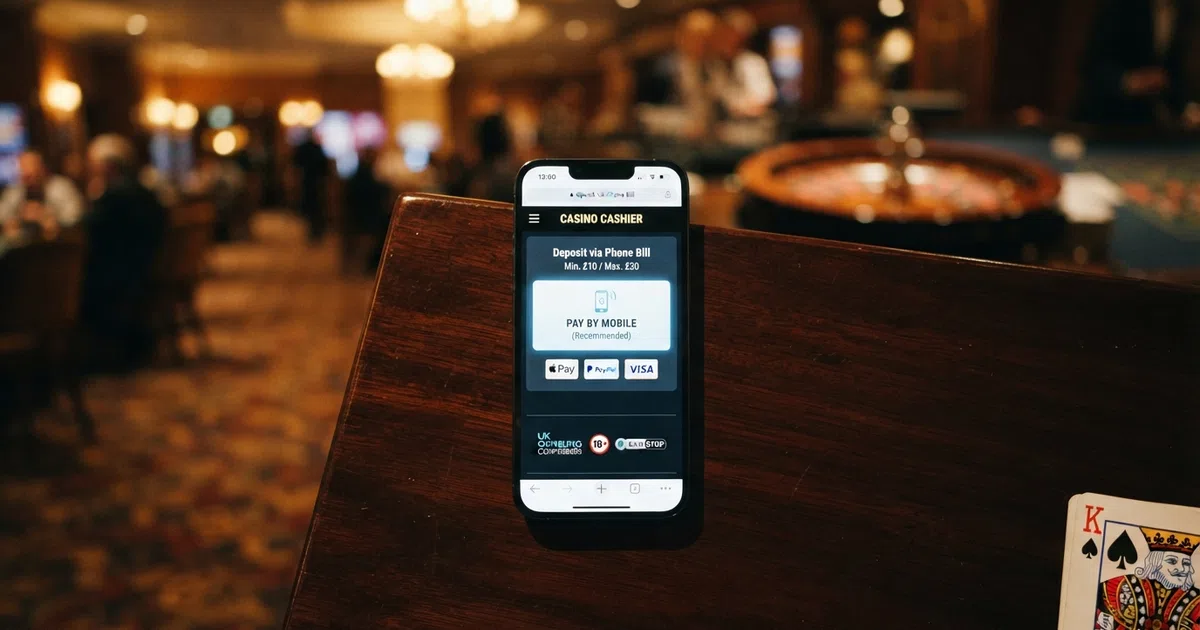
What follows is a working guide to the ten UK-licensed casinos that accept this method, the trade-offs the marketing pages tend to skip, and the rules of the road that govern the entire market. Every figure in the page comes from operator terms, the Gambling Commission’s public register, the Phone-paid Services Authority’s published caps, or the calculation set out in the bonus section. Where a number is not in the research, the page says so plainly rather than guess.
Data current as of September 8, 2026. Licensing claims verified against the Gambling Commission’s public register.
What a Mobile Top-Up Casino Actually Is — and Why UK Players Use Them
The three names that get used interchangeably across the UK market — pay by phone, pay by mobile, and mobile top-up — all describe the same mechanism: a carrier-billed deposit routed through a third-party processor. The “top-up” in the phrase is the casino’s word, not the mobile network’s. It means the casino balance is being topped up via the phone account, the same way a child might top up a game wallet through a parent’s phone bill. It has nothing to do with topping up a prepaid SIM at a corner shop; that is a different product on a different billing system.
The processors that sit between the casino and the mobile network are three: Fonix, Boku and Siru Mobile, with a legacy option called Payforit still showing up on some older pages. Fonix has become the dominant choice among UK-licensed casinos — it is the route used at Duelz, MrQ, Hot Streak and Hollywood Bets, among others. Boku is the established global brand, with 28 million active users across more than ninety countries. Siru Mobile operates at a smaller scale, used by Videoslots and Mr Vegas. The casinos do not advertise which processor they use on the cashier page; the processor only shows up in the small print of deposit guides and review sites.
Why use it? Two reasons that show up in the research, and one that does not get talked about enough. The first is privacy: the casino never sees a bank account or card number, so a phone-bill deposit does not expose those details to a breach or a leaked database. The second is friction: a deposit can be made in under a minute from a phone already in the hand, with no card to hand, no wallet app to open and no banking authentication to push through. The third, less discussed, is that the deposit cap is hard-wired into the method — the £30 per-transaction, £40 per-day, £240 per-month limits are not a choice the operator makes, they are a regulatory floor. For a player who wants a hard ceiling they cannot negotiate past, that is a feature.
The same ceiling is a problem for anyone depositing more than £30 at a time. And phone-bill deposits cannot be used to withdraw, so the player still needs a second payment method to cash out. Both points are developed in the trade-off section below; the marketing copy tends to glide past them.
The UK market for this method is genuinely niche. Major operators — bet365, William Hill, Ladbrokes, Coral, Paddy Power, Betfred, Sky Bet, Sky Vegas and Betfair — do not accept pay-by-phone deposits at all. They require debit card, Apple Pay, Google Pay or bank transfer. The players who arrive at this page are looking at a sub-section of the GB-licensed market that is smaller than the comparison sites sometimes make it sound, and the list of operators worth ranking runs to about ten.
How Pay-by-Phone Casino Deposits Work: Every Method, Limit and Fee
The flow at the cashier is the same at every UK-licensed operator that accepts the method. On the first deposit, the player selects Pay By Mobile, enters their mobile number, and waits for a confirmation PIN by SMS. They type the PIN back into the cashier, the deposit lands, and a second SMS arrives as a receipt. On subsequent deposits the PIN step is usually skipped because the device is now recognised. The receipt SMS is the part most guides forget to mention; it is the only record the player will get that a deposit has gone through, because the charge on a contract phone bill may not appear for weeks.
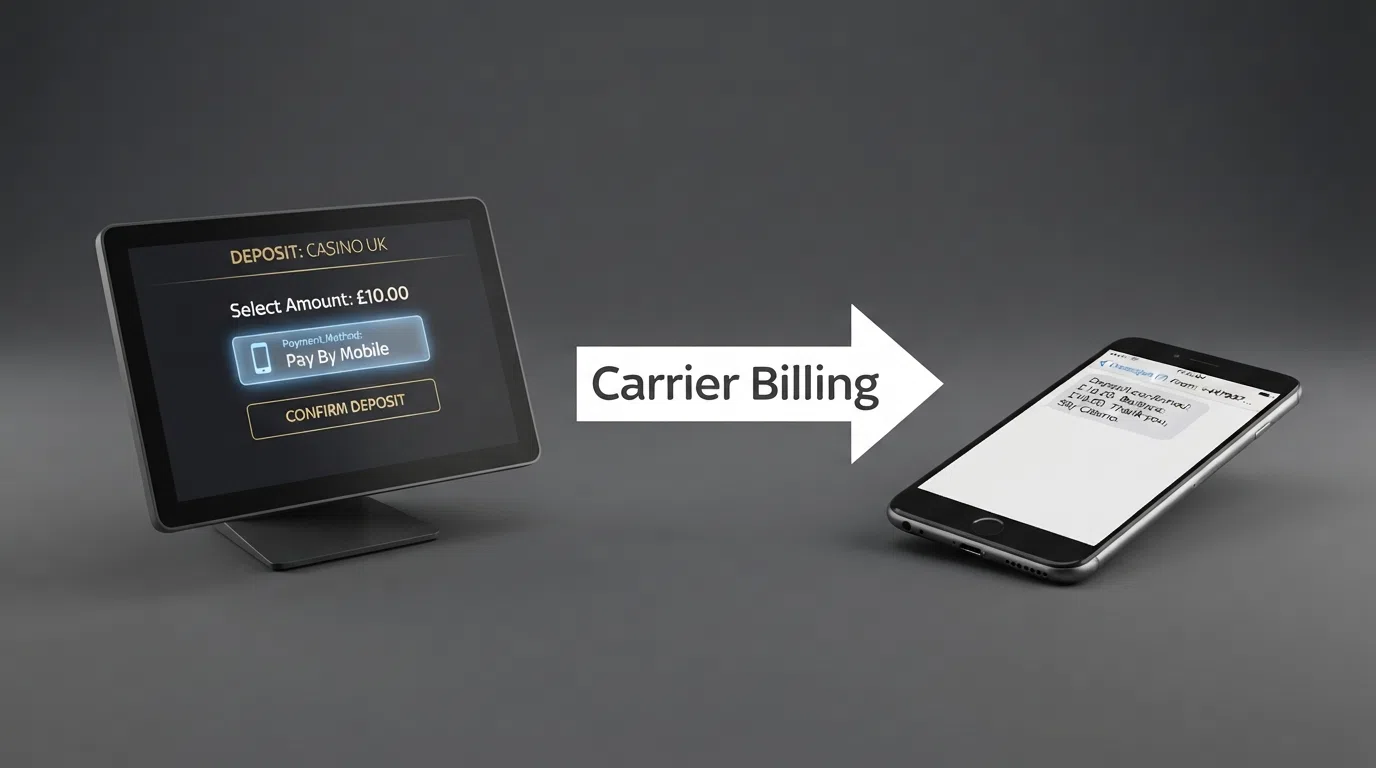
Carrier billing splits into two flavours, and the distinction matters for budget discipline. A contract phone player is postpaid: the deposit is added to the next monthly bill from EE, O2, Vodafone, Three or the relevant MVNO, and the player settles it along with the rest of the tariff. A prepaid (pay-as-you-go) SIM player is debited at the moment of deposit, with the money coming off the credit already loaded on the SIM. The two routes have identical deposit caps under the Phone-paid Services Authority’s rules, but the prepaid route is the more self-limiting one: when the credit runs out, the deposits stop. The contract route, by contrast, lets a player accumulate charges that only become visible at the end of the billing cycle — a delay that is part of the reason the regulator has set the cap where it is.
How Carrier Billing Works: Fonix, Boku and Payforit Explained
Fonix is the newer of the three, UK-focused, and now the default option for most UK-licensed casinos adding the method. Boku is the longer-established global brand; its 28 million active users across 90-plus countries make it the most widely deployed carrier-billing processor in the world, but in the UK specifically it is the second-favourite. Siru Mobile is the third route, with a smaller footprint. Payforit is the legacy option — it still works on some UK networks and at some older operator integrations, but Fonix has displaced it in most modern casino cashier builds.
The practical effect for a player is the same regardless of which processor sits in the middle: the deposit cap, the SMS confirmation flow, the inability to withdraw, and the carrier’s role in settling the charge are all identical. The differences are operational — Boku’s global reach means a player who travels may see the same processor on foreign networks, while Fonix tends to be a UK-only product.
Phone Bill Payments: Charging Your Deposit to Your Monthly Bill
A player on a contract phone sees their casino deposits land on the same monthly statement as their tariff, minutes and data. Some networks do not itemise the charge as “gambling” on the statement; the merchant descriptor may show the processor’s name or a neutral retail label. That makes bill-shock a real risk even within the PSA limits, because a player reviewing their bill weeks after the deposit may not connect the line item to the casino session. The £40 daily and £240 monthly caps exist precisely to keep that risk bounded, but the caps apply across all third-party merchants combined, not per casino — so a player who hits £40 at one operator in a day has also hit their PSA ceiling across every other pay-by-mobile merchant on the same phone number.
Pay-by-Mobile Options: Phone Bill vs Direct Carrier Charge
Both flavours are covered by the same PSA cap, but the contract (postpaid) and prepaid (pay-as-you-go) routes are different in feel. The prepaid route is the natural harm-reduction option: the credit on the SIM is the budget, and when it is gone it is gone. The contract route is the natural convenience option: the deposit is deferred to the bill, and the player’s bank balance is not touched at the moment of play. Casinos that accept pay-by-phone generally support both, but a player on a prepaid SIM who has not loaded enough credit will simply see the deposit fail at the cashier.
SMS Deposits: The Text-to-Deposit Flow Step by Step
The full flow, as described in the operator guides research reviewed, runs in five steps: select Pay By Mobile at the cashier, enter the mobile phone number, receive a confirmation PIN by SMS for the first transaction, enter and confirm the PIN at the cashier, and receive a receipt SMS confirming the deposit. Subsequent deposits on the same device usually skip the PIN step. The PIN SMS is the security beat — it confirms that the person entering the phone number actually has the handset, which is the only authentication the method offers.
Phone Credit Top-Ups: Funding Casino Play From a Prepaid Balance
For a pay-as-you-go player, the deposit is debited from the existing credit on the SIM at the moment of confirmation, not added to a bill. The hard stop when the credit runs out is the closest the UK market comes to an enforced loss limit at the payment-channel level, and the kind of feature that does not get a marketing page but ought to. A player who has £20 of credit on their SIM and tops up another £10 from a gift card can, in theory, deposit the full £30 — the per-transaction cap — but cannot go beyond it without loading more credit, and loading more credit requires a deliberate act at a shop, an app or a top-up voucher. The friction is part of the safety net.
Deposit Limits, Processing Speed, and the Fees Some Operators Hide
The numbers that decide whether the method is worth using sit in three places. The deposit speed is essentially instant on every UK-licensed operator: the receipt SMS arrives within seconds of the cashier confirmation. The deposit limits are the PSA caps: £30 per transaction, £40 per day, £240 per month, applied across third-party merchants combined. The processing fees vary by operator, and this is where the marketing copy diverges from the small print. Hot Streak Casino and Mobile Wins both charge a 15% processing fee on PayviaPhone deposits, meaning a £10 deposit leaves the player with £8.50 of playable balance before the first spin. Fonix and Boku operators generally do not charge a processing fee on top of the deposit, but a player who sees “Pay By Mobile” listed as a payment method at the cashier should always check the deposit-confirmation screen for a fee disclosure before confirming — the disclosure is required, but it does not always surface before the PIN step.
The Slots and Games You Can Play With a Phone-Bill Deposit
The game library at a phone-bill casino is the same library a debit-card player sees. There is no game-type restriction tied to the deposit method. Slots dominate, with Pragmatic Play, Play’n GO, NetEnt, Red Tiger and Microgaming all represented across the featured operators. Live-dealer tables from Evolution are available at Duelz, and table games — blackjack, roulette, baccarat — are present at the larger operator lobbies. The phone-bill deposit does not change which games the player can launch.

What does change, in practice, is the betting rhythm. The £30 per-transaction cap means a phone-bill player cannot place a single large stake on a high-roller table; they are constrained to the slot-stake and table-minimum range the casino already operates in. At a £5 max-stake slot under the UKGC’s 2025 rules, the per-spin ceiling is the regulatory floor rather than the deposit ceiling, so the PSA cap is rarely the binding constraint on slot play. It binds at the table games, where a £30 single deposit may only cover a handful of hands at a £5 blackjack minimum.
Slots Available With a Mobile Top-Up Deposit
A phone-bill player gets the full slot catalogue. Pragmatic Play’s Big Bass Splash and Gates of Olympus, Play’n GO’s Book of Dead, NetEnt’s Starburst-adjacent library, Red Tiger’s daily-jackpot network and Microgaming’s older progressive portfolio all appear at the featured operators. MrQ runs all of its games at full RTP versions — meaning the theoretical return-to-player percentage the regulator and the provider publish, rather than a reduced configuration some operators use to manage margin. For the other operators in the featured set, the RTP configuration is not confirmed in the research and the page does not invent a figure; the player can check the in-game information panel at any slot to see which configuration the operator is running.
Phone-Bill Slot Titles With Real RTPs: A Data Table
| Slot title | Provider | RTP | Volatility |
|---|---|---|---|
| Big Bass Splash | Pragmatic Play | 96.71% | High |
| Book of Dead | Play’n GO | 96.21% | High |
| Gates of Olympus | Pragmatic Play | 96.50% | High |
| Sweet Bonanza | Pragmatic Play | 96.48%–96.51% | Medium-high |
These four are the titles research carries a confirmed RTP for, drawn from operator promos, Pragmatic Play’s published database and Play’n GO’s published game information. RTP in the UK is operator-configurable within regulatory limits, so the figure a player sees in-game may sit at the top or the bottom of the published range; Sweet Bonanza is the clearest example, with a 0.03-percentage-point spread depending on configuration. Max-win figures are 5,000× for Big Bass Splash, Book of Dead and Gates of Olympus, and 21,175× for Sweet Bonanza — but max-win is a marketing headline, not a probability statement, and a player chasing it is paying for the chance at a tail outcome the slot is engineered to deliver rarely.
Other Game Types and Live-Dealer Availability
Live-dealer tables from Evolution are available at the larger featured operators — Duelz lists Evolution among its providers, and the operator lobby carries the standard blackjack, roulette and game-show formats. Table games in the RNG (non-live) format are present at all ten featured operators. Slingo, scratch cards and crash games are present at several of them. Slots remain the dominant product by game count and by share of player activity, which is partly a function of the £5 max-stake rule making table games a slower burn and partly the marketing weight the providers put behind new slot releases. None of the featured operators restricts a game type by deposit method, and a player depositing by phone bill can launch any game the cashier’s deposit method allows.
The UK’s Best Mobile Top-Up Casinos Ranked: Bonus Eligibility, Honest Fees and the Methods Each One Accepts
The ranking that follows orders the ten UK-licensed operators that accept phone-bill deposits by the size and quality of their welcome offer, with the bonus-eligibility flag carried explicitly. The split in the UK market is sharper than the comparison sites tend to show: a number of operators accept phone-bill deposits for play but explicitly exclude them from the welcome bonus, requiring a debit-card first deposit to unlock the offer. That distinction is the most important column in the table, because it determines whether the deposit method the player has chosen actually works with the bonus they came for.
| Casino | Mobile billing method | Min deposit (phone bill) | Welcome offer | Free spins | Wagering requirement | Phone-bill bonus eligible? | UKGC licence |
|---|---|---|---|---|---|---|---|
| Duelz | Fonix | £10 | 140 free spins (20/day × 7 days) | 140 | 10× on winnings | Yes | SuprPlay Limited |
| MrQ | Fonix | £10 | 100 free spins on Big Bass Splash | 100 | 0× (no wagering) | Yes | Lindar Media Limited |
| Hot Streak Casino | Fonix | £10 | Up to £1,500 + 250 bonus spins (multi-stage) | 250 | 10× | Yes (15% processing fee) | Grace Media Limited |
| Peachy Games | Boku | £10 | 40 free spins on Big Bass Splash on £10 slot wager | 40 | 0× (no wagering) | Yes | Bear Group Limited |
| Videoslots | Siru Mobile | £5.12 | 100% up to £200 + 11 wager-free welcome spins | 11 | 10× on match; spins wager-free | Yes | Videoslots Limited |
| Mr Vegas | Siru Mobile | £5.12 | 100% up to £200 + 11 wager-free welcome spins | 11 | Spins wager-free; match terms vary | Yes | Videoslots Limited (sister site) |
| Hollywood Bets | Fonix | £5 | 100 free spins welcome offer | 100 | n/a | No — debit card required for bonus | Hollywood Bets |
| Monster Casino | Fonix / PayviaPhone | £10 | 100% up to £50 + 30 free spins | 30 | n/a | Yes | ProgressPlay Limited |
| Mobile Wins | PayviaPhone | £10 | Welcome bonus (amount varies) | Varies | 10× on bonus | Yes (15% processing fee) | ProgressPlay Limited (licence 39335) |
| Spinzwin | Fonix / PayviaPhone | £10 | 100% bonus + 20 free spins | 20 | n/a | Yes | ProgressPlay Limited |
The first column a player should read is the last one before the licence: Phone-bill bonus eligible? Seven of the ten say yes. Three of the seven (Hot Streak, Mobile Wins, and to a lesser extent the ProgressPlay platform more broadly) attach conditions the headline number does not mention — the 15% processing fee at Hot Streak and Mobile Wins, the 50× wagering at Mobile Wins, the unconfirmed bonus terms at Monster Casino and Spinzwin. Hollywood Bets sits in the no column because it accepts phone-bill deposits but excludes them from the welcome bonus, requiring a £10+ debit-card deposit instead. The page works through each operator individually below.
Duelz: 140 Free Spins on Fonix Deposits, With a Daily-Claim Rhythm
Duelz offers the largest spin count in the featured set — 140 free spins on a £10 Fonix deposit — but the offer is structured as 20 spins per day for seven days, with a midnight expiry on each daily batch if unclaimed and a £100 max cashout per batch. The wagering requirement is 10× on winnings, which is the UKGC’s December 2025 ceiling. Spins carry a £0.10 value, and the player must also wager £25 on slots to unlock the offer. Duelz is licensed by the UKGC under SuprPlay Limited, and its provider list includes Pragmatic Play, Play’n GO, NetEnt and Evolution — a full-strength stack for the live-dealer and slot categories. The seven-day rhythm is the part players tend to miss in the headline; a player who deposits on a Friday and does not log in over the weekend will lose that Friday’s batch.
MrQ: Zero-Wagering Free Spins — the Only Operator With No Playthrough
MrQ is the standout offer in the set, and the only one with a zero-wagering policy. A £10 Fonix deposit unlocks 100 free spins on Big Bass Splash (RTP 96.71%), and the winnings are credited to the real-money balance as withdrawable cash — no playthrough, no max-cashout cap, no conversion step. The claim window is 48 hours, which is tighter than Duelz’s seven-day rhythm, and the spin value is £0.10. MrQ is UKGC-licensed under Lindar Media Limited, runs all games at full RTP versions, and operates a zero-wagering policy across all its promotional offers. For a player choosing on the basis of bonus quality alone, MrQ is the cleanest offer in the set; the 48-hour claim window is the only friction, and it is a real one for a player who does not log in daily.
Hot Streak Casino: The Largest Bonus Package — With a 15% Processing Fee
Hot Streak’s headline — up to £1,500 matched bonus plus 250 bonus spins across a multi-stage welcome package — is the largest bonus figure in the featured set. The wagering requirement is 10× (the UKGC ceiling), and Fonix deposits are accepted. The catch is the 15% processing fee on PayviaPhone deposits: a £10 deposit leaves £8.50 to play with, and the matched-bonus value is calculated on the deposited figure, not the playable figure, so the effective bonus-to-deposit ratio is lower than the headline suggests. Hot Streak is UKGC-licensed under Grace Media Limited. For a player who plans to deposit the maximum the PSA cap allows (£30 per transaction), the 15% fee takes £4.50 off every deposit, which adds up over a welcome-package playthrough. The offer still ranks above the £200 match-cap sites for total bonus value, but the fee is a real cost and the page names it plainly.
Peachy Games: Boku Deposits With Wager-Free Spins
Peachy Games is the only Boku-only operator in the featured set. The welcome offer is 40 free spins on Big Bass Splash (RTP 96.71%), awarded when the player wagers £10 on slots — note that the trigger is a £10 wager, not a £10 deposit, so the spins are unlocked by play rather than funding. The wagering requirement is 0×; winnings are paid as withdrawable cash. Peachy Games is UKGC-licensed under Bear Group Limited, with Pragmatic Play, Play’n GO and NetEnt on the provider list. The Boku integration is the differentiating factor for a player who specifically wants Boku rather than Fonix as the processor, but functionally the deposit flow and the PSA caps are identical to Fonix. The £10-wager trigger is the detail a player should read twice before depositing.
Videoslots: Siru Mobile and a 100% Match Bonus on a £5.12 Minimum
Videoslots offers the lowest phone-bill deposit threshold in the featured set at £5.12, with a 100% match bonus up to £200 plus 11 wager-free welcome spins on Pink Elephants 2. The wagering requirement is 10×. The Siru Mobile integration is the lowest-friction option for a player depositing small amounts frequently, and the 5,000+ game library is the broadest in the set. Videoslots is UKGC-licensed under Videoslots Limited.
Mr Vegas: Same Siru Offer, Different Lobby
Mr Vegas carries an identical welcome structure to Videoslots — 100% up to £200 plus 11 wager-free welcome spins on Pink Elephants 2, Siru Mobile deposits at a £5.12 minimum, same bonus terms. The differentiation is branding and lobby: Mr Vegas is positioned as the more casual, slot-forward sister site to Videoslots’ broader portfolio. A player choosing between the two is choosing on the look of the lobby and the slots they want to play, not on the welcome offer. Mr Vegas operates under the same Videoslots Limited licence.
Hollywood Bets: Accepts Phone Billing — But the Bonus Needs a Debit Card
Hollywood Bets is the case study in why the “phone-bill bonus eligible?” column matters. The operator accepts Fonix deposits at a £5 minimum and runs a 100-free-spin welcome offer — but the welcome offer is explicitly gated behind a debit-card first deposit, with phone-bill deposits excluded from the bonus. A player who reads the headline offer, deposits £5 by phone bill to keep their bank details out of the casino, and then finds the free spins are not in their account has not made a mistake; the operator’s terms reserve the bonus to a different funding route. Hollywood Bets is UKGC-licensed. For a player who is set on phone billing as the deposit method, Hollywood Bets is still a viable option for play — the 100 free spins are simply not part of the offer they will receive.
Monster Casino: ProgressPlay Platform, Phone-Bill Deposit, Unconfirmed Bonus Terms
Monster Casino runs on the ProgressPlay platform and accepts Fonix / PayviaPhone deposits at a £10 minimum. The headline offer is a 100% welcome bonus up to £50 plus 30 free spins, but the wagering requirement and bonus-validity terms for the phone-bill deposit route were not confirmed in the research carried out for this page. The offer is listed as eligible for phone-bill deposits based on the operator’s published welcome page, but a player claiming the offer should verify the wagering and max-cashout terms in the bonus terms section of the casino before depositing. ProgressPlay Limited is the licence holder, and the platform’s regulatory history is noted in the final section of this page.
Mobile Wins: The 15% Fee Operator With a 50× Wagering Requirement
Mobile Wins is the costliest phone-bill bonus in the featured set by the numbers. The PayviaPhone deposit carries a 15% processing fee, the wagering requirement is 10× on the bonus amount, and the max cashout from the offer is capped at 3× the bonus amount. The 10× wagering is the headline number: at the UKGC’s £5 max-spin stake, clearing a £50 bonus at 10× wagering requires £500 of slot play — and the time cost of that play at a 2.5-second minimum spin cycle runs into minutes. The operator is UKGC-licensed under ProgressPlay Limited (licence 39335), an operator platform currently subject to heightened regulatory monitoring.
Spinzwin: Another ProgressPlay Operator With Unconfirmed Phone-Bill Bonus Terms
Spinzwin rounds out the featured set, also on the ProgressPlay platform, accepting Fonix / PayviaPhone deposits at a £10 minimum. The headline offer is a 100% welcome bonus plus 20 free spins, with wagering terms not confirmed in the research for this page. ProgressPlay Limited is the licence holder, and the platform context — including the 2025 UKGC enforcement action covered in the final section — applies.
The Cost of a Phone-Bill Bonus in Spins, Seconds and Pounds
The bonus-cost calculation works best on a real offer rather than a generic example, so this section works through Duelz and contrasts it with MrQ. The assumptions are the UKGC’s December 2025 wagering cap of 10×, the £5 statutory max stake for players aged 25 and over, Big Bass Splash’s published RTP of 96.71% as the representative slot, and a 2.5-second minimum spin cycle.
Duelz’s 140 free spins at £0.10 each carry a notional bonus value of £14. At 10× wagering, the player must turn over £140 of qualifying play to clear the bonus. Dividing £140 by the £5 max stake gives 28 spins. At the 2.5-second minimum cycle, 28 spins take 70 seconds — just over a minute of play to clear the bonus. At Big Bass Splash’s 96.71% RTP, the expected loss on £140 of wagering is £140 × (1 − 0.9671) = £4.61. That is the real cost of clearing the Duelz offer under these assumptions.
MrQ’s 100 free spins at £0.10 each carry a notional bonus value of £10, but the wagering requirement is 0× — there is no turnover to clear. The cost in time is zero. The cost in expected loss is the cost of the free spins themselves: at Big Bass Splash’s 96.71% RTP, 100 spins at £0.10 cost £10 × (1 − 0.9671) = £0.33 in expected value. The two offers are not in the same league on bonus economics; MrQ is materially cheaper to claim.
The caveat the calculation does not show: a real session will not hit 96.71% RTP exactly. RTP is a long-run average over millions of spins, and any individual session will sit above or below it, often well below, because variance on a 100-spin sample is large. The £4.61 figure for Duelz is the statistical cost, not a guaranteed loss. The £0.33 figure for MrQ is the same kind of estimate at a smaller scale. Neither promises a payout.
A second caveat: the £4.61 estimate assumes the player wagers only the bonus-derived amount at the maximum stake. In practice, a player who deposits £10, claims the spins and plays through the wagering will be mixing the bonus balance with their cash balance, and the qualifying play figure may run higher than £140 depending on how the operator applies the wagering contribution. The calculation is a clean-room estimate, not a session-by-session prediction.
Is Pay-by-Phone Gambling Legal in the UK? The Rules That Protect Your Money
Phone-bill casino play is legal in Great Britain under the Gambling Act 2005, extended to remote operators by the Gambling (Licensing and Advertising) Act 2014 — the point-of-consumption reform that brought every online casino serving GB customers into the UK Gambling Commission’s licensing regime. The Gambling Commission is the single statutory regulator, and the three licensing objectives set out in section 1 of the Act — preventing gambling from being a source of crime, ensuring fair and open gambling, and protecting children and other vulnerable persons — are the framework within which every other rule sits.
A UKGC licence is not optional. Operating without one is a criminal offence under section 33 of the Gambling Act 2005, carrying up to 51 weeks’ imprisonment and an unlimited fine. The Commission’s enforcement against unlicensed offshore sites is data-led rather than network-led — the UKGC does not hold statutory ISP or DNS blocking powers — and the published enforcement figures show 3,140 disruption notices and 287,961 URLs removed against illegal operators between April 2024 and June 2025. For a phone-bill player, the practical implication is that any operator accepting deposits from a GB handset must be on the public register at gamblingcommission.gov.uk, and any operator that is not on the register is operating illegally, regardless of how the deposit is funded.
The 2014 reform ended the previous arrangement in which an operator licensed in another jurisdiction could serve GB customers without a GB licence. Northern Ireland is not covered by the Gambling Act 2005 and runs on separate, older law; “UK-licensed” is common market usage, but “GB-licensed” is the accurate term. A player in Northern Ireland has a narrower set of legally licensed options than a player in England, Scotland or Wales.
UKGC Licensing: What It Means for Phone-Bill Casino Players
A UKGC licence commits the operator to three things that matter directly to a phone-bill player. First, identity verification before the first deposit — name, address and date of birth must be confirmed by the operator before any money is taken, in force since 7 May 2019. A phone number is not a substitute for that check; the operator runs a separate KYC process regardless of how the deposit is funded. Second, fund segregation: customer deposits must be held in segregated accounts, separate from the operator’s operating capital, so that player funds are not available to the operator’s creditors in an insolvency. Third, dispute resolution: an alternative dispute resolution (ADR) provider is available to any player who has exhausted the operator’s internal complaint process. The licensing objectives — crime prevention, fair and open gambling, protection of children and the vulnerable — are the test the operator is held to throughout the licence period, and breach of any of them is a licence-condition failure the Commission can act on.
GAMSTOP, Self-Exclusion and Carrier Billing
GAMSTOP is the national multi-operator self-exclusion scheme for online gambling in Great Britain, and participation has been a mandatory condition of every GB online operating licence since 31 March 2020. A player who registers with GAMSTOP is barred from every GB-licensed online gambling site for the period they select — six months, one year, five years, or five years with auto-renewal — and the exclusion cannot be cancelled early. Phone-bill deposits do not change GAMSTOP coverage: the exclusion applies at the operator level, not the payment level, and a self-excluded player will be blocked from depositing by any method the operator supports.
The boundary that matters: GAMSTOP is online-only and licence-bound. It does not cover land-based gambling — bookmakers, casinos, arcades — and it does not cover unlicensed offshore sites. A player who has self-excluded and then opens an account with an unlicensed operator is not protected by GAMSTOP, and the phone-bill deposit method does not change that. The page states this once and refers back to it; the point does not need to be made in every section.
Age Verification and Phone Accounts
The May 2019 rule requires every remote licensee to verify the player’s name, address and date of birth before any deposit or any gambling activity. The verification is run by the casino, not by the mobile network, and a phone account’s own age records do not substitute for it. A pay-as-you-go SIM purchased without age verification does not bypass the KYC check at the casino; the casino is required to run its own check before taking the first deposit, and the deposit will not be accepted without it. A player who is under 18 cannot use the phone-bill method at a GB-licensed site any more than they can use a debit card, and the network’s own age-gating on SIM purchase is a separate layer of protection, not a substitute.
Phone-Bill Gambling Rules: The PSA Cap, the Payment Services Regulations and the UKGC’s Role
The two-regulator split is the part most player-facing pages do not explain. The UKGC licenses the casino and enforces the conduct rules — age verification, fair play, anti-money-laundering, self-exclusion. The Phone-paid Services Authority (PSA) regulates the payment channel, and the £30 per-transaction, £40 per-day and £240 per-month caps that bind phone-bill casino deposits sit under the Payment Services Regulations 2017 (Schedule 1, Part 2(l)) electronic communications exclusion, not under the Gambling Commission’s rules. The two regulators cover different things; a player who wants to challenge a deposit cap is dealing with the PSA, while a player who wants to challenge a bonus exclusion is dealing with the UKGC-licensed operator. The £240 monthly subscriber limit applies across all third-party merchants combined, not per casino, so a player who maxes out the cap at one operator has also maxed it out everywhere else on the same phone number.
Responsible Gambling on Mobile Billing: The Safety Net Built Into the Cap
The PSA deposit cap is the most consequential responsible-gambling feature of phone-bill casino play, and it is built into the payment method itself rather than chosen by the operator. A player on a debit card can deposit £500 in a single transaction at a GB-licensed casino; a player on phone billing cannot exceed £30 in a single transaction, £40 in a day or £240 in a month without switching methods. For a player who wants a hard ceiling on their gambling spend, the PSA cap does what no deposit-limit tool at the operator level can do — it stops the deposit at the payment channel, before the funds ever reach the casino.
The cap is not a substitute for the operator-level tools. From 31 October 2025, every GB-licensed operator must prompt a player to set a financial limit before their first deposit. From 30 September 2026, the operator must offer a gross deposit limit (based solely on money paid in) with at least equal prominence to any net-deposit display. A player who wants a tighter cap than the PSA’s £240 monthly ceiling can set one at the operator level, and the operator-level limit applies on top of the PSA limit, not instead of it.
The PSA Deposit Cap as a Built-In Spending Brake
The £30, £40 and £240 caps apply across third-party merchants, not per casino, which is both the strength and the limitation of the cap as a harm-reduction feature. The strength: a player cannot route around it by opening multiple accounts at the same network, because the cap sits at the phone-account level. The limitation: a player can open accounts at multiple casinos, hit the cap at each one, and end up with a higher total monthly outflow than the £240 figure suggests — the cap restrains the spend per phone number, not the spend per player. A player who recognises this and wants a tighter overall ceiling needs to set an operator-level limit at each casino, and the regulatory framework now requires the operator to prompt them to do so.
Self-Exclusion and Cooling-Off With Carrier Billing
The path to self-exclusion runs through GAMSTOP, not through the phone network. A player who wants to lock themselves out of phone-bill casino deposits at every GB-licensed site registers with GAMSTOP for a six-month, one-year or five-year exclusion, and the exclusion applies regardless of the deposit method. The operator-level self-exclusion and time-out tools — typically available for 24 hours, seven days or longer — apply at the casino, and a self-excluded player at one operator is not automatically excluded at another. GAMSTOP is the only route that covers the whole GB-licensed market, and it is the route a player who is serious about stopping should use. Blocking the phone number alone is not sufficient: the number can be ported, a new SIM can be acquired, and the same player can deposit from a different handset at the same operator. The exclusion has to sit at the operator, and GAMSTOP is the only mechanism that sits at every operator at once.
Spend Tracking When Charges Go to Your Phone Bill
A phone-bill deposit may not appear on a player’s statement for weeks, which is the spending-tracking problem unique to the method. A player who reviews their bank account at the end of the day sees debit-card spend; a contract-phone player reviewing their phone bill at the end of the month sees the casino deposits. The lag makes it harder to keep a running total of gambling spend, and it is part of the reason the regulator has tightened the rules on financial limits and prompted deposits. From 28 February 2025, operators must run a light-touch financial vulnerability check on customers reaching a £150 net deposit threshold in a rolling 30-day period, using publicly available data. The National Gambling Helpline’s referral numbers — 996 referrals in January 2026, a 48% year-on-year increase — and the 81.5% share of contacts citing online gambling as their primary problem (a five-year high) are the markers of how many players are running into trouble with exactly this kind of spend pattern.
Where to Get Help: UK Responsible-Gambling Resources
The help channels a player can reach today, in the UK, are:
- National Gambling Helpline (GamCare): 0808 8020 133, available 24/7, free and confidential.
- NHS gambling harm clinics: 15 specialist clinics across England, Scotland and Wales, accessed via the helpline or via a GP referral; service use increased 130% over the preceding year.
- GAMSTOP: the national self-exclusion register, free to use, available at gamstop.co.uk.
- Gamblers Anonymous UK: peer-support meetings, online and in person.
- GambleAware: funds prevention, research and treatment; information and self-assessment tools at gambleaware.org.
- GamCare self-assessment tools: online screening at gamcare.org.uk.
A player who has hit the PSA cap and feels the need to hit it again is the player the help lines exist for. The cap is a brake, not a cure.
How We Selected and Ranked These UK Mobile Top-Up Casinos
The ten operators in the featured set were drawn from a sweep of the GB-licensed market, filtered on three criteria. First, UKGC licence status confirmed on the public register at gamblingcommission.gov.uk. Second, the operator accepts a phone-bill deposit method — Fonix, Boku, Siru Mobile or PayviaPhone — at the cashier. Third, the operator runs a welcome offer accessible to a phone-bill depositing player, either as a bonus-eligible deposit or as a deposit-triggered free-spin package. Operators that do not accept pay-by-phone deposits (the major bookmakers and high-street brands) were excluded by the second criterion; operators that accept pay-by-phone but exclude it from the welcome bonus (Hollywood Bets) are included but flagged in the table. Operators licensed outside Great Britain were excluded, because the entire regulatory framework the page describes applies only to GB-licensed sites, and ranking an offshore operator against a GB-licensed one on a like-for-like basis would be misleading.
The bonus comparison is on offer value, wagering requirement, processing fees and bonus-eligibility for the phone-bill deposit route, with the working example in the bonus-cost section grounded in Duelz’s 140-spin offer and contrasted with MrQ’s zero-wagering offer. The data sources were operator deposit guides, the UKGC public register, the PSA’s published caps, OLBG’s pay-by-phone comparison table, casinowithdrawal.co.uk’s Boku Casinos UK page, slotfruit.co.uk’s operator reviews, TalkSport’s pay-by-mobile guide, The Independent’s slot RTP table, and the Pragmatic Play and Play’n GO published game information. Cross-referencing across at least two non-affiliate sources was the standard for any figure that appears in the table.
What was not checked, and the page does not claim to have checked, includes per-operator payout speed, live customer-support quality, the specific RTP configuration deployed at each operator beyond the four named titles, the availability of every payment method listed in the operator’s deposit guide, and the real-world frequency of bonus payouts or free-spin triggers. The page describes what the research carries; where a number is not in the research, the page says so rather than estimate.
The enforcement context is part of the ranking in the sense that it is part of the reader’s decision: ProgressPlay Limited, the platform behind Mobile Wins, Monster Casino and Spinzwin, was fined £1,000,000 by the UKGC on 21 August 2025 for anti-money-laundering and social-responsibility failures. The fine is a public-record regulatory action, not a marketing claim, and it is part of the platform context for any player choosing among the three ProgressPlay operators. The other seven operators in the featured set carry no equivalent enforcement flag in the research.
Phone-Bill Casino Deposits: Who They Suit, and Who Should Use a Debit Card Instead
The argument for phone-bill depositing comes down to three things, and the argument against it comes down to the same three things read the other way.
Privacy. The phone-bill method does not share bank or card details with the casino, which is the strongest privacy position available in the GB-licensed market. A player whose priority is keeping their bank details out of a gambling operator’s database — for security, for budgeting or for personal preference — gets that with the phone-bill route. The trade-off is that withdrawals must go through a separate method, so the player still has to register a debit card or bank account for cashouts. The privacy win is on the deposit, not the cashout.
Budget discipline. The PSA cap is the hardest spending brake in the GB-licensed market. A player who cannot trust themselves to stop at £30 in a single session is being restrained by the payment channel, not by willpower. The same cap is a serious limitation for a player who plays at higher stakes or who wants to move £200 into a casino in a single session to claim a matched-bonus offer. The trade-off is built in: the cap protects the player who needs it most, and it frustrates the player who needs it least.
Bonus eligibility. The phone-bill deposit is the welcome offer at MrQ, Duelz, Hot Streak, Peachy Games, Videoslots, Mr Vegas, Monster Casino, Mobile Wins and Spinzwin. It is not the welcome offer at Hollywood Bets, where a debit-card first deposit is required. At the ProgressPlay operators and at Hot Streak, the eligibility is real but the headline number carries a cost the small print reveals — 15% processing fees, 50× wagering, 3× bonus max cashout. The clearest offers in the set on bonus economics are MrQ (zero wagering, no fee) and Duelz (10× wagering, no fee, seven-day claim rhythm). Hot Streak carries the highest fee-adjusted bonus cost; Mobile Wins the highest wagering multiple; the ProgressPlay operators the most terms the page cannot confirm.
The verdict the figures support: phone-bill depositing is the right choice for a player whose priority is privacy, who plays at a stake level the PSA cap does not bind, and who is choosing an operator whose bonus terms make the phone-bill deposit route genuinely worthwhile — which, in the featured set, points to MrQ first and Duelz second. It is the wrong choice for a player depositing more than £30 at a time, for a player chasing the highest-volume welcome packages, and for a player at Hollywood Bets, where the phone-bill deposit does not unlock the welcome offer and the choice of method costs the bonus. A debit card is the better instrument for the high-volume, bonus-maximising player; a phone bill is the better instrument for the privacy-conscious, budget-disciplined player who is happy with a smaller offer. The PSA cap is what makes the second option safer than it would otherwise be, and the marketing pages tend to undersell that.
Frequently Asked Questions About UK Mobile Top-Up Casinos
How do I deposit at a UK casino using my phone bill?
Select Pay By Mobile at the cashier, enter your mobile phone number and confirm a PIN that arrives by SMS on your first transaction. The deposit lands within seconds, and a receipt SMS confirms the charge. Subsequent deposits on the same device usually skip the PIN step. The charge is added to your next monthly phone bill if you are on contract, or debited from your prepaid credit if you are on pay-as-you-go.
What is the maximum I can deposit via pay by phone at a UK casino?
The Phone-paid Services Authority caps deposits at £30 per transaction, £40 per day and £240 per month, and these limits apply across all third-party merchants on the same phone number — not per casino. The £30 ceiling is hard-wired into the method at every GB-licensed operator and cannot be raised by the casino.
Can I withdraw my casino winnings to my phone bill?
No. UK mobile networks do not support merchant refunds to a phone bill, so phone-bill deposits can only be deposited, not withdrawn. Cashouts must go through a separate registered method such as a debit card or bank transfer, and you will need to set up that method before your first withdrawal.
Do pay by phone deposits qualify for welcome bonuses at UK casinos?
At most of the featured operators, yes — MrQ, Duelz, Hot Streak, Peachy Games, Videoslots, Mr Vegas, Monster Casino, Mobile Wins and Spinzwin all allow phone-bill deposits to qualify. Hollywood Bets is the exception, requiring a debit-card first deposit for the welcome offer. Even where the phone-bill deposit qualifies, check for processing fees (Hot Streak and Mobile Wins charge 15%) and high wagering requirements before claiming.
Are there fees for depositing via phone bill at UK online casinos?
Most Fonix and Boku operators do not charge a processing fee, but some do — Hot Streak Casino and Mobile Wins both charge 15% on PayviaPhone deposits, meaning a £10 deposit leaves you with £8.50 of playable balance before the first spin. The fee is disclosed at the cashier before the deposit is confirmed, and you will see it on the deposit-confirmation screen rather than in the marketing copy.
What happens if I reach my phone bill deposit limit at a casino?
The cashier will decline the deposit at the PSA cap — £30 per transaction, £40 per day or £240 per month, depending on which limit you hit. The cap sits at the phone-network level, so it applies across all GB-licensed operators on the same phone number, not just at the casino you are playing at. To deposit more, you would need to switch to a debit card, Apple Pay, Google Pay or bank transfer, or wait until the cap resets (the daily cap resets at midnight, the monthly cap on the billing cycle date).
Payments – fastestpayout-casinos-uk
Content created by the «fastestpayout-casinos-uk» team