
XRP Casinos for UK Players: Every Option Is Offshore
 Available in GB
The appeal of XRP at an online casino is the speed. A transaction settles on the Ripple network in three to five seconds for a fee of about a tenth of a US cent, and the destination casino credits the balance almost immediately. For a UK player who has used only debit cards and bank transfers, that difference feels like moving from a postal service to a courier. The catch, and it is the single most important fact on this page, is that no UKGC-licensed casino accepts cryptocurrency deposits in 2026. Every brand you can actually use sits in the offshore market, licensed in Curaçao or Anjouan, outside the British regulatory perimeter. The speed is real. The protection that normally travels with a UK gambling licence is not.

This page ranks the ten XRP-accepting casinos that surface most often for UK searchers, all of them offshore, on the metrics that actually matter once a player moves past the welcome banner: licence status, game library, bonus terms and the realistic clock on an XRP withdrawal. It explains the mechanics of XRP deposits, the destination-tag trap that catches first-timers, and the fee structure most reviews skip. It then turns to the part nobody else writing on this subject is willing to write about plainly: what a UK player gives up the moment the casino does not hold a Gambling Commission licence, where self-exclusion stops working, and which help services remain available regardless of where the gambling happens.
*Current as of September 8, 2026 · Verified against the UK Gambling Commission’s public register of operating licence holders.*
How XRP Casino Deposits Work
An XRP deposit is a transfer of value from a personal wallet or exchange account to a casino-controlled Ripple address. The flow is short: the player copies the casino’s wallet address and destination tag from the cashier, sends the XRP from a wallet that controls the corresponding private key, and waits for the network to confirm. The network itself takes three to five seconds; the credit to the casino balance typically takes a moment longer while the casino’s payment processor watches the ledger. The whole path, from the player’s wallet to a playable balance, usually completes inside a minute.
The destination tag is the part that catches people out. Most XRP-accepting casinos assign a single deposit address to all players, then use a numeric destination tag — a secondary identifier attached to the transaction — to route incoming funds to the correct account. The casino shows both the address and the tag in the deposit screen, and the wallet must include the tag when the payment is signed. If the player copies only the address and sends the XRP without a tag, the funds arrive at the casino’s wallet with no way to identify the sender. Most casinos cannot recover those funds. Treat the destination tag as a required field, not an optional one.
The exchange-rate risk is the other subtlety. The casino displays its balance in GBP, dollars or its own internal credit, but the value of the underlying XRP moves constantly. A deposit worth £100 when sent can be worth £92 or £108 by the time the player cashes out, depending on which way the price has moved. Over short sessions the movement is usually trivial. Over weeks, and on large balances, it is not. Anyone using XRP at a casino is taking a small position on the asset, whether they intended to or not.
Withdrawals reverse the path: the player requests a payout, the casino approves it, and the XRP is sent from the casino’s hot wallet to the player’s wallet address, with a destination tag if the receiving wallet requires one. Crypto-native casinos process withdrawals in minutes once approved. Hybrid operations — casinos that take both fiat and crypto — are slower, because the same compliance queue that handles a bank transfer handles a payout to a blockchain address.
The UK XRP Casino Landscape: Every Option Is Offshore
The UK online gambling market is one of the most heavily regulated consumer-finance environments in the world, and it is closed to XRP. The UKGC’s licence conditions and the LCCP framework make cryptocurrency deposits practically impossible for a licensed operator, because source-of-funds verification and the AML controls a licensed casino must apply are not currently compatible with a pseudonymous on-chain transfer. The Commission has not issued an express statutory ban on crypto, but no operator in the licensed market offers it. The UKGC’s public register of operating licence holders, with 2,663 records, is the verification source for this fact: a search of that register for any casino accepting XRP returns nothing.
The regulator is not ignoring the question. On 26 February 2026, UKGC Executive Director Tim Miller told the Betting and Gaming Council AGM that the Commission had asked its Industry Forum to examine what a “sensible” pathway for crypto payments at licensed operators might look like. The phrasing matters: the Commission is exploring, not implementing. The earliest any change could land is late 2027, when the FCA’s Financial Services and Markets Act 2000 (Cryptoassets) Regulations 2026 (SI 2026/102) are expected to bring cryptoassets within the FCA’s regulatory remit. Until then, and probably for some time after, the entire UK-facing XRP casino market is offshore.
That market is substantial. Curaçao-licensed operators dominate the space — Jack.com, BC.Game, Lucky Block, CasinOK, Vave and BitStarz all hold Curaçao Gaming Authority licences. Three of the featured operators — Thrill, MonacoJack and Rakebit — are licensed in Anjouan, a newer jurisdiction whose gaming board has issued licences to a growing number of crypto-focused brands. The Anjouan licence is cheaper and faster to obtain than Curaçao’s newer framework, and the requirements are lighter, which is partly why so many of the newest crypto casinos have appeared there. One operator in the featured set, Dexsport, has no licence status confirmed in the public sources for this guide. Every one of these ten operators accepts UK players. None of them holds a GB licence. The gap between those two statements is the page’s central subject.
The offshore operators market themselves aggressively to UK players — British payment rails, GBP display currency, English-language support — and the UKGC’s enforcement is disruption-based rather than blocking-based. Between April 2024 and June 2025, the Commission issued 3,140 disruption notices and referred 447,778 URLs to search engines, producing an average 32% fall in engagement across 160 disrupted sites. That is the regulatory pressure these brands operate under. It is not a barrier to a UK player signing up tonight.
The 10 XRP Casinos Accepting UK Players Compared
The table below ranks the ten operators that surface most consistently for UK players searching for XRP-accepting casinos. Every entry is offshore; every entry accepts XRP; no entry is UKGC-licensed. Where a value could not be confirmed from the sources reviewed for this guide, the cell is left blank rather than filled with a guess.
| Operator | Licence | Games | Welcome Bonus | XRP Withdrawal Speed |
|---|---|---|---|---|
| Jack.com | Curaçao | 9,500+ | 100 free spins, 0× wagering | Instant |
| Thrill | Anjouan | 3,480+ | 70% Rakeback + 10% Cashback (ongoing) | Instant |
| BC.Game | Curaçao | 8,000+ | 470% up to $1,600 + 400 FS + 60 no-deposit FS | Under 1 hour |
| Lucky Block | Curaçao | 4,000+ | 200% match + FS + 7-day cashback | 10–20 minutes |
| CasinOK | Curaçao | 9,000+ | — | Instant |
| Vave | Curaçao | 16,900+ | — | — |
| BitStarz | Curaçao | — | 50 no-deposit FS + up to 5 BTC + 180 FS | Fast (crypto-standard) |
| MonacoJack | Anjouan | Several thousand | Up to £2,500 + 275 FS across 4 deposits | — |
| Rakebit | Anjouan | 6,000+ | — | Instant |
| Dexsport | Not confirmed | — | — | Instant |
Three things stand out. The first is the licence split: Curaçao holds six of the confirmed jurisdictions, Anjouan three, and one is unconfirmed. The second is the bonus gap. Four of the ten operators — CasinOK, Vave, Rakebit and Dexsport — do not have a confirmed welcome offer in the sources reviewed here, which is itself a finding: it means a UK player cannot compare offers on a like-for-like basis at those brands without visiting the site and reading the current terms. The third is the withdrawal column, where eight of ten carry a confirmed speed. Vave and MonacoJack do not, and for a player optimising on payout time that is a meaningful gap. The two operators with the thinnest data overall — Dexsport, with licence, games and bonus all unconfirmed — are also the ones whose player-protection profile is hardest to assess before depositing.
Jack.com — Instant XRP Withdrawals and Zero-Wagering Free Spins
Jack.com is a Curaçao-licensed operator with a 9,500+ game library spanning Pragmatic Play, Evolution, Hacksaw Gaming, Nolimit City and Relax Gaming. The welcome offer is 100 free spins on selected Pragmatic Play slots, and the terms are the cleanest in the featured set: 0× wagering, no win cap, unlimited withdrawals, £20 minimum deposit. XRP sits alongside Bitcoin, Ethereum, Litecoin, Dogecoin, Tether, Bitcoin Cash, Tron and Cardano in the cashier. Withdrawals are processed instantly, which at an offshore casino means the casino releases the funds as soon as the request is approved, and the XRP network does the rest in three to five seconds. For a UK player optimising on the two variables that matter most — bonus value and payout speed — Jack.com is the strongest of the ten. The trade-off is the standard one: Curaçao, not UKGC.
The 0× wagering on the welcome spins is the standout. Most offshore welcome offers carry a multiplier — 35×, 40×, sometimes higher — that requires the player to wager the bonus amount many times over before any winnings become withdrawable. A 0× requirement means whatever the free spins win is withdrawable immediately, and the absence of a win cap means there is no ceiling on the payout. Combined with unlimited withdrawals, the offer rewards exactly the player who treats the casino as a place to play slots, not as a system to grind through bonus clearance. Jack.com is the cleanest wager-free offer in the featured set, and the right choice for a player who values that over a larger headline number.
Thrill — Rakeback and Cashback Instead of a Traditional Bonus
Thrill launched in 2025 under an Anjouan licence and replaces the matched-deposit welcome with an ongoing rakeback-and-cashback structure: 70% rakeback on house-edge contributions and 10% cashback on net losses, with no traditional wagering requirement. The game library is smaller than the leaders — 3,480+ titles — but the bonus model is genuinely different. A player at Thrill is not clearing a one-time welcome package; they are receiving a percentage back on activity indefinitely. For a high-volume player the math compounds differently than a single matched deposit, and the absence of a wagering multiplier means the value is realised on receipt, not after turnover.
The model suits a specific player. Someone who plays a few sessions a week at modest stakes will see modest returns from a 70% rakeback figure, because the rakeback base — the casino’s theoretical edge on the games played — is small. Someone who plays a high volume, or who plays higher-edge games, will see the percentage return more meaningfully. Thrill is the right pick for the player who has decided that traditional welcome bonuses are not the best value and who wants a rebate rather than a match. XRP withdrawals are instant.
BC.Game — A 470% Welcome Package and In-House Originals
BC.Game is a Curaçao-licensed casino with a large four-deposit welcome package totalling 470% up to $1,600, plus 400 free spins across those four deposits and 60 no-deposit free spins credited on sign-up. The headline number is among the largest in the offshore market. The library runs to 8,000+ slots, plus BC.Game’s in-house originals — proprietary games built around crash, dice and plinko mechanics that the casino itself developed. XRP withdrawals are processed in under an hour on the crypto-standard queue, which is fast but not the instant offered by Jack.com, Thrill or Rakebit.
The wagering requirement on the welcome package could not be confirmed in the sources reviewed for this guide. That gap matters, because a 470% match sounds very different at 35× wagering than at 50×, and very different again at 10× — which is the UKGC’s cap, in force since December 2025, that no offshore casino in this comparison is bound by. A UK player who wants the real cost of the BC.Game welcome has to read the current bonus terms on the site before depositing. The no-deposit 60 free spins are the cleanest part of the offer: no funding required, real-money gameplay, and a fast route to test the cashier.
Lucky Block — 200% Match Bonus with Seven-Day Cashback
Lucky Block is a Curaçao-licensed casino with a 200% matched-deposit welcome plus free spins and a 7-day cashback structure that returns a percentage of net losses each week. The game library runs to 4,000+ titles across Pragmatic Play, Hacksaw Gaming, Nolimit City and Evolution. XRP withdrawals are processed in 10–20 minutes, which is the fastest confirmed figure behind the instant-withdrawal operators and noticeably faster than BC.Game’s under-one-hour window.
The wagering requirement on the matched-deposit portion is not confirmed in the sources reviewed. As with BC.Game, the headline 200% figure is only the start of the calculation; the multiplier attached to it decides whether the welcome package is a real opportunity or an expensive grind. The 7-day cashback is a useful complement, because it provides a return on losing weeks in a way a one-time welcome bonus does not. Lucky Block is the right pick for a player who values the cashback structure and the fast-but-not-instant payout window over either zero-wagering terms (Jack.com) or a high headline match (BC.Game).
CasinOK — 9,000+ Games with Instant XRP Payouts and Fiat Rails
CasinOK launched in 2025 under a Curaçao licence and offers a 9,000+ game library with the most flexible payment setup in the featured set: XRP alongside Bitcoin, Ethereum, Tether, Litecoin, Dash, Bitcoin Cash, BNB, Tron, Dogecoin and USDC on the crypto side, plus Visa, Mastercard and Apple Pay on the fiat side. That hybrid structure is the operator’s distinguishing feature, because it lets a player move between fiat and crypto without opening a second account. XRP withdrawals are processed instantly.
The welcome bonus is not confirmed in the sources reviewed for this guide. That is a meaningful gap for a comparison, because a player choosing between CasinOK and Jack.com or BC.Game is choosing partly on the welcome offer, and at CasinOK that comparison is not currently possible from the data available. The 9,000+ game count and the fiat-crypto hybrid, plus the 2025 launch date, make CasinOK the right pick for a player who wants to keep a fiat payment option open alongside XRP and who has confirmed the current welcome offer directly on the site.
Vave — 16,900+ Games Across Eight Major Providers
Vave holds a Curaçao licence and lists 16,900+ games, the largest confirmed library in the featured set. The provider roster is the sector’s heavyweight lineup: Pragmatic Play, Evolution Gaming, NetEnt, BGaming, Hacksaw Gaming, Play’n GO, Relax Gaming and Nolimit City. For a player whose decision turns on the breadth of the catalogue, Vave is the leading option by a margin of nearly 8,000 titles over the next-largest library.
Neither the welcome bonus nor the XRP withdrawal speed could be confirmed in the sources reviewed. Both are material: a player optimising on payout time cannot place Vave against the instant-withdrawal brands without that figure, and a player comparing welcome offers cannot place Vave against Jack.com or BC.Game without the terms. The 16,900+ library is the strongest argument in Vave’s favour, and the unconfirmed bonus and withdrawal speed are the strongest arguments for caution. The right reader for Vave is a player who values game-count breadth above all else and is willing to confirm the bonus and payout terms on the site before depositing.
BitStarz — No-Deposit Free Spins with a 40× Wagering Catch
BitStarz is one of the longer-established names in the offshore crypto casino market, Curaçao-licensed, with a reputation built across multiple industry award cycles. The welcome package pairs 50 no-deposit free spins — credited on sign-up, with no funding required — with a matched-deposit bonus of up to 5 BTC plus 180 free spins. The wagering requirement on both the bonus and the free-spin winnings is 40×, with a $100 maximum cashout on the no-deposit free-spin winnings and a $20 minimum deposit. XRP is supported and withdrawals are processed on the casino’s fast crypto-standard queue.
The 40× wagering and the $100 cap on the no-deposit winnings are the conditions that decide whether this offer is worth taking. A 50-free-spin no-deposit bonus is genuinely useful for testing a casino, and the $100 cap is a hard ceiling on what those spins can pay out — the casino will not pay more than that on winnings from the 50 spins, regardless of the result. A player who treats the no-deposit spins as a free trial of the cashier, the game library and the support response time, rather than as a route to a payout, gets full value. A player who expects the 50 free spins to fund a real-money run is going to be disappointed. BitStarz is the right pick for a player who wants the no-deposit test and has read the $100 cap before depositing.
MonacoJack — A £2,500 Welcome Package Across Four Deposits
MonacoJack launched on 27 November 2025 under an Anjouan licence (ALSI-202502022-F11) with the most structured welcome package in the featured set: four deposit tiers totalling up to £2,500 and 275 free spins. The first deposit returns 100% up to £1,000 plus 75 free spins; the second 50% up to £500 plus 75 free spins; the third 50% up to £500 plus 50 free spins; the fourth 100% up to £500 plus 75 free spins. The minimum deposit is £20 on every tier. The wagering requirement on the package could not be confirmed in the sources reviewed, and the XRP withdrawal speed is also unconfirmed.
A welcome package of that size is a serious commitment on the player’s side. Four deposits at £20 minimum is £80 of the player’s own money before the fourth free-spin tranche is unlocked, and the real value of the package depends entirely on the wagering multiplier applied to each tier. At a 35× multiplier the calculation changes; at 50× it changes again. The newness of the licence and the November 2025 launch date mean the operator has a short track record for community feedback or dispute history. MonacoJack is the right pick for a player attracted by the structured four-tier offer who has checked the current wagering terms on the site and accepts the limited operating history.
Rakebit — Instant XRP Withdrawals from a 2024 Anjouan Launch
Rakebit launched in 2024 under an Anjouan licence and offers a 6,000+ game catalogue with instant XRP withdrawals. The operator is established enough to have a year of operating history but new enough that community feedback is still building. The welcome bonus is not confirmed in the sources reviewed. Instant XRP withdrawals place Rakebit alongside Jack.com, Thrill and CasinOK at the top of the payout-speed table.
The lack of a confirmed welcome offer is a real gap for a comparison, but the withdrawal speed and the established 2024 launch date make Rakebit a reasonable fit for a player whose priority is fast crypto payouts over a matched-deposit welcome. The 6,000+ game count sits in the middle of the featured set, and the Anjouan licence is the same framework that licenses Thrill and MonacoJack. Rakebit is the right pick for a player who values instant payouts and is willing to confirm the welcome offer on the site.
Dexsport — Instant XRP Withdrawals but Minimal Verified Data
Dexsport is the thinnest data profile in the featured set. Instant XRP withdrawals are confirmed. The licence status, the game count, the provider roster and the welcome bonus are not. A player landing on Dexsport from a comparison page will not be able to assess the operator’s player-protection profile from any source reviewed for this guide, and the absence of a confirmed licence jurisdiction makes a basic due-diligence check — does this operator hold a licence at all, and where — impossible without visiting the site.
The instant withdrawal figure is the only confirmed reason to consider Dexsport. A player who prioritises payout speed above all else and is willing to do the licence verification directly with the regulator (if a jurisdiction is named on the site) is the only reader this operator currently suits on the evidence available. For every other UK player, the data gap is too wide to recommend Dexsport over any of the other nine operators in the table. The right way to read this profile is as a flag: the casino is real and processes XRP withdrawals fast, but the page cannot tell a reader more than that.
XRP Deposits and Withdrawals: Speed, Costs and What the Fine Print Hides
The XRP payment lifecycle is genuinely faster than any UKGC-licensed alternative, and the headline figures are accurate. Settlement on the Ripple network takes three to five seconds. The network fee is approximately $0.001 per transaction. A minimum deposit at most XRP-accepting casinos runs from 5 to 20 XRP, equivalent to roughly £10 to £20 at recent prices, and minimum withdrawals typically start at 5 to 10 XRP. On paper, and on the network, the case for XRP over a debit card or a bank transfer is straightforward.
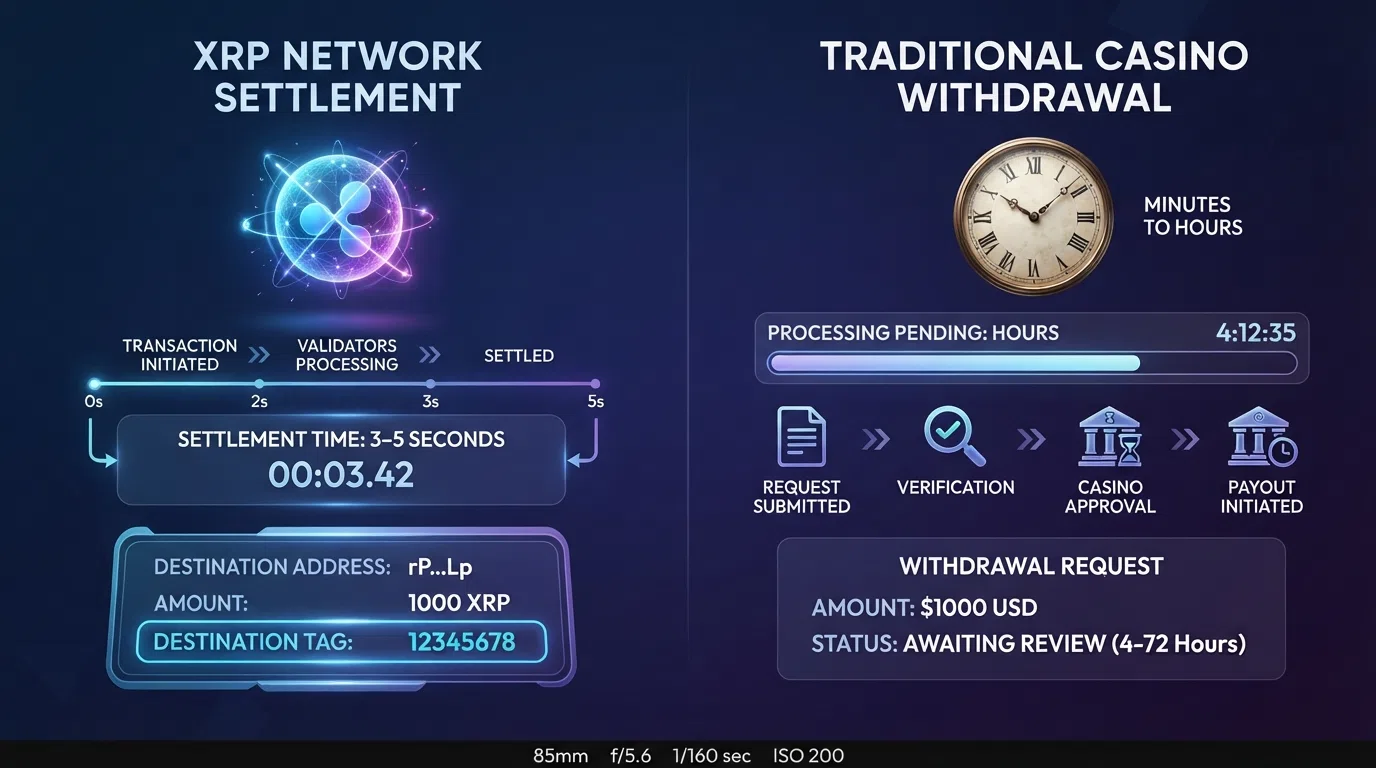
The fine print changes the picture at the edges. Casino-side withdrawal fees are the first place the network-fee advantage gets spent: a casino that charges 0.5% on a withdrawal is charging £5 on a £1,000 payout, which is more than the player’s entire lifetime network-fee cost on XRP at that casino. Currency conversion spreads eat the next slice. Most XRP casinos display balances in dollars or in their own internal credit, and the GBP figure is calculated at a rate the casino controls. On a deposit the spread is usually hidden inside the displayed value; on a withdrawal it is more visible. Inactivity deductions are the third cost: an offshore casino that charges a monthly fee on dormant balances will quietly take a percentage of any XRP the player leaves sitting in the account. The network fee is near zero. The total cost of banking at an offshore casino is not.
The practical order for a UK player goes like this. The player opens a wallet that controls XRP — an exchange account, a hardware wallet, or a software wallet — and acquires the XRP. The player opens an account at the casino, completes whatever verification the operator requires, and visits the cashier. The casino shows a wallet address and a destination tag. The player copies both, sends the XRP from the wallet, and waits for the credit. The network confirms in seconds. The casino credits the balance within minutes for instant-processing operators, longer for hybrid operations. The reverse path on withdrawal is the same sequence in the other direction. The place the sequence stalls is at the casino’s approval queue, not on the network, which is why a casino advertising “instant crypto withdrawals” can still take an hour to release the funds if the security team wants to review the request.
How to Deposit XRP at an Online Casino
The three-step flow is short. Step one: acquire XRP in a wallet the player controls — an exchange account, a hot wallet app, or a hardware wallet. Step two: open the casino cashier, copy the deposit wallet address and the destination tag, and send the XRP from the wallet to that address with the tag included. Step three: wait for the network confirmation (three to five seconds) and the casino credit (minutes for instant operators, longer for hybrid ones). The whole path is usually complete inside five minutes.
The destination tag is where first-time players lose money. A wallet address alone is not enough; the casino needs the tag to route the deposit to the correct player account. Most wallets show the tag as a separate field in the send screen. The casino shows the tag on the deposit page, often labelled “Memo” or “Tag” or “Destination Tag.” Copy both the address and the tag, paste them into the wallet, and double-check before signing. A deposit sent without the tag will arrive at the casino’s wallet with no sender identification, and most casinos cannot recover those funds. The destination tag is a required field, not a courtesy.
Confirmation behaviour is the second detail. The XRP ledger confirms a transaction in three to five seconds, but “confirmed” and “credited” are not the same. A casino that credits deposits only after a certain number of ledger confirmations, or that runs a manual review on first deposits, will hold the balance for longer than the network did. First deposits are almost always slower than subsequent ones, because the casino’s risk system has no history on the account.
How Fast XRP Withdrawals Really Arrive
The network settles in seconds. The casino’s approval queue is where the real clock runs. The eight operators in the featured set with confirmed XRP withdrawal speeds break into three tiers: instant (Jack.com, Thrill, CasinOK, Rakebit, Dexsport) where the casino releases the funds immediately on request; fast (BC.Game, BitStarz) where the casino processes on a crypto-standard queue typically completing in under an hour; and near-instant (Lucky Block) at 10–20 minutes. Vave and MonacoJack have no confirmed speed in the sources reviewed.
The difference between instant and under-an-hour is the difference between a casino whose payment system was built for crypto and a casino whose payment system was built for bank transfers and adapted to accept crypto. A crypto-native operator runs automated approval on small withdrawals and processes the request as soon as it is signed. A hybrid operator routes every withdrawal through the same compliance queue that handles a Visa payout, which means manual review, security checks and a queue position. The marketing claim “instant crypto withdrawals” is usually true at the first type and aspirational at the second. The only way to know is to test with a small withdrawal before committing a large balance.
Fees, Minimums and Hidden Costs of XRP Casino Banking
The network fee of approximately $0.001 is the cheapest line item in the entire cost stack, and it is the one every review leads with. It is also the one that matters least. Casino-side withdrawal fees, where they exist, typically run from 0.1% to 1% of the withdrawal amount, and that is the figure that determines what banking at an offshore casino actually costs. On a £500 withdrawal at 0.5%, the player pays £2.50 — more than 2,000 times the network fee. Currency conversion spreads, where the casino displays in a currency other than GBP, add another hidden margin that varies by operator and is rarely disclosed in the bonus terms.
Minimum deposit and withdrawal thresholds sit at 5 to 20 XRP for deposits and 5 to 10 XRP for withdrawals at most operators in the featured set. Those figures compare unfavourably with UKGC-licensed minimums, which are typically £5 to £10 on debit cards, but favourably with bank-transfer minimums, which often start at £50 or higher. The practical effect is that XRP allows smaller minimum transactions than most UK banking rails, which is a real advantage for a player who wants to keep individual session stakes low.
XRP price volatility is the cost nobody flags. The GBP value of a deposit and the GBP value of the same funds at withdrawal can differ by 5% to 10% over a few weeks, more during sharp market moves. The casino credits the deposit in its internal currency at a rate of its choosing and pays out at a rate of its choosing, and the player carries the price risk on the difference. Over a short session at modest stakes the movement is usually noise. Over a large balance held for weeks it is a real cost, and it is one that no fee table in any casino’s terms will show.
Payment Alternatives to XRP: Cards, E-Wallets and Other Cryptos
The licensed UK market runs on debit cards, bank transfers, PayPal, Apple Pay and a handful of e-wallets. The credit-card ban, in force since 14 April 2020, removed one of those rails entirely. What remains is a slower, more heavily regulated set of payment options than a player gets at an offshore casino, and the contrast is part of the appeal of crypto for a UK player who has experienced the difference.
Within the offshore set, XRP is the fastest and cheapest option on the table. Bitcoin is slower — settlement on the Bitcoin network typically takes 10 to 60 minutes — and more expensive at the network level, though the gap narrows during low-congestion periods. Ethereum is faster than Bitcoin and more expensive during periods of high gas demand. Tether and USDC, as stablecoins, eliminate the price-volatility cost that XRP carries, which is a real advantage for a player who wants crypto speed without taking a position on a volatile asset. Litecoin is the closest comparison to XRP on speed and cost, and Dogecoin sits a step behind.
Hybrid casinos like CasinOK, which take both fiat and crypto, are worth a look for a player who holds both balances. The fiat rails at an offshore casino are not subject to UKGC restrictions, which means debit card and Apple Pay are options there in a way they are not at a UKGC casino that takes GBP. The trade-off is the loss of UK consumer protection on the fiat side as well. A UK player optimising on payment flexibility has the most options at a hybrid offshore casino, and pays for that flexibility in the standard way: no UKGC recourse.
XRP Casino Bonuses: Why That Welcome Offer May Cost More Than It Pays
The bonus structure at a UKGC-licensed casino is constrained in ways the offshore market is not. Since 19 December 2025, the LCCP has capped wagering requirements at 10× on bonus funds and banned mixed-product promotions. A UKGC welcome offer looks modest in headline value — a 100% match up to £100 with 10× wagering is typical — but the cost to the player of clearing the bonus is calculable and capped. The offshore market, free of those constraints, posts much larger headline numbers. A 470% welcome package, a 200% match, a 200% match with seven-day cashback — none of these offers exist in the licensed market. They are real offers, and they are real bonuses. The wagering multipliers attached to them are the part that decides the cost.
A 0× wagering offer like Jack.com’s 100 free spins is the cleanest structure in the comparison: whatever the spins win is withdrawable immediately, no calculation required. A 40× wagering offer like BitStarz’s bonus and free-spin winnings requires the player to wager the bonus amount 40 times before any winnings become withdrawable, and on a $100 bonus that is $4,000 of wagering before the first dollar of winnings clears. The $100 maximum cashout on BitStarz’s 50 no-deposit free spins is a separate ceiling: regardless of the wagering outcome, no more than $100 will be paid out on winnings from those spins. The two conditions interact, and a player who reads only the welcome banner has not seen either.
For the four operators with unconfirmed wagering requirements — BC.Game, Lucky Block, MonacoJack and the rest — the only honest statement is that the page does not know what the multiplier is. A player evaluating those offers must read the current terms on the site. The default assumption at an offshore casino is that a welcome bonus carries a wagering requirement in the 35× to 50× range unless the terms say otherwise. That assumption is not always right, but it is a better starting position than assuming the welcome banner tells the whole story.
Welcome Bonuses at XRP Casinos Compared
The table below covers the six operators in the featured set with a confirmed welcome offer. The other four — CasinOK, Vave, Rakebit and Dexsport — have no confirmed offer in the sources reviewed, and a like-for-like comparison is not possible without checking the current site.
| Operator | Bonus Type | Bonus Value |
|---|---|---|
| Jack.com | Free spins | 100 free spins, 0× wagering, no win cap |
| Thrill | Rakeback + cashback | 70% Rakeback + 10% Cashback (ongoing) |
| BC.Game | Matched deposit + free spins | 470% up to $1,600 + 400 FS + 60 no-deposit FS |
| Lucky Block | Matched deposit + free spins + cashback | 200% match + free spins + 7-day cashback |
| BitStarz | No-deposit FS + matched deposit | 50 no-deposit FS + up to 5 BTC + 180 FS |
| MonacoJack | Matched deposit across 4 tiers | Up to £2,500 + 275 FS across 4 deposits |
The structural difference between the six offers is more informative than the headline values. Jack.com is wager-free. Thrill is a rebate model with no traditional welcome. BC.Game and Lucky Block are matched deposits with attached free spins, where the real value depends on the multiplier. BitStarz layers a no-deposit component on top of a matched deposit, with a $100 cap on the no-deposit winnings. MonacoJack is a structured four-tier commitment. Each model rewards a different player: the wager-free offer suits a player who wants the spins to be the bonus; the rebate model suits a high-volume player; the matched-deposit offers suit a player who plans to clear a single large welcome; the no-deposit-plus-match suits a player who wants to test the casino before committing. Comparing them by headline value misses the point.
No-Deposit Free Spins and Wager-Free Offers
The two bonus types that ask for the least of the player are no-deposit free spins and wager-free spins, and they are the ones where the catches hide most carefully. BitStarz’s 50 no-deposit free spins require no funding and no commitment, and the player gets to test the casino’s cashier, the game library and the support response. The $100 maximum cashout on those winnings is the catch: regardless of what the spins produce, the casino will not pay more than $100 on them. The 40× wagering on the winnings is the second catch, and the two together mean the offer is a real test of the casino but a poor route to a real payout. A player who treats the 50 spins as a free trial gets the right value; a player who expects to fund a session from them is going to be disappointed.
BC.Game’s 60 no-deposit free spins carry similar logic. The headline is genuinely free spins on sign-up, and the value is in the test, not in the payout ceiling. Jack.com’s 100 free spins with 0× wagering and no win cap are the wager-free benchmark the comparison is built around. The difference is structural: where BitStarz’s spins are capped at $100 in withdrawable winnings, Jack.com’s spins are not capped at all, and where BitStarz’s winnings carry 40× wagering, Jack.com’s carry none. The 0× wagering plus no win cap combination is the offer that rewards a player who treats the spins as the bonus rather than as a route to a large payout.
The real-money comparison between the two structures is sharp. A player who wins $50 from 50 no-deposit spins at BitStarz needs to wager that $50 at 40×, which is $2,000 of play, before any of the original $50 is withdrawable — and the maximum that can ever be paid out from the 50 no-deposit spins is $100. A player who wins $50 from 100 free spins at Jack.com withdraws the $50 immediately, and a $200 win is also withdrawable immediately. The wagering requirement is the cost the marketing copy skips.
Slots, Live Dealer and Table Games at XRP Casinos
The game libraries at offshore XRP casinos are an order of magnitude larger than the libraries at UKGC-licensed sites, and the difference reflects the regulatory environment. A UKGC slot carries a statutory maximum stake of £5 per game cycle for players 25 and over and £2 for players 18 to 24, both in force since 2025. A UKGC slot also bans auto-play, enforces a 2.5-second minimum spin speed, and prohibits losses disguised as wins. Those rules do not exist in Curaçao or Anjouan, and the offshore game libraries reflect it: 9,500+ titles at Jack.com, 16,900+ at Vave, 8,000+ at BC.Game. The volume is a direct consequence of the absence of those controls.
The provider rosters at the major operators overlap heavily. Pragmatic Play, Hacksaw Gaming, Nolimit City, Play’n GO, Relax Gaming, NetEnt, BGaming and Evolution Gaming appear across the featured set. A player who likes a specific provider’s games — Nolimit City’s high-volatility slots, for example, or Hacksaw’s bonus-buy mechanics — will find them at most of the top-tier offshore XRP casinos. The live-dealer offering runs through Evolution and Pragmatic Play Live, which between them cover blackjack, roulette, baccarat, game-show titles and the regional variants. A UK player familiar with Evolution’s live tables at a UKGC site will find the same studio output at the offshore operators, with the same games and the same dealers.
The gap is in the safety controls. A UKGC slot will not let a player bet more than £5 per spin at 25+, will not let a spin complete faster than 2.5 seconds, and will not show a “loss” as a “win” with celebratory graphics. None of those controls exist on an offshore slot. The high-volatility titles that dominate offshore libraries — Nolimit City and Hacksaw in particular — are designed around bonus-buy features, fast spin speeds and large stake ranges that no UKGC operator can offer under the current rules. A player moving from a UKGC site to an offshore XRP casino is moving from a heavily regulated product to an unregulated one, and the games feel different because they are.
Online Slots You Can Play with XRP Deposits
The slot libraries at featured operators cover the major studios, and most operators publish a provider filter that lets a player jump to a specific studio. Pragmatic Play’s slots — Gates of Olympus, Sweet Bonanza, the Big Bass series — are everywhere. Hacksaw Gaming’s bonus-buy catalogue is at most of the top-tier operators. Nolimit City’s high-volatility titles appear at the larger libraries. The mega-ways and cluster-pay mechanics from Relax Gaming round out the offering. The player experience is that of a large unregulated slot library with the same providers a UK player would recognise from a UKGC site, but without the stake caps and the safety controls.
Demo mode and free-play slots are available at most offshore operators, and they let a player test a title without committing XRP. The RTP transparency gap is the issue. UKGC-licensed operators publish per-title RTP figures prominently; offshore operators vary in how prominently they publish them, and the absence of a regulatory requirement to display RTP means a player may have to look harder for the figure on a slot at a Curaçao casino than at a UKGC one. Provably fair verification — the cryptographic proof that a game’s outcome was not manipulated — is the offshore alternative, and it appears on a subset of titles at a subset of operators. A player who values RTP transparency as a decision input should check the cashier or the game info screen before playing.
Live Dealer and Table Games at XRP Casinos
Live dealer coverage at the featured operators runs through Evolution and Pragmatic Play Live, the same studios that power the live-dealer offering at UKGC-licensed sites. The games are familiar: blackjack, roulette, baccarat, craps, game-show titles like Crazy Time and Monopoly Live, and the regional variants. A UK player who has played Evolution’s live blackjack at a UKGC site will see the same tables, the same dealers, and the same game mechanics at an offshore XRP casino. The difference is in the surrounding controls.
UKGC table-game protections are narrower than the slot protections. The £5 / £2 stake cap applies to online slots only, not to roulette, blackjack or live dealer. There is no spin-speed cap on a roulette bet and no auto-play ban on a blackjack hand. The practical consequence is that the live-dealer experience at an offshore casino is closer to the UKGC experience than the slot experience is, because the UKGC rules that govern table games are less restrictive. A player moving from a UKGC live-dealer lobby to an offshore live-dealer lobby will notice fewer differences than a slot player will.
The table-game range beyond live dealer is where the offshore libraries diverge further. RNG blackjack, roulette, baccarat, video poker, scratch cards, keno and the crypto-native games — crash, dice, plinko, the BC.Game originals — sit alongside the live tables. The crypto-native games are a category that does not exist in the licensed market at all, and they are the part of the offshore catalogue that has no UKGC analogue.
XRP Casino Gaming on Mobile: What Works and What Does Not
Mobile play at offshore XRP casinos is almost entirely browser-based, and the experience is solid where the casino has been built for it. Responsive web design at the major operators scales the slot library, the live-dealer lobby and the cashier to a phone screen without the loss of functionality a player might expect. The deposit flow on mobile is the same as on desktop: copy the wallet address and destination tag from the cashier, send the XRP from a wallet app, wait for the credit. Some operators add a QR code to the deposit page, which lets the player scan the address and tag from a mobile wallet without manual copying, and that is a real improvement on the typing flow.
A dedicated mobile app is rarer. Most offshore operators do not maintain iOS or Android apps in the app stores, partly because the app stores restrict real-money gambling apps in many jurisdictions and partly because a responsive web app covers the same use case at a lower maintenance cost. Where a dedicated app exists, it usually offers push notifications for bonuses and a slightly faster cashier. The differences are marginal. A UK player who wants to play on mobile is not going to find that the app-or-browser question is the deciding factor; the catalogue and the bonus terms are.
Android and iOS compatibility is uniform across the featured set. Modern mobile browsers handle the slot rendering, the live-dealer video stream and the cashier without issue. Data usage is the practical limit: live-dealer video on a phone consumes mobile data at a rate that will exhaust a standard plan during a long session, and a player on a mobile data budget should consider playing live-dealer games on Wi-Fi. Push notifications and in-browser wallet connections vary by operator and are not a meaningful differentiator.
Mobile Browser Play vs Dedicated Casino Apps
The responsive web experience at the featured operators is the default, and for most players it is sufficient. The slot catalogue renders correctly, the live-dealer video stream adapts to the screen size, the cashier accepts the wallet address and destination tag, and the withdrawal flow is the same as on desktop. The trade-off against a dedicated app is the absence of push notifications for bonuses and promotions, and the small additional latency of loading the site through a mobile browser rather than from a local app. For most players, neither difference matters.
A dedicated app, where one is offered, does not change the underlying catalogue or the bonus terms. It changes the loading speed and the notification flow. A player whose decision turns on either of those should download the app if one is offered; a player whose decision turns on the catalogue, the bonus or the licence will not be moved by the app-versus-browser question. The honest summary is that the mobile experience at offshore XRP casinos is good enough that the device and access method are not the deciding factors for a UK player.
Beyond XRP: Multi-Crypto Casinos and the Privacy Trade-Off
Every featured XRP casino also accepts Bitcoin and Ethereum, and the majority take a longer altcoin list. Jack.com supports Bitcoin, Ethereum, Litecoin, Dogecoin, Tether, Bitcoin Cash, Tron and Cardano alongside XRP. CasinOK supports thirteen cryptocurrencies including XRP, BTC, ETH, USDT, LTC, BCH, BNB, Tron, DOGE, USDC and others. The multi-crypto structure is the industry default, and the practical consequence is that a player who holds several cryptocurrencies is not locked into XRP at any of the featured operators.
A subset of the offshore market goes further and offers no-KYC or reduced-verification play, where a player can deposit, play and withdraw without submitting identity documents. The trade-off is sharp. The verification a UKGC casino applies at sign-up — proof of identity, proof of address, source-of-funds checks — exists to protect the player as well as to satisfy the regulator. An offshore casino that skips it skips both functions. A player who has a dispute about a withheld withdrawal at a no-KYC casino has no identity trail to support a complaint, no ADR provider to escalate to, and no regulator to approach. The anonymity that appealed at sign-up is the anonymity that frustrates at payout.
For a UK player the privacy trade-off has a second layer. GamStop, the national self-exclusion scheme that covers every GB-licensed online operator, does not cover any offshore casino. A player who has self-excluded through GamStop can open an offshore XRP casino account in minutes with no barrier. The decision to use the offshore market is the decision to step outside the UK self-exclusion infrastructure, and that decision has implications for anyone who self-excluded for a reason.
No-KYC and Anonymous XRP Casino Play
No-KYC play at an offshore XRP casino means the player can deposit, play and withdraw without submitting identity documents, and a subset of the featured set offers it or offers reduced verification up to a withdrawal threshold. The appeal is straightforward: no documents to upload, no waiting for a manual review, no name tied to the casino account. The cost is in what the player gives up.
The first loss is dispute resolution. A UKGC casino is required to participate in an approved ADR scheme, and the player has a clear complaints path: the casino, then the ADR provider, then the UKGC. An offshore casino has no equivalent structure. A player whose withdrawal is delayed, whose bonus is voided without clear grounds, or whose account is closed with funds inside it has no UK regulator to approach and no ADR provider to escalate to. The casino’s internal complaints process is the only process.
The second loss is responsible-gambling intervention. UKGC casinos apply affordability checks at a £150 net-deposit threshold, prompt players to set deposit limits, and offer time-outs and self-exclusion. Offshore casinos vary in what they offer. A no-KYC casino by definition cannot apply financial-vulnerability checks because it has not verified the player’s identity. The interventions that exist inside the licensed market are not consistently available outside it. A player who wants deposit limits, reality checks and self-exclusion at an offshore casino needs to set them manually and trust the operator to honour them.
New XRP Casino Launches Worth Watching in 2026
The newest operators in the featured set are the ones with the least operating history, and that fact cuts both ways. A 2025 launch has the most current game library and the most current bonus structure, but it also has the smallest pool of community feedback, the shortest dispute history, and the least-established reputation. A player evaluating a new launch is evaluating on the operator’s claims rather than on a track record.
MonacoJack is the most recent launch in the featured set, with a 27 November 2025 debut and an Anjouan licence (ALSI-202502022-F11). The four-tier welcome package is the largest in the comparison, and the Anjouan licence is verifiable through the regulator’s public register. Thrill and CasinOK both launched in 2025, with Thrill’s rakeback-and-cashback model and CasinOK’s hybrid fiat-crypto payment structure marking them out from the longer-established operators. Rakebit launched in 2024, a year further back, and is the most established of the post-2023 launches. Dexsport’s launch date is not confirmed in the sources reviewed, and the licence jurisdiction is also unconfirmed — a separate data gap that compounds the newness problem.
A new launch means no track record. The player has no community reviews to read, no dispute threads to check, and no long-term payout data to compare. The casino has every incentive to perform well in the first year to establish reputation, and the operator is also under less immediate pressure from any external audience. The right way to treat a new launch is to test the cashier with a small deposit and a small withdrawal before committing a larger balance. The casino’s response to the test transaction — speed, communication, any unexpected fees — is the most reliable signal a player can get in the absence of a longer track record.
What a New Casino Launch Means for UK Player Safety
A new offshore launch sits at the intersection of the most attractive offers and the thinnest safety data. The licence is verifiable through the regulator’s public register, and the Anjouan licence MonacoJack holds (ALSI-202502022-F11) is a real, checkable record. The ownership structure, the dispute history and the community feedback are all short. The checklist for a new launch is short: verify the licence against the regulator’s register, check whether the operator names its parent company and its directors, look for community feedback on independent forums, and test the cashier with a small transaction before committing.
The UKGC’s public register, with 2,663 records, is the verification model that makes licence checks possible, and it works for GB-licensed operators. For offshore operators the equivalent is the Curaçao Gaming Authority’s public register and the Anjouan Gaming Board’s licence database, both of which are public. A licence that does not appear on a regulator’s register is a licence that cannot be verified, and a player who cannot verify a licence is a player with no external recourse if the operator misbehaves. Dexsport, with no confirmed licence in the sources reviewed, sits at the outer edge of that risk. MonacoJack, with a verifiable Anjouan licence, sits closer to the centre. The difference is the verification step.
The Legal Reality: No UK Licence Means No UKGC Protection
The legal position for a UK player at an offshore XRP casino is the single most important subject on this page, and it has not changed between the launch of any of the featured operators. Operating without a GB licence is a criminal offence under section 33 of the Gambling Act 2005, and the penalty falls on the operator: up to 51 weeks’ imprisonment and an unlimited fine. The player, by contrast, faces no penalty for gambling at an unlicensed site in the sources reviewed for this guide. What the player loses is protection.

GamStop, mandatory for every GB-licensed online operator since 31 March 2020, does not cover any offshore casino. A player who has self-excluded can open an offshore account in minutes. The UKGC’s complaints process, which routes disputes through approved ADR providers, is unavailable for offshore operators. The statutory deposit limits, the financial vulnerability checks, the stake caps and the bonus restrictions that exist inside the licensed market do not exist at an offshore casino. The player carries none of the consumer protections that travel with a UKGC licence, and the regulator’s enforcement arm is disruption-based: 3,140 disruption notices and 447,778 URL referrals between April 2024 and June 2025, producing a 32% average fall in engagement across 160 disrupted sites. The regulator makes the offshore sites harder to find; it does not make them safer to use.
The crypto gambling pathway is the development to watch. On 26 February 2026, UKGC Executive Director Tim Miller told the BGC AGM that the Commission had asked its Industry Forum to examine a “sensible pathway” for crypto payments at licensed operators. The phrasing — “sensible pathway” — is exploratory, not a commitment. The FCA’s Financial Services and Markets Act 2000 (Cryptoassets) Regulations 2026 (SI 2026/102) are expected to bring cryptoassets within the FCA’s regulatory remit from 25 October 2027, which is the earliest possible date for a licensed UKGC casino to accept XRP. The regulatory trajectory points toward licensed crypto gambling in the UK. The current market is entirely offshore.
Why No UKGC-Licensed Casino Accepts XRP in 2026
There is no statute that names XRP or any cryptocurrency and prohibits it at UKGC-licensed casinos. What exists is a regulatory framework that makes crypto deposits practically impossible for a licensed operator. The LCCP requires source-of-funds verification, customer due diligence and ongoing AML monitoring. A direct crypto deposit from a pseudonymous wallet address cannot satisfy those requirements as the rules are currently written. A licensed operator that accepted XRP would be unable to verify the source of funds in the way the LCCP expects, and the UKGC’s guidance has made clear that crypto payments are not authorised on licensed platforms.
The pathway to a licensed XRP casino requires two things to happen. The first is the UKGC’s Industry Forum producing a workable framework for crypto payments at licensed operators — a “sensible pathway,” in Tim Miller’s February 2026 phrasing. The second is the FCA’s FSMA 2026 cryptoasset regime coming into force on 25 October 2027, which would give cryptoassets a defined regulatory status and would allow licensed operators to apply the standard AML controls to crypto deposits. Neither step has happened yet. The earliest a UKGC casino could accept XRP is late 2027, and that assumes both steps land on the published timeline. Until then, the gap between no express prohibition and no practical pathway is what keeps XRP outside the licensed market.
The Crypto Gambling Pathway: What the UKGC’s 2026 Announcement Actually Means
Tim Miller’s speech to the BGC AGM on 26 February 2026 is the most significant UK regulatory development on crypto gambling to date, and it is worth reading carefully. The Commission has asked its Industry Forum to examine what a “sensible pathway” for crypto payments at licensed operators might look like. The Commission is exploring. The Commission is not implementing, and the speech did not commit to a date or a framework. A licensed XRP casino in the UK is a possibility the regulator is now actively considering, not a near-term probability.
The FCA’s FSMA 2026 framework (SI 2026/102) is the other piece. Bringing cryptoassets within the FCA’s regulatory remit, expected to commence on 25 October 2027, would give the UKGC a defined cryptoasset framework to apply at the gambling boundary. The two timelines are connected but not identical: the UKGC’s exploration of a gambling-specific pathway and the FCA’s broader cryptoasset regulation are separate processes that may converge by late 2027. What a licensed XRP casino would actually look like — UKGC protections plus crypto speed, plus the AML controls the LCCP requires — is a question for the Industry Forum’s work over the next eighteen months. The market in 2026 is entirely offshore, and the regulatory trajectory is toward licensing over a multi-year horizon.
Offshore Licensing: Curaçao, Anjouan and What They Actually Guarantee
The three licence frameworks relevant to a UK XRP casino player are the UKGC, the Curaçao Gaming Authority and the Anjouan Gaming Board. The table below maps them on the player-protection dimensions that decide what the licence actually delivers.
| Protection Feature | UKGC | Curaçao Gaming Authority | Anjouan Gaming Board |
|---|---|---|---|
| GamStop integration | Yes | No | No |
| UKGC complaints route | Yes | No | No |
| Approved ADR provider | Yes | No | No |
| Statutory slot stake cap | Yes (£5/£2) | No | No |
| Wagering requirement cap | Yes (10×) | No | No |
| Credit card ban | Yes | No | No |
| UK consumer-law protection | Yes | No | No |
| Mixed-product promotion ban | Yes | No | No |
| Financial vulnerability checks | Yes | No | No |
| Statutory deposit limits | Yes | No | No |
The pattern is total. The UKGC provides every protection in the list. Neither Curaçao nor Anjouan provides any of them. The Curaçao licence is the more established of the two offshore frameworks, with longer operating history and a clearer regulatory structure. The Anjouan licence is newer and lighter-touch, which is partly why so many of the most recent crypto casino launches have appeared there. For a UK player the practical difference between Curaçao and Anjouan is small — neither provides any of the protections a UKGC licence delivers — and the larger difference is between any offshore framework and the UKGC itself. The licence is a regulatory baseline, not a substitute for UK oversight.
What UK Players Lose When They Play at Unlicensed Casinos
The list below names the protections a UK player steps outside when opening an offshore XRP casino account, in the order they tend to matter once a problem arises:
- GamStop self-exclusion, which covers every GB-licensed site and none of the offshore operators in this comparison
- The UKGC complaints process and access to approved ADR providers, which is unavailable for offshore disputes
- Statutory deposit limits and financial vulnerability checks at the £150 net-deposit threshold, which are LCCP requirements and do not apply offshore
- Slot stake caps of £5 for players 25+ and £2 for players 18–24, which apply to UKGC slots only
- The 10× wagering cap on bonus funds, which the licensed market enforces and the offshore market does not
- The credit card ban, which prevents one form of harmful borrowing inside the licensed market
- UK consumer-law protection, including the right to escalate a complaint to a UK regulator or ombudsman
- The mixed-product promotion ban, which prevents the cross-selling that offshore casinos use to move players between products
- The LCCP’s safer-gambling requirements, which require operators to monitor customer activity and intervene where harm indicators appear
The player penalty position is the one place the law is silent. There is no penalty traced in the sources reviewed for this guide for a UK player who simply gambles at an unlicensed site. What the player loses is every protection on the list above, with no British legal recourse if funds are withheld, no escalation route if the operator voids a bonus unfairly, and no intervention if the gambling stops feeling like a choice.
Staying Safe When the Safety Net Is Gone: Responsible Gambling at Offshore XRP Casinos
The UK responsible-gambling infrastructure is world-class, and almost none of it reaches an offshore XRP casino. GamStop does not cover offshore operators. The UKGC’s affordability-check framework does not apply. The LCCP’s safer-gambling requirements do not bind an Anjouan-licensed casino. The statutory levy that funds treatment, prevention and research — 1.1% of gross gambling yield for remote casino operators, in force from 6 April 2025 — flows to UK treatment and prevention services, not to the offshore operators that accept UK players. A UK player who chooses the offshore market is choosing to step outside that infrastructure, and the choice has implications that compound at higher stakes and longer sessions.
The prevalence data is the context that makes the choice concrete. 2.5% of adults in Great Britain are experiencing problem gambling (PGSI 8+), and 47% of adults gambled in the past four weeks, according to the 2025 Gambling Survey for Great Britain. 30% of adults with gambling problems want treatment or support, up from 17% in 2020. An estimated 4.3 million adults are affected by a family member or friend’s gambling, and around 2 million children live in households with adults experiencing problem gambling. The numbers are not a warning aimed at the offshore market specifically. They are the background against which any gambling decision is made, and they are sharper for the player who has chosen a market where none of the UK interventions apply.
The help services that remain available regardless of where the gambling happens are the second line of defence. GamCare runs the National Gambling Helpline on 0808 8020 133, available 24/7, with additional support through live chat, WhatsApp and online channels. The NHS operates gambling harm clinics across England, Scotland and Wales, with the National Problem Gambling Clinic in London and the NHS Northern Gambling Service among the specialist providers. Gamblers Anonymous runs peer support meetings across Great Britain. GambleAware funds the National Gambling Support Network and operates as the commissioning body for prevention and treatment. None of these services are offshore-operator-specific, and none of them requires the player to be gambling at a UKGC-licensed site. They are available to anyone in Great Britain who needs them.
Why GamStop and UK Self-Exclusion Do Not Apply Offshore
GamStop is the UK’s national self-exclusion scheme, and it is mandatory for every GB-licensed online gambling operator. A player registers once, and the exclusion propagates to every licensed site in the country. The exclusion periods are 6 months, 1 year or 5 years, with a 5-year option that auto-renews, and the exclusion cannot be cancelled early. The scheme is the single most effective self-exclusion tool in the British market, and it is the one that stops working the moment a player opens an offshore account.
The offshore gap is a deliberate consequence of the scheme’s design. GamStop is a UK industry initiative, coordinated by the UKGC and funded by the statutory levy. An offshore casino licensed in Curaçao or Anjouan has no obligation to participate, and none of the featured operators in this comparison are connected to GamStop. A player who has self-excluded for a reason can open an offshore XRP casino account in minutes, fund it with XRP, and resume gambling with no friction. The decision to do that is the player’s, and the protections that travel with a UKGC licence do not follow the player across the offshore boundary. Self-exclusion is a UKGC-licensed-market tool, and the offshore market sits outside it.
Practical Harm-Reduction Tools and Where to Get Help
The harm-reduction tools that exist at any casino — deposit limits, reality checks, time-outs, self-exclusion — are available at some offshore operators and not at others. A player who wants to use them at an offshore XRP casino should set them manually at the account level, and the operator’s willingness to honour them is a question that only the test of a session can answer. The most reliable safety net is the one that sits outside any individual casino: the UK help infrastructure, which is available to any player in Great Britain regardless of where the gambling happens.
GamCare’s National Gambling Helpline, on 0808 8020 133, is the 24/7 entry point. The line offers confidential support, and GamCare also provides live chat, WhatsApp and online resources. The NHS runs specialist gambling harm clinics — the National Problem Gambling Clinic in London, the NHS Northern Gambling Service, and additional clinics in Scotland and Wales — that offer structured treatment for problem gambling. Gamblers Anonymous runs peer-led meetings across Great Britain. GambleAware funds the National Gambling Support Network and is the main commissioning body for prevention and treatment. The prevalence figures — 2.5% of adults experiencing problem gambling, 4.3 million adults affected by a family member or friend’s gambling, around 2 million children in affected households — describe the population these services exist to serve, and the services are free, confidential and available without any reference to where the gambling has been happening.
How We Evaluated and Ranked These XRP Casinos
The sources reviewed for this page are the editorial and regulatory references most often cited in the UK-facing crypto casino space: CryptoSlate, Webopedia, CryptoNews, Casino.org, CryptoWeekly, VIP-Grinders, CoinGabbar, CasinosBlockchain, ProvenlyFair, British Gambler, GamblingNews and the UK Gambling Commission’s public register. The featured operators are the brands that surface most consistently for UK searchers looking for XRP-accepting casinos, ranked on four criteria: licence jurisdiction, game count, welcome bonus terms and XRP withdrawal speed.
Licence status was verified against the UKGC’s public register of 2,663 operating licence holders, and against the published Curaçao and Anjouan regulator records. Every featured operator holds an offshore licence or has a licence status that could not be confirmed in the sources reviewed. No operator in the ranking holds a GB licence, and the ranking is explicit about that. Bonus terms were checked against the operators’ published terms, and where a value could not be confirmed the cell is left blank rather than filled with a guess. Withdrawal speeds were sourced from operator claims and from independent reviews, and the same confirmation rule applies: unconfirmed values are marked as such, not invented.
The ranking logic is straightforward. Operators with more confirmed data rank above those with less, because a UK player comparing options needs comparable figures to compare on. Licence verifiability matters: a verifiable Anjouan or Curaçao licence is stronger than an unconfirmed jurisdiction. Bonus transparency matters: a wager-free offer is shown above a 40× wagering offer, and a confirmed welcome package is shown above an unconfirmed one. Withdrawal speed matters, and operators with instant confirmed XRP withdrawals are shown above those with unconfirmed speeds. The limitations of the ranking are also part of it: the table covers ten operators, the page covers every one of them in more depth, and the data gaps are stated in the text rather than hidden in the cells.
What UK Players Should Actually Do About XRP Casino Gambling
The advantages of the offshore XRP casino market are real and they belong on the page. Deposits credit in minutes, network fees are a fraction of a UK debit card’s cost, and the game libraries are an order of magnitude larger than anything a UKGC site can offer. The 0× wagering offer at Jack.com, the 16,900+ game library at Vave, the instant-withdrawal profile at the top of the speed table — these are genuine features, and a player who values them has reasons to use the offshore market.
The costs are real in the other direction, and they compound. No UKGC licence means no GamStop, no UKGC complaints route, no ADR, no statutory deposit limits, no financial vulnerability checks, no British consumer-law protection and no UK legal recourse if funds are withheld. The 0× wagering offer is genuine, and the offer at the next casino may carry a 40× multiplier with a $100 cap, and the gap between the two is the cost of not reading the terms. The game library is genuinely larger, and the absence of stake caps and spin-speed limits is the reason it is. The instant withdrawal is genuinely faster than a UK bank transfer, and the casino’s approval queue is the part of the clock that no network figure can speed up.
The actionable takeaway is the same in every case. Before depositing XRP at any offshore casino, a UK player should verify the licence against the regulator’s public register, read the current bonus terms on the operator’s site, test the cashier with a small deposit and a small withdrawal, and set the deposit limits and reality checks manually. The UKGC crypto pathway and the FCA’s FSMA 2026 framework are both expected to take effect in late 2027, and the licensed crypto casino market may look different within eighteen months. Until then, the offshore market is the only market, and the responsibility for the choice sits with the player who makes it. The help services are there for anyone who needs them: GamCare’s National Gambling Helpline on 0808 8020 133, the NHS gambling harm clinics, Gamblers Anonymous and the National Gambling Support Network. The line is free, the support is confidential, and the decision to call it is not a small one.
Frequently Asked Questions
Are XRP casinos connected to GamStop self-exclusion?
No. GamStop covers every Gambling Commission-licensed online gambling operator in Great Britain, and no offshore XRP casino in the comparison participates in the scheme. A player who has self-excluded through GamStop can open an offshore XRP casino account and deposit without restriction, because the casino has no integration with the UK self-exclusion database. GamStop has been mandatory for GB-licensed online operators since 31 March 2020, and the exclusion periods run for 6 months, 1 year or 5 years. The offshore market sits outside that infrastructure entirely, and a self-excluded UK player has no automatic protection at any of the featured operators.
Do I need to complete KYC verification to play at XRP casinos?
It depends on the operator and the withdrawal amount. Some offshore XRP casinos offer reduced-verification play up to a withdrawal threshold, and a small subset offer no-KYC play through the entire deposit-and-withdrawal cycle. The trade-off is sharp: an offshore casino that does not verify identity has no way to apply the responsible-gambling interventions the LCCP requires, and a player whose withdrawal is disputed has no identity trail to support a complaint. A player who values the UKGC’s complaint and ADR routes will not find them at an offshore operator, and KYC is the mechanism that links the player to those protections in the first place. Reduced-verification play is real, and the absence of consumer recourse is the cost of it.
How does XRP compare to Bitcoin and Ethereum for casino deposits?
XRP is the fastest of the three at the network level. A transaction on the Ripple ledger settles in three to five seconds, against ten to sixty minutes on Bitcoin and a variable window on Ethereum that depends on gas demand. The network fee on XRP is approximately $0.001 per transaction, against a Bitcoin fee that varies with congestion and an Ethereum fee that can spike sharply during high-demand periods. Tether and USDC, as stablecoins, match XRP’s speed on some networks without the price-volatility cost XRP carries. For a UK player optimising on speed and cost, XRP is the leading option; for a player who wants crypto speed without taking a position on a volatile asset, a stablecoin on a fast network is the better fit.
What fees do I pay when depositing or withdrawing with XRP at a casino?
The network fee on the XRP ledger is approximately $0.001 per transaction, and the casino does not add to it on the deposit side at most operators. Casino-side withdrawal fees, where they exist, typically run from 0.1% to 1% of the withdrawal amount, and that is the line item that decides what banking at an offshore casino actually costs. Currency conversion spreads — the difference between the GBP value the casino displays and the market rate — are a separate, less-visible cost. Minimum deposit thresholds at XRP casinos typically sit at 5 to 20 XRP, equivalent to roughly £10 to £20 at recent prices, and minimum withdrawals at 5 to 10 XRP. The network fee is near zero; the total cost of banking at an offshore casino is higher than that.
Is it legal for UK players to gamble at offshore XRP casinos?
There is no penalty traced in the sources reviewed for this guide for a UK player who gambles at an unlicensed site. The offence under section 33 of the Gambling Act 2005 falls on the operator, not the player, and enforcement is disruption-based — 3,140 disruption notices and 447,778 URL referrals between April 2024 and June 2025, with a 32% average fall in engagement across 160 disrupted sites. What the player loses is every UKGC-licensed-market protection: no GamStop, no UKGC complaints route, no approved ADR provider, no statutory deposit limits, no financial vulnerability checks, no UK consumer-law protection and no British legal recourse if funds are withheld. Playing is not prosecuted. Playing without protection is the cost.
Payments – fastestpayout-casinos-uk
Content created by the «fastestpayout-casinos-uk» team