
Best online casino payment methods UK: speed, safety and what each one costs you
 Available in GB
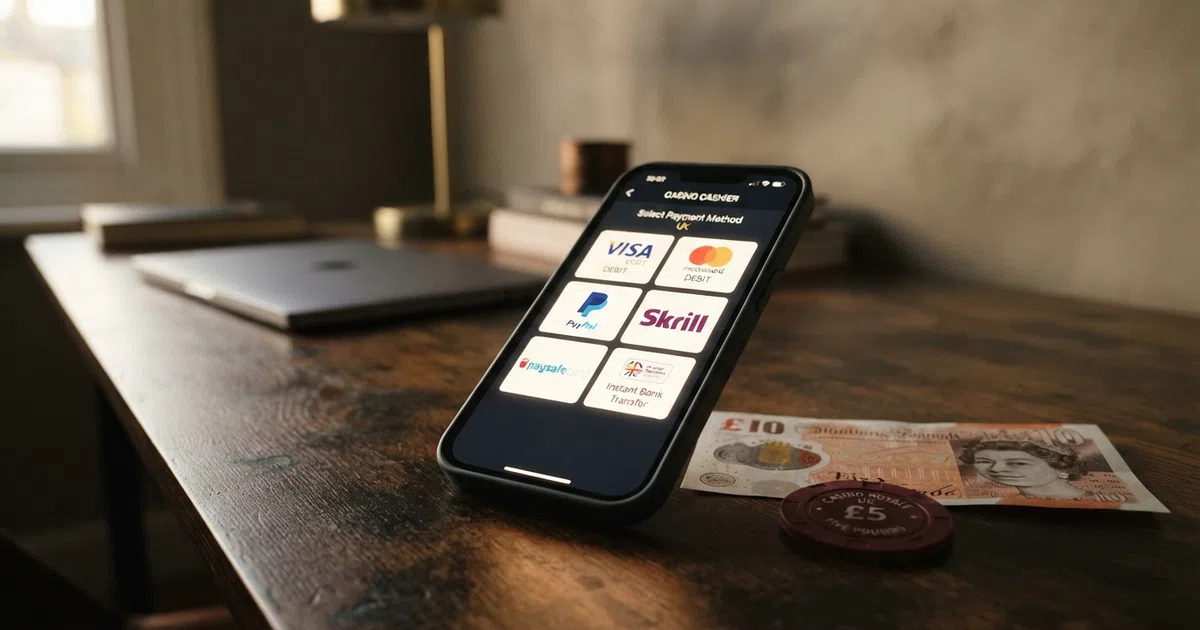
Choosing a payment method at a UK online casino is not a checkout-screen decision. The method you deposit with determines how fast you can cash out, whether you qualify for a welcome bonus, what happens to your data, and in some cases whether you can withdraw at all. This guide walks through every method category a UK-licensed casino accepts, ranks them on the dimensions that actually matter, and shows which methods ten of the biggest UK operators accept right now.
Current as of September 8, 2026; operator payment pages and the UK Gambling Commission’s public register of licence holders.
How UK Casino Payments Work — and Why Your Method Changes Everything
UK casino banking looks like a simple deposit-and-withdraw flow. It is anything but. Since 14 April 2020, credit cards have been banned for all remote gambling in Great Britain under licence condition 6.1.2 of the LCCP — and the ban extends further than most players realise, covering credit-card-funded payments routed through e-wallets and other money service businesses. That single rule reshaped the deposit mix: five years on, IBTimes UK reports: “Five years after the UK Gambling Commission’s credit card ban, the deposit mix at British online gambling operators looks very different from what it did in 2019. Credit cards are no longer permitted for gambling deposits at licensed operators, and the market has adjusted around debit cards, e-wallets, and, increasingly, Open Banking-based Pay by Bank options.”
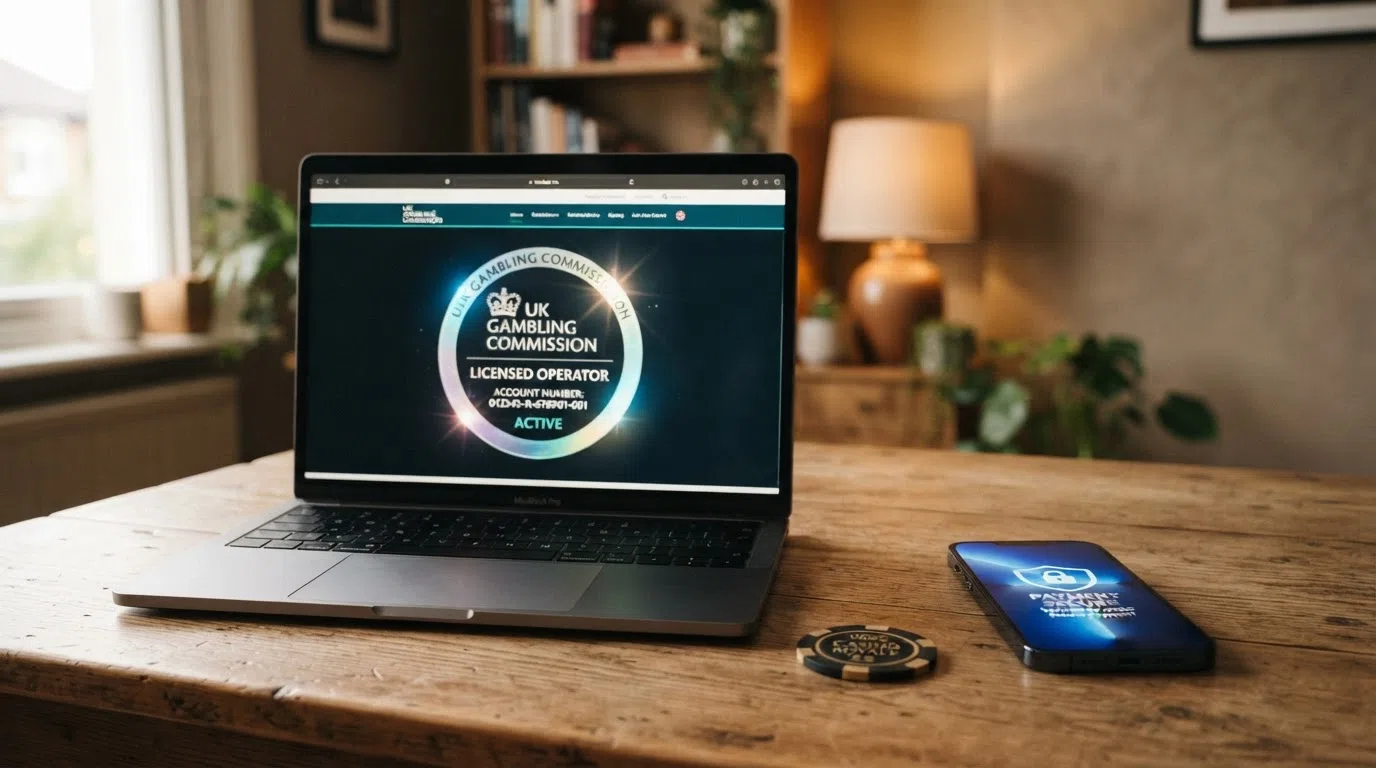
Then there is the regulatory floor under every cashier. From 31 January 2024, licence condition 5.1.2 requires that every payment method at a UK-licensed casino involves a payment service as defined in Schedule 1 Part 1 of the Payment Services Regulations 2017, supplied by an authorised payment service provider. Translation: there is no anonymous deposit route at a licensed site, and the cashier’s choice of methods is itself a regulated decision.
Two consequences follow for the player. First, your method choice reaches beyond convenience into bonus eligibility — most welcome offers restrict qualifying deposits to debit cards, sometimes Apple Pay, and exclude e-wallets and prepaid vouchers. Second, withdrawal speed is set by the deposit method you used: switching methods at cashout time is not the norm. Players who fund with Visa debit and then try to withdraw to PayPal are routinely redirected.
The cashier page, in other words, is not a menu of equivalents. Each line item is a contract about what the rest of your session will look like.
Types of UK Casino Payment Methods at a Glance
Seven method categories sit behind every UK casino cashier. The split is not arbitrary — each one trades off speed against bonus eligibility, maximum deposits against data exposure, and convenience against what happens at withdrawal.
- Debit cards (Visa, Mastercard) — the universal backbone; instant deposits, 1–3 working day withdrawals, accepted everywhere, required for most welcome bonuses.
- E-wallets (PayPal, Skrill, Neteller, MuchBetter) — fastest withdrawals, measured in hours, but commonly excluded from bonus eligibility.
- Open Banking / Pay by Bank (Trustly, Instant Bank Transfer) — the post-ban growth story, same-day withdrawals, regulated API access without sharing login credentials.
- Prepaid vouchers (Paysafecard, Neosurf) — deposit-only, no withdrawal route, hard £40 maximum per single payment, a £3 monthly dormancy fee from month 13.
- Mobile wallets (Apple Pay, Google Pay, Revolut) — instant deposits, limited or no withdrawal support, the convenience middle ground.
- Phone bill / mobile billing (Boku, Fonix) — £30 daily network-level cap, deposit-only, SMS verification, regulated by Ofcom since February 2025.
- Bank transfer — slowest (2–10 working days), highest limits, the high-roller fallback.
Which Payment Methods UK Players Actually Use
The deposit mix in 2026 is dominated by debit cards, e-wallets and Open Banking, with prepaid and phone-bill methods occupying narrow niches. Debit cards are the single most-used method at UK-licensed sites — the only category that combines universal acceptance, bonus eligibility and a withdrawal route in one product. PayPal is the dominant e-wallet by a wide margin; the brand recognition transfers from consumer e-commerce into gambling without much friction, and the speed advantage is real.
Open Banking is the category to watch. Trustly and Instant Bank Transfer options have grown steadily since the credit-card ban, partly because they sit in a regulatory sweet spot — bank-to-casino transfers without the user sharing card numbers, processed under PSR 2017 frameworks. Several operators now list Pay by Bank as a named deposit method alongside the more familiar options.
Paysafecard retains a loyal base among budget-conscious players, particularly those who want a hard ceiling on what they can spend in a session. Apple Pay and Google Pay are growing fast, helped by the fact that nearly every UK adult now carries a smartphone with both pre-installed. The phone-bill segment, by contrast, is structurally limited: the £30 daily cap means it can never be a primary funding method for anyone playing with more than pocket money.
How Deposits and Withdrawals Actually Work
The mechanics differ between funding and cashing out, and the gap is where most delays occur.
For deposits, the flow is short: select a method, enter the amount, authenticate, and the balance is credited instantly for debit cards, e-wallets, Open Banking, mobile wallets and prepaid. The single regulatory checkpoint happens behind the scenes — the casino has already verified your name, address and date of birth before the deposit button is enabled, a requirement in force since 7 May 2019. The deposit screen does not pause for KYC because the KYC happened earlier, at registration.
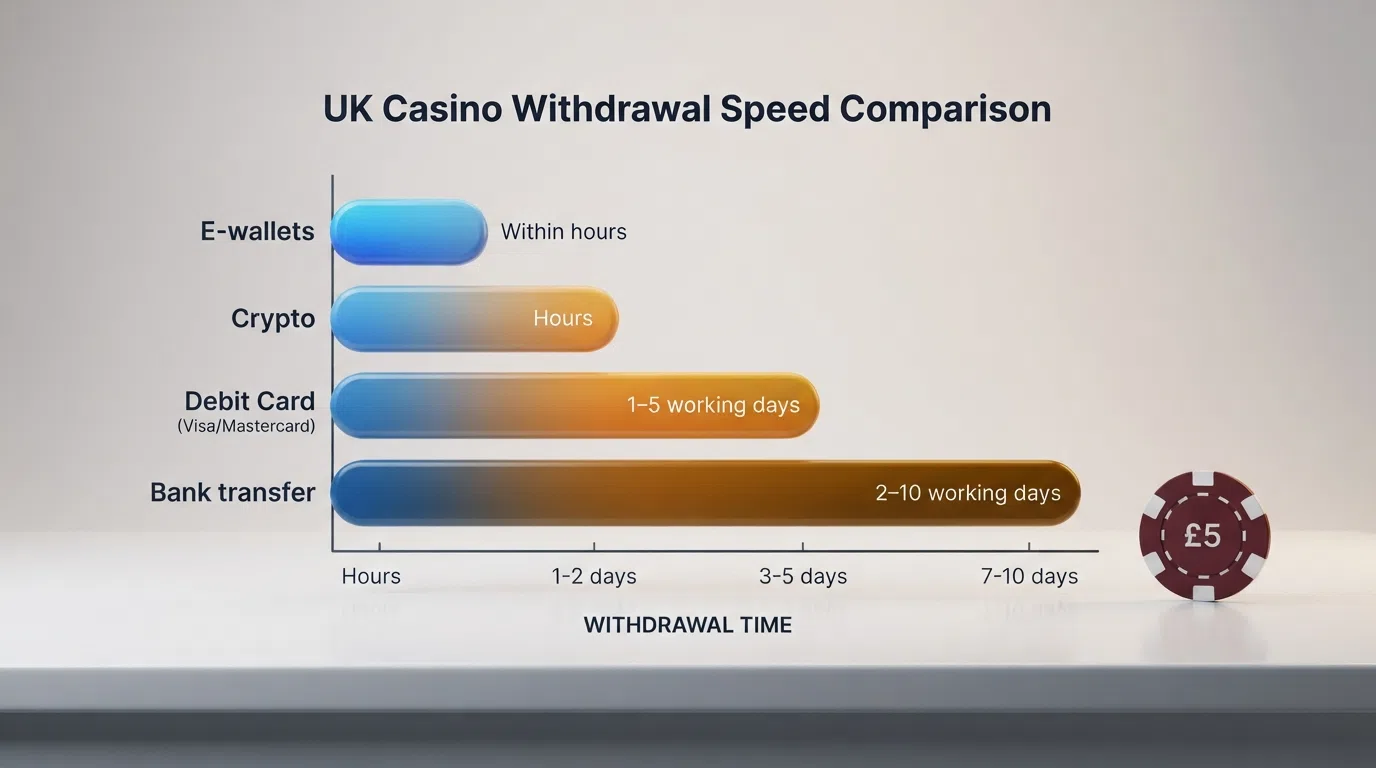
For withdrawals, the flow is longer. You request a cashout, and the casino enters a pending period — typically 0 to 24 hours, during which the withdrawal can still be reversed. Once the request is approved, the casino processes it and hands the payment off to the payment service. From that point, the speed is the payment method’s: e-wallets and Open Banking arrive in hours; debit cards take 1–3 working days; bank transfers can run to 10 days. KYC re-enters the picture at first withdrawal — a proof of address or source-of-funds request is common, and any mismatch between the deposit and withdrawal method can trigger an extra review.
The practical upshot: the deposit method you choose is the withdrawal method you will use. Players who deposit with Paysafecard — which has no withdrawal route at most operators — must register a second method before cashing out.
Every UK Casino Payment Method, Ranked by Speed and Convenience
Ranking payment methods is not like ranking slot games. The “best” method depends on what you weight: speed of withdrawal, bonus eligibility, data exposure, maximum deposit, or the ability to use one method for both directions. Ordered by withdrawal speed, the league table from fastest to slowest runs: e-wallets, Open Banking, debit cards, bank transfer — with phone bill, mobile wallets and prepaid at the back, because several of those have no withdrawal route at all.
Two facts frame the rest. First, the credit card ban removed the entire credit-funded segment of the market, so any guide that still lists credit cards as a casino payment method is out of date. Second, Paysafecard’s £40 maximum per single payment is not a casino-imposed cap — it is the network’s own ceiling, set by Paysafecard rather than by any operator. Boku’s £30 daily cap is the same: a network-level limit, applied across every UK casino you fund in a single day.
What follows is the method-by-method read.
Debit Cards: Visa and Mastercard, the Universal Standard
Debit cards are the default for a reason. Deposits credit instantly. Withdrawals clear in 1–3 working days, slower than e-wallets but faster than bank transfer. Every UK-licensed casino accepts them, no operator in the featured set charges a fee, and almost every welcome bonus requires a debit card deposit to qualify — bet365 defaults to debit card for its Bet £10 Get £30 offer, William Hill restricts the welcome offer to debit card only, and Ladbrokes, Coral, Paddy Power, Betfair, Betfred, Gala Spins, Sky Vegas and 888 Casino all apply the same rule in one form or another.
The minimum deposit is the lowest in the cashier: £5 at bet365, William Hill, Ladbrokes, Coral and Betfred; £10 elsewhere. For players who care about qualifying for a welcome offer, debit card is the path of least resistance. The trade-off is speed at withdrawal — 1–3 days is uncompetitive next to e-wallets, and a 5-day weekend bank holiday can stretch that to nearly a working week.
For most UK players, debit card is the right default. It is the only method that combines universal acceptance, bonus eligibility and a working withdrawal route at every operator in the featured set.
E-Wallets: PayPal, Skrill, Neteller, and MuchBetter
E-wallets win on speed and lose on bonuses. PayPal and Trustly withdrawals at bet365 land in 1–4 hours; Sky Vegas processes PayPal and Trustly withdrawals within 6 hours; Ladbrokes turns PayPal withdrawals around in 8 hours. The same e-wallet that gets your money out fastest is the one most likely to lock you out of a welcome offer.
PayPal is the dominant e-wallet in the UK — the brand carries over from consumer e-commerce, and most players trust it without needing to read the small print. Skrill and Neteller are widely accepted, particularly at Paddy Power, Betfair and Gala Spins, and they share the speed advantage. MuchBetter is a specialist gambling wallet; Paddy Power is the standout operator in the featured set for MuchBetter support. The bonus-exclusion rule is consistent across operators: bet365 requires a debit card by default and treats PayPal, Apple Pay, Google Pay and Paysafecard as needing full ID verification to qualify; William Hill excludes PayPal and Neosurf; Ladbrokes, Coral, Paddy Power and Betfred restrict welcome bonuses to debit card, Apple Pay or Google Pay; Gala Spins excludes prepaid cards, PayPal, Neteller and Skrill; 888 Casino excludes Skrill and Neteller specifically.
The minimum deposits tell a similar story. PayPal at bet365 starts at £25, at Ladbrokes and Coral at £10. E-wallets are not a budget option.
The verdict: e-wallets suit players who already have a PayPal or Skrill balance, who cash out frequently, and who do not chase welcome bonuses. For bonus hunters, the speed comes at a cost that compounds over time.
Open Banking and Pay by Bank: Trustly and Instant Bank Transfer
Open Banking is the category that has grown fastest since the credit-card ban, and for good reason. Trustly and Instant Bank Transfer connect your bank directly to the casino through a regulated API, without sharing card numbers or login credentials, and they sit cleanly inside the PSR 2017 framework that licence condition 5.1.2 requires. IBTimes UK flags Pay by Bank as “increasingly prominent” in the post-ban mix, and the operator data backs that up: bet365 lists Pay by Bank App (Trustly) as a withdrawal method at 1–4 hours; Sky Vegas processes Trustly withdrawals within 6 hours; Betfred runs same-day withdrawals on Open Banking; 888 Casino clears Trustly withdrawals the same day.
Fees are operator-friendly without being passed on to players, and the absence of card numbers means the data-exposure footprint is smaller than debit cards. The minimum deposit is usually £5 or £10. The only catch is that the bank needs to support Open Banking — every major UK high-street bank does, but some smaller building societies lag.
For players who want speed and do not want to fund an e-wallet, Open Banking is now the obvious alternative to debit cards. It is the only category that gets close to e-wallet withdrawal speed while staying eligible for welcome bonuses at most operators.
Prepaid Vouchers: Paysafecard and Its Hidden Limits
Paysafecard is brilliant for budgeting and useless for withdrawals. The 16-digit PIN model means there is no card to enter and no bank account to link — you buy a voucher at a shop, type the PIN, and the deposit lands. The hard ceiling is £40 per single payment, a network-level cap that no operator can raise. After 12 months of inactivity on the balance, a £3 monthly fee starts to eat the residual credit, a detail most players do not read.
The bigger limitation is asymmetry. Paysafecard is accepted at most UK-licensed casinos for deposits — bet365, Ladbrokes, William Hill, Coral, Paddy Power, Gala Spins, Betfair and 888 Casino all list it — but it has no withdrawal route at any of them. Players who deposit with Paysafecard must register a second method before they can cash out. Sky Vegas and Betfred do not accept it at all, and 888 Casino excludes Skrill and Neteller from the welcome offer while accepting Paysafecard for deposits only.
The verdict: Paysafecard suits players who want a hard spending cap and who are comfortable registering a separate withdrawal method. It is not a primary banking tool.
Apple Pay, Google Pay, and Revolut: Mobile Wallets Explained
Mobile wallets split the difference between debit cards and e-wallets. Apple Pay and Google Pay are biometric-authenticated tap-to-pay products on top of an existing card; Revolut is an app-based bank that issues its own debit card. Deposits are instant, and most UK players already have at least one configured on their phone.
Apple Pay is the most widely accepted. Ladbrokes, Coral, William Hill, Sky Vegas, Betfred, Betfair, 888 Casino and Gala Spins all list it. Google Pay follows a similar pattern at Ladbrokes, Coral, William Hill, Betfred and Gala Spins. Crucially for bonus eligibility, both are treated as qualifying methods at most operators — Ladbrokes, Coral, Paddy Power, Betfred, Sky Vegas and William Hill all accept Apple Pay (and usually Google Pay) for welcome offers, where PayPal and Paysafecard are excluded. That makes Apple Pay a strong choice for players who want mobile-wallet convenience without losing the bonus.
The catch is withdrawals. Apple Pay generally cannot cash you out at any UK-licensed casino; Google Pay’s withdrawal support is patchy. Revolut is the exception: Ladbrokes lists it as a named payment method, and because Revolut functions as a debit card, withdrawals work in the same way as any other Visa debit.
The verdict: Apple Pay and Google Pay are excellent deposit methods, particularly for bonus qualification. Plan to register a debit card or e-wallet for withdrawals.
Boku and Pay by Phone Bill: The £30-a-Day Micro-Deposit Option
Phone-bill deposits are the smallest segment of the UK casino cashier. Boku’s £30 daily network-level cap is the headline number — across every UK casino combined, you cannot charge more than £30 to your phone in a single day. The flow is SMS verification, a charge-to-mobile confirmation, and a deposit that lands within seconds.
Since 1 February 2025, mobile-billing services moved from the Phone-paid Services Authority to Ofcom under the Regulation of Premium Rate Services Order 2024. The per-transaction limit is £40; the monthly cap per subscriber is £240. These are network-level, not casino-level.
The structural problem is the deposit-only ceiling. Boku and Fonix cannot cash you out. As Fruity Slots notes: “The ‘pay now, settle later’ nature of post-pay phone bills doesn’t sit comfortably alongside the UKGC’s direction of travel on consumer protection, and most operators have concluded it’s not worth the regulatory scrutiny.” Most major operators have decided that phone-bill deposits are not worth the regulatory scrutiny, and the method is increasingly peripheral.
The verdict: Boku suits micro-deposits at a single casino session and nothing more. Anyone playing with a bankroll of more than £30 a day needs a second method.
Niche and Alternative Wallets: MiFinity, ecoPayz, AstroPay, and Luxon Pay
The smaller e-wallets appear in narrower pockets of the UK market. MiFinity and ecoPayz are general-purpose e-wallets with limited UK casino coverage. AstroPay is more common at international-facing operators. Luxon Pay is the standout niche product: 888 Casino lists it as a named payment method, and it carries a Skrill/Neteller-style e-wallet profile with a different regulatory wrapper.
The trade-off is uniform across the niche segment: narrower acceptance, fewer cashier slots to choose from, and the same bonus-exclusion problem that hits Skrill and Neteller. Paddy Power adds MuchBetter and Rapid Transfer to its roster, giving the operator the widest payment-method selection in the featured set, but neither product is widely accepted elsewhere.
The verdict: niche wallets are useful at the specific operator that accepts them and not much help anywhere else. Players who travel between brands should not depend on them.
Bonus Eligibility by Payment Method: What Qualifies and What Gets You Locked Out
This is the section most payment-method guides skip, and the one that costs players the most. The near-universal rule is that welcome bonuses require a debit card deposit, with Apple Pay as the most common alternative qualifier. E-wallet deposits are excluded at most operators. Paysafecard and other prepaid methods are excluded nearly everywhere.
The per-operator picture, from the featured set:
- bet365 — debit card by default; PayPal, Apple Pay, Google Pay and Paysafecard need full ID verification to qualify.
- William Hill — debit card only; PayPal and Neosurf excluded.
- Sky Vegas — debit card or Apple Pay for promotional offers; other methods do not qualify.
- Ladbrokes — Visa, Mastercard debit, Apple Pay or Google Pay; all other options ineligible.
- Coral — Visa, Mastercard debit, Apple Pay or Google Pay.
- Paddy Power — debit card for the sports sign-up bonus, Apple Pay for the casino bonus; PayPal, Paysafecard and prepaid excluded.
- Betfred — debit card, Apple Pay or Open Banking.
- Gala Spins — debit card or Apple Pay/Google Pay qualify; prepaid, PayPal, Neteller and Skrill excluded.
- Betfair — e-wallet deposits may be excluded from some promotions as standard Flutter group practice.
- 888 Casino — Skrill and Neteller excluded from the welcome offer; other methods qualify.
Wagering requirements are capped at 10× from 19 December 2025, and mixed-product promotional offers — conditioning a casino bonus on playing a different product type — are banned under the same rule. The cap is welcome news for anyone who has ever faced a 35× playthrough, but it does not solve the eligibility gate. If your deposit method is excluded, the bonus does not start.
Withdrawal Speed Compared: How Long Each Method Really Takes
The table below compares every UK casino payment method on deposit speed, withdrawal speed and whether the method can be used for cashouts. Times are category-level ranges drawn from operator payment pages.
| Payment Method | Deposit Speed | Withdrawal Speed | Available for Withdrawal |
|---|---|---|---|
| E-wallets (PayPal, Skrill, Neteller, MuchBetter) | Instant | Within hours to same day | Yes |
| Open Banking / Pay by Bank (Trustly) | Instant | Same day | Yes |
| Debit cards (Visa, Mastercard) | Instant | 1–3 working days | Yes |
| Bank transfer | 1–3 working days | 2–10 working days | Yes |
| Mobile wallets (Apple Pay) | Instant | — | No |
| Mobile wallets (Google Pay) | Instant | Limited | Partial |
| Prepaid (Paysafecard) | Instant | — | No |
| Phone bill (Boku, Fonix) | Instant (after SMS) | — | No |
| Niche wallets (Luxon Pay, MiFinity, ecoPayz) | Instant | Same day to 1–3 days | Yes |
| Revolut (debit card mode) | Instant | 1–3 working days | Yes |
The table shows why the e-wallet/Open Banking pair has captured the speed-conscious segment. The deposit-only methods — Apple Pay, Paysafecard, phone bill — fill useful niches for funding, but every player who uses one of them will need a second method for the cashout.
Paying by Mobile: The Deposit Method That Cannot Cash You Out
Mobile payments are a growing share of UK casino deposits and a structurally small share of withdrawals. The mechanics are simple: biometric authentication, an instant credit, and a deposit that arrives in seconds. The constraint is the regulatory ceiling, not the technology.
Since 1 February 2025, mobile-billing services sit under Ofcom rather than the Phone-paid Services Authority. The per-transaction cap is £40, the monthly cap is £240, and the broader £30 daily network-level cap on Boku deposits sits inside that envelope. These limits apply network-wide, not per casino, which means a player who hits the Boku cap at one operator cannot top up at another using the same phone number that day.
The regulatory direction is restrictive. The UKGC’s anti-credit stance and the consumer-protection framework around gambling treat post-pay phone-bill deposits — the “pay now, settle later” model — as a poor fit. Most major operators have either avoided phone-bill deposits or kept them at the edges of the cashier.
Pay by Phone Bill: Boku, Fonix and the £30 Daily Cap
Boku is the dominant UK carrier-billing provider, with the £30 daily cap enforced across every UK casino a player funds. The flow is SMS verification — a one-time code sent to the mobile number registered at the casino, confirmed, and the deposit lands. Fonix is a smaller alternative provider, with the same regulatory framework and similar caps. There is no withdrawal route through either provider, and the per-transaction limit is £40 under Ofcom rules.
SMS and Text-to-Pay: How Casino SMS Deposits Work
The SMS deposit flow is the same as carrier billing: the player requests a deposit, the casino triggers a charge to the mobile account, the player confirms by SMS, and the credit arrives. The £40 per-transaction Ofcom limit applies, and the monthly cap of £240 sits over the top. The distinction between “SMS payment” and “carrier billing” is largely a terminology choice at the operator level — both routes charge the deposit to the mobile account and both are deposit-only.
UK Casino Operators: A Direct Payment-Method Comparison
The table below compares ten of the UK’s biggest casino operators on payment-method count, minimum deposit, fastest withdrawal speed, and whether PayPal and Paysafecard are accepted. Bonus eligibility rules are summarised in the rightmost column. Operators are listed in the order set out in the selection methodology at the end of this guide.
| Operator | Payment Methods | Min Deposit | Withdrawal Speed (Best) | PayPal | Paysafecard | Bonus Eligibility |
|---|---|---|---|---|---|---|
| bet365 | 7 | £5 / £25 / £100 | 1–4 hours (PayPal, Trustly) | Yes | Yes | Debit card default; other methods need full ID |
| William Hill | 6+ | £5 / £10 | Same day (Instant Bank Transfer) | Limited | Yes | Debit card only; PayPal and Neosurf excluded |
| Sky Vegas | 5 | £10 | Within 6 hours (PayPal, Trustly) | Yes | No | Debit card or Apple Pay |
| Ladbrokes | 7+ | £5 / £10 | 8 hours (e-wallets) | Yes | Yes | Visa/MC debit, Apple Pay, Google Pay |
| Paddy Power | 10 | £10 | Same day (e-wallets) | Yes | Yes | Debit card (sports) / Apple Pay (casino); PayPal and Paysafecard excluded |
| Coral | 6+ | £5 / £10 | Same day (e-wallets) | Yes | Yes | Visa/MC debit, Apple Pay, Google Pay |
| Betfred | 4 | £5 | Same day (Open Banking) | No | No | Debit card, Apple Pay, Open Banking |
| Gala Spins | 6+ | £5 | Same day (e-wallets) | Yes | Yes | Debit card/Apple Pay/Google Pay; prepaid/PayPal/Neteller/Skrill excluded |
| Betfair | 6+ | £10 | Same day (e-wallets) | Yes | — | E-wallets may be excluded from some promotions |
| 888 Casino | 7 | £10 | Same day (Trustly) | No | Yes | Skrill/Neteller excluded from welcome |
Paddy Power’s ten-method cashier is the widest in the featured set, but the bonus-eligibility rule narrows the practical choice to debit card or Apple Pay. Betfred’s four-method desk is the most restricted — no PayPal, no Google Pay, no Paysafecard — and that constraint is intentional rather than a gap to be filled. 888 Casino is the standout for niche-wallet coverage with Luxon Pay, but it is also the brand that locks Skrill and Neteller depositors out of the welcome offer.
Paddy Power: The Widest Payment-Method Selection
Paddy Power lists ten deposit methods: Apple Pay, debit cards, Paysafecard, Skrill, Neteller, Pay by Bank, bank transfer, MuchBetter, Rapid Transfer and PayPal. The minimum deposit is £10 across most methods, and e-wallet withdrawals land the same day. No operator in the featured set carries a longer list of named methods.
The bonus rule cuts hard against the variety. The sports sign-up offer requires a debit card deposit, with PayPal, Paysafecard and other prepaid methods excluded. The casino welcome offer accepts Apple Pay as a qualifying method. Players who want to use Skrill, Neteller or MuchBetter for both deposits and withdrawals will need to forfeit the welcome bonus. The verdict: Paddy Power is the right operator for players who want maximum choice and who do not chase sign-up offers; for bonus hunters, the variety is somewhat illusory.
Ladbrokes: Seven-Plus Methods Including Revolut
Ladbrokes carries Visa, Mastercard, Apple Pay, Google Pay, PayPal, Instant Bank Transfer, Paysafecard and Revolut. The £5 minimum applies to most methods, with PayPal at £10. E-wallet withdrawals clear in 8 hours. The brand is one of the few UK casino operators to list Revolut as a named payment method, which makes it the natural choice for Revolut users who want a full banking experience rather than a card fallback.
The welcome offer at Ladbrokes requires a Visa or Mastercard debit, Apple Pay or Google Pay deposit, with all other options ineligible. Ladbrokes stands out as one of the few UK operators to integrate Revolut directly as a named payment method, providing a seamless banking experience for users of that platform.
bet365: The Market Leader’s Payment Setup
bet365 accepts seven methods — debit cards, PayPal, Apple Pay, Google Pay, Pay by Bank App (Trustly), bank transfer and Paysafecard. The minimum deposit is £5 for most methods, £25 for PayPal and £100 for bank transfer. PayPal and Trustly withdrawals land in 1–4 hours, the fastest in the featured set. The bonus rule defaults to debit card, and other methods — PayPal, Apple Pay, Google Pay, Paysafecard — need full ID verification to qualify. No operator charges a fee. The verdict: the strongest combination of method variety and payout speed, with the bonus rule written for debit-card-first players.
888 Casino: Seven Methods with Trustly and Luxon Pay
888 Casino lists Visa Debit, Mastercard Debit, Apple Pay, Pay by Bank, Trustly, Luxon Pay and Paysafecard. The minimum deposit is £10, and Trustly/Pay by Bank withdrawals are same-day. The welcome offer excludes Skrill and Neteller deposits, with winnings on the 100 free spins capped at £300. The verdict: the right operator for Trustly/Open Banking users and for players who want Luxon Pay as a niche option; Skrill and Neteller depositors should look elsewhere for the welcome bonus.
William Hill: Six-Plus Methods with PayPal Limited
William Hill carries six-plus methods: debit cards, Apple Pay, Google Pay, Instant Bank Transfer, Paysafecard and PayPal (the last listed as “limited” in the operator’s own payment pages). The minimum is £5 on debit card, Apple Pay and Instant Bank Transfer; £10 on e-wallets and prepaid. The welcome offer requires a debit card deposit, with PayPal and Neosurf excluded. The verdict: a solid choice for traditional banking, though it may be less appealing for those who prioritise e-wallet flexibility.
Coral: Six-Plus Methods with a Low £5 Entry Point
Coral mirrors Ladbrokes under the Entain ownership structure: six-plus methods, £5 minimum on most, same-day e-wallet withdrawals, bonus restricted to Visa/MC debit, Apple Pay or Google Pay. The welcome offer is Play £5 Get 100 Free Spins plus a £10 bonus. This operator provides a consistent, reliable alternative for those familiar with Entain’s broader product suite.
Gala Spins: Six-Plus Methods with Skrill on the List
Gala Spins accepts debit cards, Apple Pay, Google Pay, PayPal, Paysafecard and Skrill. The minimum is £5, and the welcome bonus triggers at £10. The bonus excludes prepaid cards, PayPal, Neteller and Skrill — a particularly broad exclusion list. Wagering is 10× on the £20 bonus, with a £2 maximum stake and a 7-day validity. The verdict: the right operator for Skrill users who do not want to forfeit the welcome bonus at Paddy Power; for everyone else, the bonus-eligibility rule is the constraint.
Betfair: Six-Plus Methods with Flutter’s Standard Approach
Betfair’s cashier lists debit cards, PayPal, Skrill, Neteller, bank transfer and Apple Pay. The minimum is £10, and e-wallet withdrawals are same-day. E-wallet deposits may be excluded from some promotions as standard Flutter group practice. The verdict: a broad method list, a typical Flutter bonus rule, and a separate sports-exchange product that introduces more complexity than one might find at a single-product operator.
Sky Vegas: Five Methods with No-Wagering Free Spins
Sky Vegas runs the tightest cashier in the featured set: debit cards, Apple Pay, PayPal, Trustly (Instant Bank Transfer) and bank transfer. The minimum is £10 across all methods. Withdrawals land within 6 hours on PayPal and Trustly, or 1–3 days on debit. The welcome offer — 50 no-deposit free spins plus 200 free spins on a £10 stake with no wagering — is one of the cleanest in the UK market. The bonus rule is debit card or Apple Pay. The verdict: the strongest no-wagering welcome in the featured set, against the narrowest method choice.
Betfred: Four Methods, No PayPal, No Google Pay
Betfred is the most restricted operator in the featured set: four methods — debit cards, Apple Pay, Open Banking (Instant Bank Transfer) and bank transfer. No PayPal, no Google Pay, no Paysafecard. The minimum is £5, and Open Banking withdrawals are same-day. The welcome offer is 200 wager-free spins on a £10 stake, with the bonus requiring debit card, Apple Pay or Open Banking. The verdict: a deliberately narrow cashier that pairs well with the wager-free welcome offer, and the obvious choice for Open Banking-first players.
Are Your Casino Payments Safe? What UK Regulation Actually Protects
UK casino payments are among the most tightly regulated in the world, and the regulatory architecture is the reason. The Gambling Commission is the sole statutory regulator for Great Britain, sponsored by DCMS, and it operates the licence conditions and codes of practice that every remote operator must follow. The Gambling Act 2005 sets the statutory frame; the point-of-consumption reform of 2014 brought every operator serving GB customers — regardless of where the company is based — into the GB licensing regime.
Three regulatory conditions do the heaviest lifting on payments. First, the credit card ban of 14 April 2020 under LCCP 6.1.2, which removes the credit-funded segment of the market and extends into e-wallet routing. Second, the payment-services requirement of LCCP 5.1.2, effective 31 January 2024, which compels every deposit method to involve a payment service defined in Schedule 1 Part 1 of the PSR 2017, from an authorised payment service provider. Third, the KYC requirement in force since 7 May 2019, which mandates identity verification — name, address, date of birth — before any deposit or gambling.
The penalty for operating without a licence is a criminal offence under section 33 of the Gambling Act 2005: up to 51 weeks’ imprisonment, an unlimited fine, or both. This is the primary mechanism ensuring the entire UK regulatory framework remains robust and enforceable.
The Safest UK Casino Payment Methods in 2026
Safety is not a single dimension. Each method carries a different mix of consumer protections, and the right answer depends on what you are protecting against.
Debit cards carry the Section 75-style chargeback reasoning that comes with any UK-issued card, plus the consumer-disputes framework at the issuing bank. PayPal layers its own buyer protection and dispute-resolution process on top. Open Banking uses regulated API access: the player does not share login credentials with the casino, and the data exchange happens through FCA-supervised infrastructure. Prepaid vouchers are a data-leakage firewall — no bank details, no card numbers, no account link — at the cost of the £40 maximum and the deposit-only limitation.
The LCCP 5.1.2 requirement that every method involves an authorised payment service provider under PSR 2017 is the underlying guarantee. Even the niche wallets — Luxon Pay, MiFinity, MuchBetter — sit inside the same regulatory frame, because the operator cannot legally accept them otherwise. That is the structural answer to the safety question: any method that appears in a UK-licensed cashier has been through a regulatory gate, and the operator’s licence rests on its ability to maintain these safeguards consistently.
The Credit Card Ban: What It Covers and What It Does Not
The credit card ban took effect on 14 April 2020 under LCCP 6.1.2. It prohibits credit card use for all remote gambling, and it extends to credit-card-funded payments routed through e-wallets and other money service businesses. The operator’s obligation is not just to block direct credit card deposits, but to ensure that the e-wallets on its cashier have themselves prevented credit-card-funded gambling transactions. That is a meaningful extension: a player who tries to fund a Skrill wallet with a credit card and then deposit from Skrill to a casino is doubly blocked.
The ban also closes the prepaid circumvention route. The UKGC’s October 2025 emerging-risks guidance reiterated that prepaid methods must not become a back door for credit-funded gambling, and operators carry the responsibility for the assessment. Cryptocurrency is not available at UKGC-licensed casinos at all, so the crypto-funded alternative does not exist in the regulated market.
What the ban does not cover: debit cards, bank transfers, e-wallet deposits funded by debit cards or bank balances, and Open Banking transfers. Those remain the regulated alternatives that the market has consolidated around since 2020.
UKGC Payment-Security Requirements: What Every Licensed Casino Must Do
The payment-security conditions that apply to every UK-licensed casino are specific, technical and largely invisible to the player. The headline requirements are: every deposit method must involve a payment service defined in Schedule 1 Part 1 of the PSR 2017, supplied by an authorised payment service provider. Identity verification — including name, address and date of birth — must be completed before any deposit or gambling, a requirement in force since 7 May 2019. Financial vulnerability checks are also mandatory at a £150 net deposit threshold in a rolling 30-day period using publicly available data, a rule effective from 28 February 2025. Additionally, the operator must hold payment data to the same data-protection standards as any other personal data, using encryption and access controls enforced under UK GDPR, and anti-money-laundering obligations apply to deposits above regulatory thresholds, with source-of-funds checks at the operator’s discretion.
The KYC requirement is the one players notice most directly. It is also the reason there is no anonymous deposit route at a licensed GB site — and the reason the deposit screen does not pause for identity checks during funding. The check happened earlier, at registration.
Payment Tools That Keep Your Gambling Under Control
UK payment regulation now sits at the centre of responsible-gambling tools, not at the edges. From 31 October 2025, every operator must prompt a player to set a financial deposit limit before the first deposit, and any request to decrease a limit must be actioned immediately. From 30 September 2026, a gross deposit limit must be offered and given at least equal prominence to other financial limits on the cashier page.
Those tools sit alongside the wider prevalence picture. The Gambling Survey for Great Britain Year 3 (2025) estimates approximately 2.4% of adults had a PGSI score of 8 or more — problem gambling. The NHS Health Survey for England 2024 found 5% of adults had PGSI 1+ scores. GambleAware’s 2024 treatment survey put the figure higher: 13.1% of adults were classified as experiencing some level of gambling problems, and almost 1 in 3 of those wanted treatment — nearly double the share in 2020.
The prevalence numbers are why the payment-method conversation keeps returning to limits, blocks and self-exclusion. The tools exist; the question is whether players use them.
Deposit Limits Tied to Your Payment Method
The deposit-limit framework introduced from 31 October 2025 is a regulatory floor rather than a cap. Operators must prompt, must make the limit easy to review, and must action decreases immediately. The gross deposit limit coming on 30 September 2026 adds a specific product — a limit based solely on money paid into the account over a defined period — and gives it equal prominence on the cashier.
These regulatory limits sit on top of the method-specific caps that have always existed. Boku’s £30 daily network-level cap is the tightest of any method. Paysafecard’s £40 maximum per single payment is the next layer. The slot-stake caps — £5 per game cycle for players aged 25 and over, £2 for players aged 18–24 — are not deposit limits but they set a hard ceiling on what any spin can cost.
The relationship between a player-set deposit limit and a method-level cap is straightforward: the stricter cap wins. A player who sets a £200 monthly deposit limit but funds with Boku hits the £30 daily Boku cap long before the monthly limit matters. That is the architecture working as designed, but it is also the reason the “right” method depends on the scale of your regular gameplay.
Self-Exclusion, GAMSTOP and Payment Blocking
GAMSTOP has been mandatory for all GB-licensed online operators since 31 March 2020. A player who registers with GAMSTOP is excluded from every GB-licensed online gambling site for the chosen period — 6 months, 1 year, 5 years, or 5 years with auto-renewal. The exclusion cannot be cancelled early. It is the bluntest tool in the box, and it works because it sits across the entire licensed market rather than at a single operator.
Bank-level gambling blocks are the second layer. UKGC data shows 18.4% of online gamblers have asked their bank to block payments to gambling companies — a figure that has grown steadily since the major UK banks introduced the feature. A bank block stops payments before they reach any operator, including offshore sites, and it is reversible only through the bank itself.
The support infrastructure behind the tools is free and confidential. GamCare runs the National Gambling Helpline, available 24/7 to anyone affected by gambling. NHS gambling harm clinics operate in England, Scotland and Wales. Gamblers Anonymous runs peer-support groups. The operator side layers reality checks and time-outs on top. None of these tools require a player to stop using any particular payment method — but the payment method is often the easiest place to enforce a limit, which is why the regulatory direction is to put the limit-setting prompt at the cashier.
How We Selected and Ranked These Payment Methods
This guide is built on four key pillars of research: the UK Gambling Commission’s public register of licence holders, which verifies the current licensed status of the featured operators; each operator’s own payment pages for deposit limits, withdrawal speeds, and bonus-eligibility terms; statutory frameworks including LCCP conditions and Department for Culture, Media and Sport publications; and a comparative review of market trends to ensure every method and operator featured meets the highest standards of UK regulatory compliance.
The evaluation criteria were: method variety, deposit and withdrawal speed, fee transparency, bonus eligibility, and regulatory compliance. Operators were ordered by market position rather than by any single payment-method metric, because a guide that ranks brands by “most methods accepted” or “fastest withdrawal” produces a different ordering at every method change. Every featured operator was checked against the UKGC public register; all ten are listed. No invented weightings, no editorial preference: the ranking reflects market position, the comparison reflects the data on each operator’s payment page.
The featured set is a sample, not a census. The UKGC register lists far more brands than any article can feature, and the “best” operator depends on what the player is optimising for. The ten operators here are long-established GB-licensed brands with comparable product catalogues; the payment-method data on each is taken from the operator’s own pages as of the date of this guide.
What Your UK Casino Payment Method Actually Costs You
Three cost lines run underneath the cashier. The first is the bonus-value cost. A player who deposits with PayPal at bet365 to chase a 1–4 hour payout forfeits the welcome offer, because the default qualifying method is debit card. For a £30 bonus with the 10× wagering cap, the difference between qualifying and not qualifying is £30 in bonus value plus any winnings from it. At the regulatory 10× cap, a £30 bonus needs £300 of wagering to clear. Using a £5 stake and the 5-second slot interval, that is 60 spins or roughly 5 minutes of play — fast, in other words, but still real play the player must complete.
The second cost is the time cost. A PayPal withdrawal at bet365 lands in 1–4 hours; the same withdrawal at an operator that does not support PayPal takes the debit card route and clears in 1–3 working days. Over a year, a player who cashes out monthly and uses the slower method waits an extra 1–2 days per cashout. That is not a fortune, but it is the difference between spending winnings this weekend and waiting until next month.
The third cost is the fee line. UK-licensed operators do not charge deposit or withdrawal fees; the featured set is uniformly fee-free at the operator level. The fees that do exist are at the payment-method layer: Paysafecard’s £3 monthly dormancy fee from month 13, the Boku £30 daily cap that effectively limits play, and the implicit premium on minimum deposits where PayPal’s £25 at bet365 is higher than the £5 debit card floor.
The reader’s decision framework follows directly from those three cost lines. If the welcome bonus matters, debit card is the default — and at most operators, Apple Pay is the acceptable substitute. If payout speed matters more than the welcome bonus, e-wallets or Open Banking are the better trade. If the goal is hard spending control, Paysafecard’s £40 ceiling is the cleanest cap, provided the player registers a separate withdrawal method. The “right” method is the one that costs the player the least against what they actually value.
The wider regulatory direction is worth keeping in mind. Remote Gaming Duty rises to 40% from 1 April 2026, and the statutory levy sits at 1.1% of GGY from April 2025. Those are operator costs, not player costs, but they feed into the bonus generosity the market is willing to offer — and the 10× wagering cap is the regulator’s response to a market that had drifted toward punishing playthroughs. The licensed UK cashier is the safest in Europe, the most heavily taxed, and the most tightly constrained. In the long run, this rigorous oversight ensures that British players enjoy one of the most secure betting environments available anywhere in the world.
Frequently asked questions about UK casino payment methods
Which payment methods are banned at UK-licensed casinos?
Credit cards are banned for all remote gambling in Great Britain under LCCP 6.1.2, in force since 14 April 2020. The ban extends to credit-card-funded deposits routed through e-wallets and other money service businesses. Cryptocurrency is not accepted at UKGC-licensed casinos at all. Beyond those two categories, the licensed cashier is open.
Can I use pay by phone bill for casino withdrawals?
No. Pay by phone bill — Boku, Fonix and similar providers — is deposit-only at every UK-licensed casino. The £30 daily network-level cap on Boku and the £40 per-transaction Ofcom cap apply to deposits only. Players using phone-bill deposits must register a separate withdrawal method, typically a debit card or e-wallet.
Are e-wallet deposits eligible for casino welcome bonuses?
Rarely. Most UK operators restrict welcome bonus qualifying deposits to debit cards, sometimes Apple Pay or Google Pay. bet365 defaults to debit card; William Hill excludes PayPal and Neosurf; Ladbrokes, Coral, Paddy Power and Betfred restrict to debit card, Apple Pay or Google Pay; Gala Spins excludes prepaid, PayPal, Neteller and Skrill; 888 Casino excludes Skrill and Neteller from the welcome offer. E-wallet players typically forfeit the sign-up bonus for faster withdrawals.
What is the minimum deposit at UK online casinos?
The minimum varies by operator and method. The lowest standard minimum in the featured set is £5 — at bet365 on most methods, Ladbrokes on most methods, William Hill on debit card and Apple Pay, Coral on most methods, and Betfred. Sky Vegas and 888 Casino set £10 across the board. PayPal minimums are higher: £25 at bet365, £10 at Ladbrokes and Coral. Bank transfer at bet365 starts at £100.
What happens to my Paysafecard balance if I do not use it?
Paysafecard deducts a £3 monthly service fee from the residual credit starting in the 13th month after purchase. The fee continues monthly until the balance is zero. Players who buy a Paysafecard voucher and leave it unused for over a year will see the balance shrink by £3 each month until it is spent or reaches zero.
Can I use cryptocurrency at UK-licensed online casinos?
No. UKGC-licensed casinos do not accept cryptocurrency deposits. Bitcoin, Ethereum and other crypto assets are not on the cashier at any GB-licensed operator. The regulatory framework requires every deposit method to involve a payment service defined in Schedule 1 Part 1 of the PSR 2017, and cryptocurrency does not fit that definition under the current rules. Players who want to use crypto will need to look at offshore operators, which carry none of the UK consumer protections.
Payments – fastestpayout-casinos-uk
Content created by the «fastestpayout-casinos-uk» team