
Real Cash Casino Games: A Sterling-Stakes Guide for UK Players
 Available in GB
A real cash casino in the United Kingdom is a Gambling Commission–licensed platform on which you deposit pound sterling, wager it on slots, table games and live dealer tables, and withdraw the winnings to a bank account. Demo-play sites look almost identical on the surface, but the difference runs all the way down to the licence on the wall: one pays out, the other does not. The UK market in 2026 sits inside the most regulated remote gambling regime in Europe, and the page below is an editor’s read of what that regime now means for the player who wants to deposit ten pounds, spin a few hundred rounds, and walk away with whatever survives the math.

The bonus structures and operator specifics below are current as of September 8, 2026 and have been verified against the UK Gambling Commission’s public register. Every licence claim and offer detail was checked against the named operator’s own promotional page, the UKGC register, and independent affiliate reporting.
What a Sterling-Stakes Online Casino Is, and How It Differs from Free Play
A “real cash” UK casino is a site that holds a Gambling Commission operating licence for Great Britain, accepts deposits in pounds sterling, and pays winnings in pounds sterling back to a verified payment method. Player winnings carry no income tax: betting duty was abolished for UK punters in 2001, and the only tax on gambling is paid by the operator. The market in 2026 is therefore defined less by what the player can win and more by the rules they have to play under. Every site in the comparison further down the page holds an active UKGC licence, and that is the dividing line between a sterling-stakes casino and a free-play social casino: social sites run on virtual chips, never pay out in real money, and answer to no British regulator.
The register itself is not small. The UKGC’s public register of licensed gambling businesses, last refreshed in late July 2026, carries 2,663 active operator records. That number includes software suppliers, key personnel and ancillary licences, so the count of consumer-facing casino brands is lower, but it confirms one thing: the regulated market is crowded, and the operators the regulator considers legitimate are publicly identifiable. Deposits in this market go through debit cards, bank transfers and a small set of e-wallets. Credit cards have been banned for all remote gambling since April 2020, a rule that extends to e-wallets funded by a credit card, so the payment path starts narrower than it used to be.
Real Cash Casinos vs. Demo-Play Sites — What Changes When You Deposit
Demo mode is the casino giving you play money on the same slot you would find at a real-money site. The reels spin, the bonus rounds trigger, the volatility feels the same, and nothing leaves your balance because nothing was on it. Real cash play changes three things at once. First, every UKGC-licensed operator must verify your name, address and date of birth before your first deposit — that step has been mandatory for remote licensees since May 2019, and it applies whether you want to play for pennies or pounds. Second, your deposit method is restricted: no credit cards, no credit-card-funded e-wallets, and the operator will check. Third, you are now under the full UKGC player-protection framework, which means deposit limits, reality checks, GAMSTOP coverage, and the right to refer a dispute to an alternative dispute resolution provider.
The free-play site you cleared in demo mode is the same game, the same provider, and the same math, but the free-play wrapper around it carries no licence condition, no KYC check, and no withdrawal. The shift from demo to real money is a shift from entertainment product to regulated financial service, and the protections that fall into place at that boundary are the subject of most of the rest of this page.
How a UK Real Cash Casino Works, From Deposit to Withdrawal
A typical session follows a predictable arc. You register, verify your identity, set a deposit limit (the operator is required to prompt you from October 2026), choose a deposit method — debit card, PayPal, Trustly, bank transfer — and load ten pounds or more. You browse a lobby of slots, table games and live dealer tables from providers such as NetEnt, Pragmatic Play, Playtech, Evolution and Microgaming, and you play. When you stop, you withdraw, and the operator checks the same identity you registered with, runs source-of-funds checks at the relevant threshold, and releases the funds back to the method you used to pay in.
Two technical rules sit underneath every spin. Every online slot at a UKGC-licensed casino must run at a minimum 2.5-second cycle, with no auto-play and no turbo features — losses disguised as wins are banned, and reverse withdrawals are permanently banned, so once you have asked for a cash-out the operator cannot offer to talk you out of it. On the tax side, the operator now pays a 40% Remote Gaming Duty from April 2026 (up from 21%) and a 1.1% statutory levy on gross gambling yield split 50/30/20 between NHS treatment, prevention and research. Neither of these is your bill, but they explain why the bonus offers you see are tighter than they were five years ago.
Online Slots, Table Games & Live Dealer — The Games British Customers Stake Money On
Slots dominate the UK real cash market by turnover, by session count and by the amount of regulator attention they get. The 2.5-second minimum cycle, the auto-play ban and the losses-disguised-as-wins ban all apply to online slots and only to online slots. Table games and live dealer products carry no statutory stake cap, and the game-design rules that physically constrain slot play do not apply to a blackjack hand or a roulette spin. The age-banded stake limits — £5 for players aged 25 and over, £2 for players aged 18 to 24 — apply to every online slot at every UK-licensed operator from the first spin, and the two age bands are enforced per player, not per product.
The provider mix at any one operator is the most concrete thing about the experience: it determines which titles you can actually find. A NetEnt-heavy site carries Starburst and the branded slots that go with it, a Pragmatic-heavy site carries the Bonanza and Olympus catalogue, and a Playtech-heavy site carries the live dealer tables that sit behind many UK-facing brands. Some sites carry over 7,000 games; others carry closer to 900. The catalogue is not a proxy for quality, but it is a proxy for choice.
Online Slots for Real Cash: The Games British Players Actually Play
Thousands of titles sit behind the slot lobby of a major UK-licensed casino, drawn from dozens of providers. They all run under the same rules. The £5 stake cap for adults aged 25 and the £2 cap for younger adults are imposed by the Gambling Act 2005 (Operating Licence Conditions) (Amendment) Regulations 2025, in force since April and May 2025, and apply to total staked per game cycle — one spin, not one wagering round. The 2.5-second minimum cycle and the auto-play ban mean you cannot accelerate a slot session the way you can on a table game: at the fastest legal setting you are looking at 24 spins per minute, so the marketing pages that show ‘1,000 spins in an hour’ describe a pace that is well within the current UK regulatory limits.
Progressive jackpots, Megaways titles and classic three-reel games all sit under the same stake cap. The jackpot size is not an exemption; if you are 24, the maximum you can bet on a progressive slot is £2, the same as on a three-reel fruit game. A 50-year-old at the same site can bet up to £5. The cap is a per-player rule, enforced through the operator’s age and identity verification, and it reshapes the game-selection logic for younger players more than for any other demographic.
Table Games and Live Dealer: Real Cash Beyond the Reels
Table games and live dealer products are not subject to the slot stake cap. A £500 hand of blackjack or a £1,000 roulette spin sits inside the same regulatory framework that caps slot play at £5, because the harm-mitigation rationale that produced the slot cap — the rapid-cycle, high-engagement design of online slots — does not apply to a game where the round is set by the dealer and the player’s choice. The same 2.5-second minimum cycle rule does not apply either; a hand of blackjack is not a “game cycle” in the sense the Remote Technical Standards use the term.
Live dealer tables are the fastest-growing segment of the UK real cash market for that reason. UK players connect by video stream to studios hosted by Evolution, Playtech and a handful of other providers, where a human dealer runs the table. Game speed is set by the dealer and the format, and published RTPs on live blackjack, roulette and baccarat generally exceed what slots return — basic-strategy blackjack returns over 99% of stakes to the player over the long run, which is a level slots at the same site rarely match. The catch is variance: a blackjack hand resolves in seconds, but a 99% RTP only shows up across hundreds of thousands of hands, not in the session you actually play.
How to Choose Which Real Cash Casino Game to Play
Three numbers matter more than any of the others. RTP, the return-to-player percentage, is the share of stakes the game returns to players over millions of rounds — a 96% slot has a 4% house edge, a 99% blackjack variant has a 1% house edge, and a 1% difference compounds over a long session. Volatility shapes the shape of the session: a low-volatility game pays small amounts often, a high-volatility game pays rarely and in larger sums, and the same RTP on a high-volatility slot will feel like nothing for hours and then crash through with a single big hit. Stake size and minimum spin value matter because the per-spin cost is what you actually feel: a £0.10 spin on a 96.71% slot stretches a £10 deposit further than a £1 spin on a 96.09% slot, even though the house edge looks similar in percentage terms.
Demo mode is the cheapest way to test a game you have not played before — the same reels, the same mechanics, no withdrawal path. It tells you whether you like the bonus round and how the volatility feels. It does not tell you whether the game pays better in real play; the RTP is fixed, demo or real money, and the only thing that changes at the boundary is whether the wins come out as withdrawable pounds.
Five High-RTP Slots With the Best Real Cash Payouts at UK Casinos
| Slot Title | Provider | RTP | Volatility | Max Win |
|---|---|---|---|---|
| Book of Dead | Play’n GO | 96.21% | High | 5,000× |
| Starburst | NetEnt | 96.09% | Low | 500× |
| Big Bass Bonanza | Pragmatic Play | 96.71% | High | 2,100× |
| Gates of Olympus | Pragmatic Play | 96.50% | High | 5,000× |
| Sweet Bonanza | Pragmatic Play | 96.48% | High | 21,100× |
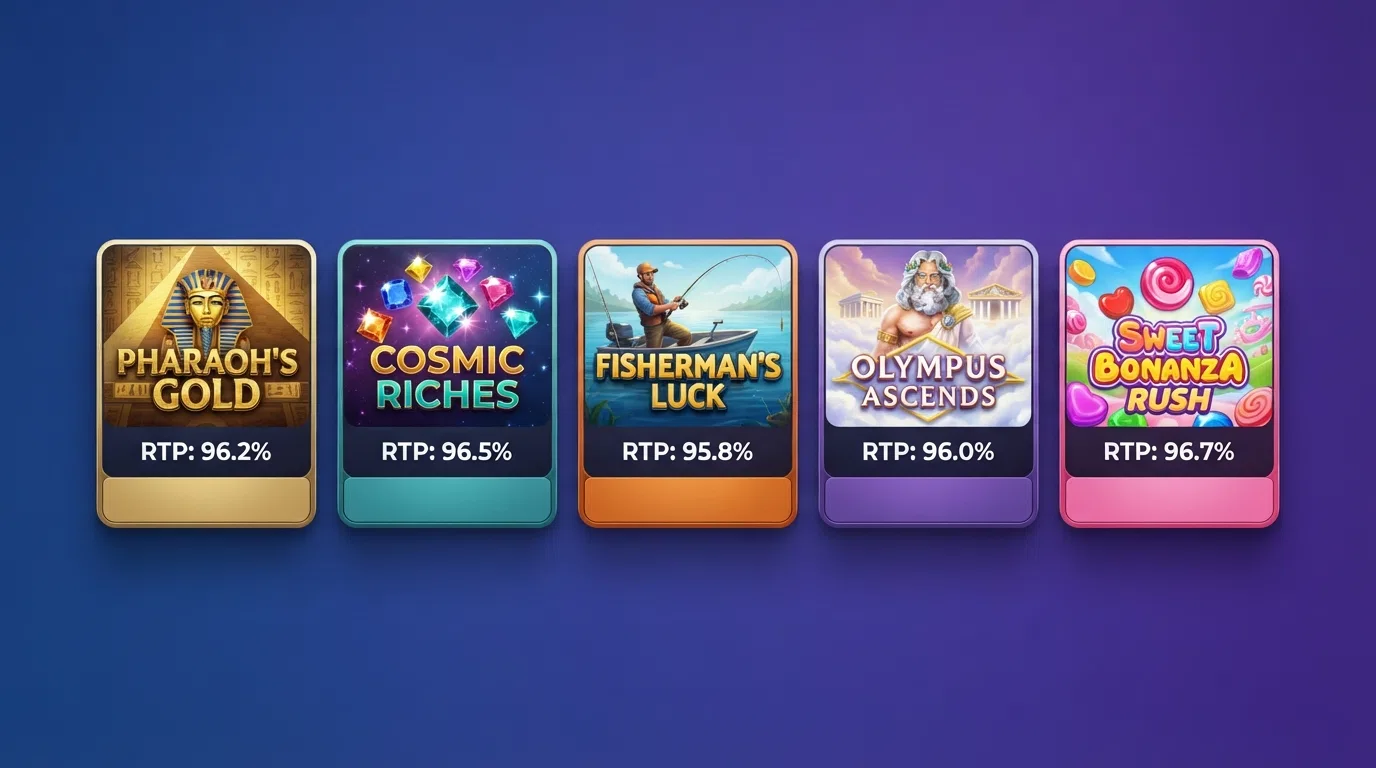
The five titles above sit at the top of the UK real cash slot market for return-to-player, and three of them come from Pragmatic Play. Big Bass Bonanza and Gates of Olympus are the two highest-RTP games in the set, and both are also the slot attached to several of the welcome offers further down this page — that is not a coincidence, since a 96.71% RTP makes the wager-free spin mechanics of those offers genuinely worth claiming. Sweet Bonanza’s 21,100× max win is the largest on the list, but the volatility is high and the route to that figure is a bonus round that triggers rarely. Starburst at 96.09% is the outlier: low volatility, small maximum payout, and a game you play for the steady session rather than the long shot. Book of 99 (Relax Gaming) holds the UK market’s ceiling at 99% RTP, but its availability is operator-specific and most of the featured set does not carry it.
What Actually Moves the Needle: RTP, Volatility and the 2.5-Second Rule
RTP is theoretical and long-run. A slot that returns 96.21% over millions of spins will not return 96.21% in any given session, and a player who quits after fifty spins has no statistical claim on anything close to the long-run number. The figure is a contract between the game and the operator: over enough rounds, the slot will keep 3.79% on average. The session you are actually playing is one of the millions the contract is averaged over, and whether you are on the lucky side or the unlucky side of that average is the question no RTP figure can answer.
Volatility is what changes the shape of the session. A low-volatility slot pays small amounts often, and a session of 200 spins on Starburst will probably see 60 to 80 of those spins return something. A high-volatility slot pays rarely: 200 spins on Sweet Bonanza or Gates of Olympus will probably return almost nothing for the first 100, and then the bonus round either fires or it does not. The two profiles appeal to different players, and choosing the wrong one for your session length is the most common way the house edge compounds into real losses — not because the RTP is different, but because a player who runs out of bankroll before the volatility evens out is mathematically certain to lose more than the long-run average.
The 2.5-second minimum cycle is the third number, and it is the one the marketing pages do not mention. You cannot hammer the spin button and accelerate a session; the game will not let you. The fastest legal rate is 24 spins per minute, and at £5 a spin that is £720 a minute wagered — a pace that, in practice, the £150 financial vulnerability check and the deposit limit you set before your first deposit are the things standing between you and an unmanageable session. The 2.5-second rule is also the reason the “wager-free spin” offers further down this page are not as generous as they read: at 24 spins per minute, even a 200-spin allocation takes roughly 30 minutes to clear.
Best UK Real Cash Casino Sites: 2026 Compared
| Operator | UKGC Licence | Welcome Bonus | Free Spins | Wagering | Game Providers |
|---|---|---|---|---|---|
| Paddy Power Games | Active | 60 no-deposit spins + 200 on deposit | 60 + 200 | 0× | Playtech, NetEnt, Pragmatic Play, Evolution, Blueprint |
| bet365 Games | Active | Up to 500 spins over 20 days | Up to 500 | 0× | Playtech, NetEnt, Microgaming, Pragmatic Play, Evolution |
| PlayOJO | Active | 50 spins on Big Bass Bonanza | 50 | 0× | NetEnt, Pragmatic Play, Play’n GO, Evolution, Microgaming |
| Sky Vegas | Active | 200 spins on £10 spend | 70 + 20 + 200 | 0× | NetEnt, Pragmatic Play, Evolution, Blueprint, IGT |
| BetMGM Casino | Active | 100% match to £50 + up to 200 spins | 125–200 | 10× (bonus) | Evolution, NetEnt, Pragmatic Play, Play’n GO, Microgaming, Red Tiger |
| Grosvenor Casinos | Active | 100% deposit bonus + 100 spins | 100 | — | IGT, Evolution, Novomatic, NetEnt, Playtech, Greentube |
| LeoVegas | Active | 50 spins on Big Bass Splash | 50 | 0× | NetEnt, Evolution, Play’n GO, Pragmatic Play, Microgaming |
| Ladbrokes | Active | 100–200 spins on £10 bet | 100–200 | 0× | Playtech, NetEnt, Evolution, IGT, Blueprint, Red Tiger |
| bet365 Casino | Active | Up to 500 spins over 20 days | Up to 500 | 0× | Playtech, NetEnt, Microgaming, Pragmatic Play, Evolution |
| MrQ | Active | Zero-wagering site-wide | — | 0× | Pragmatic Play, Play’n GO, NetEnt, Big Time Gaming, Evolution |
Every operator in the table holds an active GB operating licence on the UK Gambling Commission’s public register. The register, last refreshed in late July 2026, is the only authoritative source for licence status; a brand not on the register is operating illegally in Great Britain, and no offer of “free spins” or “matched deposits” changes that. The comparison above ranks the ten operators on welcome offer shape, free-spin count, wagering terms and provider mix — the four dimensions a player comparing real cash casino games is actually choosing between.
The wagering column is where the comparison bites. Seven of the ten featured operators carry 0× wagering on free-spin winnings, meaning the spin winnings are paid as cash. BetMGM is the one site on the list that runs a deposit-match bonus with wagering: a £50 match at 10× is the most you can be asked to turn over under the January 2026 cap. Grosvenor’s specific multiplier was not published on the promotional pages reviewed, so the cell reads as a dash — but the UKGC’s 10× cap is the legal ceiling, and any number above that on a UK-licensed site would be a breach.
Paddy Power Games — 60 No-Deposit Spins, Zero Wagering
Paddy Power Games is the only featured operator offering a genuine no-deposit allocation that pays cash. Sixty free spins land on registration with no deposit required, and the winnings carry 0× wagering — they are withdrawable from the moment they credit. A further 200 spins unlock on a £10 deposit and a £10 wager, also at 0× wagering and at £0.10 per spin, with seven days from registration to use them across Paddy’s Mansion Heist and a selection of other Flutter-platform slots. The brand is operated by Flutter Entertainment plc under an active UKGC licence, and the platform draws on the Flutter provider set: Playtech, NetEnt, Pragmatic Play, Evolution and Blueprint.
The no-deposit tier is the part that matters. Every other featured operator with a “free” allocation either asks for a deposit before the spins credit (bet365 Games, PlayOJO, LeoVegas, MrQ) or bundles the free spins with a verification step (Sky Vegas). Paddy Power’s 60-spin registration offer is the only one in the set that costs nothing to try and that pays what it wins. That is the verdict: for a player who wants to test a UK-licensed real cash casino without putting any money in, Paddy Power Games is the only entry in the table where that is possible.
bet365 Games — Up to 500 Wager-Free Spins Over 20 Days
bet365 Games runs the largest free-spin pool in the featured set, with a prize-selection mechanic that awards spins in batches of 5, 10, 20 or 50. The player picks ten times over 20 days, and the total depends on which batches come up. The headline “up to 500 spins” is the ceiling, not the floor — the average selection lands closer to 100 to 150 spins across the ten picks. All winnings carry 0× wagering, so whatever the picks return is paid as cash. The qualification is £10 in lifetime deposits, not a per-offer deposit, which means a returning bet365 customer who has previously deposited ten pounds or more qualifies without a new deposit.
The licence sits with Hillside (New Media) Limited, an active UKGC operator. The provider mix spans Playtech, NetEnt, Microgaming, Pragmatic Play, Evolution and bet365’s in-house originals. Validity runs 30 days from registration, with 24 hours to make each individual selection once the window opens — miss a selection and the next day’s batch is the only replacement. The verdict: for a player with an existing bet365 account, the 30-day window and the lifetime-deposit trigger make this the easiest large allocation to claim. For a new customer, the prize-selection mechanic means the headline number is aspirational, and the realistic return sits well below 500 spins.
PlayOJO — 50 Wager-Free Spins on Big Bass Bonanza, No Max-Win Cap
PlayOJO offers 50 free spins on Big Bass Bonanza — the 96.71% RTP Pragmatic Play title — with zero wagering on the winnings and no cap on the amount you can withdraw. There is no max-win limit and no playthrough, which is the site’s pitch. The qualification is a £10 minimum first deposit, and the offer is credited after that deposit clears. The operator is Skill On Net Limited, an active UKGC licensee, and the platform claims 7,000+ games across NetEnt, Pragmatic Play, Play’n GO, Evolution and Microgaming.
The “no max-win cap” line is the part that distinguishes PlayOJO from most of the set. Several UK-licensed sites do impose a cap on free-spin winnings even when the wagering is 0×; PlayOJO’s policy is to pay whatever the spins return. The downside is the modest 50-spin allocation at £0.10 each — a £5 total spin value before any winnings — and the absence of a no-deposit tier. For a player depositing £10 and looking to extract maximum slot value from a first session on a high-RTP title, PlayOJO offers a premium choice, with no cap on the winnings from its wager-free spins.
Sky Vegas — 200 Free Spins on £10 Spend, No Wagering
Sky Vegas splits its allocation across three tiers: 70 free spins on registration with no deposit required, 20 more spins after identity verification, and a final 200 spins on £10 of real-money spend within 30 days of registration. All tiers carry 0× wagering, and the spins are issued at £0.10 across a selection that includes Starburst. The free-spin expiry is 7 days from credit, which is tight. The operator is Bonne Terre Limited, part of the Flutter group, and the licence is active on the UKGC register.
The 70 registration spins are the no-deposit element, and they make Sky Vegas the second of the two featured operators with a genuinely free tier (alongside Paddy Power Games). The verdict: the 7-day expiry makes this a time-sensitive offer; for a casual visitor, the expiry is a significant cost.
BetMGM Casino — 100% Match to £50 Plus Up to 200 Free Spins
BetMGM Casino is the only featured operator running a deposit-match bonus alongside its free spins. A 100% match up to £50 doubles the first deposit, and between 125 and 200 free spins on Big Bass Splash (96.71% RTP) credit at £0.10 each. The deposit is subject to 1× wagering before any bonus funds release, and the bonus itself is then subject to 10× wagering — the maximum the UKGC permits under the January 2026 cap. The activation window is 7 days from registration, with a 3-day expiry on the bonus funds once credited. The licence sits with LeoVegas Gaming plc in partnership with MGM Resorts, and the provider mix is the deepest in the set: Evolution, NetEnt, Pragmatic Play, Play’n GO, Microgaming and Red Tiger.
The calculation in the section on bonus value below shows that a £50 match at 10× wagering on a 96% RTP slot costs roughly £20 in expected losses. That is the trade for the matched deposit: the spins are 0× on the spin winnings, but the bonus funds carry a real playthrough cost. The verdict: for a player who plans to play through the bonus and withdraw within a week, BetMGM is the strongest deposit-match in the featured set. For those prioritising a wager-free experience, other operators on this list provide a more direct path.
Grosvenor Casinos — 100% Deposit Bonus and 100 Free Spins
Grosvenor Casinos is the online face of the UK’s largest land-based casino chain, operated by The Rank Group under a single UKGC licence that covers both the high-street estate and the online platform. The welcome offer pairs a 100% deposit bonus with 100 free spins, though the specific wagering multiplier and per-spin value were not stated on the promotional pages reviewed. The 10× cap is the legal ceiling for any UK-licensed site, so the absence of a published number is not a red flag — it is a gap in the public material.
The provider mix is the part of the offer that is concrete: IGT, Evolution, Novomatic, NetEnt, Playtech and Greentube — a line-up that brings the Novomatic and Greentube titles you do not see on most UK-licensed sites. The verdict: for a player who already knows the Grosvenor brand from the high street and wants the same operator online, this is the natural entry. The welcome offer is competitive on shape; the lack of published wagering detail means the player should verify the terms on the operator’s own page before claiming.
LeoVegas — 50 Wager-Free Spins on Big Bass Splash
LeoVegas offers 50 free spins on Big Bass Splash (96.71% RTP, Pragmatic Play) for a £10 minimum deposit, with 0× wagering on the spin winnings. The deposit carries a 1× wagering requirement, the spins expire 3 days after crediting, and PayPal deposits are explicitly excluded from the welcome offer. The operator is LeoVegas Gaming plc, an active UKGC licensee, and the platform carries 3,000+ games from NetEnt, Evolution, Play’n GO, Pragmatic Play and Microgaming.
The PayPal exclusion is the detail that matters. Several UK players default to PayPal for online gambling, and at LeoVegas a PayPal deposit does not trigger the 50 wager-free spins. The deposit still works, the games still play, but the welcome offer is forfeit. For a player using a debit card or Trustly, the offer is straightforward: 50 spins on a high-RTP slot, 0× wagering, £0.10 per spin. For a PayPal user, the offer is worth nothing.
Ladbrokes — Bet £10 Get 100–200 Free Spins, No Wagering
Ladbrokes runs a “bet £10, get free spins” welcome offer with the spin count ranging from 100 to 200 depending on the active promotion. The 200-spin variant carries 0× wagering on the spin winnings, and the slots are drawn from the Entain platform’s catalogue: Playtech, NetEnt, Evolution, IGT, Blueprint and Red Tiger. The operator is Entain plc, trading through LC International Limited under an active UKGC licence. The specific eligible slot title and the per-spin value were not stated in the promotional material reviewed.
The range is the issue. A “100–200” allocation is two different offers sharing a landing page, and the player who claims at the lower end gets half the headline value. The verdict: if you have checked the current promotion on the Ladbrokes site before registering, the 200-spin no-wagering variant is highly competitive; otherwise, the outcome remains uncertain.
bet365 Casino — Up to 500 Wager-Free Spins
The casino-branded entry at bet365 mirrors the structure of bet365 Games further up the table: up to 500 free spins via 10 prize selections of 5, 10, 20 or 50 spins each, awarded over 20 days. The 0× wagering applies, the £10 lifetime-deposit trigger applies, the 30-day claim window applies, and 24-hour selection deadlines apply. The licence, the provider set and the qualifying conditions are the same as the Games entry. The difference is the front door: the casino-branded page routes into a different lobby with a different default slot selection.
The verdict: for most players, the difference between this and the Games entry is not material. If you already have a bet365 Casino account, claiming through this page avoids cross-brand confusion. It remains a high-value allocation for a player with existing lifetime deposits.
MrQ — Zero Wagering, Site-Wide, as a Permanent Policy
MrQ is the only featured operator where zero wagering is not a welcome-offer feature but a permanent site-wide policy. Every promotion on the site carries 0× wagering, every bonus win is withdrawable cash, and the headline offer of wager-free spins on first deposit is the first instance of a rule the rest of the site follows. The specific spin count and slot title vary by active promotion, which is the trade for the policy: MrQ’s offer changes more often than the others on this list, and a player checking the site today may find a different allocation than a player who checked last week. The operator is Lindar Media Limited, an active UKGC licensee, and the platform carries 900+ games from Pragmatic Play, Play’n GO, NetEnt, Big Time Gaming and Evolution.
The permanent zero-wagering policy is the strongest structural advantage in the featured set. The trade is the smaller game library (900 versus 7,000 at PlayOJO) and the variable welcome offer. For a player who values the zero-wagering principle above the size of the spin allocation, MrQ is the right entry on the table.
Why Your 2026 UK Casino Bonus Is Smaller Than It Looks
Every UKGC-licensed bonus has carried a 10× wagering ceiling since 19 January 2026, and that single line is the most significant change to the UK bonus market in a decade. A £50 bonus that would have demanded £3,250 in playthrough at the old 65× standard now demands £500, which is still a real cost but is no longer the closed shop it used to be. The cap is part of the Licence Conditions and Codes of Practice, and the Commission has confirmed it applies to every UK-licensed site, with no exceptions and no grandfathering for older promotional mechanics. A second reform at the same time banned mixed-product promotions — the “bet £10 on football, get 50 free spins” bundle is no longer a legal offer at a UK-licensed site.
That is the part of the bonus the small print now states. The part the small print cannot state is the expected loss, which is what a bonus actually costs. The calculation section further down works through a £50 match bonus at 10× wagering on a 96.21% RTP slot and arrives at a figure of around £20 in expected losses — the cost of turning the bonus into withdrawable cash. That figure is not a marketing number; it is a statistical estimate, the same way the RTP itself is a statistical estimate, and it is the closest thing to a “real price” the player can put on a welcome offer. The £50 bonus is worth £50 on the promotional page and worth roughly £30 net after the expected loss, which is the gap this section is named for.
No-Deposit Bonuses: Free Play That Can Pay Real Cash
A no-deposit bonus awards spins or bonus cash on registration, before any deposit is made. Paddy Power Games is the clearest example in the featured set: 60 free spins land on registration with no deposit required, and the winnings are paid as cash with 0× wagering. Sky Vegas is the other: 70 registration spins before deposit, also at 0× wagering, with a 7-day expiry. Beyond those two, the UK market’s “no-deposit” labels often refer to a free-spin allocation that credits only after a deposit is made, or to bonus cash that converts to withdrawable funds only after a deposit triggers KYC.
The £10 deposit trigger is the most common pattern, and the 10× wagering cap applies to no-deposit bonuses just as it does to deposit bonuses. A player who claims a no-deposit offer should expect the same KYC checks, the same 10× ceiling on any bonus funds, and the same withdrawal conditions as a deposit bonus. The “no deposit” label is true on the way in and the same as every other offer on the way out.
Deposit Free Spins: What “Wager-Free” Actually Delivers
“Wager-free” means the winnings from the free spins are paid as withdrawable cash, with no playthrough on the spin result. It does not mean the spins are free, and it does not mean the deposit that triggered the offer is free. Seven of the ten featured operators carry 0× wagering on their free-spin winnings: bet365 Games, PlayOJO, Sky Vegas, LeoVegas, Ladbrokes, bet365 Casino and MrQ. A typical trigger is a £30 minutesimum deposit, and a typical per-spin value is £0.10, which at 24 spins per minute means an allocation takes roughly 30 minutes to clear — that is the market standard across the UK-licensed set.imum deposit, and a typical per-spin value is £0.10, which is the market standard across the UK-licensed set.
The deposit is the trade. A 200-spin allocation at 0× wagering is worth whatever the spins return in cash, but the player has put £10 in to claim it, and that £10 is the same £10 they would have deposited to play anyway. The offer is genuinely valuable when the spins are on a high-RTP slot — PlayOJO’s 50 spins on Big Bass Bonanza at 96.71% is the cleanest example, since a high RTP makes a 0× wagering spin materially more likely to return a real amount. The same allocation on a 94% slot is worth less in expectation, and the difference is exactly the kind of detail a player comparing offers should check.
The 10× Wagering Cap and Other Bonus Terms the Small Print Hides
The 10× cap is the new rule, but it sits inside a wider set of terms the small print now applies. Mixed-product promotions are banned, so an operator cannot ask a player to bet on a football match to qualify for a casino free-spin allocation. Marketing opt-in is per product and per channel, and the boxes are unticked by default from May 2025 — a player who has not actively ticked the casino bonus box does not receive casino offers. Bonus validity windows vary from 3 days (BetMGM, LeoVegas) to 30 days (bet365 Games, bet365 Casino), and a 3-day window is a real constraint: a player who registers on a Friday and waits until Monday has lost the spins.
Before the cap, wagering of 35× to 65× was the market norm, which is what made a £50 bonus functionally worthless to most casual players — turning over £3,250 at 0.5% expected loss per spin is hours of play with a high probability of busting the bankroll before the playthrough clears. The 10× cap reduces that turnover to £500, which is a real number a player can clear in a single session. The reform has moved UK bonuses from “marketing fiction” toward “modest real value”, and the calculation below shows what that real value looks like once the expected loss is taken into account.
How to Claim a UK Real Cash Casino Bonus Without Losing the Value
A bonus at a UK-licensed site is a contract with a price, and the price is the expected loss from the wagering. Four checks before claiming keep the contract on the player’s side. First, the wagering multiplier: 0× is best, 10× is the legal maximum, and anything above 10× on a UK-licensed site is a breach to be reported. Second, the validity window: a 3-day expiry on spins means the player must use them in three days or lose them, and that is a constraint worth knowing before registering on a Friday night. Third, the eligible games: playing an excluded title while a bonus is active may void the bonus and any winnings, so the eligible-game list is worth reading before the first spin. Fourth, the expected loss: a £50 bonus at 10× wagering on a 96% RTP slot costs roughly £20 in expected losses, which is the figure to subtract from the headline bonus value before deciding the offer is worth claiming.
The deposit-to-withdrawal path is the same at every UK-licensed site: deposit, claim, play through the wagering, withdraw to the same payment method. The path stalls most often at KYC — the verification check is the longest predictable delay, and a player who has uploaded documents before claiming the bonus will clear it faster than a player who uploads at withdrawal. The reverse-withdrawal ban means the operator cannot offer to undo the cash-out once it has been requested, which is the regulatory fix for a long-standing pattern in which operators tempted players to keep playing by reversing their withdrawal.
How Quickly UK-Licensed Casinos Send Withdrawals to Your Bank
Withdrawal speed at a UK-licensed casino is set by the payment method, not by the operator brand. E-wallets clear fastest, debit cards take longest, and the operator’s internal processing time sits on top of the payment rail. The “instant withdrawal” marketing claim means the operator processes the request immediately — the payment rail still takes hours to days, and the difference between a fast and a slow casino is usually the internal processing window, not the rail itself.
KYC verification is the gate every first withdrawal has to pass. The check is a licensing condition, not an operator policy, and it applies whether the withdrawal is £10 or £10,000. A player who has verified identity at registration (uploaded a photo ID and proof of address before depositing) will clear the check faster at withdrawal than a player who deferred verification to the cash-out point. The reverse-withdrawal ban means a player who has asked for a withdrawal cannot be talked out of it by the operator’s “are you sure?” prompt — once the request is in, the cash-out proceeds.
Withdrawal Processing Times by Payment Method
E-wallets — PayPal, Trustly, Skrill — are the fastest route once KYC is cleared, with most operators processing the withdrawal the same day and the funds appearing in the e-wallet account within hours. PayPal is the most widely supported across the featured set, and Trustly has expanded significantly in the UK over the last two years. Skrill is less universal among the ten featured operators but is available at several. Debit cards — Visa and Mastercard — are the slowest of the three common rails: Visa Fast Funds can deliver same-day payouts at participating banks, but standard debit card withdrawals take 1 to 3 working days from the operator’s release. Open banking and direct bank transfer sit in the same 1-to-3-working-day band, with no widely deployed instant-withdrawal rail in the UK casino market at the time of writing.
The operator’s internal processing window sits on top of all of this. A 24-hour pending period is common — the operator holds the withdrawal for 24 hours before releasing it to the payment rail — and a player who requests a withdrawal late on a Friday night may not see the funds until the following Tuesday. The fastest real-world UK withdrawal is an e-wallet payout at an operator with no pending period, which clears in a few hours; the slowest is a debit card withdrawal at an operator with a 24-to-48-hour pending period, which clears in 3 to 5 working days.
Payout Terms, KYC and the Caps No One Mentions
KYC is the term every UK player meets at the first withdrawal. The operator must verify your name, address and date of birth, and the check is a licensing condition under the LCCP. The verification is one-off: a player who has cleared KYC at one UK-licensed operator has not cleared it at another, and each operator runs its own check against the documents the player uploads. Source-of-funds checks sit on top of KYC: at higher withdrawal thresholds the operator may ask for bank statements or payslips to confirm the funds being deposited are legitimate, and this is a regulatory requirement rather than operator obstruction.
Withdrawal minimums and maximums per transaction vary by operator and are rarely published on the landing page. A typical minimum is £10, and a typical maximum is several thousand pounds per transaction; the player who needs to move more than the per-transaction cap usually has to split the withdrawal across multiple requests. Reverse withdrawals are permanently banned at UKGC-licensed casinos — once a withdrawal has been requested, the operator cannot offer to cancel it, and the cash-out proceeds regardless of any retention offer the operator might have made. The reverse-withdrawal ban is one of the older reforms on the rulebook, in force since October 2021, and it is the single most effective piece of player-protection engineering in the UK market.
Licensed Casino Apps vs. Mobile Browser: What British Customers Gain from Each
A native casino app and a mobile browser deliver the same game catalogue, the same RTP, the same bonus terms and the same UKGC protections — the games are not different products in different wrappers. The choice between the two is a choice about convenience, not quality, and most UK operators offer both so the player can pick the one that fits the moment. A native app adds push notifications, biometric login, and offline access to the account page; a mobile browser adds nothing to install, nothing to update, and the ability to switch devices without an app store account.
App store ratings are the one signal a browser-only operator cannot offer. A 4.6-star average across 50,000 reviews on the Apple App Store is a real data point about the player experience at that operator; a browser-only site has no equivalent. The ratings are not the whole picture — app store reviews are skewed toward complaints, and a 4.2-star average at a large operator is not worse than a 4.6 at a small one — but they are a public quality signal a player can check in 30 seconds.
Native Casino Apps on iPhone and Android
Native apps support Face ID and fingerprint login, which is faster and more secure than a password entry on a phone keyboard. Push notifications alert the player to bonus expiry, withdrawal completion and the arrival of new promotions — a browser tab cannot replicate this, and a player who misses a 3-day bonus window because there was no notification has lost real value. The app store listing carries the public rating, the review count, the operator’s support contact and the most recent app version, all of which are signals a player can use to evaluate the operator before downloading.
The download is from the Apple App Store or Google Play, never from the operator’s website. A link on the operator’s site routes to the store, and the store handles the install. A player who sees a “.apk” file or a “download our app directly” link on a UK-licensed casino site is looking at a different product — and probably not a UKGC-licensed one.
Browser-Based Mobile Casinos: No Download, Same Real Cash
Responsive HTML5 means every UKGC-licensed casino works in a mobile browser without an app download, and the experience is not a stripped-down version of the desktop site. The full game catalogue, the full bonus set, the full KYC flow and the full withdrawal process all work in Chrome or Safari on a phone. The main trade-off is the absence of push notifications and biometric login, which is a convenience gap rather than a functionality one. A player who plays occasionally and does not want a casino app on their phone gets the same real cash experience in a browser tab.
The browser route is also the route that survives device changes. A player who switches from iPhone to Android does not have to migrate an app account — the browser is the same browser. The operator updates the site, and the player sees the new version on the next visit, with no update cycle and no app store approval delay. For a player who values mobile-first gaming and does not want to manage app updates, the browser-based experience provides full functionality without the commitment of a download.
Mobile Slots for Real Cash: What Changes on a Small Screen
All UK slot rules apply identically on mobile. The £5/£2 stake caps, the 2.5-second minimum spin cycle, the auto-play ban and the losses-disguised-as-wins ban are all enforced at the game-engine level, and the same rules run on a phone as on a desktop. Slot interfaces are designed mobile-first at most providers: the spin button sits within thumb reach in portrait mode, the paytable collapses into a swipe-up panel, and the balance and bet size are pinned to the top of the screen. A slot’s RTP is the same on every device — the 96.21% on Book of Dead does not change because you are playing on a phone.
Session-length tools are mandatory on mobile and desktop. Reality checks — the pop-up at a set interval showing session time and net position — appear on the phone screen at the same frequency as on the desktop, and the time and net-position display sits at the top of the slot during play. The regulation is identical, and so is the experience.
UK Gambling Commission Licensing — What It Protects When You Deposit and Spin
The UK Gambling Commission is the sole statutory regulator for remote casino gambling in Great Britain, and a UKGC licence is the only licence that authorises an operator to take real cash bets from British customers. A Curaçao, Malta or Gibraltar licence is not a substitute; operating without a GB licence is a criminal offence under section 33 of the Gambling Act 2005, carrying up to 51 weeks’ imprisonment and an unlimited fine. The point-of-consumption reform of 2014 closed the loophole that let operators based outside the UK serve British customers under their home-jurisdiction licence, and every operator that takes a real cash deposit from a player in Great Britain today holds a GB operating licence or is operating illegally.
The Commission’s three licensing objectives, set out in section 1 of the Gambling Act 2005, are: keeping crime out of gambling, ensuring gambling is fair and open, and protecting children and vulnerable persons. Every licence condition and code of practice the Commission publishes is an operationalisation of one of those three objectives, and the operator-specific licence conditions on every UKGC-licensed casino are the binding rules that the Commission enforces.
How the UKGC Licence Works and Why It Is the Only One That Counts
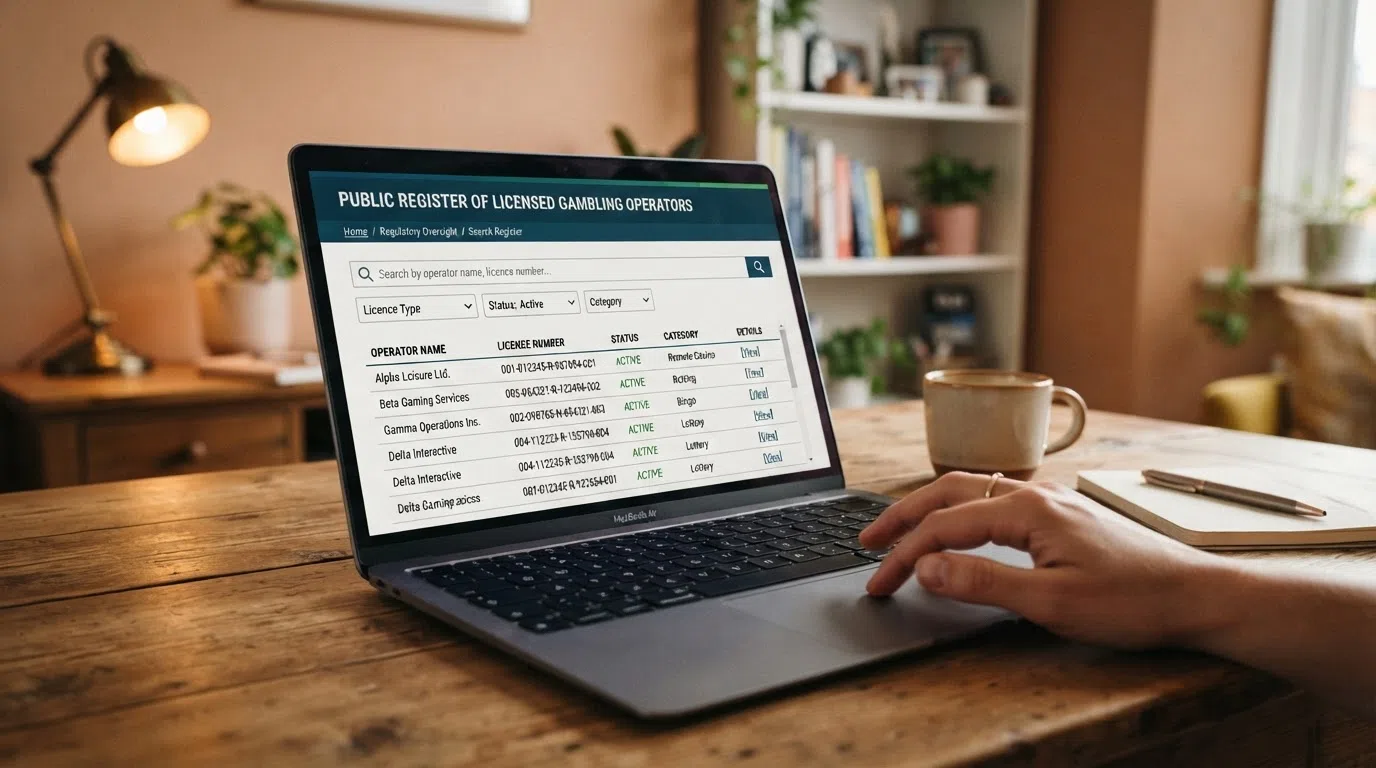
The UKGC public register lists every active licence holder — operator, key personnel, software — and is freely searchable at the Commission’s website. The register was last updated in late July 2026 and contained 2,663 records. The register is the single authoritative source for licence status, and a player who wants to verify a brand before depositing can search the operator name and read the licence type, the operating address and the current status (active, suspended, revoked). A brand not on the register is operating illegally in Great Britain, and no offer of “free spins” or “matched deposits” changes that.
The licence covers the operator, its key personnel and the software it runs. The LCCP (Licence Conditions and Codes of Practice) and the RTS (Remote Technical Standards) are the binding technical and behavioural standards attached to every licence, and the Commission can fine, suspend or revoke a licence for breach. Enforcement is active and public: the Commission publishes enforcement notices, financial penalties and settlement agreements on its website, and the action taken against a major operator is a matter of public record.
UKGC-Licensed vs. Offshore Operators: The Protections You Lose
An unlicensed offshore operator has no UKGC oversight, no GAMSTOP coverage, no alternative dispute resolution route and no British consumer-law protection. A player who has a complaint against a UK-licensed operator can refer it to an ADR provider, escalate to the Commission if ADR fails, and pursue the matter under UK consumer law. A player who has a complaint against an offshore operator has none of those routes: the operator is outside UK jurisdiction, the Commission cannot enforce a ruling, and the player’s only recourse is the court of the operator’s home jurisdiction, which for a Curaçao-licensed site means a Curaçao court.
The Commission’s enforcement against offshore operators is disruption-based. Between April 2024 and June 2025 the Commission issued 3,140 disruption notices and referred 447,778 URLs to search engines for delisting; 287,961 of those URLs were removed. Statutory ISP blocking powers have been proposed but are not yet enacted, and offshore sites remain technically accessible from a UK IP address. There is no established penalty for a UK player who chooses to gamble on an unlicensed site — the player is not committing an offence — but the player loses every regulatory protection the UK system provides, and that loss is the risk.
The £5 and £2 Stake Limits, Credit Card Ban and Other Rules That Shape Every Spin
Online slots in the UK are capped at £5 per game cycle for adults aged 25 and over, and £2 for adults aged 18 to 24. Two adults at the same casino on the same slot can face different maximum bets, and the cap is enforced at the operator level through age and identity verification. The cap applies to total staked within a game cycle, not to a single spin button press — but since a game cycle in a UK slot is a single spin, the cap is effectively a per-spin maximum. The credit card ban, in force since April 2020, blocks all credit-card deposits and all credit-card-funded e-wallet deposits at every UK-licensed operator.
Auto-play, turbo spin and losses disguised as wins are all banned, and the 2.5-second minimum spin cycle means a player cannot run a slot faster than 24 spins per minute. Reverse withdrawals are permanently banned, and the player who requests a cash-out cannot be talked into reversing it. These are the rules that physically constrain every real cash slot session in the UK, and they apply at every UK-licensed operator without exception.
GAMSTOP, Financial Vulnerability Checks and Your Rights as a Player
GAMSTOP is the mandatory national online self-exclusion scheme, in force since March 2020, and every GB-licensed operator must participate. A player who registers with GAMSTOP is excluded from all GB-licensed online gambling for the chosen period — six months, one year, five years, or five years with auto-renewal — and the exclusion cannot be cancelled early. The point of GAMSTOP is its irrevocability: the nuclear option, not a cooling-off tool.
Financial vulnerability checks are mandatory at a £150 net deposit threshold in a rolling 30-day period, in force since February 2025. The check uses publicly available data only — it is not a credit check — and the operator runs it at the threshold and again at higher thresholds. From October 2026 the operator must prompt a player to set a deposit limit before the first deposit: decreases apply immediately, increases are subject to a cooling-off delay. The statutory levy of 1.1% of gross gambling yield, in force since April 2025, funds NHS treatment, prevention and research; the operator pays, not the player.
Responsible Gambling: The Controls Every UK Player Gets by Law
Every UKGC-licensed operator must provide deposit limits, reality checks and time-out facilities. These are regulatory requirements under the LCCP and RTS, not optional extras, and the operator’s account menu carries the controls in the same form at every site. A player who wants to set a deposit limit, take a 24-hour time-out, or activate a reality check at 30-minute intervals can do so in the account settings at any UK-licensed casino, and the change takes effect immediately for a decrease or after a cooling-off delay for an increase.
The prevalence of problem gambling in the UK is low but not negligible. The most recent NHS survey puts problem gambling (PGSI 8+) at 0.4% of adults in England and at least moderate-risk gambling (PGSI 3+) at 1.6%. The highest rate is in the 25–34 age band, where 3.5% fall into the at-risk categories. The numbers are not large, but they are real people, and the help infrastructure behind the UKGC framework exists because the regulator concluded the market needs it.
Deposit Limits, Reality Checks and Time-Outs — Built Into Every UK Licence
Deposit limits must be prompted before the first deposit from October 2026, and the limit can be set as a daily, weekly or monthly ceiling. A decrease takes effect immediately; an increase is subject to a cooling-off delay (typically 24 hours to 7 days) so the player does not raise the limit in the heat of a losing session. A “gross deposit limit” — money paid in over a set period — is the only form of limit that can be called a “deposit limit” under the Remote Technical Standards; net-deposit and loss limits may also be offered, but they cannot be marketed as “deposit limits”.
Reality checks are pop-ups at a set interval (typically 30 or 60 minutes) showing session time and net position. The pop-up is mandatory, cannot be permanently dismissed, and reappears at the next interval. A time-out is a short self-exclusion from 24 hours to 6 weeks, set by the player in the account menu; the time-out locks the account for the chosen period and is shorter than a GAMSTOP exclusion, which carries a minimum period of six months. All three controls are LCCP requirements, and an operator that does not offer them is in breach of its licence.
Where to Get Help: GamCare, the National Helpline and NHS Treatment
The National Gambling Helpline is run by GamCare on 0808 80 20 133, free, 24 hours a day, 365 days a year, by phone, live chat and WhatsApp. GamCare is the main entry point for advice, self-assessment and referral to treatment, and the helpline is the first call for a player who is concerned about their own or someone else’s gambling. From April 2026, NHS England took commissioning responsibility for gambling-harm treatment in England, funded by the statutory levy; NHS referrals rose from 2,284 in 2023/24 to 4,355 in 2024/25, a near-doubling that reflects both increased demand and increased capacity.
GAMSTOP itself is reached at gamstop.co.uk or 0800 138 6518 (10am to 8pm, 7 days), and registration takes a few minutes. The exclusion cannot be cancelled early, so registration is a serious step. GambleAware funds prevention and treatment research, Gamblers Anonymous UK runs peer-support meetings, and Gamban is a paid service that blocks gambling sites and apps on a personal device — useful for a player who wants a hard technical block on top of a self-exclusion.
Frequently Asked Questions
Are online casino games for real cash legal in the UK?
Yes, online casino games are legal in the UK provided they are hosted on a platform licensed by the Gambling Commission. These licensed sites are subject to strict regulations, including age verification, mandatory stake limits and fair-play standards, ensuring a secure environment for players within Great Britain.
What is the maximum I can stake on online slots in the UK?
Online slots are capped at £5 per game cycle for players aged 25 and over, and £2 for those aged 18 to 24. These stake limits, imposed by the Gambling Act 2005 (Operating Licence Conditions) (Amendment) Regulations 2025, are enforced across all UK-licensed operators.
How do I know if a UK online casino is licensed by the Gambling Commission?
You can verify any operator by searching their name on the Gambling Commission’s public register. Every site on this page has been cross-referenced with this register; an unlicensed brand does not offer the legal protections, such as GamStop or ADR, that are mandatory for UK-licensed casinos.
Do I pay tax on gambling winnings in the UK?
No, UK players do not pay income tax on gambling winnings. Betting duty was abolished for players in 2001, and the financial burden of gambling taxation, including the 40% Remote Gaming Duty and the statutory levy, rests entirely on the licensed gambling operators.
Can I play real cash casino games on my mobile phone?
Yes, you can play via mobile browser or a native app. Both methods offer the same game catalogue, RTP, and regulatory protections. Native apps provide added features like push notifications and biometric login, while mobile browsers allow for instant access without the need for downloads or store accounts.
The ten featured operators were selected from the UKGC public register of licensed gambling businesses, and every operator in the table holds an active GB operating licence verifiable on the Commission’s website. The selection criteria were the shape of the welcome offer (wager-free preferred, deposit-match noted where relevant), the wagering terms (0× weighted highest, 10× as the legal ceiling), the game-provider mix (breadth and the presence of major studios such as NetEnt, Pragmatic Play, Playtech and Evolution), the presence or absence of a genuine no-deposit component, and the clarity of the published terms. The ranking above is editorial, not algorithmic, and the order reflects the offer’s value to a representative UK player comparing real cash casino games in 2026.
Every operator was checked against the UKGC public register before being included. A brand not on the register would have been excluded regardless of the offer, because the rest of this page’s protections — GAMSTOP coverage, ADR, source-of-funds checks, the 10× wagering cap — depend on the UKGC licence being in force. The research that informed the ranking was conducted in 2026 using operator promotional pages, the UKGC register, and independent affiliate analysis; the register snapshot used was the late-July 2026 update of 2,663 records.
What UK Players Should Actually Do About Real Cash Casino Play in 2026
The UK licensed market in 2026 offers stronger player protections than at any point in its history. The 10× wagering ceiling, the £5 and £2 age-banded stake limits, the credit card ban, the mandatory deposit-limit prompt, GAMSTOP coverage, the 2.5-second minimum cycle, the reverse-withdrawal ban and the financial vulnerability check at £150 net deposit are all in force, and they sit on top of the basic licensing regime. None of these protections exist at an offshore operator, and a UK player who chooses an unlicensed site forfeits every one of them for a larger bonus or a wider game catalogue that the licensed market does not actually lack.
The bonus figure on the promotional page is almost never what the player keeps. The calculation section above works through a £50 deposit-match bonus at 10× wagering on a 96.21% RTP slot and arrives at roughly £20 in expected losses — the cost of turning the bonus into withdrawable cash. A £50 bonus is worth £50 on the page and worth around £30 net after the expected loss, and that gap is the single most important number a player comparing offers should be carrying in their head. The 0× wagering offers at seven of the ten featured operators close that gap entirely; the deposit-match offers do not.
The tools to control spend are in every UK-licensed account menu right now. Set a deposit limit before the first session, not after. The operator is required to prompt for one, and the limit can be tightened at any time. A player who has set a £10 daily deposit limit before registering at a new site has built in the single most effective harm-mitigation control the UK framework offers, and a player who has not set one is the one the framework was designed to reach. Play at a UKGC-licensed operator, claim a 0× wagering offer if the bonus matters, and treat the rest of the session as a paid entertainment product with a fixed ceiling — because the house always has an edge, and the only question is how much of it the player chooses to give back.
Casinos – fastestpayout-casinos-uk
Content created by the «fastestpayout-casinos-uk» team