
Malta-Licensed Online Casinos and the UK Player: the Real Picture
 Available in GB
An MGA-licensed online casino sounds like a regulatory seal of approval — and in most of Europe, it is. For a player sitting in Birmingham, Manchester or Cardiff, the picture is more complicated. The Malta Gaming Authority oversees the operator, but the Gambling Commission decides who may legally serve customers in Great Britain. The two regulators do not overlap, and the difference between them decides whether a UK player keeps every British safeguard or quietly loses most of them.

The one sentence every UK player needs before reading further: an MGA licence alone does not authorise serving GB customers. Any operator offering real-money gambling to players in Great Britain needs a UKGC licence as well, and that second licence is the one that brings GamStop, the 10× wagering cap, the statutory stake limits, and the UKGC complaints route.
This page is built around that distinction. The ten operators ranked below all hold active UKGC licences and have confirmed Malta ties. They are legal, GamStop-connected, and reviewed on the basis of welcome offer, licence standing, and standout feature. MGA-only casinos that accept UK players are discussed honestly in the regulatory section — they exist, but they are not legal for GB customers, and they are not ranked here.
Data current as of September 8, 2026, verified against the UK Gambling Commission’s public register and the Malta Gaming Authority’s public register and Dynamic Seal of Authorisation.
What a Malta-Licensed Casino Means — and What It Doesn’t — for UK Players
What a Malta-Based Online Casino Actually Is
An MGA-licensed casino is an operator authorised by the Malta Gaming Authority under the 2018 Gaming Act. The MGA is a Tier-1 European regulator that issues B2C (Business-to-Consumer) gaming service licences for casino, sports betting, live dealer, and poker products, alongside B2B licences for software providers. An operator holding an MGA B2C licence can run from a Maltese base and serve multiple international markets under one regulatory roof — every market that accepts MGA oversight in lieu of its own local licence.
The licence certifies that the operator has met the MGA’s standards on corporate fitness, software integrity, anti-money-laundering controls, segregation of player funds, and reporting. What it does not certify is suitability to serve any specific national market — including Great Britain. That decision belongs to the Gambling Commission, under section 33 of the Gambling Act 2005 and the point-of-consumption rule introduced by the Gambling (Licensing and Advertising) Act 2014.
Take Betway as a concrete example. Betway Limited holds MGA licence MGA/CRP/130/2006 — a B2C Gaming Service Licence, status “Licensed”, registered at 9 Empire Stadium Street, Gzira, Malta, verified via the MGA Dynamic Seal of Authorisation. That single number is what an MGA licence looks like on the register, and it is what the Dynamic Seal on the operator’s own site links back to.
Best and Top-Rated — What Those Labels Actually Mean for a UK Player
“Best Malta casino” is a phrase that appears on roughly half the affiliate pages ranking in this space. For a player in a market where MGA-only is enough, it can mean what it says. For a UK player, it does not. The metric that matters in Great Britain is not which operator has the slickest welcome offer or the deepest game library — it is whether the operator holds a UKGC licence at the point of consumption, because that licence is the legal gateway to GAMSTOP, to the 10× wagering cap, to the age-banded slot stake limits, and to the UKGC complaints and ADR (Alternative Dispute Resolution) route.
Every operator ranked on this page passes that filter. All ten hold active UKGC licences; nine have confirmed Malta ties through their own licence or through a parent group. The “best” label, in this context, is shorthand for the operators a UK player can use without losing the British protections they are entitled to — and the ranking is built around bonus shape, wagering tolerance, and standout feature rather than a single composite score.
The wider landscape contains many more MGA-licensed brands than the ten here. They sit on the MGA register, serve their home markets cleanly, and pose no problem to anyone. They become a problem only when they accept UK customers without holding a UKGC licence — because at that point the operator is committing a criminal offence under section 33 of the Gambling Act 2005, and the player loses every GB safeguard in the process.
Real-Money Play at MGA Casinos — the UK Player’s Position in 2026
Deposit and play mechanics at a dual-licensed casino — one with both MGA and UKGC licences — are functionally identical to those at any UKGC-only site. The cashier, the game lobby, the wagering interface, and the bonus mechanics all look the same to the player. The difference is in the regulatory layer beneath: when an operator holds both licences, the UKGC’s product-level rules apply on top of the MGA’s operator-level oversight.
That second layer is what brings the GB-specific features. Online slots carry statutory maximum stakes per game cycle: £5 for players aged 25 and over (in force from 9 April 2025), and £2 for players aged 18–24 (in force from 21 May 2025), imposed by SI 2025/215. Bonuses carry a hard 10× wagering ceiling and a ban on mixed-product promotional offers. From 31 October 2026, the operator must prompt every new customer to set a financial limit before the first deposit. None of these applies at a UKGC-only site any more than at an MGA-only site.
At an MGA-only casino accepting UK players, none of it applies. There is no UKGC-mandated stake cap, no 10× wagering ceiling, no deposit-limit prompt, no GAMSTOP coverage, and no UKGC complaints route. The casino may still apply sensible limits voluntarily — most do — but the player has no statutory recourse if something goes wrong. That is what the “MGA licence alone does not authorise serving GB customers” line means in practice at the cashier.
The Two-Regulator Reality — How the MGA and UKGC Stack Up for UK Players
Why Online Casinos Are Based in Malta — the Tax, the Law and the Talent
Malta did not become Europe’s iGaming capital by accident. Gambling has been regulated there since 2000, when the Lotteries and Gaming Authority was established; it was rebranded as the Malta Gaming Authority in 2015. The 2018 Gaming Act put a stable modern framework in place: B2C and B2B licence types, clear technical standards, and a tax regime designed to attract international operators.
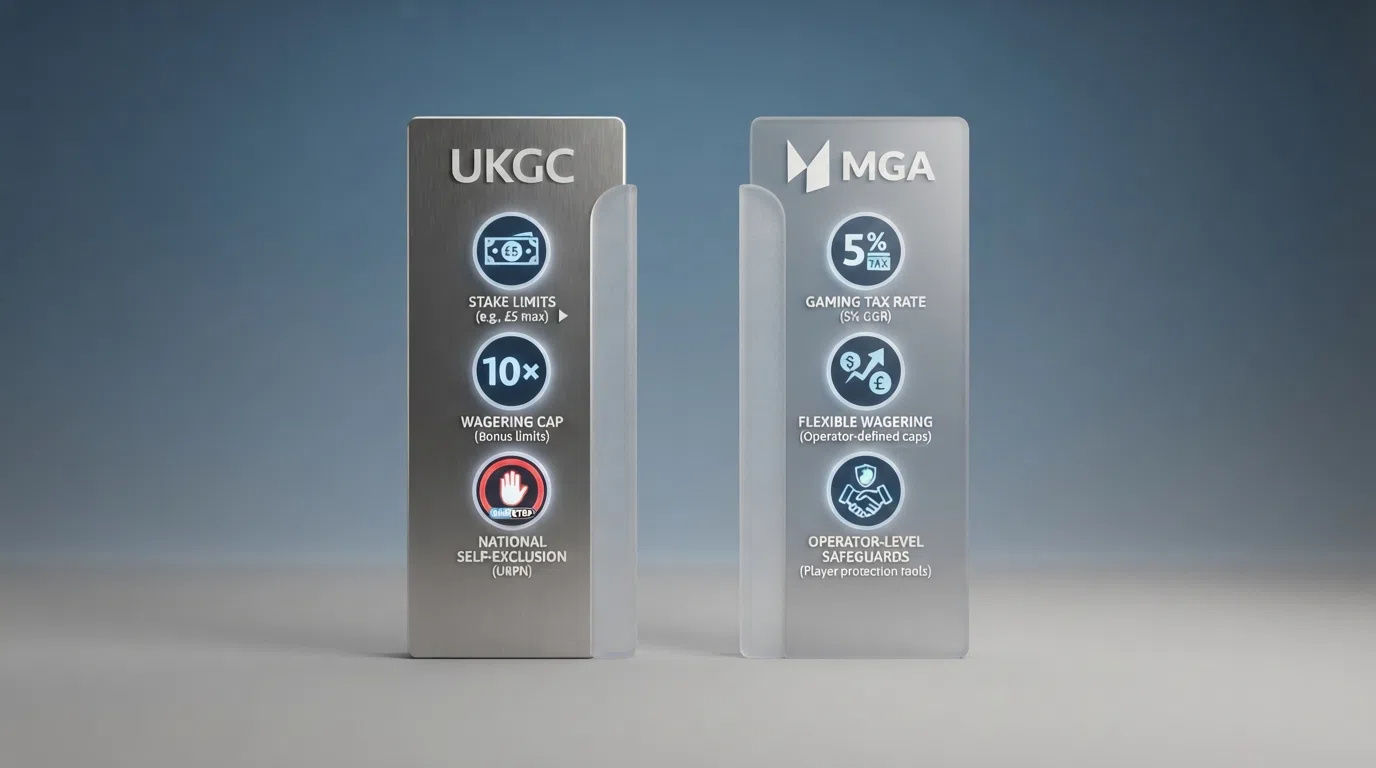
The headline rate is 5% of Malta-player revenue, but the composition matters. From 1 October 2026 the Type 1 casino rate rises to 15% and Types 2–4 to 10% — a meaningful shift for operator margins, though not yet enough to displace Malta as the European hub. Underneath the tax line sit three structural advantages: EU membership, an English-language common-law legal system that handles commercial disputes in a language operators actually use, and a deep local talent pool in compliance, payments, and product.
That last point shows up in the game lobby. Most of the global slot and live-casino providers — Evolution, NetEnt, Play’n GO, Games Global — hold MGA B2B licences and run their platform infrastructure through Malta. An operator licensed in Malta gets access to that supplier base with a single integration; an operator licensed anywhere else often has to license the same providers separately. The concentration is part of why MGA casinos routinely field catalogues that rival the UK’s largest brands.
MGA vs UKGC — the Two-Regulator Landscape for UK Players
The UKGC is the licensed gambling sector’s most paternalistic regulator: hard product caps, mandatory affordability checks, statutory levy, point-of-consumption authority, and the largest financial penalties in the regulator’s history. The MGA runs a lighter-touch model — operator-level oversight, segregation of player funds, anti-money-laundering controls, but no prescriptive product rules on stake limits, bonus ceilings, or game-design features.
The table below maps the differences that matter at the screen. Where the UKGC mandates or caps a feature, the MGA either leaves it to the operator or does not address it at all.
| Feature | MGA Position | UKGC Position |
|---|---|---|
| Regulatory philosophy | Operator-level licensing; lighter product touch | Product-prescriptive; stake caps, feature bans, bonus ceilings |
| Online slot stake limit | No statutory cap | £5 per game cycle (25+); £2 per game cycle (18–24) |
| Bonus wagering cap | No statutory cap | Hard ceiling of 10× bonus amount |
| Mixed-product promotions | Permitted | Banned (LCCP SR Code 5.1.1) |
| Multi-operator self-exclusion | Operator-level only; no cross-operator database | Mandatory GAMSTOP for all GB online operators since 31 March 2020 |
| Credit cards for gambling | Permitted unless operator policy says otherwise | Banned since 14 April 2020 (LCCP 6.1.2) |
| Auto-play on slots | Permitted unless operator restricts | Banned |
| Spin speed minimum | No statutory minimum | 2.5 seconds per game cycle |
| Losses disguised as wins | Permitted unless operator restricts | Banned |
| Reverse withdrawals | Permitted unless operator restricts | Permanently banned |
| Deposit limit prompt | Limit-setting tools required | Mandatory before first deposit from 31 October 2026 |
| Financial vulnerability check | Not mandated | Mandatory at £150 net deposit in 30 days |
| Financial risk assessment | Not mandated | Staged rollout announced; start date not confirmed |
| Remote Gaming Duty | MGA tax 5% on Malta-player revenue (rising 1 Oct 2026) | RGD 40% from 1 April 2026 on GB-player revenue |
| Statutory levy | None | 1.1% of GGY from 6 April 2025; 50% treatment / 30% prevention / 20% research |
| Complaints route | Operator’s internal process; MGA escalation | UKGC complaints route + approved ADR |
| Advertising rules | MGA operator guidance | CAP/BCAP codes enforced by ASA; “strong appeal” test; no one under 25 in ads |
| Crypto transactions | Permitted (traceable coins only; Monero banned) | Not prohibited at operator level; GB payment-rail rules effectively restrict |
The two columns do not represent a choice between better and worse regulators. They represent two different regulatory philosophies applied to two different markets. For a UK player, the relevant question is which regime applies to the casino they are depositing at — and at an MGA-only casino accepting GB customers, the answer is the lighter column on the left.
Checking an MGA Licence Is Real — the Public Register and the Dynamic Seal
An MGA licence is only as good as its authenticity, and the MGA provides two public-facing tools a UK player should use before depositing a pound.
The first is the MGA public register. Every licensed operator appears there with a licence number, licence type, status (Licensed, Suspended, or Cancelled), and registered address. A licence can be searched by operator name or by licence number; the entry shows what the operator is authorised to do and when the licence was issued.
The second is the Dynamic Seal of Authorisation — a clickable badge that appears on the operator’s own site. The seal links to a live MGA verification page that re-confirms the licence number, type, and status in real time. A seal that does not click through, or that links to a generic marketing page, is a red flag. Betway’s Dynamic Seal, for instance, links back to MGA/CRP/130/2006 at the registered Gzira address; LeoVegas’s seal links to MGA/CRP/237/2013 at Plaza Business Centre, Sliema.
For dual-licensed operators, a third step is worth adding: cross-reference with the UKGC public register. Every UKGC operating licence appears there with the operator’s company name, licence number, and status. If the operator is licensed by the MGA but does not appear on the UKGC register, it is not authorised to take GB customers — regardless of what the welcome page says.
Malta Casinos and GamStop — the Safeguard Gap Every UK Player Should Understand
GAMSTOP is the single most important piece of responsible-gambling infrastructure in Great Britain. It is a national multi-operator self-exclusion register, mandatory for every GB-licensed online operator since 31 March 2020. A player who joins GAMSTOP chooses an exclusion period of six months, one year, or five years — and can opt to auto-extend for a further five years, up to seven years past the initial term if no contact is made at expiry. The exclusion cannot be cancelled early. The operator must check the GAMSTOP database at registration and refuse to onboard anyone whose name is on the list.
MGA-licensed casinos are not connected to GAMSTOP, and there is no equivalent cross-operator database on the Maltese side. The MGA handles self-exclusion at operator level only — a player must request exclusion separately from each MGA casino they have used, and a self-exclusion at Casino A does not prevent registration at Casino B.
For a UK player using a dual-licensed operator, this is not a problem. The brand holds a UKGC licence, which means it must check GAMSTOP at registration; a self-excluded player cannot onboard there. For a UK player using an MGA-only casino, it is a problem. The casino is not on GAMSTOP, the operator’s own self-exclusion system does not cover the wider market, and a player who has chosen to exclude themselves from UK-licensed gambling can register and deposit the same day.
This is a structural gap in the international regulatory architecture, not a feature to promote. A UK player who has chosen self-exclusion is making a deliberate decision to step away from regulated gambling; an MGA-only casino removes the mechanism that enforces that decision.
UK Player Acceptance — Which MGA Casinos Welcome British Customers, and on What Terms
Not every MGA-licensed casino accepts UK players, and those that do fall into two camps.
The first is the dual-licensed set — operators that hold both a UKGC licence and an MGA tie. These are legal for UK customers, fully compliant with GB product rules, connected to GAMSTOP, and contribute to the statutory levy. Every operator ranked on this page belongs to this camp.
The second is the MGA-only set — operators that hold an MGA licence but no UKGC licence, and that nonetheless accept registrations from players in Great Britain. These operators are committing a criminal offence under section 33 of the Gambling Act 2005; the player loses GAMSTOP coverage, the UKGC complaints route, approved ADR, and British consumer redress if funds are withheld. The enforcement reality is that the UKGC works through disruption, not blocking. In a single recent year the Commission issued 3,140 disruption notices, referred 447,778 URLs to search engines, secured removal of 287,961 URLs, and measured an average 32% fall in engagement across 160 disrupted sites. That is a real reduction in player reach. What no penalty traced this run suggests, however, is that a player who merely gambles on an unlicensed site is not personally prosecuted — every sanction is aimed at the operator, the advertiser, and the intermediary.
That asymmetry is the reason the legal gate matters rather than the criminal risk. The licensed market delivers the safeguards; the unlicensed market does not.
Top 10 UK-Licensed Casinos with Malta Gaming Authority Ties — Ranked for 2026
The table below compares the ten featured operators across licence status, welcome offer, wagering terms, free-spin count, and standout feature. The order reflects the ranking methodology detailed in the methodology section: UKGC licence active as a pass/fail gate; MGA tie confirmed at operator or group level; welcome offer shaped by type and value; wagering terms weighted towards zero-wagering offers; provider mix and game catalogue breadth as a tie-breaker.

| Casino | UKGC Licence | MGA Licence Status | Welcome Offer | Wagering | Free Spins | Standout Feature |
|---|---|---|---|---|---|---|
| Bet365 | Active | Multiple MGA licences (casino, sports, live dealer, poker) | Up to 500 Free Spins | 0× on winnings | 500 (£0.10 each) | No-wagering free spins at scale |
| William Hill | Active | Dual jurisdiction confirmed | 200 Free Spins on Big Bass Splash | 10× on winnings | 200 (£0.10 each) | Named-slot transparency |
| Sky Vegas | Active | Flutter group MGA licence | Up to 200 Free Spins | 0× on winnings | 200 | Flutter backing, zero wagering |
| Ladbrokes | Active | Entain group MGA (iGregulator) | Free spins on £10 spend | 10× on winnings | 50–100 (variable) | Entain standard, variable count |
| Paddy Power | Active | Flutter group MGA licence | Up to 260 Free Spins | 0× on winnings | 60 no-deposit + 200 after wager | Only no-deposit offer in the set |
| Coral | Active | Entain group MGA | Free spins on £10 stake | 10× on winnings | ~50 (£0.10 each) | Entain standard, narrow offer |
| Betfred | Active | Not confirmed (UKGC + Gibraltar) | 200 Free Spins | 0× on winnings | 200 (£0.10 each) | Zero wagering, debit-card only |
| Betfair | Active | Flutter group MGA licence | 50 Free Spins on Jackpot King | ≤10× on winnings | 50 (10p each) | Flutter MGA, modest spin count |
| Gala | Active | Entain group MGA | 100 Free Spins | 10× on winnings | 100 (£0.10 each) | Mid-range Entain offer |
| Betway | Active (iGregulator) | MGA/CRP/130/2006 (Licensed, Dynamic Seal) | 100% Match Bonus up to £50 | 10× on bonus | None | Only match bonus; strongest MGA credentials |
The ranking is not a buyer’s guide. It is a comparison of what each operator offers within the same regulatory frame, so a UK player can see which shape of bonus suits them — no-wagering free spins at scale, a modest match bonus, a no-deposit component, or a deposit-and-stake spin bundle.
Bet365 — No-Wagering Free Spins at Scale
Bet365’s welcome offer is the largest spin count in the set: up to 500 free spins on selected games, with zero wagering on winnings. That second clause is the one that matters — winnings from the spins are cash, withdrawable immediately, with no playthrough required. The trigger is a £10 lifetime deposit, and the spins are released across 10 selections over 20 days, at £0.10 per spin. There is a 30-day window from registration to claim and a 24-hour expiry per selection, so a player who signs up and walks away will lose the offer.
Bet365 holds an active UKGC licence and multiple MGA licences covering casino, sports betting, live dealer, and poker. The provider mix is broad: Playtech, Evolution, NetEnt, Microgaming/Games Global, and Pragmatic Play. The 500-spin structure with no wagering makes Bet365 the strongest single proposition on this page for a player who values spin volume and immediate cashout over a percentage match.
William Hill — Named-Slot Free Spins with a Tangible Value
William Hill runs 200 Free Spins on Big Bass Splash — a named slot, which gives the offer transparency that several competitors avoid. The trigger is a £10 deposit and a £10 stake; the spins are worth £0.10 each, with 10× wagering on winnings and a 72-hour expiry from credit. The offer runs to 31 December 2026.
William Hill’s UKGC licence is active, and the MGA tie is confirmed via dual jurisdiction. The provider list — Evolution, Playtech, NetEnt, IGT, Games Global — covers both slots and live casino. The 10× wagering is the UKGC ceiling; the named slot removes ambiguity about what the player is actually getting; the short expiry is the only friction.
Sky Vegas — Zero Wagering, 200 Free Spins, Flutter Backing
Sky Vegas matches Bet365 on the no-wagering proposition — up to 200 free spins with zero wagering on winnings. The trigger is a £10 deposit and spend, and the spins expire seven days after award. Qualifying deposits must be made within 30 days of registration. Sky Vegas sits inside Flutter Entertainment, which holds MGA licences across its brand portfolio — the same group tie that backs Paddy Power and Betfair on this page.
The provider mix is the broadest in the set: Evolution, NetEnt, Playtech, IGT, Pragmatic Play, and Big Time Gaming. Sky Vegas is the right pick for a player who wants zero-wagering free spins, a wide provider spread, and the Flutter group’s MGA credentials, without the spin-volume ceiling Bet365 imposes.
Ladbrokes — the Entain Standard with Variable Free Spins
Ladbrokes runs a deposit-and-stake free-spin offer whose spin count varies by active promotion — typically 50 to 100 spins on selected slots, with 10× wagering on winnings (the UKGC ceiling) and a typical seven-day validity. The offer sits inside the Entain group’s MGA framework, confirmed via the iGregulator API for LC International Limited.
Ladbrokes’ provider list covers Evolution, Playtech, NetEnt, IGT, and Games Global. The variable spin count is the operational friction: the same headline can mean a £5 spin value or a £10 spin value, depending on the active promotion. Always confirm the active promotion details at the cashier before placing your first deposit to ensure the spin count aligns with your expectations.
Paddy Power — No-Deposit Spins Plus Deposit Spins, Zero Wagering
Paddy Power is the only operator in the set offering a no-deposit free-spin component — 60 spins (50 on selected slots plus 10 on Paddy’s Mansion Heist) credited before any deposit, with zero wagering on winnings. A further 200 spins are credited after a £10 wager, also zero-wagering. Total: up to 260 free spins, all with winnings withdrawable immediately.
The seven-day expiry is tight; the no-deposit component is what separates this offer from every other entry on the page. Paddy Power’s UKGC licence sits with PPB Counterparty Services Limited, and the MGA tie runs through Flutter Entertainment. The provider list — Evolution, NetEnt, Playtech, Pragmatic Play, Red Tiger — covers the main bases. For a player who wants to test the casino before committing a deposit, this is the only entry on the page that allows it without wagering friction.
Coral — Straightforward Entain Free Spins
Coral delivers the Entain-group standard: deposit £10, stake £10, get free spins on selected slots — typically 50 spins at £0.10 each, with 10× wagering on winnings and a seven-day validity. The UKGC licence sits with LC International Limited; the MGA tie runs through Entain.
The provider list — Evolution, Playtech, NetEnt, IGT, Games Global — matches the rest of the Entain trio. Coral’s offer is the narrowest of the Entain set; Gala delivers twice the spin count, Ladbrokes delivers a variable range. Coral remains the straightforward choice for those seeking a consistent bonus without the complexity of variable spin counts.
Betfred — No-Wagering Free Spins, Debit-Card Only
Betfred’s 200 Free Spins carry zero wagering — winnings are cash, withdrawable immediately. The trigger is a £10 deposit and stake, but the deposit must come from a debit card; e-wallets and other methods are excluded. The spins are valued at £0.10 each for a total offer value of £20, with a seven-day expiry from credit and a 14-day qualification window after registration.
Betfred’s UKGC licence is active (Petfre (Gibraltar) Limited), but the MGA tie was not confirmed this run — Betfred operates under UKGC and Gibraltar licences rather than an MGA licence in its own right. That sets it apart from the Flutter and Entain brands. The provider list covers Playtech, IGT, Evolution, Games Global, and Pragmatic Play. For a player who is comfortable paying by debit card and values zero-wagering spins, Betfred delivers; the payment-method restriction is the only friction.
Betfair — Jackpot King Focus with a Modest Spin Count
Betfair’s welcome offer is the smallest in the set: 50 free spins at 10p each, tied to Jackpot King titles (Crabbin’ For Cash Extra Big Catch Jackpot King or selected alternatives). The trigger is a £10 deposit and spend on Jackpot King games, with wagering capped at 10× or less — the UKGC ceiling — and a seven-day expiry after award.
Betfair sits inside the Flutter Entertainment group, which holds MGA licences across the brand portfolio. The provider list covers Evolution, Playtech, NetEnt, Red Tiger, and Blueprint — the last of which powers the Jackpot King series. The narrow game focus is the friction; a player who wants jackpot-eligible spins at a Flutter-MGA operator will find Betfair’s offer purpose-built for that.
Gala — 100 Free Spins, Entain Group, Standard Terms
Gala rounds out the Entain trio with 100 free spins at £0.10 each, on selected slots, with the standard 10× wagering on winnings. The trigger is a £10 deposit and spend; spins are valid for seven days and must be claimed within seven days of registration. Gala’s UKGC licence sits with Gala Interactive (Gibraltar) Limited; the MGA tie runs through Entain.
The provider list — Evolution, Playtech, NetEnt, IGT, Games Global — matches Coral and Ladbrokes. Gala sits between Coral (50 spins) and the variable Ladbrokes range; for a player who wants a clean mid-range Entain offer with no variability, Gala is the predictable choice.
Betway — the Only Match Bonus in the Set, With the Strongest MGA Credentials
Betway is the only operator in the top 10 offering a percentage match bonus rather than free spins: 100% match up to £50 on the first deposit (minimum £10, debit card only). Wagering is 10× on the bonus — the UKGC ceiling — with a seven-day validity from account registration. No free spins are bundled into the main welcome offer.
Betway’s MGA credentials are the most thoroughly verified in the set: licence MGA/CRP/130/2006 (B2C Gaming Service Licence, status “Licensed”), registered at 9 Empire Stadium Street, Gzira, Malta, confirmed via the Dynamic Seal of Authorisation. The UKGC licence is active and confirmed via the iGregulator API. The provider list — Microgaming/Games Global, Evolution, NetEnt, Pragmatic Play — covers the slot and live bases. For a player who prefers a percentage match to spin volume and values verifiable MGA credentials over bonus size, Betway delivers the only proposition of its kind on this page.
MGA Casino Bonuses — Why the Numbers Need a Second Look
The headline figures on MGA casino bonuses look generous, but they need a second look. The UKGC’s bonus rules changed on 19 December 2026, and the changes reshaped what every GB-licensed operator can offer. From that date, wagering requirements on bonuses are capped at 10× — a hard ceiling, not a guideline. Mixed-product promotional offers are banned: no “bet £10 on football, get 50 free spins” bundles. Direct-marketing opt-in is required per product and per channel, so a player who opts into casino marketing is not automatically opted into sports.
The dual-licensed reality for the ten operators on this page is that every welcome offer already sits under the UKGC cap. Every wagering multiple is 0× or 10×; no offer stretches beyond the ceiling. That is the regulated version of MGA casino bonuses for UK players — and it is meaningfully tighter than the terms an MGA-only casino can set, because without the UKGC cap there is no statutory ceiling on wagering requirements at all.
The no-wagering offers deserve a separate note. Several operators in the set — Bet365, Sky Vegas, Paddy Power, and Betfred — offer free spins where winnings are withdrawable immediately, with no playthrough required. That is the strongest shape a UK bonus can take under the current rules: the player takes the spin risk, the casino takes the marketing cost, and nothing else sits between the player and a withdrawal.
An MGA-only casino’s bonus terms can look quite different. Without the UKGC cap, wagering multiples can run 30×, 40×, or higher; mixed-product offers can be bundled; opt-in requirements can be looser; and the player has no statutory recourse if the terms are unfair. The bonus shape is part of the licensed-versus-unlicensed trade-off.
Welcome and Deposit-Match Bonuses at Malta-Tied Casinos
The welcome-offer landscape across the featured set is predominantly free-spin based. Nine of the ten operators offer free spins as their primary welcome incentive; Betway is the sole match-bonus operator. That pattern is not accidental — free-spin offers are cheaper to run, easier to cap at the 10× wagering ceiling, and easier to communicate clearly. A match bonus requires the player to deposit a larger amount, wait through a turnover calculation, and trust that the wagering terms are clean.
For a player who wants a deposit match, Betway is the only option in this set: 100% up to £50, with 10× wagering, debit-card deposit, and a seven-day expiry. The offer is small by industry standards, but the terms are clean and the MGA credentials are the strongest in the set. For a player who wants the largest spin volume, Bet365 delivers 500 zero-wagering spins across 10 selections; for a player who wants no-deposit spins, Paddy Power is the only operator offering them.
The UKGC cap at 10× means every bonus in the featured set is capped. An MGA-only casino has no such ceiling. The contrast matters most when the bonus is large enough to make the wagering term the deciding factor — a £200 bonus at 10× requires £2,000 turnover; the same bonus at 40× requires £8,000 turnover, four times the play volume for the same headline.
No-Deposit Bonuses and Free-Spin Offers at MGA Casinos
No-deposit offers are rare in the UK-licensed space. Paddy Power’s 60 no-deposit spins (50 on selected slots plus 10 on Paddy’s Mansion Heist) are the only example in the featured set, and they sit alongside zero-wagering terms. That combination — no deposit, no wagering, immediate cashout on winnings — is the cleanest no-deposit structure a UK player can find at a dual-licensed casino.
The broader MGA-only landscape is more permissive. Casinos operating without a UKGC licence can attach higher wagering multiples, shorter validity windows, and maximum-win caps to no-deposit offers — terms that reduce the player’s effective edge without making the headline look worse. A 50-spin no-deposit offer with 50× wagering and a £20 maximum win is technically a £50 value, but practically a coin-flip on whether the player clears anything at all.
Across the featured set, free-spin counts range from 50 (Betfair) to 500 (Bet365), at £0.10 per spin in every case. The total offer value scales with the count: Betfair’s 50 spins at 10p are worth £5; Bet365’s 500 spins at 10p are worth £50. What “no wagering on free-spin winnings” means in practice is that the winnings are cash — withdrawable the moment they land in the balance, with no playthrough and no game-weighting friction.
Wagering Requirements and the Terms That Eat Your Bonus
Wagering requirements are the single most important bonus term, and the UKGC cap at 10× is among the lowest in the world. A £50 bonus at 10× requires £500 turnover before withdrawal — a clear, calculable figure. The same £50 bonus at 40× would require £2,000 turnover; at 60×, £3,000. The cap matters because it bounds how much play the player must complete to clear the bonus, and how much house edge they expose themselves to in the process.
Game weighting is the second-order term most players miss. Slots typically contribute 100% of stake to the wagering requirement; table games often contribute 10–20%; live casino games often contribute nothing at all. A player who tries to clear a £500 turnover requirement at a 10% live-roulette contribution needs £5,000 of live-roulette stake to clear it — five times what the headline number suggests.
Validity windows across the featured set are short. Seven days is the norm at Sky Vegas, Ladbrokes, Paddy Power, Coral, Betfred, Betfair, Gala, and Betway. William Hill’s 72-hour expiry is the tightest. Bet365’s 30-day registration window with 24-hour per-selection expiry is the most structured: the player has 30 days to start claiming and 24 hours to use each batch once released. A player who signs up and walks away from any of these offers will lose them.
The MGA-only contrast is sharp. Without the UKGC cap, wagering requirements can run 30×, 40×, or higher; game weighting can be far less favourable; validity windows can be tighter. The bonus looks the same on the page — “200% up to £500, 50 free spins” — and the wagering term decides whether it is worth claiming.
Getting Money In and Out of a Malta-Licensed Casino
UK players funding an MGA-tied casino use the same payment rails as at any UKGC site. Debit cards and PayPal lead the deposit mix; Skrill, Neteller, Trustly, and bank transfer are widely supported. Credit cards have been banned for gambling in Great Britain since 14 April 2020 under LCCP condition 6.1.2, and the ban extends to credit-card-funded e-wallet deposits — a player who tops up Skrill with a credit card cannot then deposit from Skrill to a UKGC-licensed casino.
Withdrawal speed is a function of two layers: the payment rail and the operator’s internal processing. E-wallet withdrawals — PayPal, Skrill, Neteller — typically clear within minutes to 24 hours once internally approved. Debit card withdrawals and bank transfers take 1–5 business days after processing. The internal layer is the bottleneck: KYC (Know Your Customer) verification, document checks, and source-of-funds reviews happen at signup or at withdrawal thresholds, and the time those reviews take is what the player waits on.
Two operators in the featured set carry debit-card-only conditions on their welcome offers — Betfred and Betway. That is a bonus term, not a permanent deposit restriction: once the welcome offer is cleared, the full payment-method suite is available. Even if you rely on e-wallets like PayPal or Skrill, you can still unlock these offers by using a debit card for that initial qualifying deposit.
Deposit Methods — Cards, E-Wallets and Bank Transfer
Debit cards are the default for most UK players — Visa and Mastercard are universally accepted across the featured set, and the deposit flow is the same as at any UKGC-only site. Credit cards are banned. Revolut and other fintech cards are generally accepted where Visa/Mastercard debit is, though individual operator policies can differ; a player with a Revolut card should check the cashier page before depositing.
PayPal, Skrill, and Neteller are the e-wallet leaders. PayPal is the most widely accepted — every featured operator supports it — and the fastest withdrawal route. Skrill and Neteller are slightly less universal but offer the same speed at the cashier. The trade-off with e-wallets is bonus eligibility: some welcome offers exclude e-wallet deposits, and the qualifying-deposit terms at Betfred and Betway are debit-card-only.
Trustly and pay-by-bank are the open-banking options. They are growing in the UK market and offer instant deposits without card details, but they sometimes exclude players from bonus eligibility — a player depositing via Trustly may find the welcome offer unavailable. Bank transfer is the slowest deposit method but the most universal: every operator accepts it, and no bonus terms exclude it.
Withdrawal Speed, Fees and Cashout Caps
E-wallet withdrawals are the fastest route for UK players. PayPal, Skrill, and Neteller typically clear within minutes to 24 hours after internal approval — the internal layer is the wait, not the rail. Debit card withdrawals take 1–5 business days after processing; bank transfers sit in the same band. The UKGC requires operators to process withdrawals promptly, but does not set a per-method time limit, so actual speed depends on operator KYC throughput.
KYC and document verification are the real bottleneck. MGA casinos require KYC at signup or at withdrawal thresholds — proof of identity, proof of address, and source-of-funds documentation at higher thresholds. A player who completes KYC at signup sees fast withdrawals; a player who waits until the first withdrawal triggers a 24–72-hour verification pause.
Fees are operator-specific. Most UK-licensed operators do not charge withdrawal fees, but payment providers may. PayPal does not charge for casino withdrawals; some banks charge for international transactions; e-wallets are generally fee-free. A player who deposits £100 and withdraws £100 will usually receive £100 minus any payment-provider charge.
Cashout caps and per-transaction limits vary by operator and by VIP tier. Research does not carry per-operator withdrawal caps for the featured set, so a player should check the cashier page before depositing. The general rule for UK-licensed operators is that there is no arbitrary low cap on withdrawals, but large withdrawals may trigger additional verification steps and slower processing.
Why MGA Casinos Punch Above Their Weight in Game Selection
Malta’s status as the licensing hub for the industry’s biggest game providers means even a mid-size MGA casino can field a catalogue that rivals the UK’s largest brands. Evolution, NetEnt, Play’n GO, Games Global, and Pragmatic Play all hold MGA B2B licences — most of the global slot and live-casino supply chain runs through Malta. An operator licensed there integrates that supply chain once and offers the full catalogue; an operator licensed elsewhere often has to license the same providers separately, or accept a thinner lobby.
The catalogue size at MGA casinos routinely runs to 1,000-plus slots, dozens of live tables, and multiple variants of roulette, blackjack, and baccarat. For a UK player depositing at a dual-licensed MGA casino, the experience is the same as at a UKGC-only site — the same games, the same providers, the same lobby structure. The difference is in the regulatory layer around the catalogue: at a dual-licensed casino, the UKGC’s stake caps and game-design rules apply on top of the MGA’s operator oversight.
For online slots specifically, the UKGC’s age-banded stake caps apply to dual-licensed operators but not to MGA-only casinos: £5 per game cycle for players aged 25 and over, £2 for players aged 18–24. Those caps shape the effective maximum bet a UK player can place at any slot, regardless of what the game’s UI allows. Demo mode — typically available at MGA-licensed casinos without requiring a deposit or registration — lets a player test a slot before committing real money and see how the stake cap feels in practice.
Online Slots at MGA Casinos — What UK Players Can Actually Play
Slots dominate the catalogue at every MGA-tied casino in the featured set. Bet365 and Sky Vegas each carry five-plus major providers; the rest of the set carries four or five. Megaways, progressive jackpots, and branded slots are all available across the featured operators — the provider mix determines the lobby quality.
The UKGC stake caps — £5 for 25-plus, £2 for 18–24 — apply to dual-licensed operators and shape the maximum stake a UK player can place per game cycle on any online slot. A player who tries to stake £10 per spin will be blocked by the operator; a player who tries to stake £5 will see the bet accepted. The cap is total staked within a game cycle, not per spin within a multi-spin feature, so a bonus round that triggers repeated automatic spins counts as a single cycle.
RTP (Return to Player — the long-run percentage of stake a slot returns to players) figures vary by title. Research does not carry per-title RTP figures for the featured operators; the typical industry range sits around 96%, with high-volatility slots running lower (94–95%) and low-volatility slots running higher (97%+). For the most accurate RTP data, always consult the in-game paytable, as these percentages are published by the software developer directly within the slot interface.
Live Dealer and Table Games — Roulette, Blackjack and Baccarat at MGA Casinos
Evolution is the dominant live-casino provider across the featured set — every operator in the top 10 lists Evolution as a live-dealer source. Playtech is the main alternative, present at Bet365, William Hill, Ladbrokes, Coral, Betfair, and Gala. The two providers between them cover the bulk of the live-dealer catalogue a UK player will find at any dual-licensed casino.
Table-game variants are extensive. Online roulette runs from European Roulette through Lightning Roulette and immersive variants; blackjack covers Infinite Blackjack, Speed Blackjack, and standard formats; baccarat ranges from Speed Baccarat to controlled-squeeze variants. Side bets, multi-camera angles, and native-language dealer tables are available across the Evolution catalogue.
The UKGC’s statutory stake caps apply to online slots only — there is no equivalent cap on live-casino products in Great Britain. A UK player at a dual-licensed operator can stake freely at live roulette, blackjack, and baccarat within the operator’s own table limits, which are typically set high enough to accommodate VIP play. The asymmetry reflects the political focus on slot harm: online slots have been the subject of the most prescriptive British regulation, while live casino and table games operate under lighter product rules.
Game Providers and Demo Mode — Who Powers the Lobby and How to Try Before You Buy
The provider mix is the single best shorthand for a casino’s game quality. The big-five providers across the featured set — Evolution (live casino), NetEnt (slots), Playtech (slots and live), Games Global/Microgaming (slots), and Pragmatic Play (slots) — cover the bulk of the catalogue. A casino carrying all five offers the strongest lobby; a casino carrying three still offers a competitive mix.
Demo mode — also called fun mode or free play — lets a player test slots without depositing or registering. MGA-licensed casinos typically offer demo versions of slots, though availability can vary by operator and by game provider. The feature matters for UK players for three reasons: it lets a player test stake-cap compliance by placing the maximum allowed bet on a slot before committing real money; it lets a player evaluate volatility and bonus-round frequency without risk; and it lets a player compare lobbies across operators before signing up.
A player who values demo mode should check the lobby before registering — not every operator offers demo on every game, and some providers restrict demo availability in regulated markets. The UKGC’s product rules do not address demo mode directly, so availability is a function of operator policy rather than regulatory mandate.
Crypto at MGA Casinos — Permitted, Traceable, but Never Anonymous
The MGA permits cryptocurrency transactions under its 2018 Gaming Act. Bitcoin, Ethereum, and other traceable cryptocurrencies are allowed; privacy coins like Monero are not. The permission is conditional: KYC is mandatory at signup or at withdrawal thresholds, every crypto transaction must be auditable, and the operator must be able to identify the source and destination of funds.
That combination — crypto permitted, KYC mandatory — means “crypto casino” under an MGA licence is not the anonymous experience the phrase suggests elsewhere. The player deposits Bitcoin, the casino converts to fiat (EUR or GBP) for gameplay, and the operator knows exactly who the depositor is. At withdrawal, winnings convert back to crypto at the prevailing rate and are sent to the player’s wallet, with the same identity checks applied.
For UK players, the dual-licensed picture complicates this further. UKGC-licensed operators in the featured set typically do not offer crypto deposits — GB payment-rail rules and the credit-card ban intersect with crypto processing in ways that make crypto deposit rails difficult to operate at scale. The practical upshot is that an MGA-only casino that accepts both UK players and crypto is operating without a UKGC licence, which carries all the risks covered earlier: no GamStop, no UKGC complaints route, no British consumer redress.
Bitcoin and Crypto Deposits at MGA Casinos — How It Works
A player depositing Bitcoin at an MGA-licensed casino goes through the same KYC process as a fiat depositor. The deposit flow runs: player selects Bitcoin at the cashier, the casino generates a wallet address for the transaction, the player sends Bitcoin from their wallet to that address, and the funds are converted to fiat (EUR or GBP) for gameplay. The blockchain transaction is visible and auditable; the casino’s internal records link the wallet address to the verified player identity.
Withdrawal runs in reverse. The player requests a withdrawal in crypto, the casino converts the fiat balance to Bitcoin (or the requested coin) at the prevailing rate, and the funds are sent to the player’s wallet. KYC applies at every stage — proof of identity, proof of address, source-of-funds documentation at higher thresholds. The MGA’s traceability requirement means every crypto transaction must be auditable; this is not an anonymous channel.
For a UK player at a dual-licensed casino, crypto deposits are typically unavailable. For a UK player at an MGA-only casino, crypto deposits are available — but the operator is operating without a UKGC licence, and the regulatory safeguards that apply to fiat play do not extend to the crypto rail. The crypto angle does not change the underlying legality question.
New Malta Casino Sites Worth Knowing About in 2026
New MGA-licensed casinos launch regularly, and the marketing push around a fresh site often features bigger welcome bonuses, modern UX, crypto integration, and faster KYC than established brands. For UK players, the filter is the same as for established operators: UKGC licence first, then bonus terms, provider mix, and payment methods.
The 2025–2026 cohort of new Malta casino sites does not have a named list in this research; the landscape is described qualitatively. A new operator that accepts UK players without a UKGC licence is operating illegally, regardless of how new or well-designed it is. The UKGC’s enforcement record — 3,140 disruption notices, 287,961 URLs removed, a 32% engagement fall across disrupted sites — shows that new unlicensed sites get caught, but the disruption cycle runs months behind the launch, and players who deposit early carry the risk.
The legitimate new launches follow a different pattern: they apply for a UKGC licence alongside the MGA licence, build the product to UKGC standards from day one, and onboard with the responsible-gambling infrastructure (GamStop, deposit-limit prompts, reality checks) already in place. A player evaluating a new MGA casino should apply the same checklist they would use for an established brand — verify the UKGC licence, check the MGA Dynamic Seal, read the bonus terms, confirm payment methods, and inspect the responsible-gambling tools.
What to Check Before Joining a New MGA-Licensed Casino
The checklist below covers the verification steps a UK player should run before depositing at any new MGA-licensed casino, regardless of how polished the marketing looks.
- Verify the UKGC licence on the Gambling Commission’s public register. If the operator does not appear, walk away.
- Check the MGA licence via the Dynamic Seal on the operator’s site and cross-reference against the MGA public register. Confirm the licence number, status, and registered address.
- Read the bonus terms — wagering multiplier, game-weighting, validity window, maximum win cap, minimum deposit, payment-method eligibility.
- Confirm payment methods — debit card and e-wallet support, withdrawal timeframes, fees, and any per-method restrictions on the welcome offer.
- Check the responsible-gambling tools — deposit limits, reality checks, session timers, GAMSTOP registration, and links to help organisations.
The UKGC licence check is the non-negotiable step. An MGA-only operator accepting UK players is operating illegally under section 33 of the Gambling Act 2005; the bonus terms, payment methods, and responsible-gambling tools are secondary to that gate.
Responsible Gambling — What MGA Casinos Offer and What UK Players Lose
The responsible-gambling gap between the UKGC and MGA regimes is real, and it cuts in a specific direction: MGA casinos provide operator-level tools, but the UK’s national infrastructure — GAMSTOP, the GamCare helpline, NHS gambling harm clinics, the statutory levy that funds treatment — does not extend to MGA-only casinos. A UK player using an MGA-only casino loses every one of those safeguards.
The UK infrastructure is substantial. GAMSTOP is mandatory for every GB-licensed online operator since 31 March 2020; exclusion periods run six months, one year, or five years (with auto-renewal), and cannot be cancelled early. The GamCare National Gambling Helpline received 55,228 calls and online chats in 2023–24 — a 25% increase year-on-year — and made 996 referrals to treatment in January 2026, a 48% jump. NHS gambling harm clinics operate in England, Scotland, and Wales; the GambleAware-funded National Gambling Support Network covers the rest. The prevalence data sits behind all of this: 0.4% of UK adults experience problem gambling (PGSI 8+ — Problem Gambling Severity Index, the highest-risk band), 1.6% experience at least moderate-risk gambling (PGSI 3+), and men are more than twice as likely as women to score in the at-risk range.
The MGA side requires operators to provide limit-setting tools, reality checks, and operator-level self-exclusion — but no cross-operator self-exclusion database exists, no statutory-levy-funded treatment infrastructure sits behind the operator tools, and no national self-test tool was found this run for Malta specifically. A player using an MGA-only casino has the operator’s own safeguards and nothing else.
The dual-licensed safety net is the strongest position available. Operators holding both licences connect to GAMSTOP, contribute to the statutory levy, and operate under the UKGC’s full responsible-gambling framework. The player gets the MGA’s operator-level oversight and the UKGC’s product-level safeguards — including the affordability-check architecture, the financial-vulnerability screen, and the deposit-limit prompt.
GamStop, Self-Exclusion and What an MGA Casino Cannot Offer
GAMSTOP is the UK’s single most powerful responsible-gambling tool, and it does not exist on the MGA side. A self-excluded UK player can register at an MGA-only casino the same day, and that is a structural gap rather than a feature.
The mechanics are specific. A player joins GAMSTOP by choosing an exclusion period — six months, one year, five years, or five years with auto-renewal. The exclusion cannot be cancelled early. After the initial period, if the player does not contact GAMSTOP to confirm reinstatement, the exclusion auto-extends for up to seven further years. Every GB-licensed online operator must check the GAMSTOP database at registration and refuse to onboard anyone whose name is on the list. Mandatory since 31 March 2020.
The MGA equivalent is operator-level self-exclusion only. A player must request exclusion separately from each MGA casino they have used; there is no cross-operator register; a self-exclusion at Casino A does not prevent registration at Casino B. For a dual-licensed brand — one with both a UKGC and an MGA licence — the UKGC requirement wins: the operator must check GAMSTOP, and a self-excluded player cannot onboard. For an MGA-only casino, the GAMSTOP check does not apply, and a self-excluded UK player can register and deposit.
The honest framing: this is a gap in the international regulatory architecture. Opting for self-exclusion reflects a serious commitment to step away from gambling, but relying on an MGA-only operator effectively bypasses the very barrier that was designed to protect you.
Deposit Limits, Reality Checks and Where to Get Help
The UKGC mandates that every GB-licensed operator prompt a customer to set a financial limit before the first deposit — from 31 October 2026 — and offer a gross deposit limit with at least equal prominence from 30 September 2026. Reality checks and session timers sit alongside the prompt. The architecture is designed to make the limit-setting moment unavoidable: a player cannot reach the deposit button without seeing the prompt first.
The MGA requires operators to provide limit-setting tools and reality checks, but no single national self-test tool was found this run for the Maltese market. A player at an MGA-only casino has the operator’s own tools and the operator’s own self-exclusion, with no cross-operator database to enforce either.
Help is available regardless of which casino a UK player uses. The GamCare National Gambling Helpline is free and runs 24/7; the NHS operates gambling harm clinics in England, Scotland, and Wales; Gamblers Anonymous UK runs peer-support meetings; GambleAware funds treatment and research. The prevalence context is the same regardless of the casino: 1.6% of UK adults experience at least moderate-risk gambling, and 81.5% of GamCare Helpline contacts cite online gambling — a five-year high that reflects the shift in player behaviour toward remote products.
How We Selected and Ranked the Casinos on This Page
The ranking on this page is built on a defined source set and a defined methodology. Every operator’s UKGC licence was verified against the Gambling Commission’s public register; every operator’s MGA tie was checked via the MGA public register, the Dynamic Seal of Authorisation, or the iGregulator API; and every welcome-offer figure was collected from the operator’s official UK site and verified against published terms.
The ranking criteria are: UKGC licence active as a pass/fail gate — an operator without an active UKGC licence is not eligible; MGA licence or group-level MGA tie confirmed; welcome-offer shape and wagering terms; provider mix and game catalogue breadth as a tie-breaker. No weightings or composite scores were assigned; research does not carry a quantitative scoring model. The order in the table reflects the operator most likely to suit a broad UK audience first, with the specific offer shape and standout feature detailed in each write-up.
The exclusions are explicit. Operators without an active UKGC licence are not included. This page ranks only casinos a UK player can legally use; MGA-only operators accepting UK customers are discussed in the regulatory section but do not appear in the comparison.
The data currency line is the same one that sits under the lead: operator details were verified against research compiled in 2026, and bonus terms and licence statuses change. A reader should check the operator’s own site before depositing, and should reverify the UKGC licence status against the public register if more than a few weeks have passed since this page was published.
Before You Deposit — Why the UKGC Public Register Is the Only Starting Point That Counts
The safe route is the dual-licensed route. Every operator ranked on this page holds an active UKGC licence; a UK player depositing with any of them keeps every British protection — GAMSTOP, the 10× wagering cap, the statutory stake limits, the UKGC complaints route, the approved ADR framework, and British consumer redress if funds are withheld.
The risky route is the MGA-only route. An MGA-only casino accepting UK players is operating illegally under section 33 of the Gambling Act 2005; the player loses GAMSTOP, approved ADR, the UKGC complaints mechanism, and the British consumer-redress framework. The enforcement record is real — 3,140 disruption notices, 287,961 URLs removed in a single year — but the disruption cycle runs months behind the launch, and the personal consequence for the player who gambles at an unlicensed site is not a prosecution. It is the absence of every safeguard the licensed market provides.
The decision framework is short. Check the UKGC public register before depositing at any casino that markets itself as MGA-licensed. If the operator does not appear on the register, walk away — regardless of how generous the welcome offer looks, how modern the UX feels, or how wide the game catalogue runs. The UKGC licence is not a marketing badge; it is the legal gateway to the entire British responsible-gambling and consumer-protection architecture.
For a UK player who wants both regulators’ protections, the dual-licensed brands on this page offer the MGA’s operator-level oversight and the UKGC’s product-level safeguards. That combination is the strongest regulatory package available to a British player at a Malta-tied casino. The ranking on this page does not pick a winner — it equips the reader to choose, and the reader’s own priorities (bonus type, wagering tolerance, provider preference) should drive the final decision.
Frequently Asked Questions
Is it legal for UK players to use a Malta-licensed (MGA) online casino?
An MGA licence alone does not authorise serving GB customers — any operator offering real-money gambling to players in Great Britain needs a UKGC licence as well, under the Gambling (Licensing and Advertising) Act 2014. The ten operators ranked on this page hold active UKGC licences and are legal; an MGA-only casino accepting UK players is committing a criminal offence under section 33 of the Gambling Act 2005.
How can I confirm a casino’s MGA licence is genuine?
Check the MGA public register at the regulator’s website — search by licensee name or licence number to see status (Licensed, Suspended, Cancelled) and registered address. Then check the Dynamic Seal of Authorisation on the operator’s own site; the badge must click through to a live MGA verification page. For dual-licensed operators, cross-reference against the UKGC public register to confirm the GB licence separately.
Can I claim a welcome bonus at an MGA casino as a UK player?
At any dual-licensed casino on this page, yes — the welcome offers range from 50 free spins (Betfair) to 500 zero-wagering spins (Bet365) plus a single 100% match up to £50 (Betway). The UKGC’s 10× wagering cap applies to every bonus at GB-licensed operators from 19 December 2026; mixed-product promotional offers are banned. An MGA-only casino may offer larger headline bonuses with higher wagering multiples and tighter validity windows.
Is my money safe at a Malta-licensed online casino?
At a dual-licensed casino, yes — player funds are segregated under both MGA and UKGC rules, the operator is subject to financial-conduct oversight, and disputes can be escalated to the UKGC and to approved ADR providers. At an MGA-only casino, the segregation rules still apply but the UKGC complaints route, ADR, and British consumer redress are unavailable; if funds are withheld, the player’s recourse is limited to the Maltese regulator.
Do MGA casinos have wagering requirements on their bonuses?
Yes — every bonus carries a wagering requirement unless explicitly marked as wager-free. The featured set splits between zero-wagering offers (Bet365, Sky Vegas, Paddy Power, Betfred) and 10× wagering offers (William Hill, Ladbrokes, Coral, Betfair, Gala, Betway). The 10× figure is the UKGC ceiling, in force from 19 December 2026. MGA-only casinos can set higher multiples; 30×, 40×, or more is not unusual outside the UKGC cap.
Licence – fastestpayout-casinos-uk
Content created by the «fastestpayout-casinos-uk» team