
Where UK players can actually deposit by text message — and what that method really costs them
 Available in GB
Funding a casino account by text message is a real, regulated option for UK players — but it is available at only a fraction of the country’s licensed sites, and the rules that govern it sit further down the stack than most comparison pages admit. The deposit lands. The winnings cannot travel back the same way. The daily ceiling is set by your mobile network, not the casino, and you cannot get around it by switching brands. Anyone telling you SMS deposits are a “safer” way to gamble should be asked to define what they mean: the rail is capped, the rest is yours to manage.
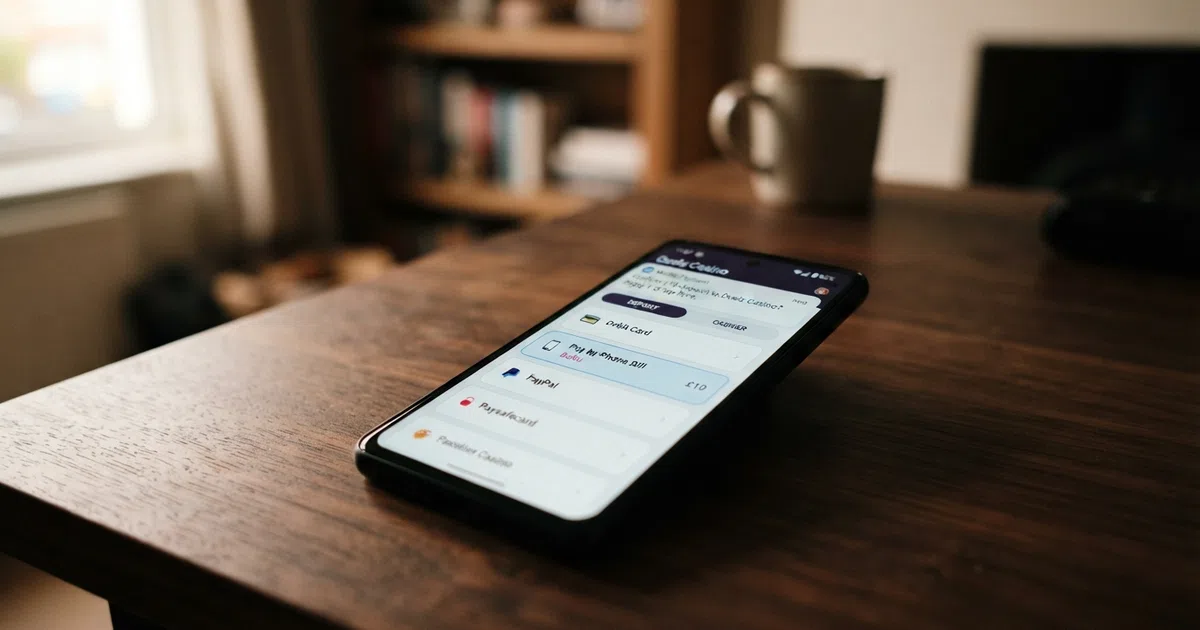
This page covers every operator in our reviewed set on a single yardstick — confirmed SMS or phone-bill deposit support, welcome-offer terms, and the practical route to cashing out — and lays out the UK regulatory architecture underneath, so the comparison is built on something more than marketing.
Current as of September 8, 2026 against the Gambling Commission’s public operator register and the Payment Services Regulations 2017 electronic-communications exclusion.
What a Pay-by-SMS Casino Actually Means for UK Players
“SMS casino” and “pay by phone bill casino” both describe the same thing in the UK market: a deposit method where the casino charges the amount to your mobile phone account rather than to a bank card. The text message is the confirmation, not the payment. Your network carries the charge, your casino balance updates within seconds, and the deposit shows up on your monthly phone bill or against your prepaid credit.
The appeal is straightforward. No bank card details pass through the casino’s payment page. No e-wallet sign-up stands between you and the cashier. For players who do not want a debit card on file with a gambling site — or who simply do not have one to hand — phone-bill funding removes a friction point at exactly the moment a friction point matters most.
The central limitation sits one sentence away and tends to get buried. SMS deposits are deposit-only. There is no rail, anywhere in the UK phone-billing infrastructure, that sends casino winnings back to a mobile account. Every SMS depositor must set up and verify a second payment method — debit card, bank transfer, PayPal — before any withdrawal can move. The privacy-friendly promise holds for the deposit leg. It does not hold for the cashout.
Most UK players search for the method because they have seen it advertised or have a phone account they want to use, not because they have compared the rails. That is the right starting point for an honest comparison: what the rail actually does, what it does not, and which licensed operators have wired it into their cashier.
Phone Bill Deposits vs SMS Verification — Two Completely Different Things
Two UK casino flows use the same word — SMS — and they have nothing in common underneath it. Conflating them is the single most common mistake in this corner of the market.
Phone-bill deposits, sometimes called carrier billing or pay-by-mobile, route the deposit through an intermediary — Fonix, Boku, or PayviaPhone in the UK — which charges your mobile network account and credits your casino balance. Money moves. The SMS in this flow is the confirmation prompt asking you to authorise the charge.
SMS verification is something else entirely. The casino texts a code to your phone to prove you own the number. No money moves in either direction. The code unlocks an account, a bonus, or a stage of registration. It does not fund your account.
Paddy Power Games runs SMS verification to unlock its no-deposit free spins — a player expecting to fund their account by phone bill on that step would be misled. The spin stage is free, the verification is free, the casino balance still reads zero until a real deposit happens. The two flows use the same channel, charge the same recipient, and solve different problems.
SMS Casino Sites vs Apps — What UK Players Actually Use
The mobile-versus-app question is shorter than most guides make it. Most UK SMS casino deposits happen through the mobile browser, not a dedicated app, because the payment page is a web redirect from the carrier-billing provider. The casino hands you off to Fonix or Boku, the intermediary asks for your phone number and sends the SMS, and you bounce back to the cashier with funds credited. The whole thing works in Safari and Chrome exactly as it works in any branded app.
Apps that support phone-bill funding wrap the same web-based payment sheet. They may pre-fill your phone number from the device’s SIM and remember it for one-tap repeat deposits, which is a real convenience on a third or fourth deposit in a week. But the underlying mechanism is identical, and the casino’s library, bonus terms, and withdrawal queue are the same regardless of entry point. The browser is the common denominator; the app is a polish on the repeat-use case.
Inside the Phone-Bill Funding Flow — and the Cashout Route You Must Add
The SMS deposit flow is short and largely mechanical, but each step has a player-facing gotcha worth naming.
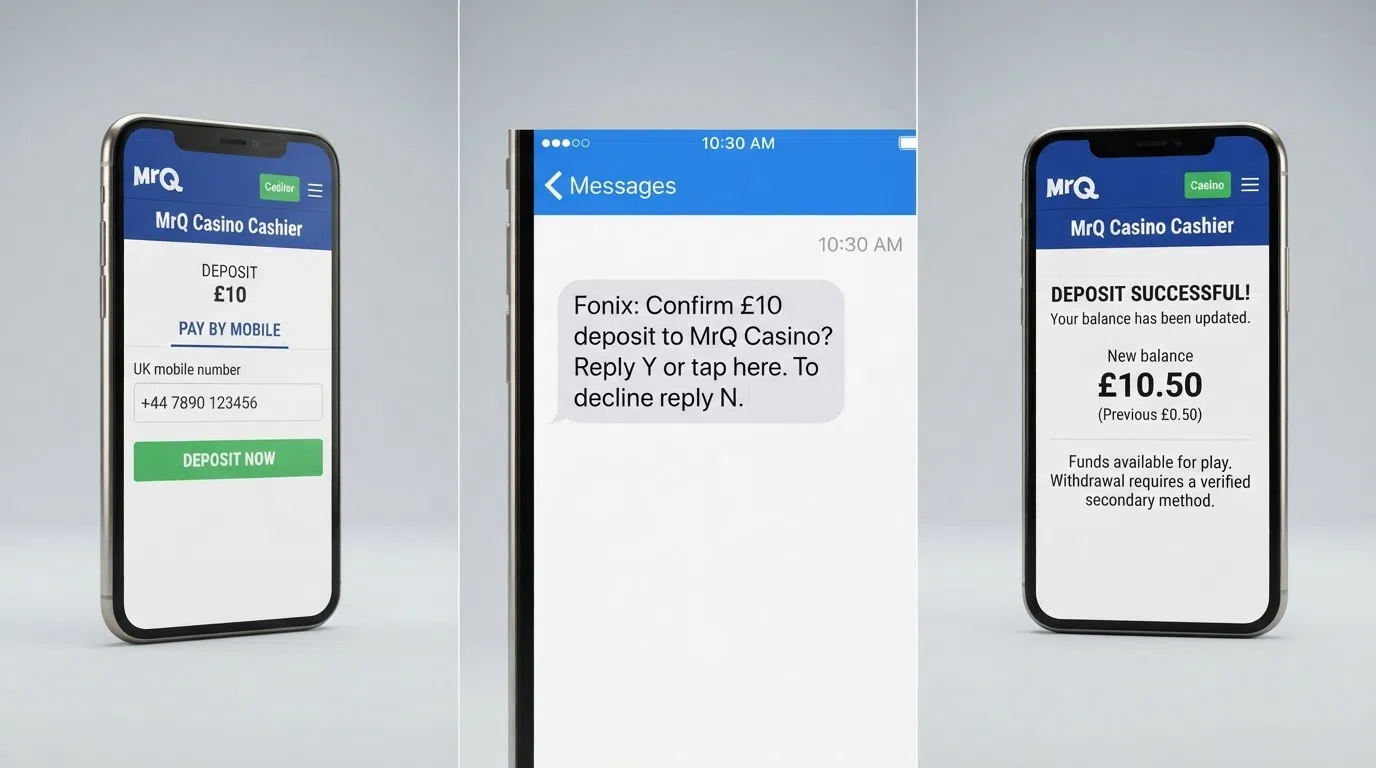
The SMS Deposit Flow, Step by Step
At the cashier, you select “Pay by Mobile” or “Pay by Phone Bill” from the deposit-method list. You enter your UK mobile number. The casino does not pass that number to O2, EE, Vodafone or Three directly — it hands it to a carrier-billing intermediary, which then negotiates the charge with your network. You receive a text message from the billing provider asking you to confirm the charge. You reply Y or follow the link to authorise. The charge lands on your phone bill, or deducts from your prepaid credit, and your casino balance updates within seconds to a few minutes. From the player’s side, four steps; from the network’s side, a half-dozen systems confirming that the subscriber can be billed and that the regulator’s caps have not been exceeded.
Carrier Billing: Fonix, Boku and PayviaPhone — the Middlemen Behind the Message
Three names dominate the UK carrier-billing layer for gambling merchants: Fonix, Boku, and PayviaPhone. They sit between the casino and your mobile network. Their role is to authenticate the transaction via SMS, apply the charge to your mobile account, and enforce the regulatory spending caps that govern charge-to-mobile flows.
| Limit or Feature | Details and Value |
|---|---|
| Single transaction cap | £40 (PSR 2017 limit) |
| Monthly network cap | £240 (PSR 2017 limit) |
| Standard minimum deposit | £10 (Market standard) |
| Slot spin speed minimum | 2.5 seconds (UKGC mandate) |
Which provider a given casino uses is typically not visible to the player. The cashier says “Pay by Mobile”; the underlying contract is the casino’s business. What does surface, sometimes, is the minimum deposit the intermediary’s per-transaction fee will allow — and that floor is the next point in the comparison.
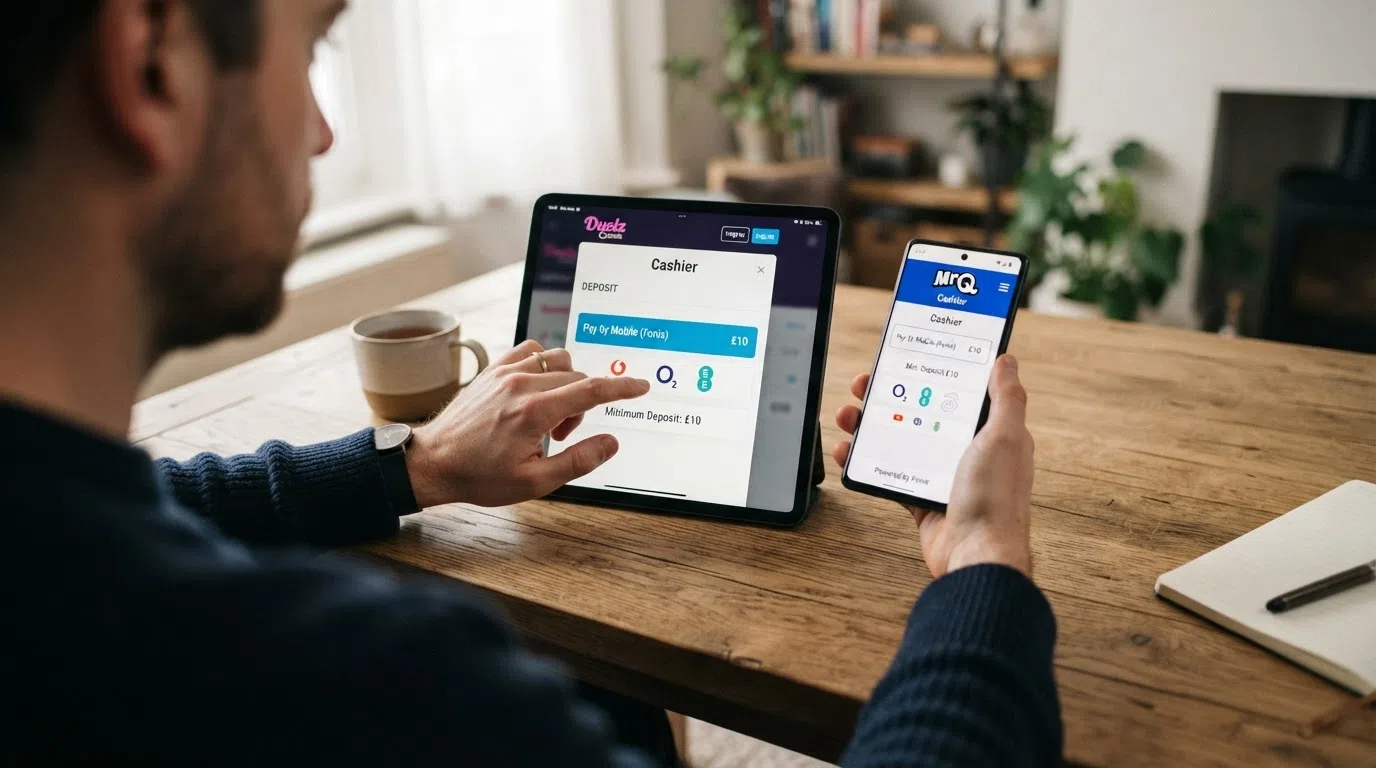
Duelz and MrQ, the only two operators in our featured set with confirmed phone-bill deposit support, both run on Fonix with a £10 minimum. That figure is not coincidence. It is the practical floor the carrier-billing model imposes on UK casino deposits, and it shows up across the comparison for a reason.
Minimum Deposits in Practice — £3, £5 and £10 Compared
The theoretical minimum on some carrier-billing rails is as low as £3 or £5. The actual minimum at UK casino cashiers is almost universally £10. Duelz and MrQ both confirm a £10 pay-by-mobile minimum. Sky Vegas and Betfair structure their welcome offers around a £10 deposit trigger. Below £10, the intermediary’s per-transaction fee eats a meaningful slice of the deposit, and the casino has no commercial reason to surface a method that loses money on small tickets.
The £10 floor is not a UKGC rule. It is the market’s working answer to what a phone-billed deposit can viably be. A player who wants to deposit less than that has chosen a rail the rail cannot serve.
Daily and Monthly Deposit Caps — the £240 Ceiling and Where It Comes From
There are two cap layers, and they are often confused.
The statutory layer sits at the network level. Under the Payment Services Regulations 2017 electronic-communications exclusion, charge-to-mobile transactions can be capped at up to £40 per single transaction and £240 per calendar month for the subscriber. These are regulatory ceilings — not casino policies, not promotional terms, and not negotiable through site switching. A player cannot get around the £240 monthly ceiling by depositing at three different UKGC-licensed SMS casinos; the cap follows the mobile account, not the operator.
The working layer is what most players and many guides actually encounter: a daily limit commonly cited in the £10–£30 range, and a monthly figure in the £240–£300 band. The narrower daily band reflects the per-transaction enforcement most carriers apply on top of the monthly regulatory ceiling.
The interaction with the UKGC’s deposit-limit tool is worth naming, because both layers are now in play. From 31 October 2025, every UKGC-licensed casino must prompt a customer to set a financial limit before their first deposit, and from 30 September 2026 a gross deposit limit must be offered as a distinct tool. The casino-level limit can sit below the network-level cap; it cannot sit above it.
Why SMS Is Deposit-Only and Which Cashout Methods Actually Work
No UK casino can route winnings back to a phone bill. The Phone-paid Services Authority framework governs charge-to-mobile flows as one-directional: the carrier can apply a charge to the mobile account, but it cannot apply a credit in the opposite direction. Carrier-billing contracts reflect this. Even a casino willing to send money back cannot find a regulated rail to send it on.
The practical consequence is structural. Every SMS depositor must verify a second payment method before any withdrawal, and that method must pass the same KYC check as the casino account itself — name, address, date of birth — completed before the first deposit, since 7 May 2019. The deposit method does not affect withdrawal speed. The cashout method does, and so does the casino’s internal processing queue.
What works: debit card via Visa Direct or Mastercard Send, which often clears the same day. Bank transfer, which runs one to three business days. PayPal and Apple Pay at the casinos that support them as withdrawal methods. The first deposit method you set up at the cashier is the one that gets verified, and the one the casino will default to when you click “withdraw” — so the choice made at sign-up is the one that follows you through the lifecycle of the account.
The Best UK-Licensed Casinos for SMS Deposits: 2026 Comparison
Ten UKGC-licensed operators are compared below. Every licence status was checked against the Gambling Commission’s public register; all ten hold Active licences at the time of writing. SMS-deposit eligibility was confirmed for two operators — Duelz and MrQ, both via Fonix with a £10 minimum and both bonus-eligible — and was not confirmed for the remaining eight in this review cycle. Welcome-offer details are surfaced where research carried them; where they are not surfaced, the column reads as a dash, and the operator’s own write-up below the table fills in only what the table can hold.
| Operator | UKGC Licence | Welcome Offer | Free Spins | Wagering | Bonus Validity |
|---|---|---|---|---|---|
| Duelz | Active (UKGC) | Not surfaced | — | — | — |
| MrQ | Active (UKGC) | Not surfaced | — | — | — |
| Sky Vegas | Active (UKGC) | 50 no-deposit FS + 200 FS after £10 deposit/wager | 250 | 0× | 7 days |
| Betfair | Active (UKGC) | 50 no-deposit FS + 100 FS after £10 deposit/wager | 150 | 0× | 7 days |
| Paddy Power Games | Active (UKGC) | 50 no-deposit FS via SMS verification + 100 FS after first deposit | 150 | 0× (per reviewed sources) | — |
| Betfred | Active (UKGC) | Stake £10 → up to 200 FS (debit-card deposit required) | Up to 200 | 0× | 7 days |
| PlayOJO | Active (UKGC) | 50 FS on Big Bass Bonanza after £10 first deposit | 50 | 0× | — |
| LeoVegas | Active (UKGC) | 50 FS on Big Bass Splash after £10 deposit played through once | 50 | 0× | — |
| Ladbrokes | Active (account 1611) | Play £10 → £50 bonus | 0 | 40× | Accept in 14 days, valid 30 days |
| Gala Bingo | Active (LC International, account 54743) | Deposit £10 + spend £10 on slots → 100 FS | 100 | — | Claim in 7 days, spins valid 7 days |
Two operators sit at the top because they are the only ones where the comparison’s primary question — does this casino let me deposit by phone bill? — has a confirmed yes attached to it. The rest of the table ranks on welcome-offer value and fairness of terms, with wagering multiple and free-spin count doing most of the work.
Sky Vegas: 250 Free Spins with Zero Wagering — SMS Deposit Not Confirmed
Sky Vegas runs the largest free-spin count in the featured set: 50 no-deposit spins on registration, plus 200 more after a £10 deposit and wager — 250 total at £0.10 each. Every spin carries 0× wagering, which means whatever the spins pay out is withdrawable cash the moment the bonus window closes. There is no turnover hurdle, no game-weighting puzzle to solve, no slot-only restriction on the cashout.
The catch for SMS depositors sits at the cashier. Sky Vegas’s reviewed payment options lean toward debit-card and bank-style methods; phone-bill deposit eligibility was not confirmed in this cycle. A player who arrives wanting to fund by SMS may find the option absent or unconfirmed, and that is worth knowing before the welcome offer pulls them in. The 7-day bonus validity is short enough that hesitation costs real spins.
Betfair: 150 Wager-Free Spins and a Trusted Brand — SMS Status Unclear
Betfair’s welcome shape mirrors Sky Vegas on structure and halves it on volume: 50 no-deposit spins plus 100 after a £10 deposit and wager, 150 total at £0.10 each, with 0× wagering across the lot. The brand sits under the Flutter group alongside Paddy Power, which means the operator carries a long-standing UKGC licence and a recognisable name for players who value incumbency over novelty. SMS-deposit eligibility at the casino cashier was not confirmed in this review, and the welcome offer’s £10 trigger is small enough that a phone-bill deposit would be the natural fit if the rail were confirmed.
Betfred: Up to 200 Free Spins — Debit Card Required, No SMS Confirmation
Betfred’s offer rewards up to 200 free spins at 0× wagering, but the gate is a £10 debit-card deposit and a £10 stake on slots. The reviewed terms do not mention SMS or phone-bill funding as a qualifying method. A player who deposits by phone bill at Betfred will not trigger the welcome spins; that exclusion is explicit.
The library compensates somewhat. Betfred’s slots catalogue draws from Blueprint Gaming, Pragmatic Play, Games Global, NetEnt, Nolimit City and Hacksaw Gaming — one of the wider studio mixes in the featured set. Once a player has cleared the welcome stage with a debit card, the SMS rail becomes a viable funding option for ongoing play, subject to the casino’s own cashier configuration. For a brand-curious SMS depositor, that is a two-stage journey: card first, phone bill after.
Paddy Power Games: SMS Verification for Bonus Activation, Not SMS Funding
Paddy Power uses SMS for one specific job: verifying the player’s phone number so the 50 no-deposit spins can land. No money moves in that step. Once the verification is complete, a further 100 free spins become available after a first deposit — 150 total in the reviewed shape, with no wagering on the spins per the reviewed terms. The no-deposit spins are allocated to daily jackpot games; the exact eligible title was not surfaced in this review.
SMS as a cashier funding method — the question this page is built around — is a different question. Reviewed sources do not confirm phone-bill deposits at Paddy Power Games’ cashier, even though they confirm the SMS-verification step for the bonus. Players should read those as two separate answers to two separate questions.
Ladbrokes: £50 Welcome Bonus with a 40× Wagering Requirement
Ladbrokes is the only featured operator offering a cash-match bonus rather than free spins: play £10 and receive a £50 bonus, a 500% match on the qualifying spend. The wagering hurdle is the steepest in the comparison — 40× the bonus, which means £2,000 in turnover before the bonus converts to withdrawable cash. Players have 14 days to accept the bonus and 30 days to meet the wagering once accepted. There are no free spins in this welcome shape.
The slots library is large enough to absorb the playthrough: 1,800+ slot titles from NetEnt, Pragmatic Play, BTG and Play’n GO. The UKGC licence is the kind of long-standing registration that signals operational depth — Ladbrokes Betting & Gaming Limited holds account 1611, Active. SMS-deposit eligibility was not confirmed in this review, and the qualifying deposit may need to run through a debit card to satisfy the bonus gate.
Gala Bingo: 100 Free Spins After a £10 Deposit and £10 Slot Spend
Gala Bingo’s offer runs through a two-step trigger: deposit £10, then spend £10 on any slot game, and 100 free spins at £0.10 each land in the account. Claim within seven days of registration; spins valid for seven days once credited. The total upfront commitment is £20, the highest in the featured set, and it is worth weighing against the no-wagering structure the reviewed terms imply on the free-spin winnings.
The operator sits under LC International Limited, UKGC account 54743, Active — covering the broader Gala trading-name family alongside Gala Casino and Gala Spins. SMS-deposit eligibility at the Gala Bingo cashier was not confirmed this run. The two-step trigger also tells you something about who the offer is designed for: a player prepared to commit £20 up front to qualify for a 100-spin package with no playthrough.
PlayOJO: 50 Wager-Free Spins on Big Bass Bonanza
PlayOJO keeps the structure short. Fifty free spins on Big Bass Bonanza after a first deposit of £10, zero wagering on the resulting winnings, no maximum cashout stated in the reviewed terms. Pragmatic Play’s Big Bass Bonanza is a named target rather than a mystery allocation, which means a player accepting the offer knows the RTP and volatility profile of the slot they will be playing — a small but real advantage over a free-spin bundle attached to a surprise title.
SMS-deposit eligibility was not confirmed in this review, and the £10 trigger is set as a minimum first deposit, not specifically a debit-card deposit. The cashout is uncapped, which makes the offer well suited to a player who has already set up a secondary withdrawal method.
LeoVegas: 50 Wager-Free Spins on Big Bass Splash
LeoVegas mirrors PlayOJO’s structure and attaches it to a different slot. Fifty wager-free free spins on Big Bass Splash after a £10 deposit that is played through once on eligible games. Spins at £0.10 each, total potential value £5, zero wagering on what they pay out.
The extra friction is the playthrough step: the £10 deposit has to be wagered once on eligible games before the spins are credited. Most featured operators credit the spins at the deposit stage without that intermediate step, and the difference is small in time but real in cash. SMS-deposit eligibility was not confirmed this run.
Duelz: Confirmed Pay By Mobile via Fonix — £10 Minimum, Bonus-Eligible
Duelz is one of two featured operators where the page’s primary question has a confirmed answer. Pay By Mobile is in the cashier, the underlying intermediary is Fonix, the minimum is £10, and the method qualifies for bonuses. That last point matters: at most UK casinos, a phone-bill deposit is treated as a standard deposit for promotional eligibility, but confirmation is not universal, and an SMS depositor at Duelz is not gambling on whether their first deposit will activate the welcome stage.
The trade-off is honest and worth flagging. Duelz’s welcome offer was not surfaced in this review cycle. The operator holds an Active UKGC licence, and the SMS rail is in the cashier, but the bonus shape that meets it has to be checked on the operator’s own promotions page. For a player whose priority is the deposit method itself, Duelz is the cleaner starting point of the two confirmed options.
MrQ: Confirmed Pay By Mobile via Fonix — £10 Minimum, Bonus-Eligible
MrQ is the second of the two. Pay By Mobile via Fonix, £10 minimum, bonus-eligible, UKGC-licensed. Like Duelz, the welcome offer was not surfaced in this review cycle — a player arriving at MrQ for the SMS rail needs to check the current promotion before depositing, but the rail itself is the same confirmed configuration as Duelz.
Together, Duelz and MrQ are the only operators in the comparison where a player can deposit by phone bill and know, at the time of writing, that the method is bonus-eligible. For every other operator on this page, the rail is a question mark.
UK Gambling Law and SMS Casino Safety — What the Licence Actually Requires
The UK does not regulate SMS deposits through a single statute chapter. It regulates the casino product through a layered architecture: a primary Act, a regulator with enforcement powers, a code of practice that sets the day-to-day standards, and remote technical standards that govern the technology underneath.
The foundation is the Gambling Act 2005, which brought British gambling law under one statute for the first time and set three licensing objectives under section 1: preventing gambling from being a source of crime or disorder, ensuring it is conducted in a fair and open way, and protecting children and other vulnerable persons from harm. The Gambling (Licensing and Advertising) Act 2014 extended that framework to remote operators serving GB customers — the point-of-consumption reform that made a UKGC licence compulsory for any casino taking GB players, regardless of where the operator is based.
The working instruments are the Licence Conditions and Codes of Practice (LCCP) and the Remote Technical Standards (RTS). Britain does not write a single rulebook and call it done; it writes a series of codes and conditions, each addressing a specific operator obligation, and updates them as the market changes. The 10× wagering cap that took effect on 19 December 2025, for example, is a Social Responsibility Code change rather than an Act amendment. The KYC requirement that has been in force since 7 May 2019 is an LCCP condition.
UKGC Licensing — the Minimum Standard Every Casino on This Page Meets
Every operator in the comparison table holds a UKGC licence. What that licence mandates, in concrete terms: full KYC before first deposit — name, address, and date of birth verified — in force since 7 May 2019; participation in the GAMSTOP national self-exclusion scheme, mandatory for online licensees since 31 March 2020; compliance with the LCCP responsible-gambling codes; and submission to the Commission’s enforcement powers, which include financial penalties, licence suspension, and revocation.
A player can verify any of these licences themselves. The Gambling Commission’s public register is searchable by operator name and account number, and the licence status field reads as “Active,” “Surrendered,” “Lapsed” or similar. Two account numbers surfaced in this review: Ladbrokes Betting & Gaming Limited at 1611, Active, and LC International Limited at 54743, Active, the latter covering the Gala Bingo, Gala Casino and Gala Spins trading names. Every other featured operator appears on the register with Active status.
What “Not on GamStop” Really Means for a UK Player Using SMS Deposits
“Not on GamStop” is marketed as a feature at offshore casinos. For a UK player, it is the opposite. GAMSTOP is the national multi-operator online self-exclusion scheme for Great Britain; participation is mandatory for every UKGC-licensed online operator. Exclusion periods run six months, one year, five years, or five years with auto-renewal, and once active an exclusion cannot be cancelled early.
A casino labelled “not on GamStop” is, by definition, outside the UKGC licensing perimeter. The player loses Commission oversight, access to an Approved Dispute Resolution provider, and GAMSTOP coverage entirely. The SMS deposit method does not change this calculation. Paying by phone bill at an unlicensed casino does not make it safer — it charges an unregulated operator to a regulated mobile account. The rail’s legitimacy does not transfer to the operator.
Trust Signals to Check Before You Deposit by SMS
- Find the UKGC licence number in the casino’s footer and cross-reference it on the Gambling Commission’s public register; confirm the status reads “Active.”
- Look for the GAMSTOP logo and follow the link to confirm the operator is listed as a participant.
- Confirm the casino displays the 18+ age restriction and responsible-gambling links — National Gambling Helpline 0808 8020 133, GamCare, GambleAware — prominently in the footer.
- Read the payment-method terms: a legitimate UK SMS casino will state explicitly that phone-bill deposits are deposit-only and will name the withdrawal alternatives.
Why Most SMS Deposits Still Qualify for Bonuses — and When They Don’t
The general rule is permissive. Most UK casino welcome offers do not exclude phone-bill deposits by default. Duelz and MrQ, the two operators with confirmed phone-bill support, both state that the method is valid for bonus eligibility. The default at most UKGC-licensed casinos is that any deposit method available in the cashier qualifies for any promotion that does not explicitly exclude it.
The exceptions are specific and worth flagging. Betfred’s reviewed welcome offer explicitly requires a debit-card deposit to trigger the free spins; an SMS deposit will not activate them. Sky Vegas’s reviewed cashier pushes debit-card and bank-style options, and SMS eligibility is unconfirmed. Ladbrokes’ qualifying deposit may need to run through a debit card to satisfy the bonus gate. These are not universal exclusions; they are operator-by-operator decisions written into specific T&Cs.
The structural constraint is the same for every SMS depositor regardless of bonus eligibility. Because the rail is deposit-only, every player must set up and verify a secondary withdrawal method before any bonus winnings can be cashed out. The KYC step has to happen anyway — since 7 May 2019, full verification is required before the first deposit — but the SMS-specific requirement is the secondary-method setup, which is its own small friction point at the cashier.
No-Deposit Free Spins Triggered by SMS Verification — How They Work
Three featured operators run a no-deposit stage that starts with an SMS verification step: Sky Vegas, Betfair and Paddy Power Games. The mechanics are simple and the same in each case. Register an account, receive an SMS with a verification code, enter the code, and the no-deposit free spins land in the account. No money moves. The verification is a gate, not a charge.
What to watch for once the spins land: they are typically restricted to specific games. Paddy Power allocates its no-deposit spins to daily jackpot games, the exact eligible title not surfaced in this review. Sky Vegas and Betfair carry 50 each in the reviewed shape. Any winnings may carry a maximum cashout limit, though none was surfaced for these operators in this cycle. All three then offer additional free spins after a first deposit — 200 at Sky Vegas, 100 at Betfair, 100 at Paddy Power — bringing the totals to 250, 150 and 150 respectively.
The 10× Wagering Cap — What UK Rules Mean for Bonus Hunters in 2026
From 19 December 2025, UKGC LCCP Social Responsibility Code 5.1.1 caps wagering requirements at a maximum of 10 times the bonus amount and bans mixed-product promotional offers across betting, casino, bingo and lottery. The cap is a backstop rather than a disruptor for this page’s operators: seven of the eight featured operators with surfaced wagering terms sit at 0×, and the only exception is Ladbrokes at 40× — a term that would be non-compliant if applied to a newly launched offer today, though the reviewed Ladbrokes offer was surfaced before the cap’s effective date and may have been restructured since.
The cap does not cap deposit triggers, free-spin values, or the operator’s freedom not to offer bonuses at all. It limits the turnover multiple on bonus funds themselves. For bonus hunters, the practical effect is to push the market further toward the 0× free-spin model that already dominates the featured set.
Mobile SMS Deposits — Browser vs App and the Networks That Handle the Payment
SMS deposits are mobile by construction. The whole flow — entering a phone number, receiving a confirmation text, replying to authorise — happens on the same device, and the carrier-billing intermediary (Fonix, Boku, PayviaPhone) is reachable only through the mobile network. The networks that support charge-to-mobile for gambling merchants where the operator has a billing agreement in place are O2, EE, Vodafone and Three. The limiting factor is the casino’s contract with the billing intermediary, not the network itself.
How Mobile-Optimised SMS Deposit Flows Differ from Desktop
On mobile, the cashier detects the device, the Pay by Mobile option is surfaced prominently, the SMS confirmation arrives on the same device, and the casino balance updates in the same browser tab or app screen. The flow is native to the phone. On desktop, the Pay by Mobile option may still appear, but the SMS confirmation arrives on a separate device — a split-screen flow that adds a meaningful step. Some casino cashiers hide the pay-by-phone option entirely on desktop because the carrier-billing providers’ redirect pages are not optimised for desktop viewports.
The mobile browser’s ability to auto-detect a phone number from the device’s SIM is a small but real convenience. Desktop requires manual entry every time.
Slots, Table Games and Live Dealer — What You Can Actually Play with an SMS Deposit
An SMS deposit lands in the casino balance as indistinguishable funds. The casino does not tag money by deposit method. Once credited, an SMS-deposited pound behaves exactly like a debit-card-deposited pound: the same game catalogue, the same RTP, the same UKGC-mandated restrictions on bonus buys, auto-play and reverse withdrawals.
The real constraint on play is bankroll size, not game type. SMS deposits are capped at £10–£30 daily and £240 monthly. High-stakes table games and high-volatility slots that demand large session budgets are harder to sustain on a rail with that ceiling. The game is the same; the bankroll is smaller.
The statutory stake limits on online slots apply regardless of deposit method. From 9 April 2025, the maximum stake is £5 per spin for players aged 25 and over; from 21 May 2025, the maximum is £2 per spin for players aged 18 to 24. Auto-play has been banned since 31 October 2021. Spin speed cannot be faster than 2.5 seconds. These rules apply whether the funds came from a debit card or a phone bill.
Playing Slots with an SMS Deposit — What the Stake Caps Mean in Practice
At the £5 maximum stake for players aged 25 and over, a £10 SMS deposit buys two spins at the cap or up to 100 spins at £0.10. At the £2 maximum for players aged 18 to 24, a £10 deposit buys five spins at the cap or 100 spins at £0.10. The statutory ceiling does not force the maximum, but it sets the upper bound.
The session length that comes out of an SMS deposit is short by design. With the UKGC-mandated 2.5-second minimum spin speed and the £10–£30 daily cap, a single SMS-funded session is bounded on both ends — by the bankroll the rail allows and by the spin rate the regulator enforces. For a player who wants the payment method to enforce a hard stop on session length, the math works in their favour. For a player who wants to grind through 500 spins in an evening, the rail is the wrong tool.
The slot titles named in the featured offers — Big Bass Bonanza at PlayOJO, Big Bass Splash at LeoVegas — are Pragmatic Play titles available across multiple UK operators. RTP figures for the exact game configurations used in these offers were not surfaced in this review.
New SMS Casinos Worth Watching in 2026
The new-entrant landscape for SMS casinos in the UK is thin. No specific new SMS-focused casino launch was surfaced in this review cycle, and the reasons are structural rather than incidental. A new casino entering the UK market needs a UKGC licence before it can serve GB players, and the SMS deposit rail is one feature among dozens in the licence application — not a differentiator large enough to anchor a launch on its own.
What tends to drive SMS deposit adoption at new casinos is a pre-existing carrier-billing contract — typically with Fonix — and a marketing decision to surface the method in the cashier. The technical integration is straightforward because the billing intermediary handles the compliance layer. The harder part is building a casino brand that can compete with operators like Duelz, MrQ, Sky Vegas and Betfair on library size, welcome-offer value, and trust signals, while making the SMS rail a meaningful part of the proposition.
What a New SMS Casino Needs to Offer to Compete with Established Brands
A new entrant needs the same confirmed-SMS configuration Duelz and MrQ already run — phone-bill deposit support with a clear statement of the billing intermediary and the minimum deposit amount, plus bonus eligibility stated in the offer T&Cs. A welcome offer designed without a debit-card trigger would be a real differentiator: it would mean an SMS depositor could fund the account, claim the welcome, and play without ever touching a bank card. That is the proposition no incumbent currently leads with.
The withdrawal side is what new entrants typically compete on. A fast and clearly explained secondary withdrawal method — debit card with Visa Direct, or PayPal — that the player can verify during the same KYC session is a meaningful upgrade on the one-to-three-day bank-transfer default. And underneath everything, a UKGC licence displayed prominently and verifiable on the public register. Without it, none of the other features matter.
SMS Deposits and Safer Gambling — More Than Just a Spending Cap
The £240 monthly ceiling on phone-bill deposits is a hard spending boundary, but it is a by-product of carrier-billing regulation rather than a designed responsible-gambling feature. The UKGC’s safer-gambling toolkit is layered on top of the rail, and it is more comprehensive than any payment-rail cap on its own.
Every UKGC-licensed casino must offer deposit-limit tools, with a mandatory prompt to set a financial limit before the first deposit, in force from 31 October 2025. A gross deposit limit must be offered as a distinct tool from 30 September 2026. Reality checks — pop-ups showing session duration and net position — are required. Time-outs of 24 hours to six weeks are required. GAMSTOP self-exclusion is mandatory for every online licensee.
The context for why these tools carry weight is the NHS referral data. Gambling referrals in England rose sharply — from 2,284 in 2023/24 to 4,355 in 2024/25, nearly doubling in a single year. The SMS deposit cap is a starting point, not a substitute. The full UK safer-gambling toolkit is what a player who wants hard limits needs.
GAMSTOP, Reality Checks and Where to Get Help if Gambling Stops Being Fun
GAMSTOP is the national online self-exclusion service. Registration runs at gamstop.co.uk, with exclusion periods of six months, one year, five years, or five years with auto-renewal. Once active, the exclusion applies across every UKGC-licensed operator within 24 hours and cannot be cancelled early. Reality checks and time-outs sit inside every UKGC-licensed casino’s account settings — a reality-check pop-up showing session duration and net position, plus the ability to set a time-out from 24 hours to six weeks without involving customer support.
The help infrastructure outside the casino is what a player who wants external support can reach immediately. The National Gambling Helpline runs on 0808 8020 133, free and confidential 24 hours a day, operated by GamCare. NHS specialist gambling harm clinics operate in England, Scotland and Wales. GambleAware publishes an online self-assessment tool. Adult psychiatric survey data places problem gambling at 0.4% (PGSI 8+) and moderate-risk gambling at 1.6% (PGSI 3+) of the survey population — small percentages, real people.
How We Selected and Ranked Every Casino on This Page
The operator set was drawn from UK-focused casino-affiliate and comparison sources, selected for UKGC licensing status, search visibility for SMS and pay-by-phone queries, and availability of verifiable bonus and payment-method data. Every licence status was checked against the Gambling Commission’s public register; all ten featured operators hold Active licences.
Ranking criteria were applied qualitatively. Operators are ordered by confirmed SMS or phone-bill deposit support first — which puts Duelz and MrQ at the top, because they are the only two operators in the set where that question has a confirmed answer — then by welcome-offer value and fairness. Free-spin count, wagering multiple (lower is better), deposit trigger size, and bonus validity window each contribute to the ranking of the remaining operators, with the offer’s transparency and the absence of restrictive conditions weighed alongside the headline figures.
What this review does not cover: live cashier testing was not performed. SMS-deposit eligibility is based on published terms and comparison-source data, not on a test deposit at each operator. Bonus T&Cs can change between review cycles, and what reads as confirmed today may be amended by the operator next month. The picture is accurate as of the date this page was reviewed; a player should verify the current terms at the operator before depositing.
Should You Fund Your Casino Account by SMS? A Decision Checklist for UK Players
SMS deposits make sense for a UK player who wants a deposit method that does not expose bank card details to the casino, who is comfortable with a £10–£30 daily ceiling that enforces a hard session limit, who has already set up and verified a secondary withdrawal method, and who is playing at Duelz or MrQ — the only two featured operators where the SMS rail and bonus eligibility are both confirmed. Under those four conditions, the rail works as designed: deposit by phone bill, play through the welcome offer, cash out via the verified secondary method.
SMS deposits do not make sense for a player who plans to deposit more than £30 in a single session — the network cap makes that impractical — or who wants to claim a welcome offer that explicitly requires a debit-card deposit, like Betfred’s. The welcome offer that gates on a card is a real exclusion, not a soft preference. A player who wants the fastest possible cashout without setting up a second payment method is also a poor fit, because SMS does not function as a withdrawal rail at all.
The bottom line. SMS deposits are a legitimate, UK-regulated payment rail that adds convenience and a hard spending boundary. They are not a shortcut around KYC — full verification is required before the first deposit regardless of the method. They are not a route to anonymity — every UKGC-licensed casino collects and verifies the player’s identity before play. They are not a withdrawal method — every SMS depositor needs a verified secondary method for any cashout. The player who understands those three constraints can use SMS deposits safely and efficiently. The player who does not will discover them at the cashier, when the rail they thought they understood does not do what the marketing suggested.
Frequently Asked Questions
Which UK-licensed casinos actually let me fund my account by text message right now?
Duelz and MrQ are the two operators in our reviewed set with confirmed phone-bill deposit support — both run Pay By Mobile via Fonix with a £10 minimum, and both confirm the method is valid for bonus eligibility. Every other featured operator holds a UKGC licence, but SMS eligibility was not confirmed in our review cycle, so check the operator’s own cashier before depositing.
What actually happens between tapping “deposit” and seeing the funds in my casino balance?
You select Pay by Mobile at the cashier, enter your UK mobile number, receive an SMS from the carrier-billing intermediary asking you to confirm the charge, reply or follow the link to authorise, and the casino balance updates within seconds. The intermediary — Fonix, Boku or PayviaPhone — sits between the casino and your network, applies the charge, and enforces the regulatory spending caps.
Can I ever cash out casino winnings to my phone bill or mobile balance?
No. The Phone-paid Services Authority framework treats charge-to-mobile as one-directional: a charge can be applied to your mobile account, but a credit cannot. Every SMS depositor must verify a separate withdrawal method — debit card, bank transfer, PayPal — before any winnings can move out of the casino.
Who actually decides how much I can deposit by SMS — the casino, my network, or the regulator?
The regulator and the network, not the casino. Under the Payment Services Regulations 2017 electronic-communications exclusion, charge-to-mobile transactions are capped at up to £40 per single transaction and £240 per calendar month at the network level. A player cannot get around that ceiling by switching UKGC-licensed casinos, because the cap follows the mobile account.
Will using a phone-bill deposit stop me claiming a casino’s sign-up welcome offer?
Not by default — most UK casino welcome offers accept phone-bill deposits. Duelz and MrQ confirm the method is bonus-eligible. The exception is Betfred, which requires a debit-card deposit for its welcome offer. For every other featured operator, the T&Cs do not explicitly exclude phone-bill deposits but also do not confirm them, so read the offer terms before depositing.
If I want to check a UK casino’s licence myself, what am I looking for on the register?
The Gambling Commission’s public register is searchable by operator name or account number. Confirm the licence status reads “Active” and that the licence covers the correct activity type — casino or remote casino. The two account numbers surfaced in this review are Ladbrokes Betting & Gaming Limited at 1611 and LC International Limited at 54743, both Active.
Why did the UK ban credit cards for gambling — and does that rule touch SMS deposits?
Since 14 April 2020, GB-licensed remote operators have been prohibited from accepting credit card payments for gambling, including where a credit card funds an e-wallet that is then used to gamble. The rule does not directly touch SMS deposits, because phone-bill funding is a charge to the mobile account rather than a card transaction — but it does mean a player cannot route a credit-card-funded e-wallet to a casino that takes SMS deposits as a workaround.
Is SMS depositing a safer-gambling feature, or just another convenient way to pay?
Both, but the safer-gambling framing has limits. The £240 monthly network-level cap is a hard spending boundary enforced by the rail itself — a player who uses SMS cannot deposit more than that in a calendar month at UKGC-licensed casinos. But the cap is a by-product of carrier-billing regulation, not a designed safer-gambling feature. The UKGC’s deposit-limit tools, reality checks, time-outs and GAMSTOP self-exclusion are the designed layer, and the SMS rail does not replace any of them.
Do SMS Deposits Qualify for Standard Welcome Offers?
Confirmed bonus-eligible: Duelz and MrQ. Unconfirmed: Sky Vegas, Betfair, Paddy Power Games, Ladbrokes, Gala Bingo, PlayOJO and LeoVegas. None of the unconfirmed operators explicitly excludes phone-bill deposits in their reviewed terms, but none confirms them either — and the gap is what an SMS depositor is gambling on if they pick one of these for the bonus rather than the deposit method. The single confirmed exclusion is Betfred’s debit-card requirement for the welcome stage.
The practical move is short: before depositing by phone bill, open the offer’s full T&Cs and search for “payment method,” “deposit method,” or “eligible deposit.” If the terms list phone bill, pay-by-mobile, Fonix, Boku or PayviaPhone as eligible, the rail is in. If they list “debit card only” or “Visa/Mastercard deposits only,” the rail is out. If the terms say nothing, the rail is unconfirmed and the player is the one taking the risk.
Mobile Browser vs Casino App — Which Route Works Better for SMS Deposits?
The browser is the common denominator. Every UKGC-licensed casino with a mobile-optimised site accepts SMS deposits through it, because the payment flow is a web redirect that runs in any modern mobile browser. Apps that support the method wrap the same redirect and may add two conveniences: pre-filling the phone number from the device’s SIM for one-tap repeat deposits, and caching the verified secondary withdrawal method so the post-SMS cashout setup is faster on return visits.
In practice, most UK players depositing by SMS do so through the browser because only a minority of SMS-accepting casinos maintain a dedicated app. The browser wins on coverage; the app wins on repeat-use polish. Neither wins on the underlying mechanism, because the underlying mechanism is the same in both cases.
Table Games and Live Dealer — Are They Available on SMS-Funded Accounts?
Yes. The casino does not tag funds by deposit method, so SMS-deposited money works on blackjack, roulette, baccarat and live-dealer tables exactly as debit-card funds do. The practical limitation is the table minimum.
Live-dealer table minimums typically start at £0.50 to £1.00 for auto-roulette and £1 to £5 for hosted blackjack. A £10 SMS deposit covers two to ten hands at the table minimum, which is short even by recreational-session standards. The bankroll constraint, not the game catalogue, is what defines the SMS-funded live-dealer experience.
The wagering-contribution caveat matters when a bonus is involved. Table games and live-dealer games often contribute at a lower percentage toward wagering requirements than slots do, and some bonuses exclude them entirely. Check the bonus T&Cs for “game weighting” or “game contribution” before treating table play as part of a bonus playthrough.
Payments – fastestpayout-casinos-uk
Content created by the «fastestpayout-casinos-uk» team