
Casino Sites That Accept Credit Cards UK: Where They Still Work and What You Give Up
 Available in GB
Since 14 April 2020, no casino licensed in Great Britain has been able to take a credit card payment for gambling. The change was made under licence condition 6.1.2 of the Licence Conditions and Codes of Practice (LCCP), and it was total: every remote betting, gaming and lottery product at every GB-licensed operator fell under the same prohibition from the same date. A credit card casino, in the way the phrase was understood before 2020, no longer exists on the British regulated market.

This is a guide to what is actually left. The two paths open to a UK player in 2026 run in opposite directions. The first goes through debit cards, e-wallets, bank transfers and a small but growing list of approved alternatives at GB-licensed casinos, where every deposit is wrapped in UK Gambling Commission oversight. The second goes offshore, to Curaçao-licensed casinos that still accept Visa and Mastercard credit cards and are not bound by the British rule. Both paths are described honestly here, with their actual mechanics, the bonus terms attached, and the regulatory protections each one carries or strips away.
Data current as of September 8, 2026; licence status and operator details were checked against the UK Gambling Commission’s public register.
Why your credit card no longer works at most UK casino sites
The April 2020 ban is the single most important fact on this page, because it decides what a credit card casino can be in the UK today. The LCCP provision that brought it in (condition 6.1.2) was published alongside consultation evidence showing that 22% of online gamblers who funded play with a credit card were classed as problem gamblers, against a far lower rate among players who used their own money. The 22% figure is the published rationale; the practical effect is that no GB-licensed operator can take a credit card payment, accept a credit-card-funded e-wallet top-up, or process a credit card withdrawal related to gambling.
The ban was extended to e-wallets from the start, not patched in afterwards. The Commission reminded operators that they can only accept e-wallet payments where the e-wallet provider demonstrably blocks credit card use for gambling. PayPal, Skrill and Neteller are widely accepted at GB-licensed casinos today, but the route from a credit card through any of them is closed. The single legal exception is non-remote lottery — the face-to-face purchase of a National Lottery ticket or scratchcard in a shop — which falls outside the gambling regimes that LCCP 6.1.2 covers.
The data behind the ban came from a smaller pool than the rule’s reach suggests. In 2018, around 800,000 UK consumers used a credit card for some form of gambling, roughly 2% of all credit card holders. That figure is the base from which a national policy was drawn.
What a credit card casino was — and who still accepts them today
Before April 2020, a credit card casino was not a separate category. It was any casino that accepted Visa or Mastercard credit cards as a deposit method, which in practice meant every major GB-licensed operator and almost every offshore one. The phrase was a descriptor of payment, not a product class, and it sat alongside debit cards, e-wallets and bank transfer as one option in the cashier.
That descriptor no longer applies on the British regulated side. Zero GB-licensed casinos accept a credit card today, and the only UK-facing sites that do are Curaçao-licensed operators outside the UKGC’s jurisdiction. The split this produces is the entire shape of the current market. A UK player who wants a credit card deposit has one route, and that route runs through operators that carry no British licence, no GAMSTOP coverage, and no UKGC complaints procedure. A UK player who wants full British regulatory protection has the opposite route, and credit cards are not on it.
How a credit card casino deposit works — minimums, processing and fees
At an offshore site that still takes credit cards, the deposit flow is the same as it ever was. You open the cashier, pick Visa or Mastercard, type in your card details and the amount, confirm, and the funds appear in your casino balance within seconds. The minimums sit lower than at most GB-licensed operators: £10 at Rolletto, £20 at Donbet and Mystake. There is no processing fee at the casino’s end.
The fees that matter are at the card issuer’s end, and most UK players do not see them until a statement arrives. Several major UK card issuers treat gambling transactions as cash advances, which means higher interest rates charged from the date of the transaction rather than the end of the billing cycle, and no grace period in between. A separate friction sits at the bank level: a growing number of UK banks now apply blanket gambling blocks to known gambling merchants, regardless of the operator’s licence status or the card type. A credit card deposit at an offshore casino can be declined by the bank before it ever reaches the cashier. The two frictions are independent, and a player hitting either one will see the deposit fail for reasons that have nothing to do with the casino.
Credit card vs debit card at online casinos — the differences that matter
The card type is not a small administrative detail. Three differences follow from it, and the third is the one that drove the ban.
The first is regulatory treatment. Every GB-licensed casino accepts Visa and Mastercard debit, and will continue to: the prohibition is on credit, not on card payments per se. The second is consumer credit protection. Section 75 of the Consumer Credit Act 1974 makes the credit card issuer jointly liable with the supplier for misrepresentation or breach of contract on purchases between £100 and £30,000, which is a meaningful backstop when a service goes wrong. That protection does not extend to debit cards. It is also moot for British casino players, because the only places that take credit cards are offshore, and the section 75 route runs through UK consumer credit law that an offshore operator may not honour in practice. The third is the debt dimension, and this is the one the Commission named. Gambling on a credit card is gambling on borrowed money, and the data showed a problem-gambling rate among credit card users that was far higher than the rate among players funding play from their own bank accounts.
Can you still use a credit card at a UK online casino? The honest answer
Two answers, each complete.
At a GB-licensed site: no. Every operator on the UK Gambling Commission’s register has been prohibited from accepting a credit card payment for gambling since 14 April 2020. The prohibition extends to credit-card-funded e-wallet transactions. The only legal exception is non-remote lottery purchases. There is no operator, no bonus, no product and no workaround that gets a credit card deposit through a GB-licensed cashier.
At an offshore site: yes, with the trade-off laid out. Curaçao-licensed casinos including Donbet, Mystake, Goldenbet, Freshbet and Rolletto all accept Visa and Mastercard credit cards because they sit outside the UKGC’s jurisdiction. A deposit goes through, the games play, and the bonus terms are honoured or not by the operator alone. What is also true is that a UK player using one of these sites has no GAMSTOP coverage, no route into the UKGC’s complaints process, no access to an approved alternative dispute resolution (ADR) provider, and no British consumer redress if a withdrawal is withheld or a bonus is voided. The site is operating outside the British regulatory perimeter, and the British regulatory perimeter is the only place those protections exist.
Alternatives to credit cards at UK casino sites — debit, e-wallets and crypto compared
- Visa and Mastercard debit. Accepted at every GB-licensed casino on this page. Funds leave your bank account directly, there is no cash-advance trap, and debit transactions are not flagged as gambling by UK card issuers the way credit charges sometimes are. The default payment method for the regulated market.
- PayPal. Accepted at bet365, William Hill, 888casino, Duelz and All British Casino. PayPal’s own buyer protection sits behind the deposit, but PayPal will not process a credit-card-funded top-up for gambling under the UKGC’s e-wallet rules.
- Skrill and Neteller. Widely accepted at both GB-licensed and offshore operators. Withdrawals are often faster than debit at the same site, and the wallets are typically free to hold.
- Apple Pay. Growing acceptance at GB-licensed casinos including bet365, 888casino and All British Casino. Routes through your debit card or pre-funded Apple Cash, not through credit.
- Bank transfer. The slowest deposit method, but the one with the highest per-transaction limits. Used at every GB-licensed site on this page, and at the offshore operators.
- Paysafecard. A prepaid voucher that needs no bank account. Accepted at Duelz and All British Casino on the GB side, and at Donbet offshore.
- Crypto (Bitcoin and others). Accepted at all five offshore casinos on this page. Not available at any GB-licensed site.
From 31 October 2025, every GB-licensed operator must prompt the customer to set a financial limit before the first deposit. The prompt is mandatory; the deposit is not possible without seeing it. Decreases to an existing limit are actioned immediately; increases carry a cooling-off delay.
GB-licensed alternatives vs offshore credit card casinos — which are worth your time
A direct comparison of the two paths open to a UK player who wants to deposit at an online casino in 2026.

| Casino | GB Licence? | Accepts Credit Cards? | Welcome Offer | Wagering | Bonus Validity |
|---|---|---|---|---|---|
| bet365 | Yes | No | Up to 500 free spins | 0× on spin winnings | 30 days |
| William Hill | Yes | No | 200 free spins on Big Bass Splash | 10× on spin winnings | 72 hours from credit |
| 888casino | Yes | No | 100% up to £100 | 10× on selected slots | 90 days |
| Duelz | Yes | No | 100% up to £1,000 + 100 free spins | 35× on bonus (recorded as found; verify current terms) | 14 days |
| All British Casino | Yes | No | 100 cash spins at £0.10 | 0× (winnings as cash) | — |
| Donbet | No (Curaçao) | Yes | 150% up to £750 + 50 free spins | 30× (deposit + bonus) | 30 days (14 for spins) |
| Mystake | No (Curaçao) | Yes | 120% up to £600 | 35× (deposit + bonus) | — |
| Goldenbet | No (Curaçao) | Yes | 300% up to £1,500 + 100 spins | 35× (deposit + bonus), 10× cashout cap on bonus | 30 days |
| Freshbet | No (Curaçao) | Yes | 300% up to £3,000 + 200 free spins (across three deposits) | 40× | — |
| Rolletto | No (Curaçao) | Yes | Up to £5,500 + 200 free spins (casino route 100% up to £1,000 + 200 FS) | 30× on bonus, 30× on spin winnings | 30 days |
The five GB-licensed operators share three features: zero credit card acceptance, full UKGC protections, and wagering terms that sit at or below the 10× statutory cap that took effect on 19 December 2025 for GB-licensed operators. The five offshore operators share three different features: credit card acceptance, no GB licence, and wagering multiples of 30× to 40× on the bonus plus deposit. The bonus headline at an offshore site is larger in pound terms; the requirement attached to it is also larger, and the regulatory backstop is missing.
How we evaluated and ranked every casino on this list
Every operator’s licence status was checked against the UK Gambling Commission’s public register, which was last updated on 29 July 2026. Each of the five GB-licensed operators is on the register with an active account; each of the five offshore operators is not, and is correctly recorded here as holding no GB licence. The bonus terms, payment methods and game providers were sourced from operator websites and from a panel of affiliate trackers accessed in 2026, and are recorded as found rather than as they ought to be.
Ranking was driven by four criteria, in this order. The first is licence status: a GB-licensed operator sits above an offshore one, full stop, on the page’s own subject, because credit card acceptance at a GB-licensed site is impossible and the offshore route is the only way to deposit by credit card. The second is bonus fairness, scored on wagering multiple — lower is better, benchmarked against the 10× statutory cap that now applies at every GB-licensed operator. The third is the validity window and any cashout caps, since a short window or a hard cap can deflate a large headline. The fourth is payment-method range and provider quality. No undisclosed commercial weighting was applied, and no operator paid for inclusion or placement.
bet365 — GB-licensed heavyweight with zero-wagering free spins
bet365 is the largest operator on the page and the one with the cleanest welcome offer. Up to 500 free spins across ten selections of 5, 10, 20 or 50 spins on Book of Horus, Curse of the Bayou, Magic Forge and Wrath of the Deep, with zero wagering on anything won from those spins. The winnings are paid as cash and can be withdrawn straight away. The 30-day validity is the longest on the GB side of the list, and the payment method roster (Visa debit, Mastercard debit, PayPal, Apple Pay, bank transfer) is the standard GB-licensed spread. The provider list runs through Blueprint Gaming, Playtech, NetEnt and Pragmatic Play, with others in the lobby. Credit cards are not accepted. This is the GB-licensed operator to point a player who wants free-spin value without a wagering multiplier at.
William Hill — established GB bookmaker with low-stake free spins on Big Bass Splash
William Hill is the high-street name most UK players will already recognise, and the online offer matches the brand’s identity. 200 free spins on Big Bass Splash at 10p each, triggered by a £10 deposit and stake, with 10× wagering on the spin winnings and a £30 maximum cashout. The 72-hour validity window is the tightest on the page; the wagering sits at exactly the 10× statutory maximum that came in on 19 December 2025, which is compliance rather than generosity. Payment methods are Visa debit, Mastercard debit, PayPal and bank transfer; the provider list runs through Pragmatic Play, Blueprint, NetEnt and Evolution. The licence is held by evoke plc under account 39208. Credit cards are not accepted. The right reader is someone who wants a familiar name and a low-stake spin route without paying anything beyond the £10 trigger.
888casino — proprietary-platform GB casino with a straightforward 100% deposit match
888casino is the only operator on this page that runs its own in-house games alongside third-party studios, and the welcome offer is the simplest of the five GB-licensed options. A 100% deposit match up to £100, with 10× wagering on selected slots and a 90-day validity window — the longest on the page, by a margin. There are no free spins, just the match. Payment methods include Visa debit, Mastercard debit, PayPal, Apple Pay and bank transfer; the licence is held by 888 UK Limited under account 39028. The provider mix is 888 proprietary, NetEnt, Evolution and Playtech. Credit cards are not accepted. The fit is a player who prefers a clean deposit match and a long window to clear it, with the proprietary games as a point of difference.
Duelz — gamified GB-licensed casino with a £1,000 headline bonus and a wagering caveat
Duelz carries the largest GB-licensed headline on the page: a 100% deposit match up to £1,000 plus 100 free spins at £0.10 each, with a £5 maximum bet during wagering and a 14-day validity. The wagering multiple is recorded here as 35× on the bonus, which is the figure the source returned. From 19 December 2025, GB-licensed operators are capped at 10× wagering on bonus funds under LCCP Social Responsibility Code 5.1.1, and a current 35× figure would not be compliant. Either the term has been updated since the source was captured or the operator is out of step with the rule, and the current Duelz terms page should be checked before claiming. Payment methods are the broadest on the GB side, running through Visa debit, Mastercard debit, PayPal, Trustly, Neteller, Skrill and Paysafecard; the licence is held by SuprPlay Limited. Providers include Pragmatic Play, Play’n GO and NetEnt. Credit cards are not accepted. The headline is large; check the wagering terms before claiming the bonus to ensure they fit your play style.
All British Casino — no-wagering cash spins at a GB-licensed site with broad payment support
All British Casino is the GB-licensed operator with the simplest clearing condition: 100 cash spins at £0.10 each, with zero wagering on anything won. Trigger the offer with a £10 deposit and wager, and the winnings are withdrawable cash. The payment roster is the broadest on the GB side, with Visa debit, Mastercard debit, PayPal, Skrill, Neteller, Trustly, Paysafecard and Apple Pay all supported; the provider list runs through NetEnt, Microgaming, Evolution and Blueprint. The licence is held by L&L Europe Ltd. Credit cards are not accepted. The right reader is someone who wants a no-wagering spin offer at a GB-licensed site and values the wide payment spread over a large bonus headline.
Donbet — Curaçao-licensed offshore casino accepting credit cards with a 150% match
Donbet accepts Visa and Mastercard credit cards, both for deposits and withdrawals, and matches the first deposit by 150% up to £750 with 50 free spins attached. The minimum deposit is £20, the wagering is 30× on the combined deposit and bonus, and the bonus is valid for 30 days (14 days for the free spins). The maximum bet during wagering is £5. Payment methods include Visa, Mastercard, Skrill, Neteller, Paysafecard, crypto and online banking. The operator claims 80+ game providers, though the research sources did not independently verify which studios those are. There is no GB licence, no GAMSTOP coverage, no UKGC complaints route, no approved ADR provider, and no British consumer redress if a withdrawal is withheld. The bonus matches a credit-card-accepting site, but be aware that you are opting out of the safety nets required by British law.
Mystake — Curaçao-licensed offshore casino with credit card deposits and a 120% bonus
Mystake takes Visa and Mastercard credit cards and runs a streamlined 120% deposit match up to £600 with a £20 minimum. There are no free spins attached; the offer is a pure deposit match with 35× wagering on the combined deposit and bonus. Payment methods run through Visa, Mastercard, Skrill, Neteller, crypto and bank transfer. The game provider roster was not independently verified in the research sources, and the site functions without a GB licence, meaning you have no access to GAMSTOP, UKGC complaints, or British consumer redress. The fit is a player who wants a deposit match, accepts the offshore trade-off, and is content with the listed payment methods.
Goldenbet — high-match offshore casino with a three-deposit welcome package
Goldenbet accepts Visa and Mastercard credit cards and runs a 300% match up to £1,500 across three deposits, plus 100 bonus spins. The wagering is 35× on the combined deposit and bonus, and there is a maximum cashout cap of 10× the bonus amount — the kind of clause that turns a large headline into a smaller realised value once the wagering is cleared. The maximum bet during wagering is £5, the bonus validity is 30 days, and payment methods include Visa, Mastercard, Skrill, Neteller and crypto. The provider roster is unverified. No GB licence, no GAMSTOP coverage, no UKGC complaints route and no British consumer redress. The headline is substantial; just remember that the 10× cap on withdrawals is a key term that limits the bonus value.
Freshbet — the highest-match offshore welcome package on this list at 300% to £3,000
Freshbet accepts Visa and Mastercard credit cards and runs the largest headline on the page in pound terms. A 300% match up to £3,000 plus 200 free spins, spread across three deposits (first 150% up to £1,500 + 100 free spins; second 100% up to £1,000 + 50 free spins; third 50% up to £500 + 50 free spins). The wagering is 40× — the highest on the page — and payment methods include Visa, Mastercard, Skrill, Neteller, crypto and bank transfer. The provider roster is unverified. This site operates without a GB licence, meaning you have no access to GAMSTOP, UKGC complaints, or British consumer redress. The fit is a player whose priority is the largest deposit match available with credit card acceptance, and who has read the 40× multiplier and the offshore trade-off before claiming.
Rolletto — offshore casino and sportsbook with a £5,500 headline package and a £10 minimum
Rolletto accepts Visa and Mastercard credit cards and posts the largest headline on the page across its full platform, up to £5,500 plus 200 free spins when casino and sportsbook offers are combined. The casino-only route is a 100% match up to £1,000 plus 200 free spins, with 30× wagering on the bonus and 30× on the free spin winnings. The minimum deposit is £10, the lowest on the offshore side; the maximum bet during wagering is £5; the bonus validity is 30 days. Payment methods include Visa, Mastercard, Skrill, Neteller and crypto. The provider roster is unverified. No GB licence, no GAMSTOP coverage, no UKGC complaints route and no British consumer redress. The fit is a player who wants the lowest minimum deposit and the largest platform-wide headline, on credit card terms, with the offshore trade-off accepted.
The UK credit card gambling ban — what it actually covers and what it means for you
The ban’s legal text is licence condition 6.1.2 of the LCCP, and its effect is absolute on the British regulated side. Every remote gambling product (betting, gaming and lotteries) and every non-remote betting product at every GB-licensed operator falls under it, and the prohibition extends to credit-card-funded e-wallet transactions. The single legal carve-out is non-remote lottery — the face-to-face shop purchase. Pre-existing rules already barred credit cards in non-remote casinos, bingo halls, adult gaming centres and family entertainment centres; the 2020 ban closed the online gap that had been the route most affected.
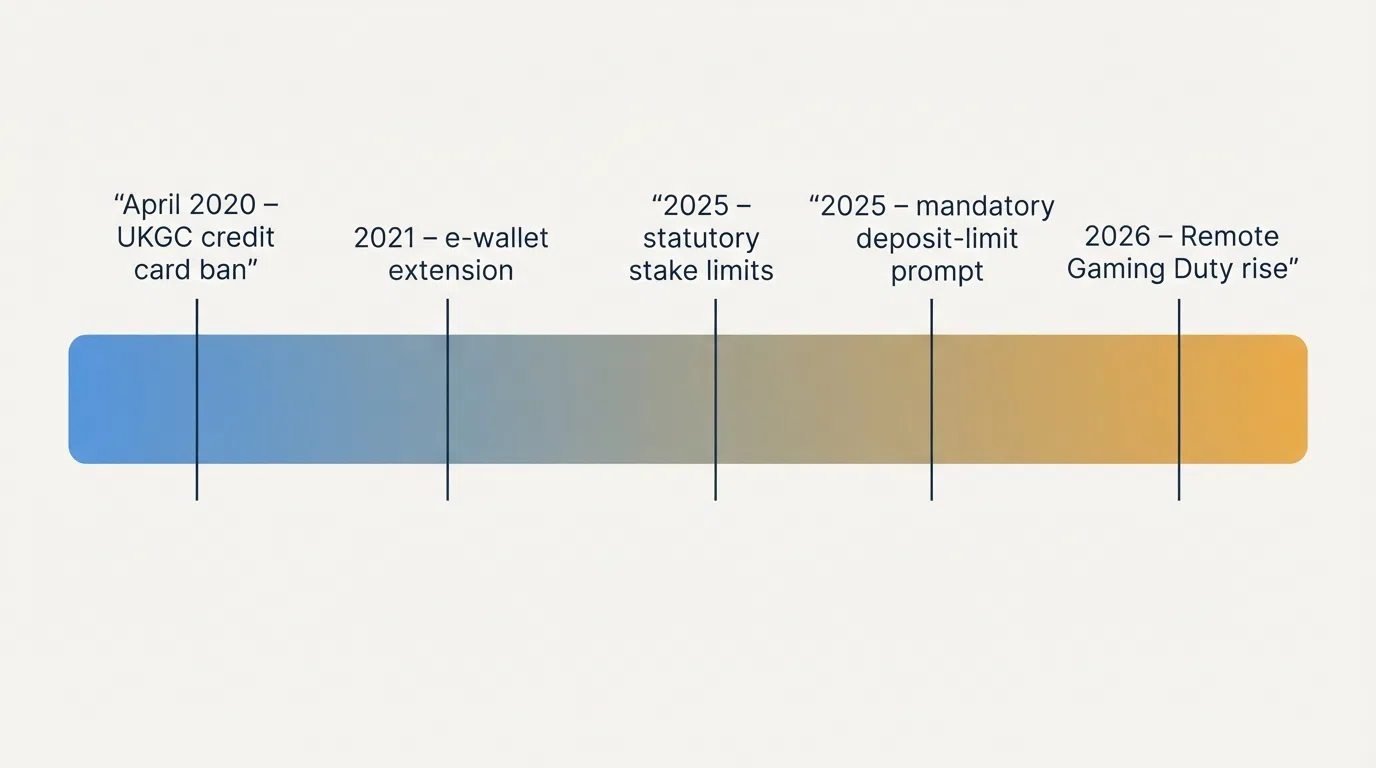
The offshore reality is unchanged by any of this. Curaçao-licensed casinos sit outside the UKGC’s jurisdiction and continue to take credit cards, and the players using them are accessing a market the Commission can disrupt but not block. Section 33 of the Gambling Act 2005 makes it a criminal offence to provide gambling facilities to customers in Great Britain without a UKGC licence, and the sanction runs to 51 weeks’ imprisonment, an unlimited fine, or both — but the offence is the operator’s, not the player’s. There is no established criminal penalty for a player who simply plays on an unlicensed site.
What the ban achieved is the question the post-2020 data answers. The Behavioural Insights Team tracked average weekly credit card gambling spend falling from £24,500 to £3,350 — an 86% reduction that held through 2024. The NatCen evaluation found post-ban survey waves less likely (AOR 0.82) to report credit card gambling, but did not find a significant overall shift in the use of borrowed money for gambling. Within the subset of players who had previously gambled on credit, 76% stopped using borrowed funds entirely, while 15% did use borrowed funds and attributed their shift to the ban. The Communications did not reach all people who gamble.
The April 2020 ban explained — what LCCP licence condition 6.1.2 actually prohibits
The instrument is one licence condition in a longer compliance code, and the text is short. From 14 April 2020, no licensee may accept payment for gambling by credit card, where “credit card” means a card issued under section 11(1)(a) of the Consumer Credit Act 1974. The prohibition covers all remote gambling (betting, gaming and lotteries) and non-remote betting; pre-existing rules already covered non-remote casinos, bingo, adult gaming centres and family entertainment centres. The single carve-out is non-remote lottery.
Two extensions sit alongside the headline rule. The first is the e-wallet extension: an operator can only accept a customer payment via an e-wallet if that e-wallet demonstrably prevents credit card use for gambling. The second is the search for indirect routes — the Commission’s published position is that any route that begins with a credit card and ends in a gambling deposit is covered, and operators are responsible for the design of their cashier. The Commission’s January 2020 consultation response restated this: e-wallet providers and operators share the obligation to ensure the credit card ban is not circumvented through wallet top-ups.
Why credit cards were banned — the 22% statistic that drove the decision
The published rationale sits on a single statistic. The UK Gambling Commission’s consultation found that 22% of online gamblers who used credit cards were classed as problem gamblers, against a base rate in the single digits for non-credit-card users. The 22% figure is not a licence-specific finding; it describes a behaviour the regulator chose to interrupt rather than a risk that evaporated when the rule took effect. The 800,000 UK consumers who used a credit card for gambling in 2018 — around 2% of credit card holders — were the policy’s scope.
The post-ban evaluation paints a more granular picture. Average weekly credit card gambling spend fell from £24,500 to £3,350 — an 86% reduction that held through 2024. Among all people who gambled, those in the post-ban survey waves were less likely (AOR 0.82) to report credit card gambling compared with pre-ban waves. The ban did not, however, have a significant overall impact on the use of borrowed money for gambling: 76% of former credit card gamblers stopped using borrowed funds entirely after the ban, but 15% did use borrowed funds and attributed their choices to the ban. The communications about the ban did not reach everyone who gambled.
Are any credit card casinos still legal in the UK? The offshore reality
Zero GB-licensed operators accept a credit card, and compliance with the ban is monitored by the UKGC as a standing licence condition. The offshore sites that still take Visa and Mastercard credit cards — Donbet, Mystake, Goldenbet, Freshbet and Rolletto in this comparison — do so because they hold Curaçao licences and sit outside the UK regulatory regime. The legal risk for the operator is established: section 33 of the Gambling Act 2005 makes it a criminal offence to provide gambling facilities to customers in Great Britain without a UKGC licence, and the sanction runs to 51 weeks’ imprisonment, an unlimited fine, or both. The Gambling (Licensing and Advertising) Act 2014 made the GB licence a point-of-consumption requirement, meaning a Curaçao or Malta licence is not a substitute for serving British customers.
There is no equivalent criminal offence for the player who uses an unlicensed site. The actual loss for the player is protection: no GAMSTOP coverage, no UKGC complaints route, no approved ADR provider, and no British consumer redress if funds are withheld. Enforcement against unlicensed operators works through disruption rather than blocking. The UKGC has no statutory power to require ISP or DNS blocking — legislation has been proposed but not enacted — and the published model runs through cease-and-desist notices, search-engine URL referrals, domain registrar and hosting pressure, and payment-provider referrals. The figures for April 2024 to June 2025: 3,140 disruption notices, 447,778 URLs referred to search engines, 287,961 URLs removed, and an average 32% fall in engagement across 160 disrupted sites.
Non-Gamstop casinos and credit card acceptance — the protections you give up
A row-by-row view of what a GB licence gives you versus what disappears at an offshore credit card casino.
| Protection | GB-Licensed Casino | Offshore (Curaçao) Casino |
|---|---|---|
| GAMSTOP self-exclusion coverage | Mandatory since 31 March 2020; exclusion 6m / 1y / 5y / 5y+auto, no early cancellation | None — not connected to GAMSTOP |
| UKGC complaints route | Available to every player | None |
| Approved ADR provider | Mandatory for licensees | None |
| British consumer redress if funds withheld | Available | None |
| Statutory slot stake limits | £5 (25+), £2 (18–24) | No statutory cap |
| Wagering requirement cap on bonus funds | 10× from 19 December 2025 | No statutory cap |
| Statutory deposit-limit prompt before first deposit | Required from 31 October 2025 | None required |
| Financial vulnerability checks at £150 net deposit | Required from 28 February 2025 | None required |
| Game provider audit obligation | Independent testing required | Self-declared |
| Auto-play and feature-buy ban on slots | In force since 2021 | Not applied |
| Statutory levy funding treatment, prevention, research | 1.1% of GGY for remote casino | None |
The protections the GB column lists are the result of fifteen years of rule-making. They exist because the Gambling Act 2005 and its subsequent amendments require them, and they are enforced by the Gambling Commission. The right column is not a claim about the offshore operator’s reliability — Donbet, Mystake, Goldenbet, Freshbet and Rolletto are real businesses processing real payments — it is a description of the regulatory perimeter. The perimeter is the only place those protections exist.
What the ban means for players — the protections gained, the borrowing that shifted and what 2026 brings
The headline finding is the 86% fall in average credit card gambling spend, which held through 2024, and the 76% of former credit card gamblers who stopped using borrowed funds entirely. The caveat is the 15% who did use borrowed funds and said the ban was part of the reason, and the wider finding that the ban did not significantly change overall use of borrowed money for gambling. The Gambling Survey for Great Britain 2024 reports 2.7% of adults scoring 8+ on the Problem Gambling Severity Index (problem gambling), 3.1% moderate-risk and 8.8% low-risk — the same order of magnitude as the pre-ban baseline.
The regulatory picture in 2026 has added new protections that did not exist when the credit card ban came in. Statutory slot stake limits took effect on 9 April 2025 (£5 for 25+) and 21 May 2025 (£2 for 18–24). From 31 October 2025, every GB-licensed operator must prompt a financial limit before the first deposit, action decreases immediately, and apply a cooling-off delay to increases. From 19 December 2025, wagering requirements are capped at 10× on bonus funds. Financial vulnerability checks became mandatory at a £150 net deposit threshold in a rolling 30-day period from 28 February 2025, using publicly available data only. A gross deposit limit based solely on money paid into the account takes effect on 30 September 2026 under RTS 12, and only that form may legally be called a “deposit limit”. The Remote Gaming Duty rose from 21% to 40% on 1 April 2026, and the statutory levy has been in force since April 2025 — both operator-side taxes that may compress margins and bonus values at GB-licensed sites over time.
The credit card ban worked at its specific target. It did not eliminate problem gambling, and the regulator never claimed it would. What it did was remove a specific funding route that the data showed carried a disproportionate share of harm, and the years since have added layer after layer of further protection on top.
Playing online slots with a credit card — what is still available in 2026
Slot play is where the two paths diverge most clearly, because the GB-licensed slot product carries more specific restrictions than any other gambling vertical and the offshore path carries none of them. At a GB-licensed site, the maximum stake on a slot game cycle is £5 for players aged 25 and over, and £2 for players aged 18 to 24, both in force under SI 2025/215. Auto-play has been banned since 31 October 2021, every game cycle must last at least 2.5 seconds, losses disguised as wins are prohibited, and feature buys are banned. The credit card ban stops the credit-funded route; the stake limit caps the size of a single spin; the auto-play ban forces a player to be physically present for every spin; the feature-buy ban removes the most volatile bonus structure from the slot product. The full slot regulatory stack is a GB-licensed-only product.
At an offshore site, none of these restrictions applies. There is no statutory stake cap, no auto-play ban, no feature-buy ban, no spin-speed minimum, and credit cards are accepted for slot play. The five Curaçao-licensed casinos on this page — Donbet, Mystake, Goldenbet, Freshbet and Rolletto — all offer online slots funded by Visa and Mastercard credit cards, and the slot product at each is the slot product the operator chooses to offer, with the volatility and the maximum stake set by the studio and the operator rather than by the regulator.
Credit card slot sites available to UK players right now
Donbet, Mystake, Goldenbet, Freshbet and Rolletto all accept Visa and Mastercard credit cards, all offer online slots, and all hold Curaçao licences with no GB licence. None of them applies the UK statutory slot stake limits, the auto-play ban or the feature-buy ban. None is connected to GAMSTOP. None offers access to a UKGC-approved ADR provider. The only recourse for a UK player whose withdrawal is withheld or whose bonus is voided is the operator’s own terms and the Curaçao regulator, which has no enforcement reach in Great Britain.
Donbet claims 80+ game providers, though the research sources did not independently verify specific studio names for any of the five offshore operators. The provider rosters at Mystake, Goldenbet, Freshbet and Rolletto are recorded as unverified in the data underlying this page. A provider claim at an unregulated casino carries no independent audit obligation, which is the practical consequence of the audit regime being a GB-licensed-only requirement.
How to play slots with a credit card — deposit steps and game selection
The mechanics at an offshore casino follow a standard flow. Open the cashier, select Visa or Mastercard, enter the card details and the deposit amount (minimums are £10 at Rolletto and £20 at Donbet and Mystake), confirm, and the funds appear in the casino balance within seconds. Open the slots lobby, pick a game, set the stake, and spin. The maximum stake is set by the operator and the studio, not by a statutory cap; auto-play is available if the game supports it; feature buys are available on the games that have them.
The mechanics at a GB-licensed casino are the same flow minus the credit card option. The maximum stake is £5 per spin for players aged 25 and over, and £2 per spin for players aged 18 to 24. Auto-play is disabled, feature buys are blocked at the platform level, and every game cycle lasts at least 2.5 seconds. The deposit is funded by debit card, e-wallet, bank transfer or another approved method. Withdrawals at offshore casinos are processed back to the card, an e-wallet or a crypto address; processing times and reliability vary, and there is no UKGC complaints route if the operator delays or refuses.
Which slot providers and games work with credit card deposits
At GB-licensed casinos, the confirmed provider rosters run through NetEnt, Microgaming, Evolution, Blueprint Gaming, Playtech, Pragmatic Play and Play’n GO — the studios listed in the operator entries above. These are verified by the research sources and are subject to the GB-licensed site’s independent testing regime.
At offshore casinos, the picture is less clean. Donbet claims 80+ providers, the others do not publish a verifiable roster, and the research sources did not independently confirm specific studio names for any of the five. The provider claim at an offshore casino is a marketing claim rather than an audited roster, and the slot game you see at the lobby is the slot game the operator has chosen to integrate, with no obligation to publish a return-to-player figure that has been independently tested.
For a slot player who prioritises verified game quality and fairness, the GB-licensed casinos offer a known and audited provider set but require a debit card or e-wallet deposit. For a slot player who prioritises paying by credit card, the offshore casinos accept the method but the game roster is taken on trust. The two priorities do not align on any single operator on this page.
Staying safe — the responsible gambling tools that actually protect UK players
The single most important fact about the responsible gambling framework in the UK is that it is a GB-licensed framework. GAMSTOP, deposit limits, reality checks, time-outs, financial vulnerability checks, the National Gambling Helpline, the TalkBanStop partnership, the statutory levy funding treatment and prevention — all of these exist because a regulator required them to exist, and they apply at GB-licensed sites. The offshore casinos on this page are not bound by any of them. A player choosing the offshore path is choosing to step outside every one of those safeguards, regardless of how reputable the operator is.
The prevalence data behind the safeguards is the reason the safeguards exist. The GSGB 2024 survey found 2.7% of adults in Great Britain scoring 8+ on the PGSI (problem gambling), with a further 3.1% moderate-risk and 8.8% low-risk. Nearly 15% of the adult gambling population shows some measurable level of gambling-related risk. Almost one in three adults who gamble and are experiencing any level of problems want treatment, support or advice — up from 17% in 2020.
GAMSTOP self-exclusion — how it works and why it does not cover offshore sites
GAMSTOP is a free national multi-operator self-exclusion scheme. You register once, and you are blocked from every GB-licensed online gambling site for your chosen exclusion period. The periods are six months, one year, five years, or five years with auto-renewal; once registered, the exclusion cannot be cancelled early under any circumstances, and the only route back is to wait out the period. Participation has been mandatory for every GB-licensed online operator since 31 March 2020.
GAMSTOP is online-only and licence-bound. It does not cover land-based venues — bookmakers, casinos, bingo halls, amusement arcades — and it has zero reach over offshore Curaçao-licensed casinos. If you register with GAMSTOP and then attempt to deposit at Donbet, Mystake, Goldenbet, Freshbet or Rolletto, the self-exclusion does not trigger: those operators are not connected to the GAMSTOP system, and there is no mechanism for GAMSTOP to know you are there. The TalkBanStop campaign combines GAMSTOP with free Gamban blocking software and National Gambling Helpline support as a three-layer safety net, but the same gap applies at the device level: an offshore casino’s site is not blocked unless Gamban’s list includes it, and the player has to install Gamban in the first place.
Deposit limits, reality checks and cooling-off periods — the tools you have at GB-licensed casinos
From 31 October 2025, every GB-licensed operator must prompt a player to set a financial limit before the first deposit, and a deposit cannot proceed without seeing the prompt. Any request to decrease a limit is actioned immediately; any request to increase a limit carries a cooling-off delay. From 30 September 2026, a gross deposit limit based solely on money paid into the account over a set duration must be offered, and only that form may legally be called a “deposit limit” under RTS 12.
Financial vulnerability checks became mandatory at a £150 net deposit threshold in a rolling 30-day period from 28 February 2025, under LCCP Social Responsibility Code 3.4.4. The checks use publicly available data only — bankruptcy records, county court judgments, individual voluntary arrangements, debt relief orders — and are not a credit check. Financial risk assessments (often called affordability checks) have been announced and confirmed by the UKGC Board for a staged rollout, but the regime is not yet in force. Reality checks pop up at set intervals to show how long a player has been playing and how much they have spent. Time-outs let a player block access for a short cooling-off period of 24 hours to six weeks. None of these tools is required at the offshore credit card casinos on this page.
Where to get help — helplines, clinics and blocking tools
- National Gambling Helpline (operated by GamCare). 0808 8020 133, free, 24 hours a day, every day. Also accessible via web live chat and WhatsApp. Over 52,000 calls handled in 2024–25. Accredited by the Helplines Partnership.
- TalkBanStop. A partnership of GamCare, Gamban and GAMSTOP. Three free tools: helpline support, Gamban blocking software for your devices, and GAMSTOP self-exclusion.
- NHS gambling harm clinics. England, Scotland and Wales. Referral through a GP or self-referral in some areas.
- GambleAware. The charity that funds research, prevention and treatment, and commissions the National Gambling Support Network.
- Gamblers Anonymous. Peer-support meetings across the UK, both in-person and online.
- Bank gambling blocks. Many UK banks now let you block gambling transactions from your account via your banking app. The block applies regardless of whether the casino is GB-licensed or offshore.
The 2.7% problem-gambling prevalence rate from the GSGB 2024 survey translates to roughly 1.4 million adults in Great Britain. Nearly 30% of adults who gamble and are experiencing any level of problems want treatment, support or advice, up from 17% in 2020. The infrastructure above is what the statutory levy funds, and it is free at the point of use.
How we chose and ranked the casino sites on this page
Every operator on this page was checked against the UK Gambling Commission’s public register, which was last updated on 29 July 2026. Each of the five GB-licensed operators is on the register with an active account; each of the five offshore operators is not, and is correctly recorded as holding no GB licence. The welcome-offer terms, payment methods and game providers were sourced from operator websites and from a panel of affiliate trackers accessed in 2026 — Bookies.com, Thebingoonline.com, onlinecasino.co.uk, Racingpost.com, Pamtree.com, Casinoity.com, casinobuddies.co.uk, Tekedia.com, Mystakecasino-gb.com, vaultspins.co.uk, Casinos-uk.com, Offshoreonlinecasinos.com, Thebeigelshop.com, rollettocasinoss.co.uk and Thecasinospress.com. The figures are recorded as found.
Ranking was applied qualitatively, in this order. The first criterion is GB licence status — the primary split, because the page’s subject is credit card acceptance, and a GB-licensed site cannot accept a credit card while an offshore site can. The second criterion is bonus fairness, scored on wagering multiple and benchmarked against the 10× statutory cap that took effect at GB-licensed sites on 19 December 2025. The third is the validity window and any cashout caps. The fourth is payment-method range and provider quality, with the caveat that provider claims at offshore casinos are self-declared rather than independently audited. No weighting formula is applied beyond these criteria, and no operator paid for inclusion or placement.
Is the convenience of one payment method worth every protection the UK has built?
The two paths are not equivalent, and the page’s job is to make that clear.
The GB-licensed path gives a player the full set of UKGC protections: GAMSTOP self-exclusion, an approved ADR provider, a UKGC complaints route, statutory slot stake limits, a 10× wagering cap on bonus funds, a mandatory deposit-limit prompt, financial vulnerability checks at the £150 net deposit threshold, a statutory levy funding treatment and prevention, and a regulator with statutory enforcement powers. The trade-off is that credit cards are not accepted; the player funds the account with a debit card, an e-wallet, a bank transfer or another approved method.
The offshore path gives a player the credit card deposit. The trade-off is that every one of the protections above is gone — no GAMSTOP, no ADR, no UKGC complaints route, no statutory stake or wagering caps, no deposit-limit prompt, no financial vulnerability checks, and provider claims that are self-declared rather than independently audited. The site’s licence is Curaçao, which has no enforcement reach in Great Britain.
The data on the credit card ban is the clearest guide to what the rule was designed to interrupt. The 22% problem-gambling rate among credit card users was the rationale. The 86% fall in average credit card gambling spend and the 76% of former credit card gamblers who stopped using borrowed funds are the results. The 15% who switched to other forms of borrowing, and the finding that the ban did not significantly change overall use of borrowed money for gambling, are the limits. The rule worked at its specific target. It did not eliminate problem gambling, and no responsible account of it claims otherwise.
The cost of choosing offshore is not a monetary line item. It is the absence of every safeguard the UK regulatory system has built since 2005: the licensing objectives, the LCCP, the social responsibility codes, the stake limits, the deposit caps, the 10× wagering ceiling, the statutory levy, the helpline, the self-exclusion scheme, the alternative dispute resolution route, the enforcement model. In 2026 that system is the most developed consumer protection framework for online gambling anywhere in the world, and the choice the page equips a reader to make is whether the convenience of depositing with a credit card is worth stepping outside it.
This page does not and will not pick an operator for a reader. The comparison, the data and the regulatory detail above are here so the trade-off is fully visible before a deposit is made.
Frequently asked questions about credit card casinos in the UK
Do e-wallets like PayPal or Skrill get around the credit card ban?
No. The UK Gambling Commission’s credit card ban extends to credit-card-funded payments routed through e-wallets, and the Commission reminded operators that they can only accept an e-wallet payment where the e-wallet demonstrably prevents credit card use for gambling. PayPal, Skrill and Neteller are widely accepted at GB-licensed casinos, but the route from a credit card through any of them is closed by design and by rule.
What is GAMSTOP and how does it actually protect UK players?
GAMSTOP is a free, UK-wide self-exclusion service for online gambling. By registering once, you prevent yourself from accessing any GB-licensed gambling site for six months to five years. It is mandatory for every GB-licensed operator but does not apply to offshore casinos, which operate outside this framework and remain accessible.
What should I do if I think I have a gambling problem?
Contact the National Gambling Helpline on 0808 8020 133 — free, 24/7, operated by GamCare and also available via web live chat and WhatsApp. Consider registering with GAMSTOP and installing Gamban blocking software through the TalkBanStop partnership. NHS gambling harm clinics operate in England, Scotland and Wales; referral is through a GP or self-referral in some areas. Gamblers Anonymous runs peer-support meetings across the UK.
Which deposit methods work at UK casino sites now that credit cards are banned?
Visa and Mastercard debit are accepted at every GB-licensed casino on this page. PayPal is accepted at bet365, William Hill, 888casino, Duelz and All British Casino. Skrill, Neteller, Apple Pay, bank transfer and Paysafecard are accepted at varying combinations of GB-licensed operators. Crypto (Bitcoin and others) is accepted at all five offshore casinos on this page and at no GB-licensed site. The credit card ban does not affect any of these methods directly.
What consumer protections do I lose at an offshore casino without a UKGC licence?
GAMSTOP coverage, the UKGC complaints route, access to an approved ADR provider, British consumer redress if funds are withheld, the statutory slot stake limits, the 10× wagering cap, the mandatory deposit-limit prompt, the £150 net deposit financial vulnerability check, and the independent game-provider audit obligation. Section 33 of the Gambling Act 2005 makes it a criminal offence for the operator to provide gambling facilities to GB customers without a UKGC licence, but the offence is the operator’s, not the player’s, and enforcement against the player is not established.
Payments – fastestpayout-casinos-uk
Content created by the «fastestpayout-casinos-uk» team