
Trusted Casinos Not on GamStop UK: The 2026 Reality Check
 Available in GB
Searching for a casino that sits outside the GamStop self-exclusion scheme is, at bottom, a search for something the British regulated market deliberately does not offer — and the gap is where exactly the same protections the scheme enforces on a UK Gambling Commission (UKGC) brand get traded away. The legal position is settled and worth stating bluntly: it is not a criminal offence for a UK resident to gamble on an offshore-licensed site. The criminal offence under section 33 of the Gambling Act 2005 falls on the unlicensed operator, not the player. What the player loses is not freedom; it is the safety net. And that is the subject because every other difference in this article — bigger bonuses, looser terms, crypto payouts — flows from that single structural choice.

Verified against current data as of September 8, 2026 and the UK Gambling Commission public register of licence holders.
What “trusted” means at a casino outside GamStop
The word *trusted* keeps its everyday meaning even where the regulator that usually certifies it has no jurisdiction. A Curaçao, Anjouan or Costa Rica licence gives a brand the legal right to take bets, and that is all it gives the player: no UKGC-level protection, no access to an Alternative Dispute Resolution (ADR) provider recognised by a British regulator, and no statutory fund segregation. “Offshore does not mean unsafe — but it does mean unprotected by UK law” (expert guidance, 2026). That distinction is the foundation of every safety assessment a UK player should make before depositing at a non-GamStop casino.
*Trusted* at a non-GamStop site is therefore a property the operator has to earn in public, not one a regulator confers on it. A licence number printed in the footer is a starting point, not a conclusion; the conclusion is whatever sits behind it — a verifiable operator identity, a real company on a regulatory register, fair terms a reader can read, and an independent review trail that has held up over months rather than weeks. A British licence is the only route to the UKGC’s complaints process and ADR, and it has been compulsory at point of consumption since the Gambling (Licensing and Advertising) Act 2014. Outside that regime, the operator is, by definition, unlicensed for the GB market. Anything called “trusted” is the operator earning that word without the Commission’s umbrella above it.
How a casino earns the word “trusted”
The signals that justify *trusted* are concrete and checkable. The first is licence verifiability: a Curaçao licence number can be cross-referenced against the Curaçao Gaming Authority register, and a current sub-licence id should resolve to a live entry. The second is operator identity on record — the legal entity behind the casino, its registered address, and the people behind the company. The third is fair terms that are stated, full and unaltered, in the bonus page itself, not buried in a terms-of-service PDF that has shifted since the last promotion. The fourth is an independent review-platform trail that confirms payout behaviour over time.
Offshore sites run on Curaçao, Anjouan or Costa Rica licences, and a GB licence is required to target Great Britain — an offshore licence is not a substitute. Those two sentences together define the playing field: every brand on this list is outside the GB regime, and the only thing that distinguishes one from another is how it behaves inside that fact.
Real-money play and the sites that review it
Real-money play at a non-GamStop casino means stakes and payouts in pounds, dollars or crypto, not training-mode credits. That single word changes everything about which platforms review the operator: a site that audits real-money play is one that has deposited, played and withdrawn from its own balance. Independent review platforms are the closest thing the offshore world has to a regulator’s complaints queue, and what they actually check — payout speed, terms enforcement, bonus fairness once a withdrawal is requested — is the work that fills their scorecards. The online-versus-land-based context for the UK player is that almost all “real money” gaming for offshore-licensed brands happens online; a brick-and-mortar venue operating on a Curaçao licence and accepting UK players is the exception, not the format.
Not on GamStop, not under UK law: the trade-off players make
The choice to play outside GamStop is a legal one for the operator and a protective one for the player. On the operator side, providing gambling facilities to a GB customer without a UKGC licence is a criminal offence under section 33 of the Gambling Act 2005, carrying up to 51 weeks’ imprisonment, an unlimited fine or both. On the player side, no penalty attaches to the act of gambling there. What attaches is the absence of everything a British licence buys.
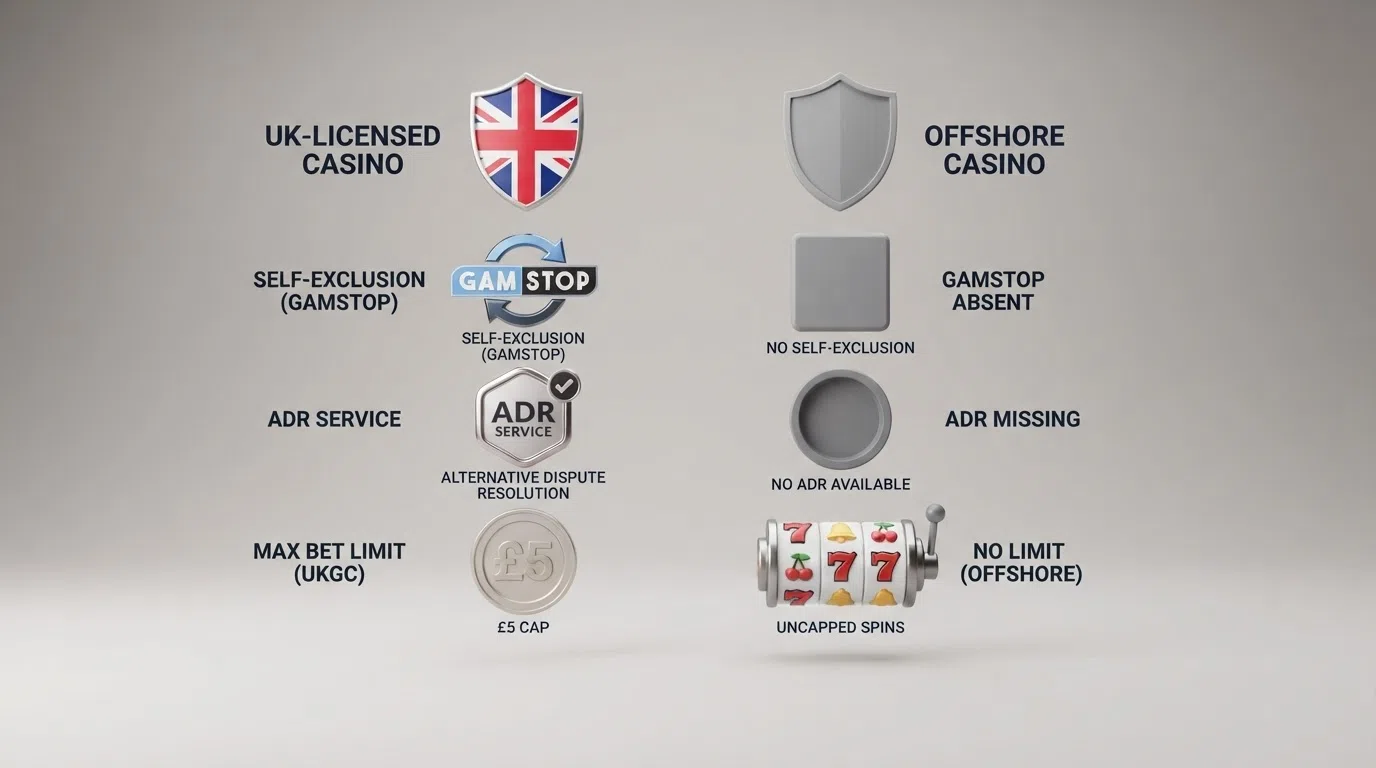
GamStop has been a mandatory licence condition for every UKGC-licensed online operator since 31 March 2020. Register with GamStop and every UKGC-licensed site is unavailable to you for six months, one year, five years, or five years with auto-renewal — and the exclusion cannot be cancelled early. The scheme does not cover offshore operators because those operators do not hold UKGC licences in the first place. They have no integration to switch on, no obligation to honour your registration, and no duty to refuse your deposit.
Operators that stay offshore run on economics: a GB licence carries the statutory levy (1.1% of gross gambling yield for remote casino, since April 2025), a Remote Gaming Duty that rose to 40% from 1 April 2026, the December 2025 wagering cap, and the full weight of LCCP compliance. The corresponding offshore environment offers a 30×–45× required turnover instead of a 10× cap, and the Compliance, Advertising and Stake rules simply do not apply. Enforcement against unlicensed sites is disruption rather than blocking — cease-and-desist notices, search-engine referrals, payment-provider pressure — and in 2024–25 the Commission issued 516 cease-and-desist requests against operators and saw 95,705 URLs removed. In 2025–26 the figure was 397,527 URLs reported and 266,667 removed at a 67% takedown rate. Enough to inconvenience, not enough to remove.
What GamStop is, and what it does not cover
GamStop is a self-exclusion register. Register once and every UKGC-licensed online operator must refuse your deposits and marketing contact for the period you selected — six months, one year, five years, or five years with auto-renewal — and that period cannot be ended early. The scheme has been mandatory since 31 March 2020 and covers every GB-licensed product, from slots to sports. The boundary sits exactly where the UKGC licence ends. A Curaçao brand is not a UKGC brand; it does not see a GamStop request and has no duty to refuse play from a self-excluded player.
This is the precise line the page draws: GamStop reaches every site that has integrated it; offshore sites have not, and the scheme cannot force them to.
UKGC-licensed versus offshore: what you gain and lose
| Protection or Rule | UKGC-Regulated Site | Non-GamStop Site |
|---|---|---|
| Statutory slot stake cap (£5 aged 25+, £2 aged 18–24) | Yes (SI 2025/215) | No |
| Wagering cap (10×, from 19 December 2025) | Yes | No — usually 30×–45× |
| Credit cards banned (since April 2020) | Yes, including credit-card-funded e-wallets | No |
| Net-deposit financial vulnerability check (£150, 30-day rolling) | Yes (since February 2025) | No |
| Fund segregation and ADR access | Yes | No — none of the three offshore regimes provide either |
| Minimum age verification | Identity verified before first deposit | Varies, KYC often deferred until first withdrawal |
| Auto-play, 2.5-second spin minimum | Banned since October 2021 | Not enforced offshore |
| GamStop integration | Mandatory | Never |
The right column is shorter for a reason: every entry deleted is a protection the operator is no longer required to provide. The bold claim in the GB column is the entry that the Commission enforces personally; the non-GamStop column’s *No* is not a feature of the operator’s choice but a fact about the regime it sits in.
Offshore licences and how to read a safety signal
Three licence regimes account for almost every non-GamStop site a UK player will encounter. Curaçao eGaming, now operating under the Curaçao Gaming Authority (CGA/CGB), issues sub-licences via master licence holders and has tightened its framework over recent years — the new-regime licences are more rigorous than the old sub-licences they replaced. Anjouan operates a lower-friction licence regime widely used for white-label operations, and Costa Rica issues a less scrutinised licence that is, in practice, closer to a registration than an audit. None of the three replaces a UKGC licence: none provides ADR access, none requires fund segregation, and none offers a player complaints route comparable to the Commission’s.
To verify a Curaçao licence, take the printed number — typically a 4-digit sub-licence id with a master licence holder — to the Curaçao Gaming Authority register and confirm both the master licence status and the sub-licence entry. A live register entry is a current licence; an expired master licence means the sub-licence is unenforceable. Anjouan and Costa Rica lack comparably public registers; an absence is harder to disprove than a presence, which makes those regimes weaker safety signals on paper.
Ranked: the offshore operators behind the “trusted” label
Every row in this table is, by the definition of the keyword, a brand that does not hold a UKGC licence and is not integrated with GamStop. The ranking orders the eleven by how well each brand’s profile fits the *trusted non-GamStop* request: identifiable operator, published licence reference, transparent terms, a track record of UK-player traffic, and a slot and live-dealer library wide enough not to depend on a single studio.
| Operator | Licence | First-Deposit Bonus | Wagering | Min. Deposit |
|---|---|---|---|---|
| MyStake | Curaçao — OGL/2024/1798/1048 | 150% up to £750 (300% up to £1,500 across three deposits) | 30× deposit + bonus | £20 |
| Donbet | Curaçao (GCB) | 150% up to £750 + 50 free spins | 30× deposit + bonus | £20 |
| Freshbet | Curaçao | 100% up to £500 (1st); full package £1,280 across three deposits | 30× bonus | £20 |
| Goldenbet | Curaçao (Santeda International B.V.) | 300% up to £1,500 across three deposits + 100 free spins | 35× bonus | £20 |
| Rolletto | Curaçao (Santeda International B.V.) | 150% up to £500 + 200 free spins (50 instant + 30/day for 5 daily logins) | 30× bonus + deposit | £20 |
| Velobet | Curaçao (Santeda International B.V.) | 150% up to £500 + 70 FS (under £500); 100% up to £1,000 + 70 FS (£500+) | 30× bonus; 35× free-spin winnings (£100 max) | — |
| Winstler | Curaçao master licence 5536/JAZ (Favorit United N.V.) | 5-tier package totalling ~£9,500 (first deposit 300% up to £500) | 45× bonus | £50 |
| Cosmobet | Curaçao (Santeda International B.V.) | 100% first deposit (casino) + 150% up to €1,000 (sports) | 30× bonus + deposit | £20 |
| Lucky Barry | Curaçao (Cerberlot N.V.) | 375% up to €1,000 | 35× | £10 |
| Emperia Casino | Curaçao (Fortuna Games N.V.) | Up to £3,000 + 325 free spins across four deposits | — | — |
| Bilucky Casino | Costa Rica (operator undisclosed) | Four-tier welcome (amount unspecified) | — | — |
A blank cell is a fact research did not surface, not a finding the page invented. Emperia and Bilucky carry the most gaps for that reason, and the write-ups below flag the same gaps. The four Santeda brands — Goldenbet, Rolletto, Velobet and Cosmobet — appear on the same proprietary platform launched between 2020 and 2025, which raises concentration rather than competition questions worth keeping in mind.
MyStake
The largest library and the biggest three-deposit match in the set. MyStake runs over 7,500 games from the marquee studios — Pragmatic Play, NetEnt, Microgaming, Evolution and Play’n GO among them — and pairs the scale with a 150% match up to £750 on the first deposit, expanding to 300% up to £1,500 across the first three deposits. Wagering is 30× on deposit plus bonus combined, with a 30-day validity and a £20 minimum deposit. The licence is Curaçao OGL/2024/1798/1048, held by GTW B.V.
The 30× on the combined deposit + bonus is the meaningful sum: a £750 first-deposit claim, doubled, must be turned over £45,000 before any withdrawal clears — which is the 30× the GB-licensed 10× cap keeps out of British brands. MyStake sits where the scale proposition meets the turnover reality, and works for a player who wants the catalogue and a single set of clear, posted terms.
Donbet
A straightforward 150% match with free spins attached to the first deposit. Donbet offers 150% up to £750 plus 50 free spins on first deposit; wagering runs at 30× on deposit plus bonus, with a £20 minimum and a 30-day validity window. The operator is Curaçao-registered through the GCB regime and not separately disclosed in public sources.
For a player who wants the bonus maths to start and stop at the first deposit — no second- and third-deposit tiers to chase — Donbet is the cleanest single-deposit shape in the ranking. The library sits around 5,000 games with the same marquee studios the rest of the set runs. Worth registering for the clarity rather than the headline.
Freshbet
A three-deposit package worth £1,280 aimed at fast crypto payouts. Freshbet splits the welcome into 100% up to £500 on the first deposit, 50% up to £400 on the second and 25% up to £380 on the third — totalling £1,280. Wagering is 30× on the bonus amount only, with a £20 minimum. The crypto withdrawal route is the differentiator: under 24 hours tested.
The wagering structure is the relevant comparison — bonus only, rather than bonus + deposit — and it is meaningfully lighter than MyStake’s combined treatment at the same 30× rate. Crypto withdrawals being measured in hours rather than days is the practical reason a player comfortable with Bitcoin or Litecoin would route their play through Freshbet rather than a fiat-only brand.
Goldenbet
The deepest single-deposit match at 300% with 100 free spins on top. Goldenbet carries a 300% match up to £1,500 across three deposits, plus 100 free spins, with wagering at 35× on bonus funds and a £20 minimum deposit. The operator is Santeda International B.V. — the same company that runs Rolletto, Velobet and Cosmobet on its proprietary platform.
The 35× on bonus only is more demanding than combined wagering of 30× in some competitor packages, but the 100 free spins on top are the wider bonus spread. The Santeda-platform concentration is the consideration: four brands on one operating system means four skins for one organisation, which is not a hazard but is a layout that demands a closer look at the underlying reviews than a single operator would.
Rolletto
A 200-spin drip that pays out over five daily logins. Rolletto offers 150% up to £500 plus 200 free spins — 50 instantly on first deposit, then 30 per day across five consecutive daily logins. Wagering is 30× on deposit + bonus combined, with a £20 minimum and a 30-day validity. Curaçao-licensed and Santeda-operated.
The drip is the structural feature: the 200 free spins are not a single wallet credit, and missing a single daily login forfeits the next day’s batch. The play pattern looks like a five-day commitment before the spins even resolve, which is a real cost to anyone who does not intend to log in daily.
Velobet
A two-tier welcome that raises the match for deposits of £500 or more. Velobet carries 150% up to £500 plus 70 free spins on deposits under £500, and a 100% match up to £1,000 plus 70 free spins on deposits of £500 or above; wagering is 30× on the bonus amount and 35× on free-spin winnings with a £100 maximum cashout from free spins. A separate crypto track offers 160% up to €1,000 at 35×. The library is 7,000+ titles from 90+ studios.
The £100 free-spin cap is the figure to remember: even a 70-spin win can sit above that ceiling, and anything above it does not withdraw. Two tiers on the same brand is also a structural feature — Velobet reads as a casino that has decided which deposit size it wants and built the terms to herd players toward it.
Winstler
The biggest headline package at ~£9,500, gated behind the highest wagering. Winstler runs a five-tier welcome totalling roughly £9,500, opening at 300% up to £500 on the first deposit; the wagering requirement is 45× on bonus with a £50 minimum deposit. Curaçao master licence 5536/JAZ has been held by Favorit United N.V. since October 2022. Withdrawal limits are €1,000 per day, €2,500 per week, €10,000 per month.
The ~£9,500 figure is genuinely the headline, and the 45× multiplier is the genuine ceiling. A player who intends to chase the full five-tier ladder under those turnover rules is exhausting much more than £9,500 in nominal bonus value. The fixed monthly withdrawal limit is also the constraint that turns a winning session into a multi-week withdrawal queue. Winstler is the explicit answer to *what does the most demanding offer in this set look like*.
Cosmobet
A 100% casino match with a separate 150% sports package alongside. Cosmobet runs a 100% first-deposit casino bonus and a parallel 150% up to €1,000 sports welcome; minimum deposit is £20 and wagering runs at 30× on deposit + bonus combined. The operator is Santeda International B.V.
For sports-betting readers who also want a casino, Cosmobet carries the package split in a single brand rather than two. For pure casino readers, the casino offer itself is the one to measure against the others on the list, and that measurement is unflattering: same 30× on deposit + bonus as several competitors, but without the scale of catalogue to compensate.
Lucky Barry
The 375% headline sits behind a €2 bet cap and a seven-day clock. Lucky Barry’s welcome is 375% up to €1,000 at 35× wagering, with a €2 maximum bet during wagering, a seven-day bonus validity and a £10 minimum deposit. The operator is Cerberlot N.V., Curaçao-licensed.
The validity is the structural constraint: seven days, €2 per spin maximum, 35× on a 375% match. The arithmetic produces a player who is forced to grind at minimum-stake wagers under a tight clock. The £10 minimum entry is genuinely low, which is the one practical feature the brand has kept; the rest of the package is a fairly extreme version of the genre.
Emperia Casino
The widest library (12,000+ games) spread across a four-deposit welcome. Emperia runs up to £3,000 plus 325 free spins across four deposits, on a 12,000+ game library from Fortuna Games N.V. under a Curaçao licence; the wagering, minimum deposit and validity were not specified in the sources reviewed for this ranking.
The 12,000-title catalogue is the reason Emperia lands on a non-GamStop shortlist regardless of the missing figures, and the four-deposit structure is the reason to read the terms before claiming. Wagering that is not publicly posted is a gap the player must close before committing real money, not a fact the page can paper over.
Bilucky Casino
The Costa Rica outlier whose terms the page leaves deliberately unstated. Bilucky carries a Costa Rica licence with an undisclosed operator, a four-tier welcome package, and 2,000+ games from 80+ providers; the wagering, deposit tiers and validity were not specified in sources found.
The Costa Rica registration is the differentiator in the wrong direction — Costa Rica issues the loosest of the three offshore licence types and runs no public register comparable to Curaçao’s. A Costa Rica licence is not a ground for refusing a brand, but it is a reason to demand more from the rest of the file: verifiable operator identity, posted terms, a current payout record. The reason Bilucky slots into this ranking at all is the 80-provider catalogue; the reason the write-up is short is the absence of the terms a reader needs.
How to judge an offshore casino before you deposit
- Take the licence number to the issuing regulator’s register and confirm the master licence and sub-licence are both current.
- Read the operator name to the company register of the licensing jurisdiction and confirm the legal entity behind the brand.
- Click the testing-lab seal (eCOGRA, iTech Labs) and follow the link to the live certificate, not the badge image.
- Read the bonus terms on the same page as the offer, not the generic terms-of-service.
- Search for payout complaints specific to the brand, dated within the last six months.
The previous list is the order to work through them in, not a menu. Each step costs about two minutes; none of them requires a specialist tool.
The signals a trustworthy casino displays
The visible markers that separate serious operators from the rest are four and are stated upfront on the homepage or the footer: a published licence number that resolves to a live regulator entry, a verifiable operator identity (legal entity, registered address, parent company), transparent bonus terms that do not change once claimed, and live customer support in plain UK language with response times of under a few minutes. Add an independent review-platform rating with multiple reviewer accounts and recent payout confirmations, and the brand has cleared the public-trust bar.
The three offshore licence regimes are the structural floor — a Curaçao sub-licence under a current master, an Anjouan licence under a registered operator, or a Costa Rica registration — and a brand that cannot show any of the three should not accept a deposit.
Red flags that should stop a registration
The five things that signal an operator is not worth the risk are a missing licence page or an untraceable operator name, repeated payout complaints across independent review platforms, bonus terms that appear to shift after the player has claimed, no live-chat or unresponsive customer support, and a flimsy or absent responsible-gaming page. Each of those is independently sufficient reason to walk away; two of them together is the start of a guaranteed loss.
None of these requires insider information. Payout complaints are searchable; live-chat latency is a two-minute test; the responsible-gaming page either exists or it does not. The market rewards operators that look like grown-up businesses and penalises operators that look like landing pages, which is itself the trust signal.
RNG certification and why you can check it yourself
Three testing labs cover virtually every serious offshore casino. eCOGRA, iTech Labs and Gaming Laboratories International audit game Random Number Generator (RNG) outputs and publish live certificates — clicking the seal at the bottom of a casino page should resolve to a certificate on the lab’s domain showing the operator name, the date and the games or game families tested.
A live certificate is the evidence of fairness for the games a player actually plays; a static badge image without a clickable link is the absence of evidence. The reason to check is not a distrust of the lab but a distrust of the operator: an expired or unrelated certificate is one of the easier fictions to assemble on a landing page.
The bonus that looks bigger than it is: non-GamStop offers decoded
A bonus at a non-GamStop casino looks like the GB-licensed equivalent multiplied by something — three times the headline, a third the wagering cap in the wrong direction. The headline number is what the operator prints; the number the player keeps is the one that survives the wagering, the cashout cap and the time limit. The arithmetic on this ranking is a worked illustration: take MyStake’s 300% up to £1,500 across three deposits at 30× wagering on deposit plus bonus. A player claiming the full £1,500 bonus (from a £500 total deposit) is committing to (500 + 1,500) × 30 = £60,000 in turnover to clear the bonus — which is the 30× the GB-licensed 10× cap prevents at British brands.
Treat that as a worked example of a calculation method rather than a guaranteed timing prediction — £1 nominal stake, £1 nominal bonus from a £1 deposit, 5 seconds per spin, gives roughly 5,000 spins to clear the bonus at 30×. The expected-loss calculation is bonus × wagering × (1 − RTP), where the representative RTP near 96% produces a small expected loss per cleared bonus, with substantial variation across the casino’s actual game mix. The Bonus Cost calculation is a statistical estimate, not a forecast.
Welcome offers and the multi-deposit trap
A two- or three-deposit package pays out only as far as the player funds it. The first deposit unlocks tier one, the second unlocks tier two, and so on, with most packages requiring the tiers to be claimed within a single window — usually 30 days from the first deposit, sometimes less. The wagering differences are where the cost shows up: Freshbet’s £1,280 three-deposit package applies 30× to the bonus amount only; Goldenbet’s £1,500 three-deposit package applies 35× to bonus funds; MyStake’s three-deposit package applies 30× to bonus + deposit combined. Three different configurations of the same nominal headline, each with its own real cost.
Free spins that are not free: the fine print
Free spins carry wagering on their winnings and a maximum cashout that quietly caps the upside. Velobet applies 35× wagering on free-spin winnings and a £100 maximum cashout from the spins. Rolletto offers 200 spins but pays them over five days — 50 instantly and 30 per day for five daily logins — and missing a login forfeits the next batch. Donbet attaches 50 free spins directly to the first deposit at 30× on deposit plus bonus. None of these are “free” in the literal sense; all of them convert a marketing number into a real-money wagering and timing commitment.
Low-wagering, cashback and the terms that signal trust
The offer shapes that cost the player less are cashback as actual loss-back rather than as bonus currency, low-wagering deals in the 5×–15× band where they appear, and bonus terms that are short and posted. Bonus terms that flag trust are short validity windows and high wagering read backwards — they are the warning signs, not the selling points. Lucky Barry’s 375% looks generous until a player sits with the €2 maximum bet, the seven-day validity and the 35× wagering; the GB-licensed 10× cap is what is being escaped here, and the 30×–45× range is what is being accepted instead.
Getting money in and out: payments at non-GamStop casinos
Payments at non-GamStop casinos look faster and looser partly because the rules that constrain them at GB-licensed sites do not apply. Credit cards were banned for all remote gambling in April 2020, and that ban includes credit-card-funded e-wallet deposits — so a Skrill wallet topped up via a credit card does not deposit at a GB brand, but does at most offshore ones. Crypto is the fastest payout route: Bitcoin confirms in 10–60 minutes, Litecoin under 10 minutes, Ethereum in 2–5 minutes, USDT TRC-20 under 5 minutes. The casino-side approval step still sits in front of all of these and is independent of the technology beneath it; the speed of a crypto payout is a property of the blockchain network and the casino’s willingness to release.
eWallets and prepaid: what UK players can actually use
Skrill, Neteller and Paysafecard are the e-wallet and prepaid methods UK players reach most easily at non-GamStop casinos. They generally work for deposits at offshore sites even where they are restricted at GB brands, and deposit speed is instant on both sides. Card deposits are accepted at most non-GamStop brands where the GB credit-card ban does not apply; debit cards that draw directly from a UK current account are outside the ban and process normally. The gap is credit-card-funded e-wallets, which the LCCP 6.1.2 ban has closed at GB brands but not at offshore ones.
Withdrawal speed: what the casino promises versus what it delivers
The timeline from approval to wallet splits in two: the casino’s own approval delay (where KYC happens, where bonus terms are checked) and the network confirmation time once the funds leave. The casino side is the controllable variable — anywhere from hours to days, depending on whether the operator runs night-shift payments. The network side is the uncontrollable one: Bitcoin’s 10–60 minutes is a function of the blockchain, not the brand. Winstler publishes €1,000 per day, €2,500 per week, €10,000 per month as withdrawal limits; other operators either publish similar limits or apply default daily and monthly caps without quoting a number. A big win against monthly-limit rules can sit across several weeks of withdrawals.
Crypto casinos: the most trusted picks and the anonymity trade-off
Crypto delivers what fiat cannot at offshore casinos — fast payouts, low friction, and in some cases no KYC at all. The trade-off is what anonymity costs and what it does not actually buy. The UKGC has not yet permitted GB-licensed operators to take crypto: an exploratory crypto pathway review opened at the Betting and Gaming Council AGM in February 2026, and no UKGC-licensed casino currently accepts cryptocurrency for deposits or withdrawals. At the offshore end, several brands on this ranking run dedicated crypto routes, and Velobet in particular operates a 160% up to €1,000 at 35× wagering crypto track alongside the fiat welcome.
Bitcoin, Ethereum and the altcoins UK players use
Bitcoin is the default at most non-GamStop casinos accepting crypto, and the 10–60 minute confirmation window is the benchmark the others are measured against. Ethereum trades speed (2–5 minutes) for gas fees that vary with network load and can be significant at relative-to-stake levels for small deposits. Litecoin (under 10 minutes) and USDT on TRC-20 (under 5 minutes) are the practical low-fee choices for players who want crypto speed without Bitcoin’s volatility exposure. Operators with a dedicated crypto track are usually paying out in the same coins, so choosing the coin at deposit picks the coin at withdrawal.
No-KYC and anonymous casinos: the limits of privacy
No-KYC at a non-GamStop casino is a delay, not a guarantee; identity verification almost always kicks in at withdrawal, when the operator needs to send the funds to a named account, and the limits are tighter at higher withdrawal amounts. The trade-off is what the absence of KYC costs in the wider sense: no ADR route under a British regulator, no chargeback through a UK card issuer once a deposit is confirmed, no UKGC complaints process if a withdrawal is delayed, and no statutory fund segregation. Anonymous play and protected play are different products; this ranking is the second, not the first.
Mobile play without an app: the browser and PWA reality
Non-GamStop casinos skip the App Store and Google Play because both marketplaces restrict gambling apps that do not hold a UKGC licence; the result is a mobile experience built for the browser rather than stored as an icon on the home screen. Most operators on this ranking ship Progressive Web Apps (PWAs) or browser-only access, both of which load at the same speed and render the same game catalogue as a comparable desktop session. The player experience is a touch-optimised lobby, full game library and full cashier, accessed by typing a URL into the phone’s browser rather than tapping an app icon.
Browser versus app: what a PWA can and cannot do
A PWA installs to the home screen as an icon but is still a browser session underneath; notifications, offline access and launch speed are partial, polished for the brand but not equivalent to a native app. None of the featured non-GamStop operators ship a native mobile app, which is the structural choice rather than an omission. The browser experience has matured to parity with native apps for slot play and live-dealer sessions; the loss is in storage, biometrics and the deeper OS integration an app gets, none of which most slot play actually needs.
Mobile game selection and performance
Slot and live-dealer availability on mobile mirrors the desktop lobby for the providers on this list — Pragmatic Play, NetEnt, Microgaming, Evolution and Play’n GO all render on the phone, with HTML5 wrappers around the games rather than platform-specific builds. The browser-versus-desktop gap is in load speed on a slower connection and in the visual density of complex live lobbies at small screen sizes. Both are liveable. Neither makes the game catalogue smaller.
Slots, live tables and the studios behind them
The library breadth across the featured set is the reason a UK player moves offshore in the first place. MyStake carries 7,500+ games, Velobet lists 7,000+ from 90+ studios, Emperia claims 12,000+, and the rest of the set runs 2,000–5,000. The marquee studios — Pragmatic Play, NetEnt, Microgaming, Evolution and Play’n GO — recur across the rankings, which is itself the trust signal: a casino with these names on its lobby has signed provider agreements rather than scraped a catalogue.
Online slots and where the biggest libraries are
Slot volume is both a trust signal and a choice signal. MyStake’s 7,500+, Velobet’s 7,000+ across 90+ studios and Emperia’s 12,000+ place those three at the top of the catalogue ranking; the rest cluster at 2,000–5,000. The £5/£2 slot stake cap at GB-licensed sites does not apply offshore, which means high-stake slot play is structurally possible at these brands in a way it no longer is at British ones. Spin speed, auto-play, reverse-withdrawal rules and the loss-disguised-as-a-win ban are not enforced offshore either; the choice is a real choice.
Live dealer and table games on the offshore floor
Evolution is the dominant live-dealer provider on this list, with Pragmatic Play Live and a few smaller studios filling the gaps; roulette, blackjack and baccarat are table stakes at every featured brand. Live-dealer stake limits run uncapped offshore — the GB-licensed tier structure required by the December 2025 rules simply does not exist — and live tables on the phone render at the same fidelity as the desktop lobby for the providers involved. The trade-off is the lack of a UK ADR provider sitting behind a complaint about a misdeal.
Providers: reading the studio names on an offshore site
The provider list is a trust signal rather than a logo wall. Pragmatic Play, NetEnt, Microgaming, Play’n GO and Evolution are the studios whose games most players recognise, and a casino that lists them alongside its name has signed integration deals and been added to the providers’ published operator lists. A studio’s own licence — most are held under the Malta Gaming Authority (MGA) or the UKGC themselves — is the second layer of evidence a game has been audited: a game running under an MGA-certified Random Number Generator (RNG) and a non-GamStop operator’s skin is not lacking fairness evidence, it is lacking the GB-specific player-protection wrapper that sits over the same games at home.
Bingo, high-roller and sweepstakes: the niche verticals
Bingo, high-roller and sweepstakes sit at the edges of the offshore market and are not evenly covered. Bingo rooms are present at some featured brands but are not the headline product; high-roller tiers exist where welcome packages run into five figures, with their own RTPs and gameplay patterns; sweepstakes casinos are legal in parts of the United States but operate under a different model outside the UK, so their UK-facing footprint is limited. None of the featured operators is a dedicated sweepstakes brand, and the bingo range is a smaller version of what a UK-licensed Mecca or Gala player would find.
New non-GamStop casinos: what a fresh launch changes
Newness cuts against the *trusted* label rather than for it. A 2025 launch has not yet earned the multi-year payout record an established brand can show, and a fresh entrant is harder to assess than a brand with two to three years of independent review coverage. Most of the operators on this ranking were launched between 2020 and 2025 on the Santeda International B.V. proprietary platform, and the concentration of four featured brands on one operator is the kind of single-point-of-failure detail worth weighing in a deposit decision.
What to check before you join a new casino
The launch-date checklist that catches the flash-in-the-pan operators runs through: the operator’s company and licence traceability, the first-month bonus terms, the early payout record, complaint history, and the responsible-gaming and support pages. The offshore licence regimes here are Curaçao, Anjouan or Costa Rica; the trust floor is the verifiable operator entity and a current CGA sub-licence, not the brand’s reputation. Anything older than three months without a live support channel or a current responsible-gaming page is the start of a real warning list.
New non-GamStop entrants versus established names
The trust gap between a 2025 launch and a multi-year record is essentially evidence older than the player can be. The Santeda brands — Goldenbet, Rolletto, Velobet and Cosmobet — share a single platform launched between 2020 and 2025, so the four-reading-rows effect is actually a single entity with four marketing skins. For a UK player, that long-track-record argument applies to Rolletto, Goldenbet and Velobet more than to a brand that refreshed its skin and re-launched in 2025.
Playing safe when the safety net is gone: responsible gambling offshore
The tools that exist at non-GamStop casinos are operator-set rather than regulator-mandated, so the variance is wide: a generous operator offers deposit limits, time-outs and self-exclusion across its own brand; a stingy one offers the page as the act. Tools absent offshore that a GB-licensed site must offer include GAMSTOP integration (which is a player-side exclusion against the operator set) and the standard regulated interventions — vulnerability checks, mandatory pre-deposit deposit limits, mandatory spending reviews. The relevant prevalence figures behind the warning are stark: 13.1% of GB adults who gamble experience some level of problems and almost one in three of those want treatment; 2.4% of GB adults score as problem gamblers by the PGSI 8+ definition; the National Gambling Treatment Service treated 11,960 clients in 2024/25, an 11% rise on the prior year. These are not numbers for the offshore casino to address. They are numbers for the UK reader who is making the deposit decision.
The responsible-gaming tools offshore casinos offer
Deposit limits and self-exclusion tools do appear on the better-run non-GamStop brands, though across the offshore set they are operator-set rather than regulator-mandated. Reality checks, time-out buttons and session reminders are operator-level choices — the variance between brands is high. The tools that are absent offshore are the ones the GB scheme enforces centrally: GAMSTOP coverage, the £150 financial vulnerability check, the standardised gross-deposit-limit prompt from 30 September 2026, and the Commission complaints process for unpaid withdrawals. Full statements of each sit in the responsible-gaming section earlier; the broader argument is summarised together there.
Where UK players find help when it is needed
The British support network stays reachable regardless of where a player has deposited. GamCare runs the National Gambling Helpline — free, confidential and 24/7. GambleAware, the independent charity, funds treatment, prevention and research and publishes the Annual Treatment and Support Survey. NHS gambling harm clinics (the NHS Northern Gambling Service, the National Problem Gambling Clinic in London and around 15 regional clinics across England, Scotland and Wales) provide clinical treatment. Gamblers Anonymous runs peer support groups. Online self-tests at GambleAware and GamCare can pull a real signal out of self-reporting. The 13.1% of GB adults who experience gambling problems, the 11,960 clients treated in 2024/25 and the 2.4% classified as problem gamblers are the reason this section of the page exists.
How we selected and verified these casinos
The sources behind this ranking are regulator-facing: the UK Gambling Commission public register, the Curaçao Gaming Authority licence check, the European-facing offshore review sites, and the independent review platforms whose published payout and complaint records produced the body of evidence on the table. The ten operators were checked against licence verifiability, operator identity, terms transparency and player traffic — no invented weightings, no operator-paid placement in the ranking, no fabricated scores. The British market is dominated by a small number of long-established groups, and the verification route for the GB side is the Commission’s public register of licence holders; the equivalent on the offshore side is the Curaçao Gaming Authority register, the Anjouan licence record and the Costa Rica-issued licence documents.
Your call: what to do about an offshore casino in 2026
The honest restatement of the trade-off is the only conclusion the figures will sustain: “offshore does not mean unsafe — but it does mean unprotected by UK law.” The 30×–45× wagering across this ranking is the cost of escaping the GB 10× cap; the absence of GAMSTOP reach is the cost of escaping the GB self-exclusion regime; the absence of ADR is the cost of escaping the GB complaints process. None of those absences fits every player, which is the reason the ranking is ranked rather than ranked-away. The cases where this choice makes sense are narrow and specific: an experienced player who has read the terms, set their own deposit limit before opening the cashier, accepted that a withdrawal dispute ends at the operator, and chosen a brand whose payout record has held up over months rather than weeks. The cases where it does not make sense are routine: anyone registered with GamStop and considering the offshore route to circumvent their own self-exclusion, anyone depositing funds they cannot afford to lose, anyone reading the £1,500 bonus as money they will keep. The one decision worth taking off this page is to make it explicitly: pre-commit a deposit limit, refuse to chase a bonus, and treat the offshore brand as a self-funded entertainment budget rather than a financial product. No operator is recommended; none is sent to; the reader closes the page having chosen a trade-off rather than an offer.

Frequently asked questions
Is it legal for UK players to gamble at casinos not on GamStop?
Yes, for the player. The criminal offence under section 33 of the Gambling Act 2005 falls on the unlicensed operator, not on the UK resident gambling there. A GB licence has been compulsory at point of consumption since 2014, so the brand is operating illegally for the GB market — which is the operator’s exposure, not yours. The trade-off the player accepts is the loss of UKGC-level protection.
What happens if a non-GamStop casino refuses to pay out my winnings?
The dispute sits with the offshore regulator rather than the Gambling Commission. Curaçao, Anjouan and Costa Rica all offer weaker complaints infrastructure than a UK ADR route, and the operator’s terms of service govern the process. The options narrow considerably if the operator refuses to engage; the choice of brand matters more than the choice of game.
Why do some UK players prefer non-GamStop casinos over UK-licensed ones?
The reasons given are usually higher bonuses, lower wagering or no wagering at all, higher slot stake limits (the £5/£2 GB cap does not apply offshore), and crypto payouts without the GB verification steps. None of those is an answer to a player with a self-exclusion in place; the choice to play offshore is not a way around a GamStop registration, because the registration covers UKGC-licensed sites and offshore sites are outside the scheme by design.
How do I check if an online casino has fair RNG-certified games?
Click the testing-lab seal at the footer of the casino — eCOGRA, iTech Labs or the testing laboratory — and follow it to a live certificate on the lab’s own domain. A live certificate lists the operator name, the date and the games or families tested. A static badge image without a clickable link, or a link that resolves to the casino’s own page, is not evidence of fairness.
What responsible gambling tools are available at casinos outside the UKGC?
The tools that exist are operator-set rather than regulator-mandated, so the variance is wide: deposit limits, time-outs and self-exclusion on the better operators, a thin page on the rest. GAMSTOP does not reach offshore sites, so a self-exclusion at one offshore brand does not protect a player at another. The GB support network stays reachable: GamCare, GambleAware, the NHS gambling harm clinics and Gamblers Anonymous all run independently of where a player has deposited.
Account – fastestpayout-casinos-uk
Content created by the «fastestpayout-casinos-uk» team