
How to Find a UK No-Minimum-Deposit Casino That Actually Delivers
 Available in GB
*Current as of September 8, 2026. Operator licence status verified against the Gambling Commission’s public register.*
The phrase “no minimum deposit” sounds like a free ride. It isn’t. What a UK-licensed casino actually promises when it drops its deposit floor is something narrower and more useful: you can put £1, £5 or even nothing into the cashier and start playing with real money. Whether that small outlay (or that zero outlay) produces anything worth withdrawing depends on the wagering structure, the spin value, the withdrawal minimum and a pile of UK rules most affiliate pages never mention. This article walks through what the term means in the regulated British market, which of the ten featured operators actually deliver on it, and what the Gambling Commission’s protection framework costs the player who uses it.

The article runs ten operators deep: four genuinely deposit-free (Sky Vegas, Paddy Power, Betfair, MrQ), and six others that require a qualifying deposit or have not confirmed a deposit-free offer. It uses the UK Gambling Commission’s own rules and public register as its reference point, and it surfaces the friction — withdrawal minimums, pay-by-mobile caps, the 40% Remote Gaming Duty — that a marketing page will not.
“No Minimum Deposit” Doesn’t Mean What Most Players Think
“No minimum deposit” is one of the most misread phrases in UK casino marketing. The confusion comes from a real structural overlap: a casino with no deposit floor will often hand out free spins on registration, and those no-deposit spins sit next to the no-minimum-deposit promise on the same landing page. Players assume the two are the same offer. They are not.
“No minimum deposit” is a deposit rule. It tells you the casino will accept whatever amount you choose to pay in, down to a nominal sum or zero in some cases. “No deposit bonus” is a bonus rule. It tells you the casino credits you something — usually free spins — without requiring a deposit at all. Both can apply at the same casino, on the same player, for the same session. Neither is what most players read it as.
The UK Gambling Commission’s public register, last updated 29 July 2026, lists 2,663 licensed operator records. That is the supply side of the British market these no-minimum-deposit casinos sit inside. It is a regulated, mature market with statutory stake caps, identity verification before any deposit, and the 10× wagering cap on bonuses that took effect in December 2025. These are not offshore sites competing on bonuses they cannot pay; they are UK-licensed brands competing on accessibility.
What “No Minimum Deposit” Actually Promises — and What It Doesn’t
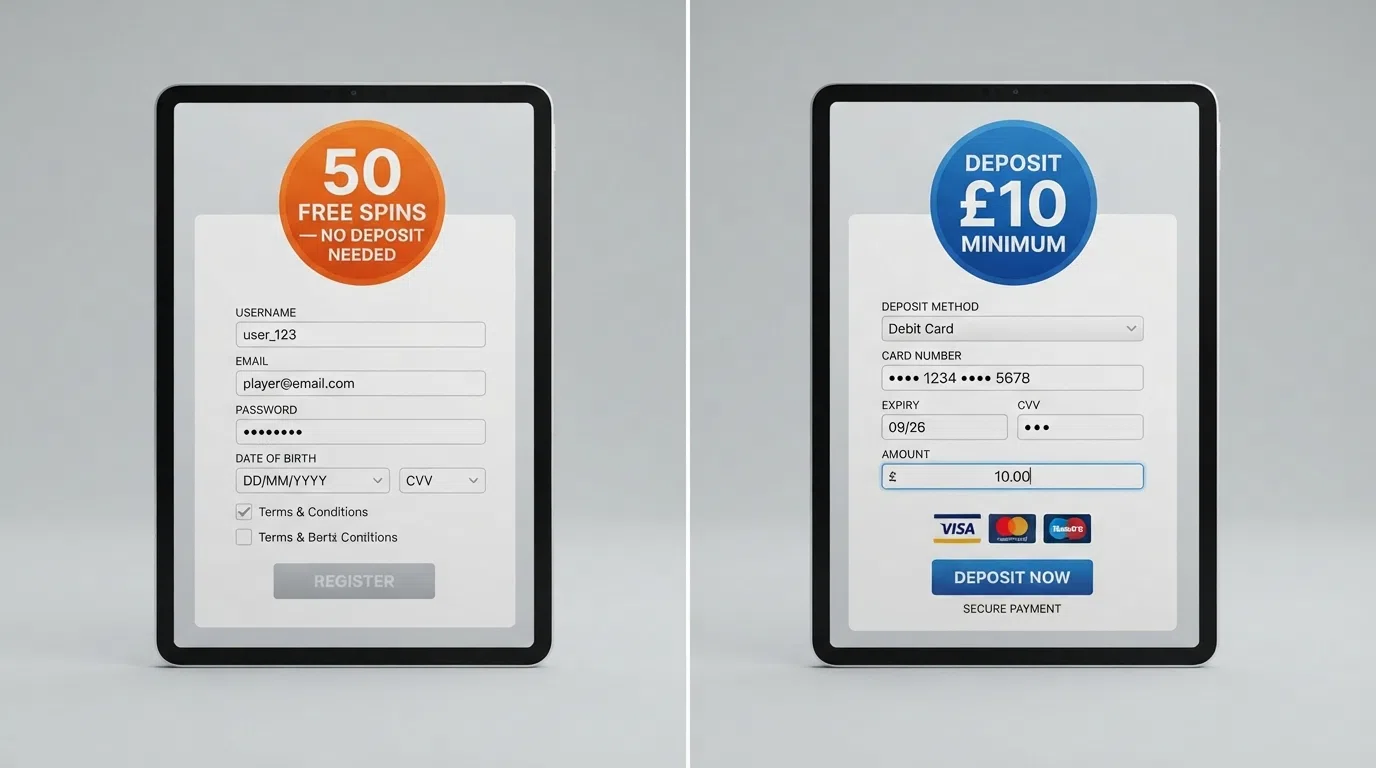
The practical reality is unglamorous. A casino with no deposit floor lets you deposit £1. It may also credit you 50 free spins on registration, which you can use without depositing a penny. What it does not promise is that either of those things will be worth much.
Sky Vegas credits 50 no-deposit free spins on a new account, then releases 200 more once you deposit and wager £10. Paddy Power runs the same structure with 60 no-deposit spins plus 200 more at the £10 mark. The headline counts look generous. The spin value is £0.10. At a 96% return-to-player slot, the expected value of 50 such spins is roughly £4.80 — before wagering, before the £500 maximum payout cap Paddy Power applies, before the 7-day expiry.
This is the contract a no-minimum-deposit casino actually offers: a low-cost entry, a finite bonus, and a clean terms sheet. The marketing version sells the entry. The terms sheet sells the rest.
No-Minimum-Deposit vs Low-Deposit: Where the Real Line Sits
The line between “no minimum” and “low minimum” is thinner than the affiliate space suggests. A £1 deposit casino is functionally identical to a no-minimum-deposit casino for any player willing to pay £1. The meaningful split is between casinos that credit something on registration — no-deposit spins — and those that gate every bonus behind a deposit.
The £5 tier covers PlayOJO (50 free spins, zero wagering, £5 deposit) and Casumo (100% deposit match up to £100 plus 50 spins, £5 deposit). The £10 tier covers Sky Vegas, Paddy Power, Betfair, bet365, and William Hill for their deposit-triggered bundles. The tier structure matters because each level unlocks a different bonus shape, and the 10× wagering cap since December 2025 has flattened what those bonuses look like underneath.
For a player budgeting a first session, the practical difference is whether the casino gives you anything before you commit money, not whether the deposit floor is £0 or £1. Four of the ten featured operators do. Six others require a qualifying deposit or have not confirmed an offer.
The UK Landscape: Where No-Minimum-Deposit Casinos Fit
No-minimum-deposit positioning is a competitive move inside a licensed market, not a sidestep of one. The operators running it are UKGC-licensed brands — Sky Vegas under Sky Betting & Gaming, Paddy Power and Betfair under Flutter Entertainment, bet365 and William Hill under their own established names — competing on accessibility against each other. The 2,663-license register is the universe they sit inside.
These casinos operate under statutory slot stake caps (£5 per game cycle for players aged 25 and over, £2 for ages 18 to 24, both in force by May 2025 under SI 2025/215), mandatory identity verification since May 2019, the 10× bonus wagering cap since December 2025, and the 40% Remote Gaming Duty that took effect in April 2026. None of that is optional. None of it can be skipped by rebranding. The “no minimum” promise sits on top of all of it.
The 10 UK-Licensed Casinos That Let You Start With Nothing (or Almost Nothing)
Ten operators. Four genuinely deposit-free. Six gated by a £5 or £10 qualifying deposit. The comparison below ranks them by what they hand you on registration and what they gate behind money.
| Operator | UKGC Licence | Deposit-Free? | Free Spins (No-Deposit) | Wagering on Free-Spin Winnings | Spin Value |
|---|---|---|---|---|---|
| Sky Vegas | 39439 | Yes | 50 | 0× | £0.10 |
| Paddy Power | 39439 | Yes | 60 | 0× | £0.10 |
| Betfair | 39439 | Yes | 50 | 0× | £0.10 |
| MrQ | 51250 | Yes | 10 | 0× | £0.10 |
| bet365 | 39563 | No (£10 lifetime) | — | 0× | £0.10 |
| William Hill | 39225 | No (£10 deposit + wager) | — | 10× | £0.10 |
| PlayOJO | 39326 | No (£5 deposit) | — | 0× | — |
| Casumo | 45402 | No (£5 deposit) | — | 30× (deposit + bonus) | — |
| Betfred | Active (Petfre (Gibraltar) Ltd) | Not confirmed | — | — | — |
| 888 Casino | 39028 | Not confirmed | — | — | — |
The column that matters most when comparing is the deposit-free status. Operators with no-deposit spins let you test the casino without committing a pound. Operators without them ask you to pay first, and the bonus you get for paying is the offer you should weigh, not the “no minimum” headline. Em dashes in the table mark fields research did not cover.
Sky Vegas: 50 No-Deposit Spins, Zero Wagering, Winnings Paid as Cash
Sky Vegas runs the most straightforward deposit-free offer among UK-licensed casinos. Register a new account, receive 50 free spins, use them on eligible games, keep whatever you win — there is no wagering requirement, no maximum cashout cap stated in the reviewed terms, and a 7-day window from credit. The Sky Vegas welcome page says it directly: “When you register a new account with us, you can enjoy 50 free spins on the selected games below. No deposit needed and definitely, no wagering required. Anything you win will be yours!”
Deposit £10 and wager it, and another 200 spins unlock, also at £0.10 each, also zero wagering, also 7-day validity. The full bundle is 250 spins. Sky Vegas is licensed under UKGC account 39439 (Bonne Terre Ltd, trading as Sky Betting & Gaming), listed Active on the public register.
Spins load on the first eligible game selected. Eligible titles include Starburst (RTP 96.09%, low volatility) and Rainbow Riches (RTP 95.00%, medium volatility). For a player testing the casino without committing, this is the cleanest version of the no-minimum-deposit promise: zero in, potential cash out, no strings.
Sky Vegas is our top pick for testing a regulated casino without risking your own capital; the 50 free spins offer a real-money session with zero wagering strings. If you were already prepared to make a deposit, you might prefer the 200-spin bonus bundle instead.
Paddy Power: 60 No-Deposit Spins With a £500 Safety Net
Paddy Power’s bundle is the largest deposit-free spin count among featured operators: 60 no-deposit spins (50 on eligible slots including Fishin’ Frenzy, Eye of Horus, King Kong Cashpots and Deal or No Deal Megaways, plus 10 on Paddy’s Mansion Heist), followed by 200 more after depositing and wagering £10. All spins are £0.10 each, zero wagering on winnings, 7-day validity.
The difference that matters is the £500 maximum payout cap. Paddy Power is the only deposit-free operator in this list to state one. If you hit a high-value combination on a 50-spin run of 96% RTP slots, the cap cuts off anything above £500. For a player spinning at £0.10 with no wagering, £500 is a generous ceiling — but it is a ceiling, and it is the reason Sky Vegas’s no-cap terms are worth comparing.
Paddy Power operates under UKGC account 39439 (PPB GE Ltd, part of Flutter Entertainment), Active. Game providers include NetEnt, IGT, Playtech, Blueprint, Pragmatic Play, Red Tiger and Evolution.
Paddy Power delivers the highest no-deposit spin count, making it the strongest entry point for those seeking maximum free-spin volume. However, players who hit lucky and value an uncapped payout might prefer Sky Vegas, which lacks this operator’s £500 ceiling.
Betfair: 50 No-Deposit Spins on Jackpot King Games
Betfair offers 50 no-deposit free spins tied specifically to Blueprint’s Jackpot King network, plus 100 more after depositing and spending £10. Eligible titles include Crabbin’ For Cash Extra Big Catch Jackpot King, Eye of Horus and Fishin’ Frenzy. Spin value £0.10, zero wagering, 7-day expiry, no maximum cashout cap stated.
The Jackpot King routing is the specific trade-off here. Blueprint’s Jackpot King titles run progressive prize pools that pay on top of standard line wins. The volatility profile is higher than a standard Starburst spin — bigger upside, longer stretches of nothing between meaningful returns. For a player depositing nothing and using 50 spins on a progressive, that variance profile is what you are buying.
Betfair operates under UKGC account 39439 (TSE Malta LP / Betfair Casino Ltd, Flutter Entertainment), Active, with multiple licence numbers across the group’s exchange, gaming and casino verticals.
Betfair is the clear choice if you want to chase progressive jackpots on the Jackpot King network without spending a penny. If, however, you prefer consistent, lower-variance gaming, you should explore operators offering standard Starburst or Big Bass slots instead.
MrQ: 10 No-Deposit Spins, Zero Wagering, No Cap
MrQ is the smallest deposit-free bundle in the featured set — 10 no-deposit free spins on Big Bass Q the Splash at registration — but the cleanest in structure. Zero wagering on winnings, no maximum cashout stated, withdrawals paid as cash. MrQ is the operator that built its offer on the no-wagering principle, and the 10-spin count is the price of that simplicity.
The slot itself is a Big Bass series title from Pragmatic Play and Reel Kingdom. The Big Bass family carries a published RTP of 96.71% at the Tier 1 configuration, with medium-to-high volatility — the same provider line that powers William Hill’s 200-spin Big Bass Splash welcome, but without the £30 cap or the 10× wagering.
MrQ operates under UKGC account 51250 (Lindar Media), Active. Game providers include NetEnt, Pragmatic Play, Red Tiger, Evolution and Push Gaming.
MrQ offers the most straightforward, no-nonsense welcome bonus on the list — 10 spins, zero wagering, no hidden payout caps. This is an ideal, low-commitment test, though some players may find 10 spins too short to form a full impression of the platform.
bet365: Up to 500 Free Spins — but Only After You’ve Deposited Before
bet365’s “10 Days of Free Spins” mechanic delivers the largest free-spin total on the list — up to 500 spins, revealed as 5, 10, 20 or 50 per day across 10 selections — but it is not a deposit-free offer. New players must have deposited a minimum of £10 in lifetime deposits before the offer is available.
Each batch of spins is £0.10, zero wagering on winnings, paid as cash. Spins expire 7 days from credit; the full offer must be claimed within 30 days. No maximum cashout cap is stated. The deposit gating is what disqualifies bet365 from the deposit-free column — but for any player who has already funded a bet365 account (sports, casino, anything), the 500-spin ceiling is unmatched.
bet365 operates under UKGC account 39563, Active. Game providers include NetEnt, IGT, Playtech, Blueprint, Pragmatic Play, Red Tiger, Evolution and Play’n GO.
Worth taking if: you have a bet365 history and want the largest deposit-triggered spin bundle. Not available if: you have never deposited with bet365 before.
William Hill: 200 Spins on Big Bass Splash — £10 Deposit, 10× Wagering, £30 Cap
William Hill’s welcome offer is the most restricted among featured operators. Deposit and wager £10, receive 200 free spins on Big Bass Splash at £0.10 each. The catch is in the wagering: 10× on free-spin winnings, applied to the advertised game within a 17-minute window, with a £30 maximum on redeemable winnings.
The 10× wagering sits at the upper edge of what the December 2025 statutory cap allows. The 17-minute window is the tightest validity among featured operators. The £30 cap is the lowest. William Hill is the operator where every term pushes toward less generous, and the brand recognition is what carries the offer. 200 spins have 17 minutes of play time.
Big Bass Splash runs at a published RTP of 96.71%, with medium-to-high volatility from the Big Bass Bonanza series. William Hill operates under UKGC account 39225 (WHG (International) Limited), Active. Providers include NetEnt, IGT, Playtech, Blueprint, Pragmatic Play, Red Tiger, Evolution and Play’n GO.
William Hill is a legacy name that offers a substantial 200-spin welcome package, though it comes with 10× wagering and a tight 17-minute window. If those terms feel restrictive, many other featured casinos offer better value for your budget.
PlayOJO: 50 Free Spins, Zero Wagering — £5 Minimum Deposit Required
PlayOJO built its brand identity on no wagering. The 50 free spins on offer carry zero wagering requirements, winnings are paid as withdrawable cash, and the operator’s wider “OJOplus” promise reinforces the same principle on ongoing returns. The £5 minimum deposit gates the offer — it is not a no-deposit bonus.
The £5 trigger is the lowest among deposit-gated featured operators. For a player who wants to commit a small amount and see how a casino treats them, PlayOJO is the lowest-cost entry on the deposit-gated side. The 0× wagering sits well below the 10× statutory cap, which is the structural reason PlayOJO’s offer looks generous — it is the model the rest of the market now has to match.
PlayOJO operates under UKGC account 39326 (Skill On Net Ltd), Active. Providers include NetEnt, Pragmatic Play, Red Tiger, Evolution, Play’n GO and Microgaming.
PlayOJO is the standout choice for players who want to avoid wagering requirements entirely and value a low £5 deposit threshold. If you were searching for a strictly no-deposit offer, however, you will need to look elsewhere as PlayOJO requires a qualifying deposit.
Casumo: 100% Match Up to £100 + 50 Spins — but 30× Wagering Changes the Maths
Casumo’s welcome is the only deposit match in the featured set: 100% up to £100 plus 50 free spins at £5 minimum deposit. The wagering is 30× on deposit plus bonus combined — the highest multiplier among featured operators, and a structure the December 2025 statutory cap does not touch because the cap applies to bonuses alone, not deposit-and-bonus combinations.
That distinction matters. A £100 deposit with a £100 bonus at 30× on deposit-plus-bonus requires £6,000 of wagering before withdrawal. At £5 a spin, that is 1,200 spins; at £2 a spin for under-25s, 3,000. The expected loss on £6,000 of wagering at a 96% RTP is around £240 — the real cost of clearing the bonus. Casumo is the outlier under the new rules, and it is also the only featured operator whose bonus structure genuinely rewards the larger deposit.
Casumo operates under UKGC account 45402, Active. Providers include NetEnt, Pragmatic Play, Play’n GO, Evolution, Red Tiger and Microgaming.
Worth taking if: you plan to deposit the full £100 and want the highest welcome value. Worth passing if: you are a low-stakes player — the 30× wagering dwarfs what any other featured operator asks.
Betfred: A UK High-Street Name — Deposit-Based Welcome, No No-Deposit Offer Confirmed
Betfred is included on brand strength and UK market presence, not on a confirmed no-deposit offer. The operator runs under UKGC licensing via Petfre (Gibraltar) Ltd, listed Active on the public register, with an estimated 4.85% share of UK remote gaming. Welcome-offer specifics — bonus type, free-spin count, wagering, validity, maximum cashout — were not confirmed in this research run. The Betfred promotions page should be checked for the current terms.
Game providers include major studios like NetEnt, IGT, Playtech, Blueprint, Pragmatic Play, Red Tiger, and Evolution. The roster matches most featured operators; the welcome terms do not.
Worth taking if: you are already a Betfred customer from the high street and want the casino vertical on a familiar platform. Worth passing if: you need a confirmed deposit-free bundle — Betfred has not been confirmed to offer one.
888 Casino: A Legacy Brand — Bonus Terms Not Surfaced in This Research Snapshot
888 Casino is one of the oldest online casino brands and appears in Racingpost’s five-best list for no-minimum-deposit casinos. UKGC licensing is confirmed under account 39028, Active. Proprietary 888 slots sit alongside NetEnt, IGT, Playtech, Blueprint, Pragmatic Play and Evolution.
The gap is the welcome offer. Bonus type, free-spin count, wagering multiplier, validity and maximum cashout were not surfaced from research snippets. The 888 Casino promotions page and the UKGC register should both be checked before depositing. The brand recognition and longevity are real; the welcome offer is not documented here.
Worth taking if: brand longevity and the 888 slots library matter to you. Worth passing if: you need the welcome terms in front of you before committing.
Why Your 2026 No-Deposit Bonus Is Smaller Than It Looks
UK regulation has quietly shrunk the real value of casino welcome offers. Three forces press on what an operator can give away in 2026, and each one shows up in the terms of the offers above.
The 10× wagering cap on bonuses took effect on 19 December 2025 under LCCP Social Responsibility Code 5.1.1. Before that date, 30× and 40× wagering were standard; high-match bonuses carried wagering multiples that took hundreds of spins to clear. The cap made those structures illegal. Casumo’s 30× survives only because the cap applies to bonuses alone, and Casumo’s wagering base is deposit plus bonus combined — a different calculation that the rule does not reach.
The 40% Remote Gaming Duty rose from 21% on 1 April 2026, announced at Autumn Budget 2025. Operators now pay a 40% tax on online casino profits. Every free spin and every matched deposit cuts into that margin. The result is the £0.10 standard spin value across every featured operator: a uniform ceiling that the duty makes economically rational.
Pay-by-mobile deposits have a £40 daily cap imposed by the Phone-paid Services Authority. The cap is structural — it is not something an operator can waive — and it makes pay-by-mobile a starter method, not a banking channel. The 1.1% statutory levy on gross gambling yield, effective from 6 April 2025, adds another operator-side cost that feeds the same restraint on welcome generosity.
The structural gap between UK-regulated offers and the offshore promises that still rank for this keyword comes down to these forces. An offshore casino can advertise 200% matches at 40× wagering because none of these caps apply. A UK-licensed casino cannot.
No-Deposit Free Spins: What “Free” Actually Means at a UK-Licensed Casino
A no-deposit free spin at £0.10 on a 96% RTP slot has an expected value of roughly £0.096 — not the £0.10 the headline implies. The real value of the structure is not the spin count; it is the zero-wagering clause. With zero wagering, every penny of expected value is withdrawable cash. With 10× or 30× wagering, that same spin has to clear a turnover threshold before withdrawal — and the expected loss on the turnover is the bonus’s real cost.
Sky Vegas credits 50 no-deposit spins at registration, valued at £0.10 each. The expected return across all 50 spins at a 96% RTP is £4.80 — but the headline figure is “free”, not “worth £4.80”. Paddy Power runs 60 spins with the same structure and a £500 ceiling on payout. Betfair runs 50 on Jackpot King games with the same zero-wagering structure but higher variance. MrQ runs 10 with the cleanest terms and no stated ceiling.
The expiry window is 7 days from credit for Sky Vegas, Paddy Power and Betfair. William Hill’s deposit-triggered 200 spins have 17 minutes. bet365’s 10-day mechanic gives 7 days per batch with 30 days to claim the full offer. The shorter the window, the more compressed the session — and the higher the chance that unplayed spins expire worthless.
Welcome and Deposit-Match Bonuses: The £5 and £10 Triggers
Most featured operators gate their larger welcome packages behind a £5 or £10 deposit. PlayOJO and Casumo sit at the £5 tier; Sky Vegas, Paddy Power, Betfair, bet365 and William Hill sit at £10. The deposit itself is small; what it unlocks varies sharply.
A £5 deposit at PlayOJO unlocks 50 zero-wagering free spins — the cleanest structure on the deposit-gated side. A £5 deposit at Casumo unlocks a 100% match up to £100 plus 50 spins, but the 30× wagering on deposit plus bonus makes the match expensive to clear. A £10 deposit at Sky Vegas unlocks 200 additional spins on top of the 50 no-deposit spins, all zero wagering. A £10 deposit at William Hill unlocks 200 spins on Big Bass Splash with 10× wagering and a £30 cap.
Casumo is the only featured operator with a true deposit match. The £100 ceiling is the largest bonus on the list. The 30× on deposit-plus-bonus is the largest wagering burden. The trade-off is direct: more bonus, more turnover required to clear it.
Wagering Requirements: Why 0× Is the New Standard — and 30× Is a Relic
The 10× statutory cap under LCCP SR Code 5.1.1 reshaped the UK bonus market in December 2025. Before the cap, a 30× or 40× wagering multiple was common; some offshore operators still run them. After the cap, any bonus wagering above 10× on the bonus alone is a compliance breach.
Seven of the ten featured operators now carry 0× wagering on free-spin winnings: Sky Vegas, Paddy Power, Betfair, MrQ, bet365, PlayOJO and (on its free spins) Casumo. William Hill’s 10× sits at the new cap. Casumo’s 30× applies to deposit plus bonus combined, which the cap does not reach. The shift to zero wagering is the structural change the cap produced — high-multiplier bonuses are gone, and the operators that built their offers on zero wagering are now the market standard.
The competitive norm in 2026 is not “lowest wagering” but “zero wagering on free spins”. William Hill’s 10× is no longer competitive on that metric; it survives on brand and on the £10 minimum deposit tier.
Ongoing Promotions and Player Offers Beyond the Welcome
Research carried limited ongoing-promotion data for the featured operators. Welcome offers are documented; retention offers are not surfaced in the same detail. The general pattern is that ongoing terms are less generous than welcome terms — a standard across most regulated markets.
The structural pressure on retention offers comes from the 40% Remote Gaming Duty and the 1.1% statutory levy, both of which cut into the margin an operator can give away on reload bonuses and loyalty rewards. Loyalty schemes and prize draws exist at most UK-licensed casinos, but the headline figures are smaller than the welcome bundle and the wagering structures vary. A player who has used the welcome spins and wants to evaluate ongoing value should look at the operator’s promotions page directly rather than relying on affiliate summaries.
The Payment Methods That Actually Work for Small Deposits — and the Ones That Don’t
Three payment methods matter for low-stakes UK players: PayPal, debit cards and pay-by-mobile. Each one comes with a structural constraint that the marketing copy does not surface.
The methods that don’t work are credit cards — banned for all remote gambling in Great Britain since 14 April 2020 under LCCP condition 6.1.2, and the ban extends to credit-card-funded e-wallet payments — and cryptocurrency, which no UKGC-licensed operator accepts as of 2026. Credit cards were the easiest debt-funding path for gambling; the ban removed it. Crypto remains incompatible with UK identity-verification requirements, and no licensed casino can route it.
The gap that catches players is the asymmetry between deposit and withdrawal minimums. Depositing £1 is straightforward at most UKGC-licensed operators. Withdrawing £1 may not be — withdrawal minimums are higher than deposit minimums at most casinos, and a player who deposited £1 and won £3 may find that £3 is below the withdrawal floor. The mechanics are covered in the section on fast withdrawals below.
PayPal at No-Minimum-Deposit Casinos: Fast, Familiar, but Not Universal
PayPal is the most-requested deposit method among UK casino players. It is available at most UKGC-licensed operators, but research did not carry per-operator PayPal availability across the featured set, and the writer cannot confirm PayPal acceptance for every brand. The general pattern is that large operators — Sky Vegas, Paddy Power, Betfair, bet365, William Hill — accept PayPal; smaller and newer operators may not.
PayPal has its own transaction minimums, separate from the casino’s deposit floor. A PayPal transaction below £1 may be declined by PayPal itself rather than the casino. PayPal withdrawals are typically faster than debit card withdrawals, often processed within 24 hours once approved. A player who wants PayPal should check the operator’s banking page before registering.
Debit Cards: The Default, the Backstop, and the Credit Card Ban
Debit cards are the universal fallback for UK casino deposits. Every UKGC-licensed operator accepts Visa and Mastercard debit; most accept Maestro. The deposit floor at the casino applies regardless of card type.
The credit card ban since April 2020 covers all remote gambling — including any e-wallet payment funded by a credit card. The ban was structural: it removed a debt-funding pathway that was disproportionately used by problem gamblers. The LCCP condition that enforces it sits alongside the identity-verification requirement that has been mandatory since May 2019: a player cannot deposit with a debit card without first verifying name, address and date of birth. The 72-hour grace period that previously applied is gone.
For a low-stakes player, debit cards remain the default method and the lowest-friction one. There is no daily cap, no per-transaction fee from the card issuer, and no exclusion from any operator’s bonus terms.
Pay-by-Mobile: £40 a Day, Deposit Only, on Your Phone Bill
Pay-by-mobile — carrier billing — is the lowest-friction deposit method for a first £1–£5 session. The player enters a mobile number, confirms the deposit via SMS, and the charge appears on the next phone bill or deducts from prepaid credit. No bank account or card is involved.
The £40 daily cap imposed by the Phone-paid Services Authority is the binding constraint. The cap applies across all pay-by-mobile transactions, not per operator — a player cannot bypass it by depositing at two different casinos on the same day. Pay-by-mobile is deposit-only: withdrawals must go to a bank account or debit card. The method is best suited to a player testing a casino with a small first deposit, not to someone planning to bankroll a longer session.
Fast Withdrawals and the Minimum-Cashout Problem
Depositing £1 is easy at most UK-licensed casinos. Withdrawing £1 is often not. Withdrawal minimums are higher than deposit minimums at most operators — typically £5 or £10 — and the gap between what you can put in and what you can take out is where small-stakes players get caught.
Instant-withdrawal operators exist, but they tend to be on the PayPal-and-debit-card rails. Some operators impose a 72-hour pending period before processing a withdrawal, during which the request can be reversed — a practice the Gambling Commission banned for UK licensees in October 2021. The reverse-withdrawal ban means a withdrawal request, once submitted, cannot be cancelled by the player to reinvest the funds. It will be processed.
A player depositing £1 should check the withdrawal floor before committing. If the casino requires a £10 minimum withdrawal and the player has £3.50 in winnings, the winnings cannot be cashed out and may eventually expire under the bonus terms. The deposit floor and the withdrawal floor are different numbers, and the smaller one is rarely the one that matters.
Slots You Can Play for Pennies — and the Ones Worth Your Time
No-minimum-deposit casinos let you play slots at the penny level — but the statutory stake caps in the UK mean a session is £2 or £5 a spin, not a fraction of a penny. The “no minimum deposit” promise is about the deposit, not the stake.
The stake caps are age-banded under SI 2025/215: £5 per game cycle for players aged 25 and over (in force 9 April 2025), £2 for players aged 18 to 24 (in force 21 May 2025). A “game cycle” is one spin, including any feature games and bonus rounds triggered by that spin. The cap is the legal maximum — operators can set lower limits on individual titles, but cannot exceed the statutory ceiling.
The session-length factors under the same rules: auto-play is banned, the minimum spin speed is 2.5 seconds, losses disguised as wins are banned, and total losses/wins and time played must be displayed during slots sessions. The rules took effect on 31 October 2021 and shape the rhythm of every UK-licensed slot session since.
No-Minimum-Deposit Slots: What the Stake Caps Mean in Practice
A player at a no-minimum-deposit casino can deposit £1. The casino’s slot library accepts stakes from 10p upward — but the statutory cap limits the maximum stake to £5 (or £2 for under-25s). The casino lets you deposit a small amount; the game itself sets the minimum stake, and the regulator sets the maximum.
This means a session at a no-minimum-deposit casino is structurally similar to a session at any other UK-licensed casino. The deposit floor differs; the stake ceiling does not. The bankroll lasts longer per deposit (because the floor is low), but each spin still costs the same legal maximum.
The expected loss on a 100-spin session at the statutory maximum, on a 96% RTP slot, is £19.55 for a 25+ player and £7.82 for an 18–24 player. The calculation is straightforward: 100 spins × stake × (1 − RTP). At lower stakes, the expected loss shrinks proportionally. The casino’s edge works slowly at low stakes — but it works.
Highest-RTP Slot Titles at a Glance
Among the slot titles confirmed in research with a published RTP, three stand out. The table below lists the titles, their RTPs, providers and volatility where research carries it. No RTP or volatility value has been invented for any title not listed here.
| Slot Title | RTP | Provider | Volatility |
|---|---|---|---|
| Starburst | 96.09% | NetEnt | Low |
| Rainbow Riches | 95.00% | — | Medium |
| Big Bass Splash | 96.71% | Pragmatic Play / Reel Kingdom | — |
Starburst and Rainbow Riches appear in the eligible-games list for Sky Vegas’s no-deposit spins. Big Bass Splash is the bonus slot for William Hill’s 200-spin welcome and also the basis of MrQ’s 10 no-deposit spins on Big Bass Q the Splash. The remaining slot titles in the featured operators’ libraries — Eye of Horus, Fishin’ Frenzy, Paddy’s Mansion Heist, the Jackpot King network, Wrath of the Deep — are not listed with a confirmed RTP in this research snapshot and should be checked individually on the operator’s game information page.
Table Games and Live Dealer at Low Stakes
Blackjack, roulette and live-dealer games are available across the featured set, with Evolution confirmed as the live-dealer provider at Sky Vegas, Paddy Power, Betfair, bet365, William Hill, Betfred, 888, MrQ, PlayOJO and Casumo. RNG table games carry their own stake minimums, typically 10p or 25p on roulette and 50p on blackjack at the low end.
Live-dealer tables run at higher minimums, often £1 or £5 on standard blackjack and roulette. The higher minimums reflect the operating cost of streaming and staffing a live table. A low-stakes player who wants to use a live-dealer bonus should check the table minimum on the specific title before depositing — a £1 slot deposit does not necessarily reach the £1 live-roulette minimum at every operator.
Table games carry a different house-edge profile than slots. European roulette runs at 2.7%; American roulette at 5.26%. Blackjack with basic strategy runs below 1%. At low stakes, the difference in house edge matters more than at high stakes because the bet sizes are closer to the table minimum and the variance per hand is smaller relative to bankroll.
The Game Providers Behind No-Minimum-Deposit Casinos
NetEnt, Pragmatic Play, Playtech and Evolution dominate the provider landscape at featured UK operators. NetEnt supplies Starburst and Gonzo’s Quest across most of the featured set. Pragmatic Play and Reel Kingdom power the Big Bass series that anchors William Hill’s and MrQ’s welcome bundles. Playtech supplies a broad portfolio of branded and progressive titles. Evolution runs the live-dealer vertical across all ten featured operators.
Play’n GO appears at bet365, William Hill, PlayOJO and Casumo. Microgaming appears at PlayOJO and Casumo. Blueprint Gaming’s Jackpot King network anchors Betfair’s no-deposit offer and contributes to the broader slot library at most featured operators. Push Gaming appears at MrQ. 888 Casino runs proprietary 888 slots alongside the third-party library.
The provider concentration — NetEnt, IGT, Playtech, Blueprint, Pragmatic Play, Red Tiger and Evolution appearing at seven or more operators — means the slot library looks similar across the featured set. The differentiation is in the welcome offer and the bonus structure, not the underlying games.
Crypto Casinos Promise Zero Minimums — Here’s Why UK-Licensed Sites Can’t Deliver
As of 2026, no UKGC-licensed operator accepts cryptocurrency. The “crypto casino no minimum deposit” results that rank in UK search results are offshore sites operating without a GB licence.
The structural reason is identity verification. Since 7 May 2019, remote licensees must verify name, address and date of birth before any deposit or gambling — including free bets and bonuses. The 72-hour grace period that previously applied is gone. Cryptocurrency’s pseudonymous design is incompatible with that requirement at the technical level: a UK casino cannot verify a player’s identity against a wallet address the way it can against a bank account or debit card.
The UKGC has not issued a formal crypto ban. The Commission’s position is that crypto payments are not compatible with current licence conditions, particularly the anti-money-laundering and source-of-funds obligations under licensing objective one (preventing crime and disorder). The result is the same as a ban: no GB licensee accepts crypto.
Why Bitcoin and Altcoins Are Absent from the UK Licensed Market
It is not a formal prohibition; it is a structural incompatibility. The UK requires identity verification before any deposit. Crypto’s pseudonymous design does not satisfy that requirement. Anti-money-laundering obligations under the Gambling Act 2005 licensing objectives require operators to know their customer’s source of funds — a check that operates against bank statements and payslips, not against wallet histories.
The affiliate pages that rank for “crypto casino no minimum deposit” against this keyword are offshore sites with Curaçao, Malta or Gibraltar licences. Those licences are not substitutes for a GB licence. Under the Gambling (Licensing and Advertising) Act 2014, a GB licence is compulsory at the point of consumption for any operator serving GB customers. An offshore casino offering crypto deposits to UK players is operating without a GB licence, regardless of what other jurisdiction has licensed it.
What to Watch for When the 2027 Crypto Regime Arrives
The FCA’s cryptoassets framework, expected to take effect in late 2027 under the Financial Services and Markets Act 2000 (Cryptoassets) Regulations 2025, may open a regulated path for crypto deposits at UK casinos. The UKGC is examining whether cryptoassets can be integrated as a payment method under that framework.
A regulated crypto deposit method would need to satisfy the same identity-verification, source-of-funds and AML checks that any other payment method satisfies. That requirement narrows the field significantly — it would need to be a fully traceable, KYC-compatible crypto payment, not the anonymous wallet transfer that offshore crypto casinos currently offer. The timeline is not confirmed; the conditions are not fixed; no UK operator has announced a crypto deposit product. As of 2026, this is prospective.
Mobile Play at No-Minimum-Deposit Casinos: Browser Beats the App
Most UK casino players access no-minimum-deposit operators through a mobile browser. Dedicated apps exist at the larger operators — bet365, William Hill, Paddy Power, Betfair, Sky Vegas — but a player testing a site with a £1 deposit typically opens the browser version first.
The friction difference is real. A native app requires a download from the App Store or Google Play, an install, an OS permission grant and a login. A mobile browser session requires a URL and a login. For a player evaluating a casino before committing, the browser path is the lower-friction one.
Mobile-Optimised Sites: What “Mobile Friendly” Actually Means at a UK Casino
A mobile-optimised casino site is not a resized desktop page. The game grid, the cashier and the account tools have to work at thumb-reach on a 6-inch screen. The HTML5 standard is the universal delivery mechanism — all featured operators’ game libraries run in-browser without downloads. The slot animations, the live-dealer streams and the bonus-claim flows all render through the browser.
Payment flows on mobile differ from desktop. Apple Pay and Google Pay are integrated at most major UK operators for deposits, though they cannot process withdrawals — payouts still go to a bank account, debit card or PayPal. The cashier at a mobile-optimised casino is designed for one-handed use: deposit buttons large enough to tap reliably, withdrawal forms compact enough to complete on a phone screen.
Casino Apps: Fewer Than You’d Expect at the No-Minimum-Deposit End
Dedicated casino apps are concentrated among the largest operators. bet365, William Hill, Paddy Power, Betfair and Sky Vegas maintain native iOS and Android apps. Smaller and newer no-minimum-deposit brands tend to be browser-only — a PlayOJO or MrQ player is more likely to use the mobile site than a downloaded app.
The app-install friction matters for a player who wants to test a casino with £1. Downloading an app, granting permissions and logging in takes longer than opening a browser tab. The trade-off is that apps typically offer faster loading, push notifications for promotions and a more streamlined cashier. For a player who has already committed to an operator, the app is the better experience. For a player evaluating one, the browser is the faster path.
New No-Minimum-Deposit Casinos: What Matters and What’s Just Marketing
A newly launched no-minimum-deposit casino can be a genuine find or a rebadged legacy operation. The UKGC licence date and the ownership group are the only reliable signals.
The UKGC public register — 2,663 records, last updated 29 July 2026 — is searchable by business name, trading name, domain name or account number. The licence date on the register tells you how long the operator has held a GB licence. The ownership group tells you whether the licence sits behind a known brand or a freshly incorporated company.
A new casino’s bonus terms deserve closer reading. Welcome offers at new launches often carry higher spin counts or larger matched deposits to compensate for the lack of brand recognition. Those terms can be generous — or they can be the only generous thing the operator does, with tighter ongoing terms afterwards. The bonus structure is worth comparing against the established operators on this list; the headline figure alone is not enough.
How to Evaluate a Brand-New Zero-Minimum Casino Before You Deposit
Three checks take under two minutes on the UKGC public register. The first: search the register by domain name and confirm the licence is Active. An inactive, suspended or surrendered licence is a stop signal regardless of what the welcome page says. The second: identify the operating company from the licence record and check whether it runs other brands. Group depth is a stability signal — an operator backed by a known group is less likely to disappear with player funds than a single-brand shell. The third: verify the game-provider list and payment methods match what the marketing page claims. A mismatch between the advertised offer and the actual banking options is the most common early warning.
How to Pick a No-Minimum-Deposit Casino Without Getting Burned
The UKGC licence is the floor, not the ceiling. Every operator on this list holds an Active GB licence; the comparison turns on bonus structure, payment-method fit and game selection underneath that common baseline.
Three comparison dimensions matter for a no-minimum-deposit player. First: deposit-free status. Operators that credit something on registration (Sky Vegas, Paddy Power, Betfair, MrQ) let you test without committing. Operators that gate everything behind a £5 or £10 deposit do not. Second: wagering burden. Seven of ten featured operators carry 0× on free-spin winnings; William Hill’s 10× and Casumo’s 30× (on deposit-plus-bonus) are the outliers. Third: withdrawal friction. The deposit minimum is rarely the constraint; the withdrawal minimum and the pending-period rules are.
The Step-by-Step Filter: Licence, Bonus, Payment, Games — in That Order
- Confirm Active status on the UKGC public register by searching the operator’s domain name. An inactive or suspended licence is a stop.
- Check whether the welcome offer is deposit-free or deposit-triggered, and whether wagering is 0×. A 0× offer with no deposit required is the cleanest structure on the market.
- Verify your preferred payment method is accepted and check the withdrawal minimum. A casino that accepts PayPal for deposits but requires a £20 minimum withdrawal is not the same as one with a £5 minimum.
- Confirm the game library carries the titles or providers you want. The provider concentration across the featured set means most casinos carry the same major studios; differentiation is in the welcome bundle and the bonus terms.
What Player Reviews Actually Tell You — and What They Miss
Player reviews on Trustpilot, casino forums and App Store ratings reliably surface two things: payout-speed complaints and customer-service responsiveness. A pattern of complaints about delayed withdrawals or unresponsive support is a real signal. The absence of those complaints is not — small-stakes players rarely write reviews, and a casino with thousands of satisfied high-stakes players may still have withdrawal minimums that trip up a £1 depositor.
What reviews systematically miss is licence-status changes, T&C updates and corporate restructuring. A casino that changed its wagering terms last month will still have reviews praising the old terms. A casino whose parent company restructured will still have reviews referring to the old brand. The UKGC register and the operator’s own T&Cs page are the authoritative sources for those facts; reviews are supplementary.
The UK’s Legal Safety Net: What Your Licence Actually Protects
A UKGC licence is the most robust player-protection regime in English-speaking online gambling. It mandates identity verification before any deposit, caps bonus wagering at 10×, compels GAMSTOP participation, runs financial vulnerability checks at £150 net deposits, and limits slot stakes by age band. It does not cap how much a player can lose.

The Gambling Act 2005 sets three licensing objectives that underpin every rule a UK player encounters: preventing crime and disorder, ensuring fair and open gambling, and protecting children and other vulnerable persons. Identity verification, AML obligations and the credit card ban flow from objective one. RTP disclosure, RTS technical standards, the auto-play ban and the 2.5-second spin speed flow from objective two. GAMSTOP, affordability checks, stake caps and advertising restrictions flow from objective three.
The protections a UKGC licence provides are real and binding. The protections it does not provide — a state-set loss ceiling, ISP-level blocking of unlicensed sites, a guarantee that no player will lose more than they can afford — are also real and worth knowing.
UKGC Licensing: The Three Objectives That Shape Every Rule
Licensing objective one, preventing crime and disorder, underpins the identity-verification requirement, the AML obligations and the credit card ban. Every deposit at a UKGC-licensed casino is traceable to a verified identity; every withdrawal goes to a verified payment method. Objective two, ensuring fair and open gambling, underpins the RTP disclosure requirements, the RTS technical standards and the game-design rules. Objective three, protecting children and other vulnerable persons, underpins GAMSTOP, the affordability-check framework, the age-banded stake caps and the advertising restrictions.
The three objectives are not abstractions. They are the legal root of every restriction a UK player encounters on a licensed site, from the £5 maximum stake to the 10× wagering cap to the GAMSTOP enrolment prompt at registration.
GAMSTOP: How the National Self-Exclusion Scheme Works at No-Minimum-Deposit Casinos
GAMSTOP is mandatory for every UKGC-licensed online operator. Since 31 March 2020, participation has been a licence condition; an operator that does not enrol its customers in GAMSTOP cannot hold a GB licence. The scheme blocks a self-excluded player from accessing every UKGC-licensed online gambling site simultaneously, not just one.
Exclusion periods offered are six months, one year, five years, or five years with auto-renewal. A player cannot cancel the exclusion early. When the period expires, the player is contacted and asked whether they want to resume gambling; if no contact is made, the exclusion continues for up to seven years after expiry. The continuation rule exists because a player who self-excluded for five years and heard nothing in that time is unlikely to want the exclusion lifted without prompting.
The critical limitation: GAMSTOP covers UKGC-licensed sites only. A casino that does not hold a GB licence does not participate in GAMSTOP. A player who has self-excluded and then opens an account at an offshore site has circumvented their own exclusion — and lost the rest of the UK protections along with it.
Non-GamStop and Without-GamStop Casinos: What Those Search Results Really Are
A “non-GamStop casino” marketing itself to UK players is an unlicensed operator. GAMSTOP participation is a mandatory licence condition; opting out of GAMSTOP means opting out of the entire UK regulatory framework. The offshore licence that operator holds — Curaçao, Malta, Gibraltar — is not a substitute for a GB licence. The Gambling (Licensing and Advertising) Act 2014 makes a GB licence compulsory at the point of consumption.
The player-facing consequence is the loss of every UK protection. No identity-verification guarantee. No GAMSTOP coverage. No Gambling Commission complaints route. No ADR. No statutory recourse for withheld withdrawals. The operator-side consequences are enforcement-driven: cease-and-desist notices, search-engine delisting referrals, domain registrar pressure and payment-provider referrals. Between April 2024 and June 2025, the Commission issued 3,140 disruption notices, referred 447,778 URLs to search engines and saw 287,961 URLs removed.
The Commission does not currently hold statutory ISP or DNS blocking powers. Legislation has been proposed but not enacted. There is no confirmed penalty for a player who gambles on an unlicensed site. What the player loses is the protection framework, not their liberty.
Financial Vulnerability Checks: The £150 Threshold Most Casual Players Will Cross
Since 28 February 2025, most remote licensees must run a light-touch financial vulnerability check when a customer’s net deposits reach £150 in a rolling 30-day period. The check uses publicly available data only — CCJs, IVAs, bankruptcy orders. It is not a credit check and not a full affordability assessment.
The £150 threshold is low enough that a regular low-stakes player will cross it. A player depositing £10 three times in a month reaches £150 in net deposits before the rolling window resets. The check is light-touch by design — it surfaces obvious financial distress signals without requiring a full income-and-expenditure review. A player with no CCJs, IVAs or bankruptcy orders will pass the check without intervention.
Stage two — financial risk assessments — has been announced but not yet commenced. Stage one thresholds: £5,000 net deposits in 24 hours for players aged 25 and over, £2,500 for under-25s. Final thresholds: £1,000 to £3,000 for 25+, £750 to £2,000 for under-25s. The start date is not confirmed. When it takes effect, the assessment will be more invasive than the vulnerability check — closer to a full affordability review.
Responsible Gambling: The Tools and Numbers That Matter
The National Gambling Helpline, run by GamCare, is free, confidential and available 24 hours a day, every day of the year, on 0808 80 20 133. In January 2026, the helpline made 996 referrals to treatment and peer-based support services — a 48% increase year-on-year from 674 in January 2025. The number is the most current snapshot of how many UK gamblers are seeking structured help.
Prevalence is stable. According to the Health Survey for England 2024, 5% of adults had Problem Gambling Severity Index scores of 1 or more, indicating at-risk or problem gambling. The figure has been stable since 2012. Men (7%) are more likely than women (3%) to score in the at-risk range. Five per cent of the adult population is a substantial number, and it is the baseline against which the helpline referrals, the GAMSTOP enrolments and the affordability-check thresholds are calibrated.
Operator-level tools are mandatory. Deposit limits must be prompted before the first deposit (since 31 October 2025); reality checks during sessions; time-outs from 24 hours to six weeks; self-exclusion via GAMSTOP for longer periods. GamCare’s TalkBanStop partnership, which layered practical tools, self-exclusion and counselling, formally concluded in March 2026 as harm services transition to statutory levy commissioning. Among layered-model users, 68% said using more than one element made it “much easier” to reduce gambling, and 54% strongly agreed it changed their behaviour. The layered model informed the current operator-side requirements.
How We Picked and Ranked These 10 Casinos
The methodology behind this ranking is deliberately narrow. It compares what each operator offers on registration and what it gates behind a deposit, not the full casino experience. Every operator was checked against the UKGC public register; ranking turns on deposit-free status, wagering burden, spin value, maximum cashout where stated and the bonus slot title.
Source basis: the UKGC public register as of 29 July 2026 for licence status; operator T&Cs pages and welcome-offer pages for bonus terms; racing industry portals and comparison sites like Oddschecker and Bookies for cross-referencing and competitive context. Evaluation criteria: UKGC licence status (Active required), genuinely deposit-free versus deposit-triggered, wagering multiplier on free-spin winnings, spin value, maximum cashout cap where stated, game-provider roster, offer validity window.
The ranking does not measure payout speed (research did not carry per-operator withdrawal-time data), customer-service quality, mobile-app availability or live-chat responsiveness. Those dimensions matter for a casino review but sit outside the specific question of which no-minimum-deposit casino delivers the most value on a £0 or £10 starting outlay.
What You Should Actually Do With Your First Visit to a No-Minimum-Deposit Casino
Start with a genuinely deposit-free operator — Sky Vegas, Paddy Power, Betfair or MrQ — to test the experience without committing money. The four-way comparison among those operators turns on the spin count (50 at Sky Vegas and Betfair, 60 at Paddy Power, 10 at MrQ), the maximum cashout cap (no cap stated at Sky Vegas, Betfair or MrQ; £500 at Paddy Power) and the slot volatility (Jackpot King progressives at Betfair, flat at Sky Vegas and MrQ). For a player who wants to evaluate the casino before depositing, any of the four works.
If you are depositing, check the withdrawal minimum before funding. The ability to deposit £1 does not guarantee the ability to withdraw £1. The deposit floor and the withdrawal floor are different numbers, and the smaller one is rarely the binding constraint.
Treat no-deposit free spins as a trial, not a strategy. The expected value of 50 £0.10 spins on a 96% RTP slot is roughly £4.80 — a sample of the casino, not a bankroll.
Verify any operator before depositing by searching the UKGC public register by domain name. An Active licence is the floor; a stable ownership group and a known game-provider roster are the next things to check.
Set a deposit limit at the first prompt. It is a mandatory UKGC requirement since October 2025 and the single most effective player-protection tool the licensed market offers. The operator has to ask; the player has only to set a number.
The National Gambling Helpline (0808 80 20 133) is free, confidential and available 24/7. If gambling stops feeling like a choice, that is the number to call.
Frequently Asked Questions
Can I play real money slots without making a deposit at a UK casino?
Yes, at four of the ten featured operators. Sky Vegas, Paddy Power, Betfair and MrQ credit free spins on registration without requiring a deposit. The spins are £0.10 each, carry zero wagering requirements, and any winnings are paid as withdrawable cash. Spin counts range from 10 (MrQ) to 60 (Paddy Power). A 7-day expiry applies from credit; Paddy Power caps maximum payouts at £500 from free spins.
Which UK-licensed casinos offer free spins with no deposit and zero wagering requirements?
Sky Vegas (50 spins), Paddy Power (60 spins, £500 max payout), Betfair (50 spins on Jackpot King games) and MrQ (10 spins on Big Bass Q the Splash) all offer no-deposit free spins with zero wagering on winnings. Every operator is UKGC-licensed and Active on the public register. Spins are £0.10 each and expire 7 days from credit. Paddy Power is the only one to state a maximum cashout cap.
What happens if I gamble at a casino that does not hold a UKGC licence?
You lose the UK player protections. There is no GAMSTOP coverage, no Gambling Commission complaints route, no ADR and no statutory recourse for withheld withdrawals. The operator is not subject to the 10× wagering cap, the £5/£2 stake caps or the credit card ban. The Commission uses cease-and-desist notices, search-engine delisting and payment-provider referrals to disrupt unlicensed sites — between April 2024 and June 2025, 287,961 URLs were removed from search results. No penalty attaches to the player; the loss is protection, not liberty.
How does GamStop self-exclusion work at no-minimum-deposit casinos?
GAMSTOP participation is mandatory for every UKGC-licensed online operator since 31 March 2020. Self-exclusion blocks access across all licensed sites simultaneously. Exclusion periods are six months, one year, five years, or five years with auto-renewal. The exclusion cannot be cancelled early and continues for up to seven years after expiry if the player is not contacted. GAMSTOP does not reach unlicensed sites — a player who self-excludes and then gambles at an offshore casino has circumvented their own exclusion.
What are the UKGC’s new bonus wagering rules, and when did they take effect?
Since 19 December 2025, wagering requirements on UK-licensed casino bonuses are capped at 10× under LCCP Social Responsibility Code 5.1.1. The cap applies to bonuses alone, not to deposit-plus-bonus combinations. Mixed-product promotional offers — for example, “bet £10 on football, get free spins” — are banned under the same provision. The result is the shift to zero wagering on free spins as the competitive norm in the UK market, with seven of ten featured operators now carrying 0× on free-spin winnings.
Limits – fastestpayout-casinos-uk
Content created by the «fastestpayout-casinos-uk» team