
Casinos not on GamStop: what UK players actually get when they leave the UKGC
 Available in GB
The phrase “casinos that bypass GamStop” does not describe a product the Gambling Commission regulates. It describes a marketing label used by offshore operators who have never joined the UK self-exclusion scheme, and by affiliate sites that round them up for British search traffic. Every brand on this page is licensed somewhere else, accepts UK players, and operates outside the protections a UKGC licence would force it to carry. The label is honest about what it skips; the trade it offers in return is rarely spelled out.

Verified as of September 8, 2026 against the UK Gambling Commission’s public licence register and the Curaçao Gaming Authority’s register where a Curaçao number was supplied.
Not on GamStop: what the label means, and what it doesn’t cover
GamStop is the national multi-operator self-exclusion scheme the Gambling Commission requires every UKGC-licensed online operator to join. By the end of 2026 it carried 561,983 active exclusions, with 117,756 new registrations during the year — roughly 1% of the UK adult population. That is the net a “not on GamStop” label places itself outside of.
Three search phrasings name the same thing. Non GamStop casinos, casinos not on GamStop, and casinos outside GamStop are interchangeable terms the search engines treat as one cluster. The “non” and “not on” forms are exact synonyms. “Outside GamStop” borrows a spatial metaphor — as if GamStop were a fence you step past — but the change is rhetorical, not factual. Every variation points to the same offshore product.
The label is silent on the licence. A casino “not on GamStop” can carry a Curaçao GCB sub-licence, a Costa Rica registration, an Anjouan Gaming authorisation, or an MGA licence — and the answer decides what protection, if any, the player gets. “Not on GamStop” is not the same statement as “licensed to serve Britain.” Only a UKGC licence does that. Since the Gambling (Licensing and Advertising) Act 2014, any operator taking GB customers needs a GB licence wherever it is based; a Curaçao or Malta badge does not fill that gap.
The label is also silent on the format. Casino sites and online casinos name the same browser-and-mobile product. The same split recurs in “new casino sites” versus “new online casinos.” Neither phrasing implies a different licence, game set, or protection level. The page that splits them is splitting synonyms.
How offshore casinos operate, and who signs up
Offshore casinos in this niche run on Curaçao, Anjouan, Costa Rica or, less often, Maltese licences. None of those jurisdictions authorise the operator to market to, or take deposits from, the British market; a UKGC licence is separately required and is the only thing that does. The casinos on this page hold no GB licence and sit outside GamStop by design — they were never inside it. Their pitch is the offer the licensed market will not give: bigger bonus matches, credit cards the UK banned in 2020, stake sizes free of the £5/£2 age-banded cap, no affordability checks.
Affiliate round-ups do most of the recruitment. UKGC-licensed operators face advertising restrictions through CAP and BCAP codes enforced by the ASA, and bonus terms capped at 10× wagering. Offshore operators answer to neither regime, and the affiliate sites that list them lean into the contrast. The legal exposure sits with the operator, not the player — section 33 of the Gambling Act 2005 makes unlicensed provision a criminal offence for the provider, not for the customer.
Who can play from the UK — and what that access costs them
No UK law stops a player from opening an account at an offshore casino. What the player gives up is the safety net, not personal legality. The access itself is friction-light: cards, e-wallets and crypto all clear, the credit card ban that has applied to UKGC sites since April 2020 does not follow the player across the border, and crypto withdrawals typically settle within hours.
The cost is the recourse behind the deposit. If a Curaçao-licensed site refuses to pay, the UKGC has no complaint route to offer. If the operator becomes insolvent, the player has no British consumer protection to fall back on. If a self-excluded player opens a new account to “bypass” the original exclusion, the offshore site has no UK mechanism to enforce the block — and that is the honest pairing to make: an excluded player is not protected on an unlicensed site.
Why the search is growing: the 2026 squeeze on UK players
The licensed market has tightened sharply, and the squeeze explains the search volume. Online slots carry a statutory maximum stake of £5 per game cycle for players 25 and over, £2 for those 18 to 24 — in force since April and May 2025. Credit cards have been banned for gambling since April 2020. From December 2025 the UKGC’s Social Responsibility Code 5.1.1 capped wagering requirements at 10× and banned mixed-product promotional offers. A statutory levy at 1.1% of gross gambling yield took effect in April 2025 for remote casinos, and Remote Gaming Duty rises from 21% to 40% from 1 April 2026.
None of these limits binds the offshore operators on this page. The £5 stake cap does not follow the player offshore. Credit cards clear there. Bonus wagering at 30× or 45× is the norm. The combined effect is a licensed market that protects harder and an offshore market that pays more in headline terms — and that gap is the reason the search exists.
10 non-GamStop casinos ranked: why the welcome bonus is rarely free money
The table below ranks the ten featured operators from this run. None of them holds a GB licence. None of them is inside GamStop. The headline match percentages are the smallest part of the offer; the wagering multiple, the maximum bet while wagering, the cashout ceiling, and the bonus validity decide what a welcome package is actually worth. Cells research did not cover show “n/a.”
| Operator | Licence | Welcome bonus | Wagering | Game count |
|---|---|---|---|---|
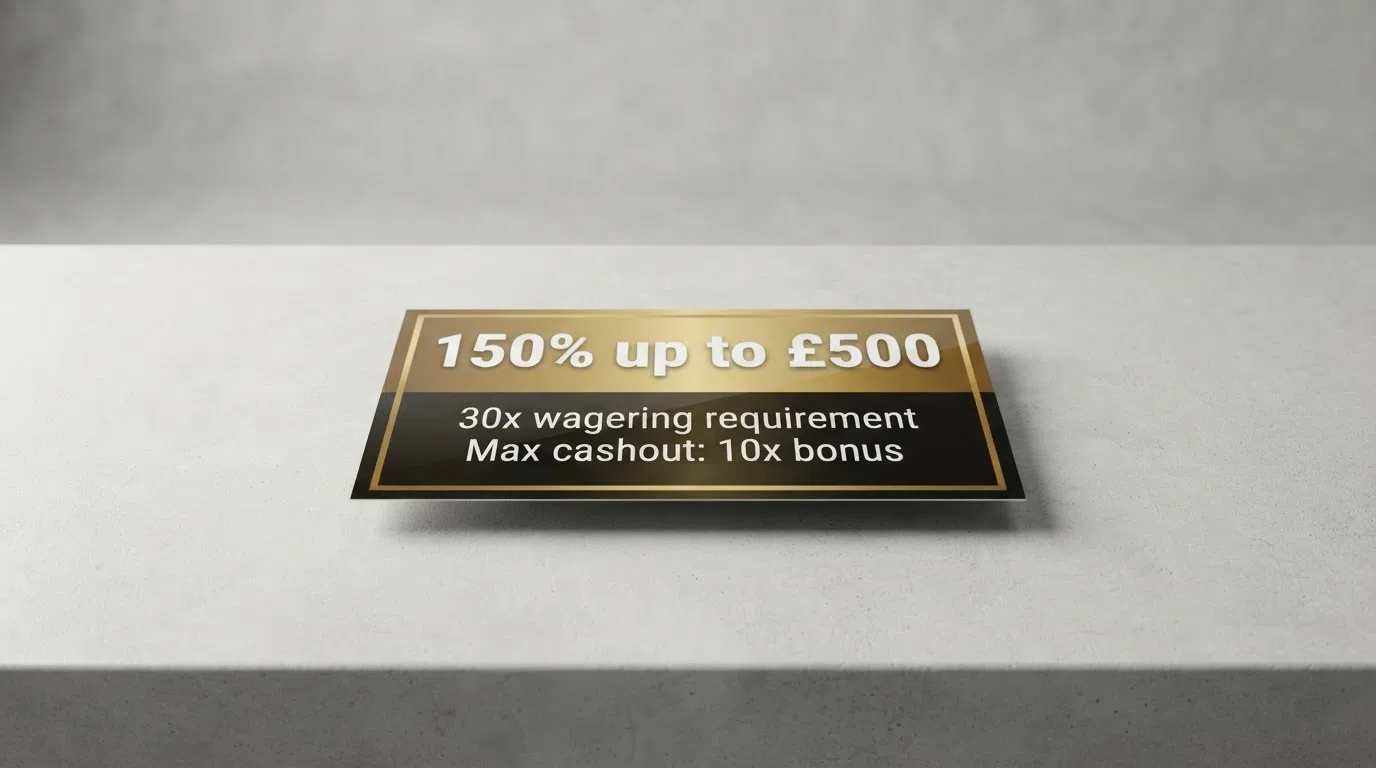
| Rolletto | Curaçao GCB OGL/2024/1798/1048 | 150% up to £500 + 200 FS | 30× (bonus funds) | 4,000+ |
| Winstler | Curaçao master 5536/JAZ | 600% up to £9,500 (5 deposits) | 45× (bonus funds) | n/a |
| MadCasino | Curaçao (number not confirmed) | 100% up to £1,500 + 300 FS | 35× (bonus + FS) | n/a |
| Emperia Casino | Curaçao OGL/2024/112/0974 | 4 deposits, up to £3,000 + 325 FS | n/a | 12,000+ |
| Bilucky Casino | Costa Rica (number not confirmed) | 1st deposit: 100% up to £250 + 200 FS | 40× (bonus + FS) | 2,000+ |
| WinBeast | Curaçao 1668/JAZ | 3 deposits, 375% up to €5,000 + 500 FS | 40× (deposit + bonus) | 8,000+ |
| Candyland | Curaçao (number not confirmed) | 200% up to £500 | 35× (deposit + bonus) | n/a |
| SlimKing | not confirmed | n/a | n/a | 3,650+ |
| SpinBoss | not confirmed | n/a | n/a | 8,900+ |
| Mr Jones Casino | Anjouan (number not confirmed) | n/a | n/a | 9,200+ |
UK-licensed bonuses are capped at 10× wagering. The 30×–45× multiples above are the offshore norm, and the difference is exactly the gap the table hides. A reader comparing only the headline matches will not see it.
Rolletto: 150% to £500, 200 spins, 30× playthrough
Rolletto is the ranked set’s priority pick and the brand with the most fully disclosed terms in this run. The welcome package is 150% up to £500 plus 200 free spins: 50 of those spins land instantly, then 30 a day across five daily logins. Wagering sits at 30× on bonus funds with a £5 maximum bet while the requirement is open. Bonus winnings are capped at 10× the bonus amount for standard players, with 30 days to complete the playthrough.
Behind the offer, the catalogue is wide. Santeda International B.V. operates Rolletto on Curaçao GCB sub-licence OGL/2024/1798/1048, with 4,000+ titles drawn from 84 providers — Pragmatic Play, NetEnt, Evolution, Play’n GO, Nolimit City, Hacksaw Gaming and Push Gaming among them. The minimum deposit is £20. Rolletto suits a player who wants the most disclosed terms in the set and a deep game library; the 30× wagering sits at the low end of the offshore norm, and the 10× winnings cap is the rule that decides what the bonus is actually worth.
Winstler: a 600% package spread across five deposits
Winstler carries the biggest headline match in the ranked set and the steepest playthrough. The five-deposit package totals up to 600% / £9,500 — and the wagering sits at 45× on bonus funds. Minimum deposit is £50. Favorit United N.V. operates the brand on Curaçao master licence 5536/JAZ, with some sources also listing an Anjouan Gaming authorisation.
The detail that matters most is the withdrawal ceiling. Winstler caps withdrawals at €2,000 per day, €10,000 per week and €40,000 per month. A player who lands a five-figure win should plan around those limits, not around them as a footnote. The 45× wagering is high enough that a player who deposits the £50 minimum and runs the offer at face value will turn over £427,500 in bonus-only playthrough (calculated as £9,500 × 45) — and that is before the cashout ceiling decides what comes out the other side.
MadCasino: 100% to £1,500 and 300 spins on a £10 entry
MadCasino carries the lowest entry barrier of the ranked set. The welcome package is 100% up to £1,500 plus 300 free spins, with 35× wagering on bonus funds and free-spin winnings, a £5 maximum bet while the wagering is open, and a £10 minimum deposit. The Curaçao licence number was not confirmed this run.
A £10 deposit is the headline, and the wagering multiple decides whether it is a bargain. At 35× on bonus plus free-spin winnings, the playthrough requirement rises sharply with deposit size — the offer is generous in absolute terms but the entry barrier is the only structural advantage over higher-deposit peers.
Emperia Casino: 12,000 games behind a £3,000 welcome package
Emperia Casino is the newest name in the ranked set — launched 2026 — and the brand with the largest library this run recorded. The welcome package is a four-deposit structure worth up to £3,000 plus 325 free spins. Fortuna Games N.V. operates the brand on Curaçao GCB sub-licence OGL/2024/112/0974, granted 8 July 2024 and confirmed via the CGA certificate portal.
The catalogue carries 12,000+ titles from 20+ providers — Pragmatic Play, NetEnt, Evolution Gaming, Play’n GO, Hacksaw Gaming, Push Gaming, BetSoft and BGaming among them. Wagering and minimum deposit were not confirmed this run, and that gap is the part of the offer a player should pin down before depositing. Newness cuts both ways: a 2026 launch has no payout record to inspect, and a large library is not a licence.
Bilucky Casino: 200 spins tied to one Megaways title
Bilucky’s welcome package is a four-deposit structure, and the first stage is 100% up to £250 plus 200 free spins on a single title — Beware the Deep Megaways — delivered at 20 spins per day over ten days. Wagering is 40× on bonus funds and free-spin winnings. Minimum deposit is £20 per stage.
The library is 2,000+ games from 80+ providers. The licence is Costa Rica, exact number not confirmed this run — and Costa Rica sits at the thin end of the regulatory spectrum. Scoping the free spins to one Megaways title is the trade: the player gets volume on a named game, not flexibility across the catalogue, and the 40× playthrough applies to both halves of the offer.
WinBeast: 500 spins across three deposits
WinBeast carries the most free spins in the ranked set. The three-deposit package is structured 100% up to €1,000 + 100 free spins on the first deposit, 50% up to €1,000 + 100 free spins on the second, and 100% up to €1,000 + 100 free spins on the third — totalling 375% up to €5,000 and 500 free spins. Wagering is 40× on deposit plus bonus. Bonus validity is 7 days for bonus money and 3 days for the free spins.
Santeda International B.V. operates the brand on Curaçao 1668/JAZ. The catalogue lists 8,000+ games — 5,000+ slots and 2,500+ jackpots. Minimum deposit is £20. The 3-day free-spin window is short, and a player who does not sit down and use them inside that window loses them — that detail is more consequential than the 500-spin headline.
Candyland: 200% on the first deposit, capped cashouts
Candyland’s welcome offer is a 200% match up to £500 (or 100% cashback insurance). Wagering is 35× on deposit plus bonus. Maximum bet while wagering is £5. Bonus validity is 30 days. Minimum deposit is £15.
The detail that decides whether this offer is worth taking is the cashout ceiling. Cashouts are capped at 10× the deposit for deposits of £249 or below. A player who deposits £249 and clears the bonus is looking at a maximum withdrawal of £2,490 from bonus-derived winnings — and the cap is what makes a 200% match not free money. The Curaçao licence number was not confirmed this run.
SlimKing: 3,650+ games, thin public data
SlimKing is described as an independent operator with 3,650+ games — 3,400+ of them slots. Providers include Amatic, Hacksaw Gaming and Mancala Gaming alongside 40+ others. Licence, welcome bonus and minimum deposit were not confirmed this run, and that gap is the trade-off: a deep slot-heavy catalogue is offset by an offer that is not on the public record. A player who cannot verify the licence in a public register is taking the catalogue on faith.
SpinBoss: 8,900 games from 75+ providers
SpinBoss is described as an independent casino carrying 8,900+ games from 75+ providers. The catalogue is the headline; the licence, welcome bonus and minimum deposit were not confirmed this run. As with SlimKing, the absence of a verifiable licence number is the part of the picture a player should resolve before depositing — and it cannot be resolved from the page alone.
Mr Jones Casino: Anjouan-licensed, 9,200+ games
Mr Jones Casino is the only Anjouan-licensed name in the ranked set. ChapChap Technologies Ltd operates the brand under an Anjouan Gaming authorisation, exact number not confirmed this run. The catalogue carries 9,200+ games — 8,400+ slots, 300+ RNG titles and 450+ live dealer tables — with Playson, Play’n GO and Endorphina among 70+ providers.
Welcome bonus and minimum deposit were not confirmed this run. Anjouan sits at the thin end of regulatory oversight — for context, an MGA-licensed operator must segregate player funds, run compliance audits and offer an ADR route. Mr Jones does not run on MGA terms, and a player should not assume the protections MGA requires.
Is it safe? The legal reality of playing outside the UKGC
The honest answer separates two questions: who commits the offence, and what the player loses. Under section 33 of the Gambling Act 2005, providing facilities for gambling in Great Britain without a UKGC licence is a criminal offence — up to 51 weeks’ imprisonment, an unlimited fine, or both. The offence is the operator’s. No penalty has been traced for a UK player who merely gambles on an unlicensed site. What the player loses is protection.
| Rule | What it caps or bans at a UKGC-licensed site |
|---|---|
| Online slots stake cap (since 9 April 2025) | £5 per game cycle for 25+; £2 per game cycle for 18–24 |
| Credit card deposits (since 14 April 2020) | Banned, including credit-card-funded e-wallets |
| Wagering requirements (since 19 December 2025) | Hard cap of 10×; mixed-product bonuses banned |
| Financial vulnerability check (since 28 February 2025) | Light-touch check at £150 net deposit in a rolling 30 days |
| Identity check (since 7 May 2019) | Name, address and date of birth verified before first deposit |
| Auto-play (since 31 October 2021) | Banned |
| Spin speed (since 31 October 2021) | Minimum 2.5 seconds per game cycle |
| Reverse withdrawals (since 31 October 2021) | Permanently banned |
| Losses disguised as wins (since 31 October 2021) | Banned |
The table above is the protection a GB licence imposes. None of these limits follows the player to a Curaçao-, Anjouan- or Costa Rica-licensed brand, and the absence is the trade-off the marketing never names.
What “licensed” means when the licence isn’t the UKGC’s
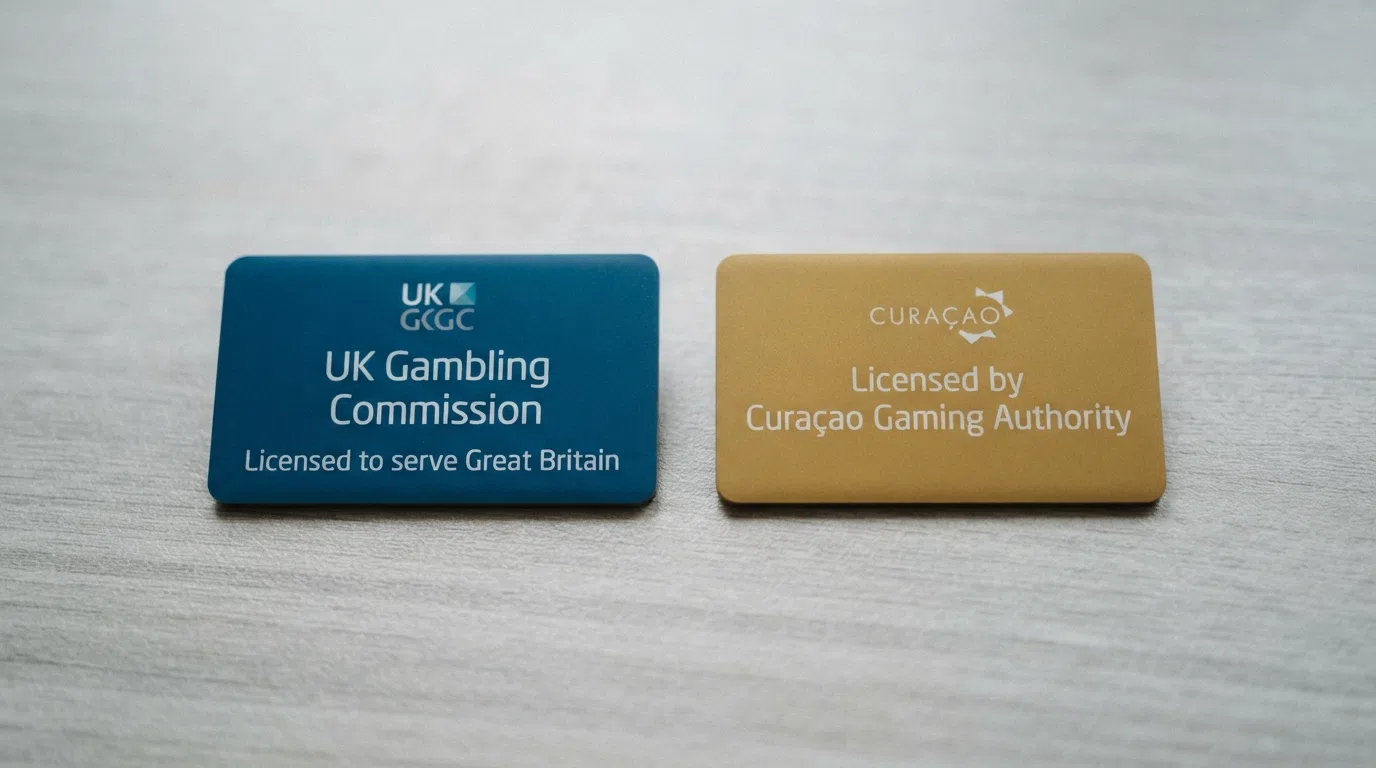
A Curaçao, Maltese or Anjouan licence binds the operator to that jurisdiction’s rules. None of those jurisdictions authorises the operator to serve the British market — only a UKGC licence does that, and the 2014 point-of-consumption reform made that explicit. The UKGC’s enforcement model is disruption rather than prosecution: between April 2024 and June 2025 the Commission issued 3,140 disruption notices, referred 447,778 URLs to search engines for delisting, and saw 287,961 URLs removed, with an average 32% fall in engagement across 160 disrupted sites. The Commission does not currently hold statutory ISP or DNS blocking powers; legislation has been proposed but not enacted.
Safe or not: what a licence does and doesn’t guarantee
The answer depends on the jurisdiction behind the badge. An MGA-licensed operator must segregate player funds from operational accounts, submit to compliance audits, offer responsible-gambling tools including deposit limits and self-exclusion, and join an ADR process. A post-2023 Curaçao licence is stronger than the old master-licence sprawl — operators now sit in a public register — but it remains below UKGC and MGA standards. Costa Rica and Anjouan offer minimal oversight. Safety is a jurisdiction question, not a “licensed versus unlicensed” toggle, and the badge alone is not the answer.
How to verify a casino’s licence before you deposit
The concrete check is a register search. Under the post-reform Curaçao CGA regime, every licensed operator sits in the authority’s searchable public register. The verification is mechanical: search the operator company name, not the trading brand, and match the licence number to the company that holds it. A name that does not appear, or a number that maps to a different entity, is a red flag that overrides any bonus headline. The UKGC runs the parallel exercise the other direction — a UKGC-licensed site must verify the player’s name, address and date of birth before they can deposit, which is why a brand on this page will not ask for the same set of checks at sign-up.
Player protection outside the UKGC: what you lose
The protection gap is the real, personal cost of going offshore. No GamStop coverage. No UKGC complaints route. No approved ADR provider if a dispute opens. No British consumer redress if funds are withheld or the operator fails. The £150 rolling 30-day financial vulnerability check that has applied to UKGC-licensed remote operators since February 2025 does not follow the player offshore. UK authorities cannot compel an offshore operator to pay winnings, refund deposits or resolve a dispute, and the player is the one who pays for the absence of that compulsion.
Curaçao, Malta, Anjouan: what each licence actually buys you
The offshore hubs vary sharply in what they require of operators. The table below compares each jurisdiction on the questions that decide what a player actually gets.
| Jurisdiction | What the licence requires | What a UK player actually gets |
|---|---|---|
| Curaçao GCB (post-2023 LOK) | Public register; sub-licences from master holders; KYC; some responsible-gambling obligations | No UK authorisation; below UKGC/MGA standards; verifiable licence number via the CGA portal |
| Malta (MGA) | Fund segregation; compliance audits; deposit limits and self-exclusion; ADR participation | No UK authorisation; the strongest offshore protections on this page; not held by any featured operator this run |
| Anjouan Gaming | Limited regulatory framework; minimal oversight | No UK authorisation; thin protection; offered by Mr Jones Casino |
| Costa Rica | Minimal regulatory framework | No UK authorisation; thin protection; offered by Bilucky |
A “European” or “international” label is still not UK authorisation. Since the 2014 Act, any operator serving GB customers needs a GB licence wherever it is based, and a Maltese licence does not fill that gap.
Curaçao: the default licence for non-GamStop casinos
The post-2023 LOK reform — National Ordinance on Games of Chance, P.B. 2024 no. 157 — replaced the old master-licence sprawl with a single regulator and a public register. Operators now sit in a register players can search to verify the licence. It remains an offshore grant that does not authorise the British market, and a UKGC licence is still separately required. Most featured brands on this page run on it — Rolletto, Winstler, MadCasino, Emperia, WinBeast and Candyland all carry Curaçao licences — which is why the register check matters more than the badge.
Malta (MGA): the strongest offshore protections on this page
An MGA-licensed operator must segregate player funds from operational accounts, submit to regular compliance audits, implement responsible-gambling tools including deposit limits and self-exclusion, and participate in an alternative dispute resolution process. None of that makes an MGA licence a GB licence. No featured operator this run holds an MGA licence, and that absence is the structural reason the protections above are a benchmark rather than a current offer.
Costa Rica and Anjouan: licences with minimal oversight
Costa Rica and Anjouan both provide minimal regulatory oversight compared with Curaçao or Malta. Bilucky runs on a Costa Rica licence, Mr Jones Casino on Anjouan. Neither jurisdiction offers the fund-safety or ADR guarantees an MGA licence carries, and the player carries the gap.
European and international hubs: why a “European” licence still isn’t UK authorisation
Since 2014 any operator serving GB customers needs a GB licence wherever it is based. A European or international licence cannot legitimise serving Britain, and the label “European” describes where the hub sits — not who it is allowed to serve. The point-of-consumption rule cuts the other way too: a brand whose licence sits in Malta is, for a UK player, still an unlicensed provider for the purposes of section 33.
New non-GamStop casinos: the freshest names are also the least proven
Newness in this niche usually means a fresh offshore shell, not a new licence class. Emperia Casino is the only 2026 launch research confirmed this run. New brands advertise 12,000+ game libraries and four-deposit packages to stand out, and a launch date is not a licence or a payout record. The sites-versus-online split is the same cosmetic split already covered above, and the watch-list below is the practical check before depositing anywhere new.
The newest non-GamStop casinos for UK players
Emperia Casino is the one 2026 launch this run recorded: Fortuna Games N.V., Curaçao OGL/2024/112/0974, 12,000+ games, a four-deposit package up to £3,000 plus 325 free spins. The remainder of the featured set carry no confirmed launch dates this run. A player who wants recency should read it as recency of marketing, not of regulatory track record — the licence was granted in July 2024, and the casino launched in 2026, and those two dates measure different things.
What to check before joining a brand-new offshore casino
A new brand’s checklist, not its promises:
- Verify the licence number against the operator company name in the jurisdiction’s public register
- Confirm the operator company rather than the trading brand, since the trading brand is what the marketing pushes and the operator company is the legal entity
- Read the withdrawal terms and caps before the first deposit, because they are rarely the headline and they are the rule that decides what a payout looks like
- Remember a new brand has no payout record to inspect, and “this run” data is the only data a player has
A new offshore operator that withholds funds leaves no UK recourse. The check exists because the recourse does not.
How to choose a non-GamStop casino: what reviews leave out
Affiliate reviews in this niche cover bonus, games, payments and licensing but rarely the legal position. They run 1,500–3,000 words over the same four blocks. They rank 5–10 operators with a bonus summary and a comparison table. They almost never give per-title RTP or volatility. Four commonly featured titles carry 96.09%–96.71% RTP as the reader-comparable baseline — Book of Dead at 96.21%, Sweet Bonanza at 96.48%, Big Bass Bonanza at 96.71% and Starburst at 96.09% — and a review that names the title without the figure is selling the headline, not the math.
Reading reviews: what an affiliate round-up will and won’t tell you
The genre’s blind spots are consistent. Reviews state the bonus headline, the game count and the licence, but rarely the legal position a UK player occupies on the other side of the page. They almost never publish per-title RTP or volatility for the games the bonus is wagered on, which leaves a reader to clear a 35× playthrough on a slot whose house edge they have not been told. Treat any review’s omission of wagering and cashout caps as a warning, and read the bonus terms in the operator’s own terms page before depositing.
Curated lists: why every “best non-GamStop” list looks alike
Every “best” list in this niche ranks the same 5–10 offshore brands with a bonus summary and a comparison table. The “best” label reflects affiliate economics rather than a regulator’s standard, and the same operator names recur because few offshore brands actively target this keyword. The repetition is not independent endorsement. It is the same set surfaced by the same kind of site, and a reader comparing two lists is mostly comparing the same names twice.
The selection criteria that actually matter
Rank by what changes the money, not the headline. The criteria that move a decision are licence verifiability against a public register, the wagering multiple and what it applies to, the cashout caps and withdrawal limits, and the game library breadth. Everything else — colour scheme, mascot, brand voice — is decoration around those four numbers, and a comparison table that omits any one of them is missing the part that pays.
Responsible gaming off GamStop: tools, limits, and the gap no site fills
The safer-gambling reality outside the UK self-exclusion net is that offshore sites may offer their own limits but none of them connect to GamStop. The UK’s mandatory protections stop at the licensed border. By the end of 2026 GamStop carried 561,983 active exclusions and registered 117,756 new ones during the year; problem gambling runs at 0.4% of adults in England, with 1.6% at moderate risk or above and the highest rate at 3.5% among 25–34 year olds. The figures are the scale of the gap, not its justification.
What offshore sites offer for safer play — and what they can’t
MGA-licensed operators must offer deposit limits and self-exclusion among their responsible-gambling tools. Curaçao post-2023 sites carry stronger obligations than the old regime. No offshore site can join the UK’s multi-operator GamStop scheme, because GamStop participation is a mandatory condition of a UKGC licence and the licence is what the offshore brand does not hold. An excluded player gets no automatic block offshore. The site does not know the player has self-excluded, and the UK self-exclusion register cannot reach it.
Self-exclusion alternatives: why GamStop can’t reach these sites
GamStop exclusion runs 6 months, 1 year, 5 years, or 5 years with auto-renewal and cannot be cancelled early. It covers GB-licensed sites only. Offshore sites fall outside it entirely. The alternative is per-site limits the player must set themselves, on each site, one at a time. That is the structural shape of the gap: a single national register on one side, a patchwork of per-site toggles on the other.
Prevalence, and where to get help right now
The harm figures and the help resources that operate regardless of where someone plays:
- Problem gambling runs at 0.4% of adults in England (PGSI 8+), with 1.6% at moderate risk or above (PGSI 3+); highest at 3.5% among 25–34 year olds
- 11,960 people were treated by the National Gambling Support Network in Great Britain between April 2024 and March 2025, an 11% rise on the 10,754 treated in 2023/24
- 47% of adults in Great Britain had gambled in the past four weeks, 27% excluding National Lottery only
- The National Gambling Helpline is 0808 8020 133, run by GamCare
- GamCare offers free counselling, live chat and group chat, plus a free gambling risk-assessment tool
- GambleAware publishes information and self-assessment tools
- Gamblers Anonymous UK runs face-to-face and online meetings
- NHS gambling harm clinics operate in England, Scotland and Wales
Anyone reading this page because they have self-excluded and are looking for a way around it should call the helpline before opening a new account anywhere.
How we ranked these casinos: sources and criteria
Sources were affiliate reviews, the Curaçao CGA public register and operator or company disclosures. Operators were checked against the UKGC licence register and, where a number was available, the Curaçao and Anjouan registers. Ranking ordered by licence verifiability, then bonus terms (wagering multiple, bet caps, cashout ceiling, validity), then game library breadth. No invented weights or percentages — the criteria are qualitative, and the table above shows what was confirmed and what was not.
Should you join a non-GamStop casino? The honest bottom line
The bonuses are bigger precisely because the protections are gone. UK-licensed wagering is capped at 10×; offshore offers at 30× or 45× are the norm. UK-licensed sites banned credit cards in April 2020; offshore brands take them. UKGC sites sit inside GamStop, and an excluded player is blocked automatically; offshore sites sit outside it, and an excluded player is not protected. The withdrawal caps that some offshore brands impose — €2,000 a day at Winstler, 10× the deposit at Candyland — are the rules the marketing copy rarely leads with, and they are the rules that decide what a payout looks like.
The expected cost of the Rolletto welcome package illustrates the gap. Turnover required to clear a £500 bonus at 30× wagering is £15,000; spinning Book of Dead at 96.21% RTP carries a house edge of 3.79%, so the expected loss from clearing the bonus under those assumptions is £15,000 × (1 − 0.9621) — about £568. That is an estimate, not a forecast for any single session. It is the statistical cost of clearing the offer under the conditions the page already states, and it is the figure that answers what the bonus costs, not what it pays.
Frequently asked questions
Is playing at a non-GamStop casino legal for me as a UK player?
No UK law stops you from opening an account at an offshore casino, so the access itself is not illegal. However, you lose the safety net of the UKGC. Section 33 of the Gambling Act makes unlicensed provision a criminal offence for the operator, not for the customer who chooses to play.
What happens if a non-GamStop casino refuses to pay out my winnings?
If an offshore site refuses to pay, you have no UKGC complaint route to follow. Because these sites are unlicensed in Britain, there is no approved ADR provider to intervene, and no British consumer protection or statutory redress to rely on if the operator withholds your funds or becomes insolvent.
How do wagering requirements at non-GamStop casinos compare with UK-licensed sites?
The differences are significant. UK-licensed bonuses are strictly capped at 10× wagering. In contrast, offshore sites frequently impose requirements of 30× to 45× on bonus funds. This gap is the real cost of the headline-grabbing bonus matches, and it is a structural trade-off the licensed market is designed to avoid.
Which payment methods work at non-GamStop casinos — and are credit cards really accepted?
Yes, credit cards are accepted at offshore sites, unlike at UKGC-licensed casinos where they have been banned since April 2020. You can typically use Visa, Mastercard, e-wallets like MiFinity, and various cryptocurrencies. These methods usually clear faster than bank transfers, though you should check each operator’s specific withdrawal processing times.
Did the new £5 and £2 stake caps push players toward non-GamStop casinos?
Yes, the tighter licensed market is a primary driver of this search volume. While UK-licensed online slots carry a statutory maximum stake of £5 per game cycle for those 25 and over, and £2 for 18 to 24-year-olds, these limits do not follow the player to offshore casinos, where higher stakes remain allowed.
Account – fastestpayout-casinos-uk
Content created by the «fastestpayout-casinos-uk» team