
UK Casinos That Accept Citadel: What Replaced It and Where to Play Now
 Available in GB
A page promising UK casinos that accept Citadel Instant Banking answers a question whose terms have already changed. Citadel Commerce UK Limited, the UK payment-services entity behind Citadel Instant Banking, had its Financial Conduct Authority authorisation cancelled on 12 July 2024. No replacement authorisation has been filed. Every UKGC-licensed casino that once carried Citadel in its cashier has moved on, and most have replaced it with the modern open-banking rail: Trustly, Instant Bank Transfer, Pay by Bank, Volt or TrueLayer. These are the same kind of instant bank-to-casino flow Citadel pioneered, but with full FCA authorisation, faster processing, and crucially, a withdrawal route Citadel never offered.

What follows is a working guide for the reader who arrived searching for Citadel and needs to know what happened, what to use instead, and which UKGC-licensed casino fits. The comparison covers ten major UK operators — every one verified against the Gambling Commission public register on 29 July 2026 — and explains how the bonus landscape has changed since the 10× wagering cap and the December 2025 mixed-product ban came in. None of the ten currently offers Citadel. The instant-banking alternative at each is named.
*Data current as of September 8, 2026 and verified against the Gambling Commission public register and the FCA register.*
Citadel Was Britain’s Instant Casino Deposit Rail — What Happened to It
Citadel Instant Banking was, for the best part of a decade, the open-banking deposit method UK online casinos defaulted to. A player picked Citadel in the cashier, authenticated with their online banking credentials, and the funds appeared in the casino balance within seconds. No card details were shared. No e-wallet account was needed. The transaction looked like a bank transfer but cleared like a card payment. For a market that had spent the previous decade routing around slow bank transfers and high card declines, Citadel was the first clean answer to “I want to pay from my bank and play now.”
The mechanics were a standard open-banking redirect. The casino’s cashier passed the player to their bank’s authentication screen, the bank confirmed the transfer, and the funds settled in real time. Citadel did not charge the player for the deposit, though the player’s own bank could apply its own charges in some cases. The minimum deposit at UK casinos accepting Citadel typically started at £10. The ceiling was set by the operator’s cashier rules rather than by Citadel itself.
What ended Citadel’s UK role was a regulatory event, not a commercial one. The Financial Conduct Authority cancelled Citadel Commerce UK Limited’s authorisation on 12 July 2024, with no subsequent re-authorisation. As one industry audit put it, “Paramount Commerce is the audit’s clean failure. The Canadian Interac specialist’s UK footprint ran through Citadel Commerce UK Limited, and the register shows that authorization cancelled on July 12, 2024, with nothing replacing it.” The cancellation matters because any payment-services firm serving UK customers needs FCA authorisation. Once that status lapsed, UKGC-licensed operators could no longer route customer funds through Citadel for regulated deposits. The cashier option disappeared, and it has not come back.
The competitive vacuum Citadel left has been filled by a more modern generation of Pay by Bank providers. Trustly leads the UK gambling open-banking market, with Volt and TrueLayer also established names. The flow is similar — pick the open-banking option at the cashier, authenticate with your bank, funds land in seconds — but the rail now also supports withdrawals via Faster Payments, which Citadel never did. Roughly 15% of UK gambling deposits now clear through open banking, a figure that grew around 40% year on year. The experience the player was chasing with Citadel is now several clicks away, with a better safety profile and the option of getting paid back the same way.
Comparison of Open-Banking Providers
| Provider | Key Feature | Withdrawal Support | Typical Speed |
|---|---|---|---|
| Trustly | Direct Bank API | Yes (Faster Payments) | Instant |
| Volt | Open Banking | Yes (Faster Payments) | Instant |
| TrueLayer | Open Banking | Yes (Faster Payments) | Instant |
How Citadel Instant Banking Worked at UK Online Casinos
The deposit flow at a Citadel-supporting UK casino ran through a redirect. The player selected Citadel in the cashier, entered the deposit amount, and was passed to a Citadel-hosted screen that asked which bank they wanted to pay from. The bank choice triggered a redirect to that bank’s own online authentication — the same screen the player used to log in to their banking app or website. The bank confirmed the transfer from the player’s current account, the casino was notified in real time, and the balance updated. The whole sequence took longer to read than to perform.
A few practical points distinguished Citadel from card or e-wallet deposits. No card details ever touched the casino, which reduced fraud exposure on the player’s side. No separate e-wallet account had to be funded first. The deposit was effectively a bank transfer, but it cleared at card-payment speed. Citadel itself did not levy a fee on the player for processing the deposit, though the player’s own bank might apply its own charges depending on the account type. The experience was identical on desktop and mobile: the redirect worked in any modern browser, and the bank authentication screen adapted to the device.
The mechanism now has a name — Pay by Bank — and a successor in Trustly, Volt and TrueLayer. The deposit experience is materially the same. What has changed is what happens when the player wants to withdraw: the modern open-banking rails can push money back to the same bank account via Faster Payments, usually within the day. Citadel could not.
The July 2024 FCA Cancellation — What It Means for UK Players
The FCA register entry for Citadel Commerce UK Limited, reference 575193, shows the firm’s authorisation as cancelled with effect from 12 July 2024. There is no record of a successor firm or a re-authorisation application. Paramount Commerce, Citadel’s parent, retains its Canadian Interac business but no longer has a UK payment-services entity through which to route casino deposits.
The practical consequence is straightforward. UKGC-licensed casinos, which are the only casinos operating legally in Great Britain, do not currently offer Citadel as a deposit method. Any review page or casino comparison that lists Citadel as a live option in the UK is out of date. The cancellation is a payment-method regulatory failure, not a casino failure — no operator is at fault for removing Citadel, and no operator has been told to. The UKGC’s framework requires that customer funds be handled by properly authorised payment services, and once Citadel’s authorisation lapsed, the rail was no longer available under that framework.
A player who still has a Citadel account from before July 2024 cannot use it to deposit at a UK-licensed casino. The relevant question is no longer which casinos accept Citadel but which open-banking deposit method each casino now uses in its place. The answer, across the ten operators featured later on this page, is Trustly, Instant Bank Transfer, or standard bank transfer — all FCA-authorised, all instant on the deposit side, and most offering a withdrawal route that Citadel lacked.
Why a Citadel Deposit Landed in Seconds but Your Withdrawal Never Did
Citadel’s profile at UK casinos was a study in asymmetric rails. The deposit side was excellent: instant, fee-free from Citadel’s end, low minimums, and no card details shared. The withdrawal side simply did not exist. A player who deposited £100 via Citadel and won £500 had to nominate a different method — bank transfer, debit card, or e-wallet — to receive the payout. The same open-banking rail could push money in but could not pull it back. That asymmetry defined the experience, and it is the reason the modern Pay by Bank providers, which can do both, have displaced Citadel so thoroughly.
The deposit speed is worth dwelling on because it explains why Citadel was popular. Citadel Instant Banking deposits were processed in real time — the moment the player confirmed the transaction with their bank, the balance updated at the casino. Among mainstream payment methods, that speed was competitive with debit card and faster than e-wallet, since there was no separate e-wallet account to fund first. The minimum deposit at UK casinos accepting Citadel typically clustered around £5 to £10, with the upper limit set by the operator rather than by Citadel. The cost to the player was zero from Citadel’s side, though the player’s own bank could apply its own charges.
The withdrawal side was the structural gap. Citadel withdrawals were generally not available at UK online casinos. Players had to use a separate method — typically bank transfer, debit card, or e-wallet — to cash out. Bank transfer payouts took one to three working days; debit card payouts took one to two; e-wallets were faster but required a funded account. The asymmetry meant the same player who could fund their account in seconds had to wait days to collect winnings.
That gap is what the modern Pay by Bank providers have closed. Trustly, Volt and TrueLayer can both push deposits and pull withdrawals over the same open-banking connection, with Faster Payments on the withdrawal side usually settling the same day. The reason this matters is not just convenience. If a player wins and wants to lock in the result, the time between winning and the money landing in the bank account is the window in which the money is at risk — not from fraud, but from the player’s own next session. The faster the rail, the less money sits in the casino balance exposed to further play. Open-banking withdrawals close that window.
Deposit Limits — What You Could Load into Your Casino Account
Citadel deposits at UK casinos accepted a wide range of amounts, with the lower bound typically set by the operator rather than by Citadel itself. Most UK casino cashiers configured Citadel with a £10 minimum, with some accepting as little as £5 — the same band that the modern open-banking rails now occupy at bet365, William Hill, Betway and others. The upper limit was not Citadel’s to set; it was the operator’s own cashier rule, and it varied by brand.
Two regulatory features now sit on top of whatever the cashier allows. First, every UKGC-licensed operator must prompt the customer to set a deposit limit before the first deposit, and from 30 September 2026 the vocabulary is standardised: a gross deposit limit must be offered, and only that form may be called a deposit limit. The player can set whatever ceiling they want, including a very low one, and the operator cannot raise the limit without a cooling-off period. Second, a light-touch financial vulnerability check runs once a player hits £150 in net deposits over a rolling 30-day period, comparing the player’s details against public data (bankruptcy, CCJs, IVAs, DROs, administration orders). The check does not block play but triggers a check-in.
For a player who wants to use a low-limit cluster, the practical reality is that Citadel’s £5–£10 minimum band is now the Trustly/Instant Bank Transfer minimum band at most major UK operators. The deposit method itself does not constrain the lower limit; the operator does. The constraint that does bite is the upper limit on individual spins, which is statutory — £5 for players 25 and over, £2 for those aged 18–24 — but that is a slot stake cap, not a deposit cap.
How Fast Citadel Deposits Reached Your Balance
Citadel’s defining feature was speed. Deposits were processed in real time, with the funds appearing in the casino balance the moment the bank confirmed the transfer. Among mainstream payment methods in the UK market, that speed was competitive with debit card (typically a few seconds) and faster than e-wallet (which requires a pre-funded e-wallet account). The flow worked identically on desktop and mobile, since the bank authentication screen adapted to the device.
The comparison with other rails is worth being specific about. A debit card deposit on Visa or Mastercard typically clears in under a minute at a UKGC-licensed casino, with the funds available almost immediately. An e-wallet deposit (PayPal, Skrill, Neteller) is similarly fast but requires the player to have funded the e-wallet first, which adds a step. A traditional bank transfer using BACS or CHAPS is much slower — one to three working days for BACS, same-day for CHAPS but with a fee. Citadel sat in the fast lane without requiring a pre-funded intermediary.
The modern Pay by Bank rails preserve that speed. Trustly, Volt and TrueLayer all clear deposits in seconds, with the bank authentication step the only variable. These alternatives now offer the same deposit performance Citadel once provided, while adding the withdrawal capability Citadel lacked.
Cashing Out — Why Citadel Was a Deposit-Only Rail
The technical and regulatory reasons Citadel could not handle withdrawals were tied to the way the rail was structured. Citadel Instant Banking was designed as a one-way push from the player’s bank to the merchant, with no equivalent pull mechanism. The Faster Payments service, which enables near-instant bank-to-bank transfers in the UK, was not integrated into the Citadel flow at the time. As a result, a player who deposited via Citadel had no way to receive winnings back to the same bank account through Citadel. The cashier would offer the usual alternatives — debit card, e-wallet, bank transfer — and the player picked one.
The practical impact was a forced method switch at the moment of withdrawal. A player who funded with Citadel and wanted to cash out to the same bank account had to use a bank transfer payout, which took one to three working days. A player willing to use an e-wallet could speed that up, but only if they had funded the e-wallet first. The asymmetry was particularly frustrating for players who valued Citadel precisely because they did not want to use a card or open an e-wallet.
The modern open-banking rails have resolved this. Trustly, Volt and TrueLayer integrate Faster Payments, which means a withdrawal submitted through the same flow typically settles within the same day. The cashier at most UK operators now offers Trustly as both a deposit and a withdrawal method. Modern open-banking connections have effectively replicated Citadel’s deposit flow in both directions, making payouts significantly faster.
What a Citadel Deposit Cost the Player in Fees
Citadel did not charge players a fee for processing a deposit. The cost question for the player came down to whether their own bank applied any charge for an outgoing instant transfer. Most UK banks do not charge for instant outgoing payments, but some packaged accounts and a few high-street banks levy a small fee per transaction or per month. The casino side, for its part, did not surcharge Citadel deposits — operators have no commercial reason to add a fee on top of a method that already costs them a processing margin.
The honest position is that most players using Citadel at a UK casino paid nothing extra to deposit. A small minority — those whose banks charge for outgoing instant transfers — paid a small fee per deposit. The bigger cost question at UK casinos is not the deposit fee but the slot stake, the bonus wagering, and the time value of money during play, all of which dwarf any bank-side transfer charge.
The same fee structure applies to the modern open-banking rails. Trustly, Volt and TrueLayer do not charge players for deposits or withdrawals. The player’s bank may apply its own charges, depending on the account. The net cost to the player is generally zero, and the rail is functionally free for the common case.
The Open-Banking Alternatives That Replaced Citadel
The rail that has most thoroughly replaced Citadel in the UK gambling market is Trustly, which connects directly to players’ bank accounts via open-banking APIs and clears deposits in seconds. Trustly is the leading open-banking deposit provider in UK gambling, and most major operators — bet365, Sky Vegas, 888casino, Betway — list it in their cashier. Volt and TrueLayer play similar roles, with Volt strong at some operators and TrueLayer integrated into others. The standard bank transfer at William Hill, Ladbrokes, Paddy Power, Coral and Gala Bingo is the legacy rail that predates open-banking APIs but is increasingly delivered through the same kind of instant bank transfer flow.
The comparison with Citadel is favourable on every axis except brand familiarity. Speed is the same — deposits clear in seconds. Fees are the same — none from the provider, with the player’s own bank being the only possible charge. Limits are similar — £5 to £10 minimum at most operators, with the operator setting the upper bound. The decisive difference is the withdrawal route. Citadel could only push money into the casino; Trustly, Volt and TrueLayer can pull it back out, typically via Faster Payments, with the money in the player’s bank account the same day. Open-banking withdrawals close the asymmetry that defined Citadel.
The broader shift in UK gambling is the move toward open banking as a mainstream deposit method. The rail now accounts for roughly 15% of UK gambling deposits, growing at around 40% year on year. Trustly leads the market; Volt and TrueLayer are established alternatives. The deposit method a player was searching for under the Citadel name is now several clicks away at every featured operator on this page, with a better safety profile and the option of getting paid back the same way.
The 10 Best UK Casinos for Real-Time Funding — Ranked and Compared
None of the ten operators below currently offers Citadel. The comparison exists because every one offers an open-banking or instant bank transfer alternative, and the player who arrived searching for Citadel needs to know which operator’s replacement rail is the best fit. The ranking weighs UKGC licence status (verified against the Gambling Commission public register on 29 July 2026), welcome bonus value and fairness, the specific instant-banking alternative to Citadel at each brand, and the breadth of the game-provider mix. Operators with no wagering on welcome bonuses, lower qualifying deposits, and Trustly or Instant Bank Transfer at a £5 minimum rank higher than those with stricter deposit-method exclusions or wagering on bonus funds.
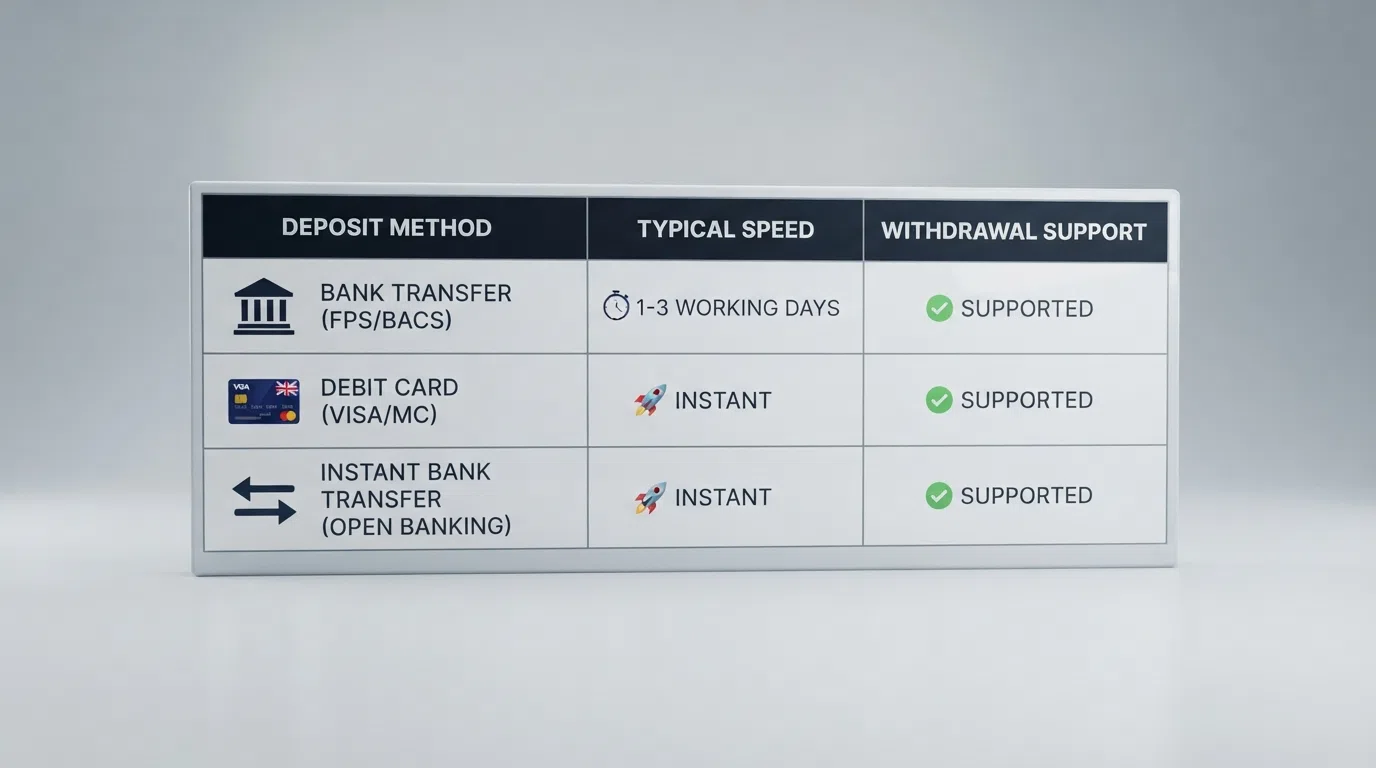
The honest context matters. Citadel is gone. The page ranks on what each operator offers today, with the open-banking rail named at each entry.
| Operator | UKGC Licence | Welcome Offer | Wagering | Instant Banking Alternative | Key Game Providers |
|---|---|---|---|---|---|
| bet365 | Active | Up to 500 free spins | 0× | Trustly (£5 min) | Evolution, Playtech, Pragmatic Play, Red Tiger, NetEnt, IGT, Blueprint |
| William Hill | Active | 200 free spins (10p) on Big Bass Splash | 10× (£30 winnings cap) | Instant Bank Transfer (£5 min) | Evolution, Playtech, IGT, Blueprint, NetEnt, Red Tiger, Pragmatic Play |
| Sky Vegas | Active (Flutter) | 50 no-deposit + 200 deposit free spins | 0× | Trustly, bank transfer (£10 min) | Pragmatic Play, Blueprint, Play’n GO, NetEnt, Evolution, Red Tiger (35 providers) |
| Ladbrokes | Active (LC International 54743) | 100 free spins (10p) on Fishin’ Frenzy, Eye of Horus | 0× | Bank transfer (£10 min) | Evolution, Playtech, Pragmatic Play, NetEnt, IGT, Blueprint, Red Tiger |
| Paddy Power | Active (Flutter) | 100 free spins (10p) on selected games | 0× | Bank transfer, debit card | Evolution, Playtech, Pragmatic Play, NetEnt, Blueprint, Red Tiger, IGT |
| Coral | Active (LC International 54743) | 100 free spins (10p) on selected games | 0× | Bank transfer (£10 min) | Evolution, Playtech, Pragmatic Play, NetEnt, IGT, Blueprint, Red Tiger |
| Betfred | Active | 50 / 100 / 200 free spins (5p / 10p / 20p) | 0× | Bank transfer (£10 min) | Playtech, Evolution, Pragmatic Play, IGT, Blueprint, Red Tiger |
| Gala Bingo | Active (LC International 54743) | 100 free spins (10p) or £40 bingo bonus | 0× (casino) / 2× (bingo) | Bank transfer | Evolution, Playtech, Pragmatic Play, NetEnt, Blueprint, IGT |
| 888casino | Active (evoke plc) | 100% match up to £100 | 10× (£100 winnings cap) | Trustly | Evolution, Playtech, Pragmatic Play, NetEnt, IGT, Blueprint, Red Tiger, 888 proprietary |
| Betway | Active | 150 free spins (10p) across 5 slots | 0× | Trustly (£5 min) | Evolution, Games Global, Pragmatic Play, NetEnt, Play’n GO, Blueprint, Red Tiger |
bet365
bet365 is the UK’s largest online operator, and its welcome offer reflects that scale. New customers can claim up to 500 free spins, structured as ten selections over twenty days — 5, 10, 20 or 50 spins per selection, with a spin value that varies between 5p and 50p depending on the game chosen. There is no wagering on free-spin winnings: whatever the spins produce is withdrawable cash. The catch is the structure. The £10 lifetime deposit to claim the offer is low, but the spins are drip-fed over twenty days, with a 24-hour gap between each selection and a 30-day claim window. A player who does not log in daily for the full twenty days leaves spins on the table.
The Citadel replacement at bet365 is Trustly, with a £5 minimum deposit. Apple Pay and Google Pay are also available at £5. The provider mix is the deepest in the set: Evolution, Playtech, Pragmatic Play, Red Tiger, NetEnt, IGT and Blueprint, plus bet365-exclusive titles. For a player who values game variety and the no-wagering structure, bet365 is the strongest entry in the ranking. The friction is the drip-feed, which suits a player who logs in regularly and less so one who wants a single session’s worth of spins upfront.
William Hill
William Hill’s welcome offer is deposit £10, stake £10, get 200 free spins at 10p each on Big Bass Splash — a single-game allocation rather than a multi-game selection. The wagering is 10× on spin winnings, with a £30 cap on what the spins can pay out and a 7-day expiry on the spins themselves. That combination — 10× wagering at the regulatory ceiling, a hard winnings cap, and a single-game restriction — is structurally the toughest welcome offer in the featured set.
The trade-off is the brand’s track record and the deposit rail. Instant Bank Transfer is available at a £5 minimum, the lowest in the set, with Apple Pay and Revolut also at £5. The provider mix is strong — Evolution, Playtech, IGT, Blueprint, NetEnt, Red Tiger and Pragmatic Play. For a player who specifically wants Big Bass Splash and is comfortable with the 10× playthrough and £30 ceiling, William Hill is a reasonable fit. The 10× wagering sits at the regulatory cap, which is worth weighing against the no-wagering offers elsewhere. A £30 cap on 200 free spins at 10p is a ceiling of around 1.5× the stake — the bonus is structured as a taster, not a windfall.
Sky Vegas
Sky Vegas runs the most generous free-spin package in the set. New customers receive 50 free spins on sign-up with no deposit required, plus an additional 200 free spins after depositing and staking £10. All 250 spins carry zero wagering on winnings, meaning anything the spins produce is immediately withdrawable cash. The deposit-side alternative to Citadel is Trustly or bank transfer, both at a £10 minimum. Apple Pay is also available.
The game-provider mix is the broadest in the set — 35 providers including Pragmatic Play, Blueprint, Play’n GO, NetEnt, Evolution and Red Tiger. The qualification window is 30 days for the deposit-and-stake trigger, with a 7-day expiry on the spins themselves. For a player who wants the most free spins with the least friction, Sky Vegas is the strongest entry. The 50 no-deposit spins are a genuine free hit, and the 200 deposit spins at 0× wagering are the cleanest no-strings bonus in the ranking. The £10 minimum on Trustly and bank transfer is slightly higher than the £5 Trustly at bet365 or Betway, but the spin count compensates.
Ladbrokes
Ladbrokes runs a clean £10-deposit-£10-play offer for 100 no-wagering free spins at 10p each on selected games including Fishin’ Frenzy and Eye of Horus — two of the most-played slots in the UK market. There is no wagering on winnings, no winnings cap, and the structure mirrors the Coral offer under the same LC International licence. The qualification window is 7 days from registration: deposit and stake £10 on slots within 7 days, accept the spins within 48 hours of being credited, and use them within 7 days. The cadence is tight but workable.
The open-banking alternative at Ladbrokes is bank transfer, with a £10 minimum. Debit card, PayPal, Apple Pay, Skrill, Neteller and Paysafecard are also available, though some e-wallets may be excluded from welcome-offer eligibility. The provider mix is solid — Evolution, Playtech, Pragmatic Play, NetEnt, IGT, Blueprint, Red Tiger. For a player who prioritises a simple, no-wagering free-spin structure without complex multi-choice tiers, Ladbrokes offers a highly reliable entry.
Paddy Power
Paddy Power’s welcome offer mirrors Ladbrokes’ in shape: deposit £10, stake £10, get 100 no-wagering free spins at 10p each on selected games. The qualification window is 7 days for the deposit-and-stake, and the spins are valid for 7 days from being credited. There is no winnings cap, no wagering, and no game-list restriction beyond the selected games.
The deposit rail is bank transfer or debit card, with PayPal, Apple Pay, Skrill, Neteller and Paysafecard also available. The open-banking alternative is less explicitly named than at Sky Vegas or 888casino, but bank transfer covers the same flow. The provider mix is strong — Evolution, Playtech, Pragmatic Play, NetEnt, Blueprint, Red Tiger, IGT. Paddy Power is a reasonable fit for a player who wants the same offer as Ladbrokes but prefers the Paddy Power brand or the Flutter operator stack. The trade-off against the higher-spin-count operators is volume: 100 spins at 10p is £10 of spin value, against 250 at Sky Vegas or up to 500 at bet365.
Coral
Coral runs the same LC International welcome offer as Ladbrokes — deposit and wager £10 on slots, get 100 no-wagering free spins at 10p on selected games, valid for 7 days with a 48-hour acceptance window. The structure, the wagering, and the spin value are identical because both brands sit on the same Entain licence. The differentiator is the brand presentation, the game-selection list, and the cashier configuration.
The deposit rail at Coral includes debit card, PayPal, Apple Pay, Skrill, Neteller, Paysafecard and bank transfer, with e-wallets excluded from welcome-offer eligibility. A player who wants to claim the welcome offer should use a debit card or bank transfer rather than an e-wallet. The provider mix is the same as Ladbrokes — Evolution, Playtech, Pragmatic Play, NetEnt, IGT, Blueprint, Red Tiger. Coral is a fit for a player who prefers the Coral brand or the specific games in Coral’s selection list, and who is happy with the same offer as Ladbrokes. The verdict is functional: same offer, different brand, same trade-offs.
Betfred
Betfred is the only operator in the set that lets the player choose their spin count and spin value. The welcome offer is stake £10, choose 50, 100 or 200 free spins, at 5p, 10p or 20p per spin respectively — a 3×3 grid of options. All carry zero wagering on winnings. The qualification is strict: the deposit must be by debit card, with PayPal, Skrill, Neteller and Paysafecard excluded from welcome-offer eligibility. The stake must happen within 30 days, with spins credited within 48 hours and valid for 7 days.
The flexibility is unusual. A player who wants fewer but higher-value spins can pick 50 at 20p (£10 of spin value) or 100 at 10p (£10) or 200 at 5p (£10) — the total spin value is constant at £10. A player who wants the most spins possible picks 200 at 5p; a player who wants the highest per-spin value picks 50 at 20p. The open-banking alternative at Betfred is bank transfer, with a £10 minimum. Debit card is the only qualifying method for the welcome offer, so a player who prefers to fund with a bank transfer can play standard games but should switch to debit card to claim the bonus. The provider mix — Playtech, Evolution, Pragmatic Play, IGT, Blueprint, Red Tiger — is solid, if slightly narrower than the deepest entries in the set.
Gala Bingo
Gala Bingo is the only dual-track welcome offer in the featured set. The casino track is deposit £10, spend £10 on slots, get 100 no-wagering free spins at 10p on selected games, valid for 7 days. The bingo track is deposit £10, spend £10 on bingo, get a £40 bingo bonus with 2× wagering. The player picks one track — the offers are alternatives, not cumulative.
The qualification window is 7 days from registration for either track. E-wallets, Apple Pay and certain prepaid methods are excluded from welcome-offer eligibility; debit card and bank transfer are the cleanest qualifying methods. The open-banking alternative is bank transfer. The provider mix — Evolution, Playtech, Pragmatic Play, NetEnt, Blueprint, IGT — covers the casino track, and the bingo product sits on Entain’s bingo platform. For a player who wants to play bingo, the £40 bonus at 2× wagering is reasonable; for a player who wants casino slots, the 100 free spins at 0× is competitive with the rest of the set but trails Sky Vegas and bet365 on volume. The verdict depends entirely on which product the player wants.
888casino
888casino runs the only cash-match bonus in the featured set. The offer is a 100% match up to £100 — deposit £10 to £100, and 888casino matches it in bonus funds. The wagering is 10× on bonus funds within 90 days, with a £100 cap on winnings from the bonus. The bonus must be staked on selected slots within 48 hours of deposit. There are no free spins in the current welcome offer; the entire structure is a cash match with a wagering requirement.
The mechanics are different from the rest of the set. A player who deposits £100 and clears the 10× wagering on £100 of bonus funds turns the bonus into withdrawable cash up to a £100 cap. The expected value depends on the RTP of the selected slots and the time taken to clear the wagering. The open-banking alternative is Trustly, alongside debit card, PayPal, Apple Pay and bank transfer. The provider mix is strong — Evolution, Playtech, Pragmatic Play, NetEnt, IGT, Blueprint, Red Tiger, plus proprietary 888 titles that are not available at other operators. 888casino is a fit for a player who wants a cash-match structure rather than free spins, and who is comfortable with 10× wagering at the regulatory ceiling. The £100 winnings cap and the 48-hour stake requirement are the trade-offs.
Betway
Betway’s welcome offer is deposit £20, stake £20, get 150 free spins at 10p each across five selected slot games, drip-fed at 50 spins per day over three days. There is no wagering on free-spin winnings. The qualification is strict: the deposit must be by debit card, and the stake must be £20 on casino products. The deposit-side alternative to Citadel is Trustly, with a £5 minimum, and bank transfer is also available at £5. The welcome offer, however, requires debit card specifically.
The trade-off is the qualifying threshold. £20 is double the £10 minimum at most other operators, and the debit-card-only restriction is the strictest in the set. The upside is the spin count — 150 spins at 10p is £15 of spin value, drip-fed over three days to extend the engagement. The provider mix — Evolution, Games Global, Pragmatic Play, NetEnt, Play’n GO, Blueprint, Red Tiger — is competitive. For a player who is happy to deposit £20 by debit card and wants a clean no-wagering offer with reasonable volume, Betway is a reasonable fit. The verdict: solid bonus, but the qualifying threshold is higher than the rest of the set, and the debit-card restriction rules out players who prefer to fund via open banking.
Why Your 2026 Instant-Banking Casino Bonus Is Worth More Than It Looks
The bonus landscape in the UK changed more between December 2025 and today than it did in the previous five years. Three regulatory shifts have reshaped what a welcome offer is worth. Wagering requirements are now capped at 10× under LCCP Social Responsibility Code 5.1.1, in force from 19 December 2025. Mixed-product promotional offers — a free bet bundled with casino spins, for example — are banned. And the remote-gaming duty on operators rose from 21% to 40% on 1 April 2026, putting operator margins under pressure and forcing a rethink of bonus generosity.
The practical effect for the player is a market where 0× wagering has become the default at the major operators. Seven of the ten featured offers — bet365, Sky Vegas, Ladbrokes, Paddy Power, Coral, Betfred and Betway — carry zero wagering on free-spin winnings. The two offers that still carry wagering, William Hill and 888casino, both sit at the new 10× ceiling, with William Hill capping winnings at £30 and 888casino capping at £100. Gala Bingo offers 0× on its casino track and 2× on its bingo track. The era of 35× or 50× wagering on casino bonuses — standard before December 2025 — is over.
The value of a bonus is not, however, captured by the wagering number alone. A 0× wagering offer with a 7-day expiry, a debit-card-only qualifying deposit, and a single-game restriction is not the same as a 0× wagering offer with a 30-day claim window, a £5 minimum via Trustly, and a player’s-choice spin allocation. The bonus terms beyond wagering — the qualifying deposit method, the validity window, the game eligibility list, any winnings cap — determine what the bonus is actually worth to the player. A £30 cap on a 10× wagering bonus is a hard ceiling on what the bonus can pay out, regardless of how the spins land.
No-Wagering Free Spins — The New UK Standard in 2026
The headline shift in the UK bonus market is the rise of no-wagering free spins. Before December 2025, the typical casino welcome offer carried 20× to 50× wagering on bonus funds or spin winnings, and the player had to play through the bonus multiple times before withdrawing. The 10× cap, which took effect on 19 December 2025, did not make 0× wagering mandatory. It made high-wagering bonuses uneconomical for operators to structure, since the cap forced them to compete on bonus generosity rather than on the size of the playthrough requirement. The result is a market where 0× has become the default at the major operators.
Seven of the ten featured offers carry 0× wagering. bet365 offers up to 500 free spins with zero wagering, structured as ten selections over twenty days. Sky Vegas offers 50 no-deposit spins plus 200 deposit spins, all at 0×. Ladbrokes, Paddy Power and Coral each offer 100 free spins at 0×. Betfred offers 50, 100 or 200 free spins at 0×, with the player choosing. Betway offers 150 free spins at 0×. The only offers in the set with wagering are William Hill at 10×, 888casino at 10× on bonus funds, and Gala Bingo’s bingo track at 2×.
What 0× wagering actually means is that winnings from the free spins are treated as real cash the moment the spin completes. There is no playthrough requirement, no bonus-to-cash conversion step, and no maximum-conversion limit on the winnings themselves (though some offers carry a separate winnings cap on the total). The player can withdraw the winnings immediately, or use them to fund further play. The shift is a genuine improvement in bonus value: a player who would have had to wager £3,500 to clear a £100 bonus at 35× now wagers nothing to clear the equivalent no-wagering offer.
How the 10× Wagering Cap Changes the Bonus Arithmetic
The arithmetic of a bonus changes substantially when the wagering multiple is capped at 10×. A £100 bonus with 35× wagering — standard before December 2025 — required £3,500 in qualifying turnover before the bonus and any winnings converted to withdrawable cash. The same £100 bonus at 10× requires £1,000 in turnover. The reduction is over 70%, and the time to clear the bonus falls accordingly, particularly when combined with the 2.5-second spin-speed cap and the ban on auto-play, which set a practical ceiling on how fast a player can generate turnover.
For 888casino’s 100% match up to £100 at 10× wagering, the math is straightforward. A player who deposits £100 receives £100 in bonus funds, with £1,000 in required turnover to clear the wagering. At the maximum £5 spin stake (for players 25 and over), that is 200 spins; at the 2.5-second minimum game cycle, that is 500 seconds of spin time, or roughly 8 minutes of active play. The real bottleneck is not the spin speed but the wagering window — 90 days from deposit — and the £100 winnings cap, which limits what the cleared bonus can pay out regardless of how the slots land.
The contrast with the pre-cap era is stark. A 35× bonus on £100 would have required 7,000 spins at 10p or 1,400 spins at 50p, taking between 5 and 17 hours of active play at the 2.5-second cap. The 10× cap cuts the play time to a fraction of that, and the 0× wagering offers in the set eliminate the play time altogether. The bonus cost to the player — the expected loss during the wagering period — falls accordingly, since less time is spent in the bonus clearing phase.
Bonus Terms That Shape What Your Bank Deposit Unlocks
The wagering number is the most visible term, but the terms that actually shape a bonus’s value are further down the page. Five terms deserve attention: the qualifying deposit method, the validity window, the game eligibility list, the spin value, and any winnings cap.
- Qualifying deposit method: Several offers require a debit-card deposit to qualify. Betfred and Betway both require debit card for their welcome offers, with bank transfer, Trustly, PayPal, Skrill, Neteller and Paysafecard excluded. Coral and Gala Bingo exclude e-wallets and Apple Pay from welcome-offer eligibility. The 0× wagering structure does not matter if the player’s preferred funding method is excluded from the offer entirely.
- Validity window: Most free-spin offers expire 7 days from being credited, with a 48-hour acceptance window. bet365 extends the claim window to 30 days but requires daily logins over 20 days. 888casino’s 90-day wagering window is the longest in the set, but the 48-hour stake requirement is the tightest. The shorter the window, the more the player must log in to use the bonus.
- Game eligibility: Most offers are restricted to selected games. bet365 and Betfred allow the player to choose from eligible games; Ladbrokes specifies Fishin’ Frenzy and Eye of Horus; William Hill is fixed on Big Bass Splash. A player who wants to play a specific slot should check the eligibility list before claiming.
- Spin value: Most offers run at 10p per spin. Betfred lets the player choose between 5p, 10p and 20p. bet365 varies by selection between 5p and 50p. The total spin value is what matters — 200 spins at 10p is £20 of spin value; 50 spins at 20p is £10. A higher spin value means a higher variance per spin.
- Winnings cap: William Hill caps spin winnings at £30. 888casino caps bonus winnings at £100. The other offers carry no winnings cap. The cap is a hard ceiling on what the bonus can pay out, regardless of wagering or spin value.
The 10× wagering cap, in force from 19 December 2025, sits behind all of this. It forced operators to compete on bonus generosity rather than on wagering multiples, which is why 0× has become the norm. The mixed-product ban — also from 19 December 2025 — prevents operators from bundling free bets with casino spins, which used to be a common welcome structure. The bonus landscape in the UK today is simpler, fairer and more transparent than at any point in the past decade.
What Your Deposit Actually Buys — Slots, Live Tables and the Providers Behind Them
A casino deposit is a ticket to a specific game library, and the libraries at the ten featured operators share a common core while differing in exclusives, live-dealer depth, and mobile delivery. The constraint that defines what each spin can cost is statutory, not commercial: online slots carry a maximum stake of £5 per game cycle for players 25 and over, and £2 for players aged 18–24, in force since April and May 2025. That cap applies across the entire UK-licensed market, regardless of the deposit method or the operator.
The other constraints on play are equally statutory. Auto-play has been banned since 31 October 2021. Spin speed cannot exceed 2.5 seconds per game cycle. Features designed to speed up play are banned. Losses disguised as wins are banned. Reverse withdrawals are permanently banned. These rules apply uniformly across the featured operators, and they define the shape of the playing experience — slower, less exploitative of player attention, and stripped of the design tricks that characterised the pre-2021 UK slots market.
Online Slots with Instant-Banking Casino Access
The slot libraries at the featured operators run into thousands of titles each, drawing from a shared pool of major UK-facing providers. NetEnt, Pragmatic Play, Playtech, IGT, Blueprint, Red Tiger and Play’n GO appear across most of the brands. The exact library differs — bet365’s exclusive titles are not available at 888casino, and 888casino’s proprietary 888 games are not available at bet365 — but the bulk of the catalogue at any of the ten operators will look familiar to a player who has used any of the others.
The statutory stake limits define what a single spin can cost. For a player 25 or over, the ceiling is £5 per game cycle. For a player aged 18–24, the ceiling is £2. These caps are not operator-set; they are imposed by SI 2025/215, and they apply across the entire UK-licensed market. A player who wants to play at higher stakes has to use a different product category — table games, live dealer, or sports betting — where the stake limits are different.
The RTP question — what return a slot gives back to the player over time — is one this article cannot answer with per-title figures. The featured operators do not publish a single canonical RTP for each game, and where they do, the figures vary by operator and by jurisdiction. A player who cares about RTP should check the game information panel at the operator they are using, where the return-to-player percentage is displayed. The headline number is not the only thing that matters; volatility — how the slot distributes its payouts — is at least as important for how a session feels.
Table Games, Live Dealers and the Real-Money Floor
Beyond the slots lobby, every featured operator runs a live-dealer floor powered predominantly by Evolution and Playtech. Blackjack, roulette and baccarat are standard across all ten, with game-show formats — Monopoly Live, Crazy Time, Deal or No Deal — common at the Evolution-powered brands. Playtech’s live offering is particularly deep at William Hill, Ladbrokes, Coral and Gala Bingo, where the Playtech suite includes branded tables and exclusive variants.
The deposit method a player uses does not gate access to any game category at a UKGC-licensed casino. A Citadel-style bank deposit (or its modern Trustly equivalent) funds the same library as a debit card or e-wallet deposit. The only restrictions are on bonus eligibility — some offers exclude e-wallet deposits, as discussed in the bonus-terms section — and on game eligibility for bonus play, where some slots contribute 100% to wagering while others contribute less or are excluded entirely.
Gala Bingo is the only bingo-first brand in the set. Its welcome offer can be claimed on the casino track (100 free spins at 0×) or the bingo track (£40 bonus at 2× wagering), and the bingo product itself sits on Entain’s bingo platform with a separate game schedule and chat-host format. A player who wants bingo specifically should pick Gala Bingo; a player who wants casino slots should pick any of the other nine and treat Gala’s casino track as a competitive 0× wagering offer.
The Game Providers Behind the Featured Casinos
The ten operators draw from a shared provider pool, with Evolution at all ten, Playtech at eight, Pragmatic Play at nine, NetEnt at eight, and Blueprint and Red Tiger across most of the rest. The shared core means a player moving from one operator to another will find many of the same games, but the exclusives and proprietary titles differ in ways that matter for game variety.
bet365 and 888casino stand out for proprietary content. bet365’s exclusive titles are not available at other operators, and 888casino’s proprietary 888-branded games are similarly unique. Sky Vegas, with 35 providers, has the broadest mix in the set, including Play’n GO titles that are not as deeply integrated at every operator. Betway’s inclusion of Games Global (Microgames) is distinctive, and Betfred’s Playtech-led mix gives it a different feel from the Evolution-heavy brands.
The provider mix matters less for the casual player and more for the player who has specific games they want to play. A player who wants a NetEnt or Pragmatic Play slot will find it at any of the ten. A player who wants an exclusive 888 title or a bet365-branded game has to use that specific operator. The provider data is a tool for narrowing the choice, not a tie-breaker between equivalent welcome offers.
Mobile Play — Slots and Tables on Any Screen
Every featured operator delivers its full game library to mobile browsers without requiring a dedicated app. The deposit flow works identically on a phone — pick the method, authenticate, and the balance updates. Apple Pay and Google Pay add a one-touch funding layer that Citadel never offered: a player with a Face ID-enabled iPhone or a fingerprint-enabled Android can deposit at bet365, William Hill, Sky Vegas, 888casino or Betway with a single confirmation, with the transaction treated as a debit card transaction rather than a credit card transaction (credit cards have been banned for UK gambling deposits since 14 April 2020).
The dedicated-app experience is a separate question. Most operators offer both a mobile site and a downloadable app, with the app providing push notifications, biometric login, and a slightly faster game-launch flow. The mobile site is functionally complete and avoids the storage cost of an app. For a player who plays occasionally, the mobile site is sufficient; for a daily player, the app is a small quality-of-life upgrade.
The credit card ban has a specific consequence for Apple Pay and Google Pay. If the card linked to Apple Pay or Google Pay is a credit card, the deposit is blocked under LCCP 6.1.2. Debit cards are unaffected. A player who has linked a credit card to their mobile wallet will need to switch to a debit card or use a different payment method. The same rule applies to credit-card-funded e-wallet deposits, which the Commission has explicitly prohibited.
New Casinos Are Racing to Offer Instant Banking — Here Is What to Check
The UK market is seeing a steady stream of new casino brands, and a meaningful number of them launch with open-banking integration built in from day one. The economics drive this: a new operator that does not offer Trustly, Volt or TrueLayer is missing a deposit method that now accounts for roughly 15% of UK gambling deposits, and the rail has become table stakes for any operator targeting a UK audience. A new casino without open banking looks dated before it has launched.
The diligence question for a new operator is sharper than for an established one. The UKGC public register is the first check — every licensed operator is listed there, and the register entry shows the licence status, the operating company, and any conditions attached to the licence. The register was last updated 29 July 2026, and the operators featured on this page were verified against it on that date. A new brand should be checked the same way: enter the operator name into the register, confirm the licence is active, and note the licence account number for reference.
The second check is the operator’s track record. A new brand has no history of withdrawal processing, no pattern of complaint resolution, and no reputation among players. The ADR (Alternative Dispute Resolution) requirement applies to every UKGC-licensed operator, so a new brand must provide access to an approved ADR scheme — but the scheme only matters if something goes wrong, and a player has no way to predict whether it will. The safer posture is to treat a new operator as an experiment, depositing a small amount and testing the withdrawal flow before committing a larger balance.
The third check is the welcome offer. A new brand often runs a more generous welcome than the established operators, both to attract players and to build a customer base. The 10× wagering cap still applies, so the wagering multiple cannot exceed 10×. The other terms — qualifying deposit method, validity window, game eligibility, winnings cap — deserve the same scrutiny as the established operators’ offers. A generous headline with a tight expiry or an excluded payment method is not as generous as it looks.
Your Money, Your Rights — UK Licensing and Regulation for Instant-Bank Deposits
Every operator on this page holds a UK Gambling Commission licence — the only licence that carries the full weight of British consumer law, GamStop integration, ADR access and the Commission’s enforcement powers. A UKGC licence is the difference between a casino deposit that is protected and a casino deposit that is not. The same principle applies to the payment method: a Citadel-style deposit that goes through an FCA-authorised payment-services firm is regulated at both ends, while a deposit that goes through an unauthorised intermediary is not.

The framework has several layers. The Gambling Act 2005 established the Commission and the three licensing objectives — preventing crime, ensuring fair and open gambling, and protecting children and vulnerable persons. The Gambling (Licensing and Advertising) Act 2014 extended the framework to remote operators, making a GB licence compulsory at the point of consumption: any operator serving British players, wherever based, must hold a UKGC licence. Operating without one is a criminal offence under section 33 of the Gambling Act 2005, carrying up to 51 weeks’ imprisonment, an unlimited fine, or both.
The payment-services layer sits on top. The FCA authorises and regulates payment-services firms operating in the UK, and a casino that processes customer deposits through an FCA-authorised firm has both ends of the transaction regulated. The Citadel cancellation in July 2024 was a payment-method regulatory failure: the UK entity lost its FCA authorisation, and UKGC-licensed operators could no longer route customer funds through it. The rail was withdrawn because the regulator at the payment-services level withdrew authorisation, and the Commission at the gambling level requires the payment rail to be properly authorised.
The UKGC Licence — The Only Mark That Counts in Britain
A GB Gambling Commission licence is compulsory for any operator serving British players. A Malta, Gibraltar or Curaçao licence carries zero legal weight in Great Britain and offers no recourse to a British player whose funds are withheld. The point-of-consumption reform in 2014 closed the previous loophole, under which an operator licensed in another jurisdiction could serve British players without a GB licence. Today, the only legal way to offer online casino gambling to a player in Great Britain is to hold a UKGC licence.
The UKGC public register is the definitive verification tool. It lists every licensed operator, the licence account number, the trading names covered by the licence, and the licence status. The register was last updated 29 July 2026, and the operators featured on this page were verified against it on that date. A player who wants to confirm a licence can search the register by operator name or by licence number, and the result will show whether the licence is active, suspended, or revoked.
An offshore-licensed casino serving British players without a UKGC licence is not legal in Great Britain. The licence does not transfer. A British player at such an operator has no GamStop protection, no Commission complaints route, no ADR, and no recourse under British consumer law if funds are withheld. The Commission’s enforcement is through disruption — cease-and-desist notices, search-engine referrals, domain suspension, payment-provider referrals — rather than ISP blocking. Between April 2024 and June 2025, the Commission issued 3,140 disruption notices, referred 447,778 URLs to search engines, and saw 287,961 URLs removed. There is no statutory ISP or DNS blocking power currently, though legislation has been proposed.
GamStop, Self-Exclusion and Bank-Deposit Gambling
Every UKGC-licensed casino must integrate GamStop — the national multi-operator self-exclusion scheme for Great Britain. Exclusion periods are six months, one year, five years, or five years with auto-renewal, and the exclusion cannot be cancelled early. Once a player registers with GamStop, the scheme notifies every UKGC-licensed online operator, and the operator must block the player from depositing, playing, and marketing communications across all of its gambling products.
The key point for bank-deposit gambling is that GamStop blocks all deposit methods, including open-banking transfers. A self-excluded player cannot circumvent the exclusion by switching from debit card to Trustly or bank transfer. The exclusion is at the player level, not the payment-method level, and the operator’s duty is to enforce the exclusion across every channel. A player who wants to stop gambling and has not registered with GamStop can do so at any time, and the registration is free, confidential, and takes effect at every UKGC-licensed operator simultaneously.
GamStop has been mandatory for all GB-licensed online operators since 31 March 2020. The scheme covers online casino, online bingo, online sports betting, and online poker. Land-based venues participate through a separate multi-operator self-exclusion scheme. The distinction matters: a player who self-excludes through GamStop is blocked from online gambling, not from physical casinos, betting shops or arcades. A player who wants a comprehensive exclusion needs to register with both schemes.
KYC Verification — What You Share Before Your First Deposit
UK regulation requires identity verification before the first deposit. The operator must confirm the player’s name, address and date of birth before any funds are accepted or any gambling takes place. The verification typically involves uploading a photo ID (passport or driving licence) and a proof of address (utility bill or bank statement), with the operator running the documents through an electronic verification system. The process takes minutes in most cases, though manual review can extend it.
Anonymous play is not possible at a UKGC-licensed site. The “no verification” or “no registration” casinos that some affiliate pages promote operate from offshore jurisdictions and do not hold a UKGC licence. A British player at such an operator is not protected by UK consumer law, GamStop, ADR or any of the Commission’s complaints mechanisms. The convenience of skipping verification is the convenience of skipping the protections that go with it.
Beyond the initial KYC, two further checks apply as a player’s deposit pattern develops. A financial vulnerability check runs once a player hits £150 in net deposits over a rolling 30-day period, comparing the player’s details against public data — bankruptcy, CCJs, IVAs, DROs, administration orders. The check is light-touch and does not block play but triggers a check-in. Separately, financial risk assessments (affordability checks) have been announced but not yet commenced, with Stage 1 thresholds at £5,000 net deposits in 24 hours (25+) or £2,500 (under 25), and final thresholds at £1,000/£3,000 (25+) or £750/£2,000 (under 25). The start date has not been confirmed.
Offshore Casinos, Crypto Payments and the Risks of Skipping UKGC Protection
An offshore casino accepting Citadel-style deposits looks convenient on the surface. The deposit clears. The games load. The bonus lands. What the player has given up is harder to see. Without a UKGC licence, the operator has no obligation to integrate GamStop, no duty to provide ADR, no requirement to segregate player funds, and no exposure to the Commission’s enforcement powers. A player whose funds are withheld at an offshore casino has no British regulator to complain to, no British court with straightforward jurisdiction, and no compensation scheme to fall back on.
The crypto-casino overlap compounds the risk. Many offshore operators push crypto deposits — Bitcoin, Ethereum, stablecoins — as the primary funding method, and these transactions sit entirely outside the UK regulatory perimeter. The FCA does not regulate cryptoassets for gambling purposes in the same way it regulates payment-services firms, and the Commission’s enforcement reach stops at the UK-regulated banking system. A player who funds a casino account with Bitcoin and wins cannot rely on UK consumer law to recover the funds if the operator refuses to pay out.
The Commission’s enforcement approach is disruption rather than blocking. Between April 2024 and June 2025, the Commission issued 3,140 cease-and-desist notices, referred 447,778 URLs to search engines for downranking, and saw 287,961 URLs removed from search results. Payment-provider referrals block the offshore operator’s ability to process UK card payments. Domain suspension removes the operator’s web address. The approach has removed a substantial number of illegal sites from UK search results, but it is not ISP blocking, and a player who knows where to look can still find offshore casinos. The Commission’s position is that the disruption model is more flexible and more sustainable than a statutory blocking regime.
Player Protection — Disputes, ADR and Getting Your Money Back
Every UKGC-licensed operator must subscribe to an approved Alternative Dispute Resolution provider. If a withdrawal is delayed, a bonus term is disputed, or a player believes the operator has acted unfairly, the player can escalate the complaint to ADR after exhausting the operator’s internal complaints process. ADR is free for the player, independent of the operator, and binding on the operator if the ADR decision goes against it. The Commission’s complaints process is a backstop if ADR does not resolve the issue.
The ADR requirement is part of a wider player-protection architecture funded by a statutory levy on operators. The levy, in force from 6 April 2025 under the Gambling Levy Regulations 2025, charges 1.1% of gross gambling yield for remote casino, remote bingo, remote general betting, remote betting intermediary and gambling software licences. The proceeds are split 50% to treatment, 30% to prevention, and 20% to research. The levy sits alongside the existing Remote Gaming Duty, which rose from 21% to 40% on 1 April 2026 — a separate tax that funds the Treasury rather than the Commission’s player-protection work.
The duty increase does not directly affect player funds. Remote Gaming Duty is a tax on the operator’s gross gaming yield, and the operator bears the cost. The competitive pressure of a 40% duty may, however, feed into bonus generosity: operators with thinner margins have less to spend on welcome offers, free spins and promotional credits. The 10× wagering cap, which was in force before the duty increase, is the more direct constraint on bonus value. The combination — a wagering cap, a duty increase, and a statutory levy — has compressed operator economics, and the visible effect has been the shift to 0× wagering and the ban on mixed-product promotions.
The Safety Net Built into Every UK Bank-Deposit Casino
Beyond the headline tools — GamStop, ADR, KYC, deposit limits — every UKGC-licensed operator runs a mandatory safety system that works regardless of how the player funds the account. Reality checks pop up during play to confirm the player is still in session. Time-outs let the player take a short break, from 24 hours to six weeks. Self-exclusion via GamStop covers longer periods, from six months to five years. The deposit-limit prompt, mandatory from 31 October 2025, ensures the player sets a financial limit before the first deposit. The £150 financial vulnerability check, in force from 28 February 2025, runs against public data once the threshold is hit.
The data behind the safety net is sobering. The Gambling Survey for Great Britain, in its Wave 4 covering September 2025 to January 2026, found that 47% of adults in Great Britain had gambled in the past four weeks — a rate stable compared to 2024. The problem gambling rate was 2.4% (PGSI 8+), stable over the three years the GSGB has run. As the GSGB’s third annual report noted, “Among all participants, 2.4% had a Problem Gambling Severity Index (PGSI) score of eight or more.” The rate has not risen, but the absolute number of people affected is large, and the treatment infrastructure is under pressure: GamCare’s National Gambling Helpline made 996 referrals to treatment in January 2026, up 48% year-on-year from 674 in January 2025.
Deposit Limits and the £150 Financial Vulnerability Check
The mandatory deposit-limit prompt has been in force since 31 October 2025, and a further tightening is scheduled for 30 September 2026. From that date, the vocabulary is standardised: a gross deposit limit must be offered, and only that form may be called a deposit limit. The player sets the limit before the first deposit, and the operator cannot raise the limit without a cooling-off period. The default behaviour is to set the limit at whatever the player chooses — there is no preset maximum — but the operator must offer the prompt, and the player must engage with it.
The £150 financial vulnerability check, in force from 28 February 2025 under LCCP SR Code 3.4.4, runs once a player hits £150 in net deposits over a rolling 30-day period. The check is light-touch: it compares the player’s details against publicly available data, including bankruptcy registers, County Court Judgments, Individual Voluntary Arrangements, Debt Relief Orders, and administration orders. A match does not block play, but it triggers a check-in, and the operator may need to take further steps depending on the result.
Financial risk assessments (affordability checks) sit further out. The thresholds have been announced — Stage 1 at £5,000 net deposits in 24 hours for players 25 and over (£2,500 for under-25s), with final thresholds at £1,000/£3,000 (25+) and £750/£2,000 (under-25s) — but the start date has not been confirmed. When the assessments come into force, operators will be required to request payslips or bank statements from players who hit the thresholds, with the level of evidence scaling with the deposit amount.
Where to Get Help — GamCare, the NHS and GAMSTOP
The help infrastructure for problem gambling in Great Britain is free, confidential and reachable today. GamCare runs the National Gambling Helpline on 0808 8020 133, available 24/7. The helpline made 996 referrals to treatment and peer-based support services in January 2026 — a 48% increase year-on-year, reflecting both rising demand and expanded treatment capacity. GamCare’s wider work includes the National Gambling Support Network, online chat and email support, and a directory of local treatment services across England, Scotland and Wales.
The NHS runs gambling harm clinics in England, Scotland and Wales, providing specialist cognitive-behavioural therapy and treatment for problem gambling. The clinics are free at the point of use, with referrals accepted from GPs, GamCare, or self-referral. GambleAware funds the National Gambling Support Network and has handled over 52,000 calls to the National Gambling Helpline per year; 93% of clients completing treatment through GambleAware-funded services saw improvement. Gamblers Anonymous runs peer support groups across the UK, with meetings listed on the GA website.
GAMSTOP is the online self-exclusion register, free to use and mandatory for all GB-licensed online operators. A player can register at any time, choosing an exclusion period of six months, one year, five years, or five years with auto-renewal. The exclusion cannot be cancelled early, and the registration is confidential. Once registered, the player is blocked from depositing, playing and receiving marketing from every UKGC-licensed online operator, and the block applies to all deposit methods, including bank transfers. The registration takes effect immediately.
How We Chose and Ranked the Casinos on This Page
Every operator on this page was checked against the Gambling Commission’s public register on 29 July 2026. Only those with an active UKGC licence, a verifiable welcome offer, and an instant-banking or open-banking deposit method were included. The ranking reflects the value and fairness of the bonus terms, with a secondary weight on the breadth of the game-provider mix and the availability of the lowest-friction deposit rail.
The evaluation basis was straightforward. The UKGC public register was the primary source for licence verification, with the FCA register consulted for the Citadel status question. Operator terms pages were the source for the welcome offer structure, wagering multiple, qualifying deposit, validity window and game eligibility. The Gambling Survey for Great Britain and GamCare’s published data were the source for the problem-gambling and help-infrastructure figures. The iGaming Payment Solutions FCA Register Audit was the source for the Citadel cancellation detail. The ranking criteria — licence status, bonus value and fairness, instant-banking alternative, game-provider breadth — were applied without invented weightings, and the ranking reflects the editor’s judgement on how those criteria combine for the player who arrived searching for Citadel.
What was excluded: operators without a UKGC licence, operators without an instant-banking or open-banking alternative to Citadel, and operators whose welcome offer could not be verified from the operator’s own terms page. The ten operators that passed all three filters are the ones featured. None of them currently offers Citadel. Every one of them offers a rail that does what Citadel did, plus a withdrawal route Citadel never had.
What Your Citadel Casino Search Should Actually Lead To
The honest end of this search is that Citadel is no longer available at any UKGC-licensed casino, and any page that suggests otherwise is out of date. The rail that has replaced it — Trustly, Instant Bank Transfer, Pay by Bank, Volt, TrueLayer — does the same job on the deposit side, with the addition of a withdrawal route via Faster Payments that Citadel never supported. The experience a player was chasing with Citadel is alive, faster, and better protected than it was in Citadel’s heyday.
The practical move is straightforward. Pick a UKGC-licensed operator from the ten featured on this page, with the comparison table and the individual write-ups as the tools for the choice. Verify the licence on the UKGC public register. Set a deposit limit before the first deposit — the prompt is mandatory, and the limit can be as low as the player wants. Fund the account via Trustly or Instant Bank Transfer, with debit card as the qualifying method for offers that exclude e-wallets. Claim the welcome offer, mindful of the wagering terms, the validity window, the qualifying deposit method, and any winnings cap. Play within the statutory stake limits — £5 per spin for 25+, £2 for 18–24. Use reality checks and time-outs as the session extends. And know the GamStop and GamCare resources before they are needed.
The 10× wagering cap, in force since 19 December 2025, has reshaped the bonus landscape in the player’s favour. Seven of the ten offers on this page carry 0× wagering. The two offers that still carry wagering, William Hill and 888casino, both sit at the new 10× ceiling. The era of 35× or 50× playthrough is over, and the bonus a player claims today costs less to clear and returns more than at any point in the past decade. The combination — a fair bonus, a fast deposit rail, a regulated operator, and a statutory safety net — is the answer to the search that started with Citadel.
Frequently Asked Questions
Can I withdraw my casino winnings using Citadel in the UK?
No. Citadel withdrawals have never been available at UK online casinos. Citadel Instant Banking was a deposit-only rail, and the UK entity (Citadel Commerce UK Limited) lost its FCA authorisation in July 2024. To withdraw at a UKGC-licensed casino, use bank transfer, debit card or an e-wallet. Modern Pay by Bank providers (Trustly, Volt, TrueLayer) can push withdrawals back to the same bank account via Faster Payments, usually within the day — a route Citadel never offered.
Is Citadel Instant Banking still available at UK online casinos in 2026?
No. The FCA cancelled Citadel Commerce UK Limited’s authorisation on 12 July 2024, with no replacement authorisation filed. No UKGC-licensed operator currently offers Citadel as a deposit method. Any review page listing Citadel as a live option in the UK is out of date. The closest modern equivalent is Trustly or Instant Bank Transfer, both FCA-authorised, both instant on deposits, and both offering withdrawal support.
Is Citadel Instant Banking safe to use at online casinos?
Citadel Instant Banking was an open-banking payment solution that authenticated deposits directly with the player’s bank, without sharing card details with the casino. The mechanism was safe. The UK entity’s regulatory standing is the issue: Citadel Commerce UK Limited’s FCA authorisation was cancelled in July 2024, which is why UKGC-licensed casinos no longer offer it. For a deposit rail with the same security profile and active FCA authorisation, Trustly, Volt and TrueLayer are the modern equivalents.
Do UK casinos charge fees for Citadel deposits and withdrawals?
Citadel itself did not charge players a deposit fee, and UK casinos did not surcharge Citadel deposits. The only possible cost was from the player’s own bank, which might apply a small charge for outgoing instant transfers depending on the account type. Withdrawals via Citadel were not available, so there was no withdrawal fee from Citadel. The modern Pay by Bank alternatives (Trustly, Volt, TrueLayer) follow the same fee structure: no provider fee, with the player’s own bank being the only possible charge.
Does depositing with Citadel qualify for welcome bonuses at UK casinos?
At the time Citadel was available, deposits via Citadel typically qualified for welcome bonuses, subject to the operator’s terms. The question is now historical, since no UKGC-licensed casino currently offers Citadel. For the modern open-banking rails, Trustly and Instant Bank Transfer deposits generally qualify for welcome bonuses at the featured operators, though some offers exclude e-wallets (PayPal, Skrill, Neteller) and require debit card specifically — Betfred and Betway both require debit card for their welcome offers, so an open-banking deposit would not qualify at those brands.
Payments – fastestpayout-casinos-uk
Content created by the «fastestpayout-casinos-uk» team