
Playing at a Casino Through a VPN in the UK — A Clear-Eyed Guide for 2026
 Available in GB
A UK player who fires up a VPN and joins a Curaçao casino is doing two things at once: getting a bonus worth several times what a GB-licensed site will offer, and walking away from every British safeguard that exists to keep a gambler’s money and welfare intact. The first part is real. The second part is the part nobody in the affiliate funnel wants to dwell on, and this article dwells on it.
Data current as of September 8, 2026, cross-checked against the UK Gambling Commission’s public register of licence holders at gamblingcommission.gov.uk/public-register.
Why UK Players Turn to VPN Casinos — And What That Actually Means
VPNs are legal in the UK — no statute prohibits their use for any purpose, including gambling. The Gambling Act 2005 draws the line at operators, not at the people sitting at the other end of the connection, so a player opening an offshore site through a tunnel is not committing an offence under British law. The legal exposure lives on the supply side, where providing unlicensed gambling facilities to UK residents carries criminal penalties under Section 33 of the Act.
That distinction is the spine of this article. Everything else — the bonuses, the crypto deposits, the no-KYC sign-up, the larger game libraries — sits on top of it, and the entire offshore market exists because the GB regulator cannot stop it from existing while offshore licensing bodies happily take the operator’s fee. UK players know this, on some level, when they search for a VPN-friendly casino. The honest version of the offer says so out loud.
What “VPN-Friendly” Actually Means at an Online Casino
A VPN-friendly casino is an operator that does not block VPN IP ranges or aggressively enforce geo-restrictions. The label is fuzzier than it sounds. Some operators have written VPN use into their terms as a permitted practice — Jackbit is the cleanest example, treating it as policy rather than a loophole. Most offshore casinos simply do not run the detection layer a GB-licensed site runs, so a tunneled connection slips past unnoticed. And a third group, larger than either, names VPN use as prohibited in clause after clause while doing very little to enforce the rule.
GB-licensed casinos do enforce it. Modern geolocation systems are designed to catch precisely this — “VPNs, proxies, remote desktop tools and other forms of location manipulation,” in the words of Elizabeth Cronan at GeoComply. The UK Gambling Commission has acknowledged that rising VPN traffic has widened the margin of error in its illegal-gambling tracking models since mid-2025, which is the regulator’s polite way of saying the circumvention economy is now large enough to distort its data.
The practical difference between a GB-licensed site and an offshore VPN casino is not detection sophistication. It is what happens on the other side of the connection. GB sites identify a player, verify them, monitor them, accept the £5 or £2 stake cap the law imposes, and offer complaints routes when something goes wrong. Offshore sites identify as little as the law of Curaçao requires them to, take the deposit, run the game, and leave the player holding the bag if the site decides to close the account.
How Offshore VPN Casinos Operate
The offshore VPN casino is a small business registered in a jurisdiction that issues gambling licences on payment of a fee and asks few questions afterward. Curaçao is the default — most of the operators on this list run on a Curaçao licence. Anjouan has emerged as a second tier. Costa Rica is the loose end: it does not issue gambling licences at all, and operators like BetPanda operate on a business-registration or data-processing permit instead. None of these jurisdictions enforce GB territorial restrictions. None of them publish responsible-gambling rules. None of them answer to a UK player whose withdrawal stalls.
The payment-rail difference matters as much as the licence. GB-licensed casinos accept fiat through UK banks, which sit inside a regulatory perimeter that allows the bank to refuse or reverse gambling-related transfers to offshore operators. Offshore casinos accept crypto, and crypto bypasses the banking layer entirely. That single structural difference is why the crypto casino and the VPN casino are, in practice, the same product.
How to Play at an Online Casino Through a VPN
The mechanics are not complicated. A player signs up with a commercial VPN provider, picks a server in a country the offshore casino accepts — Ireland, Canada, Germany, Brazil — and opens the casino as if they were physically there. Most offshore sites handle the rest: account creation, deposit, play, withdrawal. Where the casino enforces KYC, it does so on its own terms, sometimes only at withdrawal and sometimes only after a large win.
The friction arrives in three places. The first is the VPN itself — a poor provider leaks the real IP and the casino’s geolocation catches it. The second is payment: a UK bank can decline an outbound transfer to an unfamiliar gambling merchant. The third is withdrawal, where an offshore casino may request verification documents for the first time when a player tries to cash out, with the threat of account review hanging over the request.
Choosing the Right VPN for Casino Play
A VPN for casino play is not the same purchase as a VPN for general privacy. Three features matter more than the rest: speed, because a stalled connection mid-spin is its own kind of loss; server-network breadth, because a casino that has flagged one server farm will block it but rarely all of them; and obfuscation, the technology that disguises VPN traffic as ordinary HTTPS, which defeats the simpler detection layers. A no-logs policy and a kill switch — a setting that cuts the internet connection if the VPN drops — round out the minimum, because the worst case for a player is a session continuing on a raw IP the casino has just decided to scrutinise.
ProtonVPN, NordVPN and Surfshark recur across recommendation lists for casino use, mostly because their server counts are large and their obfuscation modes are documented. Smaller providers work for some operators and fail at others. The general rule is that the bigger the network, the lower the chance any single blocked range catches a player out.
Why UK Players Use a VPN at Online Casinos
Five motives drive UK traffic offshore, and they are not equally good. Crypto deposits head the list — no GB-licensed casino accepts cryptocurrency, and the regulatory perimeter that excludes it is the LCCP’s source-of-funds, AML and customer-verification regime. Higher stake limits come second: the £5 cap for adults aged 25 and over and the £2 cap for those aged 18 to 24, imposed by SI 2025/215, do not apply offshore. No-KYC registration is the third, with GB sites requiring verified identity before any deposit. GAMSTOP circumvention is the fourth — and the riskiest, because the player doing it has usually already decided they have a problem. Access to game libraries and providers not available on GB-licensed platforms rounds out the list.
A reader weighing these motives will notice that the first three are about features the GB market chooses not to offer, and the fourth and fifth are about escaping restrictions the GB market imposes for protection reasons. That asymmetry is the entire conversation.
VPN Casino vs Traditional GB-Licensed Casino: What Changes for UK Players
The trade-off is concrete. A GB-licensed casino caps bonuses at 10× wagering on the bonus amount and applies £5 or £2 per spin depending on age. An offshore VPN casino routinely offers 40× to 50× wagering, with no spin cap, on a bonus several times larger. Crypto deposits work offshore and are barred domestically. Withdrawals that take days through a UK bank take minutes through Bitcoin or Monero offshore. In return, the player gives up GAMSTOP coverage, the UKGC complaints route, an approved ADR provider, and any practical chance of recovering funds from an operator that decides not to pay.
This is not a like-for-like swap. It is a different product with different rules and different risks, and the rest of the page is what those rules and risks look like in practice.
The Legal Reality: No GB Licence Means No UKGC Safety Net
A VPN-friendly casino is an unlicensed product in the GB market, no matter how the operator dresses it up. The GB market is the product the Gambling Commission regulates, and the regulator’s enforcement strategy — disruption rather than blocking — shapes what “unlicensed” means in practice. A UK player who joins one of these sites trades British statutory protections for an offshore contract with no British backstop.

The Gambling Act 2005 and Player Liability
The Act targets operators, not players. Section 33 makes providing gambling facilities without a UKGC licence a criminal offence — a summary offence carrying up to 51 weeks’ imprisonment, an unlimited fine, or both. The offence sits on the supply side. A UK resident who simply gambles on an unlicensed site commits no criminal offence under the Act, and the statute never mentions VPNs at all. The 2014 Gambling (Licensing and Advertising) Act extended this framework to remote operators, making a GB licence compulsory for any operator taking GB players regardless of where the operator is based — which is the rule every Curaçao and Costa Rica casino in this list is operating against.
UKGC Enforcement: Disruption, Not Blocking
The Commission has no statutory power to order ISP or DNS blocking of offshore sites — that legislation has been proposed but never enacted. What it does have is a disruption toolkit: cease-and-desist notices with a 48-hour deadline, test purchases against suspected illegal operators, referral of URLs to search engines for delisting, pressure on domain registrars and hosting providers, and referrals to payment companies. The published figures for April 2024 to June 2025 tell the story in volume: 3,140 disruption notices issued, 447,778 URLs referred to search engines, 287,961 URLs removed, and an average 32% fall in engagement across 160 disrupted sites. The Commission’s own assessment is that disruption cuts reach but does not eliminate it, which is why offshore VPN casinos continue to operate.
GB-Licensed Operator VPN Policies — Quoted from the Terms
GB-licensed operators treat VPN use as a prohibited practice and write it into their terms. Bet UK’s terms, dated 9 March 2026, list “accessing services whilst located in any territory other than the United Kingdom (including if you use a VPN or any similar technology to disguise your location)” as a Prohibited Practice. LeoVegas carries identical language in its terms dated 24 June 2026. BetMGM and Lottomart run the same clause. The practical consequence of breaching it is account suspension and fund confiscation — not a conversation, not a warning, but a freeze and a review that can take weeks to resolve.
This is what “VPN-friendly” actually contrasts with. A GB-licensed casino will close the account of a player caught tunneling in. An offshore casino will accept the same player and run their session.
What UK Players Lose at an Unlicensed Casino
The list is short and the gaps are large:
- No GAMSTOP coverage — self-exclusion at GB-licensed sites does not extend to offshore operators.
- No UKGC complaints route — the Commission does not adjudicate disputes with operators it does not licence.
- No approved ADR provider — the independent arbitration GB sites must offer does not apply.
- No British consumer redress — a UK player whose funds are withheld has no statutory route to recover them.
- No statutory stake caps — the £5 / £2 per-spin rule imposed by SI 2025/215 is a GB-only protection.
- No game-design rules — auto-play bans, 2.5-second spin-speed floors, the prohibition on losses disguised as wins, the reverse-withdrawal ban: all GB-only.
- No enforced responsible-gambling obligations — deposit limits, affordability checks, time-out tools: present where the operator chooses to offer them, absent otherwise.
The Offshore Licence Reality: Curaçao, Costa Rica, Anjouan
Curaçao is the workhorse jurisdiction for VPN-accessible casinos, and the operator set on this list leans heavily on it. Anjouan has emerged as a secondary option. Costa Rica is different: it does not issue gambling licences at all, and a casino registered there — BetPanda is the cleanest example — is operating on a business-registration or data-processing permit. Stake once held a GB licence and surrendered it in March 2025, joining the offshore ranks by choice rather than by accident.
None of these licences substitutes for a GB one. They differ in cost, in the questions they ask during application, and in the complaint mechanisms they offer to foreign players. They share the property of not being a GB licence, which is the property that matters here.
How the Rules Differ: GB-Licensed vs Offshore VPN Casino
| Player Protection | GB-Licensed Casino | Offshore VPN Casino |
|---|---|---|
| UKGC licence and complaints route | Yes | No |
| GAMSTOP self-exclusion | Yes (mandatory) | No |
| ADR provider | Yes (approved) | No |
| Statutory slot stake cap | £5 (25+), £2 (18–24) | No statutory cap |
| Wagering cap on bonuses | 10× bonus amount | 40×–50× typical, no statutory cap |
| Crypto deposits | No | Yes (BTC, ETH, USDT, LTC, XMR) |
| Mandatory ID verification before deposit | Yes | Varies; often minimal |
| Auto-play ban, spin-speed floor, LDW ban | Yes (in force 31 Oct 2021) | Not enforced |
| Reverse-withdrawal ban | Yes | Not enforced |
| Credit-card ban (incl. via e-wallet) | Yes (since 14 April 2020) | Not enforced |
| Source-of-funds and affordability checks | Yes | Not enforced |
| Responsible-gambling obligations | Statutory | Voluntary |
The Expected Cost of a Welcome Bonus at a VPN Casino
Welcome bonuses at offshore VPN casinos carry a real cost that the headline figure does not state. Worked example using the Stake welcome package as the model: a 200% match up to $2,000 with 40× wagering on deposit plus bonus, played on a slot with a 96.50% RTP — Gates of Olympus by Pragmatic Play — produces an expected loss of turnover multiplied by the house edge of 3.50%.
A player taking the full $2,000 bonus funds a session where total playable amount is deposit ($1,000) plus bonus ($2,000) = $3,000. The 40× wagering requirement applies to that combined $3,000, so required turnover is $120,000. At a 96.50% RTP, the house edge is 3.50%, and the expected loss from clearing the wagering is $120,000 multiplied by 0.0350 = $4,200.
That figure is the bonus’s real cost in expectation, and it sits four times above the $1,000 the player deposited. A GB-licensed site under the December 2025 wagering cap would set the same scenario at 10× on the bonus only — $2,000 bonus, $20,000 required turnover, expected loss of $700. The offshore bonus is more generous on paper. Its arithmetic, on paper, costs six times more to clear. The reader choosing between them is choosing between a larger bonus and a larger expected loss, and the wagering multiplier is the lever.
The VPN Casino Line-Up: Who Welcomes UK Players — And Who Doesn’t
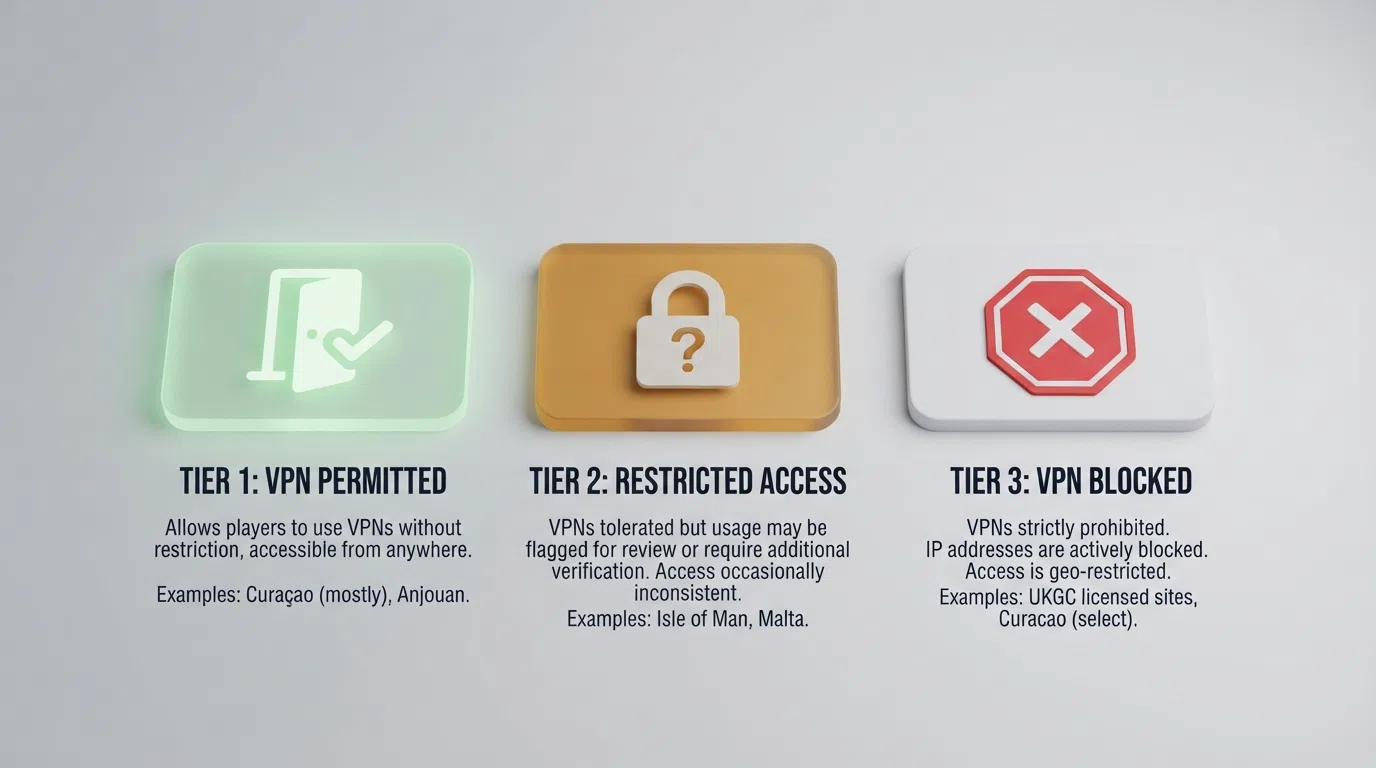
Ten operators, ranked by VPN-policy openness, bonus value and game depth. The split is sharper than the affiliate pages make it sound. Three operators in this set explicitly forbid VPN use in their terms — Stake, BC.Game and Vave. Three welcome it outright or run a deliberately permissive policy — Jackbit, Wild.io and Flush. The remaining four sit somewhere in the middle: tolerant in practice, restrictive in language.
| Operator | Licence Status | Welcome Bonus | Free Spins | Wagering | VPN Policy | Bonus Validity |
|---|---|---|---|---|---|---|
| Stake | Curaçao (surrendered UKGC March 2025) | 200% up to $2,000 | — | 40× (deposit + bonus) | Prohibited | 30 days |
| BetPanda | Costa Rica business registration only | 100% up to 1 BTC | — | 40× (deposit) | VPN-friendly; no KYC at registration | 7 days |
| Cloudbet | Curaçao | Up to $2,500 + 200 FS | 200 FS | 0× (rakeback model) | VPN-tolerant | 30 days |
| BitStarz | Curaçao (UK restricted in T&Cs) | 300% up to 5 BTC | 180 FS in daily batches of 20 | 40× (bonus) | VPN-friendly in practice | 7 days per stage |
| Wild.io | Curaçao | 350% up to $1,000 | 300 FS | 40× | VPN-friendly — confirmed permitted | 7 days |
| Lucky Block | Curaçao (Anjouan cited) | 200% up to €25,000 | 50 FS (Wanted Dead or a Wild) | 40× (released in 10 instalments) | VPN-friendly; no blocks reported | 7 days for FS |
| Jackbit | Curaçao | — (welcome is FS-only) | 100 FS on Hot Chilli Bells | 10× on FS winnings only | Explicitly allowed | 7 days |
| BC.Game | Curaçao (UK restricted in T&Cs) | Up to $20,000 (360% over 4 deposits) | — | 40× (deposit + bonus) | Forbidden — T&Cs clause 3.4 | 30 days |
| Flush | Curaçao | Up to $3,000 + daily FS | Daily FS | — | VPN-friendly; privacy-first design | — |
| Vave | No confirmed licence (UK restricted in T&Cs) | 150% up to 1.5 BTC | 100 FS | 50× | Restricted — confiscation risk | — |
Stake is a Curaçao operator that once held a GB licence and surrendered it in March 2025. The bonus is generous on paper — 200% up to $2,000 with 30 days to clear — and the game depth is real: Pragmatic Play, Evolution, Hacksaw Gaming, Push Gaming, Nolimit City and a library of proprietary originals. The trouble is the terms. Stake’s clause prohibiting VPN or proxy use to circumvent geo-blocking is the strictest in this set, and the same operator that built its UK brand under GB regulation now writes the rule that would close a UK player’s account if it caught them tunneling in. For a reader who values the brand recognition and the game catalogue, the calculation is straightforward: the offer is one of the larger ones, the games are deep, and the operator has stated in plain language what happens on detection. The reader choosing this path is choosing an offer whose headline number is real and whose T&Cs will not bend around their method of access.
BetPanda has no formal gambling licence at all — only a Costa Rica business registration. The welcome is 100% up to 1 BTC with 40× wagering in a 7-day window. The headline feature is the Bitcoin Lightning Network integration: near-instant BTC payouts once a player requests a withdrawal, which is the practical answer to the bank-blocking problem that drives UK players offshore in the first place. The KYC posture is the loosest in this set — no identity check at registration, and verification is reserved for large wins and AML flags. The trade-off is that an operator with no gambling-specific licence has no gambling-specific accountability: a dispute that goes wrong has no regulator to escalate to and no alternative dispute resolution service to file with. For a reader who wants speed and anonymity, BetPanda delivers both. The reader accepting that delivery accepts that the same speed and anonymity run in both directions — including against the player when something goes wrong.
Wild.io is the largest game library in this list short of BC.Game — 7,000+ titles from Pragmatic Play, Evolution and Hacksaw — with a 350% match up to $1,000 plus 300 free spins across the welcome package. Wagering is 40× with a 7-day validity window, which is tight by any standard. The VPN policy is the cleanest of the permissive group: confirmed VPN connections permitted, not merely tolerated. For a player who wants game variety and a clear green light on access, Wild.io is the most straightforward fit in this part of the set, and the bonus percentage is the highest in the table. The caveat is the same caveat that applies to every operator in this list, but it is worth restating: the games are licensed offshore, the welcome bonus is wagered under offshore rules, and the operator’s compliance with a complaint is a function of its own customer-service policy.
Cloudbet is the only operator on this list that replaces wagering requirements with a cash rakeback programme. The headline is up to $2,500 in real cash plus 200 free spins, paid over 30 days as rakeback and cash drops, with no playthrough conditions attached. A player who understands rakeback — the casino returning a percentage of house edge from every wager as cash, regardless of outcome — is looking at a welcome package that costs the casino real money on every spin and pays out regardless of whether the player wins. The arithmetic is different from a bonus with 40× wagering: the casino is paying for play, not for volume. The VPN policy is tolerant without being explicit. For a player who values a bonus they can actually withdraw, Cloudbet is the most structurally honest offer in this set.
Lucky Block runs the highest nominal bonus cap on this list — 200% up to €25,000 — released in 10 instalments, with each instalment tied to the player having wagered 6× their deposit. The free spins are 50 on Wanted Dead or a Wild (Hacksaw Gaming) with a €20 minimum deposit and 7-day validity. The licence situation is the dual Curaçao / Anjouan registration, and the VPN policy is VPN-friendly with no blocks reported. The instalment-release structure is the point that matters: a player does not get the full €25,000 in cash. They get 10% per stage, and each stage requires real money to have moved through the account first. For a high-volume player who plans to deposit and wager substantially, the structure makes sense. For a player who plans a smaller session, the headline number is misleading: the actual bonus realised depends on actual play, not on the cap.
BitStarz is a long-established crypto casino operating on Curaçao since 2014, with a 4,000+ game library and provably fair titles. The welcome is 300% up to 5 BTC plus 180 free spins across four deposits, with 40× wagering and 7-day validity per stage. The free spins are credited in daily batches of 20 — a structure that keeps the bonus active across a longer window than the headline number suggests. The terms list the UK among restricted countries, which is the same clause that appears across this set, and the VPN policy is friendly in practice. For a player who wants a deep game library and is comfortable reading a Curaçao operator’s terms carefully, BitStarz is the most established option on this list by operational history. The 40× wagering and the 7-day stage window are the standard offshore numbers; nothing here is exceptional, and nothing is predatory by the standard of this particular market.
Jackbit is the operator whose terms welcome VPNs outright — “VPN usage explicitly allowed; intentional policy not a loophole,” in the words of independent reviewers. The welcome is 100 free spins on Hot Chilli Bells with no wagering on the spins themselves and 10× wagering on winnings only, with a $100 maximum cashout on the free-spin winnings and a $50 minimum deposit. The wagering multiple is the lightest on the list, and Monero (XMR) is supported end-to-end — deposit, play and withdraw through a built-in wallet, with verification reserved for fraud and AML flags only. For a reader who values explicit VPN access and a privacy-tier currency, Jackbit is the cleanest match in this set. The trade-off is the free-spin structure: $100 max cashout caps the upside, and the rest of the welcome is the 10× on winnings, which is light by offshore standards but still present.
BC.Game has the largest game library in this list — 8,000+ titles including 75+ proprietary provably fair games — and a 360% match welcome bonus up to $20,000 across four deposits. The rakeback structure adds a 300% rakeback bonus on top. The terms, however, are the problem. Clause 3.4 explicitly forbids VPN or proxy use to mask location, and the UK is listed among restricted countries. A UK player who joins BC.Game via VPN is accepting that the operator’s own rules say their access is not permitted, and the same operator that offers the largest game catalogue also offers the clearest documentation that a UK player has no business there. The bonus structure includes a separate 40× wagering on free-spin winnings with a $10 maximum withdrawal cap per batch — a tight ceiling on what the welcome actually pays out. For a reader who can read the terms and accepts the contradiction, the catalogue is unmatched. For a reader who cannot, the catalogue is the largest in a product they have agreed not to use.
Flush is a Curaçao-licensed casino built around privacy, with up to $3,000 plus daily free spins across the welcome programme and a 5,500+ game library from Pragmatic Play, Evolution and Hacksaw. The wagering multiple and bonus validity are not confirmed in the available research, which is itself a piece of information a careful reader should weigh: an operator that does not publish its wagering in plain terms is an operator that wants the player to discover the number at the point of withdrawal. The VPN policy is friendly and the design is privacy-first. For a reader prioritising catalogue breadth over bonus transparency, Flush fits the profile. The reader choosing it is choosing to accept that some of the headline terms are not yet on the page.
Vave is the operator whose own terms warn that VPN users risk account closure and fund confiscation. The welcome is 150% up to 1.5 BTC plus 100 free spins on first deposit with 50× wagering — the highest wagering multiple in this set — and the UK is listed among restricted countries. The game library is 7,000+ titles from Pragmatic Play, Evolution and Betsoft, which is competitive, but the licence situation is the weakest in the table: no confirmed gambling licence at all. For a reader who reads the terms, Vave is the operator whose own documentation most clearly states that a UK player’s access is unwelcome and that the consequence of being caught is loss of funds. For a reader who does not read the terms, Vave is a casino with a large game library and a large welcome bonus, and the two profiles describe different readers with different outcomes.
Crypto and Anonymity: What GB-Licensed Casinos Cannot Offer
Crypto payments, no-KYC registration and VPN access form a single proposition at offshore casinos, and the GB-licensed market cannot offer any of the three. The reason is structural: the LCCP’s anti-money-laundering, source-of-funds and customer-verification requirements make direct crypto deposits effectively impossible at any operator legally serving Great Britain. Identity verification before any deposit or gambling is mandatory. The credit-card ban of 14 April 2020 closes off another payment rail, including credit-card-funded payments through e-wallets. What remains, in the licensed market, is fiat through UK banks, and UK banks can decline outbound transfers to unfamiliar gambling merchants.
Why Crypto and VPN Casino Play Go Together
The link is structural. A UK player who wants to deposit at an offshore casino faces three barriers in fiat: the bank can decline the transfer, the credit-card ban makes plastic unusable, and the operator may not accept UK-issued cards anyway. Crypto bypasses all three. The transaction clears on a blockchain, never touches the UK banking system, and arrives at the casino in a currency the casino accepts. The same currency works in reverse on withdrawal. The VPN exists because the casino’s geo-blocking would otherwise refuse the connection; the crypto exists because the banking layer would otherwise refuse the transfer. Both barriers exist in the licensed market by design, and both are absent offshore by design.
The Crypto Casino Landscape for UK VPN Users
Bitcoin, Ethereum, Tether and Litecoin are the standard deposit currencies across this set of operators. Monero is the privacy-tier currency — Jackbit is the clearest example, supporting XMR end-to-end through a built-in wallet. Bitcoin Lightning Network is the emerging fast-payment rail, and BetPanda is the operator integrating it most visibly for near-instant BTC withdrawals. The diversity of supported currencies is itself a feature: a player who values privacy picks Monero, a player who values speed picks Lightning, a player who values liquidity picks Bitcoin or Ethereum, and the casino accommodates the choice.
Bitcoin Casinos and VPN Play
Bitcoin remains the default currency at VPN-friendly casinos, and welcome bonuses are denominated in BTC accordingly: 1 BTC at BetPanda, 5 BTC at BitStarz, 1.5 BTC at Vave. The volatility risk is real. A bonus worth 1 BTC on the day it is granted is worth a different amount in fiat by the time the wagering requirement is cleared, and a player whose bankroll is denominated in pounds is taking an exchange-rate position on top of the gambling position. Hybrid casinos that also accept fiat insulate the player from this volatility; pure crypto casinos do not. The reader choosing a BTC-denominated bonus at a crypto-only operator is taking two bets at once — one on the games, one on the currency.
No-KYC Casinos: Anonymity’s Double Edge
BetPanda and Jackbit are the clearest no-KYC and minimal-KYC operators in this set. What “no-KYC” means in practice is no source-of-funds checks at registration, no age verification beyond self-declaration, and no responsible-gambling obligations enforceable under British law. The operator reserves the right to request verification after a large win or on an AML flag, which is the line at which the no-KYC promise stops being unconditional. The anonymity the player enjoys is the anonymity the player relies on for protection: with no verification, there is no source-of-funds check to refuse suspicious deposits, no affordability assessment to flag a session that has drifted beyond the player’s means, and no statutory route to escalate a complaint. The reader choosing this profile is choosing speed and privacy over every check the licensed market was designed to perform.
Provably Fair Games — A Crypto Casino Advantage
Provably fair is a verification standard that lets a player check each spin’s outcome independently against a published algorithm. The casino publishes a server seed; the player provides a client seed; the outcome is hashed from both before the spin and verifiable afterward. BitStarz, BC.Game and Jackbit all offer provably fair titles, and BC.Game operates 75+ proprietary games built to the standard. GB-licensed casinos do not use provably fair systems because they sit inside a different verification regime: the regulator audits the games, the operator publishes the RTP, and the player trusts both. Provably fair is a different trust model — cryptographic rather than regulatory — and the player who values it is choosing to verify outcomes themselves rather than rely on a regulator’s audit.
Responsible Gambling When the UK Safety Net Falls Away
The most important sentence in this section is the first one: GAMSTOP does not cover offshore sites. A UK player who has self-excluded at GB-licensed operators can still open an account at every casino in this list, and the GAMSTOP exclusion that protected them at home does not follow them through the tunnel.
Self-Exclusion, GAMSTOP, and the VPN Casino Gap
GAMSTOP has been mandatory for every GB-licensed online operator since 31 March 2020. Exclusion periods run 6 months, 1 year, 5 years, or 5 years with auto-renewal, and they cannot be cancelled early. The system works at GB-licensed sites because every licensed operator must check it before allowing a new account. The system does not work at offshore sites because no offshore operator checks GAMSTOP, and the exclusion list itself does not extend beyond the GB licensing perimeter. A player who has self-excluded and then opens an offshore account via VPN is not circumventing a tool that is broken — they are using a tool that was never designed to reach the sites they are now using. The help that exists for them is help that runs outside the gambling system entirely.
Practical Help Resources Every UK Player Should Know
The help infrastructure that works regardless of where a UK player chooses to gamble:
- National Gambling Helpline (run by GamCare) — 0808 8020 133 for England and Scotland, 0808 2819 265 for Wales; free, available 24 hours a day, every day.
- GamCare — counselling, live chat, forums and treatment referrals at gamcare.org.uk.
- NHS gambling harm clinics — specialist treatment available in England, Scotland and Wales.
- Gamblers Anonymous UK — peer support at ga.org.uk.
- Gamban — device-level blocking software at gamban.com; blocks gambling sites and apps at the device level regardless of jurisdiction.
- GambleAware — tools, self-assessment and information at gambleaware.org.
Gamban is the option that works at offshore sites. It blocks access at the device, not at the regulator, so it reaches VPN-accessible casinos by blocking the connection rather than by relying on a licensing perimeter.
The Prevalence Context: How Many UK Players Are at Risk
The data is from the NHS Adult Psychiatric Morbidity Survey 2023-24 and from GamCare’s published figures for 2026. 0.4% of adults in England experience problem gambling as measured by a PGSI score of 8 or higher; 1.6% experience at least moderate-risk gambling at a PGSI score of 3 or higher. Among people contacting the National Gambling Helpline in 2026, 81.5% disclosed problems with online gambling — the highest proportion in at least five years. GamCare’s January 2026 referral figure of 996 to treatment and peer-based support services was up 48% from the 674 recorded in January 2025. The numbers are not the whole population, but they are the population that has decided to ask for help, and they are growing.
A reader weighing whether to use an offshore VPN casino with the help infrastructure above in mind is weighing two facts. The first is that GAMSTOP does not reach the offshore casino. The second is that the help lines, the NHS clinics, Gamban and GamCare do — and they work for a player regardless of which site they last used.
How We Evaluated These VPN-Friendly Casinos
The ranking rests on three checks. The first is the UKGC public register of licence holders, used to confirm that none of the ten operators is GB-licensed — the register contains 2,663 business records, last updated 29 July 2026. The second is each operator’s published terms and conditions, used to read the VPN policy in the operator’s own words and to confirm wagering, bonus validity, free-spin terms and minimum deposits against the source. The third is independent review material, used to confirm game-provider depth and to triangulate bonus terms where the operator’s own copy was thin.
The ranking is ordered by VPN-policy openness, then by bonus value, then by game-provider depth and UK accessibility. No weighting formula or proprietary score is claimed. Operators whose terms explicitly prohibit VPN use are still listed because the page is about where UK VPN traffic goes in practice, not about which operators would prefer it did not. Evaluation is grounded in research data collected 2026. The limitations of the data are stated where they apply: Flush’s wagering multiple and bonus validity are not confirmed in the available research, and Lucky Block’s bonus is denominated in euros while the rest of the set is denominated in dollars or crypto, which affects direct comparison.
Before You Play: The Decision Every UK VPN Casino User Faces
The honest summary is this. A VPN-friendly casino offers a UK player what the GB-licensed market will not: crypto deposits, no identity verification at registration, bonus multiples several times larger, and stake limits that do not exist. The arithmetic on the bonus is the arithmetic the wagering multiplier sets, and the wagering multiplier offshore is several times larger than the cap GB sites must apply. The expected loss from clearing a $2,000 bonus at 40× wagering on a 96.50% RTP slot is $4,200 in expectation; under the 10× GB cap, the same bonus would cost $700. The offshore offer is more generous. It is also more expensive to clear, and the difference is not a margin — it is the entire spread.
What the player loses is the British safety net. No GAMSTOP. No UKGC complaints route. No ADR. No statutory stake cap. No game-design rules. No enforced responsible-gambling obligations. The UKGC disrupts offshore sites through search-engine delisting and cease-and-desist notices, but it does not block them, and the operators in this list continue to take UK traffic because the disruption strategy cuts reach rather than eliminates it.
The operators in this set differ on whether they want UK VPN traffic. Jackbit, Wild.io and Flush welcome it. Cloudbet, Lucky Block and BitStarz tolerate it. Stake, BC.Game and Vave prohibit it in their terms while continuing to operate in a market where UK players reach them through the very mechanism the terms forbid. A reader choosing among them is choosing among three different relationships with the legal exposure they are accepting by being there at all.
The help infrastructure that does work for a UK player — the National Gambling Helpline, GamCare, NHS gambling harm clinics, Gamban — works regardless of where they choose to play. The 48% year-on-year increase in treatment referrals and the 81.5% online-gambling share of helpline contacts are the figures that put the offer in context, and they are figures no casino in this list can affect.
A VPN casino is a calculated risk, not a like-for-like substitute for a GB-licensed site. The reader making this choice is making it with their eyes open or it is not a choice at all.
Frequently Asked Questions
Is it legal to use a VPN to gamble at an online casino in the UK?
Using a VPN is legal in the UK — no statute prohibits it for any purpose. The Gambling Act 2005 criminalises operators providing unlicensed gambling to UK residents under Section 33, but the offence sits on the supply side, not the player side. There is no criminal penalty for a UK resident who gambles on an unlicensed site.
What happens if a UK-licensed casino detects that I am using a VPN?
GB-licensed operators list VPN use as a Prohibited Practice in their terms — Bet UK and LeoVegas both name it explicitly. Detection typically triggers account suspension and fund confiscation, and the process can take weeks to resolve because the operator’s fraud review holds the balance during the investigation.
Can I use cryptocurrency to deposit at a VPN-friendly casino from the UK?
Yes. Offshore VPN casinos accept Bitcoin, Ethereum, Tether and Litecoin as standard, with Monero supported by Jackbit and Bitcoin Lightning Network payouts at BetPanda. No GB-licensed casino accepts crypto because the LCCP’s AML and source-of-funds requirements make direct crypto deposits incompatible with a GB operating licence.
Does GAMSTOP block access to VPN-friendly offshore casinos?
No. GAMSTOP covers only GB-licensed online operators and has been mandatory across the GB market since 31 March 2020. Offshore casinos do not check the GAMSTOP database, and the exclusion list does not extend beyond the GB licensing perimeter — a fact that matters most for self-excluded players who are considering offshore sites.
What is the best VPN for online casino gambling in the UK?
ProtonVPN, NordVPN and Surfshark recur across recommendation lists because their server networks are large and their obfuscation modes are documented. The decisive features are speed, server breadth and obfuscation — a small provider with a thin network is more likely to be blocked by the casino’s geolocation layer.
Are my winnings from a VPN-friendly casino taxable in the UK?
No. Player gambling winnings are not taxed in the UK — the player-side betting duty was abolished in 2001, and the rule applies whether the site is GB-licensed or offshore. The tax sits on the operator side as Remote Gaming Duty, which rose from 21% to 40% from 1 April 2026.
Can I withdraw my winnings from an offshore VPN-friendly casino to a UK bank account?
Most offshore casinos pay out in crypto, which means the funds arrive in a Bitcoin or Ethereum wallet rather than a UK bank account. A player who wants pounds needs to convert through an exchange, and that conversion is itself a taxable event for capital gains if the crypto position has appreciated above the annual exempt amount.
Casinos – fastestpayout-casinos-uk
Content created by the «fastestpayout-casinos-uk» team