
Online Casinos Without ID Verification for UK Players
 Available in GB
A “no-ID casino” for a UK player is, by definition, an offshore site. Since 7 May 2019, every UKGC-licensed operator must verify a player’s name, address and date of birth before the first deposit — there is no grace period, no quick workaround inside the GB licensing system. The product that the keyword describes does not exist under a British licence. Every operator reviewed on this page operates outside that system.

Verified against the UK Gambling Commission’s public register (2,663 licence holders, 29 July 2026).
Data current as of September 8, 2026, based on the UK Gambling Commission’s public register.
What a No-ID Casino Actually Is — and What It Never Can Be
| Feature | UKGC-Licensed Casino | Offshore No-ID Casino |
|---|---|---|
| ID Verification | Mandatory (at registration) | Tiered (at threshold) |
| GAMSTOP Coverage | Yes | No |
| Fund Segregation | Mandatory | No |
| Complaints Route | UKGC / ADR | Regulator terms only |
| Spin Speed Cap | 2.5 seconds | No |
| Deposit Limits | Mandatory prompt | None |
Data current as of September 8, 2026, based on the UK Gambling Commission’s public register.
The Five-Minute Definition: What “No ID” Means — and What It Doesn’t
A no-ID casino, for a UK reader, is an offshore site that lets a British player open an account and play with real money without uploading a passport, driving licence, or proof of address at the sign-up step. The registration flow is typically email and password — sometimes a phone number — and then a deposit screen. No document upload, no selfie, no waiting.
That is the honest ceiling, and every qualifier matters. “No ID at registration” is not “no ID ever.” Every offshore operator in the featured set has a verification trigger point — a threshold at which the platform asks for documents. The common range is a cumulative £2,000 to £3,000 across deposits and withdrawals, or the first withdrawal request at the more conservative operators, or a tiered ladder that scales with the size of the cashout. No operator reviewed is truly no-KYC at every level. The word “instant” in a no-ID casino’s marketing refers to the first deposit, not to a £50,000 withdrawal.
The legal position is sharper than most pages admit. It is entirely legal for a UK resident to access and play at an offshore no-KYC casino — no player has been prosecuted for doing so. It is simultaneously illegal for that platform to provide its services to GB consumers without a UKGC licence. The asymmetry is the defining feature of the product: the player is not the criminal, the operator is.
No-ID vs UKGC-Licensed: The Trade-Off at a Glance
A UKGC-licensed casino hands the player a suite of protections: identity verification before play, GAMSTOP self-exclusion coverage, approved alternative dispute resolution (ADR), segregated player funds, a UKGC complaints route, financial vulnerability checks, mandatory deposit-limit prompts, session time and loss displays, and a 2.5-second spin-speed cap. A no-ID offshore casino strips most of these out — what it adds in return is speed (register in two minutes, deposit in crypto, play within the hour) and a lower paper trail.
The “eKYC” middle ground is worth flagging because it muddies the comparison. UKGC-licensed sites that advertise “instant verification” are still doing ID verification — they use automated services like Onfido or Jumio to cross-check names and dates against databases. The process is fast and frictionless, but it is not “no ID.” A player who has self-excluded through GAMSTOP will still be caught by eKYC. A player who has been barred by a UKGC operator will still be flagged. eKYC is a different category from no-KYC, and pages that conflate them confuse the reader on the one point that matters.
The trade-off can be stated plainly. UKGC-licensed = identity check, GAMSTOP, ADR, segregation, complaints route. Offshore no-ID = none of those, in exchange for registration-to-play in minutes and crypto-native deposits. Neither is universally better; each suits a different player and a different tolerance for the risks.
How UK Players Find and Browse No-ID Casino Sites
Offshore no-ID casinos reach UK players mostly through search results, affiliate review pages, and crypto-gambling forums. The licence badge they display — Curaçao GCB, Anjouan ALSI — is not a substitute for a UKGC licence. It confirms the operator holds a licence somewhere; it does not confirm the licence authorises provision to GB consumers, and no overseas licence does.
A few red flags in the presentation tell a reader when to walk away. No licence information anywhere in the footer is the first. No responsible-gambling page, or a page that exists but links to nothing, is the second. No terms and conditions, or terms that contradict the bonus offer on the landing page, is the third. None of these guarantees a site is unsafe — but all three appear disproportionately at sites that are.
The single most useful pre-deposit check is the UKGC’s public register. It contains 2,663 licence holders, last updated 29 July 2026, and is searchable by business name, trading name, domain name, or account number. If the casino you are considering is not on the register, you are not protected by GAMSTOP, ADR, or the UKGC complaints route. That is the test that determines everything else on this page.
10 Offshore Casinos Accepting UK Players in 2026
Every operator below was checked against the UKGC public register. None holds a GB casino licence. The table captures what is comparable across the ten — licence, welcome offer, wagering, the point at which identity is demanded, and the GB-licensed status that is, for each row, “No.” The operator write-ups that follow cover what is not comparable: the dispute history at one, the licence expiry at another, the product-model shift at a third.
| Casino | Licence | Welcome Bonus | Wagering | KYC Trigger | GB-Licensed |
|---|---|---|---|---|---|
| MyStake | Curaçao (GTW B.V.) | 150% up to £1,500 | 30× | At withdrawal | No |
| Freshbet | Curaçao GCB | 100% up to £500 | 30× | At withdrawal | No |
| DonBet | Curaçao GCB | 150% up to £750 + 50 FS | 30× | ID + address before first withdrawal | No |
| Velobet | Curaçao (Santeda/GTW B.V.) | — | — | At withdrawal (disputes reported) | No |
| Stake.com | Curaçao GCB direct | No welcome bonus | N/A | Mandatory for everyone | No |
| BC.Game | Anjouan (Twocent Technology) | Up to $20,000 (crypto) | — | ~€10,000/month cap; $2,000–$3,000 at withdrawal | No |
| Rollbit | Curaçao | No-wager rakeback | None | Risk-based, $2,000–$10,000 | No |
| Jackbit | Curaçao | Rakeback + free spins | — | No KYC for small withdrawals | No |
| Cloudbet | Curaçao + Anjouan | 100% up to 5 BTC | — | — | No |
| Bets.io | Anjouan | — | — | — | No |
Cells marked with an em dash carry no documented figure in the source research. Where a column is blank, the data simply does not exist in the public record, and that absence is itself worth knowing before depositing.
Why No UKGC-Licensed Casino Appears in This Ranking
The reason is regulatory, not editorial. UKGC licence condition 17.1.1, in force since 7 May 2019, requires every licensed remote operator to verify a customer’s name, address and date of birth before the customer deposits or gambles. The pre-2019 grace period — 72 hours to send documents — is gone. There is no licensed UK casino that registers a player without ID verification.
“Quick verification” UKGC casinos use eKYC: Onfido, Jumio, automated database cross-checks. The whole process takes seconds, not days. But it is still identity verification. A player who is on GAMSTOP will be blocked. A player who has been self-excluded by a UKGC operator will be flagged. The keyword asks for “without ID,” not “with fast ID,” so eKYC sites do not belong on this page. For readers who want UKGC protection and are content with automated verification, the UKGC public register lists every licensed option.
MyStake: Up to £1,500 Welcome Package
MyStake runs the largest welcome package in the featured set: a 150% first-deposit match with a £1,500 ceiling. The wagering requirement is 30× — a figure that, as the calculation further down shows, translates into substantial turnover before any withdrawal clears. The game library is mainstream: Pragmatic Play, NetEnt, Play’n GO and Evolution cover the slots and live-dealer sides of the catalogue.
The licence history is the part worth understanding. MyStake previously operated under Santeda International B.V., whose Curaçao licence expired in December 2025. The brands — MyStake, Velobet, DonBet, Goldenbet — moved to GTW B.V. after Curaçao regulatory scrutiny on the Santeda group. KYC is triggered at withdrawal rather than at registration, consistent with the offshore norm, and the provider mix is broad enough that the product experience is not the bottleneck.
For a UK player weighing MyStake, the offer’s size is its strongest feature and the licence churn its weakest. The £1,500 ceiling is generous; the 30× multiplier is heavy. Readers who clear bonuses methodically should size their deposits to what they are willing to turnover, not to what the headline allows.
Freshbet: 100% Match to £500, Fast Crypto Payouts
Freshbet’s offer is more compact and, on the bonus terms alone, easier to read: a 100% match to £500 on the first deposit, with the broader package stepping up to 250% up to £1,500 across three deposits. The 30× wagering multiplier is the same as MyStake. The £20 minimum deposit is unremarkable.
What separates Freshbet is the payout speed: under 24 hours on crypto withdrawals, according to multiple reviewer reports. For a UK player who wants the offshore experience without the multi-day wait that some Curaçao sites impose, that is the practical edge. KYC runs at withdrawal, with no verification at registration or deposit.
A reader comparing Freshbet to MyStake is comparing a smaller ceiling against a faster payout. The two are different bets: MyStake rewards larger deposits; Freshbet rewards impatience. Neither is wrong; the choice is about what the reader values more.
DonBet: £750 Bonus + 50 Free Spins — But ID Required Before You Cash Out
DonBet pairs the welcome match with a free-spin bundle: 150% up to £750 plus 50 free spins. The wagering requirement is 30× on the bonus amount. The provider mix is the same trio — Pragmatic Play, NetEnt, Evolution — that powers most of the featured set’s slot and live-dealer lobbies.
The distinctive feature is the verification bar. DonBet demands government-issued photo ID and proof of address before the first withdrawal, regardless of the amount. Approval typically arrives within 18 hours, which is fast by offshore standards — but the requirement itself is the most demanding in the featured set. A player who registered specifically to avoid the ID step will meet it at the cashout.
NEXT.io has identified DonBet’s parent group as a black-market operator. That is a data point worth carrying alongside the offer terms. For a player who values the free-spin bundle and is willing to upload documents at withdrawal, DonBet is competitive; for a player whose priority is the smallest possible verification footprint, the 18-hour approval window is the moment the “no-ID” framing breaks.
Velobet: Fast Payouts, But Verify Early
Velobet sits inside the same Santeda/GTW B.V. group as MyStake and DonBet. Reviewer reports put payout speed at 12 to 24 hours, which is competitive. The provider set — Pragmatic Play and NetEnt — covers the mainstream slot catalogue without the live-dealer depth of MyStake or DonBet.
The unresolved question is verification. Player reports include account verification disputes and balance confiscations. While not a statistical frequency, the pattern of account verification disputes and balance confiscations is a signal to act with caution before depositing. Velobet’s verification is not the “no ID at all” model — it is the offshore model with documented friction.
The advice is straightforward: verify proactively before depositing more than a player can afford to lose at a site where withdrawal disputes have been reported. The 12-to-24-hour payout is real when it works; the dispute reports are real too, and a reader who ignores the second fact is gambling twice.
Stake.com: No Welcome Bonus — Mandatory KYC and Daily Races Instead
Stake.com is the largest brand by recognition in the featured set, and the one whose product has shifted most. There is no traditional welcome bonus. What Stake offers instead is a daily-races leaderboard and reload promotions, plus a proprietary games catalogue that includes Hacksaw Gaming titles.
The licence is direct from Curaçao GCB — Medium Rare N.V., account number 145353, licence OGL/2024/1451/0918, verified current as of 4 June 2026. In March 2025, Stake exited the GB market after a UKGC investigation into its practices, by mutual agreement with TGP Europe to terminate its white-label arrangement. KYC is now mandatory for everyone: Level 1 collects basic details, Level 2 requires government-issued ID before bonuses or deposits.
For a reader searching for a no-ID casino, Stake.com in 2026 is closer to a UKGC-style KYC model than the offshore norm. The keyword’s promise is not delivered here — and that is worth saying plainly, because the brand’s name recognition can mislead a player into thinking the experience matches the marketing of “no ID.” A self-excluded player looking for a GamStop bypass will not find it at Stake.com; the verification step catches them at registration.
BC.Game: Up to $20,000 in Crypto Bonuses — Anjouan-Licensed
BC.Game’s headline figure is the largest on the page: matched deposit bonuses up to $20,000, denominated in crypto, with a multi-deposit package that includes free spins. The licence moved in 2024 — BC.Game withdrew its Curaçao licence in December 2024 after the Curaçao entity was declared bankrupt in November 2024, and relocated to Anjouan under Twocent Technology Limited, licence ALSI-202410011-FI1.
The verification ceiling is the practical limit. Unverified play is capped at roughly €10,000 per month. Withdrawals over $2,000 to $3,000 may trigger AML and KYC review. The provider mix — Pragmatic Play, Evolution, BGaming, plus BC.Game’s own proprietary titles — covers the slot and live-dealer bases.
For a UK player, the $20,000 figure is real, but it is also a marker of how much bonus turnover the operator expects to extract. The Anjouan licence is lighter than Curaçao’s new LOK framework; the BC.Game ownership trail runs through Belize. None of that makes the casino unsafe in a general sense, but it is the kind of structure a reader should know exists before depositing.
Rollbit: No-Wager Rakeback — the Only Operator in the Set Without Wagering Requirements
Rollbit’s product is structurally different. There is no traditional welcome bonus. There are no wagering requirements on rewards — a rakeback model that returns a percentage of house edge or bet volume without playthrough conditions. Rollbit is the only operator in the featured set with that structure.
The licence is Curaçao. The UK is listed as a restricted jurisdiction, and BetRank rates Rollbit’s trust score at 64.6 out of 100 — Tier 2. KYC is triggered at a risk-based withdrawal limit of $2,000 to $10,000 depending on account profile. The product mix includes an in-house Crash game, an NFT marketplace, and a standard casino provider layer.
For a player who dislikes wagering requirements — and the calculation further down shows why that dislike has a rational basis — Rollbit is the cleanest offer in the set. The trade-off is the restricted-jurisdiction status and the trust-score rating. A reader who wants no-wager rewards with the lightest possible KYC trigger should look here first.
Jackbit: Rakeback and Free Spins, No KYC for Small Withdrawals
Jackbit’s entry-level offer is a rakeback plus free spins on first deposit. The KYC bar is the lowest in the featured set: no KYC for small withdrawals. The minimum deposit is $20 in crypto equivalent, and crypto payouts are instant.
The licence is Curaçao. The provider set — Pragmatic Play, Evolution, NetEnt — covers the slot and live-dealer catalogue without proprietary titles. For a player whose play volume stays below the KYC threshold, the experience is close to the marketing ideal of “no ID.”
The honest qualifier is in the threshold itself. “Small withdrawals” is a defined ceiling, and a player who crosses it will face the same document request as everyone else. For low-volume play, Jackbit is competitive; for high-volume play, the KYC trigger arrives at the same point as the rest of the set.
Cloudbet: 100% Match Up to 5 BTC — the Highest Ceiling in the Set
Cloudbet is the veteran crypto casino in the featured set, with a 100% match up to 5 BTC — the largest single-figure ceiling in headline terms. The minimum deposit is 0.001 BTC, and crypto payouts are instant.
The licence is dual: Curaçao and Anjouan. The provider mix — Pragmatic Play, Evolution, Microgaming — is broad, with Microgaming giving the slot catalogue a depth the other operators lack. The specific KYC trigger point for Cloudbet is not publicly disclosed; a player should expect verification at a withdrawal threshold consistent with the offshore norm.
For a high-volume crypto player, the 5 BTC ceiling is the draw. The dual licence and Microgaming coverage make Cloudbet a credible choice for a player who values crypto-native operation and slot variety over the smaller, cleaner offers elsewhere.
Bets.io: Anjouan-Licensed with Pragmatic Play and Evolution
Bets.io is the operator with the least documented detail in the research set. The licence is Anjouan. The providers are Pragmatic Play, Evolution and NetEnt. Welcome bonus terms, wagering multipliers, and KYC trigger points are not published in standard operator terms.
A reader considering Bets.io is reading from a thin file. The Anjouan licence and the provider names are real; the offer terms and the verification ceiling are not on the record. The honest move is to check the operator’s own terms page before depositing — a practical step that, given the gaps, is also the responsible one. Bets.io is included in the ranking because it meets the structural criteria (offshore, accepts UK players, no ID at registration) and is named in industry sources; it is flagged here because the research does not carry the specifics other operators carry.
Why No UK-Licensed Casino Can Skip Your ID — and Where Players Go Instead
What “No ID Verification” Means — and Why UK Casinos Demand It
“No ID verification” sounds like one thing, but it is a spectrum. At one end, an operator that requests no documents at any deposit or withdrawal level. At the other, a tiered model that asks for verification only after a cumulative threshold is crossed. The truth, in the research, is that every operator in the featured set sits somewhere on that spectrum — none is at the absolute end. The £2,000 to £3,000 cumulative trigger range is the practical band.
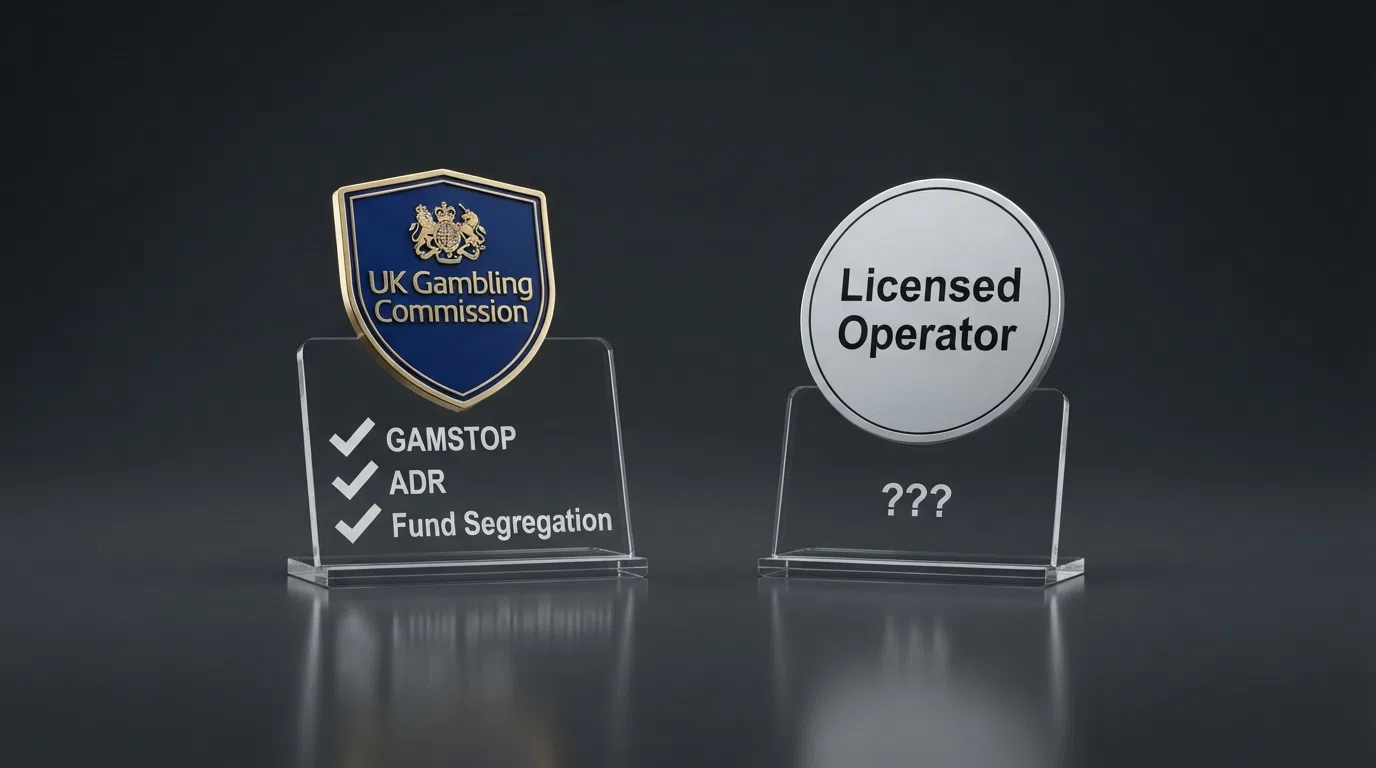
The UKGC’s demand for identity is grounded in the three licensing objectives, not bureaucracy. Objective one is preventing gambling from being a source of crime. Objective three is protecting children and other vulnerable persons from harm. Both require knowing who the customer is. The verification check collects name, address and date of birth — three data points that catch the under-18 player at the door, the self-excluded player at GAMSTOP, and the money-laundering risk at the deposit stage.
The age-banded stake caps are the concrete reason verification is not optional. A player aged 25 and over can stake up to £5 per spin on online slots. A player aged 18 to 24 is capped at £2 per spin. Those caps, imposed by SI 2025/215, apply to the total staked within a game cycle. The casino cannot enforce them without knowing the player’s age, and it cannot know the age without the document check. “No ID” is, in this specific sense, incompatible with the age-banded framework that the UKGC built.
The UKGC KYC Framework: What Every Licensed Casino Must Check
The UKGC’s KYC framework is layered. LCCP condition 17.1.1 demands identity verification before deposit or play. LCCP SR Code 3.4.4, in force since 28 February 2025, triggers a financial vulnerability check at a net deposit threshold of £150 in a rolling 30-day period. LCCP 6.1.2, in force since 14 April 2020, bans credit cards for all remote gambling, including credit-card-funded e-wallet payments. The Commission’s stated ground: 22% of online gamblers who used credit cards were classed as problem gamblers.
From 19 December 2025, wagering requirements at GB-licensed casinos are capped at 10× under SR Code 5.1.1. Mixed-product promotional offers are banned. From 31 October 2025, operators must prompt a customer to set a financial limit before the first deposit; RTS 12 standardises a gross deposit limit. The game-design rules, in force since 31 October 2021, ban auto-play, cap spin speed at 2.5 seconds, ban losses disguised as wins, and permanently ban reverse withdrawals. None of these apply offshore. Every one of them is part of what a UK player leaves behind.
The offshore casino does not run any of these checks. It does not verify at registration, does not trigger a vulnerability check at £150, does not ban credit cards, does not cap wagering at 10×, does not display session time or loss totals, and does not slow the spin cycle to 2.5 seconds. The marketing word for this is “freedom.” The regulatory word for it is “no framework.”
Offshore vs UKGC-Licensed: The Legal Reality for UK Players
The Gambling (Licensing and Advertising) Act 2014 introduced point-of-consumption reform: a GB licence is compulsory for any operator providing gambling facilities to customers in Great Britain, regardless of where the operator is based. A Curaçao or Anjouan licence is not a substitute. Section 33 of the Gambling Act 2005 makes unlicensed provision a criminal offence — up to 51 weeks’ imprisonment, an unlimited fine, or both. That penalty is aimed at the operator, not the player. No UK player has been prosecuted for accessing an offshore site.
The UKGC’s enforcement model is disruption, not blocking. Between April 2024 and June 2025, the Commission issued 3,140 disruption notices to unlicensed operators, referred 447,778 URLs to search engines, achieved 287,961 URL removals, and recorded an average 32% fall in engagement across 160 disrupted sites. For October 2024 to September 2025, the Commission reported 208,088 enforcement actions on illegal online gambling — the largest category being search-engine referrals. The Commission does not currently have statutory ISP or DNS blocking powers; legislation has been proposed but not enacted.
The practical effect is that an offshore casino can be reached from a UK IP address without the connection being blocked. It can advertise through affiliate sites that are not on UKGC referral lists. It can process crypto deposits without a UK-regulated payment intermediary. The legal framework says this is criminal provision; the enforcement model says it is criminal provision that the Commission disrupts rather than blocks.
Cashing Out: Withdrawals Without ID — Speed, Caps and What Can Go Wrong
The withdrawal ladder varies by operator. Jackbit and Rollbit sit at the lightest end: no KYC for small withdrawals, with risk-based triggers at higher volumes. Freshbet and MyStake trigger KYC at the first withdrawal. DonBet is the strictest: photo ID and proof of address required before the first withdrawal, with approvals typically clearing within 18 hours. BC.Game caps unverified play at roughly €10,000 per month, with $2,000 to $3,000 the typical AML trigger at withdrawal.
What happens when KYC is requested? The operator sends a document list, the player uploads, and the approval window opens. DonBet’s 18-hour approval is fast. Others are slower, and the variation is wide enough that a player should not assume a 24-hour wait. The risk on the conservative end is documented at Velobet, where account-verification disputes and balance-confiscation reports have appeared in player feedback. A player who deposits more than they can afford to lose at a site with a known dispute pattern is not managing risk — they are absorbing it.
The bigger structural point: when an offshore operator withholds funds, the player has no UK ADR provider, no UKGC complaints route, and no guaranteed fund segregation. The recourse is the operator’s own terms page and, in extremis, the Curaçao or Anjouan regulator — neither of which has the enforcement reach of the UKGC. The section on the safety net a UK player leaves behind covers this in full.
Bonuses Without Barriers: No-Deposit Offers and Free Spins That Skip KYC
The bonus landscape across the featured set runs from match-deposit offers (100% to 150%) through free-spin bundles (DonBet’s 50 FS) to rakeback models (Rollbit’s no-wager structure) and crypto-denominated packages (BC.Game’s $20,000 ceiling). The wagering reality at three operators — MyStake, Freshbet, DonBet — is 30×. That is three times the UKGC’s 10× cap. The cap exists because the Commission concluded that higher multipliers materially harm players; offshore operators are not bound by that conclusion.
No-deposit bonuses with verified terms are not available across the featured operators. That absence is worth stating rather than papering over: a player searching for a “no deposit, no ID” offer will not find a verified one in this ranking.
The prescribed calculation makes the wagering cost concrete. Take DonBet’s £750 welcome offer with a 30× multiplier and a £5 stake per spin: the required turnover is £22,500. At £5 per spin, that is 4,500 spins. At the UKGC’s 2.5-second spin interval, that is 11,250 seconds, or roughly 42 minutes. The calculation is mechanical, and the marketing does not perform it. The reader who performs it before depositing knows the cost of the bonus in time.
Crypto and Anonymity: Bitcoin Casinos That Skip the ID Check
Cryptocurrency is the engine of the no-ID model. No bank intermediary, no card-issuer KYC trail, withdrawals direct to a wallet. For a UK player who wants the lightest possible verification footprint, crypto is the practical answer.
Four of the featured operators are crypto-native in the relevant sense. BC.Game offers crypto-denominated bonuses up to $20,000. Cloudbet matches deposits up to 5 BTC. Jackbit pays out instantly in crypto from a $20 minimum. Stake.com built its product around crypto deposits. The remaining operators accept crypto alongside fiat, but the no-ID experience at those sites runs more cleanly through a Bitcoin wallet than through a card.
The anonymity ceiling is the same ceiling that applies everywhere on this page. Even crypto casinos trigger KYC at cumulative thresholds. BC.Game caps unverified play at roughly €10,000 a month; Rollbit’s risk-based limit sits at $2,000 to $10,000. The trade-off on data privacy runs in both directions: a no-ID casino collects less personal data, but it offers no GDPR-equivalent protections, no data-portability rights, and no UK ICO complaint route. A player who values the smaller data footprint gets it; a player who wants the EU-style data rights does not.
Pay-by-Mobile and Other Payment Routes at No-ID Casinos
Operator-specific pay-by-mobile data is not consistently available for the featured set. The general picture is that crypto is the dominant deposit and withdrawal route, with fiat options less documented across the offshore sites reviewed.
Pay-by-mobile is a natural fit for the no-ID model in theory: the phone bill acts as the intermediary, no bank statement is generated, the deposit appears as a mobile charge. In practice, pay-by-mobile deposits tend to carry low caps and high fees, and the operator-specific data is not in the public sources. A reader who wants to use pay-by-mobile should check each operator’s cashier page for the actual terms rather than assume the option exists at a workable ceiling.
The credit-card-ban context is worth carrying. LCCP 6.1.2, in force since 14 April 2020, bans credit-card gambling at UKGC-licensed casinos. Offshore operators are not bound by that rule, and a UK player who has been declined for a credit-card deposit at a licensed site may find the same deposit accepted at an offshore one. Whether that is a feature or a warning is a question each reader answers for themselves.
No Selfie Required: Slots, Live Dealer and Table Games at No-ID Casinos
Live Dealer Games Without ID Verification
Evolution is the dominant live-dealer supplier across the featured set — present at MyStake, Freshbet, DonBet, Stake.com, BC.Game, Jackbit, Cloudbet and Bets.io, eight of the ten. Pragmatic Play Live is available at most of those plus the operators where Pragmatic Play appears without the live-dealer label. Proprietary live tables exist at Stake.com alongside its Hacksaw Gaming titles.
The game types are the standard live-dealer catalogue: roulette, blackjack, baccarat, and the game-show format that Evolution pioneered. The difference from a UKGC live lobby is the regulatory environment. The £5/£2 statutory stake cap on online slots does not extend to live-dealer games under SI 2025/215, but the broader game-design rules — mandatory reality checks, session time and loss display — do not apply offshore either. A player at a no-ID live table is not prompted to take a break, not shown session time, not shown session loss.
Online Slots: Playing Without Uploading Documents
The slot provider line-up across the featured set is mainstream and broad. Pragmatic Play appears at nine of the ten operators. NetEnt sits at MyStake, Freshbet, DonBet, Velobet, Jackbit and Bets.io. Play’n GO is at MyStake. Hacksaw Gaming is at Stake.com. BGaming is at BC.Game. Microgaming is at Cloudbet. The catalogue depth is comparable to a UKGC-licensed lobby; the slot experience differs in what the UKGC’s rules do not reach.
Auto-play is available. Spin cycles can run faster than the UKGC’s 2.5-second cap. The £5/£2 stake cap does not apply. Per-title RTP data for the featured operators is not publicly available, reflecting the fact that offshore slots are not bound by UKGC RTP reporting requirements. Players cannot independently verify the return-to-player figure at most of the sites on this page. The RTP context is qualitative, not numeric, and that is the honest characterisation.
RNG Table Games at No-ID Casinos
RNG blackjack, roulette and baccarat run on software alone, with no streaming latency and no dealer. The tables are available 24/7, with no seat limits and no live-dealer scheduling. Provider coverage is broad: Pragmatic Play’s RNG table suite, NetEnt’s classic table games, Microgaming’s table library at Cloudbet.
The difference from a UKGC RNG table is the same as the live-dealer difference — none of the UKGC’s session display rules apply offshore, and the player does not see a real-time session loss or time counter. RNG tables at offshore casinos run at the speed the software allows, which is faster than most players expect on their first session.
The Safety Net You Leave Behind: Staying Safe at Offshore Casinos
GamStop and Self-Exclusion: Why Offshore Casinos Sit Outside the Net
GAMSTOP is the UK’s national self-exclusion register. It has been mandatory for every GB-licensed online operator since 31 March 2020. A player who registers with GAMSTOP chooses an exclusion period of six months, one year, five years, or five years with auto-renewal. The exclusion cannot be cancelled early. The register is the single most effective tool the UKGC framework offers for a player who has decided to stop.
GAMSTOP does not cover a single operator on this page. Every casino in the featured set is offshore; GAMSTOP does not reach them. A self-excluded player who opens an account at an offshore no-ID casino has walked past the fence. The “no ID” model is, for that player, the GamStop-bypass model by construction.
The complementary tools that work across jurisdictions are device-level blockers. GamBan and BetBlocker install at the device or network level and block gambling-site traffic regardless of the operator’s licence. A self-excluded player who wants the protection to extend offshore should pair their GAMSTOP registration with a device-level blocker. Neither is a substitute for the other; together they cover more ground.
The Tools You Lose: Deposit Limits, Reality Checks and Time-Outs
Every UKGC-licensed casino must offer a set of responsible-gambling tools that an offshore operator is not required to provide. From 31 October 2025, licensed casinos must prompt a customer to set a financial limit before the first deposit. From 28 February 2025, a financial vulnerability check is triggered at £150 net deposit in a rolling 30-day period. Reality checks interrupt play at defined intervals. Time-out options lock the account for cooling-off periods. Session loss and time displays have been mandatory since 31 October 2021.
Research does not document equivalent tools at the featured offshore operators. Most offer at most a self-exclusion request by email. The statutory levy — 1.1% of gross gambling yield from 6 April 2025, split 50% treatment, 30% prevention, 20% research — funds the treatment infrastructure that offshore operators do not contribute to. A UK player at a no-ID casino is outside the system that funds the help.
What a player can do instead is limited but real. Set a deposit budget before logging in. Keep gambling funds in a separate wallet with a hard cap. Install BetBlocker or GamBan at the device level. None of these replicate the UKGC’s automatic vulnerability check; all of them put the responsibility where it lands once the UKGC framework is no longer in the picture.
Where to Get Help: Helplines, Clinics and Support Services
The National Gambling Helpline — 0808 8020 133 — is free, confidential and available 24/7, run by GamCare. GamCare also operates live chat, online counselling, and a treatment-referral pathway. In January 2026 alone, GamCare made 996 referrals to treatment and peer-based support services — a 48% increase on January 2025. Of those disclosing a form of gambling to GamCare Helpline advisers, 82% cited struggles with online gambling specifically — the highest rate since 2021.
The National Gambling Support Network treated 11,960 clients in Great Britain between April 2024 and March 2025, an 11% increase on the previous year. The problem-gambling rate among those in treatment fell from 87% at initial assessment to 27% at final assessment. NHS gambling treatment clinics operate in England, Scotland and Wales. NICE guideline NG248 covers identification, assessment and management of gambling-related harms. The Primary Care Gambling Service is a national service for anyone experiencing gambling-related harms. Gamblers Anonymous UK runs peer support groups.
The prevalence context is large. 47% of adults in Great Britain gambled in the past four weeks. 4.3 million adults are affected by a family member or friend’s gambling. An estimated 2 million children live in households with adults experiencing problem gambling. None of these figures describes the average reader of this page; all of them describe the population the help resources exist to serve. A reader who recognises their own situation in any of those numbers has a phone to call.
How We Chose and Ranked Every Casino on This Page
The selection methodology drew on industry competitor pages, the UKGC’s official site and public register, NEXT.io for licence-tracking and black-market operator identification, GamCare and GambleAware for prevalence data, and the operators’ own terms pages. Every operator was cross-checked against the UKGC public register — 2,663 licence holders as of 29 July 2026, searchable by business name, trading name, domain name or account number. None of the ten holds a GB casino licence. That fact is the entry criterion, not a conclusion.
The ranking criteria, in order of weight: licence status and jurisdiction quality, KYC trigger transparency, bonus terms clarity and wagering burden, provider quality and game range, and documented payout speed and player-feedback signals including reported disputes. What the ranking does not measure is also part of the methodology. No personal testing. No deposit-and-play verification. No real-money sampling. This is a researched review, not a user trial.
The gaps in the table — the cells without specific figures — indicate data that is not publicly available. Where bonus terms, wagering multipliers, or KYC trigger points are absent from the public record, the page says so rather than fabricating a number. The Velobet write-up flags the dispute pattern in player feedback. The Bets.io write-up names the research gaps. The Cloudbet write-up marks the KYC ceiling as qualitative. A reader who treats the table’s empty cells as the absence of a number rather than the presence of a guessed one is reading the page correctly.
Your Move: What to Check Before You Play Anywhere
The first check is the UKGC public register. If the casino is on it, the player is protected by GAMSTOP, ADR, fund segregation, and the UKGC complaints route. If it is not on it, none of those protections apply. The register is the test that determines everything downstream.
The second check is the operator’s withdrawal terms. Every operator in the featured set has a KYC trigger threshold. The range across the set runs from “no KYC for small withdrawals” (Jackbit, Rollbit at low volumes) to “ID and proof of address before the first withdrawal” (DonBet) to a cumulative £2,000 to £3,000 trigger (the typical offshore norm). A player who has not found the threshold before depositing has not found the ceiling at which the “no ID” framing breaks.
The third check is the bonus maths. A 30× wagering requirement on a £500 bonus means £15,000 in turnover before withdrawal. At a £5 stake per spin and a 2.5-second spin interval, that is 3,000 spins and roughly 2 hours and 5 minutes of continuous play. The calculation is mechanical, and the marketing does not perform it. The reader who performs it before depositing knows the cost of the bonus in time.
The fourth check is the help-resource bookmark. The National Gambling Helpline is 0808 8020 133 — free, 24/7, and works regardless of where the player gambles. A player who has decided to proceed should still have the number in their phone before the first deposit, because the right time to call is before it is needed.
The honest summary is short. Offshore no-ID casinos trade every UKGC protection — GAMSTOP, ADR, fund segregation, the complaints route, the vulnerability check, the deposit-limit prompt, the spin-speed cap, the session display — for registration-to-play in minutes and a crypto-native deposit flow. That trade-off is real. The reader who understands it can make an informed choice. The reader who did not know it now does.
Frequently Asked Questions
What is a no-ID casino and how does it work for UK players?
A no-ID casino is an offshore gambling site that lets a UK player register and deposit without uploading identity documents at sign-up. Registration typically takes an email and a password, and a crypto or card deposit can follow within minutes. Every operator reviewed on this page, however, has a verification trigger point — a cumulative deposit-plus-withdrawal threshold of £2,000 to £3,000, a first-withdrawal check, or a risk-based withdrawal ceiling. None of them is truly ID-free at every level.
Can I withdraw from a no-ID casino without submitting documents?
Yes, up to the operator’s KYC trigger. Jackbit and Rollbit accept withdrawals without documents at small amounts. Freshbet and MyStake trigger verification at the first withdrawal regardless of size. DonBet requires photo ID and proof of address before the first cashout, with approvals typically within 18 hours. The phrase “no-ID casino” describes the registration step, not the withdrawal step at every volume.
Do no-ID casinos accept UK players who are on GamStop?
Every casino on this page is offshore, and GAMSTOP does not cover offshore operators. A self-excluded player who opens an account at a no-ID casino has walked past the GAMSTOP fence by construction. The complementary protection that works across jurisdictions is device-level blocking software such as GamBan or BetBlocker, which can be installed alongside a GAMSTOP registration.
What payment methods can I use at a no-verification casino?
Crypto is the dominant deposit and withdrawal route across the featured set. Bitcoin is accepted at BC.Game, Cloudbet, Jackbit and Stake.com. Fiat options are less documented, and pay-by-mobile data is not in the public record for the operators reviewed. Credit cards may be accepted at offshore sites, although they are banned at UKGC-licensed casinos under LCCP 6.1.2.
Are crypto casinos with no ID verification safe for British players?
The “safe” question splits in two. On data privacy, crypto casinos collect less personal data but offer no GDPR-equivalent protections or UK ICO complaint route. On fund safety, no offshore operator in the featured set offers UKGC-style fund segregation, and recourse if funds are withheld is limited to the operator’s own terms and the offshore regulator. The legal position is that accessing these sites is not a player offence, but the operator is providing gambling facilities illegally under section 33 of the Gambling Act 2005.
What protections do I lose by playing at an offshore no-ID casino?
The list is the UKGC framework, minus the ID check. No GAMSTOP coverage, no UK ADR provider, no UKGC complaints route, no guaranteed fund segregation, no mandatory financial vulnerability check at £150 net deposit, no mandatory deposit-limit prompt, no 2.5-second spin-speed cap, no auto-play ban, no session time or loss display, no losses-disguised-as-wins prohibition, and no reverse-withdrawal ban. The player trades all of these for the registration speed and the crypto-native deposit flow.
Where can I get help if I have a gambling problem in the UK?
The National Gambling Helpline is 0808 8020 133 — free, confidential and available 24/7, run by GamCare. GamCare also operates live chat, online counselling and treatment referrals. NHS gambling treatment clinics operate in England, Scotland and Wales. NICE guideline NG248 covers identification and management of gambling-related harms. Gamblers Anonymous UK runs peer support groups. The Primary Care Gambling Service is a national service for anyone experiencing gambling-related harms. Help works regardless of where a player gambles.
Account – fastestpayout-casinos-uk
Content created by the «fastestpayout-casinos-uk» team