
Where 600% Casino Bonuses Actually Live in 2026 — And What to Claim Instead
 Available in GB
A “600% casino bonus” reads like a windfall. Deposit ten pounds, play with seventy. The arithmetic is simple, and so is the assumption underneath it: that somewhere on the British market a casino is offering exactly that to a new customer. In 2026 that assumption is wrong, and the gap between the search term and the regulated market is the single most important fact on this page. No UKGC-licensed operator offers a 600% deposit match. The highest percentage match you can find under a British licence is 200%. Every offer that carries the 600% number sits outside the consumer protections that govern British gambling — the GAMSTOP self-exclusion register, the ADR scheme, the Commission’s complaints route, the deposit-limit prompt and the financial vulnerability check are all services of the licensed market, and the headline percentage that brought you here is a product of the place where none of them apply.

The line below applies to every figure, table and operator profile that follows.
Data current as of September 8, 2026; licence status verified against the UK Gambling Commission’s public register of operating licence holders (last updated 29 July 2026).
Why a 600% Casino Bonus Almost Never Comes from a UK-Licensed Operator
A 600% deposit match is the kind of offer that only exists where the marketing budget is not constrained by what the regulator will permit. The UK Gambling Commission’s rulebook has been tightening around casino bonuses since 2022, and the three changes that landed between January and April 2026 ended the commercial case for high-percentage deposit matches inside the licensed market. The 10× wagering ceiling, the mixed-product restrictions and the Remote Gaming Duty rise to 40% did not just make bonuses harder to advertise… they made the cost of writing a 200% match materially worse than the cost of writing a 50-free-spin welcome offer, and the welcome-offer landscape has shifted accordingly.
The arithmetic that explains the shift is the arithmetic of operator margin. A £100 bonus under the old 40× wagering norm required £4,000 of player turnover before withdrawal, and a meaningful slice of that turnover was expected to come back as wins the player would cash out. A £100 bonus under the 10× cap requires only £1,000 of turnover, which means the house edge is earned over a much smaller base and the expected loss for the operator collapses. The same £100 bonus that once cost the house a few pounds now costs a few tens of pence to underwrite, and a 600% match — which would hand a £10 depositor £60 in bonus and need to underwrite £600 in cleared value — becomes commercially indefensible under the post-2026 rulebook. The offer does not go away; it relocates.
What the relocation looks like in practice is offshore. Seven Casino, which does not hold a UKGC licence, advertises a 600% deposit bonus over four deposits to new customers, with 10× wagering on the first tranche. The percentage is plausible; the consumer protection is not. The same percentage from a UK-licensed operator would be illegal under current rules, which is why the two products sit in different markets rather than on the same terms. A player looking for the 600% number is being invited, by the search itself, to consider an offer that the British regulator will not permit inside the regulated market.
The deeper problem is that the search term conflates two very different products. A 600% match from an offshore operator and a 100% match from a UK-licensed one look like competing headline numbers, but they are not the same product. The offshore percentage carries no statutory stake limit, no mandatory deposit-limit prompt, no GAMSTOP enrolment, no ADR scheme, no Commission complaints route and no British consumer redress if funds are withheld. The licensed percentage carries all of those, in exchange for a smaller number. A reader who treats the two as alternatives on a single scale is not comparing offers; they are comparing two completely different markets and assuming the only difference is the percentage.
What a 600% Casino Bonus Actually Means
A 600% match works on the same mechanic as every deposit-match bonus: the operator tops up a qualifying deposit by a stated percentage up to a stated ceiling. A 100% match turns a £10 deposit into £20 in playable balance; a 600% match turns the same £10 into £70. The headline number is the multiplier, the ceiling is the cap on bonus funds the operator will write, and the gap between the deposit and the bonus is the figure the marketing photographs.
The percentage is doing more rhetorical work than mechanical work. A 600% match and a 100% match are mechanically identical — both are deposit-multipliers, both carry wagering requirements, both have validity windows and game restrictions and maximum-cashout caps. The difference is in the size of the bonus funds and, more importantly, in the size of the turnover required to clear them. A £10 deposit at 600% produces a £60 bonus; at the offshore 10× wagering, that bonus requires £600 of playthrough before withdrawal. A £10 deposit at 100% produces a £10 bonus, requiring £100 of playthrough at the same 10× multiplier. The percentage scales the bonus, and the percentage scales the wagering burden in lockstep — the higher the headline, the larger the sum you must put through the machine before any of it is yours to withdraw.
That is the design. A 600% match looks like a windfall because the bonus funds are large relative to the deposit. The terms that surround the bonus funds — the wagering, the max cashout, the eligible games, the validity window — are the structure that decides whether the windfall is real. A player who claims a 600% match and does not understand the terms that wrap it has read the headline and not the contract. The CasiGO 200% welcome offer (up to £200 plus 50 free spins, 40× wagering, 7-day expiry) sits on the same mechanic, scaled down. The difference between the two is not the offer structure; it is the regulator behind it.
The Highest Deposit Matches You Will Realistically Find at UK-Licensed Casinos
The UK regulated market in 2026 is a market in which 200% is the ceiling. CasiGO’s 200% up to £200 plus 50 free spins (40× wagering, 7-day expiry) is the highest real deposit-match percentage among operators appearing in our August 2026 review. The next-tallest figure is 100%, and only one operator in the featured set — 888 Casino — still offers a cash-match welcome at all. The remainder have migrated to free spins, and the reason is not consumer demand: it is the operating economics of a 200% match under a 10× wagering cap, a mixed-product ban and a 40% Remote Gaming Duty.
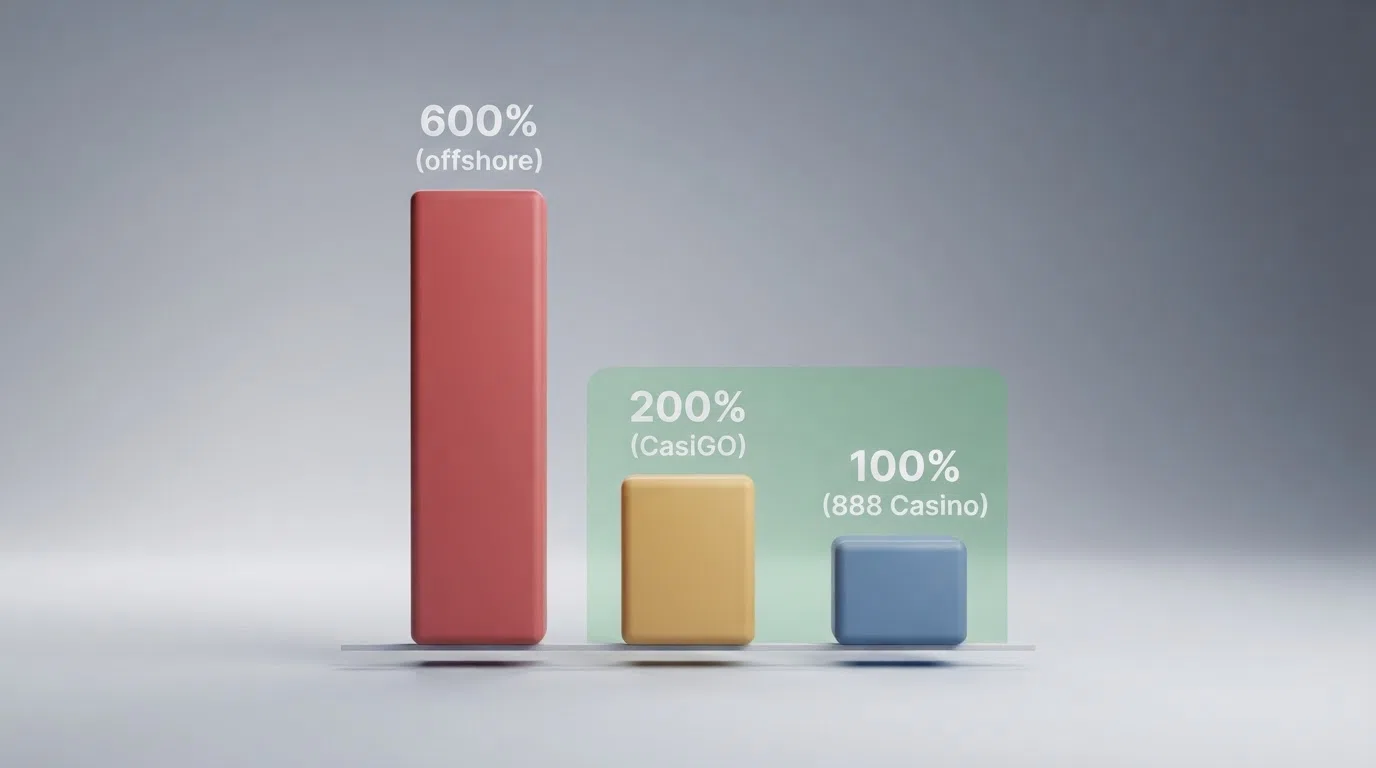
The 10× wagering cap is the lever. Under the old 40× to 60× norm, a £200 bonus at CasiGO required £8,000 to £12,000 in turnover, and the operator earned house edge across that base. Under the 10× cap, the same bonus requires only £2,000, and the operator must absorb the cost of writing the bonus across a turnover base that is a fraction of what it was. The Commission explicitly framed the cap as a harm-reduction measure — “capping the wagering requirement to ten decreases the likelihood of harm, reduces complexity and improves transparency while maintaining consumer choice” — but the side-effect is a structural shift in what a bonus is worth to the operator writing it. The 200% match survives because 200% is the highest number CasiGO’s economics can absorb; 600% cannot be written at any bonus size under the current rulebook.
What replaces the cash match is the free-spin welcome offer, and the replacement is not equivalent. A 100% deposit match and a 200-free-spin offer do not produce the same kind of playable value. The deposit match scales with the player’s bankroll — a £100 deposit at 100% becomes £200, a £500 deposit becomes £1,000. The free-spin welcome offer is fixed in count and in stake value, and the player’s deposit does not change the number of spins they receive. The shift from one to the other moves the welcome offer from a scaled product to a fixed product, and the player trades the upside of a large deposit for the predictability of a known number of spins. Whether the trade is worth it depends on the wagering burden of the offer they are comparing it to — which is the question the next section takes up.
Where Those 600% Offers Actually Come From
Seven Casino is the cleanest case study for where the 600% number lives. It is not a UK-licensed operator. Its welcome package, advertised as a 600% deposit bonus for new players over four deposits, is structured to look familiar — 10× wagering on the first deposit, eligible games listed, terms and conditions published — but the regulatory infrastructure behind it is not British. A Curaçao, Maltese or Gibraltar licence is not a substitute for a GB licence, and the Gambling Act 2005 makes operating without a GB licence to serve GB customers a criminal offence under section 33. Seven Casino’s offer is targeted at the UK player through a search term that the UK-licensed market cannot supply, and the player who accepts the offer is transacting outside every protection the British rulebook provides.
1win, another non-UKGC operator, advertises a 500% bonus plus 500 free spins, and the structural pattern is identical: headline percentage the regulated market cannot match, terms-of-service language that mimics the licensed market, no British consumer protection behind the offer. The pattern is not unusual. The 600% keyword is, in effect, an offshore keyword. Every operator that surfaces in the search results carrying that headline is an operator that the UK regulator has either declined to license, declined to renew, or never had jurisdiction over.
What a player gives up by transacting with an unlicensed operator is the full set of British consumer protections. There is no GAMSTOP — a self-exclusion at an unlicensed casino is a request to a single operator, not a block on the entire market. There is no Commission complaints route — the UKGC’s dispute resolution pathway exists only for licensees. There is no ADR — every UK-licensed operator must belong to an Alternative Dispute Resolution scheme, and an offshore operator has no such requirement. There is no statutory stake cap of £5 (or £2 for under-25s), no 2.5-second spin minimum, no mandatory deposit-limit prompt before first payment, no financial vulnerability check at £150 of net deposits in 30 days. There is no protection for the player who deposits funds and finds the operator refuses to honour a withdrawal — the British enforcement apparatus (cease-and-desist, search-engine delisting, payment-provider pressure) can disrupt the unlicensed operator’s access to GB customers, but it cannot recover a player’s lost stake.
The enforcement reality matters here. The Commission does not hold statutory ISP or DNS blocking powers — legislation has been proposed but not enacted — so the mechanism by which an unlicensed operator is kept from GB customers is disruption, not blocking. The operator can be made harder to find, harder to pay, and harder to advertise, but a player who has already deposited has no British route to recover the funds. The 600% headline is the price of admission to a market where that is the recourse available to you.
The Bonuses UK Casinos Actually Offer (and Why They Are Mostly Free Spins Now)
The UK welcome-offer landscape in 2026 is dominated by free spins, and the dominance is structural rather than incidental. The 10× wagering cap, the mixed-product ban and the Remote Gaming Duty rise have not made cash bonuses illegal, but they have made them expensive to write relative to free-spin offers, and the operator market has migrated accordingly. Nine of the ten featured UKGC-licensed operators on this page use free spins as their primary welcome offer. Only one — 888 Casino — still offers a deposit match. The shift is the most important change in the British casino market in the last decade, and it is the change that explains why a 600% deposit match no longer exists in the licensed space.
The four bonus formats a UK player will encounter in 2026 are deposit matches, free spins, no-deposit spins and ongoing retention offers. The deposit match is the legacy format — operator matches your deposit by a stated percentage up to a stated ceiling. Free spins are the dominant format — operator credits a fixed number of spins on a fixed slot at a fixed stake, with the winnings either paid as withdrawable cash or as bonus funds subject to wagering. No-deposit spins are a sub-format of free spins — credited on registration without requiring a deposit. Ongoing retention offers are the post-welcome product: reload bonuses, weekly spin drops, loyalty currency. Each format carries different terms, and the difference in terms is what decides which offer is worth taking.
What the 10× cap and the mixed-product ban reshaped is the cost side of every format. Under the old 40× to 60× wagering norm, a free-spin welcome offer was rarely the headline product because the expected loss to the operator was larger than a deposit match’s expected loss. Under the 10× cap, the expected loss on a free-spin offer is bounded by the small stake value (typically £0.10) and the limited number of spins (50 to 500), and the operator can write the offer at a known cost. The deposit match, by contrast, scales with the player’s deposit, and a 200% match on a £500 deposit costs the operator the same £600 of bonus that it cost under the old rulebook — but the operator now earns house edge across only £6,000 of turnover instead of £24,000 to £36,000. The economics inverted, and the welcome offer followed the economics.
Deposit-Match Bonuses: The Classic Welcome Offer, Now a Rarity
A deposit match works on a simple mechanic: you deposit, the operator matches the deposit by a stated percentage up to a stated ceiling, and the resulting bonus funds are subject to wagering before withdrawal. A 100% match up to £100 on a £100 deposit produces £100 in bonus funds and £200 in total playable balance. A 100% match on a £50 deposit produces £50 in bonus and £100 total. A 100% match on a £10 deposit produces £10 in bonus and £20 total. The bonus scales with the deposit; the percentage is constant.
888 Casino’s 100% deposit match up to £100 (10× wagering on selected slots, 90-day validity, £100 max cashout, £10 minimum deposit) is the sole deposit-match welcome offer in the ten-operator featured set. The CasiGO 200% up to £200 plus 50 free spins (40× wagering, 7-day expiry) sits outside the featured set but is the highest real UKGC-licensed percentage match in our August 2026 research, and it illustrates the structure of a high-percentage cash bonus under the post-reform rulebook: a much shorter validity window (7 days versus 888’s 90), a higher wagering multiplier than the post-2026 cap (CasiGO is grandfathered under earlier terms or operates under a different offer structure, but the 40× is the term that surfaces in the offer comparison), and a tighter game-restriction clause.
The shift from cash-match bonuses to free-spin-based welcome offers is best understood as a shift from a scaled product to a fixed product. A £10 player and a £500 player receive the same number of free spins on most UK welcome offers, and the player’s bankroll does not change the headline value. A £10 player and a £500 player at a deposit match receive different bonus amounts, and the headline value scales. The fixed product is cheaper for the operator to write because the cost is known in advance; the scaled product is more expensive because the cost depends on how aggressively the player maximises it. The 10× wagering cap made the scaled product disproportionately more expensive — the operator earns house edge across the wagered turnover, and the wagered turnover is now ten times the bonus rather than forty to sixty times. A scaled product under a 10× cap is an offer whose economics are tightly bounded in a way that the operator finds unappealing, and the free-spin offer is the format that survives the bounding.
Free Spins: The Bonus That Took Over UK Casino Promotions
Free spins are the dominant UK welcome offer, and the dominance is explained by the cost structure. A free-spin offer credits a fixed number of spins at a fixed stake (typically £0.10) on a fixed slot, with winnings either paid as cash or as bonus funds. The operator’s cost is the bonus funds paid out in winnings, and under the 10× cap, that cost is bounded by the small stake value and the limited spin count. The player receives a known number of spins at a known stake on a known slot, and the headline number — 100 spins, 200 spins, 500 spins — is the marketing photograph.

The free-spin counts across the featured set range from 50 to 500. Bet365 offers up to 500 free spins in 10 selections over 20 days (prizes of 5, 10, 20 or 50 spins per pick, 30-day registration window, 4 minutes between selections). 32Red offers 320 free spins on Big Bass Splash at £0.10 each. Paddy Power offers 260 free spins total (60 no-deposit plus 200 on a £10 deposit-and-wager). Sky Vegas offers 250 free spins (50 no-deposit plus 200 on a £10 deposit-and-spend). Betfred offers 200 free spins on a £10 stake. William Hill offers 200 free spins on Big Bass Splash. Ladbrokes offers 100 free spins plus 300 LadBucks on a £10 deposit-and-spend. Coral offers 100 free spins on a £10 spend. 888 Casino offers no free spins. The counts cluster between 100 and 320, with Bet365’s 500 as the high outlier and Coral’s 100 as the floor.
The critical distinction in a free-spin welcome offer is whether the winnings carry wagering. A free-spin offer with 0× wagering pays winnings as withdrawable cash, and the player can withdraw any win from the spins as soon as the spins are used. A free-spin offer with wagering — the 10× default under LCCP SR Code 5.1.1 — pays winnings as bonus funds subject to playthrough, and the player must put the winnings through the machine before withdrawal. The difference between 0× and 10× on a £50 free-spin win is the difference between £50 in cash and £50 in bonus funds that require £500 of turnover to clear. The wagering multiplier is the single most important number in any free-spin welcome offer, and the post-2026 cap has made 10× the maximum the operator can write — but zero wagering is still permitted, and the operators that have moved to 0× free spins are the operators whose welcome offers are easiest to evaluate.
No-Deposit Bonuses: Free Play Without Funding Your Account
A no-deposit bonus is a bonus credited on registration, before any qualifying deposit, and the term is sometimes used loosely. A genuine no-deposit bonus requires no payment and no qualifying stake before the bonus is credited; the player registers, verifies identity, and the bonus appears in their account. An offer that requires a £10 deposit and a £10 stake before the bonus is credited is not a no-deposit bonus, however it is marketed; it is a deposit-gated offer.
Two of the ten featured UKGC-licensed operators offer genuinely deposit-free spins. Sky Vegas credits 50 no-deposit free spins on registration with no payment required, plus 200 additional free spins on a £10 deposit-and-spend. Paddy Power credits 60 no-deposit free spins (50 on eligible slots plus 10 on Paddy’s Mansion Heist at £0.10 each) plus 200 more on a £10 deposit-and-wager. Both offers carry 0× wagering on free-spin winnings, and both are paid as withdrawable cash. The two operators are the only ones in the featured set whose welcome offer can be tested without a player committing funds, and the value of that property is real: a player can register, claim the no-deposit spins, complete the identity verification the operator is required to perform under UKGC rules, and decide whether to deposit on the basis of how the casino performs.
The scarcity of no-deposit offers is not accidental. A no-deposit offer is the most expensive welcome format for the operator to write because the player receives bonus value without committing any of their own, and the operator’s expected loss is uncapped by the player’s deposit behaviour. Under the post-2026 rulebook, the no-deposit offer survives in two forms: as a small number of free spins (50 to 60 in the featured set) and as a zero-wagering structure that limits the operator’s downside. The offer cannot legally be a no-deposit cash bonus with wagering attached, because the mixed-product ban and the bonus-design rules restrict cross-product structures, and because the cost of writing a no-deposit cash bonus is uneconomical at any meaningful size.
Wagering Requirements: The 10× Cap and What It Means for Your Winnings
The wagering requirement is the multiplier applied to bonus funds (or, in some cases, free-spin winnings) that determines the turnover required before withdrawal. A 10× wagering requirement on a £100 bonus requires £1,000 of playthrough; a 40× requirement on the same bonus requires £4,000; a 60× requirement requires £6,000. The multiplier scales the cost of converting bonus funds into withdrawable cash, and the higher the multiplier, the larger the house edge the operator can earn before the bonus clears.
The UKGC’s 10× cap, in force since 19 January 2026 under LCCP Social Responsibility Code 5.1.1, is a statutory ceiling on this multiplier for bonus funds. Before the cap, wagering requirements of 40× to 60× were the UK norm, and a £100 welcome bonus could demand £4,000 to £6,000 in turnover. After the cap, a £100 bonus demands at most £1,000 in turnover, and the operator’s room to earn house edge across the bonus is compressed to a fifth or a sixth of what it was. The cap applies to bonus funds; free-spin winnings can technically carry wagering under the same code, and the cap is the maximum the operator can write, not the minimum. Zero wagering remains legal, and most featured operators in this guide use it.
What zero wagering means in practice is that the player keeps what they win. A 0× free-spin offer with no maximum cashout cap pays the entire winnings as cash, withdrawable as soon as the spins are used. A 10× offer requires the player to playthrough the winnings before withdrawal, and the winnings are bonus funds rather than cash. The 10× cap has not changed the legal structure of zero wagering; it has changed the relative attractiveness of zero-wagering offers by making 10× the maximum alternative. Before the cap, a player comparing a 0× offer to a 40× offer was comparing two products on very different cost bases. After the cap, the same player is comparing 0× to 10× — a much smaller gap, and a much stronger case for the zero-wagering offer.
Game weighting is the second lever in the wagering structure. Slots typically contribute 100% of stake value to wagering requirements, while table games and live casino games contribute a smaller percentage (often 10% to 20%, sometimes 0%). The weighting reflects the house edge: slots have a higher house edge, so the operator earns more per unit of turnover, and 100% weighting is commercially viable. Table games have a lower house edge, so 100% weighting would let the player clear wagering faster than the operator can earn it back, and the operator restricts the contribution. Calculating your effective budget requires reading the weighting table before you make a deposit, as the difference between 100% and 10% is significant.
How to Claim a Casino Welcome Bonus in Three Steps
Claiming a welcome offer at a UK-licensed casino follows the same sequence across the ten featured operators, and the sequence is the same whether the bonus is a deposit match or a free-spin allocation. The three steps are registration, identity verification, and deposit. The bonus activates automatically at most operators, with an opt-in checkbox where the operator requires one.
The first step is registration, and it requires name, address and date of birth — the three fields every UKGC licensee must verify before any deposit or gambling, under the identity-verification rule that has been in force since 7 May 2019. There is no grace period. The operator is required to verify the player’s identity using a credit-reference agency or document upload before any funds can be deposited, and any operator that allows play before verification is in breach of its licence conditions. The verification takes seconds for most players, longer for the small minority whose details do not match the public databases the operator queries.
The second step is the first deposit, and the minimum threshold is typically £10. 32Red is the outlier in the featured set, with a £30 stake threshold. The deposit method is a debit card or bank transfer — credit cards are banned UK-wide for all remote gambling since 14 April 2020, including credit-card-funded e-wallet deposits. The bonus opt-in is a checkbox at most operators; some credit the bonus automatically once the deposit clears, and the player must opt out if they do not want it.
The third step is bonus activation, which is automatic at most featured operators. Free spins are credited immediately or in daily batches (Bet365 credits its spins in 10 selections over 20 days; other operators credit the full allocation in one tranche). The identity verification that runs before the first deposit is the same identity verification the operator is required to perform for responsible-gambling purposes, and the deposit-limit prompt that the operator must surface before first payment (from 31 October 2025) is the same prompt that activates the financial limit the player sets.
- Register with name, address and date of birth, and verify your identity before depositing.
- Make a first deposit of at least £10 (£30 at 32Red) by debit card or bank transfer, and tick the bonus opt-in if one appears.
- The bonus activates automatically, with free spins credited immediately or in tranches and a deposit match credited to your bonus balance.
Ongoing Offers: What Happens After the Welcome Bonus Ends
The welcome bonus is a one-time event. Once a player has claimed it, the welcome offer is closed, and the operator’s relationship with the player moves to retention offers: reload bonuses, weekly free-spin drops, loyalty currency, prize draws, leaderboards. The retention product is the operator’s mechanism for keeping a player active between welcome bonuses, and the terms on retention offers are often stricter than the terms on the welcome.
The 10× wagering cap applies to all bonus funds, not only welcome offers, and the mixed-product ban applies across all promotions. A reload bonus is subject to the same 10× ceiling; a weekly free-spin drop is subject to the same game-weighting rules. What changes between the welcome offer and the retention offer is usually the size. Welcome offers are designed to be the largest single allocation of bonus value a player receives; retention offers are smaller, more frequent, and often gated by a recurring deposit or a recurring stake threshold. The shift from welcome to retention is a shift from a one-time scaled product to a recurring fixed product, and the terms reflect the smaller unit size.
The specific terms of retention offers vary by operator and were not surfaced on a per-operator basis for this guide. What can be said is that every UKGC-licensed operator publishes its current promotions on its own site, that the 10× cap governs every bonus amount the operator credits, and that the mixed-product ban prohibits cross-product structures. A player comparing welcome offers to retention offers should compare the per-spin value and the wagering multiplier, not the headline size — the same arithmetic that decides the welcome offer’s real value decides the retention offer’s real value.
The Highest-Value Casino Welcome Offers Available to UK Players in 2026
The ten operators below hold active UKGC remote casino operating licences, confirmed against the Commission’s public register of licence holders (last updated 29 July 2026). The ranking is by bonus value under the post-reform rulebook, and the ranking methodology is: wagering burden first (0× ranks above 10×), free-spin volume at equal wagering second, presence of a no-deposit element third, max-cashout restrictiveness fourth, deposit threshold fifth. Two operators carry the same 0× and similar spin counts, and the no-deposit element is the tiebreaker. Two operators carry 10× wagering and lower spin counts, and they sit below the 0× group.
The table below gives every headline figure side by side. The operator write-ups that follow cover the terms that do not fit in a column: the structure of the welcome offer (whether the spins are no-deposit or deposit-gated), the validity window in days, the eligible slot titles where the operator names them, and the consumer-protection infrastructure that is identical across all ten because they are all UKGC-licensed. The ranking is by value to the player; it is not an endorsement of any operator. Every brand in the table is a real, licensed British casino; the comparison is between the offers, not between the operators as places to play.
| Casino | Welcome Offer | Wagering on Winnings | Max Cashout | Minimum Deposit or Stake | Offer Validity |
|---|---|---|---|---|---|
| Bet365 | Up to 500 free spins | 0× | No cap | £10 lifetime deposits | 30 days to claim, 20 days to use |
| Sky Vegas | 250 free spins (50 no-deposit + 200 on deposit) | 0× | No cap | £10 deposit-and-spend | 7 days |
| Paddy Power | 260 free spins (60 no-deposit + 200 on deposit) | 0× | No cap | £10 deposit-and-wager | 7 days |
| Betfred | 200 free spins | 0× | No cap | £10 stake | 7 days |
| William Hill | 200 free spins on Big Bass Splash | 10× | £30 | £10 deposit and stake | 72 hours |
| Ladbrokes | 100 free spins + 300 LadBucks | 10× | No cap | £10 deposit-and-spend | 48h accept / 7d use |
| Coral | 100 free spins | 0× | No cap | £10 spend on slots | 48h accept / 7d use |
| 888 Casino | 100% deposit match up to £100 | 10× on bonus | £100 | £10 minimum deposit | 90 days |
| 32Red | 320 free spins on Big Bass Splash | 0× | No cap | £30 stake | 48h to use / 7d to claim |
| Betway | Terms not surfaced this run | — | — | — | — |
The wagering column is the column that decides real value. Every operator in the 0× group pays free-spin winnings as withdrawable cash, and a player who wins £50 from a 0× free-spin offer at Bet365 or Sky Vegas or Paddy Power or Betfred or Coral or 32Red keeps the £50 with no further playthrough. The two operators carrying 10× wagering (William Hill and Ladbrokes) pay winnings as bonus funds, and the same £50 win requires £500 of additional turnover before it can be withdrawn. The 10× cap is the lowest ceiling the regulator permits, and it is still the difference between keeping £50 and putting £500 through the machine to keep £50.
Bet365: 500 Free Spins, Zero Wagering, No Cashout Cap
Bet365’s welcome offer is the largest free-spin allocation in the featured set, and it carries the most generous cashout terms. Up to 500 free spins are awarded in 10 selections over 20 days, with each selection revealing a prize of 5, 10, 20 or 50 spins. The selections are made at 24-hour intervals, and the player has 30 days from registration to claim the offer. A minimum of £10 in lifetime deposits is required to qualify, so the offer is not deposit-free, but the qualifying threshold is lower than the deposit threshold at any other featured operator that gates spins behind a stake.
The wagering on all free-spin winnings is zero, and no maximum cashout cap is stated in the terms. The eligible titles are Book of Horus, Curse of the Bayou, Magic Forge and Wrath of the Deep. The provider roster covers Playtech, NetEnt, Microgaming, IGT and Pragmatic Play. Bet365 holds an active UKGC remote casino licence, confirmed via trade sources citing the Commission’s register. The 500-spin headline is the ceiling, not the floor — a player whose 10 selections reveal the minimum prize of 5 spins each receives only 50 spins, and the average across a large population will sit well below 500. The 30-day claim window and the 24-hour gap between selections are the terms a player must respect to convert the offer into cash.
For a player with a £10 debit card deposit to spare, this is the offer with the highest ceiling and the lowest friction. The 0× wagering means every win is cash; the no-cap terms mean a large win from a 50-spin selection is not truncated; the 30-day window gives the player time to make the selections without rushing.
32Red: 320 Free Spins on Big Bass Splash, Wager-Free Winnings
32Red’s 320 free spins on Big Bass Splash at £0.10 each is the second-largest allocation in the featured set, and it carries the same 0× wagering and no-cap structure as the top three. The threshold is the highest among the deposit-gated offers in the set: a £30 stake on slots is required to qualify, compared to the £10 deposit-and-spend at most other operators. The £30 stake is the cost of admission, and the 320 free spins at £0.10 are the return.
The bonus must be claimed within 7 days of registration, and the spins must be used within 48 hours of claim. The provider roster is Microgaming, NetEnt, Evolution and Pragmatic Play, and 32Red operates under a Kindred/32Red Ltd UKGC remote casino licence, confirmed active via the operator’s own site. The eligible slot is named — Big Bass Splash, a Pragmatic Play title — which is unusual in a set where most operators do not name the eligible slot in their headline terms.
The higher stake threshold filters the offer toward players with a larger bankroll. A £30 stake is three times the £10 threshold at most other operators, and the player who chooses 32Red is paying more up front for a larger free-spin allocation. The 0× wagering means the spins are evaluated purely on stake × count × slot return, and the Big Bass Splash volatility and RTP determine what the spins are worth in cash. The Big Bass Splash RTP was not surfaced in the research for this guide.
Paddy Power: 260 Free Spins Including 60 With No Deposit Required
Paddy Power’s 260 free spins is the largest no-deposit allocation in the featured set, with 60 of the 260 spins available before any qualifying deposit. The structure is two-tranche: 50 no-deposit spins on eligible slots plus 10 no-deposit spins on Paddy’s Mansion Heist at £0.10 each, followed by 200 additional spins credited on a £10 deposit-and-wager. The Mansion Heist spins are awarded as a £1 bonus rather than as spins, which is an unusual structural feature.
All free-spin winnings across both tranches are paid at 0× wagering, and no maximum cashout cap is stated in the terms. The validity window is 7 days from claim. Paddy Power holds an active UKGC remote casino licence as part of the Flutter group, confirmed via the operator’s own site. The provider roster covers Playtech, NetEnt, IGT, Pragmatic Play and Blueprint. The no-deposit element — 60 spins credited on registration before any payment — is the property that makes this offer the most testable in the set: a player can register, verify identity, claim the 60 no-deposit spins, and decide whether to deposit on the basis of the result.
Sky Vegas: 250 Free Spins Including 50 That Need No Deposit
Sky Vegas’s 250 free spins are split between 50 no-deposit spins credited on registration and 200 additional spins on a £10 deposit-and-spend. Both tranches carry 0× wagering, and no maximum cashout cap is stated. The validity window is 7 days from credit. Sky Vegas holds a valid GB remote casino licence as part of the Flutter/Sky Bet group, confirmed via their official site.
The 50 no-deposit spins are genuinely deposit-free — no payment and no qualifying stake are required to claim them. The 200 deposit-gated spins require the player to deposit at least £10 and to spend that £10 on eligible slot games before the spins credit. The structure mirrors Paddy Power’s two-tranche model, and the two offers are functionally similar in testability: a player can claim the no-deposit spins, evaluate the casino on the result, and deposit at their discretion.
Betfred: 200 Free Spins, Zero Wagering and an Explicit No-Cap Promise
Betfred’s 200 free spins on a £10 stake (debit card deposit required) is the strongest cashout terms statement in the featured set. The wagering on free-spin winnings is 0×, and the terms explicitly state “no max cashout cap” — the only operator in the set to use the explicit “none” language in its cap provision. The 7-day expiry after credit is the validity window.
Betfred holds an active UKGC remote casino licence, confirmed via trade sources (Bookies.com, BritishGambler). The provider roster is Playtech, IGT, Pragmatic Play and Blueprint. The eligible slot titles were not specified in the research surfaced for this guide. The “no max cashout cap” wording is the single most important term in the offer: it is the difference between a large win being truncated at a stated ceiling and the same win being paid in full as cash.
Coral: 100 Free Spins With No Wagering on Winnings
Coral’s 100 free spins is the simplest offer in the set, and the simplicity is the offer’s strongest property. A £10 spend on slots is the qualifying action; 100 free spins are credited in return; all winnings are paid at 0× wagering with no maximum cashout cap. The validity window is 48 hours to accept and 7 days to use the spins.
Coral holds an active UKGC remote casino licence as part of the Entain group, confirmed via The Independent’s trade review (which also confirmed the 0× wagering on winnings). The provider roster covers Playtech, NetEnt, IGT, Pragmatic Play and Blueprint. The 100-spin count is the floor of the free-spin range in the set, and the £10 spend is the standard threshold. The offer is a useful benchmark for what the post-2026 UK welcome offer looks like at its most basic: a fixed number of spins, paid in cash, on a single qualifying spend.
William Hill: 200 Free Spins on Big Bass Splash With a £30 Cashout Ceiling
William Hill’s 200 free spins on Big Bass Splash at £0.10 each is a high-volume offer with the tightest terms in the set. A £10 deposit and stake is required to qualify. The wagering on free-spin winnings is 10×, which distinguishes it from the 0× free-spin operators, similar to Ladbrokes. The maximum cashout from the offer is £30, and the validity window is 72 hours from issue. The eligible slot is named (Big Bass Splash), and the Big Bass Splash RTP was not surfaced in the research for this guide.
William Hill holds an active UKGC remote casino licence, confirmed via trade sources. The provider roster features top industry studios like Playtech, NetEnt, IGT, Pragmatic Play, and Blueprint. The £30 cashout cap is the binding constraint on this offer: a player who wins £100 from the 200 spins will receive £30 and forfeit £70. The 10× wagering adds a further £1,000 of playthrough on the same win before it becomes withdrawable, were the cap not in place. Both terms compress the offer’s real value to a small fraction of its headline spin count.
Ladbrokes: 100 Free Spins Plus LadBucks, 10× Wagering on Winnings
Ladbrokes’s 100 free spins plus 300 LadBucks on a £10 deposit-and-spend is a mixed offer that pairs a free-spin allocation with a loyalty-currency allocation. The wagering on free-spin winnings is 10×, and no maximum cashout cap is stated. The validity window is 48 hours to accept and 7 days to use the spins. The spin value is £0.10 per spin.
Ladbrokes holds a valid UKGC remote casino licence as part of the Entain group. Its provider roster features Playtech, NetEnt, IGT, Pragmatic Play, and Blueprint. The LadBucks component is a loyalty currency redeemable in the operator’s loyalty shop, and its cash-equivalent value is not stated in the headline terms — a player evaluating this offer should price the LadBucks against the operator’s loyalty-shop rates before deciding whether the 100 free spins are the main event or a side bet.
888 Casino: 100% Deposit Match Up to £100 — the Last of Its Kind in the Featured Set
888 Casino’s 100% deposit match up to £100 is the only deposit-match welcome offer in the ten-operator featured set, and the rarity is itself the headline. A £10 minimum deposit is required to qualify. The wagering on bonus funds is 10× on selected slots, and the maximum cashout from the offer is £100. The validity window is 90 days from credit — the longest in the set.
888 Casino holds an active UKGC remote casino licence as part of the evoke group, confirmed via trade sources. The provider roster is NetEnt, Microgaming, Pragmatic Play, Evolution and Playtech. The 90-day validity is the offer’s strongest term, and the £100 max cashout is its tightest. A player who deposits £100 and clears the £1,000 wagering requirement will receive at most £100 in withdrawable bonus funds, regardless of the playable balance the bonus helped generate. The 100% match is a useful format for players who plan to deposit a larger amount and want the matched funds to extend their play, but the £100 cap means the offer is a £100 product whatever the deposit.
Betway: Established UK Operator With Casino Welcome Terms Under Review
Betway is a major UK-licensed casino operator with an active UKGC remote casino licence (Super Group) and a provider roster covering Microgaming, NetEnt, Pragmatic Play and Evolution. The specific terms of its current welcome offer — bonus structure, free-spin count, wagering multiplier, validity window and max cashout — were not surfaced in the operator sweep for this guide, and the operator is included on market-share presence rather than on verified bonus terms.
A player considering Betway should verify the current welcome offer directly on the operator’s own site before depositing, because the offer terms in the UK market are fluid and the featured set’s ranking is by offer value, not by operator brand. The UKGC licence is the protection; the welcome offer is the commercial product, and the two are evaluated separately.
Claiming a Casino Bonus on Your Phone: Fewer Differences Than You Would Expect
The bonus terms at every UK-licensed casino are contractually identical regardless of the platform used to claim them. The wagering multiplier, the max cashout cap, the validity window, the eligible games and the free-spin count are the same on a mobile browser, a mobile app and a desktop browser, because the same terms-and-conditions document governs all three. What differs between mobile and desktop is the navigation — the lobby layout, the deposit flow, the game-loading times — not the offer.
The practical difference between claiming on mobile and claiming on desktop is whether the player downloads an app first. Most major UK casino brands maintain dedicated iOS and Android apps, and the app is the entry point for the mobile experience. The bonus is claimable through both the app and the mobile browser, and the activation flow is the same: register, verify identity, deposit, opt in where required, receive the bonus. The download is a friction point, not a substantive difference in the offer.
Bet365, Sky Vegas, Paddy Power, William Hill, Ladbrokes, Coral, 888 Casino and Betway are confirmed or widely known to maintain dedicated casino apps. 32Red and Betfred were not specifically surfaced for app availability in the research for this guide, though both maintain active UKGC licences and both are likely to offer app access given their market position. The app-versus-browser decision is largely a preference decision — the app may load games faster, may store login credentials, and may surface promotions more prominently, but the underlying offer is identical.
Casino Apps Offering the Best Welcome Bonuses
The welcome offer is the same on the app and on the browser. A player who claims Bet365’s 500 free spins on the iOS app receives the same offer, the same wagering terms, the same 30-day claim window and the same eligible slot titles as a player who claims on the desktop browser. The terms are not platform-specific, and the operator cannot apply different conditions to the app version of the offer without publishing a separate terms document for that version.
The app-versus-browser choice is therefore a usability choice, not a value choice. The iOS and Android apps are available through the App Store and Google Play respectively; some operators also offer direct APK downloads from their own sites. The download takes a minute; the first-launch flow requires the same identity verification as the browser version; the deposit flow is the same. The advantage of the app is the persistent login and the push-notification access to retention offers; the disadvantage is the storage cost and the need to keep the app updated.
Mobile Deposits and Bonus Activation
Depositing on mobile uses the same payment methods as depositing on desktop: debit card and bank transfer. Credit cards are banned UK-wide for all remote gambling since 14 April 2020, and the ban extends to credit-card-funded e-wallet deposits. A player who attempts to deposit via credit card — directly or through PayPal funded by a credit card — will be declined at the payment-processor level, and the deposit will not credit.
The bonus opt-in flow on mobile mirrors the desktop flow: a checkbox or a toggle at the deposit screen, an automatic credit on deposit where the operator does not require opt-in, and a confirmation screen showing the credited bonus. The first deposit on a new account triggers the mandatory deposit-limit prompt that the operator is required to surface under UKGC rules from 31 October 2025. The prompt is the same on mobile and desktop, and the player can set a daily, weekly or monthly limit. A request to decrease a limit takes effect immediately; a request to increase a limit carries a 24-hour cooling-off period and a confirmation step.
The Regulation That Keeps 600% Offers Out of the UK Market
The UK Gambling Commission licenses and supervises every casino bonus offered to a GB customer, and the rulebook explains exactly why the 600% number does not appear in the licensed market. The Gambling Act 2005 establishes the three licensing objectives (preventing crime, ensuring fairness, protecting the vulnerable), and the Gambling (Licensing and Advertising) Act 2014 extended the licensing requirement to remote operators at point of consumption. A casino serving GB customers must hold a GB operating licence, and the licence conditions — published in the Licence Conditions and Codes of Practice (LCCP) — govern every aspect of the operator’s product, including the design of welcome offers.
The three regulatory changes that killed high-percentage deposit matches between January and April 2026 are the 10× wagering cap, the mixed-product ban and the Remote Gaming Duty rise to 40%. Each change is a separate lever, and the three levers together made the 600% match economically impossible inside the licensed market. The 10× cap compressed the house edge the operator can earn on bonus funds; the mixed-product ban removed the cross-selling revenue that used to subsidise headline percentages; the duty rise reduced the operator’s after-tax margin on every pound of gross gambling yield. The combination is the reason a 600% match does not exist in the UK regulated space, and the combination is the reason every offer that carries that number sits outside the British rulebook.
How the UK Gambling Commission Licenses and Supervises Casino Bonuses
The Gambling Commission is an executive non-departmental public body sponsored by the Department for Culture, Media and Sport, and it is the single statutory regulator for commercial gambling in Great Britain. Its powers derive from the Gambling Act 2005, and its operating remit covers the licensing objectives, the licence conditions and the enforcement actions available against non-compliant operators. The Commission does not regulate Northern Ireland, which runs on separate, older law.
Bonus design sits under LCCP Social Responsibility Code 5.1.1, which sets the maximum wagering multiplier (10×), bans mixed-product promotional offers, governs the transparency of bonus terms, and establishes the player-protection framework that surrounds every welcome offer. The code applies to every UKGC licensee, and the operator’s compliance team is required to ensure that every published bonus is structured within the code. A 600% deposit match at 40× wagering with a cross-product structure (a casino bonus contingent on the player also placing a sports bet) would breach at least three provisions of the code, and no licensed operator would be able to publish it.
The statutory levy, in force from 6 April 2025, is a separate funding mechanism that sits alongside Remote Gaming Duty. The levy is set at 1.1% of gross gambling yield for remote casino licences, and it funds the treatment, research and prevention infrastructure that supports the licensing objectives. The levy is paid by the operator, not the player, and it is separate from the duty. The combined effect of the levy and the duty is the operator’s tax burden, and the tax burden is the variable that decides what bonus economics the operator can sustain.
The 10× Wagering Cap, the Mixed-Product Ban and the End of High-Percentage Matches
The 10× wagering cap took effect on 19 January 2026 under LCCP SR Code 5.1.1, and the cap applies to all bonus funds. A £600 bonus — the bonus size a £10 deposit would attract under a 60× wagering offer — generates at most £6,000 in required turnover under the cap, compared to the £24,000 to £36,000 that would have been required under the old 40× to 60× norm. The house edge is earned across the turnover, and the smaller the turnover base, the smaller the operator’s expected revenue from the bonus. The cap compresses the operator’s bonus economics across every bonus size, and the compression is most severe at the largest bonus sizes — the very place the 600% match would sit.
The mixed-product ban took effect on the same date, under the same code. A mixed-product promotional offer conditions a bonus on the customer playing a different product type — a casino bonus that requires the player to place a sports bet, for example. The four product types are bingo, lottery, casino and betting, and the ban prohibits cross-product conditioning. The ban removes the cross-selling revenue that used to subsidise headline percentages, and the removal is a separate compression of the operator’s bonus economics. A 200% casino bonus that historically came with a sports-bet condition no longer has that condition available, and the operator cannot extract the same marketing value from the player.
The Remote Gaming Duty rose to 40% on 1 April 2026, up from 21%. The duty is the operator’s tax on gross gambling yield (the total amount wagered minus the total amount paid out in winnings), and the rise means the operator keeps 60p of every £1 of GGY instead of 79p. A welcome bonus is a marketing expense funded out of after-tax GGY, and the duty rise means every pound of bonus spend now costs the operator more in pre-tax revenue. The duty rise does not directly prohibit high-percentage matches, but it prices them out of commercial viability, and the result is the same as a prohibition for the purposes of the licensed market.
The Commission’s published rationale for the 10× cap is that it “decreases the likelihood of harm, reduces complexity and improves transparency while maintaining consumer choice.” The Commission does not say the cap was designed to end high-percentage matches; the cap is a consumer-protection measure. The economic consequence is that high-percentage matches are no longer commercially viable, and the consequence is the result of the cap working as designed.
Offshore Casinos Offering 600% Bonuses: What You Lose
Seven Casino’s 600% welcome package, spread over four deposits with 10× wagering on the first tranche, is the case study for what the offshore product looks like in practice. The percentage is high. The wagering on the first tranche is at the UK cap, suggesting the operator has imported the 10× structure as a marketing term. The remaining terms — game weighting, max cashout, eligible games, validity windows — are not British and are not enforced by the Commission. The player who claims the offer is transacting outside the British rulebook, and the rulebook’s protections do not apply.
The protections in question are not abstract. Every UKGC-licensed operator must offer GAMSTOP, the mandatory multi-operator self-exclusion scheme. The Commission has powers to investigate complaints, order refunds, revoke licences and pursue criminal prosecution under section 33 of the Gambling Act 2005. Every UKGC-licensed operator must join an Alternative Dispute Resolution (ADR) scheme that the Commission has approved, and a player who is unable to resolve a complaint with the operator directly can escalate to the ADR provider at no cost. None of these mechanisms exist for an unlicensed operator, and a player whose funds are withheld by an offshore casino has no British route to recover them.
The table below sets out the protection gap side by side. The column structure is fixed: every protection listed is mandatory at every UKGC-licensed operator and absent at every unlicensed operator. The list is not exhaustive of the British regulatory framework — it covers the player-facing mechanisms a reader is most likely to encounter and most likely to need.
| Protection | UKGC-Licensed Casino | Offshore Operator (No UK Licence) |
|---|---|---|
| GAMSTOP self-exclusion | Mandatory since 31 March 2020 | Not available |
| Statutory stake limit (£5/£2 by age) | Enforced under SI 2025/215 | Not enforced |
| Mandatory deposit-limit prompt before first deposit | Required from 31 October 2025 | Not required |
| Financial vulnerability check at £150 net deposits | Required from 28 February 2025 | Not required |
| Identity verification before first deposit | Required since 7 May 2019 | Not required |
| Credit card ban (including e-wallet-funded credit) | Enforced under LCCP 6.1.2 | Not enforced |
| Auto-play ban and 2.5s spin minimum | Enforced under RTS | Not enforced |
| ADR scheme membership | Mandatory for every UKGC licensee | Not required |
| Commission complaints route | Available for any licensed operator | Not available |
| Reverse-withdrawal ban | Enforced under RTS | Not enforced |
| Player fund protection rules | Enforced under LCCP | Not enforced |
The table is a list of what a player gives up by claiming a 600% bonus from an unlicensed operator, and the list is the same for every offshore brand. The 600% headline is the price of admission, and the price is paid in protections a player may not need until they do. The enforcement reality is that the Commission uses cease-and-desist notices, search-engine delisting referrals, payment-provider pressure and domain-registrar action to disrupt unlicensed operators, but the Commission does not currently hold statutory ISP or DNS blocking powers, and a player who has already deposited cannot recover the funds through any British mechanism.
Player Protections That Unlicensed Operators Cannot Offer
GAMSTOP is the single most important protection the British market provides, and it is the one most directly relevant to a player who is considering a high-percentage offer. GAMSTOP is a national multi-operator online self-exclusion scheme, and since 31 March 2020 it has been a mandatory condition of every UK Gambling Commission online operating licence. A player who registers with GAMSTOP is blocked from every UKGC-licensed gambling site for their chosen exclusion period: six months, one year, five years, or five years with auto-renewal. The exclusion cannot be cancelled early, and the player cannot reverse the registration within the chosen period.
GAMSTOP does not cover offshore operators. A player who has self-excluded through GAMSTOP and then attempts to deposit at Seven Casino or 1win will not be blocked, because those operators are not connected to the GAMSTOP system. The self-exclusion is British; the offshore operator is not British; the two systems do not talk to each other. The implication is that a player who uses GAMSTOP as a harm-reduction tool and then claims a 600% bonus from an offshore operator has, in effect, found a way around their own self-exclusion — and the offshore operator has no obligation to refuse the deposit or to enforce the exclusion.
The other mandatory protections fill the same role in different ways. The financial vulnerability check at £150 of net deposits in a rolling 30-day period (from 28 February 2025) uses publicly available data — County Court Judgments, bankruptcy orders, Individual Voluntary Arrangements, Debt Relief Orders — to flag players who may be experiencing financial distress, and the operator is required to intervene when the check fires. The mandatory deposit-limit prompt before first payment (from 31 October 2025) is the operator’s tool for surfacing the player’s own limit-setting behaviour, and a request to decrease a limit takes effect immediately. Identity verification before first deposit (since 7 May 2019) is the operator’s first interaction with the player, and it is the first opportunity to apply the responsible-gambling framework. None of these mechanisms is present at an unlicensed operator, and the absence is not incidental — the offshore operator is competing on price (the 600% number), and the British protection framework is the cost the offshore operator does not have to pay.
The help infrastructure that supports the protection framework is also British. GamCare’s National Gambling Helpline is available 24 hours a day, 7 days a week, free of charge, on 0808 8020 133 (England and Scotland) and 0808 2819 265 (Wales), with live chat at gamcare.org.uk. NHS gambling harm clinics operate in England, Scotland and Wales. Gamban, the gambling-blocking software, is free for UK residents. The TalkBanStop partnership (GamCare, GAMSTOP and Gamban) formally concluded in March 2026 as the services transition to statutory levy commissioning, and the three individual services continue independently. None of this help infrastructure is accessible through an offshore operator’s platform, because the offshore operator is not part of the British network.
When a Big Bonus Becomes a Bigger Risk: Safer Play With High-Percentage Offers
A high-percentage deposit match is engineered to encourage a larger first deposit, and the engineering is the offer’s commercial logic. The bigger the match, the more a player feels they are leaving money on the table by depositing less than the maximum the offer will match. The psychology is well-understood, and the British regulator’s response is a series of mandatory player protections designed to interrupt the cycle at the points where it does the most harm. The 10× cap is one such interruption. The deposit-limit prompt is another. The £5 stake cap is a third. GAMSTOP is the safety net for the player who decides the cycle is already out of control.
The prevalence data that grounds these protections is the Gambling Commission’s quarterly and annual survey work. The problem gambling rate (PGSI 8+, the clinical threshold for problem gambling) in Great Britain was 2.4% in the third annual GSGB report (2025 data), described as stable over the survey’s three years — 2.5% in Year 1 (2023) and 2.7% in Year 2 (2024). The figure is the share of adults classified as problem gamblers, and it is the headline number the Commission uses to track the population-level health of the gambling market. The stability of the figure across three survey years is the empirical basis for arguing that the post-2022 regulatory tightening has not produced a population-level decline in problem-gambling prevalence — the rate was already where it is before the tightening, and it remains where it is afterwards.
GambleAware’s Annual Treatment and Support Survey found almost 1 in 3 adults (30%) experiencing any level of gambling problems want treatment, support or advice, up from 17% in 2020. The gap between the share who experience problems and the share who seek help is the population the help infrastructure is designed to reach, and the gap is the reason the helpline, the clinics and the blocking software are publicised at every licensed operator. The 30% figure is the demand side of the safer-gambling system, and the regulatory protections are the supply side.
Bonus Chasing: Why High-Percentage Offers Encourage Bigger Deposits
The mechanism by which a 600% match encourages a larger deposit is the size of the bonus relative to the deposit. A 100% match turns £10 into £20; the player feels they are getting their money’s worth at any deposit size. A 600% match turns £10 into £70; a player who deposits only £10 feels they are missing out on £50 of bonus funds. The pressure to maximise the deposit is engineered by the percentage, and the engineering is the marketing photograph. The player who deposits £100 at a 600% match receives £700 in playable balance, and the gap between the £700 and the £70 is the difference between a windfall and a missed opportunity in the player’s mind.
The British regulator’s response to this engineering is a layered set of interruptions. The deposit-limit prompt before first payment (mandatory from 31 October 2025) is the operator’s first opportunity to surface the limit-setting tool, and the player who sets a limit of £50 cannot deposit the £100 the offer is designed to attract. The £5 stake cap for players aged 25 and over (and £2 for 18 to 24, in force from 9 April 2025 and 21 May 2025 respectively under SI 2025/215) is the ceiling on how fast the bonus funds can be turned over, and the ceiling slows the cycle mechanically. The financial vulnerability check at £150 of net deposits in a rolling 30-day period (from 28 February 2025) is the operator’s opportunity to intervene when the player’s deposit behaviour suggests financial distress, and the operator is required to act on the check’s result. The 2.5-second spin minimum and the auto-play ban (in force since 31 October 2021) slow the rate of play, and the slowing is itself a harm-reduction lever.
The post-2026 rulebook does not prohibit high-percentage offers outright. The 10× cap and the mixed-product ban are the regulatory levers, and the levers work by changing the offer’s economics, not by banning the offer. The economics change is what makes the 600% offer uneconomical inside the licensed market, and the uneconomical offer is the offer the operator does not write.
Deposit Limits, Reality Checks and the Tools Every UK Player Has
Every UKGC-licensed operator must give the same set of safer-gambling controls, and the controls are the same across all ten operators in the featured set. The mandatory deposit-limit prompt before first payment is the first tool, and the prompt requires the player to set a financial limit before any funds can be deposited. The limit can be a daily, weekly or monthly cap, and a request to decrease the limit takes effect immediately. A request to increase the limit carries a 24-hour cooling-off period and a confirmation step, and the cooling-off period is the operator’s opportunity to remind the player of the limit-setting tool.
Reality checks are the second tool, and they interrupt play at set intervals to show the player how long they have been playing and how much they have spent. The intervals are set by the operator, and the player can adjust them within the operator’s permitted range. The auto-play ban (in force since 31 October 2021) is the third tool, and the ban prohibits the operator from offering an auto-spin feature on any slot. The player must press the spin button for every game cycle, and the pressing is itself a friction point that interrupts the rapid-play pattern auto-play was designed to enable.
The £5 stake cap on online slots (25+) and the £2 cap (18 to 24) are the hard statutory limits, imposed by SI 2025/215. The cap is per game cycle, not per session, and the operator is required to enforce the cap at the slot level. Two adults at the same casino can face different maximum bets on the same slot, and the difference is age-based. The credit card ban (since 14 April 2020 under LCCP 6.1.2) blocks all credit-card-funded remote gambling, including e-wallet deposits where the e-wallet is funded by a credit card. The statutory levy (1.1% of GGY for remote casino licences, from 6 April 2025) funds the treatment and research infrastructure through operator GGY, and the levy is paid by the operator rather than the player.
The combination of the prompt, the reality check, the auto-play ban, the stake cap and the credit card ban is the British player-protection system, and the system is mandatory for every UKGC licensee. Self-exclusion is straightforward through GAMSTOP, ensuring your request covers the entire licensed market instantly.
GAMSTOP and Self-Exclusion: How to Step Away From Every UK Casino at Once
GAMSTOP is the single most effective harm-reduction tool in the British system, and it is the one tool that operates at the market level rather than the operator level. A player who registers with GAMSTOP at gamstop.co.uk is blocked from every UKGC-licensed gambling site for their chosen exclusion period, and the block applies to every operator that holds a GB online operating licence. The exclusion periods are six months, one year, five years, or five years with auto-renewal. The exclusion cannot be cancelled early, and the player cannot reverse the registration within the chosen period.
GAMSTOP has been a mandatory condition of every UK Gambling Commission online operating licence since 31 March 2020, and the integration is automatic: a player who self-excludes is flagged in the GAMSTOP database, and every UKGC-licensed operator is required to check the database before allowing a new account registration or a returning-player login. An operator that fails to check the database is in breach of its licence conditions, and the breach is enforceable by the Commission. The scheme is free for the player, and registration takes a few minutes.
The limitation of GAMSTOP is that it does not cover offshore operators. A player who self-excludes through GAMSTOP and then attempts to deposit at Seven Casino or 1win will not be blocked, because those operators are not connected to the GAMSTOP system. The scheme is British; the offshore operator is not British; the two systems do not talk to each other. The implication is that GAMSTOP works as a market-level exclusion only inside the British market, and the British market is exactly the market that does not offer the 600% bonus. A player who has self-excluded to escape high-percentage bonus chasing and then claims a 600% offer from an offshore operator has, in effect, found a way around their own self-exclusion.
Gamban is a complementary tool — a piece of blocking software that prevents a device from connecting to gambling sites. Gamban is free for UK residents, and the software runs at the device level rather than the operator level, which means it can block access to offshore operators as well as UKGC-licensed ones. The combination of GAMSTOP (operator-level) and Gamban (device-level) is the strongest self-exclusion setup available to a UK player, and the TalkBanStop partnership (the umbrella scheme that combined GamCare, GAMSTOP and Gamban) concluded in March 2026 as the three services transition to statutory levy commissioning. The three services continue to operate independently, and a player can register with each of them separately.
Where to Get Help: Helplines, Clinics and Blocking Software
Help is free, available 24 hours a day, and structured around British services. GamCare’s National Gambling Helpline is 0808 8020 133 for England and Scotland and 0808 2819 265 for Wales, with live chat at gamcare.org.uk. The helpline is open every day of the year, and the call is free from any UK landline or mobile. GamCare’s advisers can signpost to local treatment, set up a self-exclusion plan and provide ongoing support.
NHS gambling harm clinics operate in England, Scotland and Wales, and the clinics offer cognitive-behavioural therapy and other evidence-based treatments for problem gambling. Referral is through a GP or through GamCare, and waiting times vary by region. The clinics are part of the NHS, and treatment is free at the point of use. Gamban is free for UK residents and blocks gambling sites at the device level, working alongside GAMSTOP for layered protection.
The help infrastructure exists because the population it serves is large. The 2.4% PGSI 8+ prevalence figure (2025 data) represents hundreds of thousands of adults in Great Britain, and the 30% share of adults experiencing any level of gambling problems who want treatment (up from 17% in 2020) is the demand the infrastructure is designed to meet. The infrastructure is free, confidential, and independent of the gambling industry — the statutory levy funds the services, and the levy is paid by operators rather than by players.
How We Selected and Ranked the Casinos on This Page
The ten operators on this page were sourced from the UK Gambling Commission’s public register of licence holders (last updated 29 July 2026), cross-referenced against operator own-site imprints and non-affiliate trade sources (Bookies.com, BritishGambler, The Independent). Every operator in the featured set holds an active UKGC remote casino operating licence, and the licence status was confirmed for each operator from at least one non-affiliate signal — the operator’s own site imprint or a trade review citing the Commission’s register.
The ranking criteria, in order of weight, are: wagering burden (a 0× free-spin offer ranks above a 10× offer, because 0× pays winnings as cash and 10× pays winnings as bonus funds), free-spin volume at equal wagering (a higher spin count ranks higher, because the spin count is the fixed product the offer delivers), presence of a no-deposit element (an offer with a no-deposit tranche ranks above one without, because the no-deposit element is the testable part of the offer), max-cashout restrictiveness (a no-cap offer ranks above a capped offer, because the cap truncates winnings the player has earned), and minimum deposit or stake threshold (a lower threshold ranks above a higher threshold, because the lower threshold widens the offer’s accessibility). CasiGO’s 200% deposit match sits outside the featured set but is the external benchmark for the highest real UKGC-licensed percentage match in the August 2026 SERPs.
Operators excluded from the featured set are: operators not holding an active UKGC remote casino operating licence, offshore brands that target the UK market without a GB licence, and brands whose welcome terms could not be verified against at least one non-affiliate source within the research window. Bet365, Sky Vegas, Paddy Power, Betfred, William Hill, Ladbrokes, Coral, 888 Casino, 32Red and Betway are the ten operators that met the inclusion criteria. Betway’s specific welcome-offer terms were not surfaced within the research window, and the operator is included on market-share presence rather than on verified bonus terms.
The ranking is by offer value, not by operator brand. Two operators with the same wagering multiplier and similar spin counts are ranked by the no-deposit element (the offer with a no-deposit tranche ranks higher), the max-cashout cap (no cap ranks higher than a cap), and the validity window (a longer window ranks higher than a shorter one). The ranking is a comparison of the offers as they stand at the research date, and the comparison is not a recommendation of any operator as a place to play.
What to Do With a 600% Bonus Search: The Bonus Worth Claiming Is the One With Honest Terms
The central finding of this page is the 600% gap. No UKGC-licensed casino in 2026 offers a 600% deposit match, and every offer that carries the 600% number sits outside British consumer protection. The 200% match at CasiGO is the highest real percentage from a licensed operator, and the 10× wagering cap makes even the 200% match commercially marginal. The free-spin welcome offer is the format that has displaced the deposit match in the UK licensed market, and the displacement is the consequence of the post-2026 rulebook working as designed.
The metric that actually determines welcome-offer value is not the headline percentage. A 0× wagering free-spin offer with no max cashout cap returns more real money than a 600% match buried under 40× wagering, because the wagering multiplier is the variable that scales the cost of converting bonus funds into withdrawable cash. The 10× cap is the lowest ceiling the regulator permits, and the cap is still the difference between keeping a win and putting the win through the machine to keep it. A no-cap free-spin offer at 0× is the offer with the cleanest value proposition, and the offer with the cleanest value proposition is the offer whose terms are easiest to evaluate before depositing.
The practical takeaway is to compare the wagering column and the cashout cap, and to pick the offer that lets the player keep what they win. A 0× offer with no cap pays winnings in cash; a 10× offer with a cap pays winnings as bonus funds subject to a ceiling. The difference between the two is the difference between a cash product and a marketing product, and the difference is the one that matters once the welcome offer is claimed. The 600% number is a marketing product, and the 600% number is the one a player should be most cautious about.
The action is to stay inside the UKGC-licensed market, where every protection on this page applies: GAMSTOP, the deposit-limit prompt, the financial vulnerability check, the ADR scheme, the Commission complaints route and the British consumer redress. The 600% bonus is available only outside that market, and the cost of claiming it is the loss of every protection the licensed market provides. Prioritising these protections allows you to claim an offer at a licensed casino with full regulatory recourse; seeking the 600% headline means operating without these safeguards.
Frequently Asked Questions About Casino Bonuses in the UK
Do I have to pay tax on casino bonus winnings in the UK?
No. Gambling winnings in the UK are not subject to income tax or capital gains tax for the player; the player-side duty was abolished in 2001. The tax falls on the operator as Remote Gaming Duty (40% from 1 April 2026) and the statutory levy (1.1% of GGY for remote casino licences from 6 April 2025). A UK player who wins £1,000 from a free-spin welcome offer at a UK-licensed casino keeps the £1,000 in full, less any wagering the offer’s terms require. The same is not true in every jurisdiction, but it is the position in Great Britain.
How does the £5 online slots stake limit affect clearing a bonus?
The £5 maximum stake per game cycle for players aged 25 and over (in force from 9 April 2025 under SI 2025/215) is a hard ceiling on the stake a player can place on a single spin. A player who has a £100 bonus to clear at 10× wagering has £1,000 of required turnover, and at the £5 maximum stake that turnover represents 200 spins. At the 2.5-second spin minimum, 200 spins take 500 seconds, or roughly 17 minutes of continuous play. The cap does not change the wagering multiplier or the turnover required; it changes the rate at which the turnover can be generated, and the change is a deliberate slowing mechanism. Players aged 18 to 24 face a £2 stake cap (in force from 21 May 2025), and the same £1,000 of turnover represents 500 spins and roughly 42 minutes of continuous play at the lower cap.
Can I use a credit card to deposit and claim a casino bonus?
No. Credit cards are banned for all remote gambling in the UK since 14 April 2020 under LCCP licence condition 6.1.2, and the ban extends to credit-card-funded e-wallet deposits. A player who attempts to deposit via credit card — directly or through PayPal funded by a credit card — will be declined at the payment-processor level, and the deposit will not credit. The ban covers all remote gambling products (casino, betting, bingo, lottery) and is enforced at the payment-processor level by the card issuers and the e-wallet providers. Debit cards and bank transfers are the standard deposit methods at every UKGC-licensed operator.
What is the difference between wagering on bonus cash and wagering on free-spin winnings?
Wagering on bonus cash applies to the matched deposit funds the operator credits to a player’s bonus balance (for example, the £100 in bonus funds from an 888 Casino 100% deposit match). Wagering on free-spin winnings applies to the cash value of any winnings generated by free spins credited under a welcome offer. The 10× cap under LCCP SR Code 5.1.1 applies to both forms, and zero wagering is permitted on either. The distinction matters because the two forms are treated as separate balances in the operator’s account system, and a player clearing one form does not automatically clear the other. A 0× free-spin welcome offer at Bet365 or Sky Vegas pays free-spin winnings as cash with no further playthrough; a 10× free-spin welcome offer at William Hill or Ladbrokes pays free-spin winnings as bonus funds subject to playthrough before withdrawal.
Are there any UK-licensed casinos with no wagering requirements on their welcome offer?
Yes. Six of the ten featured operators on this page offer 0× wagering on free-spin winnings: Bet365 (up to 500 free spins), Sky Vegas (250 free spins), Paddy Power (260 free spins), Betfred (200 free spins), Coral (100 free spins) and 32Red (320 free spins). Each of these offers pays free-spin winnings as withdrawable cash with no further playthrough required, and Betfred is the only operator in the set to explicitly state “no max cashout cap” in its terms. 888 Casino’s 100% deposit match carries 10× wagering on the bonus funds (the maximum the regulator permits), and William Hill and Ladbrokes carry 10× wagering on free-spin winnings. The 0× offers are the cleanest value proposition in the UK welcome-offer market, and the 0× structure is the post-2026 high-water mark for player-friendly terms.
Mobile vs Desktop: Does the Platform Change Your Bonus?
The bonus value, wagering multiplier, max cashout cap, validity window and eligible games are platform-agnostic. The same T&Cs govern both. Game availability on mobile is occasionally narrower than on desktop — some older slots lack mobile-optimised versions, and the operator’s mobile lobby may carry a smaller subset of the full game library. The welcome-offer eligible titles at the featured operators are all mobile-optimised, and the headline offer can be claimed and cleared in full on a phone.
The £5 stake cap for players aged 25 and over (and £2 for players aged 18 to 24) applies equally on mobile and desktop, as does the 2.5-second spin minimum and the auto-play ban. The regulatory floor is the same on every platform, and the operator cannot offer different conditions on the mobile version of a slot. The only material platform difference is the screen size and the input method — a phone is harder to navigate for long sessions, and a desktop is harder to use on the move. Neither difference changes the offer.
Promotions – fastestpayout-casinos-uk
Content created by the «fastestpayout-casinos-uk» team