
Slot Tournaments in the UK: The Rules, the Prizes, the Casinos Worth Your Time
 Available in GB
A slot tournament is, on the surface, a simple thing. You play a slot. You climb a leaderboard. You either win a prize or you do not. The format has been around for decades, but the UK market in 2026 is shaped by rules that have no real equivalent anywhere else a UK player can legally log on — stake ceilings tied to age, a hard floor on spin speed, a cap on the wagering a casino can attach to a bonus, and a self-exclusion register every licensed operator must honour. Those rules change what a tournament is worth, who it suits, and what it actually costs a player who decides to enter one.
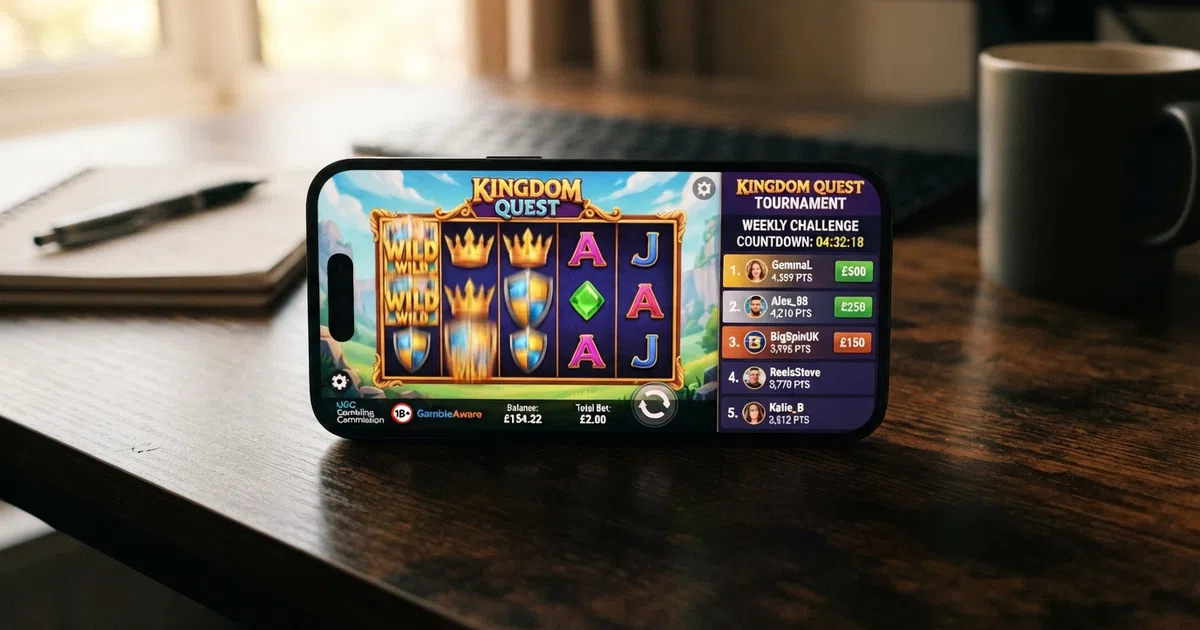
This page is built for a UK player deciding whether to enter a tournament today, which one, and at which casino. It runs through how scoring works and why the £5 stake cap matters more in a timed competition than it does in casual play. It names the ten GB-licensed operators worth comparing, the freeroll circuits where the entry fee is zero, and the rules that govern what you can keep when you win. And it is honest about what the prize terms cost — because in a market where the worst-case wagering is 10× and the best case is zero, the spread between offers is real money, not marketing copy.
*Current as of September 8, 2026. Licence status verified against the Gambling Commission’s public register of operating licence holders.*
What Slot Tournaments Actually Are — and How They Decide a Winner
A slot tournament is a timed or scored competition on slot games. Players pay an entry fee or qualify for free entry, play a specified slot or set of slots, and accumulate points, credits or win-multipliers that rank them against every other entrant. The leaderboard settles at a fixed deadline, and prizes are paid to a defined number of top finishers.
Casual slot play and tournament play look superficially similar — a player sits down, spins a slot, and either wins or loses on each spin. The structural differences matter more than the visual ones. A tournament has a fixed window. A tournament has a leaderboard. A tournament has a prize table, and the slot session is the means by which a player climbs that table rather than the end in itself. The competitive framing changes the psychology of the session: every spin is no longer an independent bet, it is a step in a race, and the position a player occupies at any given minute is the only score that matters.
The UK player encounters a specific tournament environment shaped by the Gambling Commission’s game-design rules. Auto-play has been banned since 31 October 2021. Every spin must be triggered manually. The minimum time between spins is 2.5 seconds — a hard floor that software cannot defeat. Features designed to speed up play — turbo mode, quick-spin, the option to skip reel animations — are all prohibited. And the practice of dressing up a loss as a win with sound effects and celebratory imagery has been banned along with reverse withdrawals. The result is that a UK tournament session is, by regulation, slower and more honest than the same format played under an offshore licence, and that difference shows up directly in how a player has to think about maximising their spin count.
The Tournament Format Spectrum: Leaderboards, Knockouts and Timed Races
The dominant format in the UK is the scheduled leaderboard tournament. Players enter a tournament window, play the eligible slot or slots, and accumulate a score that ranks them against every other player who has entered. At the close of the window, prizes are paid to the top finishers according to a published prize table. This is the format that drives most of the UK tournament market, including Coral’s daily programme, Galabingo’s Free-To-Play schedule, and the network tournaments run by Pragmatic Play and other providers.
Head-to-head formats exist as a smaller category. Duelz runs direct duels between two players on the same slot, with a new duel starting every fifteen minutes and a daily prize pot of £1,500. The format removes the leaderboard entirely and substitutes a two-player matchup, which changes the psychological shape of the session: instead of climbing a hundred-player board, a player is chasing one opponent’s score. The competitive pressure is more concentrated, and the prize pool is distributed across a far smaller field.
Network provider tournaments are the largest cross-casino format in the industry. Pragmatic Play’s Drops & Wins — currently in Season 7, running from 4 March 2026 to 3 March 2027 — distributes a total prize pool of €/£25,000,000 across more than 5,000,000 individual prizes, with daily tournaments offering 500 cash prizes from a £20,000 expected daily pool and Weekly Wheel Drops offering a £350,000 expected pool. Drops & Wins runs at every UK-licensed casino that hosts Pragmatic Play slots, which makes it the format a UK player is most likely to encounter regardless of which operator they choose.
VIP and invite-only tournaments form a fourth category, restricted to players who have reached specific loyalty tiers or who have been individually invited by an operator. These tournaments typically feature higher entry fees, larger prize pools and smaller fields. They are not the focus of this page because the access criteria put them beyond most players’ reach.
How to Enter a UK Slot Tournament: Fees, Free Entry and Qualification Paths
There are four routes into a UK slot tournament, and they map onto different operator models.
Entry-fee tournaments require a buy-in. The fee funds the prize pool, often with an operator contribution on top. Buy-in tournaments are uncommon among the featured operators on this page — most UK tournament programmes lean towards free or quasi-free entry.
Free-to-play and freeroll tournaments charge no entry fee. Galabingo’s Free-To-Play tournaments run daily from 1 May 2026 until further notice with no spend requirement, and Tombola arcade’s Prize League runs 28 free tournaments every day across three time blocks (11am–1pm, 3pm–5pm, 7pm–10pm), each lasting 15 minutes with guaranteed cash prizes. These are the formats most accessible to casual players.
Automatic qualification runs through real-money play on eligible slots. Drops & Wins is the clearest example: a player opts in, plays any eligible Pragmatic Play slot with a minimum bet of 15p per spin, and their first 5,000 spins per day count towards the leaderboard. No separate entry action is required.
Loyalty-point and coin-to-play gateways substitute accumulated loyalty currency for entry cash. Gala Bingo’s Point-To-Play tournaments let players redeem Gala Points earned through regular play. Coral runs Coin-to-Play tournaments that draw on a player’s accumulated Coin balance. These routes tie tournament access to prior play, which is a softer form of qualification than a buy-in but a harder one than a pure freeroll.
The Virgin Games Slot Masters model sits between freeroll and qualified entry: it is free to enter and carries no entry fee, but it requires a minimum £10 lifetime deposit to access. That deposit threshold is the closest most UKGC licensees come to “no deposit”, because the age verification and AML obligations that come with a remote casino operating licence make a true zero-registration tournament effectively impossible at a licensed operator.
The Leaderboard Equation: Why Your Stake Size Matters Less Than You Think
Tournament scoring falls into three families, and the family in use changes what a player should optimise for.
Points-based scoring rewards the volume of play. Each spin earns a fixed number of points regardless of outcome. The player who spins the most wins. This format favours players with time and stamina — high rollers have no automatic advantage beyond the marginal speed of placing larger bets, and a low-stakes player who plays longer accumulates points at roughly the same rate.
Win-multiplier scoring divides the win amount by the stake. A 15p spin returning £1 scores 6.67. A £5 spin returning £1 also scores 0.20. The multiplier system levels the field between stake sizes — a player staking 15p per spin competes on equal terms with a player staking £5 per spin, because what matters is the ratio of return to stake, not the absolute return.
Credits-based scoring gives every entrant a fixed starting balance and tracks net position. This is the rarest format in the UK and tends to appear in short, fast formats rather than multi-day leaderboards.
Drops & Wins uses win-multiplier scoring, which means the UK stake cap at £5 (or £2 for players aged 18 to 24) matters less than a player might assume. A £5 spin cannot buy a five-times advantage over a 15p spin under multiplier scoring — both spins compete on the same metric. The stake cap does narrow the gap between high and low rollers, but it does so as a secondary effect: the primary equaliser is the scoring system itself.
A player watching the leaderboard during a tournament session sees their current rank, their running score, the time remaining in the window, and the prizes within reach at their current position. The leaderboard refresh rate varies across operators and platforms. On mobile, the refresh can lag enough during a timed tournament that a player should treat their in-game score, not their position on the board, as the reliable indicator.
How to Win a Slot Tournament: Strategy Under UK Game-Design Rules
The competitive strategies that work in a UK tournament session are constrained by the game-design rules in a way that offshore tournament play is not. Auto-play is banned. Spin speed is floored at 2.5 seconds. Speed-up features do not exist in any UK-licensed slot. So a UK player cannot maximise their spin count by configuring software — they can only maximise it by sitting down and tapping.
At a theoretical maximum, a player manually tapping at 2.5-second intervals achieves 24 spins per minute, or 360 spins in a 15-minute session. That number is an upper bound, not a realistic target. Fatigue sets in well before the theoretical maximum, the slot’s animation length between spins often exceeds the 2.5-second floor (the floor is on spin-to-spin, not on animation completion), and a player watching a leaderboard is not maximising the rate at which they click “spin”. A realistic target in a fifteen-minute session sits closer to 200–250 spins for an engaged player.
Early entry versus late entry is the first strategic decision a player makes. Early entry gives more time to chase a target score but commits the player to a longer session. Late entry gives the player a leaderboard to read — they know the score they need to beat to reach a paid position. For multiplier-scored tournaments where the field spreads out quickly, late entry can be efficient: a player who sees the cutoff score at minute ten and then plays for the remaining five minutes can target the score they need rather than spinning blindly.
Matching strategy to the scoring format is the second. Volume of spins matters most under points-based scoring. Win size matters most under multiplier scoring, and a player chasing a multiplier target should be looking for the slot’s bonus rounds and high-variance features rather than grinding small wins. Credits-based scoring rewards careful bankroll management within the fixed starting balance.
Chasing losses in a tournament is structurally worse than chasing losses in casual play. The clock is running. The £5 stake cap limits recovery-bet size. And the leaderboard makes every losing spin visible — a player who is twenty positions below the paid cutoff after ten minutes is not going to climb back into the money by betting bigger, because bigger bets still compete on the same scoring metric. The right response to a losing tournament session is to stop.
Real-Money Tournaments: Cash Prizes, Prize Pools and What You Actually Keep
Tournament prizes come in three forms. Cash prizes are the cleanest — withdrawable immediately, with no wagering requirement and no bonus terms attached. Bonus-credit prizes carry wagering requirements, which under the UK cap from 19 December 2025 cannot exceed 10× the bonus amount. Free-spin prizes typically pay winnings as cash with no wagering, though some operators credit spin winnings as bonus funds subject to the same 10× ceiling.
Drops & Wins is the clearest example of cash-prize structure in the UK market. Every prize pays as withdrawable cash with zero wagering requirement, though prizes must be claimed within 7 days of crediting or they are lost. The 7-day claim window is the standard for network tournaments and is one of the fine-print details a player should check before entering.
The 10× wagering cap on bonus prizes changes the economics of operator-run freerolls. A £50 prize credited as bonus funds requires £500 in turnover before withdrawal — down from £1,750 or £2,500 under the 35× or 50× norms that prevailed before December 2025. That is a real improvement, and it is one of the structural reasons UK tournament prizes are more accessible than their equivalents in less-regulated markets. The best case is zero wagering (Drops & Wins). The worst case is 10×. The spread is wide enough that the same £50 prize is worth materially different amounts depending on which operator credits it.
Prize-pool structures vary. Guaranteed pools lock the total prize amount regardless of how many players enter. Progressive pools scale with the field. Top-heavy distribution concentrates prizes at the top of the leaderboard. Flat distribution spreads the prize pool more evenly across more paid positions. The Drops & Wins daily tournament pays 500 cash prizes from a £20,000 pool — an average of £40 per prize, but the top prize is £3,000, so the distribution is steep. A tournament with 500 prizes and 50,000 entrants is a different proposition from 500 prizes and 2,000 entrants, even with the same prize pool, because the probability of finishing in a paid position changes.
Tournament Rules and Fine Print: What the Terms Sheet Actually Says
The rules players skip are the rules that determine whether a tournament entry is worth the time.
Game eligibility is the first. Tournaments run on specific slots or provider networks, and playing the wrong game voids the score entirely. A player who enters a Drops & Wins daily tournament and then plays a non-Pragmatic slot accumulates nothing. Operators typically display the eligible games prominently on the tournament page, but a player who enters via the lobby without checking may spend a session on the wrong game.
Minimum-stake requirements are the second. Drops & Wins requires a minimum bet of 15p per spin, and falling below that mid-session disqualifies the spins from counting. A player who adjusts their stake down to extend their session may find their leaderboard score frozen as a result.
The 5,000-spin daily cap in Drops & Wins is the third. Beyond 5,000 qualifying spins per day, additional spins do not count toward the leaderboard. This caps the maximum time a high-volume player can spend on a single day’s competition, and it means a player cannot grind their way to the top of a multiplier-scored leaderboard by sheer spin count.
Prize-distribution mechanics matter more than the headline prize pool suggests. A £20,000 pool distributed across 500 prizes averages £40 — but the top prize of £3,000 accounts for 15% of the pool, and the bottom prizes may be worth only a few pounds. A player evaluating a tournament should look at the bottom of the paid tier, not the top, because that is the realistic outcome for most entrants.
Free and Freeroll Tournaments: Real Prizes Without Spending a Penny
A freeroll tournament has no entry fee. The prize pool is funded by the operator or the network provider, and the players pay nothing to compete. Free-to-play tournaments are similar in structure but may carry a qualification requirement — a minimum deposit history, a loyalty-tier threshold, or a verification step.
The distinction between a true freeroll and a “free” tournament with hidden costs matters. Galabingo’s Free-To-Play tournaments carry no spend requirement, which makes them true freerolls. Virgin Games’ Slot Masters is free to enter but requires a £10 lifetime deposit to access. Slots Temple runs no-deposit free tournaments with cash prize pools — including a £2,000 OLBG Special tournament with 50 prizes and £500 for first place, available once per day. The taxonomy is fine-grained, and a player searching for “free” should know which kind of free they are getting.
Freerolls exist because the operator business case for them is strong. Player acquisition: a tournament with no entry cost is a hook. Retention during quiet hours: a daily freeroll at 11am brings players back to a site that might otherwise see traffic only in the evening. Cross-selling: a player who enters a free tournament and enjoys the experience is a candidate for a first deposit. The economics work because the operator is not paying the full prize pool in cash terms — the prize is funded by marketing budget, and the player activity it generates is worth more than the payout.
The UK-specific advantage of freerolls is structural. The 10× wagering cap and the Drops & Wins zero-wager prizes mean UK freeroll winnings are unusually clean compared to markets where tournament prizes carry 35× or 50× wagering. A £50 freeroll prize in the UK is, in the worst case, a £500-turnover release. In some offshore markets, the same £50 prize would require £1,750 or £2,500 of turnover before withdrawal. The difference is not marketing — it is real money.
Where to Find Daily Freeroll Slot Tournaments at UK Casinos
- Duelz runs free head-to-head tournaments every 15 minutes, with a daily prize pot of £1,500 distributed across the duels
- Coral runs daily slot tournaments in the 14:00–23:00 UK time window, free-to-play, with monthly prize pools of £5,000–£15,000 distributed across the top 100–500 finishers
- Galabingo runs Free-To-Play tournaments daily from 1 May 2026 until further notice, with no spend requirement
- Tombola arcade runs 28 tournaments every day across three time blocks (11am–1pm, 3pm–5pm, 7pm–10pm), each lasting 15 minutes with guaranteed cash prizes
No-Deposit Free Tournaments: The Entry Path With Zero Financial Commitment
The smallest category, and the one search demand is loudest for, is the no-deposit tournament — a tournament a player can enter without ever having deposited.
Slots Temple is the clearest example of the no-deposit model in the UK market. Its OLBG Special tournament offers £2,000 in prizes across 50 places, with first place winning £500, and entry is limited to once per day. The no-deposit model is the closest the licensed UK market comes to friction-free tournament entry.
The reason most UK-licensed casinos cannot match this is regulatory. Age verification and AML obligations under UKGC rules mean a licensed operator must verify a customer’s identity before processing any withdrawal — and tournament winnings, even from a no-deposit entry, are subject to the same verification requirement. A true zero-registration tournament is effectively impossible at a UKGC licensee because the operator cannot verify the winner without at least a name, address and date of birth, and the verification process typically requires the customer to submit documents that imply some level of account commitment.
The Virgin Games Slot Masters model is the closest most licensees get to “no deposit”. The tournament is free to enter, but the operator requires a £10 lifetime deposit to access it. The deposit is not a fee — it is a regulatory gate. Once a player has crossed it, the tournament is free in the practical sense, but the gate is real.
Ladbrokes runs freeroll slot tournaments distributing free spins and cash rewards with no entry fee. The format is part of the Entain group’s broader freeroll infrastructure — the same backbone that powers Coral’s Coin-to-Play and Free-To-Play tournaments — and Ladbrokes positions its freerolls as the primary tournament draw rather than a supplement to paid formats.
Free-Entry Tournaments Beyond Slots: Blackjack, Roulette and Live-Casino Competitions
Table-game and live-casino tournaments are a small minority of the UK tournament market. Most network tournaments — Drops & Wins, Battle of Slots — are slots-only. Where table-game tournaments exist, they tend to be operator-run promotions tied to new game launches or weekend events, rather than scheduled recurring formats.
The structural difference from slot tournaments is the scoring system. Table-game tournaments score on hand results or profit targets rather than spin multipliers, which means the competitive dynamics are different. A blackjack tournament rewards careful hand selection and bankroll discipline. A roulette tournament can be scored on straight-up hit rate, on profit over a fixed number of spins, or on a combination.
The £5/£2 age-banded stake cap does not apply to roulette, blackjack or live casino. It applies to online slots only, per game cycle. A player in a blackjack or roulette tournament can wager above £5 per hand or spin without breaching the stake cap, because the cap is on a different product category. That changes the competitive economics: high rollers in a slot tournament are constrained by the same ceiling as everyone else, but high rollers in a roulette tournament can deploy larger stakes and shift the balance of a leaderboard more decisively.
Ten UK Casinos With Slot Tournaments: How They Compare in 2026
The ten operators ranked below all hold active GB operating licences verified against the Gambling Commission’s public register. They were assessed on tournament format depth — whether they run a proprietary format or only network tournaments — entry accessibility (free-to-play, freeroll and buy-in options), prize structure (cash versus bonus, wagering terms), mobile tournament experience and slot-library size with demo-mode availability. The ranking order is by tournament-offering strength, not by welcome-bonus size or brand recognition, which is why an operator with a proprietary format sits above one with network-only access regardless of brand size.
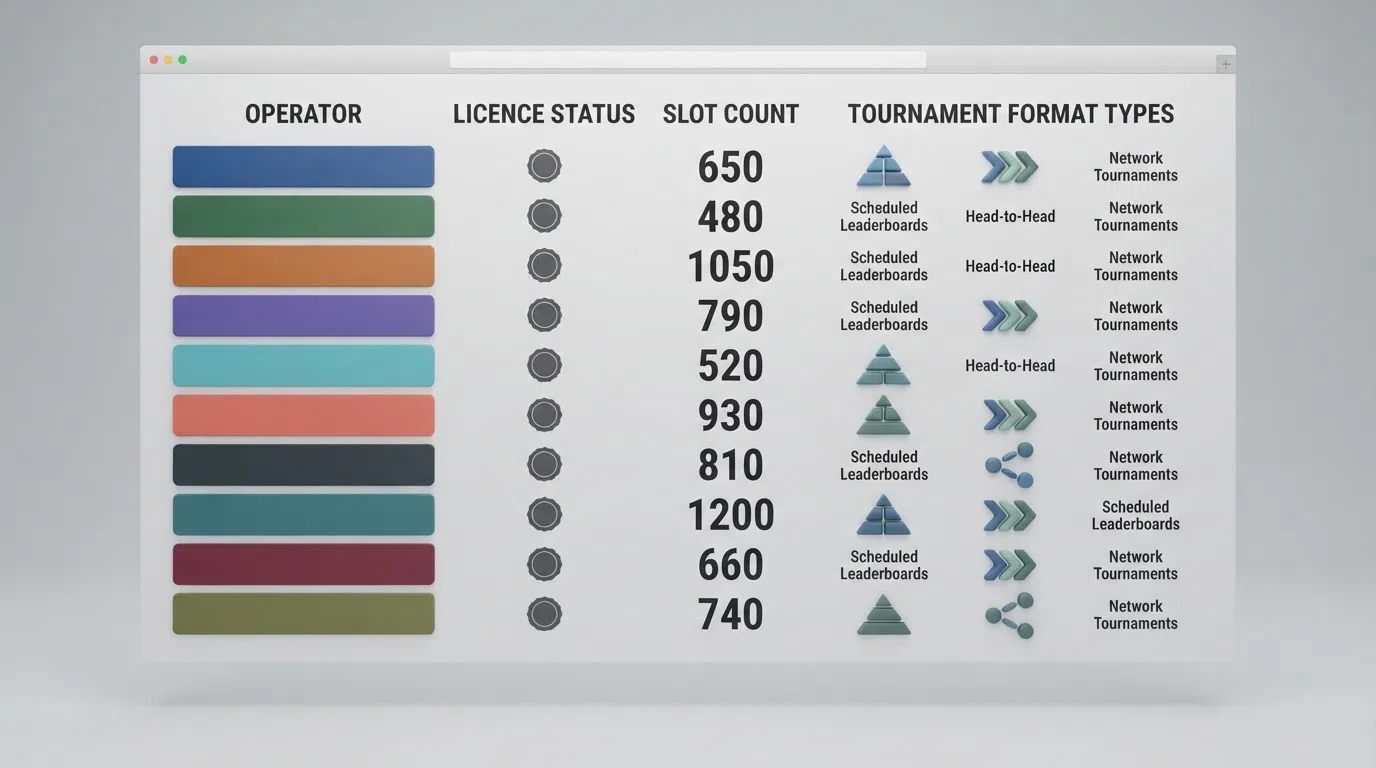
Tournament Entry Methods
| Operator | Tournament Format | Entry Type |
|---|---|---|
| Coral | Scheduled Leaderboard | Free / Coin-to-Play |
| Duelz | Head-to-Head | Free |
| Videoslots | Battle of Slots | Buy-in |
| Sky Vegas | Network | Drops & Wins |
| bet365 | Network | Drops & Wins |
| Gala Bingo | Scheduled | Free / Point-to-Play |
| Paddy Power | Network | Drops & Wins |
| Ladbrokes | Freeroll | Free |
| Betfred | Promo | Free Spins Acca |
| Mr Vegas | Encore | Free / Buy-in |
Tournament Wagering Terms
| Operator | Wagering Multiplier | Notes |
|---|---|---|
| Coral | 0× | Welcome offer |
| Duelz | 30× | Bonus funds |
| Videoslots | 35× | Matched deposit |
| Sky Vegas | 0× | No wagering |
| bet365 | 0× | No wagering |
| Gala Bingo | Varies | By promo |
| Paddy Power | 0× | No wagering |
| Ladbrokes | Varies | By promo |
| Betfred | 0× | On free spins |
| Mr Vegas | 10× | Matched deposit |
The spread across the table is the story. Five of the ten carry zero wagering on their welcome free spins — the prize is what it says. Two carry the standard bonus-funds wagering (Videoslots at 35×, Mr Vegas at 10×). Two vary by promotion (Gala Bingo, Ladbrokes). And one (Duelz) sits in the middle with standard wagering on bonus funds but a welcome package structured around a deposit match rather than free-spin winnings.
Coral: Daily Tournaments With Real Cash Prizes and Zero-Wager Welcome Spins
Coral’s daily tournament programme runs from 14:00 to 23:00 UK time, with prize pools per tournament ranging from £1 to £50 in cash or up to 100 free spins. The monthly tournament prize pool sits at £5,000 to £15,000, distributed across the top 100 to 500 finishers depending on the tournament. The welcome offer carries zero wagering on free spins — winnings are withdrawable cash. The library runs to 1,000+ slots with demo mode available, making Coral one of the larger UK tournament libraries. As an Entain brand, Coral shares infrastructure with Ladbrokes and Gala Bingo, but the daily free-to-play and Coin-to-Play schedule is its own product, not a duplicate. Coral is the strongest daily-tournament option in the featured set for a player who wants a guaranteed schedule and zero-wager welcome terms.
Duelz: Head-to-Head Duels Every 15 Minutes With a £1,500 Daily Pot
Duelz is the only UK operator offering true head-to-head slot duels as its primary tournament format. One-on-one rather than leaderboard, with a new duel starting every fifteen minutes and free entry. The £1,500 daily prize pot is distributed across all duels in the day. The welcome package is 100% up to £1,000 plus 100 free spins on first deposit, with standard bonus-fund wagering and a 30-day validity. The library runs to 1,000+ slots with demo mode. The gamified casino interface integrates duels into the core experience — tournaments are not a sidebar here, they are the front door. Direct head-to-head competition is rare in the UK market, making Duelz a distinct standout for competitive play outside the traditional leaderboard format.
Videoslots: Battle of Slots and the Industry’s Largest Game Library
Videoslots’ Battle of Slots is a multiplayer tournament format where players compete on the same game simultaneously, with Clash of Spins as a daily-event variant. The format is proprietary — no other UK casino replicates it. The library runs to 5,000+ slots, the largest among featured operators, all with demo mode. The welcome offer is 100% up to £200 plus 11 wager-free spins on Starburst, with 35× wagering on the matched deposit and a 60-day validity. Parent company Immense Group (Videoslots Ltd) holds UKGC licence #39380. The Battle of Slots format serves as a unique entry point for players prioritizing deep library volume over a daily, scheduled tournament calendar.
Sky Vegas: Network Developer Tournaments With Zero-Wager Prizes
Sky Vegas runs Pragmatic Play Drops & Wins and Big Bass jackpot tournaments as its network-developer events, with no proprietary format of its own. The welcome offer is deposit and stake £10 for up to 200 free spins with zero wagering requirements (winnings are withdrawable cash), with a 7-day spin expiry. The library includes 500+ slots with demo mode. The Flutter group backing means network-tournament access is reliably maintained, but a player looking for daily operator-run tournaments will not find them here. Sky Vegas is the right pick for a player whose priority is the Drops & Wins network and zero-wager welcome terms, and who does not need a daily proprietary schedule.
bet365: Drops & Wins Plus a £50,000+ World Cup Prize Pot
bet365’s tournament offering is Pragmatic Play Drops & Wins, jackpot tournaments from select games, and the World Cup Prize Pot exceeding £50,000 for existing players. The welcome offer is up to 500 no-wager spins across 10 days (spin values £0.10–£0.20), zero wagering on winnings, 30 days to claim and a 7-day spin expiry. The library includes 500+ slots with demo mode. The brand’s scale means tournament prize pools are reliably funded, but the tournament formats are network-provider rather than proprietary. For a player who values scale, prize-pool size and zero-wager terms over format novelty, bet365 delivers on the headline numbers.
Gala Bingo: Free-To-Play and Point-To-Play Tournaments With a Loyalty Currency
Gala Bingo runs two tournament types side by side: Free-To-Play (no spend requirement) and Point-To-Play (enter by redeeming Gala Points earned through regular play). The daily schedule runs from 1 May 2026 until further notice, supplemented by a Daily Free Spin reel. The library includes 500+ slots with demo mode. Welcome and wagering terms vary by promotion. The Gala Points system turns regular play into tournament entry currency — a structural feature no other featured operator matches. For a player who is already playing at Gala Bingo, the Point-To-Play route is a built-in tournament pipeline. For a player choosing an operator primarily on tournament grounds, the dual-currency system is a differentiator but not a daily schedule on the Coral scale.
Paddy Power: 260 Free Spins and Network Tournament Access With Zero Wagering
Paddy Power’s welcome offer is the largest no-wager free-spin package among featured operators: 60 no-deposit free spins (50 on slots plus 10 on Paddy’s Mansion Heist) plus 200 more after depositing and wagering £10, all 260 spins carrying zero wagering — winnings paid as withdrawable cash. The tournament offering is Entain/Flutter network promotions and Pragmatic Play Drops & Wins, with no proprietary tournament format. The library includes 500+ slots with demo mode. Paddy Power is the right pick for a player who prioritises the welcome package over daily tournament infrastructure — the 260 zero-wager spins is a stronger headline than anything else in the ranking, but the tournament schedule is network-led rather than operator-led.
Ladbrokes: Freeroll Slot Tournaments With Free Spins and Cash Rewards
Ladbrokes’ tournament programme is built around freeroll entry with tangible prizes — free spins and cash rewards distributed with no entry fee. Welcome and wagering terms vary by promotion. The library includes 500+ slots with demo mode. As part of the Entain group, Ladbrokes shares freeroll infrastructure with Coral, but positions its freerolls as the primary tournament draw rather than a supplement to paid formats. For a player who wants pure freeroll access without a daily proprietary schedule, Ladbrokes delivers the format cleanly. It is not the strongest daily schedule in the ranking, but the freeroll positioning is consistent.
Betfred: Free Spins Acca and Tournament-Style Promotions for Existing Players
Betfred’s tournament-adjacent offering centres on the Free Spins Acca promotion for existing players, which runs on a recurring promotional cycle rather than a scheduled tournament format. The welcome offer is up to 200 free spins after depositing £10 and staking on eligible slots, with spin values from 5p to 20p each, zero wagering on free-spin winnings and a 7-day expiry. The library includes 500+ slots with demo mode. Betfred does not run a dedicated tournament platform — the offering is promotional rather than competitive, which places it at the lower end of this ranking for tournament depth. For a player whose priority is a strong welcome package and recurring free-spin promotions rather than tournament infrastructure, Betfred is a reasonable fit but not a tournament-first choice.
Mr Vegas: Encore Tournaments and the Immense Group’s Second UK Tournament Brand
Mr Vegas runs the Encore tournament format plus free-spins tournaments, leveraging the same Immense Group infrastructure that powers Videoslots’ Battle of Slots. The library runs to 5,000+ slots, the joint-largest among featured operators, all with demo mode. The welcome offer is 100% up to £50 plus 11 wager-free Welcome Spins, with a notably low 10× wagering on the matched deposit (the UK cap) and a 60-day validity. Mr Vegas shares UKGC licence #39380 with Videoslots under the Immense Group. For a player who wants the Immense Group tournament infrastructure at a lower entry threshold than Videoslots, Mr Vegas is the alternative. The 10× wagering on the matched deposit is the cleanest bonus terms in the ranking — exactly at the regulatory ceiling.
Playing Tournaments on Mobile: What the Apps Get Right — and Wrong
Every featured operator offers its tournaments on mobile via browser or app, but the experience varies sharply. Leaderboard refresh lag during timed events is the most common pain point. A player watching their position stall for thirty seconds while the board catches up may have already lost a place, and the lag compounds under poor network conditions. Session drops when switching apps are the second — a player who alt-tabs to check a message and returns finds their tournament session disconnected, with the leaderboard score preserved but the session timer running in their absence. Notification delays for tournament start times are the third — a tournament that begins at 14:00 and notifies at 14:05 has already lost five minutes of the playing window.
Slots Temple’s mobile tournament schedule feature is the mobile benchmark. Its mobile app displays a tournament schedule showing all upcoming tournaments with their prizes, a feature the operator’s senior digital marketing lead has identified as central to engagement. The reasoning is straightforward: a player who knows what is coming can plan their session, and a player who plans their session is more likely to return. Most featured operators offer some version of a tournament calendar, but the depth of the schedule view — upcoming tournaments, prize pools, start times, eligible games — varies.
Virgin Games provides full tournament access on iOS and Android apps, which is the standard the rest of the market is measured against. The Slot Masters format translates well to mobile because the multiplayer structure is light on screen real estate.
Daily Mobile Tournaments: Which Operators Let You Play on the Go Every Day
- Duelz — every 15 minutes, duels, mobile-accessible
- Coral — daily 14:00–23:00, free-to-play, browser-based mobile access
- Galabingo — daily, Free-To-Play and Point-To-Play, browser-access
- Tombola Prize League — 28 per day across three sessions, mobile-accessible
The operators whose tournaments are network-scheduled rather than daily are Sky Vegas, bet365 and Paddy Power, all of which offer Drops & Wins access on the Pragmatic Play schedule rather than a daily operator-run calendar. A player who wants a daily habit on their phone is best served by the four operators above; a player who wants the largest prize pool and is willing to follow a weekly schedule is better served by the network-tournament operators.
Crypto Tournaments at UK Casinos: A Niche the Market Barely Serves
Cryptocurrency casino tournaments are scarce in the UK market for a structural reason. GB-licensed operators must comply with AML and source-of-funds rules under their operating licence. Anonymous cryptocurrency deposits — the kind that crypto casinos in other markets rely on for player acquisition — are incompatible with those rules. A UKGC licensee that accepted anonymous crypto deposits would breach its source-of-funds obligations, which are conditions of the licence.
A handful of offshore operators (Curaçao, Malta-licensed) run crypto slot tournaments. They are accessible to UK players by URL, and they are not prosecuted for the act of playing. But they offer no UKGC protection, no GAMSTOP coverage, and no alternative dispute resolution route. A UK player who self-excludes via GAMSTOP and then logs into an offshore crypto casino is not protected — the offshore site has no obligation to honour the exclusion, and the Commission has no jurisdiction to enforce it.
The trade-off for a UK player who wants crypto tournament access is the complete loss of every GB-player protection covered in the legality section of this page. That is the cost of leaving the regulated market, and it is a cost no bonus terms or prize structure can offset.
Cryptocurrency Payment and Tournament Play: What UK Rules Permit
The Gambling Commission does not prohibit cryptocurrency as a payment method in principle. The barrier is practical, not doctrinal. The AML requirements — source-of-funds checks, customer due diligence — make anonymous crypto deposits effectively impossible at a licensed operator. A licensed casino that wanted to accept crypto would need to verify the source of funds for every deposit, which defeats the privacy advantage crypto users typically seek.
No featured operator on this page accepts cryptocurrency deposits. The Remote Gaming Duty at 40% from 1 April 2026 and the statutory levy at 1.1% of GGY from 6 April 2025 apply regardless of payment method, so a crypto-accepting licensee would pay the same tax rates as a fiat operator. There is no tax-arbitrage advantage that would draw licensed operators toward crypto acceptance — the regulatory cost of AML compliance on crypto deposits outweighs any marketing benefit.
The credit card ban that took effect on 14 April 2020 — including the ban on e-wallets funded by credit cards — adds a layer of payment friction that affects crypto-adjacent payment methods too. A UK player who holds crypto and wants to deposit at a GB-licensed casino will typically need to convert to fiat through an exchange, fund a debit card or bank account, and deposit through the standard channels. The crypto is not banned; the convenience of using it directly at a UK casino is.
Are Slot Tournaments Legal in the UK? Licensing, Caps and the Rules That Protect Players
Online casino gambling is licensable in Great Britain under the Gambling Act 2005 as extended by the Gambling (Licensing and Advertising) Act 2014 — the point-of-consumption reform that brought all remote operators serving GB customers into the Commission’s regulatory perimeter from late 2014. Slot tournaments fall within remote casino operating licence provisions, and the Gambling Commission does not issue a separate “tournament licence”. Tournament operators run under their existing remote casino licence, and network tournaments such as Drops & Wins and Battle of Slots operate within UKGC rules via real-money play on eligible games.
The three licensing objectives under section 1 of the Gambling Act 2005 are preventing gambling from being a source of crime or disorder, ensuring gambling is conducted in a fair and open way, and protecting children and other vulnerable persons from being harmed or exploited. Every condition attached to a UKGC operating licence — from stake caps to wagering ceilings to GAMSTOP integration — is a mechanism for delivering one or more of those three objectives.
The Rules That Shape Every UK Tournament Spin: Stake Caps, Spin Speed and the Auto-Play Ban
Four game-design rules directly constrain tournament play, and each one matters more in a timed competition than in casual play.
The £5/£2 age-banded stake cap (SI 2025/215) means every UK player’s maximum spin in an online slot is £5 for players aged 25 and over, or £2 for players aged 18 to 24. The cap applies per game cycle and cannot be defeated by splitting a spin across multiple stakes. In a tournament, this means a high roller cannot buy a structural advantage by staking ten times the entry-level bet — the ceiling is the same for every entrant.
The auto-play ban and 2.5-second minimum spin speed (in force 31 October 2021) mean every spin must be triggered manually and the spin-to-spin interval cannot be shorter than 2.5 seconds. In a timed tournament, a player physically tapping at 2.5-second intervals achieves at most 24 spins per minute, or 360 spins in a 15-minute session. That number is the theoretical maximum, and it is the same for every UK player regardless of bankroll. The ban on speed-up features — turbo mode, quick-spin, the option to skip reel animations — closes the loopholes that would otherwise let a player exceed the floor.
The ban on losses disguised as wins means a spin returning less than the stake cannot be dressed up with celebratory sound effects or imagery. The tournament leaderboard is therefore a more honest feedback loop than the game screen itself — the leaderboard shows the player’s running score in unambiguous terms, while the slot screen cannot mislead a player into treating a net loss as a win. The reverse-withdrawals ban, also in force since 31 October 2021, prevents a player from cancelling a withdrawal request to keep playing, which closes a behavioural loop that tournament sessions can trigger.
Wagering Requirements on Tournament Prizes: The 10× Cap and What It Means
The rule is LCCP Social Responsibility Code 5.1.1, in force 19 December 2025. It caps wagering requirements on all bonus offers at 10× and extends to tournament prizes structured as bonuses. The same rule banned mixed-product promotional offers — promotions requiring a sports bet or another gambling activity to unlock free spins.
The arithmetic changes the economics of operator-run tournaments. A £100 tournament prize credited as a bonus requires £1,000 in turnover before withdrawal under the 10× cap. Under the pre-regulation norm of 35×, the same £100 prize would have required £3,500 in turnover. Under 50×, £5,000. The cap is not a marketing gesture — it is a hard ceiling on how much play the operator can require before a bonus becomes withdrawable.
The practical effect is that UK tournament prizes are among the most accessible in any regulated market. The worst-case wagering is 10×, and the best case — Drops & Wins — is zero. Drops & Wins prizes pay as withdrawable cash with no wagering requirement, subject only to the 7-day claim window. The gap between zero and 10× is wide enough that the same headline prize at two different operators is worth materially different amounts.
GAMSTOP, Deposit Limits and Tournament Play: What Happens When You Self-Exclude
GAMSTOP self-exclusion has been mandatory for every GB-licensed online gambling site since 31 March 2020. Exclusion periods are six months, one year, five years, or five years with auto-renewal. The exclusion cannot be cancelled early — a player who registers for a five-year period and changes their mind after six months remains excluded until the period ends.
For an active tournament player, self-exclusion means the account locks immediately. Any unclaimed tournament prizes are forfeited. Re-entry is blocked for the chosen period. A player who self-excludes mid-tournament does not get a partial settlement — the exclusion is total, and the tournament’s prize table applies only to players who remain active through the close.
From 31 October 2025, operators must prompt customers to set a financial limit before their first deposit, and any request to decrease a limit takes effect immediately. Tournament buy-ins count against these limits, which means a player with a £100 weekly deposit cap who enters a £20 buy-in tournament has committed a fifth of their weekly allowance in one entry. From 30 September 2026, a gross deposit limit must be offered with at least equal prominence to other financial limits, which caps tournament entry-fee spend alongside regular play.
Financial vulnerability checks trigger at a £150 net deposit threshold in a rolling 30-day window from 28 February 2025. The check uses publicly available data only — county court judgments, bankruptcy, IVA, DRO — and a positive match triggers enhanced monitoring rather than automatic account closure.
Offshore Tournaments and Unlicensed Operators: The Risk a UK Player Takes
Operating without a GB licence is a criminal offence under section 33 of the Gambling Act 2005, carrying up to 51 weeks’ imprisonment, an unlimited fine, or both. The player faces no prosecution — the offence is the operator’s, not the customer’s. But the player who enters a tournament on an unlicensed site loses every protection the UK regulatory framework provides.
There is no GAMSTOP coverage on an unlicensed site. A player who has self-excluded in the UK and then plays on an offshore site has circumvented their own exclusion, and the offshore site has no obligation to honour it. There is no access to the Gambling Commission’s complaints process — the Commission cannot investigate a complaint against an operator it does not regulate. There is no alternative dispute resolution route. There is no guarantee that the tournament’s rules or prize payouts are fair, because the operator is not subject to UKGC fairness testing.
The Commission’s enforcement approach is disruption rather than blocking. Between April 2024 and June 2025, the Commission referred 447,778 URLs to search engines and saw 287,961 URLs removed. The Commission uses cease-and-desist, search-engine referrals, payment blocking and domain suspension. It does not have statutory ISP or DNS blocking power, and proposed legislation to grant that power is pending. A Curaçao or Malta licence displayed on a tournament site is not a substitute for a GB licence. A UK player on such a site has no statutory protection, and the site’s regulator — if it has one — operates under a different legal framework with different player safeguards.
Staying in Control: Responsible Play During Competitive Tournament Sessions
Tournament play carries distinct responsible-gambling risks. The leaderboard creates urgency. The fixed time window encourages prolonged sessions — a 15-minute tournament is short, but a multi-day Drops & Wins campaign is not, and the daily 5,000-spin cap is structured to keep players returning. The “just one more spin to climb a place” dynamic mirrors chasing losses in regular play, but it is structurally built into the tournament format itself.
The prevalence context is the baseline. Approximately 0.5% of the adult English population experience problem gambling. A further 3.8% are at elevated risk of gambling harms. An estimated 7% of the British population are negatively affected by someone else’s gambling — 4.3 million adults in Great Britain, by the most recent count. Among adults who gamble and are experiencing any level of problems, almost 1 in 3 — 30% — want treatment, support or advice, nearly doubling from 17% in 2020. The demand signal is rising, not falling.
The session-length data from the Gambling Commission’s quarterly market overview for the quarter to March 2026 shows that online slots sessions lasting longer than an hour decreased by 12% year-on-year to 8.9 million, while total sessions increased by 18% to 202 million. More sessions, but shorter on average — a pattern consistent with the regulatory effect of the spin-speed floor and the auto-play ban, both of which cap the rate at which a single session can extend.
Responsible-Gambling Tools That Apply During Tournament Sessions
Reality checks are mandatory pop-up reminders displaying time played and net position. In a timed tournament, a reality check can interrupt a critical late-stage push, but it is legally required and cannot be disabled during the session. A player who finds reality checks disruptive in a tournament context should treat that disruption as a feature, not a bug — it is the regulator’s mechanism for breaking the session rhythm that competitive play encourages.
Deposit limits, set by the player, apply to tournament buy-ins. A decrease in the limit takes effect immediately, so a player who sets a lower limit mid-tournament cannot enter further buy-in tournaments for the remainder of the period. An increase in the limit may be delayed, depending on the operator and the player’s history.
Time-outs are short self-exclusion periods ranging from 24 hours to 6 weeks. A time-out locks the account, ends any active tournament participation, and forfeits unclaimed prizes. The forfeit is total — a player who takes a 24-hour time-out mid-tournament does not return to the same position when the time-out ends.
The auto-play ban functions as a passive responsible-gambling measure alongside its game-design role. By forcing manual engagement with every spin, the ban makes it harder to play through a tournament session on autopilot. A player who is physically tapping for every spin cannot dissociate from the betting action the way an auto-play session allows, and the engagement cost — fatigue, attention, the inability to look away from the screen — is itself a brake on session length.
Where to Get Help: The UK’s Gambling Support Infrastructure
The National Gambling Helpline is 0808 8020 133, operated by GamCare, available 24 hours a day, 7 days a week, free and confidential. Support is offered by phone, online chat and WhatsApp. GamCare was founded in 1997 and provides structured support alongside its helpline, with a forum community of more than 30,000 contributors.
GambleAware funds treatment and prevention. The organisation commissioned the Annual GB Treatment and Support Survey, which is the source of the 30% treatment-demand figure and the 4.3 million affected-adults estimate.
The NHS operates gambling harm clinics in England, Scotland and Wales. These are specialist NHS services for gambling disorder, with referral pathways through GPs and self-referral options depending on the region.
Gamblers Anonymous is a peer-support fellowship following a model similar to other 12-step programmes. Meetings are held in person and online across the UK.
The statutory levy that funds much of this infrastructure is set at 1.1% of gross gambling yield for remote casino licences, in force from 6 April 2025. Proceeds are split 50% to treatment, 30% to prevention, and 20% to research. The levy replaced the previous voluntary-contribution model and provides a more stable funding base for the support services a player in difficulty may need to reach.
How We Selected and Ranked These Tournament Casinos
The operator universe is every casino ranked on this page holding an active GB operating licence, verified against the Gambling Commission’s public register of licence holders. The register contains 2,663 active records and is updated daily. Every operator on this page was confirmed against that register.
The selection criteria were tournament format depth — whether the operator runs a proprietary format or only network tournaments — entry accessibility (free-to-play, freeroll and buy-in options), prize structure (cash versus bonus, wagering terms), mobile tournament experience, and slot-library size with demo-mode availability. Brand size and welcome-bonus headline value were not criteria. A smaller operator with a stronger tournament offering outranks a larger one with network-only access.
The sources informing the ranking are the Gambling Commission’s public register and published guidance, operator-published tournament terms, independent affiliate reviews including OLBG, CasinoHawks, Racing Post, CasinoWizard, CanCasino, Bookies dot com, Dimers and Casinolyze, and the Pragmatic Play Drops & Wins promotion page. The competition was assessed against existing UK tournament-comparison pages from Casinositesonline, OLBG, Bojoko and Mr Gamble to identify where depth was missing and where this page could add analysis those pages do not carry.
The ranking order sorts by tournament-offering strength. Videoslots ranks third despite a smaller welcome offer than Sky Vegas or bet365 because Battle of Slots is a proprietary format no other featured operator replicates. Mr Vegas ranks tenth despite a strong welcome package because its Encore format, while proprietary, is the same Immense Group infrastructure as Videoslots and the tournament depth is comparable rather than additive. Coral ranks first because the daily schedule, the monthly prize pool, the Coin-to-Play option and the zero-wager welcome terms together represent the strongest tournament offering in the featured set.
Your Tournament Playbook: What the UK Rules and Prize Terms Mean for Your Decision
Three questions should pass before any tournament entry.
Is the prize cash or bonus? Cash is the clean answer. Drops & Wins pays cash. Many operator-run freerolls pay bonus. The difference is not cosmetic — it is the difference between money in a withdrawable balance and money subject to a wagering requirement.
What is the wagering multiple if bonus? Under the UK cap, the answer is at most 10×. Before the cap, the answer was 35× or 50×. The cap is the regulator’s mechanism for keeping the difference between cash and bonus honest. A player who ignores this question is accepting a worse conversion on their prize than they realise.
Does the entry cost — in money or time — exceed the expected value of a prize-place finish? For a free tournament with zero entry cost, the question reduces to whether the time is worth spending. For a buy-in tournament with a £20 fee and a £500 top prize paid across 500 places, the expected value calculation depends on the field size and the player’s assessed probability of finishing in a paid position. For most UK players entering most tournaments, the honest answer is that the entry is entertainment with a chance of a small prize, not an investment.
UK-regulated tournaments are structurally fairer than their offshore equivalents. The 10× wagering cap closes the gap between bonus and cash. The £5/£2 stake limits narrow the bankroll gap between entrants. The auto-play ban and 2.5-second spin floor force equal spin-rate ceilings. GAMSTOP provides a safety net that works across the regulated market. None of these features exist in the same combination on an unlicensed site.
The one number that changes everything is zero. Drops & Wins prizes carry zero wagering and pay as cash, which makes them the cleanest tournament value in the UK market. A player who treats Drops & Wins as the baseline and evaluates every other tournament against it will make better entry decisions than a player who reads the headline prize pool and skips the prize terms.
A tournament is entertainment with a prize, not an income stream. The UK regulatory framework is designed to keep it that way — the stake cap, the spin-speed floor, the wagering ceiling, the GAMSTOP register, the mandatory reality checks. These are not obstacles to enjoying a tournament. They are the reason a tournament can be enjoyed without becoming something else. Check the tournament’s specific terms page before entering. The operator-ranked comparison above tells a player where to look, and the legality section tells them what to look for.
Frequently Asked Questions
How is scoring calculated in a slot tournament leaderboard?
Scoring systems fall into three families: points-based, which rewards volume of play; win-multiplier, which divides win amount by stake (used by Pragmatic Play Drops & Wins); and credits-based, which tracks net position from a fixed starting balance. Win-multiplier scoring levels the field between stake sizes, because a 15p spin returning £1 scores higher than a £5 spin returning the same £1. The UK stake cap of £5 per game cycle (or £2 for players aged 18–24) narrows the high-roller advantage further, but the primary equaliser is the scoring system itself.
What is the difference between a freeroll tournament and a buy-in tournament?
A freeroll tournament charges no entry fee and is funded by the operator or network provider. A buy-in tournament requires an entry fee, which typically funds the prize pool. Galabingo’s Free-To-Play tournaments and Slots Temple’s no-deposit OLBG Special are true freerolls. Virgin Games’ Slot Masters is free to enter but requires a £10 lifetime deposit to access, which places it in a middle category. Buy-in tournaments are uncommon among the featured operators on this page — most UK tournament programmes lean towards free or quasi-free entry.
Can I play slot tournaments on my mobile phone?
Yes. Every featured operator offers tournament access on mobile via browser or app. The experience varies by operator: Duelz’s head-to-head duels translate well to a phone screen, while full-leaderboard tournaments can suffer refresh lag. Virgin Games provides full tournament access on iOS and Android. Slots Temple’s mobile app displays a tournament schedule showing upcoming events with prizes. For timed tournaments, a stable Wi-Fi connection and disabled notifications from other apps improve the experience.
What are Pragmatic Play Drops & Wins tournaments?
Drops & Wins is the industry’s largest provider-funded slot tournament, currently in Season 7 running from 4 March 2026 to 3 March 2027 with a total prize pool of €/£25,000,000 across more than 5,000,000 individual prizes. Daily tournaments offer 500 cash prizes from a £20,000 expected daily pool, and Weekly Wheel Drops offer a £350,000 expected pool with a top prize of 100,000× bet capped at £100,000. Entry is automatic — a player opts in, plays any eligible Pragmatic slot with a minimum 15p bet, and the first 5,000 spins per day count toward the leaderboard. All prizes pay as cash with zero wagering, claimable within 7 days.
How do wagering requirements apply to slot tournament prizes?
Tournament prizes paid as cash carry no wagering requirement and are withdrawable immediately. Tournament prizes paid as bonus funds are subject to a 10× wagering cap under LCCP Social Responsibility Code 5.1.1 (in force 19 December 2025). A £100 bonus prize requires £1,000 in turnover before withdrawal under the cap. Drops & Wins prizes sit at the cleanest end of the spectrum: zero wagering, cash, 7-day claim window. Operator-run freerolls may credit prizes as bonus funds, in which case the 10× cap is the worst case a UK player will encounter at a licensed casino.
Can you win real money from free slot tournaments in the UK?
Yes. Cash prizes from free tournaments are withdrawable immediately, subject to standard verification and minimum-threshold rules. Drops & Wins pays all prizes as cash with zero wagering. Slots Temple’s no-deposit tournaments distribute cash prizes including £500 for first place in the OLBG Special. The cashout process still requires ID verification before the first withdrawal, and payment-method restrictions apply — credit cards have been banned for all remote gambling in GB since 14 April 2020. A free-tournament winner who has never deposited may find their first withdrawal slower than a deposit player because the operator has no deposit history to verify against.
Can You Really Win Cash From a Free Tournament?
Yes, but the answer depends on the prize type and the wagering terms.
Cash prizes from free tournaments are withdrawable immediately. A £50 win in a Drops & Wins freeroll pays £50 in cash that lands in a player’s withdrawable balance and can be withdrawn subject only to standard verification and minimum-threshold rules. This is the cleanest prize structure in the UK tournament market.
Bonus-credit prizes from operator-run freerolls carry wagering requirements. Under the 10× cap from 19 December 2025, a £50 bonus prize requires £500 in turnover before it converts to withdrawable cash. The £500 turnover is real play at real stakes — it is not a fee, but it is volume a player must put through the slot before the prize becomes theirs to withdraw.
Free-spin prizes typically pay winnings as cash with no wagering. Sky Vegas’s welcome free spins and Paddy Power’s 260-spin welcome package both credit winnings as cash with zero wagering. Some operators credit spin winnings as bonus funds subject to the 10× cap, but this is the exception among the featured operators on this page rather than the rule.
The cashout reality is that minimum withdrawal thresholds still apply. ID verification is still required before the first withdrawal. Payment-method restrictions — including the credit card ban for all remote gambling since 14 April 2020 — still apply. A player who wins a freeroll prize still has to clear the same withdrawal process as a deposit player, and a no-deposit winner who has never deposited may find their first withdrawal slower than expected because the operator has no deposit history to verify against.
Free and Freeroll Tournaments on Mobile: Do They Work the Same Way?
Freerolls are time-sensitive, and mobile play introduces latency, screen-size constraints and distraction that can cost a player a leaderboard position. The risks are highest in long-session freerolls where a session drop means forfeited score, and lowest in short-session formats where the timer is short enough that a drop costs only seconds.
Duelz on mobile works well because the head-to-head duel format translates to a two-player view that does not need a full leaderboard. A phone screen displays the duel state cleanly. Coral and Galabingo freerolls are browser-based, with no dedicated tournament app features — a player using these is relying on the mobile browser experience, which is functional but not optimised. Tombola’s Prize League works on mobile because the 15-minute session length is short enough that latency is unlikely to interrupt play materially.
The practical advice for mobile tournament play: use a stable Wi-Fi connection for timed tournaments, disable notifications from other apps during a session, and test the leaderboard refresh speed before committing to a mobile session. A player who finds the refresh lag unacceptable on mobile should play on desktop instead — the same casino, the same tournament, but a more reliable display.
Promotions – fastestpayout-casinos-uk
Content created by the «fastestpayout-casinos-uk» team