
Online casinos without registration: what the UK actually offers
 Available in GB
The phrase “no registration casino” promises a UK player something the law does not let any licensed operator deliver. Since 7 May 2019, every Gambling Commission–licensed remote casino has had to verify a customer’s name, address and date of birth before that customer deposits a penny or places a single bet. The pre-2019 72-hour grace period, when a player could register, deposit, and sort their documents later, is gone. What the search term is really asking for is speed and convenience, the absence of a five-field form and a separate document upload, not the absence of identity verification itself. That distinction is the whole page.

Current as of September 8, 2026 and cross-checked against the Gambling Commission’s public register of licence holders.
What “no registration casino” genuinely delivers in Britain
Three products in the UK answer, partially or fully, to the “no registration” description. None of them removes identity verification where real money is on the table. The first is streamlined sign-up: the same legal KYC step, but compressed into a few seconds through automated database checks, open banking, or Trustly’s Pay N Play, where the bank confirms who you are during the payment flow rather than after it. The second is free demo play: virtual credits, no real-money stake, no real-money wins, and at many UK-licensed sites no account required to spin the reels, though age verification is still mandatory under UKGC rules. The third is offshore crypto casinos, which can offer genuine no-KYC play because they are not licensed for GB customers in the first place, and the player gives up every protection a UK licence confers.
The closest the licensed UK market gets to the no-registration ideal is Pay N Play via Trustly, which is now available in the UK alongside Sweden, Finland, Estonia and the Netherlands. The product combines registration and deposit into a single step: the player picks a stake, their bank confirms their identity through open banking, and the game loads. No form, no document upload, no separate verification step. It is not no-registration in the strict legal sense, since the bank still confirms who the player is, but it is the practical experience the search term is reaching for.
The search-term reality — what UK players are actually asking for
“No registration” ranks as a search term in the UK because the underlying frustration is real. Forms are long, document uploads fail on the first attempt, and the gap between “I want to play one slot” and “I have to photograph my passport and my gas bill” is wide enough that players search for the shortcut. The 37% online gambling participation rate for the four weeks from September 2025 to January 2026 is the audience doing the searching. The share who want true anonymity is small; the share who want to skip a five-minute form is large, and those are not the same ask.
A few clicks of search, however, will not find a licensed UK casino that has dropped the identity check. The Gambling Commission rule has been in force for over six years, and the operator landscape has reorganised around compliance, not around circumventing it. What has changed is how the verification step runs. Automated checks against electoral roll, credit reference, and open banking data have replaced the manual document review for most customers, and the UKGC’s own financial risk pilot found that 97% of assessments could complete frictionlessly without the customer supplying any documents at all. The friction the search term is reacting to is, in most cases, friction the operator has already removed.
Pay N Play and Trustly — the one-step sign-up that feels like no registration
Pay N Play works by leaning on the bank as the identity provider. When a player chooses Pay N Play at a participating casino, Trustly’s payment flow opens a secure session with the player’s bank, the bank returns verified name, address and date of birth, the deposit is authorised, and the casino creates the account in the background. The player sees a single button, a confirmation screen, and a game lobby. Behind the curtain, every piece of information the UKGC requires has been collected and stored.
Two conditions attach. The player needs a UK bank account that supports strong customer authentication, which most current accounts do, and the bank’s automated checks have to clear the player on the first pass. When the data does not match cleanly, the casino falls back to a document upload, the same five-minute process Pay N Play was meant to skip. For the majority of UK customers, the experience is as close as a GB-licensed casino gets to the no-registration promise.
Instant-play and no-download casinos — the practical side
“No download” is a different ask from “no registration” and the search term conflates them. Every modern UK-licensed casino is built on HTML5, which means the full game library loads in a desktop or mobile browser with no software install. There is no separate “instant play” tier any more, because the entire industry is the instant-play tier. Casino aggregator sites that list no-registration-adjacent brands are mostly grouping instant-play operators under a label that sounds relevant, then pointing readers at the same licensed casinos the rest of the market reviews. The aggregator is the sign-up shortcut, not the technology.
What an instant-play casino still requires, in 2026, is a verified account before the first real-money spin. The browser loads the games, but the cashier stays locked until the KYC step is done. That is the UK line, and no amount of browser-based convenience crosses it.
The law that makes true no-registration casinos impossible in Britain
A single UKGC rule is the reason the search term cannot be satisfied. Pre-deposit KYC, in force since May 2019, requires every licensed remote operator to verify a customer’s identity before any deposit, any bet, any free spin or any bonus. Before that date, operators had 72 hours after registration to complete the check. After it, the check has to run first. The rule exists to serve the three licensing objectives of the Gambling Act 2005: preventing crime, keeping gambling fair and open, and protecting children and vulnerable people. The 2019 change closed a window that had been used for fraud, money laundering and underage play, and it has not been loosened since.
Around that single rule sits a thicket of other statutory restrictions: stake caps by age band, a 10× wagering ceiling on bonuses, a ban on credit card deposits, mandatory deposit-limit prompts, and reverse-withdrawal prohibitions. Each of them is a feature of a regulated market, and each is the reason a no-registration product is not on offer. The detail matters because the trade-off, between the convenience the searcher wants and the protection the framework delivers, is the only honest answer this page can give.
The UKGC’s pre-deposit KYC rule — why you must verify before you play
The rule is short and absolute. Name, address and date of birth must be verified before the customer can deposit funds or gamble, with their own money or with a free bet or bonus. The check can be automated, through credit reference, electoral roll or open banking data, or it can be a document review, but it has to happen first. The 72-hour grace period that previously let a player register, deposit, and verify later was removed because it gave a window for fraud, identity theft, and underage play. The window is closed, and the cost of reopening it would be paid by players, not by operators.
For most customers, the check runs invisibly. The 97% frictionless figure from the UKGC’s financial risk pilot is the share of assessments that completed without the customer uploading a single document, which is roughly the share of UK adults whose identity data the databases cover cleanly. The remaining 3% hit a manual review, which can take hours or days. The casino cannot offer the player a real-money game in the meantime. That is the bottleneck the “no registration” search is really trying to avoid, and the operator is forbidden from short-circuiting it.
What Britain actually caps — stake limits, wagering rules and speed curbs
Britain caps the spin, not the month. Online slots carry a statutory maximum stake of £5 per game cycle for players aged 25 and over, and £2 per game cycle for players aged 18 to 24, set out in the Gambling Act 2005 (Operating Licence Conditions) (Amendment) Regulations 2025. The cap is on slots only, not on roulette, blackjack or other casino games. It applies to the total staked in a single game cycle, so a player cannot split a £10 stake across two spins to get around the ceiling. The stake limits are the headline restriction, but they sit inside a wider set of design rules that make a no-registration product harder to build.
On bonuses, wagering requirements have been capped at 10× at every GB-licensed site since 19 January 2026, and mixed-product promotional offers, where betting on football earns free spins, are banned. On deposits, operators must prompt a customer to set a financial limit before the first deposit, and any request to decrease a limit has to be actioned immediately. On payments, credit cards have been banned for gambling since 14 April 2020, including credit-card-funded e-wallet deposits. On game design, auto-play is banned, the minimum spin speed is 2.5 seconds, losses disguised as wins are banned, and reverse withdrawals are permanently banned.
The tax side closes the picture. Remote Gaming Duty rose from 21% to 40% from 1 April 2026, and the statutory levy sits on top at up to 1.1% of gross gambling yield for remote casino. The operator is paying roughly half of every pound of GGY to the state before any other cost. That is the cost base a no-frills offshore casino is dodging, and it is also the reason offshore casinos can afford to skip the verification step.
Offshore casinos without a UKGC licence — what you lose when you play outside the system
A Curaçao, Maltese or Gibraltar licence is not a substitute for a GB licence. Operating gambling facilities for GB customers without a UKGC licence is a criminal offence under section 33 of the Gambling Act 2005, carrying up to 51 weeks’ imprisonment, an unlimited fine, or both. The Gambling Commission does not prosecute individual players, and there is no established penalty for a player who merely gambles on an unlicensed site. The Commission pursues disruption instead of blocking: cease-and-desist notices, search-engine delisting referrals, domain-registrar pressure, and payment-provider referrals. In the period from April 2024 to June 2025, the Commission issued 3,140 disruption notices and referred 447,778 URLs to search engines, of which 287,961 were removed. The year before that, October 2024 to September 2025, logged 208,088 enforcement actions against illegal online gambling.
The player is the one paying for the absence of a UKGC licence. GAMSTOP, the national multi-operator self-exclusion scheme, is mandatory for every GB-licensed online operator, and it cannot reach an offshore brand. A player who has self-excluded in the UK can deposit at a Curaçao-licensed crypto casino the same afternoon, and the GAMSTOP account does nothing to stop it. The ADR complaints route disappears with the licence. The £5 and £2 stake caps do not apply. The 10× wagering ceiling does not apply. The financial vulnerability check at £150 net deposit in a rolling 30 days does not apply. The session-time and total-loss display requirements do not apply. The GamCare referral route, built into every licensed UK casino, does not apply.
For a player who has never needed any of those protections, the offshore offer is genuinely frictionless: no KYC, crypto in and out, no stake or wagering caps, no game speed limit. For a player who has, or might, the friction was the point.
10 UK casinos with the fastest sign-up in 2026
The ten operators below are the closest the licensed UK market comes to a no-registration experience. They all sit on the Gambling Commission’s public register, every one of them verifies identity before a real-money spin, and the ranking puts the no-registration-adjacent qualities first: no-deposit offers, zero wagering, and onboarding that runs in under five minutes for the typical UK customer. The table is the comparison; the write-ups underneath explain what each one is worth.
| Operator | Welcome Offer | Wagering | Bonus Validity |
|---|---|---|---|
| Sky Vegas | 70 no-deposit spins + 200 spins on first £10 deposit | 0× | 7 days |
| Betfair Casino | 50 no-deposit spins + 100 spins on £10 deposit and wager | 0× | 7 days |
| Paddy Power Games | 50 + 10 no-deposit spins + 100 spins on £10 deposit and wager | 0× | 7 days |
| Virgin Games | 100 spins on Game of Thrones after £10 deposit and £10 wager | 0× | 30 days |
| bet365 Games | Up to 500 spins across 10 daily reveals | — | 20 days (claim within 30 days) |
| William Hill Vegas | 200 spins on Big Bass Splash after £10 deposit and £10 stake | 10× | 72 hours |
| 888casino | 100% deposit match up to $500 equivalent + 100 spins | — | — |
| NetBet Casino | 25 no-deposit spins on registration | 0× | — |
| PlayOJO | 50 spins on first deposit | 0× | — |
| MrQ | 30 spins on first deposit | 0× | — |
Em-dashes mark values the operator does not publish in sources a UK reader can verify; the audit reads those gaps as data, not as failure to look.
Sky Vegas — 70 no-deposit spins with zero wagering
Sky Vegas opens with the strongest no-deposit offer in the featured set. Register, opt in, verify a payment card, and 70 free spins land on selected games, including Eye of Horus and Fishin’ Frenzy, at £0.10 per spin, a total headline value of £7, before any deposit is made. Wagering is 0×, which means anything the spins return is withdrawable cash, not bonus credit. The 70 spins are valid for seven days from credit. A further 200 free spins, on the same zero-wagering terms, unlock when the customer deposits £10 and stakes £10 on any eligible game. The Flutter Entertainment operator combines fast automated verification with a bonus that pays real money, which is the closest a UK-licensed casino gets to the no-registration promise for a customer who wants to play before committing a deposit. For the player who only wants a few slots on the first night, this is the standout.
Betfair Casino — 50 no-deposit spins on Jackpot King slots
Betfair’s welcome is built around 50 no-deposit free spins at £0.10 each, eligible on Crabbin’ For Cash Extra Big Catch Jackpot King and other selected Jackpot King titles, with no wagering and a seven-day validity. A second bundle of 100 free spins unlocks on a £10 deposit and a £10 wager. The progressive-jackpot angle is the differentiator: a no-deposit player is spinning on a game that can pay a seven-figure prize, which a non-jackpot slot cannot. The catch is the game restriction. A customer who wanted to play the spins on Eye of Horus or Fishin’ Frenzy has to look elsewhere. For the player who actively wants a shot at the Jackpot King pool with no deposit, Betfair is the cleaner fit.
Paddy Power Games — 60 no-deposit spins plus an exclusive game
Paddy Power offers the largest no-deposit bundle in the set: 50 spins on eligible slots, including Eye of Horus, plus 10 spins on Paddy’s Mansion Heist, an exclusive live-roulette-style game credited as a £1 bonus. The verification step is a phone call rather than a card, which is unusual among the featured brands. Zero wagering, seven-day validity, and a further 100 free spins once a £10 deposit and £10 wager are in. The exclusive title is the part most players will not find elsewhere, and the 60-spin total beats every other no-deposit offer in the comparison. For a player who has not decided which slot to try, the mix of well-known titles and an exclusive is the strongest single reason to register here.
Virgin Games — 100 free spins on Game of Thrones with zero wagering
Virgin Games routes a deposit-gated offer rather than a no-deposit one. The customer deposits £10, wagers £10 on any slot, and receives 100 free spins on Game of Thrones, at 1p coin size across 10 lines for £0.10 per spin. Wagering is 0×, the winnings are cash, and there is no cashout cap. The validity window is the longest in the set: 30 days from completing the qualifying steps to start the spins, then another 30 days to use them. The branded slot is the draw. Game of Thrones is a popular but aging title, and the chance to spin it on a regulated site with cash winnings is a narrower proposition than the no-deposit offers above. For a player who likes the theme and has the time to clear the qualification, it pays more than Sky Vegas or Betfair on the deposit step; for a player who does not, the same £10 unlocks fewer spins elsewhere.
bet365 Games — up to 500 free spins across 10 daily reveals
bet365’s “10 Days of Free Spins” mechanic is the oddest welcome in the set. After a £10 lifetime deposit and a registration within the qualifying window, the customer claims 10 daily reveals, each containing 5, 10, 20 or 50 free spins at random, at least 24 hours apart, for up to 500 spins in total. The claim window is 30 days from registering, the reveals are spread across 20 days from the first claim, and the value of one spin is £0.10. The mechanic is a retention play disguised as a welcome: the casino is paying the bonus out over two weeks rather than on day one, which holds the player across the period. For a customer who enjoys a daily reveal and the chance of a 50-spin day, it is a quirky fit. For a customer who wants the spins up front so they can move on, the bet365 mechanic feels like the opposite of no-registration.
William Hill Vegas — 200 spins on Big Bass Splash with a £30 cashout cap
William Hill Vegas is the outlier. The welcome is 200 free spins on Big Bass Splash (Pragmatic Play), after a £10 deposit and a £10 stake on the advertised game, with three restrictions the other featured operators do not impose. Wagering is 10× on free spin winnings, the maximum cashout from the offer is £30, and the spins expire 72 hours from credit. The offer ends 31 December 2026. The 10× wagering ceiling is the statutory cap, so the operator is using the full allowance rather than offering more than the rule allows, and the £30 cashout cap turns a 200-spin bundle into a low-ceilinged proposition. The maths is straightforward: at £0.10 per spin, 200 spins at 96% return yields roughly £19.20 in expected value, which is comfortably below the £30 cap, so a player who hits the wagering will see most of what they win. The 72-hour window is the sharper cost, since 200 spins is a heavy first-night session. For a player who wants the spin count and is comfortable with the cap, this is the lean welcome; for a player who values zero-wagering cash terms, it is the worst deal in the set.
888casino — the only deposit-match bonus in the featured set
888casino is the only operator in the ranking offering a deposit-match structure rather than a free-spin welcome. The published headline is 100% up to a $500 equivalent plus 100 free spins, on the first deposit. The currency is the first friction: the figure research surfaces is in US dollars, and the GBP equivalent for a UK customer may differ. Wagering and validity are not published in the sources available for a UK-specific reader, so the 100% match cannot be weighed against the spin offers in the rest of the table without further checking on the operator’s own UK site. 888casino is GB-licensed under evoke plc, alongside William Hill Vegas, and the verification flow is the same regulatory standard. For a player who prefers a matched deposit to free spins and is willing to dig into the terms, the brand is worth a look; for a player comparing on the headline numbers in the table above, the gaps in the row are themselves the comparison.
NetBet Casino — 25 no-deposit spins paid as withdrawable cash
NetBet is the simplest no-deposit offer in the set. Register, no deposit, 25 free spins on rotating popular titles, zero wagering, winnings paid as withdrawable cash. The spin count is the lowest no-deposit total in the comparison, and the rotating title means the specific game is not guaranteed. For a player who wants to try the casino with nothing committed and no time pressure beyond a standard bonus window, this is the lowest-friction entry in the set. The 25 spins are also the easiest to walk away from. For a player chasing the largest no-deposit bundle, Sky Vegas and Paddy Power are stronger; for a player who values a single, simple “try the site” step, NetBet is the cleanest of the four no-deposit options.
PlayOJO — 50 deposit spins with no wagering and no cashout cap
PlayOJO built its reputation on the “no wagering” position, and the welcome keeps it. 50 free spins on the first deposit, at £0.10 per spin, zero wagering, no maximum cashout, on a popular slots selection that varies. The brand is GB-licensed under SkillOnNet Ltd and is one of the most-cited examples of the post-2026 bonus model: no wagering, no cap, what the spins win is the player’s money. The 50 spins are deposit-gated, so the player is committing £10 or more to claim them, which is a step the no-registration searcher wanted to skip. For a player who has already accepted the deposit step and wants a clean cash-out path, PlayOJO is a strong fit. For a player still on the no-deposit fence, Sky Vegas or Paddy Power are the closer match.
MrQ — 30 deposit spins paid as cash with no wagering
MrQ closes the ranking with the leanest deposit welcome: 30 free spins on the first deposit, zero wagering, winnings paid as cash, no maximum cashout. The brand is small, GB-licensed under Lindar Media Ltd, and positions itself as a no-frills alternative to the bigger names in the set. The 30 spins are the smallest deposit-gated bundle in the comparison, and the no-frills ethos is the point. For a player who values a tight, low-overhead welcome and is comfortable with a smaller brand, MrQ is the honest match. For a player chasing spin count, the £10 deposit unlocks 50 at PlayOJO, 100 at Virgin Games, or up to 500 at bet365, and the 30-spin total looks thin by comparison.
Free slots without registration — the one genuinely no-account experience
Demo mode is the only UK product that genuinely requires no account. The player loads a slot, the game credits the balance with virtual coins, the reels spin, and nothing in the experience touches real money. No deposit is asked for, no payment method is requested, and no real-money win or loss is possible. The UKGC’s pre-deposit KYC rule still applies in spirit: since May 2019, age-gating extends to free-to-play games on a licensee’s site, and most UK-licensed casinos ask for a date of birth before loading the demo. A full account is not required at most sites, though some operators require one for technical reasons, and a small number of free-slot aggregators operate without any UKGC licence and sit outside the rule.
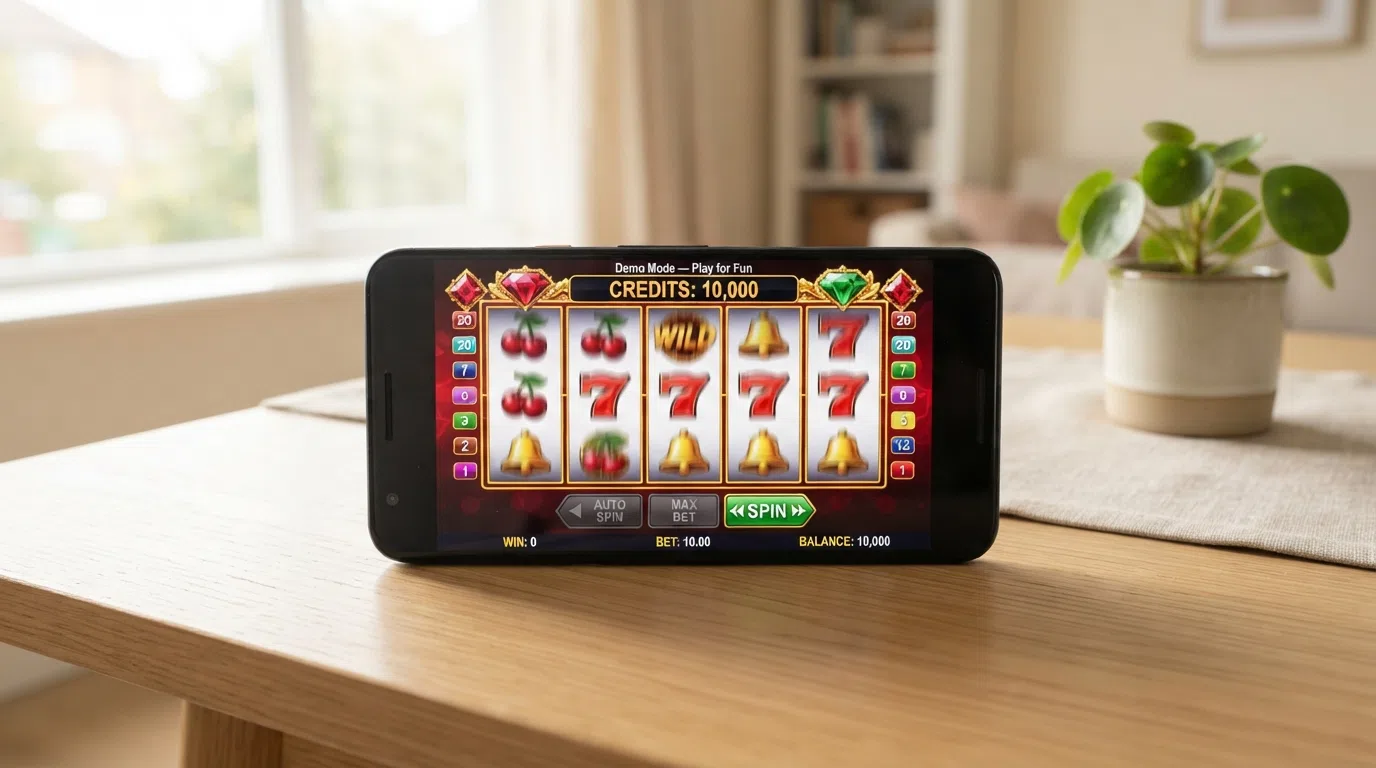
The market is wide. Classic three-reel slots, five-reel video slots, 3D titles, Megaways games with up to 117,649 ways, and the bonus-round-rich high-volatility releases all ship with a demo version, because the studios need players to try before they buy. Q1 2026 saw £773m in slots GGY on 25.1 billion spins, a 12% year-on-year rise, and a meaningful share of the 13.4 million average monthly active accounts began with a demo session.
Demo mode at UK-licensed casinos — how it works and what it costs you
Demo mode runs on virtual credits, and the credits are not money. A 10,000-coin balance that refills at the click of a button is the standard setup, and the credit-to-sterling ratio is set by the operator, not by the player. No real-money stake is possible on a demo game, and no real-money win is paid out. The only cost is the time it takes to play, and the only way a player can lose is by closing the tab.
The age-gating rule is the part most players do not notice until they hit it. Since May 2019, the UKGC requires age verification before any gambling activity on a licensee’s site, including free-to-play games. In practice, this means a date-of-birth gate at the demo entry, and at many sites a confirmatory check against the operator’s own database. A full account is usually not required; the gate is a single screen, not a registration form. Some operators, for technical or commercial reasons, do require a full account before the demo loads, and a small number of free-slot aggregators operate without a UKGC licence at all, which puts the age gate on the player rather than on the site.
The slot types you can play instantly — from classic reels to Megaways
The range of free slots a UK player can reach without registering is the full range. Three-reel classics sit alongside five-reel video slots, branded releases like Game of Thrones, and the Megaways titles where the number of ways to win changes with every spin. The 25.1 billion spins logged in Q1 2026 run across this catalogue in real-money mode, and the same catalogue sits behind a demo button on the studio’s site or on the operator’s site.
The demo RTP may not match the real-money RTP. Studios sometimes run a higher return in demo mode to give players a more generous first impression, and the difference is rarely published. The point of demo play is to learn the mechanics: how the bonus round triggers, how the wilds land, how the volatility feels across a session. Real-money RTP is verified by independent testing houses on the live version, and the demo is a marketing surface, not a regulated product.
Mobile free slots — no app, no sign-up, just a browser
Every modern slot is built on HTML5, which means the game runs in a mobile browser without an app install. The player opens the casino site, taps a slot, and the reels load in the browser window. The experience is indistinguishable from a native app for the vast majority of titles, and the no-download aspect is universal rather than a differentiator. The free-slot aggregators that cluster around the “no download no registration” search variant are mostly mobile-friendly by default, because the entire instant-play market is mobile-first in 2026.
The age-gating rule applies on mobile too, and the flow is the same as on desktop. A small number of operators ask for a date of birth on first load; others ask on first real-money deposit. A smaller number still require a full account before any demo loads, which is friction the search term is trying to avoid.
Bonuses that reward the sign-up step — what UK casinos actually offer in 2026
The bonus landscape in 2026 is the cleanest it has been in years, and the reason is the 10× wagering cap that took effect on 19 January 2026. Before the cap, wagering multipliers of 35× and 50× were common, and the typical bonus turned a £20 headline into a £200 turnover requirement that a player would, on average, lose before clearing. The cap brings the worst offers into line with the best, and the featured set reflects that. Nine of the ten operators either offer zero-wagering free spins or use the full 10× allowance, and the 10× allowance is the ceiling the rule sets.
Mixed-product promotional offers, where a bet on football earns free spins, are banned under the same rule. Bonuses have to stay in their lane: a casino bonus is a casino bonus, a sportsbook bonus is a sportsbook bonus, and the two cannot be combined to inflate a single headline. The change has flattened the marketing surface and raised the floor for the player.
No-deposit free spins — the closest thing to a no-registration reward
Four of the ten featured operators offer free spins with no deposit required: Sky Vegas (70), Betfair (50), Paddy Power (50 plus 10 on the exclusive), and NetBet (25). The total no-deposit headline across the four is 195 free spins, and the 0× wagering on every one of them means the winnings are cash. The “no deposit” label still requires the sign-up step the searcher is trying to skip. Registration, opt-in, and either a card or phone verification is the minimum at each operator, and the KYC framework is the same regardless of the bonus type.
The trade is the no-registration ask. The player skips a £10 deposit, the operator skips a deposit-match offer, and the result is a smaller bonus bundle that costs the player a sign-up and a verification step rather than a financial commitment. For the player who wants the smallest possible commitment, the four no-deposit offers are the right starting point. For the player who has decided to play anyway, the deposit-gated offers below are usually a stronger headline.
Deposit-match and deposit-gated offers — what you trade for the extra step
The deposit-gated operators are the rest of the set. Virgin Games offers 100 spins on Game of Thrones for a £10 deposit and a £10 wager, with the longest validity window in the set. bet365 offers up to 500 spins across a 10-day reveal mechanic. William Hill Vegas offers 200 spins on Big Bass Splash, with the 10× wagering and the £30 cashout cap that no other featured operator imposes. PlayOJO offers 50 spins with no wagering and no cap. MrQ offers 30 spins with no wagering and no cap. 888casino is the only deposit-match offer, and the published figure is in US dollars, which the UK player will need to convert.
The extra step the deposit opens is a larger bonus pool. The Sky Vegas 200-spin bundle is the most generous deposit-gated spin offer in the set, the PlayOJO 50 spins are the cleanest cash terms, and the 888casino match is the only offer where the bonus scales with the deposit. The arithmetic on cost is laid out below for the William Hill offer, which carries the only wagering and cap of the set, but the same formula applies to any of them. A no-registration searcher who has decided to deposit anyway gets more spins for the same step than the no-deposit offers above, and the difference between the two is whether the player wants the £10 on the deposit screen or off it.
Bonus terms under the 2026 rules — wagering caps, validity and cashout limits
The 10× wagering cap and the mixed-product ban are the two rules that shape the 2026 bonus market. The cap is a ceiling: operators can offer any multiplier up to 10×, and many offer 0×, which is functionally a no-wagering bonus. The ban on mixed-product offers is a separation: a casino welcome cannot be combined with a sportsbook free bet, and the two products cannot share a single promotional headline. The practical effect is that every bonus in the set is a single-product offer with a single set of terms.
The validity windows vary. Sky Vegas, Betfair, Paddy Power and NetBet give seven days. Virgin Games gives 30 days to start the spins and another 30 days to use them. William Hill Vegas gives 72 hours, the tightest in the set, on 200 spins. The other operators do not publish a validity in sources a UK reader can verify. Cashout caps are the rarest restriction: only William Hill Vegas imposes one, at £30, which sits well below the expected value of the offer at the published RTP.
The 0× wagering offer is the cleanest in the set, and the easiest to value. Where the spin returns £1, the player keeps £1 as cash and can withdraw it. Where the spin returns £1 on a 10× wagering offer, the player has to stake £10 before the £1 converts to cash. At a 96% RTP, the £10 turnover costs 40p on average, so the £1 returns as roughly 60p. The difference is the price of the bonus, and 0× is the price floor.
Crypto casinos and the anonymity promise — why it does not work for UK players
No UKGC-licensed casino is known to accept cryptocurrency. The UKGC has not established whether GB licensees may accept crypto deposits, and the practical position is that the major operators have not built a crypto rails at all, because the anonymity the technology promises is in direct conflict with the mandatory KYC framework. The credit card ban is the parallel: the UKGC restricts payment methods proactively, and crypto is the only payment class where the regulatory question is still open. The position is likely to move, but it has not moved in 2026.
Offshore crypto casinos, typically licensed in Curaçao, do accept Bitcoin, Ethereum and stablecoins, and they offer genuine no-KYC play because they are not licensed for GB customers in the first place. The trade is the trade that runs through this entire page: the player gives up every UK protection in exchange for a frictionless first deposit. The rest of this section is about what that trade costs.
Why no UKGC-licensed casino accepts cryptocurrency
The UKGC’s mandatory KYC rule requires every customer to be identified before any deposit. Cryptocurrency deposits, by design, do not carry a verified identity with the funds. The two are not technically incompatible — a casino can accept a crypto deposit and still verify the customer through a separate KYC flow — but the marketing promise of a crypto casino is that the KYC flow is optional, which is the part the UKGC cannot allow. A licensed casino that accepted crypto and ran KYC would have a worse product than the offshore competition, and a licensed casino that accepted crypto and skipped KYC would be breaking the rule.
The credit card ban is the precedent for proactive payment-method regulation. The UKGC moved against credit cards in 2020, before the harm was fully visible, on the basis that the payment method itself was the problem. The same logic applies to crypto: the payment method is the feature, and the feature is incompatible with the framework. The position may soften as stablecoin regulation matures, but in 2026 a UK player who wants to deposit in crypto is depositing at an unlicensed site, whether the casino describes itself that way or not.
Offshore crypto casinos — the real cost of playing without UK protections
The crypto casino offer is the cleanest version of the no-registration promise. No KYC, crypto in and crypto out, instant play, no stake cap, no wagering cap, no game speed limit, no GAMSTOP. The player registers an email address, sends Bitcoin to a deposit address, and starts spinning. The friction is zero. The cost is everything the licensed market was built to provide.
GAMSTOP does not reach the site. A player who has self-excluded in the UK can deposit at a Curaçao-licensed crypto casino the same afternoon, and the self-exclusion does not fire. The 10× wagering cap does not apply. The £5 and £2 slot stake caps do not apply. Auto-play, turbo spin, and reverse withdrawals, all banned in the UK, are standard. The session-time and total-loss display, mandatory in the UK, is not offered. The financial vulnerability check at £150 net deposit in a rolling 30 days does not apply. The GamCare referral route, built into every UK-licensed site, does not apply. The ADR complaints route, the route a player would take if an offshore casino refused to pay a withdrawal, does not exist in any form the UKGC recognises.
For a player who has never needed any of those protections, the offshore offer is genuinely better on the dimensions the search term is asking about. For a player who has, the offer is a worse deal than five minutes of sign-up at a licensed UK casino.
No-registration play on mobile — what you can actually do
Mobile is where no-registration play is closest to the search-term ideal, because every modern UK-licensed casino is built mobile-first. The site loads in a phone browser, the games run in HTML5, and the cashier stays locked until the verification step runs. The experience is identical to desktop in everything except screen size. The friction is the same friction: identity verification before the first real-money spin.
The free-slot angle is the one place mobile beats desktop for a no-registration searcher. Demo mode on a mobile browser is the genuine no-account product, and a phone is the most common way UK players reach it. A short detour through the free-slot aggregators and the demo-mode mechanics covers the rest of the mobile story.
Browser-based mobile play at no-registration casino sites
Every UK-licensed casino in the featured set works in a mobile browser without an app install. HTML5 has won the format war, and the operators that still ship native apps do so as a loyalty feature rather than a requirement. The mobile browser experience is faster than the native app for most players, because the browser caches credentials, the operator’s site is built for the screen size, and the app install is one more step the no-registration searcher did not want.
The one feature a native app offers that a browser does not is biometric login, which is faster than a password on a returning visit. For a player who plans to play repeatedly, the native app is a small convenience gain. For a player who wants to play one slot tonight and may not return, the browser is the right surface. The verification step is the same on both.
Free mobile slots without downloading or signing up
The intersection of “mobile”, “free” and “no registration” is the demo mode on a mobile browser. The player opens a free-slots aggregator or a UK-licensed casino site, taps a slot, confirms the date of birth on the age-gate, and the reels load with virtual credits. No account, no app, no download. The experience is the same on a phone as on a desktop, and the catalogue is the full catalogue of HTML5 slots.
The age-gate is the friction the search term is reacting to, and it is the friction that has to remain. A mobile site that does not ask for a date of birth on the demo is not a UKGC-licensed site, and the catalogue it offers is not subject to the same content rules. For a player who wants the full range of UK-regulated titles in mobile demo mode, the licensed sites are the answer, and the date-of-birth confirmation is the price.
New no-registration casino launches in 2026
The newest UK-licensed casino brands are the closest the market gets to a no-registration product, because each generation trends toward faster automated verification. The 2019 KYC rule has been in force for over six years, and the operator landscape has had time to build the infrastructure. Database checks run in milliseconds, open banking is integrated at the major processors, and the 97% frictionless figure from the UKGC’s pilot is the share of customers who never see a document upload screen. A new launch in 2026 is a launch against that benchmark, and the operator that wants to compete has to match it.
The market is wide. 2,179 gambling operators were active in Great Britain as of 31 March 2025, and the rate of new licence grants has not slowed. Each new launch is searchable on the UKGC public register, which was last updated 29 July 2026 and can be filtered by business name, trading name, domain name or account number.
The newest brands offering streamlined UK sign-up
A new UK-licensed launch in 2026 is built around automated KYC, not around circumvention. Trustly integration is the headline feature for the brands that have it, because Pay N Play is the closest the licensed market comes to no-registration. Open banking through other processors is the next best, and database checks against credit reference and electoral roll data cover most of the rest. The friction a player sees on day one is the friction the operator has been able to remove from the process, and the launch announcements of 2026 lean on that story.
The check that matters before any deposit is the licence check. The UKGC public register is searchable by domain name, and any operator a player is considering can be verified in under a minute. The register is the only authoritative source, and a launch announcement that does not appear on the register is not a UK-licensed launch. This is the gate the page keeps coming back to, and the gate every new brand has to clear.
Welcome offers at the latest no-registration casino launches
The 10× wagering cap and the mixed-product ban shape every 2026 welcome. A new launch that wants to compete with the established brands has to offer either a no-wagering free-spin bundle or a sub-10× wagering structure on a deposit match, and the established brands have already pushed the floor to 0×. The trend is toward no-wagering free spins as the standard new-casino offer, with the spin count and the deposit gate as the differentiators.
A few things to verify in a new casino’s terms before claiming a welcome offer: the wagering multiplier (10× is the ceiling, 0× is the cleanest), the validity window (7 days is the typical minimum, 30 is generous), the cashout cap (no cap is the standard, William Hill’s £30 is the outlier), and the game eligibility (some offers are locked to a single title, others to a wide selection). The four checks take a few minutes and they are the only protection against an offer that looks generous on the headline and costs more than it returns.
Staying safe when the account is the whole point — responsible gambling at UK casinos
The account is not the friction. The account is the protection. Every UK-licensed casino has to offer deposit limits, reality checks, time-outs, self-exclusion, GAMSTOP, financial vulnerability checks, and a clear route to GamCare. None of those tools work without an account, and the value of the account to a player who needs them is the entire reason the framework exists. The page would not be honest if it talked about responsible gambling as an afterthought, because the framework is the reason the no-registration shortcut is not on offer.
The help infrastructure is real and it is staffed. The National Gambling Helpline is 0808 8020 133, run by GamCare, available 24 hours a day. GamCare itself offers counselling, live chat and forums. The NHS runs gambling harm clinics across England, Scotland and Wales, and the Primary Care Gambling Service is a free confidential NHS service for adults. Gamblers Anonymous runs peer-support meetings. GambleAware, funded by the statutory levy, commissions treatment and prevention. GAMSTOP is the multi-operator self-exclusion scheme, mandatory at every GB-licensed online casino, with exclusion periods of six months, one year, five years, or five years with auto-renewal.
The harm is also real. GamCare’s 2026 data shows 82% of Helpline disclosures cited online gambling specifically, the highest rate since 2021. The 37% online gambling participation rate in the four weeks from September 2025 to January 2026 is the audience the framework is built to protect, and a meaningful share of that audience is the share that has called the Helpline. A page about no-registration casinos that does not say so is not a complete page.
The tools every UK-licensed casino must give you
Deposit limits are mandatory, and the offer is the part that is mandatory. Since 31 October 2025, every operator has to prompt a customer to set a financial limit before the first deposit, and any request to decrease a limit has to be actioned immediately. From 30 September 2026, only a gross deposit limit may be called a “deposit limit”, which closes a loophole where a net-of-winnings figure was marketed as a deposit ceiling. The prompt is the trigger: a customer who does not set a limit is still depositing, but the operator has to ask, and the ask has to be easy to act on.
Reality checks and session-time displays are mandatory. Operators have to show the player how long they have been playing and what they have won or lost, and a session-time display is required during any slots session. Time-outs, where a player locks themselves out for a short period, are a feature of every UK-licensed site. Self-exclusion, through GAMSTOP, is the heaviest tool. Exclusion periods are six months, one year, five years, or five years with auto-renewal, and GAMSTOP cannot be cancelled early. A player who self-excludes through GAMSTOP is excluded from every GB-licensed online casino for the period, and the exclusion extends to the next operator the player tries.
Financial vulnerability checks have been mandatory since 28 February 2025. The threshold is £150 net deposit in a rolling 30-day period, and the check uses publicly available data: county court judgments, bankruptcy orders, individual voluntary arrangements, debt relief orders. A player who trips the threshold is asked for a source-of-funds conversation, and the operator has discretion on the response. The financial risk assessment pilot layers a higher threshold on top, with Stage 1 at £5,000 in 24 hours (25+) or £2,500 (under 25), and final thresholds between £1,000 and £3,000 (25+) or £750 and £2,000 (under 25). The pilot is announced but not yet commenced, and the start date is to be confirmed.
Where to get help — numbers, services and the real prevalence
The National Gambling Helpline is 0808 8020 133, run by GamCare, free and confidential, available 24 hours a day. GamCare itself offers structured counselling, a live chat service, and peer-support forums. The NHS runs gambling harm clinics in cities across England, Scotland and Wales, and the Primary Care Gambling Service is a free confidential NHS service for adults with a gambling problem. Gamblers Anonymous runs peer-support meetings in person and online. GambleAware, funded by the statutory levy, commissions treatment and prevention work and hosts self-assessment tools on its site.
The prevalence context is not an abstract. 82% of GamCare Helpline disclosures in 2026 cited online gambling specifically, the highest share since 2021, and the 37% online participation rate for the four weeks from September 2025 to January 2026 is the denominator. Every figure on this page, from the spin count to the bonus size, is read by an audience that includes players who have called the Helpline. The framework is for them, and the rest of the page is incomplete without the framework.
How we chose and ranked these casinos
The ranking is built on three factors, in order: speed of sign-up, no-deposit availability, and wagering terms. Every operator in the set is verified against the UKGC public register of licence holders, which is the only authoritative source for a GB licence. The register is searchable by business name, trading name, domain name, or account number, and every operator in the ranking was checked before the page was written.
Speed of sign-up covers the operator’s onboarding flow: automated KYC, open banking integration, Trustly Pay N Play availability, and the share of customers who complete the verification step without uploading a document. The 97% frictionless figure from the UKGC’s financial risk pilot is the benchmark, and operators that match it rank above operators that fall back to manual review at higher rates. No-deposit availability covers the welcome offer: operators that give free spins before a deposit rank above operators that require one. Wagering terms cover the cost of the bonus: 0× is the cleanest, 10× is the ceiling, and anything in between is ranked by how close it sits to 0×.
The ranking does not measure payout speed, game-library size, customer-support responsiveness, or live-casino depth. Research did not carry these per operator, and inventing them would have been a worse failure than leaving the gaps. A player who cares about those factors should weigh them against the ranking, not expect the ranking to weigh them.
What UK players should actually do about “no registration” casinos
The headline finding is the only honest one. True no-registration real-money play does not exist in the UK, and it is not going to. The pre-deposit KYC rule has been in force since 2019, it has not been loosened, and there is no proposal to loosen it. Every GB-licensed casino will verify identity before the first real-money spin, and the gap between “no registration” as a search term and “no registration” as a regulatory possibility is not closing.
The practical path is to accept a five-minute sign-up at a UK-licensed casino and use the time saved by the operator’s automated verification to look at the bonus terms. The 10 operators in this page’s comparison are the starting point. Sky Vegas and Paddy Power lead on no-deposit value. Virgin Games and bet365 lead on deposit-gated spin count. PlayOJO and MrQ lead on no-wagering cash terms. William Hill Vegas is the outlier, with the only 10× wagering and the only cashout cap, and the player who values the spin count should know the cap before claiming. NetBet and 888casino are the lean options, with the smallest no-deposit bundle and the only deposit-match structure, respectively.
The free demo slots are the genuine no-account option, and they are worth using before committing to a sign-up. A player who is unsure about a slot can load the demo on a mobile browser, play through a bonus round, and decide without a deposit. The catalogue is the full catalogue of HTML5 slots, the age-gate is the only friction, and the experience costs nothing.
The cost of the offshore no-KYC shortcut is the entire UK framework. A player who deposits at a Curaçao-licensed crypto casino gives up GAMSTOP, the £5 and £2 stake caps, the 10× wagering ceiling, the financial vulnerability check, the ADR complaints route, and the GamCare safety net. For a player who has never needed any of those, the trade looks one-sided in their favour. For a player who has, the trade is a worse deal than five minutes on a regulated sign-up. The one action to take today, before any deposit at any casino, is to check the operator against the UKGC public register. The search takes a minute, and it is the only check that matters.
Frequently asked questions
Can I play at an online casino in the UK without registering an account?
No, not for real money. Every UKGC-licensed casino has to verify your name, address and date of birth before you can deposit or place a bet, and that requirement has been in force since 7 May 2019. The closest a UK player gets is Pay N Play via Trustly, which combines the verification and the deposit into a single bank-confirmed step, or free demo slots, which run on virtual credits and do not require a real-money account.
Do I need to verify my age to play free demo slots in the UK?
Yes. The UKGC’s age-verification rule, in force since May 2019, extends to free-to-play games on a licensee’s site, and most UK-licensed casinos ask for a date of birth before loading a demo. A full account is usually not required for the demo itself, and a few free-slot aggregators operate without a UKGC licence, in which case the age check sits with the player rather than the site.
What is the best no deposit bonus at a UK casino in 2026?
The largest no-deposit free-spin bundle in the featured set is Sky Vegas at 70 spins, with Paddy Power Games at 50 plus 10 on the exclusive title in second place, Betfair Casino at 50 spins on Jackpot King games in third, and NetBet Casino at 25 spins as the leanest option. Every one of them carries 0× wagering, which means the winnings are paid as withdrawable cash.
What are the wagering requirement limits at UK casinos in 2026?
Wagering requirements are capped at 10× at every GB-licensed casino under a UKGC rule that took effect on 19 January 2026, and mixed-product promotional offers are banned under the same rule. Nine of the ten featured operators offer either 0× wagering or use the full 10× allowance, and William Hill Vegas is the only operator in the set imposing both a 10× wagering and a £30 cashout cap.
Are crypto casinos without registration available to UK players?
Crypto casinos without registration exist, but they are not licensed for GB customers. No UKGC-licensed casino is known to accept cryptocurrency, and the offshore crypto casinos that offer no-KYC play are typically licensed in Curaçao, carry no UKGC protections, and sit outside the GAMSTOP self-exclusion scheme. A player who deposits at one gives up the UK framework, and the UKGC’s enforcement approach is disruption rather than prosecution of individual players.
How does Pay N Play work at UK online casinos?
Pay N Play via Trustly combines the registration and deposit steps into a single bank-verified flow. The player picks a stake, Trustly opens a session with the player’s bank, the bank returns verified name, address and date of birth, the deposit is authorised, and the casino creates the account in the background. The player sees one button and a game lobby, and the legal KYC requirement is met through open banking data rather than a separate form or document upload.
Account – fastestpayout-casinos-uk
Content created by the «fastestpayout-casinos-uk» team