
Where to play European roulette online in the UK — and what the wheel actually costs you
 Available in GB
*Last updated September 8, 2026 — verified against the Gambling Commission’s public register.*
European roulette is the version of the game with a single green zero and 36 numbered pockets — 37 in total — and that single structural difference is the reason it has become the default at UK online casinos. The maths is not subtle. One pocket the player can never back, one extra number the house collects, and the table’s edge settles at 2.70%. The American double-zero wheel, by contrast, runs at 5.26%. The European game is not a marketing flavour; it is the cheaper one to play, and the rest of this page is about how to make the cheapest version of roulette work for the pounds you decide to risk.

The rest of the article moves from the wheel itself to the formats it comes in (live dealer, RNG, high-stakes), to the demo mode that lets you learn it for nothing, to the ten UKGC-licensed operators that carry it seriously, and to the legal and safer-gambling framework that sits underneath every spin. Where the maths and the marketing disagree, the maths wins the page.
What European Roulette Is — and Why the Single Zero Makes It the Wheel UK Players Want
European roulette is a 37-pocket wheel — the numbers 1 through 36 plus a single zero — paired with a betting felt that organises every wager into two zones: inside bets on individual numbers, and outside bets on broader outcomes. Every spin resolves in roughly the same way the croupier has resolved it for two hundred years: a ball falls into one of the 37 pockets, and the table is paid or cleared accordingly. The 2.70% house edge is built into the geometry. With one pocket out of 37 that the player cannot select, every straight-up bet wins 35-to-1 instead of the 36-to-1 a “fair” wheel would offer, and that single missing unit is the casino’s margin on every spin.
Why the Single Zero Changes Everything
The American wheel adds a second zero pocket — 38 in total — and the maths answers for itself. A straight-up on the American wheel pays 35-to-1, but the player now has 38 pockets to miss instead of 37. The European house edge is 2.70%; the American edge is 5.26%. On a £100 wager the European player loses £2.70 on average; the American player loses £5.26. Over a thousand spins at £1 each, that gap is the difference between an expected £27 loss and an expected £52.60.
French roulette uses the same 37-pocket wheel as the European game, but the rules layer two concessions on top of even-money bets. La Partage returns half the stake on any even-money loss; En Prison holds the stake for one more spin in prison. Both rules halve the effective edge on red/black, odd/even and high/low to 1.35%. The catch is that French roulette is rarer at UK online casinos than European: several of the operators in this guide do not stock it at all. A player who finds it can take the lower edge on even-money bets; a player who does not is still better off at the European single-zero table than anywhere with a double zero.
The 37-Pocket Wheel: Layout, Colours, and That Green Zero
The wheel itself is a non-sequential arrangement of numbers 1 through 36, alternating red and black, with a single green zero. The non-sequential layout looks random on purpose — it spreads low and high numbers, red and black, odd and even across the wheel so no large segment of the circumference clusters in one colour or one half. The zero is the only green pocket, and its position is what makes the casino’s edge concrete.
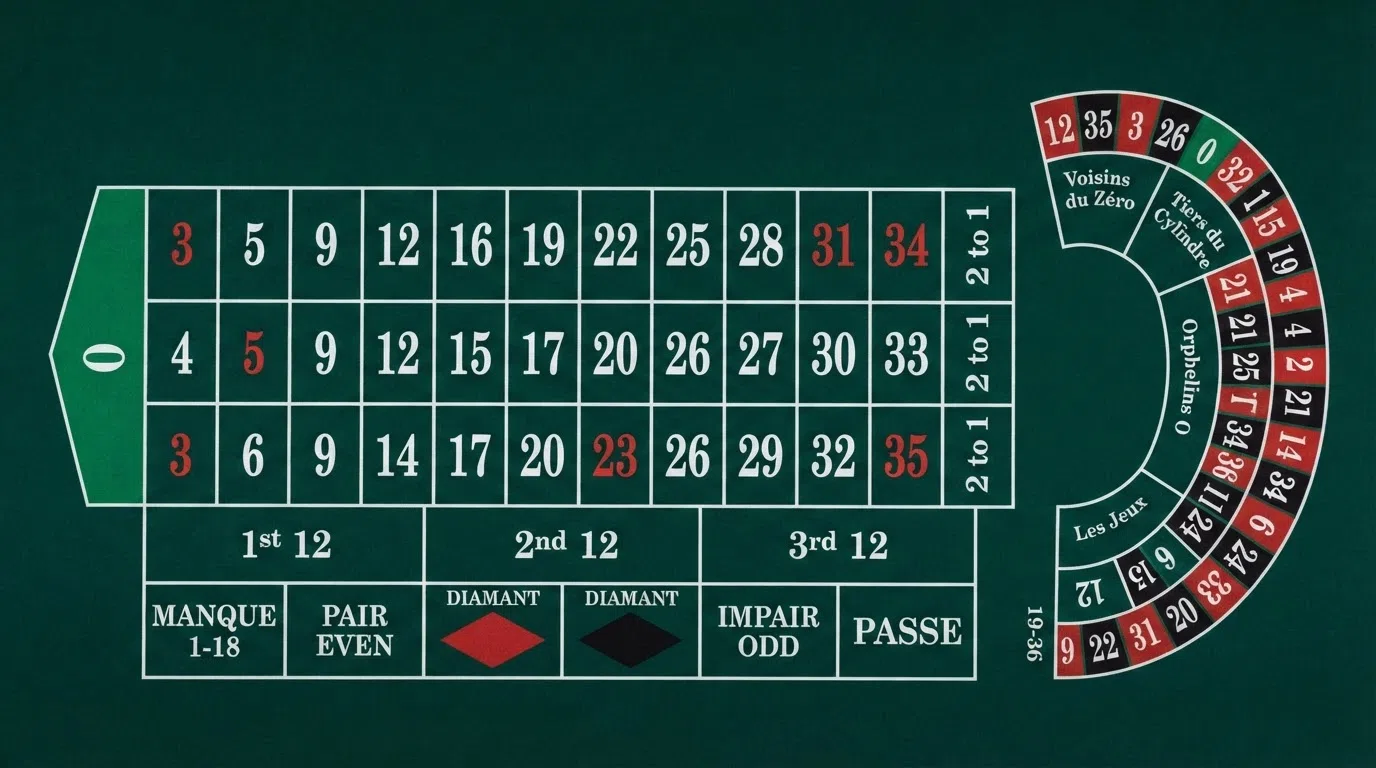
The betting felt mirrors the wheel in two zones. The inside grid carries the numbers 1 through 36 in three rows of twelve, with the zero above the grid as a separate green square. Around the inside grid sit the outside boxes: red/black, odd/even, high/low at the table’s short ends, and the three dozen and three column bets along the long edges. The felt is identical at RNG and live-dealer tables.
A second betting area — the racetrack — sits next to the wheel on most UK-facing tables. It is a curved oval mapped to the wheel’s number sequence rather than the felt’s grid, and it exists for the announced bets: Voisins du Zero (neighbours of zero), Tiers du Cylindre (third of the wheel) and Orphelins (the orphans). Those names sound like a foreign language because they are the French calls the croupier announces at land-based European tables; on Playtech’s Roulette Pro they are pre-set bet buttons on the racetrack, which is the only feature that distinguishes some RNG European titles from each other.
How a Round of European Roulette Plays Out, Step by Step
A live-dealer round runs in a fixed sequence. The croupier announces “place your bets”; chips go onto the felt before the betting window closes. The croupier spins the wheel in one direction and releases the ball in the opposite direction; the ball loses momentum, drops past the deflectors, and settles into a numbered pocket. The croupier announces the winning number, marks it on the layout, clears losing chips and pays winning bets. Outside bets on red, black, odd, even, dozens and columns are paid without ceremony; an inside bet on a single number takes longer because the croupier walks the payout around the table.
An RNG round runs the same betting sequence but compresses the rest. The wheel animation is cosmetic; the result is decided by a random number generator in the instant the spin button is pressed, and the betting interface clears losing chips and stacks winnings on winning positions without a human in the loop. The pace is faster — there is no ball to watch drop, no croupier to wait for — which is what makes RNG tables popular for short sessions and unpopular with players who want the social texture of a real casino.
One regulatory detail worth flagging: the statutory minimum spin speed of 2.5 seconds under the game-design rules applies to online slots, not to roulette. A roulette round ends when the wheel stops and the result is settled, and the Commission has not set a minimum spin duration for that. The rule is on slots; reusing it on roulette is the single most common factual error a UK page on this subject makes.
Every Inside Bet in European Roulette, Explained
The inside bets are the wagers placed directly on the numbered grid — payouts that look large because they cover few numbers and hit rarely. Even at 35-to-1, the edge on a straight-up is the same 2.70% as every other bet on the table, because the payouts are calibrated to the 37-pocket geometry. The casino does not give the player a better or worse deal on a corner than on a column; the surface is the same on every square of the felt.
| Bet Type | Numbers Covered | Payout | House Edge |
|---|---|---|---|
| Straight-up | 1 | 35:1 | 2.70% |
| Split | 2 | 17:1 | 2.70% |
| Street | 3 | 11:1 | 2.70% |
| Corner | 4 | 8:1 | 2.70% |
| Six-line | 6 | 5:1 | 2.70% |
| Dozen / Column | 12 | 2:1 | 2.70% |
| Even-money (red/black, odd/even, high/low) | 18 | 1:1 | 2.70% |
The 5:1 on a six-line feels like a worse deal than the 8:1 on a corner, but the six-line covers six numbers and the corner covers four — the payout tracks the probability. A player who bets £10 on a corner wins £80 when it hits; a player who bets £10 on a six-line wins £50 when it hits. The expected loss on either wager, over thousands of spins, is the same 27p per £10 staked.
Red or Black, Dozens and Columns: The Outside Wagers
The outside bets trade lower payouts for higher hit rates. Even-money bets on red, black, odd, even, high (19–36) and low (1–18) cover 18 numbers each, paying 1:1. The win probability is 18/37 — about 48.65% — and the loss probability is 19/37 — about 51.35%. The 2.70% edge is the gap between those two fractions. Dozens and columns cover 12 numbers each, paying 2:1, and the win probability rises to 12/37 (about 32.43%) with the same 5/37 gap that produces the edge.
The even-money bets are where the French roulette La Partage rule cuts the edge in half — to 1.35% on red, black, odd, even, high and low. Players who play even-money at a French table with La Partage are losing half as much per spin as players at a European table without it. The dozen and column bets are unchanged, because La Partage applies only to even-money bets. This is the reason French roulette, where it is offered, suits players who bet red or black for long sessions.
The 2.70% House Edge — What It Really Costs You, Spin by Spin
The 2.70% comes from the single zero. On a straight-up bet, the player selects one of 37 pockets; the probability of winning is 1/37, and the payout is 35 to 1. A “fair” payout for a 1-in-37 chance would be 36-to-1; the missing unit is the house edge, and it shows up on every bet on the table in proportion to the player’s stake. The edge is the same on the corner at 8-to-1, on the column at 2-to-1, and on the even-money bet at 1-to-1. The geometry is uniform.
In money terms, the player loses £2.70 on average for every £100 wagered over the long run. A single session can win or lose far more — variance is enormous on a 1-in-37 event — but the long-run average is the figure the maths converges on. The 97.30% return-to-player is the same number expressed as a percentage the player keeps; the 2.70% house edge is the percentage the player loses. Neither is a per-session guarantee; both are statistical averages over thousands of spins.
The expected cost of a deposit-match bonus shows the same number in a different light. The 888casino welcome bonus — 100% up to £100 with 10× wagering — gives a new player £100 in bonus funds on a £100 deposit. The wagering requirement is £100 in bonus multiplied by 10, which is £1,000 of total turnover the player must cycle through before any winnings can be withdrawn. At the European roulette house edge of 2.70%, the expected loss on that turnover is £1,000 × 0.027 = £27 — assuming only the bonus amount is wagered. The player who clears the wagering with exactly average luck walks away with £73 of the original £100 bonus. Individual sessions vary widely, and the £27 is an average over many spins, not a promise for any one player; but the £73 is the number the maths points to under the stated assumptions. The bonus is not free money; it is a partial refund of the player’s expected loss, with strings.
Beyond the Basic Table — Live Dealers, RNG Titles, and High-Stakes European Roulette
European roulette online comes in three formats: live-streamed tables with a real croupier, RNG digital games driven by a random number generator, and VIP high-limit rooms where the stakes go up. The 37-pocket geometry is the same in all three. What changes is the experience, the bet limits, and the providers that built the table.
Real Croupiers, Real Tables: Streaming European Roulette from Casino Floors
Live-dealer European roulette streams a real wheel and a real croupier from a studio or casino floor into the player’s screen, with a digital overlay for placing chips. The result is determined by a physical ball in a physical pocket, not by an algorithm, and the player watches the outcome unfold in real time. The dominant providers for UK-facing live European roulette are Evolution and Playtech, with Pragmatic Play Live also appearing on a smaller set of brands; the choice of provider determines features, table limits, and the studio setup.

Evolution’s live European roulette is the most common in the UK set, with multi-camera angles, in-play statistics, and a chat function that lets the player talk to the croupier and other players. Playtech’s live European roulette runs to a similar brief — streamed tables, digital betting, mobile-first — and several UK operators carry both providers side-by-side. Grosvenor Casinos is the unusual case: its live European roulette tables are streamed from actual Grosvenor venues rather than a studio, which is the closest experience to walking into one of the company’s eighty-odd UK casinos. Live tables are the high-trust format for the player who wants a human being spinning the wheel, and they typically carry higher minimum bets than the RNG tables because a real croupier and a real studio cost the operator more than a server.
RNG European Roulette — Gold, Pro, Premium and the Digital Titles Compared
The RNG titles are the digital offerings from the major providers — Microgaming, Playtech and Evoplay — each with its own take on the 37-pocket game. The bet limits are lower than live, the spin resolution is faster, and the features are provider-specific.
| Game Title | Provider | RTP | Volatility |
|---|---|---|---|
| European Roulette Gold | Microgaming | 97.00% | — |
| Premium European Roulette | Playtech | 97.30% | — |
| Roulette Pro | Playtech | 97.30% | — |
| European Roulette | Evoplay | 97.30% | — |
European Roulette Gold Series, by Microgaming, is the older of the four and the lowest in RTP at 97.00%. The 0.30 percentage-point gap to the Playtech and Evoplay titles is the cost of the saved-bet functionality and the nine call bets on the racetrack. Bet limits run £1 to £80, which makes the Gold series the table for lower-stakes sessions. Playtech’s Premium European Roulette takes the stakes up to a £500 maximum bet, with a 36× maximum win multiplier, and was released on 15 May 2017; it is the standard high-end RNG table in the UK market. Playtech’s Roulette Pro is the racetrack specialist — favourite-bets, announced bets including Voisins du Zero, Tiers and Orphelins — and launched in June 2012. Evoplay’s European Roulette rounds out the set at 97.30% RTP with a €3,600 maximum win. Volatility is not characterised by the providers for any of these four titles, and the gap is honest rather than an oversight.
VIP and High-Stakes European Roulette: What Changes When the Limits Go Up
VIP tables are European roulette in the same 37-pocket geometry, with the table minimum and maximum raised. Live-dealer VIP European roulette typically runs minimums of £5 to £10 and maximums of £500 to £10,000+, with a dedicated host, faster spins, and occasionally a private room. RNG VIP tables — where they exist — are scaled-up versions of the same digital titles, with the 97.30% RTP intact and the bet ceiling raised.
The 2.70% edge is unchanged at any stake. What changes is the absolute expected loss: a player wagering £500 a spin on a VIP table loses £13.50 on average per spin, against the 27p per spin at the £1 RNG minimum. The higher limits make the Martingale slightly more survivable — the table maximum is further away from the starting stake — but the ceiling still caps the progression eventually, and the edge is unchanged. VIP tables are about the experience and the stake size, not about a better deal from the casino.
Playing European Roulette Without Spending a Penny — Free Mode and Demo Play in the UK
Demo mode is the operator’s free-play version of the European roulette table: the same RNG, the same wheel layout, the same betting felt, but the chips are virtual and the winnings are not real. The strongest use of demo mode is the first one — learning the felt, the bet placement, and the payout timing before any real money is on the table.
Demo Mode vs Real-Money Play — What You Learn and What You Miss
Demo mode is excellent at teaching the geometry. The player learns the placement of inside and outside bets, the timing of the croupier’s calls on a live table, and the visual difference between a corner and a six-line. The numbers behave the same way in demo mode as in real-money play — the 2.70% house edge is built into the table, not into the wager — and the player can sit through a hundred spins to see how a betting progression actually feels.
What demo mode cannot teach is bankroll discipline. A player who loses a hundred virtual credits in ten minutes feels nothing; a player who loses £100 in real money feels the loss in a way that changes the next decision. The Martingale looks like a clever idea in demo mode, where the doubling sequence never hurts; in real-money play the same sequence is the path to the table maximum. Demo mode is the right place to learn the felt, and the wrong place to learn how to walk away.
Where to Find Free European Roulette — No Registration, No Deposit, No Catch
The majority of UKGC-licensed operators place a “demo” or “play for free” button on the European roulette thumbnails in their game lobbies. No registration is required at most UKGC-licensed sites for RNG demo play — the player can spin the wheel without an account, and the chips are virtual. The live-dealer tables are the exception: streaming a real croupier costs the operator money, and demo mode is not offered on live tables. A player who wants to learn live roulette before staking real money watches the stream in observation mode rather than playing it for free.
Demo mode is not the same as a no-deposit bonus. A no-deposit free spin — Sky Vegas offers 50 to new UK players before any deposit — gives the player a chance to win real money that can be withdrawn. Demo mode gives the player a chance to learn the table with no real money at risk and no real winnings possible. The two are different tools, and the player who wants to learn the felt uses demo mode; the player who wants to be paid for trying the operator uses a no-deposit bonus. UKGC rules require identity verification before any real-money play, including the withdrawal of no-deposit bonus winnings — so the no-deposit spin is genuinely free to play, but the cashout requires the same ID check as a real-money withdrawal.
Where to Play: The 10 Best Operators for European Roulette Online in 2026
The table below lists the ten UKGC-licensed operators that carry European roulette seriously, with the welcome offer, free-spin count, and wagering multiple for each. Every operator was verified against the Gambling Commission’s public register (last updated 29 July 2026). The ranking reflects a qualitative synthesis of European roulette game quality, fairness of the welcome offer under the 10× wagering cap, trust signals, and safer-gambling infrastructure — full methodology is in the section on how the list was built.
| Casino | UKGC Licence | Welcome Offer | Free Spins | Wagering |
|---|---|---|---|---|
| bet365 | Hillside (UK Gaming) ENC, 38721 | Up to 500 free spins via prize-reveal | 500 | 0× |
| Grosvenor Casinos | Rank Digital Gaming, 39384 | £20 deposit + £20 match + 100 spins on Big Bass Splash | 100 | 10× |
| Ladbrokes | Ladbrokes Betting & Gaming, 1611 | Play £10, get £30 casino bonus | None | 10× |
| Sky Vegas | Bonne Terre / SBG Sports, 67370 | 50 no-deposit + 200 deposit-triggered spins | 250 | 0× |
| BetMGM | UKGC-licensed | Stake £10, get 200 spins on Big Bass Splash | 200 | 0× |
| Paddy Power | UKGC-licensed (Flutter Entertainment) | 60 no-deposit + 200 deposit-triggered spins | 260 | 0× |
| 888casino | UKGC-licensed (evoke plc) | 100% deposit match up to £100 | None | 10× |
| Betfred | UKGC-licensed | Up to 200 free spins on selected Playtech titles | 200 | 0× |
| Betfair | UKGC-licensed (Flutter Entertainment) | — | — | — |
| William Hill | UKGC-licensed (evoke plc) | — | — | — |
The two operators with no confirmed welcome offer in this table — Betfair and William Hill — are still listed for their European roulette product. The bonus is not the only reason to pick a casino, and the roulette coverage at both brands is strong. The standard advice is to check the operator’s promotions page directly for the current terms.
bet365 — The Zero-Wagering Free-Spin Powerhouse for European Roulette
bet365’s welcome offer is up to 500 free spins, delivered through a 20-day prize-reveal mechanic — the player claims ten daily selections over twenty days, with each selection revealing a prize. The spins are worth £0.10 each, the winnings carry zero wagering, and the only requirement is a £10 lifetime deposit. The 7-day expiry on each batch is short, but the absence of any wagering requirement is the relevant fact for the player who cares about value.
The welcome bonus is slot-only, which is the one place the headline does not match the roulette player’s use case. The free spins cannot be used on European roulette, and the player is not getting a “£500 welcome for roulette” — they are getting a hundred or so pounds of slot value on a brand that also happens to run a strong live European roulette product. The roulette play at bet365 stands on its own: Evolution, Playtech and Pragmatic Play Live are all live, the digital lobby carries Playtech’s Premium European Roulette and Roulette Pro, and the screen handles live and RNG tabs without forcing the player to choose. UKGC licence is held by Hillside (UK Gaming) ENC, account 38721. For the roulette player, bet365 is a live-table operator first and a slot-bonus operator second; the free spins are a nice-to-have on the slot side, not the reason the brand is on this list.
Grosvenor Casinos — Land-Based Heritage Meets Live-Streamed European Roulette
Grosvenor’s welcome offer is a £20 deposit matched with a £20 bonus and 100 free spins on Big Bass Splash, with 10× wagering on the bonus and the free-spin winnings and a £2,000 maximum cashout. The 10× wagering is the new UK statutory cap, and the £2,000 cap is a generous ceiling for a £20 deposit offer. PayPal and Paysafe deposits are excluded from the welcome offer, which is worth noting for the player who funds the account that way.
The roulette product is the strongest of the ten. Grosvenor carries Evolution live streams from its own physical casino locations — a feature no other operator on this list offers — alongside Playtech, IGT and Microgaming tables. The digital lobby includes Playtech’s Roulette Pro and Premium European Roulette, and the in-venue branding translates into a recognisable visual identity on the live streams. UKGC licence is held by Rank Digital Gaming (UK) Limited, account 39384. Live-dealer fans looking for the closest thing to an in-person venue visit will find Grosvenor the top choice.
Ladbrokes — The High-Street Name with Playtech European Roulette
Ladbrokes’ welcome offer is the simplest in the set: play £10, get £30 in casino bonus, with 10× wagering. No free spins; no deposit match beyond the £30; no opt-in for a secondary bonus. The clean structure is the point — the player knows what they are getting before they stake the £10.
The roulette strength is Playtech. Ladbrokes carries the full Playtech suite: Roulette Pro with its racetrack and announced bets, Premium European Roulette at the £500 maximum bet, and the broader Playtech live European roulette feed. Evolution live dealer is also live, and the player has the choice of provider on most tables. UKGC licence is held by Ladbrokes Betting & Gaming Limited, account 1611, with the remote casino licence active from 1 November 2014 — the longest-running licence on this list. Ladbrokes is an established choice for those prioritising Playtech’s catalogue and high-street heritage.
Sky Vegas — No-Deposit Spins and Zero Wagering for a Low-Risk Entry
Sky Vegas is the only featured operator offering no-deposit free spins: 50 before the player pays a penny, plus another 200 after depositing and staking £10. The total is 250 free spins, all with zero wagering on winnings, all expiring after 7 days, with 30 days to meet the deposit-and-stake requirement for the second batch. The 50 no-deposit spins are the lowest-risk entry point in the featured set: a player who loses them has lost nothing but a few minutes, and a player who wins walks away with real cash.
The free spins are slot-only, and the winnings — because they carry zero wagering — are withdrawable cash usable on any of the casino’s games, including European roulette. Evolution, Blueprint, IGT, NetEnt and Red Tiger are the live and RNG providers, and the European roulette coverage is strong across both formats. UKGC licence is held by Bonne Terre Limited (SBG Sports), account 67370. For the player who does not want to stake a deposit to test a casino, Sky Vegas is the only option on this list.
BetMGM — Straightforward No-Wagering Spins with Strong Provider Depth
BetMGM’s welcome offer is stake £10, get 200 free spins on Big Bass Splash, worth £0.10 each, with zero wagering on winnings. The spins expire after 7 days, and the deposit-and-wager requirement must be completed within the same window. The 1× wager on casino games is the lowest playthrough hurdle in the featured set — the £10 must be cycled once before the spins unlock, and roulette counts toward that 1×.
The provider roster is broad: Evolution, Playtech, Pragmatic Play, NetEnt and Red Tiger live and RNG tables are all live, and the European roulette coverage is on par with the top of the set. The 1× wager requirement is the small print that matters — a player who stakes £10 on roulette and loses it has cleared the hurdle. The free spins are the headline; the 1× wager is the practical step. BetMGM earns its place through this blend of deep provider support and a straightforward, accessible entry.
Paddy Power — The Most Free Spins in the Set, Zero Wagering
Paddy Power offers 260 free spins in total — 60 before deposit (50 on slots and 10 on Paddy’s Mansion Heist) and 200 after a £10 deposit-and-wager. The zero wagering structure matches Sky Vegas, and the per-spin value is £0.10 across the board. The 7-day expiry is standard.
The payment exclusion is the relevant restriction. Debit card, Apple Pay or Pay by Bank are the qualifying deposit methods; PayPal and other e-wallets are excluded from the welcome offer. A roulette player who funds the account via PayPal will need to switch to a debit card or Pay by Bank to claim the 200 spins. The provider roster — Evolution, Playtech, Red Tiger and NetEnt — is solid for European roulette, with live and RNG options on both. Paddy Power stands out as the primary recommendation for those targeting maximum free-spin volume.
888casino — The Only Deposit-Match Bonus in the Set
888casino stands alone in the featured set with a classic deposit-match welcome bonus: 100% up to £100 on a first deposit of £10 or more. The wagering is 10× on selected slots only, with a 90-day validity and a £100 maximum cashout. The £100 cap is the lowest in the set — the player who takes the full £100 bonus and clears the wagering with maximum luck cannot withdraw more than £100 from the bonus.
The wagering is on selected slots, and roulette play does not count toward the requirement. The 888casino player who deposits £100 to take the full match bonus cycles the wagering on slots rather than roulette, then withdraws any remaining bonus funds up to the £100 cap. The live and RNG lobbies are Playtech, Evolution, NetEnt, Red Tiger and 888 proprietary — the 888 titles are exclusive to the brand and not available elsewhere. UKGC licence is held by evoke plc. 888casino remains the standout for players preferring a deposit-match structure over free-spin bonuses.
Betfred — Playtech Roulette Titles Plus Zero-Wagering Free Spins
Betfred’s welcome offer is up to 200 free spins on selected Playtech titles for new customers who deposit via debit card and stake £10 on casino slots. The spin values vary by title — Age of the Gods at £0.20, Better Wilds at £0.10, and God of Storms 2 at £0.05 — and the wagering is zero on all winnings. The 7-day expiry is standard, and the 14-day window to stake £10 from registration is the constraint on the offer.
The variance in spin value is the practical detail. Age of the Gods spins are worth four times God of Storms 2 spins, and the player who lands on the higher-value title by prize-reveal walks away with a more valuable welcome. The roulette product is Playtech — Roulette Pro and Premium European Roulette — alongside Evolution live dealer and IGT tables. Betfred is a reliable choice for players who prioritise the Playtech catalogue and don’t mind variable spin values.
Betfair — The Exchange Brand with European Roulette
Betfair’s current welcome offer was not confirmed in this review’s research run. The brand is included for its established UK presence, its Playtech and Evolution European roulette tables, and its Red Tiger slot coverage. The exchange-betting ecosystem is a different product from the casino, and the player who values the breadth of a Flutter brand under one roof has reasons to look at Betfair alongside the casino-only operators. UKGC-licensed under Flutter Entertainment, with the register last updated 29 July 2026. The pragmatic advice is to check Betfair’s promotions page directly for the current welcome offer before staking a deposit — the roulette product remains accessible regardless of the bonus.
William Hill — The Heritage Bookmaker with European Roulette
William Hill’s current welcome offer was not confirmed in this review’s research run. The brand is included for its decades-long UK presence, its Playtech, Evolution, IGT and Red Tiger European roulette tables — the four-provider coverage matching the top of the set — and its status as one of the most recognised gambling names in Britain. UKGC-licensed under evoke plc, with the register last updated 29 July 2026. The pragmatic advice is the same as for Betfair: check the operator’s promotions page for the current terms, and treat the roulette product as the reason to look at William Hill rather than the bonus.
Is Online European Roulette Legal? Licensing, Player Protections, and the Offshore Question
Online European roulette is legal in Great Britain when played at a UKGC-licensed casino, and illegal otherwise. The Gambling Act 2005, extended by the Gambling (Licensing and Advertising) Act 2014, requires any operator serving GB customers to hold a Gambling Commission licence regardless of where the operator is based. The UKGC is the single statutory regulator — an executive non-departmental public body sponsored by the Department for Culture, Media and Sport — and the three licensing objectives under section 1 of the 2005 Act are preventing crime and disorder, ensuring fair and open gambling, and protecting children and vulnerable persons. Minimum age is 18 across all commercial gambling. Since 7 May 2019, remote licensees must verify name, address and date of birth before any deposit or gambling, including the use of bonuses and free-to-play games.
The UK Gambling Commission Licence — What It Means for Your Money
A UKGC licence is not a rubber stamp. It imposes binding conditions on every operator — the Licence Conditions and Codes of Practice (LCCP), the Remote Technical Standards (RTS), and the Social Responsibility Codes — and the Commission enforces them through financial penalties, licence suspension, and licence revocation. The public register at gamblingcommission.gov.uk/public-register lists every licensed operator with its account number, trading names, and licence status; the register held more than 2,663 records at the last update on 29 July 2026, and every operator in the ranking above was verified against it.
The relevant licence numbers for the featured set are: bet365 (Hillside UK Gaming ENC, 38721), Ladbrokes (Ladbrokes Betting & Gaming, 1611, remote casino licence active 1 November 2014), Sky Vegas (Bonne Terre / SBG Sports, 67370), and Grosvenor (Rank Digital Gaming, 39384). BetMGM, Paddy Power, 888casino, Betfred, Betfair and William Hill are all on the register as GB-licensed operators at the same date. The register is the single source of truth: a player who checks the number before depositing is doing the one-minute check that protects every pound they stake.
The Rules That Protect UK Roulette Players — Caps, Bans, and Fair-Play Requirements
The UK player-protection framework is unusually dense. The relevant rules, in plain English, are these. Operators must prompt customers to set a financial deposit limit before their first deposit (from 31 October 2025), and decreases to a limit take effect immediately. A standardised “gross deposit limit” must be offered from 30 September 2026 with at least equal prominence to other limit options. Credit cards are banned for all remote gambling since 14 April 2020, including credit-card-funded e-wallet payments — anonymous play is not possible at a UKGC-licensed casino. From 19 December 2025, wagering requirements are capped at 10× the bonus amount under LCCP Social Responsibility Code 5.1.1, and mixed-product promotional offers are banned.
The slots stake cap under SI 2025/215 is the regulation most commonly misreported on roulette pages. The cap is £5 per game cycle for players aged 25 and over (from 9 April 2025) and £2 for players aged 18–24 (from 21 May 2025), and it applies to online slots only — not to roulette. The “game cycle” in the regulation refers to a slot spin; a roulette round ends when the wheel stops and the result is settled, and the £5/£2 ceiling does not apply. The casino’s own table limits apply instead, and a roulette player can stake the £100, £500 or £10,000 maximum set by the operator. Reputable UK pages distinguish the two; the misreporting is the same fact stated wrong.
The financial-vulnerability check regime is the next layer of the framework. Under LCCP Social Responsibility Code 3.4.4, light-touch checks using publicly available data are triggered at £150 net deposits in a rolling 30-day period (from 28 February 2025). The stage-1 financial risk assessment thresholds — £5,000 net deposits in 24 hours for players 25 and over, £2,500 for under-25s — were confirmed on 7 July 2026, but the Stage 1 checks are not yet commenced in force. The high-spending customer is “markedly more likely to be in financial difficulty” than the general population, in the Commission’s own findings from the vulnerability pilot, and the check regime is the policy response.
Offshore Operators and European Roulette — What a Missing British Licence Costs You
An offshore licence is not a substitute for a UKGC licence. An MGA, Gibraltar or Curaçao licence does not satisfy the point-of-consumption requirement under the Gambling Act 2014, and providing unlicensed gambling to GB customers is a criminal offence under section 33 of the 2005 Act — up to 51 weeks’ imprisonment, an unlimited fine, or both. The Commission’s enforcement approach is disruption rather than ISP blocking: cease-and-desist notices, search-engine delisting, payment-provider referrals, and domain registrar pressure. The Commission’s published figures record 3,140 disruption notices and 447,778 URLs referred between April 2024 and June 2025; the Commission does not currently hold statutory ISP-blocking powers, and legislation to grant them has been proposed but not enacted.
The player who signs up at an unlicensed site loses every protection this page has described. There is no GamStop coverage on an offshore site; the self-exclusion register does not reach it. There is no ADR route and no British consumer redress if funds are withheld. The Commission does not act as a complaints body for unlicensed operators, and the player’s recourse is the overseas regulator — which is judged by its own standards, not the UKGC’s. The practical advice is straightforward: the UKGC public register takes a minute to check, and the operator’s account number is the one fact that decides whether the casino is one the player can trust with a deposit.
Staying in Control — Safer Gambling Tools Every European Roulette Player Should Know
The UK safer-gambling infrastructure is a concrete toolkit, not an abstract warning. The tools are built into the licensed system, and the player who knows how to use them keeps roulette as entertainment.
Setting Deposit Limits and Session Controls Before You Play
Deposit limits are mandatory for UK operators to offer before the first deposit. A decrease takes effect immediately — the player who sets their limit at £50 for the week and tries to deposit £70 will be blocked. An increase faces a cooling-off period, which gives the player time to reflect on whether the higher ceiling is actually necessary. The 30 September 2026 standardised gross deposit limit will standardise the offer across operators, but the underlying rule — that a player must set a limit before they play — has been in force since 31 October 2025.
Session controls are the second layer. Reality checks are pop-ups that display time played and net spend at intervals during a session; time-out periods range from 24 hours to 6 weeks; and the operator must display total losses, total wins, and time played during a session. The game-design rules on slots — auto-play banned, minimum 2.5-second spin speed, losses disguised as wins banned — apply to slots, not roulette, but the principle of pace awareness applies as strongly to a live roulette table. A spin resolves every 30–60 seconds at a live table and faster on RNG, and a player can cycle through dozens of bets before noticing how long they have been playing. The session display is the check that surfaces the elapsed time.
GAMSTOP and Self-Exclusion — How It Works, What It Covers, and What It Doesn’t
GAMSTOP is the national self-exclusion register, free to use at gamstop.co.uk, and mandatory for every GB-licensed online operator since 31 March 2020. The exclusion periods are 6 months, 1 year, or 5 years; the 5-year exclusion can be set with auto-renewal. The exclusion cannot be cancelled early, and the record continues for up to 7 years after expiry if the registrant does not contact GAMSTOP to confirm they want to be removed. The mechanism is simple: a player who registers with GAMSTOP cannot open a new account at any GB-licensed casino, and the existing accounts are blocked for the duration of the exclusion.
The limitation is honest. GAMSTOP is online-only and does not reach unlicensed sites. A player who self-excludes via GAMSTOP and then opens an account at an offshore European roulette casino has no GAMSTOP protection at that site — the only barrier is the player’s own discipline. The device-level complement is Gamban, blocking software available free through the Commission’s page, which blocks gambling sites at the device level rather than the operator level. The two tools together — GAMSTOP for the licensed market and Gamban for the device — close more of the gap than either alone.
When Roulette Stops Being Entertainment — Warning Signs and Where to Get Help
The line between playing European roulette for enjoyment and chasing losses is crossed one session at a time. The warning signs are concrete: chasing losses, betting more than planned, hiding gambling from family, borrowing to gamble, feeling irritable when not playing. The UK help infrastructure is built to catch the player at any of those points.
The GamCare National Gambling Helpline is 0808 80 20 133 — free, confidential, 24/7 — with a live chat at gamcare.org.uk for players who prefer not to call. GamCare also offers free counselling and treatment across England, Scotland and Wales. GambleAware (begambleaware.org) is the signposting hub for information, self-assessment tools, and routes into treatment. The NHS runs gambling harm clinics in England, Scotland and Wales; Gamblers Anonymous runs peer support meetings across the UK; SENSE is the land-based self-exclusion scheme for casino floors. A precise current UK prevalence figure for gambling disorder was not surfaced in the research run for this article, and the qualitative point is the one to carry: the help is free, confidential, and one call or one click away.
How We Chose and Ranked the Best European Roulette Casinos
The ranking is built from a structured evaluation, not a single editorial pick. Every operator was checked against the Gambling Commission’s public register at the time of research (last updated 29 July 2026), and the licence numbers on the operator pages are the verifiable claim. Game-provider data was sourced from the operator sites and independent casino-review sources. Welcome-offer terms were verified against the operator promotions pages and the major UK affiliate audits.
The qualitative criteria, in the order of weight applied, are: the strength of the European roulette product — live-dealer and RNG tables, provider count, table limit depth — and the fairness of the welcome offer under the 10× wagering cap that took effect on 19 December 2025. Trust signals — licence longevity, complaints record, ownership transparency — are the next layer. The safer-gambling toolset is the last. No proprietary scoring system, weightings or percentages are applied; the ranking is a synthesis of these criteria, and the table is the summary of the part that fits in a grid.
Two operators in the featured set — Betfair and William Hill — had welcome offers unconfirmed at the time of research. Both are included for their European roulette product and their UK presence, and the unconfirmed status is disclosed in the table and the operator block. The single point a reader can take from this is that the bonus is not the only reason to pick a casino, and the roulette coverage at a brand is worth checking even when the headline number is missing.
Before You Place Your First Bet — The European Roulette Checklist for UK Players
Five things matter, drawn from the rest of this page. Run them in order before the first deposit.
European roulette over American roulette. The single zero cuts the house edge from 5.26% to 2.70%. On £100 wagered, the European player loses £2.70 on average; the American player loses £5.26. The American game is not a different flavour; it is a more expensive one. The UK market favours European, and the player who sticks with European on every visit avoids the most expensive table in the room.
A UKGC-licensed casino, verified on the public register. The Commission’s register at gamblingcommission.gov.uk/public-register takes a minute to check. A UKGC licence is the only licence that gives the player the protections on this page — GamStop, ADR, consumer redress, the 10× wagering cap, the credit card ban — and the operator’s account number is the one fact that decides whether the casino is one the player can sign up at safely.
A welcome offer that matches the player’s style. The zero-wagering free-spin deals — at bet365, Sky Vegas, BetMGM, Paddy Power, Betfred — let the player keep what they win, with no playthrough on the bonus. The deposit-match deals — at Grosvenor, Ladbrokes, 888casino — give the player more to play with but require cycling the wagering before any withdrawal. The 10× cap is the UK standard, and the player who reads the small print before the first deposit is the player who is not surprised by it later.
A deposit limit, set before the first deposit. The single most effective brake on overspending is the limit the player sets themselves. The UK regulation requires operators to offer the limit before the first deposit; the player who takes the offer is using the system as it is designed to be used.
A recognition that the 2.70% is the price of the seat. Rouletted is not a way to make money. The edge is the edge, and the system that beats it has not been invented. The player who treats roulette as paid entertainment — the price of a spin being the 2.70% commission on the stake — is the player who enjoys the game without expecting it to pay for itself.
The headline: European roulette at a UKGC-licensed casino, played with a deposit limit and a clear understanding of the 2.70% edge, is the safest way to enjoy online roulette in Great Britain. No system beats the maths, and no offshore site is worth losing every protection the UK system provides.
Frequently Asked Questions
What is the difference between European and American roulette?
European roulette has 37 pockets — numbers 1 through 36 plus a single zero — and a house edge of 2.70%. American roulette has 38 pockets — the same 36 numbers plus both a single zero and a double zero — and a house edge of 5.26%. The extra zero pocket on the American wheel is the only structural difference, and it nearly doubles the casino’s edge on every bet. The European version is the standard at UK online casinos.
What is the best strategy for European roulette?
No betting system alters the 2.70% house edge. The Martingale system — doubling the bet after every loss on even-money bets — is the most famous, but the doubling sequence is capped by the table maximum and the player’s bankroll, and the sequence dies as soon as either is reached. The Fibonacci and Labouchere systems are gentler progressions, but they do not change the underlying maths. The only “strategy” that works is bankroll discipline: set a deposit limit, choose even-money bets if you want longer sessions, and accept that the 2.70% is the price of the seat.
Is European roulette better than French roulette?
French roulette uses the same 37-pocket wheel as European roulette, but it adds La Partage or En Prison on even-money bets — both rules return half the stake on a losing even-money bet, halving the effective house edge to 1.35% on red, black, odd, even, high and low. European roulette is the better choice where the dozen and column bets dominate, because La Partage does not apply to those. French roulette is the better choice for players who bet even-money at length, but it is rarer at UK online casinos than European.
Do UK casinos offer bonuses that can be used on European roulette?
Most UK casino bonuses are slot-only, and the specific welcome offers in this ranking are no exception — the free spins at bet365, Sky Vegas, BetMGM, Paddy Power, Betfred and 888casino are all valid on slot games. The 888casino deposit-match bonus carries wagering on selected slots only, and roulette play does not count toward the wagering requirement. The cash winnings from zero-wagering free spins are unrestricted and can be used on European roulette, but the bonus itself is locked to slots. No-deposit bonuses carry the same restriction.
What is the RTP of European roulette?
The theoretical return-to-player on European roulette is 97.30% — the inverse of the 2.70% house edge. The figure is identical across every bet on the table: straight-up, split, corner, column, dozen, and even-money. The Playtech Premium European Roulette, Playtech Roulette Pro, and Evoplay European Roulette titles all carry 97.30% RTP; the Microgaming European Roulette Gold Series is the exception at 97.00%, the cost of its saved-bet functionality and nine call bets. The 97.30% is a long-run average, not a per-session guarantee.
European Roulette Betting Systems — Do the Martingale and Its Cousins Actually Work?
Betting systems do not work, in the only sense a system is supposed to work: none of them changes the 2.70% house edge. The Martingale — double the bet after every loss on an even-money bet — is the most famous. The illusion is that a win “recovers” the previous losses. The reality is that the doubling sequence requires a bankroll that grows geometrically, and the table’s maximum bet caps the sequence at a level the player may not be able to reach. Seven consecutive losses on even-money bets is roughly a 1-in-106 event, and a £10 starting bet requires £1,270 for the eighth spin. The eighth spin recovers £1,250 of losses and returns £10 of profit, but only if the table maximum allows the bet. At a £500 table cap, the sequence dies on the seventh step.
The Fibonacci and Labouchere systems are gentler progressions, but “gentler” is not the same as “profitable”. The house edge is unchanged, the bankroll still has a finite ceiling, and the table maximum still caps the doubling. No betting system has ever altered the long-run edge in European roulette; the systems rename the loss and make it feel like a strategy, but the underlying maths is the same on every spin. The 2.70% is the price of the seat at the table, and the only way to change it is to play at a different game.
Slots – fastestpayout-casinos-uk
Content created by the «fastestpayout-casinos-uk» team