
The Most Trustworthy Online Casinos in the UK, Ranked
 Available in GB
The word “trustworthy” gets thrown around by every casino that can spell it, which makes the search for a genuinely safe UK site harder than it looks. The honest answer is that the search starts, and mostly ends, with one regulator. A UK Gambling Commission licence is the only meaningful baseline, and the rest — fund protection, fair bonus terms, audited games, working self-exclusion — is a direct consequence of that one fact. Without it, nothing else on this page applies.

The UK framework is unusually strict by international standards, and the cost of that strictness shows up in places players notice: a £5 maximum stake on most online slots, a hard 10× cap on bonus wagering, a mandatory reality check at intervals you set yourself, and a national self-exclusion register that no licensed operator can sidestep. None of those restrictions is decorative. Each one closes a door that a less regulated market leaves open. Whether the trade is worth it is a different question, and one this page answers as it goes.
What follows is a working definition of trust on a UK-licensed site, a step-by-step method for verifying any operator yourself in about 30 seconds, a ranked comparison of ten operators that all cleared the entry test, and a full account of the regulations and tools that turn a UK licence into something a player can rely on.
Current as of September 8, 2026 against the UK Gambling Commission’s public register at gamblingcommission.gov.uk.
What Makes an Online Casino Trustworthy — and How to Spot One
A trustworthy UK casino is not a casino that calls itself trustworthy. It is a casino that has met a series of independently enforceable obligations, and where you can verify each one in the time it takes to boil a kettle. The list is short, and the order matters.
The first test is the UKGC licence. No licence, no other question. The second is fund protection — whether your deposit is ring-fenced in a way that survives the operator going under. The third is independent game testing, meaning a third-party lab has certified the random number generator behind every slot and table game. The fourth is the post-2026 bonus regime, which is the first time in years that comparing offers is a clean exercise. The fifth is safer-gambling infrastructure, from GAMSTOP on the national level to a deposit-limit prompt before your first pound goes in. Each of these is a separate chapter; what unites them is that a UKGC licence pulls every lever, so an unlicensed operator fails all of them at once.
That said, the licence is not the whole story. The UK market is in the middle of a regulatory tightening that started in October 2021 and has not stopped. The post-2026 reforms — a 10× hard cap on wagering, a ban on mixed-product offers, age-banded slot stake limits, mandatory financial vulnerability checks at £150 — are the single clearest trust signal on the page, because only a licensed operator has to obey them. An offshore site selling the same product has not opted into any of it.
The Non-Negotiables: UKGC Licence, Fund Protection and Independent Audits
Three things must be in place before anything else on a UK casino gets a look in.
A UKGC operating licence is the entry ticket. The Commission’s public register, at gamblingcommission.gov.uk, lists every licensed operator and is searchable by business name, trading name, domain or account number. The register shows the licence status (active, suspended, surrendered), the licensed activities covered (remote casino, remote bingo, sports betting), and any regulatory action. A footer badge on a casino’s homepage means nothing on its own; the register is the only source that counts.
Player fund protection is the second pillar, and the one that matters most if the operator fails financially. The UKGC requires operators to hold player funds in one of three ways, which the operator must disclose. The strongest form is insurance-backed, where the policy pays out if the operator becomes insolvent. The middle tier is medium protection, with funds held in a trust or similar independent arrangement. The weakest permitted tier is basic segregation, where player balances are kept in a separate bank account from operating cash. Every tier is better than nothing — the offshore alternative is “no separation at all” — but the tiers are not equal, and a casino that picks basic segregation is making a different choice from one that buys insurance.
Independent fairness testing is the third. A random number generator is a piece of code, and code is what auditors test. The three labs that dominate the UK market are eCOGRA, Gaming Laboratories International and iTech Labs. Each runs games through statistical analysis, checks the published return-to-player figures against what the software actually pays out, and issues a certification the casino can display. An audit badge from one of the three is the standard signal; the absence of one is a question worth asking.
Beyond these three, every licensed casino must use SSL encryption to protect data in transit, must verify a player’s identity before the first deposit, and must offer access to an approved Alternative Dispute Resolution provider such as IBAS for any complaint the operator’s own team cannot resolve. None of these is headline-grabbing. Together they are the floor.
How to Verify a UK Casino Yourself in 30 Seconds
A casino can claim anything on its own website. The only source that matters is the UKGC’s public register, and the route through it is short.
Open gamblingcommission.gov.uk and find the public register, then search by either the operator’s company name, the trading name on the casino’s footer, the domain in the URL bar, or the licence account number if you have it. The four fields cover every angle a casino might use to identify itself. The result page shows whether the licence is active, what activities it covers, and any regulatory action. A casino that holds a remote casino licence and is marked Active is licensed to take your money. A casino that is suspended, surrendered, or simply not on the register is not.
The check takes about 30 seconds and works equally well on a phone. It works whether you have an account already or you have just clicked through from an advert. The point is that the casino’s own claims — the badge in the footer, the “fully licensed and regulated” strapline, the “UK players welcome” promise — are not the source. The register is.
Two practical tips. First, search by the company name on the casino’s terms-and-conditions page, not the brand name on the homepage; a casino called “LuckyReelsUK” on the front may trade under a parent company with a different name on the register. Second, watch for licences that cover sports betting or bingo but not remote casino — the activity list is the part that tells you whether the casino product you are about to use is the one the licence actually covers.
Why the UK’s Post-2026 Bonus Rules Are a Trust Signal, Not a Restriction
The new bonus regime is the easiest way to tell whether a casino is playing by UK rules or running an older playbook. Until recently, a UK casino could set its own wagering multiple — 30×, 40×, 65× were all common — and could bundle a sports free bet into a casino welcome. From 19 December 2025, neither is permitted.
The 10× wagering cap is the headline change. It applies to every bonus, on every licensed UK casino, in one direction only: down. The Commission is on record saying that capping wagering “decreases the likelihood of harm, reduces complexity, and improves transparency while maintaining consumer choice,” which is the regulator’s own argument that this is a trust intervention, not a commercial one. For the player, the practical effect is that a £100 bonus no longer demands £3,000 of slot play to clear; £1,000 is the ceiling. A bonus whose terms exceed 10× is now an instant red flag that the operator is not licensed, or is licensed and ignoring the cap.
The mixed-product ban closes a different door. The old “bet £10 on the football, get 50 free spins” offer was a single bonus that crossed a product boundary, and was easy to over-commit to. Splitting offers by product is now mandatory, and direct marketing requires a separate opt-in for each product and each channel — from 1 May 2025. The result is that two offers from two different casinos can finally be compared on the same axis, because every casino has to publish terms under the same rules.
For a player choosing where to play, the test is simple: a bonus with wagering above 10×, or a promotion that bundles a casino bonus with a sports free bet, is not from a UK-licensed operator. The arithmetic the marketing used to hide is now visible by law.
Trustworthy Slots — What the UK’s Game-Design Rules Protect You From
The rules on slot design are the part of the framework players feel at the machine. They were put in place on 31 October 2021 and tightened by the age-banded stake cap in 2025, and they exist to close the small psychological tricks that make a slot harder to walk away from.
Auto-play is banned. A player can no longer set 500 auto-spins and let the machine run; each spin is a deliberate action. Spin speed has a minimum of 2.5 seconds per cycle, which slows the rate at which money can be staked and makes the time spent playing visible. “Losses disguised as wins” — the celebrated slot trick of pairing a losing spin with a flashing lights-and-sound fanfare — are banned. Reverse withdrawals are permanently banned, meaning a player cannot deposit, play, and then cancel a withdrawal back to the card in a single session. Session loss, win and time displays are mandatory, surfacing the running cost of play while it is still going on.
On top of the design rules, the stake cap from SI 2025/215 sets the maximum per game cycle at £5 for players aged 25 and over, and at £2 for players aged 18 to 24. A “game cycle” runs from the moment a spin starts until the stake is lost or the winnings are credited; it is not a per-spin cap, but in practice it functions as one. The age-banded figure is unusual internationally and is one of the clearest differentiators of the UK model.
None of this means a licensed slot has a better return to the player. The house edge is the house edge. The rules instead remove the design choices that make a slot harder to leave: no auto-play to remove the player from the action, no faster cycles to compress time, no fake wins to soften losses.
Crypto Casinos and Trust — Why ‘Provably Fair’ Is Not the Same as Regulated
Crypto casinos make a clean argument for themselves: the game is provably fair, the ledger is public, the operator cannot cook the books. The argument is half right and the conclusion is wrong.
Provably fair is a real mechanism. A crypto casino publishes a hashed seed before play and lets the player verify after the fact that the result was determined by that seed, not by the operator adjusting the outcome. The mechanism is mathematically sound and the verification is genuinely available. The problem is what it does and does not cover. Provably fair proves the game was not tampered with. It does not segregate player funds, does not give access to a UK-approved Alternative Dispute Resolution service, does not connect to GAMSTOP, does not invoke the UKGC complaints route, does not trigger the £150 vulnerability check, and does not honour the 10× bonus cap or the £5/£2 stake limit. The verification is real; the surrounding protection is not.
The relevant fact for UK players is that no UKGC-licensed casino currently accepts cryptocurrency deposits. The choice is therefore not between “a regulated casino that takes Bitcoin” and “a provably fair crypto casino”; it is between a UKGC-licensed casino that takes pounds and a crypto casino that takes tokens and sits outside the UK system. A reader who values the provably-fair claim more than GAMSTOP, IBAS and the Commission’s enforcement arm is making a deliberate choice, and a costly one. For most players, the protections wrapped around a UKGC licence are the point.
Red Flags — When a Casino’s Trust Claims Do Not Add Up
The framework above is supposed to make every UK casino safe, and in the broad sense it does. The places it does not are identifiable.
A missing or unverifiable UKGC licence number is the first and most serious warning. If the operator’s homepage does not display a licence number, or the number does not resolve on the register, walk away. A licence that is on the register but does not list remote casino among the licensed activities is the second warning — the casino is licensed for something, but not for what you are about to do.
A bonus whose wagering requirement is above 10×, or a promotion that bundles a casino bonus with a sports or bingo bonus, is operating outside the post-2026 rules. Either the operator is unlicensed, or it is licensed and ignoring the cap. Neither is acceptable.
The absence of independent certification from eCOGRA, Gaming Laboratories International or iTech Labs is a softer warning, because not every audited game carries a visible badge, but a casino that names no testing body at all has chosen not to disclose the audit. The absence of any reference to GAMSTOP on the safer-gambling page is a hard warning, because GAMSTOP participation is mandatory and a casino that does not surface it is either unlicensed or not bothering to make the link obvious.
Finally, the marketing. A casino that emails and texts aggressively, never mentions limits, and pushes the player toward higher deposits is signalling that it sees compliance as a chore. The opposite — a casino whose safer-gambling page is a click away, whose promotional emails carry a one-click opt-out, and whose deposit-limit prompt is the first thing you see — is the signal that the operator takes the licence as a working set of obligations rather than a marketing badge.
How to Read Casino Reviews — Separating Genuine Assessment From Affiliate Marketing
Most ranking pages in this market are paid placements. The disclosure is usually present but small; the methodology, if there is one, may be a paragraph at the foot of the page. Separating the two is mostly a matter of looking at what the review does when the answer is uncomfortable.
A serious review names the UKGC licence number and the licensed entity. talkSPORT’s casino methodology, for example, treats a valid UKGC licence as the first gate and refuses to test an operator that fails it. That is a baseline a reader can apply themselves. A weaker review treats the licence as a footer note, mentions “fully licensed” once, and moves on to the welcome offer.
The next test is methodology. A review that says “we tested deposits, withdrawals, customer support, game library” and shows the results has done something. A review that lists twenty operators, gives each a paragraph, and produces no individual scores is recycling the same marketing copy the casino publishes. The tell is specificity: a review that says “withdrawal to Visa took 1 working day on 26 July, 1.5 days on 30 July” has done the work. A review that says “fast withdrawals” has not.
Disclosure of commercial relationships is the third test. UK advertising rules require it; the ASA enforces it. A review that buries “we may earn a commission” in a footer link is technically compliant; a review that opens with the disclosure and names the commercial arrangement is showing that it has thought about the conflict. Both are common, and the second is closer to useful.
Finally, negatives. A genuine review of a UKGC-licensed casino will mention the restrictions — the £5 stake cap, the 10× wagering limit, the GAMSTOP sign-up, the deposit prompt. A review that lists only positives is reading the marketing brief. The restrictions are the price of the protections, and a page that pretends they do not exist is not telling the reader the whole story.
Real-Money vs Demo Play — What a Trustworthy Casino’s Free-Play Offer Tells You
Demo mode — the ability to play slots and table games for fun money without depositing — is standard on UK-licensed sites, and it is worth taking seriously as a trust signal. The reason is small but pointed: a casino that lets you test its product before you spend a penny is, in a modest way, demonstrating confidence in what it sells.
The regulatory framework treats demo play and real-money play differently for one purpose only: identity verification. Since 7 May 2019, every remote licensee must verify a player’s name, address and date of birth before the first deposit, and must run the verification before the first bet. A demo session does not require verification, which is why a casino can offer a few hundred free-play spins without an account. Once a player chooses to deposit, the same rules that govern real-money play apply — the same stake cap, the same spin-speed minimum, the same prohibition on losses disguised as wins.
A casino that hides its game library behind a deposit wall is making a different choice. The game library is not regulated in a way that requires a deposit to view; the choice to require one is a marketing choice. It is a small one, but small choices are how the larger picture is built.
The UK’s Most Trustworthy Online Casinos, Compared
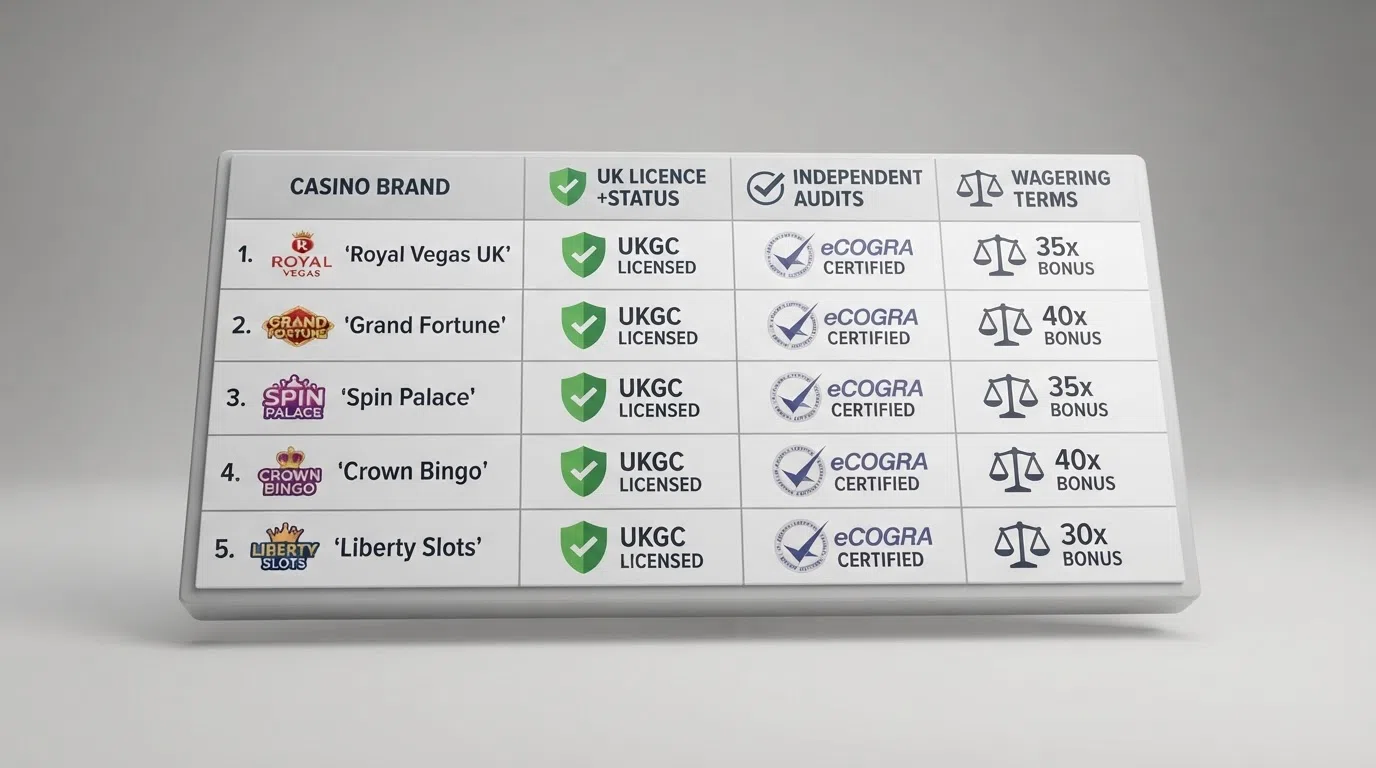
The ten operators below all hold active UKGC remote casino licences and were verified against the public register for this ranking. They are not in order of bonus generosity; they are in an order that reflects trust signals, with the strongest combination of licence history, breadth of game library, and bonus fairness leading. Where the current welcome offer was not captured during research, that is noted in the operator’s profile rather than filled in from another source.
| Casino | UKGC Licence Status | Welcome Offer | Wagering on Bonus | Key Game Providers |
|---|---|---|---|---|
| bet365 Casino | Active (account 38721, Hillside UK, from 17 Oct 2019) | Up to 500 free spins via daily prize reveal | 0× on winnings | Pragmatic Play, Playtech, NetEnt, Evolution, Big Time Gaming (40+) |
| William Hill Vegas | Active (account 2752, William Hill Organization, from 1 Jan 2009) | 200 free spins on Big Bass Splash | 10× on winnings | Pragmatic Play, Evolution, Blueprint, Red Tiger, Playtech, NetEnt |
| Sky Vegas | Active (Flutter Entertainment) | 50 no-deposit spins + 200 spins on £10 deposit | 0× on winnings | Blueprint, Pragmatic Play, Red Tiger, Evolution, NetEnt, IGT |
| 888 Casino | Active (account 39028, 888 UK, from 1 Nov 2014) | 100% deposit match up to £100 (alt: 100 free spins) | 10× on bonus funds | Pragmatic Play, Playtech, NetEnt, Evolution, Red Tiger, Blueprint |
| Ladbrokes | Active (account 1611, Ladbrokes Betting & Gaming, from 1 Nov 2014) | 100 free spins + 300 LadBucks | 10× on winnings | Pragmatic Play, Evolution, Playtech, Red Tiger, Blueprint, NetEnt |
| Coral | Active (Entain group) | 100 free spins | 0× on winnings | Pragmatic Play, Evolution, Blueprint, Red Tiger, Playtech, NetEnt |
| Paddy Power Games | Active (Flutter Entertainment) | 60 no-deposit spins + 100 spins on £10 deposit | 0× on winnings | Pragmatic Play, Blueprint, Evolution, Red Tiger, Playtech, NetEnt |
| Betfair Casino | Active (Flutter Entertainment) | — | — | Playtech, Pragmatic Play, Evolution, Red Tiger, Blueprint, NetEnt |
| Betfred Casino | Active (Petfre Gibraltar) | — | — | Playtech, Pragmatic Play, Evolution, Red Tiger, Blueprint |
| Gala Casino & Bingo | Active (Entain, LC International) | — | — | Pragmatic Play, Evolution, Playtech, Red Tiger, Blueprint, NetEnt |
The seven operators with a confirmed welcome offer sit in a different category from the three that do not. A casino whose current bonus terms are not on the page is not failing the trust test — Betfair, Betfred and Gala all hold active UKGC licences and operate under the same regulatory framework as the rest — but the reader comparing offers has to look at the casino directly for what is on the table this week. Where the offer is confirmed, the comparison is more useful, and the wagering column shows the real spread: four of the seven are wager-free, two sit at the 10× cap, and one (888’s deposit match) also sits at the 10× cap on bonus funds. The cap is the legal ceiling; the wager-free offers are below it.
| Casino | Welcome Offer | Free Spins Count | Wagering Requirement | Bonus Validity | Maximum Cashout |
|---|---|---|---|---|---|
| bet365 Casino | Daily prize reveal | Up to 500 | 0× | 30 days to claim, 7 days to use | Not capped |
| William Hill Vegas | 200 free spins (Big Bass Splash) | 200 | 10× | 72 hours from credit | £30 |
| Sky Vegas | 50 no-deposit + 200 on deposit | 250 total | 0× | 7 days | Not capped |
| 888 Casino | 100% match up to £100 | — (alt: 100 spins) | 10× | 90 days | £100 (deposit match) |
| Ladbrokes | 100 spins + 300 LadBucks | 100 | 10× | 48 hours to accept, 7 days to use | — |
| Coral | 100 free spins | 100 | 0× | 7 days | Not capped |
| Paddy Power Games | 60 no-deposit + 100 on deposit | 160 total | 0× | 7 days | Not capped |
The two tables together tell a clear story. The wager-free offers (bet365, Sky Vegas, Coral, Paddy Power) all settle as cash and have no cashout cap, which is the strongest possible bonus structure under the cap. The 10× offers (William Hill, 888, Ladbrokes) all settle as bonus funds or carry a cashout ceiling — William Hill’s £30 cap on spin winnings is the tightest in the set, and 888’s £100 cap on the deposit match is more generous but still bounded. The single deposit match in the set, 888’s, also has the longest validity at 90 days; the wager-free offers are tighter at 7 days. None of the offers exceed the 10× cap, which is the post-2026 compliance check in practice.
bet365 Casino — Wager-Free Spins From the UK’s Largest Game Library
bet365’s UKGC licence sits with Hillside (UK Sports/UK Gambling) ENC, account 38721, with remote casino activity licensed from 17 October 2019. The current welcome offer is up to 500 free spins delivered through a daily prize reveal, in chunks of 5, 10, 20 or 50 over 10 days, each spin valued at £0.10. The defining feature is that the winnings carry zero wagering — they are paid as cash, withdrawable as cash, with no cashout cap. Players have 30 days to claim and 7 days to use the spins once credited, and a £10 lifetime deposit is the minimum to qualify.
The game library is the deepest in the set at more than 40 providers, including Pragmatic Play, Playtech, NetEnt, Evolution, Big Time Gaming, IGT, Play’n GO and Microgaming. For a reader who cares about breadth, this is the line that separates bet365 from the rest of the table. The trust case is straightforward: an active UKGC licence, a wager-free welcome that respects the post-2026 rules, and a game library large enough that the welcome offer is only the entry point.
The trade-off is the daily-reveal mechanic itself. Some readers will prefer an offer that lands in one transaction; the prize reveal works as a 10-day engagement rather than a one-shot. For a player who values wager-free winnings and a vast library, bet365 is the strongest match in the set.
William Hill Vegas — Longest-Established Licence With a Focused Slot Offer
William Hill’s UKGC licence is the longest continuously active in the set, with account 2752 (William Hill Organization Limited) and remote casino activity licensed from 1 January 2009. The licence’s age is a different kind of trust signal from a wager-free offer: it is the regulator’s track record of accepting the operator’s annual compliance, year after year, for over fifteen years. Few brands in the UK carry that length of continuous licensing.
The current welcome is 200 free spins on Big Bass Splash at £0.10 per spin, with 10× wagering on the winnings applied to the advertised game. Spins expire 72 hours from credit, and the maximum cashout from the offer is £30. A £10 minimum deposit and wager is required. The 10× is at the post-2026 cap rather than below it, and the £30 cap is the tightest in the set, so the offer reads as competent rather than generous.
The verdict: a player who values the operator’s track record over bonus generosity has a strong fit. The 200 spins are a focused, single-title offer that does what it says. A player who wants wager-free winnings or a longer validity window is better served elsewhere in the table.
Sky Vegas — The Only Featured Operator With Genuinely Deposit-Free Spins
Sky Vegas sits under the Flutter Entertainment umbrella, alongside Paddy Power and Betfair in this set. The welcome has two parts: 50 no-deposit free spins on sign-up, and a further 200 free spins after a £10 deposit and wager, all at £0.10 per spin, with zero wagering on the winnings and a 7-day expiry. There is no cashout cap. The 50 spins are the only genuinely deposit-free allocation in the set, in the sense that the player can take them out of the welcome without paying in.
The deposit-free element is the differentiator. Most UK casinos that advertise a “no deposit” offer attach conditions that make it nearly impossible to extract value — wagering of 65× or a £5 maximum cashout. Sky Vegas’s 50 no-deposit spins carry the same terms as the deposit-triggered 200, which is unusual. For a player who wants to test a casino before committing money, the offer is honest.
The verdict: a player who wants to try a Flutter brand with no money down gets the cleanest version of that offer in the set. The 7-day expiry is short, and a player who fails to use the spins in the window loses them, but the wagering-free structure means whatever survives the window is real cash.
888 Casino — The Only Deposit-Match Bonus With a 90-Day Validity Window
888’s UKGC licence is held by 888 UK Limited, account 39028, with remote casino activity licensed from 1 November 2014. The welcome is a 100% deposit match up to £100, with 10× wagering on the bonus funds and a 90-day validity window. An alternative UK offer is 100 free spins on selected Pragmatic Play slots after a £10 deposit and wager, also with 10× wagering. Maximum cashout on the deposit match is £100.
The 888 offer is the only percentage deposit match in the set, and the 90-day validity is the longest by a wide margin — the wager-free offers all expire in 7 days, and William Hill’s spins expire in 72 hours. For a player who would rather clear a bonus slowly than let it expire in a week, 888 is the only realistic option in the table. The £100 cap on the deposit match is the natural ceiling of the offer; the 10× wagering on bonus funds sits at the post-2026 cap.
The verdict: a player who prefers a deposit match and a long validity window has the right match here, with the standard trade-off that the bonus is the legal maximum wagering rather than wager-free. A player who wants wager-free winnings is served by the four offers at the top of the table.
Ladbrokes — A Hybrid Offer With Free Spins and Loyalty Currency
Ladbrokes’s UKGC licence is held by Ladbrokes Betting & Gaming Limited, account 1611, with remote casino and bingo activity licensed from 1 November 2014. Non-remote licences date back to 1 January 2009, so the operator’s regulatory history on the high street and online together spans more than fifteen years. The welcome is 100 free spins on selected slots plus 300 LadBucks (the operator’s loyalty currency), with 10× wagering on spin winnings, a 48-hour acceptance window and a 7-day usage window. A £10 minimum deposit and wager is required.
The LadBucks top-up is a distinctive element: alongside the 100 spins, the player receives loyalty currency usable across the Ladbrokes platform. Whether that adds value depends on whether the player already uses the rest of the platform; for a single-product player, the LadBucks are a smaller consideration than the spin terms.
The verdict: a player who values a long-established UK brand with a mixed offer gets a fair structure at the post-2026 wagering cap. The 48-hour acceptance window is tight, and missing it forfeits the offer, so the practical decision is to accept immediately on qualifying.
Coral — Wager-Free Spins From an Entain High-Street Brand
Coral sits under the Entain group, alongside Ladbrokes and Gala in this set. The welcome is 100 free spins with zero wagering on the winnings, at £0.10 per spin, with a 7-day expiry and no cashout cap. A £10 minimum deposit and wager is required. The offer is among the simpler in the set: a single product, wager-free, with a single constraint (the 7-day window).
The Coral brand is one of the more recognisable high-street names that moved into online casino, and the Entain group behind it carries both Ladbrokes and Gala. The trust case rests on the group structure as much as on Coral’s own licence. A player who values wager-free terms and a familiar brand is well served.
The verdict: a player who wants wager-free spins from a recognised UK brand gets a clean offer here, with the same 7-day expiry the other wager-free offers carry. The spin count of 100 is mid-table, and a player who wants the largest single allocation in the wager-free set should look at bet365’s 500 or Paddy Power’s 160.
Paddy Power Games — The Largest Deposit-Free Spin Count at Sign-Up
Paddy Power Games is the second Flutter brand in the set, alongside Sky Vegas and Betfair. The welcome is 60 no-deposit free spins at sign-up, on Fishin’ Frenzy, Eye of Horus, King Kong Cashpots and Deal or No Deal Megaways, plus a further 100 spins after a £10 deposit and wager, all at £0.10 per spin with zero wagering and a 7-day expiry. There is no cashout cap. The 60 no-deposit spins are split across four named slots, which is unusual — most deposit-free offers load the spins onto a single title.
The deposit-free count of 60 is the highest in the set, beating Sky Vegas’s 50 by ten, and the four-slot spread gives the player more variety than the single-title offers. The 100 deposit-triggered spins bring the total to 160, which is between Coral’s 100 and bet365’s 500.
The verdict: a player who values the largest no-deposit allocation in the set, and the variety of four named slots, has a strong fit. The 7-day expiry applies to both halves of the welcome, so timing matters; a player who fails to log in within the window loses the spins. The wager-free structure means whatever is won is real cash.
Betfair Casino — Playtech-Powered With Flutter Backing
Betfair is the third Flutter brand in the set, with an active UKGC remote casino licence held through Flutter group entities. The game library is Playtech-led and includes Pragmatic Play, Evolution, Red Tiger, Blueprint and NetEnt, which is a credible spread. The current welcome offer was not confirmed during the research that fed this page, so the welcome terms, spin count, wagering and validity are not detailed here. A reader comparing offers should check Betfair’s own site for the current terms.
What is on the page is the trust case: an active UKGC licence, a Flutter corporate parent that also runs Sky Vegas and Paddy Power, and a game library that includes the major studios. The lack of a confirmed current welcome does not change any of that, but it does mean the offer comparison is incomplete for this brand. A reader who has already decided to play at a Flutter brand may pick Betfair for its game library rather than for its welcome.
The verdict: a player who values the Playtech-led library and a Flutter licence has a credible option, with the trade-off that the current bonus terms need to be checked directly. Trust is not the question; offer comparison is.
Betfred Casino — A Long-Standing UK Bookmaker With an Unconfirmed Casino Welcome
Betfred’s UKGC licence is held by Petfre (Gibraltar) Limited, with an active remote casino licence and a game library covering Playtech, Pragmatic Play, Evolution, Red Tiger and Blueprint. The brand is one of the more familiar UK high-street names, and the regulatory standing of the licence is clear. The current casino welcome offer was not captured during the research that fed this page, so the welcome terms are not detailed here.
The trust case is straightforward: a long-standing UK bookmaker with a current UKGC licence and a major-studio game library. The lack of a confirmed welcome offer does not change the regulatory standing, and a player who has decided to play at Betfred for the brand can verify the licence on the register and the offer on the casino’s site.
The verdict: a player who values the Betfred brand and is happy to check the current offer directly gets the standard trust signals. The audit is the licence, not the welcome; both are in order on the first and pending on the second.
Gala Casino & Bingo — An Entain Brand With Bingo-Casino Cross-Play
Gala sits under the Entain group, with the licence held by LC International Limited. The brand is a casino-and-bingo hybrid, which is a less common structure in the set and the source of its distinctive offer profile. The game library covers Pragmatic Play, Evolution, Playtech, Red Tiger, Blueprint and NetEnt, which is a credible spread of major studios. The current welcome offer was not captured during the research for this page, so the bonus terms are not detailed here.
For a player who plays both casino and bingo, the cross-product structure is the differentiator. A player who plays only casino is paying no penalty for that structure, since the licence and the library are the same as for any other Entain brand, but is also gaining nothing from it. The trust case rests on the Entain group’s standing and the LC International licence.
The verdict: a player who plays both casino and bingo has the most natural fit in the set, and the Entain licence and major-studio library carry the standard trust signals. The current welcome is a gap in this page rather than in the casino, and a reader who wants to compare offers should check Gala’s site directly.
How UK Gambling Regulation Protects Your Money and Your Play
The Gambling Commission is the single regulator, but the framework it works inside is layered. The Gambling Act 2005 set the three licensing objectives: preventing crime, ensuring fair and open conduct, and protecting children and vulnerable persons. The Gambling (Licensing and Advertising) Act 2014 extended the regime to remote operators at the point of consumption, which is the change that closed the loophole of an overseas operator taking UK customers without a UK licence. The LCCP and the Remote Technical Standards are the rulebooks operators must follow on top of the Act, covering everything from identity verification to slot design to bonus terms.

Enforcement is mostly through the Commission’s compliance and licensing teams, with a separate disruption operation aimed at unlicensed operators. The Commission’s annual reports show thousands of regulatory actions against licensed operators and a substantial disruption operation against the unlicensed market. The two together are why the UK market looks the way it does.
The UKGC Licence — What It Actually Guarantees
A UKGC operating licence carries enforceable duties on five fronts, each of which a player can check on the public register or in the casino’s own pages.
First, identity verification. Since 7 May 2019, every remote licensee must verify the player’s name, address and date of birth before the first deposit and before the first bet. The shift from “verify before withdrawal” to “verify before deposit” was deliberate; it ended a long period in which a player could deposit, play and only face verification when they tried to take money out, which the regulator identified as a harm pathway.
Second, player fund protection. Operators must hold player funds separately from operating cash and must disclose which of the three protection levels — insurance-backed, medium protection via trust, or basic segregation — they use. The disclosure is the key; a casino that does not state its level on its safer-gambling or terms page is non-compliant.
Third, ADR access. Every licensed casino must belong to an approved Alternative Dispute Resolution provider, of which IBAS is the most widely used. The route is independent of the operator: a player who has exhausted the casino’s own complaint process can escalate to IBAS, and IBAS’s decision is binding on the operator in most cases.
Fourth, the public register. The register is the transparency instrument, searchable by business name, trading name, domain or account number, and showing licence status, activities covered and regulatory actions. A casino’s own claims are checked against the register, not the other way round.
Fifth, the safer-gambling infrastructure — GAMSTOP, deposit limits, reality checks, time-outs, the £150 financial vulnerability check. Each of these is mandatory and enforceable. The next sections cover them in detail.
How the Credit Card Ban and Payment Rules Keep Your Money Safer
Since 14 April 2020, no UK-licensed casino has been able to take a credit card deposit. The ban is set out in LCCP licence condition 6.1.2, and the Commission has been explicit that the reason is harm prevention: a credit card is, in this context, a small unsecured loan, and the regulator decided that the borrowing channel is the wrong way to fund gambling.
The ban reaches further than most players realise. It covers credit-card-funded e-wallet payments: depositing via Skrill, Neteller or PayPal when the underlying funding source is a credit card is a breach, not a workaround. The casino is required to take reasonable steps to verify the funding source of any e-wallet payment. In practice, this means a player who funds a Skrill account with a credit card and then deposits from Skrill into a UK casino is doing something the casino is supposed to refuse.
The payment methods that remain are debit cards, bank transfers, and e-wallets funded from a current account. Apple Pay and Google Pay are available at most licensed casinos, with the same underlying source restriction: a credit card funding an Apple Pay wallet and then funding a casino is the same ban by another route.
The rule to remember is the underlying one. The ban is on credit as a funding source, not on any specific card brand or wallet. A player who has any doubt about how a payment is funded should check the source account before depositing.
The £150 Financial Vulnerability Check — What It Is and What It Is Not
From 28 February 2025, every UK-licensed casino must run a light-touch check on a customer whose net deposits reach £150 in a rolling 30-day period. The check is set out in LCCP Social Responsibility Code 3.4.4, and it uses only publicly available data: bankruptcy orders, County Court Judgments, Individual Voluntary Arrangements and Debt Relief Orders. The casino is checking the public insolvency registers; it is not running a credit check, not contacting the player’s bank, not asking for payslips.
The £150 figure is the trigger, not a deposit limit. A player who deposits £149 in 30 days triggers nothing. A player whose net deposits cross £150 triggers the check, which runs in the background and may surface a public insolvency marker. If a marker is found, the operator is expected to take a closer look and may apply further checks or restrictions. A player with no public marker sees no change.
The check is different from the financial risk assessments that have been announced but not yet commenced. Those assessments, when they come into force, will use a much higher deposit threshold (£5,000 in 24 hours for players aged 25 and over, £2,500 for under-25s at the announced stage 1, with final thresholds lower) and will require income and affordability evidence. The £150 check is the light-touch layer below that, automatic and free for the player. The two should not be confused.
GAMSTOP — How Self-Exclusion Works and Why Every UK Casino Must Offer It
GAMSTOP is the national multi-operator online self-exclusion scheme for Great Britain. Participation has been a mandatory condition of every UKGC online operating licence since 31 March 2020, which means every casino on this page is signed up, and any licensed casino that did not sign up would not be licensed.
The mechanics are deliberate. A player registers on gamstop.co.uk, chooses one of four exclusion periods — six months, one year, five years, or five years with auto-renewal — and is then excluded from every UKGC-licensed online gambling site for the chosen period. The exclusion cannot be cancelled early under any circumstances; the player who chooses five years waits five years. The auto-renewal option removes the need to remember to extend; the exclusion renews at the end of the period unless the player actively turns it off, which is itself a cooling-off process.
GAMSTOP is online-only and licence-bound. It does not reach physical betting shops, which are covered by a separate multi-operator self-exclusion scheme, and it does not reach unlicensed sites. The boundary is the licensed system. A player who self-excludes and then opens an account at an offshore casino is not blocked by GAMSTOP, because GAMSTOP has no agreement with that operator. The implication runs in both directions: GAMSTOP is the strongest exclusion available inside the UK system, and the only way to extend it outside is to use a casino that is not subject to the system at all.
The non-negotiable nature of the exclusion is the point. A player who is using GAMSTOP has chosen not to gamble, and the law requires every licensed operator to honour that choice, including by closing accounts and forfeiting balances where appropriate.
Non-GAMSTOP and Offshore Casinos — What You Risk Outside the UK System
Offshore casinos remain accessible to UK players. Most are licensed in Curaçao, Anjouan, Costa Rica or Kahnawake, and they offer casino products to UK customers without holding a UKGC licence. The legal position is that the section 33 offence under the Gambling Act 2005 — up to 51 weeks imprisonment and an unlimited fine — is aimed at the operator, not the player. No player has been prosecuted for using an offshore site.
What the player loses by going offshore is the protection. A non-GAMSTOP casino is not part of GAMSTOP, so a self-excluded player can still deposit. There is no IBAS route and no UKGC complaints mechanism, so a dispute over a withdrawal or a bonus term has no independent UK-based adjudication. There is no fund-protection disclosure, no insurance-backed segregation and no UK-based insolvency regime that covers player balances. The 10× bonus cap does not apply, the £5/£2 stake cap does not apply, the auto-play ban does not apply, the spin-speed minimum does not apply. None of the slot-design rules that the UK introduced in 2021 apply to an offshore operator, because the operator is not within UK regulatory reach.
The Commission’s enforcement against this market is through disruption, not blocking. In the 12 months to June 2025, the Commission issued 3,140 disruption notices, referred 447,778 URLs to search engines for delisting, and saw 287,961 of those URLs removed. The work is real and ongoing, but the Commission does not currently hold statutory ISP or DNS blocking powers; legislation has been proposed but not enacted. The result is that unlicensed sites are reachable, and the only effective barrier for a UK player is the player’s own choice.
A player who decides an offshore site is worth using is making a calculation. The calculation is that the larger bonus, the lack of stake cap, or the freedom from GAMSTOP is worth the absence of fund protection, ADR, complaints route, slot-design rules and bonus fairness rules. The page does not endorse that calculation. The page’s job is to make it visible.
How the Statutory Levy and Remote Gaming Duty Fund a Safer Market
Two separate levies sit on top of operator revenue, and players sometimes confuse them. Both were raised sharply in 2026 and the year before.
The statutory levy is a ring-fenced charge on operators, set at 1.1% of gross gambling yield for remote casino licences from 6 April 2025, replacing the previous voluntary contribution. The proceeds are split 50% to treatment, 30% to prevention and 20% to research, and the levy was a deliberate shift from “operators choose what to fund” to “operators fund what the regulator says is needed.” The £150 vulnerability check, the expansion of NHS clinics, and the National Gambling Helpline are all downstream of the ring-fenced treatment spend.
Remote Gaming Duty is the general tax on online casino gross profit, raised from 21% to 40% with effect from 1 April 2026, announced at the Autumn Budget 2025. The duty is collected by HMRC, not by the Commission, and goes into general taxation. Players pay no tax on gambling winnings in the UK, and the duty is not passed through in a transparent line item; the operator absorbs it. The rate rise is significant in its own right, but the consequence for the player is mostly indirect: a higher duty rate tends to compress margins on the lower-stake, higher-volume end of the market, and the welcome offers on the table reflect that pressure.
The two together explain why a UK-licensed casino is a more expensive operator to run than an offshore equivalent, and why the bonus sizes, stake caps and game-design rules exist alongside a much larger regulatory bill. The trade is the same trade the rest of the page has been about: restrictions on the operator in exchange for protections on the player.
The New Deposit Limit Rules — What RTS 12 Means for Your Wallet
From 31 October 2025, every UK casino must prompt a customer to set a financial limit before the first deposit. The prompt is mandatory, and the customer can either set a limit or actively decline. The opt-out is permitted, but it is opt-out from the prompt, not opt-out from the framework; a customer who declines can set a limit later, and the operator must continue to surface the option.
From 30 September 2026, the rules tighten further. Operators must offer a gross deposit limit based solely on money paid into the account, and only that form may be called a “deposit limit.” The change is the move from net to gross: under the older approach, a withdrawal reduced the running deposit total, which produced a moving target the player could not easily read. Under the gross approach, only what is paid in counts, which means the limit reflects what the player can afford to spend rather than the net of spend and winnings.
For the player, the practical effect is that the deposit-limit tool is now the first thing a UK casino shows a new customer, and the only thing it is allowed to call a “deposit limit” is a gross-money-in figure. A casino that talks about “net deposit limits” after the September 2026 date is not following the rule. The prompt is not a soft suggestion; it is the regulator telling operators that the player should know the number before the first pound goes in.
The Safety Net — Responsible Gambling Tools, Limits and Where to Get Help
The UK system is structured so that the tools to control gambling are as much a part of the product as the games. Every licensed casino has to offer reality checks, time-outs, deposit limits and GAMSTOP, and the regulator treats the absence of any of them as a compliance failure. The wider safety net, outside the casino itself, is the National Gambling Helpline, NHS gambling treatment clinics and a network of peer and primary-care services. None of it is a substitute for a player’s own decision, but the infrastructure is built to make that decision easier to act on.
The scale of the problem the system is responding to is worth taking seriously. A 2024 GambleAware survey classified 13.1% of GB adults — roughly 6.8 million people — as experiencing some level of gambling problems (PGSI 1+). The proportion who want treatment has nearly doubled, from 17% in 2020 to 30% in 2024, which is the clearest evidence that the demand for help is growing faster than the supply has caught up.
The Tools Every UK Casino Must Give You — Reality Checks, Time-Outs and Session Displays
Every UK-licensed casino must offer a set of player-set controls at specific points in the player journey. The controls are not optional extras, and the regulator treats their absence as a licence-condition breach.
A reality check is a pop-up that interrupts play at intervals the player sets, displaying the session time and net position. The player can continue or end the session, but the interruption is not skippable for the first few seconds, and the interval the player chooses is the interval the operator has to honour. Reality checks are part of the slot-design rules from 31 October 2021 and are mandatory across casino and slot products.
A time-out is a shorter cooling-off, typically 24 hours, 48 hours, 7 days, or 30 days, during which the account is locked. The player cannot reverse the time-out and cannot deposit. Time-outs are distinct from GAMSTOP self-exclusion, which is national and lasts months or years.
Mandatory session loss, win and time displays have been required since 31 October 2021. The display sits inside the slot or table game and updates in real time. A player who has lost £40 in 22 minutes sees £40, 22 minutes and a running total of the session’s outcome. The display cannot be turned off entirely; it is part of the game.
Deposit-limit tools are covered in detail in the section on RTS 12 above, but the practical point is that the prompt to set a limit is the first thing a new player sees, and the only form that can be called a “deposit limit” after September 2026 is a gross-money-in figure.
Where to Get Help — GamCare, the National Gambling Helpline and NHS Clinics
Free, confidential help is available 24 hours a day. The entry point is the National Gambling Helpline on 0808 8020 133, run by GamCare, free from any UK phone. The line is staffed around the clock, every day of the year, and offers information, support and counselling. Calls are confidential, and the line does not share information with operators.
NHS gambling treatment clinics operate in England, Scotland and Wales. Referral is usually through a GP, although self-referral is increasingly available, and the clinics offer specialist psychological treatment for problem gambling, often including cognitive behavioural therapy. Waiting times vary by region.
GambleAware runs the National Gambling Support Network, an online service finder that locates local treatment and support by postcode. Gamblers Anonymous runs peer support groups across the UK, modelled on the twelve-step approach. The Primary Care Gambling Service is a national service for anyone experiencing gambling harms, with online and in-person options. GamLEARN is the Gambling Lived Experience and Recovery Network, a peer-led community for people in recovery and their families.
A player who is unsure whether their gambling is a problem does not need to know the answer before picking up the phone. The helpline is the appropriate first call for any level of concern, from a single session that went longer than intended to a pattern that has become hard to break.
How Big Is the Problem? The Numbers Behind Responsible Gambling in the UK
The size of the population affected by gambling harm in Great Britain is large enough to make a reader stop. The 2024 GambleAware Annual Treatment and Support Survey found that 13.1% of adults — approximately 6.8 million people — are classified as experiencing any level of gambling problems under the PGSI (Problem Gambling Severity Index) at level 1 or above. The 0.5% of the adult population in Great Britain who meet the threshold for problem gambling is a smaller subset, but it represents around 245,000 people, and the Office for Health Improvement and Disparities estimates that approximately 445,000 adults could benefit from treatment in any given year.
The more striking finding is the change in the proportion who want treatment. In 2020, 17% of adults who were gambling with problems said they wanted treatment, support or advice. By 2024, that figure had risen to 30% — nearly double. The shift is part of a broader pattern of falling stigma around gambling harms, and it is the most direct piece of evidence that the demand for help is growing faster than the supply has caught up.
The numbers are the reason the regulatory framework is as extensive as it is. The £150 vulnerability check, the GAMSTOP mandate, the 10× bonus cap, the 1.1% statutory levy, the NHS clinics, the helpline, the slot-design rules — each of them is a response to a population-level problem, and the question of whether the regulatory bill is worth it is also a question of how the population is responding. The rising demand for treatment suggests the response is landing.
What a Trustworthy Casino’s Safer-Gambling Page Tells You
The safer-gambling page is one of the more useful trust signals, and a player who looks at it before depositing can save themselves a bad experience. The content that should be there is partly mandated and partly a matter of operator choice.
A compliant page links directly to GamCare and to the National Gambling Helpline on 0808 8020 133. The link is one click from the homepage footer and one click from the in-account safer-gambling hub. A page that names the helpline but does not link it, or that buries both behind two more clicks, is technically compliant and practically less helpful.
A compliant page explains GAMSTOP clearly: what it does, the four exclusion periods, the no-cancellation rule, and the route to register. A page that mentions GAMSTOP once without explaining the irreversibility is leaving out the part the player most needs to know.
A compliant page surfaces the deposit-limit tool, the time-out tool and the reality-check interval. A page that lists the tools but does not show how to activate them is going through the motions. A trustworthy page treats the safer-gambling section as a working product, not a legal notice.
Finally, language. A trustworthy safer-gambling page is written for the player who is using it, not for the operator’s lawyers. The tone is supportive, the steps are concrete, and the page does not pretend that the tools are infallible. A page that sounds like a disclaimer has been written for the wrong audience.
How We Selected and Ranked the Most Trustworthy UK Casinos
The basis for the ranking is a set of checks that any reader can run, applied in a fixed order. No brand paid for placement, and no brand was placed without clearing the entry test. The methodology is the one this page argues a player should use, applied consistently across the set.
The Entry Test — What a Casino Had to Pass to Make This List
Every operator on this page cleared a single hard gate before anything else was considered: an active UKGC remote casino licence, verified on the public register at gamblingcommission.gov.uk. The verification was a search by the operator’s company name, trading name and primary domain, with confirmation that the licence status is Active and that remote casino is among the licensed activities.
Operators that failed the gate are not on the page. That includes operators that hold a UKGC licence for sports betting or bingo but not remote casino; operators whose licences are suspended, surrendered or lapsed; and any operator not on the register at all. The register is the single source of truth, regardless of what the operator’s own homepage claims.
Unlicensed operators were not considered. The reasoning is the substance of the rest of the page: an unlicensed operator offers none of the protections a UKGC licence delivers, and including one in a ranking of “most trustworthy” would contradict the ranking’s own premise. A reader who wants to compare unlicensed sites is not the audience for this page.
How We Evaluated Trust — The Criteria That Shaped the Ranking
Five trust factors were weighed after the entry test. Each one is verifiable; each one is in the table above or in the operator profile.
Independent audit certification: the casino’s display of an eCOGRA, Gaming Laboratories International or iTech Labs seal was treated as a positive signal. The absence of a visible badge was not disqualifying, since not every audit is publicly displayed, but a casino that names no testing body at all was treated with caution.
Bonus fairness: terms were checked against the post-2026 10× wagering cap. Offers that came in below the cap (the wager-free set) were weighted positively. Offers at the cap (the 10× set) were treated as compliant but not exceptional. Anything above the cap would have been a disqualifier; nothing in the current set is.
Game-provider transparency: the breadth of the named-provider list, and the presence of major studios (Pragmatic Play, Playtech, Evolution, NetEnt), was treated as a positive signal. bet365’s 40-plus providers set the upper bound of the ranking on this axis; the bottom of the set has a credible but smaller library.
Operator history: the length of time the UKGC licence has been continuously active was treated as a positive signal, with William Hill’s 2009 remote casino activity start date as the longest in the set. A long history is not a guarantee of present conduct, but it is a regulator’s track record of accepting the operator’s annual compliance, and that has informational value.
Safer-gambling visibility: the prominence of the responsible-gambling page, the clarity of the GAMSTOP link, the presence of the helpline, and the surfacing of deposit-limit and time-out tools were weighed as positive signals. A casino that buries its safer-gambling section is not failing compliance, but it is signalling that the section is a legal artefact rather than a working product.
The five factors are not weighted by a published formula; the ranking is a reasoned ordering, and the operator profiles explain the judgment. A reader who weights the factors differently is free to re-rank the set, and the table is built to make that re-ranking possible.
What UK Casino Players Should Actually Do With This Information
The accumulated weight of the page is a single recommendation: stay inside the UKGC-licensed system. Every argument the page has built points the same way.
The fund protection regime, the GAMSTOP mandate, the IBAS complaints route, the £150 vulnerability check, the 10× bonus cap, the £5/£2 stake limit, the slot-design rules, the 1.1% statutory levy funding NHS clinics and the helpline: each of these is enforceable only against licensed operators. The non-licensed alternative offers larger bonuses, fewer restrictions and no equivalent of any of them. The 30-second public-register check is the habit that turns the page from an article into a working tool; a player who runs the check before depositing at a new casino is doing the work the page was written to support.
The post-2026 bonus rules make the comparison genuinely possible for the first time. Wagering capped at 10×, no mixed-product offers, and the requirement to disclose the offer’s headline terms in a comparable format have closed most of the marketing-driven opacity. A player who reads the table above and the operator profiles can choose on the same axis the regulator has forced the market to use.
The one thing a player should never do is deposit at an unlicensed site that lacks GAMSTOP coverage, fund protection and an approved ADR provider. The reason is the substance of the page: a non-GAMSTOP site has no route into the UK regulatory system, no obligation to honour a self-exclusion, no obligation to segregate player funds, and no independent complaints mechanism. The bonuses are larger because the protections are absent, and the absence is the price.
The restrictions of the UK system are real. A player who wants to stake £20 a spin cannot, on a slot. A player who wants a 65× wagering bonus cannot, on a licensed casino. A player who wants to deposit on credit cannot. The trade is the substance of the page: those restrictions are the price of the protections, and on the evidence — a regulator with enforcement teeth, a public register that works, a helpline that picks up at 3 a.m., a self-exclusion that cannot be reversed, and a bonus regime that finally makes comparison honest — the price is worth paying.
Frequently Asked Questions
Are online casinos safe to play at in the UK?
Online casinos licensed by the UK Gambling Commission are among the safest in the world for a player to use. A UKGC licence enforces identity verification, player fund protection, independent game testing, GAMSTOP coverage and ADR access, and the post-2026 bonus and slot-design rules apply to every licensed operator. A casino that is not on the public register at gamblingcommission.gov.uk offers none of these protections, and the safer route is always to verify the licence before depositing.
What are the safest payment methods for UK online casinos?
Debit cards, bank transfers and e-wallets funded from a current account are the standard safe options at a UK-licensed casino. Credit cards have been banned for all remote gambling since 14 April 2020, and the ban extends to credit-card-funded e-wallet payments through Skrill, Neteller and PayPal. Apple Pay and Google Pay are available at most licensed casinos, with the same underlying funding-source rule. The safest method is whichever the player can fund from a verified current account and monitor easily.
Can UK casinos accept credit card deposits?
No. Credit cards have been banned for all remote gambling in Great Britain since 14 April 2020 under LCCP licence condition 6.1.2, and the ban extends to credit-card-funded e-wallet payments. A UK-licensed casino that accepted a credit card deposit, including one routed through an e-wallet, would be in breach of its licence conditions. A player who is offered a credit card deposit at a UK-facing site is dealing with an unlicensed operator.
How are online casino games tested for fairness in the UK?
Independent testing laboratories — eCOGRA, Gaming Laboratories International and iTech Labs — certify the random number generators behind UK casino games, checking that the published return-to-player figures match the statistical outcomes of millions of simulated plays. The certification is one of the conditions a casino must meet to hold a UKGC licence, and an audit badge from one of the three is the standard trust signal. The game-design rules from 31 October 2021 — auto-play banned, 2.5-second minimum spin speed, no losses disguised as wins, no reverse withdrawals — sit on top of the testing regime as design constraints.
What happens to my money if a UK casino goes bust?
The answer depends on which of the three UKGC-allowed fund-protection levels the operator used. Insurance-backed protection pays out from a policy if the operator becomes insolvent. Medium protection holds player funds in a trust or similar independent arrangement that survives the operator’s failure. Basic segregation keeps player balances in a separate bank account from operating cash, which gives creditors a cleaner claim but does not guarantee a full payout. The level must be disclosed by the operator, and a player who is depositing a meaningful sum should check the level before paying in. An offshore casino has no equivalent regime, and the player becomes an unsecured creditor.
Casinos – fastestpayout-casinos-uk
Content created by the «fastestpayout-casinos-uk» team