
Mines Casino in the UK: What the Grid Does to Your Stake in 2026
 Available in GB
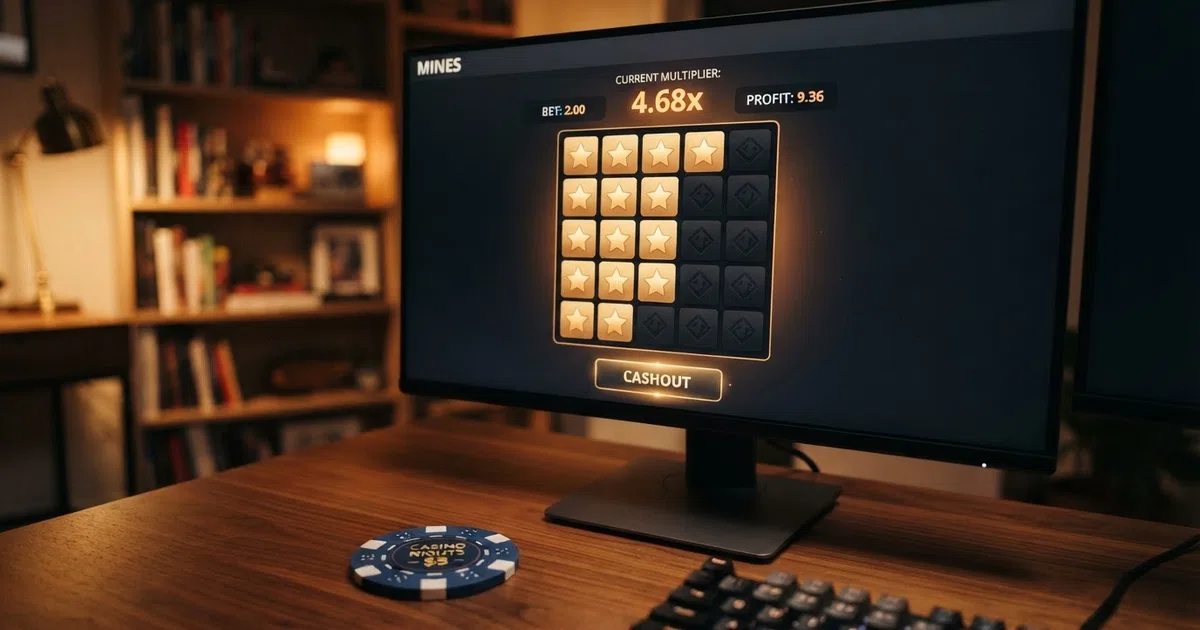
Mines is a 5×5 casino game in which a player chooses how many mines to place, reveals tiles one at a time and tries to bank the growing multiplier before the board produces a mine. Every safe reveal raises that multiplier; one wrong tile ends the round and loses the stake. Spribe’s version has a reported RTP of 97% and a 3% house edge, while Turbo Games publishes a 95% RTP for its alternative version. That sounds more controlled than a reel spin, but the cash-out choice is the whole pressure point: stopping one tile earlier protects the current return, while continuing risks it for a larger displayed multiplier.
*Data current as of September 8, 2026 and licence claims checked against the UK Gambling Commission public register.*
The important distinction is between understanding the mechanism and believing the game can be beaten. Mines has no reels, paylines or spinning symbols. It has a fixed grid, a selectable danger level and a sequence of decisions made under the clock. The practical question for a UK player is therefore not whether a mine is due, or whether the next reveal is safer after a win. It is whether the price of the entertainment is acceptable before the next tile is touched.
Why the Mines Casino Game Is Nothing Like a Slot — and How the Grid Shapes Every Decision
Mines is best understood as a grid-based risk game. That description sounds technical until the round is reduced to its essentials. There are 25 tiles, a player chooses between 1 and 24 mines, and the remaining tiles are safe to reveal. A safe tile increases the multiplier. A mine ends the round. The cash-out button lets the player take the current result after a safe reveal, but it cannot reverse a decision once another tile is opened.
That structure puts the player inside the risk progression in a way a conventional slot does not. There is no separate payline to inspect and no spin outcome delivered as a single event. The round is assembled through a series of small choices, with the multiplier acting as both a reward and a warning. The game can look simple because the board is simple; the difficult part is judging what a particular mine count is asking the player to risk.
For a representative session of 100 rounds at the stated maximum stake, the session-loss model estimates a cost of £15 for a player aged 25 or over playing at £5 per round, and £6 for a player aged 18 to 24 playing at £2 per round. Using Spribe’s reported 97% RTP and 3% house edge, these are statistical estimates rather than guaranteed outcomes, and they assume one maximum stake is wagered on every round.
What the Mines Casino Game Actually Is
Spribe is the provider most closely associated with Mines, with Turbo Games providing a prominent alternative. The versions share the central idea, but they are not interchangeable products. Spribe’s published specification gives a 97% RTP. Turbo Games’ official product information gives 95% RTP. The difference is a reminder that a label such as Mines describes a format, not a universal return.
The Spribe version uses the standard 5×5 board. Before a round starts, the player selects the mine count and the stake. The grid contains 25 tiles in total, and the choice can range from one mine to 24. Once the round is underway, each tile is either a safe reveal or the end of the stake. The return displayed after a sequence of safe tiles is a multiplier of the original bet, not a promise that the next tile will preserve it.
The numerical proposition is blunt. A 97% RTP means that, over a very large number of rounds under the stated game model, the game returns 97% of the amount wagered. The remaining 3% is the house edge. It is not a deduction taken visibly from the stake at the end of a session. It is the mathematical cost embedded in the price of playing. A player can be ahead after a few safe reveals, behind after one mine, or somewhere in between. None of those short-term outcomes changes the long-run edge.
Mines also sits between familiar casino categories. It is not a table game such as roulette or blackjack, because the player is not making a wager against a fixed table outcome. It is not a conventional slot, because there are no reels or paylines. Its closest cousins are instant-win and crash-style games, where a displayed value rises until the player takes a cash-out decision or the game ends.
Some Mines versions claim to be provably fair. That means the game uses cryptographic seed verification so that a player can check that a precommitted result has not been altered, rather than simply trusting the operator’s result screen. The label is a fairness mechanism, but it is separate from UKGC game-testing requirements. It does not turn the game into a favourable investment, and it does not make the advertised RTP a personal forecast.
The provider background matters in the UK context. Spribe holds an MGA licence, MGA/B2B/562/2018, and its games have been tested by Gaming Laboratories International and BMM Testlabs, with approvals in Gibraltar, Sweden and Ontario. An MGA licence is not a GB operating licence. It tells a UK player something about the provider’s regulatory footprint, but it does not place the casino or the individual game inside the UK licensing system. The casino carrying the game is the part that needs a GB licence.
How to Play: The 5×5 Grid, Multipliers and the Cash-Out Decision
The round begins before the first tile is revealed. The player chooses the number of mines and the stake. A one-mine setting leaves a relatively forgiving board, while 20 mines makes a mine much more likely to appear during a sequence of reveals. Twenty-four mines leaves only one safe tile among the 25. The choice changes the multiplier curve, but it does not change the game’s long-term return.
The player then reveals tiles one at a time. Each safe tile increases the multiplier. A mine loses the stake and ends the round. This is not a game in which a player can study a paytable after the result and blame a symbol pattern. The decision that matters is the one immediately before the next tile: take the current multiplier, or risk it for another safe reveal.
The cash-out button is not a cosmetic extra. It is the mechanism that turns a rising number into an amount that can be secured. A player may cash out after any safe reveal, but once the next tile is selected there is no going back. The displayed multiplier may be tempting because it grows quickly, especially with a high mine count. Yet every additional reveal also increases the chance that the round ends before the next cash-out.
That produces a curve rather than a single payout. With fewer mines, the board offers more room for safe progress and the multiplier grows more gradually. With more mines, the curve can rise more sharply, but a mine is encountered sooner on average and the stake is exposed to a harsher progression. The exact values depend on the provider and the selected configuration, which is why a full payout table would be more misleading than a qualitative account here. Players should read the multiplier shown in the live game rather than borrow figures from a different version.
The upper limit gives the multiplier system its dramatic outline. Spribe Mines has a maximum win of 10,000× the bet. Using the research’s £5 benchmark for a player aged 25 or over, that would imply up to £50,000; at the £2 benchmark for a player aged 18 to 24, it would imply up to £20,000. Those are maximum-win illustrations, not a promise that a £5 or £2 stake will produce that result, and operator caps can still apply.
The manual sequence also separates Mines from an autoplay experience. There is no button that safely runs hundreds of independent decisions for the player. The player chooses each reveal and chooses when to stop. That control makes the round feel more deliberate than a reel spin, but it does not make the decision costless. The next tile is still a gamble paid for with real money.
Mines Strategy: What the Maths Says About Your Mine Count
The probability of hitting a mine is not a fixed number that applies to an entire round. It depends on how many mines were placed and how many tiles remain. As safe tiles are removed, the number of unrevealed tiles falls. With a high mine count, the board becomes unforgiving quickly; with a low mine count, a player can usually build a longer sequence before the danger becomes acute. The player is choosing a distribution of risk, not choosing a guaranteed route through the grid.
That is why fewer mines feel safer but grow more slowly, while more mines can produce a steeper multiplier. The distinction is useful if the aim is to understand the ride. It is not a route to a mathematical advantage. The reported 97% RTP and 3% house edge for Spribe Mines remain the long-run framework regardless of the selected mine count. A more aggressive setting changes the path and the volatility; it does not remove the house’s share.
The cash-out point changes how much of the displayed multiplier is actually taken, but it does not rewrite the RTP. Stopping earlier can secure a smaller return instead of risking the whole stake on another tile. Continuing can turn a modest profit into a larger one, or turn that profit into a loss. The decision is real because it controls the timing of the risk, not because it changes the underlying price of the game.
A common mistake is to treat a previous result as if it were evidence about the next one. A win does not make the next reveal safer, and a loss does not make a higher mine count more likely to pay out. Each round is a new configuration governed by the selected game rules. Raising the mine count after a loss, or chasing a previous multiplier, is an attempt to make the next round repay an event that has already finished.
The same caution applies to the apparently enormous maximum published by another provider. Turbo Games Mines has a maximum multiplier of ×456,660. That number belongs to that product specification. It is not a typical outcome, a reason to raise a stake, or evidence that a particular strategy can reach the maximum. Comparing a maximum across providers without comparing their rules is like comparing the top prize on two different lottery tickets and ignoring the price of a ticket.
The correct strategic conclusion is therefore less exciting than the marketing suggests. Mine count selects the shape of the risk. Cash-out timing selects when that risk is taken. Neither creates a positive expected return. The house edge remains fixed at 3% for the Spribe version used as the page’s benchmark, and the 97% RTP is a long-run statistical figure rather than a promise about a single visit.
Where Mines Sits in the Casino Game Landscape
Mines is not a reel-based slot. It has no spinning symbols, no paylines and no autoplay sequence. That matters in the UK because the statutory slot-stake rules are written around casino games of a reel-based type. It also explains why a Mines lobby can sit in a different regulatory category from a slot with a superficially similar multiplier display.
The game belongs more naturally with cash-out games. Aviator, Spaceman and other crash-style titles share the idea of a growing value and a moment at which the player must decide whether to take it. Mines replaces a central rising curve with a 5×5 board and individual tile reveals. The format changes the presentation, but the central temptation is familiar: the next event is always framed as the one that will make the current decision feel complete.
Compared with a slot, Mines offers more direct control over the pace of a round. The player is not waiting only for a spin to stop; each click advances the risk. Compared with a table game, it offers a much more compressed decision structure, with no need to learn a table’s fixed rules or wait for a dealing sequence. That combination can make the game feel more involving, not less risky.
The regulatory boundary is not perfectly tidy. The game-design rules contain a crash-type carve-out for situations in which a player loses the stake unless they take action to end the game. Mines is player-paced and manually revealed, so it fits that description naturally. The wording does not, however, give a grid game a blanket exemption from every rule. The practical question is taken up in “UK Casinos With Mines Games: Why Finding One Is Harder Than It Should Be in 2026”.
Try Mines Risk-Free — Demo Mode, Free Play and the Sense in Practising First
Demo mode is useful because Mines is easy to describe and harder to play under pressure. A short session lets a new player see how the multiplier changes after each safe reveal, how a chosen mine count changes the curve and how quickly a round can end. It does not cost a stake, but it still provides the sequence of decisions that makes the game different from a slot.
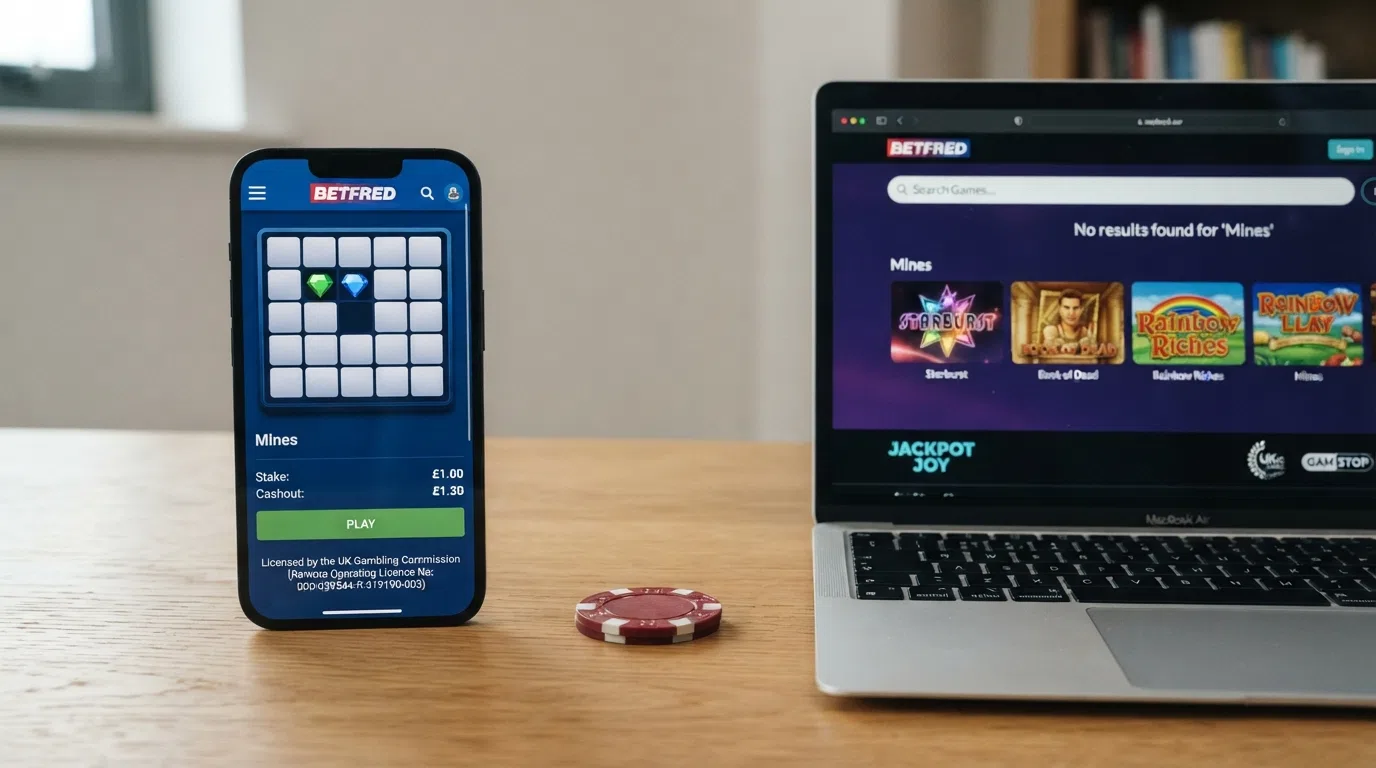
Public access is patchy. A SpinHunter sweep of 14 UK operators found no pre-login Mines page that displayed the active RTP, stake range and licence-holder panel together. Betfred was the only operator in the sweep with a public Mines product page. That does not prove that the other casinos never carry the game; it means the public evidence needed to establish availability is often missing.
Demo Mode at UK Casinos — How It Works
Most UK-facing casino lobbies put the game catalogue behind a registered account, even when a demo balance is available. The player may therefore need to create an account before opening the Mines practice mode. The balance is made of virtual credits. It has no cash value, and a win in the demo cannot be withdrawn.
That boundary is easy to overlook because the demo may look exactly like the real-money game. The grid is still 5×5, the mine count can still run from 1 to 24, and each safe reveal still raises the multiplier. Spribe’s reported 97% RTP is the same benchmark in demo and real play when the configuration is the same. The difference is what the balance represents, not a secret change to the mathematics.
A demo is valuable for learning the interface and observing the trade-off between a low and high mine count. It is less useful as evidence that Mines is available at a particular casino, because a public game page can be absent even when the game is hidden behind login. A player who wants to establish availability must check the lobby after access is granted, rather than assuming that a familiar provider is present.
Free-Play Simulators and Strategy-Testing Tools
Standalone browser simulators take a different route. They can be opened without a casino account, so the player can test a mine count over hundreds of rounds without creating a player profile. That is useful for seeing variance in action: the same setting can produce a long safe sequence in one run and an early mine in another.
Some simulators record the decisions and show aggregate results. That can help a player understand the long-run maths, especially the difference between a short winning run and a stable expectation. A simulator’s own RTP may or may not match Spribe’s 97%, so its figures should be treated as illustrative. It is not a substitute for the configuration and terms of the real game.
The practical advantage is speed. A player can change the mine count and repeat the test without moving money through a casino cashier. The practical limitation is equally important. A simulator does not reproduce identity checks, deposit-method decisions, withdrawal review or the moment when a virtual balance becomes a real loss. It can teach the board; it cannot teach the banking process or the pressure attached to a cashable balance.
What Demo Mode Cannot Tell You About Real-Money Play
Virtual credits remove the financial consequence of a bad click. A mine in a demo can be restarted immediately. A mine with a real stake ends the round and leaves the player deciding whether to fund another one. That gap is the reason a short practice session is sensible, while an extended demo-only session can create confidence that the cash-out decision is easier than it is.
The real-money journey also includes verification. UKGC-licensed remote operators must verify a customer’s name, address and date of birth before the customer can deposit or gamble. The demo cannot show whether the account will be delayed at that stage, nor whether a chosen payment method will be accepted for both deposit and withdrawal.
The wider context is uncomfortable but relevant. The UK Gambling Survey for Great Britain Year 3 found approximately 2.4% of adults aged 18 and over had a PGSI score of 8 or more, with a further 3.5% scoring 3–7 and 7.8% scoring 1–2. Those figures do not describe every player, but they explain why a game built around repeated cash-out decisions deserves a real financial boundary.
A short demo can teach the sequence. It cannot tell the player how a losing streak feels, whether a bonus balance will complicate a withdrawal, or whether a limit set before play will be respected under pressure. Treating the demo as a lesson rather than a rehearsal for a winning system is the more useful conclusion.
UK Casinos With Mines Games: Why Finding One Is Harder Than It Should Be in 2026
The first obstacle for a UK player is not the game itself. It is proving which casino currently carries it. A SpinHunter sweep in 2026 covered 14 UK operators and found no pre-login Mines page that showed the active RTP, stake range and licence-holder panel. Betfred was the only operator checked with a publicly visible Mines product page. Spribe Mines may be available behind login at several UKGC casinos, but the public sweep could not confirm that listing.
The table therefore ranks the featured UKGC-licensed operators by their casino offering and Mines likelihood, not by confirmed Mines presence alone. The order is alphabetical within the verified set. A licence proves that an operator may provide remote casino gambling in Great Britain; it does not prove that a particular game is present in its public catalogue.
| Casino | UKGC Licence Status | Game Providers | Welcome Offer | Wagering Requirement | Min Deposit/Stake to Qualify |
|---|---|---|---|---|---|
| bet365 | Active — Hillside (Sports/UKGambling) ENC, UKGC account 39563; remote casino licence since 17 October 2019 | Blueprint Gaming, Pragmatic Play, NetEnt, Playtech, others | Up to 500 free spins, with no cash match; 5, 10, 20 or 50 spins can be revealed on each of 10 separate days | No wagering on free-spin winnings | £10 lifetime deposit |
| Sky Vegas | Active — Sky Betting & Gaming, UKGC account 39439 | NetEnt, IGT, Blueprint, Pragmatic Play, others | 50 no-deposit free spins plus 200 after depositing and spending £10, for up to 250 in total | 0× — no wagering requirements | £10 deposit and spend for the 200 spins; 50 spins are no-deposit |
| 888 Casino | Active — 888 UK Limited, UKGC account 39028; remote casino licence since 1 November 2014 | NetEnt, Playtech, Pragmatic Play, exclusive in-house titles including Gods of Egypt: Queen of Jewels and Magic Miner | 100% match up to £100; no free spins in the main welcome offer | 10× | £10 minimum first deposit |
| William Hill Vegas | Active — WHG (International) Limited, UKGC accounts 38718/39225 | Pragmatic Play, Playtech, Blueprint, NetEnt, others | 200 free spins on Big Bass Splash after a £10 deposit and stake | 10× on free-spin winnings, capped at £30 | £10 deposit and £10 stake |
| Paddy Power | Active — PPB Entertainment, part of Flutter Entertainment; UKGC remote casino licence | Pragmatic Play, Playtech, Blueprint, Red Tiger, others | 60 no-deposit free spins plus 200 after depositing and wagering £10, for up to 260 in total | 0× — no wagering requirements | £10 via debit card or Apple Pay for the 200 spins; 60 spins are no-deposit |
| Betway | Active — Betway Limited, UKGC account 39700 | Microgaming (Games Global), NetEnt, Pragmatic Play, others | Stake £20 for 150 free spins, or a 100% match up to £50 on a first deposit of £10+ | 0× on free spins; 10× on the match bonus | £20 stake for the spins; £10+ deposit for the match |
| Betfred | Active — Petfre (Gibraltar) Limited; UKGC remote casino licence | Playtech, IGT, Blueprint, Pragmatic Play, others | Stake £10 for 200 free spins on Age of the Gods: God of Storms 2 | 0× — no wagering on free-spin winnings | £10 debit-card deposit and £10 stake |
| MrQ | Active — Lindar Media Ltd, UKGC account 60629 | Hacksaw Gaming, Pragmatic Play, NetEnt, Push Gaming, others | 100 free spins on Big Bass Splash after a £10+ deposit; 300 are available on Fishin’ Bigger Pots of Gold | 0× — no wagering requirements | £10 minimum deposit |
| PlayOJO | Active — SkillOnNet Ltd; UKGC remote casino licence | NetEnt, Microgaming, Pragmatic Play, Play’n GO, others | 80 free spins on Big Bass Bonanza on the first deposit | 0× — no wagering requirements, ever | £10 minimum deposit |
| 32Red | Active — 32Red Ltd, part of Kindred Group; UKGC remote casino licence | Microgaming (Games Global), NetEnt, Pragmatic Play, others | 320 free spins on Big Bass Splash when £30 is played on slots | 0× — no wagering on free-spin winnings | £30 stake on slots |
The offers show why the absence of a Mines page matters. Most of the featured brands are built around slot catalogues, so a slot welcome package can say very little about Mines availability. The two clear exceptions in terms of format are 888 Casino’s cash match and Betfred’s public Mines page. The rest require a lobby check or an account-based search.
Bet365
bet365’s relevant credentials are strong and unusually clear: the active GB licence is held by Hillside (Sports/UKGambling) ENC, UKGC account 39563, and the remote casino licence dates from 17 October 2019. Its named casino providers include Playtech, Pragmatic Play, NetEnt and Blueprint Gaming. That is a broad provider mix, but Spribe is not among the providers named for the offering described here.
The welcome offer is up to 500 free spins, not a cash match. The player spins a daily Free Spins Reel on 10 separate days, with each result revealing 5, 10, 20 or 50 spins. A £10 lifetime deposit is required, and there is no wagering on free-spin winnings. The offer is substantial on its own terms, but it remains a slot-style promotion and does not establish that Mines is in the public lobby.
For a player who values a large, familiar casino catalogue, bet365 is a credible operator to check. The missing proof is specifically the game listing: no confirmed Mines page was available publicly when the operator set was assessed. That is the distinction a comparison should preserve.
Sky Vegas
Sky Vegas operates under Sky Betting & Gaming’s active UKGC account 39439, within the Flutter Entertainment group. Its named providers include NetEnt, IGT, Blueprint and Pragmatic Play. The offer combines 50 no-deposit free spins with 200 further spins after depositing and spending £10, giving up to 250 spins in total with 0× wagering.
That structure is unusually easy to compare with the underlying stake because there is no wagering requirement on the spins. It does not, however, make Mines publicly verifiable. The game’s presence is described as behind the login wall, so a player cannot infer availability from the strength of the welcome package. The relevant check is the game lobby after registration.
Sky Vegas is the cleanest no-wagering proposition in the featured set for a reader who wants a simple free-spin balance. Mines still has to be found and its stake selector checked; the promotion answers a different question.
888 Casino
888 Casino is the only operator here with a cash-match welcome offer. The active GB licence belongs to 888 UK Limited, UKGC account 39028, and the remote casino licence has been active since 1 November 2014. The provider mix includes NetEnt, Playtech, Pragmatic Play and exclusive in-house titles such as Gods of Egypt: Queen of Jewels and Magic Miner.
The main offer is a 100% match up to £100, with a 10× wagering requirement and a £10 minimum first deposit. Unlike the free-spin offers, it asks the player to turn a cash balance through a wagering condition. The 10× figure is the current hard ceiling for UKGC casino bonuses, but the player still has to decide whether the match is worth the turnover.
Mines availability is unconfirmed. Spribe is not among the named providers, and the exclusive-title list does not establish a Mines game. 888 Casino is worth considering for its match structure, but the game search is unresolved rather than assumed from the presence of a title called Magic Miner.
William Hill Vegas
William Hill Vegas operates under WHG (International) Limited, with UKGC accounts 38718 and 39225. The named provider group includes Pragmatic Play, Playtech, Blueprint and NetEnt. Its targeted offer is 200 free spins on Big Bass Splash after a £10 deposit and a £10 stake.
The important qualifier is the 10× wagering requirement on free-spin winnings and the £30 cashout cap. Spins are issued for 72 hours, and the offer ends on 31 December 2026. A headline count of 200 can therefore hide a much smaller usable ceiling. The game is a slot promotion, not evidence that Mines is in the lobby.
The £30 cap is the lowest in the featured set. William Hill Vegas suits a reader who accepts that trade in exchange for a named slot and a familiar operator, but the advertised spin count should not be read as a £30-plus guaranteed return.
Paddy Power
Paddy Power’s active remote casino licence sits with PPB Entertainment in the Flutter Entertainment group. Its named providers include Pragmatic Play, Playtech, Blueprint and Red Tiger. The welcome package is up to 260 free spins: 60 are no-deposit and 200 follow a £10 deposit and wager through a debit card or Apple Pay. All carry 0× wagering, with seven days from issue stated in the offer terms.
The 60 no-deposit spins are the largest no-deposit allocation in this ranking. That makes the opening portion more flexible than a package that requires a stake before the first spin, but it still does not make the game catalogue transparent. Mines is not confirmed in the public game lobby described for the operator.
Paddy Power’s offer is strongest for a reader who values no-wagering spins and does not want to make a deposit before sampling the promotion. The unanswered question is the one that matters to this page: whether Mines is actually available after login.
Betway
Betway operates under Betway Limited’s active UKGC account 39700. Its named providers include Microgaming, also identified as Games Global, NetEnt and Pragmatic Play. It offers a genuine choice rather than one universal welcome route: stake £20 for 150 free spins, or take a 100% match up to £50 on a first deposit of £10 or more.
The free-spin route has 0× wagering and is delivered as 50 spins per day for three days. The match route has a 10× wagering requirement. The two offers should not be compared as if they carried the same cost: one asks for a £20 stake, while the other starts with a smaller deposit and a turnover condition. Neither route confirms a Mines category in the UK lobby.
Betway is useful here as an example of a dual-purpose bonus. A player who dislikes wagering can take the spins; a player who prefers a cash balance can take the match. The trade-off is choice, not proof that Mines is present.
Betfred
Betfred is the exception in the public-availability evidence. Its active remote casino licence is held by Petfre (Gibraltar) Limited, and the brand has a publicly accessible Mines product page. That is the only confirmed Mines presence among the ten featured operators, although the public page did not display the Mines RTP or its stake range when assessed.
The named providers include Playtech, IGT, Blueprint and Pragmatic Play. The welcome offer is 200 free spins on Age of the Gods: God of Storms 2 after a £10 stake, with 0× wagering on winnings. The spins are valid for seven days from credit, and the qualifying stake must be made within 14 days. The page gives Betfred a useful first place to look, but it does not supply every figure a cautious player might want.
Betfred’s public page earns it a practical place in the Mines search because it answers the availability question without an account. It is not a quality verdict on the game, and the missing RTP and stake-range details still have to be checked in the live interface.
MrQ
MrQ operates under Lindar Media Ltd, UKGC account 60629. Its named providers include Hacksaw Gaming, Pragmatic Play, NetEnt and Push Gaming. The deposit offer is 100 free spins on Big Bass Splash after a £10 minimum deposit, with 0× wagering; 300 spins are also available on Fishin’ Bigger Pots of Gold. The offer is valid for 48 hours from qualification, and there is no cashout cap on the stated winnings.
That is a lean, plainly priced structure. It is also a slot offer. No confirmed Mines listing is present in the public information used for the operator comparison, so the number of free spins cannot be treated as a proxy for Mines availability. A player who wants Mines must check the lobby rather than the promotion.
MrQ fits a reader who wants a short, no-wagering free-spin package with a clear real-money balance. Its absence from the confirmed Mines evidence is a game-availability point, not a judgement about the provider’s other titles.
PlayOJO
PlayOJO operates under SkillOnNet Ltd’s UKGC remote casino licence. The provider list includes NetEnt, Microgaming, Pragmatic Play and Play’n GO. The offer is 80 free spins on Big Bass Bonanza on the first deposit, with 0× wagering and no cashout cap. The “no wagering, ever” proposition removes a common source of bonus confusion.
It does not remove the need to verify the game catalogue. Mines is not confirmed in the public lobby evidence, so a player cannot assume that the 80-spin offer is redeemable on the game discussed here. The terms answer how a promotion is treated; they do not answer whether Mines is exposed.
PlayOJO is the straightforward option for a reader who dislikes wagering language. The trade is a smaller spin allocation than several other offers and no public proof of Mines presence, so the promotion should not be mistaken for a Mines-specific promise.
32Red
32Red operates under 32Red Ltd, part of the Kindred Group, with an active UKGC remote casino licence. Its named providers include Microgaming, also identified as Games Global, NetEnt and Pragmatic Play. The welcome offer is 320 free spins on Big Bass Splash when £30 is played on slots, with 0× wagering on winnings.
The qualifying stake is the highest among the featured offers. Players have 30 days after claiming the offer, while the opt-in must be completed within seven days of registration. The large spin count is therefore attached to a larger entry action than the £10 offers elsewhere, and it remains a slot promotion rather than evidence that Mines is available.
32Red suits a reader willing to make a £30 qualifying stake in exchange for 320 zero-wagering spins. Mines is still unconfirmed, so the correct comparison is between the size and terms of the offer and the separate question of game availability.
Playing Mines for Real Money — Stakes, Deposits and What a Session Actually Costs
Real-money Mines is played through a licensed casino, but the product’s grid format leaves an important legal and practical distinction in place. The casino must operate under a GB licence; the individual game may not be classified as a reel-based online slot. That difference affects how the statutory stake limits are interpreted, not whether the operator can lawfully offer a licensed game.
The cost is easier to understand than the marketing. At 97% RTP, the long-run house edge is 3%. A session can look like a collection of near-misses, early wins and dramatic cash-outs, but the underlying estimate remains the same. The practical budget is the amount a player is prepared to lose, not the amount the multiplier briefly displays.
How Staking Works in Mines — What You Can Bet Per Round
The UKGC stake limits are £5 per game cycle for players aged 25 and over and £2 for players aged 18 to 24. The £5 limit came into force on 9 April 2025 and the £2 limit on 21 May 2025. They are imposed by SI 2025/215 and apply to an “online slots game”, defined as a casino game of a reel-based type.
Mines has no reels, paylines or spinning symbols. The government consultation response discussed Slingo as a boundary product between reel and grid formats, but it did not provide a binding answer for a pure grid game such as Mines. The wording of the guidance also makes clear that the limits do not apply to games such as roulette and blackjack. The practical conclusion is that the slot cap probably does not apply to Mines, but the published position is not a binding determination of its exact classification.
Individual operators still set their own table limits. Without confirmed Mines stake ranges from the UK operators, the in-game stake selector is the only reliable first check. A player should not assume that a promotional free-spin cap, a slot maximum or a general account limit is the same thing as the maximum stake on Mines.
The upper win figure needs the same discipline. Spribe’s 10,000× maximum would be £50,000 at a £5 benchmark stake and £20,000 at a £2 benchmark stake. Those amounts are illustrations against the stated stake limits, not guaranteed returns, and the live game or operator terms may impose a lower ceiling.
Depositing at a UK Casino for Mines Play
Debit cards are the standard route for a UK casino deposit. Credit cards have been banned for gambling payments since 14 April 2020, and the ban extends to e-wallet payments funded by a credit card. A PayPal, Skrill or Neteller balance is therefore not automatically treated as a credit-card route simply because the casino accepts the e-wallet.
E-wallets are widely accepted at UKGC casinos, although individual bonus terms can exclude a payment method. Bank transfers and open-banking payments are also available, but they can be slower to process. The right method is the one that the operator accepts for both the deposit and the subsequent withdrawal, rather than the method with the fastest-looking first screen.
The featured offers mostly use a £10 qualifying deposit. That is a threshold for the promotion, not necessarily a universal minimum deposit for Mines, and it should not be confused with a session budget. Paddy Power’s deposit-triggered spins require £10 through debit card or Apple Pay, Betfred requires a debit-card deposit and a £10 stake, and 32Red requires £30 to be played on slots. Promotional qualification is a separate decision from choosing a stake on Mines.
How Payouts and Withdrawals Work at UK Mines Casinos
Withdrawal methods typically mirror deposit methods, with debit cards and e-wallets commonly presented as the quickest options. Processing times are operator-specific, so a casino’s banking page matters more than a generic promise. A player should check the method, any account verification requirements and the operator’s stated processing route before depositing.
Identity verification is mandatory. Since 7 May 2019, remote licensees have had to verify a customer’s name, address and date of birth before the customer can deposit or gamble. That check can be the point at which an apparently instant game becomes a delayed account journey. A Mines session cannot begin until the account has passed the operator’s checks.
UK rules also permanently ban reverse withdrawals. Once a withdrawal is requested, the player cannot cancel it and return the money to the playing balance. That protection is more important in an instant game, where a few quick decisions can turn a small balance into a reason to make another deposit. The withdrawal screen is part of the session’s safety architecture, not an afterthought.
Is Mines Legal in the UK? Licensing, Stake Caps and the Classification Grey Area
Online casino gambling is legal and licensable in Great Britain under the Gambling Act 2005, extended by the Gambling (Licensing and Advertising) Act 2014. The Gambling Commission is the single statutory regulator and is sponsored by the Department for Culture, Media and Sport. Mines is not made unlawful simply because it is a grid game; the central legal question is whether the casino offering it is licensed and whether the game’s design meets the applicable remote standards.
The rules that matter to a Mines player do not all attach to the same object. Stake caps, autoplay and game-cycle rules can apply to the game or product design. Credit-card rules, GAMSTOP and identity checks attach to the operator’s account and payment systems. Bonus wagering limits apply to promotions, not to the game’s RTP. Keeping those layers separate is the quickest way to avoid treating a payment rule as a game rule.
| Restriction | Scope (What It Covers) | Threshold or Cap | In Force From | Legal Basis | Applies to Mines? |
|---|---|---|---|---|---|
| Operating licence | Remote casino gambling supplied to players in Great Britain | A GB operating licence is compulsory; unlicensed supply is an offence under section 33, punishable by up to 51 weeks’ imprisonment, an unlimited fine, or both | Gambling Act 2005 framework | Gambling Act 2005, section 33; UKGC is the statutory regulator | The casino must be licensed; Mines itself has no separate GB operating licence |
| Online slots stake cap | Casino games defined as “reel-based type”, with age bands | £5 per game cycle for age 25+; £2 for age 18–24 | £5 from 9 April 2025; £2 from 21 May 2025 | SI 2025/215; UKGC online slots stake-limit guidance | Probably not on the published wording, but no binding Mines determination exists; operator limits still govern |
| Autoplay | All online gaming products | Banned | 17 January 2025 | RTS 8 and the wider game-design changes | Yes: a Mines variant cannot use autoplay; manual player action is relevant to the crash-game wording |
| Speed features and game-cycle minimum | All online gaming products, with a crash-type action carve-out | Turbos and slam stops banned; game cycles may not be faster than 5 seconds | 17 January 2025 | RTS game-design changes; implementation guidance analysed by Wiggin LLP | Applies to speed features; a manually controlled Mines round must still meet the minimum, while the crash carve-out protects a genuine player action |
| Losses disguised as wins | Casino game presentation and result messaging | Banned | 17 January 2025 | RTS 14F | Applies wherever the presentation is used; the crash-game wording does not create a blanket exemption |
| Reverse withdrawals | A player’s request to withdraw funds from a licensed remote account | Permanently banned; the player cannot cancel once requested | RTS changes currently in force | Remote Technical Standards | Applies to the withdrawal process, not to Mines’ grid or multiplier |
| Wagering requirements | UKGC casino bonuses | Hard maximum of 10× | 19 December 2025 | LCCP Social Responsibility Code 5.1.1 | Applies to bonus terms, not the game’s RTP or maximum win |
| Credit cards | All UK gambling payments, including e-wallet payments funded by credit cards | Banned | 14 April 2020 | LCCP licence condition 6.1.2 | Applies to the payment route, not the game format |
| GAMSTOP | Every GB-licensed online gambling operator | Mandatory self-exclusion with 6-month, 1-year, 5-year or 5-year auto-renewal periods | 31 March 2020 | UK regulation backbone verified against the UKGC | Applies to licensed operators; it does not reach offshore sites |
| Deposit-limit prompt and gross limit | Deposit journey at UKGC online operators | Prompt before first deposit; decreases immediate; gross definition offered and given equal prominence by 30 September 2026 | 31 October 2025; compliance deadline 30 September 2026 | RTS 12 | Applies to the account’s deposit process, not as a nationwide stake ceiling |
| Financial vulnerability checks | Net-deposit monitoring using publicly available data; separate affordability checks announced | £150 net deposits in a rolling 30-day period; Stage 1 affordability thresholds of £5,000 in 24 hours for age 25+ and £2,500 for under 25 have no start date | Vulnerability check from 28 February 2025; Board decision 7 July 2026 | UKGC financial-vulnerability rules; UKGC Board decision | Applies to account monitoring, not to Mines’ stake or RTP |
| Statutory levy | Remote casino operators’ gross gambling yield | 1.1%, split 50% treatment, 30% prevention and 20% research | 6 April 2025 | Gambling Levy Regulations 2025 | Operator-side funding mechanism, not a player loss cap |
| Remote Gaming Duty | Operator-side remote gaming tax | 40% of the relevant operator liability, up from 21% | 1 April 2026 | GOV.UK gambling duty changes | Tax is paid by the operator, not a condition attached to a Mines round |
UKGC Licensing — What It Means for Mines Players
The Gambling Commission’s three licensing objectives are to prevent gambling from being a source of crime, ensure that gambling is conducted fairly and openly, and protect children and vulnerable persons. Those objectives sit behind the operating-licence framework rather than acting as a promise that every session will be profitable.
Every featured operator in the comparison has an active remote casino licence in Great Britain. The public register is the verification route for an operator’s claim. A player can therefore start with a licence check, but should not stop there: the register confirms the operator, not the presence of a particular Mines game or the terms of a welcome promotion.
Licensed operators must comply with the Licence Conditions and Codes of Practice and the Remote Technical Standards. Providing gambling without a GB licence at the point of consumption is a criminal offence under section 33 of the Gambling Act 2005. The maximum penalty is up to 51 weeks’ imprisonment, an unlimited fine, or both. The UKGC’s enforcement is aimed at the provider, not at turning a player visit into a criminal case.
The relevant distinction is simple but consequential. A legal casino can offer games whose format is still being interpreted under individual product rules. A regulated game can still carry a house edge. A UKGC licence is a floor for oversight, not a guarantee of Mines availability, a favourable RTP or a fast withdrawal.
Game-Design Rules — Autoplay, Speed and the 5-Second Minimum
The rules that took effect on 17 January 2025 apply across online gaming products rather than only to slots. Autoplay is banned under RTS 8. Speed features such as turbos and slam stops are banned, and a game cycle may not be faster than five seconds. Losses disguised as wins are also banned under RTS 14F.
The implementation guidance contains a carve-out for crash-type games in which a player loses the stake unless they take action to end the game. Wiggin LLP’s analysis notes that the “sudden stop” in crash games is not designed to speed up the game. The point of the carve-out is player action, not a licence to make a game frantic.
Mines is a natural fit for that description because the player reveals a tile and chooses whether to cash out. It is not a blank cheque for every Mines feature. An autoplay button cannot replace the manual decision, and a turbo or auto-reveal feature would still be a speed feature. The rules shape the interface while the maths continues to take the player’s stake.
Advertising Rules, Bonus Caps and the 10× Wagering Limit
A casino bonus is not a second RTP. From 19 December 2025, wagering requirements at UKGC-licensed casinos have a hard ceiling of 10× under LCCP Social Responsibility Code 5.1.1. That ceiling limits how many times a bonus balance must be wagered; it does not make a slot or Mines payout more likely.
The same rules restrict how promotions are packaged. Mixed-product offers are banned, so a casino cannot use a sports-betting promise to hand out casino free spins. Direct marketing must be opt-in, per product and per channel, with that requirement in force from 1 May 2025.
Advertising also follows the CAP Code for non-broadcast promotions and the BCAP Code for broadcast advertising, enforced by the Advertising Standards Authority. Since 1 October 2022, the relevant test is whether an ad has strong appeal to under-18s, and no one under 25 may appear in a gambling advertisement. These controls may change the presentation of an offer; they do not change the 3% house edge in Mines.
Tax, Offshore Sites and What Happens If You Play Outside the UK System
UK players do not pay tax on gambling winnings. Betting duty was abolished in 2001. Remote Gaming Duty is a separate operator-side tax and rose from 21% to 40% for accounting periods beginning on or after 1 April 2026. The statutory gambling levy is separate again: it commenced on 6 April 2025 at 1.1% of gross gambling yield for remote casino operators, with 50% directed to treatment, 30% to prevention and 20% to research.
The offshore warning is more important than the tax label. Spribe’s MGA licence and Turbo Games’ availability outside the UK system do not turn an offshore casino into a GB-licensed operator. A site without a GB licence may offer a familiar game while leaving the player without GAMSTOP protection, a UKGC complaints route or an approved alternative dispute-resolution provider.
The UKGC’s response to unlicensed supply is disruptive rather than a promise of blanket internet blocking. Published figures for April 2024 to June 2025 recorded 3,140 disruption notices, 447,778 URLs referred to search engines and 287,961 URLs removed. The Commission uses cease-and-desist notices, search-engine delisting referrals, payment-provider referrals and related disruption work; it does not currently hold statutory ISP or DNS blocking powers.
That is why a familiar provider name is not enough. The casino’s licence, payment route, complaints route and self-exclusion reach all matter before a real stake is placed. A game can be technically fair under its own provably-fair system and still sit beyond the protections a UK player may reasonably expect.
Staying in Control — Responsible Gambling Tools That Work for Instant Games
The UK safer-gambling system is extensive, but several of its controls were designed around repeated slot or account play rather than the peculiar pressure of choosing whether to reveal one more tile. Mines is not unique because it can produce a decision every few seconds. It is distinctive because the player is asked to take a cash-out decision while the result is visibly improving.
The prevalence figures require context rather than scare language. The UK Gambling Survey for Great Britain Year 3 put approximately 2.4% of adults aged 18 and over at PGSI 8 or more, described by the Commission as problem gambling. It found 3.5% at moderate risk and 7.8% at low risk. The 2.4% estimate has stayed broadly stable across the survey’s three years: 2.5% in Year 1, 2.7% in Year 2 and 2.4% in Year 3.
Other surveys produce different rates because their questions and samples differ. The NHS Adult Psychiatric Morbidity Survey 2023–24 found 0.4% at PGSI 8+ and 1.6% at PGSI 3+ or more. Men were at 2.2% and women at 1.0%, with the highest rate among 25–34-year-olds at 3.5%. The Health Survey for England 2024 found 5% at PGSI 1 or more, stable since 2012, with men at 7% and women at 3%. The figures do not cancel one another; they show why a national estimate needs a named survey attached to it.
Deposit Limits and Financial Vulnerability Checks
- Before a first deposit, every UKGC operator must prompt the customer to set a financial limit from 31 October 2025. A decrease takes effect immediately, while an increase is not an instant permission to spend more.
- A standardised gross deposit limit must be offered with equal prominence. It is based solely on money paid in, rather than deposits net of withdrawals, and the compliance date is 30 September 2026.
- Financial vulnerability checks are mandatory at £150 in net deposits over a rolling 30-day period from 28 February 2025, using publicly available data such as county-court judgments, bankruptcy, individual voluntary arrangements and debt-relief orders. Separate affordability checks have been announced but not commenced; the UKGC Board decision of 7 July 2026 set Stage 1 thresholds of £5,000 in 24 hours for age 25+ and £2,500 for under 25, with no start date.
These controls do not impose one nationwide deposit ceiling. The player still chooses a limit, but the operator must make the limit visible before play and act when it is reduced. A Mines session should be planned against that limit, not against a balance that has already been deposited in the hope of recovering a loss.
The distinction between the £150 vulnerability check and the announced affordability thresholds matters. The first is a monitoring requirement. The second is a staged affordability measure that has been approved in principle but has not begun. A player should not be told that either threshold is a guaranteed intervention, and neither threshold changes the 3% house edge inside a Mines round.
Reality Checks, Time-Outs and Session Tools for Fast-Paced Games
Reality checks are mandatory pop-ups showing time played and net position after a set interval. The player chooses the interval, which makes the setting part of the control rather than a hidden platform default. Mines deserves a shorter, more deliberate check than a slow game because several tile decisions can fit into a short period and make a losing balance feel like a series of almost-wins.
Time-outs let a player block access to a specific operator for a cooling-off period, typically from 24 hours to six weeks. Session reminders require a review of play every six months from October 2025. Those tools cannot make a 3% edge disappear, but they can interrupt the moment-to-moment momentum that makes a cash-out decision feel compulsory.
For Mines, a useful limit is not “the next safe tile”. It is a pre-committed session boundary: an amount of total stake, a time window and a cash-out rule that is abandoned when the limit is reached. A reality check works best when it exposes that boundary before the player has spent another deposit trying to get back to an earlier multiplier.
Self-Exclusion — GAMSTOP, Operator Tools and Where to Get Help
- GAMSTOP is mandatory for every GB-licensed online operator from 31 March 2020. Exclusion periods are six months, one year, five years, or five years with auto-renewal, and the exclusion cannot be cancelled early.
- GAMSTOP does not reach unlicensed or offshore sites. A player who has self-excluded through the scheme can still encounter a non-GB site, which is why the casino’s licence and the exclusion’s coverage must be checked separately.
- The National Gambling Helpline is run by GamCare, is freephone and operates 24/7. NHS gambling harm clinics operate in England, Scotland and Wales, Gamblers Anonymous provides peer support, and GambleAware commissions treatment, prevention and research.
- The statutory levy distributes its remote-casino funding 50% to treatment, 30% to prevention and 20% to research. It is a funding structure, not a substitute for an individual decision to stop.
GAMSTOP is the strongest single account-level protection because it covers every participating UK-licensed site at once, but it is not a universal internet lock. The right response to a loss of control is to use the licensed-operator tools, register for self-exclusion and contact support rather than waiting for a pattern of risky play to become a financial emergency.
How We Picked and Ranked the UK Mines Casinos on This Page
Every operator in the comparison was checked against the UK Gambling Commission public register of licence holders, last updated 29 July 2026. Only operators with active remote casino licences are included. The account numbers and licence-holder details are included so the licence claim is a checkable fact rather than a branding assertion.
The operator set was drawn from long-established UK-facing casino brands with casino products and provider portfolios associated with Spribe, Pragmatic Play, Playtech or comparable game suppliers. Welcome-offer terms came from each operator’s published offer information and promotional terms. A provider list can show where Mines might sit, but it cannot prove a particular game is available; the public Mines page is treated as availability evidence, not as the sole measure of casino quality.
Only Betfred had a publicly visible Mines product page among the ten featured operators at the time of the check. That makes it the practical starting point for a public availability search, but it does not make it the best Mines casino or establish that its page displays every technical detail. The comparison does not exclude the other operators simply because their Mines presence could not be confirmed without logging in.
The ranking order is alphabetical within the verified set, and no operator paid for inclusion. Bonus size, no-wagering language and provider breadth explain the terms a player may encounter, but they are not treated as a guarantee that Mines is installed, that a public page is current or that a particular stake is available. The point of the ranking is to make those differences legible, not to turn a licence number into a promotional endorsement.
Your Next Move — Playing Mines at a UK Casino With Confidence
The first practical step is to establish where Mines is actually available. Betfred is the only featured operator with a public Mines product page, so it is the first place to inspect. The other casinos may carry the game behind login, but a public bonus page is not enough to establish that. Check the lobby, the game name, the stake selector and the live terms before making a deposit.
The second step is to accept the fixed cost. Spribe’s reported 97% RTP carries a 3% house edge regardless of mine count or cash-out timing. A short low-stakes session, using a low mine count while learning the sequence, can teach the interface. It cannot change the edge. Treat any multiplier on screen as a possible result, not as money that belongs to the player until the cash-out is confirmed.
The third step is to treat the stake-cap question honestly. The £5 and £2 limits apply to reel-based online slots by the published definition, and Mines probably falls outside that wording. The classification is not settled in a binding Mines-specific determination, so an operator can still set a lower limit. Read the in-game selector rather than relying on the statutory slot rule.
The fourth step is to use the account protections before the first deposit. Set a limit, decide what a session can cost and decide in advance when to stop. If the game is pulling a player in faster than intended, GAMSTOP is free, covers every UK-licensed site at once and cannot be cancelled early. It is a stronger boundary than a promise to cash out on the next safe tile.
Mines is a compact casino format with a clear mathematical cost. That does not make it illegitimate or unintelligent as entertainment. It makes the player responsible for knowing the grid, the mine count, the multiplier, the payment route and the limit before the first tile is revealed. The edge is fixed. The boundary should be too.
Frequently Asked Questions
What is the RTP of Spribe’s Mines and does it change with different mine counts?
Spribe’s Mines has a reported 97% RTP and a corresponding 3% house edge. Mine count changes the risk on each reveal and the shape of the multiplier curve, but not the long-run return. The figure is a statistical expectation across many rounds, not a promise that one session will return 97% of its stake.
Do the UK’s online slots stake limits apply to the Mines casino game?
The published limits are £5 per game cycle for players aged 25+ and £2 for players aged 18–24, applying to casino games of a reel-based type. Mines has no reels or paylines, so the limits probably do not apply, but no binding Mines determination has been published. The operator’s in-game stake limit still governs the available bet.
How does provably fair technology work in the Mines casino game?
Some Mines versions use cryptographic seed verification so a player can check that a precommitted result has not been altered. That is a separate fairness mechanism from UKGC game testing and does not alter the RTP. It can support confidence in the result record, but it cannot make a losing stake a winning one.
What is the maximum win on the Mines casino game at a UK casino?
Spribe Mines has a maximum win of 10,000× the bet. At the research’s £5 benchmark, that implies up to £50,000; at the £2 benchmark, it implies up to £20,000. These are maximum-win illustrations, not guaranteed returns, and an operator can apply a lower cashout ceiling.
Do I need to register at a casino to access the Mines demo, or can I play instantly?
Some standalone simulators are available instantly, but a UK casino often puts its game lobby behind login. A sweep of 14 UK operators found no pre-login Mines page that displayed the active RTP, stake range and licence-holder panel together. A demo can still be free even when registration is required.
How many mines should I pick for the best balance of risk and reward?
No mine count changes Spribe’s reported 97% RTP, although the number changes the multiplier curve and the chance of hitting a mine. Fewer mines allow more room for safe progress, while more mines create a sharper but harsher risk. A low count is a sensible way to learn the board, not a mathematically superior choice.
The £5 Stake Cap and the Reel-Based Definition — Does It Catch Mines?
SI 2025/215 imposed age-banded maximum stakes of £5 for players aged 25 and over and £2 for players aged 18 to 24. The £5 limit came into force on 9 April 2025, with the £2 limit following on 21 May 2025. Both are per game cycle and apply to online slots as defined in the legislation.
That definition is “a casino game of a reel-based type”. Mines has a 5×5 grid, no reels, no paylines and no spinning symbols. The government’s consultation response discussed Slingo as a boundary product, but it did not settle the treatment of a pure grid-based instant game. The UKGC guidance says the limits do not apply to non-reel-based games such as roulette and blackjack, yet it does not publish a binding answer for Mines.
The defensible conclusion is “probably not”, not “definitely not”. No published determination makes Mines automatically a slot, but neither does the grid format create a written exemption. Until the regulator or a court gives a more definite answer, the stake selector inside the game and the operator’s own limits are the practical boundaries. The cap should not be used as a reason to assume that a £5 or £2 stake is legally available on every Mines variant.
Slots – fastestpayout-casinos-uk
Content created by the «fastestpayout-casinos-uk» team