
Where to play Dream Catcher live in the UK — a ranked guide to the casinos that actually carry it
 Available in GB
Current as of September 8, 2026 · verified against the UK Gambling Commission’s public register of operating licences
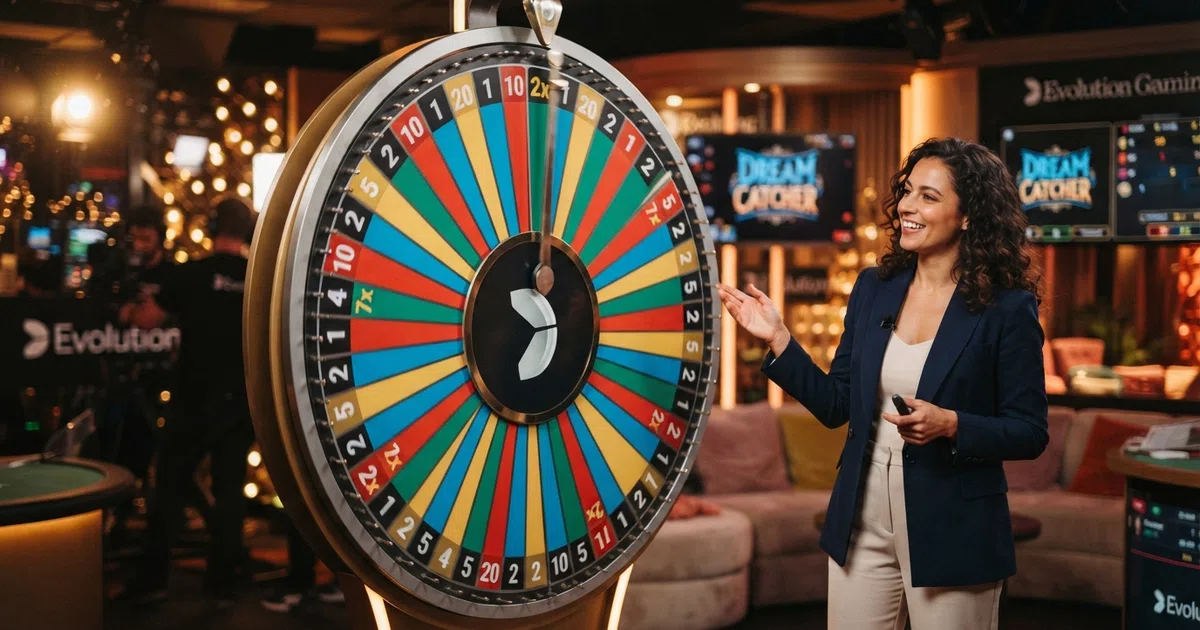
Dream Catcher is the Evolution money wheel that started the live game-show category in 2017, and it is still the cleanest version of the idea on the market. It runs from a staffed studio, hosted in real time, on a 54-segment wheel that pays 1:1, 2:1, 5:1, 10:1, 20:1 or 40:1 — with a 2x and a 7x multiplier segment that can chain a respin and turn a modest hit into something the page headlines love. For UK players the question is rarely whether the game is worth a look; it is which of the many UK-licensed casinos that list Evolution in their live lobby actually delivers the cleanest route to it. This page ranks the ten that do, with a comparison table, a per-segment RTP breakdown, and the regulatory picture that explains why the welcome offers in this market have changed shape since the bonus reforms of late 2025.
What is Dream Catcher? The live money wheel that launched a genre
Dream Catcher is a single-wheel, single-bet live casino game. There are no playing cards, no dice, no second screen of bonus mechanics — you pick one or more of six numbers, the host spins the wheel, and the segment the flapper stops on decides who is paid. That simplicity is the entire pitch, and it is why the game still fills tables nine years after launch.
The category it launched has since grown large. Gambling Capital put the global online casino market at around EUR 105,186 million at year-end 2025, and Evolution’s own reporting names game shows and live table games as a key driver of European growth, with the region returning to quarter-on-quarter growth in Q2 2026 on the back of strong development in the game-show vertical. Within that vertical, Crazy Time now has more players than blackjack and roulette combined across Evolution’s network, by the company’s own count — but Dream Catcher remains the entry point. As the operator’s chief product officer has put it, Crazy Time is the new blackjack, while Dream Catcher is the original, simpler format that new players find first. SlottyHouse UK called it “the original, and it’s still the simplest and cleanest execution of the idea.”
What follows is a tour of how the game works, where to find it in the UK, and what the numbers actually mean before any of that welcome-offer money gets turned over.
The 54-segment wheel: numbers, multipliers and how a round works
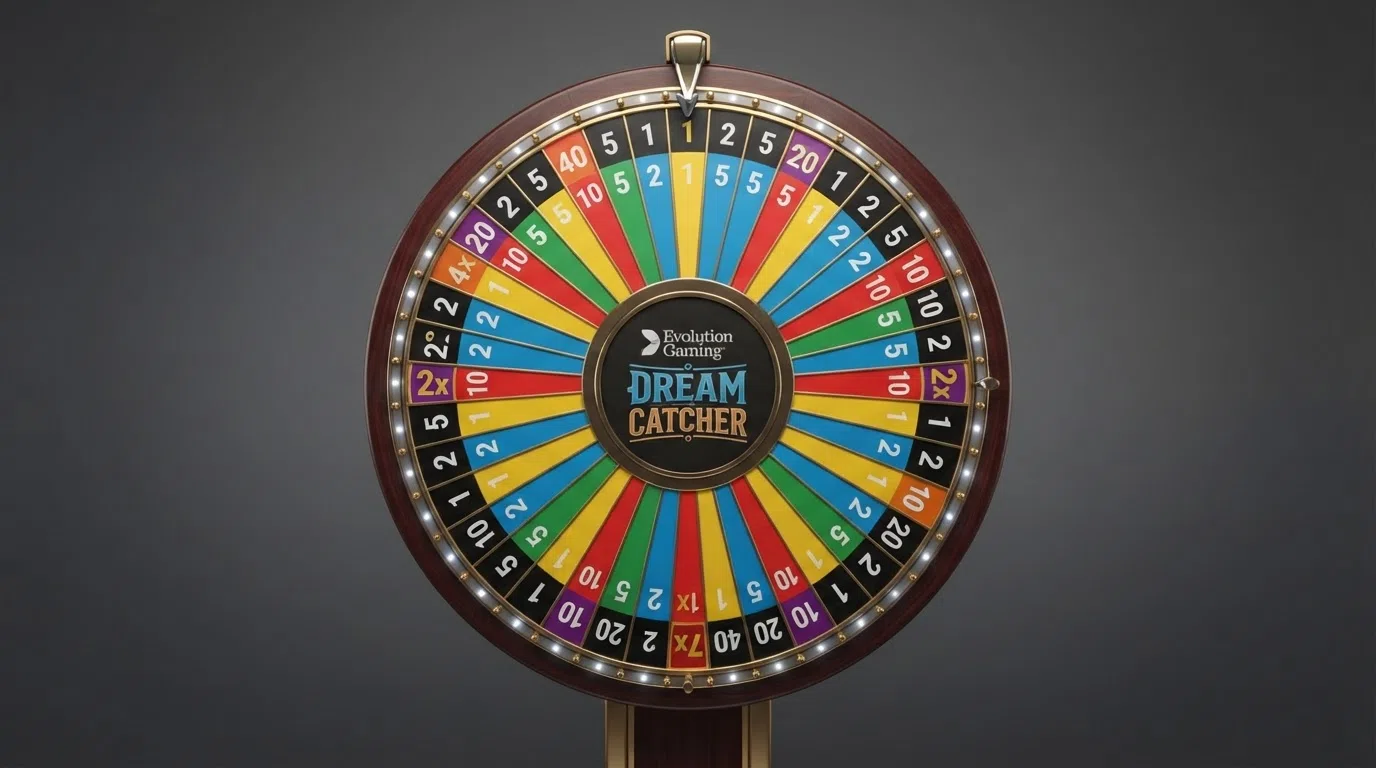
A Dream Catcher wheel is divided into 54 segments of alternating colours. Twenty-three of those segments carry the number 1, fifteen carry the number 2, seven the number 5, four the number 10, two the number 20, and one the number 40 — the rest of the wheel is taken up by the two multiplier segments, a single 2x and a single 7x, which sit at roughly opposite ends of the layout. A round plays out in roughly a minute. The host stands beside the wheel, takes bets during a timed betting window, spins, and calls the result as the flapper clicks into place.

If the flapper lands on a number, that number’s bets are paid at the corresponding odds: 1 pays 1:1, 2 pays 2:1, 5 pays 5:1, 10 pays 10:1, 20 pays 20:1, 40 pays 40:1. If it lands on a 2x or a 7x multiplier, the bets are not paid out at all — instead the wheel is respun, and whatever number comes up next has its payout multiplied. The 7x can also chain: a 7x followed by another 7x followed by a 40-segment would pay 7 × 7 × 40, which is 1,960x on the original stake, and in theory a 7x followed by a 7x followed by another 7x followed by a 40-segment would deliver approximately 13,720x — the theoretical maximum, capped at £500,000 per round. The likelihood of three 7x multipliers appearing in sequence is remote enough that nobody should plan their bankroll around it.
That is the whole game. The host’s role is to run the betting window, spin the wheel, and call the result; the player’s role is to pick a number and accept whatever odds the wheel happens to deliver.
Where UK players can find Dream Catcher online
Dream Catcher is published by Evolution, and Evolution is the only provider. The game is not white-labelled and it is not reissued by Pragmatic Play or anyone else — if a UK-licensed casino’s live lobby has a money-wheel game show, that game is Evolution’s, and the studio branding on the table will confirm it. The bigger question is whether a given operator carries the full Evolution live game-show suite or just the standard live tables (roulette, blackjack, baccarat, the occasional Casino Hold’em). Most UKGC-licensed sites that advertise a live casino have at least the standard tables; not all of them carry Dream Catcher.
All ten operators in the table later in this article are confirmed to carry Dream Catcher in their live lobby, either through Evolution’s standard product page or via the operator’s own game listing. A small note of context: Evolution itself resolved a UKGC investigation in July 2026 with a £4.75m settlement after its content was found to have appeared on six unlicensed websites via two operators. Evolution terminated the relevant commercial relationships, said no broader pattern was identified, and retained its UK licence. The settlement does not affect Dream Catcher’s availability at any UKGC-licensed casino — the game remains live across the full licensed network.
Before signing up, the practical check is to open the operator’s live casino page, search “Dream Catcher” in the game search bar, and confirm the studio branding reads Evolution. If a casino shows live tables but not Dream Catcher, the live lobby is almost certainly running a different provider’s live product.
Why Dream Catcher is the entry point to live game shows
The reason Dream Catcher stays relevant nine years on is the same reason it became the category’s first hit: it is easy to understand. New players do not need to learn a bonus round, a Top Slot, a board-game layer, or four different side bets. They pick a number, they watch the wheel, they get paid or they do not.
The Evolution CEO’s Q2 2026 remarks on the game-show category as a whole — strong development, returning to quarter-on-quarter growth in Europe — apply most directly to Crazy Time, Monopoly Live and the rest of the more complex titles in the suite. Those games are where the player count lives. But they are also where many casual players bounce off, because the betting layout is busier and the bonus rounds take longer to land. Dream Catcher is the format a player can pick up in the first thirty seconds of a round, and that is the same format that often converts them into someone who later tries Crazy Time. The game still has a job, and the job has not gone away.
The best UK casinos for Dream Catcher in 2026
Ten UKGC-licensed casinos, all confirmed to carry Dream Catcher, ranked by what their welcome offer actually delivers to a player who wants to play live game shows. The ranking weights the wagering terms (0× wagering on free spins is the cleanest path) and the validity window (shorter windows are harder to clear), alongside UKGC licence status and confirmed game availability. A small cluster of operators could not confirm their current welcome-offer terms this review round; their entries note that directly and direct the reader to the promotions page rather than guess at terms.
Two pieces of context apply to every offer in the table. First, the 10× wagering cap that took effect on 19 December 2025: a UKGC-licensed casino cannot impose a wagering requirement higher than 10× the bonus, and mixed-product offers — bonuses that condition a free spin on a deposit or a play in a different product type — are now banned. The offers listed below all sit within that rule. Second, live casino games typically contribute only 10% to 20% toward welcome bonus wagering at UKGC-licensed sites, and a few operators exclude live game shows entirely — which means the free spins tied to a slots welcome are the cleanest path for a Dream Catcher player who wants to keep their live bankroll untouched.
2026‘s top 10 Dream Catcher casinos at a glance
| Operator | UKGC Licence | Welcome Offer | Free Spins | Wagering | Bonus Validity |
|---|---|---|---|---|---|
| Bet365 | Active | Spin-the-reel welcome, up to 500 free spins | Up to 500 | 0× | 7 days per credit; 30-day claim window |
| William Hill | Active | Stake £10+ to unlock free spins | 200 (at 10p) | 10× on winnings | 72 hours from credit |
| Sky Vegas | Active (Flutter Entertainment) | 50 free spins no deposit + 200 on £10 deposit and spend | 250 total | 0× | 7 days |
| Ladbrokes | Active (Entain plc) | Not confirmed this review round | — | — | — |
| Coral | Active (Entain plc) | Free spins on first deposit | 25 | 0× | Not confirmed this review round |
| Betfair | Active (Flutter Entertainment) | Not confirmed this review round | — | — | — |
| Paddy Power | Active (Flutter Entertainment) | 25 no-deposit spins + 50 on £10 deposit and bet | 75 total | 0× | 7 days |
| LeoVegas | Active (MGM Resorts subsidiary) | 50 free spins on Big Bass Splash on £10 deposit and wager | 50 (on Big Bass Splash) | 0× | 7 days from qualification |
| 888 Casino | Active (evoke plc) | 50 free spins at 10p on registration | 50 (at 10p) | 10× on winnings, on slots within 90 days | 48-hour claim, 3-day use; winnings capped at £100 |
| Betfred | Active (Petfre Gibraltar Ltd) | 200 free spins at 10p on £10+ slots stake | 200 (at 10p) | 0× | 7 days; credited within 48 hours |
All ten are listed as Active on the UKGC public register, last refreshed 29 July 2026. Two operators in the featured set — Ladbrokes and Betfair — have not had their welcome-offer terms confirmed during this review window; their entries below explain what is confirmed and direct the reader to the operator’s own promotions page for the current offer.
Bet365
Bet365’s welcome offer for new casino customers runs as a spin-the-reel mechanic: each of ten selections over twenty days can award 5, 10, 20 or 50 free spins, taking the headline maximum to 500 free spins in total. The winnings carry 0× wagering, which is the cleanest structure on the UK market under the December 2025 reforms. Each spin credit lasts seven days once issued, and the whole welcome must be claimed within thirty days of registration. A minimum deposit of £10 unlocks the offer.
For a Dream Catcher player, what matters is that the winnings are paid in cash. There is no playthrough to grind through, no 10% live-casino contribution problem to navigate, and no restriction on the live bankroll. Bet365’s live casino lobby is Evolution-stocked and Dream Catcher is available; the operator is on the UKGC register as Active and has been throughout the review window. For a player who plans to start with a free-spin welcome and move into live play with cash-in-hand rather than bonus-tied balance, this is the most generous confirmed offer on the list.
William Hill
William Hill’s welcome is 200 free spins at 10p each, unlocked by staking £10 or more on the advertised game, with 10× wagering applied to spin winnings. The catch is the validity window: 72 hours from the moment the spins are credited, and selections are spread across twenty days with twenty-four hours between each. That 72-hour window is the shortest in the featured set, and it is the single biggest reason a careful player should plan ahead. Spins that expire unplayed are gone; winnings that do not get wagered in time are forfeit.
For a Dream Catcher player specifically, the relevant question is what 10× wagering on slot spin winnings actually costs in time. At a typical slot spin speed of around five seconds and the slot’s standard RTP, the wagering clears with reasonable speed, but it eats into the welcome week. The live casino lobby at William Hill is Evolution-stocked and Dream Catcher is available; the UKGC licence is Active. The combination is fine for a player who plans to clear the wagering quickly and then move to the live lobby with the residue.
Sky Vegas
Sky Vegas is the only featured operator offering a no-deposit portion alongside a deposit-triggered top-up. The structure is 50 free spins credited on registration with no deposit required, plus 200 further free spins after depositing and spending £10 — a total of 250 free spins, all with 0× wagering, all expiring seven days after credit. The operator is part of Flutter Entertainment and is listed as Active on the UKGC public register.
For a player who wants to test a live casino without committing a deposit first, this is the closest the UK market comes to a free look. The 50 no-deposit spins are enough to play a short session on a selected slot, and the 200 deposit-triggered spins are paid in cash on completion. Dream Catcher is available in the Sky Vegas live lobby. The only structural caveat is the seven-day expiry on the no-deposit portion — if the reader is not ready to start playing the day they register, the 50 free spins are wasted.
Ladbrokes
Ladbrokes is one of two Entain-group operators in the featured set, and the Entain live casino platform carries the full Evolution game-show suite, including Dream Catcher. The UKGC licence is Active.
The welcome-offer terms for Ladbrokes were not confirmed during this review window. Within the Entain group, live casino games typically contribute 10% toward wagering requirements, which means any deposit-match or free-spin welcome tied to live play will clear slowly if it clears at all — a structural reason to prefer a free-spin welcome that is paid in cash, even if the headline number is smaller. For the current Ladbrokes offer, the promotions page on the Ladbrokes website is the source to check, and the comparison table above will be updated as terms are confirmed.
Coral
Coral’s welcome offer is 25 free spins with 0× wagering on winnings, making it the smallest headline free-spin count in the featured set but also one of the cleanest. No playthrough, no contribution rate question, no live-casino cap to navigate. Like Ladbrokes, Coral sits in the Entain group and runs on the same Evolution-stocked live platform, with Dream Catcher available in the live lobby and the UKGC licence Active.
For a player who wants a small, no-strings welcome and intends to move into live play with their own deposit rather than bonus money, Coral is a sensible fit. The 25 spins are enough to take a quick look at a slot without committing more than a small minimum deposit, and the 0× wagering means whatever the spins return is paid in cash. The bonus validity window for this offer was not confirmed during this review window; the Coral promotions page is the source for current terms.
Betfair
Betfair is the only featured operator where First Person Dream Catcher — Evolution’s RNG adaptation of the live game, complete with a demo mode and a GO LIVE button that takes the player straight to the real table — is confirmed in the lobby. The live version of Dream Catcher is also available. The operator is part of Flutter Entertainment and is listed as Active on the UKGC public register.
The welcome-offer terms for Betfair were not confirmed during this review window. The First Person version is the point of distinction: a player who wants to spend ten minutes practising the wheel layout and the betting rhythm before risking any real money can do so at Betfair in a way that is impossible at most of the other operators in the table. For that reason alone the entry sits in the featured set; the welcome offer itself should be checked on the Betfair promotions page.
Paddy Power
Paddy Power’s welcome runs in two halves. The first is 25 free spins on Paddy’s Mansion Heist, credited as a £2.50 bonus with no deposit required. The second is 50 further free spins, credited as a £5 bonus, unlocked by depositing and betting £10. The total is 75 free spins, all with 0× wagering — winnings from both portions are kept in full — and a seven-day validity on each batch. The operator is part of Flutter Entertainment and is listed as Active on the UKGC register.
The no-deposit portion is the part that matters for a player who wants to test the waters. Twenty-five free spins at the relevant per-spin value is enough for a short slots session that produces cash winnings the player can then move into the live lobby. The deposit portion rewards the player who follows through. Dream Catcher is available in the Paddy Power live casino, and the 0× wagering structure means the live bankroll is never hostage to a bonus clearing requirement.
LeoVegas
LeoVegas runs a 50-free-spin welcome on Big Bass Splash, credited after a £10 deposit and a £10 wager on the qualifying game, with 0× wagering on the resulting winnings and a seven-day validity from qualification. Notably, live casino games are excluded from the £10 wager requirement — the qualifying stake must be on slots, but the resulting free-spin winnings, once paid in cash, are the player’s to use however they choose.
LeoVegas carries Dream Catcher in its Evolution-stocked live lobby and has a dedicated game page for it at leovegas.co.uk. The UKGC licence is Active, with LeoVegas AB operating as a subsidiary of MGM Resorts. For a player who plans to qualify the welcome with a slot session and then move into live play, the explicit exclusion of live games from the wager requirement removes the ambiguity that some other operators leave around the qualification step.
888 Casino
888 Casino’s welcome is 50 free spins at 10p each, credited on registration, with 10× wagering applied to winnings on slots within 90 days. The catch is structural: the claim window is 48 hours from registration, the use window is 3 days from claim, and the winnings are capped at £100. The 48-hour claim window is the strictest in the featured set, and the £100 cap is the only winnings ceiling on the list.
For a Dream Catcher player specifically, the 10× wagering and the £100 cap mean the welcome is a short, fixed-cost exercise: deposit, claim within two days, play within three, and either the wagering clears on a slot or it does not — with a hard £100 ceiling on what the welcome can ever return regardless of how the spins land. The live lobby is Evolution-stocked and Dream Catcher is available; the licence is Active, with the operator now operating as evoke plc.
Betfred
Betfred’s welcome is 200 free spins at 10p each, unlocked by staking £10 or more on casino slots, with 0× wagering on the resulting winnings and a seven-day expiry once the spins are credited. The free spins are credited within 48 hours of qualification. A separate live-casino offer — stake £20 to receive 5 Golden Chips — sits alongside the slots welcome and is the part of the package most directly relevant to a live-casino player. The operator is licensed under Petfre (Gibraltar) Ltd and is listed as Active on the UKGC public register.
For a Dream Catcher player, the 200 wager-free spins are the headline number, but the Golden Chips offer is the part to look at twice. Five Golden Chips usable on live tables is a small but real way to test the live lobby with house money. The two offers sit independently, so a player can take the slots welcome, clear it for cash, deposit, and then claim the live-casino portion separately if they want to.
What UK casino welcome offers actually mean for Dream Catcher players
Almost every welcome bonus at a UK-licensed casino is built for slots. The 19 December 2025 bonus reforms made that more, not less, true: the 10× wagering cap made offers with 0× wagering the cleanest legal option, and those offers are overwhelmingly free-spin offers on named slot games, paid in cash once the spins are played. The mixed-product ban — an offer may not condition a bonus on the customer playing a different product type — closes off a route that some operators used to use, where a free spin might be tied to a deposit followed by a live-casino wager.
For a Dream Catcher player the practical consequence is simple. A 0× wagering free-spin offer is the cleanest welcome to take: it pays in cash, it never locks the live bankroll, and it does not depend on whether live games contribute 10% or 20% to a bonus clearing requirement. A 10× wagering offer is workable but slower, and a 10× offer with a short validity window (William Hill at 72 hours, 888 Casino at 48 hours claim) is workable only if the player plans to clear it immediately. An offer where live casino contributes 10% to wagering and a free-spin welcome is the qualification step is the worst shape of all — a player can run through the qualification spend before realising the free spins and the wagering still need to be cleared on slots.
The table earlier in this section is a side-by-side, but the real comparison is between the offers that pay cash and those that do not. Seven of the ten featured operators (Bet365, Sky Vegas, Coral, Paddy Power, LeoVegas, Betfred, and arguably 888 Casino with its £100 cap as a hard limit) offer a 0× wagering structure. Two (William Hill, 888 Casino) carry 10× wagering. Two (Ladbrokes, Betfair) have terms that were not confirmed this review round.
Why your Dream Catcher RTP depends on the number you bet
The single most important number on a Dream Catcher table is the one nobody advertises on the table itself: the return to player varies by six percentage points depending on which number the player backs. The number-1 bet, the safest and most frequent segment, returns 96.58%. The number-40 bet, the rarest and most volatile, returns 90.57%. The house edge on the safest bet is 3.42%; on the riskiest it is 9.43%. That gap is larger than the entire house edge on most online slots, and it is the figure every player who wants to compare Dream Catcher honestly to other games needs in front of them before they sit down.
The reason is structural. The wheel pays each number as if it were an even-money shot: 1 pays 1:1, 2 pays 2:1, and so on up to 40 paying 40:1. But the number 1 occupies 23 of the 54 segments, the number 2 occupies 15, the number 40 occupies only 1. The higher the payout, the rarer the segment, and the more the house keeps on every miss. The multiplier segments (one 2x and one 7x on the wheel) do not change the long-run return — they redistribute variance around the same mean — and the maximum theoretical payout of approximately 13,720x stake is real but conditional on three consecutive 7x multipliers followed by a 40-segment, which is a sequence that is not part of any sensible session plan.
Dream Catcher is categorised as low volatility across the live-casino review community, but the volatility label is an average across the bet types, not a property of any individual choice. The number-1 bet really is low volatility; the number-40 bet is the opposite.
How to play Dream Catcher: rules, bets and payouts
A Dream Catcher round starts with a timed betting window of around fifteen seconds. The player chooses one or more of the six number segments — 1, 2, 5, 10, 20, 40 — and places a chip on the corresponding area of the betting grid. There is no minimum number of bets, no side bet, and no optional insurance. Multiple bets on the same number are added together; bets on different numbers settle independently.
When the betting window closes, the host spins the wheel. The flapper — a small metal arrow at the top of the wheel housing — clicks into place as the wheel slows, and the segment it points to is the result. If the result is a number, the corresponding bets are paid at that number’s odds. If the result is a 2x or 7x multiplier, the bets are not paid; the wheel is respun, and the next number that lands has its payout multiplied. The 7x can chain with another 7x on the respin, multiplying again, and a single 7x followed by another 7x and then a 40-segment would deliver 1,960x on the original stake. The hard cap on a single round is £500,000, or the currency equivalent.
The round ends when the wheel lands on a number segment. The next betting window opens almost immediately. There is no formal “round” boundary other than the start of the next betting window, which is why Dream Catcher tables tend to feel continuous — a steady cadence of spin, result, new bets, new spin, with the host providing colour between.
Dream Catcher RTP per segment: the table every player should see
| Segment | Frequency (out of 54) | Payout | RTP | Notes |
|---|---|---|---|---|
| 1 | 23 | 1:1 | 96.58% | Safest bet; highest long-run return |
| 2 | 15 | 2:1 | 95.87% | Second-safest; modest return drop |
| 5 | 7 | 5:1 | 95.78% | Mid-range; frequency makes it playable |
| 10 | 4 | 10:1 | 95.73% | Higher payout, higher variance |
| 20 | 2 | 20:1 | 93.40% | Long odds; visible house edge step-up |
| 40 | 1 | 40:1 | 90.57% | Rarest; lowest return of any bet on the wheel |
| 2x multiplier | 1 | Respin with 2× | — | Respins the wheel; multiplies next number |
| 7x multiplier | 1 | Respin with 7× | — | Respins and can chain for a second 7× |
The columns show the bet the player makes, how often that bet wins on the wheel, what the bet pays when it does, and the long-run return. The 2x and 7x multiplier rows carry no RTP of their own — they do not pay out on the segment that lands; they multiply the result of the respin.
The step from 96.58% to 90.57% is the single biggest number in this article. A player staking £10 on the number-1 bet over 100 spins at Evolution’s published RTP will lose, on average, around £3.42 across the session. A player staking the same £10 on the number-40 bet over the same 100 spins will lose, on average, around £9.43. The betting pattern is identical. The number on the betting grid decides the cost.
Dream Catcher vs Crazy Time vs Monopoly Live: which game show belongs on your screen
Dream Catcher is the simplest of the three by design: one wheel, six numbers, two multipliers, no bonus round, no second screen. Crazy Time, Evolution’s flagship game show, runs a two-reel main game (a money wheel plus a Top Slot that assigns a multiplier to one or more bets each round) and four separate bonus rounds, each with its own mechanic, that together account for a meaningful share of the game’s overall return. Monopoly Live sits between the two — a money wheel with three bonus triggers (2 Rolls, 4 Rolls, Chance) that launch a 3D board-game round featuring a CGI Mr Monopoly walking around a property board collecting and paying on the tiles he lands on.
For a player who wants the lowest barrier to entry and the cleanest mental model, Dream Catcher is the right pick. The bet is simple, the result is unambiguous, the round resolves in under a minute, and the per-segment RTP is published and easy to read against any other game’s single number. For a player who wants the biggest possible bonus rounds and is willing to learn a more complex layout, Crazy Time is where the larger payouts live, and Evolution’s chief product officer has described it as “the new blackjack” for the volume of players it now attracts. Monopoly Live is the pick for a player who likes the board-game layer and is comfortable with the larger variance that comes from a bonus round that can chain across multiple dice rolls.
Betting limits tell a similar story. Dream Catcher tables start at £0.10 per number at every UK operator, and most of the featured operators in this article cap the table at between £500 and £2,500 on the safer segments. Crazy Time and Monopoly Live typically start higher — £0.20 or £0.50 on the main wheel — and the bonus rounds carry their own minimums, which can be a problem for a low-stakes player.
Betting limits at UK Dream Catcher tables
Standard Dream Catcher tables start at £0.10 per number, which is the lowest the live-dealer format reasonably allows. The standard maximums at the table level run as follows: £5,000 on the number 1 segment, £2,500 on the number 2, £1,000 on the number 5, £500 on the number 10, £250 on the number 20, and £125 on the number 40. The shape of the curve is the point: the higher the payout, the lower the maximum stake, and the reason is bankroll protection for the operator against the rare but large payouts the high-multiplier segments can deliver.
UK operators typically cap their Dream Catcher tables between £500 and £2,500 across the safer segments, which is well below the standard table maximums for the low-payout numbers and broadly in line with the standard limits for the high-payout ones. The cap varies by operator and is usually set in the live casino lobby’s table information panel. A player who wants to bet more than the UK-standard cap on a high-frequency number needs to check whether the operator offers a VIP or high-roller Dream Catcher table, which some of the larger featured operators (Bet365, William Hill, Ladbrokes) do.
There is no statutory stake cap on Dream Catcher. The online slots stake cap that took effect in April and May 2025 under SI 2025/215 — £5 per game cycle for players 25+, £2 for players 18–24 — applies to online slots only and explicitly does not cover live casino games. A UK player of any age can stake £100 per spin on a Dream Catcher number at any UKGC-licensed operator that allows it. The cap is operator-set, not state-set.
You cannot play Dream Catcher for free — here is what you can do instead
There is no conventional demo mode for Dream Catcher. The reason is structural: every round is broadcast live from a staffed studio, with a real host, a real wheel, and a real betting window. A free-play version would require either a separate dedicated stream (which Evolution has not built) or an RNG simulation (which the company has built, separately, as First Person Dream Catcher). What every UK-licensed casino that carries Dream Catcher does offer is observer mode: the ability to open the table, watch the full live stream, see the results, and never place a bet. For a player who wants to learn the rhythm of a Dream Catcher round before risking money, observer mode is the closest thing to a free trial the live game offers.
For a player who wants something closer to a real demo, Evolution’s First Person Dream Catcher is the answer. It is an RNG-based version of the same wheel, with the same six numbers and the same two multipliers, but rendered as a 3D animated wheel rather than a live studio feed. A demo mode is built in, with virtual credits the player can use to test the layout, and a GO LIVE button that takes them straight to the real-money table. The first-person version does not match the social texture of the live game — there is no host, no chat, no atmosphere — but for practising the betting pattern and the result cadence it is more useful than the live table.
Observer mode: watch a real Dream Catcher round without betting
Observer mode is available at every UKGC-licensed casino that carries Dream Catcher. The lobby entry for the table looks the same whether the player is logged in as a real-money customer or as a logged-out visitor, and the table opens to the full live stream. The host’s voice, the spin, the result, the new betting window — all of it is visible. The one thing the observer cannot do is place a chip on the grid or interact with the host chat. The betting controls are dimmed or absent.
For a player who has never sat at a Dream Catcher table, observer mode is the cheapest way to understand what they are walking into. The pace is the first thing to register: a round resolves in roughly a minute, with most of that minute taken by the betting window, not the spin itself. The second is the volatility gap between the number-1 and number-40 bets: a long streak of 1s and 2s is normal, and a single 40-segment in a hundred spins is rarer than the 40:1 payout suggests. The third is the social texture: a live Dream Catcher table is a small crowd, often chatty, with the host doing real work to keep the room engaged. None of that comes through on a screenshot.
First Person Dream Catcher: the RNG version that does have a demo
First Person Dream Catcher is Evolution’s RNG adaptation of the live game. The wheel is the same 54-segment wheel, the betting grid is the same, the multipliers work the same way. The differences are that the wheel is animated rather than physical, the host is absent, and a demo mode is built in. The player loads the game with virtual credits, can play as long as the credits last, and a GO LIVE button at the side of the screen takes them straight to the real table when they are ready.
Among the operators in the featured set, Betfair is the one where First Person Dream Catcher is confirmed in the lobby. For a player who wants to spend fifteen minutes on virtual credits before opening a real-money account, that is the route in. The first-person version does not reproduce the live experience — there is no studio, no host, no chat, and the wheel-spin animation is a polished rendering rather than a physical object — but for the mechanical part of the game (which numbers to bet, what a 7x multiplier chain looks like, how the 2x behaves) it is more useful than the live table, because the player can pause and reset.
Dream Catcher is fully legal in the UK — and the slots stake cap does not touch it
Dream Catcher is a licensed and regulated live casino product in Great Britain. Every operator that offers it to UK players must hold a UK Gambling Commission operating licence; every spin is delivered by a software supplier that itself holds a UKGC software licence; the game sits within the regulatory framework set by the Gambling Act 2005 and the Licence Conditions and Codes of Practice that the Commission publishes. The online slots stake cap that has dominated the UK gambling headlines since early 2025 does not apply to Dream Catcher, and was never intended to.
What follows is the regulatory picture, the licensing architecture, the stake-cap distinction, the most recent UKGC enforcement action that touches Evolution, and the player-protection rules that apply to every Dream Catcher session at a UK-licensed casino.
How the UK Gambling Commission licenses live casino games
The UK Gambling Commission regulates commercial gambling in Great Britain under the Gambling Act 2005, with the Gambling (Licensing and Advertising) Act 2014 extending the regime to all remote operators serving GB customers regardless of where they are based. The point-of-consumption reform made a GB licence compulsory for any online operator taking GB customers, and operating without one is a criminal offence under section 33 of the Act — up to 51 weeks’ imprisonment and/or an unlimited fine. Dream Catcher, as a live casino game show delivered by a licensed software supplier, falls squarely within the licensable remote casino category.
The Commission’s three licensing objectives, set out in section 1 of the Act, are preventing gambling from being a source of crime or disorder, ensuring gambling is conducted in a fair and open way, and protecting children and other vulnerable persons from harm or exploitation. Every licence the Commission grants is tested against those objectives, and the LCCP and Remote Technical Standards that accompany the licence translate them into operational rules — game-design restrictions, anti-money-laundering checks, social responsibility code provisions, and the technical standards for the software itself.
The public register of operating licences, available at gamblingcommission.gov.uk, is the verification tool. It was last updated on 29 July 2026 and contains 2,663 active records at the time of writing. The register does not display per-brand licence grant dates in its public-facing search — it shows licence status (Active, Expired, or Revoked). Every operator in the featured set on this page has been confirmed Active on the register during the verification window for this article. A reader who wants to re-check any operator’s status can search by name on the Commission’s site and read the result in real time.
The online slots stake cap: why Dream Catcher is not affected
The Stake Limits on Online Gaming Regulations 2025 (SI 2025/215) introduced statutory stake limits for online slots in Great Britain. The headline figures are £5 per game cycle for players aged 25 and over, effective from 9 April 2025, and £2 per game cycle for players aged 18 to 24, effective from 21 May 2025. A “game cycle” is defined as the period from the moment a game is initiated to the moment all staked money is either lost or all winnings delivered.
The regulations apply to online slots and to online slots only. They do not cover roulette, blackjack, baccarat, poker, live game shows, or any other casino product. The Commission’s own guidance on the stake limit is explicit on this point. For a Dream Catcher player, the practical consequence is that the stake on a single number at a UKGC-licensed casino is governed by the operator’s table limits alone — not by the statutory cap. A player who wants to stake £100 on the number 1 segment at a high-limit Dream Catcher table can do so, provided the operator offers a table with that cap.
The reason for the carve-out is that the slot stake cap is targeted at the structural features that make online slots higher-risk for harm — rapid spin cycles, the ability to set an autoplay sequence running, the use of feature buys, the visual feedback that can compress losses. Live game shows, with their slower cadence, their visible wheel spin, their real-time result, and their mandatory host interaction, do not present the same feature profile. The Commission’s separate game-design rules (ban on autoplay, minimum 2.5-second spin speed, ban on features that speed up play) target the same features on the slot side, and they apply to slots only.
The Evolution £4.75m settlement: what happened and what it means
In July 2026, Evolution agreed to pay £4.75 million to the UK Gambling Commission after an investigation found that its live casino content had appeared on six unlicensed websites accessible to British consumers. The unlicensed access was traced to two operators that had been hosting Evolution’s content outside the licensed network. Evolution stated that it had terminated the relevant commercial relationships, that no broader pattern of unlicensed access had been identified, and that the matter was resolved without affecting its UKGC licences.
The settlement did not affect the availability of Dream Catcher, Crazy Time, or any other Evolution live game at any UKGC-licensed casino. The operator retained its software licence, and the games continue to run at every UK-licensed operator in the featured set. What the case illustrates is the Commission’s enforcement approach, which is disruption rather than ISP or DNS blocking. Between April 2024 and June 2025, the Commission issued 3,140 disruption notices, referred 447,778 URLs to search engines for delisting, and saw 287,961 of those URLs removed. The Commission does not currently hold statutory ISP or DNS blocking powers — legislation to grant them has been proposed but not enacted.
For a Dream Catcher player, the practical takeaway is that the licensed market is policed, that the regulator acts on supply-chain issues when they are found, and that the licensed route to the game is the one that has both consumer protection and the games themselves running in full.
Player protections under UK gambling law
Every UKGC-licensed casino that offers Dream Catcher must follow a set of mandatory player-protection rules. The headline provisions: age and identity verification before first deposit or first gamble (mandatory for remote licensees since 7 May 2019), a credit card ban across all gambling including credit-card-funded e-wallet deposits (since 14 April 2020), and a deposit-limit offer that the operator must make before the customer’s first deposit — with any request to decrease a deposit limit actioned immediately from 31 October 2025, and a gross deposit limit offered as the only thing the operator may call a “deposit limit” from 30 September 2026 (extended from the original 30 June 2026 date).
A financial vulnerability check is mandatory at a net deposit threshold of £150 in a rolling 30-day period, using publicly available data (bankruptcy, county court judgments, IVAs), from 28 February 2025. A financial risk assessment — the affordability check — has been announced with stage 1 thresholds of £5,000 net deposits in 24 hours (25+) and £2,500 (under 25), and final thresholds of £1,000/£3,000 (25+) and £750/£2,000 (under 25), but the commencement date has not been confirmed. The single most-misreported piece of UK gambling regulation in 2025 and 2026 is the status of those affordability checks: announced, not in force.
The bonus regime is part of the same protective architecture. From 19 December 2025, the 10× wagering cap (LCCP SR Code 5.1.1) and the mixed-product promotional offers ban are in force. A UKGC-licensed casino cannot ask a player to wager a bonus more than 10 times, and cannot tie a bonus to the player also playing a different product type. The 0× wagering free-spin offers that several operators in the featured set run sit comfortably within that rule — they are simpler than the cap requires, and they are the form the UK market has been moving toward since the cap was announced.
The safety net: responsible gambling tools at every UK-licensed casino
UK-licensed Dream Catcher casinos must provide a set of mandatory safer-gambling tools, and the help infrastructure outside the casino is free, confidential, and available 24/7. The shape of the protection has tightened materially over the last two years — the financial vulnerability check, the deposit-limit rules, and the 10× wagering cap are all post-2024 additions — and the help services have grown to meet a rising demand. The GamCare National Gambling Helpline took over 130,000 calls and online messages in 2024/25, with 7,100 referrals into further treatment and 8,100 treatment sessions delivered regionally; in January 2026 alone, GamCare made 996 referrals to treatment and peer-based support services, a 48% increase on January 2025. The National Gambling Support Network, funded by GambleAware, treated 11,960 clients between April 2024 and March 2025, an 11% year-on-year increase, and nine in ten of those who completed treatment saw improvement.
The scale of the underlying problem is larger than most readers expect. 47% of adults in Great Britain had gambled in the past four weeks in the GSGB Wave 4 data (September 2025 to January 2026). An estimated 4.3 million adults in GB are affected by a family member’s or friend’s gambling, up from 6% to 8% of the adult population since 2020. Around 2 million children may be living in households where an adult is experiencing problem gambling. Almost one in three adults (30%) who gamble and experience any level of problems want treatment, support, or advice — a figure that has nearly doubled from 17% in 2020.
Deposit limits, reality checks and session timers
Three concrete tools every Dream Catcher player should set before their first session, all mandatory at UKGC-licensed casinos: a deposit limit (offered before the first deposit, with any request to decrease actioned immediately, and the gross deposit limit structure from RTS 12 taking full effect on 30 September 2026), reality checks (periodic on-screen prompts showing the time and money spent during a session), and time-outs (short self-exclusion periods from 24 hours to several weeks, applied at the operator level without the need to use GAMSTOP). All three are configurable in the responsible-gambling or safer-gambling section of a UK casino account dashboard, usually under a heading that reads “Safer Gambling” or “Player Protection” rather than “Responsible Gambling” — both are common, and the section is always reachable from the footer of the casino’s main page.
A session timer is the single tool that does the most for a live game like Dream Catcher, because the cadence of the game — a round every minute, no formal end-of-session signal — is exactly the shape of activity that hides time spent. A reality check at 30 minutes is a reasonable starting setting; a player who finds they are extending the timer every session has information about their own play that no game design can supply.
GAMSTOP: the national self-exclusion register
GAMSTOP is the UK national self-exclusion scheme, mandatory for every GB-licensed online gambling operator since 31 March 2020. A player registers once, free, with their name, address, and date of birth, and is blocked from opening a new account or using an existing account at every GB-licensed online operator for the duration of the chosen exclusion. The available periods are six months, one year, five years, or five years with auto-renewal. The exclusion cannot be cancelled early, regardless of the period chosen.
What GAMSTOP does not cover is land-based gambling venues (bookmakers, casinos, bingo halls) and unlicensed online operators. A player who needs to exclude from land-based as well as online gambling needs to use the multi-operator self-exclusion scheme run by their venue or trade body, separately. The online side, which is the relevant one for a Dream Catcher player, is fully covered.
Where to get help: GamCare, the NHS and the National Gambling Helpline
Free, confidential help is available by phone, online, and in person. The GamCare National Gambling Helpline is 0808 8020 133, freephone, 24 hours a day, and the service also runs online chat and messaging. The NHS operates gambling harm clinics in England, Scotland, and Wales, with referral through a GP or self-referral through the NHS website. Gamblers Anonymous runs peer-support meetings across the UK. The National Gambling Support Network, funded by GambleAware, provides structured treatment through local providers in every region.
The demand on these services has grown. GamCare’s January 2026 referral total of 996 was up 48% on January 2025, and the wider helpline contact figure of over 130,000 in 2024/25 is the highest the service has reported. The NGSN’s 11% year-on-year increase in clients treated, and the nine-in-ten improvement rate for those who complete treatment, are the figures that explain why the capacity has been expanded. None of this replaces a player’s own decision to use the deposit-limit, reality-check, and time-out tools their casino provides, but it is the network underneath those tools, and it is free at the point of use.
How we selected and ranked the casinos in this guide
Every operator in the featured set was checked against the UK Gambling Commission’s public register of operating licences, last refreshed 29 July 2026. Only operators listed as Active on the register were considered for inclusion. Dream Catcher availability was confirmed via the operator’s own live-casino lobby listings and via independent review sources, principally SlottyHouse and independent live-casino data sources. Welcome-offer terms were sourced from the operator’s own promotions pages and from independent casino-review publishers, and the ranking ordered the operators by what the welcome offer actually delivers to a Dream Catcher player — free-spin count, the presence of 0× wagering, and the validity window — alongside UKGC licence status and confirmed game availability.
The market context the page sits inside is large. UK online Gross Gambling Yield for the first quarter of 2026 was £1.55 billion, up 7% year-on-year, with slots GGY up 12%. The global online casino market was valued at around EUR 105,186 million at year-end 2025, according to H2 Gambling Capital. The game-show category is the segment of that market that has been growing fastest in Europe — Evolution’s Q2 2026 reporting names it as the key driver of the European return to quarter-on-quarter growth, and the same reporting names Crazy Time as a game that now attracts more players than blackjack and roulette combined.
Sources cited in this article: the UK Gambling Commission’s published statistics, guidance, and public register; Evolution’s product pages and annual report; Gambling Capital market data; the SBC News and iGaming Expert coverage of the Evolution settlement; the GamCare annual statistics; the GambleAware annual GB Treatment and Support Survey 2024; the GSGB Wave 4 official statistics; and independent live-casino review publications including SlottyHouse and other independent reviews. Two operators in the featured set (Ladbrokes, Betfair) had welcome-offer terms that were not confirmed during the review window; their entries above direct the reader to the operator’s own promotions page for current terms.
Is Dream Catcher worth it? What the RTP figures tell the player
The case for Dream Catcher is the simplicity, the social layer, and the access. A round takes a minute, the rules fit on a single screen, the minimum stake is £0.10 per number, and a player who wants to watch before betting can do so at every UK-licensed operator that carries the game. A live host, a real wheel, and a real-time result are not the same product as an RNG slot spin, and for a player who values that texture the comparison is not even close. The case against Dream Catcher is the RTP gap: a player who backs the number 40 for the thrill of the 40:1 payout is paying a 9.43% house edge on every spin, which is roughly three times the edge a typical online slot carries, and the long-run cost of that choice is real money that no amount of bonus money will recover.
To put a number on it, a session of 100 spins at the minimum £0.10 stake on the number-1 bet, at the published 96.58% RTP, costs the player around £3.42 in expected loss over the session — roughly 34p per spin, or about £1 per ten minutes at the table’s natural cadence. The same 100 spins at £0.10 on the number-40 bet cost around £9.43 in expected loss, and the player wins less often to compensate. The arithmetic is the same on a higher-stake session scaled up: a £1 spin on the number-1 bet over 100 spins is a £342 expected loss, and a £1 spin on the number-40 bet is a £943 expected loss, with the difference between the two being almost entirely the cost of choosing the rare segment over the common one.
For the right player, Dream Catcher is worth it. The right player is someone with a small bankroll, an interest in the live format, a willingness to stay on the number-1 or number-2 bets where the RTP is at its highest, and a plan to use the safer-gambling tools the UK market now mandates. For a player who wants the 40:1 thrill, the maths is honest: the house edge on that bet is 9.43%, the table is structurally less generous than the safer segments, and the entertainment value of the rare hit is not free — it is paid for in the spins that miss. The 0× wagering free-spin offers in the featured set are the cleanest way to fund a first look at the table without touching the live bankroll, and the observer mode at every UK-licensed casino is the cleanest way to confirm the format suits before any money changes hands.
Frequently asked questions about Dream Catcher at UK casinos
What is the biggest payout possible on a single Dream Catcher spin?
The theoretical maximum is approximately 13,720× the stake, which would require a 7x multiplier, followed by another 7x multiplier, followed by a third 7x multiplier, and then a 40-segment on the respin. In practice, Evolution imposes a hard cap of £500,000 (or the currency equivalent) per game round. Realistic single-round payouts are much smaller: a 7x followed by a 40-segment pays 280×, and a 7x followed by another 7x and then a 40-segment pays 1,960×.
Do welcome offers at UK casino sites cover live game-show tables?
Most UK welcome offers are free-spin offers on named slot games, with the winnings paid in cash. Free-spin winnings can usually be used on any casino game, including Dream Catcher, once they are credited. The bonus wagering — where it exists, capped at 10× under LCCP SR Code 5.1.1 from 19 December 2025 — typically only clears on slots, and live casino games usually contribute 10% to 20% toward wagering. The cleanest welcome for a live player is therefore a 0× wagering free-spin offer, of which several appear in the featured set.
Are live dealer games included in the online slots stake restriction?
No. The online slots stake cap introduced by SI 2025/215 — £5 per game cycle for players 25+ (from 9 April 2025) and £2 for players 18 to 24 (from 21 May 2025) — applies to online slots only. Live casino games, including Dream Catcher, Crazy Time, Monopoly Live, and live roulette and blackjack, are explicitly outside the cap. Stake limits on live tables are set by the operator, not by statute.
What is the smallest and largest wager allowed on Dream Catcher at British casinos?
The standard table minimum is £0.10 per number. Standard table maximums are £5,000 on the number-1 segment, £2,500 on number 2, £1,000 on number 5, £500 on number 10, £250 on number 20, and £125 on number 40, with the maximums shrinking as the payout multiplier grows. UK operators typically cap their tables at between £500 and £2,500 across the safer segments, and the cap for a specific operator is shown in the table information panel in the live lobby. Some larger operators offer VIP or high-roller tables with higher caps.
How does the Dream Catcher wheel stack up against Crazy Time and Monopoly Live?
Dream Catcher is the simplest of the three: a single 54-segment wheel, six numbers, two multipliers, no bonus round. Crazy Time runs a two-reel main game with four separate bonus rounds and accounts for a meaningful share of the live game-show category’s player count. Monopoly Live sits between them, with a money wheel and a 3D board-game bonus round. For a player who values the simplest possible format, Dream Catcher is the right pick. For a player who wants the largest bonus rounds, Crazy Time is the better fit. Minimum bets are typically lowest on Dream Catcher (£0.10) and higher on the other two.
Can you watch a Dream Catcher game without placing a bet?
Yes. Every UKGC-licensed casino that carries Dream Catcher offers observer mode, which opens the table to the full live stream without the ability to place a bet. The host, the wheel, the result, and the new betting window are all visible. For a player who wants to learn the rhythm of a round before risking money, observer mode is the closest thing to a free trial the live game offers. Evolution’s First Person Dream Catcher, an RNG version of the same wheel, adds a built-in demo mode with virtual credits and a GO LIVE button that takes the player to the real table when they are ready.
How many UK players are affected by gambling harm?
The numbers are larger than most people assume. 47% of GB adults had gambled in the past four weeks in the most recent GSGB wave (September 2025 to January 2026), which is the headline participation figure. The harm figure sits beneath it: an estimated 4.3 million adults are affected by a family member’s or friend’s gambling, which is up from 6% to 8% of the adult population since 2020. Around 2 million children may be living in households where an adult is experiencing problem gambling. And the treatment-seeking rate among adults who gamble and experience any level of problems has nearly doubled since 2020 — from 17% to almost one in three (30%) — which is the supply-side signal that the infrastructure built over the last five years is reaching the people it was built for.
The point of these figures is not to argue that gambling should be avoided. It is to argue that the tools, the helpline, and the treatment network exist because the harm is real and at scale, and that a Dream Catcher player who finds the betting window opening faster than they planned has a free, immediate, and confidential route to support.
Live – fastestpayout-casinos-uk
Content created by the «fastestpayout-casinos-uk» team