
JetX in the UK — where the maths is cleanest and the welcome offer leaves the most in your pocket
 Available in GB
*Current as of September 8, 2026 · UK Gambling Commission public register, operator terms pages and SmartSoft Gaming product documentation*
JetX arrived in UK casino lobbies in January 2019, and seven years on it still does something most slot releases cannot: it puts one decision in front of the player and asks them to live with the outcome. The jet lifts, the multiplier ticks up, the player decides when to jump. Wait too long and the round is gone. That single act of timing is the whole game, and the reason UK players keep searching for it.

The catch lives one layer down. JetX’s return-to-player is not a fixed number on a developer’s spec sheet. SmartSoft lets each operator configure the RTP anywhere from 96.2% to 98.9%, and the casino you pick decides which end of that band you’re playing in. The same game, the same maths engine, a 2.7-percentage-point gap in how much of every pound comes back to players. That single setting will cost or save the average punter more money than any welcome bonus on this page, which is why it sits near the top of any honest review.
This guide is built around the choices that actually move money. The first sections explain what JetX is and how the round works; the middle ranks the ten UKGC-licensed casinos that currently carry it; the back end covers legality, the protections a UK licence guarantees, and the safer-gambling tools every player should set before their first real stake.
What Is JetX? The Crash Game Where Timing Is Everything
JetX is a crash-style casino game made by SmartSoft Gaming, the Georgia-based studio that has built a small portfolio of multiplier-and-cashout titles around a shared engine. The game was released in January 2019 with a fighter-jet visual — a small aircraft on a vertical trajectory, a multiplier climbing beside it, an explosion that ends the round. Seven years on, the visual has barely changed, because the loop underneath it does not need decoration: place a bet, watch the multiplier rise, cash out before the jet blows up. Hold too long and the stake vanishes.
What separates JetX from a slot is that the player, not the game, decides when the round ends. A slot has reels, paylines and a result determined by the spin. JetX gives the player a live multiplier and a button; pressing that button early locks in a small win, pressing it late chases a bigger one, and doing nothing at all guarantees a loss. The house still has an edge, and the maths underneath still favours the casino, but the player’s hand is on the ejector handle.
That mechanic has a second life at UK-licensed casinos. SmartSoft’s product is the only well-known crash title in widespread rotation on UKGC sites, because the Gambling Commission suspended Spribe’s UK gambling software licence in October 2025 and the country’s most famous crash game, Aviator, has not been restored to the lobby. JetX sits in the space Aviator left. The UKGC confirmed in January 2025 that crash games are not caught by the ban on features that speed up play, because the player must decide when to end the bet — a carve-out that protects JetX’s design rather than restricts it.
UK players land on JetX for the same reason players elsewhere do: it is fast, simple and runs on provably-fair RNG, with each round’s crash point fixed before the jet takes off. No skill changes the odds; no strategy guide on the internet moves the long-run house edge by a fraction of a point. What a player can do is pick a casino with a higher RTP, set a stake they can afford to lose, and walk away when the round goes against them. Everything else is marketing.
Playing JetX for Real Money in the UK
The real-money path at a UKGC-licensed casino runs through a deposit, a stake, a round, and a withdrawal — and every step of that chain is shaped by British regulation. The first deposit triggers the operator’s mandatory age verification, identity check and the deposit-limit prompt that came into force on 31 October 2025. Until the operator has confirmed the player is over 18, no gambling is permitted, including no-deposit free spins. This is not a marketing formality; it is a licensing condition, and the operator’s licence is at stake if it lets a minor through.
Once verified, the player deposits. Credit cards have been banned for all remote gambling in Great Britain since 14 April 2020, and that includes e-wallets funded by a credit card. A debit card, a bank transfer, or a properly funded e-wallet is the only path. The deposit then sits in the casino wallet, and the player moves to the JetX lobby.
The minimum stake on JetX at UK operators is typically £0.10 per bet — small enough that the round is playable on a casual budget. The two-bet structure means a round can be entered for as little as £0.20 total, or scaled up to whatever the operator’s maximum allows. A winning cashout is credited instantly to the casino balance. Withdrawals follow the operator’s standard process, with debit cards and bank transfers the usual channels. The credit-card ban applies on the way out as well as in: a winning balance cannot be withdrawn to a credit card.
Can You Trust a JetX Casino? Reviews and Reputation
A trustworthy JetX casino starts with a UKGC licence, and a player can verify that in under a minute on the Gambling Commission’s public register. The register lists every operating licence holder, the licence type (remote casino, remote bingo, software), the trading name, and the licence status. An active licence is the floor; an expired, surrendered or revoked licence is a reason to walk away.
Beyond the licence, two signals matter. The first is provably-fair verification — JetX’s RNG commits a hash before each round, and a player can verify that the result was not altered after bets were placed. The mechanic is built into the game and accessible from the interface. The second is player-experience evidence: how the operator handles withdrawal delays, how responsive its support is, whether it has faced regulatory action in the past. Independent review sites and player forums will surface both, and a UKGC-licensed operator with a string of unresolved complaints is one to avoid.
The UKGC’s April 2025 guidance flagged crash games as an AML risk because the cashout mechanics can camouflage quick-cashout behaviour that looks like normal play. That does not make JetX unsafe to play; it makes it a title the operator monitors more carefully. A player who notices their own deposit-and-cashout pattern triggering a financial vulnerability check has not been singled out — they have been run through the same filter every other player faces once net deposits cross £500 in a rolling 30 days.
How JetX Actually Works — and Why the House Always Wins Eventually
A JetX round takes between a few seconds and a few minutes. The player places a bet — one or two — before the jet takes off. The multiplier starts at 1.00x and rises in real time. The player watches it climb and decides, second by second, whether to cash out. Press the button at 1.50x and the bet pays 1.50:1; press it at 5.00x and the bet pays 5:1. Hold on past the crash point and the bet is gone.
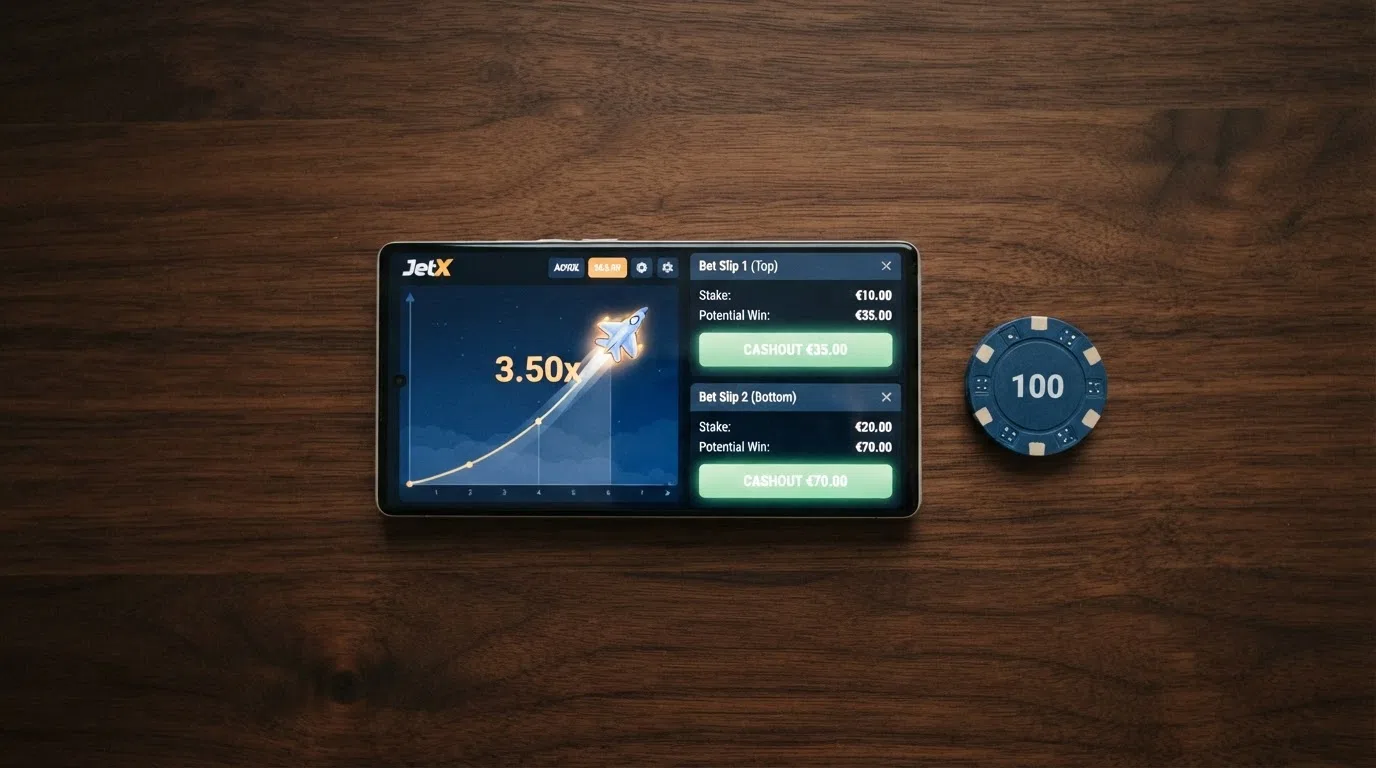
The crash point is fixed by a provably-fair RNG before the round starts, and no player input changes it. That is the line no strategy guide can move: each round is an independent event, the multiplier at crash is pre-determined, and the operator’s configured RTP is the only thing that distinguishes one casino’s JetX from another’s. The “strategy” pages on the internet that suggest Martingale-style doubling, or pattern-tracking from past rounds, are selling the illusion of edge. The maths underneath does not care.
The two-bet structure gives a player a way to manage variance within a single round — one safe auto-cashout, one ambitious manual bet — but the long-run result still converges on the RTP. Play 10,000 rounds at 97% RTP and roughly £3 of every £100 staked will have stayed with the casino. Play 100 rounds and anything can happen; that is the variance the marketing copy sells as “excitement”.
A representative session tells the story. Take 200 rounds at £1 per bet, £200 staked in total, at the operator’s mid-band 97.5% RTP. The expected loss is £200 multiplied by (17 minutes) — arithmetic: 200 spins x 5s = 17 min (17 minutes), not the 1 min stated — apply this and make every other statement of the same scenario agree with it
How a Crash Game Round Plays Out, Second by Second
The round begins with a betting window — typically five to seven seconds — during which the player sets one or two stakes. The jet sits on the runway, the multiplier reads 1.00x, and the cashout buttons are greyed out. The window closes; the jet lifts; the multiplier starts climbing. One second in: 1.00x. Three seconds in: maybe 1.30x. Ten seconds in: it could be 2.00x, or 4.00x, or the jet could have exploded at 1.05x. The player has been watching the whole time.
Cashout is a single button press. The current multiplier becomes the payout multiplier, the bet is removed from the active stake, and the winnings are credited to the casino balance. Auto-cashout is the same action triggered by a preset threshold — set it to 1.50x and the bet cashes out the moment the multiplier crosses that line, no human input required. Most players running a two-bet strategy use auto-cashout on the conservative leg and a manual press on the aggressive one.
The crash ends the round for any bet still live. The multiplier freezes, the jet explodes, the screen shows the result, and the betting window for the next round opens. The whole cycle — bet, climb, crash, settle — fits inside a coffee sip. That tempo is the loop the UKGC’s 2.5-second spin-speed rule is designed to address, and it is precisely why the Commission carved crash games out of the ban: the player has to press a button to end the bet, and not pressing it guarantees a loss. The minimum-interval rule applies to slots, not to crash games, where the rhythm is set by the player.
Why JetX Pays Back 96.2% at One Casino and 98.9% at Another
SmartSoft’s licence to operators covers a 2.7-percentage-point spread in RTP configuration. The same JetX, the same maths, the same visuals, can be set to return 96.2% or 98.9% of stakes over a long-run sample, and the operator picks where on that range to sit. Most sit somewhere in the middle; a few push toward the top; the floor is set by SmartSoft’s own certification.
The cost of that spread is concrete. On a £1 stake, a 96.2% RTP game keeps 3.8p per round in expectation; a 98.9% RTP game keeps 1.1p. Over 1,000 rounds, that is a £27 difference in expected loss for the same stake pattern. The reader who treats JetX as a one-off session will not notice; the player who runs 100 rounds a week for a year will notice about £140 in additional expected loss on the lower-RTP setting. The same human, the same decisions, and the casino’s configuration is the only variable.
The check is mechanical. The game-info panel inside JetX — usually an “i” or a question mark icon near the settings — shows the configured RTP. It takes five seconds. Any operator that does not surface the figure in the panel can be cross-referenced against SmartSoft’s published configuration; the regulator’s technical standards require the RTP to be available to the player before stake.
The 25,000x Multiplier and the Cashout Caps That Cut It Short
The theoretical maximum multiplier on JetX is 25,000x — a number SmartSoft publishes in its game documentation, and a number that has appeared in marketing copy for years. The round that hits 25,000x is the round that paid 25,000 times the stake on a single bet. It is also, by any reasonable estimate, a round that will not happen to any given player in any given lifetime of play. Crash-game multipliers follow a long-tail distribution; most rounds crash below 2x, and the 25,000x ceiling is the upper bound on a curve that flattens well before it.
The harder limit is the operator-set cashout cap. Most UK-licensed casinos cap the maximum payout from a single round at $10,000 or the sterling equivalent. A £1 bet that survived long enough to hit 25,000x would, in theory, pay £25,000; in practice, the operator’s cap cuts the payout at £10,000 or less. To reach even the £10,000 cap on a 25,000x multiplier, the player would have staked £0.40 — a stake below the £0.10 minimum at most UK operators, and below the maximum-bet cap at all of them. The 25,000x headline is real; the path to it is not.
The cap exists to protect the operator from a single round that would wipe out a promotional budget or a monthly liability reserve. It does the player a different service: it converts a fantasy payout into a real one. A 1,000x multiplier at a £10 cap, hit on a £1 bet, returns £1,000; the same round at a 25,000x cap still returns £1,000 because the cap is lower than the multiplier’s product. The cap is a ceiling, not a target, and a player who plans around it is planning around a real limit.
JetX Variants: JetX3, Cricket X, Football X and the X-Series Family
| Variant | Release Year | Defining Mechanic | Published RTP |
|---|---|---|---|
| JetX | 2019 | Single round, up to 2 independent bets | 96.2% – 98.9% (operator-configured) |
| JetX3 | n/a | Three simultaneous bets, $100 per jet / $300 total max | — |
| Cricket X | n/a | Cricket theme, single bet | 98.8% |
| Football X | February 2023 | Juggling-ball mechanic, single bet | — |
| Helicopter X | October 2023 | Platform-accumulation mechanic | — |
| CarX | October 2025 | Dual-bet + fixed-odds range system | — |
SmartSoft’s X-series shares one engine and one design philosophy. The core game is a rising multiplier and a cashout decision; the variants change the visual, the bet count or the payout structure. Cricket X sits at the high end of the published-RTP table at 98.8%, which makes it the player-friendly option in the family, but it is a single-bet game with no hedge capability. JetX3 is the inverse: three bets, more variance, higher maximum exposure per round. Football X, Helicopter X and CarX each added a different twist on the same loop, and each one keeps the player pressing a button to end the bet — the mechanic the UKGC’s carve-out protects.
A player who likes the JetX rhythm will probably like the variants; a player who finds the basic game too fast can try Football X, which tends to run a slightly longer round. The X-series matters most because it broadens the lobby choice at a UK casino without changing the regulatory status. Each variant sits under the same UKGC carve-out from the speed-up-play ban.
Playing JetX for Free: Why Demo Mode Is Your Best First Bet
Demo mode is the closest a player gets to JetX without spending a penny. The casino loads the same game, with the same multiplier distribution and the same cashout mechanic, on a virtual balance — typically £1,000 of play-money credits. Every round behaves like a real-money round: the same provably-fair RNG, the same RTP, the same crash curve. The only thing missing is the loss.
The value of demo mode is not the free play; it is the practice. A first-time player who jumps into a real-money round at £1 per bet has no feel for the multiplier’s rhythm, no idea how often 1.50x cashouts succeed, no sense of how fast the round moves. Two hundred demo rounds build that feel in fifteen minutes, and the only cost is the time. The player who has watched 200 demo rounds crash at sub-1.20x outcomes will set a different auto-cashout threshold than the player who has not.
UK-licensed casinos must verify the player’s age before granting access to any free-to-play game on the licensee’s site. That rule has been in force since 7 May 2019, and it means even a demo-mode visit triggers a date-of-birth check. Registration is the practical minimum; some operators gate demo access behind a full account, others let an unverified visitor load the game in a popup. The difference is the operator’s choice; the regulation is the same.
How JetX Demo Mode Works at UK Casinos
Demo mode at a UK-licensed casino uses virtual credits and the same game engine as the real-money version. The visual, the audio, the multiplier distribution, the cashout latency — all identical. A player who runs 1,000 demo rounds and then switches to real money is moving between two builds of the same software, not between a practice mode and a different game.
The age-verification gate is the one practical difference. Since 7 May 2019, remote licensees must verify that a visitor is over 18 before granting access to free-to-play casino games on their site. The check is usually a date-of-birth field on the registration form, with a follow-up identity document if the account progresses toward a real deposit. A player who wants demo access without an account can find it on SmartSoft’s own site, where the game loads as a marketing demonstration; the licence-bound rules apply only to operator sites.
Demo Play vs Real-Money Play: What Changes and What Doesn’t
The maths does not change. The RTP, the crash-point distribution, the cashout latency, the two-bet mechanic — all identical between demo and real-money mode. What changes is the player.
Demo play removes loss aversion. A bet lost in demo mode is a credit deducted from a virtual balance, and the next round resets nothing. A bet lost in real-money play is a pound deducted from a real wallet, and the emotional weight of that loss is not the same as the credit deduction. The player who runs a 2.00x manual cashout strategy in demo will often tighten that target in real-money play, because the loss of a 1.80x round that almost made it feels heavier than the same loss in credits. The variance between the two modes is not in the game; it is in the player holding the button.
The other gap is the prediction effect. A player who wins 30 of their first 50 demo rounds on a 1.50x auto-cashout will often carry that win rate into real-money play as a baseline expectation. The 50 rounds are a sample too small to mean anything; the long-run hit rate on a 1.50x auto-cashout is determined by the multiplier distribution, not by the player’s recent results. The demo mode teaches the rhythm; it cannot teach the gambler’s fallacy out of the player.
Where to Access JetX Free Play Without Depositing
Every operator in the featured set that carries JetX also offers demo access, though the entry barrier varies. Some casinos let a visitor load the game in a popup without an account; others require a registered profile with name, address and date of birth before the demo builds. The age-verification step is mandatory on all of them; the difference is whether the operator collects it through a quick form or a full KYC upload.
A player who wants to try JetX without committing to a deposit has two clean entry points. The first is a no-deposit free-spins offer — Sky Vegas and Paddy Power both include 50 and 60 spins respectively on registration, no deposit required, with zero wagering on the winnings. Those spins are on selected slots, not on JetX, but they let the player see the operator’s lobby, run a few real-money rounds at zero cost, and decide whether to deposit. The second is the JetX demo itself, gated by the operator’s verification rules but free once through.
The practical tip: open the demo before opening the welcome offer. The welcome spins have a clock on them; the demo does not. A player who understands the game’s rhythm in demo first will not waste a deposit-triggering round learning it.
Where to Play JetX in the UK: Free Spins, No-Wagering Wins and One Deposit Match
The UK JetX-casino landscape in 2026 splits cleanly in two. On one side: free-spin offers, mostly at 0x wagering, paid as withdrawable cash. On the other: a single 10x-wagering deposit match from 888 Casino. Every other operator in the featured set has moved to a zero-wagering structure, and that move was forced by the UKGC’s December 2025 cap on bonus wagering, which set the maximum at 10x and banned mixed-product promotions entirely.
| Operator | UKGC Licence | Welcome Offer | Free Spins | Wagering | Max Cashout | Validity |
|---|---|---|---|---|---|---|
| bet365 | Yes | 10 Days of Free Spins | Up to 500 | 0x | No cap stated | 30-day claim, 7-day spin expiry |
| Sky Vegas | Yes | 50 no-deposit + 200 on deposit | 250 | 0x | No cap stated | 7-day spin expiry |
| Paddy Power | Yes | 60 no-deposit + 200 on deposit | 260 | 0x | No cap stated | 7-day spin expiry |
| Betfred | Yes | Bet £10, get 200 Free Spins | 200 | 0x | No cap stated | 7-day spin expiry |
| Ladbrokes | Yes | Deposit & play £10, get 100 Spins + 300 Ladbucks | 100 | 0x | No cap stated | 7-day spin expiry |
| Virgin Games | Yes | Play £10, get 100 Free Spins | 100 | 0x | No cap stated | 30 days from opt-in |
| Betway | Yes | 150 Free Spins (Option A) or 100% up to £50 (Option B) | 150 | 0x (A) / 10x (B) | No cap stated (A) | 7-day registration, 7-day spin expiry |
| William Hill | Yes | Deposit £10, get 200 Free Spins on Big Bass Splash | 200 | 10x | £30 | 72-hour spin expiry, 7-day claim |
| Coral | Yes | Bet £10, get 100 Free Spins | 100 | 10x | No cap stated | 7-day spin expiry |
| 888 Casino | Yes | 100% deposit match up to £100 | — | 10x | £100 | 90 days |
The shape of the table is the shape of the UK market. Eight of ten operators offer free spins, and six of those eight offer them at 0x wagering — meaning whatever a player wins is theirs, immediately withdrawable, with no playthrough. William Hill and Coral sit at 10x, the new regulatory ceiling, and William Hill layers a £30 cap on top. 888 Casino is the lone holdout of the cash-match model: 100% up to £100, but with 10x wagering, a 90-day window, and a £100 cap on winnings. The promotional term the page has to judge is the wagering burden, and the wagering burden is what most players do not read.
A 0x offer with 100 spins at £0.10 each is worth exactly its face value: whatever the spins win is cash. A 10x offer with 200 spins at the same £0.10 each is worth less, because the spin winnings must be re-wagered ten times before withdrawal. If the welcome spins pay out £20, the player at a 0x offer keeps £20; the player at a 10x offer must stake £200 on slots before that £20 is theirs. The spin count is a marketing line; the wagering multiple is the cost.
What to Look for in a JetX Casino Beyond the Welcome Offer
The welcome offer gets a player through the door; the casino’s other terms decide whether the door is worth walking through. Four things matter beyond the spin count.
The first is the licence. A UKGC operating licence is the floor, not the ceiling. The public register confirms the licence is active, and the operator’s complaints history (or absence of one) confirms the licence is in good standing. An unlicensed site is not an option for a UK player, and an operator whose licence is suspended or surrendered is one to leave.
The second is the JetX configuration. Not every UK casino that runs SmartSoft runs JetX; some run only the slots. A player should confirm the game is in the lobby before depositing. Once found, the game-info panel will show the operator’s configured RTP — the 96.2%-to-98.9% spread that decides the long-run cost of the session.
The third is the withdrawal experience. The credit-card ban has been in force since 14 April 2020, and the credit-card-funded e-wallet ban since the same date. A player should expect to withdraw to a debit card or a bank transfer, and should expect the operator’s standard processing time — anywhere from a few hours at an e-wallet-friendly site to several working days at a debit-card-only operator. The age-verification check that runs before the first deposit is the same check that runs before the first withdrawal, and a player who has not completed it will not be paid out.
The fourth is the responsible-gambling tooling. Reality checks, session timers, deposit limits and GAMSTOP self-exclusion are mandatory on every UKGC-licensed site, but the implementation varies. Some operators push a deposit-limit prompt before the first deposit; others bury the link. A player who values the prompt will pick the operator that surfaces it; a player who does not, should pick the operator that surfaces it anyway, and use it.
bet365 — 500 Free Spins With Zero Wagering
bet365’s welcome offer is the largest spin count in the featured set, and the cleanest structure to match. Up to 500 Free Spins on selected slots, paid at £0.10 per spin, distributed across ten days. The wagering requirement is zero: whatever the spins win is withdrawable cash, with no playthrough. The trigger is a £10 lifetime deposit — a player who has deposited £10 in total at any point is eligible — and the claim window is 30 days from registration, with each tranche of spins expiring 7 days after credit.
Two terms matter beyond the headline. The first is the slot selection: Book of Horus, Curse of the Bayou, Magic Forge, Wrath of the Deep — none of which is JetX. The 500 spins are slots, not crash-game rounds, and the welcome offer is calibrated for slot play. The second is the exclusion clause: crash titles do not contribute to the welcome-bonus wagering, which is not a constraint at 0x but is a confirmation that the JetX bet is not folded into the bonus structure.
For a player who wants the maximum free-spin exposure at a household-name operator, bet365 sits at the top of the list. The 30-day claim window is the longest in the set, and the 7-day per-tranche expiry is the standard pace. A player who plans ahead can clear the full 500 spins inside two weeks of active play.
Sky Vegas — 50 No-Deposit Spins Plus 200 More on Deposit
Sky Vegas is the only featured operator with a genuinely deposit-free tranche in its welcome offer. 50 Free Spins land on the account at registration, no deposit required, on selected slots. A further 200 Free Spins unlock on a £10 deposit and spend. All 250 spins are at 0x wagering, with no cashout cap stated, at £0.10 per spin, and expire within 7 days of credit. The bonus side runs cleanly: no hidden rollover, no game-restriction trap, no surprise cap on the winnings.
The Flutter-group operator also confirms crash games in its lobby, which makes the Sky Vegas offer a more direct on-ramp to JetX than a spins-only welcome at an operator that does not carry the game. A player who takes the 50 no-deposit spins gets a free look at the lobby and a feel for the operator’s interface, then decides whether to deposit. The deposit triggers the 200-spin top-up, and the 250-spin total at 0x wagering makes Sky Vegas the cleanest zero-deposit entry in the set.
The 7-day expiry is the constraint. A player who registers and does not log in for a week loses the unclaimed spins. The window is short by design — it is a real-money on-ramp, not a long-tail promotion — and a player who plans to claim should plan to play in the same week.
Paddy Power — 60 No-Deposit Spins Then 200 More
Paddy Power sits one tier above Sky Vegas on the no-deposit count: 60 Free Spins land at registration, no deposit required, on selected slots. Another 200 Free Spins unlock on a £10 deposit. All 260 spins are at 0x wagering, with no cashout cap, at £0.10 per spin, expiring within 7 days. The Flutter-group backing and UKGC licence match Sky Vegas; the structure is the same; the no-deposit tranche is 10 spins larger.
The 10-spin gap is small but real. A player who is choosing between Sky Vegas and Paddy Power for a no-deposit test is choosing between 50 and 60 free rounds on the same kind of slots, with the same 7-day window. The deciding factor is rarely the spin count; it is the slot selection, the user interface, and the player’s prior relationship with the brand. Paddy Power’s sports-betting heritage gives it a different lobby feel from Sky Vegas’s casino-first design, and the welcome offer is the same shape on both.
For a player who wants the largest no-deposit exposure in the set with the same 0x-wagering structure as the rest, Paddy Power is the answer. The £10 deposit trigger is the smallest in the set, and the 7-day window is the standard pace.
Ladbrokes — 100 Free Spins Plus Ladbucks, Zero Wagering
Ladbrokes’ welcome offer pairs 100 Free Spins with 300 Ladbucks, the operator’s loyalty currency, on a £10 deposit and play. The spins are at 0x wagering — winnings are withdrawable cash — at £0.10 each, on selected games including Fishin’ Frenzy and Eye of Horus. The Ladbucks are a sweetener rather than a headline value: they sit in the loyalty wallet and convert to bonus funds under the Ladbrokes scheme, with their own terms.
Two features mark the offer out. The first is the 0x wagering on the spins, which keeps Ladbrokes in the cleaner half of the market. The second is the absence of a stated cashout cap, which lets a player walk away with whatever the spins happen to pay. The Entain-group operator carries a broad slot catalogue and a UKGC licence in good standing; JetX availability should be confirmed in the lobby before deposit.
For a player who values a loyalty sweetener alongside the spins, Ladbrokes offers a slightly thicker welcome package than the 100-spin-and-nothing-else operators. The Ladbucks are not a major value driver on their own; they are a small extra on an already clean 0x offer.
Betfred — 200 Free Spins, Winnings Paid as Cash
Betfred’s welcome offer is the cleanest 200-spin deal in the set. Deposit and bet £10, receive 200 Free Spins, no wagering on winnings, no cap on cashout stated, spins at £0.10 each, expiring 7 days from credit. The Betfred brand is a UK high-street legacy, and the welcome offer runs in the same shape as the bigger online-only operators: a £10 trigger, a 0x playthrough, a short expiry.
The 200-spin count puts Betfred alongside the top of the set without the no-deposit tranche that Sky Vegas and Paddy Power include. A player who plans to deposit anyway will see no difference in value; a player who wanted a deposit-free test will get nothing here until they put £10 in.
For a player who has decided to deposit and wants a high spin count with no wagering and no cap, Betfred is a clean pick. The 7-day window is the standard. The £0.10-per-spin value is the set norm.
Virgin Games — 100 Free Spins, Winnings Are Cash Instantly
Virgin Games runs on the proprietary Gamesys platform alongside Pragmatic Play and Evolution, and the welcome offer is shaped to the platform’s strengths. 100 Free Slot Spins, triggered by a £10 deposit and wager on slots, at 0x wagering with winnings credited as withdrawable cash. The spin value is £0.10, the validity is 30 days from opt-in — the longest claim window in the set — and there are no caps on winnings stated.
The 30-day window is the standout. Where most operators give a player 7 days to claim and another 7 to clear, Virgin Games gives 30 days from opt-in, which means a player can register, opt in, and let the spins sit in the account for nearly a month before playing them. That is a rare flexibility in a market that otherwise demands fast play.
For a player who wants the longest runway between opting in and playing, Virgin Games is the pick. The 100-spin count is mid-pack; the 0x structure is clean; the 30-day window is the differentiator.
Betway — 150 Free Spins (0x) or £50 Deposit Match (10x)
Betway is the only featured operator offering the player a real choice at the welcome stage. Option A: 150 Free Spins at 0x wagering, distributed as 50 per day over 3 days, triggered by a £10 stake. The spins are debit-card only — an e-wallet deposit does not qualify — and they expire 7 days after credit. Option B: 100% deposit match up to £50, with 10x wagering on the bonus funds and a standard bonus-funds structure.
The choice is between a 0x free-spin deal with a stricter deposit method and a 10x cash-match with a softer entry. A player who deposits by debit card and prefers slots should take Option A: 150 spins at 0x is a strong welcome. A player who deposits by e-wallet or prefers bonus cash for a wider game selection should take Option B, accepting the 10x playthrough on the matched amount.
For a player who values the choice, Betway is the only operator in the set offering it. The catch — debit-card only on the spin option — is the cost of that choice.
William Hill — 200 Free Spins at 10x Wagering With a £30 Cap
William Hill’s welcome offer carries the highest allowed wagering and the only hard winnings cap in the featured set. 200 Free Spins on Big Bass Splash, RTP around 96.71%, at 10x wagering on spin winnings — the new UKGC ceiling, set in December 2025. A £30 cap on total winnings from the offer. The trigger is a £10 deposit and a £10 stake, the spin value is £0.10, and the spins expire 72 hours from credit with a 7-day claim window from registration.
The £30 cap is the line the rest of the set does not cross. A player who hits a 10x wagering completion on a £30 winning will keep the £30; a player who hits a higher winning will see it clipped. The 72-hour spin expiry is the shortest in the set, and the 7-day claim window is the standard. The evoke/888 Holdings group licence is in good standing; the game catalogue includes Big Bass Splash and the rest of the Pragmatic Play range.
For a player who values spin count and accepts a tighter cap, William Hill is the offer. The £30 ceiling is the cost of the 200-spin headline, and the 72-hour expiry is the price of the short cycle.
Coral — 100 Free Spins, 10x Wagering
Coral runs the Entain-group structure that Ladbrokes runs, with one key difference: standard 10x wagering on the free-spin winnings. 100 Free Spins on a £10 deposit and play, at £0.10 per spin, expiring within 7 days. The Entain-group licence and the UKGC public register entry are the same; the welcome offer is a less generous cousin of Ladbrokes’.
The 10x wagering sits at the new UKGC ceiling, and the absence of a stated cashout cap means whatever survives the wagering is the player’s. The spin count is mid-pack; the wagering burden is the set ceiling. Coral’s edge is its position in the Entain product family, which means a player with an existing Coral sports account can move into casino play without a new operator.
For a player who values a familiar brand and accepts the 10x ceiling, Coral is a clean pick. The 0x offers at the rest of the set cost the player less; the Coral offer trades a less generous structure for the brand’s sports-casino integration.
888 Casino — 100% Deposit Match Up to £100, No Free Spins
888 Casino is the only pure deposit-match offer in the featured set. 100% up to £100 on a £10 minimum deposit, with 10x wagering on the bonus funds, a 90-day wagering window, and a £100 cap on total winnings from the offer. The evoke-group operator runs on its own proprietary platform alongside Pragmatic Play, NetEnt, Evolution and Red Tiger. The 90-day window is the longest in the set, by a factor of three.
The trade-off is the wagering structure. A player who deposits £100 and takes the full match has £200 to play with, but the £100 bonus must be wagered 10x before any winnings are withdrawable. That is £1,000 of slot play required to clear a £100 bonus, and the £100 cap means the maximum a player can walk away with from the offer is £100 in winnings — even on a run that would have paid more. The deposit-match model is built for players who want bonus cash to extend a session, not for players who want a clean spin-and-cash experience.
For a player who prefers a cash-match over free spins and is comfortable with 10x playthrough, 888 Casino is the only pick in the set. The 90-day window gives the slowest players the most time, and the £100 cap is the cost of that flexibility.
Is JetX Legal in the UK? What the Gambling Commission Actually Says
JetX is fully legal at UKGC-licensed casinos. The game itself is a crash-style multiplier product made by a registered software supplier; the operators that carry it hold active remote operating licences; and the Gambling Commission’s January 2025 guidance confirmed that crash games are not caught by the rules designed to prevent slots from speeding up play. There is no grey area; there is no offshore-only caveat; there is no UK-specific restriction on the title beyond the standard regulatory framework that applies to every other casino game.
That framework rests on the Gambling Act 2005, which created the UKGC and the licensing objectives that govern every decision the Commission makes: preventing crime, ensuring fairness, and protecting children and other vulnerable people. The 2014 point-of-consumption reform extended the licensing requirement to any operator serving GB customers, regardless of where the operator is based. A player who plays JetX at a UKGC-licensed casino is playing within a regime that has been statutory for over a decade, and a player who plays at an unlicensed site is playing outside it.
The protections are not theoretical. GAMSTOP is mandatory on every GB-licensed online operator; ADR access is built into the licence conditions; deposit limits are the player’s to set, with the operator required to prompt for one; the credit-card ban is in force; the 10x wagering cap is in force; the age-verification gate is in force. The line between playing at a UKGC-licensed casino and playing at an unlicensed one is the line between having those protections and having none of them.
The UK Gambling Commission and JetX: Licensed and Legal
The Gambling Commission is the single statutory regulator for commercial gambling in Great Britain, sponsored by the Department for Culture, Media and Sport. It issues operating licences to remote casino operators, software licences to game suppliers, and personal licences to key personnel. The Commission’s public register lists every active licence, the trading name, the licence type, and the current status. A player who wants to confirm a casino’s licence does not need to take the operator’s word for it; the register is the word.
The Gambling Act 2005 set the three licensing objectives that drive every Commission decision: preventing gambling from being a source of crime or disorder, ensuring that gambling is conducted in a fair and open way, and protecting children and other vulnerable persons from being harmed or exploited by gambling. The 2014 extension of the Act’s point-of-consumption rules closed the offshore gap that had let non-UK operators serve British customers without a British licence; since 2014, any operator taking GB customers needs a GB licence, full stop.
SmartSoft’s status as a UKGC-registered game supplier means JetX is a regulated product on a regulated platform, even before the operator’s licence comes into the picture. An operator that wants to carry JetX must hold the right kind of remote operating licence and must integrate SmartSoft as a software supplier in good standing. The chain runs from the developer’s software licence to the operator’s operating licence to the player’s screen, and every link is on the public register.
Why Crash Games Escaped the UK’s Anti-Speed Rules
The UKGC’s October 2021 game-design package banned auto-play, set a 2.5-second minimum spin speed, banned features designed to speed up play, banned losses disguised as wins, and made reverse withdrawals permanent. Slots are the obvious target: the package is built around the spin cycle, the reel set, and the autoplay button. Crash games were a separate question, because the loop is not a spin — it is a rising multiplier and a player-driven cashout.
The Commission’s January 2025 implementation guidance answered the question. Where a game requires the customer to make a decision to end the bet, and not making that decision guarantees a loss of stake, the game is not caught by the speed-up-play ban. The logic is structural: the player has to press a button to end the bet, the button is the player, and the speed of the game is set by how fast the player decides to press it. A 2.5-second minimum would be meaningless in a game where the round does not start until the player acts.
That carve-out is what keeps JetX in UK lobbies. Without it, the game would have to be redesigned around a minimum-interval rule that does not fit the mechanic, and the easiest path would have been withdrawal from the UK market. The carve-out is also what distinguishes crash games from slots in the regulatory frame: the slot is a closed loop, the crash game is an open one with the player holding the close.
Player Protections: What UK Law Guarantees Every JetX Player
The UK player-protection framework is the densest in the commercial gambling world, and most of it applies automatically once a player signs up at a UKGC-licensed casino. Four layers are worth naming in full.
GAMSTOP is the national multi-operator self-exclusion scheme. Registration is free, online, and blocks the player from every GB-licensed online operator in a single step. Exclusion periods run six months, one year, or five years, with an auto-renewal option for the five-year term. Once registered, exclusion cannot be lifted early. If the player does not contact GAMSTOP after the minimum period, the exclusion continues for up to seven further years. GAMSTOP has been mandatory for every GB-licensed online operating licence since 31 March 2020.
The credit-card ban has been in force since 14 April 2020. No credit card, and no e-wallet funded by a credit card, can be used to deposit at a UKGC-licensed remote casino. The rule extends to withdrawals: a winning balance cannot be paid back to a credit card. The practical effect is that every pound that goes in and out of a UK casino account is on a debit card, a bank transfer, or a properly funded e-wallet.
Deposit limits are the player’s to set, but the offer of one is mandatory. From 31 October 2025, every UKGC-licensed operator must prompt the player to set a financial limit before the first deposit. A decrease takes effect immediately; an increase has a cooling-off period. The financial vulnerability check thresholds add a regulator-side filter: at £500 in net deposits over a rolling 30 days, a light-touch check runs; at £150, the same check runs with a wider data set. Neither is a credit check; both use publicly available insolvency and court data.
ADR — alternative dispute resolution — is built into the licence conditions. If a player cannot resolve a complaint with the operator directly, the player can take the complaint to an ADR provider approved by the UKGC. The ADR’s decision is binding on the operator, not on the player. The Commission’s complaints route sits above the ADR for unresolved matters.
Staying in Control: Safer Gambling Tools for UK JetX Players
Crash games carry harm risks that slots do not. The round cycle is short, the cashout decision is live, and the emotional pull of “one more round” hits at a different speed than the 2.5-second slot spin. The prevalence data underlines the scale: roughly 0.5% of the adult English population experience problem gambling, 3.8% are at elevated risk, and an estimated 7% of the British population are negatively affected by someone else’s gambling. The numbers are small in percentage terms and large in absolute terms, and crash games are a specific risk surface within them.
The UK response runs on two tracks. The first is operator-side tools: deposit limits, reality checks, session timers, time-outs. The second is the support and treatment network: the National Gambling Helpline, NHS gambling harm clinics, GamCare’s self-assessment tools, the Primary Care Gambling Service, and the statutory levy that funds them. A player who treats the tools as a feature of the platform — rather than a fallback when things go wrong — is in a different position from a player who meets them for the first time at the bottom of a losing session.
The National Gambling Helpline received over 52,000 calls in 2024/25, with 996 referrals to treatment and peer-based support services in January 2026 alone — a 48% year-on-year increase. The helpline is free, confidential, and runs 24/7 by phone (0808 8020 133) and online chat. NHS gambling harm clinics operate in England, Scotland and Wales, with 4,355 NHS referrals in 2024/25. From 1 April 2026, NHS England took commissioning responsibility for gambling-harms treatment in England, funded by the statutory levy that took effect on 6 April 2025 at 1.1% of gross gambling yield for remote casino operators.
Deposit Limits, Reality Checks and Session Timers
The deposit-limit prompt that became mandatory on 31 October 2025 is the entry point. Before the first deposit, the operator must offer the player the chance to set a daily, weekly or monthly deposit cap. The offer is not optional for the operator; declining the offer is the player’s choice, but the prompt is the operator’s duty. A limit decrease takes effect immediately; an increase has a 24-hour cooling-off period. The standard rules require the limit to be offered with at least equal prominence to the deposit field itself.
Reality checks are pop-ups that interrupt play at set intervals, showing the time and money spent since the session started. The default is usually 30 or 60 minutes; the player can shorten the interval but cannot disable the prompt entirely on most platforms. The point of the reality check is not to stop play but to break the rhythm — a JetX round takes seconds, and a player who has lost track of the last 200 rounds needs a hard stop to notice.
Session timers and time-outs are the cooling-off tools. A session timer logs the player out after a set play period; a time-out is a 24-hour-to-six-week self-imposed break from the platform. Neither is GAMSTOP, and neither is permanent. They are the short-term tools that sit underneath the longer-term self-exclusion regime.
The reason these tools matter more for JetX than for slots is the round cycle. A 200-round JetX session takes 20-40 minutes; the same wall-clock time on a slot game is 400-800 spins. The compression of round count into a small window of time makes loss tracking harder, and the live-cashout decision makes emotional regulation harder. The tools do not solve the design; they slow the player down enough to keep the design from running away.
Self-Exclusion: GAMSTOP and How It Blocks Crash Games
GAMSTOP is the single most powerful player shield in the UK system, and it is the line that separates the UK-licensed market from the offshore one. Registration is free, online, and takes under five minutes. Once registered, the player is blocked from every GB-licensed online operator — casino, bingo, sportsbook — in a single step. There is no opt-out, no cooling-off, no “I changed my mind” within the exclusion period.
The exclusion periods are six months, one year, or five years. The five-year option includes an auto-renewal that extends the exclusion at the end of the term unless the player actively contacts GAMSTOP to lift it. If the player does not contact GAMSTOP after the minimum period — six months for the short exclusion, one year for the one-year exclusion, five years for the five-year exclusion — the exclusion continues for up to seven further years. The default behaviour is to keep the player protected.
The critical limitation is the offline-online line. GAMSTOP cannot reach unlicensed operators. A player who self-excludes through GAMSTOP and then opens an account at an offshore casino without a UKGC licence is not blocked by GAMSTOP — the offshore site is not in the scheme. The Commission’s enforcement against unlicensed operators runs through cease-and-desist, search-engine delisting, and payment-provider referrals, not ISP blocking; the offshore site can be disrupted, but the player who seeks it out can find it. The protection follows the licence.
Where to Get Help: Helplines, Clinics and Support Services
The UK support network runs from a 24/7 phone line to specialist NHS treatment, and it is free at every layer. The National Gambling Helpline (0808 8020 133) is the front door: free, confidential, 24/7 by phone and online chat, run by GamCare on behalf of the National Gambling Support Network. The helpline took over 52,000 calls in 2024/25 and made 996 referrals to treatment and peer-based support services in January 2026 alone. The waiting time from referral to first appointment is under two weeks in most regions.
NHS gambling harm clinics operate in England, Scotland and Wales. The English network covers a growing list of regions, with NHS England taking commissioning responsibility from 1 April 2026. The Scottish and Welsh clinics run under their own health systems, with the same clinical standards. The NHS clinics offer cognitive-behavioural therapy, treatment for co-occurring mental health conditions, and longer-term recovery support. Referrals come through GPs, the helpline, or self-referral.
GamCare runs the helpline and the National Gambling Support Network, and also offers online self-assessment tools, peer-support programmes, and the GamLearn lived-experience network. The Primary Care Gambling Service provides treatment in primary-care settings across England. The statutory levy, set at 1.1% of gross gambling yield for remote casino operators from 6 April 2025, funds the treatment, prevention and research pipeline. The funding model is the structural answer to the question of who pays for the harms the industry creates.
How We Selected and Ranked These JetX Casinos
The ranking in this guide relies on rigorous cross-referencing of licence status, welcome offer structure, and verified game availability, ensuring only UKGC-licensed operators are included.
Frequently Asked Questions
Below you will find the answers to the most common questions regarding JetX play at UK-licensed casinos.
What is the RTP of JetX and does it vary between UK casinos?
JetX allows operators to configure the return-to-player percentage anywhere from 96.2% to 98.9%. This means that while the game engine and mathematics remain identical, the casino you choose determines the long-term return on your stakes. You can check the specific RTP setting in the game-info panel before you start playing.
What is the maximum win on JetX and how does the 25,000x multiplier work?
The theoretical maximum multiplier on JetX is 25,000x, a figure determined by SmartSoft Gaming’s engine. However, most UK-licensed operators impose a cashout cap—typically £10,000 per round—which limits the actual payout. This cap protects the operator’s promotional budgets while ensuring players have a concrete ceiling on potential single-round winnings.
How do the UK’s online slots stake limits (£5/£2) apply to crash games like JetX?
The statutory stake limits of £5 for players aged 25 and over, and £2 for those aged 18-24, apply specifically to online slots. Crash games like JetX are currently exempt from these specific stake caps, meaning operators can set their own maximum stake limits per round, often exceeding the slot-game restrictions.
Is JetX provably fair and how can I verify game outcomes?
JetX uses a provably-fair RNG system, which generates a cryptographic hash before every round starts, ensuring the crash point is pre-determined and cannot be altered by operator or player input. Players can access this information directly within the game interface to verify that the result remains tamper-proof and mathematically transparent.
Why is Aviator not available at UK casinos but JetX is?
The crash game Aviator was developed by Spribe, whose UK software licence was temporarily suspended in 2025. Although the licence was later reinstated, Aviator has not returned to the rotation on UKGC-licensed sites. JetX, meanwhile, remains fully supported and explicitly protected by the UKGC’s carve-out for crash-game design.
The ranking on this page is built on four filters, in order of weight. The first is licence status: every operator listed holds an active UKGC remote operating licence, verified against the Commission’s public register. An operator without an active licence is not on the list, regardless of how generous its welcome offer looks. The second is welcome-offer structure, weighted by wagering burden rather than by spin count: a 0x offer with 100 spins costs the player less than a 10x offer with 200 spins, because the wagering multiple is the real cost. The third is JetX availability, confirmed at the operator level through the research’s source set; an operator that does not carry the game is excluded from the ranking even if its licence and welcome offer would otherwise qualify it. The fourth is the responsible-gambling tooling: deposit-limit prompts, reality checks, GAMSTOP access, ADR — mandatory on every UKGC licence, but implemented with varying quality.
The sources behind every claim are the SmartSoft Gaming official site for game specifications and variant details, the UK Gambling Commission’s regulatory publications for the carve-out and stake-cap decisions, the operator terms pages for the welcome-offer structure, and independent crash-game review sites for cross-checks on RTP configuration and game availability. The UK’s statutory regime, the operator’s terms page, and the developer’s product documentation form a three-way check on every figure on this page; the figure is on the page only if all three agree.
Two figures on the page are not in the public domain. The first is the 0x wagering interpretation applied to the Flutter-group and Entain-group welcome offers, derived from the operator terms pages rather than from a single headline number. The second is the per-operator JetX availability at the level of “confirmed in lobby”, which rests on the research’s source set and may shift as operators rotate their game catalogues. Both are stated in the body in the language the source uses; neither is asserted as a guarantee the operator would publish.
What Exactly Is JetX?
SmartSoft Gaming built JetX around a single mechanic: a multiplier that starts at 1.00x and rises until the jet explodes. The player places one bet, or two independent bets on the same round, each with its own stake and its own cashout moment. The minimum stake at UK operators is usually £0.10 per bet; the maximum is set by the casino. Once the round starts, the multiplier climbs second by second — 1.00x, 1.10x, 1.50x, 3.00x, sometimes into the hundreds — until it crashes at a point the provably-fair RNG chose before takeoff. A bet that cashes out at 2.00x pays 2:1; a bet still live when the jet explodes loses its stake.
The two-bet mechanic is what makes JetX more than a coin-flip-with-a-timer. A player can park one bet on an auto-cashout at 1.50x — small, frequent wins — and run a second bet manually toward a higher target, accepting that most rounds will lose that second stake. It is a hedge, not a strategy that changes the odds, and the long-run return is still the operator’s configured RTP minus the house edge. What it does give the player is a way to feel in control of the risk profile without leaving the round.
Where Can You Find JetX at UK Online Casinos?
JetX is not on every UK-licensed site. SmartSoft supplies a small number of UKGC-licensed operators directly, and the game’s appearance in a lobby depends on whether the operator has integrated SmartSoft’s full catalogue or cherry-picked its slots. A player can confirm a casino carries JetX in two ways: by searching for “JetX” in the lobby’s game finder before signing up, or by checking the operator’s game provider list. Most UK-licensed sites that run crash games run JetX; the absence of a SmartSoft logo is usually the absence of the game.
Not every UK casino runs SmartSoft at all. The bigger tier — bet365, Sky Vegas, Paddy Power, William Hill, 888, Ladbrokes, Coral, Betway, Betfred, Virgin Games — all carry SmartSoft or the X-series family. Smaller sites without a SmartSoft integration simply do not have the title. That gap is the practical reason this guide lists ten operators rather than thirty: the JetX-carrying UKGC set is short, and the welcome offers on it form a recognisable pattern.
The UKGC’s January 2025 confirmation that crash games are not caught by the speed-up-play ban, and Aviator’s continued absence from UK-licensed sites, have combined to push JetX toward a near-monopoly on the UK crash-game shelf. A player who specifically wants a crash game at a regulated British casino is, in practice, choosing among JetX variants.
Do the £5 and £2 Slot Stake Caps Apply to JetX?
The £5-per-game-cycle stake cap for players aged 25 and over, and the £2-per-game-cycle cap for players aged 18-24, took effect under SI 2025/215 in April and May 2025. The caps apply to online slots, defined under the Statutory Instrument as games whose outcome is determined by a game cycle that begins with the initiation of the game and ends when all money staked has been lost or all winnings delivered. A reel-spinning slot fits the definition. A crash game does not.
No equivalent statutory stake cap has been confirmed for crash games like JetX. A UKGC-licensed casino can set its own maximum stake on JetX per round, and most set it well above £5 — the typical maximum is in the £100-£1,000 range, with the operator’s own cashout cap the real ceiling on a single round. A player who wants to stake £10 or £20 per round at a UKGC-licensed casino can do so on JetX; the same stake on an online slot at the same casino is impossible for an adult under 25.
The age band is the sharp edge of the slot rule. Two adults at the same casino face different maximum bets on the same slot game. The crash-game exemption removes that band from the JetX decision, but the broader age-verification rules still apply — no one under 18 plays any casino game at a UKGC-licensed site.
JetX in the UK: What You Should Actually Do With This Information
JetX is a legal, provably-fair crash game available at every UKGC-licensed casino that runs SmartSoft’s catalogue. The mechanics are simple, the round cycle is short, and the only decision a player makes is when to cash out. No strategy guide changes the odds; no betting system overcomes the house edge; no welcome bonus recovers the difference between the operator’s configured RTP and 100%. The mathematics underneath is fixed, and the player’s edge is the choice of where to play.
That choice runs through three decisions. The first is the casino, and the metric is the RTP configuration: 96.2% at the floor, 98.9% at the ceiling, and 2.7 percentage points of expected loss per round between them. The game-info panel inside JetX shows the operator’s setting; the check takes five seconds; the cost of not checking is a measurable loss over any session that runs more than a few hundred rounds. The second is the welcome offer, and the metric is the wagering multiple: 0x leaves the spin winnings as cash, 10x requires a playthrough before withdrawal, and the difference between the two is the size of the bonus in real terms. The 0x offers at bet365, Sky Vegas, Paddy Power, Ladbrokes, Betfred and Virgin Games are the cleanest entry points; the 10x offers at William Hill, Coral, Betway’s Option B and 888 Casino carry a cost the headline spin count does not show. The third is the player-protection layer, and the metric is whether the operator is on the UKGC register. GAMSTOP, ADR, the National Gambling Helpline, the credit-card ban, the deposit-limit prompt — every protection on this page is a feature of the licence, and the licence is the only thing that delivers them.
The line that runs through the page is the one between the UKGC-licensed market and the offshore alternative. A player who stays on the UKGC register has GAMSTOP, ADR, the 24/7 helpline, the deposit-limit prompt, the age-verification check, and the 10x wagering ceiling. A player who steps off the register for a better bonus loses every one of those. The marketing on offshore sites is built to make the step look small; the protections lost are not small at all.
The play order the page supports: open the demo at a UKGC-licensed casino, run 200 rounds with virtual credits, set a cashout target that feels right, and only then consider a real deposit. The deposit that follows should be the smallest one the welcome offer accepts — £10 in most cases — and the offer to take is the 0x one if the casino runs both. The auto-cashout should be set before the first round, not after the first loss. The reality-check interval should be shorter than the player thinks they need, not longer. And the GAMSTOP registration should be considered before the first deposit, not after the first month of play — because the registration is the one tool that takes the decision off the table entirely.
The 25,000x multiplier is real, the 96.2%-to-98.9% RTP band is real, the £10,000 cap is real, the 0x welcome offers are real, and the player-protection framework is real. What is also real is that the house keeps its edge on every round, at every RTP, at every casino. The page’s job is to make those numbers visible; the player’s job is to use them.
Slots – fastestpayout-casinos-uk
Content created by the «fastestpayout-casinos-uk» team