
The UK Player's Guide to Cluster Pays Slots
 Available in GB
Cluster pays slots are the rare mechanic that changes how a slot *feels* without changing how it pays. The grid replaces spinning reels, a cluster of five or more adjacent matching symbols replaces the payline, and cascades let a single spin chain through several wins in a row. The underlying mathematics — return to player, house edge, volatility — stays where the payline version put it. The result is a faster, busier, more frequent hit pattern that has moved cluster pays from a niche experiment in 2016 to a default shape on every major UK game studio’s roster.

This guide covers what a cluster pays slot actually does, which titles carry verifiable developer data, which UK-licensed casinos carry them, and the UK-specific rules — stake caps, wagering ceilings, self-exclusion — that decide how a British player experiences every one of them. The shortlist of five titles at the heart of the page uses only data the developers themselves publish; the casino comparison uses only the Gambling Commission’s public register and the operators’ own terms.
Data current as of September 8, 2026, verified against the Gambling Commission’s public register and the operators’ own published terms.
What Cluster Pays Slots Are — and Why They Play Nothing Like Paylines
A cluster pays slot replaces the fixed payline with a grid and a simple rule: connect a minimum number of matching symbols along edges, and you win. The grid is usually larger than a standard 5×3 slot — 6×5, 7×7, 8×8 — and the matching symbols must touch each other horizontally or vertically, not diagonally. A winning cluster is then removed; new symbols fall into the empty spaces; and, if those new symbols form another cluster, the spin continues. The result is a single paid spin that can produce a string of wins, each one paid at the stake you set before the spin began.
The defining feature of the format is its hit pattern. Where a payline slot typically delivers occasional larger wins and long gaps between them, cluster pays sessions register as medium variance with a higher hit frequency: a steady drip of small 1.5–5× stake hits, topped up by cascades, with occasional 50–200× cluster-and-cascade combos. The maths is the same; the *rhythm* is different. A player picking cluster pays over paylines is choosing a session shape, not an edge.
UK players have been switching in noticeable numbers. The format now sits in nearly every major UK online casino’s lobby, and the most-played grid titles in the country — Reactoonz, Jammin’ Jars, Sugar Rush 1000 — all use the cluster pays mechanic. No competing explainer combines that mechanic with a UKGC-specific regulation section, which is the gap this page sets out to close.
The Grid That Replaced the Payline — How Cluster Pays Actually Works
A cluster pays game drops the spinning-reel metaphor and replaces it with a static grid. The reels are still there in the code, but the player sees a board — typically 6×5, 7×7, or 8×8 — and the win logic operates on the whole board at once. A spin shuffles the symbols across every cell and evaluates the result against the cluster rule.
Adjacency is the rule that does the work. Two matching symbols that touch along an edge — top, bottom, left, or right — count as connected. A diagonal connection does not. The minimum cluster size needed for a win is usually five to nine symbols, depending on the title. Once a qualifying cluster is identified, it is removed from the grid and the payout is calculated. The formula is straightforward: cluster size × symbol pay value × bet per spin. So a six-symbol cluster of medium-tier symbols on a £1 stake pays six times the per-symbol value, not the per-symbol value times the number of paylines that ran through them — there are no paylines.
Clusters frequently form in stages. A partial cluster of four symbols does not pay on its own, but when cascades drop more matching symbols into the empty spaces, a four-symbol partial can become a six-symbol cluster on the next evaluation. That is the source of the format’s hit-frequency bump: the mechanic gives partial clusters a second, third, and sometimes fourth chance to turn into paid wins.
Cascades, Tumbles and Chain Reactions — One Spin, Many Wins
The cascade mechanic — sometimes called tumble, sometimes avalanche — is the engine that turns a single spin into a chain. Once a winning cluster has been paid and removed, every symbol above the removed cells drops into the gap. New symbols fall in from the top to fill the remaining empty cells. The grid is then re-evaluated; if a new cluster has formed, it pays and is removed. The cycle repeats until no more clusters form.
A single spin can chain through several cascades without any further stake from the player. The stake was paid up front, when the spin started; every cascade after that is “free” in the sense that no additional money is at risk. From the player’s perspective, a £1 spin can produce a £0.30 win on the first cluster, a £0.50 win on the cascade, and a £1.20 win on the third cascade — all from the same £1 outlay.
This is why cluster pays sessions feel busier than payline sessions even at the same RTP. The hit frequency climbs because every cascade is a new chance to win, and partial clusters get topped up by the falling symbols. The total payout over a session is still bounded by the return-to-player percentage, but it is delivered in smaller, more frequent instalments. Gonzo’s Quest — the 2010 NetEnt title that pioneered the Avalanche mechanic on a 5×3, 20-payline grid — sits adjacent to the format, but it is *not* a cluster pays game. It cascades, but the wins are still paid on fixed paylines.
Cluster Pays vs Traditional Paylines — What Changes and What Stays the Same
The honest answer is that almost nothing changes underneath. The underlying odds on a cluster pays slot are the same as they would be on a payline slot of the same RTP and volatility. The house edge is set by the game designer and verified by the test house; the cluster mechanic changes how a win is structured on the grid, not whether the player gets one. BetMGM’s own explainer puts it plainly: choosing a cluster pays slot over a payline slot does not change your underlying odds; it changes how a win is displayed.
What changes is the experience. Cluster pays games deliver smaller, more frequent wins, with a hit pattern that feels closer to a series of small successes than a long wait for one large one. Volatility sits in the medium range for most titles, with the hits bunched in the 1.5–5× stake region. That is a different shape from a high-volatility payline slot, where the same 96% RTP might come from one 200× hit and forty losing spins.
A player who finds payline slots repetitive — the same reels, the same scatter pays, the same bonus round — gets a genuine change of pace from cluster pays. A player chasing the largest possible single payout on any given spin gets more out of high-volatility payline titles with 5,000×+ max wins. The maths is the same; the choice is about session rhythm, not about an edge.
How to Play a Cluster Pays Slot — From First Spin to Bonus Round
The first thing to do at any UK-licensed casino is set a stake that fits the statutory cap. For players aged 25 and over, the maximum per game cycle is £5; for players aged 18 to 24, the cap is £2. A “game cycle” covers the whole spin from initiation to final settlement — for a cluster pays game with cascades, that means the original stake plus every cascade it generates. The cap applies to the total at risk within that cycle, not to a single reel evaluation.
The paytable is worth reading before the first real-money spin. Every cluster pays title publishes the per-symbol payouts, the minimum cluster size, the bonus round trigger conditions, and the maximum win. The big numbers — max win, bonus frequency — are usually a click away. The small numbers — what a five-symbol cluster of the lowest-tier symbol pays — are where the session budget actually goes, and they are the ones worth knowing.
A first session on a cluster pays title typically feels busier than expected. The hit frequency is higher than a comparable payline slot, the wins are smaller, and the cascade chain can run for several iterations on a single spin. Bonus rounds in cluster pays titles are usually triggered by collecting a set of special symbols through the cascades — clearing a meter of scatter symbols, for example, or landing a specific number of feature symbols. The mechanic is different from a payline slot’s three-scatter trigger, but the effect is similar: a free-spin round with enhanced features and a chance at the maximum win.
The UK Cluster Pays Landscape in 2026
The UK market in 2026 is shaped by a thicket of rules that no other jurisdiction imposes in quite the same combination. The age-banded stake cap is the one players feel first: £5 per game cycle for those aged 25 and over, £2 for those aged 18 to 24. The cap has been in force since April and May 2025 respectively, and it limits how much any single spin — with all its cascades — can cost.
The Remote Gaming Duty rise to 40% from 1 April 2026 changes what operators carry, even if it does not change the player experience directly. A higher tax bill on each pound of gross gaming yield squeezes margins, and operators have responded by prioritising the highest-revenue titles. Cluster pays slots are popular enough to keep their place on the lobby front pages, but the long tail of niche providers is thinner than it was a few years ago.
The game-design rules are the third layer. Auto-play is banned — every spin is a deliberate button press. Spin speed cannot be faster than 2.5 seconds per game cycle. Features that speed up play are banned. Losses disguised as wins — the celebratory animation on a spin that pays back less than the stake — are banned. Reverse withdrawals — the option to cancel a withdrawal and play the money back — is permanently banned. The effect is to slow the session down and remove the design tricks that nudge players into longer, faster play.
The Cluster Pays Slots Worth Your Time — A Data-Backed Shortlist
The titles below are the cluster pays games with verifiable, developer-published RTP and grid data. Each row carries the developer’s own numbers — RTP, volatility rating, max win, and grid size — sourced from the product page or specification sheet. Volatility is the developer’s own rating, expressed in the scale the developer uses (e.g. 1–5 for Pragmatic Play, 1–10 for Play’n GO). One non-cluster-pays title is included as a comparison point: Gonzo’s Quest, which uses the Avalanche cascade mechanic on a 5×3 payline grid.

| Slot Title | RTP | Provider | Volatility | Max Win | Grid |
|---|---|---|---|---|---|
| Aloha! Cluster Pays | 96.42% | NetEnt | Low | 700× | 6×5 |
| Reactoonz | 96.51% | Play’n GO | High (10/10) | 4,570× | 7×7 |
| Sugar Rush 1000 | 96.53% | Pragmatic Play | Very High (5/5) | 25,000× | 7×7 |
| Jammin’ Jars | 96.83% | Push Gaming | High | ~20,000× | 8×8 |
| Cluster Tumble | 96.4% | Relax Gaming | High | 20,000× | 8×8 |
| Gonzo’s Quest *(comparison — not cluster pays)* | 95.97% | NetEnt | Medium-High | 2,200–3,750× | 5×3 (20 paylines) |
Aloha! Cluster Pays is the low-volatility end of the shortlist. Its 6×5 grid and 21% hit frequency produce a steady stream of small wins, and the 700× max win caps the upside at a level that most sessions will not approach. It is the right title for a player who wants to learn the cluster pays mechanic without the bankroll swings of the high-volatility options.
Reactoonz and Jammin’ Jars are the two highest-frequency cluster pays titles in the UK market. Reactoonz runs a 7×7 grid with the Quantum feature chain, and its 10/10 volatility rating means long dry spells punctuated by the 4,570× max win. Jammin’ Jars sits on an 8×8 grid with a 26% hit frequency — the highest on the shortlist — and the jar wild multipliers can stack to produce the ~20,000× max win.
Sugar Rush 1000 and Cluster Tumble are the two highest-ceiling titles. Sugar Rush 1000’s multiplier spots can reach 1,024× during the free-spin round, and the 25,000× max win is the largest on the shortlist. Cluster Tumble’s 8×8 grid and 20,000× max win sit in a similar territory. Both are very high volatility; a session can burn through a deposit without approaching a meaningful cluster.
Gonzo’s Quest is the comparison point. It uses NetEnt’s Avalanche cascade mechanic on a 5×3, 20-payline grid, which makes it a *cascade* game rather than a *cluster pays* game. It is included here because the cascade chain on a Gonzo’s Quest spin behaves the same way as a cluster pays cascade — symbols drop, new clusters form, the chain continues — and it gives a useful baseline for what a cascade feels like without the cluster mechanic.
Try Before You Stake — Free and Demo Cluster Pays Slots in the UK
Demo mode is the cheapest way to learn a cluster pays mechanic. The RNG runs the same code in demo and real-money play, so the hit pattern, cascade chain length, and bonus frequency all behave the same way with virtual credits as they do with cash. The only thing demo cannot simulate is the psychology of having real money on the line — but for testing whether a title’s pace, volatility, and bonus triggers suit your taste, it is the right starting point.
UK-licensed casinos carry the cluster pays shortlist in their demo lobbies, and developer sites — NetEnt, Play’n GO, Pragmatic Play, Push Gaming, Relax Gaming — host no-registration demos of their own titles. A player who wants to test Aloha! Cluster Pays or Reactoonz can do so without creating an account on the developer’s site. The casino lobby is the place to compare titles side by side and to test the bonus round triggers before committing a deposit.
How to Access Cluster Pays Slot Demos at UK-Licensed Casinos
A UK-licensed casino’s demo lobby is gated by the same age-verification rules as the real-money lobby. Since 7 May 2019, every remote licensee has had to verify the customer’s name, address, and date of birth before they can deposit *or* gamble — and the rule extends to free-to-play games and free bets on the licensee’s site. In practice, that means a UK player who wants to spin a demo at a UKGC-licensed casino will need to register an account and confirm their date of birth before the free-play version unlocks. Demo play with virtual credits does not require a deposit, but it does require the registration step.
The developer-hosted demos are a faster route. NetEnt, Play’n GO, Pragmatic Play, Push Gaming, and Relax Gaming all host playable demos of their cluster pays titles on their own product pages, with no registration required. The trade-off is that the developer demo shows the game in isolation — no comparison with other titles, no preview of how the casino lobby presents it, no test of the casino’s bonus terms. A player who wants to compare three or four cluster pays titles at once is better off at a casino lobby; a player who wants to test one specific title with no friction is better off at the developer’s site.
The phrase “free play” at a UK casino means virtual credits, not a no-deposit bonus. The distinction matters: a no-deposit bonus is a promotional offer with terms, and it is covered in the casino comparison section below. Free play, in the sense of a demo mode, is a built-in feature of the game and carries no wagering requirements because nothing real is at stake.
Demo Mode vs Real-Money Play — What the Free Version Will Not Tell You
The maths do not change between demo and real-money play. The RNG produces the same distribution of outcomes, the cascade chains run for the same length on average, and the bonus round triggers at the same frequency. The mechanics are identical because the same code runs in both modes. A player who learns a title’s pace in demo will see the same pace with real money on the line.
What demo cannot simulate is the *experience* of losing real money. A 50-spin losing streak in demo is a curiosity; the same streak with a £1 stake is a £50 hit to the bankroll, and the player’s reaction to it is not something virtual credits can replicate. The psychology of stake size — the way a £2 spin feels different from a 10p spin — is the part of the session that demo strips out. A player who wants to know whether they can tolerate a cluster pays session at the £5 statutory cap needs to play with real money, starting small.
Demo is the right place to learn the cascade chain, the bonus round trigger, and the volatility class. Real money is the right place to learn whether the title’s pace suits your bankroll. Both are useful; neither replaces the other. A cluster pays slot’s withdrawal process — how fast the casino pays, what verification it asks for — is also something demo cannot tell you, because no money moves.
Where Cluster Pays Meets Real Money — UK Casinos Ranked and Compared
The casino comparison below covers the ten UKGC-licensed operators that dominate the British online slots market. The columns are the ones that matter for a cluster pays player: the licence status, the game providers (which determine the cluster pays titles available), and whether the welcome offer includes a genuinely deposit-free component. A “deposit-free” offer is one that credits free spins or bonus funds without requiring the player to fund their account first; it is the closest the UK market comes to a no-strings trial.
Five of the ten operators (Sky Vegas, PlayOJO, 32Red, Virgin Games, Betway) have their current welcome bonus terms fully confirmed in the research; the remaining five (Bet365, William Hill, Ladbrokes, Betfair, Gala Spins) have confirmed UKGC licensing and confirmed provider rosters, but their current specific bonus terms were not surfaced in detail and should be checked directly on the casino’s promotions page before depositing.
| Operator | UKGC Licence | Key Game Providers | Genuinely Deposit-Free |
|---|---|---|---|
| Sky Vegas | 65519 | NetEnt, Playtech, Blueprint, Play’n GO, Pragmatic Play, Red Tiger, Evolution | Yes (50 no-deposit spins) |
| PlayOJO | UKGC-licensed | NetEnt, Play’n GO, Pragmatic Play, Blueprint, Push Gaming, Relax Gaming, Evolution, Red Tiger, Games Global | No (£10 deposit) |
| 32Red | 45322 | Games Global, NetEnt, Evolution, Pragmatic Play, Play’n GO, IGT | No (£30 deposit + stake) |
| Virgin Games | UKGC-licensed | Pragmatic Play, NetEnt, Games Global, Blueprint, Play’n GO, Evolution, Red Tiger, Push Gaming, Relax Gaming | No (£10 deposit + wager) |
| Betway | UKGC-licensed | NetEnt, Games Global, Evolution, Pragmatic Play, Play’n GO, Blueprint | No (£50 match, 50× wagering) |
| Bet365 | UKGC-licensed | NetEnt, Playtech, Pragmatic Play, Play’n GO, Evolution, Blueprint, Games Global | Not confirmed |
| William Hill | UKGC-licensed | Playtech, NetEnt, Evolution, Pragmatic Play, Blueprint, Play’n GO, IGT | Not confirmed |
| Ladbrokes | UKGC-licensed | Playtech, NetEnt, Evolution, Pragmatic Play, Blueprint, Play’n GO, Games Global | Not confirmed |
| Betfair | UKGC-licensed | Playtech, NetEnt, Evolution, Pragmatic Play, Blueprint, Red Tiger | Not confirmed |
| Gala Spins | UKGC-licensed | Playtech, NetEnt, Evolution, Pragmatic Play, Blueprint, Play’n GO | Not confirmed |
The cluster pays shortlist at these operators. Every operator in the table carries at least some of the five cluster pays titles in the shortlist. NetEnt’s Aloha! Cluster Pays and Play’n GO’s Reactoonz are the most widely available — they show up at every operator in the table. Push Gaming’s Jammin’ Jars appears at PlayOJO and Virgin Games (both list Push Gaming and Relax Gaming). Pragmatic Play’s Sugar Rush 1000 is available wherever Pragmatic Play titles are licensed. Relax Gaming’s Cluster Tumble is the narrowest of the five — it appears at PlayOJO and Virgin Games.
A note on wagering requirements. Since 19 December 2025, the Gambling Commission has capped wagering requirements at 10× and banned mixed-product promotional offers. The cap is a hard ceiling; no UK-licensed operator can legally attach a wagering requirement above 10× to a bonus. Betway’s 50× wagering on its £50 matched-deposit offer is the one figure on this page that exceeds the cap — and that is exactly why the table flags it. Verify Betway’s current terms directly before depositing, because the terms as published in the research predate the cap’s enforcement in some cases.
Sky Vegas — The Only Featured Operator With Genuine No-Deposit Free Spins
Sky Vegas holds UKGC licence 65519 under the Flutter group. The welcome offer is the standout: 50 no-deposit free spins — credited without any deposit requirement — plus 200 additional free spins after depositing and spending £10 on selected slots. All 250 spins carry 0× wagering, meaning winnings are paid as withdrawable cash with no turnover requirement.
For a cluster pays player, the relevant question is which titles the free spins land on. The research does not name a single qualifying game; the spins are on “selected slots”, which the casino defines in its terms. A player who wants to use the spins specifically on a cluster pays title should check the current qualifying games list on the Sky Vegas promotions page before opting in. The provider roster — NetEnt, Playtech, Blueprint, Play’n GO, Pragmatic Play, Red Tiger, Evolution — covers the core cluster pays shortlist, so the games are reachable through the operator’s catalogue, but the welcome-spin allocation is a separate question.
Verdict. The 50 no-deposit spins make Sky Vegas the only featured operator where a player can try a cluster pays session — or any session — without funding an account first. The 0× wagering on all 250 spins means there is no turnover trap. For a player who wants to test the waters before committing a deposit, this is the right starting point.
PlayOJO — Zero Wagering and a Broad Cluster Pays Library
PlayOJO runs on a SkillOnNet UKGC licence. The welcome offer is 50 free spins on Big Bass Bonanza (or 80 on Book of Dead, depending on the current promotion) after a £10 first deposit. All winnings are paid in cash with 0× wagering, which is PlayOJO’s signature feature — the “no wagering, ever” model applies to the welcome offer the same way it applies to everything else on the site.
The provider roster is the deepest in the comparison. NetEnt, Play’n GO, Pragmatic Play, Blueprint, Push Gaming, Relax Gaming, Evolution, Red Tiger, and Games Global are all present, which means every title in the cluster pays shortlist is available: Aloha! Cluster Pays, Reactoonz, Sugar Rush 1000, Jammin’ Jars, and Cluster Tumble. A player who wants to move between cluster pays titles on a single platform gets the broadest catalogue here.
Verdict. PlayOJO is the right pick for a player who wants zero-wagering terms and the full cluster pays shortlist on one site. The £10 deposit is the only friction; everything after that — wins, bonuses, rewards — pays as cash. The trade-off is that the welcome offer is not deposit-free, so a player who wants to play without funding the account needs to look at Sky Vegas instead.
32Red — 320 Free Spins With Zero Wagering on Winnings
32Red holds UKGC licence 45322 under Kindred/evoke. The welcome offer is 320 free spins at £0.10 each — £32 total face value — when the player deposits and stakes £30 on slots. The 0× wagering on free spin winnings puts 32Red in the same no-turnover camp as Sky Vegas and PlayOJO. The Games Global, NetEnt, Evolution, Pragmatic Play, Play’n GO, and IGT provider roster includes several major cluster pays titles; Jammin’ Jars (Push Gaming) and Cluster Tumble (Relax Gaming) are not in 32Red’s published provider list.
The £30 deposit-and-stake condition is the one to watch. The player must both deposit £30 *and* stake £30 on slots before the spins credit. A player who deposits £30 and plays table games or live casino with it does not trigger the welcome spins. The requirement is clearly stated in the terms, but it is the kind of condition that catches a player who does not read the small print.
Verdict. 32Red offers the largest free-spin count in the comparison at zero wagering, but the £30 deposit-and-stake gate is heavier than PlayOJO’s £10 or Virgin Games’ £10. A player who plans to stake £30 on slots anyway gets full value; a player who would prefer a smaller first commitment is better served elsewhere. Jammin’ Jars and Cluster Tumble players should note that Push Gaming and Relax Gaming are not in 32Red’s published roster.
Virgin Games — 100 Free Spins With Cash Winnings and a Strong Provider Mix
Virgin Games is a Gamesys/Bally’s brand with a UKGC licence. The welcome offer is 100 free spins on Big Bass Splash after depositing and wagering £10. Winnings are paid as cash with 0× wagering, consistent with the zero-turnover model at Sky Vegas, PlayOJO, and 32Red. The provider roster is the second-deepest in the comparison: Pragmatic Play, NetEnt, Games Global, Blueprint, Play’n GO, Evolution, Red Tiger, Push Gaming, and Relax Gaming. Every title in the cluster pays shortlist is available, including Jammin’ Jars and Cluster Tumble through the Push Gaming and Relax Gaming partnerships.
The £10 deposit-and-wager condition is lighter than 32Red’s £30 gate, but it is a wager condition — the player must wager £10 before the spins credit, not merely deposit it. A player who deposits £10 and plays a single £10 spin at a £0.10 stake would need to confirm whether 100 sub-stakes of £0.10 each count as a single “wager” of £10 or as 100 separate wagers. The terms define the exact mechanics, and a player should check them before opting in.
Verdict. Virgin Games offers the second-deepest provider roster in the comparison and 100 zero-wagering spins for a £10 deposit-and-wager. It is the right pick for a player who wants the full cluster pays shortlist — including the Push Gaming and Relax Gaming titles that 32Red lacks — with a light entry condition. A player who wants a no-deposit trial is still pointed to Sky Vegas.
Betway — A Traditional Match Bonus With Wagering That Exceeds the UK Cap
Betway runs on a Super Group UKGC licence. The welcome offer is a 100% deposit match up to £50 — a £50 deposit returns £50 in bonus funds, for £100 total playable — with 50× wagering on the bonus amount. The provider roster covers NetEnt, Games Global, Evolution, Pragmatic Play, Play’n GO, and Blueprint, which means the shortlist titles are well-represented.
The 50× wagering is the figure that needs scrutiny. Since 19 December 2025, the Gambling Commission’s LCCP Social Responsibility Code 5.1.1 has capped wagering requirements at 10×. A 50× wagering requirement is more than four times the statutory ceiling. This either means Betway’s terms have been updated since the research was compiled, or the offer as researched no longer complies with current UKGC rules. The 10× cap is a hard ceiling — no UK-licensed operator can legally attach a higher multiplier. A player considering Betway should verify the current wagering terms directly on the casino’s promotions page before depositing.
Verdict. Betway’s provider roster covers the mainstream cluster pays titles, but the 50× wagering on the welcome offer sits well above the UK statutory cap. If the offer still carries 50× as published, it should not be available to UK players; if the terms have been updated to 10× or below, it is a straightforward match bonus. Verify on site before committing. The comparison flags this operator specifically because the terms as researched do not match the current regulatory ceiling.
Bet365 — A Market Leader Whose Current Cluster Pays Offer Needs Checking
Bet365 is a Hillside (New Media) UKGC-licensed brand. The provider roster is broad: NetEnt, Playtech, Pragmatic Play, Play’n GO, Evolution, Blueprint, and Games Global. The cluster pays shortlist titles are all reachable through the catalogue. The current welcome offer and wagering terms were not fully confirmed in the research — Bet365 rotates its promotions frequently, and the specific cluster pays allocation was not surfaced.
A player considering Bet365 for cluster pays slots should check the promotions page directly. The cluster pays shortlist’s reachability is not in question; the welcome offer’s specific terms — free spin count, qualifying games, wagering multiplier — are. The UKGC licence and the provider depth are confirmed; the bonus detail is the one item to verify on site.
Verdict. Bet365 carries the major cluster pays titles, and the licence is solid. The current welcome offer is the missing piece — verify directly before depositing. A player who is already a Bet365 account holder for sports betting may find the casino side a natural extension; a player choosing purely on the cluster pays welcome offer should compare what is currently published on Bet365 against the confirmed terms at Sky Vegas, PlayOJO, 32Red, and Virgin Games.
William Hill — A Familiar Name Whose Cluster Pays Bonus Needs Verification
William Hill runs under evoke plc’s UKGC licence. The provider roster covers Playtech, NetEnt, Evolution, Pragmatic Play, Blueprint, Play’n GO, and IGT. The shortlist titles are available; Jammin’ Jars and Cluster Tumble depend on whether Push Gaming and Relax Gaming are also carried, which was not confirmed in the research.
The welcome offer was not fully confirmed — William Hill runs rotating promotions, and the specific cluster pays allocation at the time of research was not surfaced. The licence and the provider base are the two confirmed elements. A player considering William Hill for cluster pays should check the current promotions page for the welcome offer terms, including the wagering multiplier (the 10× cap applies to all UK-licensed operators) and the qualifying games.
Verdict. William Hill is a high-trust, high-licence-status brand with the mainstream cluster pays titles in its catalogue. The welcome offer details need confirming on site; the provider depth is solid for the three most widely available titles but thinner for the Push Gaming and Relax Gaming pair. A player who already has a William Hill account for sports or bingo will find the casino a familiar environment; a new player should weigh the unconfirmed welcome offer against the confirmed terms at the zero-wagering operators.
Ladbrokes — An Entain Brand With Cluster Pays Titles Worth Verifying
Ladbrokes is an Entain UKGC-licensed brand. The provider roster includes Playtech, NetEnt, Evolution, Pragmatic Play, Blueprint, Play’n GO, and Games Global. The cluster pays shortlist titles are all available; Jammin’ Jars (Push Gaming) and Cluster Tumble (Relax Gaming) were not confirmed in Ladbrokes’ published provider list.
The welcome offer was not fully surfaced in the research. Ladbrokes, like the other Entain brands, runs rotating promotions with varying free spin counts, qualifying games, and wagering terms. A player should check the current Ladbrokes promotions page for the welcome offer’s specific details. The 10× wagering cap applies to all UK-licensed operators as of 19 December 2025; any offer above that figure would be non-compliant.
Verdict. Ladbrokes carries the mainstream cluster pays shortlist under a solid UKGC licence. The welcome offer terms are the gap in the picture — verify on site. An Entain account holder who already plays across Ladbrokes, Coral, or Gala Spins will find a familiar platform; a new player should compare the current Ladbrokes offer against the zero-wagering options at the top of the comparison.
Betfair — A Flutter Exchange Brand With a Casino Side Worth Investigating
Betfair holds a Flutter group UKGC licence. The casino side carries Playtech, NetEnt, Evolution, Pragmatic Play, Blueprint, and Red Tiger. Aloha! Cluster Pays (NetEnt), Reactoonz (Play’n GO — *not* in the confirmed roster), and Sugar Rush 1000 (Pragmatic Play) vary in availability; the Play’n GO absence is the notable gap, since Reactoonz is one of the two highest-frequency cluster pays titles in the UK market. Sugar Rush 1000 should be available through Pragmatic Play; Aloha! Cluster Pays through NetEnt. Jammin’ Jars (Push Gaming) and Cluster Tumble (Relax Gaming) were not in the confirmed roster.
The welcome offer was not fully confirmed. Betfair’s casino runs separate promotions from its exchange product, and the specific terms at the time of research were not surfaced. A player should check the Betfair casino promotions page for the current welcome offer. The licence is solid; the provider depth covers the Pragmatic Play and NetEnt titles but not necessarily the full cluster pays shortlist.
Verdict. Betfair is a strong brand with a solid licence, but the provider roster as confirmed has a Play’n GO gap that limits the cluster pays shortlist. A player who specifically wants Reactoonz will not find it here; a player focused on Pragmatic Play and NetEnt titles will. Verify the welcome offer on site before depositing.
Gala Spins — An Entain Slot-Focused Brand to Check
Gala Spins is an Entain UKGC-licensed brand positioned around slots. The provider roster includes Playtech, NetEnt, Evolution, Pragmatic Play, Blueprint, and Play’n GO. Several cluster pays shortlist titles are reachable through the catalogue; Push Gaming and Relax Gaming were not confirmed.
The welcome offer was not fully surfaced. Gala Spins, like Ladbrokes and the other Entain brands, runs rotating promotions with varying free spin allocations, qualifying games, and wagering terms. A player should check the current Gala Spins promotions page. The 10× statutory wagering cap applies.
Verdict. Gala Spins is a slot-focused Entain brand with a solid licence and a provider roster that covers the mainstream cluster pays titles. The welcome offer is the unconfirmed element — verify on site. A player who values a slots-only environment over a full-service casino will find Gala Spins’ positioning a fit; a player who wants the broadest provider roster should look at PlayOJO or Virgin Games.
Are Cluster Pays Slots Legal and Fair? How the UK Regulates Every Spin
Cluster pays slots are fully legal in Great Britain under the Gambling Act 2005, which has governed commercial gambling in England, Scotland, and Wales since 2007 and was extended to remote operators in 2014 by the Gambling (Licensing and Advertising) Act. The Gambling Commission is the single statutory regulator — an executive non-departmental public body sponsored by the Department for Culture, Media and Sport — and every operator serving British players must hold a Gambling Commission operating licence, regardless of where the operator is based. The point-of-consumption reform of 2014 closed the loophole that had allowed offshore operators to serve British customers on a remote licence.
The Commission’s three licensing objectives are the foundation of everything else. They are written into the Act itself: preventing gambling from being a source of crime or disorder, ensuring gambling is conducted in a fair and open way, and protecting children and other vulnerable persons from being harmed or exploited. Every licence condition, code of practice, and technical standard traces back to one of those three.
The working instruments are the Licence Conditions and Codes of Practice (LCCP) and the Remote Technical Standards (RTS). The LCCP sets social responsibility and operating conditions; the RTS sets the technical requirements for remote gambling — RNG testing, game-cycle timing, identity verification, and the rest. A cluster pays slot played at a UK-licensed casino is operating under both, and every spin is governed by rules the casino cannot waive.
The UK Gambling Commission Licence — What It Guarantees Every Cluster Pays Player
A Gambling Commission operating licence is the legal prerequisite for taking bets from British customers. The point-of-consumption rule means a Gibraltar-licensed or Malta-licensed operator serving British players still needs a GB licence on top — there is no “remote licence from elsewhere” route to the UK market. The licence covers the operator, its senior management, its software, and its payment processing, and it is revocable.
The three licensing objectives translate into concrete protections. Crime prevention means anti-money-laundering controls, know-your-customer checks, and source-of-funds verification. Fairness means independently tested RNGs, published RTPs, and clear game rules. Protection of the vulnerable means age verification, self-exclusion integration, financial vulnerability checks, and the full suite of safer-gambling tools described in the responsible gambling section below.
Verification is straightforward. The Gambling Commission’s public register of licence holders is the single authoritative source. A player who wants to check any operator’s licence status enters the brand name or licence number at the register’s search page and confirms the licence is active, in date, and covers the right product (remote casino, remote slots). Sky Vegas’s licence number 65519 is one of the entries visible on the register, and it can be cross-referenced against the operator’s own published terms.
The enforcement record is the other side of the licence. For the period October 2024 to September 2025, the Commission reported 208,088 enforcement actions on illegal online gambling — disruption notices, URL referrals, takedown requests, and the rest. For April 2024 to June 2025 specifically, 3,140 disruption notices were issued, 447,778 URLs were referred to search engines, and 287,961 URLs were removed. The average engagement fall across 160 disrupted sites was 32%. The Commission does not yet hold ISP or DNS blocking powers — the tools are disruption and cooperation with search engines and payment providers, not direct blocking.
RNG Testing and Fairness — How Every Cluster Pays Outcome Is Verified
Every cluster pays outcome is generated by a random number generator — an RNG — that produces a random value between 0 and 4 billion in a millisecond. The value is mapped to the symbols on the grid, the outcome is rendered, and the cascade chain plays out from there. The whole sequence is over before the animation finishes. The outcome is impossible to guess, which means there is no strategy that will help a player predict or influence the next spin.
RNG testing falls under RTS 7 and is carried out by approved test houses — independent laboratories accredited by the Commission to test gambling software. The test house runs statistical analysis on the RNG output over millions of simulated spins, confirms the distribution matches the theoretical design, and certifies the game. The certification is a condition of the game being deployed at a UK-licensed casino. A cluster pays slot in a UK casino lobby has passed this process, and the certificate is on file with the Commission.
The practical effect is that neither the player nor the casino can predict or manipulate an individual spin. The casino sees the outcome after the player does, when the cascade chain has resolved and the payout has been credited. The player cannot time a spin, cannot adjust a stake to chase a win, and cannot identify a “hot” or “cold” grid. The maths is the maths, and the test house has signed it off.
UK Slot Restrictions — Stake Caps, Spin Speeds and What the Market Bans
The UK slot rules are the layer players feel in every session. The age-banded stake cap is the most visible: £5 per game cycle for players aged 25 and over, £2 for players aged 18 to 24. A “game cycle” is the period from spin initiation to final settlement — for a cluster pays game with cascades, that means the original stake plus every cascade it produces. The cap was imposed by SI 2025/215 and has been in force since April and May 2025 respectively.
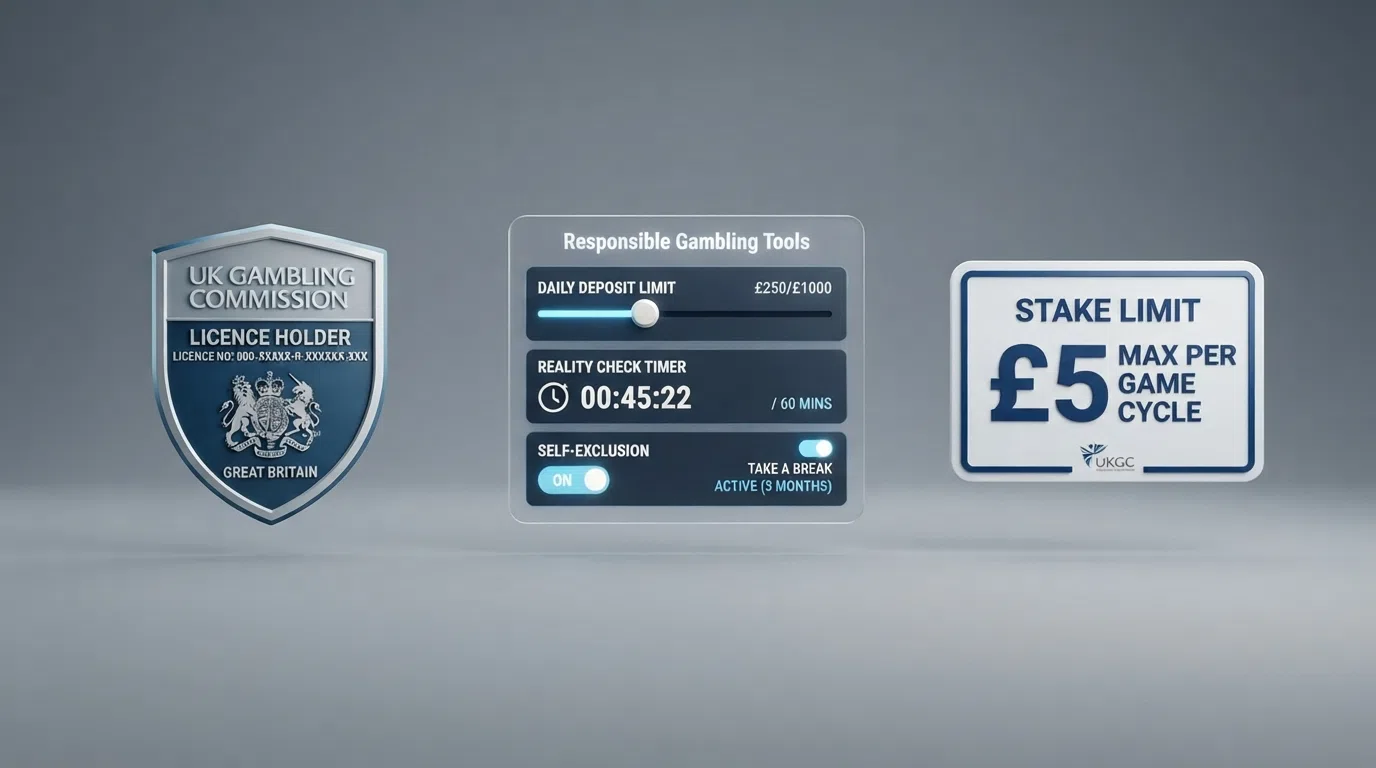
Auto-play has been banned since 31 October 2021. Every spin is a deliberate button press; the casino cannot spin on the player’s behalf. Spin speed cannot be faster than 2.5 seconds per game cycle, and features that speed up play — turbo mode, quick-spin toggles — are banned. Losses disguised as wins — the celebratory animation on a spin that returns less than the stake — are banned. Reverse withdrawals — the option to cancel a pending withdrawal and play the money back — are permanently banned. The operator must display total losses, total wins, and time played during a slots session.
The bonus rules, in force since 19 December 2025, cap wagering requirements at 10× and ban mixed-product promotional offers — a bonus cannot be conditioned on the customer playing a different product type. The 10× cap is a hard ceiling: no UK-licensed operator can attach a wagering requirement above 10× to a bonus offer. A player who sees an offer above 10× is looking at a non-compliant term or an offer that pre-dates the cap.
Credit cards have been banned for all gambling payments in Great Britain since 14 April 2020. The ban extends to credit-card-funded payments routed through e-wallets — funding a Neteller or Skrill account with a credit card and then gambling with the e-wallet balance is also prohibited. Debit cards and bank transfers are unaffected.
Staying in Control — Responsible Gambling Tools for UK Cluster Pays Players
The UK’s responsible gambling infrastructure is built into every licensed casino. Deposit limits, reality checks, time-outs, self-exclusion, financial vulnerability checks, and the full support network — GamCare’s helpline, NHS gambling clinics, blocking software, bank-level transaction blocking — are all in place as a condition of the licence. The cluster pays player who plays at a UK-licensed casino has these tools available without requesting them; the operator must offer them, and the player can use them at any time.
The prevalence data puts the scale of problem gambling in context. The NHS Adult Psychiatric Morbidity Survey 2023–24 found that 0.4% of adults in England score 8 or above on the Problem Gambling Severity Index — the clinical threshold for problem gambling — with a 95% confidence interval of 0.2–0.6%. A further 1.6% score 3 or above, which is the “moderate risk or above” category. Men (2.2%) are more likely than women (1.0%) to score 3+. The highest-risk age band is 25–34, at 3.5%. The broader “at-risk or problem” measure (PGSI 1+) has been stable at 5% of adults between 2012 and 2024 — the long-run figure has not shifted despite a decade of regulatory change.
The Limits You Set — Deposit Caps, Reality Checks and Session Controls
The deposit-limit framework has been rebuilt. From 31 October 2025, every UK-licensed casino must prompt the customer to set a financial limit before their first deposit. The prompt is mandatory, not optional; the player has to actively engage with it. The limit must be easy to review and change, and any request to *decrease* a limit must be actioned immediately — not at the end of a cooling-off period. The original effective date for the standardised gross deposit limit was 30 June 2026; it has been extended to 30 September 2026.
The gross deposit limit is the specific form the casino must offer. A “deposit limit” by name, in UK-licensed casino terms, means a gross deposit limit — a cap on the total amount the customer can deposit in a stated period, net of withdrawals. The casino may offer other limit types alongside it, but only the gross deposit limit can be labelled “deposit limit” and it must be given equal prominence with any other limit options.
During play, reality checks and session displays are mandatory. The operator must display total losses, total wins, and time played during a slots session. Reality checks — pop-up reminders of how long the player has been in the session — are available and adjustable. Time-outs, which lock the account for a cooling-off period of 24 hours to several weeks, are available on request.
GAMSTOP — How Self-Exclusion Works and Where It Does Not Reach
GAMSTOP is the national multi-operator online self-exclusion scheme for Great Britain. It has been a mandatory condition of every Gambling Commission online operating licence since 31 March 2020. A player who registers with GAMSTOP is blocked from opening new accounts, depositing, or gambling at every GB-licensed online operator for the duration of the exclusion.
The exclusion periods are fixed: six months, one year, five years, or five years with auto-renewal. Once the player registers, the exclusion cannot be cancelled early — there is no “remove me” button for any of the four periods. The minimum commitment is six months; the maximum is effectively ten years (a five-year period that auto-renews into a second five-year period). The auto-renewal option is the right choice for a player who is certain about the decision and wants the longest possible separation from gambling.
The critical gap is that GAMSTOP covers only GB-licensed online operators. Land-based venues — bookmakers, casinos, bingo halls — are not part of the scheme. Unlicensed online sites are not part of the scheme. A player who has self-excluded through GAMSTOP and then opens an account at an offshore, unlicensed site has no UK regulatory protection: no complaints route, no alternative dispute resolution, no consumer redress, and no guarantee the site will pay out. The exclusion protects against the licensed market; it does not protect against the unlicensed one.
Where to Get Help — Helplines, Clinics and Support That Work
The National Gambling Helpline, run by GamCare, is free on 0808 8020 133, 24 hours a day, seven days a week. The line is confidential and provides information, support, and counselling for anyone affected by problem gambling — the player themselves, a family member, or a friend. The call is free from any UK phone.
NHS gambling treatment clinics operate across England, including the National Problem Gambling Clinic in London, the Northern Gambling Service, the Southern Gambling Service, the West Midlands, East Midlands, East of England, and South West services. Self-referral is possible; GP referral is also an option. From 1 April 2026, NHS England took on commissioning responsibility for gambling-harms treatment, funded by the statutory levy that took effect on 6 April 2025 at 1.1% of gross gambling yield for remote operators.
The treatment numbers in 2024/25 are the clearest picture of the system’s reach. NHS referrals totalled 4,355 — a 91% increase on the 2,284 referrals in 2023/24. The National Gambling Treatment Service treated 11,960 clients in the same period, an 11% increase year-on-year. Half of those clients had their first appointment within six days of referral. Of those who completed treatment, 93% saw improvement. One quarter of the clients treated said their problem gambling had started by the age of 18 — a reminder that the population at risk skews younger than the gambling-advertising rules might suggest.
Blocking software — Gamban and Betblocker — is free for UK residents. Both block access to gambling sites and apps at the device level, working alongside GAMSTOP. Bank-level transaction blocking is available through most UK banks; gambling payments can be blocked at the account level, independently of any other tool. GambleAware runs the National Gambling Support Network and hosts online self-assessment tools for anyone who wants to gauge their own gambling behaviour.
How We Selected and Ranked the Casinos on This Page
The ten operators in the comparison are the largest UK market-share casino and slot brands. Selection was driven by the operators’ presence on the UKGC public register, their published game lobbies, and their prominence in the British market. Every operator in the table is currently licensed; every one carries at least some of the cluster pays shortlist in its catalogue.
The ranking criteria were UKGC licensing status (verified against the public register), game provider depth (the wider the provider roster, the more cluster pays titles available), and the welcome offer’s specific terms — wagering multiplier, free spin count, qualifying games, and whether a genuinely deposit-free option exists. The genuinely deposit-free column distinguishes offers that credit free spins or bonus funds without a deposit (Sky Vegas’s 50 no-deposit spins) from those that require a deposit-and-wager condition before the spins credit.
What the comparison deliberately does not factor in: payout speed, because the research carries no per-operator data on withdrawal times; minimum deposit, because it is rarely surfaced at per-operator level; and subjective design preferences, which are not measurable. The page describes operators; it does not recommend one as a place to play. The reader’s choice depends on the welcome offer’s fit, the provider depth, and the specific cluster pays titles they want to access.
For the titles in the shortlist, the data is developer-published. Each row’s RTP, volatility rating, max win, and grid dimensions come from the developer’s product page or specification sheet, not from a secondary aggregator. Where the developer uses a custom volatility scale (Pragmatic Play’s 1–5, Play’n GO’s 1–10), the rating is reported on the developer’s own scale. Hit frequency is included where the developer publishes it. Gonzo’s Quest is included as a comparison point because its Avalanche cascade mechanic sits adjacent to the cluster pays format; it is not itself a cluster pays game.
Your Next Move — What to Actually Do About Cluster Pays Slots in the UK
Cluster pays slots are worth trying if payline slots have started to feel repetitive. The mechanic delivers a genuinely different session rhythm — more frequent small wins, cascade chains that turn one paid spin into several, and a hit pattern that rewards patience over big-bet aggression. The shortlist in the section titled “The Cluster Pays Slots Worth Your Time — A Data-Backed Shortlist” gives five verifiable starting points: Aloha! Cluster Pays for the low-volatility introduction, Reactoonz and Jammin’ Jars for the high-frequency high-volatility options, Sugar Rush 1000 and Cluster Tumble for the very-high-volatility ceiling chases.
The safest way to start is demo mode at a UKGC-licensed casino or on the developer’s site. The RNG behaves identically in both modes, so demo teaches the mechanic, the cascade chain, and the bonus triggers without the bankroll commitment. Once the player is ready for real money, the £5/£2 statutory cap per game cycle is the spending ceiling — and the safest first stake is well below it.
The UK regulatory framework is the one thing this page can confirm in detail. Every UKGC-licensed casino is operating under stake caps, a 10× wagering ceiling, a credit card ban, GAMSTOP integration, mandatory deposit-limit prompts, and independently tested RNGs. The unlicensed offshore market offers none of those protections. The cluster pays shortlist is available at every operator in the comparison table; the licence status is the one thing the player must verify themselves, and the UKGC public register is where to verify it.
The one thing this page cannot tell you is which title you will enjoy. The five-title shortlist is a starting point, not a verdict. The session shape — high-frequency small wins versus long waits for very large ones — is the real choice, and the only way to know which suits you is to play. If you choose to deposit, pick an operator from the comparison table in the section titled “Where Cluster Pays Meets Real Money — UK Casinos Ranked and Compared”, check the licence on the UKGC public register, and set your deposit limit before you fund the account. The limit prompt is mandatory; using it is the first decision that belongs to the player.
Frequently Asked Questions
How do cluster pays slots work compared to traditional payline slots?
Cluster pays slots replace fixed paylines with symbol adjacency. On a 6×5, 7×7, or 8×8 grid, a win is triggered by a cluster of five or more matching symbols connected horizontally or vertically — diagonal connections do not count. Payline slots require matching symbols to land on one of a fixed number of pre-drawn lines. The underlying RTP and house edge are set independently of the mechanic, so the odds are the same; the session rhythm is different, with more frequent small hits and longer cascade chains on cluster pays titles.
What is the minimum cluster size needed to win on a cluster pays slot?
The minimum cluster size is typically five to nine symbols, depending on the title. Aloha! Cluster Pays and Sugar Rush 1000 both require a minimum of five. Larger clusters pay exponentially more — the payout is calculated as cluster size × symbol pay value × bet per spin. The exact threshold and the payout table are published in each game’s paytable, which is available in the casino lobby and on the developer’s product page.
Can I play cluster pays slots for free in the UK without depositing?
Demo play with virtual credits is available at every UK-licensed casino that carries the titles, and the age-verification check that unlocks demo play is the same one that unlocks real-money play. Developer sites — NetEnt, Play’n GO, Pragmatic Play, Push Gaming, Relax Gaming — host no-registration demos of their own titles. A “no-deposit” *bonus* with real prizes is a different thing: Sky Vegas’s 50 no-deposit free spins are the one genuinely deposit-free offer in the comparison table; every other welcome offer requires a deposit and wager before the spins credit.
What is the maximum I can stake per spin on cluster pays slots in the UK?
The statutory maximum stake per game cycle is £5 for players aged 25 and over and £2 for players aged 18 to 24, in force since April and May 2025 respectively. A “game cycle” covers the whole spin from initiation to final settlement, including every cascade in a cluster pays chain. The cap applies to the total at risk within that cycle. It is set by the Gambling Act 2005 (Operating Licence Conditions) (Amendment) Regulations 2025 (SI 2025/215).
Are cluster pays slots fair and tested by the UK Gambling Commission?
Yes. Every cluster pays slot at a UK-licensed casino has been independently tested by an approved test house under the Commission’s Remote Technical Standards (RTS 7), which covers RNG certification, payout verification, and game-cycle integrity. The RNG generates a random value between 0 and 4 billion in a millisecond, and the outcome is impossible to predict or manipulate. The Commission publishes a public register of licence holders where any player can verify an operator’s status.
What is the difference between cascading wins and cluster pays mechanics?
Cascading wins and cluster pays are related but distinct. Cluster pays is a *win-evaluation* mechanic — wins are formed by clusters of adjacent matching symbols, not by paylines. Cascading wins (also called tumble or avalanche) are a *follow-on* mechanic — after a winning cluster is paid and removed, new symbols drop in, and the grid is re-evaluated. Gonzo’s Quest is a cascade game on a 5×3 payline grid; Reactoonz is a cluster pays game on a 7×7 grid with cascades. Most modern cluster pays titles use cascades as a standard feature.
How does GAMSTOP self-exclusion work for online slot players?
GAMSTOP is the national multi-operator online self-exclusion scheme for Great Britain, mandatory on every Gambling Commission online operating licence since 31 March 2020. A player registers at the GAMSTOP site, chooses an exclusion period (six months, one year, five years, or five years with auto-renewal), and is blocked from opening new accounts, depositing, or gambling at every GB-licensed online operator for the chosen period. The exclusion cannot be cancelled early. GAMSTOP covers only GB-licensed online operators; it does not cover land-based venues or unlicensed offshore sites.
Slots – fastestpayout-casinos-uk
Content created by the «fastestpayout-casinos-uk» team