
eCheck at UK Online Casinos: What It Really Is and Where to Use It
 Available in GB
“Instant,” in casino marketing, usually means the operator’s own clock. With eCheck in the UK, it means something stricter: the rail your bank runs. The label survives from a US product that has no exact twin on this side of the Atlantic, and the practical question for a UK player is which underlying payment system a casino is actually using when it shows “eCheck” at the cashier. The answer, almost every time, is Bacs Direct Debit, Faster Payments, or an open-banking “Pay by Bank” redirect. The cashier button is the same; the wait behind it is not.
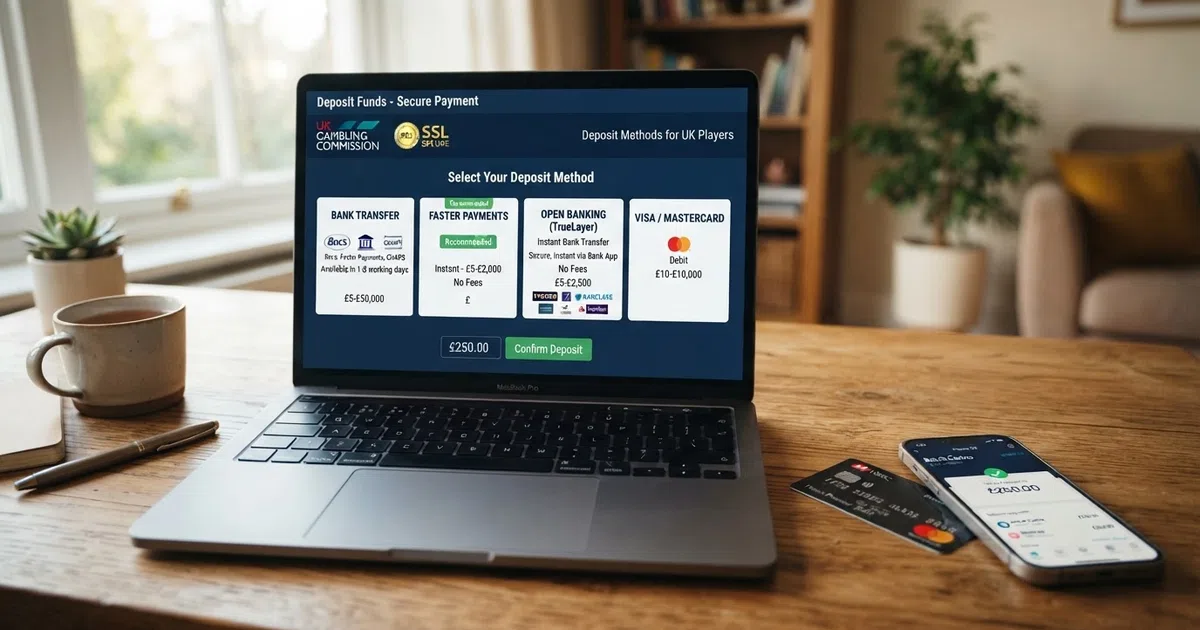
Current as of September 8, 2026 · Licence claims checked against the UK Gambling Commission’s public register.
Why “eCheck” Means Something Different at UK Casinos
What UK Casinos Actually Mean by “eCheck”
A US eCheck rides the Automated Clearing House — a batch settlement network run by Nacha, with a multi-day clearing cycle. Great Britain has no equivalent rail, and the country’s retail banks did not build one because Faster Payments already settles in seconds and Bacs already handles the slow lane. When a UK-facing casino leaves an “eCheck” option at the cashier, it is reusing a North American label for a flow that runs on British infrastructure, not importing the American system.
Betsquare is direct about the mapping: “In the UK there is no ACH equivalent, so what casinos label ‘eCheck’ is really a Bacs Direct Debit deposit, a Faster Payment, or an open-banking bank transfer.” That sentence does most of the work on this page. The rest is what the three routes look like at the cashier, how long each takes, and where the delay you actually feel is coming from.
Bacs Direct Debit is the structural cousin of the US original: the player authorises the casino to pull a specific amount, and a chargeback window is built in. Faster Payments is the speed upgrade: 24 hours, often minutes, that covers every realistic casino deposit. Open banking — branded at the cashier as Pay by Bank — is the newer third option, where the player authenticates directly with the bank through a redirect, the bank confirms the funds, and the transfer rides the same Faster Payments rails underneath. Bet365 turned on TrueLayer Pay by Bank as its checkout option in January 2026 as a concrete example of where open-banking “eCheck” is heading: instant deposits and withdrawals through bank authentication, with no card details shared and no e-wallet standing between the player and the casino.
A UK player who sees “eCheck” at a cashier is, in practice, choosing which of those three rails to fund the account through. The label is borrowed; the rails are homegrown.
Why UK Players Choose Bank-to-Bank Over Cards and E-Wallets
Three reasons keep bank-to-bank “eCheck” in the menu at a UK casino when a debit card is faster and an e-wallet is more familiar. The first is that UK players cannot use a credit card for gambling at all. The UK Gambling Commission banned credit cards for remote gambling on 14 April 2020 under licence condition 6.1.2, and the rule was extended to credit-card-funded e-wallets shortly afterwards. A player whose usual funding route was a credit card had to find a new one; Bacs, Faster Payments and open-banking bank transfer filled the gap with a method that, like the banned product, moves money directly from a bank account — but without the credit that made the ban necessary.
The second is the trust register. A debit card details the player’s full card number, expiry and security code to the casino, and an e-wallet creates an intermediary that the player has to fund separately. A bank-to-bank transfer hands the casino only what it needs: a sort code and account number for Bacs, or a one-time authentication handshake for open banking. Players who are uneasy about sharing card details at a gambling site, or who do not want a third-party balance sitting between their bank and their casino, find the bank rail cleaner.
The third is visibility. Every eCheck transaction — deposit and withdrawal — leaves a single line on one bank statement, under one account, with the casino’s name on it. A player can total their casino spend in one place without reconciling across cards, e-wallets and apps. That is not a safety feature the UKGC mandates, but it is a spending-tracking feature that bank-to-bank offers and card-plus-wallet does not.
The trade-off is speed at the deposit and review at the withdrawal. Cards authorise in seconds; bank transfers authorise when the rail says so, and the rail sometimes says “tomorrow.” A player who wants instant gratification at the cashier will prefer a debit card; those prioritizing a clearer account record and a method aligned with recent regulatory shifts prefer the bank-to-bank route.
How Fast Your eCheck Deposit (and Withdrawal) Really Is
How to Deposit with eCheck at a UK Casino
The deposit flow is short, and the differences between the three rails sit in two places: what the player types in, and how long before the casino balance updates. The choice is made at the cashier. A player picks “eCheck,” “bank transfer,” or “Pay by Bank” from the deposit list — the wording varies — and the next step depends on which rail the operator has wired up.
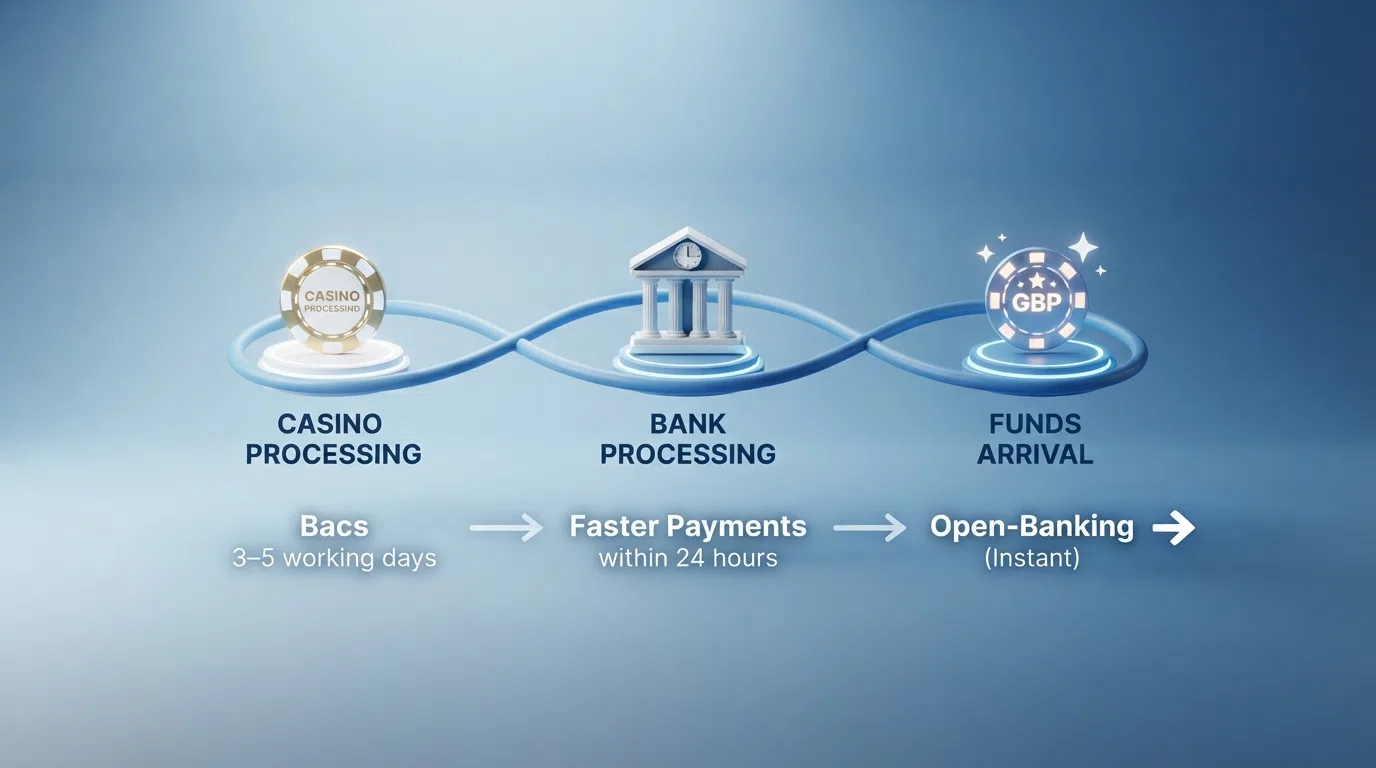
For Bacs Direct Debit, the casino collects a sort code and account number, the player authorises the debit, and the funds arrive in the player account once the Bacs leg clears. Faster Payments collects the same bank details but settles inside the operator’s window — usually minutes during banking hours. Pay by Bank does not collect details at all: the player is redirected to their own bank’s app or web login, approves the payment there, and the bank posts it through Faster Payments on the player’s behalf.
The friction point on Bacs is entering the sort code and account number correctly and accepting that “deposited” does not mean “playable right now” — the funds need the working day to clear. The friction point on Faster Payments is rare; the rail rarely fails. The friction point on Pay by Bank is the redirect itself, and only because the player needs their bank login handy. None of the three needs a card reader, a third-party account, or a credit check, and none of them exposes a credit line — which is precisely the regulatory point.
A practical note: every UK-facing operator on this page is required to verify the player’s identity before a first deposit and before any gambling. The eCheck flow lands on a verified account, not an open one. The deposit and the identity check are separate steps, and the player should expect to complete verification — photo ID and proof of address — before the first eCheck deposit goes anywhere playable.
eCheck Withdrawal Times: How Long You Will Actually Wait
A withdrawal is a different animal from a deposit, and the wait has two distinct halves. The first half is the operator’s: the casino runs its own KYC and anti-fraud review on the withdrawal request, checks it against the player’s deposit history and any active bonus terms, and then approves it. The second half is the rail’s: the approved amount is sent to the player’s bank account through Bacs Direct Credit or Faster Payments, depending on which the operator routes through. Casino.org puts the combined window at around three days for a typical eCheck withdrawal; in practice the rail leg is the smaller half, and the review is the larger one.
Betsquare’s numbers, applied to a UKGC-licensed operator, are the right ones to anchor on: a Bacs leg runs three to five working days after the operator approves, while a Faster Payments leg usually arrives within 24 hours. The KYC and anti-fraud review is “the biggest variable,” and the review is what makes the first withdrawal the slowest. A player withdrawing from a freshly verified account, or withdrawing for the first time to a new bank account, can expect the operator to slow-walk the payout while it confirms the destination. After the first successful withdrawal to a verified account, subsequent payouts to the same destination usually clear much faster — though “usually” is the operator’s call, not the rail’s.
A player who wants a same-day or near-instant withdrawal should look for an operator that routes through Faster Payments or, better, through an open-banking rail that uses Faster Payments underneath. A player withdrawing to a Bacs-only cashier should expect the three-to-five-working-day window to apply, on top of whatever the operator’s own review takes, and should plan around the working-day clock rather than the calendar.
Instant eCheck: When Faster Payments Cuts the Wait
“Instant” at a UK eCheck cashier is shorthand for “Faster Payments,” and Faster Payments is genuinely fast at the rail level — most transactions settle in seconds during banking hours. The bottleneck sits one layer up, in the operator’s own processing, and that is where most of the marketing language lands. A casino that promises “instant eCheck withdrawals” is promising to combine a fast rail with a quick internal approval, and the second half of that promise is the variable one. A player who has already passed KYC, who has no bonus wagering in progress, and who is withdrawing to a previously verified bank account can realistically see a Faster Payments payout the same day. A player who is new, who is mid-bonus, or who is withdrawing to a new destination will not.
Open banking tightens this further. Pay by Bank, where the operator and the bank are linked through an API rather than a sort code and account number, can authenticate the destination as part of the deposit flow and skip the verification step on the way out. Bet365’s TrueLayer Pay by Bank integration, in production from January 2026, is the current high-water mark: the player authenticates with the bank once at deposit, and both directions settle through the same authenticated link. That is what “instant” looks like when the rail, the operator and the verification are aligned.
Bacs, by contrast, is the slow lane on purpose. A Bacs Direct Credit settles three to five working days after the operator releases it, with a hard ceiling on speed that the rail — not the casino — sets. Bacs is the right rail for scheduled payouts and large transfers; it is the wrong rail for a player who wants their money tonight. A player who has a choice of rail at the cashier should treat Bacs as the default-cost option and Faster Payments as the premium-speed option, and read the operator’s banking page to see which one the operator actually uses on the way out.
Real-Money Play with eCheck: What Changes
The mechanics of real-money play do not change with the deposit method — the slots spin the same, the roulette wheel does not know how the bankroll arrived — but three things shift once the funding route is bank-to-bank. The first is the playable-funds timing. A debit card deposit is playable on authorisation; a Bacs eCheck deposit is playable only when the rail clears, which can be a working day. A player who deposits and immediately tries to spin can find the balance short, and the reason is the rail, not the casino.
The second is the withdrawal return path. A deposit by card can usually be withdrawn back to the same card; a deposit by eCheck has to be withdrawn back to the same bank account, and the operator is supposed to return it to the source. Some operators will allow a withdrawal to a different bank account, but that triggers a fresh verification cycle on the new destination, and the wait stretches accordingly. A player who plans to move bank accounts mid-play should do it between withdrawals, not during one.
The third is the bank-account tether. There is no e-wallet buffer between the player and the casino with an eCheck deposit — money goes from a bank account to the casino, and back to the same bank account. That is cleaner for spend tracking and tighter for the UKGC’s traceability expectations, which require operators to know who funded the account and where winnings went. It also means the bank statement is a real-time log of gambling spend, in a way that a card-plus-wallet mix is not.
eCheck Deposit Limits: Minimum and Maximum Amounts
Research does not give a per-operator minimum-deposit figure for eCheck, and the honest answer is that the floor varies. Most UKGC-licensed casinos set a minimum bank-transfer deposit, sometimes lower for an open-banking Pay by Bank flow, but the exact number is operator-specific. A player should check the cashier page directly before depositing; the minimum is published there, and it is the same minimum whether the rail is Bacs, Faster Payments or open banking.
The maximum is more interesting. Bank transfers allow larger single-transaction ceilings than cards or most e-wallets, both because the rails permit it and because the operator’s own internal limit can be set higher for a verified bank-account funding route. A player who wants to deposit a few thousand pounds in one transaction will usually find eCheck a more accommodating ceiling than a debit card. The UKGC does not impose a state-set maximum deposit — the model is a player-set limit prompted by the operator, not a regulator-set cap — so the ceiling is the operator’s, and the operator will set it against the player’s verified identity and deposit history.
The regulatory change worth knowing about is the deposit-limit prompt that took effect on 31 October 2025. Every UKGC-licensed online operator must now prompt a player to set a financial deposit limit before the first deposit, and the limit must be easy to review and change; decreases apply immediately, increases only after a confirmation step. From 30 September 2026, the standardised “deposit limit” terminology and prominence requirements of RTS 12B apply. For an eCheck player this means the limit-setting conversation happens before the first bank transfer, not after, and the operator is the one that has to start it.
New eCheck Casinos vs Established Names
A newly launched UKGC-licensed casino that accepts eCheck is, in payment-rail terms, no different from an established one. The rail is Bacs, Faster Payments or open banking for both. The UKGC’s payment-services condition — licence condition 5.1.2 — requires every licensee to route customer payments only through methods delivered by an authorised payment service provider under the Payment Services Regulations 2017, and that condition is the same on day one of a new licence and on year eleven of an old one. A new casino’s bank-transfer option is not a lesser version of an established casino’s bank-transfer option; both are wired into regulated UK banking infrastructure.
The advantage of the established name is track record. A player who has heard of withdrawal delays at a particular brand can search the operator’s history; a player at a brand that launched last quarter cannot. The retail-heavy legacy names — William Hill, Ladbrokes, Coral — have a public track record of paying out bank-transfer withdrawals that a new entrant does not yet have. The new casino, in turn, may offer a more modern open-banking integration, a cleaner mobile cashier, or a more generous first-deposit arrangement to compensate for the shorter history. The UKGC licence is the equaliser on payment-method safety; it is not the equaliser on operational history.
The practical filter for a player is twofold. First, the UKGC public register, where a current licence status is the price of entry. Second, the operator’s own withdrawal track record, which is where an established name has the edge. Both filters apply regardless of whether the operator is a household name or a brand the player has not heard of until now.
eCheck on Mobile: Casino Apps vs Browser Play
The eCheck flow on mobile is the same eCheck flow as on desktop, but the redirect step is what changes the feel. A Pay by Bank deposit on a mobile browser opens the player’s bank app or bank login in a new tab or in-app browser; on a native casino app, the same flow either deep-links into the bank app or opens the bank in an in-app browser, with the bank authentication happening inside the casino’s chrome. Either way, the player ends up at the bank’s own authentication page, and the biometric step — Touch ID, Face ID, the bank’s own fingerprint prompt — is what makes the mobile flow feel faster than the desktop one. The bank is doing the second-factor check, and the second factor on a phone is a thumb.
The browser flow is identical in plumbing — the same open-banking API, the same Faster Payments rail underneath — but lacks the biometric step. A player who wants the fastest mobile eCheck deposit should use the casino’s app, not the browser; the app’s deep-link to the bank app is the shortest path. A player who prefers not to install a casino app will lose perhaps five to ten seconds in the browser flow, which is not material for a Bacs deposit that takes a working day to clear anyway.
Withdrawal routing is the same back-end pipeline regardless of which channel the player used to deposit. A withdrawal request raised in the app is processed by the same back office, goes through the same KYC review, and is sent to the same bank account as a withdrawal raised in the browser. The mobile channel changes the player’s experience of the deposit, not the operator’s experience of the withdrawal.
Top 10 UK Casinos That Accept eCheck, Compared
| Operator | UKGC Licence Status |
|---|---|
| bet365 | GB-licensed (UKGC public register) |
| William Hill | GB-licensed (UKGC public register) |
| Sky Bet | GB-licensed (UKGC public register, Sky Betting & Gaming entities) |
| Ladbrokes | GB-licensed (UKGC account 1611; active from 1 Nov 2014) |
| Coral | GB-licensed (UKGC public register, Ladbrokes Coral group) |
| Betfair | GB-licensed (UKGC public register) |
| Sky Vegas | GB-licensed (UKGC public register, Sky Betting & Gaming entities) |
| 888casino | GB-licensed (UKGC account 39028; active from 1 Nov 2014) |
| Virgin Games | GB-licensed (UKGC public register, Gamesys group) |
| 32Red | GB-licensed (UKGC public register, Kindred entities) |
| Payment Rail | Typical Speed | Best For |
|---|---|---|
| Bacs Direct Debit | 3–5 Working Days | Large Transfers |
| Faster Payments | Under 24 Hours | Rapid Deposits |
| Pay by Bank | Instant | Modern UX |
All ten operators are GB-licensed per the UKGC public register. The licence is what makes the cashier’s eCheck label a bank-to-bank flow into regulated UK financial infrastructure rather than a route to an offshore operator; the brand name on the cashier is secondary to the licence number behind it.
The table above is a licence check, not a ranking. Every operator meets the regulatory floor. What separates them for the eCheck player is the underlying payment rail each one has wired up, the maturity of the back-office review, and the operational history the player can lean on at withdrawal time. The write-ups below work through each of those differences.
bet365
Bet365 is the largest UK-facing operator by player volume, and the largest by payment-rail ambition in this set. The company recommended TrueLayer Pay by Bank as its checkout option in January 2026 — instant deposits and withdrawals through bank authentication, with no card details shared. For an eCheck player, that is the cleanest open-banking integration on the UK market as of writing, and it is the version of “instant eCheck” the rail is capable of when the operator’s back office does not slow it down. The scale means the cashier is mature, the bank-rail coverage is broad, and the KYC review queue is the most heavily resourced in the set. This operator is the strongest candidate for instant-speed users.
William Hill
William Hill is a high-street legacy brand whose online casino carries a payment-rail stack that has been refined for two decades. The retail-to-online trust carryover is real for a player who is uneasy about sharing bank details with a casino they have never visited, and the operational maturity shows in the back office: a player with a verified account and a clean withdrawal history can expect the review queue to move faster than at a newer operator. The eCheck player at William Hill is paying for the operational history in the sense that the brand has no need to compensate for a short track record; the rails are Bacs, Faster Payments and open banking, in the usual mix, with the operator’s own bank-rail configuration underneath. This is a reliable choice for players prioritizing long-term payout stability.
Sky Bet
Sky Bet is licensed under the Sky Betting & Gaming umbrella and is a UK-only-facing brand, which means the payment-rail configuration has been built for a British audience from the start. Bank transfer is a standard option in a broad payment-method mix that also includes debit cards and the usual e-wallets. The UK-only focus matters for payment-method reliability in a small way: the operator does not have to reconcile rail configurations across multiple jurisdictions, and the cashier page is built around the rails a UK player will actually use. For the eCheck player, Sky Bet is the no-surprise option in the Sky group’s portfolio — a bank transfer here behaves the way a UK player expects a bank transfer to behave, and the cashier is not the place the brand innovates.
Ladbrokes
Ladbrokes is one of the longest continuously licensed UK casino operators, with a UKGC account (number 1611) that has been active from 1 November 2014 onward across multiple remote activities. A licence that has been live for over a decade has been through several rounds of UKGC rule changes — the 2020 credit-card ban, the 2020 GAMSTOP mandate, the 2025 deposit-limit prompt — and an operator with that history has rebuilt its payment stack around each of them. For the eCheck player that means the bank-transfer deposit and withdrawal flows are deeply embedded in the back office rather than bolted on, and the operational maturity of the rail configuration is high. The retail-shop trust carryover is similar to William Hill’s, and the licence longevity is itself a reason a player might prefer Ladbrokes to a newer brand. It stands as a premier destination for traditional bank-transfer players.
Coral
Coral sits in the Ladbrokes Coral group and shares the group’s payment-infrastructure investment, which is the relevant point for an eCheck player. The bank-transfer deposit and withdrawal flows are not separate products built twice; they are a single group-level rail configuration deployed across both brands. A player who finds the Ladbrokes eCheck experience fits them will find Coral behaves the same way at the cashier and in the back office, and vice versa. The group’s operational backing is the strength, and Coral’s standalone brand identity is a smaller factor than the underlying infrastructure. Choosing between the two depends on game libraries and on-site promotions, as the payment infrastructure is standardized across the group.
Betfair
Betfair is the exchange-led brand in this set, and the casino side of the operation accepts bank transfers under the same UKGC licence as the exchange. The dual-product infrastructure — exchange plus sportsbook plus casino plus games — is the operational point. A player who already has a Betfair exchange account will find the casino cashier familiar, and the eCheck deposit that funds the exchange account is the same eCheck deposit that funds the casino wallet. For a player who has no existing relationship with Betfair, the exchange heritage is a smaller draw than the operator’s payment-rail coverage and its back-office maturity. The bank-transfer option is a standard cashier method, with no exchange-specific quirk, and the eCheck player at Betfair is in the same regulated pipeline as the eCheck player at any other licensed operator on this page.
Sky Vegas
Sky Vegas is the slots-focused sister brand to Sky Bet, sharing the Sky Betting & Gaming group licence and the group payment-infrastructure investment. The eCheck player at Sky Vegas is in the same back-office pipeline as the eCheck player at Sky Bet: the bank-transfer rail configuration, the KYC review queue and the cashier flow are the same group-level product. The slots-first positioning is what changes the on-site experience rather than the cashier, and the bank-transfer deposit behaves identically. Sky Vegas is the slots destination and Sky Bet is the broader-betting destination; the eCheck experience is uniform, with both operating under the same group-level banking infrastructure.
888casino
888casino is the globally recognised casino brand in this set, with a UKGC account (number 39028) that has been active from 1 November 2014 onward for casino, bingo and general betting. The international operator scale is the relevant point for an eCheck player: a multi-jurisdiction operator has the payment-infrastructure investment to wire up Bacs, Faster Payments and open banking at a level a single-jurisdiction operator may not match, and the UK cashier is built on the back of that investment. Bank transfer is a standard cashier option, and the operator’s track record on the UK rail is long. It remains a robust international choice for UK players.
Virgin Games
Virgin Games is a UK-facing brand under the Gamesys group, with UKGC licensing and a curated game selection that leans on the Virgin brand. Bank-transfer deposit is a standard option in a payment-method mix that the player should check on the cashier page before depositing, and the UK-only focus means the rail configuration has been built for a British audience. The Gamesys group operational backing is the relevant point for the back office; the Virgin brand identity is the relevant point for the on-site experience. Seeking a UK-focused casino with the Virgin brand on the cashier is straightforward here, and the game library and brand identity remain the core focus.
32Red
32Red is a long-running UK-focused casino brand now operating under the Kindred Group, with mature bank-transfer payment processing and a UKGC licence that the player can verify on the public register. The Kindred Group’s operational backing is the relevant point for the back office, and the UK-only heritage of the 32Red brand is the relevant point for the cashier’s payment-method mix. Bank transfer is a standard option, and the eCheck player at 32Red is in the same regulated UK pipeline as the eCheck player at any other licensed operator on this page. It is a long-standing contender for players who favor established Kindred-backed brands.
Is eCheck Legal at UK Casinos? What the Gambling Commission Requires
UK Gambling Commission Licensing and eCheck Payments
The UK Gambling Commission requires every operator serving GB customers to hold a point-of-consumption licence, and that licence carries a payment-services condition that shapes every eCheck transaction at a UKGC-licensed casino. Licence condition 5.1.2 of the LCCP — the Licence Conditions and Codes of Practice — requires licensees to accept customer payments only via methods involving payment services under the Payment Services Regulations 2017 and delivered by an authorised payment service provider. In plain English: the casino’s bank-transfer option is not a private arrangement between the operator and the player; it is a regulated payment service that runs through a UK-authorised PSP, with the same regulatory floor as any other payment method on the cashier.
The point-of-consumption licensing regime, brought in by the Gambling (Licensing and Advertising) Act 2014 and built on the Gambling Act 2005, is the reason a UK player can assume the bank-transfer option at a UKGC-licensed casino is a regulated rail rather than an offshore loop. Every operator on this page holds a GB licence, which is the licence that authorises it to take a Bacs Direct Debit, a Faster Payment or a Pay by Bank redirect from a UK customer. An operator without the GB licence cannot lawfully take that payment from a UK customer, and the UKGC’s enforcement is built around disrupting that flow — URL referrals, domain and payment action — rather than ISP-level blocking.
The practical test for a player is simple. The UKGC public register is searchable, and a current active licence is the price of entry. A cashier showing “eCheck” or “bank transfer” at a UK-facing casino is, in regulatory terms, only as safe as the licence on the register. The rail underneath is the rail the UKGC has authorised; the operator is the variable.
The Credit Card Ban and Why eCheck Fills the Gap
The UK banned credit cards for remote gambling on 14 April 2020 under licence condition 6.1.2, with the restriction extended to credit-card-funded e-wallets shortly afterwards. The ban was a deliberate intervention to cut off the gambling-credit pipeline — borrowed money funding a stake, with the gambler paying the lender back later — and it removed the most convenient direct-from-account funding method for any UK player who had been using credit as a cashflow tool. The product that was banned had a clear structural replacement: a bank-to-bank transfer from a current account, with no credit, no e-wallet buffer, and the funds already cleared in the player’s own name.
eCheck — in the UK sense, a Bacs, Faster Payments or open-banking transfer from a bank account — is the natural fit for the post-2020 funding model. The funds are the player’s own, the source is verifiable, and the rail is the same one the player uses for any other direct debit. A Bacs Direct Debit is the closest structural parallel to the US original, in that the casino pulls the funds with the player’s authorisation; a Faster Payment or Pay by Bank transfer is the modern equivalent, in that the player pushes the funds through the bank. Either way, the funding method does not involve credit, and the responsible-gambling logic that justified the credit-card ban — no borrowed money on the line — is preserved.
The ban has the side effect of making the bank-to-bank rail the default direct-from-account funding method for any UK player who cannot or will not use a debit card. That is the structural reason eCheck has stayed in the UK cashier at all, even after the US product it borrowed the name from has faded from the North American market.
How the UKGC 10x Wagering Cap Affects eCheck Bonus Claims
The UKGC’s bonus rules are deposit-method-blind. The 10x wagering cap on incentives and the ban on mixed-product promotions apply regardless of how the player funded the account, and an eCheck deposit qualifies for a welcome bonus on the same terms as a debit-card deposit at a UKGC-licensed operator. The cap is set by the Social Responsibility code provision 5.1.1 of the LCCP, and it limits the wagering requirement on any incentive to ten times the incentive amount — bonus plus any associated deposit requirement — for casino and bingo products.
What the cap means for the eCheck player is that the worst-case wagering burden on a UK-licensed casino’s welcome offer is bounded. A £100 bonus cannot carry more than £1,000 of wagering. A £10 bonus cannot carry more than £100. That ceiling is a feature of the UK regulator, not of the payment method, and it sits underneath every bonus offer at every UKGC-licensed casino, regardless of whether the player deposited by card, e-wallet or bank transfer.
The qualifier that matters is the operator’s own bonus terms. The UKGC cap is the ceiling; the operator’s actual bonus terms are the floor for that brand, and they vary by offer. A player who wants the welcome bonus and is depositing by eCheck should check the specific offer’s terms — minimum deposit, eligible payment methods, wagering multiple within the 10x cap, eligible games — on the operator’s promotion page, because the cap is uniform and the offer is not. The audit will not catch a player who skips this read, but the player will.
Player Protections When Depositing via eCheck
The player-protection architecture that applies to a UKGC-licensed casino is the same architecture whether the player funds the account by debit card, e-wallet or bank transfer. Mandatory pre-deposit and pre-gambling identity verification, mandatory GAMSTOP integration for online operators since 31 March 2020, the deposit-limit prompt that took effect on 31 October 2025, and the dispute-resolution route through the UKGC and an Alternative Dispute Resolution provider are all features of the licence, not of the payment method. The eCheck player inherits all of them.
The bank-transfer rail has two specific protection features that card and e-wallet funding do not offer. The first is the audit trail. Every Bacs Direct Debit, Faster Payment and open-banking transfer leaves a regulated, bank-stamped record on the player’s account, with the casino as the named payee. A player can produce that record as evidence in any dispute with the operator, and the operator cannot. The second is the source-of-funds clarity. A bank-to-bank transfer is unambiguously the player’s own money; there is no credit line, no e-wallet balance funded by an unknown source, and no third-party buffer. The UKGC’s source-of-funds expectations are easier to satisfy with a bank transfer than with any other method, and the operator’s verification work is correspondingly lighter.
What a player should not assume is that the rail itself is a protection. The rail is a payment method; the protection is the licence. A player at an unlicensed operator gets none of the architecture above, even if the cashier says “eCheck.” The licence is the door; the rail is the floor; the player has to check both.
Offshore eCheck Casinos and UK Players: The Real Risk
A UKGC licence is required at point of consumption, which means every operator taking a deposit from a UK customer needs the GB licence, regardless of where the operator is incorporated. The UKGC’s enforcement is disruption-based — URL referrals, domain and payment action — rather than ISP-level blocking, which is why a UK player can still find offshore casino brands in search results. A player who signs up to one and deposits by eCheck is sending a bank transfer to an operator that is not subject to UKGC rules.
The absence of the UKGC framework is the point. There is no mandatory pre-deposit identity verification, no GAMSTOP integration, no deposit-limit prompt, no 10x wagering cap and no ADR route. A bank transfer to an unlicensed operator is a bank transfer to a counterparty outside the UK regulatory perimeter, and the bank may or may not block the payment under its own terms. The “eCheck” label on the cashier does not change the regulatory status; the operator’s licence status does.
The safer path for a UK player is the licensed operator. The UKGC public register is the test, and the ten operators on this page are the ones that pass it. A player who values the bank-to-bank rail for the reasons covered earlier — the audit trail, the source-of-funds clarity, the no-credit funding model — gets all of those plus the UKGC architecture by sticking to a licensed brand, and none of the architecture by going offshore.
How eCheck Helps You Stay in Control of Your Casino Spending
Setting Deposit Limits with eCheck
The UKGC’s deposit-limit regime is player-set and operator-prompted, and that combination has a specific meaning for the eCheck player. The player decides the limit; the operator is required to ask for it before the first deposit; the limit is easy to review and change; a decrease applies immediately, an increase only after a confirmation step. The pre-first-deposit prompt took effect on 31 October 2025, and the standardised “deposit limit” terminology and prominence requirements of RTS 12B apply from 30 September 2026.
The eCheck player, more than most, benefits from a clean limit-setting conversation. A bank-to-bank deposit is unambiguous about where the money is coming from, and a player who sets a weekly limit can see the bank statement filling up against the limit without ambiguity. A player who funds the account through a mix of card, e-wallet and bank transfer has to reconcile the deposits across statements and apps; a player who funds the account through eCheck only has to watch one statement.
The increase-cooldown is the regulatory line worth understanding. A player can cut the limit immediately — useful on a bad day — but raising it is a deliberate step that the operator has to make the player walk through. That is the responsible-gambling logic of the regime: a player who wants to gamble more has to think about it; a player who wants to gamble less can act now. The eCheck rail does not change that logic, but it makes the limit easier to police, because the deposit history is on the bank statement as well as in the operator’s own deposit log.
Self-Exclusion and How It Blocks eCheck Transactions
GAMSTOP has been mandatory for every GB-licensed online operator since 31 March 2020. A player who registers with GAMSTOP is excluded from every UKGC-licensed online casino and betting site at once, and the exclusion covers every payment method, including eCheck. The self-exclusion blocks new account openings, blocks deposits to existing accounts, and blocks the operator from marketing to the excluded player for the duration of the exclusion.
For the eCheck player, the block works at the operator level rather than at the rail level. A Bacs Direct Debit mandate, a Faster Payment instruction or a Pay by Bank redirect are all payment methods; the GAMSTOP block sits one layer up, in the operator’s own account management. The operator’s KYC checks the GAMSTOP register on every login and on every deposit, and an excluded player is stopped at the cashier before the payment instruction is sent. The rail is not asked to enforce the block; the operator is.
A player who wants to come back after a self-exclusion period has to work through the GAMSTOP reactivation process, which is designed to be slower than signing up. The reactivation is not a one-click reversal; it is a deliberate step with a cooling-off period. The UKGC’s logic is that a player who chose to exclude themselves should not be able to undo that decision impulsively, and the eCheck rail is the last thing in the chain — the deposit is blocked before the bank is asked to move the money.
Tracking Spend Across eCheck-Funded Casino Accounts
The single-bank-account nature of eCheck is the spend-tracking advantage, and it shows up most clearly in a player’s own reconciliation. Every deposit appears on the bank statement as a single line, with the casino’s name as the payee. Every withdrawal appears on the same statement, with the casino as the payer. A player can total casino spend for the month by adding up the lines on one account, which is a tighter reconciliation than a player funding through card and e-wallet can manage.
The cross-check the bank statement enables is more useful than the operator’s own deposit history. The operator’s history shows what the player deposited at that operator; the bank statement shows what the player deposited across every operator. A player with multiple casino accounts funded by eCheck can total the spend in one place, and a player with a single casino account can sanity-check the operator’s own deposit log against the bank statement. Neither method is fraud-proof, but the bank-stamped record is harder to dispute than the operator’s internal log.
The limit of the single-statement view is that it covers one bank account. A player who funds from a joint account or a partner’s account has a different reconciliation problem, and a player who moves money through a savings account before transferring to a current account has added a layer of indirection that dilutes the audit trail. The cleaner the bank-side setup — one current account, one player, one statement — the more useful the eCheck spend-tracking advantage becomes.
Where to Get Help: UK Gambling Support Services
- National Gambling Helpline — 0808 8020 133, free and confidential, 24 hours a day, run by GamCare with NHS England backing.
- GamCare — the main third-sector provider of gambling-harm support in England, Scotland and Wales, with online chat, telephone and face-to-face services.
- GambleAware — the commissioning body for prevention and treatment services across Great Britain, with a directory of local help.
- NHS gambling support — gambling treatment clinics commissioned through NHS England, with referral routes through the GP or directly through the National Gambling Helpline.
- Wales specialist NHS gambling-harm treatment services — being established in 2026, with services provided by Betsi Cadwaladr University Health Board alongside a Wales gambling helpline.
- Public Health Scotland — has published a healthcare needs assessment on gambling harms prevalence and a map of Scottish service provision, which is the authoritative reference for help in Scotland.
Help is free, confidential, and available regardless of which payment method funded the gambling. A player who is concerned about their own or someone else’s gambling can ring the National Gambling Helpline at any time, on any day, without giving a name.
How We Selected and Ranked These eCheck Casinos
The ten operators on this page were drawn from the pool of UKGC-licensed casinos that accept bank-transfer / eCheck-style payments. Each operator was checked against the UK Gambling Commission’s public register for current active licence status before being included, and the operator is named only where the register shows a current GB licence. The pool is not exhaustive — the UK-facing online casino market is larger than ten brands — but it covers the long-established names and the larger current operators that a UK player is most likely to encounter when looking for a bank-transfer deposit option.
The ranking reflects a qualitative assessment of four criteria: brand track record, payment-infrastructure maturity, licence longevity and player-protection provisions. Brand track record means the operator’s history of paying out bank-transfer withdrawals without disputes, which favours the long-established names. Payment-infrastructure maturity means the operator’s investment in Bacs, Faster Payments and open-banking rails, which favours the operators who have wired up Pay by Bank or similar modern flows. Licence longevity favours operators whose UKGC account has been active through several rounds of regulatory change. Player-protection provisions are uniform across the set — every operator is subject to the same UKGC framework — so they do not differentiate between brands, but the operational delivery of that framework does.
The sources used for the operator selection were the UK Gambling Commission’s public register, the operator help centres, and the payment-method guides published by Betsquare, Casino.org and SeamlessChex. The limits of the ranking are honest. It covers only the operators reviewed here; it is not a market survey; it does not score operators on a numerical scale; and a player who wants a head-to-head comparison on a specific feature not covered in the write-ups should check the operator’s own site directly. The licence check is the floor; the qualitative ranking is a guide, not a recommendation.
Your eCheck Casino Checklist: What Matters Most for UK Players
The single check that matters more than any other is the UK Gambling Commission licence. Every operator on this page holds one, and a current active licence on the UKGC public register is the price of entry for any UK-facing casino taking bank-transfer deposits. A cashier that shows “eCheck” at an unlicensed operator is a different product entirely, and the rest of the UKGC architecture — identity verification, GAMSTOP, deposit-limit prompt, ADR route, 10x wagering cap — does not apply. Start with the register; everything else is downstream of that.
The rail underneath the “eCheck” label is the next thing to understand. There is no UK equivalent of the US ACH rail; the cashier label maps to Bacs Direct Debit, Faster Payments or open-banking Pay by Bank, and the three have different settlement speeds. Bacs is the slow lane — three to five working days on the withdrawal leg, three working days on the deposit. Faster Payments is the speed lane — under 24 hours, often minutes. Pay by Bank is the modern lane — instant, authenticated through the bank app, with the same Faster Payments rail underneath. The label on the cashier is borrowed; the speed is set by the rail.
The deposit speed depends more on the operator than on the rail. The rail sets the floor: Bacs is slow, Faster Payments is fast, Pay by Bank is instant. The operator sets the ceiling: a slow KYC review queue will hold a withdrawal back regardless of the rail, and a well-resourced back office will release it quickly. The first withdrawal is the slowest, because the operator is verifying the destination and the player’s identity at once. After the first successful withdrawal to a verified bank account, the rail is usually the binding constraint, and the operator’s review queue is fast.
The regulatory protections apply regardless of which licensed operator is chosen. The pre-deposit identity verification, the deposit-limit prompt, the GAMSTOP block, the 10x wagering cap, the ADR route, the £5 / £2 slots stake cap, the credit-card ban — all of these are features of the licence, and the player gets them at every UKGC-licensed brand on this page. The brand is the variable; the licence is the constant.
The actionable takeaway is short. Pick a UKGC-licensed operator from the set above. Set a deposit limit before the first eCheck deposit. Know which bank rail sits behind the “eCheck” label at the cashier you are using, and expect the first withdrawal to take the longest. Verify the operator’s own eCheck / bank-transfer terms on the cashier page before depositing, because the regulator sets the floor and the operator sets the rest.
Frequently Asked Questions
Can I use eCheck at UK online casinos?
eCheck is not a UK payment rail — Great Britain has no equivalent of the US Automated Clearing House. What UK casinos label “eCheck” is a Bacs Direct Debit, a Faster Payment or an open-banking Pay by Bank transfer, all of which are available at UKGC-licensed casinos. A UK player with a current account at any major UK bank can fund a casino account by bank transfer, and the cashier label is the only thing that varies.
Do UK casinos charge fees for eCheck deposits or withdrawals?
UKGC-licensed casinos do not typically charge for bank-transfer deposits or withdrawals, and most UK retail banks do not charge for receiving a Faster Payment or a Bacs Direct Credit. The player’s own bank tariff is the variable, particularly for high-volume small deposits on a business account. The operator’s cashier page is the source of truth on any per-operator fee.
What is the minimum I can deposit using eCheck at a UK casino?
Most UKGC-licensed casinos set a minimum bank-transfer deposit in the £5–£10 range, sometimes lower for a Pay by Bank flow, but the exact figure is operator-specific and published on the cashier page. There is no UKGC-imposed minimum. The maximum is set by the operator against the player’s verified identity, with bank transfers generally permitting higher single-transaction ceilings than cards.
Can I claim a welcome bonus if I deposit by eCheck?
Yes. The UKGC’s bonus rules are deposit-method-blind, and the 10x wagering cap and the ban on mixed-product incentives apply regardless of how the player funds the account. An eCheck deposit qualifies for a welcome bonus on the same terms as a debit-card deposit, subject to the specific offer’s terms — minimum deposit, eligible payment methods, wagering multiple — which the player should check on the operator’s promotion page.
Does eCheck work for withdrawals as well as deposits?
Yes, and the rail matters more on the withdrawal. Bacs Direct Credit takes three to five working days after the operator approves; Faster Payments usually arrives within 24 hours; Pay by Bank can be near-instant through bank authentication. The biggest variable is the operator’s internal KYC and anti-fraud review, which the player experiences as a hold on the first withdrawal, and which is slower for new accounts or new destinations.
eCheck Fees: Do UK Casinos Charge for Bank Transfers?
The fee picture for eCheck at a UKGC-licensed casino is mostly a non-picture. UKGC-licensed operators do not typically charge a fee for bank-transfer deposits or withdrawals, and most treat the rail as a no-cost payment method. The qualifier “most” is doing work: the operator’s own banking or payments page is the source of truth, and a handful of operators will levy a small fee on a withdrawal that requires manual handling — a reversal, a return to a different account, a payout in a non-base currency. None of this is the rule; all of it is operator-specific and is published in the cashier terms.
The player’s own bank is the other possible source of a charge. UK retail banks generally do not charge for receiving a Faster Payment or a Bacs Direct Credit, and most do not charge for setting up a Direct Debit. Some banks, particularly business accounts, levy a small fee per Faster Payment transaction above a monthly free allowance; consumer accounts rarely do. The player who wants certainty should check their own bank’s tariff, particularly if they are sending a lot of small deposits rather than a few large ones.
The cleanest way to read the fee question is to assume no fee from the casino and check the bank’s tariff for the deposit volume the player is planning. The “free at the cashier” assumption holds for the operators reviewed on this page.
Payments – fastestpayout-casinos-uk
Content created by the «fastestpayout-casinos-uk» team