
UK Bank Transfer Casinos Ranked: Speed, Limits and the Real Cost of Each Welcome Offer
 Available in GB
Funding a casino account by bank transfer is not the slow, paper-based process the phrase still conjures for many UK players. The Faster Payments rail under every modern “instant bank transfer” button settles in seconds; Open Banking pushes that further by removing the operator from the card-acquiring chain entirely. Of the 37% of UK adults who participated in online gambling in the past four weeks, a growing share now funds those sessions from their current account rather than from a debit card, partly because the ceiling is higher, the data footprint is smaller, and the rail itself was built for the kind of instant, authenticated transfers the casino cashier now asks for. Total online Gross Gambling Yield reached £1.55 billion in Q4 2025/26, up 7% year-on-year, and a meaningful slice of that flow no longer touches a Visa or Mastercard at any point. Current as of September 8, 2026 against the UK Gambling Commission Public Register.

How a Bank Transfer Casino Deposit Works, Step by Step
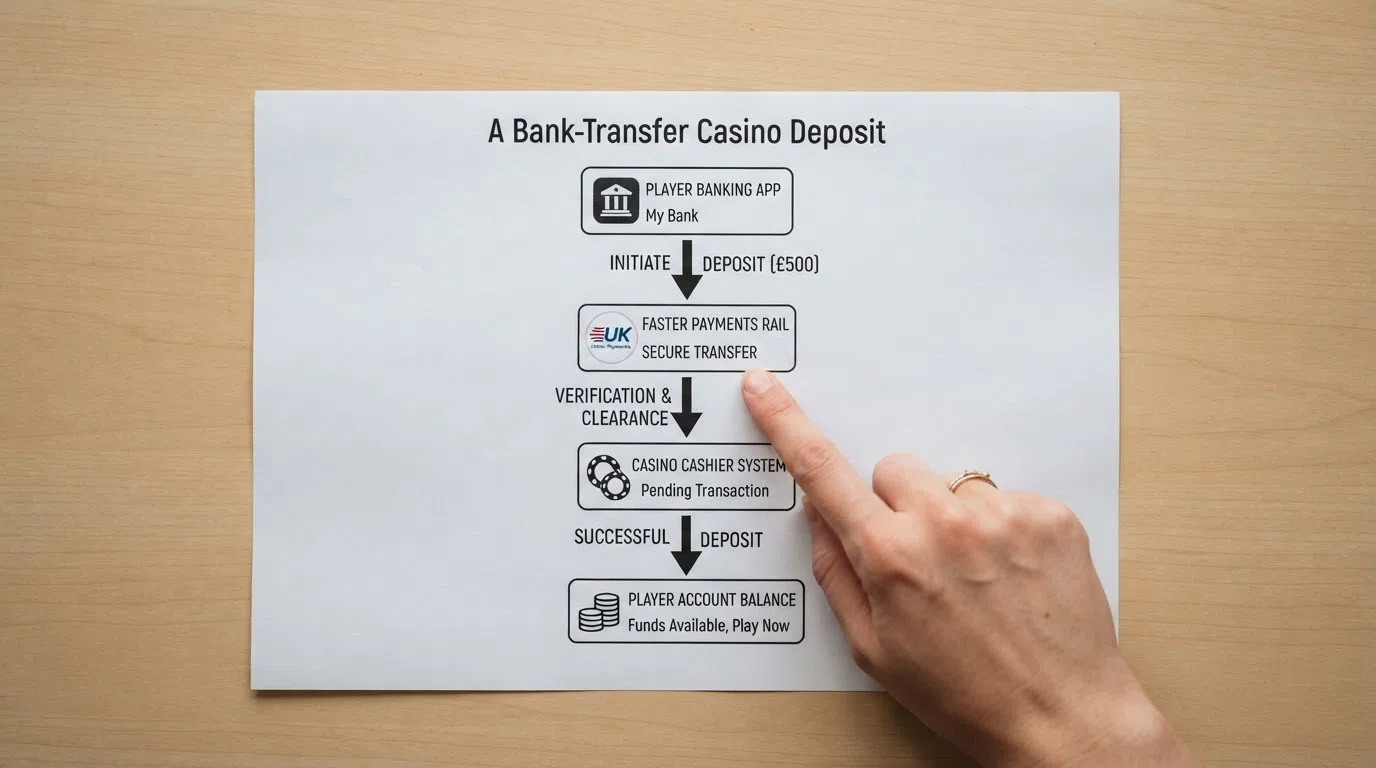
A bank-transfer deposit starts in the casino cashier, not at the bank. The player selects Bank Transfer or Instant Bank, and the cashier presents one of two flows. The traditional rail asks the player to push funds to a sort code and account number the casino provides; the money then walks the BACS clearing cycle, which is batch-based and runs over one to three business days. The instant rail is different. The cashier triggers an Open Banking redirect — trustly are the providers most UK players see — the player authenticates inside their own banking app with Face ID or a passcode, and the payment settles over the Faster Payments Scheme in seconds. The casino never sees a card BIN, never stores an e-wallet token, and receives only a payment reference plus the confirmation that the funds have left the player’s account. Faster Payments operates 24 hours a day, seven days a week, and supports single payments of up to £1 million — the technical ceiling is high enough that no UK casino’s deposit limit is constrained by the rail itself. The practical constraint is the operator’s own policy, not the payments infrastructure.
Bank Transfer vs Debit Cards vs E-Wallets: Where It Wins (and Loses)
The three payment families are not interchangeable, and bank transfer is not uniformly the best. On speed, instant bank transfer via Faster Payments or Open Banking settles in seconds; Visa and Mastercard debit are near-instant but route through a card acquirer; PayPal and Skrill are instant at the wallet but add a second hop before the casino sees the funds. On privacy, bank transfer wins cleanly — the casino receives no card number and no e-wallet login, just a payment confirmation. On limits, the ceiling is where bank transfer separates itself: the highest featured cap sits at £100,000 on a traditional BACS rail, against typical debit-card caps of a few thousand pounds per transaction. On fees, bank transfer is normally free to the player; operators absorb the acquiring cost, and Open Banking specifically lowers that cost relative to card schemes. The real loss is the dependency on the player’s own bank — if the bank does not support Open Banking redirects, or runs a maintenance window at the moment of deposit, the “instant” promise slips.
The UK Bank-Transfer Casino Landscape: How to Find a Genuine Site
The market for bank-transfer casinos in the UK is not a curated shortlist — it is the licensed market with one payment filter applied. Every UKGC-licensed operator that has integrated Open Banking, or that publishes a BACS sort code on its banking page, qualifies. The UKGC Public Register, last updated 29 July 2026, is the single source of truth for whether a brand is licensed to take UK real-money play; the affiliate “top 10” lists that crowd the search results measure SEO signals more reliably than they measure player value. A genuine bank-transfer casino surfaces the rail on its cashier screen before the registration form, publishes a banking page that names the rail and its limits, and answers a live-chat query about bank transfer in under a minute. Verification on the Public Register takes one search by operator name and one check that the status reads “Active.”
Real-Money Play via Bank Transfer: What Changes
The mechanics of a bank-funded session are not the same as a card-funded one. During deposit, the balance cannot be used until the payment has cleared — for Open Banking that is seconds; for traditional BACS, a player waits out the clearing window before the reels spin. During withdrawal, the operator’s own pending period — typically 24 to 72 hours — sits ahead of the rail’s settlement time, so a “1-3 day” published window describes the entire journey, not just the bank leg. At withdrawal, William Hill’s processing window completes the bulk of the wait, while a traditional bank-transfer withdrawal at bet365 can stretch to 2-10 business days end-to-end. The psychological difference is real, too. A bank transfer leaves a discrete line on a current-account statement for every casino deposit, and that paper trail is the natural responsible-gaming checkpoint that a card’s aggregated monthly total never provides. Players who want to budget by session, not by month, find that paper trail useful.
The Best UK Casinos That Accept Bank Transfer in 2026: How They Compare
Ten UKGC-licensed operators sit on this list because they meet three gates: an active licence on the Public Register, a published bank-transfer deposit method in the cashier, and a welcome offer open to bank-transfer depositors on the same terms as everyone else. They are ranked by the combination of deposit speed, wagering burden, and offer transparency — no paid placements, no proprietary score. The table below is the starting point; the operator write-ups underneath carry the context each row cannot.

| Operator | UKGC Licence | Welcome Bonus | Wagering Requirement | Bank Transfer Type & Deposit Speed |
|---|---|---|---|---|
| LeoVegas | UKGC (Active) | 50 Wager-Free Spins (Big Bass Splash) | 0x | Instant Bank Transfer (£10–£20,000) |
| PlayOJO | UKGC (Active) | Wager-Free Spins | 0x | Instant Bank / Open Banking |
| Casimba | UKGC (White Hat Gaming) | 50 Cash Spins (Wager-Free) | 0x | Instant Bank Transfer (£20+) |
| Betfair | UKGC (Active) | 50 Free Spins + Deposit £10 Get 100 | 1x (spins) | Bank Transfer (Faster Payments) |
| William Hill | UKGC (Active) | 200 Free Spins (Big Bass Splash) | 10x (winnings) | Instant Bank Transfer (£5–£99,000) |
| Betfred | UKGC (Active) | 200 Free Spins | 10x | Instant Bank Transfer (£5+) |
| Mr Vegas | UKGC (Active) | 100% up to £50 + 11 Wager-Free Spins | 10x (bonus) | Instant Bank Transfer (£10–£1,000) |
| Duelz | UKGC (SuprPlay) | 100% up to £100 + 100 Spins | 10x (bonus + wins) | Instant Bank Transfer (£25+) |
| BetMGM | UKGC (Active) | Free Spins (varies) | 10x | Bank Transfer (Direct) / Open Banking |
| Bet365 | UKGC (Active) | Up to 500 Free Spins | 20x | Bank Transfer (£100–£100,000, 2-10 days) / Instant Bank (Open Banking) |
LeoVegas — Wager-Free Spins With No Strings
LeoVegas leads the bank-transfer cohort for the simplest of reasons: 50 wager-free spins on Big Bass Splash, a £10 minimum deposit via instant bank transfer, and a 0× wagering requirement that turns every spin win into immediately withdrawable cash. The deposit rail caps at £20,000 — lower than the sportsbook-casino hybrids, but high enough for nearly every session a recreational player runs. The Open Banking flow inside the iOS and Android apps is the polished benchmark for the featured set. The brand’s narrow ceiling is its main friction: a high-volume depositor who wants to fund a six-figure session will look elsewhere, but for the median UK player this is the cleanest welcome on the page.
PlayOJO — Zero Wagering as a Business Model
PlayOJO built its brand on a single rule: no wagering, on any promotion, ever. The welcome offer carries wager-free spins — the count varies by campaign — and bank-transfer deposits via Open Banking qualify on the same terms as card deposits. There is no turnover bar to unpick, no bonus-versus-cash distinction to track, and no maximum win cap that swallows a lucky hit. The trade-off is the spin count: PlayOJO’s welcome offers fewer spins than its wagering-heavy rivals, because the cost of giving a wager-free spin is the cost of the spin itself. PlayOJO remains a top recommendation for anyone prioritising straightforward terms over the distraction of big, high-turnover bonuses.
Casimba — Cash Spins That Skip the Wagering Trap
Casimba’s 50 cash spins carry the same wager-free promise as PlayOJO’s, and the £20 minimum deposit via instant bank transfer keeps the entry modest. The licence sits with White Hat Gaming, the platform group. The 0× wagering on the spins means the welcome offer costs nothing to clear, and a player who finishes the welcome walk-away with whatever the spins paid out. The platform group’s footprint is the caveat: a player who has already exhausted a welcome at a sister site should check whether the offer terms carry through or reset.
Betfair — 1× Wagering and the Lowest Spin-Clearing Bar
Betfair is the closest a major UK operator comes to wager-free without the label. The welcome pairs 50 Free Spins with a Deposit £10 Get £100 match, and the 1× wagering on the spin side is functionally near-wager-free: one turnover of any winnings and the cash is withdrawable. The deposit rail runs on Faster Payments — not Open Banking-branded but settled on the same backbone, with the backing of a FTSE 100 parent behind the licence. The 1× is the differentiator; the deposit match adds a layer that turns a small deposit into more playable credit, and the two together make Betfair the pick for a player who wants both spin volume and a quick cash-out path.
William Hill — Low Minimum, High Ceiling, and a 10× Wager on Winnings
William Hill publishes the widest deposit range in the featured set: instant bank transfer from £5 to £99,000. The welcome is 200 Free Spins on Big Bass Splash with 10× wagering on winnings — not on the deposit, and not on a bonus amount, only on whatever the spins produce. Withdrawals process in 1-3 days through the same bank-transfer rail, and the iOS and Android apps integrate the instant-bank cashier cleanly. The 10× on spin winnings is the friction: a £20 spin win demands £200 of turnover before withdrawal, and the house edge on that turnover is the welcome offer’s real cost.
Betfred — £5 Entry, 200 Spins, 10× Wagering
Betfred mirrors William Hill’s deposit floor at £5 and runs the same 200 Free Spins welcome with 10× wagering, but stops short of publishing the same ceiling or the same withdrawal timeline. The retail heritage brings high-street familiarity to the online cashier, and the mobile experience is functional rather than best-in-class — the apps are available, the bank-transfer flow inside them follows the same instant-API pattern as the sportsbook-casino hybrids, and the wagering terms match William Hill’s shape without the same ceiling disclosure. For a player who values the £5 entry point and the brand familiarity over the precise withdrawal timeline, Betfred is a credible alternative.
Mr Vegas — A 100% Match With Near-Wager-Free Spins on the Side
Mr Vegas is the only featured operator that pairs a deposit-match bonus with wager-free spins. The 100% match up to £50 carries 10× wagering on the bonus amount, but the 11 wager-free spins clear at zero turnover. Instant bank transfer deposits from £10 to £1,000 — the lowest ceiling in the featured set, which constrains the operator to players running smaller sessions rather than high-volume depositors. The web-based mobile play means no app download, and the UKGC licence is the only protection framework in play. Mr Vegas earns its place by balancing a deposit-match incentive with a handful of no-wagering spins, keeping the session ceiling modest but the bonus logic simple.
Duelz — Deposit Match, 100 Spins, and a 10× Combined Wagering Load
Duelz’s 100% match up to £100 plus 100 spins is the most generous headline in the featured set — and the 10× wagering applies to both the bonus amount and all spin winnings, which is the highest combined wagering load of any featured match offer. Instant bank transfer deposits from £25 minimum, and the gamified duel mechanic on the homepage is cosmetic rather than functional: the wagering terms treat bank-transfer depositors identically to card depositors. The SuprPlay platform group is the back-office home. For a player who can stomach the 10× on both layers, the headline numbers are real; for one who reads the small print, the welcome’s true cost is the spin-win turnover that the headline does not flag.
BetMGM — Native Apps, Direct Bank Transfer, and a Variable Welcome
BetMGM runs two bank-transfer rails side by side — a direct wire option and an Open Banking flow — and is one of the few featured operators investing in bespoke native iOS and Android app development. The welcome offer shifts with the campaign; what stays constant is a 10× wagering bar on whatever the current offer is. The brand’s US reputation does not translate to UK player protections: the licence that matters is the UKGC one, and it is the UKGC framework that defines the dispute resolution and segregated funds that apply. For a mobile-first player who wants a polished app and two rail options, BetMGM is a natural fit; for one chasing a fixed headline bonus number, the welcome’s variability is the friction.
Bet365 — The £100 Floor and a 2–10 Day Wait That Most Rivals Have Eliminated
Bet365 is the outlier the page needs to name, not the operator to bury. The traditional bank-transfer rail still routes through a £100 minimum with a 2-to-10-business-day window — the slowest and most expensive entry point in the featured set by a margin. The cashier also offers an Instant Bank / Open Banking channel as a separate option, but the legacy rail is the one a player finds first if they search by “bank transfer” alone. The welcome runs up to 500 Free Spins at a 20× wagering requirement — the highest wagering multiple in the featured set, and one that reflects a cap the UKGC’s January 2026 rule does not reach because it applies to bonus amounts rather than spin-derived winnings. The UKGC licence is active and the apps are first-rate, but a player who arrives via the traditional rail is paying for the brand recognition with both time and wagering load.
Inside a Bank Transfer Casino Payment: From Deposit to Withdrawal
The full lifecycle of a bank-transfer casino payment runs from the cashier screen through the rail to the player’s current account, and back again on withdrawal. The mechanics differ by rail but converge at three points: a verification gate that blocks both directions until cleared, an operator pending window that sits ahead of the bank’s own settlement time, and a rail settlement that is either measured in seconds or in business days. The table below lays out the three rails available to UK casino players — instant Open Banking, Faster Payments without an Open Banking layer, and traditional BACS/wire — on the dimensions a player actually feels.
| Transfer Type | Deposit Speed | Withdrawal Speed | Authentication Method | Typical Deposit Limit Range | Available at (Example Featured Operators) |
|---|---|---|---|---|---|
| Open Banking (Trustly/TrueLayer) | Seconds | Within hours of release | Bank-app login (Face ID / passcode) | £5 – £20,000 | LeoVegas, PlayOJO, Mr Vegas, Casimba, Duelz |
| Faster Payments (direct) | Seconds | Hours to 1 business day | Casino cashier / sort-code flow | £5 – £99,000 | William Hill, Betfair, Betfred |
| Traditional BACS / Wire | 1–3 business days | 2–10 business days | Manual sort code + account number | £100 – £100,000 | Bet365 (legacy rail) |
Making a Bank Transfer Deposit: Minimums, Maximums, and the Real Timeline
Deposit minimums across the featured set span £5 to £100, and the spread is not random. William Hill and Betfred set the £5 floor for the casual depositor; LeoVegas, PlayOJO, Mr Vegas and Casimba cluster at £10-£20 for the standard entry; Duelz sits at £25 for the more committed player; and bet365’s traditional rail sits at £100 because the rail itself is designed for higher-value transfers. Maximums split the same way: £99,000 at William Hill, £20,000 at LeoVegas, £1,000 at Mr Vegas, and £100,000 at bet365 on the traditional rail. No operator in the featured set charges a player-side deposit fee for bank transfer — the cost sits with the operator’s acquiring relationship, and Open Banking specifically lowers that cost relative to card acquiring. The deposit processing time is the deciding variable: seconds for Open Banking and Faster Payments, 2-10 business days for traditional BACS, and no operator in the featured set runs an instant bank-transfer rail with a wait that exceeds the rail’s own settlement time.
Bank Transfer Withdrawals: How Long They Really Take and Why
Withdrawal speed is where bank transfer divides the field, and the rail is only part of the answer. The operator’s internal processing window — typically 24 to 72 hours — sits ahead of the rail’s settlement time, and the published “1-3 day” or “2-10 business day” window covers the entire journey from the player’s “withdraw” click to the funds arriving in their current account. Open Banking withdrawals can settle within hours of release; Faster Payments without an Open Banking layer takes hours to a business day; BACS and wire take 1-3 business days at best, 2-10 at worst. Verification is the gate that blocks everything: an unverified account cannot withdraw to any rail, and bank-transfer KYC is the same standard as card KYC. The two extremes in the featured set are William Hill at 1-3 days end-to-end and bet365 at 2-10 business days on the traditional rail — a difference of more than a week for the same banking technology underneath.
Instant Bank Transfer at UK Casinos: What “Instant” Actually Means
“Instant” is an advertising word, and the rail that earns it is the Faster Payments Scheme — the UK real-time backbone that supports single payments of up to £1 million and operates around the clock. Open Banking providers like Trustly and TrueLayer build on top of that rail: the API call to the player’s bank authenticates and authorises the payment in one flow, and the FPS confirmation arrives in the casino cashier within seconds. The “open banking has significantly changed that process by enabling direct, authenticated bank-to-bank transfers that settle in seconds rather than days” framing is accurate for the Open Banking rail and inaccurate for traditional BACS — the distinction matters because the same operator sometimes runs both. When “instant” slips: a bank maintenance window, a first-time payer verification hold, or a rare FPS queue delay can push settlement from seconds to minutes. None of these changes the underlying rail; all of them are reasons to keep a fallback payment method on file.
Traditional Bank Transfer (BACS and Wire): The Slow Lane Explained
Traditional bank transfer is the rail that the search term sometimes means and that most featured operators have moved away from. The player enters a sort code and account number the casino provides, initiates the push from their own bank, and waits for the BACS clearing cycle — a batch-based system that runs over one to three business days for deposits and three to five for withdrawals. Wire transfer is a faster sibling, typically same-day or next-day, and is the rail that carries bet365’s £100,000 ceiling. The reason this option still exists is twofold: high-limit deposits that exceed Open Banking’s typical £20,000 cap, and players who prefer not to use an API-based bank login at all. The trade-off is plain: a £100 minimum that prices out casual depositors, and a wait that no instant rail operator imposes.
Deposit Limits, Verification, and the Bank-Transfer Setup Checklist
Before the first bank transfer clears, the casino needs the player’s identity verified. The KYC requirement is identical across payment methods — proof of ID, proof of address, and in some cases a bank statement showing the account belongs to the player. The new UKGC deposit-limit mandate effective 30 June 2026 — “From 30 June 2026 all online operators must provide customers with the opportunity to set a ‘deposit limit’ which is based solely on the amount a customer pays into their account” — means the deposit screen now carries a limit-setting interface as standard, and a decrease takes effect instantly while an increase has a 24-hour cooling-off period. The pre-deposit checklist that keeps a bank-transfer first deposit from stalling: a verified account, a deposit limit set on the deposit page, the correct rail selected in the cashier, and a confirmed balance in the funding account. The items in order:
- Verified account (KYC complete, with proof of address and — where required — a bank statement on file).
- Deposit limit set on the deposit page (decreases are instant; increases carry a 24-hour cooling-off period).
- Correct rail selected — Open Banking for instant settlement, BACS only if the deposit size demands it.
- Sufficient balance confirmed in the funding account, including any per-transaction caps the player’s own bank imposes.
Why Your Bank Transfer Welcome Bonus Is Smaller Than It Looks
The UKGC’s wagering cap effective 19 January 2026 changed the economics of every UK casino welcome offer. The cap sits at 10× the bonus amount, and that ceiling reshaped the headline numbers across the market — the £500-and-up deposit matches of the pre-2026 era are gone, replaced by free-spin-led welcomes whose bonus component is small enough to clear within the cap. A £50 bonus at 10× wagering demands £500 of turnover before withdrawal, and the house edge on that turnover is the welcome’s real cost; the published bonus amount is closer to a marketing figure than to a cash gift. Every featured operator’s welcome is open to bank-transfer depositors on the same terms as card depositors — no payment-method gate, no separate bonus tier, no restriction that a bank-transfer player must opt into a smaller offer. The distinction that matters more than the headline is bonus wagering versus free-spin-winnings wagering: 0× on spins from LeoVegas or Casimba is a different product from 200 spins at 10× at William Hill, and the wagering multiple is the number that decides whether the offer is worth claiming.
Welcome Bonuses for Bank-Transfer Depositors: What Each Operator Actually Gives You
Free spins dominate the welcome landscape: eight of the ten featured operators lead with free spins rather than deposit matches. The wagering spectrum maps cleanly across the featured set — PlayOJO, Casimba and LeoVegas at 0×, Betfair at 1×, William Hill, Betfred, Mr Vegas, Duelz and BetMGM at 10×, and bet365 at 20× on spin winnings. The two deposit-match offers — Mr Vegas at 100% up to £50 and Duelz at 100% up to £100 — both carry 10× wagering on the bonus amount, and Mr Vegas pairs the match with 11 wager-free spins that clear at zero. No operator in the featured set restricts its welcome offer by payment method, and the bank-transfer depositor gets the same terms as the debit-card depositor — a uniformity the UKGC’s cap has reinforced rather than diluted.
No-Deposit Bonuses and Bank Transfer: What the Market Actually Has
Many players look for “bank transfer casino no deposit bonus” deals, but the UKGC-licensed market has largely moved away from no-deposit offers. None of the ten featured operators currently offers a true no-deposit bonus payable via bank transfer; most players searching for this are looking for a low-risk entry point rather than a literal zero-deposit offer. The next best thing is a £5 minimum deposit at William Hill or Betfred, recoverable on withdrawal once any wagering is cleared. The wager-free spins at LeoVegas, Casimba and PlayOJO function as near-no-deposit value: the £10 deposit is recoverable, and the spins cost nothing to clear because the 0× wagering requirement means wins are withdrawable as cash. The non-UKGC offshore market is where “no deposit bonus bank transfer” results often land — Curacao-licensed operators, no UK player protections, no UKGC dispute resolution, and no segregated funds guarantee. A bank transfer to one of these is a transfer to an offshore entity with no UK regulatory backstop.
Free Spins Funded by Bank Transfer: The Offers That Cost Nothing to Clear
The wager-free spin is the best bonus a bank-transfer depositor can claim, and three of the featured operators run exactly that offer. LeoVegas posts 50 wager-free spins on Big Bass Splash with a £10 minimum via instant bank transfer; Casimba posts 50 cash spins at 0× wagering with a £20 minimum; PlayOJO posts a variable count of wager-free spins, always 0×. Betfair’s 1× wagering on 50 spins is functionally near-wager-free: one turnover of winnings and the cash is withdrawable. The mechanic is plain — deposit via instant bank transfer, the spins credit, play, and any win lands as cash with zero turnover requirement. The 10×-on-winnings operators tell a different story: William Hill’s 200 spins, Betfred’s 200 spins, and Duelz’s 100 spins all carry higher headline counts, but the clearing cost erases most small wins, and the welcome’s real value sits closer to the wager-free offers than the headline numbers suggest.
Wagering Requirements: The UKGC Cap, What It Covers, and What Still Trips Players Up
The 10× cap on the bonus amount is real consumer protection, and a £50 bonus now demands at most £500 of turnover before withdrawal. What the cap does not cover is wagering on free-spin winnings, wagering on a deposit amount (a “deposit playthrough”), or any term labelled a “withdrawal condition” rather than a wagering requirement. The practical maths on a £50 bonus at 10×: roughly £12 to £25 in expected loss depending on the game’s RTP, against a headline bonus of £50 — the player keeps roughly half of the bonus on average after the wagering is complete. The 20× outlier at bet365 sits on free-spin winnings rather than on the bonus amount, and the cap does not reach it because the spin-derived winnings are not a bonus amount under the rule. The result is a welcome that looks generous on the headline and demands more turnover per pound of expected value than the 10× offers do.
Slots, Live Dealer, and Every Game You Can Fund by Bank Transfer
The game catalogue does not change when the deposit rail changes. No operator in the featured set restricts game access by payment method, and bank-transfer players play the same slots, live-dealer tables and game-show formats as card depositors. The real filter is the operator’s licence and platform, not the rail — and the bank-transfer deposit ceiling determines which game types make sense for a session. Live-dealer tables, where minimums start at £1-£5 per hand on roulette and blackjack, fit cleanly within any featured deposit minimum; high-stakes slots and live game-show formats scale up to whatever the player’s bank-transfer ceiling allows.
Slot Sites That Accept Bank Transfer: What to Look For
Every featured casino carries slots, and the differentiator for a bank-transfer slot player is deposit speed and the wagering load on the welcome spins. The instant-bank-transfer operators — LeoVegas, PlayOJO, Casimba, Mr Vegas, William Hill, Betfred, Duelz — let a player deposit, spin and withdraw without lag at any stage of the rail. The sportsbook-casino hybrids (bet365, William Hill, Betfair) carry the broadest slot catalogues; the mobile-first casino pure-plays lean on provider depth rather than breadth. Progressive jackpot hunting is the one bank-transfer-specific use case: the high deposit ceiling on the traditional rail at bet365 is relevant only when a player is funding a session that exceeds the £20,000 Open Banking cap. For most players, the slot-site discovery path is the UKGC register plus the comparison table above — and no operator exposes a “bank-transfer slots” filter because no slots are excluded.
Live Dealer Tables via Bank Transfer: Higher Limits, Real Dealers
Live-dealer play rewards the higher deposit ceilings bank transfer enables. A £10 minimum on a roulette table is easier to fund from a £100 bank deposit than from a card deposit with a smaller ceiling, and the bank-transfer withdrawal rail matches the deposit rail for a closed loop. The live-dealer providers — Evolution, Pragmatic Play Live and Playtech Live — supply the same games across the featured set, with blackjack, roulette, baccarat and game-show formats available at every operator. A live-dealer session funded by bank transfer naturally runs longer because the deposit is larger and the payment friction is lower than card-on-file micro-deposits; the rail is built for sustained play.
Bank Transfer on Mobile: What the Apps Get Right (And Wrong)
The bank-transfer deposit flow on a phone is a test of the operator’s UX investment. The Open Banking redirect to a banking app and back is a multi-step handoff, and the operators with native iOS and Android apps handle it more cleanly than the web-only ones. All ten featured operators are mobile-accessible; the experience gap is in the handoff polish, not the availability.
Casino Apps That Support Bank Transfer: The Native Advantage
Native-app operators — bet365, William Hill, LeoVegas, BetMGM and Betfair — ship a smoother bank-transfer handoff than web-only ones. The app remembers the player’s deposit rail preference, triggers the banking-app redirect with a single tap, and resumes the casino session without reloading. LeoVegas’s 4.8 App Store rating is the benchmark the others are measured against. The web-app operators — Mr Vegas, Duelz, PlayOJO, Casimba and Betfred — run a browser-based flow that is functional but more susceptible to session loss when the Open Banking redirect swaps tabs.
The Legal Reality: UKGC Licences, GamStop, and What “Non-GamStop” Actually Means
Every casino on this page holds an active UKGC licence, and the “non-GamStop bank transfer casino” search points to operators outside that framework. GamStop allows self-exclusion from all UKGC-licensed operators with a single request, and the exclusion covers every payment rail the operator runs. The 2026 regulatory changes — the £2/£5 stake limits effective 30 September 2026, the deposit-limit mandate effective 30 June 2026, and the 10× wagering cap effective 19 January 2026 — apply to every UKGC-licensed operator and to no one else. A “non-GamStop” casino is an operator not on the UKGC register, typically Curacao-licensed, that does not participate in GamStop, does not observe UK stake caps, and is not bound by UK player-protection rules.
UKGC-Licensed Bank-Transfer Casinos: What the Licence Guarantees
An active UKGC licence is not a rubber stamp. It guarantees segregated client funds — a player’s balance is held separately from the operator’s working capital — mandatory Alternative Dispute Resolution access, and the 10× wagering cap on bonus amounts. The stake-limit regime arriving 30 September 2026 caps online slots at £2 per spin for 18-24s and £5 per spin for 25+, and the deposit-limit mandate from 30 June 2026 puts a limit-setting interface on every deposit page. The verification path is the UKGC Public Register, last updated 29 July 2026 — enter the operator name and confirm the status reads “Active” before depositing.
Non-GamStop Bank-Transfer Casinos: The Risks and Why They Rank
A non-GamStop casino sits outside the UKGC register, typically with a Curacao or similar licence, and offers no GamStop participation, no UK player-protection compliance, and no UK ADR. Sending a bank transfer to one is a transfer to an offshore entity: no segregated funds guarantee, no enforceable withdrawal timeline, and no UK regulatory recourse if the operator withholds winnings. The Remote Gaming Duty at 40% from April 2026 applies only to UKGC-licensed operators — non-GamStop operators pay no UK tax and fund none of the UK’s safer-gambling infrastructure. These sites appear in search results because they target the “non-GamStop” keyword deliberately, and a bank-transfer player who arrives at one has left the protection framework the UKGC built for them.
Playing Safely: The RG Safeguards That Come With Bank Transfer
Bank transfer carries a built-in responsible-gaming advantage that card rails do not. A bank statement shows every casino deposit as a discrete line item — no aggregating, no masking — and that paper trail is the natural budgeting checkpoint a player can review without asking the operator for data. The UKGC’s 2026 deposit-limit mandate puts the limit-setting interface on the deposit page itself, and the GamStop register covers every UKGC-licensed operator with a single self-exclusion request. The 81.5% of National Gambling Helpline contacts citing online gambling and the 2.4% problem-gambling prevalence in Great Britain are the scale of the issue these tools were built for.
Deposit Limits, Session Tracking, and the Tools Built Into Bank-Transfer Play
The gross deposit limit is the primary tool, and the UKGC’s 30 June 2026 mandate puts it on every deposit page. Decreases take effect immediately; increases carry a 24-hour cooling-off period. Session tracking and automated interaction monitoring are mandatory at every UKGC-licensed operator — automated interactions flagged as risk markers were up 32% year-on-year in Q4, and the monitoring runs regardless of payment method. The items that the bank-transfer rail supports specifically:
- Gross deposit limit set on the deposit page (decreases instant; increases carry a 24-hour cooling-off period).
- Bank-statement paper trail showing every deposit as a discrete line item, with no operator-side aggregation.
- GamStop self-exclusion covering every UKGC-licensed operator regardless of the payment rail used.
- Automated interaction monitoring that flags risk markers and operates payment-method-agnostically.
Where to Get Help: UK Resources for Problem Gambling
The National Gambling Helpline (GamCare) is the front-line service, and 81.5% of contacts in 2026 cited struggles with online gambling. GamStop is the national self-exclusion register — free, covering every UKGC-licensed site, taking effect within 24 hours of registration. The 2.4% prevalence figure from the GSGB annual report is the context: nearly one in forty UK adults meets the problem-gambling threshold. Additional tools sit outside the casino’s own framework: many UK current accounts now offer a gambling-transaction block at the bank level, and operators offer reality checks and time-out periods that complement rather than replace GamStop.
How We Selected and Ranked the Casinos on This Page
The source basis is the UKGC Public Register (last updated 29 July 2026) for operator-licence status, operator websites and published terms for bonus, wagering and bank-transfer specifics, and UKGC and GamCare statistical releases for prevalence and safer-gambling data. The evaluation criteria are five: UKGC licence status (a mandatory gate), bank-transfer deposit type and speed, welcome-offer value after wagering is applied, withdrawal processing window, and mobile bank-transfer experience. The ranking logic orders operators by the combination of bank-transfer speed (instant > traditional), wagering burden (lower > higher), and offer transparency (wager-free > standard) — no weightings, no proprietary score, no paid placements. What was excluded: operators without a live UKGC licence, operators that do not accept bank transfer, and non-GamStop or offshore operators — these were not evaluated and do not appear in the table.
Bank Transfer or Debit Card? What Your Choice Actually Changes
The case for bank transfer is strongest where the instant rail is available. Higher deposit ceilings, no card-network intermediary taking a cut, Faster Payments and Open Banking settlement in seconds, and a bank-statement paper trail that supports responsible-gaming budgeting without any operator-side reporting. The trade-offs are real and worth naming: traditional BACS and wire are slower than any card deposit, the Open Banking redirect requires a bank login that some players find uncomfortable, and the £100 floor at bet365’s traditional rail prices out casual depositors. The verdict: for the UK player who already uses online banking, instant bank transfer is the fastest, safest and most private way to fund a casino account — it costs nothing, leaves no card details with the operator, and at the best operators clears in seconds. The one scenario where a debit card still wins is when the player’s bank does not support Open Banking redirects and the operator offers no instant rail. From here: pick an operator from the comparison table whose bank-transfer terms match the deposit size and bonus preference, verify its licence on the UKGC Public Register, set the deposit limit on the first visit, and fund the first session via the instant rail.
Frequently Asked Questions
Are bank-transfer deposits at UK casinos actually instant?
Yes, on the instant rail. Open Banking and Faster Payments transfers settle in seconds; traditional BACS transfers settle over one to three business days. Operators like LeoVegas, PlayOJO, William Hill and Betfred run the instant rail as standard.
Is Open Banking the same thing as a standard bank transfer for casino deposits?
No. Open Banking is an API call to the player’s bank that authenticates and authorises the payment in one flow, settling on Faster Payments within seconds. A standard bank transfer typically means manual BACS entry of a sort code and account number, which settles over one to three business days.
How long do bank-transfer withdrawals take from UK online casinos?
It depends on the operator and the rail. Open Banking withdrawals can settle within hours of release; Faster Payments withdrawals take hours to one business day; BACS and wire withdrawals take one to ten business days. The operator’s own pending period (typically 24 to 72 hours) sits ahead of the rail.
Are there any fees for using bank transfer at UK casino sites?
No operator in the featured set charges a player-side fee for bank-transfer deposits. Open Banking specifically lowers the operator’s acquiring cost relative to card payments, and that saving is not passed on as a fee in the other direction.
Is it safe to link my bank account to an online casino?
On a UKGC-licensed operator, yes. The Open Banking flow authenticates inside the player’s own banking app with Face ID or a passcode, and the casino receives a payment confirmation rather than card details. The UKGC framework requires segregated client funds and binding ADR for any dispute.
Can I still claim a welcome bonus if I deposit by bank transfer?
Yes. Every welcome offer in the featured set is open to bank-transfer depositors on the same terms as card depositors. No operator gates its welcome bonus by payment method, and the UKGC’s 10× wagering cap on bonus amounts applies regardless of rail.
Game Variety and Provider Mix: Does It Change When You Pay by Bank Transfer?
It does not. A casino’s game library is the same regardless of deposit method — the licence and the platform, not the payment rail, determine what is available. The provider count varies across the featured set, and the sportsbook-casino hybrids carry the broadest catalogues because they have spent longer integrating third-party studios. No operator lets a player browse “games available to bank-transfer depositors” because no games are excluded; the real filter is the operator’s own catalogue quality. Use the comparison table and the UKGC register, not the headline game count, to compare.
Mobile Web vs Desktop: Does the Bank-Transfer Experience Degrade?
The deposit flow is the same under the hood, but on a mobile browser the Open Banking redirect through a second tab or a banking app creates friction the desktop flow avoids. The desktop flow keeps the casino session open in the background; the mobile-web flow sometimes triggers a page reload on the return tab that loses the cashier state. A mobile-web bank-transfer deposit takes 15-30 seconds longer and fails more often than a desktop deposit — but it still works. The practical fix: use the operator’s native app on mobile, or deposit via desktop and play on mobile, because the balance is cross-platform at every featured operator.
Payments – fastestpayout-casinos-uk
Content created by the «fastestpayout-casinos-uk» team