
Casinos Without a UK Licence: A GB Player's Guide to the Offshore Market
 Available in GB
September 8, 2026 · Licence data verified against the Gambling Commission’s public register and the licensing pages of Curacao GCB, the Malta Gaming Authority and the Anjouan Gaming Board.
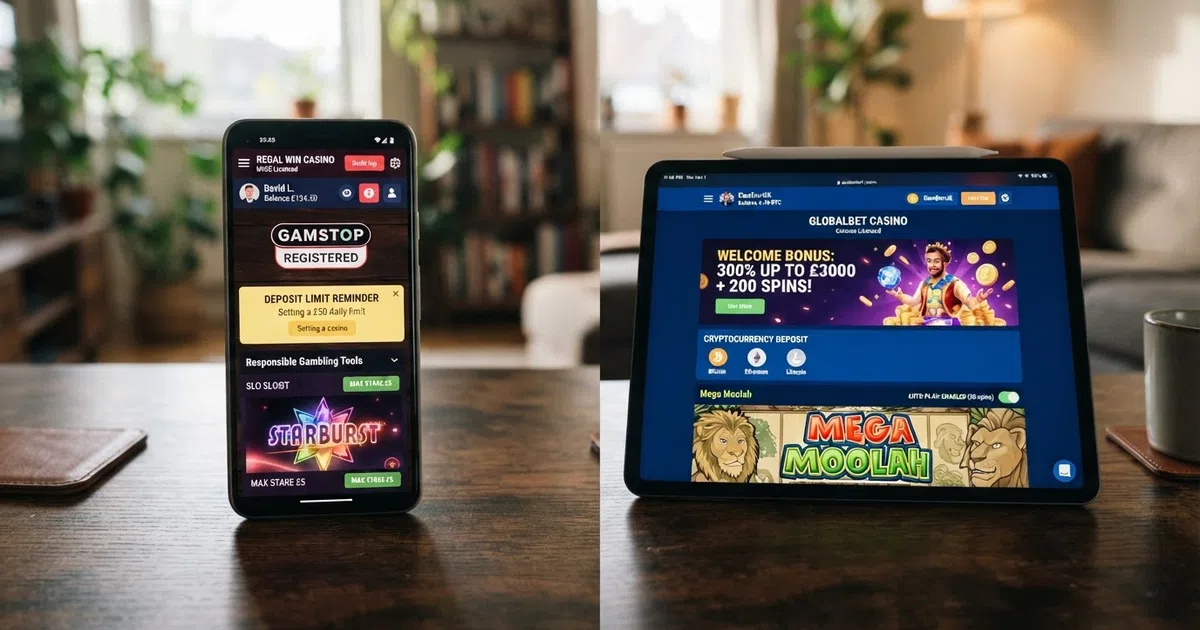
The phrase “casino without a UK licence” describes a specific market position, not a legal grey area. Since the Gambling (Licensing and Advertising) Act 2014 took effect, any operator serving Great Britain customers needs a Gambling Commission operating licence at the point of consumption. A site that does not hold one is offshore, however respectable its Curacao, Maltese or Anjouan paperwork may be. The label tells you where the operator sits relative to UK consumer law — and that position changes what the player gets and what the player loses.
Why this matters now: roughly 47% of GB adults gambled in the past four weeks, and 38% of them did so online, according to the Gambling Survey for Great Britain (Year 3, 2025). Remote Gaming Duty on licensed operators rose to 40% on 1 April 2026, layered on top of a 1.1% statutory levy that took effect in April 2025. Compliance costs, the credit-card ban, the £5/£2 stake cap and GAMSTOP integration all raise the cost of running inside the system. Some players look outside it for that reason. About 2.4% of GB adults score 8+ on the PGSI — the screen for problem gambling — which is why the protections the system installs are not optional decoration. They are why an offshore licence is a different product, not a cheaper one.
What “Offshore Casino” Means for a UK Player
An offshore casino, in the GB context, is a remote gambling operator that holds no operating licence from the Gambling Commission. The site is reachable from a London flat or a Yorkshire terrace, but it sits outside the regime that licences the Betfreds and Paddy Powers of the domestic market. The most common licences behind these brands are Curacao GCB (master licence 5536/JAZ or 365/JAZ), the Malta Gaming Authority, and the Anjouan Gaming Board — three jurisdictions with very different player-protection rules, none of which substitute for a UKGC licence under British law.
That distinction — *unlicensed for GB* rather than *unlicensed* — is worth holding on to. A Curacao GCB certificate is a real licence in its own jurisdiction. It is simply not a UK one. The site may be perfectly legitimate under Curacao law and still offer a British player none of the consumer protections a UKGC-licensed site is statutorily required to provide.
Why UK Players Look Beyond the UKGC System
The reasons are structural, not frivolous. A 40% Remote Gaming Duty plus a 1.1% statutory levy make the licensed market expensive to run, and operators pass that cost into product limits. Online slots at UKGC sites carry a statutory maximum stake of £5 per game cycle for players aged 25 and over, and £2 for players aged 18 to 24 — the lowest tier being the only one of its kind in any major European market. Credit cards have been banned for all remote gambling since 14 April 2020, with the ban extending to credit-card-funded e-wallet payments. Auto-play and bonus-buy features were removed from UKGC slots in October 2021.
A £150 net-deposit threshold now triggers a financial vulnerability check using publicly available data. None of these rules is wrong on its own terms, but the cumulative effect is a stripped-back product. A player who wants higher stakes, a credit card on file, crypto rails, auto-play or simply a different bonus structure has to leave the system to find them. The push is structural, and it explains the volume of traffic heading offshore.
What Changes the Moment You Step Outside UK Regulation
The trade-off fits on a single screen. Offshore casinos accept credit cards, e-wallets, bank transfers and cryptocurrency (Bitcoin, Ethereum, Litecoin, USDT). They publish slot stakes up to £500 per spin at some operators. Auto-play and bonus-buy features remain. Bonuses are larger, free spins come attached, and wagering multiples run three to four times the UKGC cap.
What disappears is GAMSTOP, the UKGC complaints route, approved alternative dispute resolution, the mandatory deposit-limit prompt, the financial vulnerability check and the reverse-withdrawal ban. Player recourse is limited to the offshore licence’s own dispute process. Tax is unchanged on the player side — GB residents pay no tax on gambling winnings whether the operator is licensed in London or Willemstad. The cost of stepping outside is not legal; it is structural. The player trades British consumer protection for features the British system has removed.
The Licence That Isn’t There — What UK Players Lose Outside the UKGC
The Gambling Act 2005 sets three licensing objectives: preventing gambling from being a source of crime, ensuring it is conducted fairly and openly, and protecting children and other vulnerable people. The Gambling (Licensing and Advertising) Act 2014 made those objectives apply to every operator serving a GB customer, regardless of where the operator is incorporated. Section 33 of the 2005 Act makes providing unlicensed gambling facilities a criminal offence for the operator — up to 51 weeks’ imprisonment, an unlimited fine, or both. No equivalent criminal sanction has been traced for a player who simply gambles on an unlicensed site. The risk the player carries is the loss of protection, not the loss of freedom.
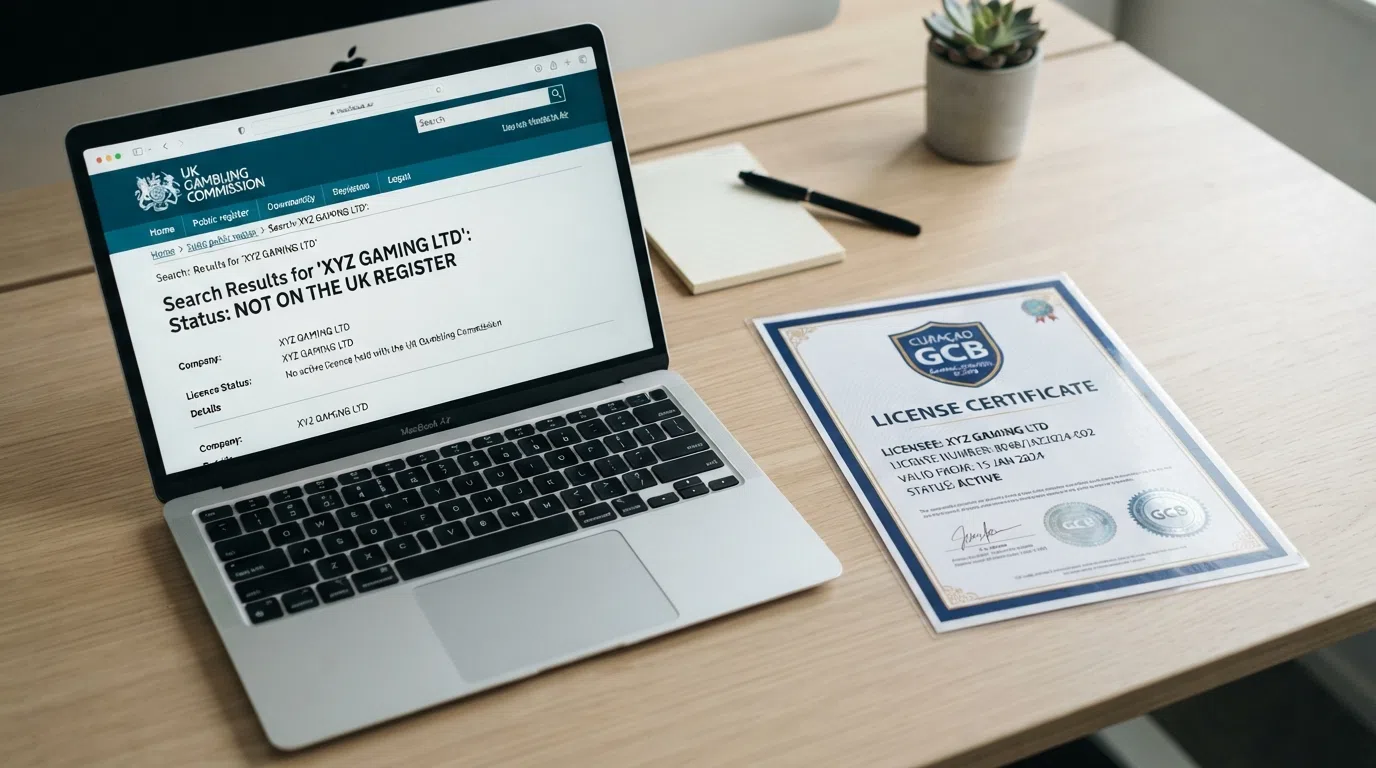
The table below sets out the contrast. Each row names a protection the licensed market guarantees and what an offshore operator typically offers in its place. The em-dash cells are not gaps in the comparison — they are the answer.
| Protection | UKGC-Licensed Casino | Offshore (Non-UK) Casino |
|---|---|---|
| Operating licence from the Gambling Commission | Required, point-of-consumption | Not held |
| GAMSTOP self-exclusion integration | Mandatory since 31 March 2020 | Not present |
| Statutory slot stake cap (£5/£2 age-banded) | Enforced | No equivalent cap |
| Credit card acceptance | Banned since 14 April 2020 | Generally accepted |
| Mandatory deposit-limit prompt before first deposit | From 31 October 2025 | Not required |
| Standardised gross deposit limit (RTS 12) | From 30 September 2026 | Not required |
| Wagering requirement cap | 10× since 19 December 2025 | Typically 25×–45× |
| Financial vulnerability check at £150 net deposit | In force from 28 February 2025 | Not required |
| Reverse-withdrawal ban | Permanent since October 2021 | Not required |
| Approved ADR route | Required | Varies by offshore licence |
| Player tax on winnings | None | None |
What “Without a UK Licence” Means in Law
Section 33 of the Gambling Act 2005 is the operative provision. It targets the operator, not the player. An offshore brand that accepts GB customers commits an offence under British law; a GB resident who opens an account and plays at that brand has not, on the evidence available, been prosecuted for doing so. The Commission’s enforcement energy is spent on the supply side: cease-and-desist notices, search-engine referrals, payment-provider pressure. John Pierce, the Commission’s Director of Enforcement, put the strategy plainly: “The reality is we need to get better at tackling the illegal market and the supply chain that supports it.”
The legal point is therefore narrow. The player does not commit a crime. The player does, however, step outside every safeguard the Commission has built — the financial vulnerability check, the deposit-limit prompt, the ADR route, the GAMSTOP backstop. What the player loses is not liberty; it is recourse.
The Enforcement Reality — What the UKGC Actually Does About Offshore Operators
The Commission’s Illegal Markets team issued 3,140 cease-and-desist and disruption notices between April 2024 and June 2025, referred 447,778 URLs to search engines and achieved 287,961 removals. Engagement data from 160 targeted sites showed a 32% fall in GB user activity three months after disruption. The Commission’s own framing: “Engagement data from 160 websites targeted for enforcement action shows a 32 per cent drop in GB user engagement following reassessment after three months.”
The new lever is the Crime and Policing Act 2026. Section 170 and Schedule 18 give the Commission power to apply for court-ordered IP-address and domain-name suspension orders against unlicensed operators, backed by £26 million in Exchequer funding over three years (£5m in 2026/27, £10m in each of the two subsequent years). Secondary legislation is required to bring the powers into effect; that step is expected by the end of 2026. Until then, the toolkit remains disruption — which works on search visibility and payment routing, not on the underlying reachability of an offshore domain.
GAMSTOP — the Self-Exclusion System Offshore Casinos Do Not Join
GAMSTOP has been mandatory for every GB-licensed online operator since 31 March 2020. Exclusion periods are six months, one year, five years, or five years with auto-renewal, and none of them can be ended early. The system works because every domestic operator is plugged into it; the moment an account is opened, the system is checked, and a self-excluded player is blocked at the door.
None of the operators on this page participates in GAMSTOP. A player registered with GAMSTOP can open an account and deposit at every brand in the list that follows. The access exists, and pretending otherwise would be dishonest. The same paragraph carries the other half: the support infrastructure described in the responsible-gaming section below — GamCare, the NHS clinics, Gamban, Betblocker — is built for exactly the player who is weighing this decision, and using it is not a failure of resolve. It is the move that closes the gap the offshore site does not close on its own.
Alternative Licensing Jurisdictions — MGA, Curacao, and Anjouan Compared
Three licences dominate the non-GamStop market serving GB players. They are not equivalent.
A Malta Gaming Authority licence binds the operator to the Player Protection Directive: self-exclusion, deposit limits, reality checks and ADR are mandatory. MGA-licensed brands are rare in this market segment — research did not find them dominating the non-GamStop space accessible from GB. Where they do appear, the player protections are closer to a UKGC experience than to the Curacao baseline.
A Curacao GCB licence — typically master licence 5536/JAZ or 365/JAZ — is the dominant licence in the non-GamStop segment. The regime has tightened, but the player-protection floor remains lower than MGA’s. Self-exclusion, deposit limits and ADR are operator-level choices more than statutory ones.
An Anjouan Gaming Board licence is the newer entrant. It appears on a small share of offshore brands accessible from GB, including one operator in the featured set. The jurisdiction has fewer publicly documented player-protection obligations than either MGA or the post-reform Curacao regime.
None of these substitutes for a UKGC licence under GB law. A brand can hold a perfectly genuine Curacao certificate and still be unlicensed for the purposes of the Gambling Act 2005.
How to Verify a Casino’s Licence Yourself
Verification is mechanical, and a player who cannot do it in five minutes should not be depositing. The Gambling Commission operates a public register of licence holders. A brand is either on it or it is not — there is no middle ground. To check: open the Commission’s public register, search the operating company name, and read the result. If the brand does not appear, it is not licensed for GB. The same approach works for Curacao GCB, the MGA and the Anjouan Gaming Board: each regulator maintains its own public register, and the licence number on the casino’s footer can be searched there directly. The casino’s own licence badge is not evidence. The regulator’s register is evidence.
10 Casinos Without a UK Licence Compared
The table below ranks the ten operators by licence strength, bonus value adjusted for wagering, and breadth of game-provider roster. The GB Licence Status column is the same in every row by design: none of these brands holds a Gambling Commission operating licence, and none participates in GAMSTOP. The wagering and bonus columns carry what the operator review sources documented; cells where the public sources did not document the figure are left as em dashes, and the operator write-up beneath the table says so plainly.
| Operator | Licence Jurisdiction | GB Licence Status | Welcome Bonus | Free Spins | Wagering Multiple | Minimum Deposit | Game Providers |
|---|---|---|---|---|---|---|---|
| MyStake | Curacao GCB | NOT GB-licensed | 150% up to £750 (300% up to £1,500 across 3 deposits) | — | 30× on bonus funds | £20 | Pragmatic Play, Evolution, NetEnt, Hacksaw, Push Gaming |
| Goldenbet | Curacao GCB | NOT GB-licensed | 300% up to £1,500 across 3 deposits | 100 free spins | 35× on bonus funds | £20 | Pragmatic Play, Evolution, NetEnt, Play’n GO |
| Freshbet | Curacao GCB | NOT GB-licensed | 300% up to £3,000 across 3 deposits | 200 free spins | 30×–40× on bonus funds | £10–£20 | Pragmatic Play, Evolution, Hacksaw, Push Gaming |
| Rolletto | Curacao GCB | NOT GB-licensed | 150% up to £500 + 100% up to £2,000 (2nd deposit) | 200 free spins (50 instant + 30/day for 5 days) | 30× on bonus funds | £20 | Pragmatic Play, Evolution, NetEnt |
| Donbet | Curacao GCB | NOT GB-licensed | 150% up to £750 + 50 FS (standard); 170% up to £1,000 + 100 FS (crypto) | 50–100 free spins | 30× on bonus + deposit | £20 | Pragmatic Play, Evolution, NetEnt, Hacksaw |
| Tenobet | Curacao GCB | NOT GB-licensed | 400% up to £5,000 across 3 deposits | — | 25× (slots) / 15× (sports) | €20 | Pragmatic Play, Evolution, NetEnt |
| Winstler | Curacao (master licence 5536/JAZ) | NOT GB-licensed | 600% up to £9,500 across 5 deposits | 200 bonus spins | 30×–45× on bonus + deposit | €50 | Pragmatic Play, Evolution, Play’n GO |
| Lucky Barry | Curacao (Cerberlot N.V.) | NOT GB-licensed | 375% up to €1,000 | — | 35× | €150 | Pragmatic Play, BGaming |
| Madcasino | Anjouan Gaming Board | NOT GB-licensed | — | — | — | €20 | — |
| Richy Reels | Curacao | NOT GB-licensed | — | — | — | — | — |
MyStake — a Balanced All-Rounder With a 150% Match and Top-Tier Providers
The first-deposit package is 150% up to £750, with a three-deposit ceiling of 300% up to £1,500. Wagering is 30× on bonus funds — at the low end of the offshore band — and the £20 minimum deposit is standard. The 30-day validity is one of the longer windows in the set. Max bet during wagering is €5 per spin, which is workable. The provider roster covers the names that matter: Pragmatic Play, Evolution, NetEnt, Hacksaw, Push Gaming. MyStake is the operator to start with for a player who wants the full offshore product range without the most aggressive bonus terms. A 30× multiple on a non-crypto welcome offer, with a real validity window and a complete provider list, is the most balanced combination in the table.
Goldenbet — the Biggest Headline Match at 300% Across Three Deposits
Goldenbet’s 300% package up to £1,500 across three deposits is paired with 100 free spins and a 35× wagering multiple on bonus funds. The £20 minimum is standard, and the provider list (Pragmatic Play, Evolution, NetEnt, Play’n GO) is full-strength. What Goldenbet does not state in the available review sources is the bonus validity window — and that is the clause that decides whether the offer is actually claimable. The headline number is the largest single-package match in the set, but the absence of a stated validity means a player should check the operator’s own terms page before depositing.
Freshbet — the Highest Total Bonus Pool at £3,000 With 200 Free Spins
Freshbet’s 300% up to £3,000 across three deposits is the largest absolute bonus ceiling in the set, and the 200 free spins are the most generous free-spin bundle. Wagering is 30× to 40× on bonus funds — the upper end of that range puts Freshbet in the same band as Winstler. The £10 minimum deposit is the lowest entry point in the set; the £20 figure is the more common real-world floor. Bonus validity is not documented in the review sources consulted. The combination of the largest ceiling, the most free spins and a low entry point makes Freshbet the headline-grabber; the wagering and validity gaps are the cost of that headline.
Rolletto — 200 Free Spins Delivered in Daily Batches With a Two-Deposit Structure
Rolletto splits the welcome package across two deposits: 150% up to £500 plus 200 free spins on the first, 100% up to £2,000 on the second. The 200 free spins are not delivered in a single tranche — 50 land instantly, the remaining 150 arrive in batches of 30 per day for five consecutive daily logins. A player who does not log in for five days leaves free spins on the table. Wagering is 30× on bonus funds, £20 minimum deposit, Curacao GCB licence. Rolletto is the right pick for a player who values a free-spin structure that rewards daily play; the staggered delivery is a design choice, not a flaw, but it is one to know about.
Donbet — a Dual-Track Offer With a Crypto Boost for Bitcoin and USDT Depositors
Donbet is the only operator in the featured set that publicly prices a separate, higher match for cryptocurrency deposits. The standard offer is 150% up to £750 plus 50 free spins; the crypto offer is 170% up to £1,000 plus 100 free spins. Wagering is 30× on combined bonus and deposit — the “combined” part matters, because the same multiple on bonus alone is meaningfully cheaper to clear. Max bet during wagering is €5 per spin, and free-spin winnings are capped at €100. For a crypto-funded player, the math favours Donbet; for a debit-card depositor, the standard offer is mid-pack.
Tenobet — the Highest Single-Deposit Percentage at 400% and the Lowest Wagering in the Set
Tenobet’s 400% up to £5,000 across three deposits is the highest single-package percentage in the set. The wagering structure is 25× on slots and 15× on sports — both well below the offshore average of 30×–35×. The £20 minimum is standard. Free spins are not listed in the available sources, and bonus validity is not stated. For a slots-focused player willing to take a Curacao licence, the 25× multiple is the single best wagering term in this comparison; a player chasing free spins or a stated validity window should look elsewhere.
Winstler — the Largest Absolute Bonus Figure at £9,500 Across Five Deposits
Winstler is the headline-grabber by absolute size: 600% up to £9,500 across five deposits, plus 200 bonus spins. Wagering is 30× to 45× on combined bonus and deposit, the upper band of the offshore range. The minimum deposit is €50, the max bet during wagering is €2 per spin, and the licence is Curacao via master licence 5536/JAZ. The combination of a 45× upper-band wagering, a €2 max bet and a €50 entry floor means Winstler’s headline number is the most expensive in the set to convert into a withdrawal. The 600% figure looks like generosity; the math behind it is the opposite.
Lucky Barry — a High 375% Match With an Unusually Tight 7-Day Validity Window
Lucky Barry offers 375% up to €1,000 at 35× wagering, with a maximum bet of €2 per spin during the bonus period. The 7-day validity is the shortest stated window in the set — most operators do not state one at all, but Lucky Barry’s published 7 days is unusually tight. The €150 minimum deposit is the highest entry point in the set alongside Winstler’s. No-deposit bonuses are capped at €5 cashout. The combination of a 7-day window and a €150 entry is a high-pressure offer: the player needs to deposit, wager 35× and clear the bonus inside a week, or lose the bonus. That is a marketing design, not a value.
Madcasino — an Anjouan-Licensed Outlier With Limited Publicly Available Data
Madcasino is the only Anjouan-licensed brand in the featured set. The minimum deposit is €20. The welcome bonus, free-spin count, wagering multiple, bonus validity and game-provider list were not specified in the review sources consulted for this evaluation. The honest description: a small-stakes offshore casino under a newer licensing regime whose public footprint is thin. A player who wants transparency on bonus terms before depositing will not find it from the available review pages; the operator’s own terms page is the only reliable source, and a player who skips that step is gambling on more than the slots.
Richy Reels — a Curacao-Licensed Operator With Bonus Terms Not Publicly Documented
Richy Reels holds a Curacao licence. The minimum deposit, welcome bonus, free-spin count, wagering multiple, bonus validity and game-provider details were not specified in the review sources available at the time of writing. The verdict on data-thin operators is the same verdict twice in a row: the operator’s own terms page is the only current source, and a player should read it before funding an account. The absence of published bonus terms is not in itself a red flag, but it does mean the comparison above cannot rank Richy Reels on value — the inputs to that calculation do not exist in the public sources.
The Offshore Bonus Trap — Why That Headline Figure Shrinks Under the Terms
The UKGC has capped wagering requirements at 10× since 19 December 2025 and banned mixed-product promotions. The offshore standard is 25× to 45× on bonus funds, with 30× to 35× the most common figure. That is a three-to-four-times gap, and it is the single largest reason a 300% headline bonus at an offshore casino is not the windfall it looks like next to a 100% match with 10× at a UKGC site.
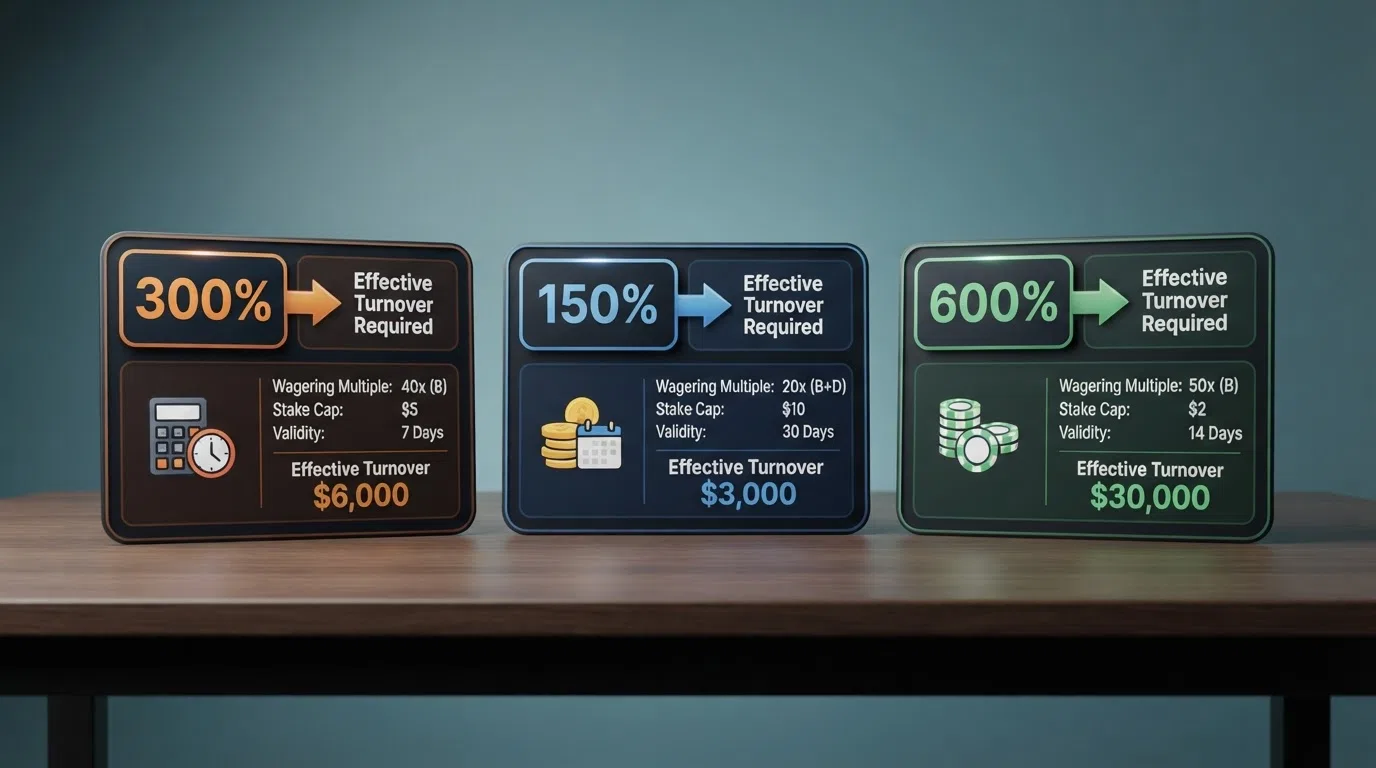
The wagering multiple is not the only number that deflates the headline. The base it is applied to matters: 30× on bonus alone is roughly half the cost of 30× on combined bonus and deposit. The max-bet rule (€2 to €5 per spin during wagering at most offshore operators) caps how fast the requirement can be cleared. The validity window — stated at 7 days at Lucky Barry, 30 days at MyStake, and not stated at most other operators — decides whether the playthrough is even possible inside the time allowed. And the game-weighting rules (slots usually 100%, table games heavily discounted or excluded) decide which games count at all.
What a Goldenbet Bonus Actually Costs to Clear
A worked example, using Goldenbet as the case. A £500 deposit triggers the 300% match and produces a £1,500 bonus. Wagering is 35× on the bonus funds, giving a required turnover of £52,500. At the offshore max-bet floor of €2 per spin, that is 26,250 spins. At a 5-second game cycle, the playthrough is roughly 21 minutes of continuous play — longer than three full working days without a break. This is a statistical estimate, not a guaranteed outcome: the calculation assumes only the bonus amount is wagered, that every spin is at the €2 floor, and that the player does not hit a feature buy or a max-volatility run. None of those assumptions will hold perfectly in practice. The point of the arithmetic is the order of magnitude: a £1,500 bonus at 35× is a 36-hour commitment at the lowest stake the operator allows, before any of the spin results are counted.
The practical consequence: the 600% Winstler headline at 30× to 45× on combined bonus and deposit is not a richer offer than the 150% MyStake headline at 30× on bonus alone. The base the multiple is applied to is the difference between a 36-hour commitment and a 60-hour one on similar absolute stakes.
Welcome Bonuses at Non-UK Casinos — the Shape of the Offers
Welcome packages in this set run from 150% to 600% match rates, spread across one to five deposits, with total ceilings from £750 (MyStake first-deposit) to £9,500 (Winstler across five deposits). Free-spin bundles range from zero (Tenobet, Lucky Barry) to 200 (Freshbet, Winstler, Rolletto). The largest headline figure is not the largest value: Winstler’s £9,500 at 45× on combined bonus and deposit is mathematically smaller than MyStake’s £750 at 30× on bonus alone, once the wagering base and the max-bet floor are applied. Two operators in the set — Madcasino and Richy Reels — have not published bonus terms in the available review sources, and a player who wants to compare them on value cannot do it from third-party data alone.
No-Deposit Bonuses and Free-Spin Offers — Free, but Not Cost-Free
No-deposit free spins at non-GamStop casinos typically carry 35× to 60× wagering on winnings, with a maximum cashout cap of £20 to £200. The player cannot withdraw more than the cap regardless of how much the spins win. Rolletto’s 200 free spins are delivered in a 50-instant, 30-per-day-for-five-days structure — a player who does not log in daily leaves spins unused. Donbet caps free-spin winnings at €100. Lucky Barry caps no-deposit bonus cashout at €5. The real value of a free-spin offer is the cashout cap minus the expected loss from wagering the winnings, and that calculation usually produces a smaller number than the headline “200 free spins” implies.
Wagering Requirements, Withdrawal Caps and the Fine Print That Decides the Value
Wagering multiples across the set range from 25× (Tenobet slots) to 45× (Winstler upper band). The bonus-only versus bonus-plus-deposit distinction is the largest single cost driver: Donbet and Winstler apply their 30× and 30×–45× to the combined amount, while MyStake, Goldenbet, Rolletto and Tenobet apply theirs to the bonus alone. Max-bet rules during wagering are €2 to €5 per spin. Stated validity windows are 30 days at MyStake and 7 days at Lucky Barry; the other operators do not publish one. Game weighting is the silent cost: slots usually contribute 100%, table games heavily discounted or excluded, and a player who tries to clear a bonus on roulette is unlikely to make progress.
How You Pay and Get Paid at Casinos Outside the UK System
The UKGC’s credit-card ban has been in force since 14 April 2020 and extends to credit-card-funded e-wallet payments via Skrill, Neteller and PayPal. The reverse-withdrawal ban has been permanent since October 2021. Identity verification is required before first deposit at every UKGC site. None of these restrictions binds an offshore operator. The payment experience is meaningfully different, and the difference runs in both directions — more options, fewer default protections.
How Pay N Play Works at Offshore Casinos
Pay N Play is the Trustly-powered model that lets a player deposit and start playing without filling out a traditional registration form. Identity and bank-account verification happen at the deposit step via open-banking APIs, and the casino receives verified data before the first spin. The model exists at some offshore casinos, but it is not universal across the featured set — most of the operators in this comparison use a conventional email-and-password registration. Pay N Play does not bypass KYC; it moves KYC from the post-registration withdrawal step to the deposit step. A player who values minimum-friction onboarding will find Pay N Play casinos faster to enter; a player who values a clear, separate verification moment may prefer the conventional flow.
Deposit Methods — Credit Cards, Cryptocurrency and E-Wallets
Offshore casinos accept credit cards — Mastercard and Visa — that have been banned at UKGC sites for five years and counting. The ban does not extend to the offshore operator’s payment stack, and most brands in this set take credit cards alongside debit cards, e-wallets (Skrill, Neteller, PayPal), bank transfers and cryptocurrency (Bitcoin, Ethereum, Litecoin, USDT). Donbet is the only operator in the featured set that prices a separate, higher bonus for crypto depositors. Bank transfers remain available everywhere but are the slowest rail by a wide margin.
Withdrawal Speed and KYC at Non-UK Casinos
Withdrawal speed varies by method. Cryptocurrency is typically the fastest rail at a few hours once approved; e-wallets are next at 24 to 48 hours; bank transfers trail at 3 to 7 business days. KYC verification — proof of ID, proof of address, proof of payment method — is required at every legitimate offshore casino before the first withdrawal lands, and the verification can be triggered earlier on suspicion of fraud. The UKGC reverse-withdrawal ban does not apply offshore: a player can cancel a pending withdrawal and reverse the funds back to the casino balance. That flexibility is real and worth knowing about, because it is also the mechanism that makes it easier to gamble money a player had already decided to cash out.
Staying Safe When the UK Safety Net Is Absent
The responsible-gambling infrastructure in the UK is one of the most developed in Europe, and almost none of it is built into the offshore casinos on this page. About 2.4% of GB adults score 8+ on the PGSI, the screen for problem gambling, according to GSGB Year 3 (2025). The NHS operates 15 specialist gambling treatment clinics across England, Scotland and Wales, with referrals up 130% year-on-year and nearly 2,000 referrals between April and September 2024. GamCare’s National Gambling Helpline made 996 referrals to treatment in January 2026, up 48% from 674 in January 2025. The National Gambling Support Network treated 11,960 clients in 2024/25, an 11% increase on the prior year. And 81.5% of helpline contacts in 2026 cited online gambling — a five-year high. The numbers describe a market where the demand for harm-prevention support is growing, and where the offline players need a route to it that does not depend on the operator they happened to choose.
Self-Exclusion Options Beyond GAMSTOP
GAMSTOP covers only GB-licensed operators. None of the casinos on this page is plugged into it. The most reliable barrier at the device level is Gamban or Betblocker — gambling-blocking software that sits at the operating-system layer and stops the browser or app from reaching gambling domains, regardless of where the site is licensed. Both are free for UK residents. Operator-level self-exclusion is available at MGA-licensed brands under the Player Protection Directive, but coverage is inconsistent at Curacao-licensed operators, and the player cannot assume that requesting self-exclusion at a Curacao casino will be enforced across the brand’s other domains. A device-level block is the move that does not depend on the operator’s cooperation. The same paragraph carries the other half plainly: the access route around GAMSTOP exists, and the support services that follow are the right next step for any player considering it.
Deposit Limits and Reality Checks at Offshore Casinos
From 31 October 2025, every UKGC-licensed operator must prompt the customer to set a financial limit before the first deposit. From 30 September 2026, a standardised gross deposit limit under RTS 12 must be offered. Reality checks — session-time reminders — are required at UKGC and MGA sites. Offshore operators under Curacao or Anjouan licences have no equivalent obligation. The practical consequence is that at most of the casinos on this page, the player is responsible for setting their own deposit limit without a mandatory nudge. An MGA-licensed brand will surface the limit-setting flow because the Player Protection Directive requires it; a Curacao brand may offer the same tools as a product feature, or may not.
Where to Find Support — UK-Facing Resources That Still Apply
These services are for any GB player who is weighing offshore play, considering it, or already doing it.
- GamCare National Gambling Helpline: 0808 8020 133, 24/7, live chat available. Made 996 treatment referrals in January 2026, up 48% year-on-year.
- NHS gambling treatment clinics: 15 clinics across England, Scotland and Wales. Referrals up 130% year-on-year, with nearly 2,000 referrals between April and September 2024.
- National Gambling Support Network: 11,960 clients treated in 2024/25, up 11% on the prior year.
- Gamblers Anonymous: peer-support meetings across the UK.
- Gamban: device-level blocking software, free for UK residents.
- Betblocker: device-level blocking software, free for all users.
- GAMSTOP: self-exclusion from every GB-licensed online gambling operator. Does not cover any casino on this page.
The Scale of the Problem — What UK Gambling-Harm Data Tells Us
The Gambling Survey for Great Britain (Year 3, 2025) estimates 2.4% of GB adults have a PGSI score of 8 or more, the screen for problem gambling, and 14.5% experience some level of gambling problems (PGSI 1+). The NHS Adult Psychiatric Morbidity Survey 2023–24 found 0.4% problem gambling (PGSI 8+) and 1.6% at moderate risk (PGSI 3+). GOV.UK’s assessment puts the problem-gambling rate at roughly 0.5% of the English adult population, with 3.8% at elevated risk and an estimated 7% of the British population negatively affected by someone else’s gambling. The 81.5% share of helpline contacts citing online gambling in 2026 is a five-year high. These figures are why a page about offshore casinos carries a long responsible-gaming section: the harm data and the offshore channel point at the same population, and the support services are built for the readers who need them most.
How We Evaluated These Casinos
The data behind the comparison table was sourced from third-party review pages — Pamtree.com, Offshoreonlinecasinos.com, Thebeigelshop.com, Casinoity.com and Nongamstop.org.uk — and cross-referenced against the Gambling Commission’s public register to confirm that none of the ten operators holds a GB operating licence. The ranking was ordered by licence strength (Curacao above Anjouan, MGA not found in the featured set), bonus value after adjusting for the wagering multiple and max-bet floor, and breadth of the game-provider roster.
What was not done: operator domains were not individually fetched for this evaluation, and the licence details and bonus terms reflect what the review sources documented at the time of writing. Operators update their terms without notice, and the public sources cited above can lag those changes. A player who is about to deposit should read the operator’s own terms page — particularly the wagering multiple, the max-bet rule, the validity window, and any game-weighting exclusions — before funding an account. The GB licence status column in the comparison table was verified against the Commission’s public register for the absence of a GB operating licence; a brand that subsequently obtained one would need to be re-checked.
What You Should Actually Do With This Information
The structural trade-off is simple to state. Offshore casinos offer credit cards, crypto, higher stakes, auto-play and bonuses the UKGC has banned or capped. They do so without GAMSTOP, without the UKGC complaints route, without mandatory deposit-limit prompts, and with wagering requirements three to four times the UKGC cap of 10×. No player prosecution has been traced for gambling on an unlicensed site, but the loss of consumer protection is real and documented.
A short framework for acting on the page. Check the licence on the regulator’s public register, not on the casino’s footer. Read the bonus terms down to the wagering multiple, the max-bet rule and the validity window — and note that operators that do not publish a validity window are not safer than the ones that do. Set a deposit limit before the first session, because no one else is going to prompt for one. Know which UK support service to call: GamCare’s National Gambling Helpline on 0808 8020 133, 24/7, with live chat. The page does not recommend a casino, because the page is not in a position to. It does the next-best thing: it sets out what each operator offers, what the licence does not cover, and where the reader can turn if the offer turns out to be the wrong one.
Frequently Asked Questions
Is it legal for a UK player to gamble at a casino that does not hold a UKGC licence?
No player has been traced as prosecuted in Great Britain for the act of gambling on an unlicensed site. The criminal offence under section 33 of the Gambling Act 2005 targets the operator, with penalties of up to 51 weeks’ imprisonment and an unlimited fine. What the player loses by gambling offshore is consumer protection — no GAMSTOP, no UKGC complaints route, no approved ADR — not freedom from prosecution.
What is GamStop and can I play at online casinos if I am registered with GamStop?
GamStop is the national multi-operator self-exclusion scheme, mandatory for every GB-licensed online operator since 31 March 2020, with exclusion periods of six months, one year, five years, or five years with auto-renewal. None of the casinos on this page participates in GamStop, which means a registered player can open an account and deposit. The access exists, and the support services listed in the responsible-gaming section are the right next step for any player considering it.
Do non-UK casinos accept UK credit cards and cryptocurrency for deposits?
Yes to both. Credit cards have been banned for all remote gambling at UKGC sites since 14 April 2020, but the ban does not bind an offshore operator, and most of the casinos on this page accept Mastercard and Visa. Cryptocurrency deposits (Bitcoin, Ethereum, Litecoin, USDT) are a standard option across the offshore market and are not accepted at any UKGC-licensed site.
Are my winnings from a non-UK casino subject to tax in the United Kingdom?
No. Gambling winnings are not classed as income and are outside capital gains tax for GB residents; player-side betting duty was abolished in 2001. The tax point is on the operator (Remote Gaming Duty, 40% from 1 April 2026), not the player. Whether the operator is licensed in London, Valletta or Willemstad does not change the player’s tax position.
Can the UK Gambling Commission block my access to offshore casino websites?
Not yet through statutory blocking. The Commission’s current toolkit is disruption: cease-and-desist notices, search-engine URL referrals, payment-provider pressure. Between April 2024 and June 2025, 3,140 disruption notices were issued and 287,961 URLs were removed, with a 32% fall in GB engagement across 160 targeted sites. The Crime and Policing Act 2026 introduced court-ordered IP-address and domain-name suspension powers, backed by £26 million in funding, but the secondary legislation needed to activate those powers is not yet in force. Until it is, blocking is not the regime — disruption is.
Licence – fastestpayout-casinos-uk
Content created by the «fastestpayout-casinos-uk» team