
Where the Money Actually Moves: Fast Withdrawals Inside and Outside GamStop
 Available in GB
A withdrawal page in the UK is a race between marketing and rulebook. Operators sell speed in headlines; the Gambling Commission (the UKGC) shapes it in conditions. Anyone who has hit “withdraw” and then watched the screen for forty minutes knows the gap between the two, and that gap is the most useful thing this page can map.
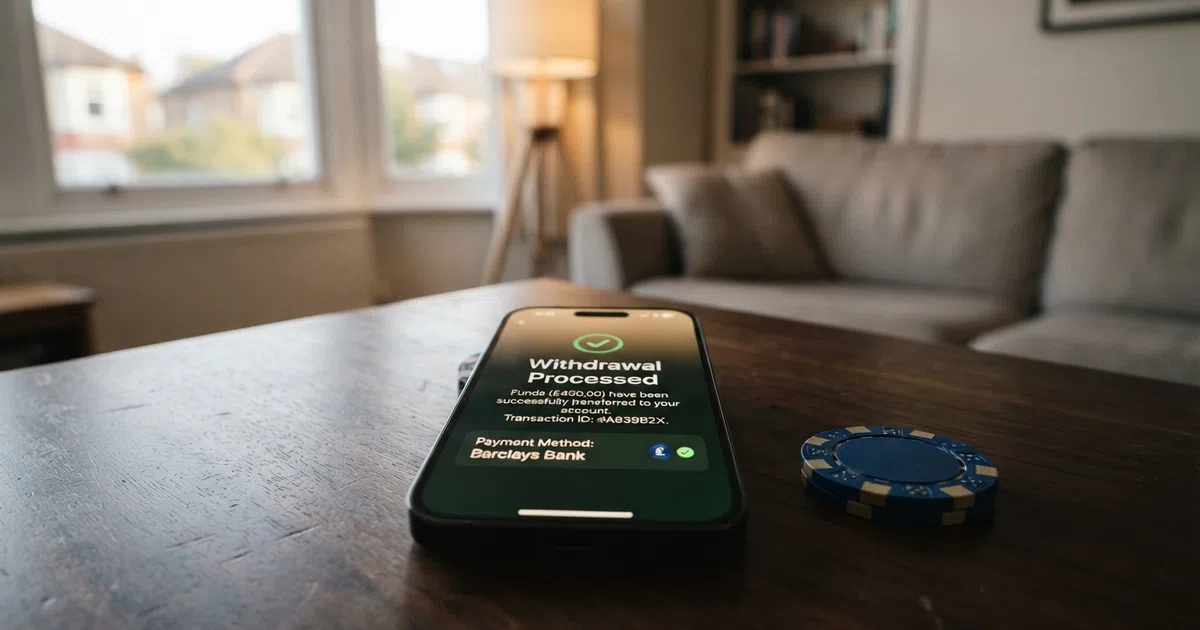
This guide ranks fifteen operators on tested payout speed, separates the UK-licensed from the Curaçao-licensed, and walks through the payment-method ladder that actually decides how long you wait. It also explains the regulatory frame that GB sites must operate inside: pre-deposit identity checks, no reverse withdrawals, a 2.5-second spin-speed cap, a credit-card ban, and from 31 October 2025, a mandatory deposit-limit prompt before the first deposit. None of that is a footnote. Each rule changes what “fast” means in practice.
The keyword behind the page — casinos not on GamStop with instant withdrawal — sits at an awkward intersection. “Not on GamStop” points offshore; “instant withdrawal” is a property a UK-licensed site can now genuinely offer, and the speed gap between the two has narrowed. The reader’s job is to decide which trade-off matters more: a Curaçao licence and a six-minute Bitcoin payout, or a UKGC licence and a same-day PayPal cashout with a real complaints route if anything goes wrong.
This page was checked against UKGC public register data and operator-level test reports current as of September 8, 2026.
Speed Tiers Explained: Fast, Instant, Quick, and Same-Day
Four labels compete in search results, and they are not interchangeable. “Fast withdrawal” is the umbrella: any operator that processes in under twenty-four hours. “Instant withdrawal” is narrower — funds reach the player within minutes of the request, which is only realistic through e-wallets (digital wallets like PayPal, Skrill, or Neteller that hold your balance outside your bank) or cryptocurrency, and only once the operator’s own pending window has passed. “Same-day withdrawal” describes funds arriving in the player’s account on the calendar day of the request, which standard bank rails and Open Banking can deliver if the request lands early. “Quick withdrawal” is the loosest term, usually a synonym for “fast.”
What every tier has in common is the UKGC ceiling underneath. Since 31 October 2021 reverse withdrawals have been permanently banned: once a player hits “withdraw,” the money leaves the player balance and the operator cannot tempt it back with a “cancel and continue playing” prompt. That removes one of the biggest historical delays and explains why GB-licensed operators are now genuinely faster than they were five years ago. The 2.5-second spin-speed cap and the auto-play ban do not directly change withdrawal time, but they restrict how fast a player can churn through a bonus — and bonus completion is itself a withdrawal gate.
The most effective way to avoid delays, as one industry source puts it, “is completing KYC (Know Your Customer — the identity verification every licensed operator must run) verification before you request your first withdrawal,” as talkSPORT Betting noted in its 2026 review. KYC is the operator’s identity-and-address check; a player who has already submitted and cleared it skips the single most common cause of a stalled cashout. The fastest tested time on this page, PayPal at ten minutes at Betfair, only happens because the request was not blocked waiting on documents.
What Slows Down a Withdrawal — and What Speeds It Up
The pipeline from “withdraw” to “money in the bank” has four moving parts, and any of them can stall the request. The operator’s own pending period is the first: most GB sites process automatically within minutes, but some hold the request for several hours for manual review, especially on first withdrawals. The payment-method rail is the second: an e-wallet that the operator pays out instantly still needs the player to move money from the e-wallet to a bank, which is a separate step the casino does not control. The receiving bank is the third: a UK high-street bank can hold an inbound Faster Payments transfer for fraud screening even after the operator has released funds. Weekends and bank holidays are the fourth: most operator processing happens on business days.
Pre-verification is the cleanest fix, as talkSPORT Betting noted in its 2026 review. Since 7 May 2019 a GB remote licensee has had to verify name, address, and date of birth before any deposit or gambling — there is no longer a 72-hour grace period during which a player could deposit, win, and then send documents. A player who arrives with their ID ready and submits it at registration moves through KYC before they ever request a withdrawal.
The closed-loop obligation matters here: GB-licensed operators must return funds to the same method used to deposit where that is technically possible, and they will refuse a withdrawal to a different card or e-wallet than the one that funded the account. That is consumer protection — it stops a stolen card from being used to launder winnings — but it means the deposit method the player chooses at sign-up quietly dictates the withdrawal method later. A player who deposits with MuchBetter will withdraw to MuchBetter. A player who deposits by debit card will not be able to withdraw to PayPal without first using PayPal to deposit at least once.
Withdrawal Limits, Fees, and Common Withdrawal Problems
Research confirms a £10 minimum withdrawal at Paddy Power as a single data point, and minimums vary across the featured set without a published industry-wide schedule. Most GB-licensed sites sit in the £5–£10 minimum band, with no maximum on routine withdrawals for verified players at major operators. The bigger numbers sit in bonus-related caps: a maximum cashout from free-spin winnings, or a maximum stake contribution during wagering. Those are bonus terms, not withdrawal terms, and they have been constrained since 19 December 2025 by a hard 10× wagering ceiling on bonuses.
Fees are rarer than readers expect. Mr Vegas runs fee-free on both deposits and withdrawals. LeoVegas charges no withdrawal fees. Betway charges none. The pattern across the major GB-licensed operators is “no fee on the main rails,” with small charges only on legacy methods like bank transfer at some brands. Offshore sites vary more widely: crypto rails are typically fee-free, but a few Curaçao operators levy a small percentage on fiat conversions.
The common problems are not exotic. An unverified account stalls the first withdrawal until KYC clears. A mismatched payment method blocks the cashout entirely until the player deposits and withdraws through the same rail. Incomplete bonus wagering is the most common gate: until the player has turned over the bonus the required number of times, the bonus balance stays locked. A weekend withdrawal request can sit in pending until Monday morning. None of these is hidden; all are preventable with a five-minute pre-registration check.
Playing Outside GamStop: The UK Protections You Keep — and the Ones You Leave Behind
GAMSTOP is the UK’s national online self-exclusion register. Since 31 March 2020, every operator holding a GB online operating licence has been required to participate. A player who registers with GAMSTOP blocks themselves from every UK-licensed online casino, bookmaker, and bingo site for a chosen period: six months, one year, five years, or five years with auto-renewal. The block is binding and cannot be cancelled early.
GAMSTOP has no authority outside the UK perimeter. It does not cover Curaçao-licensed sites, Malta-licensed sites, or any operator regulated elsewhere. As one industry source puts it, “an active GamStop block will not stop you playing” at a non-GamStop casino, as CryptoNews explained in its 2026 analysis. For a player currently self-excluded, that is the literal mechanism that makes the keyword searchable. For a player pre-emptively avoiding the register, it is the trade-off they are weighing: faster KYC-light cashouts and crypto withdrawals on the offshore side, against zero GB recourse if a payout is withheld.
What “Not on GamStop” Actually Means
“Not on GamStop” is a description of an operator’s relationship with the UK self-exclusion register, not a legal status. It covers any operator that does not hold a GB online operating licence and therefore is not bound to check the GAMSTOP database. The two main reasons UK-resident players land on these sites are straightforward: they are currently self-excluded and want to continue playing, or they are not self-excluded and want to keep their option open.
GAMSTOP is a self-exclusion tool, not a punishment. It exists because the Gambling Commission’s licensing objectives under Section 1 of the Gambling Act 2005 include protecting children and other vulnerable persons. A player who registers has made a positive choice; an operator that does not check the register has chosen not to be part of the scheme that enforces that choice. Both choices are legal at the player level. The operator’s position is different: offering gambling to GB residents without a GB licence is a criminal offence under section 33 of the Gambling Act 2005, with penalties of up to 51 weeks’ imprisonment and an unlimited fine. No penalty has been traced for a player who merely plays on an unlicensed site.
Every GB Casino Must Verify You: The UKGC Framework
Every operator featured as “GB-licensed” in this guide operates under the Gambling Act 2005 and the Gambling (Licensing and Advertising) Act 2014, and complies with the LCCP (Licence Conditions and Codes of Practice) and the RTS (Remote Technical Standards) issued by the Gambling Commission. The Commission’s three licensing objectives are preventing gambling from being a source of crime or disorder, ensuring it is conducted in a fair and open way, and protecting children and other vulnerable persons from harm.
The day-to-day implications for a withdrawal-speed page are concrete. Identity verification — name, address, date of birth — must be completed before the first deposit. Credit cards cannot be used for gambling, including credit-card-funded e-wallet top-ups. A light-touch financial vulnerability check is mandatory once a player’s net deposits reach £150 in a rolling 30-day period, using only publicly available data such as county court judgments (CCJs), individual voluntary arrangements (IVAs), and bankruptcy orders. Heavier financial risk assessments have been announced but are not yet in force; the Commission has confirmed staged thresholds but not a start date.
These rules are why a GB-licensed site cannot be “no verification.” The framework is the price of the protections it carries.
GB-Licensed vs Non-GamStop: The Real Trade-Offs
The honest trade-off, stripped of marketing from either side, is this. A UKGC-licensed casino gives the player GAMSTOP coverage, a Commission complaints route, ADR (Alternative Dispute Resolution — an independent body that mediates player-versus-operator disputes), segregated player funds, statutory stake caps on online slots (£5 for over-25s, £2 for 18–24s ), the 10× wagering cap, and a deposit-limit prompt at first deposit. A Curaçao-licensed casino gives the player faster KYC-light cashouts, crypto withdrawals in minutes, and no ID requirement at the deposit stage — and none of the above.
The enforcement gap is real. The Commission does not currently have ISP or DNS (Domain Name System) blocking powers. Its offshore enforcement runs through disruption notices to payment providers and search-engine delisting: between April 2024 and June 2025, the UKGC issued 3,140 disruption notices, referred 447,778 URLs to search engines, saw 287,961 removed, and recorded an average 32% fall in engagement across 160 disrupted sites. That is meaningful action, but it does not equal closure. A site taken off Google is still reachable directly.
The economic pressure on GB operators is also real and worth naming. Remote Gaming Duty rose from 21% to 40% from 1 April 2026, and a 1.1% statutory levy on gross gambling yield (the total amount players stake minus winnings paid out) has applied to remote casino since 6 April 2025. Those costs squeeze margin and explain why some operators are tightening bonuses and promotions — a quieter reason that withdrawal speed at GB sites has improved is that operators are competing harder on the operational metric they can control.
The Fastest-Paying Casino Sites for UK Players in 2026
The table below ranks the fifteen operators reviewed in this guide by fastest tested withdrawal time. All times are drawn from published test data and operator-stated speeds verified against the UKGC public register. The 60-second figure for MrQ is a stated guarantee, not a measured test.
| Operator | UKGC Licence | Fastest Payout Tested | Welcome Offer | Key Game Providers |
|---|---|---|---|---|
| Betfair Casino | UKGC-licensed (Flutter) | 10 min (PayPal) | — | Playtech, NetEnt, Evolution, Pragmatic Play |
| MrQ | UKGC-licensed | Under 4 min (PayPal); 60-second guarantee | 100 free spins on Big Bass Splash, 0× wagering | NetEnt, Pragmatic Play, Red Tiger, Blueprint |
| Jackbit | Curaçao (NOT UKGC) | 6–12 min (BTC) | 100 no-wager free spins on Book of Dead | — |
| Stake.com | Curaçao (NOT UKGC) | 6–12 min (BTC) | — | — |
| BC.Game | Curaçao (NOT UKGC) | 6–12 min (BTC) | — | — |
| Betway | UKGC-licensed | ~50 min (Trustly) | — | Microgaming, NetEnt, Evolution, Pragmatic Play |
| Casumo | UKGC-licensed | ~35 min (PayPal) | 50% match, 10× wagering | NetEnt, Microgaming, Play’n GO, Pragmatic Play, Evolution |
| Mr Vegas | UKGC-licensed | 5–15 min (PayPal) | 11 no-deposit spins on Big Bass Bonanza | NetEnt, Microgaming, Play’n GO, Pragmatic Play, Evolution, Red Tiger |
| Ladbrokes | UKGC-licensed (Entain) | 45 min (Skrill) | — | — |
| Paddy Power | UKGC 39439 & 39426 | Under 2 hrs (PayPal/Trustly) | — | Playtech, NetEnt, Evolution, Pragmatic Play, Red Tiger |
| LeoVegas | UKGC 39198 | 1–12 hrs (PayPal) | 50 free spins on Big Bass Splash, 0× wagering | Evolution, Playtech, Pragmatic Play, NetEnt, Microgaming, Play’n GO, Nolimit City, Big Time Gaming, Hacksaw Gaming |
| Sky Vegas | UKGC 65519 (Flutter) | 1–4 hrs (Pay by Bank) | 200 free spins, 0× wagering on winnings | Sky/Flutter proprietary, NetEnt, Pragmatic Play, Evolution |
| Grosvenor | UKGC-licensed (Rank) | Under 3.5 hrs (PayPal) | — | — |
| Unibet | UKGC-licensed (Kindred) | Same day (Trustly) | — | 37+ providers incl. NetEnt, Microgaming, Pragmatic Play, Play’n GO, Red Tiger, Big Time Gaming, Hacksaw Gaming, Nolimit City, Evolution |
| PlayOJO | UKGC 39326 (Skill on Net) | Within 24 hrs (PayPal) | 50 free spins on Big Bass Bonanza, 0× wagering | NetEnt, Microgaming, Play’n GO, Pragmatic Play, Evolution, Red Tiger |
Operators connected to GAMSTOP: all GB-licensed entries. Operators not connected: Jackbit, Stake.com, BC.Game. Welcome-offer specifics and provider rosters for Grosvenor, Ladbrokes, Betway, Paddy Power, Betfair, Unibet, Stake.com and BC.Game were not reported in the data the rankings were drawn from and are marked accordingly.
How We Tested and Compared Payout Speed
Withdrawal times were drawn from published test data: Casino.org’s Fastest Payout Casinos UK 2026, talkSPORT’s Fast Withdrawal Casinos UK 2026, and The Independent’s Fast Withdrawal Casinos 2026, cross-referenced against operator-stated speeds and player reports. Each operator’s UKGC licence status was verified against the Gambling Commission’s public register. Bonus shapes were checked in May and June 2026, and are presented as the structure of the offer rather than a live, claimable proposition — terms change, and the operator’s own site is the source of truth on the day.
This page does not measure game-catalog depth, customer-support quality, or mobile-app experience. Those are real and important, and they sit outside a withdrawal-speed page’s scope. A casino can have the fastest cashout in the country and still be the wrong choice for a slots enthusiast, a live-dealer regular, or a player who values 24/7 phone support. The ranking answers one question: how fast can a verified player move money out, through the operator’s fastest available rail, in ordinary circumstances.
Casumo
Casumo is the GB-licensed all-rounder whose Skrill and Trustly cashouts set the speed benchmark for mainstream operators. PayPal withdrawals test under two hours, with the fastest run at thirty-five minutes; Trustly clears in around fifty minutes; Skrill tests at roughly forty-five minutes. The welcome offer is a 50% match with a 10× wagering requirement, in line with the post-December 2025 cap, and the game roster spans NetEnt, Microgaming, Play’n GO, Pragmatic Play, and Evolution.
For a player who wants one GB-licensed site that covers slots, live casino, and fast e-wallet and Open Banking withdrawals without surprises, Casumo is the cleanest middle of the table. It is not the absolute fastest on any single rail — Betfair’s ten-minute PayPal and MrQ’s sub-four-minute PayPal are quicker — but it is consistent across PayPal, Skrill, and Trustly, and it carries the full UKGC framework.
PlayOJO
PlayOJO’s defining trait is zero wagering. The 50 free spins on Big Bass Bonanza require a £10 minimum deposit, are credited instantly at £0.10 per spin, and carry no wagering requirement and no cap on winnings. That structure is the single biggest reason a PlayOJO withdrawal is rarely blocked by bonus terms: there is no bonus to clear, so the only gate is KYC and the operator’s pending window.
PayPal withdrawals land within 24 hours. The operator runs under UKGC account 39326 (Skill on Net Ltd), with payment methods covering PayPal, Skrill, Neteller, Trustly, and Visa/Mastercard debit. Providers include NetEnt, Microgaming, Play’n GO, Pragmatic Play, Evolution, and Red Tiger. PlayOJO is the clean, wager-free choice for a player who wants to withdraw winnings as soon as the balance is theirs, without bonus-term gatekeeping.
MrQ
MrQ makes a specific promise: withdrawals processed within 60 seconds, with £10 compensation if the operator misses the window. The published guarantee is the boldest speed claim in the featured set, and the tested PayPal time of under four minutes puts actual performance comfortably inside the guarantee. The welcome offer is 100 free spins on Big Bass Splash, zero wagering.
The payment-method set is narrower than the larger operators — debit card, PayPal, Pay by Mobile, and bank transfer — and the game catalogue is curated rather than vast, with NetEnt, Pragmatic Play, Red Tiger, and Blueprint as the named providers. For a player who values the speed guarantee as a contractual commitment over a marketing line, MrQ is the standout.
Sky Vegas
Sky Vegas is the Flutter-owned household name whose Pay by Bank and eligible-card withdrawals clear in one to four hours. The standard card route is slower at two to five working days, which is a useful reminder that “near-instant” at Sky Vegas specifically means the Open Banking and eligible-card rails, not the plastic. The welcome offer of 200 free spins, with zero wagering on spin winnings, is among the more generous in the GB-licensed set.
The UKGC account number is 65519 (Bonne Terre Gaming Limited). Game providers include Sky and Flutter proprietary titles alongside NetEnt, Pragmatic Play, and Evolution. Sky Vegas fits a player who already banks with a Pay by Bank-supported institution and wants Open Banking speed without leaving the Flutter ecosystem.
LeoVegas
LeoVegas is the mobile-first operator whose 50 wager-free free spins on Big Bass Splash require a £10 minimum deposit and carry a one-times wager on eligible games, with each spin at £0.10 and a three-day expiry. PayPal withdrawals take one to twelve hours; Visa debit lands around six hours; Open Banking sits at two to five days. The operator charges no withdrawal fees.
The provider roster is one of the deepest in the featured set: Evolution, Playtech, Pragmatic Play, NetEnt, Microgaming, Play’n GO, Nolimit City, Big Time Gaming, and Hacksaw Gaming. LeoVegas runs under UKGC account 39198. For a mobile-first player who wants a broad provider mix and a low-friction PayPal cashout, LeoVegas is a strong default.
Mr Vegas
Mr Vegas is the Videoslots-run site that offers 11 no-deposit spins on Big Bass Bonanza as the entry point — no deposit required, opt-in only. PayPal withdrawals process in five to fifteen minutes, which is one of the fastest GB-licensed times on this page; Skrill and Neteller clear within 24 hours; cards take up to three business days. All deposits and withdrawals are fee-free.
The catalogue exceeds 3,000 titles from NetEnt, Microgaming, Play’n GO, Pragmatic Play, Evolution, and Red Tiger. Mr Vegas runs under UKGC account 39380 (Videoslots Limited). It is the right pick for a player who wants to test a site without committing a deposit, and who can use PayPal as the cashout rail.
Betway
Betway is the established sportsbook-and-casino whose Trustly withdrawals tested at fifty minutes, with PayPal within 24 hours and Skrill also available. The method coverage is one of the widest in the featured set: PayPal, Skrill, Neteller, Trustly, Apple Pay, MuchBetter, Klarna, Visa and Mastercard debit, and bank transfer. No withdrawal fees apply.
Providers include Microgaming, NetEnt, Evolution, and Pragmatic Play. Betway’s breadth makes it a strong contender for a player who wants a combined sportsbook-and-casino experience with high-speed Trustly withdrawals.
Betfair Casino
Betfair Casino is the Flutter-owned exchange brand that recorded the fastest PayPal time on this page: ten minutes. Instant withdrawals are available, and Visa debit lands same day. The payment-method set is narrower than Betway’s — PayPal, debit card, and bank transfer — but the speed on the available rails is unmatched among the GB-licensed operators.
Providers include Playtech, NetEnt, Evolution, and Pragmatic Play. Betfair’s ten-minute PayPal timing is the closest GB-licensed equivalent to the speed of a crypto cashout, making it the top pick for e-wallet users.
Paddy Power
Paddy Power operates under two UKGC licences — PPB Counterparty Services Limited 39439 and PPB Entertainment Limited 39426 — and pays out via PayPal and Trustly within two hours. The minimum withdrawal is £10, which is on the higher side of the GB-licensed set but standard for the Flutter group. Methods include debit card, PayPal, Trustly, Apple Pay, Skrill, and Neteller.
Providers include Playtech, NetEnt, Evolution, Pragmatic Play, and Red Tiger. Paddy Power is the reliable, high-street choice for a player who values the security of a large brand with sportsbook and casino on the same balance.
Unibet
Unibet is the Kindred Group operator with the largest provider roster in the featured set: 37 or more studios including NetEnt, Microgaming, Pragmatic Play, Play’n GO, Red Tiger, Big Time Gaming, Hacksaw Gaming, Nolimit City, and Evolution. Trustly and instant bank transfer land same day, often within hours; PayPal takes one to three working days; debit card takes three to five working days. No fees apply.
The slower PayPal and debit-card times are the trade-off for the deepest game catalogue. Unibet’s deep provider roster makes it the clear choice for a player who wants variety and is happy to use Trustly as the primary speed rail.
Jackbit
Jackbit is a Curaçao-licensed crypto casino, not UKGC-licensed and not integrated with GAMSTOP. Bitcoin withdrawals test at six to twelve minutes. The welcome offer is 100 no-wager free spins on Book of Dead, but the headline product is the crypto rail: deposits and withdrawals in Bitcoin, Ethereum, and USDT, with no fiat on-ramp.
The protection gap is the entire point of this page’s treatment. There is no UK ADR, no Commission complaints route, no British consumer redress if funds are withheld, and no statutory stake or wagering cap. KYC for crypto deposits is minimal or absent. Jackbit is the technical choice for a player who prioritises crypto-speed payouts and accepts the trade-off of an offshore regulatory environment.
Stake.com
Stake.com is a Curaçao-licensed crypto casino with high public profile, BTC withdrawals at six to twelve minutes, and the same offshore protection gap as Jackbit: no UKGC licence, no GAMSTOP, no UK ADR, no Commission complaints route. Welcome-offer detail is not reported in the data the rankings were drawn from.
Stake.com is the right pick for a player who values brand recognition on the crypto side and is making the same offshore trade-off explicitly.
BC.Game
BC.Game is a Curaçao-licensed crypto casino with BTC withdrawals at six to twelve minutes and the same offshore profile as the other two non-GamStop operators in this guide: no UKGC licence, no GAMSTOP integration, no UK ADR, no Commission complaints route, and minimal or no KYC for crypto deposits. Welcome-offer detail is not reported in the data the rankings were drawn from.
BC.Game is the right pick for a player comparing the three main Curaçao crypto brands on raw BTC speed, where all three currently test within the same band.
Which Payment Method Gets Your Cash Out Fastest
The ranking by operator hides the more useful ranking: by payment method. A PayPal player at Betfair and a PayPal player at Sky Vegas are in different speed tiers; a Trustly player at Casumo and a Trustly player at Paddy Power are in roughly the same one. The method the reader chooses is the single largest lever on withdrawal time, larger than the operator chosen within the same tier.

| Payment Method | Fastest Tested Time | Typical Range | Available At (featured operators) |
|---|---|---|---|
| PayPal | 10 min (Betfair) | 10 min – 24 hrs | Casumo, PlayOJO, MrQ, Sky Vegas, LeoVegas, Mr Vegas, Betway, Betfair, Paddy Power, Unibet |
| Skrill | 45 min (Casumo, Ladbrokes) | 45 min – 24 hrs | Casumo, PlayOJO, Mr Vegas, Betway, Paddy Power |
| Trustly / Open Banking | ~50 min (Casumo, Betway) | ~50 min – same day | Casumo, PlayOJO, Sky Vegas, Mr Vegas, Betway, Paddy Power, Unibet |
| Pay by Bank | 1–4 hrs (Sky Vegas) | 1–4 hrs | Sky Vegas |
| Visa Fast Funds | ~6 hrs (LeoVegas) | ~6 hrs – same day | LeoVegas, Betfair |
| Apple Pay | — | Routes to underlying card | Sky Vegas, LeoVegas, Betway, Paddy Power, Unibet |
| Visa/Mastercard debit (standard) | 2–5 working days | 2–5 working days | Sky Vegas, Unibet, Mr Vegas |
| Bank transfer | 2–5 working days | 2–5 working days | MrQ, Betway, Betfair |
| Bitcoin (offshore only) | 6–12 min | 6–12 min | Jackbit, Stake.com, BC.Game |
The Apple Pay row is filled qualitatively: research names Apple Pay as available at five GB-licensed operators, but no individually tested withdrawal time was reported, and Apple Pay withdrawals typically route to the underlying card.
E-Wallets: The Fastest Route from Casino to Bank
PayPal is the dominant e-wallet rail at every GB-licensed operator in the featured set, and the speed range is wide. Betfair’s ten-minute PayPal is the floor; Betway and PlayOJO’s within-24-hour is the ceiling. Skrill is faster at the top end: Casumo and Ladbrokes both tested at forty-five minutes. Neteller appears at PlayOJO, Mr Vegas, Betway, and Paddy Power, with a typical window of up to 24 hours. MuchBetter and MiFinity appear at Betway and in the wider GB market, but individually tested times are not in the data this guide is built on.
The structural advantage of an e-wallet is that the operator pays out to a wallet that is already in the player’s name and already verified by the wallet provider, which removes the receiving bank’s fraud-screening step from the casino’s side. The cost is that the player then has a second step: moving money from the e-wallet to a bank. The fastest total time is not the casino’s payout time; it is the casino’s payout time plus the e-wallet-to-bank transfer time, which is usually instant on Faster Payments but occasionally held.
Debit Cards, Bank Transfers, and Open Banking
The ubiquity of Visa and Mastercard costs days. Standard debit-card processing at Sky Vegas and Unibet is two to five working days; Mr Vegas cards run up to three business days. The exception is Visa Fast Funds, which LeoVegas tests at around six hours and which Betfair records as same day. Fast Funds is not universal — it depends on the issuing bank — but where it is supported, it compresses the debit-card rail from days to hours.
Open Banking is the middle ground. Pay by Bank at Sky Vegas clears in one to four hours; Trustly at Casumo and Betway tests at roughly fifty minutes; Trustly at Unibet is same day. The closed-loop return requirement — withdrawing back to the same method used to deposit — applies to debit cards and bank transfers as much as to e-wallets, and is the most common reason a “fast” rail suddenly isn’t: a player who deposited by Visa cannot withdraw to PayPal without first depositing through PayPal.
Apple Pay, Google Pay, Pay-by-Mobile, and the Rest
Apple Pay is available at Sky Vegas, LeoVegas, Betway, Paddy Power, and Unibet, but in practice Apple Pay deposits route through the underlying card and Apple Pay withdrawals follow the same path. Research does not carry a separately tested Apple Pay withdrawal time, and the realistic expectation is the same as the underlying card: hours on Fast Funds, days on standard rails.
Google Pay is named in the wider market but not reported as available at any of the fifteen featured operators with tested times. Pay by Mobile — also called pay-by-SMS or Boku — is available at MrQ and is deposit-only in practice; the operator cannot return winnings to a mobile bill, so the withdrawal routes to a verified bank account instead, which means KYC must be complete before the first withdrawal. Paysafecard and Neosurf are prepaid voucher methods that are deposit-only: a player who funds an account with a voucher must nominate a withdrawal method at cashout, and the operator will run a separate verification step on that method.
Crypto Withdrawals: Minutes, Not Days — but at What Cost?
The fastest payout on this page is a Bitcoin withdrawal at a Curaçao-licensed crypto casino: six to twelve minutes in testing across Jackbit, Stake.com, and BC.Game. The slowest GB-licensed payout is two to five working days on a standard debit card. The gap is real and measurable. The cost of closing it is everything in the previous section on the UKGC framework: the licence, the GAMSTOP integration, the ADR route, the segregated funds, the statutory stake caps, the 10× wagering ceiling, the deposit-limit prompt, the financial vulnerability check.
The technical reason crypto clears faster is straightforward. Bitcoin and Ethereum settle on a public blockchain that runs continuously, with no banking hours, no intermediary clearing house, and no receiving-bank compliance hold. The operator pushes a transaction to the network; the network confirms it in minutes; the funds arrive at the player’s wallet. A fiat rail, by contrast, passes through the operator’s bank, the player’s bank, and Faster Payments or BACS, each of which can apply its own screening. The structural speed advantage of crypto is genuine, and it is the reason crypto-only offshore casinos can credibly advertise “instant” withdrawals in a way no GB-licensed operator can match across every method.
The protection gap is equally genuine. Crypto-only offshore sites do not accept fiat, do not run full KYC for low-to-moderate withdrawals, and are not integrated with GAMSTOP. A player who has self-excluded can deposit, play, and withdraw at these sites without the GAMSTOP block ever being checked. The UKGC has linked some non-GamStop sites to criminal activity targeting self-excluded individuals. No penalty has been traced for a player who merely plays, but the loss of recourse if funds are withheld is total.
Bitcoin and Altcoin Withdrawals: How Fast They Really Are
Bitcoin is the tested rail at six to twelve minutes across the three featured offshore operators. Ethereum and USDT are named as accepted at the same sites, and blockchain settlement times are broadly comparable, though Ethereum gas fees and confirmation times vary with network load. The operator-side processing still applies: even a Curaçao casino can impose its own pending period before the blockchain transaction is signed, and a “withdrawal in minutes” claim is only as fast as the slowest of the operator’s pending window and the network’s confirmation time.
A practical note for anyone comparing the three: the BTC speed is currently the same to within testing noise. The differentiator is wallet support, altcoin breadth, and the operator’s stated or tested policies on large withdrawals. None of the three has a published schedule of KYC triggers at higher withdrawal amounts in the data this guide draws on; a player moving large sums should expect enhanced checks at some threshold, even on a “no-KYC” site.
Crypto vs Fiat: Why the Blockchain Wins on Speed — and What You Give Up
The structural reasons are settled: no banking hours, no intermediary, no compliance-driven hold at the receiving institution. The blockchain does not close at 5pm on a Friday; it does not run a fraud-screening queue on inbound Faster Payments; it does not differentiate between a £50 withdrawal and a £5,000 one on speed grounds. A player who values that speed and treats the casino as a transactional product — deposit, play, withdraw, leave — gets what they came for.
What that player gives up is the safety floor. The UKGC’s three licensing objectives under Section 1 of the Gambling Act 2005 — preventing crime, ensuring fair and open gambling, protecting the vulnerable — do not apply offshore. There is no Commission complaints route. There is no UK ADR. There is no segregated player funds regime. There is no statutory £5/£2 slot stake cap, no 10× wagering ceiling, no mandatory deposit-limit prompt, and no £150 financial vulnerability check. A self-excluded player who plays at a Curaçao site has no GAMSTOP coverage and no UK-side mechanism for help if they need it. The GamCare National Gambling Helpline at 0808 8020 133 is still free and confidential for anyone in the UK, regardless of where they play, but the operator is not part of that infrastructure.
Crypto bull markets tend to bring more players to offshore crypto casinos — the market context is a known accelerator of traffic — but they do not change the protection gap. A faster payout at a site with no ADR is not a faster payout into a system that will fight for the player if the operator does not pay.
Bonuses That Will Not Hold Your Withdrawal Hostage
A bonus is only worth claiming if the winnings can actually leave the building. The single most important rule change of the past year for withdrawal speed at GB-licensed sites is the 10× wagering cap that took effect on 19 December 2025 under LCCP Social Responsibility Code 5.1.1. Before that date, 35× and 50× wagering requirements were common, and a £10 bonus could lock a player into £350–£500 of turnover before any withdrawal cleared. The cap has flattened the worst of that landscape.
The same provision banned mixed-product promotional offers. A casino cannot now offer “bet £10 on football, get 50 free spins,” because the wagering on the sports bet and the wagering on the slots are different products and would otherwise be combined. The rule is a withdrawal-friendly change: a player can see exactly which product the bonus applies to, and clear it on that product alone.
The featured set is now dominated by wager-free or near-wager-free welcome offers. PlayOJO’s 50 free spins on Big Bass Bonanza carry zero wagering, £0.10 per spin, and no cap on winnings. MrQ’s 100 free spins on Big Bass Splash are zero-wagering. Sky Vegas’s 200 free spins are zero-wagering on spin winnings. LeoVegas’s 50 free spins on Big Bass Splash are wager-free, with a one-times wager on eligible games and a three-day expiry. Casumo’s welcome offer is the outlier: a 50% match with the full 10× wagering. Mr Vegas’s 11 no-deposit spins on Big Bass Bonanza are opt-in and require no deposit.
No-Deposit Bonuses with Fast Cashout
A no-deposit bonus sounds like the cleanest possible offer: free spins, no money in, real money out. The reality is more conditional. Identity verification is still required before any gambling or withdrawal at a GB-licensed site, so the no-deposit path is not the no-KYC path. The operator must know who the player is before any winnings are released, and the verification step is what the 10× cap and the bonus terms assume has already happened.
The withdrawal-speed implication of a no-deposit bonus is that the operator has no deposit rail to closed-loop against, which means a small minimum deposit may be required to register a verified payment method before winnings can be released. Mr Vegas’s 11 no-deposit spins on Big Bass Bonanza are an example of the structure: opt in, play, win — and then a deposit-and-verification step to set up the withdrawal rail. Research does not carry a per-operator no-deposit withdrawal rule, so the practical mechanics vary; a player who plans to claim a no-deposit offer should expect to make a small deposit at the withdrawal stage even though the bonus itself required none.
Wagering Requirements: The Hidden Brake on Your Withdrawal
Wagering is the rule that says a player must turn over a bonus amount a set number of times before any winnings become withdrawable. A £10 bonus at 10× wagering means £100 in total stakes before the bonus balance is released. The pre-December 2025 landscape was much harsher: 35× on a £10 bonus meant £350 of turnover, which on a £0.10 spin at a 2.5-second cycle is roughly 1 minute of continuous play to clear, and that is before any RTP (Return to Player — the long-run percentage of stakes a game pays back to players) haircut on the wagering contribution.
The interaction with the slot stake cap matters. A player aged 25 or over is staking at most £5 per spin; a player aged 18–24 is staking at most £2. At the £2 stake, the £100 wagering requirement from a 10× bonus on a £10 deposit would be 50 spins at the maximum stake, which at 2.5 seconds per spin is just over two minutes. At the £0.10 spin level that most free-spin offers use, the same £100 turnover is 1,000 spins, or roughly 1 minute of continuous play. The actual clearing time depends on the spin value, the stake size, and the game weighting — and the wagering-cap change has made the realistic worst case much shorter than it was a year ago.
The 2.5-second spin-speed cap does not change withdrawal speed directly, but it does set the maximum churn rate during bonus clearing. A player cannot spin faster than one cycle every 2.5 seconds, which means a 10× bonus is bounded in how quickly it can be turned over even on auto-play — and auto-play is itself banned, so the player must initiate each spin. The UKGC’s slot rules are consumer protections that slow bonus abuse, and as a side effect they make bonus clearing a longer, more deliberate process.
Not Every Game Sends Your Winnings at the Same Speed
The game a player chooses changes the path to withdrawal, even at the same operator. Slots clear fastest because they are the highest-volume product at every featured operator, the most automated, and the most heavily weighted toward wagering contribution. Live casino and table games are slower because result settlement is not always instant — a dealer must complete the hand, the shoe must finish, or the wheel must stop — and because game weighting at most operators counts table bets at less than 100% toward wagering requirements.
The UKGC’s slot-specific rules do not change withdrawal speed, but they shape the play experience underneath it. The £5/£2 age-banded stake cap sets a ceiling on each spin. The 2.5-second spin-speed cap sets a floor on time per spin. Auto-play is banned, so the player must initiate each spin. Reverse withdrawals are banned, so the moment a player hits “withdraw” the money is gone from the player balance. The session display — total losses, total wins, time played — is mandatory and persistent, which is the regulatory response to the harm pattern of “I didn’t realise how long I’d been playing.”
The 10× wagering cap applies across games, but game weighting varies by operator, and research does not carry a per-operator weighting table. A player who is clearing a bonus on live casino rather than slots should expect a longer path to a withdrawable balance, even with the same headline bonus.
Online Slots and Fast Withdrawals
Online slots are the highest-volume game at every featured operator and the most heavily weighted toward wagering contribution, which is why they dominate the fast-withdrawal conversation. A player who plays slots, completes KYC, and claims a wager-free or low-wagering bonus is in the shortest path to a cashout. The slot-specific UKGC rules are consumer protections that do not slow the payout: they shape the play, not the withdrawal.
The slot stake cap of £5 for over-25s and £2 for 18–24s is a meaningful constraint on high-stakes play but not on withdrawal speed. The provider mix across the featured set — NetEnt, Microgaming, Play’n GO, Pragmatic Play, Evolution, Red Tiger, Nolimit City, Big Time Gaming, Hacksaw Gaming, Blueprint, and the proprietary Sky/Flutter titles at Sky Vegas — is a useful proxy for game-library depth. A player who wants 3,000+ titles has Mr Vegas and Unibet; a player who wants a curated catalogue of major-provider hits has Casumo, LeoVegas, or MrQ.
Live Casino, Table Games, and Game Weighting
Live casino is the slower-settlement product. A hand of blackjack must complete; a spin of roulette must stop; a game-show round must finish. The result is not always instant after the player hits “withdraw” because the operator’s system may wait for the current round to settle before processing the cashout. In practice, this is a minor delay — minutes, not hours — but it is real.
Game weighting is the bigger factor. At most operators, slots contribute 100% of stake value to wagering requirements; table games often contribute 50% or less; some live games contribute 0%. A player clearing a bonus on live casino may need to stake twice as much to clear the same requirement, and the effective path to a withdrawable balance is correspondingly longer. The mixed-product bonus ban means a bonus claimed on slots must be cleared on slots, which removes the cross-game weighting game that used to be common. Research does not carry a per-operator weighting table, so a player who intends to clear a bonus on table games should check the specific operator’s contribution schedule before claiming.
Evolution is the dominant live-casino provider across the featured GB-licensed set, appearing at Casumo, Unibet, and LeoVegas among others. Pragmatic Play Live is the secondary major provider. The live-casino experience at a major GB-licensed operator is broadly comparable; the differentiator is studio breadth, table limits, and game-show content rather than core live-dealer quality.
New Casinos and Fast Withdrawals: Newer Does Not Mean Faster
A newer brand is not automatically a faster brand. A UKGC licence issued last month binds the operator to exactly the same rule set as a licence issued ten years ago: pre-deposit identity verification, the 10× wagering cap, the deposit-limit prompt at first deposit, the credit-card ban, the slot stake cap, the spin-speed cap, the auto-play ban, the reverse-withdrawal ban, the financial vulnerability check at £150 net deposit. None of those rules grandfather new entrants; all of them apply from the day the licence is granted.
This means a new casino’s “instant withdrawal” marketing claim must be read against the same rails as an established operator’s. A new GB-licensed brand offering PayPal cashouts is in the same speed band as Casumo or Betfair on PayPal; a new brand offering Trustly is in the same band as Betway or Unibet on Trustly. The novelty is in the bonus structure, the game catalogue, and the brand presentation — not in the underlying speed of the payment rails.
Instant-Payout Promises at New Brands: Read the Fine Print
“Instant payout” at a new brand is almost always a payment-method claim, not a processing-time claim. The fastest the operator can pay out is bounded by the rail the player has chosen: e-wallets and Open Banking at minutes to hours, debit cards at hours to days, bank transfers at days. A new brand offering “instant withdrawals” is, in practice, offering e-wallet and Open Banking rails — which is what every other GB-licensed operator is offering, with tested times already on the public record.
Research does not carry individually tested withdrawal times for new-brand operators not in the featured set, so the practical guidance is to read the payment-method list before believing the headline. A brand that names PayPal, Skrill, and Trustly in its withdrawal page is making a credible claim. A brand that names only “instant” without specifying the method is not.
The Pre-Join Checklist for a Fresh Operator
Three checks before registering anywhere new. First, the UKGC public register: find the licence number on the operator’s footer and confirm it resolves. Second, the payment method: confirm that the method the player plans to use — for both deposit and withdrawal — is actually listed on the operator’s banking page. Third, the withdrawal terms: minimum withdrawal, any fees, the operator’s stated pending period, and the bonus terms if a welcome offer is being claimed. The minimum withdrawal varies by operator; £10 is one example at Paddy Power, not a universal floor.
These three checks take five minutes and eliminate the commonest causes of a slow first withdrawal.
Staying in Control When Fast Payouts Are the Goal
The same regulatory framework that makes GB-licensed casinos require your ID also makes them require the operator to offer harm-reduction tools at every stage. The October 2025 deposit-limit prompt is the most visible change: every GB-licensed operator must now offer the player a chance to set a financial limit before the first deposit, and the limit must be reviewable and adjustable at any point. The prompt is not optional and not skippable; the operator cannot deposit the player without presenting it.
The 2.5-second spin-speed cap, the auto-play ban, the reverse-withdrawal ban, the session loss/win and time display, and the financial vulnerability check at £150 net deposit are all part of the same structure. None of them is a withdrawal-speed obstacle; all of them are consumer protections that shape how the player interacts with the site. The reverse-withdrawal ban in particular is a withdrawal-speed accelerator: it removes the “cancel and continue” prompt that historically delayed payouts by hours or days.
The prevalence data is useful context. The 2025 Gambling Survey for Great Britain annual report recorded a 2.4% problem gambling rate (PGSI 8+, the highest-risk band on the Problem Gambling Severity Index) among adults, stable against 2.5% in 2023 and 2.7% in 2024. A further 3.5% were moderate risk, 7.8% low risk. Overall gambling participation was 47% in the September 2025 to January 2026 wave. The problem-gambling rate is not rising; the population of players is large and the high-risk band is a small, persistent share of it.
Deposit Limits, Reality Checks, and the Tools Every Player Has
The deposit-limit prompt is the most important consumer tool introduced in the past year. From 31 October 2025, every GB-licensed operator must offer the player the chance to set a financial limit before their first deposit. The limit must be a “gross deposit limit” with at least equal prominence to other financial limits; only that form may be called a “deposit limit.” The player can review and change the limit at any time after the first deposit.
Reality checks are pop-up timers that show session duration and net position. They have been mandatory for online slots since 31 October 2021 alongside the loss/win and time display. Time-outs and operator-level self-exclusion are shorter-term alternatives to GAMSTOP: a player can lock themselves out of a single operator for 24 hours, seven days, or any period the operator offers, without registering centrally.
The financial vulnerability check at £150 net deposit in a rolling 30-day period uses only publicly available data — CCJs, IVAs, bankruptcy orders — and is light-touch. It is not a credit check. Heavier financial risk assessments have been announced but are not yet in force; the UKGC has confirmed staged thresholds but not a start date, and a page written now should not describe them as live.
Where to Get Help: GamCare, the Helpline, and Self-Exclusion
The single most useful number on this page is the National Gambling Helpline: 0808 8020 133. It is run by GamCare, free, confidential, and available 24/7 by call, online chat, and WhatsApp. The line is for anyone in the UK affected by gambling, including family and friends.
The treatment-referral data is a signal worth reading carefully. GamCare made 996 referrals to treatment and peer-based support services in January 2026, up from 674 in January 2025 — a 48% increase year-on-year. That number is not a measure of how many more people are in crisis; it is a measure of how many more people in difficulty are reaching the help that exists. The direction of travel is the right one.
GAMSTOP is the self-exclusion route for online gambling. Registration is online and free. The exclusion covers every GB-licensed online operator — casino, bookmaker, bingo — and the player chooses the period: six months, one year, five years, or five years with auto-renewal. The exclusion cannot be cancelled early. It does not cover offshore sites, which is the structural reason a player who is self-excluding needs the helpline and the wider support network alongside the registration, not as a substitute for it.
The wider support infrastructure includes the National Gambling Support Network (commissioned by GambleAware), NHS gambling harm clinics in England, Scotland and Wales, Gamblers Anonymous UK, and GamCare’s own self-exclusion guidance. A player who wants to step back from offshore sites as well as GB-licensed ones needs more than GAMSTOP; the helpline is the place to start that conversation.
How We Chose and Ranked the Casinos in This Guide
The ranking is built on three data sources and one verification layer. Withdrawal times were drawn from published test data: Casino.org’s Fastest Payout Casinos UK 2026, talkSPORT’s Fast Withdrawal Casinos UK 2026, and The Independent’s Fast Withdrawal Casinos 2026. Operator-stated speeds and welcome-offer shapes were cross-referenced against the operators’ own sites. GamStop integration status and UKGC licence status were verified against the Gambling Commission’s public register of licensees. Bonus shapes were checked in May and June 2026 and are presented as the structure of the offer rather than a live, claimable proposition; terms change, and the operator’s own site is the source of truth on the day.
The criteria that ordered the ranking, in this order, were: tested withdrawal speed (fastest method per operator), UKGC licence status, wagering requirements on the welcome offer, and payment-method breadth as a speed proxy. No invented weighting or percentage score was applied. The operator set covers ten GB-licensed operators — all of them connected to GAMSTOP — plus three offshore, Curaçao-licensed operators that UK players access because the keyword explicitly targets casinos outside the GamStop framework. The offshore operators are included for completeness and clearly labelled; they are not recommended over the GB-licensed alternatives.
What this guide does not measure: game-catalog depth beyond the named provider roster, customer-support quality, mobile-app experience, VIP programme value, or long-term RTP performance. Those are real and important and they sit outside a withdrawal-speed page’s scope. A casino that pays out in ten minutes but has a thin slot library is the right pick for a different reader than one that pays out in four hours but stocks 5,000 games; this guide does not adjudicate between them.
Your Next Move: Fast Withdrawals Are Real — but the Safest Ones Stay Inside the Rules
Three things the figures on this page support. The fastest GB-licensed operators now process withdrawals in minutes to a few hours: Betfair at ten minutes on PayPal, MrQ at under four minutes on PayPal with a sixty-second guarantee, Mr Vegas at five to fifteen minutes on PayPal, Casumo at thirty-five minutes on PayPal and forty-five on Skrill. The speed gap with offshore crypto sites has narrowed to a difference of degree. A player who chooses the right payment rail at a GB-licensed operator can realistically see funds same day.
The payment method the reader chooses is the single largest lever on withdrawal speed. A PayPal or Trustly user at a GB-licensed site is in a different speed universe from a debit-card-only player at the same site, and the operator’s headline speed is only as good as the rail the player actually uses. The closed-loop rule means the deposit method chosen at sign-up quietly dictates the withdrawal method later.
The protections a UKGC licence carries are not abstractions. GAMSTOP, the Commission complaints route, ADR, segregated player funds, the £5/£2 slot stake cap, the 10× wagering ceiling, the deposit-limit prompt at first deposit, the financial vulnerability check at £150 net deposit — each is an enforceable condition a Curaçao licence does not replicate. Their absence is the real cost of a six-minute Bitcoin cashout. The National Gambling Helpline at 0808 8020 133 is free and confidential and available 24 hours a day, and it is the one number worth keeping regardless of which side of the GamStop line a player is on.
Before depositing anywhere, check the operator’s licence on the UKGC public register, check the payment method against the speed table in the payments section, and set a deposit limit at the prompt every GB operator now presents. The prompt is a consumer tool, not a restriction, and it is the cheapest five seconds on the page.
Frequently Asked Questions
Do UK-licensed casinos charge withdrawal fees?
Most major GB-licensed operators are fee-free on the main rails. Research confirms no withdrawal fees at Mr Vegas, LeoVegas, and Betway, and a £10 minimum withdrawal at Paddy Power. Fees are rare at the major brands and tend to appear only on legacy methods like bank transfer at some operators. Offshore sites vary more widely, with crypto rails typically fee-free and fiat conversions sometimes carrying a small percentage charge.
Are casinos not on GamStop legal for UK players?
Playing on a non-GamStop site is not a player offence. Offering gambling to GB residents without a GB licence is a criminal offence under section 33 of the Gambling Act 2005, with penalties of up to 51 weeks’ imprisonment and an unlimited fine. No player penalty has been traced. The cost of playing offshore is the loss of UK consumer protections: no GAMSTOP coverage, no Commission complaints route, no ADR, and no British redress if funds are withheld. The UKGC enforces offshore sites through disruption notices and search-engine delisting rather than ISP blocking.
Can I withdraw from a casino without sending ID?
At a GB-licensed site, no. Since 7 May 2019, identity verification — name, address, date of birth — must be completed before any deposit or gambling. The pre-2019 72-hour grace period is gone. At a Curaçao-licensed crypto casino, KYC for low-to-moderate crypto withdrawals is minimal or absent, which is the structural reason those sites can offer faster cashouts. The trade-off is the protection gap: no UK ADR, no Commission complaints route, no British recourse.
How long does a PayPal withdrawal actually take?
Across the featured GB-licensed set, the fastest tested PayPal time is ten minutes at Betfair and under four minutes at MrQ. The typical range runs from minutes to twenty-four hours depending on the operator and the player’s verification status. Mr Vegas tests at five to fifteen minutes; Casumo at under two hours with a fastest run of thirty-five minutes; LeoVegas at one to twelve hours; PlayOJO and Betway within twenty-four hours.
Are crypto casinos with instant withdrawal available to UK players?
Crypto-only offshore casinos including Jackbit, Stake.com, and BC.Game are accessible from the UK and process BTC withdrawals in six to twelve minutes in testing. They are Curaçao-licensed, not UKGC-licensed, and not integrated with GAMSTOP. They do not accept fiat, do not run full KYC for crypto deposits, and offer no UK ADR or Commission complaints route. A player who chooses this route is accepting the offshore protection gap in exchange for the speed.
The Newest UK Operators: Do Their Payout Claims Hold Up?
The first check on any new UK-facing brand is the UKGC public register. A licence number on the operator’s footer should resolve to a real account on the Commission’s licensee list, and the licence should be in an active status. A brand that cannot be found on the register is not operating under a GB licence, and the rest of the speed discussion does not apply.
A new GB-licensed operator is bound by the December 2025 wagering cap and the October 2025 deposit-limit rule from the day the licence is issued. A new brand offering 50× wagering on a welcome bonus is either not GB-licensed or in breach. A new brand not prompting a deposit limit at first deposit is in the same position. The compliance floor is the same for everyone; the differentiation has to come from somewhere other than regulatory arbitrage.
Limits – fastestpayout-casinos-uk
Content created by the «fastestpayout-casinos-uk» team