
Highest-RTP Slots in the UK: A Real Reading of What Your Money Buys
 Available in GB
A return-to-player figure is a long-run average stitched across millions of spins, not a receipt for the next hour. The slot you sit down at will pay back something — sometimes more, often less — but the percentage stamped in the information pane describes the cumulative behaviour of the game, not your evening. That is the first thing to absorb, because every other comparison on this page leans on it: the gap between Ugga Bugga’s 99.07% and a budget Megaways at 94%, the difference a £2 stake cap makes to a 1,000-spin session, the reason a low-volatility 96% title can feel steadier than a 99% high-volatility one even though the maths says the latter returns more.

This page ranks the highest-RTP slot titles UK players can find at licensed casinos in 2026, then places them in context: where the figure is verified, what volatility does to the way it feels, how the £2 and £5 stake caps bound a real-money session, and which UKGC-licensed casinos are running welcome offers that let you try the high-RTP end of the catalogue with a small initial stake. The data is current as of September 8, 2026 and the licence claims have been checked against the Gambling Commission’s public register.
RTP is a long-run average, not what your session returns
The “best RTP” in any search result is doing a quieter job than its top-of-page placement suggests. It describes a slot’s behaviour across millions of game cycles, the kind of population size a single player will never reach. A 96% RTP means that, over the full set of spins the game will ever run, 96 pence in winnings comes back for every £1 wagered. Your next fifty spins are not that population. They are a sample of fifty, and a sample of fifty can sit almost anywhere inside the long-run band without contradicting a single decimal of the published number.
That distinction is the spine of everything that follows. The UK market’s real RTP range runs from roughly 92% at the low tier to 98% on a handful of titles, with the typical band sitting between 95% and 96.8%. The number at the top of that band — Ugga Bugga at 99.07% — is genuinely unusual, and the page’s lead ranking exists precisely because a one-percentage-point spread compounds across thousands of spins. A session of a thousand spins at 96% returns 96 pence per pound on average; the same session at 99% returns 99 pence. The difference is three pence per pound, which is small per spin and substantial over an evening. It is also still, in both cases, a return that leaves a house edge.
How a slot’s RTP number is actually built
Return-to-player is the long-run percentage of total stakes a slot pays back to players, measured across millions of spins, not a single session. The remainder — the percentage that does not come back — is the house edge. At 96% RTP, the house edge is 4%. At 99.07%, it is 0.93%. Both numbers describe the same relationship from opposite ends: every pound wagered is split, in the long run, between what the game returns and what the operator keeps.
The figure is built from the game’s paytable and reel configuration. Each symbol on each reel has a defined payout, and the combination of paylines, reel weights and feature frequencies produces a long-run payout percentage. Independent testing laboratories simulate millions of spins against that configuration to verify the number, and only after that certification is the slot cleared for deployment on a UK-licensed operator. The figure you see in the in-game information pane is the laboratory’s verified result, not a marketing estimate.
What counts as a good RTP — and where the UK market really sits
Calibration matters. “Good” only carries weight against the market you’re actually playing in. The UK-licensed slot market spans roughly 92% at the low end to 98% on a small number of titles, with the typical band between 95% and 96.8%. Most slots a player will encounter sit inside that typical band. A title at 97% or above is genuinely high; one at 98% or above is rare enough that the market is willing to name it.
A single percentage point looks small in isolation and compounds across a session. At 95% versus 97% RTP, the difference is two pence per pound wagered — over a session of 500 spins at £1 per spin, that is a £10 swing in expected return before any other variable changes. The gap is the reason a player who plans to spend time on a single title is well served by checking the figure first.
RTP and volatility are two different promises
RTP measures the total amount returned over time; volatility measures the shape of that return. A low-volatility high-RTP title — Ugga Bugga at 99.07% or 1429 Uncharted Seas at 98.6% — returns its percentage through frequent, smaller wins. A high-volatility high-RTP title — Book of 99 at 99% or White Rabbit Megaways at 97.24% — returns the same long-run percentage through rare, larger wins and longer dry stretches in between.
The pairing matters for bankroll. A low-volatility 99% title will keep a small balance alive for a long time and rarely produce a session-defining payout. A high-volatility 99% title will drain a small balance quickly if the features do not land, then potentially return more in a single bonus round than a hundred spins of the low-volatility variant. Neither is “better” in the abstract; they are different products serving different player profiles. Blood Suckers at 98% low volatility and Blood Suckers Megaways at 97.66% high volatility illustrate the trade-off on the same theme.
The top-paying slot titles UK players can find in 2026, ranked
| Slot title | Provider | RTP % | Volatility | Max win |
|---|---|---|---|---|
| Ugga Bugga | Playtech | 99.07% | Low | 1,000x |
| Book of 99 | Relax Gaming | 99% | High | 10,000x |
| Mega Joker (Super Meter) | NetEnt | 99% (Super Meter only) | — | — |
| 1429 Uncharted Seas | Thunderkick | 98.6% | Low | 670x |
| Marching Legions | Relax Gaming | 98.12% | — | — |
| Blood Suckers | NetEnt | 98% | Low | 900x |
| Money Cart | Relax Gaming | 98% | — | — |
| Money Cart 2 | Relax Gaming | 98% | — | — |
| Madame Mystique Megaways | Pragmatic Play | 98.01–98.03% | High | — |
| Blood Suckers Megaways | Red Tiger | 97.66% | High | 20,521.9x |
| White Rabbit Megaways | Big Time Gaming | 97.24% (reported up to 97.72–98.03%) | Very high | 13,000x |
| Eye of Horus Megaways Jackpot King | Blueprint Gaming | 91.5–94.5% (base, plus separate jackpot contribution) | — | — |
Ugga Bugga tops the widely available UK list at 99.07%. Book of 99 hits 99% with high volatility and a 10,000x max win. Mega Joker reaches 99% only in Super Meter mode, with the base game sitting at approximately 76.9% — a reminder that the figure in the information pane describes the mode you are in, not the slot’s best possible return. The 98% band holds 1429 Uncharted Seas at 98.6%, Marching Legions at 98.12%, Blood Suckers at 98% and the Money Cart pair, both at 98%. The Megaways and enhanced-RTP family is represented by White Rabbit Megaways at 97.24%, Blood Suckers Megaways at 97.66% and Madame Mystique Megaways at 98.01–98.03%. Eye of Horus Megaways Jackpot King rounds the table as a progressive, with a base RTP of 91.5–94.5% plus a separate jackpot contribution.
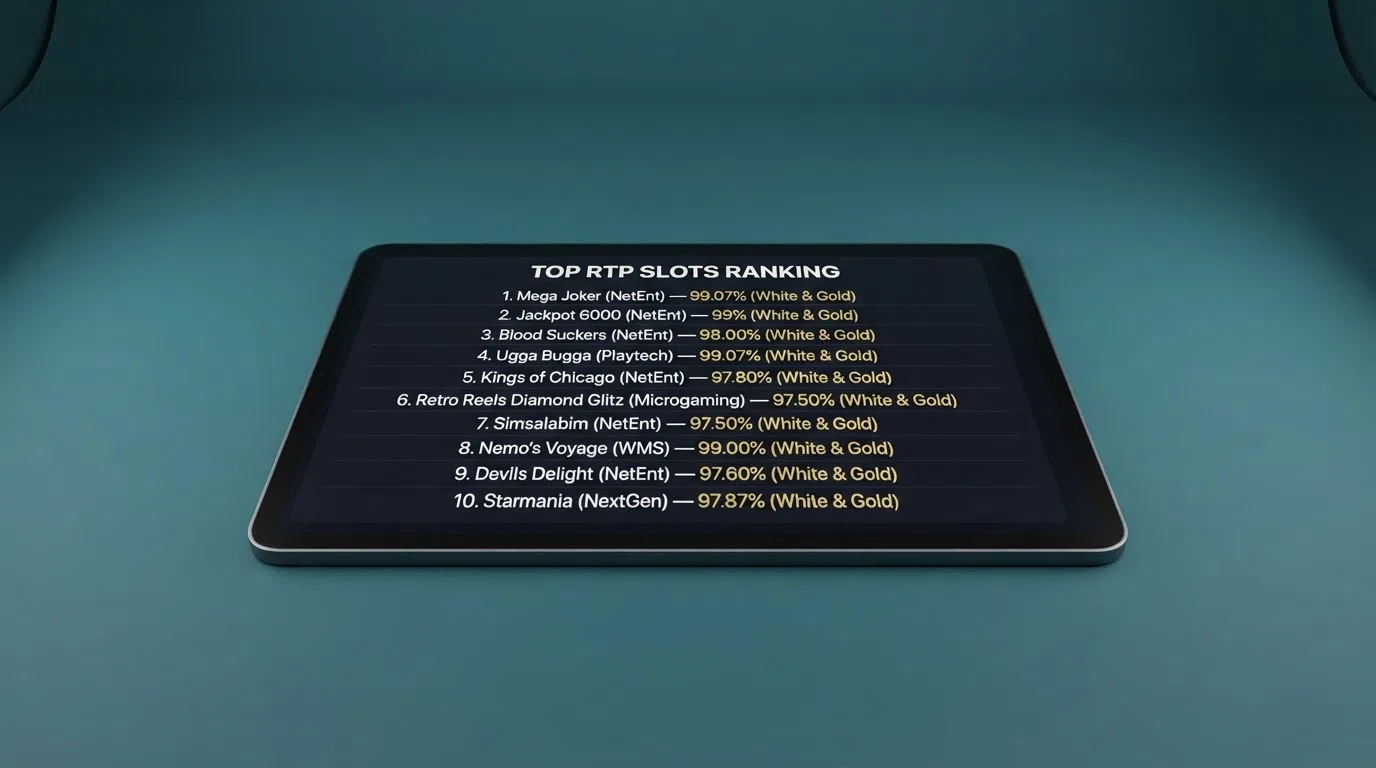
A reader comparing the rows will notice the gap between the 99% cluster and the 97% cluster narrows once volatility enters the picture. The trade-off in the section above is what the table is showing in numbers.
Online vs land-based RTP — and why denomination matters
A UK-licensed online slot must publish its RTP in the in-game information pane; the rule applies to every slot the Gambling Commission licenses for the GB market. The land-based environment is differently regulated. The same provider’s title can carry different configured RTP percentages depending on denomination, and the published figure on a physical machine is typically less visible than its online equivalent. The point of the disclosure rule is that a player can find the number before committing a stake; the online surface enforces that by design.
What real-money play changes about RTP
Demo mode and real-money play run the same random number generator and the same configured RTP. The difference is that demo mode pays nothing out. The return-to-player figure is the same number, the volatility profile is the same, and the symbol distribution is the same — but a 96% return in demo play is a return of zero in real terms. Real-money play is where the return is actually paid.
The scale of the UK online slot market sharpens that point. In the reporting period to December 2025, online slots generated £788 million in gross gambling yield, up 10% year-on-year, across 25.7 billion spins and an average of 4.6 million active accounts per month. Each of those spins is a real-money cycle, and each one is bounded by the £5 stake cap for players aged 25 and over and the £2 cap for players aged 18 to 24. The cap and the population are the parameters the long-run RTP runs inside; the figure is a percentage, but the experience of it is a session.
Finding the real RTP before you risk a spin
The figure is published. The task is to look at it, and to know what to do with the number once it is on screen. A few habits separate a player who uses RTP as a selection filter from one who treats it as a marketing claim.
Where the RTP figure lives on a slot’s game screen
The percentage sits in the in-game information or paytable pane of every UK-licensed slot, and the rule that puts it there is enforced by the Gambling Commission. The pane is usually reached through an “i” or a question mark on the game interface, and the RTP sits alongside the volatility class, the paytable and the game’s feature description. It is the authoritative figure, not the promotional copy that surrounds the slot in the operator’s lobby.
Make checking the RTP a habit before you commit money
A pre-spin routine is cheaper than a post-spin regret. Open the information pane, note the RTP, note the volatility, and check whether the figure changes by mode. Mega Joker is the clearest example: it reaches 99% in Super Meter mode but sits at approximately 76.9% in the base game, and a player who assumes the headline figure applies across both modes has misread the slot. The information pane is the document that resolves which version of the game is in front of you.
Telling a genuinely high-RTP slot from the marketing
The typical UK market band is 95% to 96.8%, which means “high” starts meaningfully above that range. Anything advertised as “high RTP” should be checked against the figure in the information pane, because the marketing language is unregulated in the way the disclosure rule is not. The cross-reference is the ranked list above: the titles that actually hit 98% and above are a small set, and a slot claiming to be “high-RTP” while sitting at 95.5% is using the phrase in its looser sense.
Filtering the catalogue for the better-paying picks
The information pane is the authoritative source for the figure, and the testing-lab certification that sits behind it is the reason the figure can be trusted at all. Independent laboratories — eCOGRA and iTech Labs among them — certify RTP through simulated rounds, and that certification is a precondition for a slot’s deployment on a UK-licensed operator. The ranked list above and the mechanic section that follows are the shortlist; the information pane is the verification step a player applies to any title the catalogue surfaces that the list does not.
The mechanic decides the return: Megaways, progressives and enhanced remakes
RTP is not a single number assigned to a theme; it is a property of the underlying game mechanic. Different families return different percentages, and the spread is wide enough to matter.
Megaways: more ways to win, RTP still in the high-90s
The Megaways engine produces a variable number of symbols per reel on every spin, which changes the hit structure and, with it, the long-run payout. White Rabbit Megaways sits at 97.24% with very high volatility and a 13,000x max win. Blood Suckers Megaways lifts the original Blood Suckers concept into the engine and lands at 97.66% with high volatility and a 20,521.9x max win. Madame Mystique Megaways, the enhanced-RTP remake of Madame Destiny Megaways, reaches 98.01–98.03% with high volatility. The full rows for these titles sit in the ranked table above.
Progressive jackpots eat into the base-game RTP
A progressive jackpot takes a slice of every wager to fund the pool, and that slice comes out of the base-game return. Eye of Horus Megaways Jackpot King carries a base RTP of 91.5% to 94.5% plus a separate jackpot contribution. The non-jackpot variant of the same family returns a higher base percentage; the progressive pays for its prize pool by trimming what the base game returns. A player who wants the prize is paying for it in expected return on the rest of the spin.
Enhanced-RTP variants: the remakes that pay back more
Enhanced-RTP variants exist because a provider has reconfigured a popular title to return a higher percentage, usually at the cost of a different feature balance. Madame Mystique Megaways, the enhanced remake of Madame Destiny Megaways, lands at 98.01–98.03% with high volatility — a meaningful lift over the original. The point of the variant is the higher return on the same concept; a player who finds the theme appealing and wants the better long-run figure has the enhanced version as the option.
Video slots: where the standard return sits
The mainstream video-slot band sits in the typical 95% to 96.8% range, with high outliers in the 98% and above cluster. 1429 Uncharted Seas at 98.6% and Blood Suckers at 98% are both low volatility, which means the higher return is delivered through frequent smaller wins rather than rare large ones. The video-slot family is where most of a player’s time is spent, and the high end of the family overlaps with the lower-volatility rows of the ranked table.
Where to play high-RTP slots: 10 GB-licensed casinos compared
All ten operators below hold an active Gambling Commission licence, and the licence status of each was checked against the UKGC public register. The offer split runs between wager-free spins packages, deposit-gated packages with 10× wagering, and one deposit match (888 Casino). The 10× wagering cap on bonus funds has been in force since 19 December 2025, and no offer in this list exceeds it.

| Casino | UKGC licence | Welcome offer | Free spins | Wagering | Bonus validity |
|---|---|---|---|---|---|
| Bet365 | Active on the UKGC public register | Up to 500 free spins after £10 lifetime deposits | 500 (revealed in increments) | 0× | 30 days to claim |
| Sky Vegas | Active on the UKGC public register | 50 no-deposit spins + 200 spins on £10 deposit and spend | 250 total | 0× | 7 days |
| William Hill | Active on the UKGC public register | 200 spins on Big Bass Splash after £10 deposit and stake | 200 | 10× | 72 hours |
| Ladbrokes | Active on the UKGC public register | 100 spins + 300 Ladbucks on £10 bet | 100 | 0× | 7 days |
| Coral | Active on the UKGC public register | 100 spins on £10 bet and stake | 100 | 10× | 48 hours to accept; 7 days validity |
| Betfred | Active on the UKGC public register | 200 spins on £10 stake (debit card required) | 200 | 0× | 48 hours to claim; 7 days validity |
| 888 Casino | Active on the UKGC public register | 100% up to £100 | None in main offer | 10× | 90 days |
| Paddy Power | Active on the UKGC public register | 60 no-deposit spins + up to 200 deposit-related spins | Up to 260 | 0× | 7 days |
| 32Red | Active on the UKGC public register | 320 spins on Big Bass Splash after £30 deposit and stake | 320 | 10× | 7 days to claim; 48-hour expiry |
| Virgin Games | Active on the UKGC public register | 100 spins on Game of Thrones (1p coin, 10 lines) or bingo or live cashback on £10 deposit and wager | 100 (or alternative) | 0× | 30 days |
The two structural splits the table shows are the wagering split (0× versus 10×) and the deposit split (deposit-gated versus no-deposit entry on Sky Vegas and Paddy Power). The 10× cap, set by the Gambling Commission, applies to the William Hill, Coral, 888 Casino and 32Red offers; the other six are wager-free on the welcome package. Validity windows run from 48 hours (Coral, Betfred) to 90 days (888 Casino), and a player who plans to clear spins at a relaxed pace will find the 30-day or 90-day offers the easier fit.
Bet365 — 500 spins, winnings paid straight as cash
Bet365 holds an active UKGC licence and runs the largest free-spins package in this list: up to 500 free spins at 10p each, with 0× wagering so winnings are paid as cash. The package is revealed in increments of 5, 10, 20 or 50 spins across ten selections within twenty days of registration, and the offer requires a minimum of £10 in lifetime deposits before spins are credited. Provider coverage runs through Playtech, NetEnt, Red Tiger, Big Time Gaming and Relax, with 1,500+ slots in the catalogue. The breadth of the provider list is the practical reason the high-RTP titles in the ranked table are mostly available here.
Sky Vegas — 50 spins before you deposit anything
Sky Vegas is one of two operators in this list that runs a genuinely deposit-free entry: 50 no-deposit spins, then 200 more spins after a £10 deposit and spend. The full package carries 0× wagering and a 7-day validity from credit. The deposit-free element is the differentiator — a player can try the catalogue without committing a stake first, and the no-deposit winnings are paid as cash.
William Hill — 200 spins after a £10 deposit and stake
William Hill’s welcome package is 200 free spins on Big Bass Splash at 10p each, unlocked by a £10 deposit and stake. Wagering sits at 10× on the free-spin winnings, with a 72-hour validity from credit and an offer end date of 31 December 2026. The 10× cap is the maximum permitted under the current UKGC rule, and Big Bass Splash is the named slot, not a free selection.
Ladbrokes — 100 spins plus 300 Ladbucks
Ladbrokes’ offer combines 100 free spins at 10p with 300 Ladbucks, the operator’s rewards currency, on a £10 bet. The package carries 0× wagering and 7-day validity. The eligible games include Fishin’ Frenzy and Eye of Horus, and the Ladbucks element adds a small rewards side to a wager-free spins core. The combination is one of the more rounded packages for a player who wants the spins plus a small additional token.
Coral — 100 spins with 10× wagering on winnings
Coral runs a straightforward spins offer: 100 free spins at 10p on a £10 bet and stake, with 10× wagering on winnings. The 48-hour accept window and 7-day validity are the tightest on the list, and a player who does not claim the offer in the first two days loses access. The 10× wagering sits at the UKGC cap; the timeline is the binding constraint, not the multiplier.
Betfred — 200 spins with a tight 48-hour claim window
Betfred offers 200 free spins on a £10 stake with 0× wagering, claimed within 48 hours of registration and valid for 7 days once credited. The debit-card deposit requirement is the only payment-method restriction. The wager-free structure is the main draw; the 48-hour claim window is the constraint, and a player who registers but does not return within two days will miss the package.
888 Casino — a 100% match instead of free spins
888 Casino is the odd one out in this list: a 100% deposit match up to £100, with no free spins in the main welcome offer. Wagering is 10× on selected slots, with 90 days’ validity from credit and a 48-hour claim window from deposit. The match is the right structure for a player who plans to deposit more than the £10 minimum that unlocks a spins offer elsewhere, and the 90-day window is the most generous in the table.
Paddy Power — 60 spins with no deposit required
Paddy Power’s offer mirrors the Sky Vegas structure: 60 no-deposit spins plus up to 200 deposit-related spins at 10p, with 0× wagering and 7-day validity. The deposit-free 60 is the entry point; the additional 200 require the £10 deposit and wager. The combination is the second genuinely deposit-free welcome in this ranking, and the eligible slot selection is wider than the named-title offers above.
32Red — 320 spins on Big Bass Splash
32Red’s welcome package concentrates its spins on a single title: 320 spins at 10p on Big Bass Splash, after a £30 deposit and stake. Wagering is 10× on winnings, with 7 days to claim from registration and a 48-hour expiry once claimed. The £30 qualifying stake is higher than the £10 floor on most other offers in this list, and the named slot means the package is not a free selection.
Virgin Games — choose spins, bingo or cashback
Virgin Games’ welcome is a pick-your-reward structure: after a £10 deposit and wager, the player chooses between 100 spins on Game of Thrones at 1p coin size and 10 lines, free bingo tickets, or live casino cashback. All three carry 0× wagering, with 30 days to complete the qualifying action and a further 30 days to play the free spins once credited. The choice is the differentiator — a player who prefers bingo or live casino over slots has a wager-free path here that the other operators do not offer.
How the UK’s rules keep slot RTP honest
A UKGC licence is the reason the figures on this page are trustworthy. The regulatory frame the Gambling Commission enforces — disclosure rules, certification requirements, stake caps, game-design guardrails — is the structure that turns RTP from a marketing claim into a verified figure. The detail of how that works sits below.
The UKGC’s disclosure requirement for every licensed slot
Every UK-licensed slot must publish its RTP in the in-game information pane, and the figure must be verified through testing-laboratory certification before the slot is deployed. The regulator is the Gambling Commission, an executive non-departmental public body sponsored by the Department for Culture, Media and Sport, and its powers flow from the Gambling Act 2005. The disclosure rule is not advisory; the licence depends on it.
How testing labs certify a slot’s RTP before it goes live
Independent testing laboratories — eCOGRA and iTech Labs among them — certify RTP through simulated rounds, and certification is a precondition for deployment on a UK-licensed operator. The certification is the reason a player can treat the figure in the information pane as a verified number rather than a developer’s claim. The lab’s role is to run the simulation the player cannot, and the licence framework’s reliance on that third-party check is what gives the disclosure rule its weight.
The £5 and £2 stake caps — and the rules shaping every spin
| Restriction | Cap or limit | Applies to |
|---|---|---|
| Stake per game cycle (25+) | £5 | Online slots only, players aged 25 and over (in force 9 April 2025) |
| Stake per game cycle (18–24) | £2 | Online slots only, players aged 18 to 24 (in force 21 May 2025) |
| Auto-play | Banned | Online slots (in force 31 October 2021) |
| Minimum spin speed | 2.5 seconds per cycle | Online slots (in force 31 October 2021) |
| Features that speed up play | Banned | Online slots (in force 31 October 2021) |
| Losses disguised as wins | Banned | Online slots (in force 31 October 2021) |
| Reverse withdrawals | Banned | All licensed products (in force 31 October 2021) |
| Wagering requirements | Capped at 10× on bonus funds | All licensed operators (in force 19 December 2025) |
| Credit cards | Banned for all gambling payments | All licensed products (in force 14 April 2020) |
| Mixed-product bonus promotions | Banned | All licensed operators (in force 19 December 2025) |
The age-banded stake cap — £5 for 25+ and £2 for 18 to 24 — is imposed by the Gambling Act 2005 (Operating Licence Conditions) (Amendment) Regulations 2025 (SI 2025/215) and applies to the total staked within one game cycle, which means it cannot be defeated by splitting a spin across two transactions. The game-design rules that sit beside the cap — auto-play banned, minimum 2.5-second spin speed, losses-disguised-as-wins banned — were brought in on 31 October 2021 and bound the shape of the session itself. The 10× wagering cap and the mixed-product bonus ban were added on 19 December 2025. Credit cards have been banned for all gambling payments since 14 April 2020.
Why a Gambling Commission licence is your safety line
A GB licence has been compulsory at the point of consumption since the Gambling (Licensing and Advertising) Act 2014. An offshore licence — Curaçao, Malta, Gibraltar — is not a substitute. The Commission’s enforcement is carried out through disruption: cease-and-desist notices, search-engine delisting referrals and domain suspensions, rather than ISP-level blocking. A licensed casino is required to offer GAMSTOP, ADR complaints routes, and the rest of the safer-gambling infrastructure. Players pay no tax on winnings; operators pay Remote Gaming Duty at 40% from 1 April 2026. The licence is what converts a casino from a website into a regulated operator, and the difference shows up most clearly when something goes wrong.
Even a 99% RTP keeps the house edge — play it like it is
The percentage is a long-run figure, and the long run has an edge. Every slot in the table above — including Ugga Bugga at 99.07% — keeps a fraction of every pound wagered in the long run. A player who treats high RTP as a profit guarantee has misread the math.
The house edge survives the best-paying title
At 99.07% RTP, the house keeps about 0.93 pence per £1 wagered in the long run. That is a small number, and it is also a permanent one. The 96-pence-per-£1 figure that defines a 96% slot is the same relationship from the other side — the long run returns 96 pence and keeps four. The session you actually play can swing far from the long-run average, in either direction, which is why the figure in the information pane is a selection filter rather than a forecast.
A worked session-loss estimate makes the point concrete. A 500-spin session at £1 per spin is £500 in total wagered, the upper end of what a real-money session looks like under the £5 stake cap. At 99.07% RTP, the expected loss is £500 × (1 − 0.9907) = £4.65. At the typical-band 96% RTP, the expected loss is £500 × (1 − 0.96) = £20. At the lower-edge 95% RTP, the expected loss is £500 × (1 − 0.95) = £25. The gap between a top-tier title and a typical-band title is roughly £15 over a 500-spin session, before any volatility difference enters the picture. The figure is an estimate, not a forecast; a single session can return more or less, and the house edge is the long-run average around which the actual outcomes scatter. The estimate also assumes only the wagered amount is at risk; no additional losses from features, side bets, or progressive contributions are included.
Playing sustainably regardless of the return rate
The edge is permanent, and the rules that bound the session are part of how a player plays around it. The Health Survey for England 2024 found 5% of adults scored PGSI 1 or more, indicating at-risk or problem gambling, with men (7%) more likely than women (3%) to score at that level. The Adult Psychiatric Morbidity Survey 2023–24 found 0.4% of adults scored PGSI 8+, with prevalence highest among 25 to 34 year olds (3.5% scoring PGSI 3+) and lowest among those aged 75 and over.
GamCare runs the National Gambling Helpline on 0808 8020 133, free and available 24/7. In January 2026, the helpline recorded 996 referrals to treatment and peer-based support services, up from 674 in January 2025 — a 48% year-on-year increase. Over the full year, the helpline received more than 52,000 calls. The trend is a real change in how quickly callers move from first contact to treatment: people are arriving ready to engage with structured support, and the referral pathway is catching them earlier than it did.
GAMSTOP is the national multi-operator self-exclusion scheme, mandatory for all GB-licensed online operators since 31 March 2020. Exclusion periods run for six months, one year, five years, or five years with auto-renewal, and the exclusion cannot be cancelled early. The £2 and £5 stake caps are the per-spin guardrails; the offer of a deposit limit is mandatory from 31 October 2025, and operators must prompt customers to set a financial limit before their first deposit. The combination is a layered structure, and each layer is there because the layers below it are not enough on their own.
How we picked and ranked these slots and casinos
The slots on the ranked table were ordered by researched RTP, with provider, volatility and max win drawn from the same sources. The casinos were ordered by licence status and offer terms; every licence claim was checked against the Gambling Commission’s public register, and no operator is included whose active licence could not be confirmed. Offer terms were taken from the operators’ own current pages and from third-party verification at the time of writing.
No weightings were invented and no offers were backfilled. Where research did not carry a figure — a per-operator site-wide RTP average, for example — the page does not assert one. The ranked list is a shortlist, not a guarantee, and the licence status is the line a reader should weight most heavily when choosing between the ten operators.
Use RTP to pick smarter slots — not to chase a guaranteed win
A 99% RTP stretches a bankroll; it does not invert the house edge. The ranked list above is a shortlist filtered by payout percentage, and the volatility column is the second variable that decides what a session on each title will feel like. Pair the two, apply the £2 or £5 stake cap that applies to the player’s age band, and the comparison becomes usable.
The arithmetic of the page supports a single conclusion. A 96% RTP returns 96 pence per £1 wagered across millions of spins; a 99.07% RTP returns 99.07 pence per £1 over the same long run. Both are long-run averages, and both leave a permanent house edge. The selection filter is real and worth applying; the profit guarantee is not, and the page does not offer one. The £5 and £2 stake caps bound the size of any single wager; the ranked list and the volatility information bound the choice of title; the rest is the player’s own.
No operator on this page is recommended. The list is a comparison of currently licensed casinos running welcome offers at the time of writing, and the licence status of each is the one fact the page asserts. The selection is the reader’s.
Frequently asked questions
How do you check a slot’s payout percentage before you spend anything?
Open the in-game information or paytable pane before the first spin. Every UK-licensed slot must publish its RTP there, and the figure has been verified by an independent testing laboratory. The disclosure rule applies to the slot from the moment it goes live on a GB-licensed operator.
Is a 96% RTP worth playing, or should you hold out for 98%+?
A 96% RTP sits in the typical UK band; 98% and above is genuinely high. The choice depends on what else the title offers. A 96% low-volatility slot will deliver its return more steadily than a 98% high-volatility one, and the experience of the session can favour either profile. Holding out for 98%+ narrows the catalogue meaningfully.
Does a higher RTP mean you will take home more cash?
No. RTP is a long-run average across millions of spins, not a forecast of any single session. A 99% RTP slot can return less than a 96% one in a given session, because the long-run average is built from a population size no individual player reaches. Higher RTP stretches the bankroll on average; it does not guarantee a profit on the night.
Why does a low-volatility 96% slot feel so different from a 99% high-volatility one?
The two slots return similar long-run percentages but deliver them differently. A low-volatility 96% pays back through frequent smaller wins, keeping a balance alive longer. A 99% high-volatility slot pays back through rare larger wins, with longer dry stretches in between. The pairing of RTP and volatility decides what a session feels like, not the RTP alone.
Can a casino change a game’s RTP after launch?
A UK-licensed slot is locked to its certified RTP once deployed. The configuration tested by the independent laboratory is the configuration the operator must run, and the Gambling Commission treats any change as a breach of the licence condition. The figure in the information pane is the figure the game runs at.
Is there any tax on slot winnings in the UK?
No. UK players pay no tax on gambling winnings. Operators pay Remote Gaming Duty, which rose from 21% to 40% effective 1 April 2026. The duty is charged on operator gaming profits, not on player returns, and the player side of the market is tax-free.
Limits – fastestpayout-casinos-uk
Content created by the «fastestpayout-casinos-uk» team