
Best progressive jackpot slots in the UK: ranked, priced and read against the rules
 Available in GB
A progressive jackpot is the bait, the long tail and the gotcha of the slots market. It dangles a seven-figure number, builds that number with a slice of every stake and resets to a fat seed the moment someone wins — which is also the moment the marketing department starts selling the next one. What follows is a ranked, working-over of the seven progressive titles the UK market is built on, the ten licensed casinos that actually carry them, and the rules — stake caps, GamStop, the 10x wagering ceiling — that decide what a player can and cannot do with a spin.
*Data current as of September 8, 2026, verified against the UK Gambling Commission’s public register of operating licence holders.*
What makes a prize “progressive” — and how it differs from a fixed top award
A fixed top award is a number on the paytable that does not change: hit the right combo at the right bet and you collect that amount, today, tomorrow, in five years. A progressive top award is a meter on a screen that moves. Each spin sends a small share — the contribution — into a single shared pot, the pot grows with every bet placed across the network, and the meter keeps ticking until a random trigger fires and pays the lot out to one player. The next spin reseeds the pot and the cycle starts again.
The shape of that pot is the real distinction. A *standalone* progressive lives on one slot in one casino, fed only by spins on that title; the ceiling is whatever one game’s players can build between wins. A *local-area* network links the same game across a single operator’s estate. A *wide-area* progressive links one prize across every casino running the same network — and that is how Mega Moolah reaches eight-figure payouts from a £0.25 stake. The wider the network, the faster the pot grows and the larger the trigger tends to be; the trade is that the chance any individual spin is the winning one is unchanged by the network’s size.
What changes is the maths underneath. The contribution that feeds the pot is taken out of what the base game would otherwise return. Strip a percentage point or two out of every spin to feed the pool and the base game pays back less. That is the gap between the number a player sees on a help screen and the number a session actually delivers, and the rest of this page is mostly about reading that gap.
How the prize pool grows: seed, contribution and the 1-in-50-million odds
Every progressive has a seed — the floor the meter resets to after a win. Mega Moolah’s Mega jackpot reseeds at £1,000,000 every time. That £1m does not come from the operator’s marketing budget; it is the network’s own money, written into the game’s design as the starting point of the next climb. From there, a share of every stake — typically around 1 to 2 percentage points of the slot’s theoretical return — is diverted into the pool. Across millions of spins a day on a wide-area network, 1% of turnover on a single title is a meter that moves fast.
The trigger is independent of the contribution. A progressive jackpot pays on a random outcome, weighted by stake size but otherwise not connected to what the reels are doing; the bonus wheel that decides whether you have won a million pounds spins on a separate mechanism, gated behind the slot’s bonus feature, and on Mega Moolah the chances of hitting the Mega tier on a single spin are estimated at roughly 1 in 50 million. To put that on a scale a British reader already knows, that is in the same ballpark as a national lottery. A 300-spin session at a 2.5-second minimum spin speed lasts about 12.5 minutes; the probability of seeing one Mega win in that window is so small that it rounds to zero, and the player should not budget as if the meter will ever land on them.
The seed, the contribution and the trigger work as a single system. The seed is what the marketing number looks like when the cycle starts; the contribution is what the base game silently gives up to build it; the trigger is the dice roll the rest of the article keeps coming back to.
Base RTP vs jackpot-inclusive RTP: why the headline number flatters the game
A slot’s published RTP (return to player) is the percentage of all stakes the game is designed to pay back over a very large number of spins. For an ordinary slot that figure is a fair summary of the experience: 96% of turnover, in the long run, comes back as winnings. For a progressive, the published figure often folds the jackpot contribution in — and the base game alone returns far less.
Mega Moolah is the cleanest example. The game advertises a return of around 96.12% when the jackpot is included. Strip the jackpot contribution out and the base game returns 88.12% — almost eight percentage points lower. That 8-point gap is the price of chasing a number that almost no one hits. Most sessions, including every session the reader of this article will ever play, pay out at the base figure. The jackpot-inclusive number is what an actuary would call the long-run return across millions of lifetimes of play; the base number is what one player, on one evening, actually gets.
The mechanism is the same on every progressive the page covers. Hall of Gods returns around 95.7% with the jackpot included, but the base game sits well below that. Jackpot King slots lop 1 to 2 percentage points off a standard RTP to fund the network prize. The “publish the higher number” move is industry-wide because it sells, and the “play the base number” reality is what costs the player. Reading the help screen is not optional.
Seven progressive jackpot titles worth your spins in 2026
| Slot | Provider | RTP | Biggest recorded win |
|---|---|---|---|
| Mega Moolah | Games Global (Microgaming) | 96.12% (88.12% base) | €19,430,723 |
| Mega Fortune | NetEnt | 96.60% | €17,861,800 |
| Hall of Gods | NetEnt | 95.70% | ~€7.8 million |
| Divine Fortune | NetEnt | 96.59% | ~$1.1 million (Major tier) |
| Age of the Gods | Playtech | 95.02% | £1 million+ (multiple) |
| Wheel of Wishes | Games Global (WowPot) | 93.30% | €14.6 million |
| Jackpot King | Blueprint Gaming | varies by host title minus 1–2pp | — |
Volatility on this class is uniformly high; the prize is paid rarely and the base game is designed to feed it rather than reward ordinary play. Two of the seven records above sit on the WowPot and Mega Moolah networks; the rest are standalone or studio-tied. Jackpot King’s “biggest win” is not given as a single figure because the prize is layered on top of dozens of underlying Blueprint slots — the pool itself is the headline, not any one payout.
The biggest single payouts these games have handed out
The largest single payout on a progressive slot anywhere is €19,430,723, won on Mega Moolah in 2021. The next largest on a Mega Moolah Mega jackpot sits around €18.9 million, and the game has produced 91 Mega-tier wins on record with an average payout of roughly £6.1 million. The single largest UK win by a domestic player is £13,212,882, taken by Jon Heywood in 2015 at Betway from a £0.25 stake on Mega Moolah — and the size of that payout relative to the stake is why the game has stayed in the public eye for a decade.
Mega Fortune’s headline number is €17,861,800 from 2013, paid when the NetEnt wheel landed on the top tier; the game’s published max base win of 1,700x is a different ceiling and applies to ordinary symbol combinations rather than the wheel. Hall of Gods’s largest recorded payout is around €7.8 million. Wheel of Wishes, on the WowPot network, paid out €14.6 million in 2026 — the freshest record on the list and the reason the game has clambered up the rankings of late. Age of the Gods has paid several £1m+ prizes across its tiers and continues to do so. Divine Fortune’s Major tier has cleared $1.1 million on more than one occasion.
Tracker data for the wider field is patchier than the headline numbers suggest, and the absence of a verified figure for some of the smaller networks is itself a reason to read the table as a snapshot of the marketing, not a complete ranking of every progressive in the UK market.
10 licensed UK casinos where these jackpots actually live
| Casino | GB licence | Progressive offering | Slots | Welcome offer | Wagering |
|---|---|---|---|---|---|
| Bet365 | Hillside (UK Gaming) ENC | 150+ progressive titles, Age of the Gods, WowPot, Jackpot King | 2,000+ | Up to 500 free spins | No wagering |
| Sky Vegas | Flutter Entertainment | 7s Deluxe Jackpot King, Rapid Fire Jackpots | 1,000+ | 50 no-deposit spins + 200 on £10 spend | No wagering |
| William Hill Vegas | William Hill Organization | Jackpot Drop (6), Jackpot King, 50+ jackpot slots | 500+ | 200 free spins on Big Bass Splash | 10x, winnings capped £30 |
| 888casino | evoke plc | Progressive + Daily Jackpot games | 2,000+ | 100% up to £100 | 10x |
| Ladbrokes | Entain | Jackpot King, Age of the Gods, WowPot | 2,000+ | Bet £10 Get 100 free spins | 10x |
| Coral | Entain | Jackpot King, Age of the Gods | 1,800+ | Bet £10 Get 100 free spins | 10x |
| Paddy Power Games | Flutter Entertainment | Bankin’ Bacon Jackpot King, progressive network | 1,000+ | 60 free spins + 100 on £10 deposit | No wagering |
| Betfair | Flutter Entertainment | Jackpot King, multi-provider progressives | 1,000+ | 50 free spins no deposit | No wagering |
| Betfred | Petfre (Gibraltar) | Jackpot King, Age of the Gods | 500+ | — | — |
| Gala Bingo | Entain | Jackpot King across bingo and casino | 1,000+ | — | — |
Bet365 and William Hill were checked against the Gambling Commission public register on 29 July 2026. The remaining eight operators carry active GB licences under the groups shown; the register is the place to confirm a specific licence number before depositing.
A quick read of the table: the widest progressive library is at Bet365, the cleanest welcome terms are at Sky Vegas and Betfair, and the cashout cap on William Hill’s free-spin offer is the single line a player should not skim. The two operators with no published welcome terms on this run — Betfred and Gala Bingo — are not weaker brands; their offers simply were not confirmed, and the row is honest about that rather than printing a guess.
Bet365
Bet365 runs the broadest progressive library of the ten, with 150+ jackpot slots spanning Age of the Gods, WowPot and Jackpot King, alongside a 2,000-slot main library and demo mode on selected titles. The progressive coverage crosses every network this page discusses, which is what makes it the place to go when the question is “where does *that* game live?” The welcome offer is up to 500 free spins on selected slots, with no wagering, £0.10 per spin, a £10 minimum deposit, a 7-day expiry per batch and 30 days to claim. That combination — broad coverage and clean free-spin terms — is the reason Bet365 sits at the top of the ranking for a player who wants the choice without the strings. For someone whose priority is the deepest, most varied progressive library at a UK-licensed operator, Bet365 is the answer.
Sky Vegas
Sky Vegas is the route onto a Jackpot King title with no deposit and no wagering. The 50 free spins on registration include 7s Deluxe Jackpot King, with 200 more on £10 deposit and spend, all at 0x wagering. The main slot library runs to 1,000+ titles with demo mode on selected games, and the licence is an active Flutter Entertainment GB remote casino licence. This is the offer for a player who wants a few real-money spins on a progressive without committing a deposit first. The catch is volume: 250 free spins on a £0.10 stake is £25 of slot action, which is one short session rather than a campaign.
William Hill Vegas
William Hill Vegas runs 50+ jackpot slots including Jackpot Drop’s six progressive tiers and a spread of Jackpot King titles, across 500+ slots in total. The progressive coverage is solid; the welcome offer less so. The 200 free spins on Big Bass Splash are 10p each, with 10x wagering on winnings inside 17 minutes and a £30 cashout cap — meaning a strong run on the spins pays out at thirty pounds, not whatever the meter said. Demo mode is the only one of the ten marked unavailable, so a player who wants to test a William Hill jackpot title first will need to do it on a different site. The brand is the right pick for a player who values the Jackpot Drop structure and accepts the capped welcome offer as the price of entry.
888casino
888casino pairs a 2,000-slot library with a deposit match rather than a free-spin welcome: 100% up to £100, 10x wagering on selected slots, 90-day validity and a £10 minimum deposit. The progressive coverage is broad and includes Daily Jackpot games, which pay smaller prizes on a must-drop timer. The wagering multiple sits at the UKGC’s 10x ceiling rather than the older 30x or 40x of pre-cap offers, and the 90-day window is more generous than the 72 hours at William Hill. 888casino is the straightforward choice for matched-money play.
Ladbrokes
Ladbrokes runs Jackpot King, Age of the Gods and WowPot across a 2,000-slot library with demo mode on selected titles, under an Entain GB licence. The welcome offer — Bet £10 Get 100 free spins at 10x wagering — sits at the UKGC’s wagering cap and is the same shape as Coral’s, reflecting the shared group structure. The progressive library is wide and the demo option lets a player test a host title before staking. The welcome terms are not the strongest on the list, but for a player who already banks with the Entain group the convenience is the point.
Coral
Coral carries Jackpot King and Age of the Gods across 1,800+ slots, with demo mode on selected titles and the same Entain GB licence as Ladbrokes. The welcome offer is Bet £10 Get 100 free spins at 10x wagering, identical in shape to Ladbrokes. The progressive library is slightly narrower than Ladbrokes’ 2,000+ titles; the difference is not material for a player who only wants the headline networks. Coral suits a player who values the Entain ecosystem and the demo option more than the deepest possible progressive list.
Paddy Power Games
Paddy Power Games is the no-wagering free-spin route to a Jackpot King title: 60 free spins on registration plus 100 more on a £10 deposit, all at 0x wagering, across a 1,000+ slot library with demo mode and a Flutter Entertainment GB licence. Bankin’ Bacon Jackpot King is one of the named Jackpot King hosts in the offer, which means the free spins land directly on a progressive title rather than an unrelated slot. The session-size math is the same as Sky Vegas: 160 spins at a low stake is a real-money test rather than a long run. For a player who wants wagering-free spins on a Jackpot King title, this is the cleanest of the Flutter trio.
Betfair
Betfair offers 50 free spins on registration with no deposit, no wagering, £0.10 per spin and a 7-day expiry, on Jackpot King titles inside a 1,000+ slot library with demo mode. The Flutter Entertainment GB licence is active. The smaller spin count than Paddy Power or Sky Vegas is offset by the simplicity — 50 spins, no conditions, one week to use them. For a player who wants the lowest-commitment way to test a real-money progressive title, Betfair is the most straightforward of the ten.
Betfred
Betfred carries Jackpot King and Age of the Gods across 500+ slots with demo mode on selected titles, under a Petfre (Gibraltar) Limited GB licence. The progressive library is solid; the welcome offer was not confirmed in this run, so this page does not print a number that the research did not back. Existing Betfred customers can use the progressive library, though the table above lists more transparent welcome offers for new sign-ups.
Gala Bingo
Gala Bingo runs Jackpot King across both bingo and casino products, with 1,000+ slots and demo mode on selected titles, under an Entain GB licence. As with Betfred, the welcome offer was not confirmed in this run and is left blank rather than guessed. The site suits a player who wants bingo and casino on the same account and is comfortable confirming the current offer on the operator’s own pages.
Mega Moolah and the networks that mint millionaires
Mega Moolah: the record-breaker with a £1m seed after every win
Mega Moolah is the slot that broke online progressive records and the one every other game is benchmarked against. The Mega jackpot reseeds at £1,000,000 after every win, the network has produced 91 Mega-tier payouts on record, and the average Mega payout sits around £6.1 million. The UK record for a single player is £13,212,882 — Jon Heywood, 2015, Betway, a £0.25 stake. The chance of any single spin hitting the Mega tier is around 1 in 50 million.
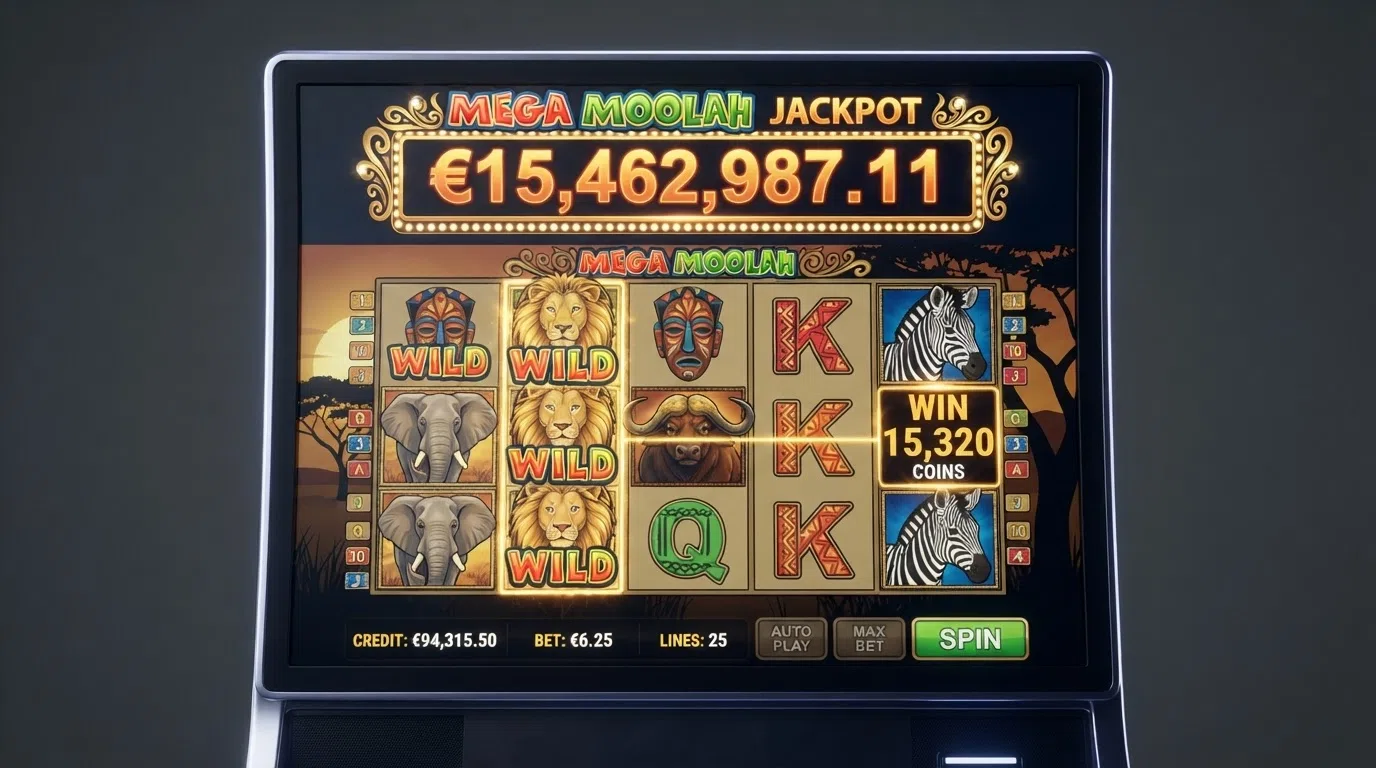
What makes the numbers worth staring at is the asymmetry. A £0.25 spin can pay £13 million; the expected return on that spin is still the base 88.12% figure the help screen publishes, with the rest of the return folded into the rare Mega hit. The vast majority of the 91 Mega wins sit well below the UK record; the average of £6.1 million is itself an outlier-prone figure. Most of the 91 winners were paid less. The seed, the contribution and the 1-in-50-million trigger are the same machinery described earlier in the article, scaled across a network big enough to produce eight-figure payouts from quarter-pound spins. The game’s value to a player is entertainment against a long shot, not a return calculation.
Jackpot King: how Blueprint layers a growing prize on ordinary titles
Jackpot King is not a slot. It is a progressive network that sits on top of ordinary Blueprint titles — slots a player might play for the base game alone — and turns a standard spin into a potential jackpot entry. The mechanic is straightforward: a portion of every bet, roughly 1 to 2 percentage points of the slot’s standard return, is diverted to the Jackpot King pool instead of staying in the base game’s RTP. The game keeps the rest of its paytable intact; the network takes its cut.
The prize structure is layered. The Royal jackpot seeds at 500 credits and the Regal at 5,000 credits; the headline Jackpot King pool itself is unlimited, growing with the network until a random trigger fires. A player on any Jackpot King host title — 7s Deluxe, Bankin’ Bacon, Genie Jackpots, dozens of others — has a chance at all three tiers on the same spin. The trade is the 1 to 2 percentage points of base return the game gives up to fund the prize, which is why the network’s RTPs run lower than the equivalent non-Jackpot-King titles. The design is the contribution mechanism of the wider field, applied per spin rather than across a network’s lifetime.
The wider field: Mega Fortune, Age of the Gods and the rest
Mega Fortune’s headline number is the €17,861,800 won in 2013, with an RTP of 96.6% and a base-game max win of 1,700x. The NetEnt wheel is the trigger and the jackpot sits above the symbol-combination paytable; the 1,700x ceiling and the 96.6% return are about the base experience.
Hall of Gods is the Norse-mythology alternative with a return around 95.7% and a top recorded payout of roughly €7.8 million. The expanding-wild bonus and the shield-smashing feature lead to the wheel, and the wheel decides whether the pot pays out.
Divine Fortune, also NetEnt, returns 96.59% with a Major jackpot that has cleared $1.1 million on more than one occasion. It is the lower-tier progressive the rest of the field gets compared to.
Age of the Gods is Playtech’s network, with a return around 95.02% and multiple £1 million+ payouts across its titles. The series is wide — God of Storms, King of Olympus, Fate Sisters, more — and a player who picks one Age of the Gods game is on the same network as the rest.
Wheel of Wishes, on the WowPot network, returns 93.3% and paid out €14.6 million in 2026, the freshest record on the page. The lower base return is the price of being inside the WowPot pool.
Wonder Woman and Diamond Jackpot are iconic titles the wider market talks about without per-title research behind them; a player curious about either should treat the absence of a verified figure as a reason to look at the help screen on the operator’s site before staking.
Why your welcome bonus won’t fund a jackpot chase
The blanket exclusion: progressive titles and welcome-offer wagering
Progressive jackpot slots are blanket-excluded from welcome bonus wagering at nearly every UKGC-licensed operator, while slots with fixed jackpots are typically eligible at full 100% contribution. The rule is not a quirk; it is the entire reason a free-spin welcome offer has any value to the operator. If progressive spins counted toward wagering, the operator would be funding a chance at a million-pound payout on a fifty-pence spin. Excluding the games the player is most likely to want to play is the trade the bonus is built on.
The consequence for a player who read the welcome offer as a chance to “chase the Mega jackpot on the house” is that the bonus is unusable on the very games the ranking above highlights. A deposit match on a 10x wagering requirement can still clear through fixed-jackpot slots, table games (where allowed) and ordinary video slots; the progressive column is closed. Mega Moolah enthusiasts must use their own funds, as the bonus is restricted to other titles.
No-deposit free spins: what Sky Vegas and Betfair actually hand over
The two no-deposit routes onto a progressive title in the UK are Sky Vegas and Betfair. Sky Vegas’s 50-registration-spin offer includes 7s Deluxe Jackpot King; Betfair’s 50-registration-spin offer runs on Jackpot King titles as well. Both are 0x wagering, so whatever a spin pays is the player’s to withdraw, subject to the operator’s minimum withdrawal threshold.
The honest read of a no-deposit free spin: 50 spins at £0.10 is £5 of slot action on someone else’s money. The chance of a 50-spin run hitting a Jackpot King tier is the 1-in-50-million-per-spin figure scaled across 50 spins, which is still a number small enough to ignore. What the offer buys is a real-money taste of the network rather than a realistic shot at a payout. Those who enjoy the experience and deposit later are the intended audience; everyone else simply collects the small reel payout.
The 10x cap and what welcome terms look like in 2026
The UK’s 10x wagering cap has been in force since 19 December 2025, alongside a ban on mixed-product promotional offers — the structure that used to let a bookmaker say “bet £10 on football, get 50 free spins on the casino”. The cap is what every UK welcome offer has to fit under, and it is the reason the table above shows 10x or 0x on every row with a confirmed figure. Older offers routinely ran 30x, 40x or 65x; a player who joined a UK casino before December 2025 and is now looking at a 10x term is seeing the new ceiling, not a one-off concession.
888casino’s 100% up to £100 at 10x is the standard shape. William Hill’s 200 spins on Big Bass Splash, with 10x on winnings inside 17 minutes and a £30 cashout cap, is the most punishing 10x offer in the table — the multiplier is at the cap, the time window is tight, and the cap on winnings means a strong run on the spins is paid out at thirty pounds, full stop. The 0x offers at Bet365, Sky Vegas, Paddy Power and Betfair are the alternative the 10x cap has not killed: rather than competing on low wagering, the cleanest operators have dropped wagering entirely on free-spin offers and pushed the value into the spin count and the eligible games. Both shapes are legal under the new rules; the 0x shape is the more player-friendly read.
Trying these games for free before you stake a penny
Where demo mode lives among the ten casinos
Nine of the ten operators in the ranking — Bet365, Sky Vegas, 888casino, Ladbrokes, Coral, Paddy Power, Betfair, Betfred and Gala Bingo — offer demo play on selected titles. The exception is William Hill Vegas, where demo mode is not available. A player who wants to learn the bonus wheel on Mega Fortune, the shield-smash on Hall of Gods or the Jackpot King entry on a Blueprint host before staking has nine places to do it; the tenth requires a real-money session from the first spin.
The phrase “selected titles” is doing real work in that sentence. Not every slot is available in demo at every operator, and progressive titles are often the most restricted. A player who wants to test Mega Moolah in demo needs to check the specific game on the specific site rather than assume the whole progressive library is open in free play. The operator’s game page is the source of truth on which titles are demo-enabled and which require a real-money stake from the first spin.
Free play vs real money: why the demo hides the true probability
A demo spin feels the same as a real-money spin: the reels land, the bonus triggers, the meter ticks. What the demo cannot show is the jackpot side of the experience, because the demo does not contribute to the network pool in the way a real spin does, and the bonus wheel that delivers the seven-figure payout is built around a contribution-funded trigger that demo play does not fully replicate. A player who learns a progressive in demo has learned the base game and the bonus feature; they have not learned the variance, because variance on a 1-in-50-million-per-spin trigger is not visible in a 300-spin practice session.
That is the practical limit of the demo. It is genuinely useful for the bonus feature, the symbol pays and the rough pacing of a session; it is not a way to gauge whether a game pays out. The 1-in-50-million figure and the 88.12% base return on Mega Moolah are properties of real-money play across the network, and the demo is a sandpit for the reels, not the meter.
The same jackpots, pocket-sized: playing on a phone
Mobile play: the rules that follow the spin onto a phone
The statutory rules that govern a progressive spin do not change when the spin happens on a phone. The £5 maximum stake for players aged 25 and over and the £2 maximum for players aged 18 to 24 apply to online slots regardless of the device; a mobile session is bound by the same game cycle as a desktop session. The 2.5-second minimum spin speed and the auto-play ban are game-design rules, not device rules, and they apply to a phone exactly as they apply to a laptop. The 88.12% base return on Mega Moolah is the same on a browser as it is in an app; the network does not know what is on the other end of the spin.
What changes on mobile is the session shape. A phone is the device a session is most likely to be opened on and most likely to be left open on; the deposit-limit prompt a customer sees before their first deposit is the regulator’s answer to a device that does not feel like a casino. The session loss and win display, the reality check and the time-out are all designed for the phone-in-pocket pattern as much as the desktop session, and they apply to the same progressive titles.
Apps vs browser: what this page did not verify
The research behind this page did not pin down an app-by-app comparison of the ten operators, and an honest read of the market says that gap is worth naming rather than papering over. Some of the ten run dedicated casino apps; some run mobile sites only; some run both with the app pulling ahead on game count and the browser pulling ahead on session continuity. The current state of any one operator’s app offering is a question for the operator’s site, and the answer changes often enough that a number printed on a static page would date fast.
The honest read for a player who wants a progressive on a phone: open the operator’s site on the phone the sessions will run on, check whether the app is offered for that operating system, and look at the specific progressive title in the game lobby to confirm it is available on mobile. The rules do not change; the interface does, and the interface is the operator’s job to keep current.
Bitcoin and crypto: why no licensed UK site offers them
Why crypto deposits are off the menu at licensed casinos
No UKGC-licensed casino accepts cryptocurrency. The Gambling Act 2005 does not have a permissive rule for crypto deposits, and in practice no licensed operator offers the option. The route to a bitcoin-deposit casino is an offshore licence — typically Curaçao — and an offshore licence means the site is not on the UK Gambling Commission’s public register. A player who wants to deposit in bitcoin and play a progressive is not looking at a UK operator.
The reason the distinction matters is what the licence carries with it. A GB licence is what puts a casino inside the dispute resolution framework, inside the financial-vulnerability-check regime, inside GamStop and inside the rules on stake caps and bonus terms. An offshore licence carries none of that. Playing at a Curaçao-licensed crypto casino means losing the protections afforded by the UK’s dispute resolution and self-exclusion frameworks.
Offshore crypto casinos and progressive titles: what you give up
The honest summary of an offshore crypto casino from a UK player’s perspective is a list of what is missing. There is no GamStop coverage, so a self-exclusion registered with the UK scheme does not apply. There is no UK Gambling Commission complaints route and no approved ADR — the alternative dispute resolution service that a UK licensee is required to be a member of. Funds that are withheld by an offshore operator are recoverable only through the operator’s own jurisdiction, which for a Curaçao licence means pursuing a complaint in Curaçao or simply not pursuing it.
The Commission does not currently have statutory powers to block offshore sites at the ISP or DNS level — legislation has been proposed but not enacted. What it has is disruption: cease-and-desist notices, search-engine referrals, domain registrar work and payment-provider referrals. Between April 2024 and June 2025 the Commission issued 3,140 disruption notices, referred 447,778 URLs to search engines and saw 287,961 URLs removed; the average engagement across 160 disrupted sites fell 32%. None of that changes the fact that an offshore site a UK player can still reach is a site the Commission’s tools have not yet removed, and the player is on it without any of the protection the UK framework is designed to provide.
The law: stake caps, licences and what GamStop changes
The £5 and £2 stake caps: what a game cycle means on a progressive title
The maximum stake on an online slot in Great Britain is £5 per game cycle for players aged 25 and over, in force from 9 April 2025, and £2 per game cycle for players aged 18 to 24, in force from 21 May 2025. The rules are imposed by the Gambling Act 2005 (Operating Licence Conditions) (Amendment) Regulations 2025 (SI 2025/215) and apply to online slots only — table games, live casino and bingo are not covered. A “game cycle” is a single spin plus any gamble feature, bonus buy or other stake attached to it, so the £5 ceiling is the total staked on one outcome rather than one button press.
The cap is the answer to a specific design problem: a high-volatility progressive can drain a bankroll in a few oversized spins if the stake ceiling is high enough to make each spin meaningful. The £5 ceiling limits how much one cycle can cost; the £2 ceiling for 18 to 24-year-olds limits it further on the age group the prevalence data flags as most at risk. A player on a progressive is bound by the same ceiling as a player on a fixed-jackpot slot; the prize size does not change the stake limit.
GamStop: how self-exclusion reaches progressive jackpot players
GamStop has been a mandatory condition of every UK Gambling Commission online operating licence since 31 March 2020. The exclusion periods on offer are six months, one year, five years, or five years with auto-renewal. None can be cancelled early. A player who has registered with GamStop is excluded from every GB-licensed online operator, on every product, for the chosen period; there is no “just casino” opt-out, and the exclusion applies whether the player is at a desktop or on an app.
The interaction with progressive play is that a self-excluded player cannot play the games in this ranking at any of the ten operators, because all ten are GB-licensed. The protection is total within the licensed market. It is not total outside it — a non-GamStop casino is one that does not participate in the scheme, which is one that is offshore and unlicensed in GB. The protection stops at the licence boundary, and the boundary is the public register.
Non-GamStop operators: offshore and unprotected
A non-GamStop casino advertising progressive jackpots to UK players is an offshore site that has not enrolled in the scheme, because enrolment is a condition of a GB licence and the site does not have one. The Commission treats such sites as unlicensed, and the consequence for a player is the absence of every protection the licensed market provides. No GamStop coverage, no UKGC complaints route, no approved ADR, no recourse through British consumer law if funds are withheld. The Commission’s response is disruption, described in the section on crypto casinos above.
The reason a player might still be tempted is the offer — a bigger bonus, a looser stake cap, a cryptocurrency deposit, a verification process that asks less. The reason a player should think twice is the same reason the offer exists: a site operating outside the UK framework is not constrained by the rules that make the licensed market legible. The £150 financial vulnerability check, the 10x wagering cap, the deposit-limit prompt, the 2.5-second spin, the auto-play ban — none of these apply on an offshore site. The player gains flexibility and loses the architecture. The trade is the player’s to make, but the trade is real.
The low-RTP trap and how to keep a session safe
Why the low return makes a jackpot chase riskier
A standard slot returns 95% to 97% of turnover in the long run. A progressive slot’s base return sits at 88% to 92% — Mega Moolah at 88.12%, Wheel of Wishes at 93.3%, Hall of Gods at 95.7% with the jackpot included. That gap is the cost of feeding the pool. A session on a progressive that does not hit the jackpot pays out at the base figure, and the base figure on Mega Moolah is almost eight percentage points below the standard. A £100 session on a 96% slot returns £96 in the long run; a £100 session on an 88.12% progressive returns £88.12. The £7.88 difference is what the prize pool is being built with.
The volatility compounds the effect. A high-volatility game produces long losing runs between wins, and a progressive on a 1-in-50-million-per-spin trigger can easily produce 1,000 or 10,000 spins without a single jackpot-tier outcome. The bankroll is being spent at the base rate against a prize the player will not see. A session budget that would be comfortable on a 96% standard slot is not comfortable on an 88% progressive; the same stake buys fewer minutes of play and a smaller chance of any win. The published jackpot-inclusive figure flatters the game, and the base figure is what the session actually feels.
The tools that slow a session down
The UKGC’s game-design rules apply to every online slot, progressive included. Auto-play is banned — a player who wants a hundred spins in a row has to press the button a hundred times. The minimum spin speed is 2.5 seconds, which is the regulator’s answer to the fast-spin features that used to let a player run a thousand spins in ten minutes. Features that speed up play, disguise losses as wins, or simulate player control are banned. The session loss and win display is mandatory, so a player who wants to know how the session is going can see it.
Outside the game design, the operator-level tools are the deposit limit and the reality check. Since 31 October 2025, an operator has to prompt a customer to set a financial limit before their first deposit, and the gross deposit limit — the form a player can actually call a “deposit limit” — has to be offered and given at least equal prominence. A £150 net deposit threshold triggers a financial vulnerability check, in force from 28 February 2025, and the check is run on publicly available data — county court judgments, IVAs, bankruptcy orders. The reality check, the time-out, the self-exclusion through GamStop and the operator’s own product blocking are all in the same toolkit. A player who wants a session to stop can have it stop; the question is whether the player uses the tool before the tool is needed.
Where to get help: GamCare, the helpline and the NHS clinics
GamCare runs the National Gambling Helpline on 0808 8020 133. The service took 996 referrals to treatment and peer-based support in January 2026, a 48% increase on the same month the year before; the helpline itself saw a record 1,165 referrals in October 2025. The numbers are the prevalence behind the marketing — a real demand, on a real phone line, run by a real organisation. GambleAware’s 2024 treatment and support survey put 13.1% of GB adults (around 6.8 million people) at any level of gambling problems on the PGSI scale, and 2.7% of participants in the Gambling Survey for Great Britain 2025 met the threshold for problem gambling. The National Gambling Treatment Service treated 11,960 clients in 2024/25, an 11% increase on the previous year; 93% of clients who completed treatment showed improvement. NHS gambling harm clinics operate in England, Scotland and Wales, and Gamblers Anonymous runs peer support groups across the country.
The architecture is in place because the prevalence is real. A player who finds a session has run further than intended, or a bankroll has gone further than budgeted, or a bet has gone from entertainment to anxiety, is a player who should pick up the phone. The helpline is free, confidential and not a step that has to be justified to anyone.
How we ranked these games
The ranking above is built on three sources. The per-title figures — RTP, biggest win, network — come from the slot providers’ published specifications, from Casino Listings’ Mega Moolah tracker data, and from the gaming press’s coverage of major payouts. The operator data comes from the UK Gambling Commission’s public register of operating licence holders, last updated 29 July 2026, and from the operators’ own product pages. The legal and regulatory figures come from the Gambling Commission’s published LCCP and RTS, from the Gambling Act 2005 as amended, and from the relevant statutory instruments. Where the research did not confirm a figure, the table cell is empty and the operator write-up names the gap rather than guessing.
The order in the table is editorial, not statistical. There is no weighted score behind the position of Mega Moolah above Mega Fortune or Jackpot King below Wheel of Wishes; the ranking reflects the size and frequency of the recorded payouts, the breadth of network coverage, and how recent the data is. A player who disagrees with the order on the basis of personal experience is not wrong; the ranking is a starting point, not a verdict.
The criteria that ordered the operators’ table are similar: licence status on the public register first, breadth of progressive coverage second, welcome offer shape third. The two Entain brands (Ladbrokes and Coral) sit in similar positions for that reason, and the two Flutter brands (Sky Vegas and Betfair) are differentiated by offer rather than coverage. A player who ranks by something other than the criteria this page used will arrive at a different order; the table is honest about the inputs that fed it.
Play for the jackpot, not the expected return
A progressive jackpot is a long shot with a public ledger, and the ledger says the same thing every time: the base game pays back less than a standard slot, the trigger is rare, and the seed is the marketing number rather than the one the bankroll should be planned around. A player who treats a session on Mega Moolah or Wheel of Wishes as entertainment with a 1-in-50-million chance of a side prize is reading the page correctly; a player who treats the jackpot-inclusive RTP as a forecast of personal return is reading the wrong number.
The practical version of that read is short. Try the title in demo mode first; nine of the ten operators on this page let a player do that. Stake at or below the £5 or £2 ceiling the law sets, set a deposit limit before the first deposit, and use the reality check and time-out tools the operator has to offer. A session that respects the base return, the volatility and the stake cap is a session the player is in control of; a session that chases the meter is not.
The jackpot will pay out to someone. The arithmetic says it will not be you, and the arithmetic is right more than 49,999,999 times out of 50,000,000. Play for the spin, not the number on the counter — and walk away when the session stops being one you would choose to start.
Frequently asked questions
What are the actual odds of winning one of these prizes?
The Mega Moolah Mega jackpot is estimated at roughly 1 in 50 million on any single spin, in the same ballpark as a national lottery. A 300-spin session at a 2.5-second minimum spin speed lasts about 12.5 minutes, and the probability of seeing one Mega win in that window is small enough to round to zero. The other progressives in this ranking sit at similar long-shot odds, with network and tier size changing the prize rather than the chance.
Which of the ten casinos carries the most progressive titles?
Bet365 leads the ten on progressive coverage, with 150+ progressive slots spanning Age of the Gods, WowPot and Jackpot King. Sky Vegas, Ladbrokes, Coral, Paddy Power and Betfair all carry Jackpot King, with the wider networks in different combinations. 888casino and Gala Bingo round out the coverage with progressive and Daily Jackpot games under their respective licences.
What is the largest jackpot a UK player has ever collected?
The largest UK win on a progressive slot is £13,212,882, won by Jon Heywood in 2015 on Mega Moolah at Betway from a £0.25 stake. The largest single payout anywhere on Mega Moolah is €19,430,723, won in 2021, and Wheel of Wishes paid out €14.6 million in 2026. The UK record has stood for over a decade, which is itself a measure of how rarely these prizes land.
Do you need a casino app to play these jackpots on your phone?
No. Every progressive on this page runs in a mobile browser, and a player who prefers the browser does not need to install an app. Some of the ten operators offer a dedicated casino app, and the app may carry a wider game library or a smoother session on certain devices; the research for this page did not pin down an app-by-app comparison, and the operator’s site is the place to check the current app offering for the specific title the player wants to run.
Is there a legal ceiling on how much one spin can cost?
Yes. The maximum stake on an online slot in Great Britain is £5 per game cycle for players aged 25 and over and £2 for players aged 18 to 24, in force since April and May 2025 respectively under SI 2025/215. The cap applies to online slots only, including progressives, and a “game cycle” covers a single spin plus any attached bonus buy or gamble feature. The ceiling is the same on mobile, on desktop and on every operator in the ranking.
Do progressive games really drain a bankroll faster than ordinary slots?
Yes, and the reason is the base return. A standard slot returns 95% to 97% of turnover in the long run; a progressive slot’s base return sits at 88% to 92% because a slice of every spin feeds the jackpot pool. A £100 session on a 96% standard slot returns £96 in the long run; the same stake on Mega Moolah’s 88.12% base returns £88.12. The difference is the contribution, and the contribution is what the prize is being built with. The high volatility means a session can lose a bankroll in long runs of non-winning spins between jackpot events, which is the design feature that makes the prize possible.
Slots – fastestpayout-casinos-uk
Content created by the «fastestpayout-casinos-uk» team