
Low volatility slots that stretch every deposit further
 Available in GB
Data current as of September 8, 2026; licence claims checked against the UK Gambling Commission’s public register.

Low volatility slots are the steady hand at the slot machine. They return small wins often enough to keep a balance alive across hundreds of spins, and in a market where the UKGC now caps both the stake per spin and the wagering on bonus funds, that steadiness has stopped being a stylistic preference and started being a strategic one. The 2% house edge on the highest-RTP low-volatility titles is the same number any slot carries, but the path to that number is what makes the difference: small hits every few spins instead of one large one every few hundred.
This page ranks the slots and the casinos that make the most of that steadiness. The ten featured operators all hold an active UKGC licence, and the section on stake limits and wagering caps explains why those licences now shape the math in a way they did not two years ago.
How low-volatility slots stretch every deposit further
Low volatility is a term of art, and it pays to know what it actually means before choosing a slot. Studios score their own titles on a 1–5 internal index, low variance sits at 1–2 on that scale, and the practical signature is three numbers: a hit frequency above 30%, a payout distribution clustered between 1× and 5× the bet, and a bonus trigger landing every 80 to 150 spins. None of these figures are printed on the slot cabinet, but together they describe the session the player can expect to sit through.
What slot volatility actually means — and where “low” sits on the scale
Volatility is the shape of the payout distribution, not the size of the return. Two slots can share a return-to-player percentage to within a tenth of a point and still feel like different games, because the way that percentage arrives is what the player actually experiences. A high-volatility title may pay 96% of every pound wagered across millions of spins, but the path to that figure is a long flat line followed by occasional spikes. A low-volatility title pays the same 96% in a tight stream of small returns, with a flatter balance curve and fewer extended dry spells.
The studio index puts low variance at 1 to 2 on a 5-point scale. The typical low-volatility slot lands a hit just over a third of spins, and most of those hits are between one and five times the stake. The max win sits low as a consequence, typically under 5,000× the stake, and the design philosophy is to keep the player funded for hundreds of spins rather than to chase a single large payout.
That is the trade a low-volatility player is making: a flatter ride in exchange for a smaller ceiling. The session lasts longer for the same deposit, but the standout win is unlikely. For a player who wants to feel their balance breathe across a hundred spins rather than to wait for one big moment, the choice is straightforward.
Low volatility vs high volatility: the same RTP, a completely different session
The clearest illustration of what volatility does is to take two slots with almost identical return rates and watch them behave differently. Starburst, NetEnt’s long-running flagship, has a stated RTP of 96.09% and sits firmly in the low-volatility camp. Book of Dead, Play’n GO’s Egyptian-themed staple, comes in at 96.21% RTP and is rated high volatility. A 100-spin session on each will produce very different balance charts: Starburst’s balance is likely to wobble gently around the starting mark, with frequent small credits replacing the stake. Book of Dead’s is likely to drift downward through a string of misses, occasionally punctuated by a feature round that pays out several times the bet.
The point is not that one slot returns more than the other — the return rates are within twelve basis points of each other. The point is that the path to the return rate looks nothing like the other. For a player with a fixed budget, the low-volatility path is almost always the longer one. A high-volatility slot can drain a small bankroll before the long-run return rate ever expresses itself, while a low-volatility slot delivers that return in increments the balance can absorb.
This is also why low-volatility slots tend to have low max-win caps. Starburst’s ceiling is around 500× to 800× the stake, well under the 5,000× threshold that signals low variance on a 1–5 studio index. The trade-off is structural: the design that produces frequent small wins also caps the size of the biggest one.
The signals that give away a slot’s volatility before you spin
Few slots print a volatility rating on the loading screen. A player who wants to know what they are about to spin has four practical checks:
- The info screen. A growing number of studios and UKGC-licensed operators now include a volatility rating, either as a 1–5 number or as a written label, somewhere on the game’s info or help page. This is the single most reliable signal when it is present.
- The paytable. Low-volatility slots cluster their payouts tightly: most symbols pay the same modest value, and the high-paying symbols appear rarely. If the paytable shows a wide spread from a few coins to several hundred times the stake on a single symbol, the slot is unlikely to be low volatility.
- The max win. A cap below 5,000× stake is a strong proxy. Slots whose top prize runs into five figures of multiplier almost always sit in the medium-to-high range.
- The provider’s habits. Some studios lean low by default. NetEnt’s catalogue, including Starburst, is built around frequent small hits. Pragmatic Play’s lower-tier titles, the classics and the simpler three-reel and five-reel games, tend toward the same pattern. Thunderkick’s output is a mixed bag but includes the medium-volatility bridge title 1429 Uncharted Seas at a 98.50%–98.60% RTP.
Why low volatility slots are the beginner’s safest starting point
A new player has two problems: learning how a slot’s features work, and keeping a balance alive long enough to learn them. High volatility is a poor teacher. A beginner who spins a high-volatility slot may watch their deposit halve before they ever see a bonus feature, and will draw the wrong lesson about what slots pay. Low volatility is forgiving: features trigger every 80 to 150 spins, hit frequency runs above 30%, and a small deposit can sustain a 200-spin session in which most of the game’s mechanics actually fire.
The UKGC’s stake cap adds a second reason. With a £5 maximum per game cycle for players aged 25 and over, and £2 for those aged 18 to 24, the natural unit of play is many small spins rather than a few large ones. Low volatility is the slot design that fits that constraint, and demo mode, which is available at every operator featured in the ranking below, lets a beginner test that fit without any deposit at all. The combination of capped stakes, frequent features and free play is the closest the UK market comes to a controlled environment for someone still learning how a slot behaves.
Medium volatility: when you want more than small wins but less than chaos
Medium volatility, sitting at roughly 3 on the 1–5 index, is the natural next step for a player who has outgrown the small-hit rhythm. The hit frequency drops, the average win grows, and the session develops more variation without the long dry spells that define a high-volatility title. The clearest example of a medium-volatility slot is 1429 Uncharted Seas from Thunderkick, with an RTP of 98.50% to 98.60%, a max win of 670× to 1,350× stake, and a hit frequency of approximately 41.2%. The win distribution is wider than a pure low-volatility slot, but the bonus features and the artwork are elaborate enough to keep the session engaging.
The signal that a player is ready to move up is a feeling of impatience with the steady stream of small returns. A low-volatility session can feel like work after a few hundred spins. Medium volatility offers the same kind of bonus-round exposure but with payouts that occasionally break out of the 1×–5× range.
The best low volatility slots at UK-licensed casinos in 2026
The ten operators below are all active on the UK Gambling Commission’s public register, which was last updated 29 July 2026. They are ordered by the strength of their low-volatility slot offering, judged on slot-library size, provider breadth, demo-mode availability and the shape of their welcome offer. The headline split is between five operators whose welcome free spins carry zero wagering requirements and the remaining three that apply the UKGC’s 10× wagering cap on bonus funds. Two operators could not be confirmed on their welcome terms in this research run and are noted as such.
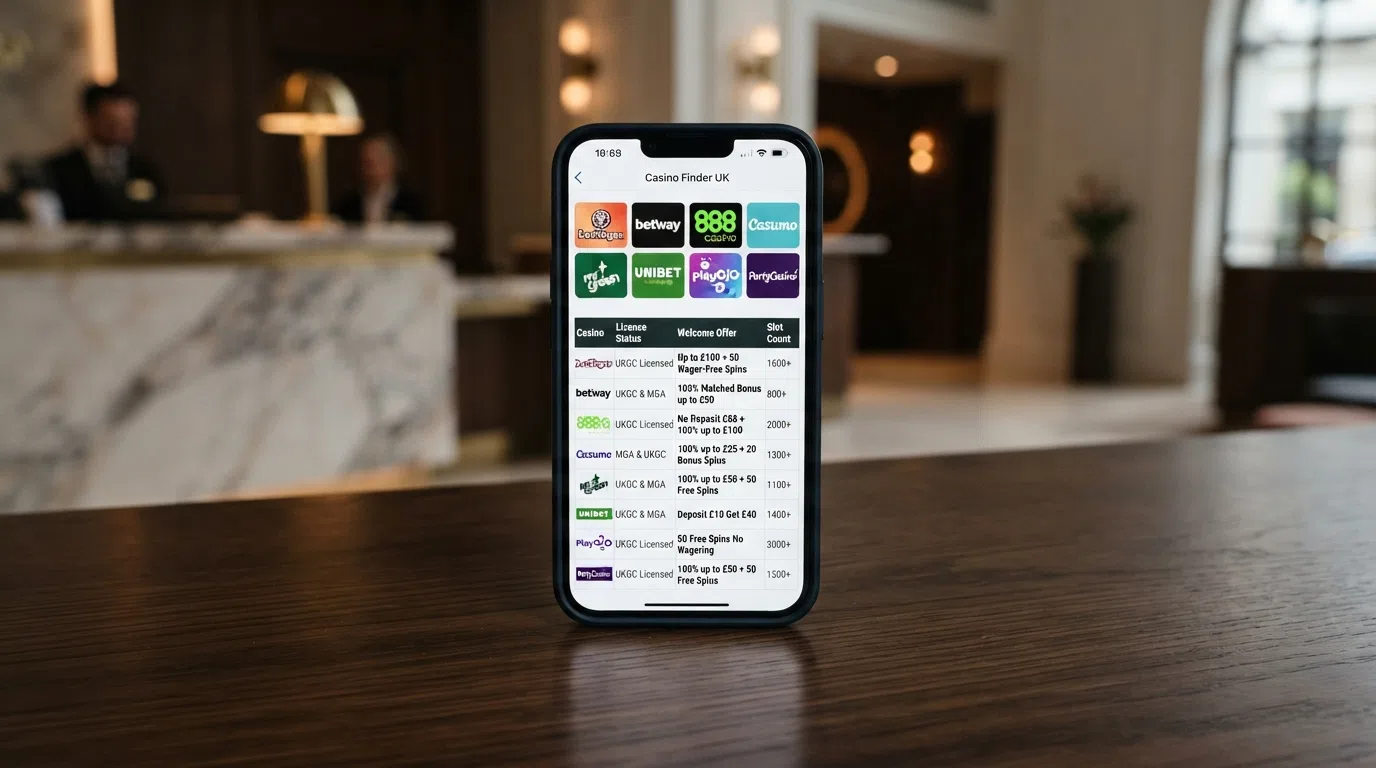
| Operator | UKGC Licence | Welcome Offer | Slot Count | Free-Spins Wagering |
|---|---|---|---|---|
| bet365 | Hillside (UK Gaming) ENC 55148; Hillside (UK Sports) ENC 55149 | Up to 500 free spins on selected slots, 10p per spin | 1,000+ | None |
| William Hill | William Hill Organization Limited 2752 | Terms vary; check site for current offer | 1,000+ | — |
| Sky Vegas | Bonne Terre Ltd 38716 | 70 no-deposit spins + 200 spins on £10 deposit, 10p per spin | 500+ | None |
| Ladbrokes | LC International Limited 39483 | 100 free spins on selected slots after £10 deposit and spend | 1,800+ | 10× on winnings |
| Coral | LC International Limited 39225 | 100 free spins after £10 deposit and wager on selected slots, 10p per spin | 1,700+ | None (paid as cash) |
| Betfair | PPB Counterparty Services Limited | 50 no-deposit spins + 100 spins on £10 deposit, selected Jackpot King slots | 500+ | None |
| Betfred | Petfre (Gibraltar) Limited | Up to 200 free spins after £10 stake, three package choices | 500+ | Check site for terms |
| 32Red | 32Red Plc | 320 free spins on Big Bass Splash after £30 deposit and stake | 500+ | 10× on winnings |
| 888 Casino | 888 UK Limited | 100% bonus up to £100 on first deposit of £10+ | 2,000+ | 10× on bonus funds |
| Virgin Games | Gamesys Operations Limited | 100 free spins on Game of Thrones or selected slots after £10 deposit and wager | 500+ | None |
bet365: the no-wagering giant with 1,000+ slots
bet365 operates under two UKGC licences: Hillside (UK Gaming) ENC account 55148 and Hillside (UK Sports) ENC account 55149, both verifiable on the public register. The welcome offer runs up to 500 free spins at 10p each on a small group of selected titles, including Book of Horus, Curse of the Bayou, Magic Forge and Wrath of the Deep, with no wagering requirements on winnings and a 30-day window to claim.
The slot library crosses 1,000 titles, drawing from eight major providers: NetEnt, Pragmatic Play, Playtech, Blueprint, Play’n GO, Microgaming, Red Tiger and BTG. Demo mode is available on RNG slots, and the breadth of the provider list means a low-volatility player can move between NetEnt’s classics, Pragmatic’s lower-tier releases and Blueprint’s licensed content without changing casino. For a player who values the largest possible no-wagering spin package and the widest low-volatility selection in one place, bet365 is the most generous of the ten.
William Hill: the established bookmaker with IGT low-volatility heritage
William Hill’s UKGC licence is held by William Hill Organization Limited under account 2752, active since 1 January 2009. The slot library is comparable in size to bet365’s at 1,000+ titles, but the provider list is where the operator differentiates: alongside NetEnt, Pragmatic Play, Playtech, Evolution, Blueprint and Red Tiger, William Hill carries IGT, the studio whose land-based slot cabinets defined the frequent-small-win model on casino floors for two decades.
The welcome offer varies; check the William Hill site for the current promotion. A player who specifically wants IGT’s low-volatility crossover titles in the same account as NetEnt and Pragmatic Play will find what they are looking for at William Hill, and demo mode is available for testing before deposit.
Sky Vegas: 270 free spins with zero wagering and a no-deposit starter
Sky Vegas operates under Bonne Terre Ltd (trading as Sky Vegas) under UKGC account 38716. The welcome structure is the only one in the featured set that splits cleanly into a no-deposit tranche and a deposit tranche: 70 free spins on registration, no deposit required, followed by 200 more free spins after depositing and staking £10, all at 10p per spin and all without wagering requirements. The spins carry a 7-day expiry from issue.
The slot library runs to 500+ titles, with NetEnt, Pragmatic Play, Playtech, Blueprint, Evolution, Red Tiger and BTG in the provider mix. The combination of a no-deposit starter and zero wagering on a 270-spin package is unique among the ten, and it makes Sky Vegas the natural choice for a player who wants to test the casino’s low-volatility catalogue with the house’s money before committing.
Ladbrokes: 1,800+ slots and Play’n GO’s multi-RTP catalogue
Ladbrokes is licensed under LC International Limited, UKGC account 39483. The welcome offer is 100 free spins on selected slots after depositing and spending £10, at 10p per spin, with a 7-day expiry and 10× wagering on winnings, sitting at the UKGC’s bonus wagering cap.
The slot count is 1,800+, drawn from NetEnt, Pragmatic Play, BTG, Play’n GO, Blueprint and Microgaming. The Play’n GO presence is the relevant detail for a low-volatility player: Play’n GO ships many of its slots in multiple certified RTP tiers, and the deployed tier at a given casino can vary. Under UKGC licence condition 7.1.1, the operator must display both the theoretical base-version RTP and the actual RTP running on the casino floor, so the player can check the configuration before they spin. Demo mode is available on all RNG slots, and the sheer library size makes Ladbrokes the right pick for a player who wants the largest selection of Play’n GO low-volatility titles on one platform.
Coral: 100 free spins paid as real money — no wagering, no catch
Coral shares its licence holder with Ladbrokes: LC International Limited, under UKGC account 39225. The welcome offer is the cleanest in the set: 100 free spins after depositing and wagering £10 on selected slots, 10p per spin, with winnings paid directly as withdrawable cash. There is no wagering requirement to clear, no maximum-cashout clause attached to the free spins, and no bonus conversion step.
The slot library runs to 1,700+ titles from NetEnt, Pragmatic Play, Blueprint, BTG and Peter & Sons, and demo mode is available. The wagering-free treatment of free-spin winnings is the differentiator: a player who wants a single simple offer, deposit, spin, withdraw if there is anything to withdraw, will find Coral’s structure the most straightforward of the ten.
Betfair: 150 free spins with no wagering, split across no-deposit and deposit tranches
Betfair operates under PPB Counterparty Services Limited, verifiable on the UKGC public register. The welcome offer mirrors Sky Vegas’s split structure but in different proportions: 50 no-deposit free spins on registration, then 100 more free spins after a £10 deposit, all on selected Jackpot King slots with no wagering requirements.
The slot library is more modest at 500+ titles, drawn from NetEnt, Pragmatic Play, Blueprint, Playtech and Red Tiger, and demo mode is available. The Jackpot King focus narrows the low-volatility selection compared with Ladbrokes or Coral, but the no-deposit layer makes Betfair a useful second account for a player who wants to test a fresh operator’s RNG before committing to a deposit.
Betfred: 200 free spins across three package choices — but wagering terms unstated
Betfred operates under Petfre (Gibraltar) Limited, verifiable on the UKGC register. The welcome structure is unusual: a choice of three free-spin packages, all triggered by staking £10, with a debit card deposit required and a 7-day expiry. The options are 50 spins at 20p on Age of the Gods, 100 spins at 10p on Better Wilds, or 200 spins at 5p on Age of the Gods God of Storms 2.
The slot library runs to 500+ titles from Playtech, NetEnt, Pragmatic Play, IGT and Blueprint, and demo mode is available. The wagering terms on winnings from any of the three packages should be confirmed on the Betfred site before staking. The IGT presence in the provider list, alongside William Hill, is the relevant detail for the low-volatility player.
32Red: 320 free spins — the highest single-title spin count in the set — with 10× wagering
32Red is licensed under 32Red Plc, verifiable on the UKGC register. The welcome offer delivers 320 free spins at 10p each on Big Bass Splash after depositing and staking £30 on slots. The 10× wagering on winnings sits at the UKGC’s cap, and the spins must be claimed within 7 days and expire 48 hours after activation.
The slot library runs to 500+ titles from Microgaming, NetEnt, Pragmatic Play, Evolution and BTG. The deposit threshold is higher than the other featured operators, but the spin count is the highest in the set, and a player with a larger first-deposit budget who is comfortable with the 10× cap will find the per-spin value competitive. Demo mode is available on RNG slots.
888 Casino: the only deposit-match bonus in the set, with 2,000+ slots
888 Casino operates under 888 UK Limited, verifiable on the UKGC register. The welcome offer is the only deposit-match structure among the ten: 100% bonus up to £100 on a first deposit of £10 or more, with 10× wagering on the bonus funds within 90 days on selected slots. There is no free-spin component.
The slot library is the largest in the featured set at 2,000+ titles, drawn from NetEnt, Playtech, Pragmatic Play, Evolution, Red Tiger and BTG. For a low-volatility player who prefers a cash bonus over a free-spin package, 888 is the natural pick, and the 10× wagering on the bonus is the lowest legal cap a UK player can currently face.
Virgin Games: 100 free spins, no wagering, and the Game of Thrones slot tie-in
Virgin Games is licensed under Gamesys Operations Limited, verifiable on the UKGC register. The welcome offer is 100 free spins after depositing and wagering £10, at 10p per spin, on Game of Thrones or a selection of other slots, with no wagering on winnings.
The slot library runs to 500+ titles from NetEnt, Pragmatic Play, Evolution, Red Tiger and IGT. The Game of Thrones tie-in is the differentiator: a player who wants the branded title with zero-wagering free spins will find Virgin Games the only path in the featured set. Demo mode is available, and the IGT provider presence rounds out the low-volatility selection.
When low volatility meets high RTP: the slots that give the most back
Pairing low volatility with a high RTP is the mathematically kindest slot experience a player can have at a UK-licensed casino. The house edge bites less often, and the return comes in increments a balance can absorb. The slots below are the ones research confirmed at low volatility with a stated RTP, and the table that follows puts the strongest of them side by side.
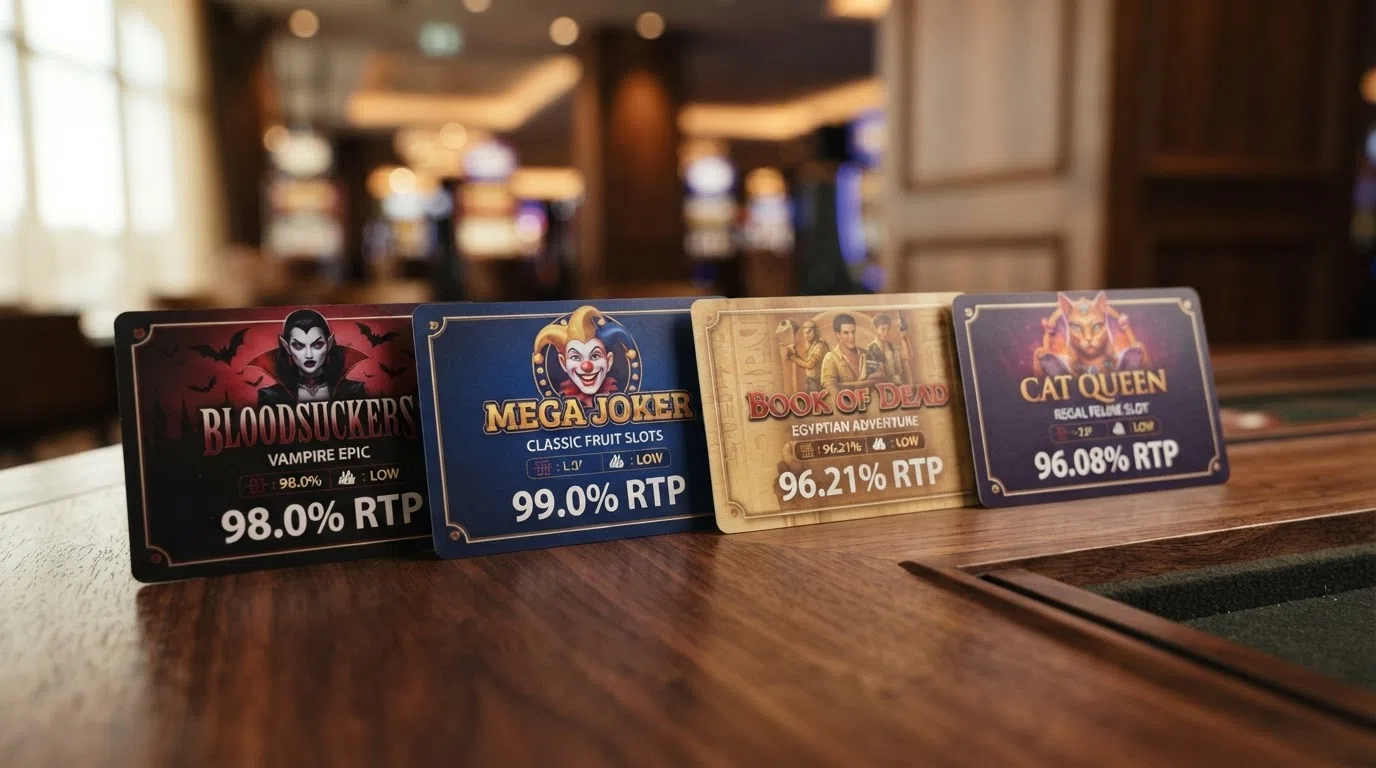
| Slot Title | Provider | RTP | Max Win |
|---|---|---|---|
| Mega Joker | NetEnt | 99.00% | 2,000× |
| The Catfather | Pragmatic Play | 98.10% | — |
| Egypt Classic | Pragmatic Play | 98.03% | 180× |
| Blood Suckers | NetEnt | 98.00% | 1,014× |
| Starmania | NextGen Gaming | 97.87% | — |
| Golden Tour | Playtech | 97.71% | — |
| Triple Tigers | Pragmatic Play | 97.21% | — |
| Starburst | NetEnt | 96.09% | 500×–800× |
Why RTP alone is not enough — the case for pairing it with low volatility
RTP is a long-run theoretical average, calculated over millions of spins. A 97% RTP tells a player what the slot returns in aggregate, but says nothing about how that return is distributed across a single session. A high-volatility slot with a 97% return rate can still drain a deposit in twenty spins if the dry spell lands early, because the return is held back for the few large payouts that define the slot’s design.
Low volatility solves this by compressing the payout distribution. A low-volatility slot with a 96.09% RTP, Starburst, can feel kinder across a 100-spin session than a high-volatility slot with a 96.21% RTP, Book of Dead, because Starburst’s path to its return rate is the steady accumulation of small wins, while Book of Dead’s path is a long flat line punctuated by occasional spikes that may never arrive.
The UKGC’s RTP-disclosure rule, licence condition 7.1.1, helps: every UK-licensed operator must display both the theoretical base-version RTP and the actual RTP deployed at the casino. But the disclosure does not change the path. A player still needs the volatility check to know what kind of session they are about to sit through.
Low volatility slots with RTP of 97% and above
A 97% RTP is a meaningful threshold: it caps the house edge at 3% or less, which is the difference between a slot that returns £97 of every £100 wagered and one that returns £94. The qualifying titles in the table above are Blood Suckers at 98.00%, The Catfather at 98.10%, Egypt Classic at 98.03%, Starmania at 97.87%, Golden Tour at 97.71% and Triple Tigers at 97.21%. Starburst at 96.09% sits just below the threshold and is included as the canonical benchmark that most players will recognise.
The caveat that applies to every title in this list, and to Play’n GO slots in particular, is the multi-RTP-tier issue. Play’n GO ships many of its titles in several certified configurations: Book of Dead, for example, is available in tiers at 96.21%, 94.25%, 91.25%, 87.25% and 84.18% RTP. The UKGC’s condition 7.1.1 requires the operator to show which tier is deployed, and a player at a Ladbrokes or other Play’n GO-carrying casino should check the specific configuration on the slot’s info screen before assuming the highest tier is running.
The 98%+ club: the lowest house edge you can spin on a low-volatility slot
Four low-volatility slots carry an RTP of 98% or higher, and each one is worth a closer look.
Blood Suckers sits at 98.00% RTP with a hit frequency of approximately 44.9% and a max win around 1,014× the stake. The combination of return rate, hit frequency and a meaningful max win is the most complete low-volatility package in the NetEnt catalogue, and the slot is widely available across the ten featured operators.
Egypt Classic from Pragmatic Play sits at 98.03% RTP with a max win of 180× stake. It is Pragmatic Play’s highest-RTP title across the entire catalogue, and the studio is reported to promote it sparingly because the thin margin leaves little for the operator after Remote Gaming Duty. The max win is modest by industry standards, but for a player prioritising the lowest house edge above the size of the ceiling, Egypt Classic is the pragmatic pick.
The Catfather, also from Pragmatic Play, sits at 98.10% RTP and is the studio’s highest-RTP low-volatility title specifically. The max win is not stated in the research available, and the slot is best evaluated for its return rate rather than its top payout.
Mega Joker from NetEnt is the highest-return low-volatility slot available, at 99.00% RTP in Supermeter mode with a max win of 2,000× stake. The Supermeter mechanic is a deliberate choice: the slot asks the player to gamble small returns on a higher-volatility mini-game to chase the headline return rate, and a player who does not engage with the Supermeter will see a lower effective RTP. For the player who wants the absolute lowest house edge and is willing to play the game’s two-tier structure, Mega Joker is unmatched.
The reason these four titles are rarely promoted is structural. Remote Gaming Duty on online casino gross yield rose from 21% to 40% with effect from 1 April 2026, and a slot returning 98% or more leaves the operator with a margin that is hard to cover after duty. These slots appear in casino lobbies, but they are not pushed on the homepage, and a player who wants them needs to know the names and search for them directly.
Low volatility slots by studio: who makes the steadiest games
The two studios that the coverage map singled out are Pragmatic Play, for its catalogue of high-RTP low-volatility titles, and IGT, for the heritage of its land-based slot machines and their online crossover. Both studios are present at the ten featured operators: Pragmatic Play across the full set, IGT at William Hill, Betfred and Virgin Games.
Pragmatic Play low volatility slots: three titles with RTPs from 97.21% to 98.10%
Pragmatic Play’s low-volatility catalogue is anchored by three titles with confirmed return rates. Egypt Classic at 98.03% RTP and a 180× max win is the studio’s highest-RTP title across the catalogue and is rarely promoted for the reason noted in the 98%+ club discussion: the operator margin after the 40% Remote Gaming Duty is too thin to make it a marketing priority. The Catfather at 98.10% RTP is the studio’s highest-RTP low-volatility title specifically. Triple Tigers at 97.21% RTP rounds out the trio at a slightly lower return rate.
The three titles together cover a useful range. A player looking for the highest return and unconcerned with the size of the ceiling picks Egypt Classic; a player who wants the same studio’s best low-volatility-specific return picks The Catfather; a player who wants a more accessible gameplay shape picks Triple Tigers.
IGT low volatility slot machines: from the casino floor to the online lobby
IGT built its reputation on the land-based slot cabinet, where the design brief is to keep a floor player seated through frequent small returns. Many of IGT’s online titles inherit that philosophy, with the same steady payout rhythm that defined their cabinets. Per-title RTP data for IGT’s low-volatility online titles was not confirmed in this research run, and the studio’s online output is best assessed qualitatively rather than by specific return rates.
IGT is present in the provider lists of three of the ten featured operators: William Hill, Betfred and Virgin Games. A player who values IGT’s land-based heritage and wants to play its low-volatility titles online will find the strongest selection at those three. Demo mode is available at all three, and the UKGC’s RTP-disclosure rule applies: the actual deployed RTP for any IGT title should be checked on the slot’s info screen before playing.
Why low volatility slots are the bonus-wagering shortcut
Clearing a wagering requirement is a survival problem. The player must place a fixed volume of stakes, and every stake burns a fraction of the wagered amount to the house edge. The faster the balance drains, the less likely the player is to complete the rollover. Low volatility, with its narrow payout distribution and frequent small hits, keeps the balance alive across more game cycles, which means more of the required turnover actually happens before the bonus funds run out. Since 19 December 2025, UKGC licence condition SR 5.1.1 has capped wagering requirements at 10× on bonus funds, the lowest ceiling the GB market has ever set, and the math is kinder than it has been in any previous era.
The maths of wagering: why steady returns clear rollovers faster than spike wins
Take a £10 bonus with 10× wagering, the lowest legal cap at any UK-licensed casino. The required turnover is £100. On a slot with a 96.09% RTP, Starburst as the worked example, the expected cost of clearing is £100 × (1 − 0.9609) = £3.91, the theoretical loss the player absorbs to release the bonus. That is the headline figure.
What the headline does not show is the variance. A high-volatility slot with a similar return rate can swing far above or below that expected cost in a single session. A player who lands a long dry spell at the start of a 10× playthrough can watch the bonus balance halve before the first feature round, even though the long-run expected loss is under £4. The bonus is gone, the rollover is incomplete, and the player walks away with nothing.
Low volatility compresses that variance. The actual cost on a low-volatility slot stays close to the expected cost, because the payout distribution is narrow and the balance is not subject to the spikes that define a high-volatility session. A £10 bonus cleared on a 98% RTP low-volatility slot costs the player closer to £2 in expected loss, and the chance of the bonus surviving the full £100 turnover is materially higher.
Best low volatility slots to use with a UK welcome bonus — and which operators let you keep everything you win
The slots best suited to clearing wagering are the ones at the top of the RTP table from earlier in this article. Blood Suckers at 98.00% RTP with a hit frequency around 44.9% and a max win of approximately 1,014× is the strongest all-rounder: high return, frequent hits, and a max win large enough to make a meaningful dent in a small bonus. Mega Joker at 99.00% RTP in Supermeter mode is the highest-return option, though the two-tier gameplay is a deliberate choice that not every player will engage with. Starburst at 96.09% RTP is the most widely available, and its low-volatility signature makes it a reliable wagering slot even at a lower return rate.
The five operators whose welcome free spins carry zero wagering requirements eliminate the rollover question entirely: bet365 with up to 500 free spins, Sky Vegas with 270 spins across a no-deposit and a deposit tranche, Coral with 100 spins paid as cash, Betfair with 150 spins across the same split structure, and Virgin Games with 100 spins on Game of Thrones. The winnings from these offers are withdrawable without any rollover, and a player who wants to keep everything they win on a free-spin package should start with those five.
The three operators that apply the UKGC 10× cap are Ladbrokes on its 100 free spins, 32Red on its 320 free spins on Big Bass Splash, and 888 Casino on its 100% deposit match up to £100. The wagering is still capped and therefore still manageable, and the slots in the RTP table above are the right games to play through the rollover. William Hill and Betfred’s wagering terms should be confirmed on the operator’s site before staking.
What a UKGC licence delivers that an offshore casino cannot match
A UKGC licence is built on three instruments working together: the Gambling Act 2005, the LCCP and the Remote Technical Standards. The Act sets the three licensing objectives, preventing gambling from being a source of crime, ensuring it is conducted fairly and openly, and protecting children and other vulnerable persons. The LCCP and RTS are the working codes that translate those objectives into specific obligations: the stake cap, the wagering cap, the RTP-disclosure rule, the game-design rules, the GAMSTOP requirement and the financial vulnerability checks. Together they form a layer of protection that an offshore site, licensed in Curaçao or Malta but serving GB customers, is not required to provide and does not provide.
The point-of-consumption rule under the Gambling (Licensing and Advertising) Act 2014 closes the regulatory gap. Any operator serving GB customers must hold a GB licence, regardless of where the operator is based. A Curaçao or Maltese licence is not a substitute, and the Commission’s enforcement actions on illegal online gambling ran to 208,088 in the year to September 2025.
How the UKGC makes sure the RTP on your screen is the RTP the slot actually runs
Licence condition 7.1.1 is the specific rule that makes the RTP check practical. Every UK-licensed operator must display the theoretical base-version RTP for every game and the specific RTP deployed at that casino. The two numbers can differ, and they do for any title that ships in multiple certified RTP tiers. Play’n GO’s Book of Dead is the clearest example: the slot is certified at 96.21%, 94.25%, 91.25%, 87.25% and 84.18% RTP, and a UK casino can deploy any of those configurations. Under condition 7.1.1, the player is entitled to see which one is running before they spin.
The game-design rules that have been in force since 31 October 2021 are the second layer. Auto-play is banned, the minimum spin speed is 2.5 seconds, losses disguised as wins are banned and reverse withdrawals are permanently banned. Each rule prevents an operator from accelerating play or obscuring the true cost of a session, and the session display requirement, which shows the player their total losses or wins and the time played during a session, is the closing piece. A player at a UK-licensed casino knows what they have spent and won in real time, and cannot be rushed into the next spin.
The £5 and £2 stake caps: why your age determines your maximum bet on the same slot
The age-banded stake cap, imposed by SI 2025/215, is unique to Britain. Two players at the same casino can face different maximum bets on the identical slot: £5 per game cycle for players aged 25 and over, in force from 9 April 2025, and £2 per game cycle for players aged 18 to 24, in force from 21 May 2025. The cap applies to online slots and not to other casino games.
The practical effect, with Starburst as the worked example, is that a 100-spin session at £2 per spin costs £200 in turnover. At a 96.09% RTP, the expected loss on that session is £200 × (1 − 0.9609) = £7.82. For a player on a small bankroll, the math is a useful boundary: the worst case is the stake, the expected case is the small expected loss, and both are within reach. The same 100-spin session at £5 per spin costs £500 in turnover with an expected loss of £19.55.
The early market data shows the cap is working. Online slots sessions lasting longer than an hour decreased by 12% year-on-year to 8.9 million in Q4 2025/26, the fourth quarter since the caps were introduced. Players are spending less per spin, and the cap is interacting with low-volatility slot design to produce the predictable, bounded sessions the policy was designed to encourage.
What happens when you play at a site without a UKGC licence
An unlicensed site removes every protection this section has described. The RTP on the screen is not verified, the stake cap does not apply, GAMSTOP does not cover the operator and there is no route to a Commission complaint or alternative dispute resolution if funds are withheld. The site’s own rules are the only rules the player has, and the player has no British consumer redress when those rules are not honoured.
The Commission’s enforcement is aimed at the operators, advertisers and intermediaries, not at the players themselves. No penalty for gambling on an unlicensed site has been confirmed for the player; what is lost is the protection framework, not the freedom to play. April 2024 to June 2025 saw 3,140 disruption notices issued and 447,778 URLs referred to search engines, of which 287,961 were removed. October 2024 to September 2025 saw 208,088 enforcement actions in total. Section 33 of the Gambling Act 2005 makes providing gambling facilities without a licence a criminal offence carrying up to 51 weeks’ imprisonment, an unlimited fine, or both, aimed squarely at the operator side.
The Gambling Act 2005 covers Great Britain, meaning England, Scotland and Wales. Northern Ireland is not covered by the Act and has its own regulatory framework, and a player in Northern Ireland should check the local rules separately. The practical check for any UK player is the public register at the Commission’s website: every UKGC-licensed operator appears there, and a site that does not appear on the register is not licensed to serve GB customers.
The safety net under every spin: GAMSTOP, GamCare and the tools you control
The responsible-gambling infrastructure in Great Britain is built to give the player control of their own play, and the scale of its use is the clearest evidence that it is being used. The NHS Adult Psychiatric Morbidity Survey 2023–24 found 0.4% of GB adults at problem-gambling level (PGSI 8+) and 1.6% at moderate risk (PGSI 3+). The National Gambling Treatment Service treated 11,960 clients in 2024/2025, and 93% of those completing treatment saw improvement. GAMSTOP recorded 117,756 new self-exclusion registrations in 2025, a 19% year-on-year increase, and 561,983 active exclusions at year-end. By mid-2026, the active exclusion count had risen to 614,738, with the 16–24 age group up 26% in the first half of the year and now representing nearly one in three of all self-exclusions.
Deposit limits, reality checks and time-outs: the tools every UK player already has
Three operator-side tools are mandatory at every UKGC-licensed casino. From 31 October 2025, the operator must prompt a customer to set a financial limit before their first deposit, and a decrease to that limit must take effect immediately. An increase may be subject to a delay. The terminology is shifting from “spend limits” to “stake limits” in RTS 12B, effective 30 September 2026, and the change is a clarification rather than a new restriction.
Reality checks are the second mandatory tool, displaying the player’s total losses or wins and the time played during a session. The display has been required since the 31 October 2021 game-design rules, and it is the player’s real-time view of the cost of their session.
Time-outs are short cooling-off periods, typically 24 hours to 6 weeks, during which the account is locked. They are distinct from GAMSTOP, which is a longer multi-operator exclusion with its own sign-up process. A player who wants a short break uses the operator’s time-out; a player who wants a longer break signs up with GAMSTOP.
The financial vulnerability check is a fourth layer. From 28 February 2025, operators must run a light-touch check when a customer’s net deposits reach £150 in a rolling 30-day period, using publicly available data such as county court judgments, bankruptcy orders, individual voluntary arrangements and debt relief orders. The check is the operator’s prompt to engage the customer in a conversation about their play, and it is one of the few friction points built into the UKGC’s framework.
Self-exclusion through GAMSTOP: what it does, who it covers, and how to sign up
GAMSTOP is a free, national multi-operator self-exclusion scheme, mandatory for every GB-licensed online operator since 31 March 2020. A player can register online, choose an exclusion period of 6 months, 1 year, 5 years, or 5 years with auto-renewal, and be excluded from every GB-licensed online operator at once. The exclusion cannot be cancelled early, and it continues for up to 7 years after expiry if the registrant does not contact GAMSTOP to lift it.
The scale of the scheme is the clearest signal of its use. 117,756 new registrations in 2025, the scheme’s highest annual total, and 614,738 active exclusions by mid-2026. The 16–24 age group has seen the sharpest rise, at 26% in the first half of 2026, and now accounts for nearly one in three of all self-exclusions. The trend is consistent with the wider pattern of younger players engaging with the available safety tools in greater numbers.
Where to get help: GamCare, BeGambleAware and NHS gambling clinics
The help landscape for a UK player is built on four channels. The National Gambling Helpline, run by GamCare, took 996 referrals to treatment and peer-based support in January 2026, a 48% year-on-year increase. GamCare’s National Gambling Treatment Service treated 11,960 clients in 2024/2025, with 93% of those completing treatment seeing improvement. NHS gambling harm clinics operate in England, Scotland and Wales, accessible by GP referral or self-referral. GambleAware funds the research, prevention and treatment infrastructure through the statutory levy: 1.1% of remote casino gross gambling yield from 6 April 2025, split 50% to treatment, 30% to prevention and 20% to research. Gamblers Anonymous runs peer-support groups across Great Britain.
A player who wants to talk to someone today can reach the National Gambling Helpline by phone or live chat through GamCare. A player who wants to exclude themselves from every GB-licensed operator at once can sign up with GAMSTOP online, free of charge. A player who wants structured treatment can ask their GP for a referral to an NHS gambling harm clinic or contact GamCare directly.
How we chose the best low volatility slots
The operator ranking is grounded in three sources. The UK Gambling Commission’s public register, last updated 29 July 2026, is the source for every licence status cited in the comparison table above. Operator websites and affiliate review data are the source for slot counts, provider lists and welcome-offer terms. Slot-specific facts, including the RTP, max win and hit frequency figures in the table of high-RTP low-volatility slots, are sourced from provider publications, operator info screens and independent slot databases.
The ranking criteria are: UKGC licence status as a mandatory gate, slot-library size and provider breadth as the measure of low-volatility choice, demo-mode availability as a prerequisite for testing a slot’s volatility before staking, and welcome-offer shape as the most visible differentiator between operators. The split between zero-wagering and 10× cap offers is the headline that follows from those criteria.
The limitation is scope. This ranking covers the ten featured operators and is not an exhaustive survey of the GB-licensed market. Other UKGC-licensed casinos carry different low-volatility catalogues, and a player who wants a broader view should treat this list as a starting point rather than a closed set. No per-title RTP figure has been fabricated: every number in this article is sourced from provider publications, operator info screens or independent slot databases, and where a figure was not confirmed, the article has either stated the absence or relied on a qualitative description.
Your low volatility slots strategy: what to play in 2026 and what to skip
The picking hierarchy for a low-volatility slot player in the current UK market has three tiers. At the top sits the 98%+ RTP club: Blood Suckers at 98.00%, Egypt Classic at 98.03%, The Catfather at 98.10% and Mega Joker at 99.00% in Supermeter mode. These are the slots where the house edge is 2% or less, and they are the rational first choice for any player who wants the kindest possible return rate within the low-volatility design. The second tier is the 97%+ group: Starmania at 97.87%, Golden Tour at 97.71% and Triple Tigers at 97.21%. The third tier is Starburst at 96.09% and the broader low-volatility catalogue, which is the right place to look when the top-tier titles are not available at a chosen casino or when a player wants a different gameplay shape.
The operator decision runs on the same logic. The five zero-wagering welcome offers, at bet365, Sky Vegas, Coral, Betfair and Virgin Games, eliminate the rollover risk entirely: the winnings from free spins are withdrawable without any playthrough, and a player who values simplicity picks from those five first. The three 10× cap offers, at Ladbrokes, 32Red and 888 Casino, are the right choice for a player who wants a larger spin package or a deposit-match structure and is comfortable clearing the rollover on the high-RTP low-volatility slots in the table above. William Hill and Betfred are the two operators whose welcome terms were not confirmed in this research run, and a player interested in either should check the current offer directly.
The stake-cap strategy is a separate decision. At £5 per game cycle for players aged 25 and over, a 100-spin session on a 96%+ RTP slot costs £500 in turnover with an expected loss under £20, and the loss is predictable rather than spikey. For a player aged 18 to 24, the £2 cap compresses the same 100-spin session to £200 in turnover and an expected loss under £8. The lower cap does not change the slot’s volatility, but it changes the absolute scale of the session, and a player who wants a longer session at a lower per-spin cost will find low volatility the natural fit within either cap.
The one thing to skip is any site without a UKGC licence. The offshore alternative removes the RTP verification on the screen, the stake cap, the wagering cap, the GAMSTOP coverage and the Commission complaint route, in exchange for nothing the player can enforce. A site licensed in Curaçao or Malta is not a substitute for a GB licence, and the point-of-consumption rule under the Gambling (Licensing and Advertising) Act 2014 means a GB player on an unlicensed site is outside the protection framework entirely.
The final point is the one this article has been building toward. Low volatility slots are not about winning more. The RTP sets the return rate, and that is the same on a low-volatility slot as on a high-volatility one with a comparable percentage. The advantage of low volatility is playing longer on the same deposit, and in a market where the stake is capped and the wagering is capped, that is a genuine edge.
Frequently asked questions
How do I identify whether a slot is low volatility before playing?
Check four signals in order: the info or help screen for a stated volatility rating or 1–5 index number, the paytable for a narrow spread of payouts clustered between 1× and 5× the bet, the max win as a proxy (a cap below 5,000× stake points to low volatility), and the provider’s design habits, with NetEnt, lower-tier Pragmatic Play titles and Thunderkick generally leaning low.
Is Starburst a low volatility slot and what is its RTP?
Yes. Starburst from NetEnt is rated low volatility, with a fixed RTP of 96.09% and a max win of 500× to 800× the stake. It is the most widely available low-volatility slot at the ten featured UKGC-licensed operators and is the canonical worked example for the stake-cap and wagering math used in this article.
Can I play low volatility slots in demo mode at UK-licensed casinos?
Demo mode is available on RNG slots at every one of the ten featured operators: bet365, William Hill, Sky Vegas, Ladbrokes, Coral, Betfair, Betfred, 32Red, 888 Casino and Virgin Games. Demo play lets you test a slot’s hit frequency and feature rhythm without staking real money, and the UKGC’s RTP-disclosure rule ensures the same deployed RTP is visible in both modes.
Do UKGC stake limits affect low volatility slot strategy?
Yes, in two ways. The age-banded cap—which sets a maximum stake of £5 for players aged 25 and over (£2 for those aged 18 to 24)—interacts with low volatility to produce bounded, predictable sessions. At £2 per spin, a 100-spin session on Starburst costs £200 in turnover with an expected loss of £7.82, making the low-volatility design the natural fit for stretching a small bankroll within the cap.
What is the difference between low volatility and high volatility slots?
The RTP, or return to player, can be near-identical, but the path to that return is different. A low-volatility slot returns its percentage in frequent small wins, with a hit frequency above 30% and most payouts between 1× and 5× the bet. A high-volatility slot returns the same percentage in sparse, large payouts, with long dry spells between features. Starburst at 96.09% RTP (low) and Book of Dead at 96.21% RTP (high) are the standard comparison pair, and a 100-spin session on each produces very different balance charts.
Which low volatility slots have the highest RTP?
The four low-volatility slots with a stated RTP of 98% or higher are Mega Joker from NetEnt at 99.00% in Supermeter mode, The Catfather from Pragmatic Play at 98.10%, Egypt Classic from Pragmatic Play at 98.03% and Blood Suckers from NetEnt at 98.00%. The next tier, at 97% to 98% RTP, includes Starmania at 97.87%, Golden Tour at 97.71% and Triple Tigers at 97.21%. All seven are available across the ten featured UKGC-licensed operators, with the specific RTP configuration visible on the slot’s info screen under licence condition 7.1.1.
Slots – fastestpayout-casinos-uk
Content created by the «fastestpayout-casinos-uk» team