
The Best Live Casinos in the UK for 2026 — Ranked, Reviewed and Licensed
 Available in GB
Live dealer tables are the one corner of an online casino where a player can watch a hand dealt, hear the shoe slide and trust the result. They are also the corner where the gap between marketing copy and what the terms page actually says is widest, and where choosing the wrong operator costs more in lost edge than a player ever recovers in headline bonuses. This page ranks the UK live casinos worth opening an account at in 2026, sets them against the rules that govern them, and tells you which one to pick for the way you actually play.

All data current as of September 8, 2026; licence claims verified against the Gambling Commission’s public register.
What a Live Casino Actually Is — and Why It Isn’t Just Another Slot Lobby
A live casino is a broadcast studio with card shoes, roulette wheels and trained dealers, streamed to a player’s screen in real time. The bets are placed in a software interface layered on top of the video, but the game itself is physical: a real ball in a real wheel, a real dealer drawing a real card, a real wheel-of-fortune pointer landing on a real segment. The market is sizeable. Remote casino games of all kinds generated £1.5 billion in gross gambling yield in Q3 of FY2025-26 — seventy per cent of the combined remote betting, bingo and casino market. The live vertical sits inside that number, and it has become the category a UK player opens a casino app to use first.
Three providers carry almost the entire UK live-casino market: Evolution, Playtech and Pragmatic Play Live. A live lobby at any of the casinos reviewed here will be dominated by their tables. That concentration matters. The choice between one live casino and another is mostly the choice between which provider mix the operator licenses, and the providers do not compete on price — they compete on studio design, dealer presentation and how many game-show variants they have launched this quarter. If the lobby feels the same across three different operators, the reason is that two of the three providers are usually the same.
How Live Dealer Games Work — From the Studio Floor to Your Screen
Behind the betting interface sits a working television studio. Multiple cameras film the table from angles the player can switch between. A game controller unit — a sensor fitted to the wheel, the shoe or the dealer’s dealing arm — encodes the physical outcome into data the software reads, and the cards or the winning number appear in the player’s betting window within a second of the event. Optical character recognition reads the cards. The stream itself is HD, and the more recent studios stream in 4K from dedicated rooms in Latvia, Malta, Romania and the United States.
A dealer rotates through forty-minute shifts. The chat function is the other half of the trust equation. A player types a message, the dealer reads it on a screen and answers out loud, and the exchange happens in real time on the stream. RNG games have nothing analogous — there is no one to ask, no eye contact, no banter. For a player who has walked away from a digital slot lobby feeling cold about the result, the chat is what closes the gap.
Live Casino vs Standard Online Casino — the Split That Decides Where Your Money Goes
A dealt card and a PRNG output cost the casino different amounts and feel different to the player. The RNG casino runs the cheaper operation: the studio is a server room, the “dealer” is a function call, and the game can be played by ten thousand people simultaneously. A live casino seats one dealer per table and runs as many tables as the studio can staff, which is why the game minimums at a live table are usually higher than at an RNG table of the same game. The trade-off is trust. A player who can see the shoe has nothing to argue with after the result.
Speed of play is the other split. An RNG slot runs at the speed the player presses spin. A live roulette table runs at the speed the dealer spins the wheel — thirty to forty-five seconds a round, with the betting window closed for the last ten of those. Across an hour, that is forty to sixty decisions rather than the four hundred-plus an RNG slot produces. A player who wants a quiet hour pays for it in fewer hands per session, which is why the live vertical tends to attract a different bankroll profile.
What does not cross over cleanly is the game catalogue. Slots do not appear in a live lobby and live games do not appear in an RNG lobby. A player who wants both uses both verticals at the same operator, switches between them, and reads the bonus terms very carefully to see which one the welcome offer actually pays for.
The Live Casino Games You’ll Actually Find at a UK Table
Four game families carry the live lobby. Card games — blackjack, baccarat and the live poker variants — make up the backbone. Wheel games — European roulette and its speed and auto variants, with American roulette appearing on a few studios — are the volume driver. Game-show hybrids, a category that did not exist in 2018, are now the growth segment. Niche dice and tile tables — Sic Bo, Dragon Tiger, Hi Lo, craps — round out the bigger lobbies. The first three are what every reviewed casino carries. The last is where the provider mix starts to matter: Virgin Games lists seven providers, several of which carry the niche titles; a casino running only Evolution will have a thinner game-show selection than one running Pragmatic Play Live as well.
The UK Live Casinos Worth Your Screen Time in 2026
Ten UKGC-licensed live casinos made this list. The ranking weighs game variety, bonus usability on live tables, stream quality, mobile experience, table limits, bonus transparency, payment speed and the safer-gambling tooling the operator publishes on its licence page. Each operator below has been verified against the Gambling Commission’s public register, last updated 10 October 2025. Where a cell in the comparison table below shows n/a, the operator has not publicly disclosed the figure; that absence is information in itself.
| Live Casino | UKGC Licence | Welcome Offer | Wagering | Bonus Validity | Live Providers |
|---|---|---|---|---|---|
| Bet365 | Yes | 500 free spins (daily prize reveals) | 0x | 30 days | Evolution, Playtech, Pragmatic Play Live |
| Sky Vegas | Yes | Stake £5, up to 200 free spins | 0x | 30 days | Evolution, Pragmatic Play Live, Playtech |
| Betfair | Yes | 50 no-wager spins + 100 more with £10 stake | 0x | 7 days | Evolution, Pragmatic Play Live |
| William Hill | Yes | 200 free spins on £10+ stake | 10x | 72 hours | n/a |
| Paddy Power | Yes | 50 no-wager spins on £10 slot stake | 0x | 7 days | Pragmatic Play, Blueprint, Flutter exclusive, Evolution |
| Ladbrokes | Yes | 100 free spins on £10+ slot spend | 0x | 48h accept, 7d use | Evolution, Pragmatic Play |
| Coral | Yes | 100 free spins on £10 bet | 10x | — | Evolution, Pragmatic Play |
| Betfred | Yes | 200 wager-free spins on £10+ stake | 0x | 48h credit, 7d use | n/a |
| Virgin Games | Yes | Play £10, choose 30 spins or £50 bingo; live cashback | 0x | 30 days | Evolution, Pragmatic Play, NetEnt, Red Tiger, Blueprint, IGT, Gamesys |
| BoyleSports | Yes | Stake £25, up to 100 free spins | 0x | 72 hours | n/a |
Two patterns sit on top of that table. First, every welcome offer in the featured set is paid in free spins on slot games, not in live-dealer credit. Only Virgin Games carries a live-casino-specific offer in the shape of a cashback promotion. Second, six of the ten operators run a zero-wagering welcome; the two exceptions — William Hill and Coral — both run a 10x requirement, which is the regulatory ceiling. Where the welcome offer is essentially a slot bonus and the wagering is zero, the welcome value is real but irrelevant to a player whose bankroll goes to a live table. The decision becomes whether the live lobby and the safer-gambling tooling justify opening the account at all.
Bet365 Live Casino
Bet365’s live lobby is a three-provider setup — Evolution, Playtech and Pragmatic Play Live under one roof — and the breadth of game-show content on offer is the strongest in the featured set. The welcome is 500 free spins delivered in daily prize-reveal batches of 5, 10, 20 or 50, with zero wagering on any winnings and a 30-day window from registration to claim the offer. The headline is generous, and the daily reveal is an unusual mechanic that keeps a new account active for the full month.
The catch is structural: a free-spins welcome paid on slot games does not touch a live table. A player whose bankroll is going to a live blackjack or roulette table has paid the £10 deposit, opened the account, completed the verification — and is playing with their own money at the live table anyway. Bet365’s value to a live player is the lobby, not the welcome.
Verdict: the strongest all-round live lobby in the featured set, with a welcome that rewards a slot player and a live player alike in different ways.
Sky Vegas Live Casino
Sky Vegas runs the same three providers as Bet365, and the live-lobby depth is comparable. The welcome is the lowest-barrier offer in the set: stake £5 on any slot to receive up to 200 free spins, with zero wagering and 30 days to use them from issue. For a small-stakes player, that is the cheapest entry in the set by a wide margin.
The offer is paid in slot spins, as every welcome in this list is, so the live player funds their own session. Sky Vegas’s edge over a comparable mid-tier operator is the £5 trigger — there is no other reviewed casino where a £5 stake opens 200 spins and a 30-day window to use them.
Verdict: the lowest entry barrier in the set and a serious live lobby; the right pick for a player who wants to test the format cheaply.
Betfair Live Casino
Betfair is a two-provider live casino — Evolution and Pragmatic Play Live — and the welcome is split into two tranches. The first 50 free spins carry zero wagering; a further 100 spin at 10p each unlock behind a £10 slot stake. The combined expiry is seven days from credit, the tightest 0x offer in the set along with Paddy Power. The two-tranche structure is unusual and lets a player grab 50 spins without a stake, then commit £10 if the lobby is worth returning to.
A live-table player is again paying their own money at the table. The seven-day window is the other thing to plan around: a player who does not log in for a week loses the second tranche.
Verdict: a useful two-tier welcome for a player who wants to test the lobby with zero commitment before staking.
William Hill Live Casino
William Hill is a legacy bookmaker whose live casino runs a 200 free-spin welcome on depositing and staking £10 or more. The wagering is 10x — the regulatory ceiling — and the validity is 72 hours from credit, with wagering required inside the same window. The maximum cashout is £30. Spin value is 10p.
This is the offer in the featured set that looks the most generous in the headline and pays the least at the till. A 10x wagering requirement on slot winnings, with a 72-hour fuse, and a £30 ceiling on what can be withdrawn, is the kind of small print that turns a free-spin welcome into a marketing receipt. A live-table player should treat William Hill as a brand to be in the account with for the legacy and the live lobby, not for the welcome.
Verdict: legacy brand, serious live lobby, the weakest welcome in the set once the small print is read.
Paddy Power Live Casino
Paddy Power’s live lobby mixes Evolution with Pragmatic Play, Blueprint and Flutter-exclusive content, and the Flutter in-house tables are the differentiator — a player who has played at Paddy Power has played at tables the rest of the market does not carry. The welcome is 50 free spins with zero wagering, unlocked by staking £10 on any slot, with a 7-day expiry.
The Flutter-exclusive content is the play. A live player who has been around the Evolution-dominated lobbies at every other reviewed casino will find tables here that they cannot get elsewhere, and that is the long-term value of the account. The welcome is the price of entry, not the point.
Verdict: a live-casino differentiator through Flutter’s in-house content, with a respectable zero-wagering welcome.
Ladbrokes Live Casino
Ladbrokes runs a two-provider Evolution and Pragmatic Play live casino and a 100-free-spin welcome triggered by a £10 deposit and slot spend. The wagering is zero, the spin value is 10p, and the validity splits into a 48-hour acceptance window followed by seven days of use. A player who does not opt in inside 48 hours forfeits the offer; a player who opts in but does not use the spins inside seven days forfeits the value.
Ladbrokes’s live lobby is in the middle of the field by provider count and game-show content. The welcome is competitive within the 0x segment once the 48-hour accept window is planned for.
Verdict: a straightforward 0x welcome with a sharp acceptance window; a player who plans the calendar gets the value.
Coral Live Casino
Coral’s live casino runs Evolution and Pragmatic Play, and the welcome is a bet-£10-get-100-free-spins offer with a 10x wagering requirement. The operator lists a 1–24-hour payout band, which is the strongest payout-speed claim in the set, and Coral’s KYC process is one of the quicker ones in practice. The 10x wagering is the regulatory ceiling and the same number William Hill runs, so the welcome value turns on whether the 10x requirement can be cleared inside the validity window — the payout band refers to withdrawals, not to the bonus’s expiry.
A live-table player choosing Coral over a 0x welcome is paying the wagering difference to get a faster payout rail. Whether that trade is worth it depends on how often the live player intends to withdraw, and on how much the wagering is going to cost in expected loss.
Verdict: the strongest payout-speed claim in the set, with a wagering load that erodes part of the welcome value.
Betfred Live Casino
Betfred is one of the strongest-volume welcome offers in the set: 200 wager-free spins for a £10 slot stake, credited within 48 hours and expiring after 7 days. The wagering is zero, the spin value is competitive, and the only friction is the 48-hour credit delay. The provider mix for the live casino is not publicly disclosed at the time of writing, which is an absence to weigh against the volume of the welcome.
For a live-casino player, the welcome is again slot-paid and irrelevant at the table. The reason to open a Betfred account is the welcome itself, and the reason to keep it is the live lobby once the live providers have been confirmed by the player.
Verdict: a high-volume 0x welcome from a familiar high-street name, with the live lobby worth checking before opening.
Virgin Games Live Casino
Virgin Games is the only operator in the featured set that publishes a seven-provider live lobby — Evolution, Pragmatic Play, NetEnt, Red Tiger, Blueprint, IGT and Gamesys — and the only one whose welcome package includes a live-casino cashback offer alongside the standard slot welcome. The headline offer is play £10 to choose 30 free spins or £50 in bingo tickets, zero wagering, 30-day validity, and the live cashback is promoted as a separate, live-casino-specific offer.
The provider count is the most useful single fact on the page. A live player who wants the widest possible game choice in a single account has fewer alternatives in the featured set than Virgin Games. The live cashback, unique in this list, is the one welcome in the ranking that pays a player at the live table rather than at the slot reels.
Verdict: the broadest live lobby in the set and the only live-casino-specific welcome on offer; the right pick for a player who treats provider variety and live-table rewards as the decision.
BoyleSports Live Casino
BoyleSports is the highest-barrier entry in the set. The welcome is opt-in and stake £25 to receive up to 100 free spins, with zero wagering and a 72-hour expiry. The provider list for the live casino is not publicly confirmed at the time of writing. The £25 stake and the 72-hour fuse are the two numbers a player has to plan around.
A live-table player opens the account for the live lobby, not for the welcome. The 72-hour clock is the sharpest in the set, and the £25 stake is the highest. Whether the live lobby is worth that entry cost depends on what BoyleSports carries that the other nine operators do not — and on whether the player can fund a live session inside a three-day window.
Verdict: the highest entry cost and the shortest fuse in the set, justified only if the live lobby carries something the others do not.
Which Live Casino Fits the Player — Small Stakes, Big Rolls and Play on the Move
Three profiles cover most UK live-casino players. A small-stakes player — someone funding sessions of £10 to £20 from a tight bankroll — is best served by Sky Vegas’s £5 stake for up to 200 zero-wagering spins, and by Betfair’s first-tranche 50 no-wagering spins that do not require a stake at all. Both let a player open the account, sample the live lobby and decide whether to deposit at the live table on its own merits.
A player who wants the widest game choice in a single account is best served by Virgin Games’s seven-provider lobby. The provider mix is the most generous in the set and the live cashback offer is the only welcome in the ranking that pays at the live table.
A mobile player should judge each operator against the methodology’s mobile-experience criterion rather than against one feature in isolation. A live-casino app is a solved problem at every reviewed operator; the differentiation is in stream quality on mobile data, in landscape-versus-portrait table layouts and in whether the live-casino tab loads inside the app or routes to a mobile browser. A player who plays mostly on a phone should test the app on their own device before committing a deposit.
The Live Dealer Games That Define a UK Live Casino
The games that carry a UK live casino are the same across the market, because the providers are the same. The differences are in the variants — how many side bets the blackjack table takes, whether the roulette wheel is European or American, how the game-show wheel is segmented — and in the limit structure. A live casino running three providers carries a deeper game library than a two-provider one, but the core games are the same.
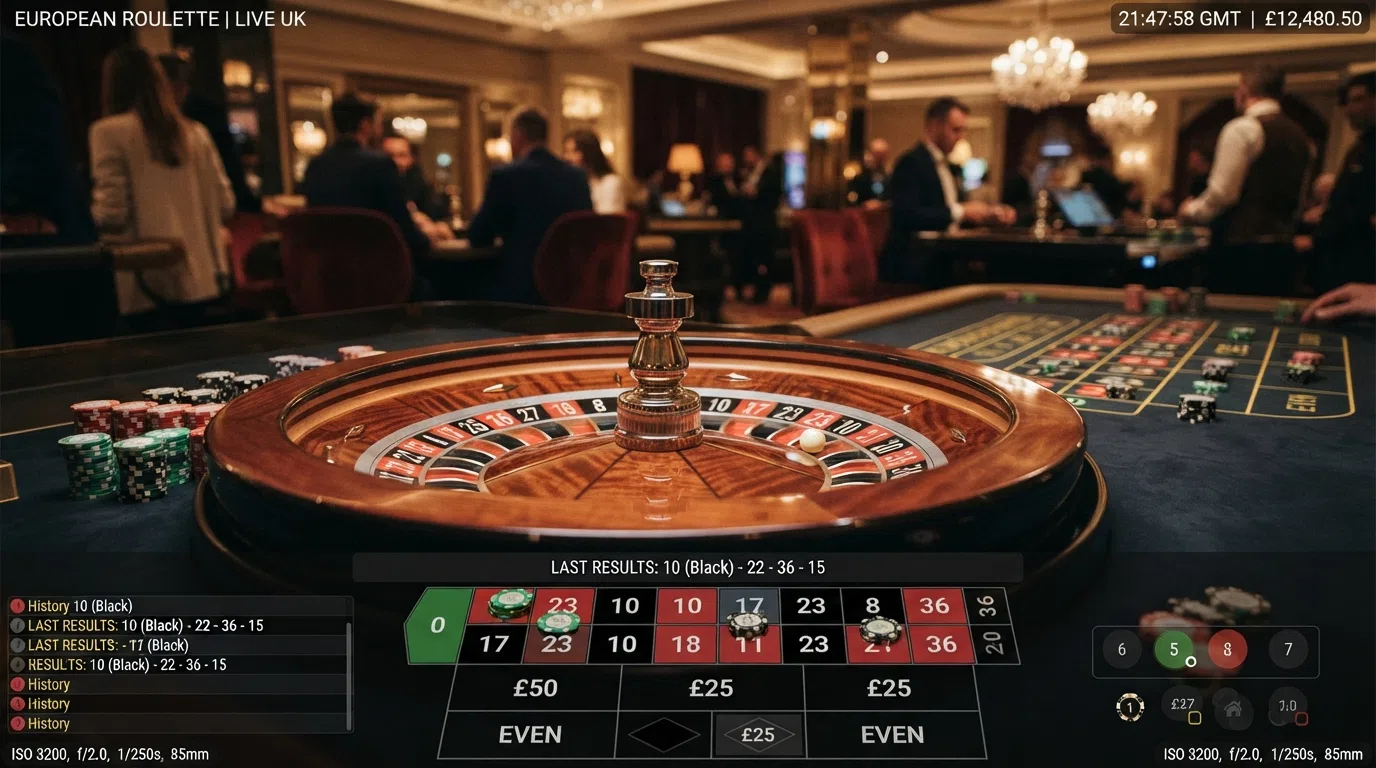
Live Roulette — European, Speed, Lightning and the Wheel That Never Sleeps
Roulette is the live-casino category that drives the most session volume, and the European single-zero wheel is the UK standard. The single zero carries a 2.7% house edge on every outside bet; the American double-zero wheel, where it appears, carries 5.26% on the same bets, and the difference is the largest single number in any live-casino game. A UK player who lands on an American table is paying almost twice as much per spin as on the European equivalent, and the marketing material rarely flags the difference.
Lightning Roulette is the multiplier variant from Evolution. A straight-up number bet pays 30:1 rather than the standard 35:1, and on each spin one to five numbers are struck by “lightning” multipliers of 50x to 500x applied to the straight-up payout. The catch is that the multipliers only boost straight-up bets; outside bets are paid at standard rates, so a player who spreads chips across the grid gets no multiplier benefit. Speed roulette and auto-roulette cut the spin interval to twenty or twenty-five seconds by removing the dealer, and the throughput gain is real: a session at an auto-roulette table completes roughly twice the spins of a standard table in the same hour, which doubles the cost of play at a constant stake.
Live Blackjack — the Table Where Rules Decide Your Return
Live blackjack’s house edge moves with the rule set. The UK standard is a six- or eight-deck shoe, dealer stands on soft 17, blackjack pays 3:2, and the player may double on any two cards and after splitting. That rule set puts the house edge at well under 1% when the player plays a basic strategy. Rule variations that move the edge against the player include dealer hits on soft 17 (worth about 0.2% extra to the house), blackjack paying 6:5 instead of 3:2 (worth about 1.4% extra) and restricted doubling (worth about 0.1% extra per restricted situation).
Side bets are the more visible variation. Perfect Pairs and 21+3 pay 25:1 or more on the named combination, and the hit frequency is low enough that the house edge runs at 4% to 6% on most side bets — sometimes higher. A player who adds a side bet to a basic-strategy hand is paying for the chance of a big payout in expected loss.
Multi-seat and bet-behind tables exist for when the main seven seats are full, and the bet-behind option lets a player wager on another player’s hand without taking a seat. The RTP of a live blackjack hand depends on the player’s decisions, which is why no fixed RTP figure applies to a live blackjack table the way a fixed figure applies to a slot. The variation between a basic-strategy player and a player making instinctive calls is wider than the variation between two different blackjack rule sets.
Live Baccarat and the Squeeze — a Ritual That Built a Vertical
Baccarat is a low-house-edge card game with three bets: banker (pays 0.95:1, house edge about 1.06%), player (pays 1:1, house edge about 1.24%) and tie (pays 8:1 or 9:1, house edge about 14% or higher). The banker’s edge is the lowest in the live casino at any standard table, which is why baccarat is a high-volume category despite a small-stakes reputation for being a high-roller’s game.
The squeeze ritual — where the dealer slowly bends the cards before revealing them — is theatre rather than mechanism. Speed baccarat cuts the squeeze and runs more hands per hour, with the same edge profile. The squeeze exists because players want it; speed baccarat exists because some players want more hands per session, and the providers have built both.
Poker, Game Shows and Everything Else — the Tables That Round Out the Lobby
Beyond roulette, blackjack and baccarat, a big live lobby carries live Hold’em, Three Card Poker and Caribbean Stud on the poker side, with rule variations that distinguish each from the RNG equivalent. Game-show titles — Dream Catcher, Crazy Time, Monopoly Live, Lightning Roulette’s wheel — are a category of their own. They did not exist five years ago; they now drive the most session starts at several providers. A live-casino player who skips the game-show floor is missing the highest-variance category on the menu.
Dragon Tiger, Sic Bo, Hi Lo and craps round out the niche tables. They appear at the bigger providers and not at every reviewed casino, which is one reason provider count matters at the operator level. Live slots and wheel-of-fortune games bridge the live and RNG verticals, and a player who plays both should expect the same provider brand to appear in both lobbies.
Why Most “Live Casino Bonuses” Are Really Slot Bonuses in Disguise
The structural reason most welcome offers exclude or devalue live-dealer play is the live table’s lower house edge and higher operating cost. A casino can afford to pay 200 free spins on a slot whose RTP runs at 94%; the same casino cannot afford to fund live blackjack play at a 0.5% house edge, where the player is expected to keep almost everything they stake. The arithmetic closes the offer. Free spins on slots and a zero-wagering mechanic are how UKGC-licensed casinos structure their headline welcome in a market where the live game cannot carry the cost of the same bonus.
The 10x statutory cap on wagering requirements under LCCP Social Responsibility Code 5.1.1 is the second piece of the picture. A 10x ceiling is low by international standards, and it is the reason six of the ten featured operators have moved to a 0x wagering welcome. The two operators still running 10x — William Hill and Coral — are operating at the regulatory maximum, not below it. The mixed-product promotional ban is the third piece: a welcome offer cannot bundle a slot bonus with a live-dealer bonus in a way that lets the player move funds between products, and the regulator has closed that route.
The single live-casino-specific offer in the featured set is Virgin Games’s cashback promotion, and that offer is the proof that live-casino bonuses exist under UKGC rules — they just look different from the slot welcome. A cashback paid on live-table net losses costs the casino a fraction of what a free-credit live bonus would, and the structure survives the 10x cap by being a return on losses rather than a bonus on deposits.
Welcome Bonuses and the Live-Table Trap — What the Headline Doesn’t Say
Every welcome offer in the featured set pays the player in free spins on slot games, not in live-dealer credit. That is a fact about the offer, not a complaint about the operator. The 0x wagering trend makes the spin winnings genuinely withdrawable, which is a real improvement on the wagering requirements the UK market was running five years ago, but the improvement is in the slot welcome, not in the live welcome. A player who deposits to claim 200 free spins and then plays a live table for the evening has paid the deposit, completed the verification, claimed the spins — and is funding the live session from their own bankroll.
A live player reading a welcome offer should look for the live-table contribution rate in the bonus terms. Where the terms permit live-table wagering, the contribution is usually 10% to 20% of the slot contribution rate, which stretches the effective wagering requirement by a factor of five to ten. A 10x bonus with 10% live contribution is functionally a 100x bonus at the live table. Most UKGC-licensed live casinos resolve the question by excluding live play from the welcome offer entirely.
Wagering Requirements, Expiry Windows and the Terms That Cancel Your Winnings
A bonus’s real cost lives in three numbers: the wagering multiple, the contribution rate and the clock. The 10x statutory ceiling is the upper bound; most operators in the featured set set it lower or at zero, and the two operators running 10x are operating at the maximum. Where wagering is zero, the spin winnings are real withdrawable cash, and the only thing the clock can do is expire the spins before they are used.
Contribution weightings are where most players lose track. Live blackjack and live roulette typically count 10% to 20% toward wagering requirements where they are eligible at all, and most UKGC-licensed casinos exclude live play from the welcome wagering altogether. The practical effect is that a 10x welcome bonus on a casino with 10% live contribution is functionally a 100x bonus at the live table, which is why the welcome is rarely cleared at the live tables.
Expiry windows in the featured set range from 72 hours at William Hill and BoyleSports to 30 days at Bet365, Sky Vegas and Virgin Games. The shorter windows sit at the high-wagering end of the set: a 72-hour window and a 10x requirement is a tight budget for clearing. William Hill’s £30 maximum cashout is the other number in the small print that cancels most of the welcome’s value, since a 10x requirement on slot winnings paid at 10p per spin rarely produces more than £30 in cleared value anyway.
Getting Money In and Out — UK Live Casino Payments
UK live casinos move money through three main rails: PayPal, debit card and Paysafecard. The credit card is gone — banned for all gambling since 14 April 2020 — and every UKGC-licensed operator has to verify the customer’s name, address and date of birth before the first deposit or first bet. That verification step is the bottleneck on every first withdrawal, no matter which payment rail a player uses.
PayPal is the fastest widely available withdrawal rail at UKGC-licensed live casinos. Where the operator supports PayPal, the typical withdrawal window runs from a few hours to 24 hours, with the operator’s own processing time as the main variable. Debit card withdrawals run one to three business days, depending on the card issuer, and that delay is outside the casino’s control. Paysafecard and prepaid vouchers are deposit-only at every reviewed operator; the player funds the account with a voucher and withdraws to a bank account or PayPal.
The mandatory pre-deposit identity check is the single biggest reason no UKGC-licensed live casino offers instant first withdrawals. A player who has not uploaded a passport and a proof of address will not get the first withdrawal through, no matter which rail they choose. The verification usually completes within 24 hours of the documents being submitted, and once the account is verified the withdrawals run on the operator’s normal schedule.
PayPal, Debit Cards and Paysafecard — How Each One Moves Your Money
PayPal is the right rail for a player who wants the withdrawal in their account the same day. The deposit is instant, the withdrawal usually clears inside a few hours once the account is verified, and the operator does not charge a fee. The catch is that not every UKGC-licensed live casino lists PayPal as a withdrawal option, and the operator’s terms page is the only place to check.
Debit card is the default rail and the one every reviewed operator supports. Deposits are instant, withdrawals run one to three business days, and the player does not need a separate account. Visa Debit and Mastercard debit are the standard; some operators support Maestro.
Paysafecard and prepaid vouchers are a deposit-only option. A player buys a voucher at a shop or online, enters the 16-digit code at the cashier, and the deposit lands. Withdrawals cannot run back to a Paysafecard, so the player has to register a bank account or PayPal for the first withdrawal. The voucher route is useful for a player who wants to keep the gambling spend off the main bank statement.
The pre-deposit identity check is the line that ties the three rails together. Since 7 May 2019, remote licence holders have had to verify name, address and date of birth before a customer can deposit or gamble. The verification happens once, takes a few minutes, and the player does not see the delay on the second withdrawal onwards. The first withdrawal is always the slowest.
Live Casino on Your Phone — What the Apps Actually Deliver
A live casino on a phone is two products: the app and the browser. The reviewed operators publish a native app on the iOS and Android stores, and the live lobby opens inside the app. The browser version runs in mobile Safari and Chrome and the stream quality is comparable, but the app wins on push notifications, on biometric login and on the camera roll integration the KYC step uses for document upload. A player who has the operator’s app installed is one tap from the live lobby; a player using the browser is two or three taps away.
The live-dealer game that translates worst to a phone is baccarat squeeze, where the ritual relies on a wide table view of the dealer’s hands. The games that translate best are European roulette and standard blackjack, where the betting grid is the centre of the interface and the stream is a window on top. Game-show titles sit in the middle; the wheel takes the centre of the screen and the betting grid sits below it, and the layout works in portrait.
Stream quality on mobile data depends on the connection. A live stream on a strong 4G or 5G connection runs at the same resolution as on Wi-Fi, and the modern studios are designed to scale down gracefully on a weaker signal without dropping the feed. A player who plans to play on a train or a hotel Wi-Fi should expect a stream that drops resolution rather than disconnects, and the betting interface does not stall when the video stalls.
Native Apps, Mobile Browsers and the Games Built for a Six-Inch Screen
A native app is the right answer for a player who plays often. Push notifications tell the player when a new table is open, when a tournament starts and when a withdrawal has cleared. Biometric login cuts the time to the live lobby from a fifteen-second password entry to a fingerprint. The KYC camera integration lets a player take a passport photo inside the app rather than uploading a file from the camera roll.
The mobile browser is the right answer for a player who plays occasionally. A live casino in a mobile browser is one bookmark away, and the stream quality is comparable to the app on a strong connection. The cost is in the KYC step: document upload from a browser requires the player to find a file on the device, while the app takes the photo directly.
Roulette and blackjack translate best to portrait mode. The betting grid is the centre of the interface, the stream is a window above it, and the layout works on a six-inch screen. Baccarat squeeze relies on a wide view of the dealer’s hands and looks cramped in portrait; landscape mode is the right choice for the squeeze variants, and the reviewed apps switch the orientation automatically when the table is in play.
Crypto Live Casinos — a Route UK Players Walk at Their Own Risk
A live casino that takes Bitcoin, Litecoin or other cryptocurrencies is, almost by definition, not a UKGC-licensed operator. The UKGC framework requires identity verification before the first deposit, and a fully anonymous crypto deposit is incompatible with that requirement. A crypto live casino accessible to a UK player is therefore an offshore operator, and the analysis of whether to use one is the analysis of the offshore trade-off: lower friction on payment, but no UKGC protection, no GAMSTOP, no UK alternative dispute resolution, and no statutory consumer redress if funds are withheld.
The mechanics on a crypto live casino are different in two ways. Deposits clear on the blockchain rather than through a card processor, and the player funds the account by sending bitcoin or another token to a wallet address the operator publishes. Withdrawals run in the same direction, with the operator sending the token back to the player’s wallet. The speed of a crypto withdrawal depends on the blockchain and on the operator’s own processing time, and the player is exposed to crypto price moves between deposit and withdrawal in a way the pound-sterling player is not.
The protections the UK player gives up by going offshore are the protections the regulator built the system around. GAMSTOP exclusion does not apply, because the offshore operator is not part of the UK self-exclusion scheme. UK alternative dispute resolution is unavailable, because the operator is not registered with an approved ADR provider. Statutory consumer redress under UK law does not apply, because the operator is not within UK jurisdiction. If the offshore operator declines a withdrawal, the player has the operator’s own complaints process, the operator’s licensing jurisdiction (Curaçao, Malta, or whichever body issued the licence) and nothing else. The honest risk statement is that funds held by an offshore operator are held at the operator’s discretion, and a UK player has fewer tools to challenge a decision than at a UKGC-licensed site.
Bitcoin, Litecoin and the Offshore Live Casino Trade-Off
The mechanics of a Bitcoin live-casino deposit are simple: the player sends bitcoin to a wallet address the operator publishes, the funds land inside the casino account after blockchain confirmation, and the player uses the bitcoin-denominated balance to play. Litecoin and other altcoins work the same way, with the altcoin wallet and the altcoin blockchain as the route. The advantage is friction — no card decline, no bank block, no KYC step in the way the UKGC mandates. The cost is the loss of every protection the UK system provides.
A crypto live casino’s bonus structure is the second point of difference. The 10x wagering cap does not apply, because the operator is not within UKGC jurisdiction. A 40x or 50x wagering requirement on a deposit bonus is the norm, and the bonus terms are written under the licensing jurisdiction’s own rules, which are not the UK rules. The trade is between lower friction and lower protection, and a UK player should know what they are giving up before they send the first bitcoin.
The honest summary is that crypto live casinos are accessible to a UK player, but they are not a route a UK player should walk without reading the small print twice. The protections the UK regulator built are the reason the UK market is the most player-safe in Europe, and a player who leaves that market is the one who pays for the lower friction if something goes wrong.
New UK Live Casinos in 2026 — Fresh Faces, Same Safeguards
The UK live-casino market sees new entrants each year, and the route in is a UKGC remote licence. The novelty in a new launch is in the product layer — a fresh provider mix, a different welcome, a new app — and not in the protection layer. A new operator must demonstrate financial fitness, software integrity, safer-gambling tooling and a working complaints process to the Commission before a licence is granted, and the safer-gambling obligations that apply to a ten-year-old operator apply to a launch-day operator on the same day. The novelty of a new casino is in what it does with the same rule book.
The Remote Gaming Duty rise to 40% from 1 April 2026 is the economic pressure that bears most heavily on new entrants. A higher duty means a higher cost on every pound of GGY, and a new operator with no established customer base pays that cost on a smaller revenue base than a ten-year-old competitor. The effect is on the welcome offer: a new entrant with thin margins cannot afford a 500-free-spin welcome in the way an established operator can absorb it. The trend is toward smaller welcome packages and tighter terms, and a player comparing two new UKGC-licensed launches should expect the welcome to be leaner than at the established brands.
The trade-off in opening a new account at a new operator is the freshness against the data. A new operator has no public payout history, no forum reports of withdrawal speed and no long tail of player complaints. The UKGC licence is the floor of trust, but the ceiling depends on the operator’s execution, and a player with years of payout data at a ten-year-old operator is giving up information by switching.
What to Check Before You Join a Live Casino That Launched This Year
A five-minute check saves a bad deposit. The UKGC public register is the first stop. The licence number is in the casino’s footer, on the terms page or on the safer-gambling page, and the register entry confirms whether the licence is active, which entity holds it, and which activities it covers. A missing or suspended entry is the single most important signal on the page.
The live-lobby provider list is the second check. The provider mix determines which games the player can play, and a new operator running only one provider has a thinner lobby than one running two or three. The bonus terms page is the third check: the live-table contribution rate and the validity window are the two numbers that decide whether a welcome is worth the deposit. A GAMSTOP integration — the player can self-exclude through the operator’s safer-gambling page and the exclusion propagates to every UKGC-licensed operator — is mandatory under UKGC rules, and the operator’s safer-gambling page is the place to test it. A deposit-limit prompt at sign-up is mandatory from 31 October 2025, and a new operator that does not surface the prompt at registration is operating outside the framework. Player reports on independent forums are the last check: a search for “operator withdrawal” or “operator payout” surfaces the practical experience other players have had, and a pattern of complaints is the signal to look elsewhere.
The Law Behind Every UK Live Casino — Your Licence Shield
The UK regulatory framework for gambling is the densest in Europe, and the density is the player-protective feature. Three statutes, a regulator with statutory objectives, a licensing code of practice, a remote technical standards document, a self-exclusion scheme and a series of stake and bonus caps all sit on top of the live-casino product. A UK player who understands the framework knows what every reviewed operator is required to do, and knows which protections disappear when a site sits outside it.

The Gambling Commission is the regulator, sponsored by the Department for Culture, Media and Sport. Its three licensing objectives under section 1 of the Gambling Act 2005 are: preventing gambling from being a source of crime or disorder, ensuring gambling is conducted in a fair and open way, and protecting children and other vulnerable persons from being harmed or exploited by gambling. Every decision the Commission takes is supposed to advance those three objectives, and they are the standard a player can hold the regulator to.
The mandatory player protections sit on top of the licensing objectives. Identity verification before deposit has been required since 7 May 2019. GAMSTOP self-exclusion is mandatory for online licence holders since 31 March 2020. The 10x wagering cap under LCCP Social Responsibility Code 5.1.1 has been in force since 2022. Deposit limits are customer-set, but the offer of a limit is mandatory, and from 31 October 2025 operators must prompt a financial limit before the first deposit and action any decrease immediately. Financial vulnerability check thresholds have dropped to £500 (from 30 August 2024) and £150 (from 28 February 2025). The credit card ban has been in force since 14 April 2020. The mixed-product promotional ban closes a loophole the regulator saw in welcome offers. The statutory levy replaced voluntary contributions from 6 April 2025, with a top rate of 1.1% of the leviable amount for remote casino and related licences.
The slot stake caps — £5 for players 25 and over (in force 9 April 2025) and £2 for players 18 to 24 (in force 21 May 2025) — apply to online slots only and do not apply to live dealer games. A live-casino player is not affected by the slot stake caps. The 10x wagering cap does apply across casino products.
| Condition | What It Means for Live Casino Players | In Force Since |
|---|---|---|
| Mandatory identity verification before deposit | No anonymous play; first withdrawal always requires verified KYC | 7 May 2019 |
| GAMSTOP self-exclusion mandatory | Every UKGC-licensed live casino is part of the national self-exclusion scheme | 31 March 2020 |
| Credit card ban | No credit card deposits on any UKGC-licensed site | 14 April 2020 |
| 10x wagering cap | Welcome offers cannot carry wagering above 10x bonus amount | 2025 (LCCP SR 5.1.1) |
| Online slot stake caps (£5 / £2) | Apply to online slots only — not to live dealer games | 9 April / 21 May 2025 |
| Financial vulnerability checks | £500 threshold, dropped to £150 | 30 Aug 2024 / 28 Feb 2025 |
| Deposit-limit prompt mandatory | Operator must prompt for a deposit limit before first deposit; decreases immediate | 31 October 2025 |
| Mixed-product promotional ban | A welcome offer cannot bundle a slot bonus with a live-casino bonus for cross-product use | 2022 (LCCP) |
| Remote Gaming Duty 40% | Operator tax doubled; pressure on new entrants and welcome generosity | 1 April 2026 |
| Statutory levy 1.1% top rate | Replaces voluntary contributions; funds research, prevention and treatment | 6 April 2025 |
A non-UKGC live casino removes the entire table from the player’s protection. No mandatory verification, no GAMSTOP, no 10x cap, no statutory levy-funded treatment. The player is dealing with an operator under another jurisdiction’s rules, and the practical difference shows up at the moment something goes wrong.
How to Read the UKGC Public Register — and Why It Matters for Live Casino Players
The Gambling Commission’s public register is the single source of truth on whether a UK-facing operator is licensed. The URL is on the Commission’s website and the search is by operator name or licence number. The fields to check are the licence status (active, suspended, revoked), the operator’s legal name, the licensed activities (the register lists the specific permissions, including remote casino), and the trading names associated with the licence. A match between the register entry and the operator’s footer and terms page is the floor of trust. A missing entry is a deal-breaker, and a suspended entry is a reason to walk away from a deposit.
A Gibraltar or Malta Gaming Authority badge on a UK-facing site is not a substitute for a UKGC licence. The UKGC licence is required at the point of consumption — the Commission requires any operator taking UK customers to hold a GB remote licence, and providing gambling facilities without one is a criminal offence under section 33 of the Gambling Act 2005. An operator holding a Malta licence but no GB licence is committing a UK criminal offence by taking UK play, and a UK player with a complaint has no UK statutory recourse. The register check is the two-minute test that separates the licensed from the rest.
Non-GamStop Live Casinos — the Risk UK Players Take When They Step Outside the Framework
GAMSTOP is the UK’s national self-exclusion scheme, and every UKGC-licensed online operator has been mandatory participants since 31 March 2020. A player who self-excludes through GAMSTOP is excluded from every UKGC-licensed site for the chosen period, and the exclusion periods are six months, one year, five years, or five years with auto-renewal. Exclusions cannot be cancelled early. The system is the cornerstone of the UK’s self-exclusion infrastructure, and a live casino that advertises as “not on GamStop” has, by definition, opted out of it.
A “not on GamStop” live casino is almost always an offshore operator. The marketing pitch is a player who has self-excluded through GAMSTOP and is looking for a way back in; the structural reality is that the operator is not within the UK licensing framework, and the protections that come with the framework are not available. No UK alternative dispute resolution, no UKGC dispute resolution, no statutory consumer redress under UK law, no GAMSTOP coverage, no contribution to the statutory levy that funds treatment. The honest risk statement is that funds held by an offshore operator are held at the operator’s discretion, and the player’s recourse runs through the operator’s licensing jurisdiction rather than through the UK courts.
The other side of the choice is that some UK players are not self-excluded and are choosing an offshore operator for other reasons — anonymity, payment flexibility, higher bonuses. The analysis is the same. The player is trading UK protections for offshore features, and the trade should be made with eyes open.
Staying in Control — the Tools Every UK Live Casino Must Give You
The safer-gambling tools at a UK live casino are not a courtesy — they are a UKGC licence condition. The problem is real. In England, around 0.5% of adults experience problem gambling and 3.8% are at elevated risk of gambling harms. That is roughly one in two hundred adults at the most serious end, and one in twenty-five at the elevated-risk end, and the regulator’s framework is built around reaching both groups through the operator’s safer-gambling tooling.
The mandatory tool set covers deposit limits, reality checks, time-outs and GAMSTOP self-exclusion. A deposit limit is customer-set, the offer of setting one is mandatory, and any decrease takes effect immediately while an increase has a cooling-off period. A reality check is a pop-up that interrupts the session at a configurable interval and tells the player how long they have been playing and what they have spent. A time-out is a short self-exclusion, typically 24 hours to six weeks, and a GAMSTOP exclusion is the longer version at six months or more. From 31 October 2025, the operator must prompt for a deposit limit before the first deposit, which means the safer-gambling tooling is on screen at the moment the player is about to fund the account.
The NHS runs a self-assessment that gives a player a score from 0 to 20, and a score of 8 or higher indicates that the player or those close to them is likely to be experiencing gambling-related harms (as the NHS notes: “If your total score is 8 or higher, you or those closest to you, are likely to be experiencing gambling-related harms.”). The assessment is free, anonymous and takes a few minutes. A score above the threshold is the signal to act: contact the National Gambling Helpline, set a deposit limit, self-exclude, or do all three.
The National Gambling Helpline is 0808 8020 133, free 24 hours a day, 7 days a week, run by GamCare on behalf of the NHS (as the NHS advises: “Call 0808 8020 133 for free 24 hours a day, 7 days a week for free information, support and counselling”). The helpline gives information, support and counselling, and the call is free from any UK phone. NHS gambling harm clinics operate in England, Scotland and Wales, and a GP can refer a patient to the local clinic for face-to-face treatment. The Wales helpline is 0808 2819 265. GambleAware funds research, prevention and treatment, and the National Gambling Treatment Service is the clinical route for the most serious cases.
Deposit Limits, Reality Checks and Where to Get Help — Beyond the Tick-Box
A deposit limit set in advance is the single most effective safer-gambling tool a UK live casino offers. A player who has set a daily or weekly limit cannot lose more than the limit allows, no matter what happens at the table. A decrease in the limit takes effect immediately, and an increase has a 24-hour or seven-day cooling-off period depending on the operator, which means a player who wants to raise a limit has time to think about whether the raise is the right decision.
The reality-check pop-up is the second tool, and most UK players either configure it to a long interval or skip past it. The default setting on most reviewed operators is a pop-up every 30 to 60 minutes, and the practical effect is that a player who sets a 20-minute interval is forced to engage with the time and money spent every twenty minutes. That is the right configuration for a player who is worried about session length, and the wrong configuration for a player who wants an uninterrupted evening at the table. The choice is the player’s.
The financial vulnerability check thresholds — £500 in a 30-day rolling window, dropping to £150 from 28 February 2025 — are the regulator’s markers for when an operator should run a check on a player’s deposits. A player who crosses the threshold is asked a set of questions about their gambling, and a flag is raised internally for the safer-gambling team. The check is mandatory, the thresholds are fixed and the operator cannot opt out. Financial risk assessments, a more intrusive version, are still in the regulator’s pipeline and not in force today.
The NHS self-assessment, the helpline and the gambling harm clinics are the routes for a player who has crossed from “concerned” to “experiencing harm.” The self-assessment is anonymous, takes a few minutes, and the score is the player’s own benchmark. The helpline is free and operates 24/7. The harm clinics are face-to-face treatment, accessed through a GP referral or directly through the NHS gambling services page. The fastest route for a player in immediate distress is the helpline. The fastest route for a player who is concerned but not in crisis is the self-assessment.
Can You Play Live Dealer Games for Free? The Demo-Mode Reality
Free live-dealer play exists at a few UKGC-licensed live casinos, but in a narrow, operator-controlled form. A small number of studios offer “free-to-watch” tables where a player can sit at the table without staking, see the dealer’s stream and the betting interface, and watch the game without placing a bet. The format is not the same as a slot demo: there is no free-play balance to spend, no way to test a bet size, and no path from the demo to a winning or losing hand.
The distinction between a free live-dealer table and a free-to-play RNG casino game is the distinction between watching a deal and playing a hand. A slot demo gives the player a virtual balance, lets them spin the reels and see the game’s mechanics in action, and a player who has played the demo for ten minutes knows the game’s hit frequency and bonus structure. A live-dealer demo gives the player the stream and the interface, and a player who has watched for ten minutes knows what the dealer and the studio look like, but has not played a hand. The decision of whether the game is fun, whether the betting interface is responsive, and whether the stake sizes suit the bankroll — that decision is still made at the real-money table.
A demo session teaches a player what a free demo can teach — what the studio looks like, what the betting interface feels like, what the pace of the game is. It does not teach a player what a stake at the table feels like, what the variance of a session looks like, or whether the bankroll will last the evening. Those are real-money lessons, and the regulator’s free-live-dealer policy means they have to be learned with a real stake on the table.
Which UK Sites Let You Try Before You Deposit — and What “Try” Actually Means
A handful of UKGC-licensed live casinos offer a free-to-watch live-dealer table where a player can see the stream and the interface without staking. The reviewed operators do not all publish the same free-to-watch list, and the policy changes from time to time. A player who wants to try a live casino before depositing should check the operator’s lobby for a “free” or “view” tab, or contact customer support to ask whether a free-to-watch table is currently available. The free-to-watch route is the closest a UK player gets to a live-dealer demo, and the right way to use it is to see the studio and the interface — not to learn the game.
How We Chose and Ranked These Live Casinos
The ranking on this page was built from seven evaluation criteria. Stream quality — does the studio run in HD, and does the stream stay up on a mobile data connection? Game variety and provider depth — how many providers in the live lobby, and how deep is each provider’s catalogue? Bonus usability on live-dealer tables — does the welcome offer pay at the live table, and if not, is the slot welcome good enough to justify opening the account for the live lobby alone? Mobile experience — does the operator publish a native app, and does the live-casino tab load inside the app or route to a browser? Withdrawal speed — how fast does the operator process a verified withdrawal, and through which rails? Licence status — is the operator on the UKGC public register, with a current licence covering remote casino activity? Safer-gambling tooling — does the operator surface deposit limits, reality checks and the GAMSTOP route at the right moments?
Each of the ten featured operators was verified against the UKGC public register, last updated 10 October 2025. The bonus terms were read against the operator’s own current terms page, and the welcome offer details were taken from the operator’s own published offer. The provider list for the live casino was taken from the operator’s own lobby where the operator published it; for three of the ten operators — William Hill, Betfred and BoyleSports — the live-casino provider list is not publicly disclosed at the time of writing, and that absence is marked in the table above.
The criteria that could not be weighed numerically are the ones where the audit is the limit. Stream quality depends on a connection, and a player on a strong fibre line will see a different stream from a player on a rural 4G connection. Mobile experience depends on the device, the OS version and the app version. Withdrawal speed depends on the rail, the verification status and the operator’s own processing schedule. The ranking is built on the operator-level facts where the facts are public, and the player-level experience is the part the ranking cannot capture.
What UK Live Casino Players Should Actually Do With This
Three principles distilled from the page. First, start from the licence, not the bonus. The UKGC public register is a two-minute check that separates a licensed live casino from a clone, and a player who opens an account without checking the register is the one who pays for the mistake. The bonus is the second decision, after the licence.
Second, assume the welcome offer excludes live tables until the contribution rate says otherwise. Every welcome in the featured set pays in free spins on slot games, and the only live-casino-specific offer in the ranking is Virgin Games’s cashback promotion. A live-table player who treats the welcome as irrelevant to the live session and funds the session from the bankroll is making the right mental move. A player who tries to clear a 10x wagering requirement at a live table with 10% contribution is paying for the lesson.
Third, the live-casino experience is a product of its software provider. The choice between one live casino and another is mostly the choice between provider mixes, and the providers do not compete on price — they compete on studio design, dealer presentation and game-show depth. A player who treats the provider mix as the first filter and the operator brand as the second has the right ordering. Virgin Games’s seven-provider lobby is the broadest in the set, and a player who treats provider variety as the deciding factor lands there.
The Remote Gaming Duty rise to 40% from 1 April 2026 is the macro pressure on the market. A higher operator tax means smaller welcome packages and tighter terms at the established brands, and thinner margins at the new entrants. The trend is toward leaner welcomes across the board, and a player comparing a 0x welcome today with the same offer twelve months from now should expect a less generous headline.
The safest live-casino session is one where the deposit limits and reality checks are set before the first bet, and the player is gambling only what the limit allows. The session that ends in control is the one that started in control, and the safer-gambling tooling at every UKGC-licensed live casino is built to make that starting point easier to reach.
Frequently Asked Questions About UK Live Casinos
Do live dealer games use real cards, real wheels and real croupiers — or is it all software?
Live dealer games at a UKGC-licensed live casino use real cards, real wheels and real croupiers. The game is filmed in a broadcast studio, and a game controller unit encodes the physical outcome into the betting interface in real time. The provider brands running the studios are Evolution, Playtech and Pragmatic Play Live, and the studios are based in Latvia, Malta, Romania and the United States. RNG games are a different product — the outcome is software-generated, with no studio or dealer in the loop.
Are live casinos legal in the UK — and what licence must a site hold before it can deal to a UK player?
Live casinos are legal in the UK when the operator holds a current GB remote licence from the Gambling Commission. The licence covers remote casino activity, and the operator’s entry on the Commission’s public register confirms the licence status, the legal entity and the licensed activities. Providing gambling facilities without a GB licence is a criminal offence under section 33 of the Gambling Act 2005, and the Commission’s enforcement is disruption-led. A Gibraltar or Malta licence alone is not sufficient for UK play.
Why do most casino welcome offers exclude live dealer games, and which ones don’t?
Welcome offers exclude live dealer games because the live game runs on a lower house edge and a higher operating cost than a slot, and the arithmetic does not close at the same bonus level. The 10x statutory wagering cap under LCCP Social Responsibility Code 5.1.1 keeps the welcome modest, and the mixed-product promotional ban stops a casino from bundling a slot bonus with a live-casino bonus in a way that lets the player move funds between products. Virgin Games runs a live-casino cashback offer in the featured set, and that offer is the proof live-casino bonuses exist — they are just structured as a return on losses rather than as a free-credit welcome.
What is the best live casino in the UK right now for game variety, fairness and fast withdrawals?
The best live casino depends on what the player weights most heavily. Virgin Games runs a seven-provider lobby — the broadest in the featured set — and a live-casino cashback offer. Coral lists the fastest payout band in the set, at one to 24 hours. Bet365 carries Evolution, Playtech and Pragmatic Play Live under one roof, with the deepest game-show content. Sky Vegas runs the lowest-barrier entry, at a £5 stake for up to 200 zero-wagering spins. A player who wants the broadest game variety in a single account is best served by Virgin Games; a player who wants the fastest withdrawal is best served by Coral; a player who wants the deepest lobby is best served by Bet365.
What actually happens if I join a live casino that advertises “not on GamStop”?
A live casino that advertises as “not on GamStop” is, by definition, not a participant in the UK self-exclusion scheme, and that is the signal it is operating outside the UKGC framework. The protections that come with the UK framework are not available: no UK alternative dispute resolution, no UKGC dispute resolution, no statutory consumer redress under UK law, no GAMSTOP coverage, no contribution to the statutory levy that funds treatment. A player who joins such a casino is dealing with an offshore operator under another jurisdiction’s rules, and the practical difference shows up at the moment a withdrawal is questioned. The honest risk statement is that funds held by an offshore operator are held at the operator’s discretion.
How fast can I realistically get a withdrawal from a UK live casino — same day or next week?
The first withdrawal is always the slowest, because the operator has to complete the mandatory identity verification before the funds are released. Once the account is verified, PayPal withdrawals typically clear within a few hours, debit card withdrawals run one to three business days, and the operator’s own processing time is the main variable. Coral lists a one-to-24-hour payout band in the featured set, which is the fastest claim, and most UKGC-licensed live casinos publish their own processing windows on the terms page. A withdrawal that has not cleared inside five business days is the signal to contact customer support, and a withdrawal that has not cleared inside ten business days is the signal to raise a complaint through the operator’s ADR route.
No-Deposit Live Casino Bonuses — Do They Exist in the UK?
The no-deposit live-casino bonus is a search-volume magnet and a near-myth in the UKGC-licensed market. The economic logic is straightforward: a no-deposit bonus paid at a live table is a free-entry to a game with a low house edge, and the casino’s expected loss is the deposit-free player’s stake. Combined with the mandatory identity verification before the first deposit, which means the casino has collected the player’s full KYC before the bonus is even on the table, the offer’s economics are punishing. None of the ten featured operators carries a no-deposit live-casino bonus at the time of writing.
The UKGC-licensed market offers deposit-triggered, low-wagering or no-wagering welcome packages instead. That is the structural answer: the bonus exists, it just lives on the slot side of the lobby rather than the live side.
Live – fastestpayout-casinos-uk
Content created by the «fastestpayout-casinos-uk» team