
30 Free Spins No Deposit at UK Casinos: What's Worth Claiming and What the Terms Actually Cost You
 Available in GB
A “30 free spins no deposit” headline at a UK casino promises something simple: register, spin, keep what you land. In practice, the headline number is the least useful thing about the offer. What decides what you walk away with is whether the spins truly require no deposit, what the spin is worth in pence, whether the winnings arrive as cash or as bonus funds tied to a wagering multiple, and which slot the spins are locked to. The UK market changed materially on 19 January 2026, when the Gambling Commission capped wagering on casino bonuses at 10× and banned mixed-product promotional bundles. The change narrowed the gap between wagered and wager-free offers, and it pulled the floor up across the board. Even so, the gap that remains between a Sky Vegas 70-spin zero-wagering no-deposit welcome and an 888casino deposit bonus with a £100 win cap is the gap this page is built to walk the reader through.
This is what the licensed UK market looks like at the time of writing: ten operators ranked, the terms they actually publish, the slots their spins are locked to, and the regulatory framework that decides what every offer on the page is allowed to do. The reader who claims an offer on the strength of a headline number is the reader who gets the worst of the deal. The reader who reads the terms gets what is on offer. Current as of September 8, 2026; licence claims verified against the UK Gambling Commission public register.
What 30 free spins no deposit actually gets you at a UK casino
The phrase “30 free spins no deposit” carries four words, and each one does work. Thirty is the headline batch — the count of spins the operator credits to your account. Free means the spin itself is paid for by the operator rather than by your deposited funds. Spins fixes the game type to online slots, the only product category a free-spin bonus applies to. No deposit is the contested word: it can mean a registration-only batch, or it can mean a free-spin bundle inside a welcome package where a deposit is required to unlock the larger batch. Both uses appear on UK-licensed casino sites, and the reader cannot tell which one is on offer without reading the terms.
At a UK-licensed casino, the real cash value of 30 spins sits between £0.30 and £3.00, depending on the coin size and the number of paylines the spin activates. A 1p coin size across 10 paylines produces a £0.10 spin; 30 of those is £3.00 of slot play paid for by the operator. A 1p coin size across a single line produces a £0.01 spin; 30 of those is £0.30 of slot play. The “30” in the headline counts spins, not pounds, and the difference is large enough to change the expected return on the offer by an order of magnitude.
Why 30 became the threshold for major-operator participation is partly arithmetic and partly marketing. A batch of 30 spins gives the operator enough spins to be visible on a comparison page, enough wagering volume to make the wagering requirement (where one applies) meaningful, and enough player exposure to one slot for the marketing partnership with the slot provider to register. Smaller batches — 10, 20 — get the operator onto fewer affiliate pages. Larger batches — 100, 200 — cost more per claim and rarely come without a deposit. Thirty sits in the band where the offer can carry both a marketing story and a manageable liability.
The £0.01–£0.10 spin value band sits well below the statutory slot stake cap the Commission introduced under SI 2025/215: £5 per game cycle for players aged 25 and over (in force from 9 April 2025), £2 for players aged 18 to 24 (in force from 21 May 2025). The cap binds on a player who has deposited funds and is playing at their own stake. The free-spin value is fixed by the operator and is not constrained by the cap, so the cap is not the binding constraint on what an offer can be worth. The binding constraint is the wagering requirement, the max-cashout cap and the eligible slot — terms the operator sets and the Commission now partially caps.
Online vs land-based — why free spins live in the digital world
A land-based casino cannot practically offer a free-spin promotion. The mechanics do not travel. A free spin at a physical slot machine requires either a technician to reprogram the machine’s RNG (a regulatory event in its own right) or a free-play voucher entitling the player to a set number of physical pulls — a promotional mechanism that brick-and-mortar operators have never adopted at scale because the audit trail is incomplete and the bonus accounting is hard.
Online, every spin is logged. The game server records the spin ID, the player’s account, the bonus balance state, the wagering contribution and the outcome. Auto-play is banned and spin speed may not exceed 2.5 seconds per game cycle, both under the Commission’s Remote Technical Standards (RTS), in force since 31 October 2021. That framework is what makes a free-spin offer possible to deliver, audit and enforce. The same RTS framework bans losses disguised as wins and reverse withdrawals. Free spins sit inside this technical scaffolding.
The wagering cap that took effect on 19 January 2026 applies to all online casino bonuses under LCCP Social Responsibility Code 5.1.1. It is an online-only rule. A land-based casino offering a complimentary play voucher is governed by a different set of rules and is not bound by the 10× ceiling. The free-spin offer, as a construct, is an online phenomenon because the regulation, the technology and the bonus accounting all live in the same place.
Real-money play vs free-play — what the spins are actually worth
A free spin sits between demo play and real-money gambling. Demo play produces no withdrawable winnings: whatever the player wins on a slot in demo mode is notional, sits in a virtual balance, and disappears when the player closes the game. A free spin at a UK-licensed casino, by contrast, produces real withdrawable winnings — provided the terms attached to the spin allow it. The third category, real-money play with deposited funds, is what a free-spin offer is designed to lead into, and the wagering requirement (where one applies) is the bridge between the free spin and the deposit.
The spin value is fixed by the operator. Across the ten operators ranked on this page, the spin value sits at £0.01 (Bally, JackpotJoy, Virgin Games — at 1p coin size, with the line count multiplying the per-spin cost) or £0.10 (Sky Vegas, Paddy Power, Betfair, Ladbrokes, Coral, MrQ, 888casino). Both values sit well below the statutory slot stake cap. A 1p-coin, 10-payline spin costs £0.10 per spin regardless of whether the funds are deposited, bonus or free — the cap binds the same way for all three.
What determines whether a win is cash or bonus funds is the wagering requirement attached to the free spin. Under the Commission’s 10× cap, the maximum wagering a UK-licensed operator can attach to a casino bonus is 10× the bonus amount. Nine of the ten operators on this page attach zero wagering: the winnings arrive as cash, withdrawable from the moment they land. 888casino attaches the maximum-permitted 10×. The winnings arrive as bonus funds and must be wagered ten times before they convert to cash. The difference, on a £3 free-spin win, is the difference between a £3 cash balance and a £3 bonus balance that requires £30 of slot play before withdrawal.
Why your 2026 30-free-spin bonus is simpler than it looks
The free-spin bonus got simpler in 2026. Not because the operators changed what they offer, but because the Commission capped what they are allowed to charge for converting it. Before 19 January 2026, a casino welcome bonus typically carried a wagering requirement of 35× to 60× the bonus amount. A £3 free-spin win at 40× wagering required £120 of slot play before the £3 converted to withdrawable cash. At 60×, it required £180. Most players walked away before the wagering cleared, and the bonus expired with most of the balance still locked.
From 19 January 2026, the ceiling is 10×. The same £3 win at 10× requires £30 of slot play — a session of about 75 seconds at the regulated 2.5-second minimum spin interval, or longer in practice once a player pauses to look at the reels. That is a session a player can plausibly complete in one sitting. The Commission’s published rationale for the change was that “capping the wagering requirement to ten decreases the likelihood of harm, reduces complexity, and improves transparency while maintaining consumer choice.” The cap is the single most consequential change to the UK bonus landscape since the 2014 point-of-consumption reform, and its effect on the free-spin market is direct.
What the cap does not cover matters as much as what it does. The cap applies to the wagering multiplier. It does not cap the bonus amount — there is no statutory ceiling on the headline number of free spins or the size of a deposit match. It does not cap the maximum cashout from bonus winnings — 888casino’s £100 win cap on its deposit bonus is permitted under the new rules. It does not standardise the eligible-slot list, the spin value, the expiry window or the game-weighting rules. A 10× wagered offer on a low-RTP slot with a £100 cashout cap can still be worth less than a 0× wagered offer on a high-RTP slot with no cashout cap.
The same 19 January 2026 change brought in a second rule: the mixed-product promotional ban. Under LCCP Social Responsibility Code 5.1.1(3b), operators are no longer permitted to offer a promotional incentive that combines more than one type of gambling product — a single bonus can no longer bundle sports betting with casino play, or casino with bingo, in one offer. The rule reshaped how welcome packages are assembled. A reader looking at an offer that says “30 free spins plus a £10 sports free bet” is looking at a structure that no longer complies with the LCCP and would be an enforcement matter for the Commission if it remained in the market.
Underneath both rules, operator costs rose. Remote Gaming Duty on online operators increased from 21% to 40% from 1 April 2026, and the statutory levy on remote casino operators sits at 1.1% of gross gambling yield (in force from 6 April 2025) under the Gambling Levy Regulations 2025. The levy proceeds are split 50% to treatment, 30% to prevention and 20% to research. Higher operator cost feeds into tighter bonus terms where the operator chooses to absorb it, and into larger welcome offers where the operator chooses to compete on player acquisition. The 10× cap sits on top of this cost stack, and the free-spin market the reader sees today is the market that emerged from all three forces acting at once.
No-deposit 30 free spins — what the label really means
A “no-deposit” free-spin offer, in its pure form, is a registration-only batch: the player signs up, completes identity verification, accepts the bonus (where acceptance is required) and the spins are credited. No payment instrument is needed to claim; no deposit is required to trigger the spins. Three operators on this page offer this tier in its pure form. Sky Vegas credits 70 no-deposit free spins at 0× wagering on 11 eligible games including Eye of Horus and Fishin’ Frenzy. Paddy Power Games credits 60 no-deposit free spins at 0× wagering on 12 eligible slots plus Paddy’s Mansion Heist. Betfair credits 50 no-deposit free spins at 0× wagering on selected Jackpot King games. All three are operated by Flutter Entertainment.
The “no deposit” claim that is more common in the UK market, and the one the headline number usually refers to, is the free-spin batch inside a welcome package where the larger offer requires a deposit. Sky Vegas’s 70 no-deposit spins are followed by 200 more free spins when the player deposits and stakes £10. Paddy Power’s 60 no-deposit spins are followed by 200 more when the player deposits £10. Betfair’s 50 no-deposit spins are followed by 100 more on a £10 deposit and spend. The 30-spin number most often seen in the market sits inside a structure like this, where the headline batch is genuinely no-deposit but the bigger batch is deposit-triggered.
The distinction matters because the reader who registers for the no-deposit batch and then deposits to unlock the second batch is in two different bonus relationships at the same time. The no-deposit spins carry one set of terms (typically 0× wagering, a 7-day validity window, a fixed eligible-slot list). The deposit-triggered spins carry another (typically the same wagering structure but a different game list, sometimes a different spin value, and a deposit-linked validity window). The bonus terms the operator publishes are the single source of truth on which batch the player is in at any point.
Zero-wagering free spins — when “keep what you win” is real
“Keep what you win” is the phrase the UK market uses for a wager-free offer, where winnings from free spins arrive as cash in the withdrawable balance from the moment they land. The phrase is a marketing line; the underlying rule is a term in the bonus terms that sets the wagering multiplier at 0×. Betsquare’s 2026 framing of this as the gold standard — “30 free spins no deposit required, keep what you win” — captures what the offer promises in plain language and what the terms have to deliver to honour it.
Nine of the ten operators on this page attach 0× wagering to their free-spin welcome offers. Sky Vegas, Paddy Power, Betfair, Bally, JackpotJoy, Virgin Games, Ladbrokes, Coral and MrQ all run wager-free free-spin batches. The single holdout is 888casino, whose deposit bonus carries the maximum-permitted 10× wagering. The reason this matters is that 0× wagering collapses the gap between the spin and the payout: there is no bonus balance, no playthrough requirement, no expiry-tied playthrough window. The win either converts to cash at the moment it lands or it does not, and on a wager-free offer it does.
Before the 10× cap took effect, the wagering differential between offers was the dominant variable in the free-spin market. At 35×–60×, the wagered offers were punishingly expensive to clear and the wager-free offers were the only rational choice. At 10×, the calculus is closer: a 10× offer on a £3 win requires £30 of slot play to clear, which at a 96% RTP costs about £1.20 in expected house edge — a real cost, but a small one relative to the £3 starting position. The cap pulled wagered offers back into the market. It did not pull them into parity with wager-free offers; the reader who has both on the table should still pick wager-free unless the wagered offer carries a larger spin batch, a higher spin value, or a better eligible slot.
Welcome bonuses, sign-up offers and new-player 30-free-spin deals
The welcome bonus is the vehicle for nearly every 30-free-spin offer on this page. New-player welcome packages at UK-licensed casinos come in two broad shapes: a standalone free-spin welcome, where the free-spin batch is the entire bonus, or a deposit-bonus welcome, where the free spins sit alongside a deposit match.
Sky Vegas, Paddy Power, Betfair, Bally, JackpotJoy, Virgin Games, Ladbrokes, Coral and MrQ all run standalone free-spin welcomes. The free-spin batch is the bonus; the player is not offered a deposit match on top. 888casino runs a deposit-bonus welcome: a 100% deposit match up to £100 plus a free-spin batch. The deposit match carries 10× wagering and a £100 winnings cap; the free-spin batch carries its own terms.
A standalone free-spin welcome is easier to evaluate. The reader needs to compare spin count, spin value, wagering multiplier, eligible slot, expiry and cashout cap. A deposit-bonus welcome is harder. The reader needs to compare all of the above on the free-spin batch, plus the deposit match percentage, the match ceiling, the wagering on the deposit match, the cashout cap on the deposit match, the game-weighting rules and the deposit-method restrictions. The standalone welcome is the cleaner offer; the deposit-bonus welcome carries more variables and is the offer where readers most often take the headline number at face value.
Deposit £10 get 30 free spins — the most common UK free-spin structure
The “deposit £10 get 30 free spins” structure is the most common shape on the deposit-triggered side of the market. Six operators on this page run variations of it. Bally Casino requires a £10 deposit and a £10 wager on slots to unlock 30 free spins on Eye of Horus Legacy of Gold. JackpotJoy requires the same deposit-and-wager combination to unlock 30 free spins on Double Bubble (or 100 on Fishin’ Frenzy The Big Catch 2). Virgin Games requires the same to unlock 100 free spins on Big Bass Splash. Ladbrokes requires a £10 deposit and a £10 stake to unlock 100 free spins on selected games. Coral requires a £10 deposit and £10 spend to unlock 200 free spins on selected slots. MrQ requires a £10 deposit to unlock 30 instant cash spins on Big Bass Splash.
The “£10 deposit” in the structure is not the same thing as a £10 stake. A £10 deposit is money paid in. A £10 stake or wager is money bet on eligible slots. Bally, JackpotJoy and Virgin Games require the player to deposit £10 and wager £10 on slots before the spins unlock — meaning the player must play through the deposited amount once on slot games before the free spins credit. Ladbrokes phrases it as “deposit and stake £10”. Coral phrases it as “deposit and spend £10”. The mechanics are the same: the player must risk the £10 on slot play, not just hold it in the account balance.
The £10 deposit sits well below the threshold at which the Commission’s financial vulnerability check engages. Under LCCP Social Responsibility Code 3.4.4, most remote licensees must run a light-touch check using publicly available data when a customer’s net deposits exceed £150 in a rolling 30-day period (the £150 figure took effect on 28 February 2025, reduced from the £500 figure that applied from 30 August 2024). A £10 first deposit does not trigger the check. A reader depositing £10 to unlock 30 free spins is depositing at a level the regulator has classified as not warranting a vulnerability check; the £10 is below the floor at which operator-side scrutiny begins.
Bonus terms that shape the real value of 30 free spins
The terms attached to a 30-free-spin offer determine what the offer is actually worth. The reader who skips the terms sees the headline and stops; the reader who reads them sees the offer. The terms that matter most are:
- Wagering multiplier. The number of times bonus funds must be played through before they convert to cash. The maximum permitted under LCCP SR Code 5.1.1 from 19 January 2026 is 10×. Nine of the ten operators on this page run 0×. 888casino runs the maximum-permitted 10×.
- Maximum cashout cap. The ceiling on how much of the bonus winnings can be withdrawn. Most operators on this page do not state a cap. 888casino caps its deposit-bonus winnings at £100.
- Eligible slot. The specific slot or slot family the spins are locked to. Operators restrict spins to particular games because the slot providers pay for the marketing exposure, because the slot’s RTP configuration is part of the operator’s cost model, and because restricting the slot limits the player migration to higher-margin games during the bonus window.
- Spin value. The per-spin cost the operator sets. £0.01 (1p coin size, single line) or £0.10 (1p coin size, 10 lines) across the featured set.
- Bonus validity. The window during which the spins must be used. Seven days is standard for the Flutter brands; 30 days is standard for the Gamesys brands and Bally; 3 days is the window on 888casino’s no-deposit free spins.
The term the operator is required to display prominently is the wagering multiplier and any cashout cap. The term the operator buries, where it exists, is the eligible-slot list — often linked from the bonus terms page rather than named in the headline. The reader who checks both sees what the offer is.
Existing-customer 30 free spins — offers beyond the welcome bonus
Free spins are not only for new players, though the welcome bonus dominates the market. Existing-customer free-spin promotions appear as reload offers (a free-spin batch tied to a fresh deposit), as loyalty programme rewards (a free-spin batch credited at a tier threshold), and as seasonal promotions (a free-spin batch tied to a calendar event or a slot launch).
The Commission’s direct marketing opt-in rules, in force from 1 May 2025 under LCCP SR Code 5.1.12, apply to existing-customer offers the same way they apply to welcome offers. The player must have opted in to “casino bonus offers via email or SMS” specifically before the operator can market a free-spin promotion to them. The reader who has opted out of marketing will not receive an email or SMS about an existing-customer free-spin offer. The offer will still be visible in the promotions tab of the casino account, where the player has affirmatively logged in.
The welcome-bonus dominance of the free-spin market is a structural fact: new-player acquisition is where the marketing spend lives, and reload and loyalty offers tend to carry smaller free-spin batches and tighter terms. A reader who has burnt through a welcome offer and is looking for a second batch is looking in a thinner market than the reader comparing welcome offers.
How to claim 30 free spins — the step-by-step flow at a UK-licensed casino
The claim process is uniform across GB-licensed operators because the regulation mandates it. A reader claiming 30 free spins at any of the ten operators on this page goes through the same five steps.
First, registration. The player provides a name, address, date of birth and contact details. Identity verification happens at this point or at the latest before the first deposit or any gambling, under the Commission’s Money Laundering Regulations framework. A player who is self-excluded via GAMSTOP cannot pass this step; GAMSTOP has been a mandatory condition of every GB online operating licence since 31 March 2020, with exclusion periods of six months, one year, five years, or five years with auto-renewal — and it cannot be cancelled early.
Second, bonus acceptance. Where the operator requires explicit bonus acceptance, the player clicks to accept. Acceptance is a regulatory artefact: it records that the player has seen the bonus terms and has chosen to claim under those terms. Most operators on this page credit the bonus automatically, with the acceptance step folded into the registration flow.
Third, deposit and stake (for deposit-triggered offers only). The player deposits £10 via a debit card or an e-wallet. Credit cards have been banned for all remote gambling payments since 14 April 2020 under LCCP licence condition 6.1.2, with the ban extending to credit-card-funded e-wallet payments. The player then wagers £10 on eligible slots. The spins credit when the wager is complete.
Fourth, spins credited. The 30 free spins appear in the bonus balance or directly on the eligible slot. The player opens the slot and plays the spins. Auto-play is banned, so the player spins manually. Spin speed is bounded by the 2.5-second RTS minimum.
Fifth, withdrawal. On a 0× wagering offer, any winnings land in the cash balance and can be withdrawn immediately. On a 10× offer, the winnings land in the bonus balance and must be wagered ten times before they convert to cash. Withdrawal time depends on the payment method; PayPal and debit card withdrawals at the operators on this page typically clear within 24 hours.
The slots behind your 30 free spins — and which ones pay best
The eligible slot matters as much as the bonus terms. A 0× wagering offer on a slot with a 96% RTP is not the same offer as a 0× wagering offer on a slot with a 94% RTP, because the expected return on each spin is different. The two percentage points of RTP translate directly into expected house edge per spin: on a £0.10 spin at 96% RTP, the expected loss per spin is £0.004; at 94%, it is £0.006. Over 30 spins, the difference is £0.06 — small in absolute terms but meaningful as a proportion of the £3 free-spin value.
Four slot titles dominate the UK free-spin market: Book of Dead, Big Bass Splash, Eye of Horus and Starburst. Book of Dead (Play’n GO) has an RTP of 96.21% in its default configuration and is classified as high volatility. Big Bass Splash (Pragmatic Play / Reel Kingdom) has an RTP of 96.71% in its default configuration, is also high volatility and carries a max win of 5,000× stake. Eye of Horus (Blueprint Gaming / Gauselmann Group) has an RTP of 96.31% and is classified as medium-high volatility (Sky Vegas, Paddy Power and BetMGM UK classify it as High). Starburst (NetEnt) has an RTP of 96.09% and is the canonical UK welcome free-spin slot, with low-medium volatility.
The RTP gap between the best (Big Bass Splash at 96.71%) and the worst (Starburst at 96.09%) eligible slot on this page is 0.62 percentage points. On a £3 free-spin batch at £0.10 per spin, that gap translates to an expected-loss difference of about £0.019 — under two pence across the entire batch. In absolute cash terms the gap is small. In percentage terms the gap is large enough that an offer locked to Big Bass Splash is structurally worth more than an identical offer locked to Starburst, before any other term is considered.
Volatility matters because it shapes how 30 spins feel. On a high-volatility slot like Book of Dead or Big Bass Splash, 30 spins is a small sample: most spins will return nothing or close to nothing, and the offer’s value sits in the chance of a single large hit. On a low-medium volatility slot like Starburst, 30 spins produces more frequent smaller wins and a steadier balance trajectory. A player who prefers the latter experience is better served by a Starburst offer; a player who prefers the former, by a Book of Dead or Big Bass Splash offer. The RTP difference does not change between the two; the variance profile does.
A further wrinkle sits in the RTP configurability of these titles. Operators can — and some do — configure Book of Dead at lower RTP settings (94.25% or 91.25%) rather than the default 96.21%. The eligible slot the reader sees named in the bonus terms is the same slot; the underlying RTP may not be. The Commission’s position is that the operator must disclose the RTP of the game in play, but the reader who wants to verify which RTP configuration is live on the slot during a free-spin session has to look at the in-game help screen rather than at the bonus terms.
The selected-slots restriction — why you cannot play 30 free spins anywhere
Free spins cannot be played anywhere. They are locked to a specific slot or a specific slot family, and the slot list is part of the bonus terms. The restriction is not arbitrary. Operators select the eligible slots for three reasons.
First, provider deals. Slot providers pay operators — or fund marketing campaigns that pay operators — to feature specific slots in welcome offers. Play’n GO’s Book of Dead and Pragmatic Play’s Big Bass Splash are the slots behind most UK welcome free-spin offers because both providers run aggressive free-spin marketing campaigns aimed at UK-licensed operators. The marketing spend flows from the slot provider to the operator; the free-spin value flows from the operator to the player; the slot is the through-line.
Second, RTP configurability. Some slots allow the operator to set the RTP within a range. Book of Dead ships with RTP configurations of 96.21%, 94.25% and 91.25%; the operator chooses which one to deploy. A slot that allows RTP configuration is a slot the operator can price into a bonus offer. A slot that ships at a fixed RTP is a slot where the cost is fixed and the operator cannot absorb margin differences in the same way.
Third, marketing value. A free-spin batch on a new slot launch is a marketing event; the operator gets player exposure on a fresh title and the slot provider gets player acquisition on a launch. A free-spin batch on a slot like Starburst, which has been the UK welcome free-spin default for a decade, is a steady-state offer rather than a launch event.
The eligible-slot lists across the featured operators vary in scope. Sky Vegas runs 11 eligible games including Eye of Horus and Fishin’ Frenzy. Paddy Power runs 12 eligible slots plus Paddy’s Mansion Heist. Betfair locks spins to Jackpot King games. Bally Casino runs its free-spin batch on Eye of Horus Legacy of Gold exclusively — a single title, no choice. JackpotJoy offers a player choice between Double Bubble and Fishin’ Frenzy The Big Catch 2. Virgin Games runs on Big Bass Splash. Ladbrokes and Coral rotate their eligible slots through a published list. MrQ runs on Big Bass Splash. 888casino runs on selected slots that vary by promotion.
The reader who cares about which slot the spins apply to reads the bonus terms before claiming. The reader who does not may find that the 30 spins credit on a slot they would not have chosen, and the variance profile of the slot — not just the RTP — shapes the experience of using the offer.
Casino table games and free spins — a category mismatch
Free spins do not apply to roulette, blackjack, baccarat, live-dealer games or any other table game. The mechanic is a slots mechanic by design: it credits a fixed number of spins on a specific slot or slot family, and the spin is the wager unit. A free-spin offer is not convertible into a roulette chip stack or a blackjack hand count; the bonus terms specify the slot, and the spins cannot be re-routed.
Game-weighting in wagering requirements is the related term that matters here. On a 10× wagered bonus, slots typically contribute 100% of the wager to the playthrough requirement; table games often contribute 0% to 20% (depending on the operator and the game). A player who prefers table games and is looking at a 10× wagered free-spin offer is looking at an offer whose wagering is hard to clear on the games they actually play, because most of the wagering does not contribute. This is a real cost; it is the cost the 10× cap did not eliminate.
The reader who prefers table games is not the reader the free-spin offer is built for. The free-spin offer is built for the slots player. A table-games reader looking for a bonus offer at a UK-licensed casino is looking in a different category — a cashback offer, a live-casino reload, a table-games tournament — and the free-spin market is the wrong market to compare in. The £5/£2 slot stake cap introduced under SI 2025/215 applies to slots only; there is no statutory stake cap on roulette, blackjack or live casino, and the bonus structures in those categories are not the bonus structures described on this page.
Top No-Deposit Offers
| Operator | Spins | Wagering |
|---|---|---|
| Sky Vegas | 70 | 0× |
| Paddy Power Games | 60 | 0× |
| Betfair Casino | 50 | 0× |
Top Deposit-Triggered Offers
| Operator | Spins | Wagering |
|---|---|---|
| Coral Casino | 200 | 0× |
| Virgin Games | 100 | 0× |
| Ladbrokes Casino | 100 | 0× |
The UK 30-free-spin market splits cleanly into two tiers. The no-deposit tier credits spins on registration, with no payment instrument required: Sky Vegas (70 spins), Paddy Power Games (60 spins), Betfair (50 spins), and — at the boundary — 888casino (50 spins, though with 10× wagering that pushes it into a different value category). The deposit-triggered tier credits spins after a £10 deposit and stake: Bally (30 spins), JackpotJoy (30 or 100), Virgin Games (100), Ladbrokes (100), Coral (200) and MrQ (30).
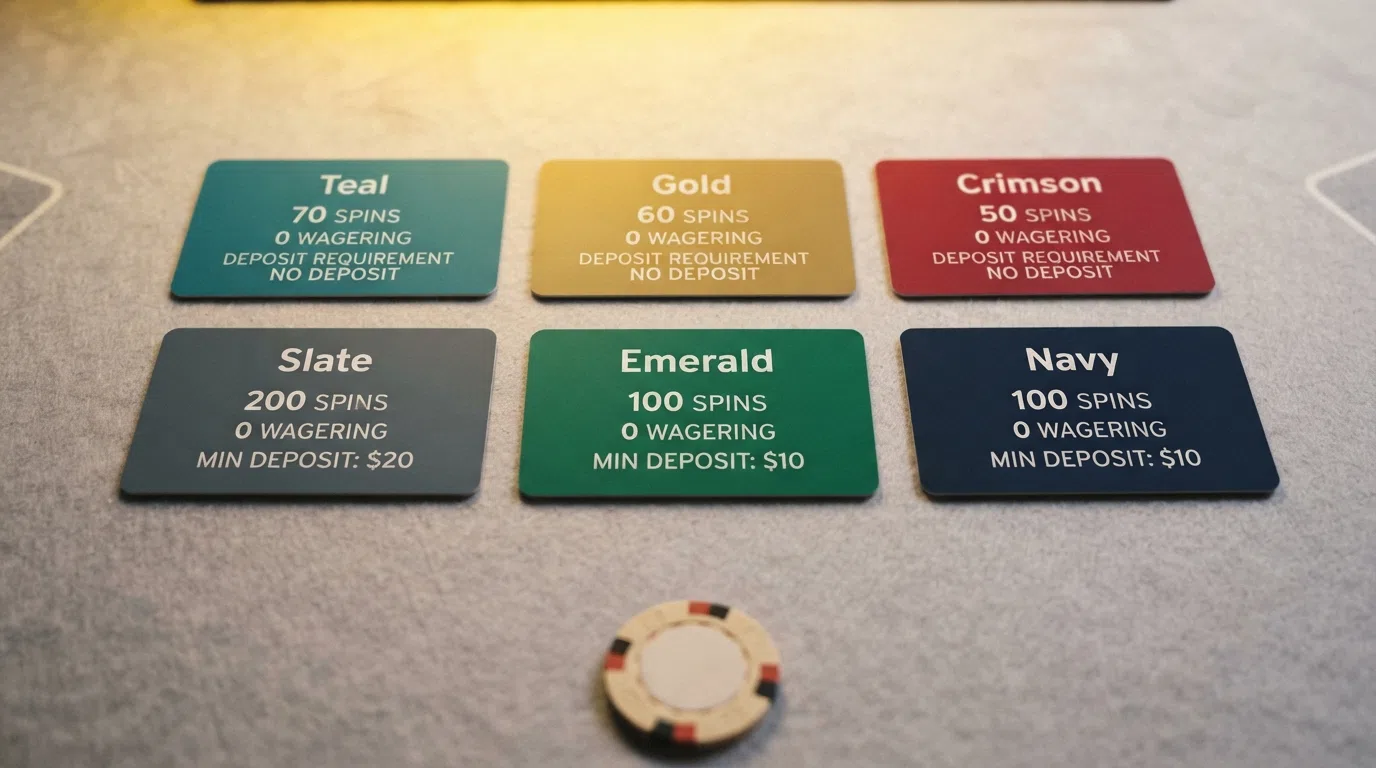
The split reflects ownership patterns as much as it reflects offer design. The no-deposit tier is dominated by Flutter Entertainment — Sky Vegas, Paddy Power and Betfair are all Flutter brands. Flutter’s no-deposit free-spin model is built around registration-led player acquisition, and the larger headline counts (50, 60, 70 spins) reflect a marketing strategy that rewards sign-up rather than deposit. The deposit-triggered tier is split between Entain (Ladbrokes, Coral), the Gamesys brands under Bally’s Corporation (JackpotJoy, Virgin Games), Bally Casino itself, the independent MrQ and 888casino. Entain’s deposit-triggered model is built around larger spin batches (100, 200) at £0.10 per spin, with the £10 deposit-and-stake structure as the entry point.
What separates a strong offer from a weak one in either tier is the same set of variables: the wagering multiplier, the spin value, the eligible slot’s RTP, the validity window, and whether the offer is no-deposit or deposit-triggered. The criteria do not change between the tiers; what changes is how the variables are configured.
Within the no-deposit tier, 0× wagering is the baseline. All three Flutter brands credit no-deposit spins at 0× wagering with a 7-day validity. The differentiation is in spin count (70, 60, 50), eligible-slot breadth (11 games, 12 slots, Jackpot King games) and brand. The reader who has a Flutter account already will find the offers broadly interchangeable; the reader who does not is choosing on brand familiarity and eligible-slot preference.
Within the deposit-triggered tier, 0× wagering is also the baseline. Eight of the ten operators run 0×. The differentiation is in spin count (30, 100, 200), spin value (mostly £0.10, with Bally, JackpotJoy and Virgin at £0.01 coin size / £0.10 total bet), eligible slot (single-title offers like Bally, multi-slot offers like Ladbrokes and Coral), validity (7 days at Entain, 30 days at Gamesys and Bally) and the deposit-and-stake mechanics.
No-deposit 30 free spins — the operators that ask for nothing upfront
The no-deposit tier has three pure entries, all operated by Flutter Entertainment. Sky Vegas leads on spin count at 70 no-deposit free spins, credited at 0× wagering, £0.10 per spin, valid for 7 days, on 11 eligible games including Eye of Horus and Fishin’ Frenzy. Paddy Power Games follows at 60 no-deposit free spins, also at 0× wagering, £0.10 per spin, 7-day validity, on 12 eligible slots plus Paddy’s Mansion Heist. Betfair completes the Flutter set at 50 no-deposit free spins, at 0× wagering, £0.10 per spin, 7-day validity, locked to selected Jackpot King games; Betfair operates under GB licence 39439.
The three offers are structurally close. The wagering is 0× across all three. The spin value is £0.10 across all three. The validity is 7 days across all three. What separates them is the eligible-slot list and the brand. Sky Vegas’s 11-game list gives the player the most choice and the broadest coverage of the popular UK free-spin slots. Paddy Power’s 12-slot list is similar, with the addition of Paddy’s Mansion Heist as a Flutter in-house title. Betfair’s Jackpot King restriction is the narrowest of the three and locks the spins to a specific slot family.
For the reader who is choosing between the three, the spin count is the headline number but the eligible-slot list is the real differentiator. 70 spins on 11 games is a different offer from 50 spins on one slot family, because the player gets to choose which slot to use the spins on. Where the eligible-slot list overlaps, the brand familiarity and the deposit-triggered follow-on offer (200 more spins at Sky Vegas, 200 more at Paddy Power, 100 more at Betfair) are the tiebreakers.
Deposit-triggered 30+ free spins — the £10 gateway to zero-wagering value
The deposit-triggered tier is where the larger spin batches live. Coral Casino leads on headline spin count at 200 free spins, credited at 0× wagering after a £10 deposit and £10 spend, valid for 7 days, on selected slots. Virgin Games and Ladbrokes both offer 100 free spins: Virgin on Big Bass Splash (0× wagering, 30-day validity, £10 deposit and wager); Ladbrokes on selected games that rotate (0× wagering, 7-day validity, £10 deposit and stake). JackpotJoy offers a player choice between 30 free spins on Double Bubble and 100 free spins on Fishin’ Frenzy The Big Catch 2 (0× wagering, 30-day validity, £10 deposit and wager). Bally Casino runs 30 free spins exclusively on Eye of Horus Legacy of Gold (0× wagering, 30-day validity, £10 deposit and wager, £0.01 coin size / £0.10 total bet). MrQ runs 30 instant cash spins on Big Bass Splash (0× wagering, £10 deposit).
The £10 deposit-and-stake structure is the gate. A £10 deposit alone is not enough to unlock the spins at Bally, JackpotJoy, Virgin or Ladbrokes — the player must also wager £10 on eligible slots. The £10 wager is typically played through on a single slot session; it does not require the player to win or to clear any bonus terms. Once the wager is logged, the free spins credit.
For the reader looking at this tier, the comparison is on three axes. The first is the spin count: 30, 100 or 200 free spins. The second is the eligible slot: a single title (Bally, Virgin, MrQ) is more restrictive than a rotating list (Ladbrokes, Coral) or a player-choice (JackpotJoy). The third is the validity: 7 days at the Entain brands (Coral, Ladbrokes) versus 30 days at the Gamesys brands and Bally. A player who cannot complete the wager and use the spins within 7 days is better served by a 30-day validity offer even at a lower spin count; the expired spins return nothing.
The wagering holdout — 888casino and the 10× cap
888casino is the only featured operator running at the maximum-permitted 10× wagering. The welcome offer is a 100% deposit bonus up to £100 on selected slots, with the player required to stake the deposit within 48 hours of claiming, the bonus subject to 10× wagering, and winnings from the bonus capped at £100. A separate 50 no-deposit free-spin batch is reported via the sign-up route, with its own terms: the spins must be claimed within 48 hours, are valid for 3 days, and carry wagering requirements. The deposit bonus offer is valid until 31 March 2026.
The 10× wagering on 888casino’s deposit bonus is the maximum permitted under LCCP SR Code 5.1.1 from 19 January 2026. Compared with the pre-cap market, 10× is materially better than the 35×–60× offers that were standard before the change. Compared with the 0× offers at the other nine featured operators, 10× is materially worse: a £100 deposit bonus at 10× wagering requires £1,000 of slot play to clear, and at a 96% RTP the expected house edge on that playthrough is about £40. The £100 winnings cap means the maximum cashout from the bonus is £100; if the bonus wallet grows above £100 during playthrough, the excess is forfeited.
For the reader choosing between 888casino and a 0× wagering competitor, the comparison hinges on what the player values. 888casino’s offer is a deposit match — the player gets bonus funds to play with — whereas the 0× offers are free spins — the player gets spins rather than funds. A player who wants the freedom to choose their own slot and stake size is better served by a deposit match, even at 10× wagering. A player who wants a known value (a fixed spin batch at a fixed spin value on a fixed slot) is better served by a free-spin welcome. The two are different products, and the comparison is on the player’s preference rather than on a single value metric.
Claiming 30 free spins on mobile — convenience without compromise
Mobile claiming is the norm at UK-licensed casinos. Every operator on this page runs a mobile-optimised site, and most run dedicated iOS and Android apps. The Commission’s Remote Technical Standards apply equally to mobile and desktop — there is no mobile carve-out in the LCCP or RTS framework, and an offer published on desktop is the same offer published on mobile.
The claim flow on mobile is the same as on desktop. Registration, identity verification, bonus acceptance, deposit and stake where required, and the spins credit. The mobile interface differs from the desktop interface in navigation and layout; the regulatory mechanics do not. A player claiming 30 free spins on a phone is going through the same five steps as a player claiming on a laptop.
The mobile browser vs dedicated app distinction is one of convenience rather than access. A dedicated app can deliver push notifications for new promotions, can store login credentials securely, and can integrate with mobile-specific payment flows (Apple Pay, Google Pay at operators that support them). The browser experience delivers the same offer without the app, and the player’s account state is the same in either environment. No featured operator restricts its free-spin offer to app-only; the offer is available regardless of the channel.
Mobile-exclusive free-spin promotions are uncommon in the UK market. The Commission’s advertising rules — the CAP Code for non-broadcast advertising, the BCAP Code for broadcast — require that all material terms be clear and prominent, and any channel-specific promotion must be disclosed as such. A genuine mobile-exclusive free-spin offer exists at some UK operators but is not part of the welcome offer set on this page. A reader who sees an offer labelled “mobile exclusive” should read the small print to confirm the restriction is genuine rather than a marketing framing of an offer available on all channels.
Mobile-exclusive free spins — rare in the UK, but worth checking
Mobile-exclusive free-spin promotions exist at some UK-licensed operators but are not part of the welcome offer set on this page. The Commission’s position under the CAP and BCAP codes is that channel-specific terms must be disclosed prominently; a promotion that is in fact available on all channels but labelled “mobile exclusive” would be an advertising standards matter, not just a bonus term.
The reason mobile-exclusive free-spin offers are uncommon in the UK is that the regulatory floor is the same across channels. Auto-play is banned on mobile as it is on desktop. Spin speed is bounded by the 2.5-second RTS minimum on both. Identity verification is required before any gambling on both. The offer does not differ in any variable the player cares about, and the operator has no structural incentive to limit the offer to one channel.
A reader who spots a “mobile exclusive” label on a free-spin offer should read the terms to confirm the restriction is genuine. If the offer is available on desktop as well, the label is a marketing framing rather than a binding restriction. If the offer is genuinely mobile-only, the operator will state which app or which mobile-browser flow unlocks it.
New UK casinos with 30 free spins — fresh brands, same rules
Newly launched UK-licensed casinos often use free-spin welcome offers to build a player base. The same regulatory framework applies regardless of the operator’s launch date: the 10× wagering cap from 19 January 2026, the mixed-product promotional ban from the same date, the direct marketing opt-in rules from 1 May 2025, the GAMSTOP requirement, the credit card ban, the identity verification requirement. A new UK-licensed casino is operating under the same LCCP and RTS framework as an established one, and the bonus terms reflect that.
The verification path for a new casino is the same as for an established one: the UK Gambling Commission public register. Any operator licensed to serve GB customers must appear on the register; the register lists the licence holder, the licence number, the licence type and the licence status. A reader who is considering claiming a free-spin offer at a new casino should check the register before registering, regardless of how the offer is marketed.
Whether new casinos offer better free-spin terms than established operators is a market-specific question, and the answer on this page is that the established operators currently lead on the no-deposit tier. Sky Vegas, Paddy Power and Betfair — all established — offer the largest no-deposit free-spin batches (70, 60 and 50 spins respectively). The newer entrants — Bally Casino, MrQ — compete on the deposit-triggered tier with smaller batches (30 spins) but with the same 0× wagering structure. The market dynamic is that incumbents with large player-acquisition budgets run the larger no-deposit offers, and newer entrants differentiate on the wagering structure (zero-wagering is now the differentiator at the new end of the market) rather than on the headline spin count.
The legal framework behind every 30-free-spin offer you claim
Every 30-free-spin offer at a UK-licensed casino sits inside a regulatory framework that the reader rarely sees but that determines what the offer can and cannot do. The framework has three layers: the statute, the regulator and the codes of practice.
The statute is the Gambling Act 2005, extended to remote operators by the Gambling (Licensing and Advertising) Act 2014. The 2014 Act introduced point-of-consumption reform: any operator serving GB customers must hold a GB licence, regardless of where the operator is based. Operating without a GB licence is a criminal offence under section 33 of the Gambling Act 2005, carrying up to 51 weeks’ imprisonment, an unlimited fine, or both.
The regulator is the UK Gambling Commission (UKGC), an executive non-departmental public body sponsored by the Department for Culture, Media and Sport. The Commission licenses operators, personnel and software, and it publishes a public register of licence holders. Three licensing objectives sit under section 1 of the Act: preventing crime, ensuring fair and open gambling, and protecting children and vulnerable persons. Day-to-day obligations sit in the LCCP (Licence Conditions and Codes of Practice) and the RTS (Remote Technical Standards).
A UKGC licence means, for the player claiming free spins, that identity verification is mandatory before first deposit or any gambling, that the operator’s funds are segregated under the LCCP, that disputes can be escalated to an alternative dispute resolution (ADR) provider, and that GAMSTOP self-exclusion applies. The public register is the only reliable way to confirm an operator’s licence status; an offer marketed by an operator not on the register is not a regulated UK offer.
How UK regulation shapes bonus terms — the January 2026 changes
The 19 January 2026 changes to the LCCP rewrote the UK bonus landscape. Two changes are directly relevant to free-spin offers, and a third change from May 2025 shapes how the offers are marketed.
The first change is the 10× wagering cap under LCCP SR Code 5.1.1. The Commission capped wagering requirements on all casino bonuses at 10× the bonus amount, replacing the pre-2026 market where 35×–60× was standard. The Commission’s published rationale: “Capping the wagering requirement to ten decreases the likelihood of harm, reduces complexity, and improves transparency while maintaining consumer choice.” The cap applies to every casino bonus at every GB-licensed operator. There is no carve-out for free spins specifically; the cap applies to the bonus the free spins generate.
The second change is the mixed-product promotional ban under LCCP SR Code 5.1.1(3b). A promotional offer can no longer combine more than one type of gambling product — a single bonus cannot bundle sports betting with casino play, or casino with bingo, in one offer. The rule applies to the offer structure rather than to the wagering; it is about what the operator can assemble in a single welcome package rather than what the player can be charged to clear it. The free-spin market is not directly affected because free spins are a single-product offer by design (slots only), but the rule reshapes how welcome packages at hybrid operators are structured.
The third change — from 1 May 2025, under LCCP SR Code 5.1.12 — is the direct marketing opt-in rule. Direct marketing to GB customers is now opt-in on a per-product and per-channel basis. A player who has opted in to “casino bonus offers via email” has not necessarily opted in to “casino bonus offers via SMS”; the consents are separate. The rule changes how operators acquire players through marketing, and it is the reason promo codes have become rarer on free-spin offers.
What the Commission did not cap is as important as what it did. There is no statutory ceiling on the headline bonus amount — the Commission does not limit the number of free spins an operator can offer, the size of a deposit match, or the spin value. There is no statutory cap on maximum cashout from bonus winnings — 888casino’s £100 cap is permitted because the cap is operator-set, not regulator-set. The Commission regulates the wagering, the bonus structure and the marketing; it does not regulate the headline number.
Player protections when claiming free spins — what the law gives you
UK regulation builds in player protections that apply from the moment a player registers for a free-spin offer. Five protections are directly relevant.
Mandatory identity verification. Every GB-licensed operator must verify the player’s name, address and date of birth before the first deposit or any gambling. The verification is part of the Money Laundering Regulations framework. A player who cannot pass verification cannot deposit, cannot gamble and cannot claim a free-spin offer. The verification is not optional.
Credit card ban. Credit cards have been banned for all remote gambling payments since 14 April 2020 under LCCP licence condition 6.1.2. The ban extends to credit-card-funded e-wallet payments. A player attempting to deposit with a credit card, or to fund an e-wallet with a credit card and then deposit from the e-wallet, will be declined. Debit cards and pre-funded e-wallets are the standard payment routes.
GAMSTOP self-exclusion. GAMSTOP is mandatory on every GB online operating licence since 31 March 2020. Exclusion periods are six months, one year, five years, or five years with auto-renewal. A self-exclusion cannot be cancelled early. A player who has registered with GAMSTOP cannot register at any GB-licensed casino for the duration of the exclusion; the operator’s registration flow checks GAMSTOP at the verification step.
Financial vulnerability check. Under LCCP SR Code 3.4.4, most remote licensees must run a light-touch check using publicly available data when a customer’s net deposits exceed £150 in a rolling 30-day period (the £150 figure took effect on 28 February 2025). The check looks at bankruptcy, county court judgments, individual voluntary arrangements and debt relief orders. A £10 deposit to unlock free spins sits well below the threshold; the check does not engage.
Statutory levy. From 6 April 2025, a statutory levy on operators replaced voluntary contributions under the Gambling Levy Regulations 2025. The top rate is 1.1% of gross gambling yield for remote casino, remote bingo and remote general betting licences. The proceeds are split 50% to treatment, 30% to prevention and 20% to research. The levy funds the safer-gambling infrastructure described in the next section.
Free spins and safer play — the tools every UK player should know
Free spins are low-stakes by design — the spin value is £0.01 to £0.10 and the batch is small — but the safer-gambling framework applies from the first spin. The prevalence of gambling harm in the UK is the reason the framework exists.
GambleAware’s Annual Treatment and Support Survey 2024 found that 13.1% of adults who gamble — approximately 6.8 million GB adults — were classified as experiencing any level of gambling problems (PGSI 1+), up from 13% in 2023. The NHS Adult Psychiatric Morbidity Survey 2023–24 found 0.4% of adults experienced problem gambling (PGSI 8+) and 1.6% experienced at least moderate risk gambling (PGSI 3+). GamCare reported 996 referrals to treatment and peer-based support services in January 2026, a 48% increase from January 2025 and a record monthly figure.
The safer-gambling infrastructure that the statutory levy funds has measurable reach. In 2024/25, 11,960 clients were treated through the National Gambling Treatment Service — an 11% year-on-year increase. Of clients completing treatment, 93% saw improvement. One quarter of clients said their problem gambling started by age 18. The figures sit behind the safer-gambling tools that every GB-licensed casino is required to make available.
The mandatory tools on every GB-licensed casino site are deposit limits, reality checks, time-outs and self-exclusion. Deposit limits: from 31 October 2025, operators must prompt customers to set a financial limit before their first deposit. Reality checks: pop-up reminders at set intervals during play, governed by the RTS framework. Time-outs: short-term account suspension (24 hours to several weeks). Self-exclusion: via GAMSTOP (mandatory, multi-operator) or operator-level tools (single-operator, shorter periods).
Deposit limits, reality checks and time-outs — the built-in safeguards
Deposit limits are the most-used tool. A player sets a daily, weekly or monthly cap on the amount they can deposit; the operator enforces the cap at the payment step. From 31 October 2025, the operator must prompt the player to set a limit before the first deposit; the prompt is a mandatory step in the registration flow, not a buried setting. From 30 September 2026, only a gross deposit limit — based solely on money paid in, not net of withdrawals — may be called a “deposit limit” (RTS 12). The terminology change is regulatory: a limit that allows the player to deposit more by withdrawing less is not a deposit limit.
Reality checks are pop-up reminders that appear during play. The interval is set by the player (typically 30 minutes to 2 hours) or by the operator’s default. The pop-up shows session duration and net position; the player can acknowledge and continue or end the session. Auto-play is banned, so the player is present at the spin button when the reality check fires; the pop-up is a visible event rather than a background notification.
Time-outs are short-term self-exclusion at the operator level. A player can time out for 24 hours, 48 hours, a week or any interval the operator supports. During the time-out, the player cannot log in, cannot deposit and cannot gamble. The operator-level time-out is independent of GAMSTOP; a player can time out at one operator without affecting any other.
Self-exclusion via GAMSTOP is the longer-period option. Six months, one year, five years, or five years with auto-renewal. GAMSTOP is mandatory on every GB online operating licence; the operator’s registration flow checks GAMSTOP at the verification step. A self-exclusion cannot be cancelled early; the player who has registered must wait out the period or wait out the five-year auto-renewal cycle. GAMSTOP does not reach unlicensed sites; the protection is bounded by the GB licensing framework.
Where to get help — the UK gambling-support network
The UK gambling-support network is publicly funded and free at the point of use. A player who is concerned about their own gambling or someone else’s can reach the following services:
- GamCare National Gambling Helpline. The primary UK helpline for gambling-related harm. Freephone, 24 hours a day. GamCare also runs the National Gambling Treatment Service, which handled 11,960 clients in 2024/25 with a 93% improvement rate among those completing treatment.
- NHS gambling harm clinics. NHS-funded specialist treatment in England, Scotland and Wales. Referral is via GP or self-referral; the clinics are part of the NHS and are free at the point of use. The NHS Adult Psychiatric Morbidity Survey 2023–24 is the data source behind the clinical case mix.
- GambleAware. Commissions treatment and research. The Annual Treatment and Support Survey is the primary data source on gambling harm prevalence in GB.
- Gamblers Anonymous UK. Peer support, modelled on the 12-step programme. Free to attend; meetings are held in person and online.
The statutory levy funds the system. From 6 April 2025, the Gambling Levy Regulations 2025 require operators to contribute 1.1% of gross gambling yield for remote casino, remote bingo and remote general betting licences, with proceeds split 50% to treatment, 30% to prevention and 20% to research. The levy replaced voluntary contributions and is the structural funding mechanism behind the helpline, the clinics and the research base.
How we selected and ranked these 30-free-spin casinos
The ten operators on this page were selected against a defined methodology. Every operator is verified against the UK Gambling Commission public register for an active remote casino licence; the register entry, the licence number and the licence type were checked for each operator at the time of writing. Every operator’s current welcome offer was verified against the operator’s own published terms on its website. The fact set was drawn from those published terms rather than from third-party listings, because the published terms are the binding contract and the third-party listings are summaries that can lag.
The ranking criteria, in order of weight: wagering multiplier on free-spin winnings (0× is the strongest position; 10× is the maximum permitted and is the weakest position in this market), no-deposit vs deposit-triggered status (no-deposit is the stronger offer because it requires no payment instrument), spin value (£0.10 is the higher position; £0.01 with multi-line activation at £0.10 total bet is equivalent), eligible-slot RTP (higher is stronger; Big Bass Splash at 96.71% is the strongest position in the featured slot set), bonus validity (30 days is the stronger position; 7 days is the standard), and eligible-slot breadth (11–12 games is the stronger position; a single-title offer is the most restrictive). The criteria are not weighted equally in practice; the no-deposit / wagering / spin-value cluster carries more weight than the validity / eligible-slot-breadth cluster because the former shapes what the offer is worth and the latter shapes how convenient the offer is to use.
The sources used: the UK Gambling Commission’s public register and published LCCP and RTS documents for the regulatory framework; the operators’ own websites for the welcome offer terms; the Commission’s news article on the 19 January 2026 changes for the wagering cap rationale; GamCare, GambleAware and NHS England for the safer-gambling data; and HMRC’s Autumn Budget 2025 for the Remote Gaming Duty rate. No operator paid for placement on this page; the ranking reflects the terms, not a commercial arrangement.
Making your 30 free spins count
Three terms determine the real value of a 30-free-spin offer: the wagering multiplier, the spin value, and the eligible-slot RTP. The wagering multiplier is the dominant variable — a 0× offer on a £0.01 spin is a different offer from a 0× offer on a £0.10 spin, because the wagering is the same but the spin value is ten times higher. A 10× offer on a £3 win requires £30 of slot play to clear; at a 96% RTP, that costs about £1.20 in expected house edge, which is real but small.
The spin value is the second variable. A £0.01 spin on a 10-payline slot costs £0.10 per spin in total bet; a £0.01 spin on a single payline costs £0.01 per spin. The headline number is the spin count, but the value of the batch is the spin count multiplied by the per-spin total bet. A 30-spin batch at £0.10 per spin is a £3 batch; a 30-spin batch at £0.01 per spin is a £0.30 batch.
The eligible-slot RTP is the third variable. Big Bass Splash at 96.71% is the strongest position in the featured slot set; Starburst at 96.09% is the weakest. The gap is 0.62 percentage points, which on a £3 batch is about £0.019 in expected loss — small in absolute terms but large enough to matter when the player is comparing two otherwise identical offers.
The expiry window is the most overlooked term. A 7-day validity window requires the player to use the spins within a week of credit; a 30-day window allows the player to spread the spins across a month. The expired spins return nothing. A player who cannot complete the wager within the validity window is better served by a longer-window offer at a smaller spin count.
The UK regulatory floor beneath every offer means safety is not a differentiator between operators. GAMSTOP, identity verification, the credit card ban, the financial vulnerability check, the deposit limit prompt — these apply to every GB-licensed operator and are not features to compare on. The differentiator between operators is the offer itself: the wagering, the spin value, the eligible slot, the expiry, the cashout cap.
The reader’s action, distilled: check the UKGC public register to confirm the operator’s licence status; read the key terms (wagering, spin value, eligible slot, expiry, max cashout); claim the offer that fits the reader’s own play style rather than the offer with the biggest headline number.
What 30 free spins actually cost you — the maths
The expected loss on a 30-free-spin batch at 0× wagering is the house edge on the batch, calculated as total spins multiplied by the per-spin stake multiplied by (1 − RTP). On a 30-spin batch at £0.10 per spin on Big Bass Splash (96.71% RTP), the calculation is:
The calculation results in a total stake of £3.00 (30 × £0.10), a house edge of 3.29% (1 − 0.9671), and an expected loss of approximately 10p (£3.00 × 0.0329).
The £3.00 staked is paid for by the operator, not by the player. The expected loss of approximately 10p is the operator’s cost, not the player’s cost. On a 0× wagering offer, the player keeps whatever wins land in the cash balance, and the player does not pay for the spins.
Where the wagering is 10× — the maximum permitted under LCCP SR Code 5.1.1 from 19 January 2026 — the cost picture changes. A £3 win at 10× wagering requires £30 of slot play to clear. At the same 96.71% RTP, the expected loss on that £30 playthrough is £0.99 (approximately £1). The player’s net position on a £3 win at 10× wagering is therefore £3 − £1 = £2 in expected cash retained, against £3 in expected cash retained on a 0× offer. The 10× wagering costs the player approximately £1 on a £3 win at a 96.71% RTP slot — a real cost, but a small one relative to the £3 starting position.
The same calculation at a lower-RTP slot produces a higher expected loss. On Book of Dead at 96.21% RTP, the house edge is 3.79% and the expected loss on a £30 playthrough is £1.14. On Starburst at 96.09% RTP, the house edge is 3.91% and the expected loss is £1.17. The variation between slots is small in absolute terms — a few pence across the batch — but it is the variation that distinguishes the strongest eligible-slot position from the weakest.
The calculation is a statistical estimate: an average over many spins under the stated assumptions, not a guaranteed outcome for any individual player. A single 30-spin session on a high-volatility slot like Book of Dead or Big Bass Splash will most often return nothing or close to nothing; the value of the offer sits in the chance of a single large hit, not in a smooth expected return. The 10p expected loss on a £3 batch is the operator’s cost on average across many batches, not the player’s loss on any single batch.
Frequently asked questions
Can I really keep every penny I win from 30 no-deposit free spins?
Yes — provided the offer is at 0× wagering, which is the case at Sky Vegas, Paddy Power, Betfair and most other featured operators. The winnings land in your cash balance from the moment they spin and are withdrawable without further play. A 10× offer, like 888casino’s, requires you to wager the winnings ten times before they convert to cash; that is the difference between “keep what you win” and “wager what you win”.
What is the maximum cash I can actually withdraw from a 30-free-spin bonus?
Most featured operators do not state a cashout cap on free-spin winnings; what you win is what you withdraw, up to whatever the slot’s max win allows. 888casino caps its deposit-bonus winnings at £100, which is permitted under the LCCP because the cap is operator-set rather than regulator-set. Always read the bonus terms — a cashout cap on a wagered offer can erase most of the value of a lucky spin.
How long do 30 free spins stay valid before they expire?
Validity windows range from 3 days (888casino’s no-deposit spins) to 30 days (Bally, JackpotJoy, Virgin Games). The Flutter brands (Sky Vegas, Paddy Power, Betfair) and the Entain brands (Ladbrokes, Coral) run 7-day windows. Expired spins return nothing; the wager requirement to unlock them must also complete within the window at deposit-triggered offers. Check the terms before claiming — a 7-day window requires you to use the spins the same week.
Can existing players claim 30 free spins or are these offers new-customer only?
The welcome free-spin batches on this page are new-customer only — one per player per operator. Existing customers can claim free spins through reload offers, loyalty rewards and seasonal promotions, but these typically carry smaller batches and tighter terms. The Commission’s direct marketing opt-in rules from 1 May 2025 mean a free-spin promotion will only reach you through the channels you have specifically opted in to.
What happens if I try to cash out before meeting the wagering rules?
On a 0× offer, there are no wagering rules to meet — your winnings are cash from the moment they land and can be withdrawn immediately. On a 10× offer, withdrawing before the wagering is complete forfeits the bonus balance and any winnings tied to it. Reverse withdrawals are permanently banned under the RTS framework; once you request a withdrawal, the funds leave your casino balance and cannot be returned to play with.
Do free-spin winnings arrive as bonus funds or real withdrawable cash from the start?
It depends on the wagering multiplier. On the nine 0× wagering offers on this page, winnings arrive as real withdrawable cash from the moment they land. On the 10× offer at 888casino, winnings arrive as bonus funds that must be wagered ten times before they convert to cash. The distinction is the single most important variable in the bonus terms — it is the difference between a £3 win you can withdraw today and a £3 win that requires £30 of slot play to clear.
Promo codes and bonus codes — do you need one for 30 free spins?
The majority of UK free-spin offers do not require a code. Eight of the ten operators on this page credit the bonus automatically on registration or on completion of the deposit-and-stake step. The reader registers, accepts the bonus (where acceptance is required), completes identity verification, deposits where required, and the spins credit without a code entry.
Where a promo code does exist, its role is the same as it has been since the Commission tightened direct marketing rules from 1 May 2025 under LCCP Social Responsibility Code 5.1.12: direct marketing is opt-in, per product and per channel. A code issued through a marketing email, an affiliate page or an SMS is no longer the mechanism by which the operator acquires the player; it is a tracking artefact that lets the operator attribute the acquisition to a specific channel. The reader who has a code enters it at registration or at deposit. The reader who does not has one will be looked after by the operator’s auto-credit flow.
The marketing rule change matters because it removed one of the historic reasons a code existed. Before 1 May 2025, an operator could market a bonus via SMS to a player who had opted in to “casino offers” generally, and a code let the operator link the resulting claim to that SMS. Under the new per-product, per-channel opt-in rule, the player must opt in to “casino bonus offers via SMS” specifically. The code is no longer the only place where the consent lives; the consent lives in the marketing preferences, and the code is, where it exists at all, a routing tag.
Casino apps and 30 free spins — does the app change the offer?
The casino app delivers the same bonus as the browser. The Flutter brands (Sky Vegas, Paddy Power, Betfair) all run dedicated iOS and Android apps. The Entain brands (Ladbrokes, Coral) also run apps. Bally Casino, MrQ and 888casino all run apps. The apps are functionally equivalent to the mobile browser for the purposes of claiming a free-spin offer.
The primary app advantage is push notifications. A player who has the app installed and has opted in to push notifications for promotions will receive a notification when a new free-spin offer is credited. A player on the browser will not receive that notification unless they have separately opted in to email or SMS marketing under the per-product, per-channel opt-in rule that took effect on 1 May 2025 under LCCP SR Code 5.1.12.
The secondary advantage is login state. An app keeps the player logged in across sessions; a browser session may time out and require re-authentication. For a free-spin offer with a 3-day validity window (888casino’s no-deposit spins), the app reduces the risk of the session timing out before the spins are used. For offers with longer validity windows, the practical impact is smaller.
New-casino no-deposit 30 free spins — do new brands offer the best deals?
New UK-licensed casinos do not currently offer the largest no-deposit free-spin batches. The 70, 60 and 50 no-deposit batches at Sky Vegas, Paddy Power and Betfair sit at the top of the no-deposit tier, and all three are established brands. Newer entrants tend to compete on the deposit-triggered tier, where the £10 deposit-and-stake mechanic is the entry point and the differentiation is on wagering structure (zero-wagering is now the baseline) and eligible slot (single-title offers at new entrants, multi-slot lists at established ones).
The Bally/MrQ model — newer UK entrants using wager-free spins to differentiate — is the pattern the new-casino end of the market follows. A new casino launching in 2026 competes on the structural quality of the offer (0× wagering, no cashout cap, a high-RTP eligible slot) rather than on the headline spin count, because the spin count is an established-operator advantage and a new entrant cannot match it without absorbing a margin it cannot sustain.
For the reader, this means the largest no-deposit free-spin offers sit at the established end of the market, and the most competitive deposit-triggered offers sit at the newer end. The two tiers serve different reader profiles: the no-deposit tier suits a reader who wants to register and play without committing funds; the deposit-triggered tier suits a reader who is willing to deposit £10 and is looking for the largest spin batch at 0× wagering.
Bonuses – fastestpayout-casinos-uk
Content created by the «fastestpayout-casinos-uk» team